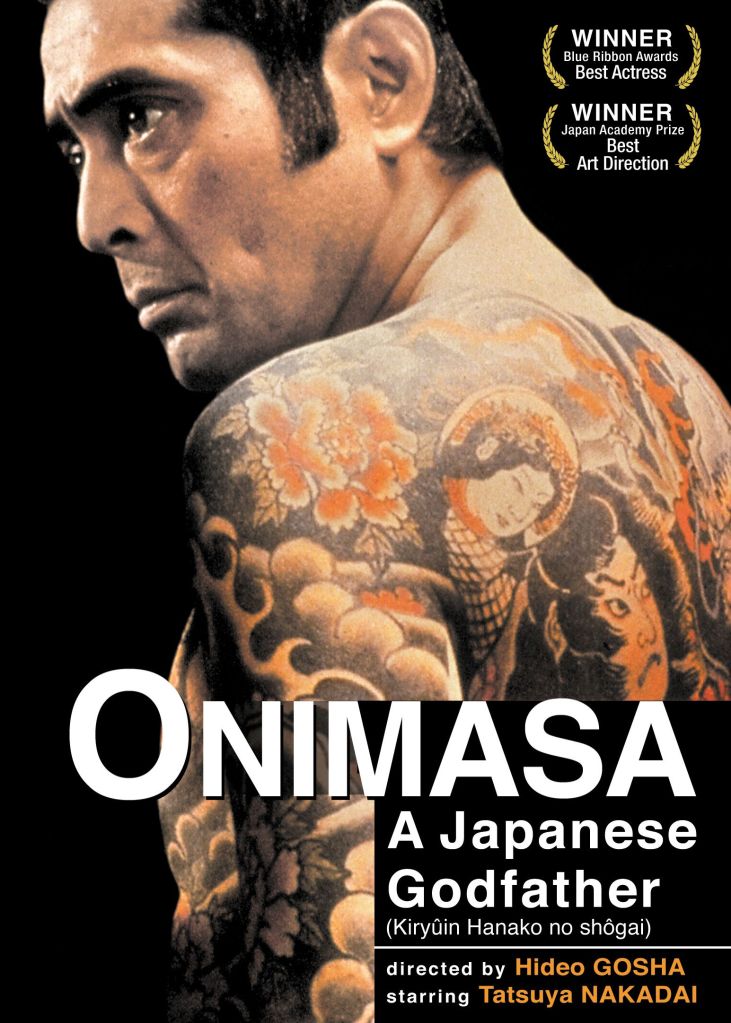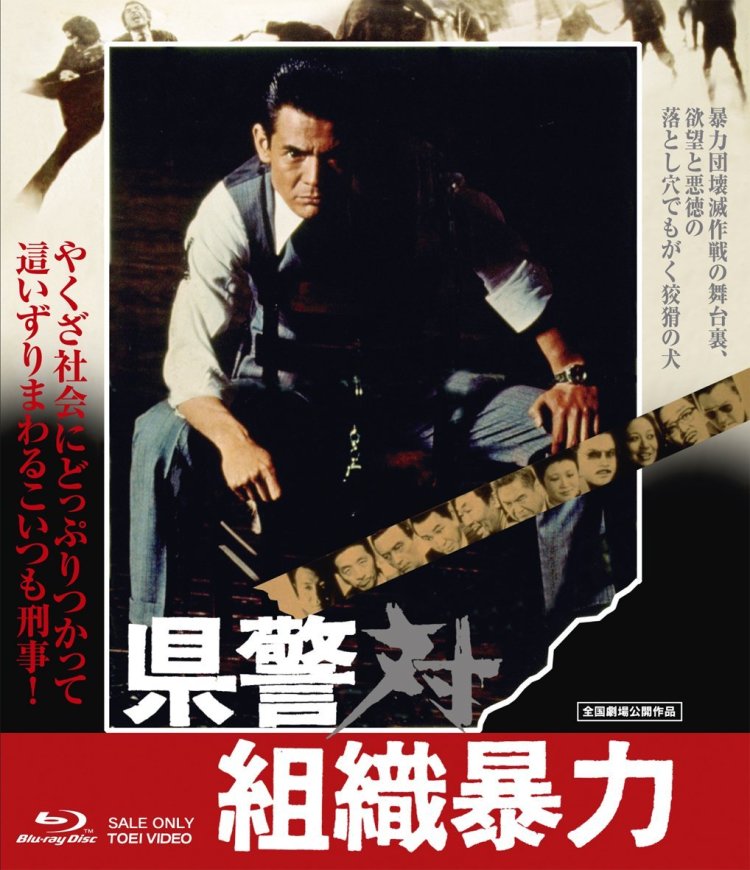
Onimasa (鬼龍院花子の生涯, Hideo Gosha, 1982)

onimasaWhen AnimEigo decided to release Hideo Gosha’s Taisho/Showa era yakuza epic Onimasa (鬼龍院花子の生涯, Kiryuin Hanako no Shogai), they opted to give it a marketable but ill advised tagline – A Japanese Godfather. Misleading and problematic as this is, the Japanese title Kiryuin Hanako no Shogai also has its own mysterious quality in that it means “The Life of Hanako Kiryuin” even though this, admittedly hugely important, character barely appears in the film. We follow instead her adopted older sister, Matsue (Masako Natsume), and her complicated relationship with our title character, Onimasa, a gang boss who doesn’t see himself as a yakuza but as a chivalrous man whose heart and duty often become incompatible. Reteaming with frequent star Tatsuya Nakadai, director Hideo Gosha gives up the fight a little, showing us how sad the “manly way” can be on one who finds himself outplayed by his times. Here, anticipating Gosha’s subsequent direction, it’s the women who survive – in large part because they have to, by virtue of being the only ones to see where they’re headed and act accordingly.
Beginning with its end, Onimasa’s story finishes with the discovery of the body of his only biological child, Hanako (Kaori Tagasugi ), in 1940. Found bled out and alone in the red light district of Kyoto, the suspected cause of death is a miscarriage. Tragically, our heroine, Matsue, arrives only a couple of hours too late after having spent years searching for her younger sister. We then skip back to 1918 when Matsue was adopted by Onimasa and his rather cool wife, alongside another boy who later ran away. An intelligent girl, Matsue earns her adopted father’s respect but neither he nor his wife, Uta (Shima Iwashita), are particularly interested in the emotional side of raising children. Things change when one of Onimasa’s mistresses gives birth to his biological child who awakens a sense of paternal interest in the ageing gangster beyond rule and possession.

Onimasa’s behaviour is frequently strange and contradictory. Originally intending to adopt only a boy, he and his wife come away from a poor family with two of their children, only for the son to run away home. Having picked her out like a puppy in a pet store window, Onimasa views Matsue as an inalienable possession. When a man arrives and wants to marry her, he goes crazy assuming the man must have been sleeping with her behind his back (despite the fact that this man, Tanabe (Eitaro Ozawa), has only just been released from prison where Onimasa had himself dispatched Matsue to visit him). Exclaiming that Matsue is “his”, has always been “his”, and no one else’s, he forces Tanabe to cut off his finger yakuza style to swear Matsue’s honour is still intact. However, this need for total control manifests itself in a less than fatherly way when he later tries to rape Matsue and is only brought to his senses when she threatens to cut her own throat with a broken glass. Despite this act of madness which he tries to justify with it somehow being for her own good, Matsue remains a dutiful daughter to both of her adopted parents.

Matsue’s innate refinement and reserve contrast’s strongly with Onimasa’s loose cannon nature. Commenting on the long history of “honourable” cinematic yakuza, Onimasa embraces an odd combination of traditions in believing himself to be the embodiment of chivalry – standing up for the oppressed and acting in the interests of justice, yet also subservient to his lord and walking with a swagger far beyond his true reach. All of this contributes to his ongoing problems which begin with a petty clan dispute over a dogfight which sees a rival leaving town in a hurry only to return and raise hell years later. Similarly, when his boss sends him in to “discourage” strike action, the union leader’s reasonable objections which point out the conflicts with Onimasa’s doctrine of chivalry and imply he’s little more than a lapdog, have a profound effect on his life. Severing his ties with his clan and attempting to go it alone, Onimasa does so in a more “honourable” way – no longer will he engage in harmful practices such as forced prostitution no matter how profitable they may be, but old disagreements never die easy and it’s a stupid ancient argument which threatens to bring his old fashioned world crashing down.

Despite concessions to the bold new Taisho era which saw Western fashions flooding into traditional culture from Onimasa’s trademark hat to the record players and whiskey glasses clashing with his sliding doors and tatami mat floors, Onimasa’s world is a childishly innocent one where honour and justice rule. Despite this he often excludes his own behaviour – one minute turning down the offer of his rival’s woman to pay a debt with her body, but later attempting to rape a young woman who had been his daughter in a drunken bid for a kind of droit du seigneur. The times are changing, it’s just that Onimasa’s traditionalist mind can’t see it. Tragically trying to rescue his daughter from a situation it turns out she had no desire to be rescued from he eventually spies the writing on the wall and puts down his sword, defeated and demoralised. Tragically, it seems Hanako may have needed him still though her rescue arrives too late to be of use.

The Onimasa family line ends here, as does this particular strand of history under the darkening skies of 1940. Out goes Taisho era openness and optimism for the eventual darkness of the militarist defeat. Matsue, now a widow – her left wing intellectual husband another victim of her father’s mistakes rather than political stringency, remains the sole source of light in her shining white kimono and pretty parasol even as she’s forced to identify the body of the sister she failed to save. The life of Hanako was a sad one, trapped by her father’s ideology and finally destroyed by her own attempts to escape it. Fittingly, she barely features in her own tale, a peripheral figure in someone else’s story. Slightly lurid and occasionally sleazy, Onimasa is another workmanlike effort from Gosha but makes the most of his essential themes as its accidental “hero” is forced to confront the fact that his core ideology has robbed him of true happiness, caused nothing but pain to the women in his life, and eventually brought down not only his personal legacy but that of everything that he had tried to build. The “manly way” is a trap, only Matsue with her patience backed up by a newfound steel inspired by her cool mother, Uta, is left behind but is now free to pursue life on her own terms and, presumably, make more of a success of it.


Original trailer (no subtitles, NSFW)

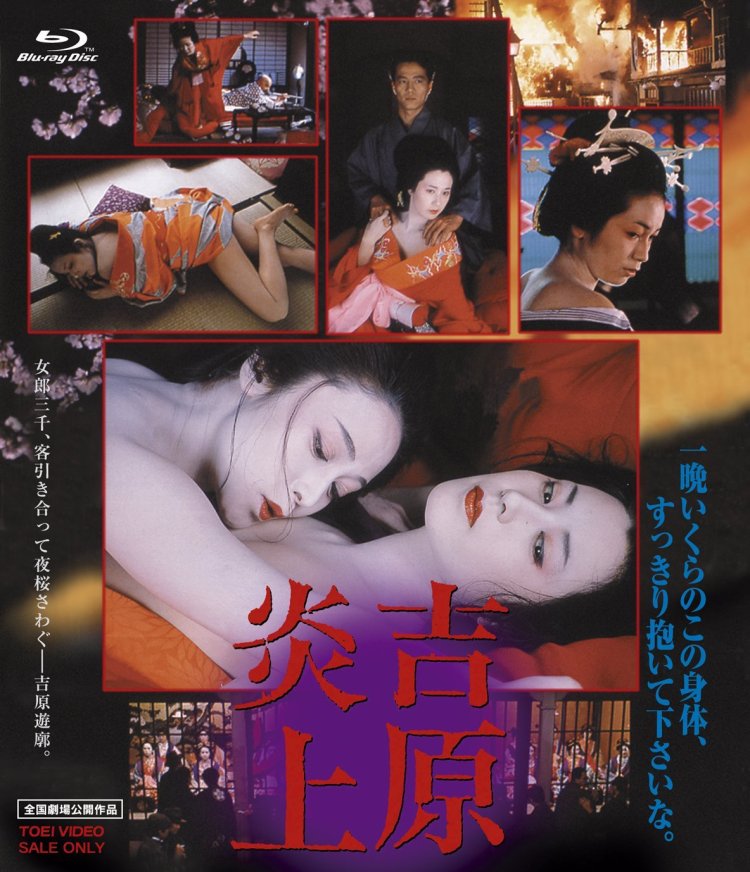
Tokyo Bordello (吉原炎上, Hideo Gosha, 1987)

yoshiwara-enjoHideo Gosha maybe best known for the “manly way” movies of his early career in which angry young men fought for honour and justice, but mostly just to to survive. Late into his career, Gosha decided to change tack for a while with a series of female orientated films either remaining within the familiar gangster genre as in Yakuza Wives, or shifting into world of the red light district as in Tokyo Bordello (吉原炎上, Yoshiwara Enjo). Presumably an attempt to get past the unfamiliarity of the Yoshiwara name, the film’s English title is perhaps a little more obviously salacious than the original Japanese which translates as Yoshiwara Conflagration and directly relates to the real life fire of 1911 in which 300 people were killed and much of the area razed to the ground. Gosha himself grew up not far from the location of the Yoshiwara as it existed in the mid-20th century where it was still a largely lower class area filled with cardsharps, yakuza, and, yes, prostitution (legal in Japan until 1958, outlawed in during the US occupation). The Yoshiwara of the late Meiji era was not so different as the women imprisoned there suffered at the hands of men, exploited by a cruelly misogynistic social system and often driven mad by internalised rage at their continued lack of agency.
Opening with a voice over narration from Kyoko Kishida, the film introduces us to the heroine, 19 year old Hisano (Yuko Natori), as she is unwillingly sold to the red light district in payment for her father’s debts. After a strange orientation ceremony from the Yoshiwara police force where one “kindly” officer explains to her about the necessity of faking orgasms to save her stamina, Hisano is taken to the brothel which is now her home to begin her training. Some months later when Hisano is due to serve her first customer, she runs from him in sheer panic, leaping into a lake where a young Salvation Army campaigner, Furushima (Jinpachi Nezu), tries and fails to help her escape.

Taken back to the brothel and tied up in punishment, Hisano receives a lesson in pleasure from the current head geisha, Kiku (Rino Katase), after which she appears to settle into her work, getting promoted through various ranks until she too becomes one of the top geisha in the area. Sometime later, Furushima reappears as a wealthy young man. Regretting his inability to save her at the river and apparently having given up on his Salvation Army activities, Furushima becomes Hisano’s number one patron even though he refuses to sleep with her. Though they eventually fall in love, Hisano’s position as a geisha continues to present a barrier between the pair, forcing them apart for very different reasons.

Despite having spent a small fortune accurately recreating the main street of the Yoshiwara immediately prior to the 1911 fire, Gosha is not interested in romanticising the the pleasure quarters but depicts them as what they were – a hellish prison for enslaved women. As Hisano and Furushima later reflect, the Yoshiwara is indeed all built on lies – a place which claims to offer freedom, love, and pleasure but offers only the shadow of each of these things in an elaborate fake pageantry built on female suffering. Hisano, like many of the other women, was sold to pay a debt. Others found themselves sucked in by a continuous circle of abuse and exploitation, but none of them are free to leave until the debt, and any interest, is paid. Two of Hisako’s compatriots find other ways out of the Yoshiwara, one by her own hand, and another driven mad through illness is left alone to die like an animal coughing up blood surrounded by bright red futons in a storage cupboard.

As Kiku is quick to point out, the Yoshiwara is covered in cherry blossoms in spring but there is no place here for a tree which no longer flowers. The career of the courtesan is a short one and there are only two routes forward – become a madam or marry a wealthy client. Kiku’s plans don’t work out the way she originally envisioned, trapping her firmly within the Yoshiwara long after she had hoped to escape. Hisano is tempted by a marriage proposal from a man she truly loves but finds herself turning it down for complicated reasons. Worried that her lover does not see her as a woman, she is determined to take part in the upcoming geisha parade to force him to see her as everything she is, but her desires are never fully understood and she risks her future happiness in a futile gesture of defiance.

Defiance is the true theme of the film as each of the women fight with themselves and each other to reclaim their own freedom and individuality even whilst imprisoned and exploited by unassailable forces. Hisano, as Kiku constantly reminds her (in contrast to herself), never accepts that she is “just another whore” and therefore is able to first conquer and then escape the Yoshiwara even if it’s through a second choice compromise solution (albeit one which might bring her a degree of ordinary happiness in later life). Land of lies, the Yoshiwara promises the myth of unbridled pleasure to men who willingly make women suffer for just that purpose, further playing into Gosha’s ongoing themes of insecurity and self loathing lying at the heart of all physical or emotional violence. Though the ending voiceover is overly optimistic about the climactic fire ending centuries of female oppression as the Yoshiwara burns, Hisano, at least, may at last be free from its legacy of shame even whilst she watches the object of her desire destroyed by its very own flames.


Oiran parade scene (dialogue free)

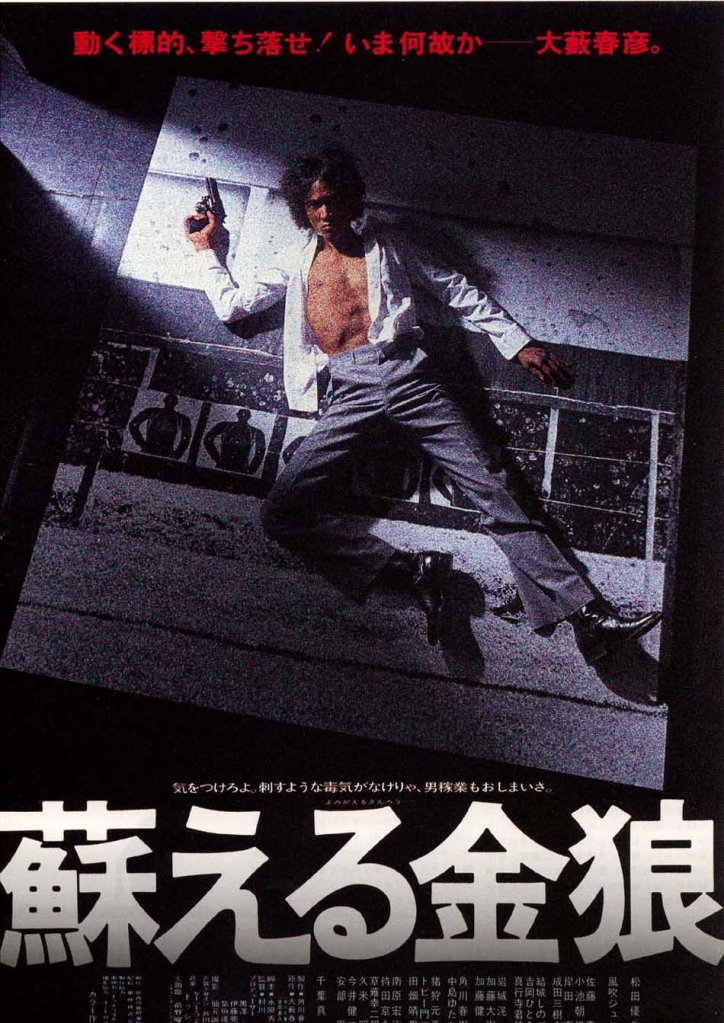
Resurrection of Golden Wolf (蘇る金狼, Toru Murakawa, 1979)

resurrection-golden-wolfYou know how it is. You work hard, make sacrifices and expect the system to reward you with advancement. The system, however, has its biases and none of them are in your favour. Watching the less well equipped leapfrog ahead by virtue of their privileges, it’s difficult not to lose heart. Asakura (Yusaku Matsuda), the (anti) hero of Toru Murakawa’s Resurrection of Golden Wolf (蘇る金狼, Yomigaeru Kinro), has had about all he can take of the dead end accountancy job he’s supposedly lucky to have despite his high school level education (even if it is topped up with night school qualifications). Resentful at the way the odds are always stacked against him, Asakura decides to take his revenge but quickly finds himself becoming embroiled in a series of ongoing corporate scandals.

Orchestrating a perfectly planned robbery on his own firm in which Asakura deprives his employers of a large amount money, he’s feeling kind of smug only to realise that the bank had a backup plan. The serial numbers of all of the missing money have been recorded meaning he can’t risk spending any of it. Accordingly he decides the “safest” thing to do is exchange the problematic currency for the equivalent in heroine. His plan doesn’t stop there, however. He also knows the big wigs at the top are engaged in a high level embezzlement scam and seduces his boss’ mistress, Kyoko (Jun Fubuki), for the inside track. Asakura is not the only game in town as another detective, Sakurai (Sonny Chiba), is blackmailing some of the other bosses over their extra-marital activities. Playing both sides off against each other, Asakura thinks he has the upper hand but just as he thinks he’s got what he wanted, he discovers perhaps there was something else he wanted more and it won’t wait for him any longer.

Based on a novel by hardboiled author Haruhiko Oyabu, Resurrection of Golden Wolf is another action vehicle for Matsuda at the height of his stardom. Re-teaming with Murakawa with whom he’d worked on some of his most famous roles including The Most Dangerous Game series, Matsuda begins to look beyond the tough guy in this socially conscious noir in which an angry young man rails against the system intent on penning him in. A mastermind genius, Asakura is leading a double life as a mild mannered accountancy clerk by day and violent punk by night, but he has every right to be angry. If his early speech to a colleague is to be believed, Asakura worked hard to get this job. A high school graduate with night school accreditation, he’s done well for himself, but despite his friend’s assurance that Asaukura is ahead in the promotion stakes he knows there’s a ceiling for someone with his background no matter how hard he works or how bright he is.

Under the terrible wig and unfashionable glasses he adopts for his work persona, Asakura has a mass of unruly, rebellious hair and a steely gaze hellbent on revenge against the hierarchical class system. He is not a good guy. Asakura’s tactics range from fisticuffs with street punks to molesting bar hostesses, date rape, and getting his (almost) girlfriend hooked on drugs as a means of control, not to mention the original cold blooded murder of the courier he stole the company’s money from in the first place. The fact he emerges as “hero” at all is only down to his refusal to accept the status quo and by his constant ability to stay one step ahead of everyone else. When the system itself is this corrupt, Asakura’s punkish rebellion begins to look attractive despite the unpleasantness of his actions.

Adding in surreal sequences where Asakura dances around his lair-like apartment in a quasi-religious ritual with his silver mask, plus bizarre editing choices, eerie music and incongruous flamenco, Murakawa’s neo-noir world is an increasingly odd one, even if not quite on the level of his next film, The Beast Must Die. Very much of its time and remaining within the upscale exploitation world, Resurrection of Golden Wolf is necessarily misogynistic as its female cast become merely pawns exchanged between men to express their own status. The tone remains hopelessly nihilistic as Asakura nears his goal of the appearance of a stereotypically successful life with an executive job and possible marriage to the boss’ daughter only to find his conviction wavering. Hopelessly bleak, dark, and sleazy, Resurrection of Golden Wolf is, nevertheless, a supreme exercise in style marrying Matsuda’s iconic image with innovative direction which is hard to beat even whilst swimming in some very murky waters.


Again, many variations on the English title but I’ve gone with Resurrection of Golden Wolf as that’s the one that appears on Kadokawa’s release of the 4K remaster blu-ray (Japanese subs only).

Original trailer (English subtitles)

https://www.youtube.com/watch?v=75mO5ysfwAc

Female Prisoner Scorpion: Beast Stable (女囚さそり けもの部屋, Shunya Ito, 1973)

beast-stableAt the end of Female Prisoner Scorpion: Jailhouse 41, Matsu – the “Scorpion” of the title, had enacted parts of her revenge but lost even more friends and allies along the way. Still filled with an intense rage, she wandered away from her imprisonment towards the dawn and a free, if uncertain, future. It’s here we find her at the beginning of Beast Stable (女囚さそり けもの部屋, Joshu Sasori – Kemono Beya) – a fugitive from justice, but a seemingly calm one. Until, that is, she is cornered.

Beginning in an extremely memorable opening sequence, the film zooms in on Matsu riding a subway train like any other young woman when she gets spotted by a couple of policemen who decide to try and take her in. Whipping out her knife from under her coat, Matsu slashes away but is almost caught when one of the policeman handcuffs her. She reacts to this situation in a typically direct way by simply hacking the policeman’s arm off and running away with it.

Hiding out in a graveyard and gnawing at her macabre bracelet in an attempt to get it off, Matsu strikes up an improbable friendship with prostitute Yuki (Yayoi Watanabe). Yuki is harbouring a dark secret in that she keeps her brain damaged brother locked up in a back room where she is forced to satisfy his sexual urges lest he attack other women.

While working as a seamstress, Matsu becomes more and more involved with the underworld and its collection of pimps and madams, each eager to profit from the weakness and misfortune of others. Eventually, after becoming too much of a problem, Matsu is locked up again – but this time inside the birdcage of a dangerous and eccentric yakuza mama-san, Katsu (Reisen Lee), with the corpse of a less fortunate victim on the other side of the bars. New names are about to appear on Matsu’s ever growing grudge list as the wrongs done to others begin to outweigh the pain of those enacted on herself.

Beast Stable differs from the first two films in the series as it mostly takes place in the “free” world until it reenters the prison environment for the final stretch. Matsu may be out of jail but she’ll never be truly free and her intense inner rage might give her away if it weren’t for her the fact her face is plastered all over the city adorning wanted posters in every conceivable location. With no particular target for her vengeful spirit, Matsu is in survival mode but her growing alliance with Yuki and the cruelty of the underground sex industry quickly awaken her old fire.

This time the big bad is another woman – a cruel madam, willing to protect her investment to the max. When she finds out one of her girls has been hiding a pregnancy, she insists on an abortion even though the baby is six months or so along. Kicking and screaming, the pregnant woman is subjected to a horrific procedure conducted by a drunken doctor which is neatly contrasted with another abortion which is carried out with a much higher level of medical care. Needless to say, Matsu cannot let this one go and makes another of her daring and mysterious escapes to enact her revenge. As she leaves, she’s become a fury of vengeance once again – her face pixelated by the surgery window, shaving her of her identity.

Though more grounded in reality than Jailhouse 41, Beast Stable is still selling the ballad of Matsu as she continues her trajectory into legendary heroine status. Always playing a long game, Matsu has the uncanny ability to escape from any holding pen save the one that burns inside her mind. Having satisfied her personal desire for revenge, Matsu moves on to the cruelties of the wider world and those that bully and misuse already vulnerable people. Her sense of greater responsibility grows as her humanity begins to return through her friendship with Yuki which eventually becomes a deep alliance between two equally trapped women.

At the end of the film we’re told that Matsu served her prison sentence and was released, but no one knows what happened to her after that. Her apotheosis is complete as she becomes the legend – a wandering heroine, meeting out justice in a cruel and indifferent world. Kaji continues to excel in her performance of the near silent Matsu, burning with rage and resentment in every scene. Beast Stable would be Ito’s final contribution to the series and acts as a suitable conclusion to the trilogy as Matsu finally becomes Scorpion in our imaginations and, strangely, our hearts.


Original trailer (English subtitles)

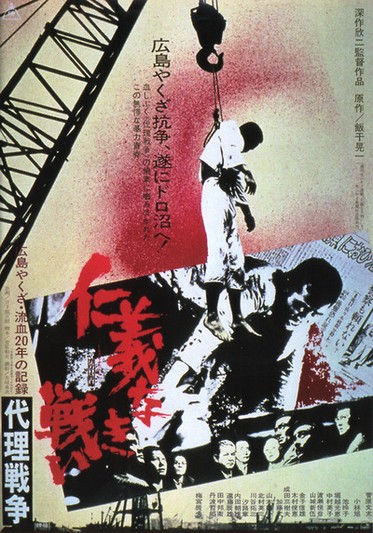
The Yakuza Papers Vol. 3: Proxy War (仁義なき戦い: 代理戦争, Kinji Fukasaku, 1973)

3-Battles-Without-Honor-and-Humanity-3-Proxy-WarThree films into The Yakuza Papers or Battles Without Honour and Humanity series, Fukasaku slackens the place slightly and brings us a little more intrigue and behind the scenes machinations rather than the wholesale carnage of the first two films. In Proxy War we move on in terms of time period and region following Shozo Hirono into the ’60s where he’s still a petty yakuza, but his fortunes have improved slightly.

It’s now 1960 – almost 15 years since Hirono came home from the war. The young people who are just coming of age grew up in the turbulent post-war era but probably don’t remember much of the conflict itself. These days the problem is the ANPO treaty and the wider world’s pre-occupation with communism. Russia and America are engaged in various “proxy wars” across the world in what would come to be known as the cold war. This tactic of indirect warfare has also taken root in the yakuza world as gangs and gang members form covert alliances, hatch secret plots to take out rivals, or otherwise try to manipulate the situation to their advantage. When the head of the Muraoka crime syndicate is assassinated in broad daylight and his underling, Uchimoto, does nothing, it kickstarts a chain of petty vendettas as each of the ambitious crime bosses vie to fill the power vacuum with the snivelling Uchimoto not least among them.

Bunta Sugawara returns to centre stage again with Hirono at the forefront of the action. One of the few yakuza guys who’s pretty happy with his lot and not seeking a higher position he’s in the perfect spot to become a very important player when it comes to supporting other people’s bids for power. Having originally backed Uchimoto he’s at something of a disadvantage following Uchimoto’s cowardly flip-flopping. However, having found himself back under the aegis of former boss Yorimoto, it does afford Hirono the possibility of finally getting revenge against him. Gangs merge several times while fracturing on the inside as the lower bosses try to get their guys in line whlst picking sides as to whom they support in the leadership battles (some with more of an eye on their own futures) but this time the action is a little more cerebral than the audacious violence of the immediate post-war period.

Changing up his style slightly, Fukasaku keeps the overall documentary approach with the news reel voice over relating the salient political and historical details plus the initial captions explaining the names and allegiances of the major players but reduces the freeze frame death announcements. The action is still frenetic with ultra naturalistic handheld camera and occasional strange angles but this time he opts for a muted colour effect in the final shoot out which increases the shocking nature of the scene. Blow for blow there’s less overt violence here though there is a fairly graphic and unpleasant rape scene which feels a little out of place though it does add to Fukasaku’s argument about the nature of aggression.

Once again the ruined the dome looms large over everything, reminding us that this isn’t just a story of gang warfare but a critique of the senselessness of a violent life. As the film says, young men are the first to die when the battles begin but their deaths are never honoured. Like Hiroshima Death Match, Proxy War also leads to the death of a youngster in pointless gang violence – another young man who ended up in the criminal underworld through lack of other options. The futility of the cycle of violence is becoming wearing – as is perhaps the point. One gang boss falls, another rises – only the names have changed. There’s no rest for an honest yakuza like Hirono when the less scrupulous are willing switch allegiance without a second thought. The only victory is staying alive as long as you can.


Proxy War is available on blu-ray in the UK as part of Arrow Video’s Battles Without Honour and Humanity: The Complete Collection box set.

The Yakuza Papers Vol. 2: Hiroshima Death Match (仁義なき戦い: 広島死闘篇, Kinji Fukasaku, 1973)

81ZkRgBFyyL._SL1378_If you thought the story was over when Hirono walked out on the funeral at the end of Battles Without Honour and Humanity think again – we’ve barely scraped the surface of the post-war Hiroshima criminal underworld chaos. The aptly named Hiroshima Death Match runs in parallel with the events of Battles Without Honour taking place in roughly the same time, 1950-1955, but features a new protagonist relegating Bunta Sugawara’s Hirono to the sidelines where he appears as a weary observer of the cruel yakuza world. This time our hero, Yamanaka, is younger – too young to have offered his life as a kamikaze in the war as he apparently wanted to, and is one of the thousands of young men who’ve found themselves alone and without futures thanks to both the after effects of World War II and the ongoing Korean War.

Hiroshima Death Match ties itself into Battles Without Honour and Humanity quite neatly when the protagonist, Shoji Yamanaka (Kinya Kitaoji), is sent to prison after taking a knife to a room full of guys who accused him of cheating in a gambling den. There he comes into contact with the first film’s hero, Hirono (Bunta Sugawara), who offers him some food whilst in solitary but then disappears for the vast bulk of the film. When he gets out, Shoji finds himself in trouble again when he can’t pay for his meal in a restaurant and offers to work off the bill. The waitress, Yasuko (Meiko Kaji), refuses and tells him to just forget about the money and leave when he’s done but Shoji is insulted by her “charity” and things kick off between him and a gang of yakuza also in the restaurant at the time. Yasuko turns out to be the widowed niece of a yakuza boss and after recovering in her care Shoji agrees to join the Muraoka gang to get revenge on the guys who beat him up.

Whereas Battles Without Honour and Humanity took as its protagonists the young men who’d returned from the war to a ruined and defeated country, Hiroshima Death Match focuses on the generation below who were too young to fight themselves but have still been marked by the after effects of the conflict. At the beginning of the film Shoji has nothing, he’s ashamed of cheating and gets upset when caught which only fuels his youthful and violent anger. He doesn’t seem to have any family to help him or honest work to go to and so, of course, he ends up a yakuza. Once again, the yakuza take the place of a traditional family offering both a place to belong and a degree of emotional and financial support – for a price.

When Shoji inevitably falls in love with Muraoka’s widowed niece, he discovers his surrogate father’s love is not quite unconditional. Yasuko has a young daughter and was married to a man who died a kamikaze war hero. Muraoka does not want her to remarry lest she shame her husband’s memory unless he keeps it in the family by marrying her off against her will to her huband’s brother. Shoji’s affair with Yasuko continues to cause a rift with Muraoka and he’s torn between a desire for a peaceful future with the woman he loves and loyalty to his gang boss to whom he owes so much. Muraoka’s own morals are shown to be far from the traditional yakuza ideals and he’s not above using Shoji’s strained loyalties to his own advantage eventually with tragic consequences.

Like Battles Without Honour and Humanity, Hiroshima Death Match is shot in the same quasi-documentary style with a weary sounding narrative voice over and frequent freeze frame captions identifying the characters along with their gangs and positions as well as their dates of demise at the appropriate time. The ruined Atomic Bomb Dome (now the Hiroshima Peace Memorial) continues to loom large over the proceedings as we’re reminded at the end that this isn’t the only blood that’s been shed here. Even more so than with Battles, Fukasaku rams home the senselessness and futility of violence. The film ends with Hirono attending another funeral (though this time in a black suit and melancholic air) where the bosses reap in consolation money and gamble at the wake. He gives his old bosses a sideways look as they laugh and joke while a young man who they all now account as some kind of legendary yakuza hero lies dead for no reason at all. What does this sort of life amount to in the end? The only reward for a life of violence is a lonely grave.


Hiroshima Death Match is available on blu-ray in the UK as part of Arrow Video’s Battles Without Honour and Humanity: The Complete Collection box set.