Phantom of the Toilet (トイレの花子さん, Joji Matsuoka, 1995)

A transfer student quickly becomes the magnet for the anxieties of her classmates amid an ongoing spate of serial murders of primary school children in Joji Matsuoka’s kids adventure movie Phantom in the Toilet (トイレの花子さん, Toiret no Hanako-san). Loosely inspired by the classic urban legend about the ghost of a little girl who haunts school toilets, the film is less a horror movie than a tale of bullying, mass hysteria, and the ways in which childish emotions can spiral out of control.

Natsumi’s (Ai Maeda) no stranger to that herself. A tomboy, she’s largely excluded from the group of popular girls at her school and exists in a rather liminal space. Her older brother Takuya (Takayuki Inoue) is in the year above, but predictably doesn’t like being bothered by his little sister at school and is for some reason embarrassed by the fact his widowed father is a milkman. Nevertheless, he’s incredibly earnest and righteous and volunteers for various things at the school like the student council. Natsumi’s problems begin when the popular girls insist on doing a Ouija board to find out the identity of a serial killer who’s already killed two children their age from different schools. Natsumi doesn’t realise that it’s a trick the other girls are playing on her, but the Ouija board says the killer is Hanako, the toilet ghost, and Natsumi is the next victim.

Meanwhile, a new girl joins their school in Takuya’s class and is immediately resented by the popular girls because she’s pretty and clever, so obviously they turn against her. Chief among the complaints against Saeko (Yuka Kono) is that she used the cubicle at the end of the girls’ toilets which supposedly belongs to Hanako, because obviously she doesn’t yet know this bit of school lore. After a series of odd things happen, including the murder of the school’s pet goat, everyone comes to the conclusion that Saeko must be possessed by Hanako and is planning to murder them all. Even Natsumi has her doubts, but eventually decides to defend Saeko while Takuya, who seems to have a crush on her, eventually gives in to peer pressure despite his promises to protect her and vision of himself as someone who does the right thing.

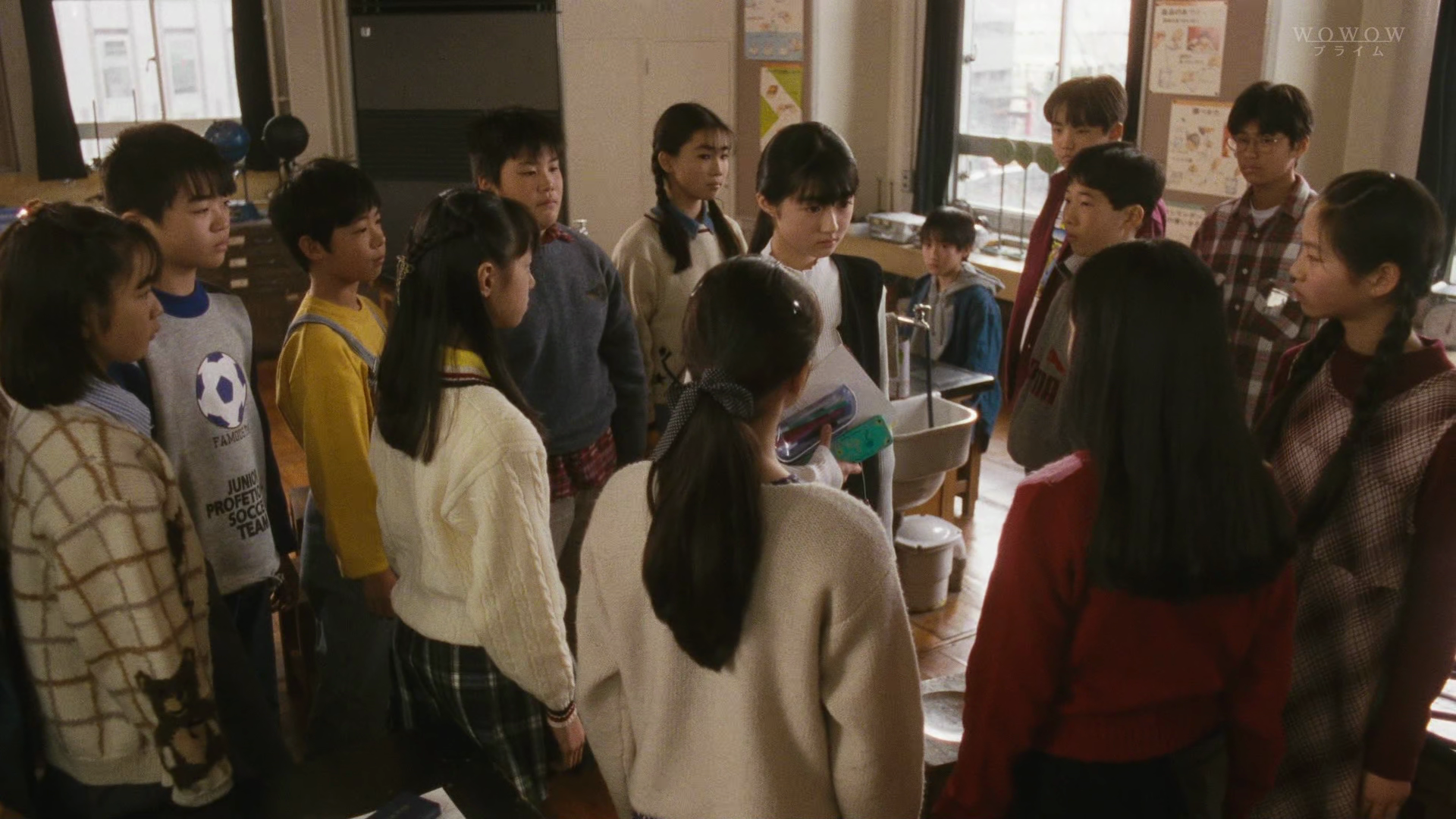
To that extent, it isn’t really Hanako that haunts the children so much as the idea of her is misused as a means of social control. A silly rumour soon gives way to mass hysteria as the popular girls bring more of the children over to their side to gang up on Saeko while the teachers are largely absent or oblivious. While in another film the kids might band together to look for the killer of the other children and thereby protect themselves and each other, instead they become ever more paranoid and the outsider figure of Saeko becomes the focus of all their negative emotions from the jealousy of the other girls to the uncertainness of Takuya who doesn’t know what to do with his confusing feelings for Saeko. In a touching moment, he replies via writing on the blackboard rather than speaking when Saeko uses it to communicate with him after losing her voice, but later ends up shouting at her to go away and leave him alone. “Silence means you agree,” one his classmates points out when Takuya attempts to abstain from an otherwise unanimous vote to subject Saeko to a kind of test akin to a ducking stool to prove whether or not she really is Hanako. Only Natsumi remains on her side.

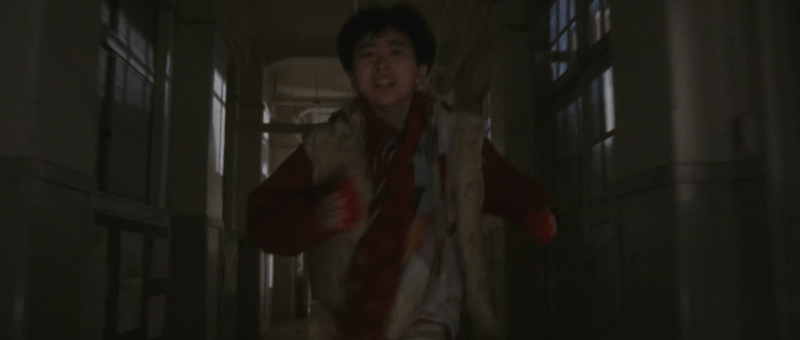
Meanwhile, the real child killer hovers in the background like an abstract threat before finally invading the school like a refugee from a slasher movie. Swinging his scythe around, his crazed moaning may prove too prove frightening for younger audiences while not even Natsumi’s father and their teacher can stop him from murderous wandering. In the end, the “real” Hanako surfaces but as a more benevolent figure who calls the kids back to the school and creates a more positive sense of mob mentality as they all shine their torches on the killer as if confronting him with what he is and what he’s done. The curse itself is lifted as the other kids rally round to save Saeko and finally accept her as one of them. A charming exploration of a 90s childhood from Grandpa playing Nintendo shogi to the looming anxieties of stranger danger, the ultimate message is one of solidarity and friendship as Hanako helps the kids let go of their petty disagreements to confront the real monster and save each other.


Trailer (no subtitles)

Drawing Closer (余命一年の僕が、余命半年の君と出会った話。, Takahiro Miki, 2024)

Takahiro Miki has made a name for himself as a purveyor of sad romances. Often his protagonists are divided by conflicting timelines, social taboos, or some other fantastical circumstance, though Drawing Closer (余命一年の僕が、余命半年の君と出会った話。, Yomei Ichinen no Boku ga, Yomei Hantoshi no Kimi to Deatta Hanashi) quite clearly harks back to the jun-ai or “pure love” boom in its focus on young love and terminal illness. Based on the novel by Ao Morita, the film nevertheless succumbs to some of genres most problematic tendencies as the heroine essentially becomes little more than a means for the hero’s path towards finding purpose in life.

17-year-old Akito (Ren Nagase) is told that he has a tumour on his heart and only a year at most to live. Though he begins to feel as if his life is pointless, he finds new strength after running into Haruna (Natsuki Deguchi) who has only six months yet to him seems full of life. Later, Haruna says he was actually wrong and she felt completely hopeless too so actually she really wanted to die right away rather than pointlessly hang round for another six months with nothing to do and no one to talk to. But in any case, Akito decides that he’s going to make his remaining life’s purpose making Haruna happy which admittedly he does actually do by visiting her every day and bringing flowers once a week.

But outside of that, we never really hear that much from Haruna other than when she’s telling Akito something inspirational and he seems to more or less fill in the blanks on his own. Thus he makes what could have been a fairly rash and disastrous decision to bring a former friend, Ayaka (Mayuu Yokota), with whom Haruna had fallen out after the middle-school graduation ceremony that she was unable to go to because of her illness. Luckily he had correctly deduced that Haruna pushed her friend away because she thought their friendship was holding her back and Ayaka should be free to embrace her high school life making new friends who can do all the regular teenage things like going to karaoke or hanging out at the mall. Akito is doing something similar by not telling his other friends that he’s ill while also keeping it from Haruna in the hope that they can just be normal teens without the baggage of their illnesses. 

The film never shies away from the isolating qualities of what it’s like to live with a serious health condition. Both teens just want to be treated normally while others often pull away from them or are overly solicitous after finding out that they’re ill but at the same time, it’s all life lessons for Akito rather a genuine expression of Haruna’s feelings. We only experience them as he experiences them and so really she’s denied any opportunity to express herself authentically. Rather tritely, it’s she who teaches Akito how to live again in urging him that he should hang in there and continue to pursue his artistic dreams on behalf of them both. Meanwhile, she encourages him to pursue a romantic relationship with Ayaka, in that way ensuring that neither of them will be lonely when she’s gone and pushing them towards enjoying life to its fullest.

Nevertheless, due to its unbalanced quality and general earnestness the film never really achieves the kind of emotional impact that it’s aiming for nor the sense of poignancy familiar from Miki’s other work. Perhaps taking its cues from similarly themed television drama, the production values are on the lower side and Miki’s visual flair is largely absent though this perhaps helps to express a sense of hopelessness only broken by beautiful colours of Haruna’s artwork. Haruna had used drawing as means of escaping from the reality of her condition, but in the end even this becomes about Akito with her mother declaring that in the end she drew for him rather than for herself. Even so, there is something uplifting in Akito’s rediscovery of art as a purpose for life that convinces him that his remaining time isn’t meaningless while also allowing him to discover the desire to live even if his time is running out.


Trailer (English subtitles)

The Laughing Frog (笑う蛙, Hideyuki Hirayama, 2002)

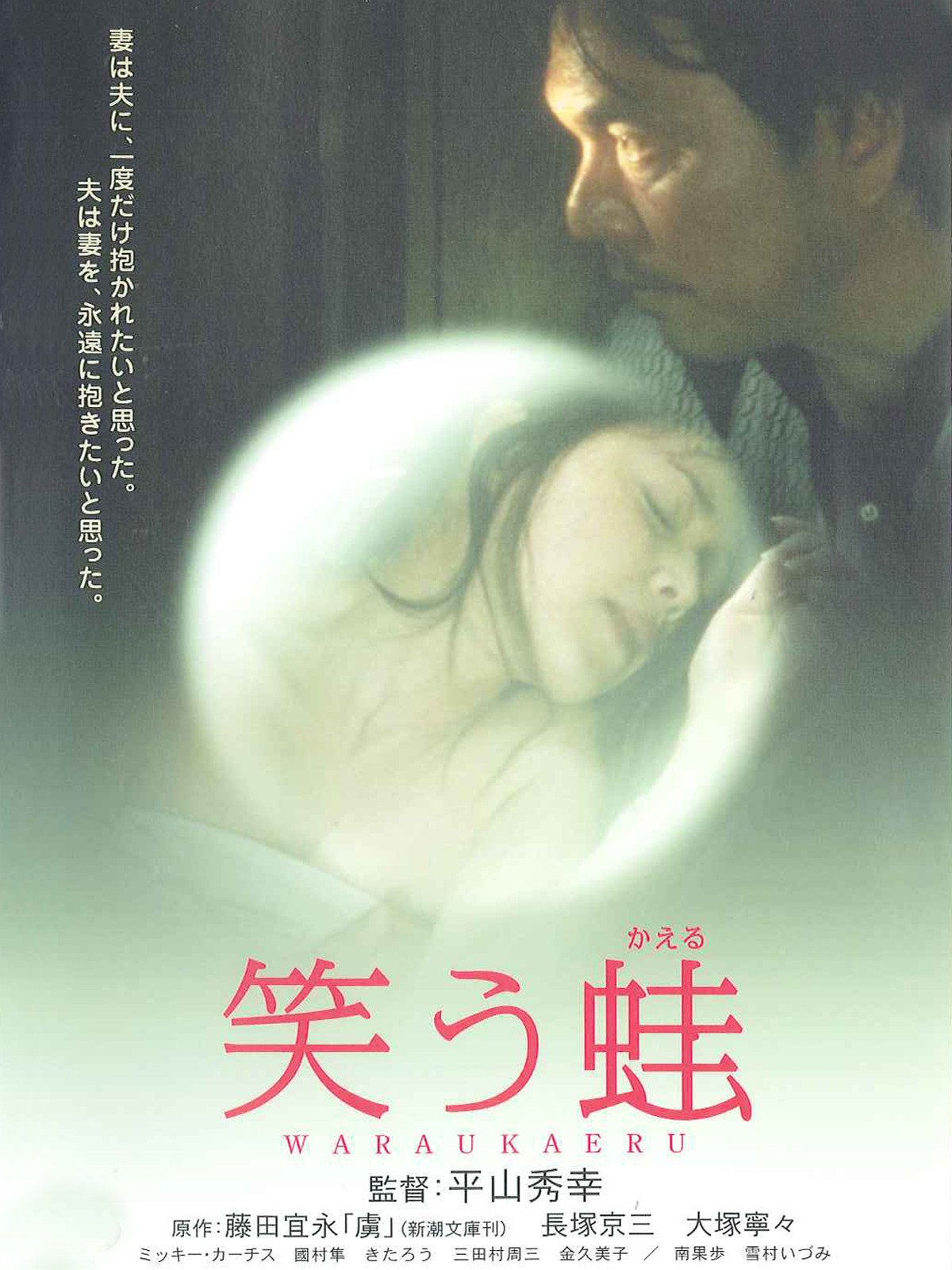
laughing frog posterEver have a day (or perhaps a lifetime) where you feel so stupid that even the frogs are laughing at you? That’s pretty much how it is for disgraced former bank manager Ippei when he turns up one day at a family holiday home he assumed would be empty but turns out not to be. In Laughing Frog (笑う蛙, Warau Kaeru) director Hideyuki Hirayama deftly dissects the modern family, the gradual redundancy of the middle-aged man, and the way society seems to have of anointing the lucky and the unlucky, in a darkly humorous satire in which even mother nature seems to be mocking our petty human concerns.

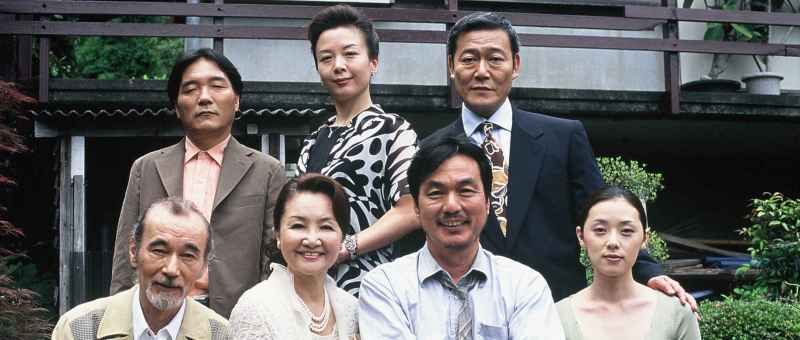
33 year old Ryoko (Nene Otsuka) is attending the third memorial service for her late father at which her greedy sister-in-law (Kumija Kim) asks for various things in an attempt to get some of the inheritance in advance while Ryoko’s brother (Shuzo Mitamura) wanders off to chat about silkworms in Chinese on his mobile phone. The event ends with Ryoko’s sprightly mother (Izumi Yukimura) and the sister-in-law urging her to sort out some kind of marital difficulties in order to ease the awkwardness surrounding her lack of external connections.

Meanwhile, Ryoko’s missing husband, Ippei (Kyozo Nagatsuka), rocks up at a rural station and climbs into a familiar house through an open window. Wandering around in his pants, he hears a noise and realises someone lives there after all. Ryoko has moved into her father’s old house in the country and started a whole new life for herself. After a brief discussion, Ryoko agrees to let him stay for a while on the condition that he finally sign the divorce papers but Ippei soon finds himself confined to an especial kind of irrelevance as he starts his new life in the hall cupboard observing his wife’s new freedoms by means of a tiny hole in the wall.

No one seems to have much of a good word to say about Ippei, which is fair enough seeing as he apparently became obsessed with a bar hostess and embezzled money from his bank to pay for a lavish affair before running away and leaving his wife to deal with the fallout. He is, however, paying for it now as his own irrelevance is once and truly brought home to him as he lives out his days like an impotent ghost trapped in a storage cupboard undergoing his wife’s strange mix of kindness and revenge.

Ryoko, the goodly wife, is not quite all she seems. Ippei’s mistress makes a surprise appearance to try a spot of extortion on the wealthy wife but she’s no match for Ryoko’s perfectly practiced poise. One of the oddly cruel accusations the mistress has to offer is that Ippei once referred to a kind of boredom with his wife’s properness, branding her a “fancy pet cat” whilst apparently avowing the mistress’ bedroom superiority. If Ippei’s sheepish behind the wall expression is anything to go by he is guilty as charged but then perhaps the uncomfortable statement leads right back to his uncomfortable place within Ryoko’s upperclass family who seem to look down on a mere bank manager, affecting politeness while secretly bemoaning the fact that their daughter has married beneath herself.

The model upperclass family is a simulacrum. Feigning politeness, elegance and dignity they attempt to disguise their otherwise distasteful affectations. Ryoko’s sister-in-law is at least honest in her constant harping on about the inheritance, plan to steal grandma’s house out from under her to knock it down and build a new one, and constant asides to her apparently hopeless (and unseen) son away at a (not great) university. Meanwhile her husband, Ryoko’s brother, pretends to chat silkworms in Chinese on his phone but is really talking to a Chinese mistress and Ryoko’s mum is planning to get married again to a (possibly dodgy) antiques dealer (Mickey Curtis) who is so deeply in debt there won’t even be any inheritance anyway.

Ryoko too has moved on. Ippei is forced to watch as she entertains her new boyfriend (Jun Kunimura), a stonemason whose main line is headstones, while the frogs outside work themselves into some kind of frenzy. Little by little all his manly affectations are worn away – he’s forced to realise how foolish he’s been, how irrelevant he is in Ryoko’s life, and how perfectly pointless his fugitive existence really is. Ryoko meanwhile remains calm and calculating. She “lies” and she wins in a bloodless victory, allowing her opponents to sentence themselves to the punishments they feel themselves to deserve. Ippei, it seems, is just a weak, unlucky man doomed to ruin himself through a series of poetic failures and petty self involved mistakes. Meanwhile the frogs look on and laugh at our human follies. Makes you feel small doesn’t it….


It All Began When I Met You (すべては君に逢えたから, Katsuhide Motoki, 2013)

It All Began When I Met You posterChristmas, in Japan, is an occasion for romance. Strangely, the Christmas date movie has never quite taken off though there are a fair few examples of this oft maligned genre even if they don’t generally help to ameliorate the contempt in which it is held. Truth be told, It All Began When I Met You (すべては君に逢えたから, Subete wa Kimi ni Aeta kara) won’t help to do that either but then it isn’t really intended to so much as provide a little warmth combat the to Christmas cold whilst celebrating the centenary of Tokyo Station (a destination surely as romantic as meeting under the clock at Waterloo).

Spinning out from Tokyo Station, the film splits into six interconnected stories of love ranging from dealing with long distance romance to an orphaned little girl who has projected her need to believe in the existence of her parents onto a faith in Santa Claus. Counting down to Christmas Day, the protagonists each progress towards some kind of crisis point which will allow them to deal with their various problems whilst getting into the holiday spirit.

Couple one are a pair of youngsters, one a fashion designer, Setsuna (Fumino Kimura), and the other an engineer, Takumi (Masahiro Higashide), who are separated because of differing work commitments. She’s in Tokyo, he’s up North, but they chat on the phone all the time and seem close despite the distance between them. The truth is revealed when Takumi comes to Tokyo and is supposed to meet up with Setsuna but stays out all night drinking with a (female) colleague instead.

Meanwhile, a college student (Tsubasa Honda) is invited to a karaoke party but isn’t sure whether to go because her crush is going and she can’t pluck up the courage to confess to him. Her boss at the pastry shop (Chieko Baisho) where she works tells her to go get him rather than allow her true love to slip away as, we later find out, happened to her when her boyfriend failed to appear at Tokyo Station 49 years earlier when they had arranged to elope. One of their regular customers, a Shinkansen driver (Saburo Tokito), has just retired early and, it turns out, may not have long to live but wants to make the most of his last Christmas with his son (Ryutaro Yamasaki) who is preoccupied about a “half-coming of age” ceremony they’re having at school.

Across down, the train driver’s brother-in-law, an arrogant CEO (Hiroshi Tamaki), runs into an aspiring actress (Rin Takanashi) who is currently in rehearsals for a play she puts on every year at a local orphanage. This year might be her last, however, because she’s begun to accept that her acting career will never take off and it’s time to go home. One of the little girls at the orphanage, Akane (Emiri Kai), is particularly looking forward to the festivities because she’s invested in the unseen figure of Santa as a substitute for believing in the unseen figures of the parents she never knew.

Each of the stories is intended to capture something of the complicated business of modern city living – a long distance relationship is, perhaps, something that many will be familiar with, relating to the pain and confusion of being not quite sure where each party currently is in terms of commitment. The pace of contemporary life frustrates romance, but the station is there to connect people and bring them back together. The conclusion is perhaps a little optimistic in its sudden cementing of a romantic bond but broadly in keeping with the Christmas theme.

The CEO and the actress, by contrast, are a much more conventional rom-com couple. Serendipitously meeting each other at various upscale joints, the CEO immediately tags the actress as a gold digger after she (accidentally) catches him flashing his premium credit card. Offended she spins him a yarn about a dead boyfriend as payback but finds it backfiring when he is unexpectedly moved and tries to make it up to her. Warmer in tone, this strand sets the station up as a symbol of the interconnectedness of city life where such mini miracles are indeed possible even if the perfectly rational reason for all the coincidental meetings is later explained to us.

However, where there’s joy there’s also heartbreak. The train driver’s tale seems out of place here, but plays into other themes of coming to terms with reality and committing to enjoying the now rather than worrying about the past or future. Similarly, the little girl begins to work out her faith in Santa maybe misplaced because the letter he’s written her is in Japanese, which is weird because isn’t Santa Swedish? Learning to accept that not having parents is not due to a lack of faith and that she has good people looking after her helps Akane move past her loneliness while the baker gets a surprise visitor who helps fill in a few details about her failed romance which in turn helps her offer advice to her young assistant faced with her own typically adolescent love worries.

Miracles really do take place at Tokyo Station, which, it has to be said, is quite picturesque. Saccharin and superficial, It All Began When I Met You is nevertheless a heartwarming tribute to the strange serendipity of city life, throwing in a good amount of Christmas cheer with hope for the future and presumably a happy new year.


Original trailer (no subtitles)

Film Noir (殺し, Masahiro Kobayashi, 2000)

Koroshi-2000Existential tales of hitmen and their observations from the shadows have hardly been absent from Japanese cinema yet Masahiro Kobayashi’s Film Noir (AKA Koroshi, 殺し) perhaps owes as much to Fargo as it does to Le Samouraï. Taking place in the frozen, snow covered expanses of Northern Japan, Kobayashi’s story is an absurdist one filled with dispossessed salarymen leading empty, meaningless lives in the wake of late middle age redundancy.
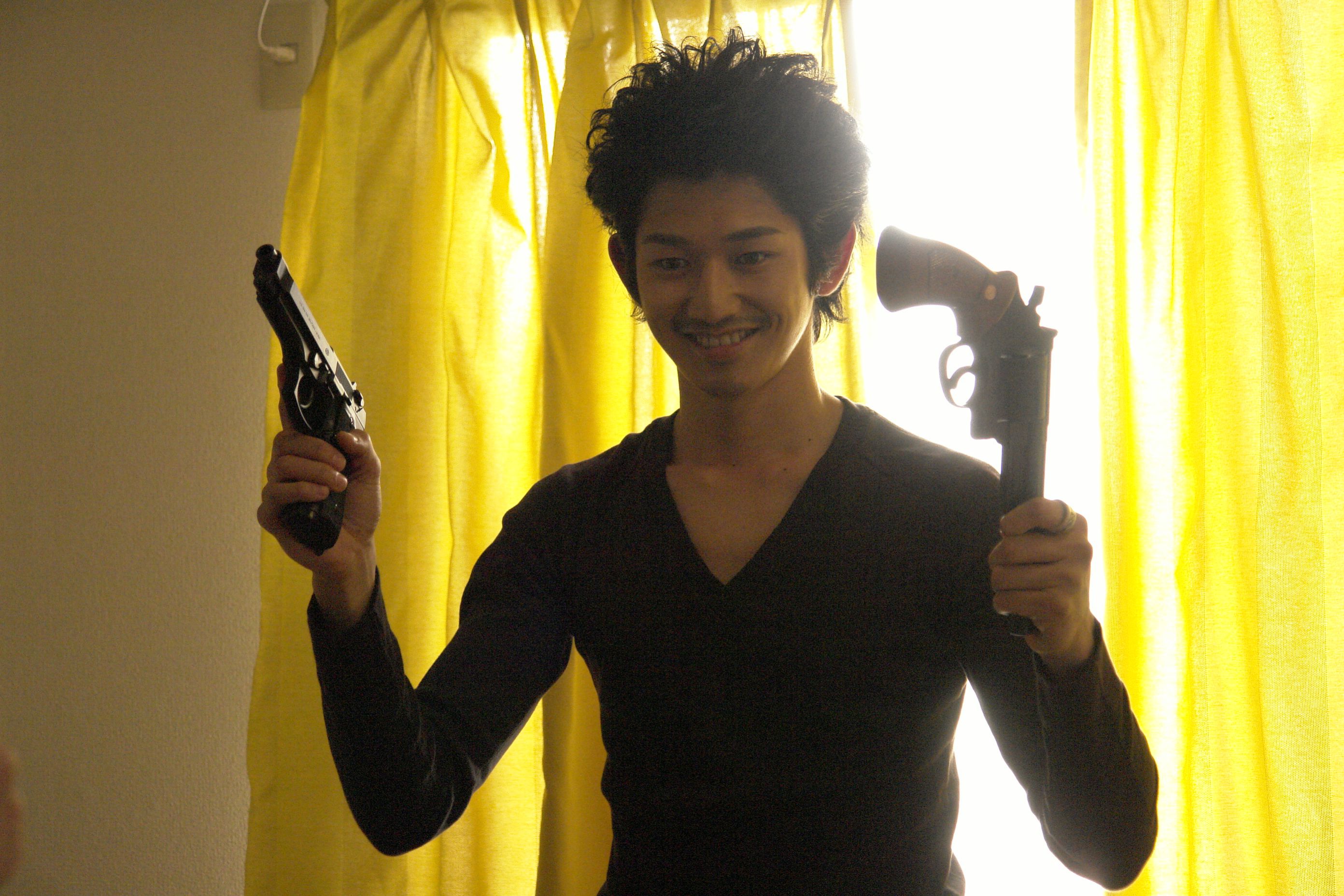
Hamazaki starts us off with a very Film Noir style voice over in which he likens being alive to be trapped on a long coach tour with strangers. You may fight and scream and argue with them right the way through, but in the end you will crave their understanding. Like many men of the era following the recent economic turbulence, he’s lost his job and, being a cowardly if kindly soul, he’s too afraid to tell his wife about it. Consequently he leaves for work everyday as normal but drives to a near by strip mall and wastes the day away playing pachinko. That is until one fateful morning when he finds the entire area deserted only for a mysterious man to climb uninvited into his car.

This unnamed man has a business proposition for Hamazaki – kill a guy, get a lot of money. As anyone would be, Hamazaki is a little shocked, confused and uncertain but eventually accepts. His first hit (like all of his subsequent hits) is on a man just like him – a middle aged loser who’s lost his job and is hiding out in the pachinko parlour hoping to figure something out before he runs out of money. Hamazaki likes his new line of work, it makes him feel like a man again and even helps him rebuild a bond with his wife (or so he thinks) but when he discovers one of his targets is someone he knows it all starts to go wrong.

Amusingly, the mysterious man gives Hamazaki a number of videos to watch as a kind of instructional guide to killing which includes a fair few from Melville including Army of Shadows and other classics of shady French cinema. This is a well worn tale and we know it isn’t going to end well for Hamazaki but we can also see from his voiceover that he’s consistently at odds with the situation as it is almost as if he’s constructing a film noir-esque reality all of his own.

Hamazaki is an unlikely fit for this kind of work – all the way through he’s berated for being “too nice”, notably in an argument with his former boss towards the end and then again by his wife who, it seems, cares more for her social standing and middle class lifestyle than she does for her kindhearted husband. The couple have a teenage daughter whom they’ve sent abroad to study in America (presumably at great expense) and only seems to contact them to ask for more money. Though she’s apparently only in high school, they seem to treat their daughter with a high level of adulthood – sending the money for her to budget with by herself (the implication is that she runs through quite a bit) and her mother even takes care to remind her of the importance of using a condom (not just the pill – America is the AIDS hub of the world, apparently) which is obviously good advice from an enlightened parent but perhaps a surprisingly frank way of talking to a teenage girl.

In many ways Hamazaki is a man without a place. Now he’s lost his job he’s become quite useless to just about everyone. As the mysterious man tells him, everyone is playing a role, in that case “killer” and “prey” but as it transpires Hamazaki was playing a role all along – that of salaryman husband and father. The couple seem happy, but in having sent their daughter overseas the Hamazakis have already broken their happy family in favour of increasing their social status. Kazuko is perhaps only playing the role of the middle class housewife and may have little use for a man who proves too soft hearted to get ahead. After Hamazaki tragically declares he wants to give up the life of a contract killer because he’s realised the importance of family, he may find that “family” had long ago abandoned him.

In this deserted, snow covered town the hearts of men are as cold as the wind that blows through the depressingly empty expanses. A man’s worth is measured by the money he makes and status he can claim, a man with no job is worth nothing at all. No love, no family, no morality – this is the archetypal film noir world filled with nothing but eternal darkness despite the bright sunshine which bounces lightly off the crisp white snow. As much about the death of the spirit as it is about the taking of life, Film Noir paints an eerily bleak picture of modern society with its rigid social codes which prize only the acquisition of money and status rather than the contents of a man’s soul.


Unsubtitled trailer:

The Foreign Duck, The Native Duck and God in a Coin Locker (アヒルと鴨のコインロッカー, Yoshihiro Nakamura, 2007)

YgoLt - ImgurReview of The Foreign Duck, The Native Duck and God in a Coin Locker over at uk-anime.net I really enjoyed this one – great movie!


Director Yoshihiro Nakamura once again returns with another adaptation of a Kotaro Isaka novel, The Foreign Duck, The Native Duck and God in a Coin Locker (アヒルと鴨のコインロッカー, Ahiru to Kamo no Coin Locker). Having previously adapted Fish Story (also available from Third Window in the UK and itself a very fine film) and Golden Slumber, Nakamura and Isaka seem to have formed a very effective working relationship and this latest effort is another very welcome instalment from the duo. Elliptical, melancholic and thought provoking The Foreign Duck, The Native Duck and God in a Coin Locker is a minor gem and every bit as whimsical as its name would suggest.

Shiina (Gaku Hamada) has just left the small town shoe shop his parents own to study law in Sendai. Moving into his new apartment he attracts the attention of his neighbour, Kawasaki (Eita), who overhears him signing Bob Dylan’s Blowing in the Wind. Kawasaki is himself a great admirer of Dylan remarking that his is ‘the voice of God’. Aloof, cold, at once dominating and indifferent the prospect of developing a friendship with the mild mannered, short and shy Shiina seems an odd one but nevertheless the two seem to develop a bond. Kawasaki therefore proposes Shiina help him with a rather peculiar problem.

Shiina’s other neighbour, who rudely rebuffed Shina’s introduction and moving in present, is apparently a foreigner – Bhutanese to be precise – and although speaks fluent Japanese cannot read. He’s particularly perplexed by the different between ‘ahiru’ – the native duck, and ‘kamo’ – the foreign duck, and is sure that if he had a good dictionary he’d be able to understand the two fully and thus perfect his Japanese. To this end Kawasaki has decided to steal a Kanji Garden Dictionary for him and wants Shiina to help. Understandably confused Shiina originally declines but is soon bamboozled into helping anyway. There’s a lot more to all of this than a simple semantic quandary though and the only thing that’s clear is that Shiina has gone and gotten himself embroiled in someone else’s story.

‘That sounds like something you just made up’ is one of the first things Shiina says to Kawasaki and indeed everything about him seems studied or affected in someway as if he were reciting someone else’s lines – essentially performing the role of himself. Half of the crazy stuff he comes up with, like his warning Shiina to avoid a particular pet shop owner completely out of the blue, sounds as if he’s just invented it on the spot for a laugh were it not for his distant and humourless manner. Without spoiling the plot too much, you start to get the feeling that there’s really something slightly off about everything you’re being told, that crazy as it seems it is the truth in one sense but perhaps not in another. This is where the mystery element of the film begins to kick in – who is Kawasaki really? What is he on about? Is any of this really happening?

Wistful in tone, The Foreign Duck, The Native Duck and God in a Coin Locker is only partly a mystery, it’s also a bittersweet coming of age tale and an, admittedly light, examination of the Japanese attitude to foreignness. Away from home for the first time Shiina is obviously keen to strike out on his own and be his own his own person but at the same time wants to fit in and be liked by his classmates. A particularly telling incident occurs when a confused Indian woman tries to get some information at a bus stop only to be ignored by those waiting. Shiina seems to feel as if he ought to help her but having just heard two of his classmates complaining about ‘stupid foreigners’ does nothing. Feeling guilty he tries to reach out to his Bhutanese neighbour but is again rebuffed. Kawasaki wants to know the difference between the foreign duck and the native one – is there such a fundamental difference? As one character says ‘you wouldn’t have talked to me if you’d known I was a foreigner’ ‘Of course I would’ Shiina replies ‘no, you wouldn’t have’ his friend responds with resignation. Isn’t it better to just help those who need it, whoever or whatever they happen to be?

The Foreign Duck, The Native Duck and God in a Coin Locker maybe a little darker than its title suggests but its tone is definitely to the wistful/whimsical side – this juxtaposition might irritate some who’d rather a more straightforward mystery or a lighter, more conventional comedy but its refusal to conform is precisely what makes it so charming. That it also manages to pack in a decent amount of social commentary in an interesting way is to its credit as is its ability to make the totally bizarre seem perfectly natural. The Foreign Duck, the Native Duck and God in a Coin locker is another impressive feature from the creators of Fish Story and fans of that earlier film will certainly not be disappointed by their latest work.


Original trailer (English subtitles)