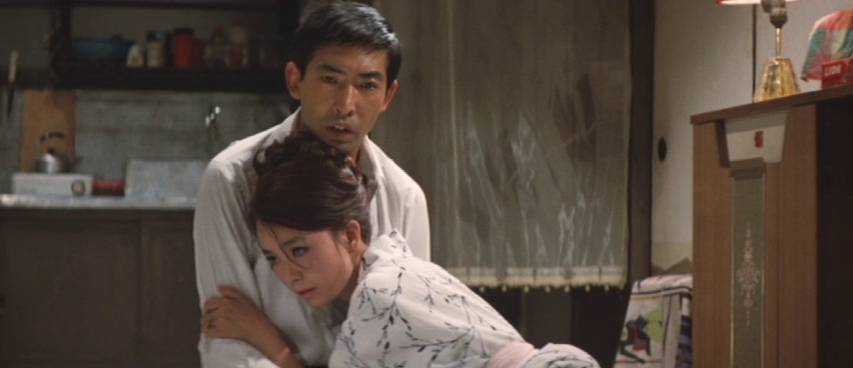
Bonds of Love (愛のきずな, Takashi Tsuboshima, 1969)

On a rainy night, a salaryman trapped in a loveless marriage and unsatisfying career chances on a beautiful woman dressed in kimono waiting by the side of the road. He decides to double back and offer her a lift, which she ill-advisedly accepts, but as it turns out he is actually the one in danger. Adapted from the Seicho Matsumoto short story Tazutazushi, The Bonds of Love (愛のきずな, Ai no Kizuna) has underlying misogyny that paints the woman at its centre as a sort of elemental spirit who bewitches men and leads them to their doom even while the hero himself is selfish and insecure, mired in an inferiority complex and incapacitated by wounded male pride.

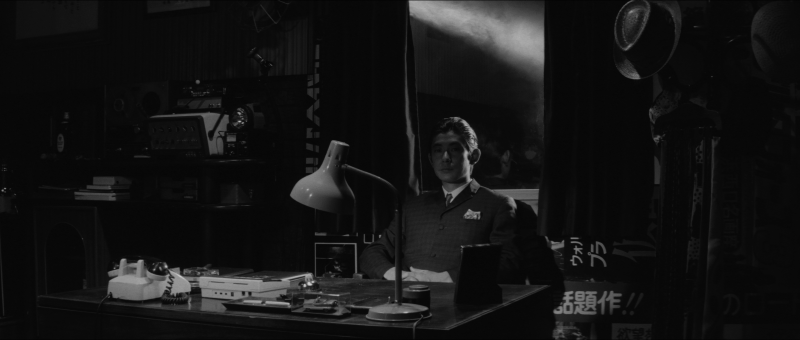
The fact that Ryohei (Makoto Fujita) is already married comes as a bit of a shock, abruptly revealed as it is by the nameplate on the suburban home he returns to after a date with Yukiko (singer Mari Sono) having told her that he lives alone at the company dorm. It seems obvious that he’s dissatisfied with his domestic life and fed up with his overly materialist wife Sanae (Chisako Hara) whose constant gripes only seem to needle at his sense of inadequacy. Today, she’s misplaced an expensive ring he’d used his annual bonus to buy her and when he notices it simply sitting next to the sink, she remarks that it’s not all that nice anyway. Ryohei at least feels that she resents him for not being more successful and having the financial power to buy her the frivolous gifts and status symbols she clearly desires. The power dynamic is in any case unbalanced because Sanae is the daughter of his boss which means she in effect has total control over his career. One word to her father, and he’s toast, but at the same time she can only help him so far with his advancement despite nagging him constantly about his future prospects. Meanwhile, the other men at the office make fun of him. They describe Ryohei as an idiot who’s only in his position by virtue of being the boss’ son-in-law. 

This of course further needles at his wounded male pride, but dating Yukiko, who adores him completely, on the side restores his sense of masculinity. After he claims to have been staying out late playing mahjong, Sanae cautions him that one of his colleagues is being transferred because of his gambling and womanising habits. At his leaving do, Miyata (Sachio Sakai) lays into Ryohei and says he’s the one who taught him how to pick up women and pretend to be single as if this is the way they overcome their sense of impotence while under the company’s thumb. Ryohei appears not to like him, perhaps because he reflects the qualities in himself he is least proud of. The news of his transfer therefore spooks Ryohei knowing that the same fate may befall him if his affair with Yukiko is exposed. 

But when Sanae does eventually suspect he’s cheating on her and complains to her mother, the boss rings Ryohei and basically tells him not to worry about it because a man’s not a man if he doesn’t play around. The conflict that Ryohei has is essentially one of conflicting masculinities, the one in which he is effectively emasculated but defines his status through a hierarchical relationship with other men within the corporate structure, and the other in which he defines it through romantic conquest which also represents a kind of freedom. But being a fairly conventional man, in the end Ryohei cannot bear to have his salaryman persona ripped away from him and will do whatever it takes to maintain his relationship with his wife and by proxy his boss to preserve his career.

Realising Yukiko poses a threat to that, he decides the only solution is to kill her but it’s also true that he’s confronted by a much more robust vision of masculinity in the form of her estranged husband Kenji (Makoto Sato) who went to prison after stabbing another man in a jealous rage. It’s clear that Ryohei is afraid of Kenji and definitely doesn’t want to end up getting stabbed. His “love” for Yukiko does not stand up to that kind of scrutiny and it’s her assertion that she’s going to tell Kenji all about their affair and ask for a divorce that shifts him into crisis mode. After all, he’s in flight from domesticity. Leaving Sanae, and with it destroying his career might not solve his problems even if what he eventually chooses is just that, to be free of the burden of the salaryman dream and move to a small town to open a shop with a woman who is in thrall to him and therefore continually submissive and loving in contrast to Sanae who only ever makes him feel small.

Yet, we can’t actually be sure how much of what happens later is actually real or just Ryohei imagining things because of his guilty conscience and continuing sense of inadequacy. Essentially, he gets a second chance to make better choices and finally gains the courage to abandon his salaryman persona only to be immediately confronted by both his transgressions and violent masculinity. Tsuboshima crafts an atmosphere of malevolence and noirish dread coupled with a spiritual sense of retribution born of the constant rains and gothic thunderstorm that heralds the final confrontation in which Yukiko is herself a harbinger of death leading weak willed men towards their doom to which they go all too willingly. 
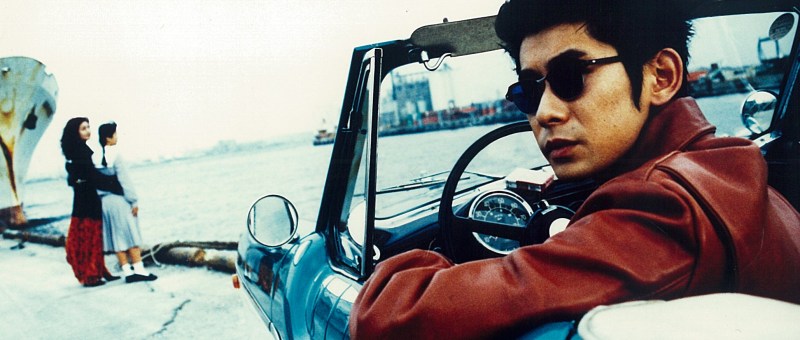

The Stairway to the Distant Past (遙かな時代の階段を, Kaizo Hayashi, 1995)

If The Most Terrible Time in My Life was channeling Nikkatsu Noir, Stairway to the Distant Past (遙かな時代の階段を, Harukana Jidai no Kaidan wo) sees Hayashi channel Fukasaku for a full-on confrontation with the legacies of the post-war era just as PI Maiku (Masatoshi Nagase) is forced to confront and attempt to cure the corrupted legacies of his own origins all while trying to save the city of Yokohama from drifting off to “another hell.” This time shooting in colour, Hayashi conjures a sense of mythic dread in the purple haze that hangs over a hidden city and the eerie blue of the path to get there.

But before all that, Maiku has fallen on such hard times his beloved car’s been repossessed and he’s stuck finding lost dogs for wealthy yet eccentric clients. Meanwhile, leader of New Japs gang Kanno (Shiro Sano) is running for political office while two of his underlings decide to freelance in order to take over the lucrative river trade which no one, not even the Taiwanese gang otherwise apparently in the ascendent, has ever dared to touch in fear of the mythic “White Man” who’s controlled the area since the post-war era with a ruthless efficiency that has seen any man challenge him not live to tell the tale. In the midst of it all is bigoted, and apparently pretty corrupt, policeman Nakayama (Akaji Maro) who first blackmails Maiku into helping him investigate a theft and smuggling ring on the river then apparently makes a deal with the White Man’s underlings who in turn blackmail him over his gambling debts but also claim they can make him chief of police if he chooses to play along.

Nakayama is a symbol of the rot in the contemporary city though he is in fact merely spineless, greedy, unpleasant and prejudiced. He asks Maiku for help because he’s hamstrung by the rules of policing which prevent him from doing the nefarious things he asks Maiku to do all of which leads to some pretty tragic consequences and a pair of orphaned children. The New Japs are perhaps a sign of further corruption still to come as Kanno tries to go legit as a politician but only as a means of increasing his influence and earnings. 

The river becomes a kind of nexus, the shore line between contemporary Japan and the “distant past” of the post-war era. Nakayama discovers that no one is technically policing it because it’s outside of everyone’s jurisdiction, while the White Man seems to have been in a position of unassailed power for half a century. As he later says, he’s the only one “living in the past” and perhaps quite literally so as Maiku has to transcend a literal stairway while guided by some kind of local prophet in order to travel to his world and finally risk his life to confront him. At the same time, Maiku is threatened by his own point of origin in the unexpected return of his mother, a now middle-aged stripper known as Dynamite Sexy Lily (Haruko Wanibuchi), who abandoned him and his sister and when he was just a child. 

Her name, along Maiku’s own, are perhaps hangovers from the Occupation era now even more out of place in a changed Japan. Making full use of the colour palate, Hayashi repeatedly flashes back to a pair of Lily’s red shoes as if signalling the unreality of the hidden city and the superimposition of past and present. His flashbacks to the late 1940s echo the cinematography of Fukasaku’s jitsuroku epics with their frenetic chases through black markets, but towards the conclusion the canted angles make it through to our era too and most particularly in the White Man’s lair, a blue-tinged industrial labyrinth that recalls the post-apocalyptic visions of a city still in ruins.

“Yokohama’s changed a lot,” Lily is told on her return and in fact several times after that. She likes it a little better now, the White Man no so much complaining that this city no longer has a place for him as if foreseeing his own eclipse and the oncoming end of an era. But then again, perhaps only the names have changed. All we’re left with is new gangsters with no code, and the White Man did at least stick to the rules even if he did so with ruthless authority. As for Maiku, his passage to the underworld seems to have brought him new clarity. His outfit now a little more sophisticated and mature, less an affectation borne of watching too many movies than an expression of himself. Nevertheless, Yokohama remains a small-town city, a cosy place with a generally friendly and easy going population albeit one with darkness hovering around the edges.


The Stairway to the Distant Past screens 18th/19th October at Japan Society New York.

Original trailer (no subtitles)

The Most Terrible Time in My Life (我が人生最悪の時, Kaizo Hayashi, 1994)

A Yokohama PI finds himself investigating a case of tragic brotherhood against the backdrop of a burgeoning gang war in Kaizo’s Hayashi’s retro crime movie The Most Terrible Time in my Life (我が人生最悪の時, Waga Jinsei Saiaku no Toki). In the first of three films featuring detective / cinema projectionist Maiku Hama (yes, that is his real name), Hayashi harks back to the Nikkatsu borderless action films of the 1960s along with classic noir while also exploring contemporary attitudes towards those not born in Japan. 

The force destabilising the local equilibrium is a gang that calls itself the “New Japs” and was founded by Zainichi Koreans who had acquired Japanese citizenship and now accepts members from other nations colonised by Japan who’ve also naturalised. The implication is that they’re agitating because the society still doesn’t fully accept them, something echoed by Maiku’s (Masatoshi Nagase) first client, a mister Kim, who says the police aren’t interested in his case because he’s a foreigner while when he actually encounters him Lieutenant Nakayama (Akaji Maro) does indeed make some quite prejudiced remarks. Hanging out in a mahjong parlour, Maiku comes to the aid of the waiter, Hai Ping (Yang Hai-Ping), newly arrived from Taiwan when he’s hassled by a racist customer noticing that the waiter’s actually carrying a knife under his shirt and might be about to ruin his life. 

Maiku loses a finger in the process (they sew it back on later), leaving Hai Ping to show up at his office with an improbably large amount of money Maiku refuses and then agrees to take when he hires him to find his brother De Jian (Hou Te-Chien) who came to Japan two years previously and has been missing ever since. Hai Ping’s relationship with De Jian speaks to Maiku because he’s also caring for his 16-year-old sister, their parents being absent from their lives just as Hai Ping and his brother were abandoned and then drifted into gang crime as a means of survival. He discovers that De Jian has married a Japanese woman of Chinese descent who like them was separated from her family which explains why she doesn’t speak any Chinese but was trotted out in a cheongsam as an exotic beauty when she was a sex worker which is how De Jian met her and got himself into trouble with gang when they ran away together. 

They are all in their way displaced people trying to get a foothold in Yokohama but finding varying degrees of success. A turf war is apparently about to break out between the Taiwanese and Hong Kong gangs, though we never actually see the one from Hong Kong only the New Japs and the Taiwanese who don’t actually fight but engage in vendettas with Hai Ping who is actually ordered to kill his own brother to prove his loyalty and atone for his crime. Maiku figures this out quite quickly and again tries to stop new his friend from making a huge mistake but not even he can prevent the fatalistic inevitability of the collision of all these competing honour codes and the implosion of a more literal kind of brotherhood in the face of that represented by the gang. 

Despite the film’s title, which in a meta touch flips around on the marquee of the cinema where Maiku has his office which is currently screening The Best Years of Our Lives, Maiku will have some far worse times in his life in subsequent films but the Yokohama we encounter here is a lived-in neighbourhood with its collection of quirky characters and strange goings on. The tone is humorous and ironic as Maiku’s friends have to chase a dog to get his finger back or Maiku’s taxi driver friend reads magazines while driving and changes hats in line with his role, but it has an underlying noirish sense of sadness for the world’s cruelty in the unfolding tragedies Maiku is powerless to prevent. Shooting in a crisp black and white, Hayashi pays tribute to Borderless action with a cameo from Jo Shishido as Maiku’s father figure while allowing Maiku to inhabit a world slightly out of time or existing only in the movies in which detectives are always hardboiled and the only way to be happy is to abandon all your hopes and dreams before the world can destroy them.


The Most Terrible Time in My Life screens 12th/18th October at Japan Society New York.

Original trailer (No subtitles)

Legend of the Cat Monster (麗猫伝説, Nobuhiko Obayashi, 1983)

Produced as a special marking the 100th episode of the Tuesday Night Suspense Theatre TV drama series, Nobuhiko Obayashi’s Legend of the Cat Monster (麗猫伝説, Reibyo densetsu) is preceded by a title card reading “Elegy for a Faraway Film”. Scripted by Chiho Katsura, the film is indeed in its way a lament for dying world albeit one which owes a heavy debt to Billy Wilder’s Sunset Boulevard with a little Fedora thrown in. Repurposing the classic ghost cat film it casts cinema itself as dangerous illusion, a vampiric compulsion that drowns all who encounter it in irresolvable longing. 

This sense of irrecoverable nostalgia is palpable from the opening sequence which, aside from the melancholy voiceover, introduces us to the world of Setouchi Cinema apparently a moribund studio complex once dubbed the Hollywood of Japan. The new arrival, Ryohei (Akira Emoto), is dressed in noticeably anachronistic fashion as if he were a 1930s newsboy rather than a young man living in the Japan of the early 1980s. His girlfriend, Ryoko (Jun Fubuki), who works as a stage hand dresses in a similarly old-fashioned style and in fact carries an oversize watch that was a heirloom from her late father, an unsuccessful film director. Ryoko remarks that she’s been hoping someone would come and rescue her from this half-dead island but she doubts Ryohei will be the one to do it because he has also come here in search of a dream. 

That dream is, however, already dead at least according to some. The film director working at the studio is berated by a woman of around the same age working as a manager for an idol star for still getting an allowance from his mother at 60 because he has failed to make it as a film director at least in financial terms. There is a poignant, largely unexplored subplot between that suggests the inability to reconcile the dream of cinema with the economic “reality” has kept them apart all these years and that their dream of love may now be over too. 

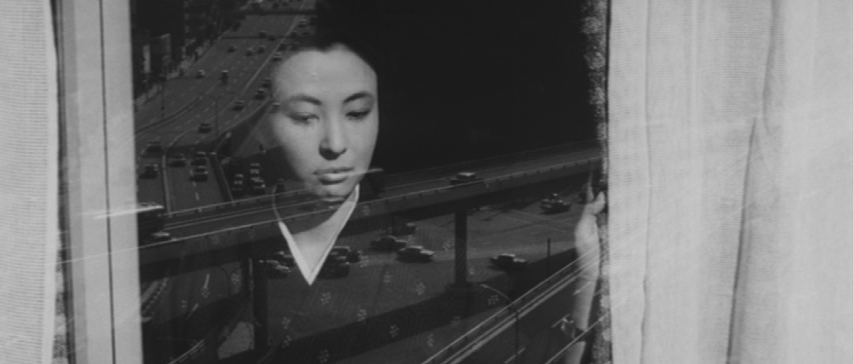
It seems that the reclusive actress at the film’s centre, Akiko (Wakaba Irie), is also living on a frustrated dream of love withdrawing from the world around her believing that her lover will someday return from “Hollywood” which seems to be another word for paradise or perhaps the world beyond on the other side of the silver screen. To her, film is but a dream with in a dream. A window or screen is a portal to the burdens of the heart, memories of days gone by, and the illusions we once saw that cannot be seen again.  She herself is trapped within her own dream of love, but it is not so much a dream of her that bewitches Ryohei but the impossibility of cinema.

When passing photographer, Tachihara (Toru Minegishi), who lost his own wife to the unobtainable magic of the movies, snaps a picture of Akiko at her window holding a cat and looking exactly as she did the day she abruptly walked out on an incomplete film, it spurs a cynical producer to get the idea of convincing her to make a comeback and in a ghost cat movie, no less. Obayashi’s casting coup is getting mother and daughter Takako and Wakaba Irie to play aged and youthful versions of the famous actress, Takako herself having been a huge star of the 1930s performing most notably for Kenji Mizoguchi in the The Water Magician. There is an undeniable poignancy in her reflection that is only her aging body which is dying, as if she were merely becoming an embodiment of her image migrating to silver screen which exists between this world and next. It’s this screen that is later ruptured by Ryoko as she makes her escape after failing to save Ryohei from the curse of cinema. 

As Akiko laments, he’s writing his script more for himself than for her and it’s the quest for art which has begun to drain and make him mad. When he, pale and zombie-like, attempts to proffer his scripts it appears to be nothing more than his own name written over and over again. Like the Max-esque butler Mizumori (Akira Oizumi) says, film is an eternal dream which by its definition can never realised and exists only a state of longing somewhere beyond the veil. Drawing inspiration from Nobuo Nakagawa in particular and harnessing the sense of gothic dread found in Sunset Boulevard, Obayashi captures the eternal nightmares of artistic creation with the maddening obsessions of unrequited love and the image of the ideal which exists eternally out of reach somewhere on the other side of the screen.


Beast Alley (けものみち, Eizo Sugawa, 1965)

In the opening title sequence of Eizo Sugawa’s Beast Alley (けものみち, Kemonomichi), a thick blob of inky blackness gradually expands over an aerial view of the city until it obscures it entirely. The title card which then appears is written in plain white, but will reappear at the film’s conclusion this time ashen as if it too had been singed by the deeply ironic flames with which the film ends. Based on a novel Seicho Matsumoto and scripted by The Beast Shall Die’s Yoshio Shirasaka, the film similarly takes an incredibly cynical view of the modern post-war society in which it is revealed the militarists are still basically in charge and presiding over a deeply corrupt social order. 

The big bad, Kito (Eitaro Ozawa), says as much when he states the need for reforming the nation’s “rotten political system” by which he means post-war democracy. Kito made his made his money doing deeply dodgy things in Manchuria in addition to running an exploitative coal mine in Japan. Now mainly bedridden, he basically runs the country as a far-right political fixer working in tandem with big business and the yakuza who have traditionally been big supporters of conservative and nationalist forces. Early on we see one of his underlings negotiating with politicians to ensure that Taiyo Roads will be hired be hired for a large scale construction project planning to put highways all the way through Tokyo. As we later discover, he’s prepared to go to great lengths in order to achieve his goal, going so far as to have a sex worker murdered to implicate the uncooperative CEO of a rival construction film into resigning by threatening to frame him for the crime so they can install their stooge in his position. 

It’s into this world that everywoman Tamiko (Junko Ikeuchi) is drawn while working as a hotel maid at a traditional Japanese inn. Trapped in a bad marriage to a man who is also bedridden yet still attempts to rape her when she returns home to find him in bed with the housekeeper, Tamiko longs for escape and is therefore ripe for the picking when approached by Kotaki (Ryo Ikebe), the manager of an upscale Western hotel, to join him in an unspecified enterprise which will apparently make her very rich. The only catch is that she will have to “get rid” of her “dependent”, which she probably wanted to do anyway, by burning down her house with him inside it. Once she’s done this, there is no turning back for her even if she had not developed complicated feelings for Kotaki who is both her salvation and damnation. 

Tamiko’s husband had failed to give her the comfortable life that he had promised, something which she thinks Kotaki can deliver even if it requires her to become the plaything of Kito whom does she actually seem to like even if aware of the precarity of her position and still in thrall to Kotaki. Leaving the hotel so abruptly was however a strategic error as it arouses the suspicious of (originally) earnest cop Hisatsune (Keiju Kobayashi) who quickly realises that Tamiko set the fire to kill her husband. Though he seemed to be motivated by justice, Hisatsune too is soon corrupted explaining to Tamiko that he has become cynical and jaded. Years of police work have shown him that true criminals know how to break the law and get away with it so he can’t do anything about them, but “good” people, like he implies Tamiko, are pushed into crime by desperation and are easily caught. Tamiko wields her sexuality against him by agreeing to a tryst, though when it doesn’t go to plan he tries blackmail and then rape before she, ironically, manages to escape from his bungled crime. 

Hisatsune’s corruption is gradual and self serving. He starts with suspicion, tailing Tamiko in the interests of justice but also because he desires her, before stumbling on the conspiracy, putting the pieces together, attempting to use them for his own gain and trying to blow a whistle mostly out of resentment. Kito’s reach is all encompassing. Hisatsune is warned off investigating certain aspects of the crime by his senior officers and is then fired on Kito’s instructions for fiddling his expenses after harassing Tamiko. He tries to give his findings to his boss but it goes nowhere and then tries the press but is given the brush off, the editor his reporter friend refers him to gently implying he’s just a crank with an axe to grind. Of course, it turns out that the reporter is already in league with dodgy lawyer Hatano (Yunosuke Ito) who is Kito’s right-hand man. 

The connections between the three men, Kotaki who was once a communist, Hatano, and Kito go back to Manchuria and the corruptions of militarist era which it becomes clear has never really ended. Kito has only one rival and it’s another faction of the conservative ruling party who are probably just waiting for him die. Attempts are made on his life and they don’t go well for those who make them. Even if Hatano hoped to simply inherit an empire he, as he points out, put in much of the work to build he is sorely mistaken while Tamiko may intellectually understand that Kito’s death would place her in a precarious position but carries on regardless. “You never know who will betray you in this world” Kotaki laments, echoing Kito’s later claim that his Buddhist statues are the only ones will never betray him even as sleeps next to a statue of Aizen Myo whom he ironically claims protects mankind from their lust and desire. 

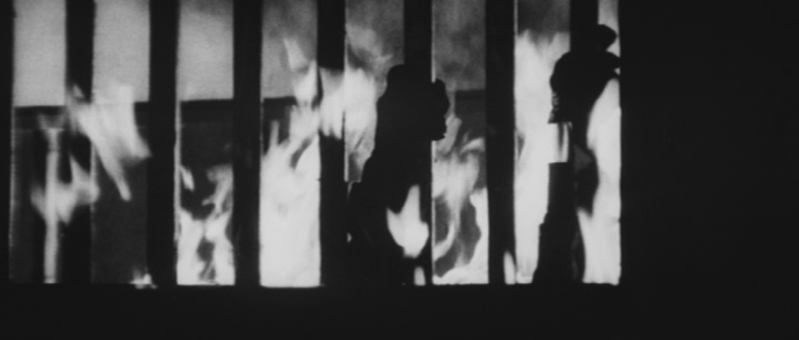
It could be said that desire is Tamiko’s undoing, but as Hisatsune had suggested perhaps you couldn’t blame her for longing to be free of the bedridden husband who had not delivered what he promised her. As she said, she was doing what could to survive even if you’d think she’d know putting on a ring taken from the finger of a murdered woman is akin sealing your own fate. Sugawa shoots with a noirish sense of dread, tracking Tamiko with her coat drawn up around her face as she tries to leave the scene of her crime, and makes the most of his fiery imagery before ending on a note of cynical laughter amid the inescapable hell the of post-war society. 


Original trailer (English subtitles)

I Live in Fear (生きものの記録, Akira Kurosawa, 1955)

Which of us is “crazy”, the man who lives in fear or the rest of us who live in its denial? By 1955, a decade had passed since the bombs fell on Hiroshima and Nagasaki, but even if the world seemed “peaceful” it was only superficial. The Korean War had “ended” in an uneasy truce only two years earlier and the world was already mired in a cold war which daily threatened to turn hot with both sides in possession of a nuclear deterrent. Akira Kurosawa’s I Live in Fear (生きものの記録, Ikimono no Kiroku) asks us if we can really say a man is “insane” if his life is ruled by a rational anxiety and if it is our refusal to accept the threat he sees which eventually drives him out of his mind. 

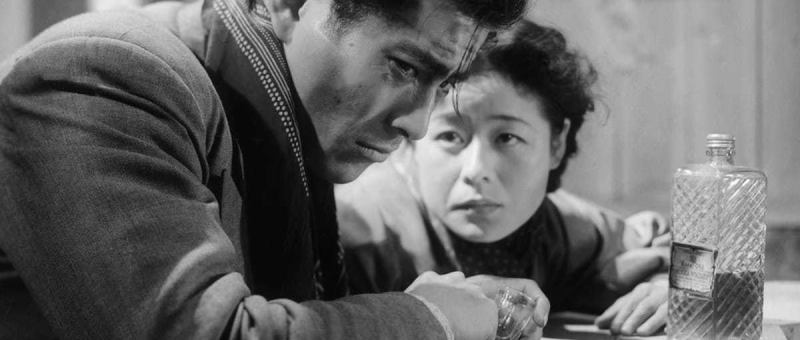
Our guide is gentle dentist Harada (Takashi Shimura) who has a sideline as a mediator at the family court. The case he has been called in on one particular afternoon is that of the Nakajima family which is attempting to have the ageing patriarch, Kiichi (a near unrecognisable Toshiro Mifune), declared legally incompetent on account of his increasing paranoia about nuclear attack and latent radioactivity. A wealthy self-made man and foundry owner, Kiichi has frittered away vast sums on harebrained schemes to keep himself and his family safe but after a plan to build a bunker in a remote area had to be abandoned, he’s set his heart on moving everyone to Brazil where he believes they will be safer. 

The problem is partly one of changing times as Kiichi, “despotic and selfish” as his son describes him, attempts to railroad his family into a safety they do not want or need. His two legitimate sons now operate the foundry and their lives are dependent on it, which is not to say that they are dependent on Kiichi, but if he goes through with selling the the foundry to finance his new life it will leave them all high and dry. It would be, to a certain way of thinking, the ultimate paternal betrayal but in Kiichi’s mind all he’s trying to do is “save” his family from an invisible threat. 

That family, meanwhile, is one he’s already undermined through patriarchal selfishness in fathering a series of illegitimate children he is also supporting financially but has never legally acknowledged. The parents of the illegitimate kids are worried that if the family succeeds in having Kiichi declared legally incompetent, his wife will get her hands on the purse strings and they’ll be left out in the cold. Kiichi, meanwhile, has an old-fashioned view of filial relations and never considers that the other kids might not want to come with him either even if it’s unexpectedly nice of him to include them, or that inviting your two mistresses to live in the same house as your legal wife might be awkward for all concerned. 

On the face of it, the case is open and shut. If a man causes his family to suffer through frittering money away on drink or pachinko, they would approve the motion to give another family member legal control over his finances. So why is it taking them so long to decide if Kiichi is a liability to his family or not? The problem is, his fear is entirely rational. It’s only its extent which is the problem. It’s perfectly understandable to be afraid of the ebola virus or brain-eating amoeba, but we can’t afford to spend every minute of every day consumed by fear and so they retreat into the background anxiety of our lives while we try to go on living. Yet, could it be that Kiichi has it right and we’re merely living in denial, sleepwalking into a preventable disaster while he alone has a plan for survival? 

“No place is safe” Kiichi’s son-in-law exasperatedly explains to him after he has taken drastic and somewhat ironic action, a kind of scorched earth policy designed to force his sons to follow him into a new world of safety. Pushed over the edge, Kiichi gets a rude awakening, realising that it was perhaps selfish of him only to think of salvation for his immediate family when his actions will essentially throw his workforce under the bus. Belatedly, he promises to find a way to take them to Brazil too, never realising that people have their own lives that aren’t so easily uprooted. He thinks Brazil is safer because the currents of the world seem to blow ill winds over Japan, but there are already more than enough nuclear bombs lying in warehouses to destroy the planet several times over. 

In any case, Kiichi has already destroyed his family through his various transgressions. They don’t want to go in part because they don’t particularly like him, are sick of his gruff authoritarianism, and resent his tendency to make unilateral decisions on their behalf. Strapped for cash he tries asking the illegitimate kids to return some of the money he gave them, but they too are insecure in their positions and cannot trust that they will continue to be provided for if Kiichi is deposed. Meanwhile, when Kiichi falls ill the legitimate children are only too quick to start discussing the inheritance in the absence of a will. Perhaps Kiichi isn’t much more to them than a walking wallet, all of which lends a rather poignant quality to his continual attempts to protect his family from the nuclear apocalypse in fulfilment of his fatherly duty even as he wagers their economic security to do so. 

If Kiichi is a Cassandra prophesying the end of the world, we won’t be here to be sorry we didn’t listen, but Harada and other more rational minds are shaken by the intensity of his vision. They cannot say that he is “mad” even if his anxiety has consumed his life, but nor can they allow him free rein to pursue his plans because they do not concern only himself but greatly affect the lives of others. They are forced to wonder if it isn’t we who are “insane”, quietly living our lives while all these preventable threats hover in the background, ignored. Kiichi’s mistake was perhaps that he wanted only to be “safe” in an unsafe world, not to cure it of its dangers. Few us are actively trying to eliminate ebola or brain-eating amoebas, just as few actively opposed an increasingly nuclear society, powerless as we are and were in the face of a greater threat. Perhaps Kiichi was the sanest one of all, retreating into a world of madness and infinite safety in a delusional bubble of survival in an otherwise crazy world.


I Live in Fear screens at the BFI Southbank, London on 6th & 13th February 2023 as part of the Kurosawa season.

The Silent Duel (静かなる決闘, Akira Kurosawa, 1949)

Amid the labour strikes crippling Toho in the late ‘40s, Akira Kurosawa formed an association with other directors and film professionals and began working with different studios, the first being Daiei on a loose adaptation of a popular play in which an idealistic doctor struggles with his repressed desires while watching others wilfully embrace post-war selfishness and cynicism. Like many of Kurosawa’s films from this period, The Silent Duel (静かなる決闘, Shizukanaru Ketto) is essentially a meditation on post-war moral decline and what’s needed to correct it but also if somewhat accidentally the destructive effects of secret keeping and miscommunication. 

Kurosawa opens the film in 1944 with exhausted field medic Kyoji (Toshiro Mifune) operating on a badly wounded solider, Nakata (Kenjiro Uemura). Distracted by the constant dripping of a leaky roof, the adverse weather conditions outside, and the general stressfulness of the situation, Kyoji makes the fateful decision to remove his gloves to better accomplish the fiddly operation he is performing only to drop a scalpel and cut himself. He continues with the surgery, but realises that Nakata is likely infected with syphilis which he may have contracted through the wound on his finger. Kyoji tells Nakata, otherwise recovering well, that he should make sure to seek treatment but overhears him boasting that his injuries may soon save him from the battlefield. Kyoji continues to serve but is unable to treat the infection effectively with the limited resources available to him as a frontline medic allowing the disease to continue its progression largely unmitigated.

Taking a job at his father’s obstetrics clinic on his return to Japan, Kyoji breaks off his longstanding engagement to pre-war girlfriend Misao (Miki Sanjo) who has been waiting for him the last six years but refuses to explain to her why he cannot go through with their marriage. She assumes it must in some way be related to his war trauma, and in a way it is. The syphilis is an obvious metaphor for the corruptions of militarism. He declines to explain, he claims, because he is certain that Misao would vow to go on waiting for him until the disease is cured which would take at least three to five years assuming it can be cured at all. As she is already 27, he would be taking away Misao’s opportunity to make a happy marriage and have children with another man. In any case, he makes her decision for her which ironically conflicts with his later statement that she should be free to seek happiness on her own, not least because it seems she has been pressured into an arranged marriage by her financially troubled father. The act of childbirth is symbolically relevant though he does not seem to consider the idea of a platonic marriage perhaps uncertain that he could go on repressing his desires as a married man. So morally upright is he, that he also refuses to lie, saying nothing rather than allowing Misao to believe that he has fallen out of love with her, met someone else, or has another war-related issue that prevents his marrying her. Nor does he seem to consider telling her that he has syphilis and allowing her to come to the same conclusion as everyone else, that he contracted it through sleeping with sex workers during his military service which is most likely how Nakata became infected. 

The stigma associated with the disease adds a further dimension to Kyoji’s frustration given that he describes himself as having wilfully sublimated his physical desires in order to be able to return to a “peaceful marriage” with Misao whereas as Nakata who satisfied himself without a second thought returned home symptomless, married, and is soon to be a father. Re-encountering him by chance, Nakata who seems to have become wealthy doing something that is likely immoral if not illegal, tells Kyoji that his sickness is cured but does eventually bring his wife in for a free checkup to discover that he has passed the disease to her and to their unborn child. Yet even confronted with the truth, Nakata lies again and suggests that Kyoji has made all this up as revenge for something that happened in the war keeping the fact that he infected him from his wife. He blames Kyoji for destroying his family rather than accept his own responsibility and sees nothing wrong in his actions until directly confronted with the body of his stillborn child apparently so deformed and monstrous that they wouldn’t let the mother see it. 

The two men have clearly taken different paths, Kyoji certain that he must put others before himself and suppressing his own desires to ensure he cannot pass the disease on while Nakata buries his head in the sand and ignores it. It is a kind of metaphor for the post-war future, those like Kyoji acknowledging that the legacy of wartime trauma is something that must be acknowledged and actively healed before happiness is possible while those like Nakata simply plow on like nothing ever happened with no thought or consideration for those around them. Yet it is also Kyoji who lies by omission even in his selflessness just Nakata lied to his wife while the truth is only discovered by accident, firstly by reluctant nurse Minegishi (Noriko Sengoku) who walks in on him injecting the remedy for syphilis, she in turn then overheard by Kyoji’s father (Takashi Shimura) while Minegishi then overhears the explanation Kyoji gives him. She in a sense completes the cycle when she asks Misao to apologise to Kyoji on her behalf as she is too embarrassed to do so herself after realising that she got him wrong having resolved to turn her life around after learning of the depths of his selflessness. 

Minegishi had been a nightclub dancer who tried to take her own life after becoming pregnant by a man who abandoned her but was saved by Kyoji who gave her a job at the clinic and convinced her to raise the child. It’s this child, at first unwanted but later loved and embraced by all despite the stigma of his being born out of wedlock, that offers the clearest path towards a healthier future suggesting that the solution lies in accepting the past with a willingness to make something new out of it rather than in wilful denial and resentful self-interest. Yet Kyoji is also human and privately resentful. “If I’d known it would happen to me I would’ve done things differently” he sneers petulantly suggesting that his properness may be an affectation rather than deeply felt conviction but equally frustrated in feeling his fate is unjust and that he’s suffering for someone else’s sin. 

“Because of the blood of a shameless guy, my body became dirty without knowing any pleasure” he complains, hinting at a metaphor for his wartime contamination dragged into a conflict by forces outside of his control. The roles he plays are ironic, firstly a healer in a place of death and destruction and then as a deliverer of life at his father’s obstetrics clinic though he fears he will never have children of his own. He is in a sense trapped by his past as shown in the repeated visual metaphor of the closed gates outside the clinic on which the flowers that represent his relationship with Misao and hope for the future gradually wither. Minegishi tells him she’s in love with him and is willing to accept the risk of his disease to alleviate his desire, but he once again chooses to say nothing, immediately returning to business. As his father points out, he has (for the most part) resolved to channel his resentment into helping those less happy than himself but if he had been happy he may have become a snob, indifferent to the suffering of others. In some ways his problem is the familiar giri/ninjo conflict as he fights a silent duel within himself between his natural desires and his better nature but it’s also a battle against the slow poison of the wartime legacy through compassion and selflessness that may, like his inescapable illness, eventually drive him into madness.


The Silent Duel screens at the BFI Southbank, London on 2nd & 11th February 2023 as part of the Kurosawa season.

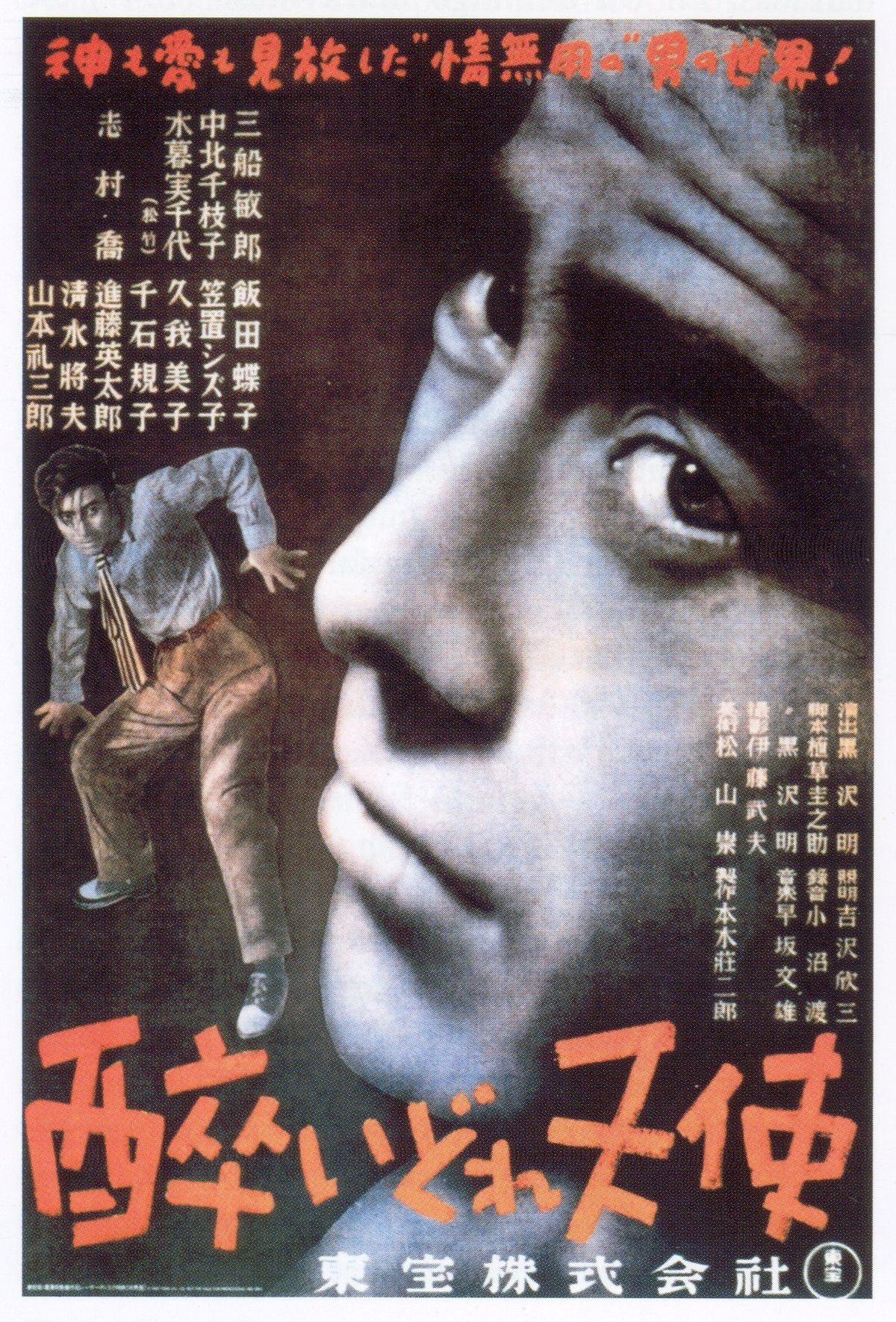
Drunken Angel (酔いどれ天使, Akira Kurosawa, 1948)

A gruff yet well intentioned doctor does his best to cure the ills of post-war Japan in a rundown slum on the edge of a fetid swamp in Akira Kurosawa’s noir tragedy, Drunken Angel (酔いどれ天使, Yoidore Tenshi). The doctor is most obviously the drunken angel of the title though it could equally apply to the unhappy yakuza he tries so hard to redeem whom most agree is not suited to that kind of life and trapped by the feudalistic thinking of the pre-war past.

Matsunaga (Toshiro Mifune) is the big man around town, but jaded physician Sanada (Takashi Shimura) sees straight through him. “He acts tough and swaggers around but I know in his heart he’s incredibly lonely,” Sanada tells his assistant, Miyo (Chieko Nakakita), a young woman he took in to help her escape the clutches of the violent yakuza ex who left her with syphilis. Miyo bemoans Sanada’s terrible bedside manner and tendency to bully his patients but praises his dedication and remarks that few doctors go as far for those under their care as he does especially ones like these who don’t often have the money to pay. This is a little ironic given Matsunaga’s original objection that he doesn’t trust doctors because it’s not in their best interests to cure you, something which Sanada jokingly acknowledges while expressing the futility he feels in the face of the mass sickness that confronts him. 

When Matsunaga first comes into his office, Sanada remarks that’s its not just his lungs that are sick, he’s sick to the core. But still he seems to think that Matsunaga can be saved, not just physically but spiritually redeemed if only he can coax him away from the yakuza underworld. Matsunaga is suffering from tuberculosis, a common disease of the post-war era and closely linked to the squalid conditions in which he lives which are themselves symbolised by the swamp in the centre of town onto which Sanada’s clinic backs. Sanada tries to warn the local children not to play in it because of the risk of typhus not to mention the mosquitos it attracts but the kids don’t really listen to him and shout back that he’s “just a drunk”. Yet the swamp represents a world upside-down, the neon sign for the No. 1 cabaret bar constantly reflected in its bubbling waters while as the film opens we see a trio of sex workers preparing to head into the red light district and a pair of petty thugs fighting while a young man plays Spanish guitar on the ruins of a bomb damaged building. 

It’s as if it were this world that is slowly consuming Matsunaga, an old-school yakuza who insists “we still believe in things like honour and loyalty” certain that the big boss will side with him against the returned upstart Okada (Reizaburo Yamamoto), Miyo’s yakuza ex, even as Sanada tells him it’s money that matters and Matsunaga no longer makes any. Everyone tells him that he already looks like a ghost, his appearance increasingly gaunt in his parallel decline as the illness takes hold and he begins to lose his status to Okada only to overhear his boss call him an “amateur” that he was only keeping around as a potential sacrifice. In the end, Matsunaga is too good for this world. Naively believing in things like honour and loyalty which no longer mean anything in the dog-eat-dog post-war society he is left with nothing other than a nihilistic bid for vengeance and a desire to repay Sanada’s faith in him if only in the most ironic of ways. 

Like Matsunaga, Sanada sometimes says the opposite of what he means claiming that he doesn’t care what happens to Matsunaga but is determined to wipe out the TB inside him to stop it spreading it to others. He’s on a mission to “sterilise this contaminated town” by eradicating the twin threats of disease and the yakuza, calling Matsunaga a coward for failing to face his fear and loneliness succumbing to the quick fixes of his hedonistic yakuza lifestyle. He’s not perfect either, a doctor who drinks his medical ethanol supplies and berates his patients when he them catches out them out drinking when he told them not to, but is also very at home with who he is and doing his best with it. His disappointment in Matsunaga is mainly in his swagger, the false bravado that masks his human frailty and unwillingness to face his fear of death which manifests itself in a hauntingly expressionistic dream sequence. Using silent cinema composition and canted angles Kurosawa conjures a world of constant uncertainty amid the vagaries of the post-war society in which the only sign of salvation is a drunken doctor and his “rational approach” to the sickness of the age.


Drunken Angel screens at the BFI Southbank, London on 2nd & 10th February 2023 as part of the Kurosawa season.

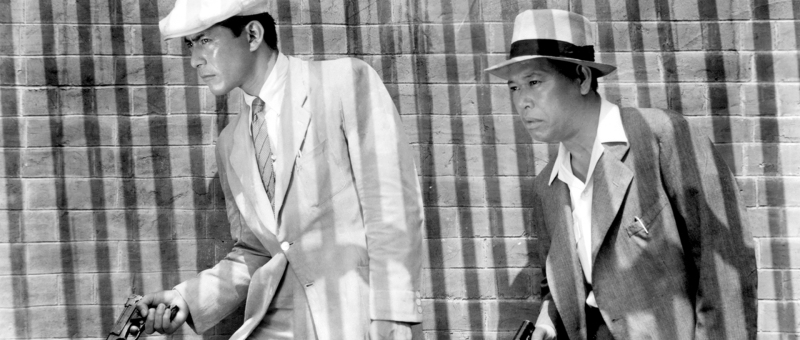
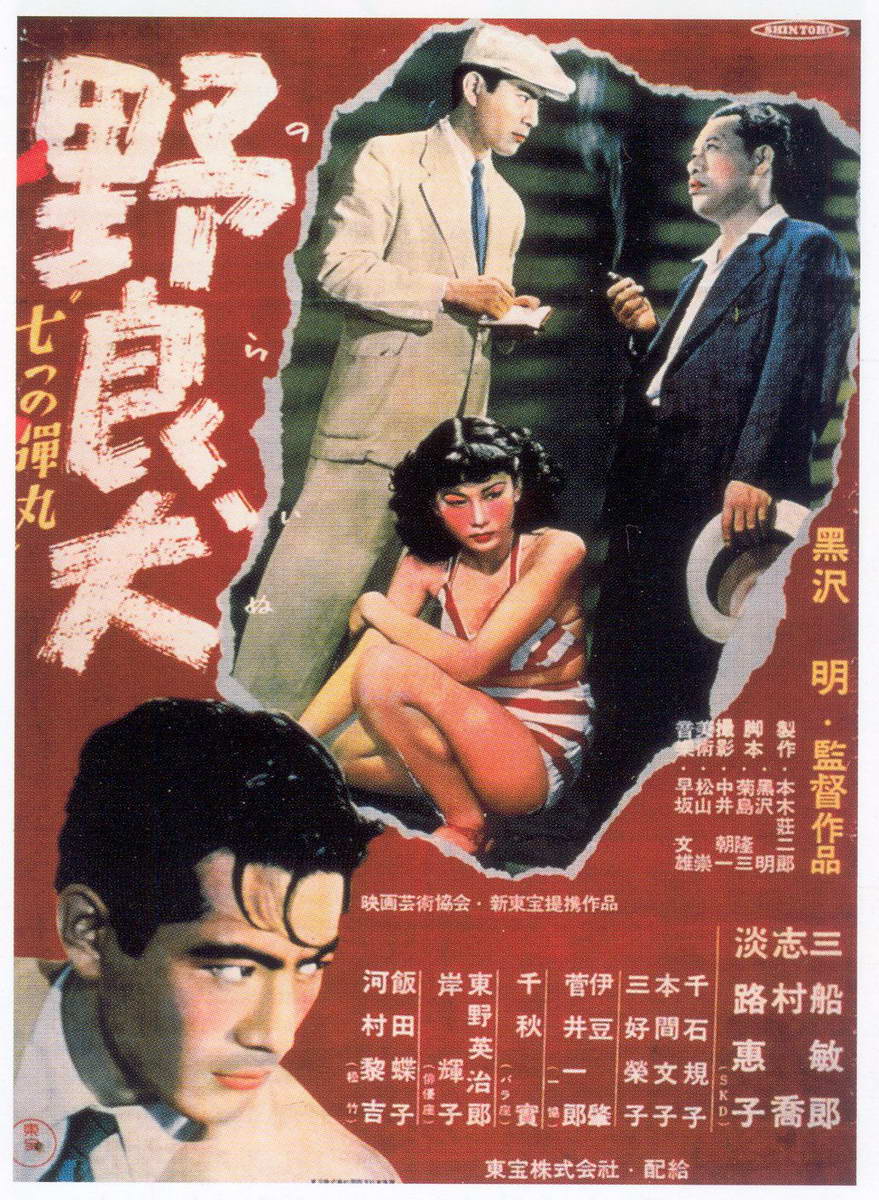
Stray Dog (野良犬, Akira Kurosawa, 1949)

“And, yes, I think the world’s not right. But it’s worse to take it out on the world” the conflicted policeman at the centre of Akira Kurosawa’s Stray Dog (野良犬, Nora Inu) explains as he struggles to reacquire his sense of authority while weighing up its limits and his own right to pass judgement on what is right or wrong or merely illegal. He must ask himself how he can enforce the law while faced with the reality that the man he chases is an echo of himself, the him that took another path amid the chaos, confusion, and despair that followed in the wake of defeat and occupation even as his well-meaning mentor insists that some people are good and others bad and he won’t be able to do his job if he gives it much more thought than that.

The policeman, Murakami (Toshiro Mifune), is perhaps the stray dog of the title who can only follow the straight path towards his missing gun taken from him on a sweltering bus in the middle of summer while he was distracted not only by the heat but by exhaustion having been up all night on a stakeout. As we later discover, Murakami is a rookie cop and recently demobbed soldier trying to make a life for himself in the post-war society. In this he is quite lucky. Many men returned home and struggled to find employment leaving them unable to marry or support families, a whole pack of stray dogs lost in an ever changing landscape. This must have weighed quite heavily on his mind as he made the decision to resign from the police force to take responsibility for the laxity that led to the gun possibly ending up in the wrong hands only to discover his superiors don’t regard it as seriously as he does. His boss tears up the letter and tells him to turn his defeat into something more positive by trying to do something about it, which might in its own way be a metaphor for the new post-war society. 

So closely does Murakami identify himself with his gun that on hearing it has been used in a violent robbery it’s almost as if he has committed the crime and is responsible for anything it might do. There is an essential irony in the fact that this weapon that was supposed to prevent crime is being subverted and used in its service as if mirroring the paths of the two men who both returned to a changed Japan and had their knapsacks stolen on their way back home. Murakami has chosen the law, while the thief Yusa (Isao Kimura) is thrown into nihilistic despair unable to make a life for himself. Murakami’s sense of guilt is further compounded on realising that he may have frustrated Yusa’s attempt to turn back, returning the gun to the underground pistol brokers who make their living through selling illegal weapons stolen from police or bought from occupation forces.

As he admits, Murakami could have ended up committing a robbery but realised he was at a dangerous crossroads and made a deliberate choice to join the police instead. He literally finds himself walking the other man’s path when he’s told by a pickpocket, Ogin (Noriko Sengoku), that the underworld pistol dealers will find him if he walks around downtown looking like he’s at the end of his rope. Ogin, the woman reeking of cheap perfume who stood next to him on the bus, was once known for her fancy kimonos but is now in western dress, signalling perhaps a further decline. In this age of privation, only kimonos and rice have held their value and it’s not unreasonable to assume that she’s sold all of hers and joined the modern generation. Ogin doesn’t have anything to do with the theft, but seems to take pity on Murakami seeing him as naive and essentially unable to understand the way things work on the ground. His mentor, Sato (Takashi Shimura), seems to understand too well, on one level looking down on those like Ogin as simply bad but otherwise happy in her company knowing exactly how to get what he wants through their oddly flirtatious conversation as they suck ice lollies and smoke illicit cigarettes in the interview room. 

Dressed in a ragged military uniform, Murakami wanders around the backstreets of contemporary Tokyo past street kids and sex workers and groups of men just hanging around. Kurosawa employs montage and superimposition to reflect the endless drudgery and maddening circularity his of passage under the stifling heat of summer in the city that allows him a better understanding of what it is to live in this world. Even so, the boy who eventually makes contact seems to see through him pointing out that he looks too physically robust to pass for a desperate drifter. Yusa meanwhile is wiry and hollow, a frightened man who uses Murakami’s gun to affect an authority he does not own which might explain why both of his victims are women. Sato emphasises the worthiness of their victimhood, explaining that the first was robbed of the money she’d saved over three years for her wedding meaning she might have to wait even longer at which point there would be no point getting married at all, while the second woman was killed at home alone and defenceless. We’re also told that her body was nude when discovered which raises the question of whether she might have been assaulted before she died which would cast quite a different light on Yusa’s crimes no longer an accidental killer but a crazed rapist well beyond salvation. 

Yet the accidental nature of Yusa’s fall does seem to be key. The trigger seems to have been a childhood friend he’d fallen in love with gazing at a dress he could never afford to buy for her, pushed into a corner by his wounded masculinity and taking drastic action to reclaim it in much the same way Murakami later does in searching for his missing gun. In their final confrontation they grapple violently in existential struggle in a small grove behind some posh houses where a woman plays a charming parlour tune on the piano pausing only for a few moments to peer out of the window on hearing gunshots. Murakami retrieves his gun and the pair fall to the ground side by side to be met by the sound of children singing, provoking a wail of absolute despair from a defeated Yusa suddenly hit by the full weight of his transgressions. He too was a stray dog heading straight in one direction driven out of mainstream society by the unfairness of the post-war world. Sato tells Murakami that he’ll eventually forget all about Yusa, that he’ll become “less sentimental” and accept the world is full of bad guys and those who fall victim to them, but Murakami doesn’t seem too convinced, for the moment at least unable to forget that Yusa was man much like himself only less lucky or perhaps simply less naive.


Stray Dog screens at the BFI Southbank, London on 1st & 13th February 2023 as part of the Kurosawa season.

The Idiot (白痴, Akira Kurosawa, 1951)

“He was too good for this world” a matriarch finally concedes of the pure soul at the centre of Akira Kurosawa’s The Idiot (白痴, Hakuchi), though like most she had found his goodness unnerving. Adapted from the Dostoyevsky novel, Kurosawa’s poetic morality play is like much of his contemporary work a meditation on the post-war future but perhaps also an admission that this “faithless world” isn’t meant for pure souls and that goodness too can be destructive in its incompatibility with a world ruled by cruelty and selfishness. 

Relocated to a wintery Hokkaido, the film opens with former soldier Kameda (Masayuki Mori) travelling north to stay with a relative after a spell in a psychiatric hospital in Okinawa. Having been sentenced to death for war crimes in what he claims was a case of mistaken identity and then unexpectedly reprieved, Kameda suffered a nervous breakdown but also describes himself as having been reborn, as if everything that had happened to him up to that point had happened to someone else. Ever since then he’s been a pure soul, selfless and ethereal but also with, as someone later puts it, an eerie power to see into people’s hearts that leaves some feeling shamed or uncomfortable in the stinging light of his goodness. 

In the outdated language of the time, he is called an “idiot” because of his epilepsy which has he says caused him epileptic dementia. In the title cards that open the film, it is said that goodness is often conflated with idiocy as if to be good is only to be naive for sophistication necessarily favours calculation over feeling. He is an outcast firstly because of the stigma surrounding his condition and secondly because of the way his goodness reflects on others, leaving them feeling exposed or perhaps judged and found wanting. 

He finds his mirror in a young woman, Taeko (Setsuko Hara), who is loved by a man he met on the train, Akama (Toshiro Mifune), but is herself an outcast because she has been the mistress of a wealthy man, Tohata (Eijiro Yanagi), since she was only 14 years old. On seeing a photograph of her in a shop window near the station he remarks that she seems very unhappy, later explaining that in her eyes he saw only long years of lonely suffering that reminded him of the eyes of a young soldier executed by firing squad who looked back at him with eyes filled with reproach that he must be sacrificed for the folly of the war. But whereas Kameda’s awakening as a pure soul has opened him up to the world, Taeko’s internalised shame has made her cold and indifferent. Kameda’s recognition of her as another pure soul grants her the courage to escape one kind of suffering in abandoning the wealthy man who has ruined her life, but only provokes further destruction in her conviction that Kameda is the one man she can never love for she will only ruin him. 

Kameda, meanwhile, falls in love with the daughter of his relative, Ayako (Yoshiko Kuga), who is proud and largely unable to express her feelings honestly often saying the direct opposite of what she actually means. She too has her idea of goodness, breaking with her childhood sweetheart Kayama (Minoru Chiaki) when he is tempted by an offer from Tohata to enter into a sham marriage with Taeko for appearance’s sake in return for a large sum of money and guaranteed social advancement. Though Ayako originally rejects Kameda because of the shame and humiliation she would feel married to a man with a disability, she nevertheless fails in love with him but is unable to accept the equality of his love in his inability to abandon Taeko to whom he has come to represent a kind of salvation. 

Ayako later comes to believe that it was she who was truly the “idiot” in her petty jealousy lamenting that “if only we could all love without hatred” as Kameda had done though it was in the end his selfless love that sealed his fate, while for Akama it was perhaps the opposite in realising that he would never possess Taeko’s heart and that the only reason she returned to him was because she thought him to be a man of so little importance that ruining him was of no consequence and ruin him she did in the madness of his love. Guileless, Kameda is also a pauper cheated out of his inheritance by a relative and then again exploited by a duplicitous businessman, his poverty another proof of his goodness while others squabble over money. Having escaped an authoritarian father and come in to his inheritance, Akama wagers his fortune trying to buy Taeko from Tohata by gazumping Kayama who later redeems himself by letting the money burn but never really escapes the stain of his temptation. 

Kurosawa frames the tale as high gothic, filled with eerie winds and mist and fire in the midst of snow. The stove of Akama’s otherwise dark and gloomy mansion seems to flare with the intensity of confrontation as the passions of these four tortured souls rise and fall while each seeking a kind of salvation which necessarily cannot satisfy all. Originally intended to run in two parts over 265 minutes, the film was famously too big for producers at Shochiku for whom Kurosawa was working outside of his regular studio Toho. They cut 100 minutes to suit their exhibition needs, excising most of the prologue and inserting a number of clumsily placed intertitles absent from the rest of the film while undercutting the sense of mounting dread in the tragic backstories of each of these doomed romantics. But even in this compromised version, Kurosawa captures something of the gothic fatalism that surrounds Kameda, an innocent lamb in a world of wolves as Akama describes him, whose boundless, selfless love has no place in this faithless world. 


The Idiot screens at the BFI Southbank, London on 13th & 21st January 2023 as part of the Kurosawa season.