
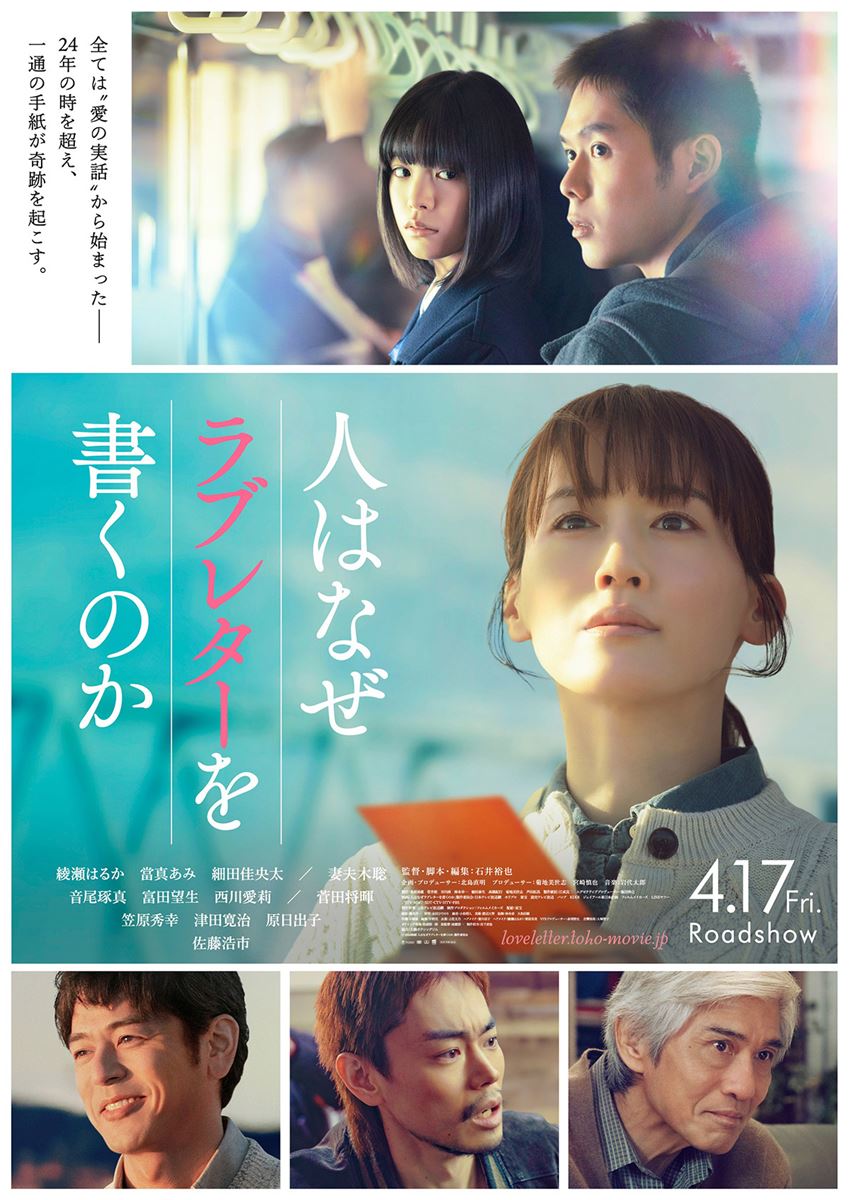
One Last Love Letter (人はなぜラブレターを書くのか, Yuya Ishii, 2026)

“Why do people write love letters?” is the question posed by the Japanese title of Yuya Ishii’s latest film, which turns out to be less about romance than the regret that stems from things left unsaid. Love letters, it seems to say, are written more for the writer than the recipient, but can, at the same time, bring about a sense of closure or peace of mind in having communicated something that would otherwise have lingered as an unresolved mystery.

The film is inspired by a real-life incident in which a bereaved family received a letter over 20 years after their teenage son’s death in a train accident from a middle-aged woman who’d had a crush on him at the time but never got a chance to say anything. It is, of course, also drawing inspiration from Shunji Iwai’s seminal 90s romantic melodrama Love Letter in which a young woman sends a letter to her late fiancé she doesn’t expect to be delivered only to get an unexpected reply. After receiving some upsetting news about a medical condition and being reminded of her own first love by her teenage daughter Mai’s (Airi Nishikawa) eerily similar experience, Nazuna (Haruka Ayase) is prompted to write a letter to Shinsuke (Kanata Hosoda), a boy she liked on the train, but eventually decides against sending it, only for it to end up being delivered anyway.

Her medical prognosis is, in some ways, the reason that Nazuna writes the letter, knowing that Shinsuke is already dead, and that writing it will allow her to sort out her own feelings. She says in the letter that there is no one else that she can talk to, though she has a husband and daughter she otherwise struggles to communicate with. She too afraid to tell her daughter that her medical condition has declined and is living in a kind of limbo state with something left permanently unsaid. To begin with, there are hints that Nazuna’s marriage is unhappy with her husband Ryoichi (Satoshi Tsumabuki) a perpetually gloomy presence who stays out late drinking alone after work presumably to avoid coming home. Likewise, his gruff instructions to Nazuna that she should give up her vegetable garden and cafe business come off as patriarchal and controlling, though his irritation later seems to be an expression of the pressure lack of communication is placing on the family unit. He wanted Nazuna to give up her vegetable garden out of consideration for her physical condition, but phrased it badly, and later changes tack to help out as he and Mai harvest the vegetables together. 

In that sense it’s a little ironic that it’s Mai who is the open communicator and directly asks her mother for romantic advice having also fallen for a boy on the train, though one in her class at school. Nazuna’s letter brings comfort to Shinsuke’s parents precisely because he had been an uncommunicative son and parts of his life remained a mystery to them. Shortly before his death, he had begun to open up, but they are still left with regret that they did not have the opportunity to talk more and left many things unsaid. It’s this realisation that prompts Nazuna to have a serious discussion with her daughter about her health and implications for the future, reducing the sense of distance and anxiety caused by a lack of communication and allowing them to come together as a family.

In the end, the daughter’s first love turns not to be such a big deal and is quickly forgotten in favour of the central messages of making sure you say everything that needs to be said while you can still say it rather than being left with lingering regrets. Mai comes to see her mother less as the “random weed” of her name, and more as a hardy plant that can grow anywhere meaning that Nazuna is still somewhere close by watching over her, so she feels secure in her maternal legacy and family history as she begins to embark on her own story. In its own way, the film itself is a kind of love letter from a daughter to a mother that brings its own kind of healing in bringing the past full circle.


One Last Love Letter screened as part of this year’s Toronto Japanese Film Festival.

Trailer (English subtitles)
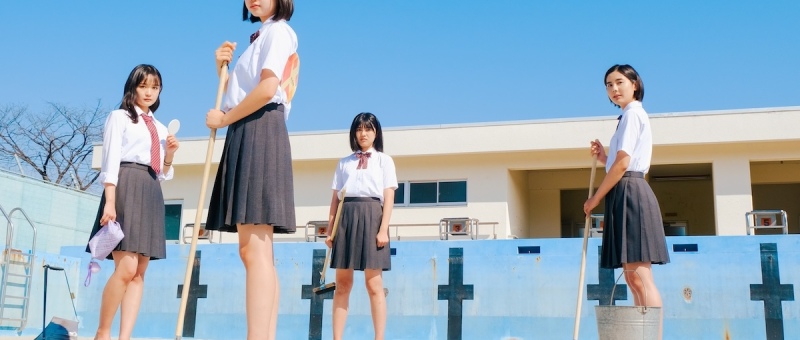
Swimming in a Sand Pool (水深ゼロメートルから, Nobuhiro Yamashita, 2024)

As the film’s title implies, the teenage girls at the centre of Swimming in a Sand Pool (水深ゼロメートルから, Suishin Zero Meter Kara) each find themselves pushing forward but meeting with resistance in Nobuhiro Yamashita’s deadpan teen comedy. Inspired by a high school play, the drama has a timely quality as each of the girls reconsiders what it means to be a woman while simultaneously insisting that gender doesn’t matter. In this case, however, it seems to matter a great deal as they’re forced into the “meaningless” and Sisyphean task of sweeping their swimming pool free of the sand that drifts over from the boys’ baseball game.  

As one of the girls, Chizuru (Mikuri Kiyota), suggests, the boys probably don’t realise (or care) how their actions are inconveniencing them. It’s the middle of summer and the pool is supposed to be undergoing maintenance in August which makes this pointless task seem even more absurd yet after trying to complain to their equally frustrated teacher Yamamoto they’re told they’ve got an attitude problem and it’s only “meaningless” because they’ve decided so in heir heads. As an adult woman, you’d think Yamamoto would have more sympathy or at least some kind of advice for the girls but only seems to want to drum mindless obedience into them, insistent that if she’s told them to do something then it must in fact have meaning. At the end of her tether she snaps that perhaps she doesn’t really like having to conform to the idea of what a teacher should be either, but seems clear that one must do it anyway. Still when a friend from home expresses surprise she’s staying in town over the summer to supervise students, Yamamoto bristles when she remarks that she now seems very like a teacher and is later seen having a covert smoke round the back of the school. 

Obsessed with rules and conformity, one of the chief reasons she’s disliked by the girls is a sense of treachery in having made one, Kokoro (Saki Hamao), humiliate herself by forcing her to participate in a swimming lesson while menstruating. Yamamoto complains that she didn’t ask for an exemption via the appropriate protocols, adding that some girls use it as an “excuse” for getting out of things. Repeatedly the girls accuse each other of using their gender to make excuses for themselves in backing down in front of the boys or allowing themselves to be constrained by social ideas of femininity. Gender is indeed something they seem to think about and dwell on, Kokoro constantly insecure in her appearance while insisting that a girl must be cute in order to count and this is the way she strives for equality with men while simultaneously insisting that gender equality is a myth.

For Miku (Reina Nakayoshi), meanwhile, the opposite maybe true in that she dances the male version of the local folk dance and has done since she was little though now wears a chest binder while she does. Miku seems hurt by Kokoro’s picking at her, eventually walking off and bumping into another girls, Rika, whom it appears she may have a crush on and is a sort of rival of Kokoro’s having beaten her to become manager of the boys’ baseball team. Another girl, Yui, seems to have a similar admiration for swimmer Chizuru but is frustrated by her having experienced a moment of existential crisis being beaten in a race by baseball team star Kusonoki with whom most of the other girls are in love.

What’s true, however, is that none of the girls can do much of anything while desperately trying to sweep up all the dust the boys chucked at them so they can get their pool back and finally swim again. “Don’t take high school girls lightly,” one insists, while another decides to make a “declaration of war” but only seems to elicit snickers from the boys. Nevertheless, through their time shovelling the sand, the girls seem to have come to their own conclusions about the role of gender in their lives and generally discovered a new kind of liberation both from their own self-imposed ideas and the sometimes repressive nature of education that reinforces them. A charming teenage summer comedy, Yamashita nevertheless captures an inspiring sense of rebellion from the students who will no longer be bound by outdated notions of what everyone else tells them they should be.


Swimming in a Sand Pool screened as part of this year’s Osaka Asian Film Festival.

Original trailer (no subtitles)