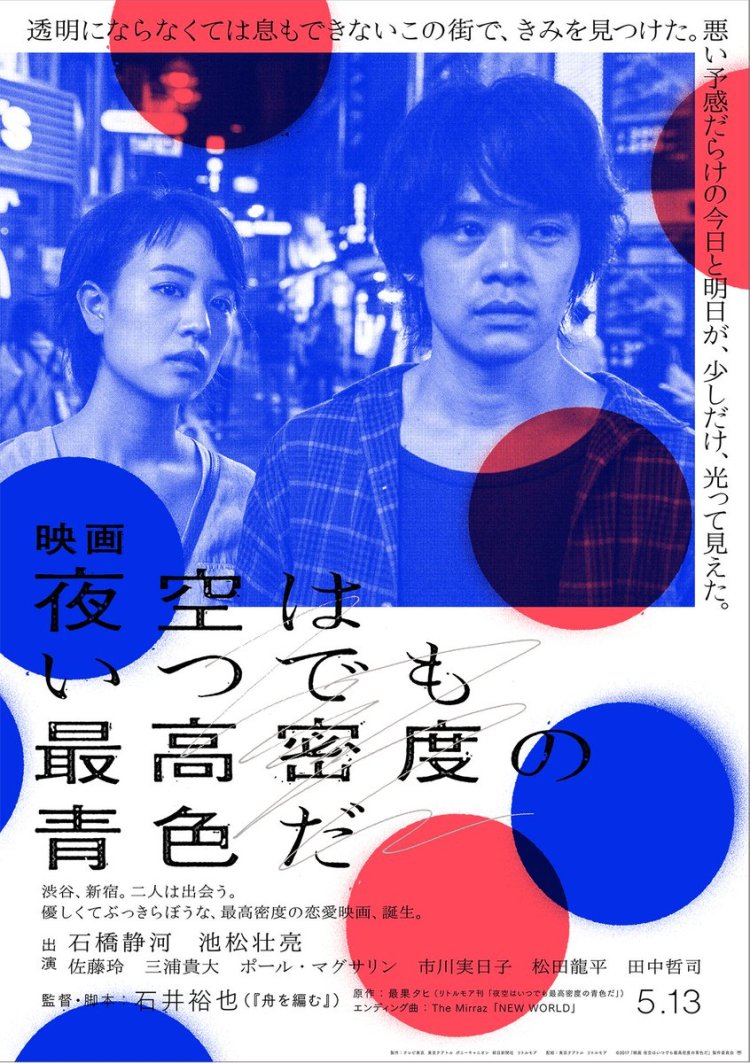
The Tokyo Night Sky is Always the Densest Shade of Blue (夜空はいつでも最高密度の青色だ, Yuya Ishii, 2017)

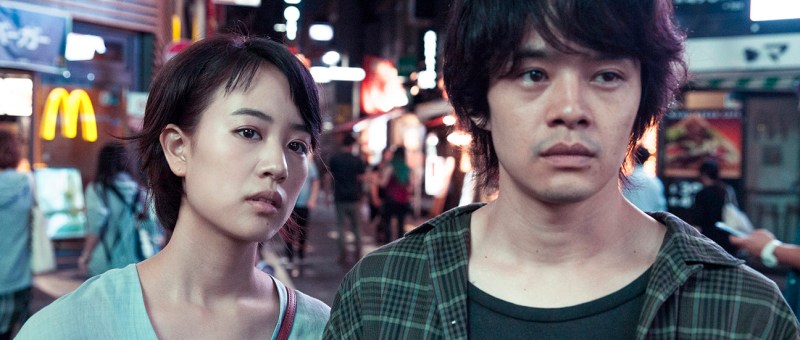
tokyo night sky posterLearning to love Tokyo is a kind of suicide, according to the heroine of Yuya Ishii’s love/hate letter to the Japanese capital, The Tokyo Night Sky is Always the Densest Shade of Blue (夜空はいつでも最高密度の青色だ, Yozora wa Itsudemo Saiko Mitsudo no Aoiro da). This city is a mess of contradictions, a huge sprawling metropolis filled with the anonymous masses and at the same time so tiny you can find yourself running into the same people over and over again. Inspired by the poems of Tahi Saihate, The Tokyo Night Sky is at once a meditative contemplation of city life and an awkward love story between two lost souls who somehow find each other in its crowded backstreets.

The heroine, Mika (Shizuka Ishibashi), works as a nurse by day and supplements her income by night as a bar tender in a “girls bar” (basically a normal bar where all the bartenders are female and you have to pay an entrance fee on top of your overpriced drinks). Depressed and anxious, she wanders the city with a poetic interior monologue expressing her constant loathing for its indifferent soullessness. Meanwhile, Shinji (Sosuke Ikematsu) is a casual day labourer working on various projects in the run up to the 2020 Olympics. He describes himself as odd and is over sensitive about being blind in one eye. Unlike his friends and colleagues, Shinji prefers literature to parties and solitude to company.

The two first catch sight of each other in a crowded bar where Mika is trying to buy time before having to head back to a dull double date with her drunken friend and the lewd guys she’s invited to come along, and Shinji is trying to read away from the noise and chaos of his lodging house. They meet again when one of Shinji’s colleagues suggests going to the girls bar, and then seem to be constantly running into one another for no particular reason.

Though romance would seem to be the natural outcome of the “pointless miracle” of their repeated meetings, the process is a slow one. It’s obvious the pair share a deep, innate understanding of each other but they each have various problems which conspire to keep them apart. Shinji, describing himself as odd and assuming he’s annoying, is prone to nervous babbling which Mika correctly guesses is less down to a love of his own voice than a fear of awkward silence. For her part Mika is anxious all the time, brittle and insecure she instinctively rejects attempts at intimacy but somehow warms to Shinji responding to his confession of oddness with a comforting “well then, you’re just like me.”

The pair advance and retreat as they wander around the city they both claim to hate but as much as they keep each other at a distance their lives begin to overlap and run in parallel. Mika receives a text from an ex (Takahiro Miura) with a confused declaration of love while Shinji receives one from an old high school classmate (Ryo Sato) with much the same effect. Mika insists that love makes you boring, that you’ll never find someone who is prepared to love the most pitiable part of you, and that there is no such thing as love on this planet, but her protestations point more towards a kind of soul-searching and buried hope than they do of active rejection.

Ishii marries the romantic undercurrent with an ambivalent portrait of the stratified city. Mika, a nurse by profession, needs to take a second job to make ends meet while the more traditionally working class Shinji is a sensitive intellectual relegated to dangerous and insecure employment. As a day labourer he gets no employment benefits like sick pay or insurance – hence when he’s injured on the job he avoids letting anyone know for as long as possible because it means both loss of wages and a doctor’s bill. An older friend (Tetsushi Tanaka) has ruined his back through long years of overwork and is now left with nothing while a Filipino migrant worker (Paul Magsign) pines for home and the wife and child waiting for him there.

Shinji’s anxieties are partly economic – trapped in insecure employment which may well, as his older friend points out, dry up once the Olympics rolls around but the greater problem is inertia. During their journeys around the city, Shinji and Mika run into the same busker (Yoshimi Nozaki) who is always singing the same strange song about her underarms sweating which seems to echo their shared anxiety. Yet the song she offers them also provides a note of hope as she enthusiastically reaches the “Ganbare!” chorus, cheering the pair of frightened lovers on and encouraging them to pursue their dreams and desires rather than waiting around for something to happen.

Waiting has been Mika’s problem. Saddled with intense abandonment issues stemming from childhood trauma, Mika is always sure something bad is about to happen. Shinji partly shares her anxiety often claiming that he has “a bad feeling” about something or other but conversely, he begins to believe that the “something” could be good as well as bad. Rather than try and argue with her, Shinji concedes most of Mika’s points, nobody knows what will happen in the future, nobody can make any promises, and everything ends someday but that’s OK – it’s only life.

Ishii’s Tokyo is a soulless place filled with the melancholy and the empty but there’s beauty here too, if only people would look up from their smartphones every now and then to see it. Mika is afraid of being swallowed by the city and becoming one of its faceless masses but her listlessness and depression stand for the city itself as she refuses and rejects the process of living with all of its attendant risks. Ishii paints the city in all the colours of the night, but for all of its beautiful sadness it’s also a place of noise and chaos where existence is exhausting and the price of living high. It is, however, also a place of ordinary miracles offering hope to the hopeless if only they are willing to accept it.


The Tokyo Night Sky Is Always the Densest Shade of Blue was screened at the 17th Nippon Connection Japanese Film Festival.

Original trailer (no subtitles)
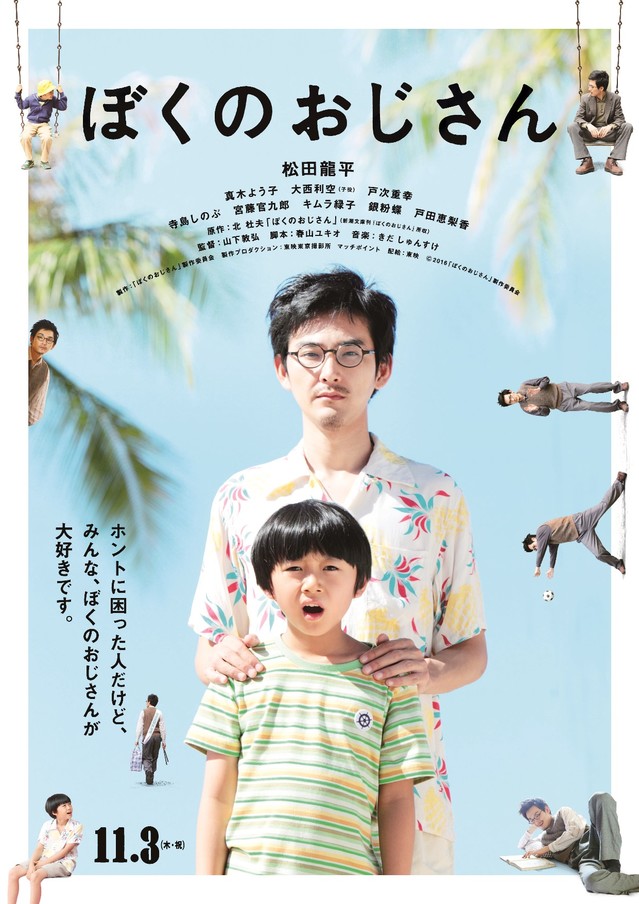
My Uncle (ぼくのおじさん, Nobuhiro Yamashita, 2016)

My-Uncle-p1Crazy uncles – the gift that keeps on giving. Following the darker edged Over the Fence as the second of two films released in 2016, Nobuhiro Yamashita’s My Uncle (ぼくのおじさん, Boku no Ojisan) pushes his subtle humour in a much more overt direction with a comic tale of a self obsessed (not quite) professor as seen seen through the eyes of his exasperated nephew. “Travels with my uncle” of a kind, Yamashita’s latest is a pleasantly old fashioned comedy spiced with oddly poignant moments as a wiser than his years nephew attempts to help his continually befuddled uncle navigate the difficulties of unexpected romance.
Yukio (Riku Ohnishi) has been given one of the most dreaded homework assignments ever – he’s supposed to write an essay about an “interesting” family member. This is a problem because Yukio thinks his family is very boring – dad is a civil servant, mum is a housewife, and his little sister is very frank but fails to generate sufficient interest for a whole essay. At this point, Yukio’s eccentric Uncle (Ryuhei Matsuda) enters the scene to enquire if the next edition of a children’s manga magazine has been released yet. Yukio says it has but he doesn’t buy it anymore because he’s grown out of it. Uncle hasn’t and wants him to buy one as soon as possible, convincing Yukio to pay 30% of the sticker price in the process. Annoyed, Yukio starts chronicling his Uncle’s strange adventures in school essay which proves a hit with his teacher (Erika Toda) who has accidentally become Uncle’s biggest fan.

Uncle lives with the family because he’s “a philosopher” which involves a lot of rejecting capitalist ideals and lying on his futon “thinking” or reading manga to give his brain a rest. Though Uncle’s brother and the father of the family (Kankuro Kudo) is content not to rock the boat, his wife (Shinobu Terajima) is often fed up with Uncle’s behaviour and is trying to set him up with proposals for an arranged marriage to get rid of him. Uncle is having none of it but is instantly smitten after being introduced to Japanese-Hawaiian photographer Eri (Yoko Maki). Eventually chasing her all the way to Hawaii with Yukio in tow, Uncle tries his luck with romance but only seems to get himself mixed up in even more unpredictable mischief.

There’s something so pleasantly innocent about My Uncle with its almost nostalgic tone and embrace of the surreality of everyday life. As seen through the eyes of Yukio, Uncle is not an entirely sympathetic figure at the beginning of the film. A part-time professor, Uncle talks big but spends his life rooting through ashtrays looking for smokable cigarette butts and collecting coupons to use for cheap dinners. Attempts to entertain the children backfire when he gifts them a very realistic plastic toy of a giant millipede though he does sometimes take Yukio out on “thinking expeditions” – usually on weekends and holidays to not be in the house to be shouted at by Yukio’s parents who are rapidly loosing patience with Uncle’s inability to progress in life.

If this were a series (and one could only hope) you could easily call the first instalment “Uncle Falls in Love” as Uncle finds himself finally thinking about settling down with the beautiful and outgoing Eri. Eri does seem to be among the few people who finds Uncle’s unusual qualities charming though he might need to rethink his plan of action if he’s finally to win her heart. Unfortunately, Eri is about to move back to Hawaii but invites Yukio and Uncle to visit. Uncle is desperate to go but as he can’t even afford to buy cigarettes, international travel is out. Undeterred, Uncle comes up with a number of labour intensive schemes to get there rather than actually working for the money but eventually makes it with Yukio’s help. There is, however, a rival on hand in Eri’s former boyfriend Shinsuke (Shigeyuki Totsugi) who is equally determined to win her back.

Life with Uncle may be one of constant exasperation but as Eri points out it’s never boring. Whether he’s getting himself arrested for accidentally buying weed or making up wild stories about himself in a misguided attempt to impress people, Uncle lives on a different plane of existence. Yukio reflects on all of this with a world weariness worthy of a 70 year old man but eventually comes to a kind of grudging affection for his silly old Uncle who is quite clearly setting himself up for a fall even if he has his heart in the right place. Yamashita mixes in poignant moments such as a reflective look over Pearl Harbour which gives rise to a discussion of life as a Hawaiian citizen of Japanese descent during the war, but broadly the tone is a bright one of zany humour and ironic one liners. Hilariously funny in a gentle, old fashioned way, My Uncle is Yamashita in full on comedy mode but all the better for it even as he leaves us desperate to find out what other strange adventures befall Uncle in the continuing saga of his existence.


My Uncle was screened as part of the Udine Far East Film Festival 2017.

Original trailer (no subtitles)

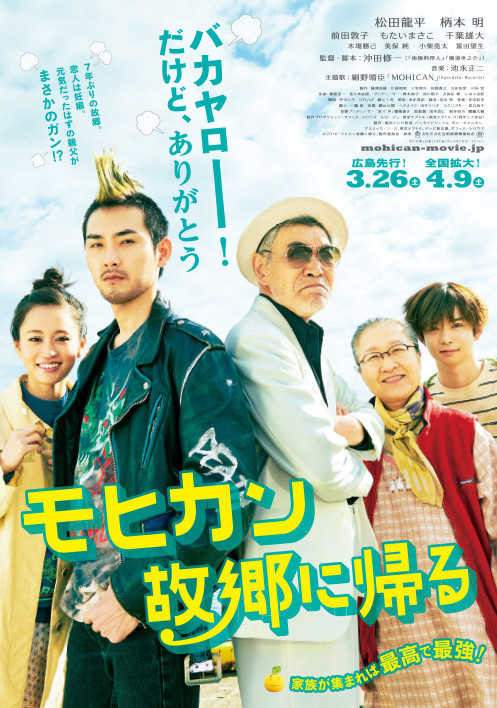
The Mohican Comes Home (モヒカン故郷に帰る, Shuichi Okita, 2016)

mohican-comes-homeJapan may be famous for its family dramas, but there is a significant substrain of these warm and gentle comedies which sees a prodigal child return to their childhood home either to rediscover some lost aspect of themselves or realise that they no longer belong in the place which raised them. Shuichi Okita’s The Mohican Comes Home (モヒカン故郷に帰る, Mohican Kokyo ni Kaeru) includes an obvious reference in its title to Keisuke Kinoshita’s colourful 1954 escapade Carmen Comes Home which cast legendary actress Hideko Takamine somewhat against type as a ditsy airhead show girl eager to show off all her city sophistications to the rural backwater she abruptly ran out of some years before. Like Carmen, the hero of Mohican Comes Home makes an unexpected trip to visit his family in the picturesque Hiroshima island village where he grew up only to find not very much has changed but an equally unexpected tragedy prompts him into a wider consideration of his past and future as he faces life’s two extremes in the very same moment.
Eikichi (Ryuhei Matsuda) left his island home some years ago for the bright lights of Tokyo where he fronts a punk band by the name of Grim Reapers. The band has some moderate underground success, but the guys are getting old for the punk scene and finding themselves with real world responsibilities from healthcare costs to the prospects of supporting wives and children. Eikichi, sporting a prominent bleached mohawk, feels this more than most as he’s soon to become a father and is intending to marry his pregnant girlfriend, Yuka (Atsuko Maeda), if only he had the money. He’s been promising to take his future wife to meet his parents for some time but so far they’ve never actually made the trip.

This time, things are different and so Eikichi makes a shocking return after seven years only to wander in during an awkward scene as his mother and younger brother try to manoeuvre his drunken father into a more convenient position whilst protecting his precious white suit from alcohol born ruin. Eikichi’s family own the village liquor store but his father’s passion is for music and he also coaches the local middle school band. A devotee of legendary Hiroshima born superstar Eikichi Yazawa, Osamu (Akira Emoto) insists the kids play his favourite tune ad nauseam to much eye rolling from the youngsters forced to associate themselves with such an uncool and old fashioned song.

Eikichi’s homecoming has not got off to the best start, especially after his father begins to sober up and recommends a hair cut and real job, both of which Eikichi resolutely refuses. Things take a more serious turn when Osamu realises his son is being financially supported by his girlfriend whom he has also got pregnant but is not yet married to. Experiencing extreme moral outrage at his responsibility shirking son, Osamu chases him around the table in what appears to be a scene often repeated during Eikichi’s childhood but the situation soon ends in an unexpected way foreshadowing Osamu’s decline into ill health.

Deciding to stay a little longer than intended, Eikichi and Yuka blend into the family home trying to help mother Haruko (Masako Motai) and boomerang younger brother Koji (Yudai Chiba) adjust while Osamu is in the hospital. The contrast between town and country, traditional and modern is never far from view whether in Yuka’s kindhearted decision to finish off preparing the family dinner though she has to consult a youtube video to find out how to gut fish, or in her astonishment at the very ordinary way in which her future in-laws met (i.e. simple propinquity). While the women begin to bond over their shared concern for their men as Haruko decides to teach Yuka some home style tips and tricks, Eikichi and his father spar with each other warmly as Eikichi takes charge of a band rehearsal and allows them to let loose on the much hated song with an energised punk fuelled twist.

Despite a strained relationship with his father, Eikichi is a good person who also wants to offer some kind of comfort to the old man in his final days. Going to great lengths to track down a particular pizza Osamu suddenly requests (the last time he ate pizza was on his 60th birthday) or eventually pretending to be Yazawa himself whom Osamu is very proud to have made eye contact with during a Tokyo concert in 1977, Eikichi comes to a kind of understanding of the man his father was as well as the man he is. Full of warm, naturalistic humour giving way to two elaborately constructed set pieces, The Mohican Comes Home is a typically well observed family drama from Okita which neatly undercuts its essentially melancholy set up with a layer of stoical perseverance.


Screened as part of the Japan Foundation Touring Film Programme 2017.

Original trailer (no subtitles)

9 Souls (ナイン・ソウルズ, Toshiaki Toyoda, 2003)

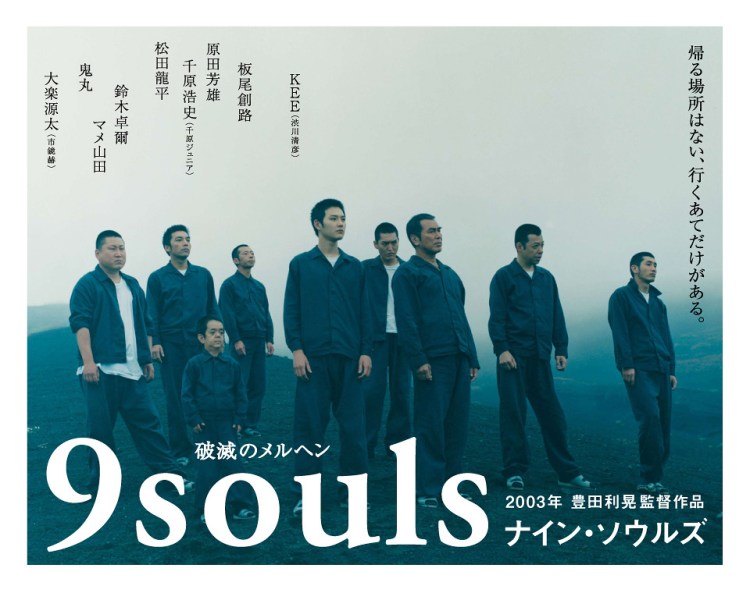
9-soulsToshiaki Toyoda has never been one for doing things in a straightforward way and so his third narrative feature sees him turning to the prison escape genre but giving it a characteristically existential twist as each of the title’s 9 Souls (ナイン・ソウルズ) search for release even outside of the literal walls of their communal cell. What begins as a quirky buddy movie about nine mismatched misfits hunting buried treasure whilst avoiding the police, ends as a melancholy character study about the fate of society’s rejected outcasts. Continuing his journey into the surreal, Toyoda’s third film is an oneiric exercise in visual poetry committed to the liberation of the form itself but also of its unlucky collection of reluctant criminals in this world or another.
Former hikkikomori Michiru (Ryuhei Matsuda) is being thrown in at the deep end as the 10th prisoner in a crowded communal cell to which he has been consigned after the murder of his father. Not long after he arrives, one of the veteran inmates who had been assigned to him as a mentor and goes by the nickname of The King of Counterfeiters (Jun Kunimura), suddenly has some kind of psychotic episode where he goes off on a long monologue about a buried time capsule and the key to the universe before being dragged off somewhere by the guards. Right after that, a little mouse turns up signalling the probability of a mouse hole somewhere in the cell. Master escape artist Shiratori (Mame Yamada) somehow comes up with a plan to use this information in order for everyone to escape, which they do, emerging from a pipe into the blue tinted landscape and making a break for freedom.

Commandeering a camper van from a young man terrified of ghosts, the gang of nine hit the road heading for a primary school where their cellmate’s time capsule promises an untold fortune in counterfeit currency. What they find there is unimpressive except for a strange looking key which they decide to give to Michiru because they’re a bunch of guys who appreciate irony. At a loss again, each begins to think about the circumstances which brought them to this point, wondering if there’s a way back or if anyone is still waiting for them.

Less than a prison break movie, 9 Souls shares more in common with the return to Earth genre in which a recently deceased person is given a second chance to deal with some unfinished business until they are finally able to accept the inevitable. Though the prisoners have each committed heinous, often violent or unforgivable crimes, they each have dreams and aspirations which were previously denied to them but may just be possible now given their extremely unusual circumstances. Sometimes those dreams are heartbreakingly ordinary – falling in love, getting married and opening a small cafe in the countryside, for example, or attending your daughter’s wedding and being able to give her a wedding present in person. Try as they might, the prisoners are only able to gain a small taste of their hopes and dreams before they all come crashing down again, leaving them with only their fellow escapees to rely on.

Looking forward to Toyoda’s next film, The Hanging Garden, 9 Souls also takes a sideways view of that most Japanese of topics – the family. Michiru came from an extremely dysfunctional environment in which his mother abandoned him and he was forced to kill his own father only for his younger brother to then betray him. Veteran prisoner Torakichi (Yoshio Harada) unwillingly becomes the “father” of the group though he was imprisoned for the murder of his son. This perfect symmetry of a fatherless son and sonless father adds to the circularity of Toyoda’s tale as each is forced to reassume their familial roles within the equally forced genesis of the prison cell family. In the outside world, each of the prisoners is searching for only one thing – acceptance, but each finds only that which they feared most, rejection. Once again cast out from mainstream society as they had been all their lives, the prisoners are left with nowhere else to go but the mystical destination offered to them by the counterfeiter’s magic key.

The truck driver’s strange fear of ghosts comes back to haunt us at the end of the film as the van, now painted a peaceful sky blue complete with fluffy clouds as opposed to the hellish red of the ironically named “lucky hole”, begins to fill up with departing spirits each finding their exit in one way or another. A man who helped his son to die will now have to save another, while a boy who locked himself inside his room will have to turn the key and open a door on eternity. Swerving from absurd comedy to deeply melancholic meditations on guilt, redemption, and a failing society, 9 Souls is among the most poetic of Toyoda’s early works swapping the rage which imbued the young of Pornostar for the sorrowful resignation of experience.


Available now in the UK as part of Third Window Films’ Toshiaki Toyoda: The Early Years box set.

Original trailer (English subtitles)

Tokyo Serendipity (恋するマドリ, Akiko Ohku, 2007)

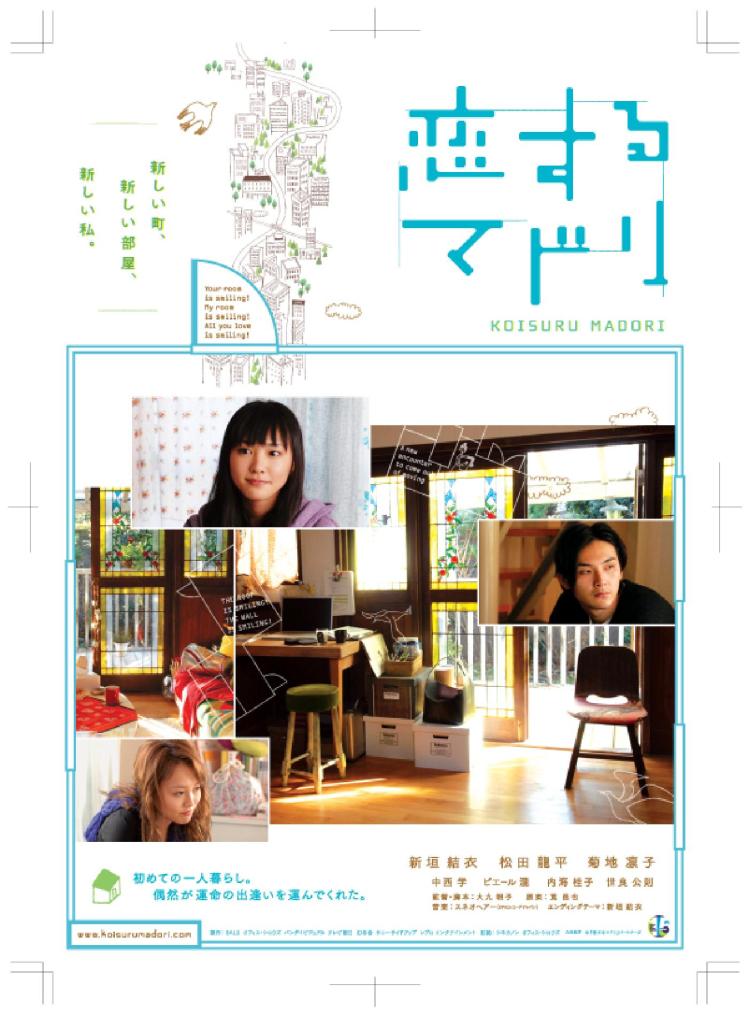
tokyo-serendipityCities are often serendipitous places, prone to improbable coincidences no matter how large or densely populated they may be. Tokyo Serendipity (恋するマドリ, Koisuru Madori) takes this quality of its stereotypically “quirky” city to the limit as a young art student finds herself caught up in other people’s unfulfilled romance only to fall straight into the same trap herself. Its tale may be an unlikely one, but director Akiko Ohku neatly subverts genre norms whilst resolutely sticking to a mid-2000s indie movie blueprint.
Yui Aoki (Yui Aragaki) is in search of a new apartment. She had been living in an unusual old fashioned building with beautiful stained-glass windows, but her sister’s in line for a shotgun marriage and if that weren’t trouble enough the apartment is set for demolition. Living on her own for the very first time, Yui moves into a smallish modern apartment in a building filled with various eccentric residents.

One in particular catches Yui’s attention – her mysterious upstairs neighbour, Takashi (Ryuhei Matsuda). By coincidence, Yui ends up working with Takashi at his lab where she learns he’s still broken up about a girlfriend that left him flat without even a word of goodbye. Remembering she left something behind at her old place she ends up meeting the new tenant, Atsuko (Rinko Kikuchi), and striking up a friendship with her over a shared interest in homemade furnishings. The coincidences continue as Yui discovers she and Atsuko have accidentally swapped apartments! Through this odd chain of events Yui also figures out that Atsuko is Takashi’s long lost love, but is hopelessly trapped in the middle, unsure of whether she should reveal this information to either party. Of course, her developing feelings for both Atsuko and Takashi place her in a series of difficult positions.

Tokyo Serendipity was sponsored by an interior design company and so it’s no surprise that the film makes quite a lot out of its production design. The fashion choices are very much of the time and favour quirky, individual aesthetics rather than an Ikea-esque off the peg minimalism. The original apartment which is soon to by bulldozed is an artist’s dream with its hidden fireplace, old fashioned furniture, stained glass windows and well lit interior. Broadly inspirational in this regard, it’s a thrifty kind of homestyle which prizes recycled materials and repurposed furnishings as opposed to the trendy high price surroundings of other parts of the city.

Like many other films of its kind from this era, Tokyo Serendipity adopts a natural, if occasionally surreal, approach filmed with a deadpan camera. The film’s one repeated large scale gag – a group of lucha libre wrestlers who work as removal men during the day, is a good example of this as their not improbable existence somehow seems oddly funny. They drop things but only in the ring – so they say, each of them well built men treating Yui’s precious goods as daintily as children using real china at a tea party. The humour could best be described as subtle, yet does succeed in raising a smile here and there.

Smiling turns out to be the film’s main message. In fact Ohku even states that her intention in making the film was solely to leave people with a smile of their faces – something which she broadly achieves. Atsuko, a slightly lost middle aged woman, claims she became an architect as she wanted to build a house with everybody smiling – something Yui echoes as she comes to a few conclusions of her own nearing the end of the film. However, Atsuko’s desire for harmony in all things is one she’s never been able to fulfil as childhood abandonment has left her with lingering commitment issues. Simply put, she always leaves first. Interestingly enough, Yui’s burgeoning romance takes a backseat to her growing friendship with Atsuko and a half-formed acknowledgment of middle-aged regrets she’s still to young to fully understand.

Despite amassing almost all of the conventional romantic comedy/drama motifs from a last minute dash to the airport and misdirected letters to an embarrassing scene where a relative is mistaken for a lover, Ohku rejects the romantic model as her central character wisely recognises exactly where she stands in this awkward situation and makes a sensible decision motivated by the best interests of both of her friends. Straightforwardly indie in style, Ohku keeps the quirk on a low simmer but manages to make her heightened reality seem perfectly natural. An unusual coming of age film trapped inside an indie romance, Tokyo Serendipity is like one of the tiny hidden spaces the film seems to like so much, though upon opening the door some will be more impressed with what they find than others.


Original trailer (no subtitles)

https://www.youtube.com/watch?v=9ymV8oQhpJs

Love Ghost (死びとの恋わずらい, Kazuyuki Shibuya, 2001)

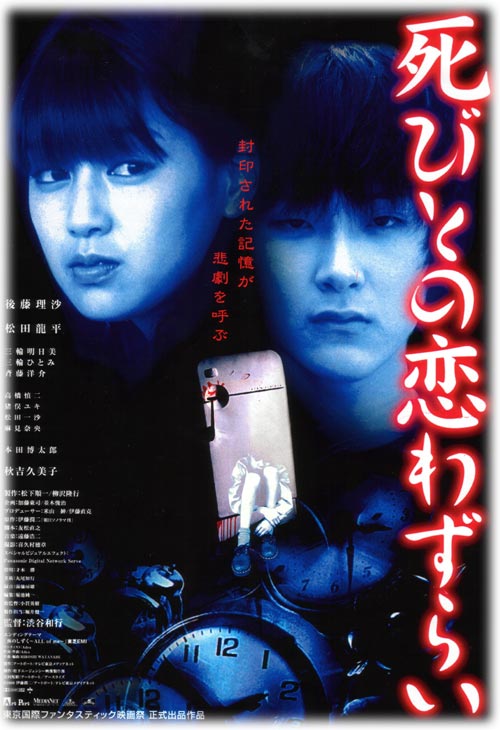
love ghost posterWhat is it about ghosts and high school girls? Maybe it’s shrines and graveyards mothers ought to be warning their daughters about rather than moody guys with motorbikes. Anyway, the somewhat salaciously titled Love Ghost (死びとの恋わずらい, Shibito no Koiwazurai) is not quite the film it claims to be, though it is haunted by the violent spirit of strong emotion. Innocent high school romance is suddenly infected with the cruel complications of adult love, mental illness, and suicide as a strange curse descends over a previously peaceful town.
Taking on the classic “mysterious transfer student” role, protagonist Midori (Lisa Goto) is about to set off for her first day in a new school after moving back to her home town ten years after her father left the family for another woman. Midori is frequently plagued by a recurring nightmare in which she indulges in the local practice of Tsuji-ura whereby girls wait near the temple and ask a passerby what they think their chances are with their current crush. Only, Midori’s visions have started to bleed into the real world and often end in a storm of fire and blood. For this reason she finds herself unable to enter the school building but is rescued by new classmate, Suzue (Asumi Miwa), who shows her another way in. On the way the pair meet clueless popular boy Kotaro (Takahashi Shinji) who is instantly smitten with the new girl, much to Suzue’s consternation.

Kotoro is, to put it mildly, a little on the dim side and either hasn’t noticed that the entire population of the school, including his good friend Suzue, is love with him or is just refusing to acknowledge it. Romance is the major occupation of the school girls who spend their break times reading tarot cards and talking about Tsuji-ura and the handsome boy dressed in black who often appears there, be he a force for good or ill. Midori isn’t really interested in her classmates but is captivated by the near silent boy at the back of the room whom everyone else is ignoring. She eventually recognises him as a boy she knew before she left and used to play with all the time. Meeting up on the roof, Ryusuke (Ryuhei Matsuda) reveals he’s been waiting for her to come back all this time. However, there is definitely something strange about this quiet boy, not to mention the ever expanding mould stain in Midori’s bathroom…

There’s a lot of obviousness in Love Ghost, but this is later revealed to be a master stroke undercutting the extreme reversals of the big reveals. Madness quickly takes hold in the school, fortunately it does not claim many victims though those who do succumb find themselves cutting their own throats out of sense of heartbroken helplessness unable to accept the fact that their romantic destinies are not the ones they would have chosen.

On the one hand there are Midori’s recurrent memories of her idyllic childhood playing with Ryusuke in beautiful green, sunlit forests which later gives way to tentative teenage romance – a perfectly natural development. However, that’s set against the increasing strangeness of the environment with its oddly ethereal atmosphere. The other girls are experiencing a dangerous kind of romantic madness turning to obsessive, unrequited love yet Midori’s own experience is seemingly a gentle and innocent one. Of course, there’s more to it than that, and Midori’s world is also “unreal” in a hundred other ways. As usual, her link to the curse is tied up with her long buried past which must once again be exposed to the light in order to move forward and finally bid goodbye to the ghosts of forgotten cruelty.

Love Ghost’s central curse is a little confused and never satisfactorily explains itself. There might be more to say about the way the intense emotions of adolescence don’t always dissipate on reaching adulthood in the way they are supposedly intended to, or about the obsessive preoccupation the schoolgirls have with romance, but Love Ghost isn’t interested in any of that. In fact, it’s a little confused what it is interested in but at heart its a series of intertwined ghost stories as Midori haunts herself whilst still alive with memories of the childhood cruelly ripped away from her by the selfish actions of a stranger which have also left her with a deep seated sense of unresolved guilt. An imperfect exercise, Love Ghost has little to recommend it aside from providing an early outing for later star Ryuhei Matsuda yet does offer a poetic, if poorly put together, take on a teen ghost story that is like to offer more to fans of supernatural romance than of J-horror gore.


Love Ghost is available on R1 US DVD from Tokyo Shock.

US release trailer:

The Suicide Song (伝染歌, Masato Harada, 2007)

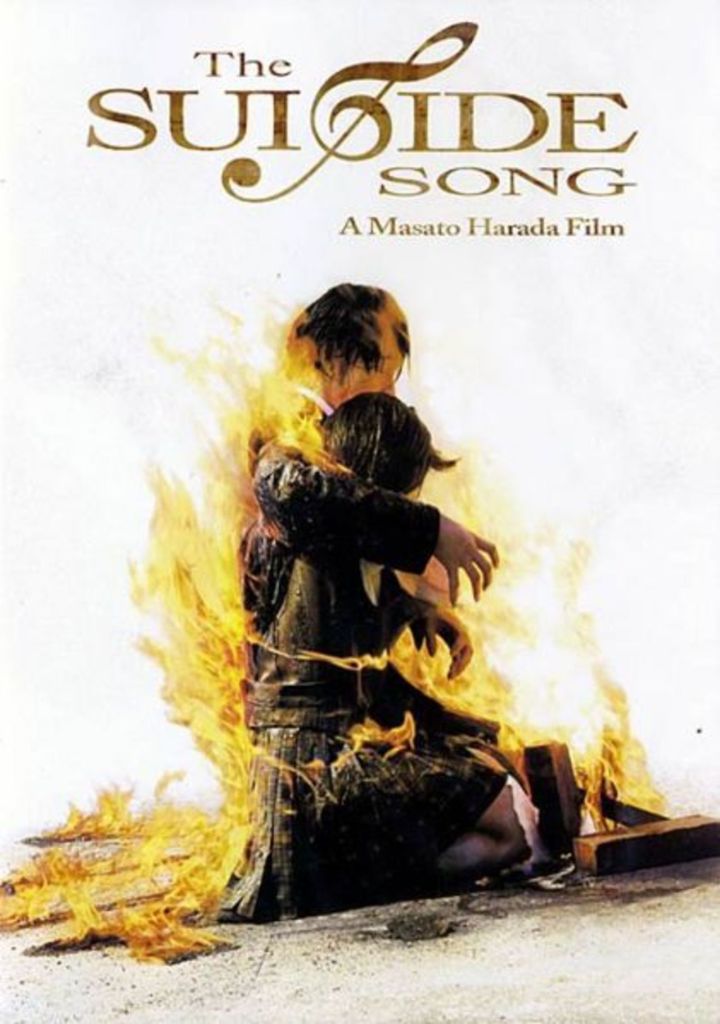
Suicide Song US Tokyo Shock DVD Cover
US Tokyo Shock DVD cover

There comes a time in every director’s life when fate leads them down the strangely tempting path of the idol movie. In recent years, sweet and innocent is no longer quite enough to cut it and when your film stars a bunch of kids from AKB48, you’re going to need 48x the kawaii factor so even though the DVD cover is suitably macabre and The Suicide Song (伝染歌, Densen Uta) is marketed as a J-Horror movie, there’s quite a lot more singing and dancing than might be reasonably expected.

In true idol star horror movie fashion, the film begins with some cutesy high school scenes before one student, Kana (Atsuko Maeda), starts in on her teacher who basically wants to skip a whole bit of the text book because it’s not on the exam. The potentially irrelevant teaching matter concerns famous Japanese playwright Chikamatsu whose big thing was, you guessed it, double suicides. Shortly after this, Kana is heard singing a weird song and then cuts her own throat with a kitchen knife right in front of her friend and classmate, Anzu (Yuko Oshima). It seems there has been a spate of these spontaneous suicides of teenage girls which occur after singing this particular song so skeevy newspaper guys Macasa, led by occult obsessed Riku (Ryuhei Matsuda ) and his ex-military buddy Taichi (Yusuke Iseya), decide to do some “investigative journalism”. Anzu and some of the other kids wind up helping out too, eventually coming under threat of that very same curse….

The idea of a “suicide song” isn’t a new one. Gloomy Sunday – a 1930s Hungarian folk song which achieved widespread acclaim thanks to an English language cover version recorded by Billie Holiday in 1941 became an urban legend after numerous suicides were linked to the doleful track and its extremely bleak lyrics. This time around, it’s AKB48’s inoffensive Boku no Hana which apparently drives anyone who tries to sing it to their deaths. Like Gloomy Sunday, the song features extremely nihilistic lyrics which echo the existential confusion and romantic disillusionment that many of its young listeners are undoubtedly experiencing. A perfectly rational explanation for why so many young women might be taking their lives with this particular song on their lips, yet Suicide Song is not particularly interested in exploring the various real world pressures which might push high school students towards death when their lives ought to be just beginning.

It’s not long before the curse makes the leap to supposedly solid adult males. Later, one character tries to weaken the importance of the song by suggesting that it just opened a door for the suppressed feelings that were already there. That each of the victims already wanted to die and and simply allowed themselves to make use of this real world meme to give themselves permission to end it all. This is an interesting idea in some ways, though comes close to victim blaming and conveniently lets the central characters off the hook for failing to save their friends who have already fallen for what is either a curse or mass hysteria. In any case, like most Japanese horror movies and mysteries, the real villain is a circle of buried secrets. The traumatic past must be faced, brought out into the light and then given a proper burial to end the ongoing chaos.

Harada is playing a very strange game. He adds in generic J-horrorisms such as odd jump cuts, stuttering, power outages and possessed video footage as well as a good deal of shadiness in the form of the low rent newspaper guys and the investigation turning up something as dark as a teenage gang competing to see how many kids they can get to kill themselves using the song as a marker. Yet, he generally keeps things cute and light just like your average teen idol romance movie. We’re even treated to a very special AKB48 performance at their club in Akihabara (“Japan’s Most Sophisticated Show” !) where they sing Aitakatta for a room full of devoted middle aged guys who are their biggest fans. There are also frequent cinematic quotations from such Hollywood classics as Vertigo and The Lady From Shanghai (not to mention a completely shoehorned in paintball sequence using Ride of the Valkyries a la Apocalypse Now) which seem to hint at some kind of greater plan, but whatever it is never quite materialises.

Whatever Harada’s intentions may have been, Suicide Song is a strange beast which veers widely in tone from wacky comedy to supposed horror film. In actuality there are very few real scares despite the J-horror aesthetic and the comedy never amps itself up to the level of parody. If the intention was to create some kind of weird, subversive genre hybrid, the punches have been well and truly pulled. Watched as a horror movie Suicide Song is prone to disappoint, though its moments of absurd comedy and cute schoolgirl drama prove enjoyable enough for those able to adjust their expectations on the turn of a dime.


The Suicide Song is available with English subtitles on R1 US DVD from Tokyo Shock.

English subtitled trailer (aspect ratio is slightly stretched):

https://www.youtube.com/watch?v=PT2vVgmwb10

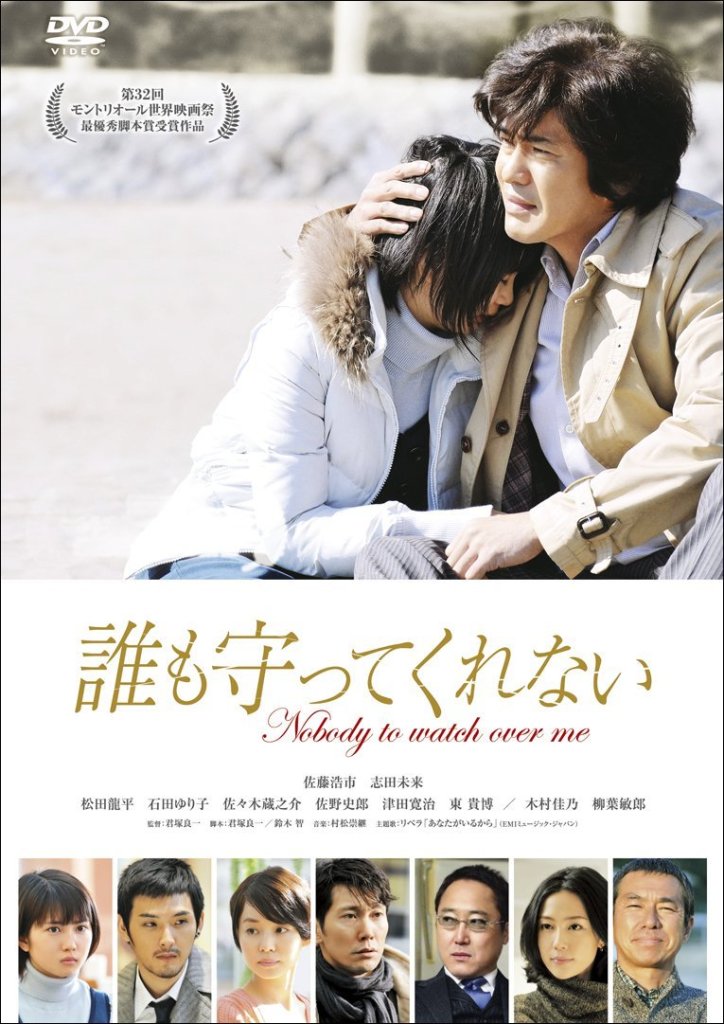
Nobody to Watch Over Me (誰も守ってくれない, Ryoichi Kimizuka, 2009)

Nobody to Watch Over MeWhen a crime has been committed, it’s important to remember that there may be secondary victims whose lives will be destroyed even if they themselves had no direct involvement in the case itself. This is even more true in the tragic case that person who is responsible is themselves a child with parents and siblings still intent on looking forward to a life that their son or daughter will now never lead. This isn’t to place them on the same level as bereaved relatives, but simply to point out the killer’s family have also lost a child who they have every right to grieve for, though their grief will also be tinged with guilt and shame.
Nobody to Watch Over Me (誰も守ってくれない, Dare mo Mamotte Kurenai) takes the example of one particular case in which an 18 year old boy has brutally stabbed two little girls in a park and then returned home as if nothing out of the ordinary had happened. After the boy is arrested, his family is caught up in a firestorm of police and press interest, barely able pause and come to terms with the surreal events that are taking place. No sooner has their son been dragged off in handcuffs than a troupe from the family court arrives with pre-printed documents which will arrange for a divorce and remarriage between the parents so that they can revert to the wife’s maiden name in an attempt to avoid the stigma of being related to a child killer. After being bamboozled into signing a number of papers with barely any explanation the family is then split up for questioning and taken to separate locations to try and throw off the press.

Grizzled detective Katsuura (Koichi Sato) is charged with looking after the murderer’s younger sister, Saori (Mirai Shida) – a 15 year old high school student. Katsuura is enduring some familial conflict of his own and was due to be taking a family holiday to try and work things out, so he’s a little distracted and put out about needing to shield this quite uncooperative teenager from the baying masses. He’s also suffering a degree of PTSD from a traumatic incident some years previously in which a case he was involved in went horribly wrong resulting in the death of a small boy. Understandably, Saori is in a state of shock, left alone with strangers to try and cope with this extremely stressful situation and unwilling to betray her brother by submitting to the police’s constant demands for information.

The police themselves aren’t always the benign and and comforting presence one might hope for on such an occasion as Katsuura’s superior has one eye on a possible promotion if he can exploit this high profile case for all its worth and is intent on pressing this innocent teenage girl as if she were some kind of war criminal. The family are treated with a degree of suspicion and contempt, as if they were directly or indirectly complicit in the violence created by their son or brother.

In actuality, there may be a grain of truth in this as the film also begins to offer some social critique of the modern family and the pressures placed on young people in the contemporary world. When questioned about their son, the mother remains more or less silent but the father angrily replies that he raised his son “strictly”. The family had high expectations and didn’t take academic failure lightly. From middle school onwards, they kept their son at home to study allowing him little outlet for anything else and, it seems, he was sometimes physically disciplined for a lack of progress.

Katsuura’s family is under threat too, perhaps placed under pressure following Katsuura’s personal disintegration over having been prevented in his attempts to save the life of the small boy some years previously or just from the constant insecurities involved being the family of a policeman whose working schedule is necessarily unpredictable. Though originally becoming fed up with Saori’s lack of cooperation, Katsuura eventually develops a protective relationship with her perhaps because she reminds him of his own teenage daughter. Given that the police are to some degree her enemy as they are the ones that have taken away her brother and separated her from her parents, it’s not surprising that she doesn’t immediately warm to Katsuura but after being betrayed by someone she believed was a true ally, she finally understands that he is firmly on her side and trying to protect her from a very real series of threats.

The modern world is shown up for all of its voyeuristic obsession with the horrifying and the taboo. The family are swarmed by press but it’s the internet that becomes the major aggressor as it publishes not only the boy’s real name, but even his parents’ address and the addresses of other people involved with the case. Self proclaimed social justice crusaders react like parasites glued to bulletin boards trading information on notorious crimes for a kind of internet fame, not caring about the facts of the case or that there are real people involved here who are already grieving. Taking the “I blame the parents” mentality to its extreme, even more distant members of the killer’s family are expected to trot out an apology for the cameras even though it’s really nothing to do with them and isn’t going to do anyone any good anyway.

Kimizuka shoots the first part of the action with a breathless intensity, mimicking hand held, on the ground news reporting to convey just how frightening and disorientating this must be for anyone unlucky enough to be caught up in a media storm. The use of choral music and occasional melodramatic touches near the end perhaps undermine the film’s emotional power which never quite coalesces in the way it seems to want to. However, Nobody to Watch Over Me is a fascinating and rich exploration of the public’s obsession with true crime stories coupled with an extreme tendency towards victim blaming and the need to hold to account those close to the perpetrator of a crime even if they had little to do with it themselves. Frightening yet hopeful in equal measure, Nobody to Watch Over Me offers scant comfort but does at least begin to ask the question.


The region 3 Hong Kong DVD release of Nobody to Watch Over Me includes English subtitles.

English subtitled teaser trailer:

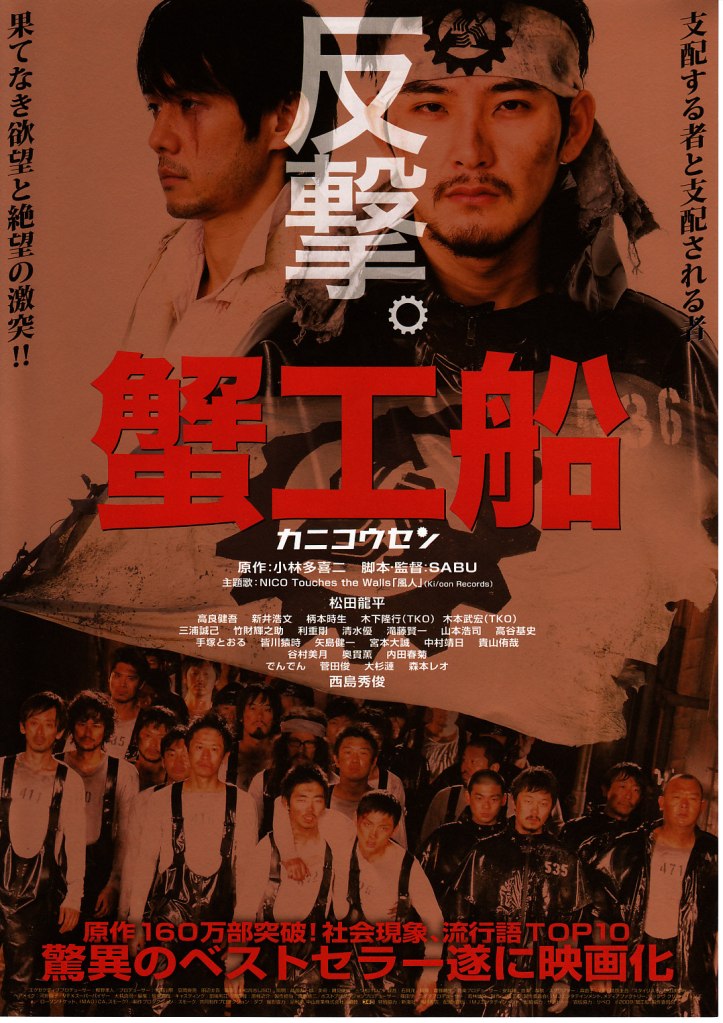
Kanikosen (蟹工船, SABU, 2009)

kanikosenBack in 2008 as the financial crisis took hold, a left leaning early Showa novel from Takiji Kobayashi, Kanikosen (蟹工船), became a surprise best seller following an advertising campaign which linked the struggles of its historical proletarian workers with the put upon working classes of the day. The book had previously been adapted for the screen in 1953 in a version directed by So Yamamura but bolstered by its unexpected resurgence, another adaptation directed by SABU arrived in 2009.
As in the book the film follows the lives of a group of men virtually imprisoned on a crab canning ship anchored near Russian seas in the 1920s. The men on the boat are of various ages and come from various different backgrounds but each is here out of necessity – nothing other than extreme poverty and lack of other options would ever persuade anyone to take on this arduous and often unpleasant line of work. Technically speaking the boat has a captain but it’s the foreman who’s in charge – dressed like a European officer in a white frock coat and riding boots and with a vicious looking scar across his left eye, Asakawa rules the waves, barking out orders and backing them up with a walking stick.

SABU films the workers’ struggles through the filter of absurdist theatre beginning with a darkly comic segment in which each of the men recount their poverty riddled circumstances and dreams for social advancement before one, Shoji, emerges and posits another idea. They will make a bid for everlasting freedom by committing mass suicide in protest to poor working conditions and consistent exploitation of their class by those above. Predictably, this fails when everyone realises they didn’t actually want to die in the first place. Later Shoji and another man are picked up by a Russian boat after being stranded at sea and after seeing how happy the Russian sailors seem to be, they return determined to enact the revolution at home.

Conveying the workers’ plight through production design, SABU opts for a packing room which is both oversized yet claustrophobic, filled with giant cogs and gears of the capitalist system in motion. The men are little more than fleshy gears themselves, just another piece of the production line to be thrown out and replaced once worn through. Gradually the workers start to realise that this system is only sustainable because of their own complicity. The foreman is, after all, only one man and the workers have made a decision to obey him – they also have the ability to decide not to. That said, the spanner in the works is that the foreman also represents the larger mechanism at play which is the imperial state itself and can call on its resources to defend himself against a potential mutiny.

Having decided to rebel and seen their revolution fail, the workers come to another realisation – that the only true path to social change is a movement for the people lead by the people as one, i.e. with no leaders and therefore no head which can be cut off to disrupt all their efforts. Hand in hand and with the bloody flag raised high do they march into battle to put an end to unfair exploitation of those without means by those that have. Ever since they’ve been on this boat, they’ve been told that they’re at war, that their services are necessary for the survival of the Imperialist state – and now so they are, engaged in the class war to end the imperialist hegemony.

In the end, SABU’s message is a little confused – he advocates collective action, but not the collective, as his revolution is born of individual choice rather than the workers linking hands behind a faceless banner. It works as a semi-effective call to arms, but more often than not undermines itself and has a tendency to pull its punches when it really counts. That said, even if it wasn’t perhaps quite what Kobayashi meant, the more general message that the revolution begins in the heart of the individual and that one has the possibility to choose to live in hell (as a slave of the state) or create a heaven for one’s self (as a free person) is one that has universal merit and appeal.


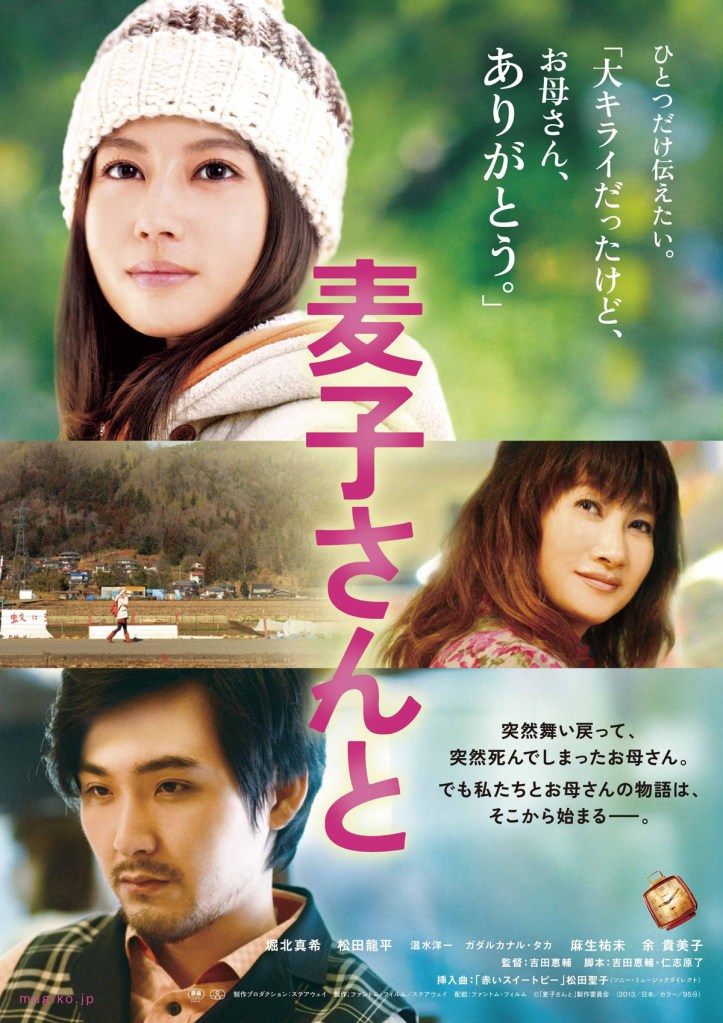
My Little Sweet Pea (麦子さんと, Keisuke Yoshida, 2013)

My Little Sweet PeaHow many times were you told as a child, someday you will understand this? There are so many things you don’t see until it’s too late, and children being as they are, are almost programmed to see things from a self directed tunnel vision. Such is the case for Mugiko – a young woman with dreams of becoming an anime voice actress who is suddenly reunited with her estranged mother of whom she has almost no memory.

Mugiko (Maki Horikita) has a part time job in a manga store and is saving money to go to voice actress school. Raised by her father who has since passed on, she lives in a small flat with her older brother Norio (Ryuhei Matsuda) who also has a low wage job in a pachinko parlour. The pair’s lives change entirely when their long absent mother, Saiko (Kimiko Yo), arrives on their doorstep one day and begs to live in with them. Norio is dead against it but eventually Mugiko is persuaded and Saiko moves in. However, right after, Norio moves out to live with his girlfriend leaving Mugiko alone with the virtual stranger who is also her mother. Mugiko has a difficult time adjusting to living with a maternal figure and harsh words follow frequent misunderstandings until Saiko suddenly dies. Mugiko then travels back to Saiko’s hometown to inter her ashes and begins to forge a connection with the mother she barely knew.

The “haha mono” or “mother movie” is a subset of Japanese melodrama which focuses on the pain and heartbreak inherent in being a mother. Making countless sacrifices, the often saintly mothers do everything they can to ensure the best for their children even if their efforts cause nothing but suffering for themselves. My Little Sweet Pea (麦子さんと, Mugiko-san to) turns the genre on its side to look at things from the point of view of one of the “ungrateful” children, Mugiko, who is filled with resentment over having been “abandoned” only to have her mother suddenly return as if expecting to forget all the years of absence with one home cooked meal.

On journeying back to her mother’s remote rural town, Mugiko begins realise they weren’t so different from each other after all. Everyone in the village is stunned by Mugiko’s appearance which turns out to be the spitting image of her mother at around the same age. Saiko had also been something of a local celebrity thanks to her beauty, charm and popular presence. She left the town for the city with dreams of becoming a famous singer just like Seiko Matsuda and her rendition of the singer’s famous song Akai Sweet Pea is fondly remembered by the older generation.

Saiko’s dreams of hitting it big in the music business were never fulfilled though we know almost nothing about what happened to her between the end of her marriage and reappearance in her children’s lives save that she obviously had enough financial security to be able to send them money every month. Through meeting her mother’s old friends (and more than a few admirers), Mugiko comes to see something of herself in the distant figure of her mother as a young woman. Even if she couldn’t be there for reasons which are never fully explained, it wasn’t because she didn’t want to be or because she’d forgotten about or rejected her children, she suffered everyday thinking of and missing them and was tragically unable to rebuild that connection even at the very end.

Mugiko has been a little unsettled in her life, floating from one dream to the next and who really knows if voice acting is really the thing that she was meant to do. Saiko may have been more certain in her objective but whatever happened later it seems she found fulfilment in being a mother even if her dream of becoming a singer didn’t work out. Having been able to meet her mother even if vicariously, Mugiko is able to understand something about herself and perhaps repair a relationship that never quite took place. Striding out boldly with her mother in spirit beside her, Mugiko is finally able to step into the adult world and everything that is waiting out there for her with a new found confidence that comes with embracing the beauty of a distant scar.


Trailer (with English subtitles)

and here is the hit song from Seiko Matsuda – Akai Sweet Pea (1982)

https://www.youtube.com/watch?v=KVWvym_CeSg