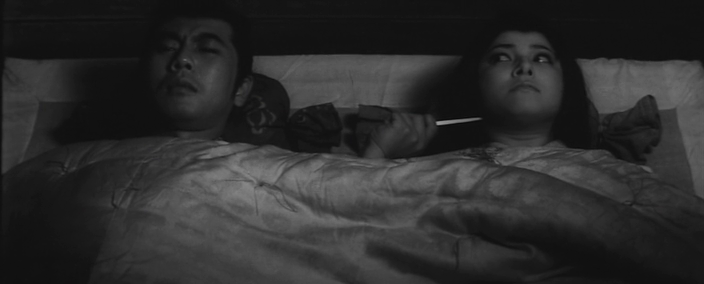
Shinobi no mono 8: The Three Enemies (新書・忍びの者, Kazuo Ikehiro, 1966)

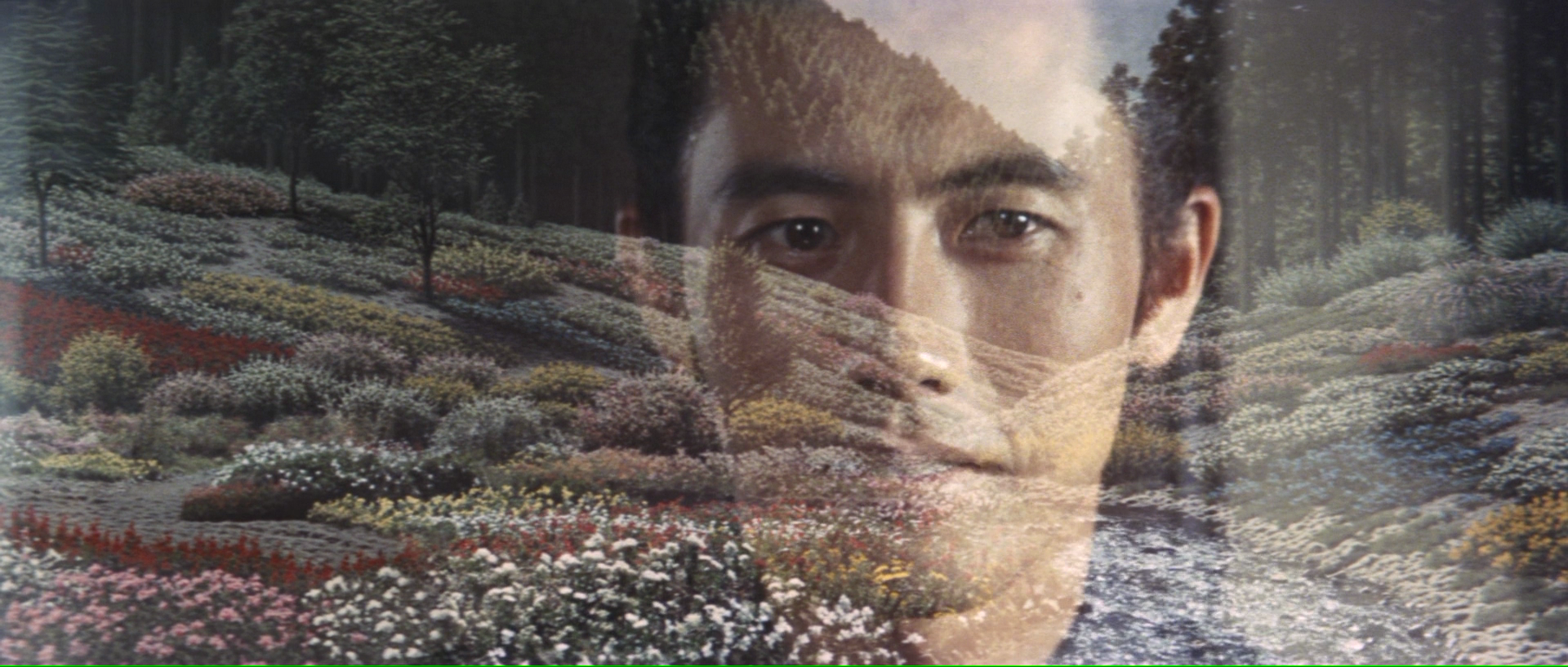
The abiding constant of the Shinobi Mono series had been its continual forward motion, at least up until instalment seven which had backtracked to the death of Ieyasu. This eighth and final film (save for a further sequel released in 1970 starring Hiroki Matsukata replacing Raizo Ichikawa who had sadly passed away a couple of years earlier at the young age of 37) however reaches even further back into the mists of time setting itself a few years before the original trilogy had begun.

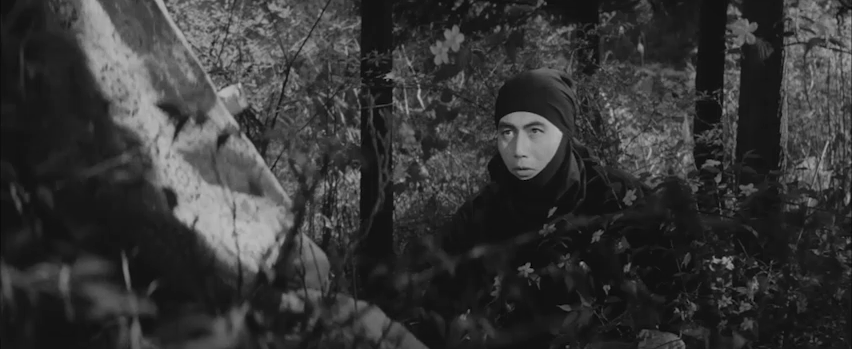
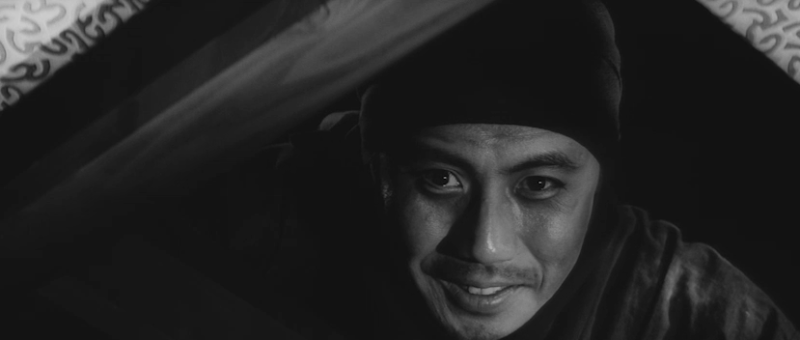
This time around, we follow young Kojiro (Raizo Ichikawa) on what is a more stereotypical tale of personal revenge albeit that one that eventually becomes embroiled in politics as he joins a ninja band that’s working for Takeda Shingen (Kenjiro Ishiyama). In slightly surprising turn of events, Ieyasu (Taketoshi Naito) turns out to be what passes for a good guy at least in contrast to Shingen’s duplicity though Ieyasu himself is still young and at the very beginning of his military career which is why unlike his older self he’s a little more proactive and willing to start a fight as well as finish one. In any case, Shingen thinks he’s an easy target largely because he simply hasn’t been in post long enough to have begun making connections with local lords, bribing them with gifts to secure their loyalty. 

In any case, Kojiro’s journey begins as something more like a martial arts film as he surpasses his current teacher and is told to find a man called Sadayu (Yunosuke Ito) in the mountains if wants to be up to gaining his revenge against the three men who killed his father while trying to steal his gunpowder. Perhaps there’s something a little ironic in the fact that Kojiro’s father was killed in a fight over what amounts to the substance of the future engineering a wholesale change in samurai warfare and edging towards the oppressive peace of the Tokugawa shogunate. But to get she revenge, Kojiro commits himself to learning true ninjutsu as the film demonstrates in a lengthy training montage. Unlike previous instalments, however, there is left emphasis place on the prohibition of emotion with the reason Kojiro cannot romance Sandayu’s adopted daughter down to her father’s whim forbidding her from marrying a ninja.

Apparently not the Sandayu of the earlier films despite the similarity of the name, this one has decided to side with Shingen because he’s mistakenly concluded that he is a “fair person who understands us ninja” when in reality he just using them and is no better than Nobunaga or Ieyasu. Shingen hires them to tunnel into a castle through the well, but is entirely indifferent to their complaints about safety leaving a Sandayu voiwing vengeance. The ninja, he says, generally serve themselves and are bound to no master but he seems to have thought Shingen was different only to be proved wrong once again.

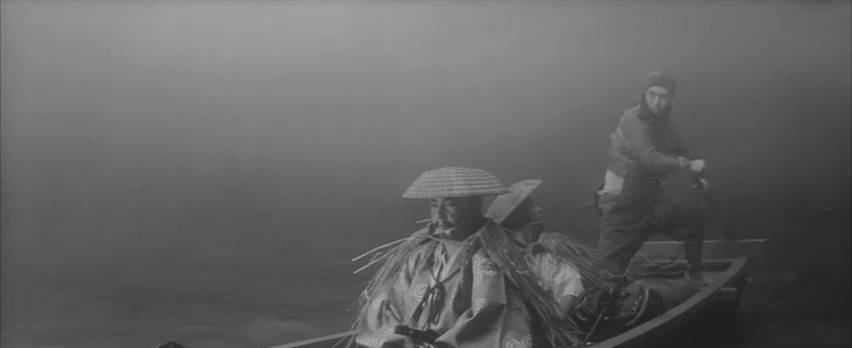
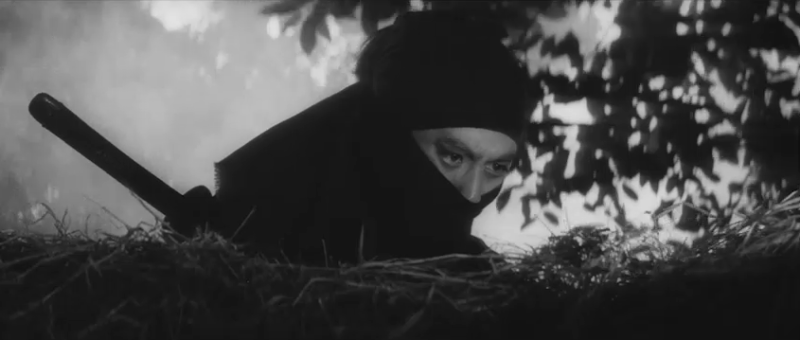
Of course, Kojiro continues looking for the men who killed his father though they obviously guide him back towards conflict anyway. When he tracks some of them down, one remarks that all he did was finish him off which was an act of kindness to end his suffering not that he necessary approved of what his fallow gang members had done. Kojiro finds a surrogate father in Sadayu much as Goemon had though this time a slightly better one even if Sandayu is also a man with a lot on his conscience. Even more so than the other films, this one takes place in a largely lawless land too consumed with perpetual warfare to notice the starving and the desperate let alone the inherent corruption of the feudal era. The bad of ninjas has a rather scrappy quality, not quite as sleek as the Iga of previous films while also a little naive. Shooting more like a standard jidaigeki, Ikehiro uses relatively few ninja tricks generally sticking to smoke and blow tarts with a few shrunken battles. Nevertheless, the violence itself is surprisingly visceral beginning with unexpected severing of an arm and leading to a man getting stabbed in both eyes. Then again, the film ends in the characteristically upbeat way which has become somewhat familiar only this time Kojiro runs back towards romantic destiny now freed of his mission of vengeance and the oppressive ninja code. 

Shinobi No Mono 6: The Last Iga Spy (忍びの者 伊賀屋敷, Kazuo Mori, 1965)

Though there’s a clear divide between the first three films in the Shinobi no Mono series and those that followed, one thing that remained constant is that time passed. By the sixth instalment, we’re already in 1637 which is more than 50 years after the setting of the first film which began in 1575 at the tail end of the Warring States era. Hero of films four and five, Saizo had been desperate to return to the chaos of the pre-Seikgahara society in which the ninja could indeed hold sway though as he discovered the pax Tokugawa was definitely here to stay. 

Given that Saizo would now be an old man, the torch is passed to his son, Saisuke (Raizo Ichikawa), who like his father opposes the Tokugawa but also has a desire for revenge against the corrupt petty official who killed him during the battle of Shimabara which definitely sealed the Tokugawa victory. Ieyasu may be dead, but the regime has only become more oppressive while it seems there is still enough intrigue to provide work for the jobbing ninja only now it’s taking place largely within the palace in the de facto one party state of the feudal society. 

On the other hand, there is a degree of destabilisation and societal flux as the old class system struggles to adjust to a world of peace. The nation is filled with disenfranchised samurai and ronin who largely have no real options to support themselves other than becoming mercenaries or taking odd jobs from various lords in the hope of eventually being taken in as a permanent retainer. It’s these ronin that Saisuke, and the rebellion’s leader Yui Shosetsu (Mizuho Suzuki), hope to marshal in convincing them to rise up against Tokugawa oppression and regain at least a little of the freedom their immediate forebears enjoyed.

The evils of this system can be seen in an otherwise sympathetic lord’s insistence that his underling will have to take the blame and commit seppuku if his decision to help the rebels is discovered. As Saisuke later remarks, the era of human knowledge rather than weaponry is already here and battles are largely being fought over parlour games played in court. At this point, the shogun’s sudden demise leaving only an 11-year-old son has opened a power vacuum that allows unscrupulous lords, like Saisuke’s enemy Izu (Isao Yamagata), to exercise power vicariously. Izu has used it to enrich himself by exploiting desperate ronin and spending vast sums on personal projects, yet he proves himself a true politician in effortlessly covering up for the lord who tried to help the rebels doubtless knowing that he now has him in his pocket for life.

Seemingly returning to the low-key social principles of the first few films, Saisuke’s rebellion is also towards the inherently unfair system complaining that the battle for power is a monster that feeds on courage and will crush conscience like an insect. But as Izu says, times have changed and the struggle cannot be ended even if Saisuke argues that anything manmade can be dismantled. Saisuke has to admit that he’s been outplayed, the leader of the revolution also turns out to be corrupt, taking advantage of other people’s desperation and dissatisfaction to enrich himself while Izu’s plotting has left him largely blindfolded as a ninja clearly out of his depth in the new and confusing world of the Tokugawa hegemony. A powerful man is always looking for a victim, he reflects, perhaps echoing the plight of Goemon unwittingly manipulated by the duplicitous Sandayu while admittedly somewhat drunk on his own misplaced sense of self-confidence. 

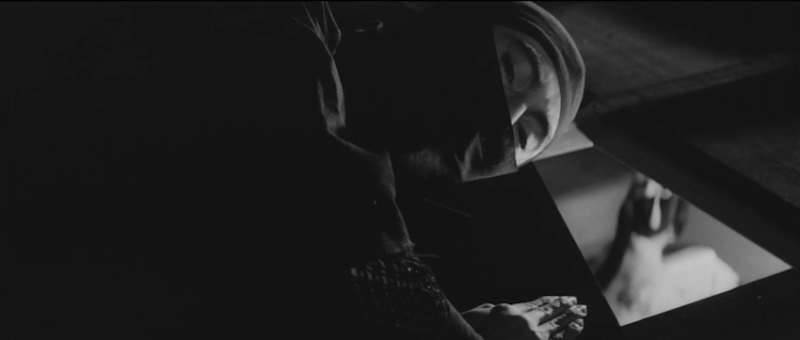
Deviating a little from the realism of the series as a whole, the film shifts into more recognisably jidaigeki territory revolving around corrupt lords and an exploited populace even if in this case it’s the disenfranchised warrior class experiencing a moment of mass redundancy though apparently unwilling to resist. Peep holes behind noh masks add a note of quirky innovation to the backroom machinations of the Tokugawa regime while silent ninja battles and flaming shuriken add to the sense of noirish danger even as it becomes clear that the ninja is approaching a moment of eclipse, no longer quite necessary in a world of constant duplicity.  


Shinobi No Mono 5: Return of Mist Saizo (忍びの者 続・霧隠才蔵, Kazuo Ikehiro, 1964)

At the end of the previous instalment, Saizo (Raizo Ichikawa) had escaped from the fall of Osaka Castle spiriting away Sanada Yukimura (Tomisaburo Wakayama) who, in contrast to what the history books say, did not die. The pair make their way towards Shimazu, where they are also not well disposed to Ieyasu (Eitaro Ozawa), but as Saizo is informed the Tokugawa clan will never die. Knocking off Nobunaga put an end to the Oda clan, getting rid of Hideyori took the Toyotomi out of the running, but killing Ieyasu will make little difference because another retainer will swiftly take his place.

As a reminder, that’s bad for Saizo because what he wanted was the chaos of the Warring States era back to restore the ninja to their previous status. Nevertheless, at the end of the previous film he claimed to have rediscovered a human heart in his devotion to Yukimura though it may of course be simply another ruse to meet an end. In any case, Ieyasu seems to be putting his ninjas to good use and is once again waiting it out apparently aware that Yukimura is alive and well in Shimazu.

Meanwhile, times are changing. Yukimura is convinced the future of warfare lies in firearms and whoever controls Tanegashima where the weapons are made will prove victorious. They think they can gain it by figuring out how they get access to high-quality iron when trading with anyone outside of Portugal is illegal and the Portuguese don’t have any. It’s access to foreign trade which is becoming a crunch issue as Ieyasu tries to solidify his power, later giving a deathbed order to ban Christianity to stop European merchants taking over the country. Saizo travels to Tanegashima to investigate and figures out that the secret is they’re trading with China, which is pretty good blackmail material, but also encounters two sisters who turn out to be the orphaned daughters of a Tokugawa ninja with vengeance on their mind.

In a surprising turn of events, it turns out that his main adversary is Hanzo Hattori (Saburo Date) but the fact he keeps outsmarting him eventually convinces Ieyasu that the ninja have outlived their usefulness. Hanzo becomes determined to kill Saizo to restore his honour, filling the palace with various ninja traps though unlike Goemon Saizo seems to be one step ahead of them. This lengthy final sequence is played in near total silence, and ironically finds Goemon just waiting, after dispatching several of Hanzo’s men, to see if his poison dart has taken effect and Ieyasu is on his way out. Only in the end Ieyasu just laughs at him. He’s 75. Saizo’s gone to too much effort when he could have just waited it out. Ieyasu has already achieved everything he wanted to. His control over Japan is secured given he’s just been appointed chancellor. He can quite literally die happy because nothing matters to him anymore. A title card informs us that when Ieyasu did in fact die, no one really cared. The Tokugawa peace continued. 

Here, once again, the Ninja too are powerless victims of fate despite their constant machinations. Yukimura tells Saizo to live and be human, advice he gives to the sisters in Tanegashima but does not take for himself staking everything on his revenge against Ieyasu which is, as he points out, pointless for Ieyasu was at death’s door anyway and his demise changed nothing. In his first of two entries in the series, Kazuo Ikehiro crafts some impressive set pieces beginning with a mist-bound underwater battle as Saizo and Yukimura make their escape by water to an epic flaming shuriken battle, though this time around the deaths are noticeably visceral. Men are drowned, stabbed, or caught on wooden spikes. Those who do not obey the ninja code are stabbed and pushed off cliffs while once again emotion is a weakness that brings about nothing more than death. Ikehiro’s frequent use of slow dissolves adds to the dreamlike feel of Saizo’s shadow existence even as the ninja themselves seem to be on the point of eclipse for what lies ahead for them in a world of peace in which there is no longer any need for stealth?


Shinobi no Mono 4: Siege (忍びの者 霧隠才蔵, Tokuzo Tanaka, 1964)

When he began what would become the Shinobi no Mono series, Satsuo Yamamoto had wanted to put a more realistic spin on the ninja movie, shifting from the fantasy-esque wuxia with which the genre had been associated since the silent days to something that was largely devoid of romanticism. In the films he directed, the ninja are powerless manipulators doomed to live unhappy lives defined by a cruel and heartless code. Though still based on the same novel, the third film began to compromise that vision in the hero’s miraculous escape from certain death, ending on a note of ambivalent positivity in which Goemon declines the offer to join Ieyasu and instead walks out into independent freedom. 

The first three films had covered all of the action in Tomoyoshi Murayama’s serialised novel, and so the following four are based on original ideas by screenwriter Hajime Takaiwa save for episode six which is scripted by Kei Hattori and Kinya Naoi. Many of the same actors appear but in different roles while the action has moved on 15 years, skipping ahead from the unseen battle of Sekigahara to the siege of Osaka and the end of the Toyotomi. Raizo Ichikawa stars as another displaced Iga ninja nominally in the service of the Toyotomi but secretly longing to bump off Ieyasu not for reasons of revenge but because there is no place for ninja in his new and peaceful society. If they’re able to unseat him, they assume the situation will revert to the civil war society with the effete Hideyori (Junichiro Narita) too ineffective to assume control over the nascent nation. 

It has to be said, this version of events has rather misogynistic overtones with frequent speeches from Sanada Yukimura (Tomisaburo Wakayama) avowing that it’s all Lady’s Yodo’s (Otome Tsukimiya) fault for giving her son bad advice that he is too naive to know not to follow. In negotiating to end the siege at Osaka castle, Yukimura had advised it was better to strike back against Ieyasu and kill him as soon as possible, but Lady Yodo vetoed it and insisted she and her son remain locked up in relative safety. His conviction is somewhat born out seeing as Ieyasu had deliberately targeted the area of the castle where they assumed she was staying in order to further frighten her.

Nevertheless, he’s astute in realising it was all essentially a ruse and part of Ieyasu’s plan to force the Toyotomi into submission. The attack on the castle was only ever intended to engineer a peace treaty which Ieasyu himself presented and forced Hideyori to sign. Then again, there’s some strange symmetry in play. When Saizo enters the castle in an attempt to assassinate Ieyasu he mangles to trick him into killing his double instead, then when Ieyasu’s ninja try to assassinate Yukimura after following Saizo having known he would pretend to be dead and dig himself out of his own grave they also kill his double much to Ieyasu’s consternation. 

It’s this similarity that Saizo hints at when he pities a retainer of Ieyasu’s explaining that Nobunaga and Hideyoshi had tried to eliminate them but they survived while Ieyasu now wants to use them for his own ends but will likely do the same when they are no longer necessary to him. Thus what they want is a kind of chaos, desperate to assassinate Ieyasu to return to the world in which the ninja are able to influence events from the shadows. Even so his conviction is apparently shaken. As in the previous series, Saizo gains a love interest, Lady Akane (Midori Isomura), who has become a sex worker as an apparent act of self-harm after being raped by Tokugawa soldiers during the fall of Osaka castle. But as we’ve been repeatedly told, a ninja’s heart lies under the blade. Born in darkness, they shall die in darkness and are not permitted to fall in love. Thus Saizo rejects her affections, but eventually declares himself corrupted by wanting to die alongside Yukimura as a loyal soldier. The in-film lore would have us believe that Yukimura did not in fact die during the final assault but was spirited away by Saizo to plot Ieyasu’s downfall in the shadows. 

Directed by Tokuzo Tanaka in his only instalment in the series, the film is shot more like a conventional jidaigeki but returns something of the fantasy aesthetic to the ninja as they somersault through the forest. Saizo’s surname effectively means “hidden in the mist”, which is partly ironic seeing as Akane also describes her rape as being overcome by a thick fog, but is also symbolic of his frequent use of smoke bombs as a disappearing trick which again undermines the sense of realism with which the series began. Yukimura is fond of declaring that the clock cannot be turned back, a sentiment echoed by Akane and emphasising the sense of melancholy fatalism that cannot be avoided in a historical drama in which the outcome is already very well known, imbuing Tanaka’s take with the sense of elegy and legend Yamamoto had so deliberately rejected. 


Sword Devil (剣鬼, Kenji Misumi, 1965)

An orphaned son’s attempts to overcome his cursed destiny are poisoned by the duplicities of the samurai society in third part of Kenji Misumi’s loose “Sword Trilogy”, Sword Devil (剣鬼, Kenki). Perhaps unfairly dismissed by some as a mere genre craftsmen, Misumi was also an intense visual stylist, a quality very much on show in this vibrant drama which pits the beauty of the natural world against the samurai order but eventually finds its hero succumbing to cruelties of his age unable to outrun himself or his destiny. 

In the prologue which opens the film, shot in an arty theatrical style, a young peasant woman formerly a maid to the late Lady Makino gives birth to a “stranger’s” child after having been promoted and given a place in the women’s quarters as a reward for her loyalty in continuing to serve her mistress in the depths of her “madness”. Lady Makino claims that Kin’s kindness brought her back to reality and is keen to ensure she continues to be taken care of after her death, but also asks her to take charge of her precious pooch hoping that she will treat it “as herself”. This is perhaps why it is rumoured that the child, given the name “Hanpei” which ironically is in part inspired by the dog-like “Spot” coupled with a suffix which implies a lowly rank, is in fact the product of a taboo union between the maid and the dog (rather than admit he is almost certainly the illegitimate son of Lord Masanobu). For some reason this bizarre rumour persists throughout the boy’s life, cast out as he is from the palace and raised in an ordinary village as the son of a low-ranking samurai who appears to be kind and loving, worried enough about Hanpei’s (Raizo Ichikawa) future to advise him to find a special skill that will allow him to support himself and perhaps overcome some of the persistent prejudice against him after the old man’s death. 

The skill he perfects, however, continues to set him apart from his fellow men in that he chooses the cultivation of flowers. A particularly snotty neighbour describes Hanpei’s art as “annoying”, though others are impressed enough by his skill to marvel that they have such a man in their clan while also pointing out that in these times of peace becoming a samurai florist might be much more useful than perfecting the art of the sword. Ironically, however, it drags him back towards the court and intrigue when he’s invited to craft a flower garden to cheer up the present young lord who seems to be succumbing to the same “madness” as his mother. The trouble starts when the garden is completed to the lord’s satisfaction but marred by the sudden and apparently unexpected arrival of a bumblebee which damages the lord’s tranquility and provokes a violent outburst in which he begins to hack at the flowers hoping to punish the one which “rudely” invited the bee to the garden. Hiding behind a tree, Hanpei perfectly aims a rock at the lord’s head to prevent him destroying his precious work and is spotted by his chief retainer, Kanbei (Kei Sato), who earmarks him for future use in his nascent conspiracy. 

Hanpei finds himself at the centre of intrigue, increasingly seduced by promises of advancement that he might be “titleless” no more and perhaps in fact escape his lowly position as the son of a dog. He ingratiates himself by, like his mother, being one of the few servants willing to bear the lord’s violent rages in volunteering to accompany his horse even though he has none of his own and has to run along behind thereby demonstrating his slightly supernatural athletic ability that gives further credence to his canine origins. In similar fashion he learns by observation, captivated rather than appalled on witnessing an old ronin practicing his sword technique by cutting in half a butterfly in the forest. Preoccupied by his lowly status and consequent lack of sword skills, Hanpei is reassured by the man’s explanation that there’s nothing more to it than draw, strike, and sheath but takes yet another step towards the samurai dark side in accepting the gift of a sword. Later he breaks it, meaning to break with the cruel path on which fate has set him, only to pick up another, supposedly cursed sword to which he was attracted because of its “evil spirit”.

Osaki (Michiko Sugata), a kind and innocent woman seemingly attracted to Hanpei because of his difference in his gentle sensitivity in contrast to the rough men around her, refuses to believe the rumours he has become an assassin working for Kanbei because no one who loves flowers like he does could be a coldblooded killer. This is in fact what he has become, sent, like a dog, after Kanbei’s enemies killing without even knowing who it is who must die only to be remorseful on discovering he has killed someone known to him. There is division and sedition within the court caused by the lord’s madness, Kanbei and his associates keen to rule in his stead while keeping his mania secret from the shogun while others, a small group of lower samurai rebels, prefer to depose him in favour of his adopted heir. Hanpei is once again a pawn, taking no side in this debate but unthinkingly doing Kanbei’s dirty work in the service of his sword. He hopes that by taking the “evil” instrument in his hands he might double his bad luck to overcome his unhappy destiny, gazing at his distorted face in its reflection, but discovers himself merely outcast once again as the villagers begin to realise he is an obstacle to their rebellion and responsible for the assassinations of their loved ones. 

The ironic conclusion finds the hero’s planned flower garden, a shared endeavour with love interest Osaki, rendered a bloody graveyard, men cut down like weeds as Hanpei’s quick draw philosophy makes a mockery of their fancy samurai fencing. The poisonous samurai legacy, infected with madnesses literal and figural, destroys everything, all beauty and grace falling under Hanpei’s “evil” sword as he finds himself, quite literally, chased out of town like a stray dog condemned to wander exiled from human society. 


The Third Shadow Warrior (第三の影武者, Umetsugu Inoue, 1963)

“In this world the weak are playthings of the strong” according to the hidden villain concealing himself slightly to the side in Umetsugu Inoue’s dark identity drama The Third Shadow Warrior (第三の影武者, Daisan no Kagemusha). Adapting a novel by Norio Nanjo, Inoue, most closely associated with sophisticated musicals, shoots in the manner of a ghost story adapting the trappings of a minor parable on the consequences of selling one’s soul for advancement in complicity with an inherently broken feudal order. 

Opening in 1564, the film wastes no time reminding us that the samurai were cruel and duplicitous, a troop of them riding through the contested mountain territory of Hida bearing the severed heads of their enemies casually insulting peasants as they go. Young farmer Kyonosuke (Raizo Ichikawa), however, can’t help but think that they’re heroic and dashing, longing like many young men as the voiceover explains to make his fortune as a samurai in this the age of war. Kyonosuke gets his wish when retainer Shinomura (Nobuo Kaneko) turns up and offers him a job at the castle, only it’s not quite what he expected. Bearing a striking similarity to lord Yasutaka, he has been hired as his third “shadow”, a decoy intended to shield the lord from harm. 

Sitting down with his two new brothers, Kyonosuke remarks how ironic it is that he’s here to escape the land but Kuwano (Katsuhiko Kobayashi) is patiently saving up his pay with the intention of using it to buy a farm and settle down with a beautiful wife. His is the most dangerous of doubling roles as the lord’s battlefield stand-in, while Ishihara (Yuji Hamada), a former actor apparently not much good with the sword, takes his place behind closed walls. Kyonosuke is quite taken with the world of the samurai, but Ishihara cautions that he’ll soon tire of this “phoney life”. In accepting this devil’s bargain, Kyonosuke has in essence consented to his own murder. A shadow man, he can no longer call himself Kyonosuke, but nor can he say he is Yasutaka. He has no fixed identity and is merely in waiting for a veil. Worse still as Ishihara has begun to suspect, they no longer have bodily autonomy because their physicality must match that of the lord. When he is blinded in a battlefield mishap with an arrow, so must they be. Deciding he’d rather not lose an arm, Kyonosuke finds himself in an altercation with his other self which leads to his demise. He intends to make a life for himself under his own name with another clan, but is forced to permanently assume Yasutaka’s identity after being cornered by Shinomura intent on manipulating him for his own ends. 

“I’m no puppet, I no longer need a puppeteer” Kyonosuke exclaims drawing strength from embracing his new identity as a samurai lord, but perhaps overreaches himself in ambitious desire failing to see the various ways he is still merely a pawn in a bigger game as Yasutaka himself once was because the lord is only ever an empty vessel and far more expendable than might be assumed. Princess Teru (Hizuru Takachiho), Yasutaka’s conquest bride, declares that she is “just a doll, the strongest will win me” but is of course playing a role herself, one which she does not desire but has been thrust upon her while her cousin, Sadamitsu (Shigeru Amachi), is engaged in a much more active piece of long form role play. Only the lord’s concubine (Masayo Banri) sees through him, falling for the gentle peasant after the rough lord who toyed with her, but their complicated love eventually seals his fate even as he believes it offers him victory. Kyonosuke became a samurai to escape his lack of agency but is arguably much less free than he ever was, driven slowly out of his mind by his fractured sense of identity and realising that in killing the only man who knew who he “really” was, he also killed himself. 

Quite literally imprisoned, Kyonosuke finds himself a shadow once again neither one man nor another, denied an identity and forever a puppet of duplicitous game players better versed in the realities of the samurai existence. “How ugly fighting over this transient kingdom” the princess disdainfully remarks while herself engaging this apparently meaningless foolishness, reminded by her cousin that a princess may hold the keys to a castle or even a nation even if he implies she is little more than his tool, a puppet to be manipulated if knowingly. Shooting with deep, expressionist shadows, chiaroscuro lighting, and a melancholy voiceover Inoue frames his tale as a parabolic caution against selling one’s soul for gold but also a crushing indictment of the inequalities of the feudal order built on wilful hypocrisy and cynical exploitation. 


A Lustful Man (好色一代男, Yasuzo Masumura, 1961)

“Why are women in Japan so unhappy?” the carefree Casanova at the centre of Yasuzo Masumura’s 1961 sex romp A Lustful Man (好色一代男, Koshoku Ichidai Otoko) laments, never quite grasping the essential inequalities of the world in which he lives. Masumura is best known for extremity, a wilful iconoclast who flew in the face of golden age cinema’s genial classism, but shock was not his only weapon and he could also be surprisingly playful. Adapted from a well known novel by creator of the “floating world” Ihara Saikaku, A Lustful Man finds him indulging in ironic satire as his hero sets out to “make all the women in Japan happy” chiefly by satisfying their unfulfilled sexual desire while resolutely ignoring all of the entrenched patriarchal social codes which ensure that their lives will be miserable. 

Set in the Edo era, the film opens not with the hero Yonosuke (Raizo Ichikawa) but with his miserly father who berates a servant after discovering a single grain of rice on the hall floor. According to him, the central virtues necessary to become rich are endurance, diligence, and vitality. You must treasure each and every grain of rice in order to accumulate. A cruel and austere man who only thinks of money, Yonosuke’s father keeps his wife in earnest poverty despite their wealth, angrily grabbing an obviously worn kimono out of her hands and insisting that it’s still good for another year, apparently caring nothing for appearances in the otherwise class conscious Kyoto society. It’s this meanness that Yonosuke can’t seem to stand. He hates the way his father disrespects his mother, and her misery is a primary motivator in his lifelong quest to cheer up Japan’s melancholy women though the weapon he has chosen is sex, a convenient excuse to live as a genial libertine to whom money means essentially nothing. 

Yonosuke’s father has set him up with an arranged marriage into a much wealthier family, which is not something he’s very interested in despite the fact she seems to be quite pretty but on learning that she has transgressively found love with the family butler he determines to help her instead, ending the marriage meeting by chasing her round the garden like a dog in heat. Several similar stunts eventually get him sent away from his native Kyoto to Edo but he takes the opportunity to escape, travelling all over Japan making women “happy” as he goes. 

As the first example proves, Yonosuke genuinely hates to see women suffer. His own pleasure, though perhaps not far from his mind, is secondary and he never seeks to take advantage of a woman’s vulnerability only to ease her loneliness. Despite that, however, he remains essentially superficial opting for the transience of postcoital bliss while ignoring the very real societal factors which make an escape from misery all but impossible. During an early adventure, he spends all of the money he conned out of his new employer on redeeming a geisha (at more than three times the asking price) so that she can be with the man she loves, but he continues to visit sex workers without interrogating their existence as indentured servants, “merchandise” which is bought and sold, traded between men and entirely deprived of freedom. In fact, he proudly collects hair cuttings from the various geishas he has known as a kind of trophy only to later discover the grim truth, that the hair likely doesn’t belong to the geisha herself but is sold to them by middlemen who get it by digging up dead bodies. 

Yonosuke remains seemingly oblivious to the duplicitous hypocrisy of the yoshiwara, but is repeatedly confronted by the evils of Edo-era feudalism with its proto-capitalist cruelty where everything is status and transaction. He is often told that as he is not a samurai he would not understand, but seems to understand pretty well that “samurai are idiots” and that their heartless elitism is the leading cause of all the world’s misery. To some a feckless fool, Yonosuke refuses to give in to the false allure of worldly riches. As soon as he gets money he spends it, and does so in ways he believes enrich the lives of women (even if that only extends to paying them for sex), eventually getting himself into trouble once again reneging on his taxes after trying to prove a geisha is worth her weight in gold. 

Yogiri (Ayako Wakao) complains that women are but “merchandise”, valued only as toys for men. “Japan is not a good country for women” Yonosuke agrees, suggesting they run away together to find a place where women are respected, indifferent to Yogiri’s rebuttal “no, wherever you go, no one can change women’s sad fate”. Yonosuke’s naive attempts to rescue women from their misery often end in disaster, a runaway mistress is dragged back and hanged, the woman he was set to marry goes mad after her father and lover are beheaded for having the temerity to speak out about corrupt lords, Yogiri is killed by a samurai intent on arresting him for tax evasion, and his own mother dies seconds after his father only to be immediately praised as “the epitome of a Japanese wife”. Yet he remains undaunted, wandering around like an Edo-era Candide, setting off into exile to look for a supposed female paradise without ever really engaging with the systems which propagate misery or with his own accidental complicity with them. Nevertheless, he does perhaps enact his own resistance in refusing to conform to the rules of a society he knows to be cruel and unfair even if his resistance is essentially superficial, self-involved, and usually counterproductive which is, in its own way, perfectly in keeping with Masumura’s central philosophies on the impossibilities of individual freedom within an inherently oppressive social order.


Bronze Magician (妖僧, Teinosuke Kinugasa, 1963)

Even when you’re the empress, a woman has little freedom. Teinosuke Kinugasa’s Bronze Magician (妖僧, Yoso) is loosely based on a historical scandal concerning Nara-era empress Koken/Shotoku and a Rasputin-like monk, Dokyo, who unlike his counterpart in the film, eventually tried to seize the throne for himself alone only to have his ambitions frustrated by the empress’ death and the fierce resistance of her courtiers. As the title implies, Kinugasa is more interested in Dokyo than he is in the perilous position of Nara-era women even in power, painting his fall from grace as a Buddhist parable about a man who pays a heavy price for succumbing to worldly passions. 

As the film opens, Dokyo (Raizo Ichikawa) emerges from a shallow cave amid many other caves after meditating for 10 years during which he reached a higher level of enlightenment and obtained mystic powers. Now he thinks it’s time to continue the teachings of departed mentor Doen and use his abilities to “actively do good and save the masses”. Before that, however, he does some not quite Buddhist things like turning a rat into a living skeleton, and twisting a snake into a tangle. In any case, he begins roaming the land, miraculously healing the sick. While reviving a thief who had been killed by samurai after trying to make off with a bird they shot, Dokyo is spotted by a retainer of the empress who brings news of his miracles back to her closest advisors. 

Empress Koken (Yukiko Fuji), in the film at least, was a sickly child and even after ascending the throne has often been ill. She is currently bedridden with a painful respiratory complaint that is giving her servants cause for concern. None of the priests they’ve brought in to pray for her (apparently how you treat serious illness in the Nara era) has been of much use. The empress’ steward Mabito (Tatsuya Ishiguro) orders that Dokyo be found and brought to the palace to see if he can cure Koken, which he does while stressing that he’s helping her not because she’s the empress but in the same way as he would anyone else. 

As might be expected, the empress’ prolonged illness has made her a weak leader and left the door open for unscrupulous retainers intent on manipulating her position for themselves. There is intrigue in the court. The prime minister (Tomisaburo Wakayama) is colluding with a young prince to depose Koken and sieze power. Left with little oversight, he’s been embezzling state funds to bolster his position while secretly paying priests to engineer Koken’s illness continue. Dokyo’s arrival is then a huge threat to his plans, not only in Koken’s recovery and a subsequent reactivation of government but because Dokyo, like Koken, is of a compassionate, egalitarian mindset. She genuinely cares that the peasants are suffering under a bad and self-interested government and sees it as her job to do something about it, which is obviously bad news if you’re a venal elite intent on abusing your power to fill your pockets while the nation starves. 

As the prime minister puts it, however, the empress and most of her courtiers are mere puppets, “naive children”. At this point in history, power lies in the oligarchical executive who are only advised by the empress and don’t actually have to do what she says. As she is also a woman, they don’t necessarily feel they have to listen to her which is one reason why the prime minister assumes it will be easy to manoeuvre the young prince toward the throne. Koken’s short reign during which she overcame two coups is often used to support the argument against female succession because it can be claimed as a temporary aberration before power passed to the nearest male heir. Nevertheless, Koken tries to rule, even while she falls in love with the conflicted Dokyo. Her right to a romantic future, however, is also something not within her control. Many find the gossip scandalous and use it as an excuse to circumvent her authority, especially after she gives Dokyo an official title which allows them to argue she has been bewitched by him and he is merely manipulating her to gain access to power. 

Dokyo, meanwhile, is in the middle of a spiritual crisis. After 10 years of study he as reached a certain level of enlightenment and attained great powers which he intended to use for the good of mankind. He is happy to discover that Koken is also trying to do good in the world but she is, ironically, powerless while the elitist lords “indulge in debauchery”, abusing their power to enrich themselves while the people starve. He begins to fall in love with her but the palace corrupts him. He accepts a gift of a beautiful robe despite his vows of asceticism, and then later gives in to his physical desire for Koken only to plunge himself into suffering in the knowledge that he has broken his commandments. He loses his magic, but chooses to love all the same while rendered powerless to hold back Koken’s illness or to protect her from treachery. 

The pair mutually decide they cannot “abandon this happiness”, and Dokyo’s fate is sealed in the acceptance of the extremely ironic gift of golden prayer beads which once belonged to Koken’s father. He is reborn with a new name in the same way as the historical Koken was reborn as Shotoku after surviving insurrection, embracing bodily happiness while attempting to do good but battling an increasing emotional volatility. The lords continue to overrule the empress’ commands, insisting that they are really commands from Dokyo, while Dokyo’s “New Deal” involving a 2 year tax break for impoverished peasants finds support among the young radicals of the court who universally decide that they must stand behind him, protecting the ideal even if they are unable to save the man.

This troubles the elders greatly. Declaring that Dokyo has used “black magic” to bewitch the empress, they determine to eliminate him, but Dokyo never wanted power. “Power is not the final truth” he tells them, “those blindly pursuing status and power only destroy themselves”. Yet Dokyo has also destroyed himself in stepping off the path of righteousness. He damns himself by falling in love, failing to overcome emotion and embracing physical happiness in this life rather than maintaining his Buddhist teachings and doing small acts of good among the poor. Nevertheless, he is perhaps happy, and his shared happiness seems to have started a compassionate revolution among the young who resolve to work together to see that his ideal becomes a reality even in the face of entrenched societal corruption.


Original trailer (no subtitles)