The Geisha (陽暉楼, Hideo Gosha, 1983)

The coming of the railroad spells doom for one of the most prestigious geisha houses in Japan in Hideo Gosha’s adaptation of the Tomiko Miyao novel, The Geisha (陽暉楼, Yokiro). Miyao’s novels had often provided the inspiration for Gosha’s films and she had herself been the daughter of a “flesh broker” in pre-war Kochi though later escaping to another town to be a substitute teacher. Though the English title may focus more on plight of the the individual geisha at its centre, the Japanese hints more at the destructive cycle of the Yokiro itself in the persistent legacy of exploitation.

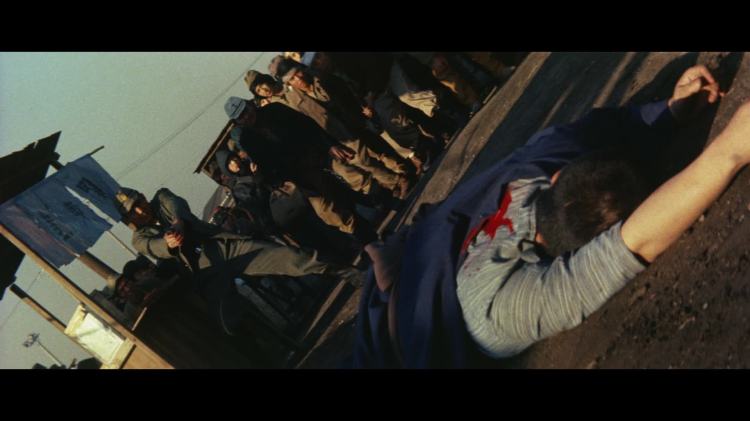
Then again as he later points out, if you’re looking for a villain in this story then the responsibility lies largely with Daikatsu (Ken Ogata) himself. In a prologue set in 1913, Daikatsu has eloped with geisha Otsuru but the pair are discovered by gangsters sent after them by the Yokiro. Daikatsu kills all of their assailants and assures Otsuru that they are finally “free” but it appears to be too late. Holding their baby daughter in one arm, Otsuru collapses into his other and presumably dies either then or shortly after while Daikatsu is later sent to prison for 10 years. 20 years later in 1933, the daughter, Fusako (Kimiko Ikegami), has become the number one geisha at the Yokiro under the name Momowaka though her career flounders because she is regarded as too emotionally distant to keep a patron. 

Daikatsu is also himself in Kochi at this point and working as a procurer brokering the sale of young women to the Yokiro and other geisha houses and brothels. When a school teacher comes to him to sell his wife, he taps her teeth to check for malnutrition much as one would examine a horse before running a hand underneath her kimono to check everything is at is should be before offering a valuation. Her husband only looks at him anxiously enquiring if a body such as hers which has as he later reveals born three children will fetch a good price. Daikatsu lets them go so the woman, Masae, can spend a final night with her family explaining that he cannot force someone to work if they do not want to do so and is well aware they will likely take his money and never be seen again which is what almost what happens. As it turns out the husband is killed in a fight and the woman ends up becoming a geisha anyway, only in the pay of prominent Osaka yakuza led by Inaso. 

Inaso (Mikio Narita) and buddies want in on the construction of the railroad that will shortly be coming to Kochi, but need to take over the town first which means getting around the mistress of the Yokiro, Osode (Mitsuko Baisho), who is apparently running every game town. The entire local economy is underpinned by female exploitation and facilitated by a woman, a former geisha, seizing the only power that is available to her. Isano later uses Masae as a kind of spy, getting her to initiate a relationship with Osode’s weak willed husband in an attempt to humiliate her which largely backfires as Osode boldly reclaims her man through a violent brawl in a hot spring though it does not appear that she is especially fond of him so much as he serves a particular purpose.

The brawl emphases the way in which women are pitted against each other by the nature of a patriarchal society along with the ways in which they are forced to mediate their power through men. Fusako also gets into an intense physical fight with Tamako (Atsuko Asano), a surrogate daughter of Daikatsu’s and emblem of a coming modernity, who insists on becoming a sex worker at the area’s most prominent brothel. In a strange moment of confrontation, both the geishas of the Yokiro dressed in their traditional regalia, and the sex workers of Tamamizu, arrive at a modern club where the heir to a banking empire courted by the Yokiro, Saganoi, dances the Charleston he learned while studying abroad in America. The geisha who dances with him struggles to pick up the moves, Saganoi lamenting that the dance is just not suited to a woman wearing a heavy kimono, elaborate wig, and clumsy geta. Tamako immediately gets up from her table and kicks off her shoes, gathering the hem of her own kimono to free her legs for the high level kicks of the modern dance. 

Fusako reclaims her authority by interrupting the dance immediately before its conclusion and insisting on retrieving their guest. Tamako appears to resent Fusako, perhaps frustrated in her relationship with Daisuke who does not appear to have had much contact with the daughter he sold at 12 years old. They too end up in an elaborate brawl in which Tamako rips off Fusako’s wig and splits her lip, symbolically freeing her to transcend the constraints of her “geisha” persona. Meeting Saganoi at Western-style bar, she boldly dances on the counter and sleeps with him of her own volition. But in doing so she conceives a child and leaves herself in a difficult position. She has betrayed her patron, and though she could simply have kept the fact from him and allowed him to think the baby was his, Fusako does not want to bring her child up in lies while simultaneously hanging on to a naive dream that Saganoi will one day return to her despite being made aware he has left for Europe. 

“All men are enemies of women,” she writhes in childbirth while swearing that no one will take her child from her, but she is still an indentured woman and her daughter is by rights the property of Osode. Her illness, presumably consumption, began long before her pregnancy and seems to an echo of the suffering she has been forced to endure as a geisha. As her health weakens, so the Yokiro declines. First it is ravaged by a literal storm, but also under threat from the Osaka gangsters desperate to take over Kochi to gain access to the lucrative construction contracts extending in its direction. Even so, as Daikatsu admits much of the fault lies with him. He chose to elope with Otsuru and was unable to protect either her or their daughter whom he allowed meet the same fate by entering the geisha world. He continued to earn his money by selling women into what is essentially slavery, and cannot escape his part in their continued exploitation while his entanglement with gangsters later disrupts the more settled life Tamako has begun to build for herself. 

“Wait all you want, the train’s not coming,” Tamako is later told, as if signalling that there really is no way out of this destructive and disappointing existence. Truly epic in scope, Gosha’s pre-war drama draws together patriarchal exploitation and societal corruption to critique a burgeoning modernity, but ends exactly as it started among the vibrant cherry blossoms only this time undercutting the melancholy of the oft repeated song with a more cheerful scene hinting at least symbolically at a long-awaited reunion. 


Original trailer (English subtitles)

Father of the Kamikaze (ゝ決戦航空隊, Kosaku Yamashita, 1974)

By the mid-1970s, Japanese cinema at least had become much more comfortable with critiquing the wartime past, considering it from a greater distance than the often raw depictions of war in the films from the previous two decades. 1974’s Father of the Kamikaze (ゝ決戦航空隊, A Kessen Kokutai), however, is among the few to skew towards the nationalist rather than the ambivalence or simple anti-war messages of other similarly themed films of its era. 

Starring ninkyo icon Koji Tsuruta who served in the air force himself, the film is a kind of biopic dedicated to Admiral Onishi who oversaw the kamikaze operations at the end of the war. As is pointed out, Onishi had been against the war in general terms even before its inception and is originally against the philosophy behind the kamikaze squadrons but as Japan’s fortunes continue to decline he becomes its biggest advocate citing a kind of sunk cost fallacy that it would be in someway unfair to the men that have already died to surrender while insisting that suicide missions are the only feasible way to turn the tide because one kamikaze could take out a hundred men by destroying battleships singlehandedly. 

The film in part attributes this extreme solution to the prevailing with your shield or on it philosophy of the contemporary society which placed extreme shame on the act of being taken prisoner. In the prologue that opens the film, a squadron of downed pilots whose heroic deaths have already been recorded is discovered alive in an American prisoner of war camp but as being a prisoner of war is so shameful and would reflect badly on the military, the decision is taken to fix the books by sending the men on a mission from which they are not intended to return. Onishi is opposed to the plan, he asks why they can’t find a way for the men to live, but the decision is already made. In any case, he describes the action of a suicide mission as a “beautiful ideal” even when insisting that a war cannot be fought in that way not least for purely practical reasons in that they do not have the resources to be wilfully sacrificing skilled pilots and their planes. 

Having come round to the idea, however, Onishi is a crazed zealot who cannot accept the idea of surrender and even goes so far as to barge into a cabinet meeting to urge ministers against a truce even though the war is clearly lost. To his mind, the only way to honour the sacrifices of those who’ve died is to fight to the last man. Kozono (Bunta Sugawara), another officer opposed to the kamikaze, eventually meets a similar fate in refusing to obey the order to lay down his arms and ending up in a psychiatric hospital. His objection had partly been that it’s wrong to turn men into ammunition, but also that the kamikaze project is itself defeatist and self-defeating when there are men such as himself who are committed to fighting on.  

In this the film leans into the image of militarism as a death cult in which dying for the emperor is the only noble goal of the whole imperial expansion. In its eventual lionising of Onishi’s image, his bloody suicide atop a white cloth resembling the flag of Japan while his parting words scroll across the screen in text, it does not shy away from his more problematic aspects in which he fails to object to a request from a junior officer that soldiers should be allowed to test their swords on American prisoners of war, roundly telling a subordinate who breaks protocol to insist that such a thing is not only morally wrong but will ruin their international reputation that he has no need to think of consequences because Japan will win this war. He claims to want to find a way of defeat that will satisfy the living and the dead, but in reality cannot accept it not least in that it would entail admitting that he sent 2600 young men to their deaths for nothing. 

Tsuruta brings the same level of pathos to his performance as he did in playing conflicted yakuza stoically committed to a destructive code, but there’s no getting away from the fact that the film focuses mainly on Onishi’s personal suffering as a man who sent other men to die for a mistaken ideal and then could not admit his mistake offering an apology only in his death in which he urged the young people of Japan to work to rebuild the nation in the name of peace. In switching to the present day and showing us Onishi’s dilapidated former residence and in fact the room in which he died with its tattered shoji and peeling paintwork, he veers towards the nationalistic in uncomfortably reinforcing the nobility of his death rather than the folly of war or absurdist tragedy of the kamikaze programme. Adopting a quasi-jitsuroku approach with frequent use of onscreen text, a narratorial voiceover, and stock footage of kamikaze in action Yamashita may portray war as madness in Onishi’s crazed devotion but cannot help depicting it as a “beautiful ideal” even in the undignified violence of Onishi’s ritual suicide. 


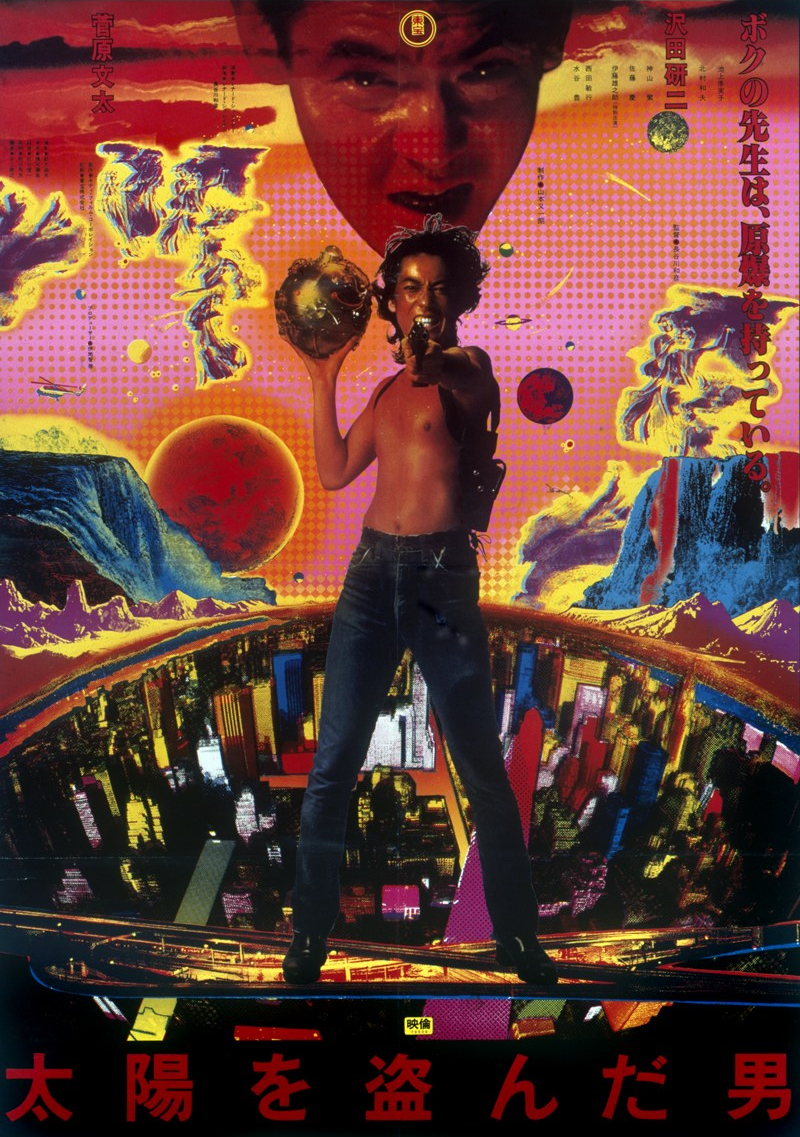
The Man Who Stole the Sun (太陽を盗んだ男, Kazuhiko Hasegawa, 1979)

(C) Toho 1979

man who stole the sun posterIn the post-Asama-Sanso world, Japanese society had shifted into period of intense calm in which improving economic prosperity was in the process of delivering comfort rather than the creeping acquisitive anxiousness that began to overshadow the bubble era. Nevertheless, in cinematic terms at least anxiety was everywhere and not least among the young who, swept along by this irresistible economic current, were quietly doubtful about their place in a changing society. Co-scripted by an American screenwriter, Leonard Schrader (brother of Taxi Driver’s Paul), The Man Who Stole the Sun (太陽を盗んだ男, Taiyo wo Nusunda Otoko) provides a satirical snapshot of this confusing moment as an oppressed, belittled high school science teacher builds an atomic bomb in his apartment just to show he can but then realises he has absolutely no idea what to do with it.

Technically speaking, the science teacher’s name is Makoto Kido (Kenji Sawada) but no one really calls him that. The kids at school refer to him as “Bubble-gum” because he always seems to be chewing on the rather childish confectionary. Not the most conscientious of teachers, he tailors the curriculum to his own interests, teaching the kids all about atomic energy and the bomb, but the kids aren’t interested. They only want to know what’s going to be on the test. To them Kido’s information is irrelevant and so they ignore him, talking amongst themselves while he carries on, preaching to a seemingly empty room.

Meanwhile, Kido is building the bomb at home, for real. As he tells the kids, anyone can build an atomic bomb – you only need the plutonium which is, admittedly, tightly controlled for just this reason. He acquires his through a daring heist on a nuclear plant. Kido never elaborates on what prompted him to begin his bizarre masterplan, but there is certainly a degree of pent up rage inside him born of resentment with his reduced circumstances. “Just” a high school science teacher, who would really think he’d have the capability to build an atomic bomb, alone, using only household equipment (plus the plutonium and a custom furnace purchased after nearly exploding his oven)?

Kido’s problems are the same as many middle-aged men in ‘70s Japan in that he feels intensely oppressed from above and below. What he’s trying to tell the kids is that they have access to this power already – anyone can build a bomb, if you bother to learn how. The only thing that’s being kept from him is the plutonium (and for good reason), which he manages to acquire anyway. A chance encounter with the madness of the age seems to kickstart his plan into gear when he meets his opposing number in police inspector Yamashita (Bunta Sugawara).

Kido, having halfheartedly escorted a group of students on a school trip, finds himself rendered powerless once again when the bus is hijacked by a distressed older gentleman (Yunosuke Ito) armed with a rifle and grenade and wearing a World War II soldier’s uniform. He demands to be driven to see the emperor from whom he intends to demand the return of his son, presumably killed in the war 30 years earlier. Yamashita, clean cut and authoritative, is the gung-ho cop who masterfully brings the hostage crisis to a close by lying to the man that the emperor has consented to see him. During the evacuation the old man is killed by police snipers (despite Yamashita’s too late cries of “don’t shoot” after having dispatched the grenade and disarmed the suspect).

Like Kido, the old man likely didn’t really know what he intended to do, only that he was lonely and desperate. The emperor couldn’t give him back his son (whose uniform he seems to be wearing) and his gesture is one of futile defiance coupled with a suicide bid that has no real goal save making an elaborate protest against the world in which he lives. Kido makes the bomb, lets the authorities know he has it, but then realises he has no demands. He asks them to fix something minor that annoys him, to stop the TV networks pulling the plug on late running baseball games to make way for the news, and finds himself rewarded. He has taken back the power, they believe he has the bomb and they fear him, but he has no further goals or notion of how his society should change. There is no idealised future he is fighting for, all there is is futility and indifference.

Meanwhile, ironically enough, Kido’s desperation provokes a mini revolution in others. A talkshow radio host (Kimiko Ikegami) named “Zero” (in contrast to Kido’s adoption of the codename “No. 9” as the 9th owner of a nuclear device and the only individual), broadcasts his on-air request for ideas, believing it to be a kind of thought experiment. The ideas she gets from the public are of the usual kind – lonely men who want to bathe with naked women, nationalists who want to start a war with America, dreamers who think it might be better not to want anything and just embrace the dream, while she muses that she wants the Rolling Stones concert that was cancelled a few years ago after a band member’s narcotics conviction to be reinstated. That being as good as anything is what Kido goes for in an overture that passes as an odd kind of romance and a suitably ironic kick back against strait-laced authority.

Kido’s war is, in a sense, a war with the fathers of the world as symbolised by men like Yamashita with their suits and neatly trimmed haircuts. Their button-down existence has never offered anything to men like Kido who feel trapped and angry within it. Yet Yamashita is also reacting against his own generation of fathers as symbolised by the old man on the bus, the last remnant of wartime resistance offering a defeated cry against a world which got away from them. Yamashita let the old man die when he prioritised his own sense of heroism, and that annoyed Kido. He can’t help sympathising with his plight which is in a way also his own in being relentlessly silenced and ignored by austere authority figures.

Turning down Yamashita’s clumsy attempt at a pickup, Zero affirms that Kido has given her a dream, which no small thing and she feels bound to him because of it. It’s an ironic statement because Kido has no dreams and not only that, he has no future either – he is slowly dying of radiation poisoning despite his precautions during the building of the bomb. In their final confrontation, Yamashita, adopting a paternal authority, neatly summarises Kido’s dilemma. The only life he has the right to take is his own, and his own death is the only thing he really wants, but he’s embarked on this elaborate plan to make his presence felt all the while aware that he will remain totally anonymous. No one will ever see him. He will die, like thousands of others, faceless. A lowly high school science teacher, no terrorist mastermind or bomb building genius. His revenge is as absurd as it is futile. Male inferiority complexes threaten to drown us all in a sea of violent resentment, and as the Earth dies screaming all we will have to reflect on is that we ourselves brought this world into being through our own incurable apathy.


Original trailer (no subtitles)

Cops vs. Thugs (県警対組織暴力, Kinji Fukasaku, 1975)

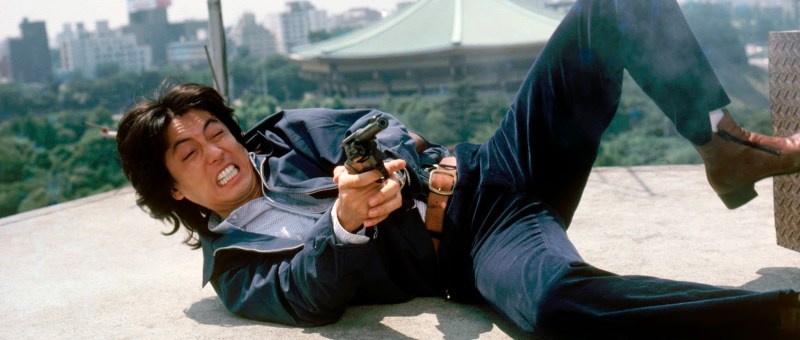
cops vs thugs J BDCops vs Thugs – a battle fraught with friendly fire. Arising from additional research conducted for the first Battles Without Honour and Humanity series and scripted by the author of the first four films, Kazuo Kasahara, Cops vs Thugs (県警対組織暴力, Kenkei tai Soshiki Boryoku) shifts the action west but otherwise remains firmly within the same universe. This is a world of cops and robbers, but like bored little boys everyone seems to forget which side it was they were on – if they truly were on any other side than their own. There are few winners, and losers hit the ground before feeling the humiliation, but the one thing which is clear is that the thin blue line is so thin as to almost be transparent and if you have to choose your defenders, a thug may do as well as a cop.

A dodgy looking guy in a dirty mac roughs up some equally dodgy looking kids. Given that the shady looking fella is played by Bunta Sugawara you’d peg him for a petty thug, but against the odds Kuno is a cop – just one with a taste for crumpled raincoats. The town he’s policing is one in the midst of ongoing gang strife following a series of breakaways and civil wars throughout the ‘50s. Things are coming to a head as rival bosses of the two breakaway factions, Hirotani (Hiroki Matsukata) and Kawade (Mikio Narita), vie for power while a former yakuza politician, Tomoyasu (Nobuo Kaneko), does his best to stir up trouble between them that Kuno is trying to keep from exploding into all out war.

Cops vs Thugs is as cynical as they come but slightly more sympathetic to its desperate, now middle aged men whose youth was wasted in the post-war wasteland. The central tenet of the film is neatly exposed by a drunken gangster who points out that at heart there’s little difference between a cop and a yakuza aside from their choice of uniform. Policemen, like gangsters, follow a code – the law, carry a gun, are fiercely loyal to their brotherhood, and at the mercy of their superiors. Good jobs were hard to come by in the devastation following the surrender, in fact one of the reasons company uniforms became so popular was that no one had decent clothes to wear and a providing a uniform was a small thing that a company could to do increase someone’s sense of wellbeing, community, and engender the feeling of family within a corporate context. The police uniform, even if it’s reduced to a badge and a gun, does something similar, as do a yakuza’s tattoos. They literally say someone has your back and will come running when you’re in trouble.

These drop outs with nowhere left to turn eventually found themselves one side of a line or on the other – the choice may have been arbitrary. Kuno says he became a cop because he wanted to carry a gun, something he could have done either way but for one reason or another he chose authority over misrule. Cops being friends with yakuza sounds counter intuitive, but many of these men grew up alongside each other, attended the same schools, perhaps even have relatives in common.

Both the police and the yakuza claim to be the defenders of honest, working people but neither of them quite means what they say. Police brutality is rife while yakuza battles reach new levels of violent chaos including, at one point, a beheading in the middle of a sunlit street. Yet the greatest threats to the population at large aren’t coming from such obvious sources, they’re hardwired into the system. Sleazy politico Tomoyasu spends his time in hostess bars and schmoozes with gangsters he uses to do his dirty work while the press look on gleefully at having something to report. Kuno may not be a candidate for police officer of the year, but he tells himself that his policy is one of appeasement, and that working with organised crime is the best way to protect the ordinary citizen. When you’re forced to work within a corrupt system, perhaps there is something to be said for flexibility.

For all of the nihilistic cynicism Fukasaku retains his ironic sense of humour, staging a violent, inefficient, and bloody murder in a tiny room where a sweet song about maternal love in which a woman sings of her hopes for the bright future of her son is playing a healthy volume. Corruption defines this world but more than that it’s the legacy of post-war desperation that says on the one hand that it’s every man for himself, but that it’s also necessary to pick a side. Cops, thugs – the distinction is often unimportant. There is sympathy for these men, and sadness for the world that built them, but there’s anger here too for those who play the system for their own ends and are content to see others pay the price for it.


Available now from Arrow Video!

Original trailer (English subtitles)
Originally published by UK Anime Network.

The Yakuza Papers Vol. 1: Battles Without Honour and Humanity (仁義なき戦い, Kinji Fukasaku, 1973)

Snapshot-2015-12-07 at 11_06_36 PM-930280086When it comes to the history of the yakuza movie, there are few titles as important or as influential both in Japan and the wider world than Kinji Fukasaku’s Battles Without Honour and Humanity (仁義なき戦い, Jingi Naki Tatakai). The first in what would become a series of similarly themed movies later known as The Yakuza Papers, Battles without Honour is a radical rebooting of the Japanese gangster movie. The English title is, infact, a literal translation of the Japanese which accounts for the slightly unnatural “and” rather than “or” where the “honour and humanity” are collected in a single Japanese word, “jingi”. Jingi is the ancient moral code by which old-style yakuza had abided and up to now the big studio gangster pictures had all depicted their yakuza as being honourable criminals. However, in Fukasaku’s reimagining of the gangster world this adherence to any kind of conventional morality was yet another casualty of Japan’s wartime defeat.

The story begins with a black and white image of a mushroom cloud with the film’s bright red title card and now famous theme playing over the top. This is Hiroshima in 1946. Things are pretty desperate, the black market is rife and there are US troops everywhere. Shozo Hirono (Bunta Sugawara) has just returned from the war (in fact he’s still in his uniform). He gets himself into trouble when he intervenes as an American soldier attempts to rape a Japanese woman in broad daylight in the middle of a crowded marketplace. He manages to cause enough of a commotion for the woman to escape but the Japanese cops just tell him not to mess with the GIs. Things don’t get much better as one of Hirono’s friends is assaulted by a yakuza. They get some rival yakuza to help them get revenge and in the commotion Hirono accidentally kills someone and is sent to prison for 12 years. In prison he meets another yakuza who wants to escape by pretending to commit harakiri and promises to get his yakuza buddies to bail Hirono out if he helps. From this point on Hirono has become embroiled in the new and dangerous world of the Hiroshima criminal underground.

Battles Without Honour and Humanity has a famously complicated plot entered around the various power shifts and machinations between different groups of yakuza immediately after the end of World War II. The film begins in 1946 and ends in 1956 though many of its cast of tough guys don’t last anywhere near as long. The picture Fukasaku paints of Japan immediately after the war is a bleak one. Even if some of these guys are happy to have survived and finally reached home, they’ve seen and done terrible things. Not only that, they’ve been defeated and now they’re surrounded by foreign troops everywhere who can pretty much do what they want when they want. They just don’t have a lot of options – if they don’t have connections to help them find work when there’s not enough to go around then it isn’t surprising if they eventually fall into to crime. Also, having spent time in the military, the yakuza brotherhood provides a similar kind of camaraderie and surrogate family that you might also find in an army corps.

It all gets ugly quite fast. Largely the yakuza are making their money profiting from the political instability, resenting the US occupation yet reaching deals with them to support their efforts in the Korean war and then selling new and untested drugs at home (with less than brilliant results). Betrayals, executions, assassinations in previously safe places like a bath house or the barbers – these are a long way from the supposedly honourable gangsters of old. One minute Hirono is offering to cut off his finger as a traditional sign of atonement (though no one knows exactly what you’re supposed to do in this situation and it all ends up seeming a little silly) and taking the rap for everyone else’s mistakes, but his friend faked harakiri to get out of jail and everyone is double crossing everyone else whichever way you look.

The whole thing is filmed in an almost documentary style with captions identifying the various characters and giving the exact time of their demise (if necessary) as well as a voice over giving background information about the historical period. The film is inspired by real life yakuza memoirs and there are parts which feel quite like a bunch of old guys sitting in a drinking establishment and recounting some of their exploits.

This new postwar world of heartless gangsters is a tough one and almost devoid of the old honour-bound nobility, however somehow Fukasaku has managed to make it all look very cool at the same time as being totally unappealing. You wouldn’t want to live this way and you definitely don’t want to get involved with any of these guys but somehow their self determined way of life becomes something to be admired. That said, there’s a sadness too – that even in the criminal underworld there used to be something noble that’s been obliterated by the intense trauma of the war. You can rebuild, you can move on from the destruction left by the war’s wake but there’s no going back to those days of “honour and humanity” – if they ever existed, they’re gone forever now.


Battles without Honour and Humanity is available in blu-ray in the UK as part of Arrow Video’s Battles Without Honour and Humanity: The Complete Collection box set.