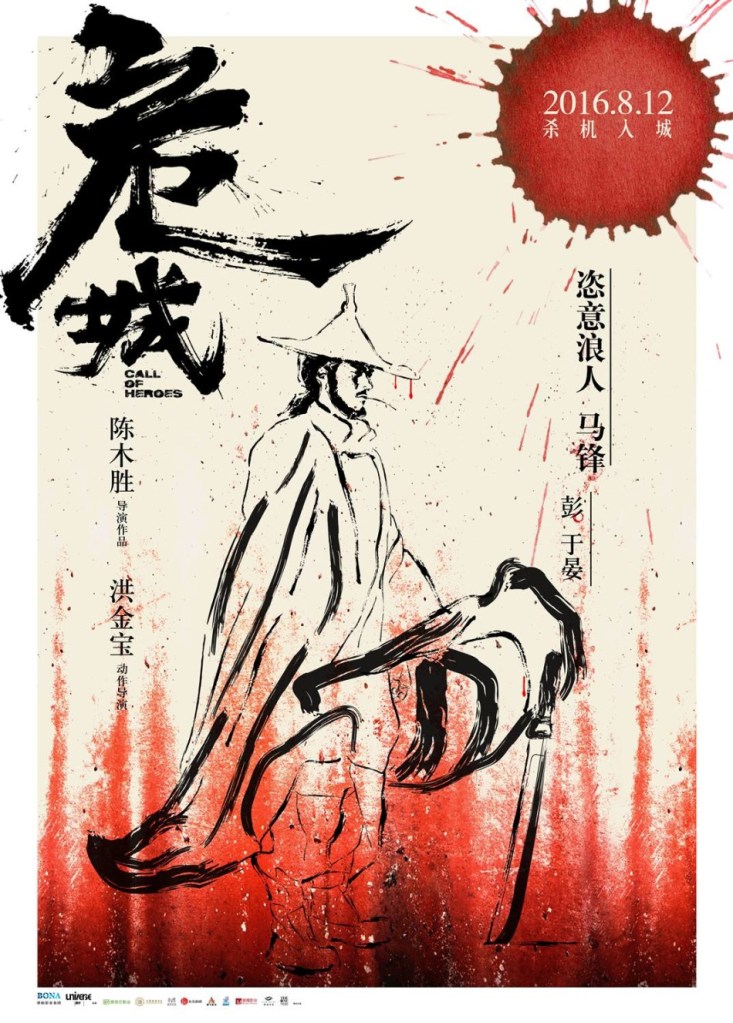
 A blast from the past in more ways than one, Benny Chan’s Call of Heroes (危城, Wēi Chéng) is a western in disguise though one filtered through Akira Kurosawa and Sergio Leone more than John Ford. Filled with Morricone-esque musical riffs and poncho wearing reluctant heroes, Chan’s bounce back to the post-revolutionary warlord era is one pregnant with contemporary echoes yet totally unafraid to add a touch of uncinematic darkness to its wisecracking world.
1914 – three years after the collapse of Chinese feudalism and warlords rule the land, each vying for power and terrain but taking little account of the displaced people in their path. The residents of Stone City find this out the hard way when notorious general Cao Ying wades into town and conducts a widespread massacre seemingly for the fun of it. Plucky school teacher Bai Ling manages to escape with some of her pupils even whilst other teachers and children are being summarily executed by Cao’s troupes.
Having left with nothing and walked miles, Bai and the children are near starvation when they stop into a noodle house to share a single bowl. Unfortunately the noodle house is about to be robbed but fortunately one of the diners is bearded wanderer Ma Feng (Eddie Peng) who isn’t up for anyone disturbing his serious food coma. Impressed with Ma’s skills, the kids and Bai make their way to Pucheng where Bai has a cousin but Cao is still on the warpath and trouble has a way of tracking good people down.
Pucheng (the name of which literally means ordinary town), is watched over by the noble sheriff Yang Kenan (Sean Lau Ching-wan) though the protective garrison has been sent to the front leaving them with only a skeleton defence. When a mysterious visitor arrives in town and proceeds to shoot dead a man, woman, and even a child, Yang arrests him but when the killer turns out to be Cao Ying’s unhinged son, a number of questions arise. Yang is committed to justice – no matter the man’s name, he ought to pay for his crimes. Yet, Cao Shaolun’s presence is sure to attract his father’s attention and so many of the townspeople feel it might be better to let Cao Shaolun go. Placate a tyrant and undermine the idea of justice by failing to enforce the law or sign your own death warrant by standing up for your principles, it’s a frontiersman’s dilemma.
The references to classic Hollywood westerns are obvious enough, particularly when the narrative takes a turn for the High Noons as Yang finds himself standing alone as the sole resistance to the oncoming militia man threat. Though the townspeople do not exactly turn on Yang in the same way they turn on Kane, they clearly choose appeasement over war. Yang’s dedication to justice is purehearted, there’s little hint of personal vanity in his decision to stand up for the rule of law but only the knowledge that folding now is the same as bowing to Cao’s tyranny.
Though introduced as a possible protagonist, Ma Feng takes a far smaller role in the action than might be expected. Clearly channeling Mifune’s Sanjuro, Peng’s wisecracking drifter and cynical, reluctant hero is almost at odds with the serious business of law vs politics over in Pucheng. His character centric subplot of conflict with a former friend who works for the other side is insufficiently developed to support the emotional weight it’s intended to carry and sometimes feels like a distraction from the main narrative though the great pot mountain based martial arts set piece is certainly one worth waiting for.
If Peng’s Ma Feng feels slightly misplaced with his cynicism and comic stunts, Louis Koo’s hammed up villain Cao Shaolun is in an entirely different film altogether. Wildly over the top, Koo plays Cao Shaolun as a permanently amused psychopath, all crazy eyes and manic laughter. A self consciously cool guy, Cao Shaolun dresses in white and murders innocents with a golden gun all the while knowing he can do as he pleases simply by the virtue of his name.
Shot with a heavily digital aesthetic, Call of Heroes’ evidently high production values are sometimes reduced to a televisual quality or otherwise let down by substandard CGI. The fight scenes themselves are filmed with an old fashioned rigour filled with innovative and exciting choreography and are refreshingly humour free. Like the best westerns, Call of Heroes contains its own parable in that the best weapon against tyranny is a strong and righteous populace but the final stretch almost undermines its noble aims by presenting what is either a revolutionary spring lead by the people for the people, or a worrying case of mob justice.
Prone to narrative dead ends in setting up major characters only to sideline or kill them off unexpectedly, Call of Heroes has a frustrated quality in not being able to decide whether it wants to be a serious call to arms for standing up for what’s right in the face of overwhelming force, or a comedic romp in which a cocky drifter sorts everything out by accident. Either way, Call of Heroes does provide a number of genuinely exciting martial arts set pieces even if floundering slightly in-between them.
Original trailer (Cantonese with Traditional Chinese/English subtitles)


