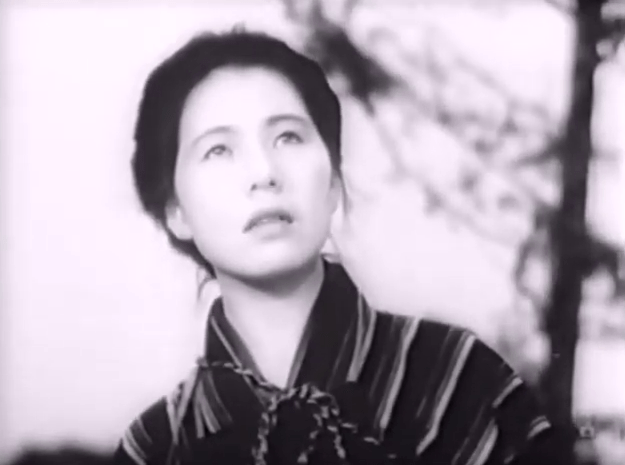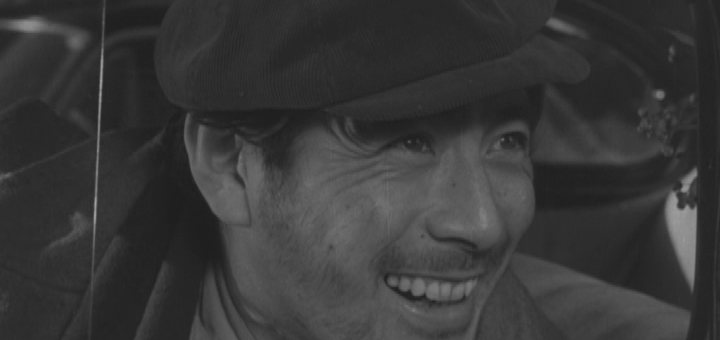
My Wonderful Yellow Car (吹けよ春風, Senkichi Taniguchi, 1953)

A kind-hearted taxi driver becomes our guide to the post-war society in a cheerful omnibus movie co-scripted by Akira Kurosawa and directed by Senkichi Taniguchi, My Wonderful Yellow Car (吹けよ春風, Fukeyo, Haru Kaze). Inspired by a Reader’s Digest column titled “human nature as seen in the rearview mirror”, the film follows cheerful cabbie Matsumura (Toshiro Mifune) as he drives around Tokyo in 1953 picking up various fares and sometimes adding commentary or trying to help with whatever kind of problem seems to be bothering them.

Then again, he stays well out of the first fare’s business as a young couple have obviously had some kind of falling out. Bursting into tears, the girl (Mariko Okada) announces that she wants to postpone the wedding and maybe even rethink this whole thing, while the boy reiterates with slight irritation that he’s said he’s sorry with the implication that that should be the end of it though we have no idea what (if anything) he’s actually done. In any case, they eventually patch things up over some canoodling in the back seat and ask to be dropped off so they can get something to eat. In some ways, the young couple represent a more hopeful vision of post-war youth who have no apparent worries besides their tiff and are financially comfortably enough not only to be getting married but can afford to travel by taxi and pay for a meal on the same occasion. 

Their situation is later contrasted with that of an older couple who’ve moved from Osaka to Tokyo in their old age and have bought a box of live lobsters to celebrate their silver wedding anniversary but as Matsumura notes though they appear to be quite well off they also seem somehow sad. That turns out to be because they lost their only son the previous summer and have moved into his old apartment. The old lady also cries in the back seat, but for a completely different reason. As they’ve only just moved here, they don’t have friends or anything to do and are completely lost in the wake of their son’s death. Matsumura’s kindness is demonstrated when he borrows three flowers from a bouquet delivered to a girl at the petrol station and presents them as an anniversary gift. The couple are so touched they invite him to enjoy their anniversary dinner with them and by the end of it have made the decision that they should go back to Osaka and restart their lives by re-opening their old business.

Throughout all this, Matsumura is very conscious of the meter. Every second he spent in the old couple’s apartment cost him money, but as he’s fond of saying you can’t always think of things like that. Even so, he reminds himself he has a wife and child so should be mindful of the clock but still turns down a fare to go back to the station and check on a young girl he’s pretty sure is trying to run away from home. A weird guy was sniffing around her and was in fact just about to lead her off when Matsumura gets back and announces he’s come to pick her up. Matsumura spends the rest of the ride trying to convince her to go home, repeatedly reminding her that most of the “panpans”, or streetwalking sex workers catering to US servicemen, were also once runaway girls. To more modern eyes we might wonder if sending her home is what’s best without knowing the reasons she wanted to leave. He goes so far as to buy her ramen which costs him more money on top of the lost fare which doesn’t collect from her either when he, a little less responsibly, abandons her when she refuses to tell him where she lives. Thankfully, it all seems to work out. The girl made a sensible decision to go home after all and is later seen happily doing her Christmas shopping with her mother who also thanks him for looking out for her.

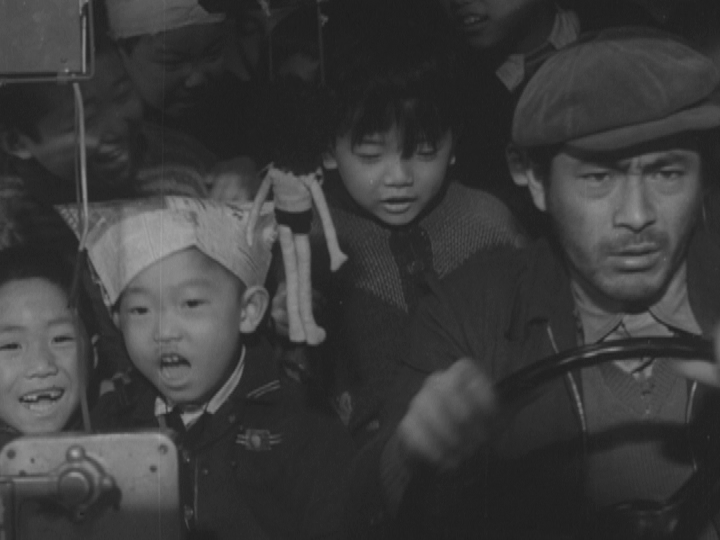
Perhaps these kinds of altruistic acts of kindness explain why Matsumura’s own clothes are quite ragged with a hole in his jumper and a tear to the shoulder of his jacket. He’s driving the cab in straw sandals which apart from anything else is probably quite cold in the winter. He spends another afternoon giving a free ride to some children, about 15 of them, who’ve crowdfunded 100 yen because they’ve never been in a car before and want to go as far it’ll take them having no idea that 100 yen is actually the initial charge so you can’t go anywhere on it all. Of course, Matsumura ends up taking them a bit further, and then realises he’ll have to take them back to where they were because they won’t have any other way of getting there or of knowing where they are now.

On the other hand, sometimes he ends up with nuisance fares such as two drunk guys who keep singing their university song. One of them even climbs out of the window and up onto the roof, causing Matsumura to assume he’s fallen off somewhere and he’ll have to go back and look for him to make sure he’s not hurt only to find him burbling in the footwell. He also ends up getting hijacked by a crook with a gun on his way back from Yokohama but getting a telling off from the police rather than a thank you for catching him after unwisely taking hold of the gun himself and messing up all the fingerprints. 

One might think the time he had a famous actress in the back of his cab who even sang along with the jingle he’d written for the cheerful yellow vehicle might make up for all that, but he says the story that best exemplifies why he loves driving a taxi is that of a middle-aged couple he picked up at the harbour shortly after a boat had docked repatriating people from China. Even in 1953, some had not yet returned after becoming trapped by the Chinese Civil War and eventual Communist victory. The man is dressed in military uniform and says he’s just been demobbed when Matsumura asks him, trying to lighten the mood while there’s obviously some degree of tension between the man and his wife. But as we gradually come to understand, it’s all just a ruse and he has in fact been in prison in Japan for the last seven years for an unspecified crime.

His wife asks Matsumura to drive around the city and attempts to show him how much things have recovered, suggesting that they can now put the past behind them and start over. But the man remains sullen and grumpy. He’s afraid to go home, afraid to face the neighbours worrying if they know what he did and that he’s been in prison. But most of all he’s afraid to face his children, the youngest of which he’s never met. The kids have been teaching themselves to say “Welcome home, Daddy,” in Mandarin believing he’s been in China all this time which the wife has to explain before they get there. The man tells his wife he understands if she doesn’t want him back, but she assures him that the children are excited as is she to start their new life together. Nevertheless, though they’ve been eagerly practicing, the older two children simply freeze when confronted by this anxious stranger who turns around to leave again feeling as if he doesn’t have the right to come back here after all only for the youngest one to suddenly pipe up with the phrase note perfect. It’s this kind of scene, getting people to where they need to be physically and emotionally, that seems to make Matsumura’s job worthwhile. In essence, he’s ferrying people towards the cheerful post-war future his cute yellow cab represents while driving round the rapidly changing city wondering who it is that’s going to end up in the rearview mirror today.


Title song (no subtitles)
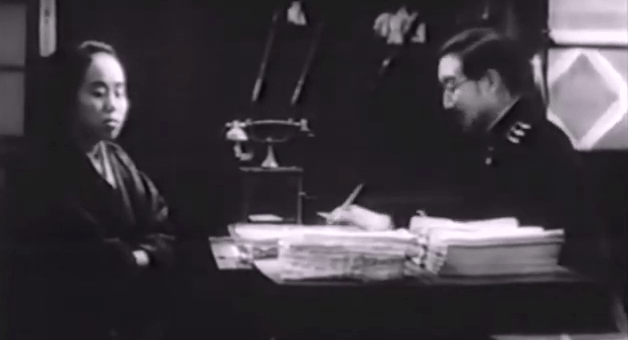
Nightingale (鶯, Shiro Toyoda, 1938)

Set in a quiet northern town, Shiro Toyoda’s Nightingale (鶯, Uguisu) finds the nation still struggling to emerge from the feudal past into the modern era. The film opens with a scene in the local train station, yet we’re also told that it is literally cut off from prosperity because the express train does not stop there and so it is relegated to the status of provincial backwater. Physically trying to flag the train down, the Mayor has been trying to get the town placed on the fast track but has had no luck so far.

The ticket man, who’d been more or less ignoring him, suggests they can’t put the station on the express line because the population of the town is decreasing presumably as young people migrate to the cities in search of work. One of the people waiting there is a man with two sons who tries to get the younger to pretend he’s younger than he is so he won’t have to pay for his ticket, though the ticket man refuses to give him a discount leaving the man with only the option to leave one of the boys behind while the family can no longer survive in the town. He explains that he’s been financially crippled by the medical fees to care for his now late wife and is clearly at his wits end trying to find a way to support his children.

The costs of medical treatment seem to be a direct driver of poverty and crime. Shifting to the local police station, we’re introduced to a man who’s become a serial chicken thief having begun stealing neighbour’s birds to pay for doctors to treat his sickly wife only she eventually left him for another man because he was always away conducting poultry heists so she thought he’d abandoned her due to her illness. His problem is compounded by the fact he had not formally registered their marriage intending to wait until the first child was born leaving him without a leg to stand on.

An official doctor later jokingly complains that he’s losing custom because no one in the area can afford modern medical care so they’re turning to dubious snake oil-style miracle cures proffered by a “fake priest” the police are about to arrest for fraud. Meanwhile, they’ve also arrested a middle-aged woman (Haruko Sugimura) who assists with births for violating the medical practice law. Branded a midwife she is really more of a wise woman who is well respected in the local community as someone who had had many children herself and also offers advice about folk remedies for various illnesses. She never claims to be a doctor and does not regard it as a job, merely as helping people even if she perhaps also enjoys the sense of being needed and important, and is unable to understand how that could ever be a crime. Unlike the priest, she takes no payment and uses her own resources though people sometimes give her small compensatory gifts such as parcels of rice as a thank you. When a woman goes into labour and the “official” midwife is not available, the policeman is unwilling to let her in but hearing the woman’s distress she runs to help her kicking all the policemen out of this very personal female space.

Her confusion bears out that within the general society as people struggle to adjust to a more ordered modernity and the encroachment of urbanity which is what the police themselves represent. Then again, they are presented as being more compassionate certainly than the staff of the railway and seemingly have a duty of pastoral care for the local area which is separate from their role in enforcing the law. A secondary drama that began at the train station involves a young woman who is being sold into sexual slavery by her father against her will. She is eventually rescued by an earnest school teacher who says the sale isn’t valid because she also signed a contract to become a teacher, convincing her father to change his mind with the help of the police who remonstrate with him that it’s wrong to sell your child even if the practice had been somewhat normalised which plays into a propagandistic element about the importance of moving on from “backward” rural practices still mired in the feudal era. The police also have access to a fund which can be used to get the broker out of the way in an effort to stamp out this morally indefensible situation in which parents sell their children into indentured servitude for reasons of poverty. 

They also agree to help an old lady who’s arrived in search of a child she fostered a decade previously who was taken back by her birth mother and sold to a circus. Like the chicken thief, the old woman was caught out by the modern convention of paperwork. She had been led to believe the adoption had been processed and the child placed on her own family register, but was illiterate and therefore easily deceived. The old woman also becomes a victim of the dodgy priest and the disease currently spreading because of his problematic cure-alls which people have turned to out of desperation in their poverty.

But despite the police’s apparent altruism, the arrival of a young woman selling a captive nightingale reveals the irony that she’s come there because it’s the only place anyone has any money. Unfortunately it turns out that capturing a nightingale has also been ruled illegal, even if one of the policeman was interested in buying it if only it could sing, so she’s come to the wrong place and if she doesn’t release it she’ll end up with a fine. The nightingale’s song is later replaced by that of a flute player who had been arrested for being drunk and disorderly having spent some money he was given towards the funeral of his baby on drink. 

The police are in some ways a disruptive influence, trying to bring a new urban order to this rural place which has its own laws and customs often at odds with those of the city. Their efforts tie in to a persistent message of modernising for the good of the nation which was particularly current in the late 1930s though the film is equally sympathetic towards the plight of the rural poor who are not after all being given very much support as the youngsters move to the city leaving the old behind, trapped on the slow line cut off from the benefits of modernity while otherwise expected to simply adapt to new visions of civility in a society still trying to emerge from the feudal past. 


Throne of Blood (蜘蛛巣城, Akira Kurosawa, 1957)

In many ways, the underlying theme in Akira Kurosawa’s films of the 1950s is that we are incapable of knowing ourselves and are, as a forest spirit remarks in Throne of Blood (蜘蛛巣城, Kumonosu-jo), afraid to look into our own hearts and admit our darkest desires. In adapting Shakespeare’s Macbeth, Kurosawa is less interested in the pull of ambition than the insecurity that drives it along with the inability to transcend himself that precipitates the hero’s decline. 

Indeed, after Washizu (Toshiro Mifune) and his best friend Miki (Minoru Chiaki) ride into the misty forest domain of the witch-like seer who ominously turns her spinning while offering a moral lesson that neither of them heed, they sit on the ground and laugh about what they’ve heard. Yet as Washizu partly admits the old woman revealed something of himself to him in that she echoed a dream of which he was unwilling to speak. Miki asks what warrior would not want to be placed in charge of a castle, but for Washizu it’s almost a primal need to prove himself in surpassing other men. Miki, by contrast, is not so nakedly ambitious but he doesn’t really need to be because he has a son. Washizu has no heir, his line will end with him and so he has only this life to make something of his name. 

Having no heir also undermines his sense of masculinity, just as it undermines the femininity of his wife, Lady Asaji (Isuzu Yamada), who as a woman now likely too old to bear a child may fear for her position. Kurosawa styles Yamada’s face as a perfect noh mask while she delivers her lines with the intonation of noh theatre all of which lends her a fairly eerie presence which only deepens as she descends into the darkness and back out again hovering like a ghost. She is in a sense perhaps already dead if not otherwise possessed by some malignant spirit as she urges her husband on in their dark deeds like a demon on his shoulder even going so far as to present him with the spear he will use to murder his lord, the ultimate act of samurai transgression. 

Yet as Lady Asaji points out, the present lord killed the lord before him for the right to sit on the dais. When the lord comes to stay with them on a pretext of hunting while preparing to launch an attack on a potential rival, the couple are moved into a room previously inhabited by a retainer who’d tried to mount a rebellion but was defeated. He took his own life and the room is still stained with his blood which covers both walls and floor. Washizu ought to realise that this is his fate too, but deep down he wants the prophecy to be true, which it is if more in the letter than the spirit. Would he have done it if he had not met the forest spirit, or would he only idly have thought of it but never followed through? It’s not something that can be known, but his eventual failure is born more of his inability to accept this side of himself than it is the price of ambition in itself. “If you’re going to choose ambition choose it honestly with cruelty” the forest spirit later advises, and Washizu might have been more successful if had he done so earlier. 

Then again, the world he lives in is as Lady Asaji describes it a wicked one in which betrayal is an all but inevitable certainty. Washizu insists that Miki is his friend, and that making Miki’s son his heir satisfies the prophecy while binding him to him so that he cannot rebel even if he were minded to. But Lady Asaji assumes that Miki is ambitious too, suggesting that he may strike first or report his treachery in the hope of personal advancement. For the prophecy to come true, someone has to betray the lord though it need not have been either of them but there can be no trust or friendship in this world of fierce hierarchy and internecine violence. 

Both men should perhaps have realised that when they were trapped riding around the eerie lair of the forest spirit with its mists and cobwebs not to mention heaps of piled skeletons still in their armour all victims of ambition and the spirit’s false promises if also echoing the legacy of wartime folly. “Look upon the ruins of the castle of delusion” the noh chant that opens and closes the film intones, warning of illusionary riches and the price of deluding oneself along with the destruction wrought by those unable to break free of the spider’s web of human desire. 


Throne of Blood screens at the BFI Southbank, London on 21st February 2023 as part of the Kurosawa season.

Original trailer (no subtitles)

Floating Clouds (浮雲, Mikio Naruse, 1955)

(C) 1955 Toho

floating clouds poster“The past is our only reality” the melancholy Yukiko (Hideko Takamine) intones, only to be told that her past was but a dream and now she is awake. Adapted from a novel by Fumiko Hayashi – a writer whose work proved a frequent inspiration for director Mikio Naruse, Floating Clouds (浮雲, Ukigumo) is a story of the post-war era as its central pair of lovers find themselves caught in a moment of cultural confusion, unsure of how to move forward and unable to leave the traumatic past behind.

We begin with defeat. Shifting from stock footage featuring returnees from Indochina, Naruse’s camera picks out the weary figure of a young woman, Yukiko, drawing her government issue jacket around her. She eventually arrives in the city and at the home of an older man, Kengo (Masayuki Mori), whom we later find out had been her lover when they were both stationed overseas working for the forestry commission but has now returned “home” to his family. Kengo had promised to divorce his wife, Kuniko (Chieko Nakakita), in order to marry Yukiko but now declares their romance one of many casualties of war. With only the brother-in-law who once raped her left of her family, Yukiko has nowhere left to turn, eventually becoming the mistress of an American soldier but despite his earlier declarations the increasingly desperate Kengo cannot bear to let her go and their on again off again affair continues much to Yukiko’s constant suffering.

Floating Clouds is as much about the post-war world as it is about a doomed love affair (if indeed love is really what it is). Kengo and Yukiko are the floating clouds of the title, unable to settle in the chaos of defeat where there is no clear foothold to forge a path into the future, no clear direction in which to head, and no clear sign that the future itself is even a possibility. Naruse begins with the painful present marked by crushing defeat and hopelessness, flashing back to the brighter, warmer forests of Indochina to show us the lovers as they had been in a more “innocent” world. At 22, Yukiko smiles brightly and walks tall with a lightness in her step. She went to Indochina in the middle of a war to escape violence at home and, working in the peaceful environment of the forestry commission, begins to find a kind of serenity even whilst dragged into an ill-advised affair with a moody older man more out of loneliness than lust.

Yet, Yukiko’s troubles started long before the war. Assaulted by her brother-in-law she escapes Japan but falls straight into the arms of Kengo who is thought a good, trustworthy man but proves to be anything but. Kengo, frustrated and broken, attempts to lose himself through intense yet temporary relationships with younger women. Every woman he becomes involved with throughout the course of the film comes to a bad end – his wife, Kuniko, dies of tuberculosis while Kengo was unable to pay for treatment which might perhaps have saved her, an inn keeper’s wife he has a brief fling with is eventually murdered by a jealous husband (a guilty Kengo later attempts to raise money for a better lawyer to defend him), Yukiko’s life is more or less destroyed, and goodness only knows what will happen to a very young errand runner for the local bar whom he apparently kissed in a drunken moment of passion.

The lovers remain trapped by the past, even if Kengo repeatedly insists that one cannot live on memory and that their love died in Dalat where perhaps they should have remained. Yukiko’s tragedy is that she had nothing else than her love for Kengo to cling to, while Kengo’s is that he consistently tries to negate the past rather than accept it, craving the purity of memory over an attainable reality, chasing that same sense of possibility in new and younger lovers but once again squandering each opportunity for happiness through intense self obsession. “Things can’t be the same after a war”, intones Kengo as an excuse for his continued callousness, but they find themselves retreating into the past anyway, taking off for tropical, rainy Yakushima which might not be so different from the Indochina of their memories but the past is not somewhere one can easily return and there can be only tragedy for those who cannot let go of an idealised history in order to move forward into a new and uncertain world.


Invisible Man (透明人間, Motoyoshi Oda, 1954)

invisible man 1954 posterThe Invisible Man is a frightening presence precisely because he isn’t there. The living manifestation of the fear of the unknown, he stalks and spies, lurking in our imaginations instilling terror of evil deeds we are powerless to stop. Daiei made Japan’s first Invisible Man movie back in 1949 – a fun crime romp with the underlying message that scientific research is important but not as important as ensuring knowledge is placed in the right hands. Toho brought Eiji Tsuburaya back for another go at the same material in 1954 as part of their burgeoning tokusaku industry fathered by Godzilla. The 1954 Invisible Man (透明人間, Toumei Ningen), directed by Motoyoshi Oda, is once again a criticism of Japan’s wartime past but also perhaps of its future. This Invisible Man is an invisible hero but one whose heroism is only recognised once the mask is removed.
Opening in grand style, the film gets off to a mysterious start when a speeding car hits “something” in the road. The “something” turns out to be a previously invisible man whose appearance is returned to him as blood leaks out from under the now stopped car. In his pocket, the man has a suicide note explaining that living life invisible is just too depressing and he can’t go on. Seeing as the note is addressed to a “friend” who is also apparently an Invisible Man that means there are more out there. Despite there being no real threat involved in any of this, the newscasters are alarmed and the public frightened.

This is quite useful for some – a shady gang quickly starts putting on Invisible Man suits including wrapping their heads in bandages just like in the movies, and robbing banks. Admittedly this makes no practical sense but adds to the ongoing fear of an “invisible” threat. An intrepid reporter, Komatsu (Yoshio Tsuchiya), links the crimes to a nightclub where the head of the gang is also trying to pressure the headline star, Michiyo (Miki Sanjo), into a career as a drug mule. Besides violence, their leverage is the little girl who lives across from Michiyo and is blind – the money they would be paying her could also be used to pay for the girl’s eye surgery. Mariko is waiting patiently for her grandfather to make the money, unaware that he has also fallen under the spell of the criminal gang.

The real “Invisible Man” is doing a good job of hiding in plain sight by proudly standing out in a traditional clown outfit complete with makeup and a fluffy nose. Nanjo (Seizaburo Kawazu) works as a promoter for the club and is also good friends with little Mariko who is unable to see him either with or without his clown suit. Unlike other Invisible Men, Nanjo is good and kind – the curse of his condition has not ruined soul.

He is, however, afraid of being exposed. Aside from social ostracism (perhaps someone who wears a clown suit 24/7 isn’t particularly bothered about that), Nanjo fears what his government would do to him if they discovered he was still alive. Like his friend who later committed suicide, Nanjo was a member of an experimental army squad recruited towards the end of the war as Japan sought to create the ultimate warriors to turn the tide in the battle against the Americans. The Invisible Men were born but the war lost, and it was assumed that they had all fallen. Nanjo, surviving, has been abandoned by the land that he fought for. His existence is a secret, an embarrassing relic of Japan’s attempt at scientific warfare, and something which no one wants to deal with. Nando’s friend could no longer cope with his non-existence. Unable to return home, unable to work, unable to marry, there was no “visible” future which presented itself to him.

In this sense, Nanjo represents a point of view many might have identified with in 1954. These men fought and risked their lives for a god they now say is only a man, to come home to a land ruled by the “enemy” in which they can neither criticise the occupation or the former authorities. These men may well feel “invisible” in the new post-war order in which the younger generation are beginning to break free while they suffer the continuing effects of their wartime service even if not quite as literally as Nanjo.

Yet there’s a kind of internalised resentment within Nanjo who describes himself as a “monster created by militarism”. Disguising himself as a clown he attempts to live a “normal” life though one segregated from mainstream society. A half-hearted romance with club girl Michiyo and a well meaning paternalism for the orphaned little blind girl point to Nanjo’s altruistic heroism but also to a reluctance to fully engage with either of them due to a lingering sense of guilt and shame.

The Invisible Man is the hero here while the bad guys subvert and misuse his name to do their evil deeds, terrorising women and threatening to burn the city down rather than surrender to authority. Even more than others in Toho’s expanding universe of tokusatsu heroes, Invisible Man is a defence of the other as not only valid but morally good even in the face of extreme prejudice and violence. It is, however, also one of their less well considered efforts and Tsuburaya’s effects remain few and far between, rarely moving beyond his work on Daiei’s Invisible Man five years previously. Bulked out with musical numbers and dance sequences, Toho’s Invisible Man is a less satisfying affair than Daei’s puply sci-fi adventure but is nevertheless interesting in its defence of the sad clown who all alone has decided to shoulder the burdens of his world.


Fighting Elegy (けんかえれじい, Seijun Suzuki, 1966)

Fighting Elegy PosterAh, youth. It explains so many things though, sadly, only long after it’s passed. For the young men who had the misfortune to come of age in the 1930s, their glory days are filled with bittersweet memories as their personal development occurred against a backdrop of increasing political division. Seijun Suzuki was not exactly apolitical in his filmmaking despite his reputation for “nonsense”, but in Fighting Elegy (けんかえれじい, Kenka Elegy) he turns a wry eye back to his contemporaries for a rueful exploration of militarism’s appeal to the angry young man. When emotion must be sublimated and desire repressed, all that youthful energy has to go somewhere and so the unresolved tensions of the young men of Japan brought about an unwelcome revolution in a misguided attempt at mastery over the self.

Kiroku (Hideki Takahashi) is an impulsive young man with a magnetic personality who, like many of his age, has found himself at a military training school designed to toughen up the boys of Japan for the glorious services they will later be expected to provide for the emperor. Very much into his training, Kiroku submits himself to the rigid codes of the school which prize virility and encourage competitive brawling between the boys. Despite the strict prohibition on soft stuff like getting it on with girls, Kiroku has developed a heavy crush on the daughter at his Catholic boarding house, Michiko (Junko Asano). Delighting in her piano playing, Kiroku cannot find a permissible way to express his desires and so records them in a very frank diary. Michiko, it seems, may return his feelings but times being what they are cannot say or do anything until he declares them and so things are left to simmer between the two with no useful place to go.

Despite belonging to a military school, Kiroku’s main outlet is in a kind of extracurricular club which is obsessed with being manly but also with rebelliousness and showing how individualist they can be through a series of challenges which often involve flagrantly breaking the rules of the school. Kiroku’s violent escapades eventually get him expelled and sent to a different institution a few towns over which explicitly prizes the “Aizu Spirit”. By now truly invidualist in his isolation, Kiroku is disappointed in the tenets of the “Aizu Spirit”. Calling all of his fellow students “wild monkeys”, Kiroku makes some odd comments on the nature of oppression and dominance by pointing out that the students all willingly submit to the teacher who demonstrates authentic authority, but refuse to respect the ones who simply don’t have it. This is, in a sense, the opposite of the philosophy which Kiroku has come to follow in which pleasure comes from rebelliousness and the natural tendency of the young to resist all forms of constraining power.

However, the most primal constraining force acting on Kiroku is sexual desire as a running joke finds him consistently bothered by unwanted erections which he then has to hide from his comrades to avoid embarrassment. Kiroku is quite passionately obsessed with Michiko to the point that he thinks of little else despite the total prohibition on female contact advanced by his military training. His diaries are full of notes about how he dreams of her delicate hands though he lies about refusing to masturbate in favour of pouring all of his virility into his violent pursuits. The situation is complicated by the presence of Christian religion which places a further taboo on the young people’s desires as they glance guiltily at the crosses on the walls each time impure thoughts arrive. Michiko is not much better off, though her own frustrations result in internalised rather externalised violence which looks set to rob her of her own happiness but lacks the all encompassing destructive element of Kiroku’s unresolved energy.

Suzuki’s message is clear, if somewhat blunt. If only these young men and women had been allowed to work out their frustrations in a more normalised way, the entire folly of warfare and imperialist expansion could have been avoided. The Christian context does add to the levels of guilt and repression, but it is one layer further than the average farm boy from rural Japan who suddenly found himself caught up in the fascist movement would have experienced. Events reach their natural conclusion at the end of the film as Kiroku reads a newspaper report of the declaration of martial law in Tokyo following the February 26th Incident in which a cabal of hotheaded young military officers launched a broadly leftwing yet authoritarian coup designed to delegitimise the government and restore power to the emperor in a return to paternalistic feudalism. His romantic dream shattered, Kiroku recognises a kindred spirit and finds a calling in the call to arms but his vocation is a false one in its negation of everything it is to be alive. The path of militarism leads only to death and destruction in its pointless and nihilistic quest to overcome rather than satisfy ordinary desires and the forces which divide Kiroku and Michiko are those same forces which bring such overriding misery to a society caught in its own difficult adolescence.


Original trailer (English subtitles)

https://www.youtube.com/watch?v=j4Hy7WJtnI8