
The Young Strangers (若き見知らぬ者たち, Takuya Uchiyama, 2024)

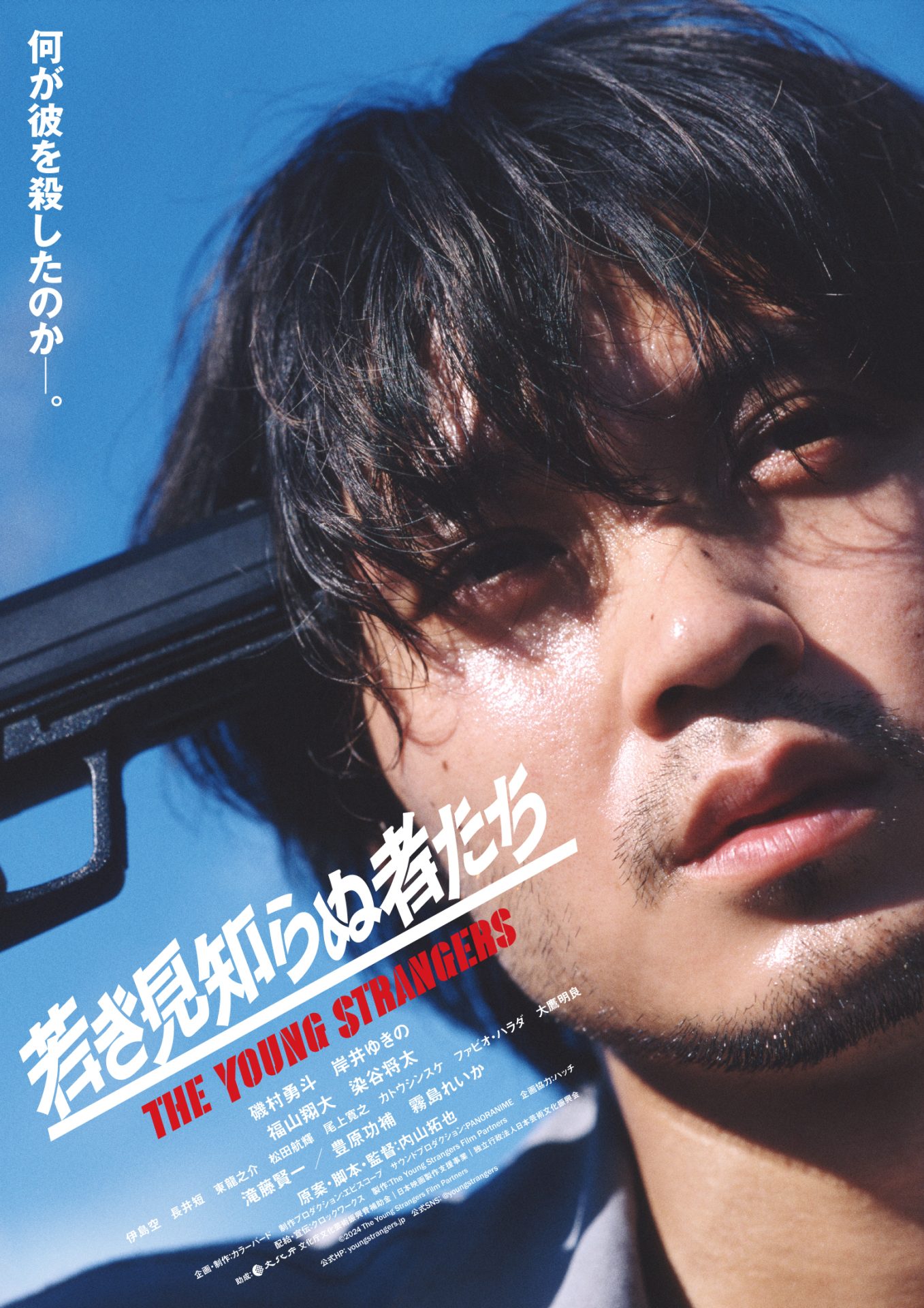
You have to protect your space from the violence of this world, a compromised father advises his sons, yet it’s something that neither he nor they are fully capable of doing. Billed as the “commercial debut” from the director of the equally emotionally devastating Sasaki in my Mind, Takuya Uchiyama, The Young Strangers (若き見知らぬ者たち, Wakaki Mishiranu Monotachi) paints a somewhat bleak portrait of contemporary Japan as place of desolation and abandonment, but at the same time is melancholy more than miserable in the earnestness with which they all dream of a better life somewhere beyond all of unfairness and injustice.

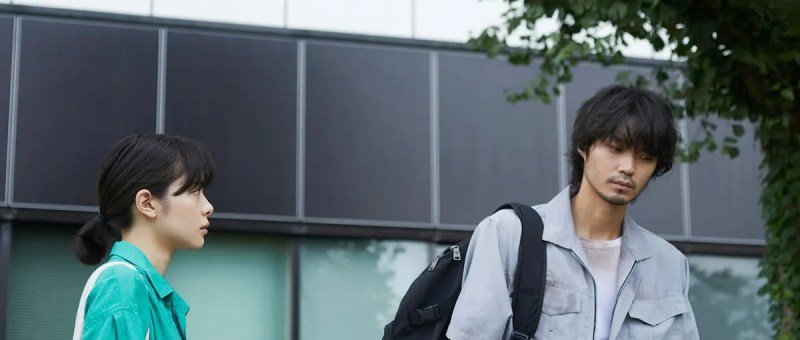
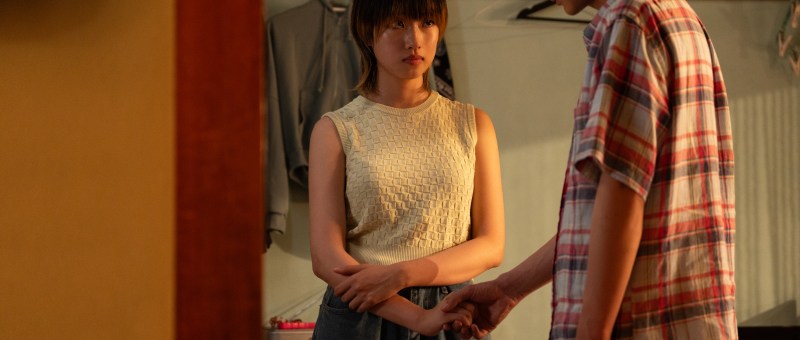
But Ayato (Hayato Isomura) seems to know that he’s burdened with some kind of karmic fate. His life oddly echoes that of his former policeman father and takes on an ironic symmetry even as he was unfairly left to pick up the pieces as a teenager adrift in the wake of parental betrayal. Now his late 20s, Ayato is a worn out and dejected figure who barely speaks after years of doing multiple jobs, in addition to running the snack bar his parents opened as a new start, to pay off the debts his father left behind. Now his mother has early onset dementia and her care is also something else he must manage as best he can with support from his girlfriend Hinata (Yukino Kishii), a nurse, and less so from his conflicted brother, Sohei (Shodai Fukuyama), who has a path out of here as an MMA champion if only he can stick to the plan and keep up with his training. 

As his best friend Yamato (Shota Sometani) points out, he’s hung onto everything his father left him but is equally in danger of losing his future. He seems wary of his relationship with Hinata, afraid to drag her into his life of poverty and hardship, while he watches friends get married and start families. He once had a promising future too, as the star of the school football team, but like everything else that came to an abrupt end in the wake of family tragedy. There are hints of trouble with law in his younger years that may have made it even more difficult for him to earn a living wage, along with giving him an unfavourable view of authority figures. Seeing another young man hassled by the police, he steps in to inverse but ends up in trouble himself. The policemen, take against him and when he’s beaten up by thugs who drag him out of the bar, they arrest him instead and let the others go. Time and again, bad actors seem to prosper and get away with their crimes, while good people like Ayato continue to suffer. When Yamato tries to come to his defence and questions the police, they lie and tell him Ayato’s just a waster as if the world were better off without him.

The boys have this game they play where put two fingers up against the back of a friend’s head and shout “bang”. It’s like there’s a bullet that always coming for them, and Ayato too fantasises about shooting himself in the head to escape this misery. Sohei, meanwhile, makes violence his weapon in taking the martial arts his father left him to forge a new path for himself while vowing not to be intimidated by violence. But violence is all around them from the literal kinds to that of an uncaring and oppressive society, and as much as Ayato fights in his own way to protect his family he can’t keep them all together nor the darkness at bay. He badly needs Sohei’s help, but also knows he can’t ask him to give up his way out or take away his future while Sohei is already pulling away. He thinks it’s time to look into a more permanent solution for their mother, and that they should let the past go, but Ayato wants to hold on to all of it as a means of giving his life meaning. “It’s not your fault, but it will be if it carries on,” a sympathetic neighbour tells Ayato after finding his mother in his cabbage patch again and leaving him to one again clear up the mess. Haunted by images of the past that in Uchiyama’s masterful staging segue into and out of the present, Ayato desperately searches for a way out of his suffocating existence, but encounters only betrayal and injustice amid the constant violence of an indifferent society.


The Young Strangers screened as part of this year’s Camera Japan.

Trailer (no subtitles)

Teki Cometh (敵, Daihachi Yoshida, 2024)

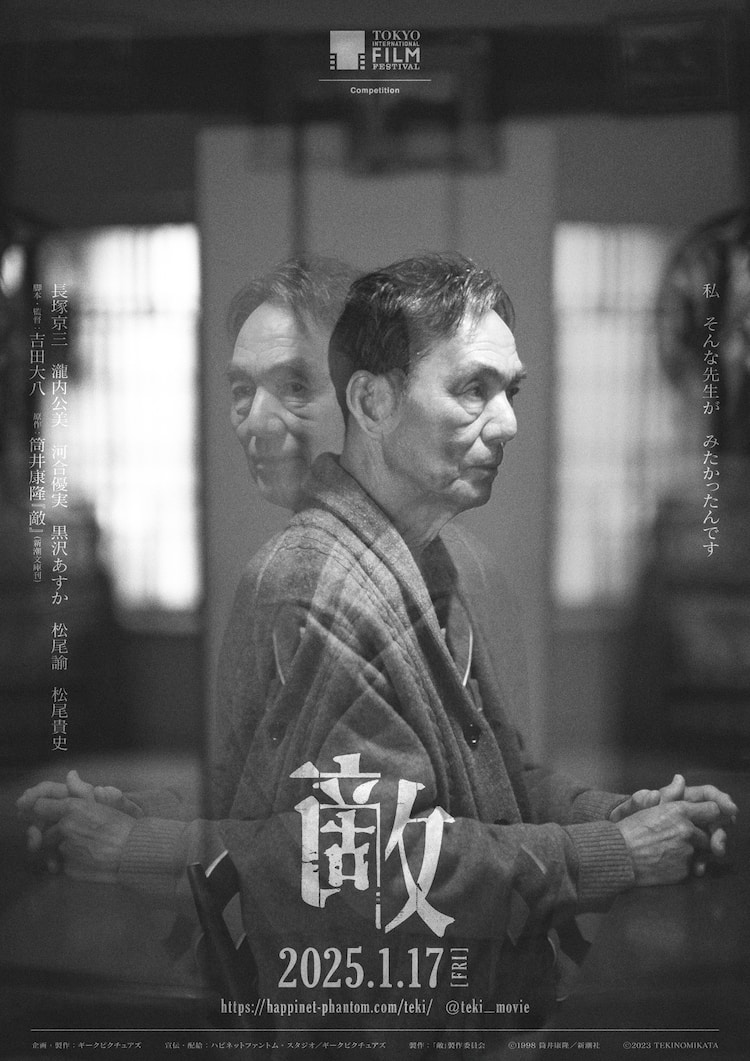
“So, reality or literature, which is more important?” an unexpected guest asks a retired professor in Daihachi Yoshida’s Teki Cometh (敵, Teki). Adapted from the novel by Yasutaka Tsutsui, the film is not exactly about encroaching dementia but rather the gradual embrace of fantasy as the hero finds himself inhabiting the shifting realities of age in which his carefully curated persona of the refined professor begins to crack under the weight of its impending end.

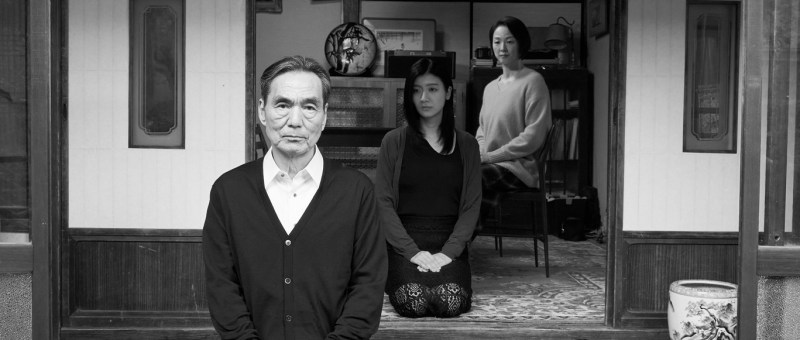
Then again, objective “reality” is clearly a strain for Gisuke Watanabe (Kyozo Nagatsuka). It’s probably not a coincidence that Gisuke shares his surname with the hero of Kurosawa’s Ikiru as he too begins to ponder the meaning of his life along with the apparently meaninglessness of his twilight years. He reveals to his friend that he’s well aware his pension won’t cover his expenses for the rest of his projected lifespan and that he’s already calculated what he calls “X-Day” which will be the day the money (and implicitly his life) will simply run out. This day is continually postponed as Gisuke acquires extra money through giving lectures on French literature or writing articles for magazines, but the early part of the film at least is all about money and its relative values. Gisuke says that he does not really contemplate the price of the newspaper because the newspaper is something he wants so he simply buys it while taking out half the amount he’d usually charge for a lecture from an ATM machine. His friend advises him to drop his fees and get more work, but Gisuke explains that his 100,000 yen boundary is carefully maintained as a kind of bulwark against a sense of obsolescence as in he thinks they’ll keep haggling him down until he’s grateful just to get anything at all.

But obsolescence is clearly something he already feels given that interest in his chosen field has already declined and perhaps there no longer is much of an audience for his views on Racine and the development of the French language. Like the professor at the centre of Kurosawa’s Madadayo, Gisuke is surrounded by former students most of whom do not work in fields related to their studies but continue to hold him up as great scholar and influential figure in their lives. Yet as the film goes on and realities begin to blur, we might begin to wonder if any of these visitors are actually real or merely spectres leaking out from Gisuke’s fracturing memory to express his own anxieties about past and present. Former student Yasuko (Kumi Takiuchi) appears to be flirting with him, but on the other perhaps she’s merely reflecting the buried desires for which he continues to feel guilt and shame. He recalls times in which they attended the theatre together and then went for meals and drinks as if they were quasi-paternal or at least platonic, but Yasuko asks him if it wasn’t sexual harassment while at the same time directly stating that the desire is mutual (and there’s 15 minutes left before her train leaves). 

From this point on, Gisuke begins having strange dreams perhaps inspired by weird messages he’s receiving about an “enemy” that’s “coming from the north”. The “north” in a Japanese context would most likely be Russia and the messages reflecting a fear of invasion but also perhaps implying that in Gisuke’s case, the enemy lies within and it’s his own brain that is attacking itself. The illicit desires that he hints at to another former student while discussing his brief foray into and eventual boredom with voyeurism begin to come to the fore in his surreal dreams including one where he is subjected to a colonoscopy that is heavily influenced by BDSM imagery. His surprise visitor asks him if he remembers the war and Gisuke says that he’s told he experienced it in the womb, implying that he carries a degree of trauma from a time before he was even born. The ghost of the grandfather he never met haunts his well-appointed Japanese-style home that speaks of his traditionalism, while Gisuke himself tenderly takes out his late wife’s old coat and deeply breathes in her scent before hanging the coat up in his office so that it too floats like a ghost.

Yoshida structures the film through a series of vignettes ordered by season, yet there’s nothing necessarily to say that the seasons are consecutive or occur within the same year. Time is becoming abstract to Gisuke, even as he’s pursued by his invisible “enemy” that attacks his respectable facade and the very image of himself as he too embraces fantasy as a means of liberation from an otherwise monotonous if also serene life of awaiting the inevitable. The monochrome photography and static composition add to the air of deadpan humour in Gisuke’s increasingly surreal world. Teki cometh for us all, but in the end teki is us and we are teki. Our own fears, regrets, and insecurities will indeed return to torment us and show us who we are. Likely as not will not like what we see.


Teki Cometh screens in Chicago 11th April as part of the 19th edition of Asian Pop-Up Cinema.

Original trailer (English subtitles)

Lonely Glory (わたしの見ている世界が全て, Keitaro Sakon, 2023)

A thoroughly unpleasant young woman gradually begins to realise that other people have feelings too and she has no idea what she’s doing with her life in Keitaro Sakon’s indie drama Lonely Glory (わたしの見ている世界が全て, Watashi no Mite Iru Sekai ga Subete). Haruka currently runs a startup geared towards helping people maintain good mental health which is ironic in the extreme because she has no understanding of or regard for the feelings of others. Yet as she says during a role play with an employee, the basic principle of their business is helping people identify their problems which she ironically does on returning home to her estranged family if not entirely for altruistic reasons. 

Before that, however, we see her be unnecessarily harsh during a staff evaluation later justifying herself to the boss that they needed to clear out those who are of no use. To her, the staff member’s feelings were irrelevant, she just informed them of their subpar performance. Her boss isn’t buying it. He tells her that her management techniques are counterproductive and that with multiple accusations of bullying behaviour she herself says she is unwilling to work on (because she doesn’t understand she’s done anything wrong) he has no option other than to ask for her resignation. Unfazed, Haruka decides to start her own startup, but is soon confronted with another crisis on learning that her mother has passed away. 

On arrival at the hospital and despite being the youngest sibling Haruka immediately takes over, seemingly unmoved, and opts for the cheapest funeral plan available. She didn’t come to her father’s funeral and her siblings didn’t expect to see her for this one either, but now she has an ulterior motive in that she wants to sell the family home and business to finance her new business venture despite the fact all three siblings still live there and two of them are financially dependent on the cafe/greengrocers for their living. Haruka is incredibly judgemental about her small-town siblings’ life choices branding them as delusional and generally carrying on with an air of superiority but it’s also true enough that they are all to a degree trapped, unable to move on with their lives while afraid to leave the safety of their childhood home. 

As she says, sometimes people just need a little push which is something that she can give them but it’s never quite clear if she genuinely cares or is motivated solely by the desire to manipulate her siblings into agreeing to sell the house. Divorced sister Miwako is fairly unfussed either way but oldest son Keisuke is consumed with shame in the idea of giving up the family business while Takuji has self-esteem issues and thinks everyone looks down on him for never managing to get a job since he finished university four years previously. Challenged by Keisuke’s much younger farm girl girlfriend Asuka on the nature of success, Haruka replies that it’s having everyone around you admit you were right which lays bare her own insecurity and need to dominate every situation that she’s in. But then ironically enough she does help each of her siblings identify their problems and then gain the courage to begin moving forward. 

The dissolution of the family business and the erasure of the family home becomes in its way liberating, less the glue that bound them together than that trapped them in a perpetual adolescence. Haruka begins to realise she’s not much better than the life coach scammer who sold her vulnerable brother false promises of easy success, and that the way she treats others can have unintended consequences but in the end she’s the one left rootless and bereft of direction after closing the shop. Perhaps that’s her lonely glory, the knowledge that she helped each of her siblings do what she now can’t (or maybe just that she got what she wanted and doesn’t know what to do with it). Told with a down to earth naturalism, Sakon’s indie drama is also a lament for the changing nature of small-town life and a loss of community as the closure of the store robs the locals of another neighbourhood hub ironically leaving Haruka all alone in the now empty space of her family home with a newfound sense of loneliness still searching for the right words and a new direction. 


Original trailer (English subtitles)

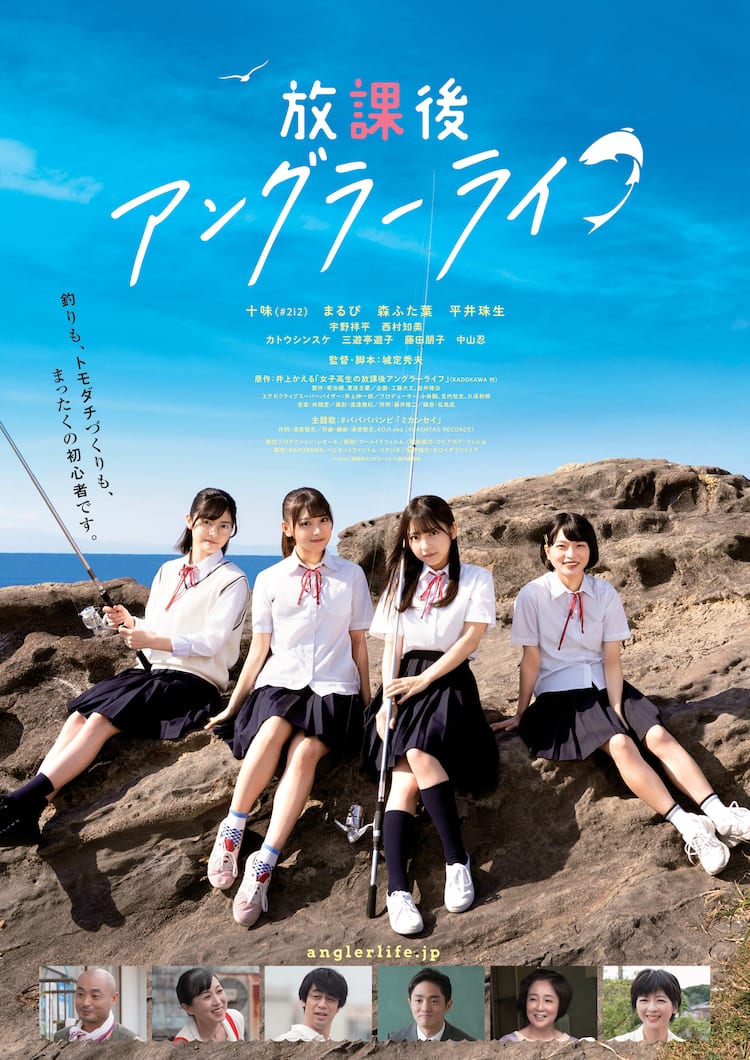
Afterschool Anglers Club (放課後アングラーライフ, Hideo Jojo, 2023)

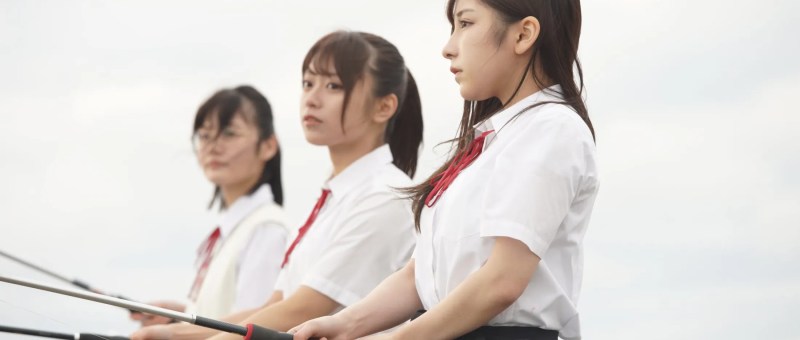
What does it take to learn to trust people again after a traumatic experience? Mezashi (Toomi), the heroine of Hideo Jojo’s adaptation of the light novel by Kaeru Inoue Afterschool Anglers Club (放課後アングラーライフ, Hokago Angler Life), was bullied by people she once called friends and has since retreated within herself, becoming a massive people pleaser while terrified of annoying people or upsetting them in some unknown way.

Fortunately for her, her father is transferred to the country and so they all have to move with Mezashi taking the opportunity to trash her phone and with it her traumatic memories of being bullied both online and off. As one might expect, people in the country are inherently more friendly and it’s difficult for Mezashi to tell if her new classmates are just excited about her arrival or already making fun of her. On moving to the country she’d written a new manifesto swearing that she wouldn’t attempt to make friends and would carry on people pleasing, instantly agreeing to any favours asked of her, smiling sweetly, and always giving non-committal answers to avoid causing offence. 

She runs into trouble when she’s invited to the secret club run by two of the girls, realising that her goals are incompatible so she can’t avoid both making friends and refusing a request. Though the girls more or less adopt her and make her a part of their unofficial fishing club, Mezashi can’t seem to work out how to be a part of a friendship group and is often confused about what she should say and do. She’s constantly worried that her new friends are annoyed with her for not being very good at their shared hobby of fishing and subsequently ruining their fun. But this sense of insecurity is a vicious cycle in that she continues to present a facade of blandness which prevents her from generating a friendly intimacy with any of the girls. Ring leader Shiira (Marupi), who originally bonds with her because their names both have a fishy connection, says as much in mentioning that it bothers her Mezashi never laughs from her heart or gets angry with them. Her defensive mechanisms actively sabotage her new relationships while she struggles to overcome the trauma of her betrayal at the hands of former friends turned bullies.

But then there are also tensions within this otherwise close and supportive friendship group in that Akari (Tamao Hirai) has an obvious crush on Shiira and is resentful of Mezashi joining their gang though not to the extent of bullying or rejection. Shiira, meanwhile, seems to be constantly flirting with Mezashi who does not appear to be interested in her in that way, even at one point pretending to have been stung by a venomous fish so that Mezashi will suck the toxins out of her leg. Nevertheless, Nagi (Futaba Mori), another member who discovers Mezashi’s secret, tries to encourage her to be less of a people pleaser and just be honest if she doesn’t like something or doesn’t want to do it such as threading the bait onto the hook or gutting the fish. In effect, she gives her permission to be herself and the confidence to believe that your friends won’t abruptly stop liking you just because you asked for help but they can’t bond with someone who won’t let them know when they’re not okay. 

All in all, Jojo paints this corner of a small coastal town as a wholesome place of kindness and comfort where people are on the whole friendly and welcoming as opposed to the city where they can be cruel and judgemental. The very thing that allows Mezashi to find her new friends was her unusual name for which she’d previously been bullied. Learning to trust again is certainly no easy thing, but just as Nagi had said humans are made to rely on each other and friendship is about both give and take, offering support and agreeing to accept it. With fishing, you just have to cast the line and see if anything bites and friendship is much the same, Mezashi gaining the strength to reel it in thanks to the gentle support of her new friends and tranquil rhythms of small town life free of the petty prejudice and casual cruelties of the city.


Afterschool Anglers Club screened as part of this year’s Camera Japan.

Original trailer (no subtitles)

Missing (ミッシング, Keisuke Yoshida, 2024)

Why is it that we rush to judgement rather than empathy? When a little girl disappears during a short walk from a local park to her home, less than helpful members of the public are quick to turn on the parents while news media, eager for ratings and clicks, is only too happy to give the people what they want casting aside ethical concerns in their exploitation of the parents’ pain all while the little girl remains missing.

In this society, it’s quite normal culturally for children of Miu’s age, six, to walk short distances alone and be left unsupervised at home at for short periods of time. Nevertheless, the public is quick to blame the mother, Saori (Satomi Ishihara), because she had gone to a concert that night and didn’t notice frantic calls from her husband worried because Miu was not at home when he got back from work at 7pm. Soari too blames herself, as is perhaps natural, but it’s unreasonable to expect anyone to never go out for an evening again after having children. Her husband comes in for less scrutiny, which might be surprising, though her brother, Keigo (Yusaku Mori), soon finds himself the prime suspect having been the last to see Miu and allowed her to walk home alone though he would previously have walked her back.

The family find themselves under scrutiny with their every move judged by an unforgiving society. When they dare to buy fancy pastries, online trolls suggest they can’t be all that bothered about Miu after all and are living the high life with the extra money they no longer need to spend on her. Given all that, it might be surprising that they turn to the media for help but in their desperation to find Miu they will leave no stone unturned. Idealistic reporter Sunada (Tomoya Nakamura) seems to want to help them, but is constantly undermined by his bosses who pressure him to take the story into more sensational territory. Though he wanted to write a human interest piece supporting the parents and raising awareness about Miu’s disappearance, he ends up placing them in the firing line for even more trolling and particularly of Saori’s brother Keigo who is an introverted, awkward man not suited to appearing on television. 

Sunada says he wants to help, but it’s undeniable that the media is exploiting the parents’ desperation raising serious ethical concerns as to how they safeguard sources and subjects while shaping the narrative around sensitive issues. Sunada takes a producer to task for placing images of a cement mixer and the sea into the ident for the piece as if it were hinting at what might have happened to Miu but really what the station is most interested in is digging up dirt on the family rather than drawing out new information on the case. A fellow journalist is having great success with a salacious story about the mayor’s son committing fraud, but his piece is less crusading investigative journalism than gossip inviting judgement. Disliking his flippant attitude, Sunada reminds him their job’s not to make people laugh, but his colleague gets a fancy promotion to head office while Sunada is stuck doing random feel good stories about seals.

Their treatment at the hands of the media also exposes a divide within the couple with Saori often frustrated by her husband’s attitude, feeling as if he isn’t invested enough. Yutaka (Munetaka Aoki) suggests simply not reading the online comments and ignoring the trolls while Saori feels compelled to defend herself. He is also warier of pranks and scammers, unwilling to simply jump on every lead out of desperation when so many people seem intent on causing them further pain. Perhaps it makes people feel more in control of their lives to blame the parents, as if something like this couldn’t happen to them because they make what they feel to be better choices, rather than accept that life is random and unfair and little girls can disappear into thin air mere steps from their own door. Unable to find her own daughter, Saori begins defending other people’s children getting a job as a crossing guard to ensure they reach home safely while simultaneously frantic and afraid, handing out fliers to a largely disinterested populace ever hungry for novelty and excitement and embarrassed by her pain even as they continue to feed on it.


Missing screened as part of this year’s Toronto Japanese Film Festival.

Original trailer (English subtitles)

September 1923 (福田村事件, Tatsuya Mori, 2023)

After the devastating Great Kanto Earthquake struck in 1923, it led to a period of hysteria in which in the natural disaster somehow became equated with the Korean Independence Movement, foreigners, and socialists and who were after all thorns in the side of rising nationalism. Documentarian Tatsuya Mori makes his narrative film debut with September, 1923 (福田村事件, Fukudamura Jiken) released to mark the 100th anniversary of the incident and focussing on a little known episode in which villagers turned on a small group of itinerant medicine pedlars they were convinced were not Japanese. 

In this case, at least, they were Burakumin. An oppressed underclass of their own, they too are divided in their views about Koreans some finding solidarity with them as another minority who is bullied and discriminated against while others are quick assert themselves as at least being above them on the pecking order cheerfully using slur words as they go. Shinsuke (Eita Nagayama), the leader of the troupe, laments that they have to live this way, tricking those worse off than themselves into buying their snake oil cures while explaining that though people will often help each other out when times are good, if survival’s on the line they’ll turn against each other. 

Perhaps that’s difficult to imagine in a small village of genial farmers, but militarism has already corrupted its gentle rhythms. Men from the village are fond of telling war stories from their time as conscripts in China or Russia, though one has a particular bee in his bonnet about wives being left lonely with husbands away overseas and is convinced that his father has slept with his wife. Another local woman was indeed having an affair shortly before her husband was killed in action and is then ostracised by the village for her transgressive behaviour becoming yet another oppressed minority. The village chief is keen on democracy and progressive in his way yet soon finds himself powerless against the local militia mostly comprised of old men with a lust for blood and glory. It’s this militarist hysteria that eventually proves tragedy as they find themselves desperate to identify “spies” and protect the village only to murder children and a pregnant woman who were just passing through. 

The absurdity extends to asking those suspected of being Non-Japanese to repeat a particular phrase difficult for Koreans in particular to pronounce, only those from other areas of Japan also pronounce it in a way that might seem “foreign” in Tokyo. Cornered by the militia, Shinsuke asks if it would be alright to kill him even if he were Korean, taking issue with the militia’s absurdist and racist rationale that decides someone must die because of the way they pronounced a certain word or seemed uncomfortable shouting “banzai” at the point of a sword. But one of the villagers unwittingly uncovers a since of guilt felt even by a man in a village miles away from anything that the Koreans have been bullied for years, this the understandable result of their rage boiling over and a moment of retribution. 

The film seems to suggest that the buck doesn’t really stop, except perhaps with the bystander who merely watches this horrifying violence and does nothing. Tomokazu (Arata Iura) has recently returned to the village after many years living in Korea bringing back with him a Korean wife but his marriage is falling apart due to his own guilt and trauma having been complicit in a Japanese atrocity. Watching the massacre unfold, his wife, Shizuko (Rena Tanaka), asks him if he’s just going to watch this time again but his attempt to intervene makes no difference. An idealistic news reporter meanwhile takes her boss to task for publishing propaganda headlines associating Koreans with crime and terrorism rather than real truth of what’s happening on the ground, asking him what the point of the press is if it won’t speak truth to power. But militarists do not listen to reason, and as the headman points out they will have to keep living with those who’ve committed these heinous acts. Sometimes a little on the nose with its symbolism such as a literal murder of hope in the killing of an unborn child, Mori’s otherwise poignant drama lacks the impact it strives for but nevertheless addresses a shocking moment of mass hysteria that is not quite as historical as we’d like to think.


September 1923 screened as part of this year’s Nippon Connection

Original trailer (English subtitles)

Saga Saga (緑のざわめき-Saga Saga-, Aimi Natsuto, 2023)

Three women contending with a legacy of patriarchal failure and male violence circle around each other in the picturesque hot springs resort of Ureshino in Aimi Natsuto’s etherial drama, Saga Saga (緑のざわめき, Midori no Zawameki – Saga Saga –). Less playful than Natsuto’s previous film Jeux de plage, the oscillating action takes on a poetic, mystical direction as the forces which bind the three women together eventually become clear while each in their own way tries to overcome a lingering sense of displacement and loneliness. 

The first of them, Kyoko (Rena Matsui), left Ureshino to become an actress in Tokyo but has given up performing and resettled in nearby Fukuoka where she runs into an old hometown boyfriend, Sotaro, who is currently sort of dating Eri, a woman he met on a dating app. Despite telling Kyoko he can’t stay long after reconnecting because he has a date with someone who is “not quite” his girlfriend, Sotaro ends up going to a love hotel with another woman, Naoko (Sae Okazaki), who frequents the bookstore where he works. Though it originally appears that Naoko is jealous of Kyoko and fears she’s missed her chance with Sotaro, we soon realise that she is in fact semi-stalking her for unclear reasons but actually wants to get in touch with someone else and eventually forms a telephone connection with Anna (Sara Kurashima), a high school girl currently living in Ureshino with her aunt, Fumiko (Asuka Kurosawa). 

In a way, they are all looking for something that seems to be missing in their lives. For Kyoko it seems to be something like the concept of home as she struggles with a series of sudden changes from the death of her mother two years previously to a brush with cancer in the form of an ovarian tumour she has recently had removed. Fumiko, who was a friend of her mother’s, tells her that she’s on a journey of self-reconciliation and there is indeed something in that as she works over the mysteries of her past while looking for new directions in her future. 

Meanwhile, she is plagued by strange dreams of being lost in a forest later telling a friend that she was once sexually assaulted in the woods when she was in high school and has the feeling the person who is chasing in her in her dream may be her father who left the family when she was a child. When she was receiving treatment for the tumour on her ovary, she began to ask herself why she had been born a woman forever subject to threat and patriarchal oppression. On her return to Fukuoka, she undergoes a very strange job interview in which she’s repeatedly assured that “being a woman” she won’t be asked to do anything “difficult” while it seems that being “attractive” is enough to get by in the beginning. Also they warn her that they don’t offer “great maternity leave or anything like that”. 

The lives of each of the women have been in one way or another overshadowed by male violence, but it’s Anna’s would-be-boyfriend Toru who is eventually victimised when he’s assaulted by a woman who wanted to bring back a problematic local festival cancelled because of a sexual assault. Toru had been in the forest to consult with some kind of mystic man trying to get him to conduct a ritual to get Anna to like him only to be told it doesn’t really work like that and you wouldn’t want it to anyway. After the assault it’s Toru’s life which spirals out of control when he’s blackmailed into acts of petty crime by the witch-like woman who forced herself on him, while Fumiko too is later forced to pay the price for having kept her secrets and for compassionate reasons attempted to hide the truth from those who most wanted to know.

Finally brought together on solving their individual mysteries, the three women settle on creating a home they can each return to, anchoring themselves as a family as a means of finding stability in a world which is so often in flux in defiance of the destructive forces which connect them. Even Eri admits that in reality she may have been looking for self-affirmation in her desire to find a dating app soulmate as her friends reflect on their terrible romantic experiences which, ironically, include being stalked. In the depths of its mysticism and eeriness, the film nevertheless ends on a note of serenity and the promise of moving forward if paradoxically by making a return. 


Saga Saga screened as part of this year’s JAPAN CUTS.

Original trailer (no subtitles)

Goodbye, Bad Magazines (グッドバイ、バッドマガジンズ, Shoichi Yokoyama, 2022)

With the 2020 Olympics on the horizon, Japan began looking for ways to tidy up its image expecting an influx of foreign visitors which for obvious reasons never actually materialised. As part of this campaign, leading chains of convenience stores announced that they would stop selling pornographic magazines in order to create a more wholesome environment for children and families along with tourists who might be surprised to see such material openly displayed in an ordinary shop. Then again, given the ease of access to pornography online sales had fast been falling and the Olympics was perhaps merely a convenient excuse and effective PR opportunity to cut a product line that was no longer selling. 

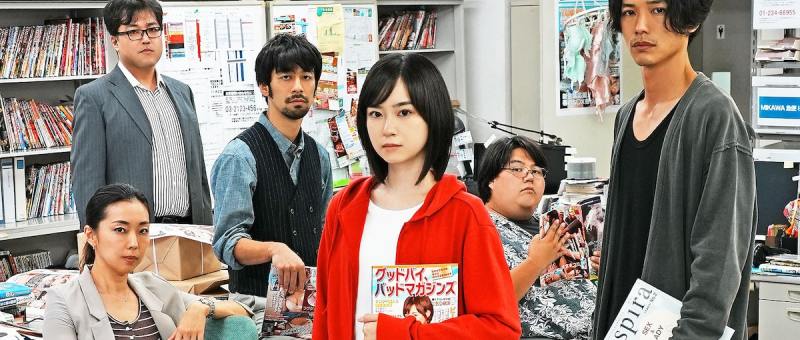
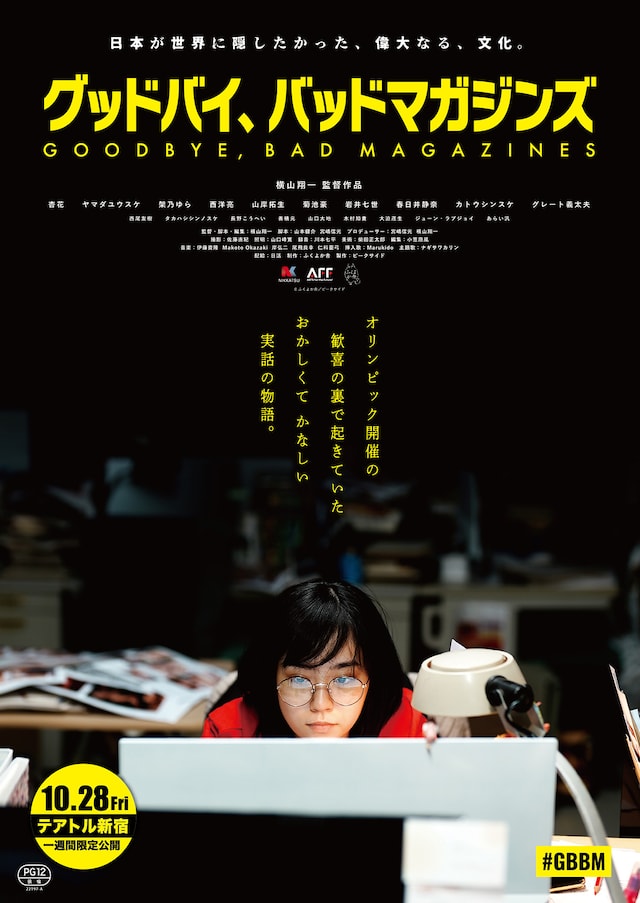
Based on actual events, Shoichi Yokoyama’s Goodbye, Bad Magazines (グッドバイ、バッドマガジンズ) explores the print industry crisis from the inside perspective of the adult magazine division at a major publisher which has just announced the closure of a long running and well respected cultural magazine, Garu. Firstly told they don’t hire right out of college, recent graduate Shiori (Kyoka Shibata) who had dreamed of working in cultural criticism is offered a job working on adult erotica and ends up taking it partly in defiance and encouraged by female editor Sawaki (Seina Kasugai) who tells that if she can make a porn mag she can make anything and be on her way to working on something more suited to her interests with a little experience under her belt. 

Her first job, however, consists entirely of shredding voided pages filled with pictures of nude women which is slightly better than the veteran middle-aged man who joined with her after being transferred from Garu who is responsible for adding mosaics to the porn DVDs they give away with the magazines to ensure they conform to Japan’s strict obscenity laws. Later a mistake is made and mosaics are omitted placing the publishing company bosses at risk of arrest and the magazine closure. Aside from being one of two women in an office full of sleazy men and sex toys, Shiori’s main problem is that she struggles to get a handle on the nature of the erotic at least of the kind that has been commodified before eventually falling into a kind of automatic rhythm. “It’s easy when it does’t mean anything” she explains to sex columnist and former porn star Haru (Yura Kano) who is much franker in her expression but perhaps no more certain than Shiori when it comes to the question asked in her column, why people have sex. 

Shiori asks her sympathetic colleague Mukai (Yusuke Yamada) for advice and he tells her that what’s erotic to him is relationships, but it seems his work has placed a strain on his marriage while his wife wants a baby and he has trouble separating the simple act of meaningless sex with that which has an explicit purpose such as an expression love or conceiving a child. According to Shiori’s editor Isezaki (Shinsuke Kato), the future of erotica will come from women with their boss finally agreeing to an old idea of Sawaki’s to create an adult magazine aimed at a female audience in the hope of opening a new market while handing a progressive opportunity to Sawaki and Shiori to explore female desire, but at the same time magazines are folding one after the other with major retailers canceling their orders and leaving them to ring elderly customers who’ve been subscribing for 30 years but don’t have the internet to let them know the paper edition is going out of circulation. 

The editorial team have an ambivalent attitude to their work, at once proud of what they’ve achieved and viewing it as meaningless and a little embarrassing. Not much more than a few months after working there, Shiori has become a seasoned pro training a new recruit who’s just as nervous and confused as she was but offering little more guidance was than she was given while becoming ever more jaded. When handed evidence that her boss has been embezzling money, she just ignores it though perhaps realising that when he’s found out it means the end for all of them too. Like everyone else, he’d wanted to start his own publishing company but the editor who left to do just that ended up taking his own life when the business failed. Yet, on visiting a small independent family-run convince store near the sea, Shiori hears of an old man who visits specifically to buy the magazines she once published because he can’t get them anywhere else while they have steady trade from fishermen who need paper copies to takes out to sea. The message seems to be there’s a desire and a demand for print media yet, even if it’s not quite enough to satisfy the bottom line. A sympathetic and sometimes humorous take on grim tale of industrial decline, Goodbye, Bad Magazines sees its steely heroine travel from naive idealist to jaded cynic but simultaneously grants her the full freedom of her artistic expression along with solidarity with her similarly burdened colleagues.  


Goodbye, Bad Magazines streamed as part of the 2022 Yubari International Fantastic Film Festival.

Teaser trailer (English subtitles)

A Man (ある男, Kei Ishikawa, 2022)

©2022 "A MAN" FILM PARTNERS

“Why was living so hard for him?” a brother remarks of man he assumed to have died in an accident after severing ties with his family, though with little sympathy in his voice and in truth should the brother be dead it would be all the better for him. Adapted from  a novel by Keiichiro Hirano, Kei Ishikawa’s A Man (ある男, Aru Otoko) asks questions not so much about the limits of identity and the existence of an authentic self, but the kinds of labels we place on others and the prejudice that often accompanies them that makes some want to run from themselves. 

Accidental detective Kido (Satoshi Tsumabuki), a lawyer who previously represented the recently widowed Rie (Sakura Ando) in her divorce from her first husband, is a case in point. He tries not to react while his wealthy and extremely conservative father-in-law runs down a case he’s just won representing the parents of a man who took his own life after being expected to work extreme overtime by an exploitative company solely to fulfil the image of the salaryman. The father-in-law sneers and complaints about the family receiving compensation before moving on to a rant about the welfare state scoffing that “real” Japanese don’t rely on such things which are only for “Koreans and people of that ilk”. 

Aside from its unpleasant xenophobia, the remark is insensitive as Kido is himself third generation Zainichi Korean, though a naturalised citizen of Japan. Throughout the film, he’s bombarded with social prejudice and racist abuse to which he chooses to say nothing, because there’s nothing he can really say, though leaving us to wonder if his decision to marry his wife (Yoko Maki), the daughter of a wealthy and conservative family, is an attempt to secure his own identity as a member of Japanese society even while bristling at her further demands, that they should invest in a more impressive, larger detached house as recommended by her father and also have another child. 

Kido’s quest to uncover the “true” identity of Rie’s husband Daisuke (Masataka Kubota) who is discovered to have been living an assumed identity when the brother of the man whose name he borrowed arrives at his memorial service, is also a quest to affirm his own identity which is in many ways as self-constructed as Daisuke’s is assumed to be. The interesting thing is that Daisuke, who said little of his past, used the other man’s backstory leaving no doubt that is not quite a case of mistaken identity that brings Kyoichi (Hidekazu Mashima) to Daisuke’s memorial service, though he is quick enough to disparage the life the deceased man shared with Rie in a rural “backwater” while making vague references to insurance policies and inheritances and simultaneously offering to pay for the funeral expenses as if reclaiming ownership over Daisuke’s legacy. 

Like Kido’s father-in-law, Kyoichi appears to be a cynical and self-interested man and it’s not difficult to see why the other Daisuke may have wished to escape his life with him. As an older man points out, everyone has things in their past and though they might not seem like much to others it’s natural enough to want run from yourself, to leave everything behind and start again somewhere else. In Japan, this is much easier to do than in some other countries and it’s true enough that changing one’s name is not that uncommon either. Rie’s young son Yuto, now old enough to question his own identity, took his mother’s maiden name after the divorce, then Daisuke’s surname Taniguchi when he married his mother. Now he wonders what his name should be if it is not Taniguchi and who he really is underneath it. 

In essence, we give people names as a kind of label to describe our relationship to them as a means of mapping out the world. These labels also come with prejudices such as that directed towards Kido as a Zainichi Korean and to another of the “disappeared” men who struggled to emerge from the shadow of his father’s crime as a death row felon. The projection of an identity can be harder to live with than the identity itself. When Kido’s wife tells him that he doesn’t seem himself and she wants him to go back to the way he was before, it’s a rejection of the new identity that has begun to surface through his quest to identify Daisuke and an instruction that he conform to the image of him she has constructed for herself as a typical Japanese salaryman not so different from her father in their affluent, middle-class existence.

Having satisfied himself that he understands the man Daisuke came to be, Kido’s self-image and sense of identity seem to be reaffirmed. He is happier with his wife and son, and has fewer doubts about his place in the world, but then he’s suddenly confronted with an unexpected revelation that undermines his new sense of security in causing him to doubt the veracity of the image he has of others, and consequently of their relationship with him which again leaves him unanchored unable to affirm his image of himself without its reflection. Rie’s final acceptance that in the end she never needed the “truth” (now that she has it) points to the same answer, that in the end Daisuke’s name was irrelevant because he was the man he was to her at the time that she knew him and this is all we can ever really know of each other in a continual act of faith in interpersonal connection. A man can be many people at once, or in quick succession, and none of them any less “real” than another. “It’s nobody’s life but your own,” Kido is reminded even as he struggles to reorient himself in a merging of identities self-constructed or otherwise but perhaps destined to remain forever a stranger to himself.


A Man screens in Chicago March 18 as part of the 16th season of Asian Pop-Up Cinema.

International trailer (English subtitles)

Onoda: 10,000 Nights in the Jungle (Onoda, 10 000 nuits dans la jungle, Arthur Harari, 2021)

For most people, the Pacific War ended in 1945. For Hiroo Onoda it may in a sense never have ended though he laid down his arms in 1974, 30 years after his initial dispatch, having spent the intervening three decades pursuing guerrilla warfare in the Philippine jungle the last two of them entirely alone. Arthur Harari’s three-hour existential epic, Onoda: 10,000 Nights in the Jungle (Onoda, 10 000 nuits dans la jungle), explores the psychological dimensions of his quasi-religious conviction in the righteousness of a mission which is in one sense no more than to survive along with his refusal to accept that the war is over and his personal struggle has been pointless. 

Immediately in opening the film in 1974 with a young man identified only as a “tourist” (Taiga Nakano) arriving on the island in search of Onoda (Kanji Tsuda), Harari draws a direct contrast between these two arrivals and subsequent departures. As he says, the Tourist is just that in town for a specific purpose after which he will leave and though you might be able to say the same of Onoda who came to the island of Lubang in late 1944 his reality was very different. On luring him out of the jungle by playing the patriotic war song he had sung with the other soldiers who unlike him accepted the surrender, the Tourist poignantly tells Onoda that he has travelled to over 50 countries whereas Onoda in a certain sense has never left Japan. “This island belongs to us” he’s fond of insisting seeing it as a piece of the Japanese empire which others are trying to take from him but he alone must defend. 

As we discover, the young Onoda (Yuya Endo) had wanted to become a pilot but washed out of the training program because of a fear of heights and was subsequently put forward for a kamikaze squadron. The irony of his life is that he is a man who refused to die for the emperor, his will to survive bringing him to the attention of Major Taniguchi (Issey Ogata) of the notorious Nakano spy school who sells his students a line that they are the good guys helping to liberate East Asia from Western imperialism. Trained in guerrilla warfare part of Onoda’s mission is to foster an uprising in the local population whom he assumes will also oppose American influence never realising that he is in fact a part of a destructive colonising force they will also seek to repel not least because of the way they have been treated by Japanese forces. 

Onoda’s first meeting with his captain on arriving on Lubang is interrupted by the arrival of the mayor of a nearby town who has come to complain that Japanese soldiers have been stealing food supplies from local farmers. This comes as a surprise to Onoda who is obviously not fully aware of the reality on the ground. His initial orders are largely ignored by the remaining NCOs who get up and leave during his briefing knowing that what he’s proposing is impossible. These men are already battle weary, many of them are sick, and they are running low on supplies. Onoda is 22 and fresh faced, arriving full of energy and patriotic zeal assuming these men are simply lazy or lack ideological commitment. He has no grounds to wield authority and no combat experience that would permit him to understand the circumstances in which he finds himself. In an especial irony, his first kill occurs after the war has (for everyone else) ended and he will himself go on to commit acts of atrocity against the local population which he justifies as acts of war. 

The military song which he is fond of singing celebrates there being no more bandits, yet banditry is essentially what he has been reduced to calling into question any idea of heroism which might be attributed to his refusal to accept the wartime defeat. In his Nakano spy school training, Onoda had been encouraged to ignore the accepted rules of war, that all is permissible in the pursuit of victory. He is also told that the prize for the “secret war” he is conducting will be a “secret glory” that goes unrecognised by others while he alone will possess true integrity in knowing that he never wavered in his mission. Yet there is something in him which weakens when he encounters the Tourist and is told that most of Japan believes him to be dead, rendering his struggle an irrelevance. 

He begins to admit the concept of surrender but only if given new orders from Taniguchi whose contradictory teachings have informed the course of his life, yet Taniguchi like many of his generation in the Japan of 1974 does not want to face his wartime past. The bookshop he now runs sells no military books and he claims not to remember Onoda or Lubang refusing his responsibility for his role in the conflict now filled with shame and regret. Yet it’s also possible that Onoda misunderstood the nature of the mission he’d been assigned, that in saving him from the kamikaze squadron because he did not want to die, Taniguchi gave him only one order – to survive. “You do not have the right to die” he reminds the recruits while giving them the ultra-individualist mantra that they must be their own officers which is in essence the paradoxical instruction to obey no orders but their own meaning that Onoda was always free to accept defeat. 

The psychological consequences of doing so, however, may have been too great. Coming of age in a militarised society, he already feels himself emasculated and embarrassed by his failure to become a pilot essentially because he is afraid to die. An awkward meeting with his father (played by film director Nobuhiro Suwa) resembles that of a Spartan woman sending her son to war with the instruction to return with his shield or on it. To return in defeat is psychologically impossible and suicide forbidden and so the only choice is inertia. In this Onoda may be hiding in the jungle unable to face a post-war future, descending into delusional conspiracy when presented with evidence that the war is over choosing to see the attempts of others to discourage him from his mission as proof of its importance, as if he and the remaining soldier sticking with him are key players in geopolitical manoeuvring worthy of such an elaborate plot. To believe the world is wrong is easier than to accept that he’s wasted his life in service of a mistaken ideal while failing to prove himself a man by the standards of a heavily militarised society. 

He’s tempted out of his delusion only by the Tourist who confronts him with the face of a new Japan entirely unknown to him, a Japan of economic prosperity, of the Shinkansen, of democracy. Being taken off the island means he must finally leave his dreams and delusions behind to enter a new post-war reality. Harari frames the island of Lubang as a psychological realm, the topography of Onoda’s delusion, but is also mindful of the islanders living outside it whom Onoda terrorises under the justification of war no better than a bandit in his quest for survival. In Harari’s oneiric landscapes, Onoda’s vistas are forever haunted by the spectres of his latent regret in the reflections of the boy he once was who came to Lubang to prove himself a man only to leave it a ghost. 


Onoda: 10,000 Nights in the Jungle opens in UK cinemas April 15 courtesy of Third Window Films. It will also be released on blu-ray May 16 in a set which also features an interview with actor Kanji Tsuda plus an interview with director Arthur Harari, DOP Tom Harari and assistant director Benjamin Papin.

Original trailer (English subtitles)