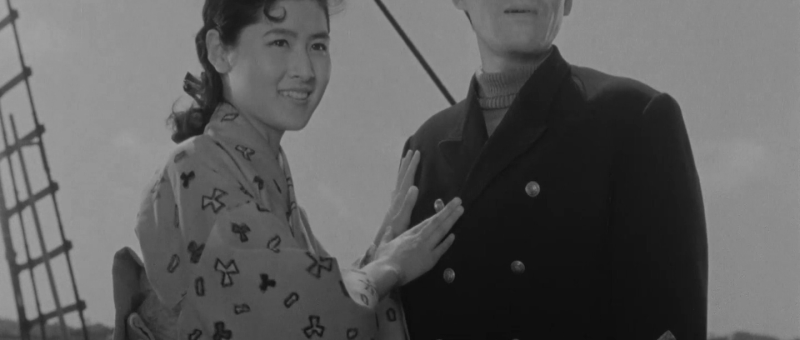
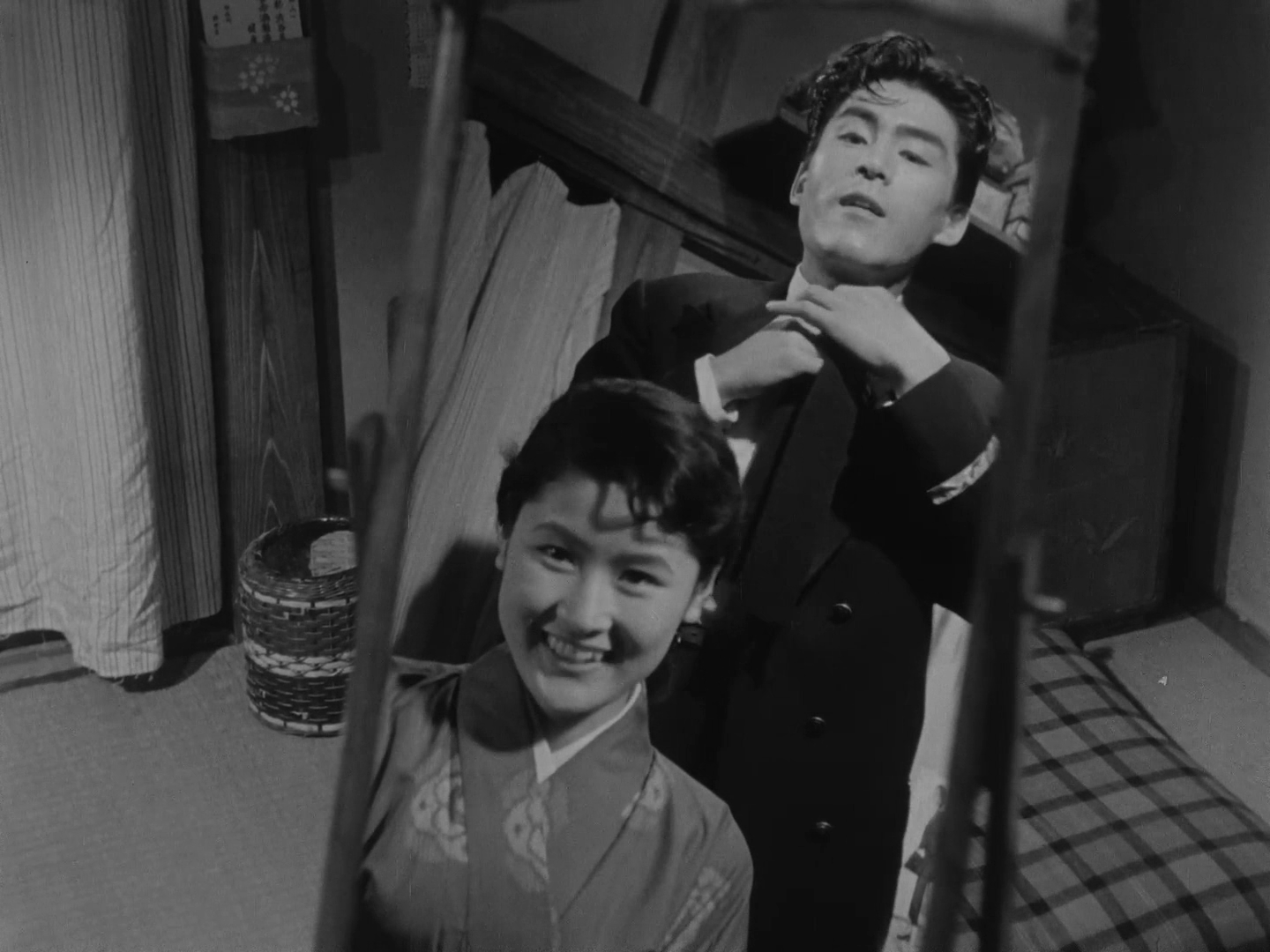
Directed under his birth name Seitaro, Seijun Suzuki’s second film Pure Emotions of the Sea (海の純情, Umi no Junjo) is essentially a vehicle for pop star Hachiro Kasuga who plays a character with the same and sings several of his popular hits including Otomi-san which eventually sold over a million copies. Perhaps precisely because of its nature as a 45-minute programme picture, Suzuki was able to get away with quite a lot of the nonsense that would become his signature style in an otherwise anarchic tale of a romantically troubled whaler and the improbable number of women who love him.
Hachiro is the harpoon operator on a whale boat, but it’s mainly women’s hearts that he seems to be piercing. While he seems to have feelings for captain’s daughter Kazue (Toshie Takada), he also attracts the attentions of Miyoko (Tomoko Ko), daughter of the head of the shipping company, local sex worker Yumi (Miki Odagiri), and “judo-geisha” Suzugiku (Kyoko Akemi). His various encounters encourage him to swear off women, but this is quite a small town and he can’t avoid them entirely. Eventually, Miyoko suggests that perhaps she, Yumi, and Suzugiku could divide Hachiro in three with Yumi taking his money, Suzugiku his heart, and Miyoko his throat for his singing voice. After some rather macabre discussions about how to get his heart out of his body, they settle on a time share arrangement instead with each of them having Hachiro for eight hours of the day, though Hachiro’s thoughts don’t seem to enter into it.
Conversely, ambitious rudder-operator Goro is interested in all these women too, though for largely cynical reasons. With the captain’s position weakened he’s angling to take over, though is unpopular with just about everyone except Yumi who feigns taking her own life to get his attention when he starts trying to woo Suzugiku, who doesn’t like him at all. He seems to be a kind of parody of the ambitious salaryman, even giving hair tonic to his balding boss in the hope of currying favour. The other sailors, however, seem to see Hachiro as a natural successor, though the captain isn’t so sure and particularly hates his habit of singing all the time. There’s a minor irony in the fact that Suzugiku often carries a portable radio to listen to Hachiro’s songs, making her a representative of modernity rather than the emblem of traditional culture one might expect a geisha to be. She even plays records of Hachiro rather than playing the shamisen much to Captain Eizo’s (Jushiro Kobayashi) consternation. According to him, geisha aren’t what they used to be. Not only are there “judo-geisha” but dancing geisha and mahjong geisha too.
Eizo’s grumpiness and harsh treatment of his men is one reason given for the boat’s declining fortunes, with Hachiro posited as a more cheerful presence who could boot their morale, though he’s more dopey than anything else and preoccupied with his romantic difficulties. Thus it’s not surprising that Eizo’s position is under threat or that he mildly resents Hachiro though picking up on his daughter’s obvious fondness for him. Nevertheless, he will eventually have to make way for the next generation, handing his captain’s jacket over to Hachiro in addition to accepting him as a potential son-in-law.
Suzuki, however, takes a rather roundabout route to get there embracing an absurdist sensibility and sense of cartoonish fun. He opens the film with an ethnographic voiceover reminiscent of a travel programme and then cuts to Miyoko away at university studying whales and introducing herself to the camera as a kind of guide to the weird fishing village, though she is not the protagonist of the film and only resurfaces halfway through as a love rival. He also adds in surrealist touches such as frequent cuts to classical statues during Suzugiku’s judo routine. When she shows off her techniques, she throws Goro straight through a wall leaving a man-shaped hole behind, while she later deflects his romantic attentions by punting him right to the top of a tall tower at the beach. Suzuki also uses small stretches of whale-themed animation to add to the childish sense of fun while simultaneously ignoring the bloodiness of Hachiro’s job as a whale hunter. Probably, he could only get away with all this precisely because it was a 45-minute kayo eiga pop song movie intended as a programme filler, but still there are hints at what would become his signature style in his distinctive composition and absurdist sense of humour.
 Before Seijun Suzuki pushed his luck too far with the genre classic
