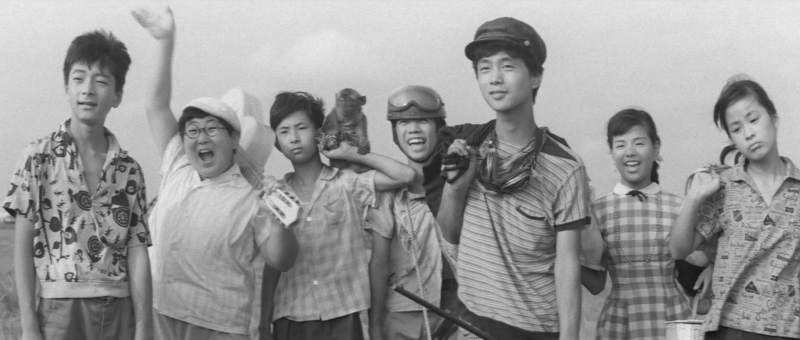
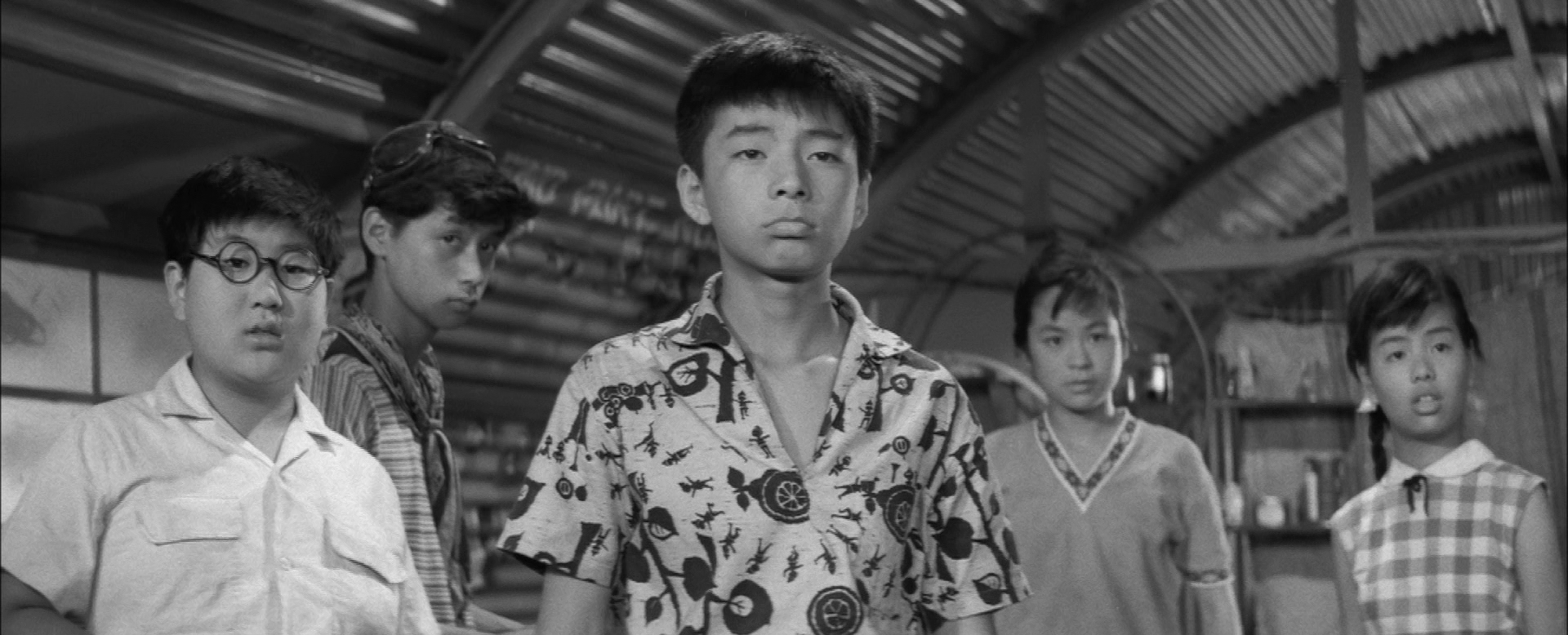
Age of Nudity (素ッ裸の年令, Seijun Suzuki, 1959)

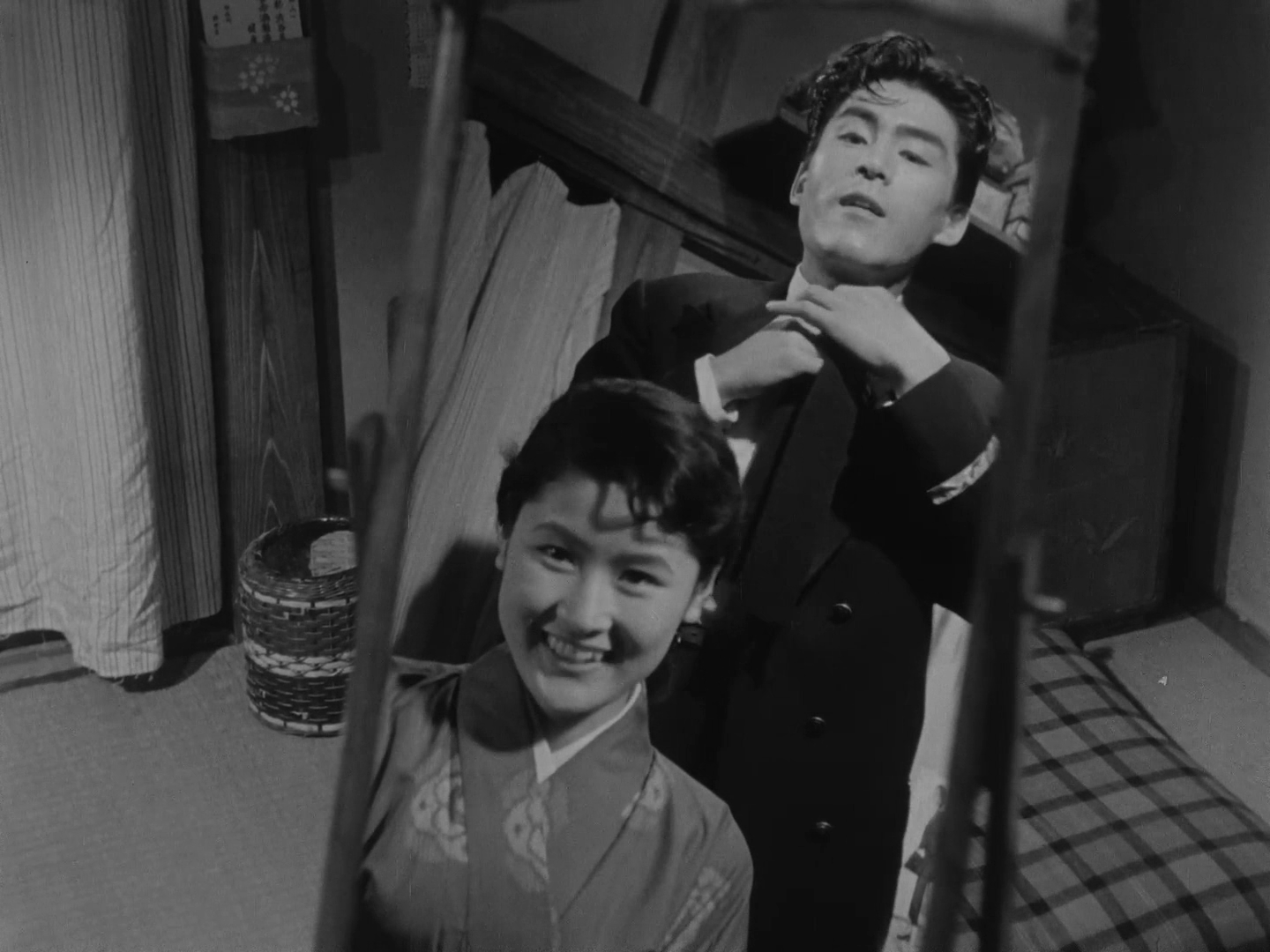
Stylistically speaking, Seijun Suzuki’s Age of Nudity (素ッ裸の年令, Suppadaka no Nenrei) is one of the least interesting of his early phase and features only brief moments of innovation such as using the cameo effect for Sabu’s flashback and elements of his taste for surrealism with unexpected cutting between events. It does however have something a little more interesting to say about the world of 1959 through the eyes of someone in the process of becoming an angry young man.

The film opens with Sabu (Saburo Fujimaki) in his school uniform gazing at motorbikes and exclaiming that adulthood must be wonderful because you can ride a bike whenever you want. Ken (Keiichiro Akagi), the leader of a group of mainly orphaned delinquents, shows him that he could do that now. His gang make a habit of “borrowing” bikes and makes money through reckless drag races. Ken’s instructions that the bikes must be returned afterwards is symbolic of his desire to live a more honest life. When Sabu gets involved with actual crimes such as robbing a local food stand, he becomes very angry with him for compromising his more noble vision of what this group should be. 

But Ken is also working with a newspaper reporter and selling him insider stories about pre-teen “delinquents” . It seems as if every day is a slow news day in the Japan in 1959, and the reporter continues to plant scare stories in an effort to create a moral panic about feral children. Ken seems to think that he’ll keep them out of it and not actually report on anything too back that directly involves them, but of course his conviction is naive. Nevertheless, he convinces himself that he’s doing it all for the group so he can get money to buy a fishing boat and support everyone through honest work. But at the same time the fact that it’s the newspapers echoes the ways in which these children have been pushed out of society, while also ironic in that the reason Sabu loses his pair round is because he’s unfairly called a troublemaker when trying to get a reluctant customer to finally pay her bill.

The newspaper round incident bears out the ways in which Sabu is unable to control his temper and his frustration often turns to violence. The reporter asks a friend of his at school hoping he will badmouth him, but the only says that he’s not a bad kid, it’s just that his family’s poor. What Sabu most wants is to stay in school, but his parents won’t pay and his mother even says that he’s getting above himself. Poor people like them don’t go to school they just work. But Sabu’s desire to break that barrier is thwarted by social prejudice and the frustration it arises in him. He first looks up to Ken as a role model, but is also the most betrayed on realising that it was Ken who leaked info on them to the press and that he’s planning to take their share of the loot and make a new life for himself alone in the country.

Humiliated after having been betrayed by the newspaper man, Ken then reverts to Sabu’s way of thinking, that as old as he gets this society won’t respect him. So perhaps he no longer needs to respect it or to stick to the nobility he was trying to teach the kids. Adulthood won’t be what we expected, he tells Yoko, as if he had thought that on turning 20 he’d suddenly be more respected and that he’d be able to forge his own future by buying a boat and becoming a fisherman. The film’s title does not translate particularly well, but the nuance is more like “the naked age” where age refers to that of a person rather than to an era. Sabu goes to the beach and marvels that everyone is “naked”, or rather that they’re all scantily clad in swimwear, and are therefore all the same with the divisions of class and wealth temporarily dissolves. But at the same time it’s more that he himself is naked in that he’s at his most raw and vulnerable. He feels himself to be alone, and has no role models to look to for how he should live his life. Resenting his father for bowing and screaming and his mother for her lack of ambition, he wants more for himself but also can’t find a way to get it. 

The fact that Ken is eventually killed in a fiery crash signals him out as a false prophet. The person the children should have been listening to was the homeless old man (Bokuzen Hidari) who appears in a vision of beatific pastorally at the film’s conclusion posed on a green hill with the sun behind him. Though the children sometimes make fun of him for his disability and what they see as a failure at life, the old man laughs it off and is constantly happy living in a tent with his little dog. He encourages the children and gives them helpful advice that helps to overcome the failures of their birth parents, while his presence suggests that true happiness is to be found only on escaping contemporary capitalist society. Sabu too perhaps comes to a similar conclusion, realising that their “independence” is an illusion when they have to compromise themselves morally in order to earn money. Ken may have given them false hope, but perhaps the old man is different in living his own “independent” life defined by humanism and simplicity free from the constraints of a society which only values and status.
Pure Emotions of the Sea (海の純情, Seijun Suzuki, 1956)

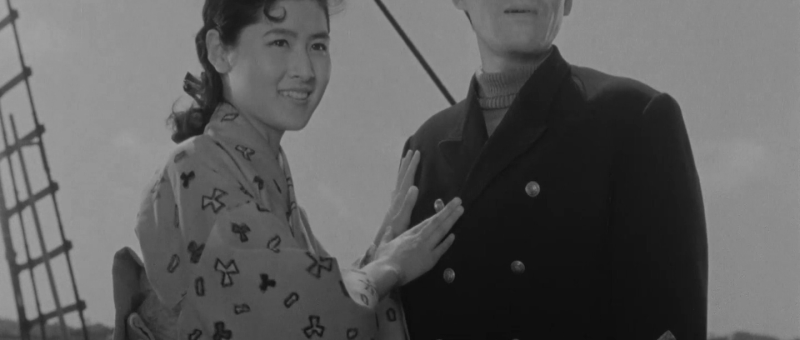
Directed under his birth name Seitaro, Seijun Suzuki’s second film Pure Emotions of the Sea (海の純情, Umi no Junjo) is essentially a vehicle for pop star Hachiro Kasuga who plays a character with the same and sings several of his popular hits including Otomi-san which eventually sold over a million copies. Perhaps precisely because of its nature as a 45-minute programme picture, Suzuki was able to get away with quite a lot of the nonsense that would become his signature style in an otherwise anarchic tale of a romantically troubled whaler and the improbable number of women who love him.

Hachiro is the harpoon operator on a whale boat, but it’s mainly women’s hearts that he seems to be piercing. While he seems to have feelings for captain’s daughter Kazue (Toshie Takada), he also attracts the attentions of Miyoko (Tomoko Ko), daughter of the head of the shipping company, local sex worker Yumi (Miki Odagiri), and “judo-geisha” Suzugiku (Kyoko Akemi). His various encounters encourage him to swear off women, but this is quite a small town and he can’t avoid them entirely. Eventually, Miyoko suggests that perhaps she, Yumi, and Suzugiku could divide Hachiro in three with Yumi taking his money, Suzugiku his heart, and Miyoko his throat for his singing voice. After some rather macabre discussions about how to get his heart out of his body, they settle on a time share arrangement instead with each of them having Hachiro for eight hours of the day, though Hachiro’s thoughts don’t seem to enter into it.

Conversely, ambitious rudder-operator Goro is interested in all these women too, though for largely cynical reasons. With the captain’s position weakened he’s angling to take over, though is unpopular with just about everyone except Yumi who feigns taking her own life to get his attention when he starts trying to woo Suzugiku, who doesn’t like him at all. He seems to be a kind of parody of the ambitious salaryman, even giving hair tonic to his balding boss in the hope of currying favour. The other sailors, however, seem to see Hachiro as a natural successor, though the captain isn’t so sure and particularly hates his habit of singing all the time. There’s a minor irony in the fact that Suzugiku often carries a portable radio to listen to Hachiro’s songs, making her a representative of modernity rather than the emblem of traditional culture one might expect a geisha to be. She even plays records of Hachiro rather than playing the shamisen much to Captain Eizo’s (Jushiro Kobayashi) consternation. According to him, geisha aren’t what they used to be. Not only are there “judo-geisha” but dancing geisha and mahjong geisha too.

Eizo’s grumpiness and harsh treatment of his men is one reason given for the boat’s declining fortunes, with Hachiro posited as a more cheerful presence who could boot their morale, though he’s more dopey than anything else and preoccupied with his romantic difficulties. Thus it’s not surprising that Eizo’s position is under threat or that he mildly resents Hachiro though picking up on his daughter’s obvious fondness for him. Nevertheless, he will eventually have to make way for the next generation, handing his captain’s jacket over to Hachiro in addition to accepting him as a potential son-in-law.

Suzuki, however, takes a rather roundabout route to get there embracing an absurdist sensibility and sense of cartoonish fun. He opens the film with an ethnographic voiceover reminiscent of a travel programme and then cuts to Miyoko away at university studying whales and introducing herself to the camera as a kind of guide to the weird fishing village, though she is not the protagonist of the film and only resurfaces halfway through as a love rival. He also adds in surrealist touches such as frequent cuts to classical statues during Suzugiku’s judo routine. When she shows off her techniques, she throws Goro straight through a wall leaving a man-shaped hole behind, while she later deflects his romantic attentions by punting him right to the top of a tall tower at the beach. Suzuki also uses small stretches of whale-themed animation to add to the childish sense of fun while simultaneously ignoring the bloodiness of Hachiro’s job as a whale hunter. Probably, he could only get away with all this precisely because it was a 45-minute kayo eiga pop song movie intended as a programme filler, but still there are hints at what would become his signature style in his distinctive composition and absurdist sense of humour.


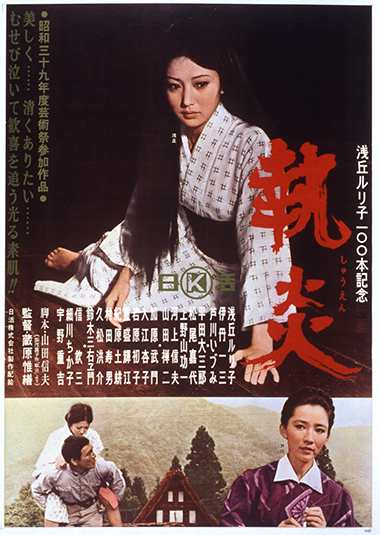
Flame of Devotion (執炎, Koreyoshi Kurahara, 1964)

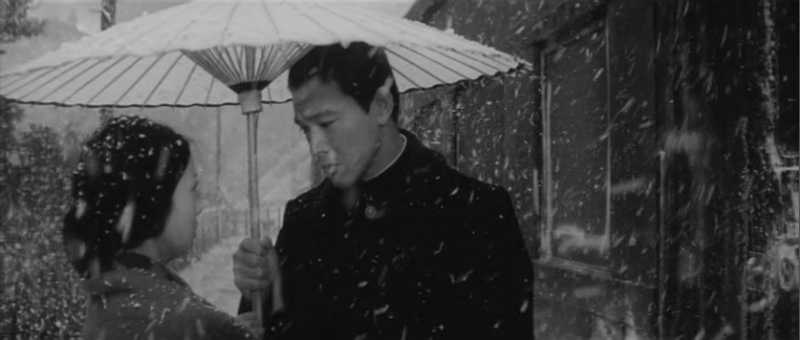
Koreyoshi Kurahara, like Seijun Suzuki, began his career at Nikkatsu mostly working on its youth-orientated commercial cinema only to end up being fired for producing films deemed too “arty” for the studio’s target audience such as his 1967 Mishima adaptation, Thirst for Love. Released the same year as Black Sun, 1964’s Flame of Devotion (執炎, Shuen) is in someways a much more subdued affair, a fairly atypical melodrama critiquing not only the destructive legacy of war but also a cultural insistence on stoical endurance in the face of emotional difficulty which is itself the mark and enabler of militarism. 

Beginning at the end, Kurahara opens with a small collection of men and women in mourning clothes walking towards a memorial service, later followed by an elegant young woman in western dress who has just arrived by train. Today marks the seventh anniversary of the death of a young woman, Kiyono (Ruriko Asaoka), who drowned herself after learning that her husband would not return from the war. The action then jumps back 20 years to a much more peaceful time in which the 10-year-old Kiyono first encountered the 12-year-old Takuji, before shifting to the more recent past in which the youngsters fell in love, overcame many hardships, and married only to be torn apart by war. 

The love story is complicated by the fact that Kiyono is a resident of a small and secretive village who claim to be descendants of the legendary Heike. Kiyono is a mountain woman, and Takuji (Juzo Itami) is a man of the sea, the son of a fishing village expected to take over the family business. When he first re-encounters Kiyono in his late teens, Takuji is in the process of finding wood to carve his own boat with dreams of sailing it all around the world. A mountain man advises him of a shortcut home, which brings him to Kiyono’s village where he serendipitously stops to ask for water and is invited inside. Kiyono insists on walking him back to the beach where she makes plain that she remembers him as the boy from all those years ago though he is now a man. She declares that she loves the sea, because it is big, manly, and also kind, abruptly stripping off and jumping in much to Takuji’s surprise. He waits for her on the beach every day after that, and the couple fall in love but the spectre of war is already upon them. Takuji has to leave for his mandatory military service and they are parted for the first time. 

Unable to see him off on the train because she would be ashamed to become emotional in front of so many people, Kiyono for the first time laments that she is not a strong woman. She sees this quality in herself as a failing and is constantly upbraided for it by the women around her who are quick to point out that the ability to bear all is a woman’s sorry duty. They see her as being too soft for the world, or perhaps merely too uninhibited, her mother lamenting that she always preferred the sea to the mountains which is perhaps why they finally agreed to allow her to leave the village and marry Takuji though no woman had ever married an outsider before. 

Yet Kiyono is a strong woman just in a different way. We were torn apart by a single order, Kiyoko laments, but when Takuji is injured she travels to the navy hospital to visit him and fiercely resists the doctor when he advises amputating Takuji’s leg. Though she is warned that the wound may become infected and Takuji may not survive, she is adamant that she will nurse him back to health herself and in fact does just that. To keep him safe from the war, Kiyono convinces Takuji move into an isolated cottage in the mountains where they can live together without being bothered by anyone else. She helps him learn to walk again, ignoring the advice of Takuji’s cousin Yasuko (Izumi Ashikawa) as a medical doctor that she is being reckless with Takuji’s health in boldly stating that she only wants the Takuji from before, not one damaged by war. But her devotion is a double edged sword, once he is healed, Takuji can be drafted again. She starts to regret her decision to oppose amputation.

The villagers, meanwhile, who had abandoned their initial scepticism to see Kiyono as a fine wife, now think her selfish and neurotic. They wonder why Takuji has not been to see his mother who is seriously ill, and for their own benefit want him to return so that he can communicate with the government who have requisitioned too many of their ships and left them unable to work. Kiyono has tried to create a space of her own into which the war may not enter, as if she were living in hiding. Nevertheless it is true that once Takuji makes the decision to leave the mountain the spell is broken, the war takes him, and there’s nothing Kiyono can do but “endure”. 

One of the ironic gifts brought to Kiyoko in the mountain is a Heike mask designed to contain all the pain and bitterness of a woman watching her husband march away to war. Yasuko, worried for her own husband, wonders if men and women are really so different. Kiyoko ironically replies that the men marching off to battle have an oddly beatific look, as if they too are in some way “enduring” in conforming to an idea of manliness though they too must be afraid, but if a woman looks that way it means she has gone mad. It’s the look that Kiyono herself eventually has, taking on the appearance of the mask, when her spirit is broken and she enters a kind of fugue state suspecting that Takuji will not return. 

Old women watching the few remaining men being recalled to the front remark on the cruelty, that they’re only going there to die because it’s quite obvious that the war is lost. It’s war which has divided the mountain and the sea, destroyed a fated a love, and created so much suffering. In an earlier time, Kiyono’s “devotion” might indeed have been seen as selfish, a desire to isolate herself and the man she loved and keep him from his duty because of her own pain. Now however, her tale is only tragedy. Not so much a woman driven mad by an excess of emotion, as a country by the lack of it.


Original trailer (no subtitles)