Samurai Hustle Returns (超高速!参勤交代 リターンズ, Katsuhide Motoki, 2016)

At the conclusion of 2014’s Samurai Hustle, it seemed that samurai corruption had been beaten back. Corrupt lord Nobutoki had got his comeuppance and the sympathetic “backwoods samurai” Naito was on his way home having found love along the way. Of course, nothing had really changed when it comes to the samurai order, but Naito was at least carving out a little corner of egalitarianism for himself in his rural domain. 

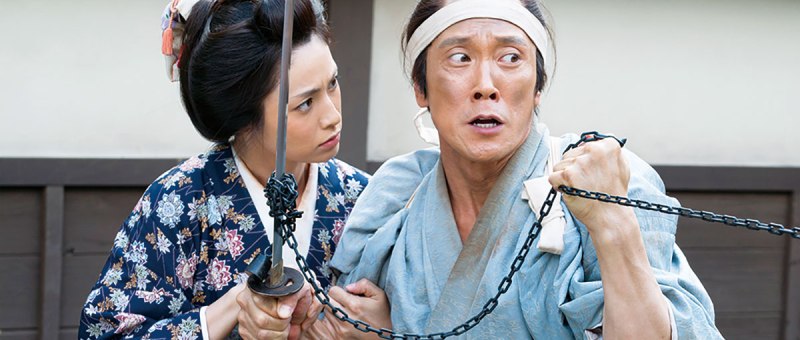
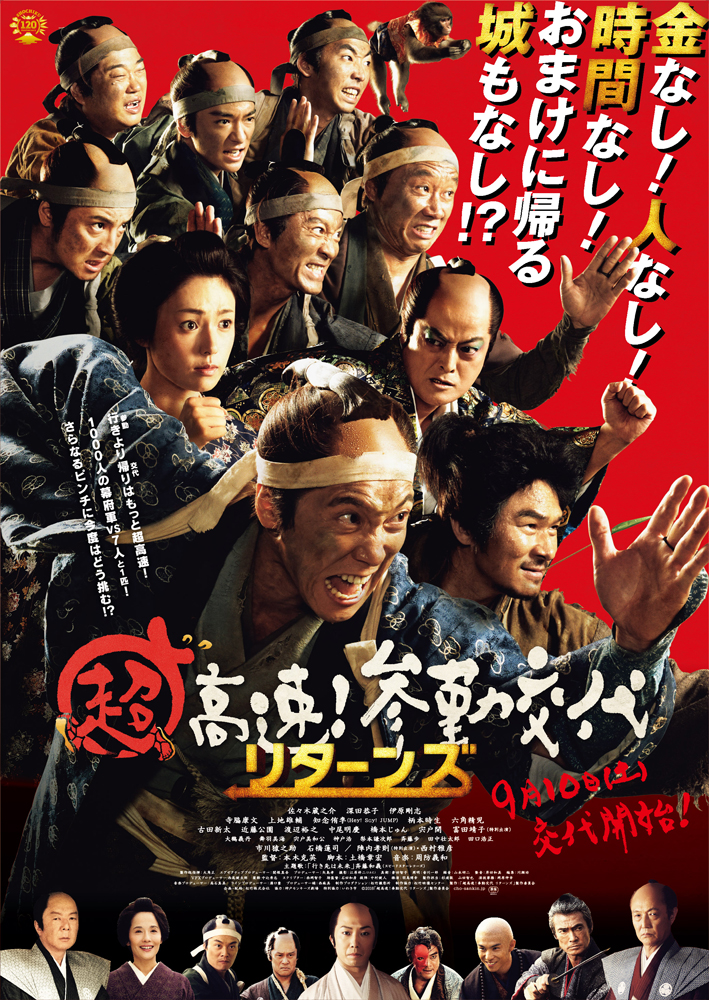
The aptly named Samurai Hustle Returns (超高速!参勤交代 リターンズ, Cho kosoku! Sankin kotai returns) picks up a month later with Naito (Kuranosuke Sasaki) taking a rather leisurely journey home in preparation for his marriage to Osaki (Kyoko Fukada) only to receive news that there has been a “rebellion” in Yunagaya. Predictably, this turns out to have been orchestrated by none other than Nobutoki who has been released early from his house arrest thanks to his close connections with the shogun but has been humiliated at court and is otherwise out for revenge with a slice of treasonous ambition tacked on for good measure. Just as in the first film, but in reverse, Naito and his retainers must try to rush home to get there before the imperial inspector arrives or else risk their clan being disbanded. 

Meanwhile, the shogun is absent at the wheel after having decided to resurrect an old tradition abandoned because of its expense and inconvenience to make a pilgrimage to Nikko. In an interesting parallel, the farmers are uncharacteristically upset with Naito, blaming him for the destruction of their fields because he wasn’t there to protect them. Naito also feels an additional burden of guilt given that, having run flat out all the way to Edo, he took his time coming back leaving his lands vulnerable to attack while he now risks losing the castle. Nobutoki wastes no time at all looking for various schemes to undermine him while secretly plotting to overthrow the shogun and usurp his position for himself. 

As in the first film, the battle is between samurai entitlement and the genial egalitarianism of Naito’s philosophy. “The real lords of Yunagaya are people like you who are one with the soil,” he tells the farmers, while Nobutoki sneers that “lineage rules supreme in this world, inherited wealth breeds more”. It doesn’t take a genius to read Nobutoki’s machinations as a reflection of his insecurity, that he invests so much in his rights of birth because he has no confidence in his individual talents. Naito counters that it’s the people around him that matter most, “people are priceless. Friends are priceless,” but Nobutoki rather sadly replies that people will always betray you in the end. Even the shogun eventually agrees that “anger brings enemies, forbearance brings lasting peace” but treats Nobutoki with a degree of compassion that may only embolden him in his schemes.

“Nepotism has endangered the shogunate,” the shogun ironically sighs apparently lacking in self-awareness even if beginning to see the problems inherent in the samurai society but presumably intending to do little about them. “No government should torment its people,” Naito had insisted on boldly deciding to retake his castle but even if this particular shogun is not all that bad, it’s difficult to deny that his rule is torment if perhaps more for petty lords like Naito than for ordinary people or higher-ranking samurai. Naito struggles to convince Osaki that she is worthy of his world and only finally succeeds in showing her that she has nothing prove and love knows nothing of class. The people of Yunagaya are impoverished but happy, satisfied with the simple charms of pickled daikon unlike the greedy Nobutoki whose internalised sense of inadequacy has turned dark and self-destructive. 

Then again, Naito is still a lord. He obeys the system out of love for his clan and a genuine desire to protect those around him but otherwise has little desire to change it actively even if his quiet acts of transgression in his closeness with the villagers and professions of egalitarianism are in their own way a kind of revolution in a minor rejection of the shogun’s authority to the extent that the time allows. Nevertheless, with his return journey he once again proves the ingenuity of a backwoods samurai getting by on his wits as he and his men race home to save their small haven of freedom from samurai oppression from the embodiment of societal corruption.


Trailer (no subtitles)

Samurai Hustle (超高速!参勤交代, Katsuhide Motoki, 2014)

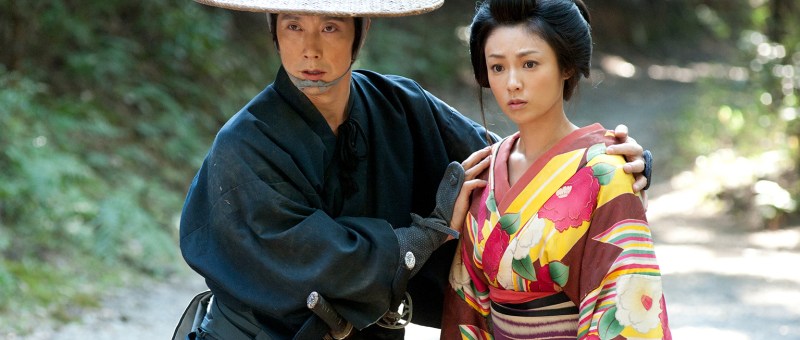
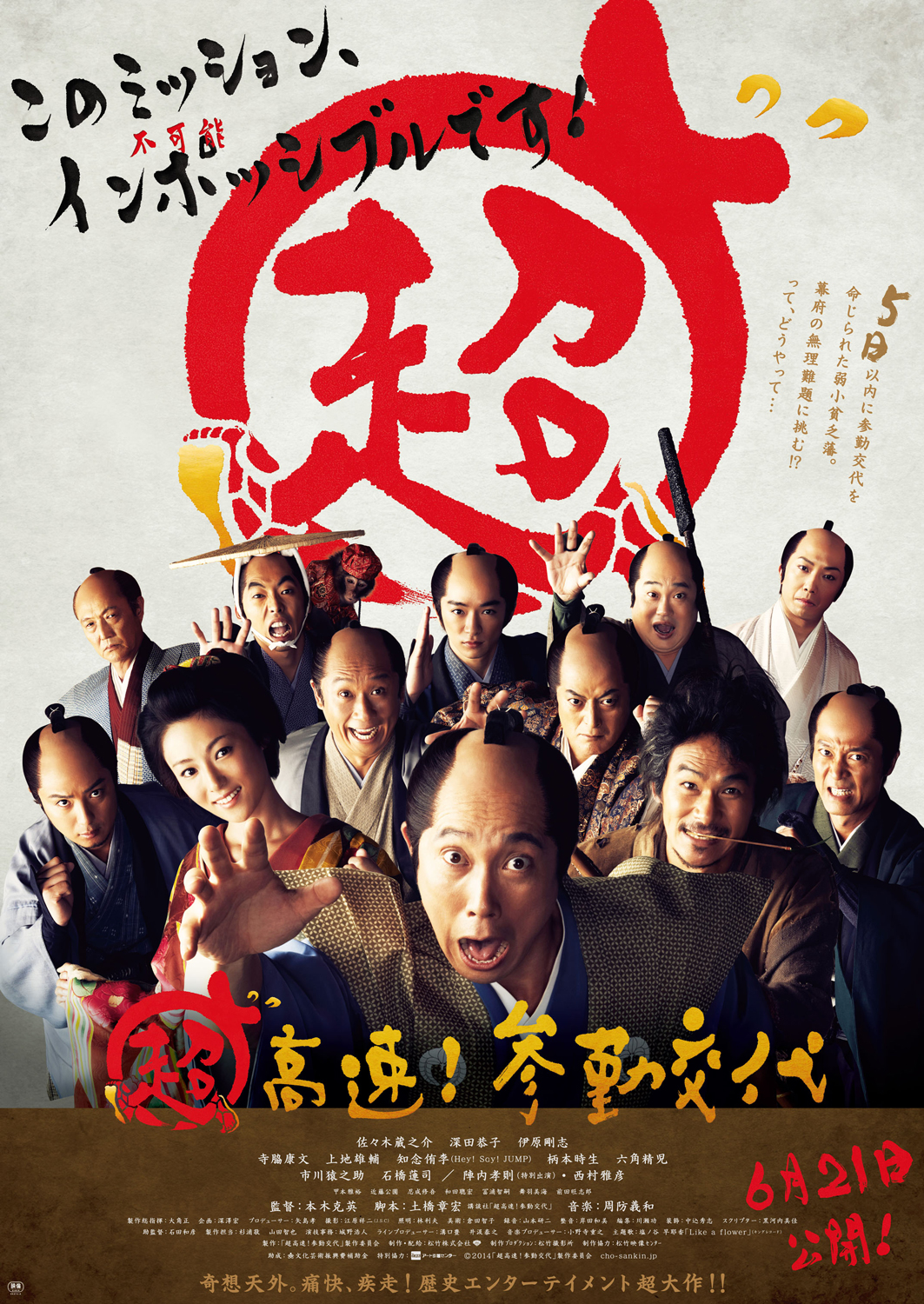
A kindhearted lord finds himself in deep trouble when he’s suddenly called back to Edo despite having just returned from his biennial service in Katsuhide Motoki’s jidaigeki comedy Samurai Hustle (超高速!参勤交代, Chokosoku! Sankin Kotai). Set in 1735, the film is in some senses unusual in pointing the various class biases even with the hierarchal samurai society as the tiny rural clan at the film’s centre are swept into intrigue by the machinations of an ambitious courtier who thinks they lied about their goldmine being extinct and plans to get his hands on it by dobbing them in to the Shogun.

The problem is that they really weren’t lying. The Yunagaya clan is dirt poor, especially after having spent a small fortune travelling to Edo and back. In this era, even distant lords were called to Edo every two years to serve at court. They were expected to parade to the capital in style, showing off their wealth and status as they go which is of course inordinately expensive. The expense was the point. Practices like these along with forcing clans to move domains on a whim were designed to weaken their resources so they’d have no recourse to rebellion even if they were even more annoyed about being forced to travel back and fore for no real reason. 

It took Lord Naito (Kuranosuke Sasaki) and his retinue 10 days to walk home, which is why it’s even more of a shock to get a letter telling them to high-tail it back in five or risk being dissolved by the shogun. Evil retainer Nobutoki (Takanori Jinnai) knows it’s impossible for them to arrive on time which is how he plans to get his hands on the gold. What he didn’t count on, however, is the unexpected scrappiness of a “backwoods samurai” who’s used to having to find ingenious solutions to difficult problems because he doesn’t have the money to solve them. Nobutoki is essentially a snob who looks down on country folk and thinks Naito does not befit the rank of a samurai anyway, sneering at his humble gift for the Shogun of some locally sourced daikon pickles. 

The homeliness of the daikon signals Naito’s down to earth nature as a fairly egalitarian samurai who doesn’t really care about hierarchy and status even if he knows he has to play the game. What he cares about is the safety and happiness of his people, which is one reason he’s going to bust his arse to get back to Edo and clear his name. Aside from his humanitarian principles, also giving away some of their rice stocks to neighbouring clans suffering during a time of famine, Naito is also thought of as an eccentric because of his severe claustrophobia which makes it impossible for him to close the door when using the bathroom, let alone travel in a palanquin, though he’s found an ingenious solution for that one too. 

In an odd kind of paradox, he becomes a defender to proper samurai values in his opposition to Nobutoki who plays fast and dirty, sending out ninja assassins on the road to try to ensure he won’t make it to Edo before the deadline. Meanwhile, he bonds with a feisty sex worker who, like him, is dealing with childhood trauma and is sick of entitled noblemen who look down on the poor despite being a fellow human who as she puts it poops and screws just like everyone else. In a way she frees him from the confines of his hierarchal existence by helping him overcome his claustrophobia, at least while she’s at his side, while he saves her from her oppression by transgressing class boundaries and bringing her into the samurai world if only as a concubine.

Nevertheless, as he warns her, being poor is hard even when you’re a samurai, and ironically his circumstances aren’t much better than hers even if he has a superficial level of comfort and security tempered by his genuine ability to appreciate the simple charms of daikon over fancy Edo cuisine. After all, sometimes samurai become peasants or peasants become samurai and for an impoverished lord like Naito the distinction is fairly thin, though he evidently does his best to protect those around him from both sides of the class divide while remaining unafraid to tell the Shogun exactly what he thinks of him. After all, you’ve got to roll with the times, especially if you’re a backwoods samurai at the mercy of a harsh and arbitrary system but also far enough away from the mechanisms of power to begin to ignore them. 


Trailer (no subtitles)

Perfect Days (Wim Wenders, 2023)

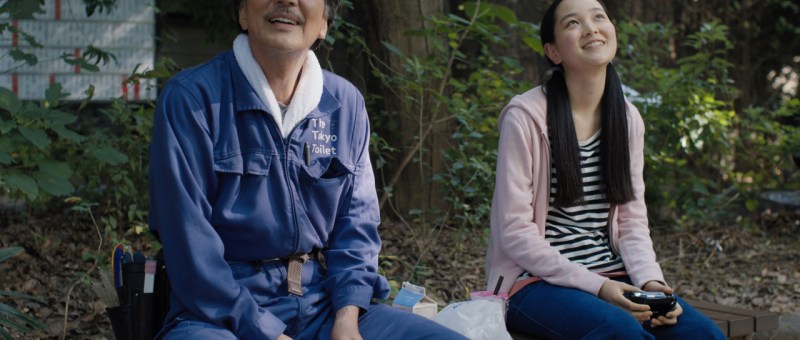
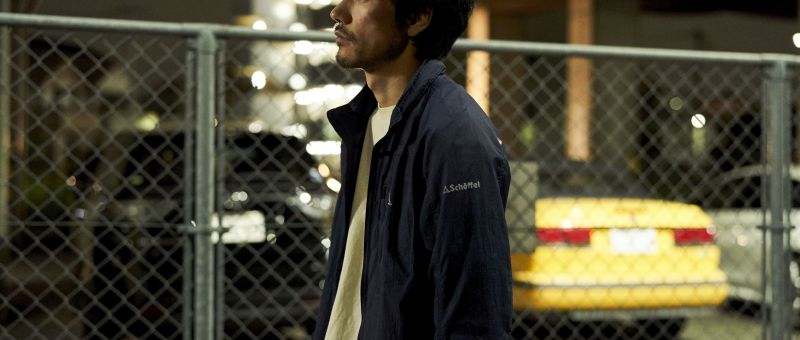
A man in late middle-aged quite obviously living in the past begins to wake up to the possibilities of change in Wim Wenders’ Tokyo-set drama, Perfect Days. Even so, Hirayama’s (Koji Yakusho) days may be pretty much the same but that doesn’t necessarily mean that his life is dull or even predictable while it’s clear that he manages to find joy in small moments of serenity even if he may also seem to be harbouring a great sadness. 

The irony is that Hirayama lives in a rundown postwar tenement that happens to be almost directly under the Tokyo Skytree which Wenders often cuts back to as if to signal the disparity between the rich and glitzy skyline of the contemporary city and the lives of those on its margins. Hirayama’s home has an almost eerie quality owing to the glowing purple light shining out of the window of his spare room where he nurtures tiny saplings back to health. The traditional-style two-floor flat has two tatami-mat rooms on the upper level, the other filled with books and cassette tapes amid an otherwise spartan interior. Before leaving for work each morning he brushes his teeth over the kitchen sink, the place has no bathroom, and meticulously takes up his belongings neatly placed in order on a shelf by the front door. 

Perhaps it’s this kind of order that Hirayama craves, clinging to the security of the usual and dedicating himself to his work with unusual rigour. A municipal toilet cleaner, he painstakingly scrubs each and every bowl and urinal, checking the nozzles on the bidet function and shining a mirror underneath to make sure everything is as clean and tidy as it could possibly be only for drunken salarymen to push past him and quite literally piss all over his hard work. Like many such workers, he attains a kind of invisibility and should anyone need to use the facilities while he’s cleaning them he’s obliged to step outside and wait before starting all over again. When he finds a little boy crying alone in a park toilet he takes him by the hand and tries to help him find his mum, only when he finds her she completely ignores Hirayama and even goes so far as to wipe the boy’s hand with a wet wipe. The boy’s little wave of thank you as they leave is the only ray of comfort and recognition. 

Yet for all that, it’s as if this the life Hirayama has chosen. He barely interacts with his chatty colleague Takashi (Tokio Emoto) who has a habit of rating everything out of ten and sees no value in his work, hardly bothering to do much cleaning at all while complaining that he has no money to romance the bar hostess he’s hoping to make his girlfriend. Takashi and Aya are fascinated by Hirayama’s collection of cassette tapes which he plays in his van, though Takashi more so for the commercial value that may be attached to them in a world in which everything old is new again and specialised stores in the trendy neighbourhood of Shimokitazawa trade exclusively in secondhand LPs and Sony Walkmans. Even so, Aya too appears to have her private sadnesses drawn to the voice of Patty Smith but pressing stop when the tape mentions suicide. The melancholy office lady in the park and an elderly homeless man who lives there too must have their own stories as unknown to Hirayama as his is to them. 

A surprise visit from a teenage niece suggests that he may have come from a relatively wealthy family with a tyrannical patriarch and that this ascetic life of his is a kind of rebellion or else or a refuge, but there’s a look of pain on his face when the landlady at his favourite bar (played by enka legend Sayuri Ishikawa) laments that she wishes everything could stay the same. Perhaps he’s tired of this very analogue life and its otherwise pleasant monotony as he further confirms for himself realising that it’s not right for things not to change as he engages in a game of shadow tag with another middle-aged man who’s evaluating his life after a terminal cancer diagnosis. In truth, the film risks straying into orientalism in its advocation of Japanese serenity in simplicity (something not helped by the final title card explaining the term komorebi) while the musical choices appear a little on the nose and the celebration of mundanity in Hirayama’s labour might otherwise seem flippant. Even so, Yakusho’s typically astute performance keeps the film on an even keel as Hirayama finds himself on a turbulent journey towards a “new world” of fulfilment and possibility. 


Perfect Days screened as part of this year’s BFI London Film Festival.

Original trailer (English subtitles)

Blue (BLUE/ブルー, Keisuke Yoshida, 2021)

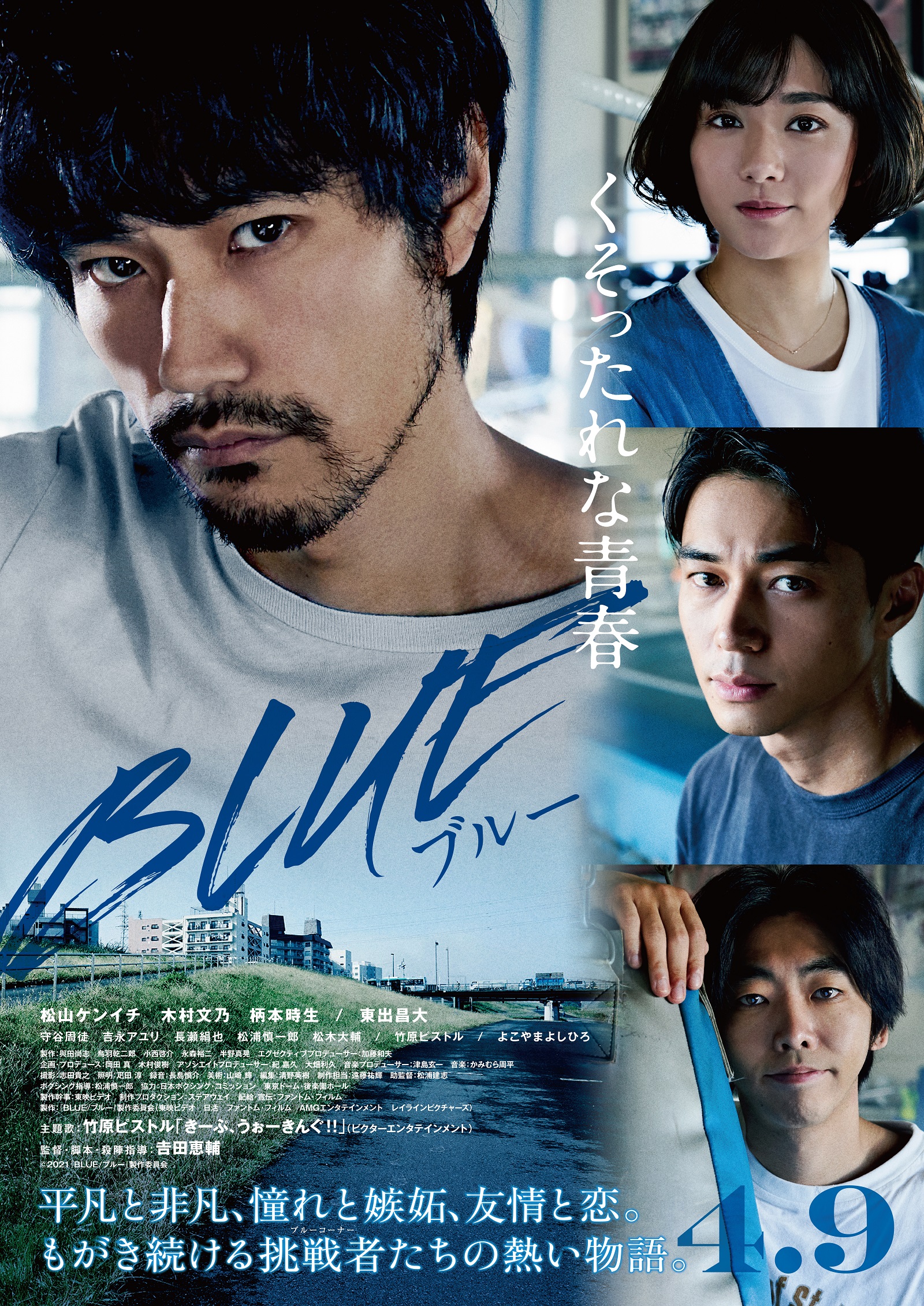
“Let me walk on my own feet” a defeated boxer insists, reminding us that his victory is in getting up even if he always loses. The heroes of Keisuke Yoshida’s Blue (BLUE/ブルー) are by and large “losers”, though the act of winning lies not so much in knocking out your opponent as in continuing to show up for the fight. Blue is not only a state of mind, but also the colour of the challenger’s corner, the spiritual home of these dejected underdogs who refuse to lie down even when seemingly defeated. 

Urita (Kenichi Matsuyama), for example, stays in boxing because there’s nothing else he wants to do though in truth he’s not much good at the sport. What he is good at is encouraging others and even if he’s a bust in the ring he’s an excellent coach and warmhearted mentor. His friend, Ogawa (Masahiro Higashide), meanwhile, is on track to take the national title but is also in denial about a medical condition that could end his career in the ring. And then there’s Narasaki (Tokio Emoto) who only took up boxing because of an offhand comment from a girl he fancied at the pachinko parlour where he works after he got beaten up by a teenager while feeling his masculinity challenged by a handsome coworker. 

Narasaki rocks up at the gym and refuses to do anything very strenuous because he only wants to look like someone who boxes, not actually box. Nevertheless, he discovers a genuine aptitude for the sport, gradually overcoming his fear of getting of hurt as he begins to enjoy the discipline of training. His journey directly contrasts with that of one of the other young hopefuls at the club who originally knocks him out during their first sparring match but later falls victim to his own egotism, insisting that he doesn’t need to take advice from a “loser” like Urita and has his own way of doing things. In his characteristic way, Urita just smiles and reminds him it’s important to master the basics but the hotheaded youngster won’t listen, blaming his lack of success on everyone else before getting himself seriously injured trying to prove his own way is superior. 

It’s the basic moves which later prove valuable to Narasaki as he attempts to take on a powerful rival, a reminder that there’s no substitute for nailing the fundamentals. Talking over their respective differences, Ogawa wonders if he really loves boxing as much as Urita does but has then to accept that “passion and talent are different” which is why he’s succeeding where Urita failed. In any case, it’s less about winning in the ring than it is about hard work and mastery of a craft. Smarting from his own early defeat, Narasaki also snaps back that he doesn’t want a loser’s advice only to bitterly regret it afterwards, realising that Urita’s strengths lie at the side of the ring rather than inside it. 

While Ogawa battles his illness, Narasaki also finds himself conflicted caring for his elderly grandmother and feeling guilty that his newfound love for boxing has led him to neglect her. Urita battles a sense of resentment and despair he covers with good humour in being fully aware that he doesn’t have what takes while attempting to encourage others only latterly confessing that a part of him always hoped Ogawa would lose. The demands of a sporting life may have endangered familial and romantic relationships but the guys do at least have each other and the familial camaraderie of the gym.

The important thing, the film seems to say, is to keep fighting, win or lose. Experiencing various setbacks, the guys each find themselves inhabiting their own internal rings, unable to let go of boxing glory no matter how elusive it may prove to be. Yoshida plays with genre norms such as training montages and ring-set climaxes, but also undercuts them in his frequent allusions to defeat allowing the heroes to lose and sometimes repeatedly solely so that they can get right back up again, on their own feet, ready to fight for something be that mastering the art of boxing or simply gaining a new sense of personal empowerment born of determination and self belief as they recommit to learning the “basics” of a fulfilling life. 


Blue streams in Europe (excl. Spain/Andorra) until 2nd July as part of this year’s hybrid edition Udine Far East Film Festival.

Original trailer (English subtitles)
Not Quite Dead Yet (一度死んでみた, Shinji Hamasaki, 2020)

©2020 Shochiku Co., Ltd. Fuji Television Network, Inc.

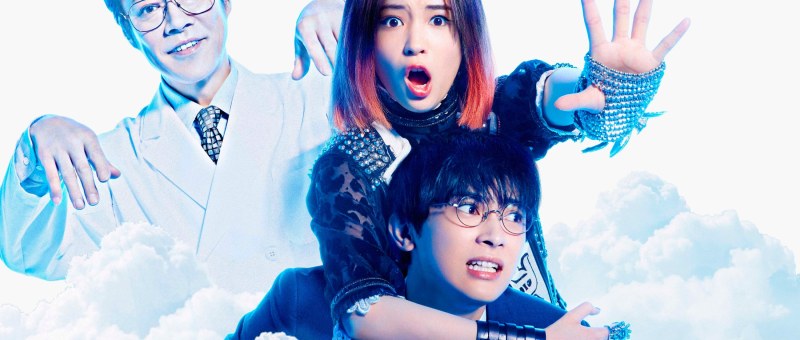
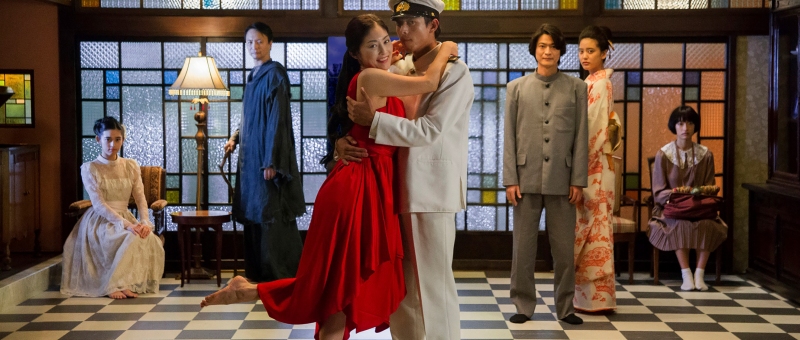
“What’s important is purpose, to live for something. Without it you’re as good as dead” according to the hero of madcap existentialist farce Not Quite Dead Yet (一度死んでみた, Ichido Shinde Mita). The feature debut from ad director Shinji Hamasaki pits a rebellious student against her overly literal, authoritarian dad as the pair begin to come to a kind mutual understanding only once he “dies” after being tricked into taking an experimental drug in order to unmask conspiracy within his own organisation. 

College student Nanase (Suzu Hirose) intensely resents her father (Shinichi Tsutsumi), the CEO of Nobata Pharmaceuticals which he has long been pressuring her to join. She’s currently the lead singer in death metal band Soulzz only according to a record scout at one of their shows their problem is that they’re all “zz” and no soul. Meanwhile, Nobata has assigned an underling, Matsuoka (Ryo Yoshizawa), to shadow her partly because Matsuoka too has very little presence and is in fact nicknamed “ghost” for his essential invisibility. The trouble starts with the escalation of a corporate feud as Nobata’s old buddy Tanabe (Kyusaku Shimada) starts manoeuvring to get his hands on the company’s research into an anti-ageing serum codenamed “Romeo”, planting a mole inside the organisation. As a consequence of his research another of the scientists nicknamed “Gramps” has stumbled on another drug which renders someone temporarily “dead” for a period of two days, naming it “Juliet”. Watabe (Yukiyoshi Ozawa), a consultant Nobata has brought in to streamline the business, convinces him to take the experimental drug in order to flush out the mole while secretly working with Tanabe to take over the company by forcing through a merger while Nobata is out of action. 

A typical socially awkward scientist, Nobata believes that life is about experiment and observation, a belief system which has thoroughly irritated his daughter who still lives at home but has divided the territory in half with clearly marked red tape. Nanase’s animosity towards her father apparently stems back to the death of her late mother Yuriko (Tae Kimura), angry with him that he never left his desk and didn’t make it to the hospital in time to see her before she passed away. “Life’s not a lab experiment” she sings, recalling her childhood during which her overly literal father took away life’s magic by patiently over explaining fairytales, scoffing that Prince Charming probably didn’t revive Sleeping Beauty with a kiss but a transfer of static electricity, while continuing to order her around in fatherly fashion now she’s all grown up. Perhaps still stuck in a petulant adolescence she started the band to vent her frustrations with the world in the form of a death metal “mass”, but she’s growing up. Her bandmates are getting jobs or getting married, she’s still stuck with no real clue about what it is she actually wants to do with her life except that she doesn’t want anything to do with Nobuta Pharmaceuticals.  

Once her father “dies”, however, she begins to gain a new appreciation for his life philosophy able to see but not hear his “ghost” while his body lies on a table in the office cafeteria. Nobata went into pharmaceuticals to help people, but has been led on a dark and vacuous path pursuing anti-ageing technology which is in itself a rejection of change and transience. Ending all her sentences with the word “death”, that’s not something Nanase can get behind. She believes in growing old gracefully, that they make drugs not to cheat death but to be able to spend longer with those they love. As her father had advised Matsuoka to do, she begins to find her purpose, rediscovers her soul, and figures out what it is she’s supposed to do with her life.

Matsuoka, however, seems to be permanently “invisible” despite the tentative romance that develops as he and Nanase attempt to subvert the conspiracy to stop them doing her dad in for good, brushing up against the venal Tanabe who seems set to muster all his corporate advantages against them partly because of an old grudge against Nobata. Of course, you have to wonder why the conspirators didn’t just poison him rather than having him go Juliet and then entering a race against time to cremate him before he wakes up, but as Nobata reminds us there are many things which science cannot explain. A cheerfully silly Christmas tale of rediscovering what it means to be “alive” in the presence of death, Not Quite Dead Yet is zany seasonal fun but with plenty of soul as its heroes learn to shake off cynical corporatism for a healthy respect of the values of transience.


Not Quite Dead Yet screened as part of Camera Japan 2020.

Original trailer (English subtitles)
Images: ©2020 Shochiku Co., Ltd. Fuji Television Network, Inc.

Miyamoto (宮本から君へ, Tetsuya Mariko, 2019)

Three years after Destruction Babies, Tetsuya Mariko returns with another ultra-violent though strangely humorous masculinity drama as a mild-mannered salaryman embarks on a quest to win the heart of his one true love by proving himself a man even if aware that his efforts are entirely meaningless while he strikes out where it counts. Inspired by Hideki Arai’s manga, Mariko previously adapted Miyamoto (宮本から君へ, Miyamoto kara Kimi e) as a late night TV drama with the majority of the cast reprising their roles for the big screen feature.

As the film opens, the titular Miyamoto (Sosuke Ikematsu) is walking bruised and bloodied through a children’s park, staring at his unrecognisable face in the hazy mirror of a public bathroom. A regular salaryman, he’s later taken to task by his boss (Kanji Furutachi). After all, how does he expect people to do business with him when he’s lost all his front teeth and has his arm in a sling? His boss reminds him he’s about to be married and will soon be a father so perhaps a little more forward-thinking responsibility is in order. It seems that Miyamoto got into some kind of fight and improbably enough he won, the other guy apparently in hospital not to recover for months though thankfully he does not want to press charges. Nevertheless, Miyamoto seems strangely cheerful, happy in himself as he takes his bride to be, Yasuko (Yu Aoi), home to meet his parents who don’t disapprove but are extremely put out by his continued secrecy especially as Yasuko is already pregnant though something tells us there’s much more to this than your average shotgun wedding.  

Skipping back between the present day of the happily settled couple and the various stages of their courtship we begin to see a pattern developing as the hapless young salaryman falls for the pretty office lady only to discover she was technically using him to break up with an obsessive ex struggling to accept that their relationship is over. Challenged by bohemian playboy Yuji (Arata Iura), Miyamoto instinctively barks out that Yasuko is a special woman and he will protect her at all costs though the jury’s out on how exactly he plans to do that. In any case, Yuji exits and even if unconvinced, Yasuko is taken in by the idea of finding a protector. But Miyamoto is less than true to his word. When it really counts, he lets her down, passed out drunk as she’s assaulted by a friend from his rugby team (Wataru Ichinose). What ensues is partly, in his mind, a means of making amends to her by getting his revenge and a quest to reclaim his self-respect by asserting his masculinity in besting his girlfriend’s rapist in a fight. “It was me he insulted” Miyamoto somewhat problematically insists, rage shovelling rice into his mouth directly from the cooker while Yasuko can barely contain her resentment and exasperation with his continued failure to follow through while painting himself as the victim in her rape. 

Consumed by toxic masculinity, Miyamoto does indeed frame everything through the prism of his fracturing manhood, never jealous or abusive but comparing himself unfavourably to the other men in Yasuko’s life and convincing himself the way to beat them all is by proving himself the most manly through the medium of pugilism. Meanwhile, he emotionally neglects the woman he claims to love and promised to protect, temporarily distancing himself from her while he embarks on his quest, leaving her entirely alone to deal with her trauma. Yasuko makes it clear that she doesn’t care about his pointless and idiotic need to validate himself through male violence, but he does it anyway and then expects her to be impressed (which she isn’t, really). In any case he freely admits he did it all for himself, literally shredding his rival’s manhood in order to retake his own in addition to gaining an extremely ironic form of revenge.  

Absurd and ridiculous as it is, Miyamoto’s quest does at least allow him to gain the self-confidence which will eventually allow him to patch things up with Yasuko, ironically by affirming that he no longer sees the need to look for approval and will protect her and their new family forevermore. A dark satire of fragile masculinity filled with cartoonish yet surprisingly graphic violence, Mariko’s third feature nevertheless retreats from the pure nihilism of Destruction Babies towards a more positive if perhaps equally uncomfortable resolution as the no longer quite so insecure Miyamoto prepares to enter a new phase of his life as a paternal figure and protector of a family.


Miyamoto streams in the US via the Smart Cinema app until Sept.12 as part of this year’s New York Asian Film Festival.

Original trailer (no subtitles)

To the Ends of the Earth (旅のおわり、世界のはじまり, Kiyoshi Kurosawa, 2019)

To the Ends of the Earth poster 2“It’s like a little journey you can take without going too far from home” a bubbly variety TV presenter announces partway through To the Ends of the Earth (旅のおわり、世界のはじまり, Tabi no Owari Sekai no Hajimari), reporting from a rundown theme park the like of which she claims you hardly ever see in Japan anymore. It might as well encapsulate her life as the host of a TV travel programme directly aimed at people who prefer to take their pleasures vicariously. Kiyoshi Kurosawa’s long career has been, in an odd sense, moving into the light. Where death was once eternal loneliness, he now tells us love is what will save us in the end, if only we overcome our fear of each other.

Yoko (Atsuko Maeda), a 20-something TV “reporter” for a variety show, is an intensely anxious young woman. In her postcards home to her firefighter boyfriend, she tells him that she feels “safe” now that they’ve arrived in a big, modern city, but, somewhat ironically, asks him to try and stay away from dangerous places. Currently shooting in Uzbekistan, she finds herself doubly isolated – both because she is a lone woman travelling with an all male crew, and because she is the star and therefore not included as a part of their team. Though they call her a “reporter”, it’s clear that the temperamental, insensitive director Yoshioka (Shota Sometani) does not value her editorial opinion and sees Yoko more or less as a kind of prop.

When we first meet her, Yoko is being forced to deliver a direct to camera speech from the middle of a “fake lake” which, as she explains, is more like a big puddle created by accident during a Soviet-era irrigation project that didn’t quite go to plan. During the course of the filming, we watch her effortlessly switch between the super “kawaii’ presenter who has to pretend the undercooked food she’s just been handed (that will probably make her ill) is the best meal she’s ever tasted, and the dejected young woman growing ever more resentful about her corrupted authenticity. Nervous and under-confident, she finds herself bullied by the demanding director, feeling as if she’s obliged to put up with whatever he asks her to do even if it compromises her safety.

Later, at the theme park, the owner of the ride Yoko is supposed to “enjoy” expresses concern, firstly claiming that it’s not suitable for women, and then apparently mistaking Yoko for a child. He doesn’t clarify if there’s actually a safety issue, that the ride is calibrated for a certain size and weight and might be dangerous for a slight woman as opposed to a beefy man, but in any case Yoko is made to ride it three times in quick succession. Akin to something they put astronauts and fighter pilots in to prepare them for coping with G-force fluctuation, it is not particularly fun but still Yoko is obliged to giggle like a giddy school girl every time before finally collapsing as if she’s about to go into nervous shock. A few moments later, however, she stands in front of the camera to give another cheerful speech about just how much fun she’s having.

Yet we also see her attempt to fight back against her sense of anxious powerlessness by actively asserting her independence. She leaves her hotel and takes a bus, a complicated affair when she doesn’t speak the language or understand where she’s going, visiting a local bazaar where she attracts not a little attention, some of the saleswomen even attempting to physically grab her in order to sell their wares. She feels the male gaze constantly upon her and though you’ll rarely find a woman who says that skirting round groups of men in darkened alleyways doesn’t make her nervous, there is something about the unfamiliarity of the environment which has Yoko on edge. Men peek in through the windows of the van where she changes costumes to make it look like they were in Uzbekistan longer than they were, and like the ride owner, a fisherman they’d enlisted to help them catch a giant fish grows progressively more irritated, claiming that the fish aren’t coming because they don’t like a woman’s smell.

Exploring the town, Yoko’s mind quietens only when she begins to hear music pouring out of a local opera house. She wanders inside and sits down, envisioning herself on stage performing Ai no Sanka, a Japanese rendering of Edith Piaf’s Hymne à l’amour, but her reverie is cruelly interrupted by a security guard who sends her anxiously reeling away. Another encounter with authority provokes a similar reaction when she’s stopped for filming in a prohibited area but instead of calmly presenting the camera, she panics and runs away. As a sympathetic detective later tells her, if you run from the police they have to chase you, it’s the law. The detective is a little offended. Why was she so afraid of Uzbek policemen? Did they seem excessively mean, what does she know about Uzbeks anyway? If only she’d tried to listen to what they were saying, all of this could have been avoided.

The detective, echoed through sympathetic translator Temur (Adiz Rajabov), avows that if we don’t talk then we’ll never understand each other. Temur became a translator after hearing about the Japanese prisoners of war who built the theatre in which Yoko heard the music, painstakingly crafting rooms dedicated to six areas of a country which had been their enemy. Moved by their generosity, he learned Japanese to give something back. Identifying herself with a captive goat she longed to free from constraint and isolation, Yoko gains confidence from his words. She confesses that she’s preparing to follow her dream of becoming a singer, but worries that she lacks the emotional authenticity required to make the song resonate. Through her cross-cultural adventure, brush with the law, and a personal crisis back home, Yoko begins to realise that the world isn’t such a scary place after all. Yoko sings the song of love, less for the uncommunicative boyfriend she unconvincingly claimed it was her hope to marry, than for herself and for the world, now as open as her heart in the limitless vistas of the Uzbek mountains.


To the Ends of the Earth was screened as part of the 2019 BFI London Film Festival.

Original trailer (English subtitles)

Ai no Sanka as performed by Hibari Misora

https://www.youtube.com/watch?v=0zYBULKBEKc

Hanagatami (花筐/HANAGATAMI, Nobuhiko Obayashi, 2017)

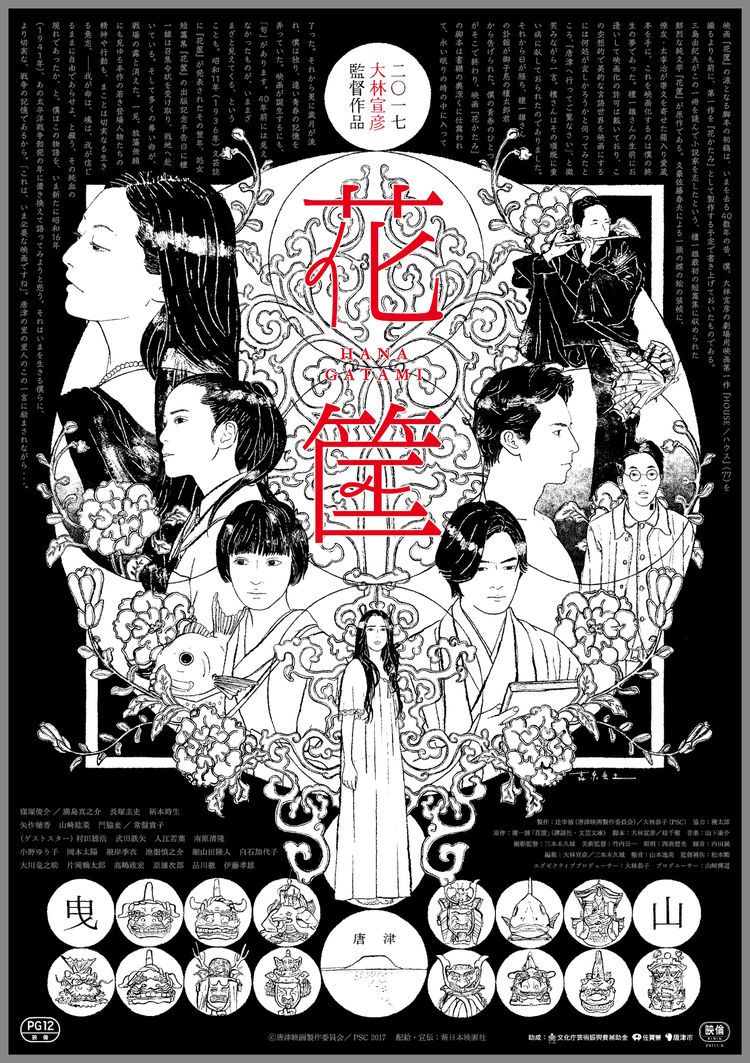
Hanagatami posterIn time the past becomes a dream. A world in and of itself, conjured from feeling and memory and painted in the imprecise strokes of one attempting to recreate a long forgotten scene. The melancholy heroes of Nobuhiko Obayashi’s long career were each trapped in a sense by nostalgia, a yearning for another time and place, or more precisely another, more innocent, version of themselves only with the benefit of hindsight and the confidence of age. Finally realising a long dreamt of project in dramatising Kazuo Dan’s classic wartime youth novel Hanagatami (花筐/HANAGATAMI), Obayashi reunites with another melancholy young man who as he puts it in the opening text wants to tell his story not out of a sense of nostalgia but out of longing for the things which were lost. Those like him who had the misfortune to be young before the war saw their whole world swept away by a kind of madness far beyond their control, losing not only a past but a future too.

When Toshihiko Sakakiyama (Shunsuke Kubozuka) returns home from Amsterdam where he had been living with his parents, Japan is already at war in China. Though the times are changing, Toshihiko’s life remains relatively untouched by conflict, insulated from the concerns of the day by the pleasant natural surroundings of his old-fashioned country town. Returning to the family estate presided over by his war-widow aunt, Keiko (Takako Tokiwa), Toshihiko strikes up a friendship with her sickly sister-in-law, Mina (Honoka Yahagi), whose proximity to death only seems to enhance her beauty. At school he finds himself caught between two polar opposites – the strong and silent Ukai (Shinnosuke Mitsushima) and the cynical nihilist Kira (Keishi Nagatsuka), while his two sets of social circles finally combine with the addition of Mina’s friends Akine (Hirona Yamazaki) and Chitose (Mugi Kadowaki) who also happens to be Kira’s cousin. The world is on the brink of ruin, but there are dances and picnics and festivals and everywhere everyone is desperate to live even in the midst of such foreboding.

Obayashi opens with a quote from one of Dan’s poems in which he mourns the flowers in full bloom shortly to be cut down in their prime. Hanagatami itself means “flower basket” but is also the title of a noh play about a woman driven mad by love for a man from whom she is separated by the arbitrary rules of her society. Japan itself has become a basket of flowers, offering up its youth on a senseless altar to political hubris while a generation attends its own funeral and becomes obsessed with the idea of permanence in a permanently uncertain world. Chitose carries about her camera, bitterly claiming that she will confer immortality on her subjects while privately longing for an end to her loneliness and suffering.

Like the heroine of the noh play, our protagonists too are driven mad by love as the madness of their times spurs them on and holds them back in equal measure. Mina, in all her etherial beauty, becomes the symbol of an age – innocence about die, drowned in its own blood. All in love with Mina, or perhaps with death itself, the men sink further into petty rivalries and conflicted friendships all the while staving off the inevitabilities of their times – that soon they too will be expected to sacrifice themselves for a cause they don’t believe in or risk being left behind alone.

Toshihiko finds himself torn between his two friends – the light and the dark, the robust Ukai and the gloomy Kira. While Toshihiko’s wide-eyed hero worship of Ukai and his idealised male physique takes on an inescapable homoerotic quality, his relationship with Kira leads him towards a darker path on which everything is “worthless” and all pleasures impossible in a world apparently so close to its end. Kira, having committed a truly heinous act, reminds his friends that they routinely kill and eat animals, and that one day they too will be gobbled up, swallowed whole by the cruelty of their times.

One by one the war takes them, if indirectly, leaving only Toshihiko behind. Describing his youth as like a game of hide and seek in which he suddenly realised it had gotten dark and all his friends had gone home, Toshihiko recasts his tale as a ghost story in which he remains haunted by the visions of his younger self and longs for his long absent friends, robbed of the futures promised to them by right of birth. Free floating through dreams and memory, Obayashi conjures an etherial world overshadowed by tragedy but coloured with wistful melancholy as pale-faced soldiers march off for the land of the dead while youth does its best to live all its tomorrows today in rejecting the senseless cruelty of its age.


Screened at Nippon Connection 2018.

Update July 2020: Hanagatami is released on UK blu-ray from Third Window Films on 6th July in a set which also includes a 20-minute making of and 35-minute interview with director Nobuhiko Obayashi.

Original trailer (no subtitles)

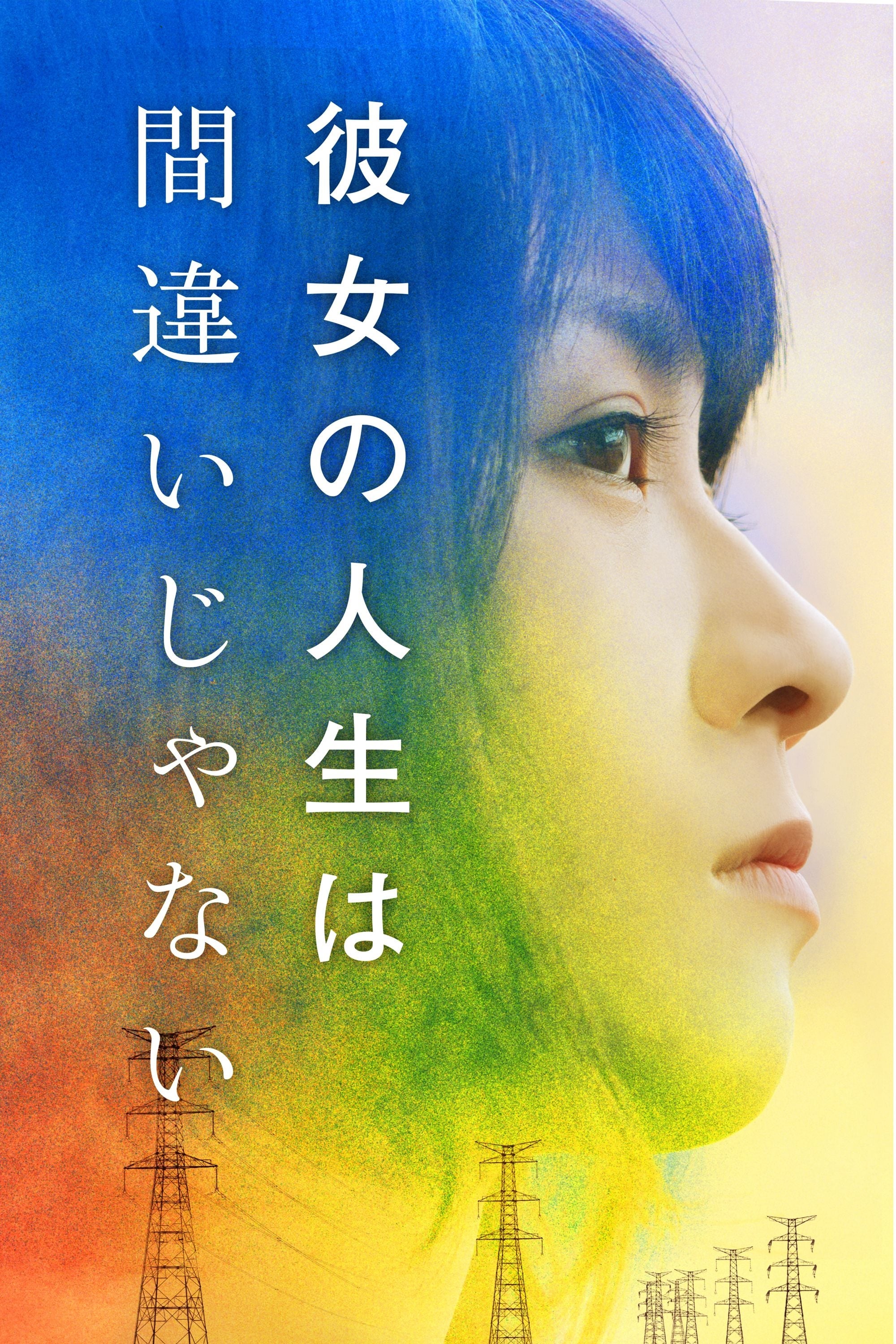
Side Job (彼女の人生は間違いじゃない, Ryuichi Hiroki, 2017)

Side JOb posterFukushima has become a focal point for recent Japanese cinema, not just as a literal depiction of an area in crisis but as a symbol for various social concerns chief among them being a loss of faith in governmental responsibility. Side Job (彼女の人生は間違いじゃない, Kanojo no Jinsei wa Machigai ja Nai) has the distinction of being helmed by a Fukushima native in Ryuichi Hiroki who also wrote the original novel from which the film is adapted. Typical of Hiroki’s work, Side Job is less an ode to the power of perseverance than a powerful meditation on grief, inertia, and helplessness. Though he offers no easy answers and refuses to judge his protagonists for the ways they attempt to deal with their situations, Hiroki does allow them to find a kind of peace, at least of the kind that allows them to begin moving forward if not quite away from the past.

Five years after The Great East Japan Earthquake of 2011, Miyuki Kanazawa (Kumi Takiuchi) is still living in a cramped prefab house with her widowed father, Osamu (Ken Mitsuishi). Miyuki’s mother was lost in the storm and her body never found, leaving the pair bereft and with an unanswered question. Having lost his farm to the exclusion zone, Osamu is left with nothing much to do and mostly spends his time idly playing pachinko and drinking much to the consternation of Miyuki who has a regular job with the city council.

Miyuki may well be angry about the way her father fritters away their money, but that doesn’t quite explain why she boards an overnight coach every Friday and spends her weekends in Tokyo engaging in casual sex work. She appears not to like the work very much and it is occasionally dangerous, but she does seem to have built up a kind of friendship with her “manager” as he drives her around the city to her various clients. Miura (Kengo Kora) claims to enjoy his work because it gives him an opportunity to observe human nature in all of its complexity though if he harbours any conflict about his role as a dispatcher of sometimes vulnerable young women, he is slow to voice it.

The “side job” of the title provides a kind of escape from a boring, conventional life in rural Iwaki, equal parts self-harm and quest for sensation. Miyuki, like many of those around her walks around with an air of irritated blankness, angry at so many things she doesn’t quite know where to begin. Yet for all that she’s also emotionally numbed, held in a state of suspended animation, longing to feel something, anything, even if that something is only shame. Through her double life Miyuki is able to find a sense of control and equilibrium that eluded her in grief-stricken Iwaki. Her manager, Miura, promises to “protect” her, though he makes clear that there are many women he feels a duty to protect rather than just Miyuki. Just as it seems Miyuki has come to depend on him, Miura drops a bombshell of his own though it maybe one which spurs Miyuki on towards a new beginning.

Everything in Iwaki is, in a sense, temporary. Miyuki and her father still live in the tiny prefab house in the hope of one day being able to go “home” while Osamu attends occasional meetings with the farming collective to try and find out what’s going on with his fields. Held in a kind of limbo, repeating the same daily tasks with relentless monotony, Miyuki and Osamu are trapped by a sense of helpless dread, forever waiting for something to happen but having lost the faith that it ever will.

While the pair struggle on, others find themselves unable to bear the weight of their tragedies. The spectre of suicide haunts Miyuki and her father from the woman next-door (Tamae Ando) who has become depressed thanks to the stigma surrounding her husband’s job with the decontamination programme, to the window at the agency which no longer opens following the suicide of one of the employees. Pushed to the edge by financial strain, there are also those who find themselves befriending the vulnerable with an intent to defraud, but it is in the end genuine human relationships which light the way for each of our struggling protagonists. Osamu bonds with an orphaned little boy through playing catch, Miyuki finds strength in Miura’s decision to break with his old life and build a new one, and her assistant at the city council, Nitta (Tokio Emoto), grows into the responsibility of being a big brother while attempting to do the best he can for the people of Fukushima.

What each of them finds isn’t an answer or a “cure” for their trauma but a path towards accepting it in such a way as it allows them to begin moving forward. New seeds are planted in the expectation of a coming future, new lives are celebrated, and the past begins to recede. Memory becomes a still frame, bottled and in a sense commodified but held close as a kind of talisman proving nothing is really ever “lost”. Filmed with an eerie sense of listless beauty, Side Job is an unflinching yet not unforgiving exploration of life after tragedy in which the only possible chance for survival lies in empathy and simple human connection.


Screened at the 20th Udine Far East Film Festival.

Original trailer (English subtitles)
 

Scabbard Samurai (さや侍, Hitoshi Matsumoto, 2011)

scabbard samuraiA samurai’s soul in his sword, so they say. What is a samurai once he’s been reduced to selling the symbol of his status? According to Scabbard Samurai (さや侍, Sayazamurai) not much of anything at all, yet perhaps there’s another way of defining yourself in keeping with the established code even when robbed of your equipment. Hitoshi Matsumoto, one of Japan’s best known comedians, made a name for himself with the surreal comedies Big Man Japan and Symbol but takes a low-key turn in Scabbard Samurai, stepping back in time but also in comedic tastes as the hero tests his mettle as a showman in a high stakes game of life and death.

Nomi Kanjuro (Takaaki Nomi) is a samurai on the run. Wandering with an empty scabbard hanging at his side, he pushes on into the wilderness with his nine year old daughter Tae (Sea Kumada) grumpily traipsing behind him. Eventually, Nomi is attacked by a series of assassins but rather than heroically fighting back as any other jidaigeki hero might, he runs off into the bushes screaming hysterically. Nomi and Tae are then captured by a local lord but rather than the usual punishment for escapee retainers, Nomi is given an opportunity to earn his freedom if only he can make the lord’s sad little boy smile again before the time is up.

Nomi is not exactly a natural comedian. He’s as sullen and passive as the little lord he’s supposed to entertain yet he does try to come up with the kind of ideas which might amuse bored children. Given one opportunity to impress every day for a period of thirty days, Nomi starts off with the regular dad stuff like sticking oranges on his eyes or dancing around with a face drawn on his chest but the melancholy child remains impassive. By turns, Nomi’s ideas become more complex as the guards (Itsuji Itao and Tokio Emoto) begin to take an interest and help him plan his next attempts. Before long Nomi is jumping naked through flaming barrels, being shot out of cannons, and performing as a human firework but all to no avail.

Meanwhile, Tae looks on with contempt as her useless father continues to embarrass them both on an increasingly large stage. Tae’s harsh words express her disappointment with in Nomi, berating him for running away, abandoning his sword and with it his samurai honour, and exposing him as a failure by the code in which she has been raised. She watches her father’s attempts at humour with exasperation, unsurprised that he’s failed once again. Later striking up a friendship with the guards Tae begins to get more involved, finally becoming an ally and ringmaster for her father’s newfound career as an artist.

Tae and the orphaned little boy share the same sorrow in having lost their mothers to illness and it’s her contribution that perhaps begins to reawaken his talent for joy. Nomi’s attempts at comedy largely fall flat but the nature of his battle turns out to be a different one than anyone expected. Tae eventually comes around to her father’s fecklessness thanks to his determination, realising that he’s been fighting on without a sword for all this time and if that’s not samurai spirit, what is? Nomi makes a decision to save his honour, sending a heartfelt letter to his little girl instructing her to live her life to the fullest, delivering a message he was unable to express in words but only in his deeds.

Matsumoto’s approach is less surreal here and his comedy more of a vaudeville than an absurd kind, cannons and mechanical horses notwithstanding. The story of a scabbard samurai is the story of an empty man whose soul followed his wife, leaving his vacant body to wander aimlessly looking for an exit. Intentionally flat comedy gives way to an oddly moving finale in which a man finds his redemption and his release in the most unexpected of ways but makes sure to pass that same liberation on to his daughter who has come to realise that her father embodies the true samurai spirit in his righteous perseverance. Laughter and tears, Scabbard Samurai states the case for the interdependence of joy and sorrow, yet even if it makes plain that kindness and understanding are worth more than superficial attempts at humour it also allows that comedy can be the bridge that spans a chasm of despair, even if accidentally.


Currently streaming on Mubi

Original trailer (no subtitles)