
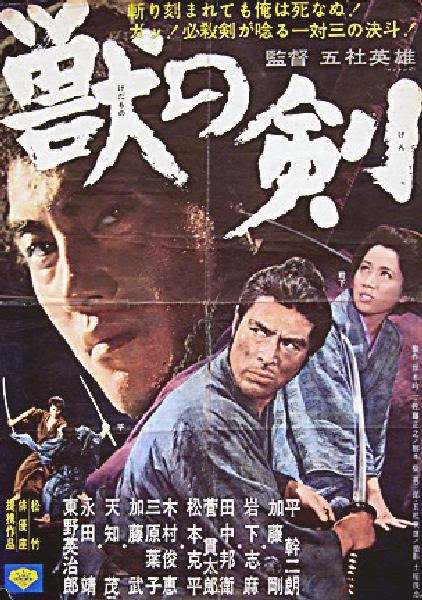
 Hideo Gosha’s later career increasingly focussed on men at odds with their times – ageing gangsters who couldn’t see their eras were ending. His second feature, Sword of the Beast (獣の剣 Kedamono no Ken), is much the same in this regard but its youthful hero knows perfectly that change is on the horizon. Gennosuke (Mikijiro Hira) tries to ride that change into a better, more equal future but the forces of order will not allow him. The cinematic samurai world of the post-war era is no longer that of honourable men, manfully living out the samurai code even when it pains them to do so. It is one of men broken by oppressive feudal rule, denied their futures, and forced to betray themselves in service to systemic hypocrisy. Yet even if men think of reforming the system, they rarely think to escape it unless it actively spits them out.
When we first meet Gennosuke, he’s crawling around in a muddy grass field, dishevelled and hungry. A lone woman spots him and plies her trade leading Gennosuke to embrace his baser instincts and give vent to his lust, but the pair are interrupted by the sound of approaching horses. Gennosuke is on the run from his clan for his part in the murder of a lord. His pursuers scream at him, “have you no pride?”, lamenting his lack of stoical resignation to one’s fate so central to the samurai ideal. “To hell with name and pride” Gensosuke throws back, “I’ll run and never stop.”
Gennosuke’s odyssey leads him into the path of petty bandits who’ve been swiping gold out of the local river. Unbeknownst to them, a couple from another clan have been living an isolated life in a small cottage where they too have been skimming the Emperor’s gold, only they’ve been doing it for their lord. The man, Jurota (Go Kato), is excited about this work because he thinks when it is completed he’ll finally be accepted as a true samurai and the future for himself and his wife, Taka (Shima Iwashita), will be much brighter. He is quite wrong in this assumption.
Gennosuke, it is later revealed, committed his fateful act of murder upon the assumption that he was part of a revolutionary vanguard, removing cruel and corrupt lords from their positions so fairer minded, decent men could rule in their stead. Instead he realises he’s been rendered a disposable pawn in a political game and that the new master he believed would usher in a brighter future only envisaged one for himself. Jurota has been duped in much the same way, asked to do something illicit, immoral, and against the samurai code under the assumption that he will finally be accepted as “one of us”. He has not considered the corruption of those he wants to join, and does not see that his crime likely means he cannot be allowed to live.
Gennosuke and Jurota are cynical men who nevertheless possess true faith in the way of the samurai. Exiled from his clan, Gennosuke is a wandering beast who pretends not to care about the people he meets, but ends up saving them anyway. Yet if Gennosuke has been “freed” from his illusions, Jurota’s devotion to them makes him a less heroic figure. When Taka is captured by bandits who threaten her life, Jurota has a difficult decision to make – surrender the gold or his wife. Jurota chooses poorly and abandons his wife to a fate worse than death at the hands of uncivilised ruffians. Taka finds this hard to forgive. No longer wishing to stay with a man who values her so lightly she turns to Gennosuke – her accidental saviour, and reveals to him that she longs to become “a beast” like him. Now “freed” of her own illusions as regards her husband’s love, their shared mission, and the fallacy of their future together as noble samurai, Taka is prepared to exile herself from the samurai world as Gennosuke has, but, as he tells her, the wife of a retainer cannot choose the life of a beast.
This world of samurai is facing its own eclipse. The Black Ships have arrived, the spell has been broken, and the modern world awaits. Gennosuke can see this future, he tried to grasp it in the murder of his lord, but it is not here yet. Gennosuke’s friend, Daizaburo (Kantaro Suga), is duty bound to take his revenge as the fiancé of the murdered lord’s daughter though he’d rather not do it, and does so only to give Gennosuke an “honourable” death. The daughter, Misa (Toshie Kimura), is understandably angry and filled with hate but she pays dearly for her vengeance. Following their ordeal, neither Daizaburo or Misa can return to their clan. They are also “freed”, their illusions broken, their debts forgiven. Breaking with the burden of their past, they would now follow Gennosuke into his new world, even if none of them know exactly where they’re going.
These private revolutions amount to a kind of deprogramming, reawakening a sense of individual agency but one which is unselfish and carries with it the best of samurai honour. Gennosuke may be a “beast” on the run, reduced to a creature of needs rather than thoughts, but there’s honesty in this uncivilised quest for satisfaction which leaves no room for artifice or hypocrisy. It may be a rough world and lonely with it, but it is not unkind. To hell with name and pride, Gennosuke will have his honour, even as a nameless beast, a self-exile from a world of cruelty, greed, and inhumanity.
Original trailer (no subtitles)
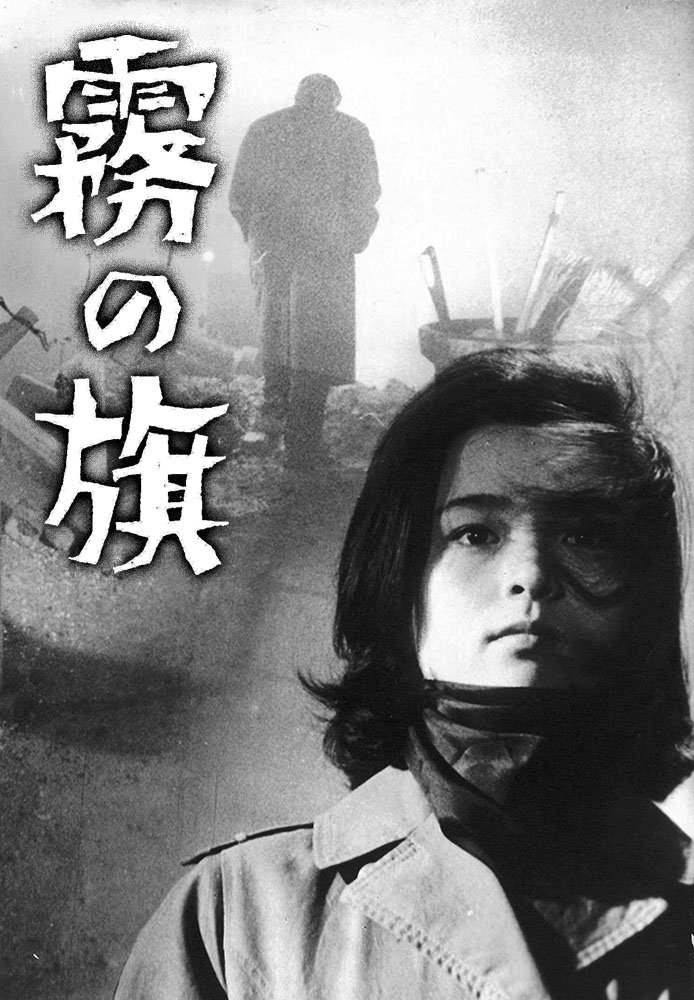 In theory, we’re all equal under the law, but the business of justice is anything but egalitarian. Yoji Yamada is generally known for his tearjerking melodramas or genial comedies but Flag in the Mist (霧の旗, Kiri no Hata) is a rare step away from his most representative genres, drawing inspiration from America film noir and adding a touch of typically Japanese cynical humour. Based on a novel by Japanese mystery master Seicho Matsumoto, Flag in the Mist is a tale of hopeless, mutually destructive revenge which sees a murderer walk free while the honest but selfish pay dearly for daring to ignore the poor in need of help. A powerful message in the increasing economic prosperity of 1965, but one that leaves no clear path for the successful revenger.
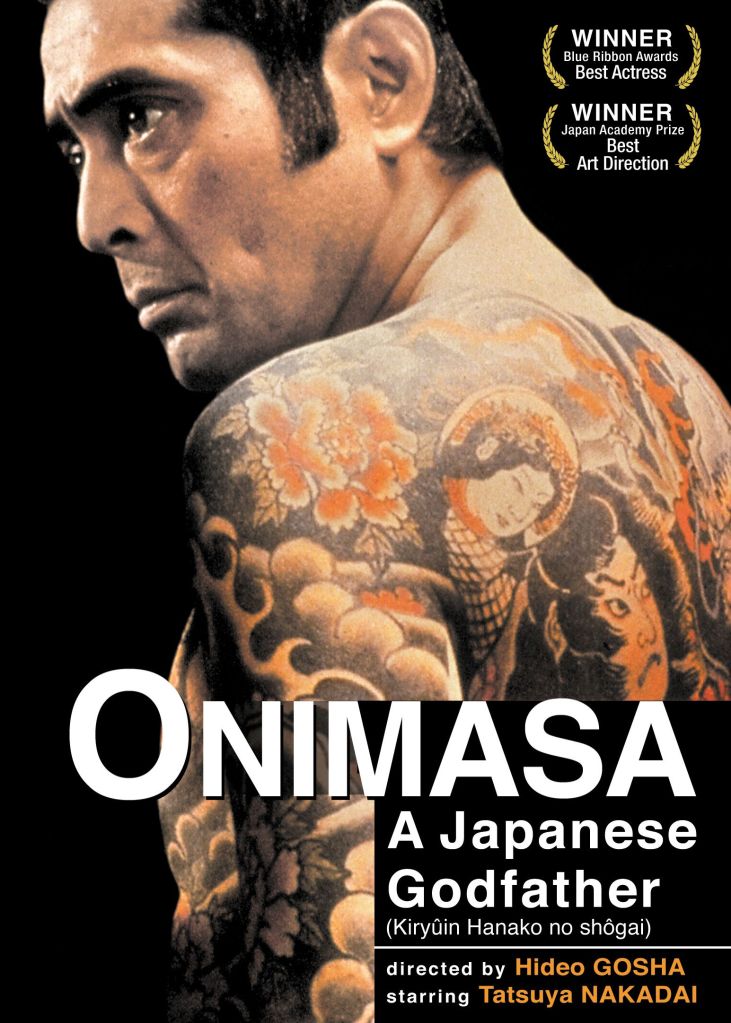 When AnimEigo decided to release Hideo Gosha’s Taisho/Showa era yakuza epic Onimasa (鬼龍院花子の生涯, Kiryuin Hanako no Shogai), they opted to give it a marketable but ill advised tagline – A Japanese Godfather. Misleading and problematic as this is, the Japanese title Kiryuin Hanako no Shogai also has its own mysterious quality in that it means “The Life of Hanako Kiryuin” even though this, admittedly hugely important, character barely appears in the film. We follow instead her adopted older sister, Matsue (Masako Natsume), and her complicated relationship with our title character, Onimasa, a gang boss who doesn’t see himself as a yakuza but as a chivalrous man whose heart and duty often become incompatible. Reteaming with frequent star Tatsuya Nakadai, director Hideo Gosha gives up the fight a little, showing us how sad the “manly way” can be on one who finds himself outplayed by his times. Here, anticipating Gosha’s subsequent direction, it’s the women who survive – in large part because they have to, by virtue of being the only ones to see where they’re headed and act accordingly.
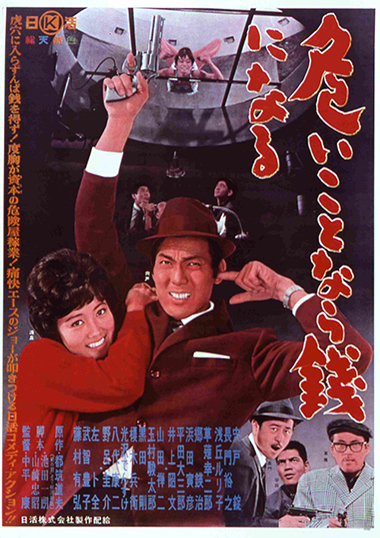 Where there’s danger, there’s money! Or, maybe just danger, who knows but whatever it is, it certainly doesn’t lack for excitement. Ko Nakahira is best known for his first feature, Crazed Fruit, the youthful romantic drama ending in speed boat murder which ushered in the Sun Tribe era. Though he later tried to make a return to more artistic efforts, it’s Nakahira’s freewheeling Nikkatsu crime movies that have continued to capture the hearts of audience members. Danger Pays (AKA Danger Paws, 危いことなら銭になる, Yabai Koto Nara Zeni ni Naru) is among the best of them with its cartoon-like, absurd crime caper world filled with bumbling crooks and ridiculous setups.
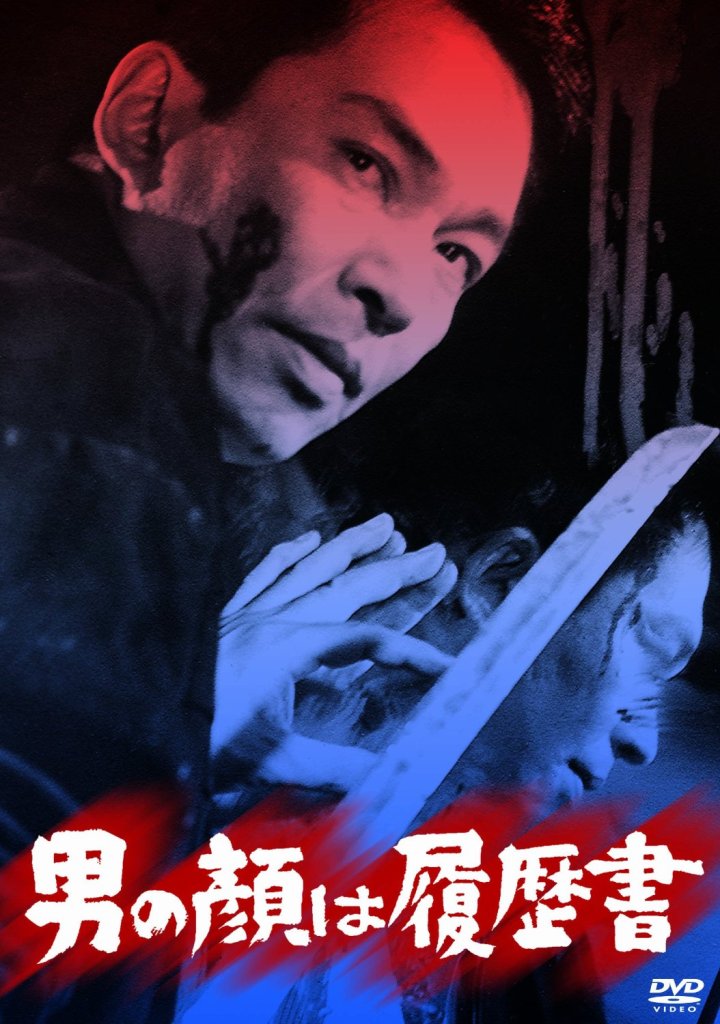 Japanese cinema has not been as shy as might be supposed in examining uncomfortable topics concerning the nation’s mid 20th century history but perhaps prefers to tackle them from a subtle, sideways viewpoint. By a Man’s Face Shall You Know Him (男の顔は履歴書, Otokonokao wa Rirekisho) is, in essence, a fairly straightforward gangster pic – save that the rampaging gangsters are a mob of “zainichi” Koreans rather than post-war yakuza or petty hoodlums. Less about what it is to be an outsider or the quest for identity in second generation immigrants, Kato’s film is about what it says it is about – a man’s face.
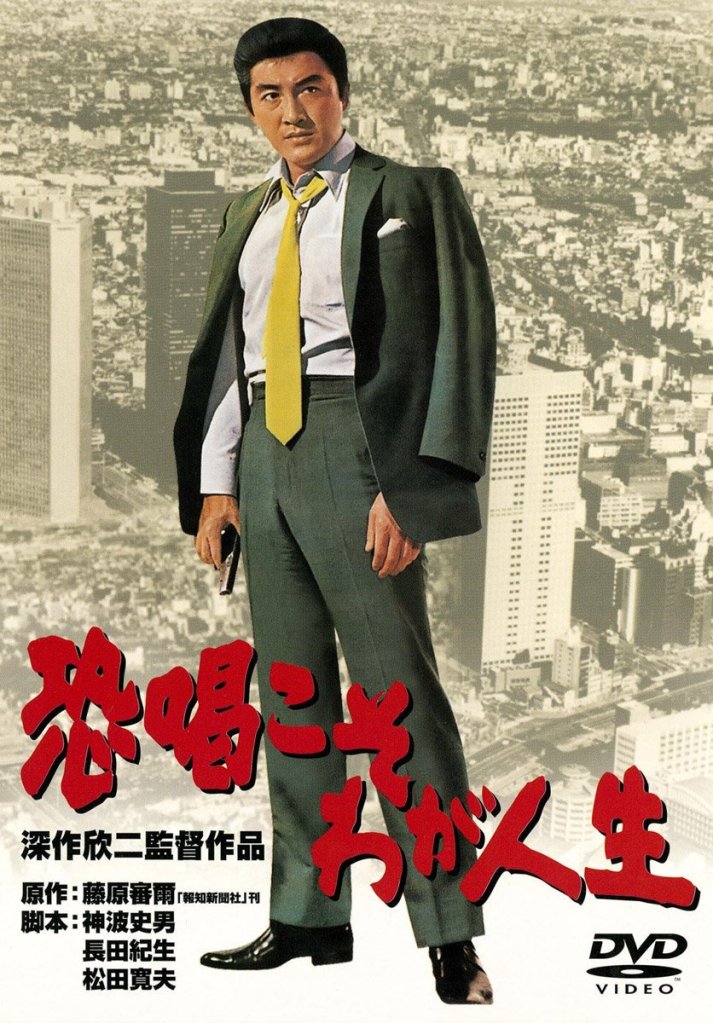 Suffice to say, if someone innocently asks you about your hobbies and you exclaim in an excited manner “blackmail is my life!”, things might not be going well for you. Kinji Fukasaku is mostly closely associated with his hard hitting yakuza epics which aim for a more realistic look at the gangster life such as in the
  There’s a persistent myth that Japanese cinema avoids talking about the war directly and only addresses the war part of post-war malaise obliquely but if you look at the cinema of the early ‘50s immediately after the end of the occupation this is not the case at all. Though the strict censorship measures in place during the occupation often made referring to the war itself, the rise of militarism in the ‘30s or the American presence after the war’s end impossible, once these measures were relaxed a number of film directors who had direct experience with the conflict began to address what they felt about modern Japan. One of these directors was Masaki Kobayashi whose trilogy, The Human Condition, would come to be the best example of these films. This early effort, The Thick-Walled Room (壁あつき部屋, Kabe Atsuki Heya), scripted by Kobo Abe is one of the first attempts to tell the story of the men who’d returned from overseas bringing a troubled legacy with them.
 Windows on Worlds