The Eagle and the Hawk (鷲と鷹, Umetsugu Inoue, 1957)

Strapping sailors meditate on revenge and forgiveness while trapped aboard a moribund cargo ship in Umetsugu Inoue’s otherwise charming musical youth drama, The Eagle and the Hawk (鷲と鷹, Washi to Taka). One of several films Inoue released starring muse of the moment Ishihara, the film uses the boat as a kind of metaphor for a reluctance to deal with the unfinished past as several of its crew members are actively engaged in a self-imposed limbo wilfully remaining in a transient space floating between two harbours with no plans to disembark. 

This is most obviously true for the zombified Ken (Kinshiro Matsumoto) who wanders around the boat in a depressive daze unable to get over a girlfriend who left him for another man though as it turns out the bosun too is hiding out at sea waiting for the statue of limitations to run out on the murder of his lover 30 years previously. When two new recruits show up from the sailors union despite only one having been requested, many are under the assumption that they too are running from something on land though the boat itself is a confined environment from which there is no real escape so it’s also an ideal space for confrontation. 

The thing they may be running from is the murder of the boat’s chief engineer in the film’s noirish opening sequence in which a middle-aged man in a sailor’s cap is stalked by a youngster in jeans before being knifed with a ceremonial dagger. If they were running from that particular crime, it might be ironic that they chose this particular boat but then as the murdered man’s son, First Mate Goro (Hiroyuki Nagato), discovers the dagger was part of a set and the other one’s owned by the captain who seems very alarmed by the whole affair. Meanwhile, the captain’s daughter, Akiko (Ruriko Asaoka), has secretly stowed away along with Akemi (Yumeji Tsukioka), the heartbroken former girlfriend of one of the two new guys, Senkichi (Yujiro Ishihara). 

Women are regarded as unlucky on board, and it’s not difficult to guess why with Goro offering strict instructions to the new guys not to try anything with Akiko while one of the other sailors later attempts to rape Akemi with a palpable desperation existing within the crew. There is also a degree of homoerotic tension between the two new guys, the other being Sasaki (Rentaro Mikuni) who typically walks around shirtless in a pair of tight jeans and works hard to give the impression of having a mysterious past all of which leads Senkichi to suspect he’s an undercover cop possibly there after him or one of the other crew members though unbeknownst to (almost) everyone there is another crime in motion on board. 

As usual, it’s the past that’s come calling with Senkichi on the boat ironically running towards rather than away from a confrontation while others desperately try to cover up their crimes or deflect their responsibility for the dodgy dealings of their youth. Both Senkichi and Sasaki immediately remark that the boat’s a “junker” as soon as they get on board, implying that it too is on its way out, its disrepair a sign of its captain’s lack of respect and care for ship and crew alike. Then again, it seems the crew were intent on drinking half the cargo, most of them clearly happy in their work and enjoying a pleasant sense of camaraderie even on this crummy ship and its presumably not quite above board trip to Hong Kong which might hint at why Akemi shows up in cheongsam though for stowaways both women seem to have brought extensive wardrobes which in all honesty are not particularly well suited to life at sea. 

In any case, the boat becomes an unexpected place of healing and forgiveness largely brokered by manly magnanimity as Goro, on learning the truth behind his father’s murder, accepts that the killer’s motivations are “understandable” even while cautioning them against the fallacy of revenge which he insists will only create more hate and violence. He’s also fairly okay with Senkichi romancing his girl, Akiko, who sadly tells him she sees him more like a brother and isn’t interested in marrying him even if that’s what her father also expects neatly reflecting the dynamic which arises between Akemi and the lovelorn Ken who begins to cheer up and consider leaving the boat to open a transistor radio shop only for Akemi to describe him as a little brother while continuing to chase Senkichi despite his interest in Akiko. An expressionistic storm scene provides some divine justice, but also provokes a bittersweet romantic resolution which suggests it’s time to get off the boat and the face the past but with a kind of cheerfulness for the future otherwise at odds with the rage and violence of the original crime. Of course, this being a vehicle for Yujiro Ishihara, Inoue works in a few romantic scenes with his ukulele and a mournful song about the moon and ocean but finally sends him back to dry land a little more “grounded” for having found his sea legs.

The Green Music Box (緑はるかに, Umetsugu Inoue, 1955)

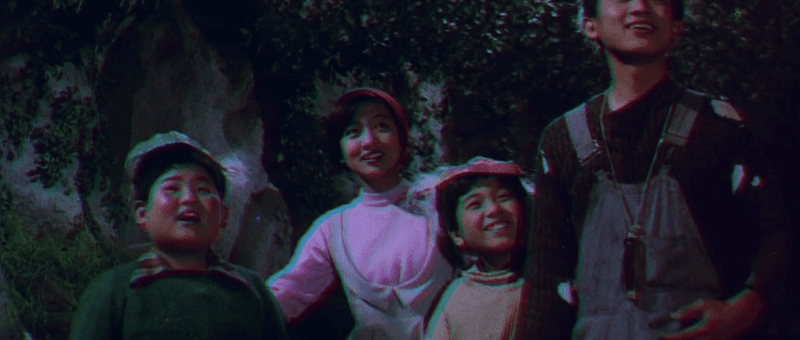
An incredibly surreal musical kids adventure, The Green Music Box (緑はるかに, Midori Haruka ni) saw the film debut of future Nikkatsu star Ruriko Asaoka who in fact took her stage name from the character she plays in the movie. She was born in Manchuria in 1940 as Nobuko Asai (she retains the first character of her surname but the second “oka” or “hill” is also inspired by the “faraway” in the Japanese title). Her father was a political secretary but the family was extremely poor and her entry into the film world came about through an open audition for the role of Ruriko in the film adaptation of a serialised novel for children by Makoto Hojo which would be produced by Takiko Mizunoe and directed by Umetsugu Inoue. Junichi Nakahara who handled the costume design for the film personally picked Asaoka out from the 3000 applicants reportedly saying “this is the girl” after seeing her in makeup. 

A classic children’s adventure movie, the film nevertheless has a strong theme of loneliness and displacement as each of the young protagonists either has no parents or has in some way been separated from them. Ruriko’s father is a scientist who left for a research project in Hokkaido a year previously and has since stopped responding to her letters. Missing him, Ruriko uses a green music box he had given her as a present as a means of floating off into a surreal dream world on the moon filled with children dressed as bunny rabbits who sing and dance with her. Later she teams up with a trio of orphans who have left their orphanage in search of adventure as well as another girl a little younger than herself, Mami (Noriko Watanabe), who has run away from the countryside to look for her mother in Tokyo. At the film’s conclusion all the children have happy family homes, Mami now living with her mother and the three boys adopted by Ruriko’s family meaning that she’s no longer lonely with her brothers now beside her as they all take a trip to the moon and a nation ruled by love, justice, and peace. 

Before all that, however, Ruriko and her mother are kidnapped by a spy, Tazawa (Kenjiro Uemura), claiming to be a colleague of her father’s. Explaining that Professor Kimura (Minoru Takada) has been taken ill, he bundles the pair into a car but takes them to a secret lab in the middle of nowhere where Kimura is being held and attempts to use them to blackmail him into giving up the scientific research he burned on learning that Tazawa belonged to a foreign power explaining that his creation could greatly benefit the world if used peacefully but cause great destruction if not. He manages to sneak the key to his research into Ruriko’s music box and tells her to escape with it though at the film’s conclusion he’ll decide to burn it anyway resolving that it’s too dangerous were it to end up in the wrong hands. 

Such dark events are not exactly unusual in children’s films, though the level of violence is surprising. Ruriko’s mother is taken off and hanged by her wrists while the foreign spies whip her. Though much of it occurs off screen, the whip cracks and screams are audible to Ruriko and her father while we also see her spin and twist, writhing in agony before falling silent perhaps having died as Ruriko comes to infer from the eerie quiet. Later, during the chaos at a circus which is also a front for international espionage a large goon slams the head of one of the children, Fatty (Hideaki Ishii), repeatedly into a table though he appears relatively unhurt and soon fights back cartoonishly by hitting him on the head with an iron bar. 

It’s not really clear why the spies operate out of a weird circus which is also seemingly guilty of copyright infringement given the various Disney-inspired papier-mâché masks lying around, but it is strangely scary for something meant to entertain small children including a surreal performance by Frankie Sakai in a brief cameo as a clown beckoning the kids towards the circus tent. The film was also Nikkatsu’s first colour movie using the short-lived Konicolor method and has a slightly sickly, washed out effect that lends an additional layer of discomfort to the brightly decorated circus environment. In any case, Ruriko and her friends are eventually able to triumph, regaining the music box and even convincing the police that the circus guys really are foreign spies even if it’s partly down to the otherwise unexplained reappearance of her parents who are in fact alive and well. In some ways melancholy, appealing to a sense of loneliness in post-war children who either may have become orphaned or are otherwise separated from their parents, the film ends on a more hopeful note in championing the sense of family that emerges between the children themselves through generational solidarity in offering a happy ending that might seem overly optimistic but nevertheless returns the kids to the kingdom of the Moon Queen and a happy world of love, justice, and peace. 


Crossroad (死の十字路, Umetsugu Inoue, 1956)

An adulterous industrialist finds himself in a sticky situation after accidentally killing his wife in Umetsugu Inoue’s bizarre noir Crossroad (死の十字路, Shi no Jujiro). Based on a story by Edogawa Rampo, the film like any good noir suggests that in the end you can’t outrun your fate and all transgressions must be paid for but also turns on cosmic irony and strange coincidence in the great “tapestry” of life in which everything really is connected.

Shogo Ise (an aged-up Rentaro Mikuni) is the director of a construction firm about to complete a hugely expensive dam project which requires the sinking of a village and quarry. Apparently unhappily married to a woman obsessed with Nichiren Buddhism believing it helped to cure her of a serious illness during the war, he more or less lives with his secretary/mistress Harumi (Michiyo Aratama) who has been receiving incredibly weird and definitely threatening letters from Shogo’s wife Tomoko (Hisano Yamaoka). Tomoko claims that she has received an order from the “Child of the Sun” insisting that she must exact vengeance for the “great sin” Harumi has committed. The letter seems to be the last straw for Shogo who has decided to leave his wife, despite her incredible wealth, and set up home with Harumi permanently. 

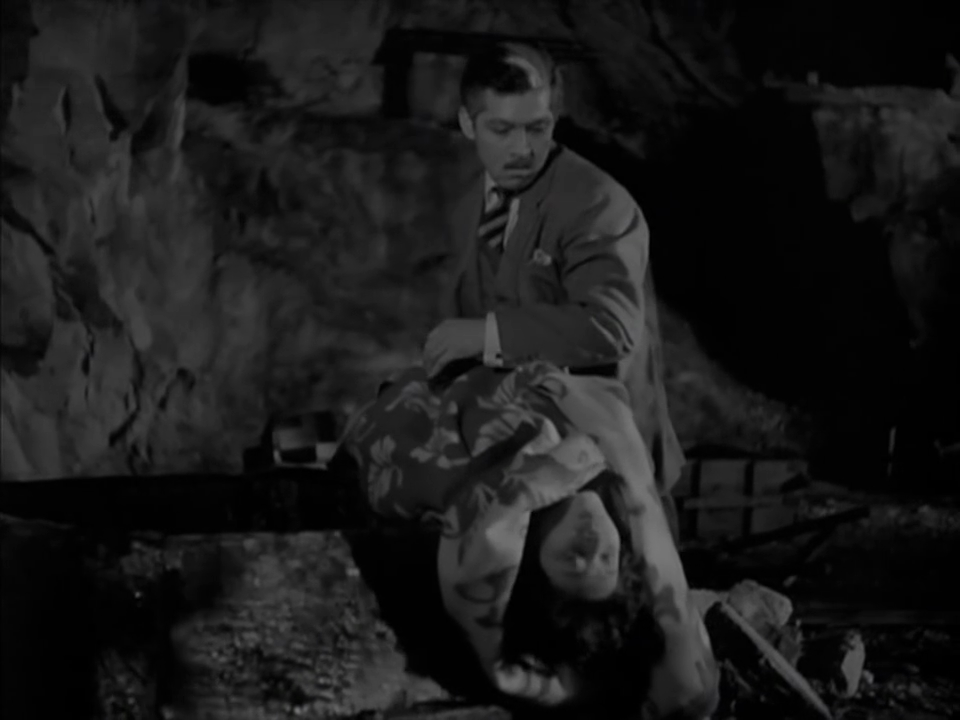
Shogo hadn’t taken the threat very seriously, but sure enough Tomoko later shows up with some kind of ceremonial dagger and barges in to attack Harumi in the bath. During the struggle, Shogo accidentally kills Tomoko while trying to wrestle the knife from her. After briefly considering turning himself in, he realises that doing so will involve them all in scandal so he decides the best thing to do is dump her body in a well at the quarry which is shortly to be sunk. However, the plan soon goes awry and not least because a random man with a head injury climes into his car after he has a fender bender on a set of crossroads and later dies there leaving Shogo no choice but dump him alongside Tomoko. 

Inoue casts the abandoned quarry in truly eerie light, filled with gothic winds as if Shogo were being chastised by the gods themselves. In a sense, he’s paying not only for his sexual transgression but for the breaking of a taboo. A homeless man who once lived in the village later relates that he stayed until the last day because he did not want to leave his ancestors’ land. Shogo is part of the post-war construction boom but there’s also an underlying implication that this industrialisation is harmful to the land itself, not least in constraining a natural flow with the imposition of a dam in addition to causing a displacement of the people who once lived in the village while literally drowning the ancestral spirits. 

Harumi too speaks of feeling as if they’re both sinking beneath the waves, chasing a happiness to which they have no entitlement though she herself seems completely blameless save for her involvement in an extra-marital affair and strangely wholesome in comparison to the film’s otherwise sordid atmosphere. Even for a noir, Inoue’s sensibility is surprisingly sleazy for the world of 1956 and more than a little suggestive. A detective that randomly shows up, Minami (Shiro Osaka), lives with his foxy assistant and the interaction between them is constantly sexually charged while Inoue frequently returns to the backstreets of a neon city and the bars that line the streets approaching the crossroads where Shogo’s fate will align. 

It could be inferred that Shogo is a man whose life was marked by the war, his marriage perhaps in haste and then regretted while his wife developed her illness and subsequent obsession with Nichiren because of its corruption. Nevertheless, he’s portrayed as a basically “good” man in a very bad situation who made some very bad choices he wasn’t in the end bad enough to carry through properly hence the amazing series of collisions that seal his fate. On the one hand, like the young couple related to the drunk man who ended up in Shogo’s car, he and Harumi are just two otherwise ordinary people who decided to chase happiness albeit through an extra-marital affair only to pay a heavy price for daring to dream of a better future. Inoue has his usual amount of fun playing with noir archetypes as men strike matches in darkened alleyways and silhouettes of mysterious men in trench coats line the walls, not to mention the gothic sense of dread in the abandoned quarry, while constantly wrong footing us only to set us on our own collision course with the vagaries of post-war morality. 


The Thief in Black (黒の盗賊, Umetsugu Inoue, 1964)

Best known as a master of the musical, Umetsugu Inoue had a long and varied filmography embracing almost every genre imaginable. He began his career at Shintoho and later joined Nikkatsu where he quickly became an in demand director often working with top star Yujiro Ishihara, but took the somewhat unusual step of going freelance in 1960 thereafter working at various studios including Shaw Brothers in Hong Kong. 1964’s The Thief in Black (黒の盗賊, Kuro no Tozoku) is not a musical but is characteristically playful even within the confines of the lighter side of Toei’s jidaigeki adventures. 

Set between the Battle of Sekigahara and the Siege of Osaka, the samurai corruption in play is essentially the burgeoning Tokugawa dictatorship, the heroes eventually uncovering Ieyasu’s secret plan for making sure his line (well, more himself in essence) remains in power for perpetuity through an insidious plot to weaken the feudal lords and ensure their loyalty to him. Meanwhile, the still developing city of Edo is beginning to turn against the Tokugawa who seem to be intent on exploiting ordinary people to enrich themselves most obviously through forcing the local workforce to renovate Edo castle rather than cleaning up the town which is apparently rampant with crime. Faced with such lack of leadership, the townspeople have come to admire a Robin Hood-like vigilante known only as the Thief in Black who alone is resisting overreaching lords. 

Part of the problem is that Ieyasu’s rule is still insecure because of the potential threat of Hideyori Toyotomi in Osaka. Consequently, they are fearful that some of the men working on the castle may be Toyotomi spies or otherwise disclose information that might benefit him if he chose to attack which is why they’ve refused the workers permission to return home to their families during the pause before beginning the second phase of works leading to further unrest. Meanwhile, corrupt local lord Tadakatsu (Ryutaro Otomo) and his sleazy priest buddy Tenkai (Minoru Chiaki) have an even darker plan in mind, preparing to simply kill the five master craftsmen in charge to ensure they present no threat. Alerted to the situation on the ground by idealistic samurai Jiro (Hashizo Okawa), their boss instructs Tadakatsu in no uncertain terms that he must treat the workers fairly in order to prevent civil unrest and/or disillusionment with the Tokugawa regime but the pair are entirely unfazed and determined to go on with their nefarious plan getting rid of Jiro if the occasion arises. 

As we later discover and in a typical jidaigeki plot device, Jiro is one of a pair of twins with his brother Kotaro (also Hashizo Okawa) abandoned because of the superstitious belief that multiple births are inauspicious. Though both men unwittingly lay claim to the name, Kotaro turns out to be the masked vigilante, his primary cause to regain the lands of the family who raised him unfairly displaced from their estates on the Musashino plains because of Tokugawa greed. Though Jiro, raised as a member of the establishment, is originally loyal to the Tokugawa who have after all brought about an era of peace, he soon begins to see that their rule is no good for the people of Edo. In his more egalitarian worldview, only by enriching the poor can they secure their rule which means less castle building and more infrastructural development along with paying people fairly for their work and absolutely not killing them afterwards. Kotaro too claims that his rebellion is for the good of the common people though unlike Jiro is much more transgressive in his ideology prepared to shake off his samurai status to become a wandering outlaw rather than content himself with the restrictive life of the heir to a samurai clan. 

Such messages are perhaps common in Toei’s brand of jidaigeki but seem unusually pronounced as the peasant workers are often given voice to lament their fate and resist their oppression more directly, pointing the finger not just at a rogue rotten lord but at the entire system built on exploiting their labour. Nevertheless, Inoue injects a hearty dose of whimsical humour to the politically charged narrative even going so far as to include a bumbling ninja claiming to be the famous Hattori Hanzo along with a comic relief magistrate and former samurai brothel owner taking his own kind of ironic revenge in getting the cowardly lords hooked on modernity with a load of faulty rifles. Obviously, Ieyasu couldn’t be stopped, but perhaps they slowed him down and reminded him of the dangers of underestimating the people. Shot with Inoue’s characteristic flare if remaining largely within the Toei house style, Thief in Black is a surprisingly direct attack on corrupt and entitled government but also a righteous romp as its idealistic heroes shuffle themselves back into their ideal positions while fighting Tokugawa oppression all the way. 


The Third Shadow Warrior (第三の影武者, Umetsugu Inoue, 1963)

“In this world the weak are playthings of the strong” according to the hidden villain concealing himself slightly to the side in Umetsugu Inoue’s dark identity drama The Third Shadow Warrior (第三の影武者, Daisan no Kagemusha). Adapting a novel by Norio Nanjo, Inoue, most closely associated with sophisticated musicals, shoots in the manner of a ghost story adapting the trappings of a minor parable on the consequences of selling one’s soul for advancement in complicity with an inherently broken feudal order. 

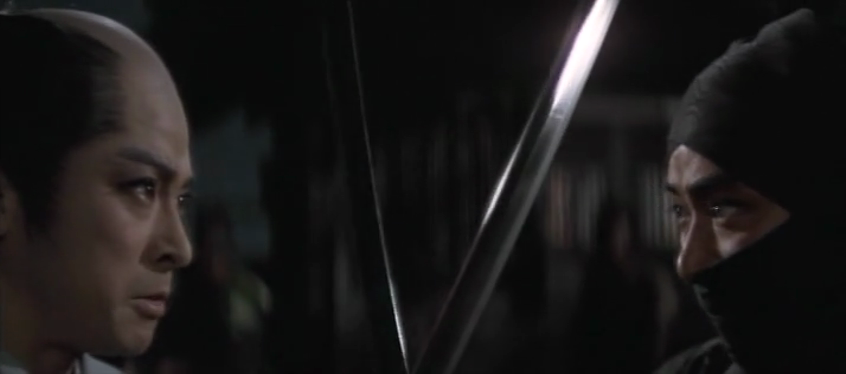
Opening in 1564, the film wastes no time reminding us that the samurai were cruel and duplicitous, a troop of them riding through the contested mountain territory of Hida bearing the severed heads of their enemies casually insulting peasants as they go. Young farmer Kyonosuke (Raizo Ichikawa), however, can’t help but think that they’re heroic and dashing, longing like many young men as the voiceover explains to make his fortune as a samurai in this the age of war. Kyonosuke gets his wish when retainer Shinomura (Nobuo Kaneko) turns up and offers him a job at the castle, only it’s not quite what he expected. Bearing a striking similarity to lord Yasutaka, he has been hired as his third “shadow”, a decoy intended to shield the lord from harm. 

Sitting down with his two new brothers, Kyonosuke remarks how ironic it is that he’s here to escape the land but Kuwano (Katsuhiko Kobayashi) is patiently saving up his pay with the intention of using it to buy a farm and settle down with a beautiful wife. His is the most dangerous of doubling roles as the lord’s battlefield stand-in, while Ishihara (Yuji Hamada), a former actor apparently not much good with the sword, takes his place behind closed walls. Kyonosuke is quite taken with the world of the samurai, but Ishihara cautions that he’ll soon tire of this “phoney life”. In accepting this devil’s bargain, Kyonosuke has in essence consented to his own murder. A shadow man, he can no longer call himself Kyonosuke, but nor can he say he is Yasutaka. He has no fixed identity and is merely in waiting for a veil. Worse still as Ishihara has begun to suspect, they no longer have bodily autonomy because their physicality must match that of the lord. When he is blinded in a battlefield mishap with an arrow, so must they be. Deciding he’d rather not lose an arm, Kyonosuke finds himself in an altercation with his other self which leads to his demise. He intends to make a life for himself under his own name with another clan, but is forced to permanently assume Yasutaka’s identity after being cornered by Shinomura intent on manipulating him for his own ends. 

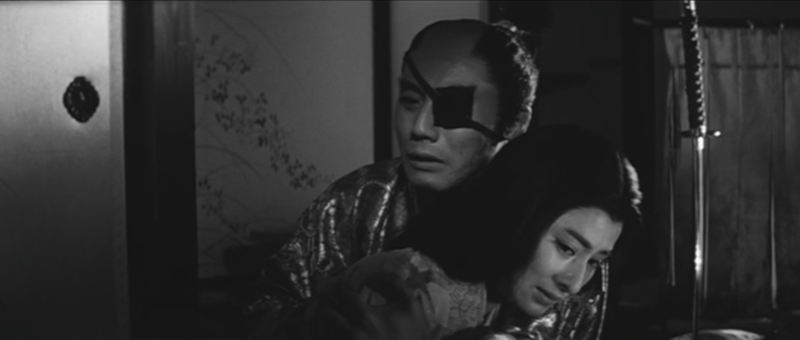
“I’m no puppet, I no longer need a puppeteer” Kyonosuke exclaims drawing strength from embracing his new identity as a samurai lord, but perhaps overreaches himself in ambitious desire failing to see the various ways he is still merely a pawn in a bigger game as Yasutaka himself once was because the lord is only ever an empty vessel and far more expendable than might be assumed. Princess Teru (Hizuru Takachiho), Yasutaka’s conquest bride, declares that she is “just a doll, the strongest will win me” but is of course playing a role herself, one which she does not desire but has been thrust upon her while her cousin, Sadamitsu (Shigeru Amachi), is engaged in a much more active piece of long form role play. Only the lord’s concubine (Masayo Banri) sees through him, falling for the gentle peasant after the rough lord who toyed with her, but their complicated love eventually seals his fate even as he believes it offers him victory. Kyonosuke became a samurai to escape his lack of agency but is arguably much less free than he ever was, driven slowly out of his mind by his fractured sense of identity and realising that in killing the only man who knew who he “really” was, he also killed himself. 

Quite literally imprisoned, Kyonosuke finds himself a shadow once again neither one man nor another, denied an identity and forever a puppet of duplicitous game players better versed in the realities of the samurai existence. “How ugly fighting over this transient kingdom” the princess disdainfully remarks while herself engaging this apparently meaningless foolishness, reminded by her cousin that a princess may hold the keys to a castle or even a nation even if he implies she is little more than his tool, a puppet to be manipulated if knowingly. Shooting with deep, expressionist shadows, chiaroscuro lighting, and a melancholy voiceover Inoue frames his tale as a parabolic caution against selling one’s soul for gold but also a crushing indictment of the inequalities of the feudal order built on wilful hypocrisy and cynical exploitation. 


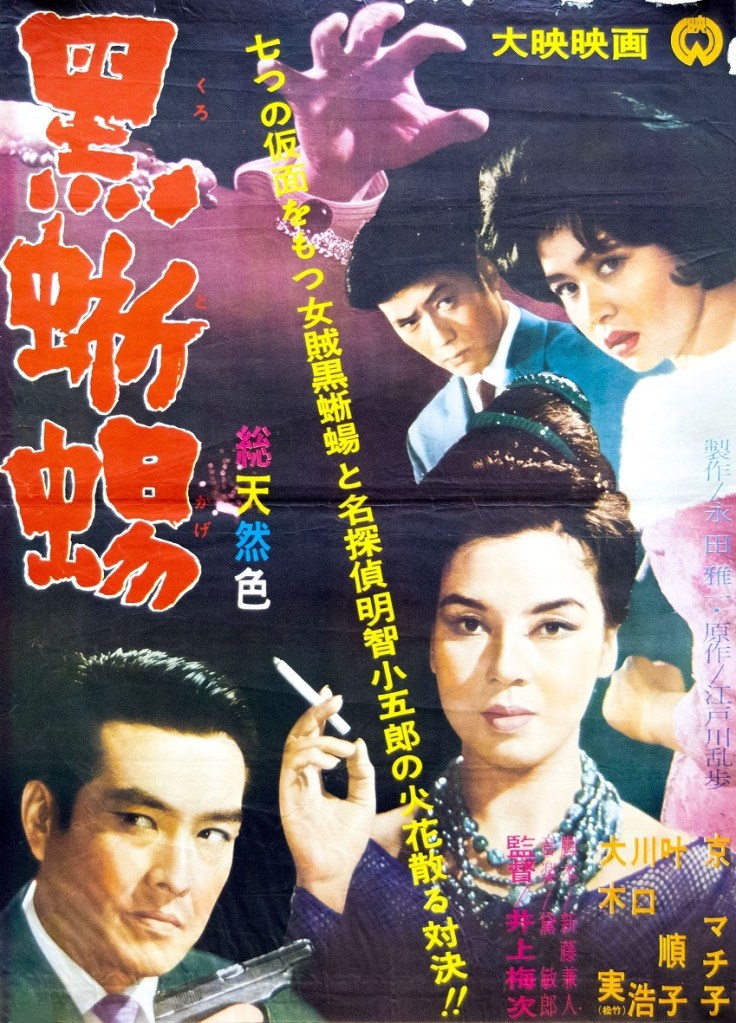
Black Lizard (黒蜥蝪, Umetsugu Inoue, 1962)

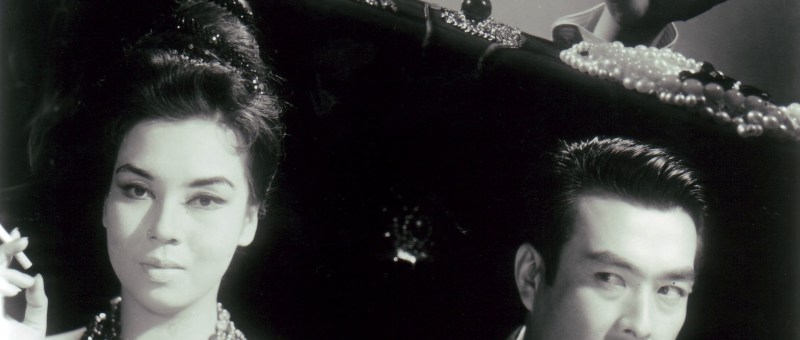
“I want to live in a world where things kiss spontaneously, money divides society like it does you and me” says the Black Lizard (黒蜥蝪, Kurotokage) to her mark, affecting the role of an elegant older woman but failing to conceal herself within the disguise. Though the later 1968 version by Kinji Fukasaku may be better known, Umetsugu Inoue’s adaptation of Edogawa Rampo’s 1934 short story, filtered through Yukio Mishima’s stage play and scripted by Kaneto Shindo, is a camp classic in its own right. Making full use of Inoue’s talent for musicals and the dance background of marquee star Machiko Kyo, Black Lizard is a full hearted crime melodrama in which the villain’s defeat is a perverse tragedy leaving the truly treacherous to ponder what it is they may have destroyed. 

Another outing for Edogawa Rampo’s master detective Akechi (Minoru Oki), the picture opens with “Japan’s best detective” offering a monologue to camera in which he explains that the world is a brutal place but crime too can be an art, it is after all a man-made creation. If only we had more artful crimes, he claims, the world might be a better place. That is perhaps why he seems to have fallen for the crafty Black Lizard, his Irene Adler talented at elaborate heists involving disguise and subterfuge. 

His present case, however, finds him on a retainer to boorish jewellery merchant Iwase (Masao Mishima) who has been receiving threatening letters claiming that someone “very evil” is planning to kidnap his 19-year-old daughter Sanae (Junko Kano) whom he is currently trying to marry off. The reason they’ve made this trip to Osaka (without her mother) is so that Sanae can meet another prospective husband. She doesn’t seem very happy about the idea, but is going along with it and it seems Iwase doesn’t intend to pressure her into a marriage she doesn’t want. In any case, she’s something of a sheltered young woman which might be why she doesn’t suspect anything of the over friendly Mrs. Midorikawa other than she seems to have designs on her father. Knowing that no young girl relishes the prospect of arranged marriage, “Mrs. Midorikawa” makes a point of introducing her to a “friend” of hers, Amamiya (Hiroshi Kawaguchi), whom she thinks might be more to her liking. Of course, Midorikawa is really Black Lizard and Amamiya is her henchman. They’ve come to kidnap Sanae in the hope of ransoming her for the precious jewel “Egyptian Star” that Iwase can’t stop boasting about. 

The thing about Black Lizard is that she’s not driven by monetary gain but by a lust for beauty. She loves everything that sparkles, but more than that the aesthetic pleasure of the human form. Black Lizard tells Sanae that she dreams of a world with no borders, in which people are free into wander into the homes of others, and the subway hangers will be made of diamonds and platinum – literally a sparkling world of peace and freedom where everything is beautiful and nothing hurts. In a slightly transgressive moment, she casts her eyes over Sanae’s youthful body, admiring her “perfectly shaped breasts” before turning melancholy in admitting that she feels sad whenever she sees someone beautiful in knowing they will soon grow old. Later, we realise we should have taken her at her word, her objection to transience apparently having turned murderous. 

Even so, Sanae in rejecting the idea of arranged marraige, foolishly admits she’d rather be stolen than bought. In her eyes, a desire to be swept off her feet by a romantic hero saving her from a bourgeois existence, but she is indeed about to be “stolen” if only to be redeemed when her father agrees to give up the Egyptian Star to save her. Iwase, however, like the Black Lizard herself, was seduced by the allure of precious jewels after striking it lucky as a working class young man labouring in a quarry. He loves his daughter, but cannot bring himself to surrender this the most precious of all his jewels even to save her life. Akechi assures him that he has a plan which will save both Sanae and the diamond, but is left with only contempt for the way that Iwase has been corrupted not quite by greed but by a kind of misdirected lust for illusionary lustre. 

Black Lizard, for her part, is smitten by Akechi’s acumen, taken both by his handsome form and by his ability to challenge her. They chase each other while wondering who it is that is really being pursued and what they intend to do if ever they manage to catch their quarry, but vowing to emerge victorious all the same. Black Lizard guards her heart jealously, like the most precious jewel of all, while Akechi is continually captivated by the perfection of her criminal escapades. “What I hate most in this world is fakes” Black Lizard exclaims, confronted by Akechi’s complicated doubles game where no one is quite whom they first seemed to be, but it’s her own authenticity which eventually blinds her in realising she might have made a damning confession to the man who has “stolen” her heart. Grotesque as it eventually is, and it ends in a bizarre museum of human taxidermy crafted into “beautiful” tableaux, Akechi cannot help but admire the “beauty” in Black Lizard’s artistry, lamenting the loss of something precious while those like Iwase will continue to sell their glittering emptiness to an increasingly “brutal” world. 


Black Lizard dancing away from the scene of the crime (no subtitles)