Beast Alley (けものみち, Eizo Sugawa, 1965)

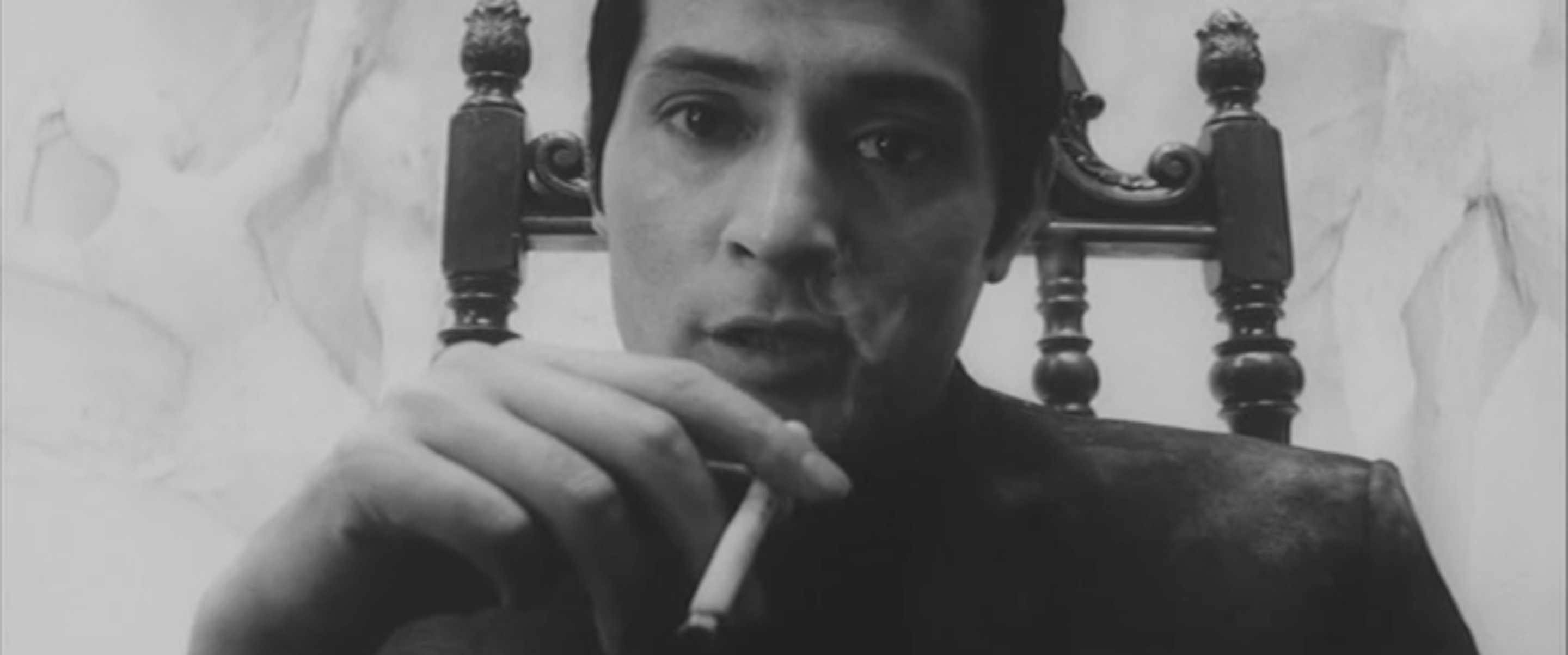
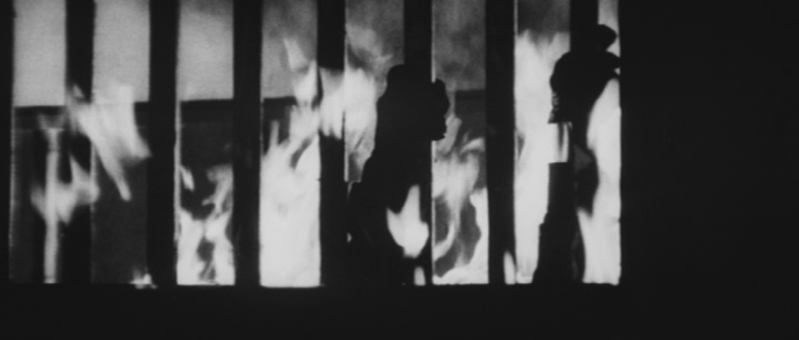
In the opening title sequence of Eizo Sugawa’s Beast Alley (けものみち, Kemonomichi), a thick blob of inky blackness gradually expands over an aerial view of the city until it obscures it entirely. The title card which then appears is written in plain white, but will reappear at the film’s conclusion this time ashen as if it too had been singed by the deeply ironic flames with which the film ends. Based on a novel Seicho Matsumoto and scripted by The Beast Shall Die’s Yoshio Shirasaka, the film similarly takes an incredibly cynical view of the modern post-war society in which it is revealed the militarists are still basically in charge and presiding over a deeply corrupt social order. 

The big bad, Kito (Eitaro Ozawa), says as much when he states the need for reforming the nation’s “rotten political system” by which he means post-war democracy. Kito made his made his money doing deeply dodgy things in Manchuria in addition to running an exploitative coal mine in Japan. Now mainly bedridden, he basically runs the country as a far-right political fixer working in tandem with big business and the yakuza who have traditionally been big supporters of conservative and nationalist forces. Early on we see one of his underlings negotiating with politicians to ensure that Taiyo Roads will be hired be hired for a large scale construction project planning to put highways all the way through Tokyo. As we later discover, he’s prepared to go to great lengths in order to achieve his goal, going so far as to have a sex worker murdered to implicate the uncooperative CEO of a rival construction film into resigning by threatening to frame him for the crime so they can install their stooge in his position. 

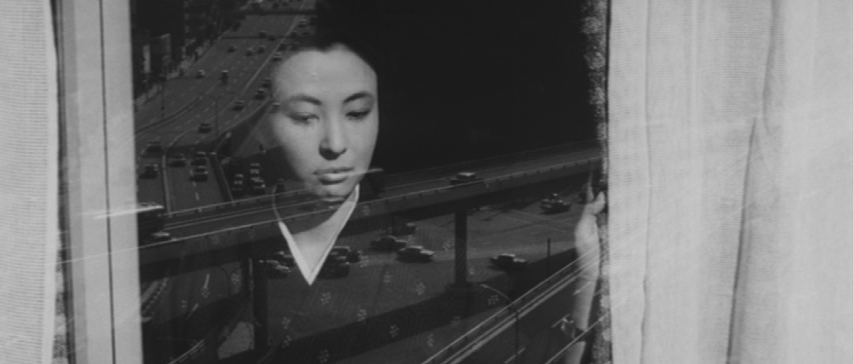
It’s into this world that everywoman Tamiko (Junko Ikeuchi) is drawn while working as a hotel maid at a traditional Japanese inn. Trapped in a bad marriage to a man who is also bedridden yet still attempts to rape her when she returns home to find him in bed with the housekeeper, Tamiko longs for escape and is therefore ripe for the picking when approached by Kotaki (Ryo Ikebe), the manager of an upscale Western hotel, to join him in an unspecified enterprise which will apparently make her very rich. The only catch is that she will have to “get rid” of her “dependent”, which she probably wanted to do anyway, by burning down her house with him inside it. Once she’s done this, there is no turning back for her even if she had not developed complicated feelings for Kotaki who is both her salvation and damnation. 

Tamiko’s husband had failed to give her the comfortable life that he had promised, something which she thinks Kotaki can deliver even if it requires her to become the plaything of Kito whom does she actually seem to like even if aware of the precarity of her position and still in thrall to Kotaki. Leaving the hotel so abruptly was however a strategic error as it arouses the suspicious of (originally) earnest cop Hisatsune (Keiju Kobayashi) who quickly realises that Tamiko set the fire to kill her husband. Though he seemed to be motivated by justice, Hisatsune too is soon corrupted explaining to Tamiko that he has become cynical and jaded. Years of police work have shown him that true criminals know how to break the law and get away with it so he can’t do anything about them, but “good” people, like he implies Tamiko, are pushed into crime by desperation and are easily caught. Tamiko wields her sexuality against him by agreeing to a tryst, though when it doesn’t go to plan he tries blackmail and then rape before she, ironically, manages to escape from his bungled crime. 

Hisatsune’s corruption is gradual and self serving. He starts with suspicion, tailing Tamiko in the interests of justice but also because he desires her, before stumbling on the conspiracy, putting the pieces together, attempting to use them for his own gain and trying to blow a whistle mostly out of resentment. Kito’s reach is all encompassing. Hisatsune is warned off investigating certain aspects of the crime by his senior officers and is then fired on Kito’s instructions for fiddling his expenses after harassing Tamiko. He tries to give his findings to his boss but it goes nowhere and then tries the press but is given the brush off, the editor his reporter friend refers him to gently implying he’s just a crank with an axe to grind. Of course, it turns out that the reporter is already in league with dodgy lawyer Hatano (Yunosuke Ito) who is Kito’s right-hand man. 

The connections between the three men, Kotaki who was once a communist, Hatano, and Kito go back to Manchuria and the corruptions of militarist era which it becomes clear has never really ended. Kito has only one rival and it’s another faction of the conservative ruling party who are probably just waiting for him die. Attempts are made on his life and they don’t go well for those who make them. Even if Hatano hoped to simply inherit an empire he, as he points out, put in much of the work to build he is sorely mistaken while Tamiko may intellectually understand that Kito’s death would place her in a precarious position but carries on regardless. “You never know who will betray you in this world” Kotaki laments, echoing Kito’s later claim that his Buddhist statues are the only ones will never betray him even as sleeps next to a statue of Aizen Myo whom he ironically claims protects mankind from their lust and desire. 

It could be said that desire is Tamiko’s undoing, but as Hisatsune had suggested perhaps you couldn’t blame her for longing to be free of the bedridden husband who had not delivered what he promised her. As she said, she was doing what could to survive even if you’d think she’d know putting on a ring taken from the finger of a murdered woman is akin sealing your own fate. Sugawa shoots with a noirish sense of dread, tracking Tamiko with her coat drawn up around her face as she tries to leave the scene of her crime, and makes the most of his fiery imagery before ending on a note of cynical laughter amid the inescapable hell the of post-war society. 


Original trailer (English subtitles)

The Vampire Moth (吸血蛾, Nobuo Nakagawa, 1956)

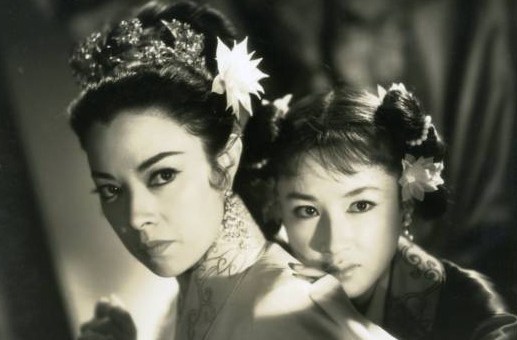
“You’ve become an evil beast that sucks blood!” intones ace detective Kindaichi, though just as his later The Lady Vampire featured no lady vampires, there is no literal bloodsucker involved in Noburu Nakagawa’s Vampire Moth (吸血蛾, Kyuketsuga). Inspired by one of Seishi Yokomizo’s mysteries featuring his iconic detective here played by the rather suave Ryo Ikebe cutting a very noirish figure in contrast to the famously disheveled eccentric from the original novels, the film is for a time at least a werewolf movie though as usual the villain turns out to be post-war greed and amorality. 

This is perhaps rammed home in the open sequence as the camera pans around the neon-lit nighttime city before entering a small cabaret bar where a fashion competition is currently in progress. A note of discord is immediately introduced by a white-haired grumpy old man (Eijiro Tono) sitting in the front row who appears to be in an incredibly bad mood, later exclaiming that the winning design by rising star Fumiyo Asaji (Asami Kuji) does not seem very original to him. Some of the models later complain about the strange spectator who’s evidently come to several other shows and has begun to creep them out. Meanwhile, an aloof, conservatively dressed woman brushes past them. Fumiyo’s assistant Toru (Ichiro Arishima) explains that she is Tazuko Kusakata (Chieko Nakakita) who had been the previous number one before Fumiyo returned to Japan after an extended stay in France. The real drama begins however with the arrival of a masked man with a box for Fumiyo who reveals his wolf-like face to Toru in an effort to convince him to deliver it. After opening the box and finding an apple with a few distinctive bite marks on the outside, Fumiyo promptly collapses.  

From the introduction of the three loose “suspects” an ominous atmosphere takes hold in the certainty that something untoward is about to happen. Soon enough some of the models start getting bumped off in quite bizarre and unpleasant ways. The first girl’s body is shipped back to the studio in a mannequin box which later leaks blood, while the gang are then delivered a cake with the next victim’s name on it in pretty icing with a butterfly moth motif above. There may not be any vampires, but there are certainly moths. The old creepy guy is revealed to be a moth specialist living a giant gothic mansion with a butterfly room in the middle full of specimens nailed to boards. His front door even has a moth motif above it like a coat of arms, while a butterfly mural lies behind it in the hallway. The killer places a decorative moth on each of his victims to cover their modesty which would seem to indicate the grumpy professor but, once he finally arrives, Kindaichi isn’t quite so sure. 

Though this is technically a Kindaichi mystery and he does finally get to unmask the criminal, he is not actually in it very much and as previously mentioned is nothing like later incarnations of the famous detective such as that of Kon Ichikawa’s series of Kindaichi movies released throughout the 1970s. In a common B-movie motif, the main detective work falls to a male and female team in dogged reporter Kawase (Minoru Chiaki) and intrepid model Yumiko (Kyoko Anzai) who eventually succeed in digging up clues at the creepy mansion while simultaneously stumbling across a subplot involving plagiarism in the world of fashion with Tazuko implying that Fumiyo stole her winning outfit from another designer and then passed it off as her own thereby robbing Tazuko of her rightful place as the best designer in Japan. Partly because of all this stress and the vast amounts of money apparently needed to sustain a career in the fashion industry, Fumiyo’s well-meaning boyfriend wants her to abandon the profession but also admits that asking her to give up fashion would be like asking her to give up her life. 

Nakagawa ramps up the tension with a series of elegantly presented reversals, making us think we’re witnessing the killer stalking Fumiyo before pulling back to reveal it’s someone else or presenting the same scene of a masked man ominously peering out from behind a tree. The presence of the “wolf man” links back to a Japanese traveller who supposedly fell victim to a supernatural curse in France described as being akin to possession by a fox in Japanese mythology causing the infected person to gain wolf-like characteristics, become violent, and eventually be consumed by an overwhelming desire for human flesh, but perhaps also hints at the sense of voracious greed that has overtaken the killer and caused them to abandon their sense of of humanity in favour of material riches. Filled with a sense of the gothic along with noirish dread in Nakagawa’s foggy, kilted angles eventually giving way to an atmospheric chase sequence strongly recalling that of The Third Man, The Vampire Moth presents a banal evil with palpable anxiety yet suggests justice will be done to those who however briefly stray from the path. 


The Age of Assassins (殺人狂時代, Kihachi Okamoto, 1967)

“Hey, what’s going on around here?” a sidekick asks directly to camera at the conclusion of Kihachi Okamoto’s characteristically anarchic conspiracy-thriller-cum-spy-spoof The Age of Assassins (殺人狂時代, Satsujinkyo Jidai). Sparked by Bond mania, the late 1960s saw a marked trend in B-movie espionage parody though Okamoto’s take on the genre is darker than the norm even if embracing his trademark taste for absurdist humour leaving us wondering who our hero really is and which side, if any, he’s really on in the confusing geopolitical realities of 1967 Japan. 

As we first meet him, the hero is bumbling professor of criminal psychology Shinji Kikyo (Tatsuya Nakadai) who has extreme myopia and a persistent case of athlete’s foot not to mention a prominent mother complex. Unbeknownst to him, he’s one of three targets picked not quite at random by Rudolf von Bruckmayer (Bruno Lucique), former Gestapo chief, who is interested in hiring some assassins trained by the megalomaniac psychiatrist Mizorogi (Hideyo Amamoto) who’s been turning his mentally distressed patients into hyper-efficient killing machines (sometimes literally) under the rationale that all great men throughout history have been in a certain sense “crazy”. Mizorogi is also in charge of a eugenicist project titled “The Greater Japan Population Control Council” which believes that Japan is already overpopulated but they have to ensure that “the lives of people who might become useful in the future must not be destroyed before they’re born.” Therefore, “the people who will be useless should be asked to bow out”, the assassin calmly explains shortly before Shinji is saved by the divine energy of his late mother as her bust falls from a shelf and knocks the killer out. 

The central conceit plays into a real anxiety about the post-war baby boom expressed in earlier films such as Yuzo Kawashima’s Burden of Love while attacking the capitalistic philosophy that regards some people as more useful than others. By the late 1960s, Nazis had begun to make frequent appearances in these kinds spy spoofs as comedy villains usually crazed to the point of being little real threat. Mizorogi too is eventually exposed as exalting the “mad” interested more in the art of chaos and the impulse to murder than in any greater political goal. Indeed, the central MacGuffin turns out to be less to do with a grand conspiracy to create some kind of super society than the very B-movie-esque missing diamond known as Cleopatra’s Tear.

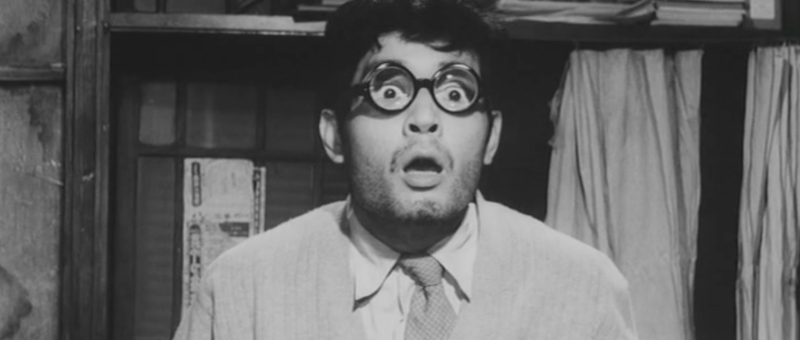
Okamoto piles each of these subplots one on top of the other as if he were making it up as he goes along suddenly undercutting what we thought we knew with an unexpected reversal. Shedding his glasses and shaving his scraggly beard, Shinji shifts from myopic professor to suave super agent using profiling and psychology to stay one step ahead while encountering plots by spiritualist cults, overly cheerful self defence force officers in the middle of training exercises, and eccentric assassins. From a modern standpoint, it might seem uncomfortable that each of the killers is manifesting disability in order to seem non-threatening, a female operative concealing a deadly weapon behind an eyepatch, while her poetry-obsessed colleague stores his in a fake crutch, but then again they are each pawns of a game being played by the crazed Mizorogi. Aided by female reporter Keiko (Reiko Dan) and car thief sidekick Otomo Bill (Hideo Sunazuka), Shinji seems to bumble from one bizarre episode to another but may actually be far more in charge of the situation than we might have assumed. 

Among the most visually striking of Okamoto’s late ‘60s pictures and once again making great use of animation, Age of Assassins features high concept production design, Mizorogi’s asylum lair a maddening corridor of Omega-shaped passages with ornate cell bars on either side behind which we can see a room full of men often engaged in what seems to be a military exercise regime while the plaster effigies of human form seem to be bursting from the walls. As in all of Okamoto’s films the central message lies in the absurdity of violence suggesting in a sense that the dog-eat-dog ethos of contemporary capitalist consumerism is in itself a kind of internecine madness countered only by Shinji’s rather childish mentality crafting his various gadgets out of household objects while attacking this elitist individualism with nothing more sophisticated than a vegetable peeler. 


Original trailer (no subtitles)

Woman of Design (その場所に女ありて, Hideo Suzuki, 1962)

“This job poisons you and deprives you of your youth” according to conflicted ad-exec Ritsuko (Yoko Tsukasa) trying her best to make it in the still very male world of adverting. A snapshot of the city in the early ‘60s, Hideo Suzuki’s workplace melodrama Woman of Design (その場所に女ありて, Sono Basho ni Onna Arite) considers the changing position of women through the eyes of four friends working at the same company, each facing challenges mainly at the hands of useless men while trying to claim a space for themselves as individuals but discovering that they are still subject to a binary choice when it comes to deciding their romantic futures. 

A woman of around 30, Ritsuko has worked her way up to a fairly senior position at Nishigin Advertising which at least appears to be a fairly progressive company run by a compassionate boss who treats his employees equally with respect for all. Nevertheless, Nishigin is very interested in its bottom line especially as the company is apparently not doing so well to the extent that they’ve unfortunately had to cut back on their “entertainment” budget which is apparently how they win and keep clients. A new opportunity has presented itself in the chance to win a contract with a pharmaceuticals company to market their brand new drug aimed at “revitalising” the lives of the over 40s. Unfortunately, they have a rival in the form of Daitsu and suave adman Sakai (Akira Takarada) who appears to have pipped Ritsuko to the post in “seducing” their sleazy PR guy.

Though focussed on her career and somewhat resistant to romance, Ritsuko finds herself attracted to Sakai if eventually wondering if he’s only using her for inside info on Nishigin which she doesn’t directly give him but their relationship does perhaps soften her attitude. Sakai’s minor betrayal in poaching the head of their art department will eventually destroy any genuine feelings they may have had for each other while leaving Ritusko painfully aware of her vulnerabilities as a female employee and of the costs of her momentary decision to break with her long-held determination to keep her professional and private lives entirely separate, admitting that her relationship with Sakai may have been a mistake but refusing to resign because of it. Meanwhile, the boss of the pharmaceuticals company with whom she seems to be on good terms tries to blackmail her into attending an omiai meeting implying he’ll be much more likely to give them the contract if she goes. Not that they necessarily mean she should give up her career, but even Ritsuko’s colleagues seem to be keen that she get married, shocked that she might determine to remain single for the rest of her life. 

That’s exactly the decision her friend Yuko (Akemi Kita) has made, dedicating herself to her career but also moody and embittered. In fact though it is no way explicit, Yuko is strongly coded as a lesbian with a possible crush on friend and colleague Mitsuko (Kumi Mizuno), herself in a difficult position apparently pushed into debt because of an attachment to a no good man whose hospitals bill she has been paying. Ritsuko’s deskmate Hisae (Chisako Hara), meanwhile, is a divorcee wondering what she’s going to do when her ex, whom she’s still hung up on, stops paying alimony, and her sister is forever badgering her for money because her brother-in-law is an irresponsible layabout who can’t hold down a steady job and has no real intention of doing so. “Men who live off women are the worst” Yuko exasperatedly exclaims thoroughly fed up with the bunch of two bit louses who seem to have ruined the lives of all her friends. 

It’s not difficult to understand why Ritsuko may be ambivalent about marriage, but even at work she’s not free of selfish, entitled men who routinely take credit for her work. Sleazy college Kura (Tsutomu Yamazaki) from the art department is forever sucking up to her only to attempt rape while discussing work at her apartment, later brushing the affair off while talking to a female colleague by affirming that older women aren’t his thing anyway. He also undercuts her by visiting the client himself to discuss ideas and changes. Kura later wins a big design prize in part thanks to the slogan Ritsuko came up with only to annoy his colleagues by implying he handled the whole campaign single-handedly. Meanwhile, though in some ways progressive her bosses are conservative when it comes to the business, shutting down the art director’s suggestion of running with an out of the box campaign (the sexier ad featuring a muscular man in his briefs which he later sells to Sakai is the one which ends up winning). Tsuboichi (Jun Hamamura) and Kura perhaps too feel constrained by a top down hierarchal structure which frustrates innovation and in their own ways rebel, but as Ritsuko later makes plain in her speech to the boss if she wants to keep her position she has to play by the rules. “Life’s short. Especially for a woman. We have no room for mistakes” as Yuko cheerfully agrees.

Yet even within that, Ritsuko manages to redefine her boundaries, making it clear that she won’t be doing the omiai. She does not, however, reject marriage entirely only state that “I will get married only when I feel the time is right”, for the moment at least entirely focused on her career. Though the future may have looked gloomy, the crisis passes and the mood brightens significantly with the news that another company is about to officially announce the launch of a long-rumoured anti-ageing cream which provides another potentially lucrative campaign opportunity for Nishigin and of course for Ritsuko should she win it. Having opened with a series of still frames followed by hazy footage of a sea of workers wandering towards their offices on an overcast morning, Suzuki closes in the twilight with the three ladies leaving the office, their friendship solidified as they head off to celebrate renewed hope for the future bolstered by a sense of female solidarity.


Madame White Snake (白夫人の妖恋, Shiro Toyoda, 1956)

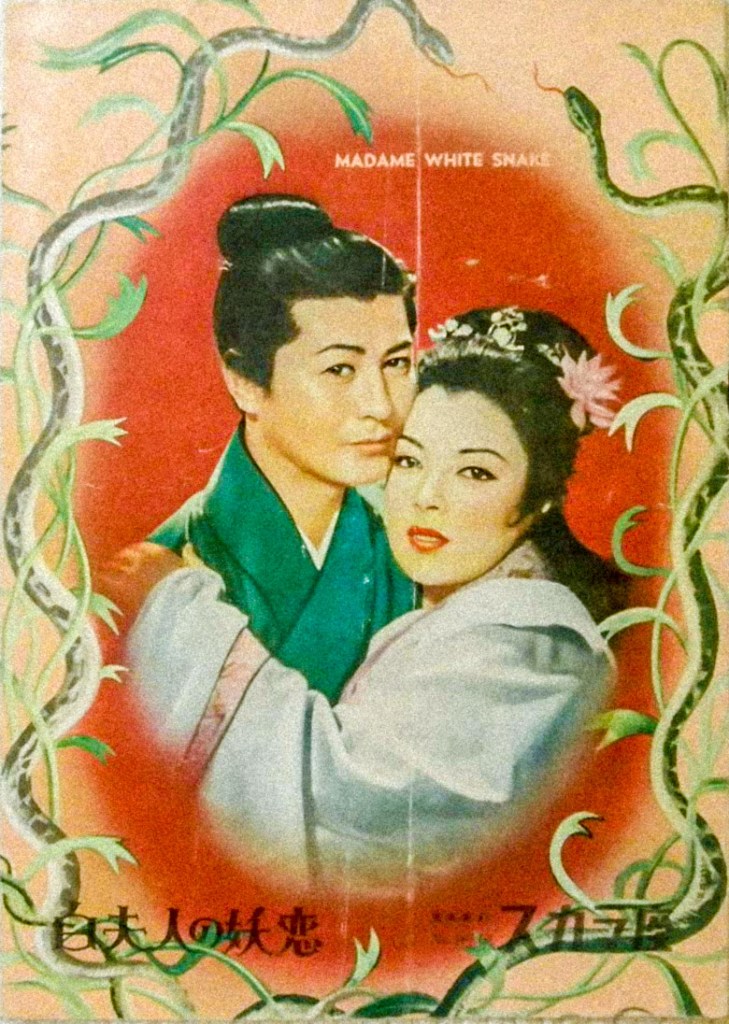
A studio director at Toho, Shiro Toyoda was most closely associated with adaptations of well respected works of literature, often with an earthy, humanist touch. He might then be an odd fit for a tale of high romance co-produced with Hong Kong’s Shaw Brothers and inspired by a classic Chinese legend. Madame White Snake (白夫人の妖恋, Byaku Fujin no Yoren) effectively drops some of Toho’s top talent, including “pan-Asian” star Shirley (Yoshiko) Yamaguchi (AKA Li Xianglan / Ri Koran), into a contemporary Hong Kong ghost movie with Toyoda doing his best to mimic the house style. 

As in the classic legend, fate is set in motion when herbalist Xu-xian (Ryo Ikebe) allows “noblewoman” Bai-niang (Shirley Yamaguchi) and her maid Xiao-qing (Kaoru Yachigusa) to board a boat he is riding to escape a storm. The pair bond because they are both orphans out in the rain to pay their filial respects to their late parents on tomb sweeping day. Disembarking, Xu-xian lends the ladies his umbrella, vowing to visit their house the next day after his rounds to reclaim it. When he arrives, Xu-xian is greeted by a near hysterical and extremely romantic Bai-niang who has apparently fallen deeply in love with him because of his pure heart. She proposes marriage, but Xu-xian is wary. He is after all just a poor boy, a herbalist living with his older sister and her husband. He has no money to get married and Bai-niang is a noble woman from a good family, society simply wouldn’t allow it. Xu-xian tries to escape, but his gentle words of refusal only wound Bia-niang’s heart. 

Hoping to smooth the situation, Xiao-qing decides to give Xu-xian a small fortune in silver taels so the money issue will be solved. Strangely, the plan appears to work. Xu-xian quickly gets over his reluctance to accept money from a wealthy woman who wants to marry him and returns to being in love and excited, selling his newfound hope for the future to his sister by showing her the taels. It is, however, not quite that simple. The silver turns out to be stolen as evidenced by a mark of fire on its surface. Xu-xian falls under suspicion as a thief and comes to resent Bai-niang for placing him in such a difficult and embarrassing position. 

Nevertheless, despite all the strange goings on such as the suddenly “abandoned” house, the green smoke, and vanishing women, Xu-xian does not seem to suspect that Bai-niang is not fully human, and is only angry with her for misusing him. In a motif which will be repeated, however, he is eventually won over. After taking a job in his sleazy uncle’s inn, he re-encounters Bai-niang and realises she really is the one for him. But as they begin to build their life together, launched with an unwise loan from the sleazy uncle who can’t seem to keep his eyes (and occasionally hands) off Bai-niang, doubt begins to creep in. Those small cracks are deepened when Xu-xian is accosted by a man who announces himself as a Taoist from Mount Ji and tells him that he has an evil aura over his head, encouraging him to believe that an evil spirit is slowly capturing his heart which why he’s a little bit afraid to go home. The priest gives him some useful talismans, which are of course quite bad news for Bai-niang who now knows that her husband secretly doubts her. 

Meanwhile, prepared to do “anything” to make the man she loves happy, Bai-niang has come to the strange conclusion that Xu-xian’s moodiness is down to the fact that their medicine shop isn’t doing so well. Unfortunately, her big idea is poisoning the local well to make everyone think there’s a plague so they’ll have to buy more of her potions. It’s a fairly nefarious plan, but apparently all for love. As in the original tale, however, the real crisis once again comes with the randy uncle who uses the pretext of a local festival to try and get Bai-niang drunk on special wine that is known to unmask spirits. Realising that his wife is a little bit otherworldly sends Xu-xian into a coma, while Bai-niang goes to ask the gods for help, only to be undercut by the annoying Taoist priest who wakes Xu-xian up by convincing him his wife’s “evil”. 

If you don’t want people to think you’re “evil”, trying to drown the entire town might not be the best move. Bai-niang’s refusal to give up on Xu-xian even when he constantly tries to reject her places her at odds with loyal servant Xiao-qing who is equal parts enraged on her behalf and exasperated that she can’t see sense. Bai-niang tells the gods that the only witchcraft she used was the witchcraft of love even if that love caused her to try and poison the entire town, but now regards herself as nothing more than Xu-xian’s wife and is willing to renounce her powers in order to save him. Once again, Xu-xian has a sudden change of heart, avowing that there are human women with the heart of a snake, and Bai-niang is a woman to him even if she’s a snake spirit which is, apparently, the only thing that matters. Still, theirs is a love this world doesn’t understand, and so only in a better one can they ever be together.


Original trailer (no subtitles)