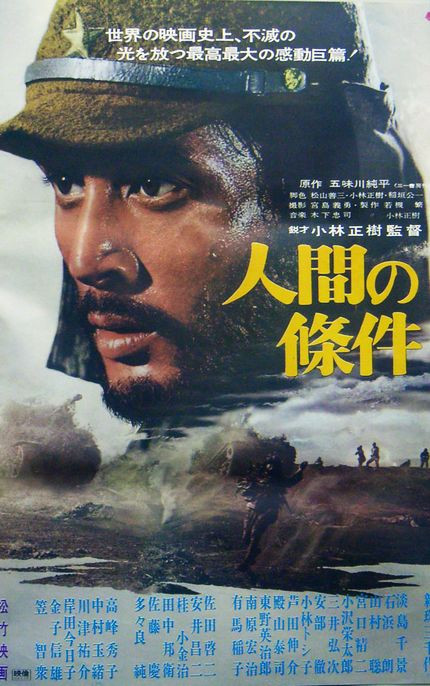
Review of Masaki Kobayashi’s magnum opus The Human Condition (人間の條件, Ningen no Joken) first published by UK Anime Network
If Masaki Kobayashi had an overriding concern throughout his career, it was the place of the conflicted soul within an immoral society. Nowhere is this better articulated than in his masterwork – the nine and a half hour epic, The Human Condition. Adapted from a novel by Junpei Gomikawa, Kobayashi’s film also mirrors his own wartime experiences which saw him conscripted into the army and sent to Manchuria where he was accounted a good soldier, but chose to mark his resistance to the war effort by repeatedly refusing all promotions above the rank of Private. Kaji, by contrast, essentially sells his soul to the devil in return for a military exemption so that he can marry his girlfriend free of the guilt that comes with dragging her into his uncertain future. At this point Kaji can still kid himself into thinking he can change the system from within but to do so means compromising himself even further.
The first of three acts, No Greater Love, takes place in Manchuria during the Japanese expansion where Kaji is working for a Japanese steel company. Fully aware that the company is using forced and exploitative labour, Kaji has been tasked with increasing productivity and has written a comprehensive report indicating that introducing better working conditions would positively affect efficiency as there would be less absenteeism and fewer sickness related gaps in the line. His boss is impressed and presents him with an offer of promotion managing a mine in the North. Kaji is conflicted but ultimately decides to accept as the post comes with a certificate of military exemption so he can finally marry his girlfriend, Michiko. However, his progressive ideals largely fall on deaf ears.
Road to Eternity finds him in the army where his left leaning ideas are even less appreciated than they were at the mine. Asked to train recruits, Kaji once again enacts a progressive approach which takes physical reinforcement out of the process and focusses on building bonds between men but his final battle comes too early leaving his team dangerously exposed. Kaji is briefly reunited with Michiko who has made a perilous journey to visit him but neither of the pair knows when or if they will see each other again.
The concluding part, A Soldier’s Prayer, finds a defeated Kaji wandering the arid land of Northern Manchuria on a desperate quest south with only the thought of getting back home to Michiko keeping him going. Eventually he is taken prisoner by Soviet forces but far from the people’s paradise he’d come to believe in, the Russians are just as unforgiving as his own Japanese. In the army he was a “filthy red” but now he’s a “fascist samurai”.
As much as Kaji is “good” man filled with humanistic ideals, he is also an incredibly flawed central presence. Already compromised by working for the steel company in Manchuria in the first place fully knowing the way the company behaves in China, his decision to take the mining job is an act of self interest in which he trades a little more of his integrity for military exemption and a marriage license. Needless to say, the head honchos at the mine who’ve been at the coal face all along do not take kindly to this baby faced suit from head office suddenly showing up and telling them they’ve been doing everything wrong. Far from listening to their experiences and arguing his point, Kaji attempts to simply overrule the mining staff taking little account of the already in place complex inter-office politics. This creates a series of radiating factions, most of whom side with Kaji’s rival and have come to view the cruel treatment of workers as a sort of office perk.
The complicity only deepens as Kaji becomes ever more a part of the machine. Kaji feels distraught after he loses his temper and strikes a subordinate, but before long he’s physically whipping a crowd of starving men in an attempt to stop them killing themselves through overeating. His biggest crisis comes when a number of Chinese prisoners are caught trying to escape and Kaji is unable to help them after specifically guaranteeing nobody would be killed. Forced to watch the botched execution of a brave man who refused to capitulate even at the end, Kaji is forced to acknowledge his own role in the deaths of these men, his complicity in the ongoing system of abuse, and his complete powerlessness to effect any kind of change in attitudes among the imperialist diehards all around him.
Kobayashi pulls no punches when it comes to examining the recent past. The steel company is built entirely on the exploitation of local workers who are progressively stripped of their humanity, whipped and beaten, starved and humiliated. The situation is only made worse when Kaji is forced to accept a number of “special labourers” from the military police. Tagged as prisoners of war, these men are not soldiers but displaced locals from Northern villages razed by Japanese troops. The train they arrive on is worse than a cattle truck and some of the men are already dead of heat, thirst, and starvation. The others pour out, zombie-like, searching desperately for food and water. Kaji is further compromised when the head of the mine has a plan of his own to subdue the men which involves procuring a number of comfort women which Kaji eventually does even if the entire process makes him sick. This is where the system has brought him – effectively to the level of a people trafficker, pimping vulnerable women to enslaved men.
Kaji comes to believe in a better life across the border where people are treated like human beings but anyone who’s read ahead in the textbooks will know this doesn’t work out for him either. Equally scathing about the left as of the right, The Human Condition has very little good to say about people, especially when people begin to act as a group. Even Kaji himself who has so many high ideals is brought low precisely because of his self-centred didacticism which makes it impossible for him to take other people’s views into account. With his faith well and truly smashed, Kaji has only the vague image of Michiko to cling to. Even so, he trudges on alone through the snowy landscape, deluded by hope, still dreaming of home. Trudging on endlessly, driven only by blind faith, perhaps that’s the best definition of the human condition that can be offered. A brutal exercise in soul searching, The Human Condition is not always even certain that it finds one but still retains the desire to believe in something better, however little in evidence it may be.
Trailers for each of the three parts (English subtitles)
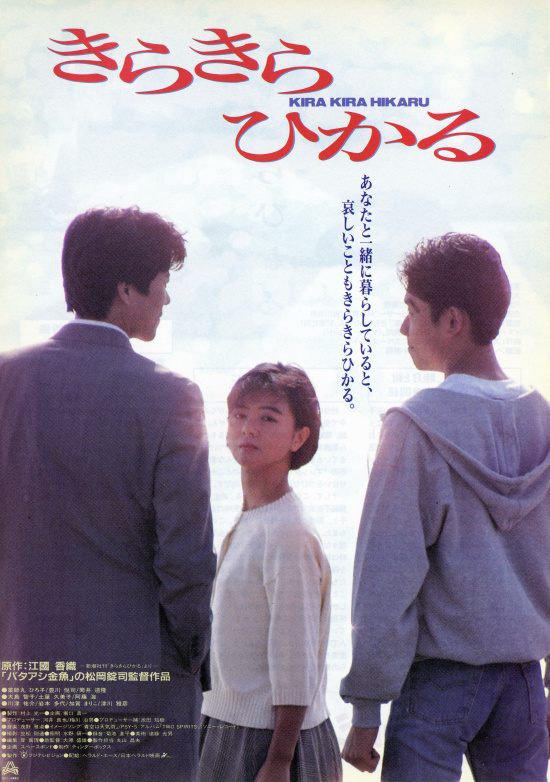 The end of the Bubble Economy created a profound sense of national confusion in Japan, leading to what become known as a “lost generation” left behind in the difficult ‘90s. Yet for all of the cultural trauma it also presented an opportunity and a willingness to investigate hitherto taboo subject matters. In the early ‘90s homosexuality finally began to become mainstream as the “gay boom” saw media embracing homosexual storylines with even ultra independent movies such as
 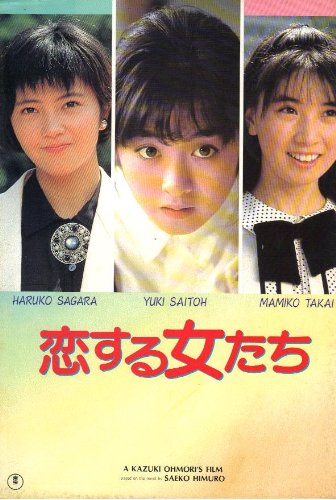 The friends you make in high school are the friends you’ll have the rest of your life, says Takako – the heroine of Kazuki Omori’s Young Girls in Love (恋する女たち, Koisuru Onnatachi). Only she doesn’t quite want hers – they’re weird and cause her nothing but trouble. Also one of them is too pretty so she soaks up all of the attention – where’s the fun in that? Takako is not altogether happy in her adolescence but at least she has her friends there beside her, right?
 Caesium is a chemical element which has the distinction of being one of the very few metals which remains liquid at room temperature. These days you’re most likely to hear about one of its isotopes which is produced as a result of nuclear fission and can pose a serious environmental problem following a nuclear related disaster. Caesium comes to be something of an obsessive concern for the 17 year old heroine of Ryo Saitani’s debut film, Cesium and a Tokyo Girl (セシウムと少女, Cesium to Shojo), as Mimi comes to connect the presence of caesium in the water with the constant soreness she’s been experiencing with her tongue since the disaster hit.
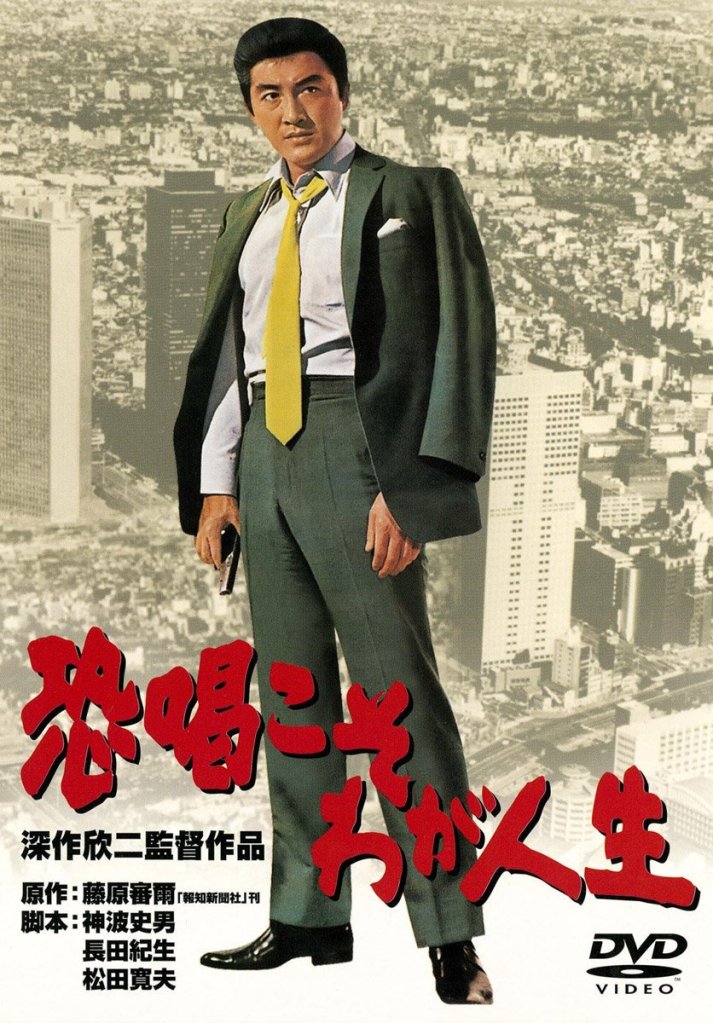 Suffice to say, if someone innocently asks you about your hobbies and you exclaim in an excited manner “blackmail is my life!”, things might not be going well for you. Kinji Fukasaku is mostly closely associated with his hard hitting yakuza epics which aim for a more realistic look at the gangster life such as in the
 For arguably his most famous film, 1964’s Manji (卍), Masumura returns to the themes of destructive sexual obsession which recur throughout his career but this time from the slightly more unusual angle of a same sex “romance”. However, this is less a tale of lesbian true love frustrated by social mores than it is a critique of all romantic entanglements which are shown to be intensely selfish and easily manipulated. Based on Tanizaki’s 1930s novel Quicksand, Manji is the tale of four would be lovers who each vie to be sun in this complicated, desire filled galaxy.
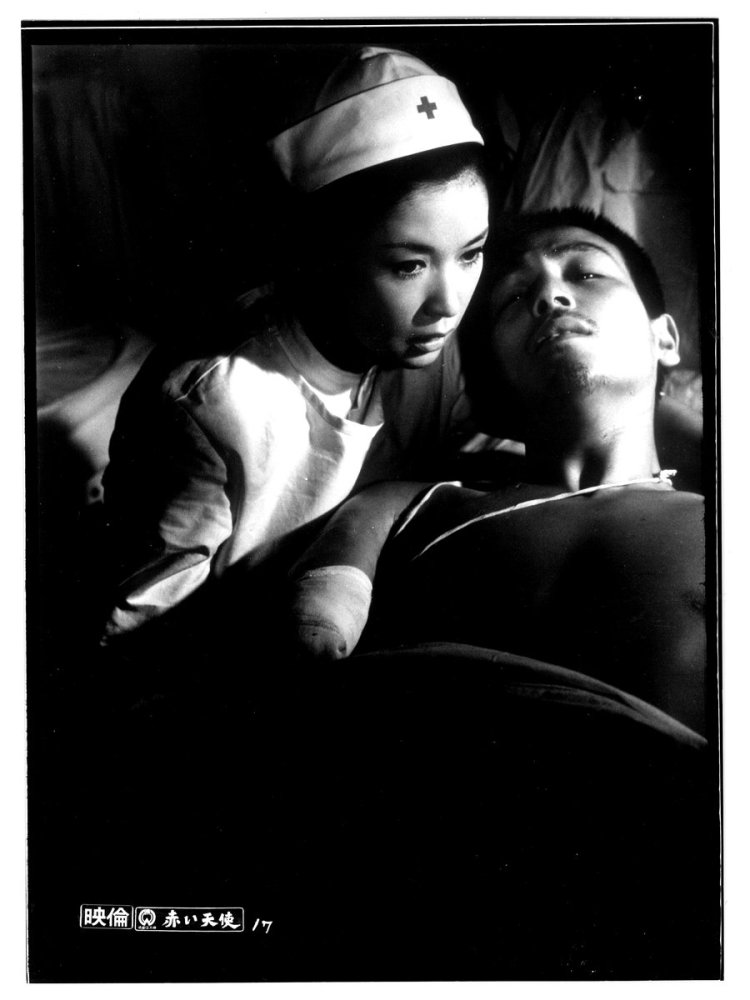 Red Angel (赤い天使, Akai Tenshi) sees Masumura returning directly to the theme of the war, and particularly to the early days of the Manchurian campaign. Himself a war veteran (though of a slightly later period), Masumura knew first hand the sheer horror of warfare and with this particular film wanted to convey not just the mangled bodies, blood and destruction that warfare brings about but the secondary effects it has on the psyche of all those connected with it.
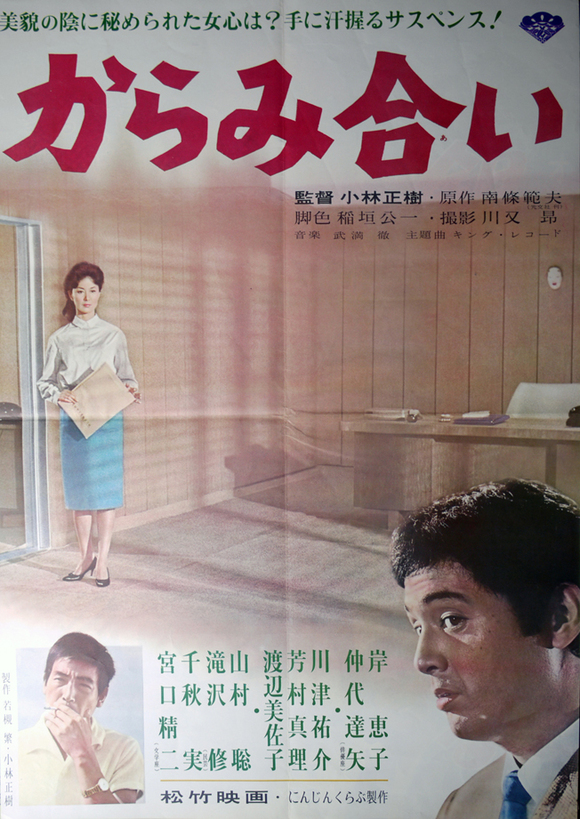 Kobayashi’s first film after completing his magnum opus, The Human Condition trilogy, The Inheritance (からみ合い, Karami-ai) returns him to contemporary Japan where, once again, he finds only greed and betrayal. With all the trappings of a noir thriller mixed with a middle class melodrama of unhappy marriages and wasted lives, The Inheritance is yet another exposé of the futility of lusting after material wealth.
 Windows on Worlds