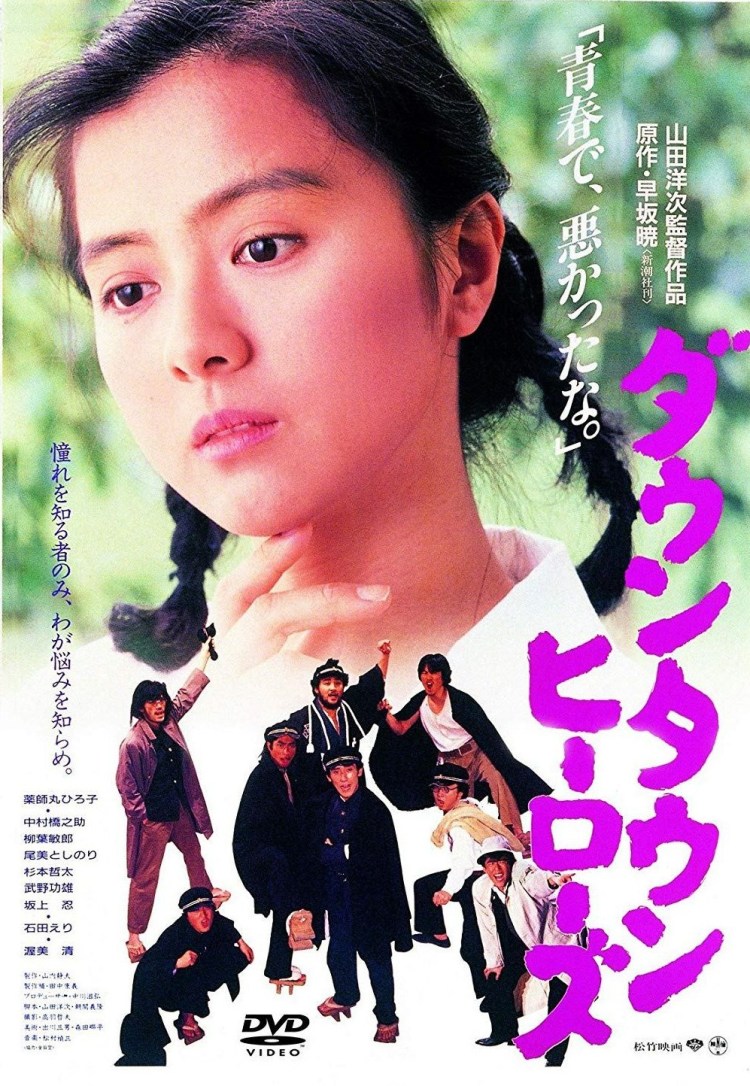
Downtown Heroes (ダウンタウンヒーローズ, AKA Hope and Pain, Yoji Yamada, 1988)

Downtown Heroes posterUnlike many of his contemporaries, Yoji Yamada was an infrequent visitor to the youth movie. Best remembered for his long running Tora-san series, Yamada’s later output is marked by an alternation of laughter and tears, running between raucous family comedies and poignant examinations of wartime loss. Set in the immediate postwar period, 1988’s Downtown Heroes (ダウンタウンヒーローズ, AKA Hope and Pain) adapts the autobiographical novel by Akira Hayasaka for a twin tale of endings and beginnings as a group of boys prepare to leave the Japan of their childhood behind and set out into the brand-new post-war future.

Our narrator for the tale is Hayasaka’s stand-in, Kosuke (Hashinosuke Nakamura), a sensitive young man from the mountains studying at the prestigious boys’ boarding school in town. The Matsuyama high school is one of the last to still be operating in Japan’s pre-war educational model. In fact, when the boys graduate the school will shut down in favour of the American 6-3-3 standard model of organising the educational system. Nevertheless, Kosuke and his friends enjoy what seems like a fantastically broad curriculum to modern eyes, much of which consists of classic German literature. Rather than their family names, the boys refer to each other with a series of nicknames inspired by their studies and have been heavily influenced by European left-wing political ideology. Accordingly, they are less than happy about the imposed American “reforms” and, paradoxically, the restrictions placed on their individual “freedom” by the “imperialist” occupation.

The central drama revolves around two episodes occurring one after another during the final year of high school. The first involves Kosuke’s friend Arles (Toshinori Omi) and a prostitute he helps to rescue from the red light district – Sakiko (Eri Ishida) was supposed to elope with a student from the school, but he didn’t show up and if the people from the brothel she was sold to find her she’ll be in big trouble. Her suitor turns out to be a fraud, but the boys are committed to saving her and hide Sakiko in their dorm, sharing their meagre rations with her before helping her escape to her home town. Meanwhile, the boys are also preparing for the very last culture festival the school will ever see at which they will present their adaptation of a classic German play. The snag is, the play needs a girl. Eventually the gang enlist the help of Fusako (Hiroko Yakushimaru) – a student at the girls’ school recently repatriated from Manchuria who also happens to be the young lady Kosuke had a meet cute with on the road and has been in love with ever since. Trouble brews when Gan (Tetta Sugimoto), the play’s director, falls in love with her too.

Told from the POV both of the old and the young Kosuke, the atmosphere is one of intense melancholy and inescapable nostalgia. Though these were times of hardship – rationing is fierce and intense, so much so that the school no longer serves meals at all on Sundays and the boys largely subsist on rice gruel, they were also times of joy and possibility. These are however youngsters in the best tradition of the sensitive young men of Japanese literature. They feel everything deeply, fully aware that they are living on the cusp of something new, which necessarily also means to be standing atop a grave. Their world is collapsing and the values they’ve been given (progressive though they seem to be) are about to be thrown out of the window. They have been taught that nothing is more important than their personal autonomy and that personal freedom is attained only through overcoming hardship, but their lives will increasingly be dictated by occupying forces and they feel themselves robbed of something without the right to reply.

Nevertheless their problems are also ordinary teenage ones of romantic crises and friendship dilemmas. Kosuke struggles with his love at first sight crush on Fusako but remains too diffident to say anything until it’s almost too late, while he also struggles to figure out what the most proper thing to do is when Gan reveals he is also in love with her. Gan, a sensitive writer, apparently burns with longing – so much so that he’s written a book long confession of love in apology for being unable to declare himself in person. Kosuke, a good friend, agrees to deliver the letter but both of them have neglected to consider Fusakao’s feelings so bound up are they in their own solipsistic dramas. Fusako was also struck by the love bug on her first meeting with Kosuke and has been patiently waiting for him to say something (as is the custom of the time). She is therefore doubly hurt and offended when he delivers a mini-tome on the theme of love from someone else before attempting to leave abruptly in a huff. Truth be told, there are few women who would enjoy being handed a thesis as a confession, but Fusako is really not in the mood to read one now.

Ending on a melancholy epilogue in which the old Kosuke looks on at field of young men playing American football before some others in running shorts brush past him and a young couple enjoy an evening walk, Yamada embraces the mild sense of deflation that has been building since the beginning. Young love faded and the dreams of youth were destined to come to nothing – not quite a tragedy, or perhaps only one of the ordinary kind, but food for the regrets of age all the same. The times were hard, and then they got better but somehow they were never so happy again. A youth drama indeed.


Original trailer (no subtitles)

Theme song “Jidai” performed by Hiroko Yakushimaru

A Female Boss (女社長 / 여사장, Han Hyung-mo, 1959)

Female Boss poster

Romantic comedies, most essentially, are made to reflect the anxieties of their times. They are not, and never have been, at the forefront of progressive thought and are, generally speaking, intended to reinforce typical notions of social conservatism. Even so, the messages of Han Hyung-mo’s A Female Boss (女社長 / 여사장, Yeosajang) are extremely jarring for the modern viewer though they proved popular enough at the time and most audiences were apparently able to find something funny in the crushing victory of the patriarchy.

Joanna (Jo Mi-ryeong) is the editor of a magazine entitled “The Modern Woman” and apparently successful enough to live a life of selfish entitlement. She has a message board above her desk which reads “women are superior to men” and most of her senior employees are also female. However, she is also extremely jaded when it comes to love and has instituted an office-wide ban on romance. Despite her previous successes, Joanna’s magazine has hit a rough patch and has been on hiatus for the last three editions. Urged on by a relative, she’s currently engaged in a form of long form flirting with the easily flattered “Golf Pants”, or Mr. Oh (Joo Sun-tae) to call him by his more dignified name, whom she intends to manipulate into propping up The Modern Woman.

Meanwhile, selfishly hogging a public telephone brings her into contact with Yong-ho (Lee Su-ryeon) who angrily kicks her little dog Mario in an effort to get her to hang up. What Yong-ho doesn’t know is that the job interview he wanted to chase a recommendation for is with Joanna’s company. Joanna, infuriated by Yong-ho’s manly insolence, decides to give him the job but only so that she can make his life a misery as a form of revenge. However, despite her “feminist” leanings, Joanna falls for Yong-ho’s brash masculinity and begins a campaign of sexual harassment that threatens to implode both her personal and professional lives.

“Joanna” has obviously taken a Western name and the title of her magazine, “The Modern Woman” is also a clue as to her “progressive” attitude towards women’s liberation. Within the context of the film, these are not “good” things to pursue or “right” opinions to hold. Joanna’s women first policy is largely held up for ridicule – not only is her magazine in trouble, but her employees are portrayed as harridans who only exist to belittle and undermine their male colleagues whose jobs they have, by implication, usurped. Joanna is not married and has no interest in men until she meets Yong-ho and is overcome by his masculine confidence and conservative attitude towards the separation of the sexes, effectively inhabiting the role of the sleazy CEO salivating over the new girl only this time it’s a new boy whose “gentlemanly” resistance to Joanna’s atypically assertive romantic pursuit only makes her want him more while also upholding his moral rectitude.

Yong-ho’s original problem with Joanna also stems from her sense of entitlement – something he is personally offended by, not just by her lack of feminine deference but in her callous flaunting of her economic superiority. Making use of the public phone to conduct her business, Joanna feeds luxury cakes to her little dog, Mario. Given than many of the other people in the queue can barely afford rice to feed their families let alone luxury foreign pastries, idly feeding one to a pet dog right in front of them is an extremely insensitive act though it’s hardly poor Mario’s fault and Yong-ho’s kick is firmly aimed at Joanna. Confronting him later, Yong-ho sees nothing wrong in his violence towards an innocent dog but even more worryingly Joanna starts to complain about damage to her “property” rather than a genuine worry that Yong-ho had caused physical pain to a creature she “loved”.

What Female Boss sets out to do is to paint the very idea of a female business leader as a ridiculous nonsense, an unwelcome subversion of the proper order which must be rectified before the whole thing comes crashing down. This does perhaps reflect a male anxiety of the growing agency of women in the post-war world where they are no longer resigned to being shuffled into arranged marriages and thence into motherhood with no other possibilities or paths to fulfilment. Worried that women won’t go back in their boxes again, men reassert their masculinity to put them back in their place. Thus, at the end of Female Boss, Joanna is made to realise the “error” of her ways by ceding her business interests to Yong-ho (by her own volition) who becomes the magazine’s editor while she, now his wife, stays home to cook fish and knit baby clothes. The other senior women are demoted and the older man they’d constantly found fault with put in their place, intent on revenge. Yong-ho does, however, promote another woman he’d become friends with to a more senior position, a woman with a young child no less, proving that perhaps it’s not all about gender, but also makes sure to take down Joanna’s sign and replace it with one which reads “men are superior to women” which is quite something to see above the editor’s desk at a magazine still calling itself The Modern Woman.

That is not to say Han doesn’t also stick the boot in to hollow masculinity as seen in the dismal collection of men who turn up to interview for Yong-ho’s position. Running from the independently wealthy who apparently just want to meet women, to scary looking silent types, and in a notably subversive touch an ultra-nationalist just demobbed from the army who breaks into an impassioned patriotic rant about how everyone should be bravely dying for the nation, these are a sorry collection of modern Korean men whom, Han seems to imply, have been emasculated by female empowerment. Poor Mr. Kim, a middle-aged man with 12 children, is apparently so incompetent at his job as to be constantly threatened with termination, only to regain his “rightful” place under the new Yong-ho regime, suddenly standing a little taller now all those “nasty women” have been robbed of their power to “oppress” him.

Unlike many other romantic comedies of the time, Female Boss’ humour is subtler and meaner, had entirely at the expense of its “ridiculous” heroine. Han does however make sure to add in a fair few club scenes and musical numbers to lighten the mood while Joanna makes her way through predatory, unwomanly, unKorean, modern girl to hanbok-wearing housewife all in a few easy steps. Female Boss is distinctly unfunny to anyone born into a society where the idea of sexual equality, if not the reality, is at least regarded as an ideal but it does perhaps betray the anxieties of a society still in flux, afraid of both the future and the past.


A Female Boss is the third of three films included in the Korean Film Archive’s Romantic Comedy Collection of the 1950s box set. It is also available to stream online from the Korean Film Archive‘s YouTube Channel.

The Love Marriage (自由結婚 / 자유결혼, Lee Byung-il, 1958)

The love marriage posteA hot button issue at the centre of the tradition vs modernity debate – who knows best when it comes to love, a bevvy of relatives with lifetimes of experience behind them or the youngsters themselves still filled with youthful idealism? Then again, as the wise father of Lee Byung-il’s The Love Marriage (自由結婚 / 자유결혼, Ja-yugyeolhon) points out, perhaps both options are bad. An arranged marriage may not work out for a variety of reasons, and a love match may only result in heartbreak, but perhaps there is a third way after all – something which he intends to figure out through gentle manipulations of his lovelorn daughters and feisty conservative wife.

Inverting the normal pattern, Lee opens with the wedding. Dr. Ko’s (Choi Nam-Hyun) eldest daughter, Suk-hee (Choi Eun-hee), has scandalised her family by marrying for love, making a modern future in a modernising world. However, her new husband, Seung-il (Seong So-min), is pensive. He has something he feels he needs to get off his chest to start married life on the right foot. Seung-il confesses that he was once in love before, somehow believing this is a terrible secret which his new wife needs to know. Suk-hee is of course sympathetic and understanding, she never assumed herself to be marrying someone without a past. In an effort to console him she makes a confession of her own. She too was once in love with someone else – the older brother of a school friend who died tragically years ago never knowing of her deeply held affection. Despite his earlier plea, Seung-il is horrified, abruptly walks out on his new wife on their wedding night, and sails to America to make a new life for himself alone.

Flashforward four years and Suk-hee, humiliated, has retreated to her bedroom, seldom leaving the house and only then to walk along the paths she used to take with Seung-il when she does. Dr. Ko has two more daughters – Moon-hee (Lee Min-ja) and college student Myeong-hee (Jo Mi-ryeong), as well as a young son, Gwang-sik (Park Gwang-su), still in school. Ko’s wife, Mrs. Ahn (Seok Geum-seong), is convinced all Suk-hee’s problems are down to getting married for love – after all, Mrs. Ahn was always against it. To prevent the same thing happening again she plans to find good matches for her other two daughters, hoping to set Moon-hee up with the son of one of her best friends, Wan-seop (Lee Ryong), who has recently returned from studying abroad. Moon-hee, however, has taken a liking to the timid college student who has been tutoring Gwang-sik, Jun-cheol (Choe Hyeon). Meanwhile, Myeong-hee has also developed a fondness for Ko’s assistant, Yeong-su (Park Am).

The times are changing, but only to an extent. Mrs. Ahn doesn’t like it that they’re changing at all. The romantic destiny of her daughters was, perhaps, one of the few things over which she exercised complete control and control seems to be something she is reluctant to give up. Suk-hee’s decision to get married for love is a new one – a rejection of the oppressive pre-war system of total deference to one’s elders in favour of exercising her individual right to choice. Her choice, however, did not work out, in part at least because of some very old fashioned ideas embedded in the head of Seung-il who is unable to cope with the idea of his wife as a real flesh and blood woman rather than the idealised picture of passive femininity he had conjured for himself.

Love and marriage enter a conflict with each other. Ko and Mrs. Ahn have extremely different temperaments but seem to have built a happy and harmonious home for their four children, raising love between them as they go. Yet not all arranged marriages work out, especially when relatives might not have their children’s future happiness as a priority. Meanwhile, young people in love might not be best placed to make serious decisions about a long term future whilst caught in the throws of passion. Ko, otherwise sympathetic, has his doubts about Moon-hee and Jun-cheol, not because of Jun-cheol’s “weak” character which is his wife’s chief complaint, but because he worries that though they are in “love” they have not yet reached an understanding of each other. Rejecting both ideas – the hyperrationality of the “arranged” marriage, and the emotional volatility of the “love” match, Ko wonders if there isn’t a way to meet in the middle, that if the older generation could perhaps guide the youngsters towards a series of likely candidates they believe to be well suited, love might blossom in a place it can take root.

Ko, quiet yet wise and permanently amused, tries out his idea on his youngest daughter, Myeong-hee, who might be the most like him and also the most modern among her sisters. Spotting the obvious attraction between Myeong-hee and his assitant Yeong-su, Ko tries to set them up and then puts a wedge between them through using Wan-Seop who is at a loose end while Moon-hee pines after Jun-cheol and refuses to meet any other suitor. Wan-seop, despite Mrs. Ahn’s obvious esteem for him, is the very example of the new Korean man who tries to make a virtue of his modernity but only exposes his old fashioned conservatism. Caught in a small debate with Yeong-su and Myeong-hee, Wan-seop who has recently returned from study in America sings the praises of life overseas and declares himself a feminist – he hates the way women are treated in Korea which is why, when he’s married, he plans to 100% obey the housekeeper and not make waves in the domestic domain. Yeong-su, quite fairly, finds this ridiculous and even if his ideas are perhaps no more “progressive” he is at least transparent in his constant verbal sparring with the confident Myeong-hee.

For all its inherent comedy, love is still a painful business and parental rigidity has a potential dark side as we see in an attempted suicide brought about by heartbreak and frustration at not being listened to by parents who insist they know best. Yet in the end love conquers all. Ko’s gentle manipulations eventually work their magic, guiding each of his daughters towards their most hopeful path but leaving the decision to take it entirely up to them. Even Mrs. Ahn begins to see the beauty of young love rather than its destabilising qualities and cannot help being touched by the happiness each of the sisters seems to have found in their chosen men even if they’ve suffered quite a lot along the way. Love is never easy, but it doesn’t need to be so hard and it only takes a little bit of understanding to set it on its way.


The Love Marriage is the second of three films included in the Korean Film Archive’s Romantic Comedy Collection of the 1950s box set. It is also available to stream online from the Korean Film Archive‘s YouTube Channel.

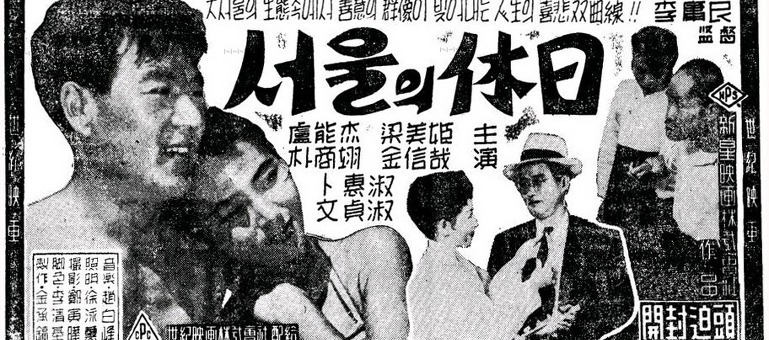
Holiday in Seoul (서울의 休日 / 서울의 휴일, Lee Yong-min, 1956)

Holiday in Seoul title cardUnlike many “golden age” directors, Lee Yong-min was not especially prolific and left behind him only 23 films when he abruptly disappeared without trace. Perhaps a fitting legacy for a director so strongly associated with the horror genre, but Lee had begun his career as a documentarian working for a Japanese company during the Colonial era. It’s Lee’s documentary background rather than his taste for genre which is most strongly in evidence in his second film, Holiday in Seoul (서울의 休日 / 서울의 휴일, Seoul-ui Hyuil), which, while containing a fair few genre elements, is an anarchic romantic comedy set entirely in a small residential area of the capital over the course one day – a public holiday, in which a series of couples are separated by accident or design on this very day which has been specifically set aside for them to spend together.

Lee opens with a series of location shots of various Seoul landmarks, elegantly composed and somewhat romanticised as if to recast the burgeoning city as a capital of love with all the promise and mystery of Roman Holiday’s Italy which even gets a brief namecheck later on. Again unconventionally, he then breaks into a lengthy POV shot with additional voice over from a narrator who locates a drunk snoozing on a bench and follows him home hoping something more interesting is happening over in the residential quarter. The narrator settles on the house opposite which belongs to a young couple recently married – she an obstetrician running a clinic out of the house, and he a hotshot reporter who’s just made a big splash with a story about a violent murder.

This is, however, a public holiday so work should be strictly off limits. Hee-won (Yang Mi-hee) has designed a packed itinerary, while her husband Jae-kwan (No Neung-geol) would rather have just lazed around at home, but as it turns out neither of them is going to get what they wanted. Minor disagreements about how to spend a rare day off aside, Hee-won and Jae-kwan are a happy young couple who have apparently married for love, are each professionally successful, and are living a comfortable middle-class life in a period of increasing economic prosperity. Their marriage is directly contrasted with the families around them which include that of the drunk we first met on the bench whose daughter Ok-i eventually descends on Hee-won for help in fear she may have fallen pregnant out of wedlock to a man who won’t take responsibility, and a middle-aged couple who have the opposite problem to that of Hee-won and Jae-kwan. Mr. Ju, a regular salaryman, is excited about spending the day with his wife but she skips out on him to go to the beauty parlour and spends most of the day with a wealthy friend and her opera loving toyboys on a well appointed yacht.

Nevertheless, marital bliss is indeed tested by the demands of the day. Though Jae-kwan had promised to go along with Hee-won’s carefully crafted plan, he gets a phone call he thinks is an important tip off about the murder case but is actually a trick set up by his colleagues who were hoping to get him to buy them a few drinks. Unfortunately, due to an odd coincidence, Jae-kwan thinks he witnesses a kidnapping that might be related to the killings and takes off in hot pursuit only to find himself dealing with another sad case of a woman brought low by love. While Hee-won is busy trying to help Ok-i sort out her predicament with both her sad/angry father and the boyfriend that’s thrown her over, Jae-kwan finds himself locked in a room with a poor young girl (Moon Jeong-suk) who is apparently also pregnant by a man who’s disappeared and has gone out of her mind with heartbreak, actively adopting the role of Ophelia and reciting potent lines from Hamlet while absolutely convinced that Jae-kwan is her long absent lover.

While the new freedoms of the post-Colonial era have enabled Hee-won not only to find love and an elected marriage but also a successful professional career as the head of her own clinic, other women have not been so lucky and have suffered doubly at the hands of men who feel bolder in their casual pursuits but also know they cannot be held to account for their actions in the same way they might have been before. Ok-i’s story does at least have a happy ending but is symptomatic of the times in which she lives as she recounts going for a job at a factory only to be molested by the foreman who thought she was a “prostitute” because he found out she had a boyfriend, while the boyfriend sort of thought the same in assuming she had been taken advantage of by the foreman. At least Ok-i has her father who might be have been enraged to begin with but later comes to her defence as does the warmhearted Hee-won, while Jae-kwan’s young woman is all alone save for her mother who is worried sick over her daughter’s mental health and has no real way to help her.

Hee-won is indeed a force for good. Despite her worry about her husband’s whereabouts (she ends up going drinking with his work buddies who, along with her other married female friends, have half convinced her he’s gone off with another woman), Hee-won comes to the aid of a crying little girl who’s desperately looking for help because her heavily pregnant mother is in a very bad way at home while dad went out a few days ago and hasn’t come back. Needless to say, Hee-won’s emergency dovetails into Jae-kwan’s dogged pursuit of crime which eventually sees him arrest a murderer after accidentally getting into a cab with him. The killer, perhaps annoyed about the previous article, makes a point of explaining to Jae-kwan that his job isn’t quite as morally upright as he’d like to believe. You can’t just go printing things in papers, he tells him, it ruins people’s lives. Jae-kwan thinks it’s murdering people that ruins lives so anything after that is fair game but his heartless rationality brings him into conflict with Hee-won when he wants to photograph and interview one of her patients who is seriously ill and might not survive if she finds out the unpleasant truth Jae-kwan wants to get her reaction to on camera. To Jae-kwan, people are just his “subjects”, mere materials for his essays, but to Hee-won they are literally flesh and blood – less fortunate than herself, they are her responsibility and she will do all she can to help them even at great personal cost.

Yet in the end the conflicts resolve themselves satisfactorily and the couples are each reunited in time to spend the last of the holiday gazing up at the moon glowing above the twinkling lights of Seoul. Having spent the day apart, each spouse emerges with a greater understanding of their partner (or in Mr. Ju’s case perhaps just a greater talent for (self)deception) and remains committed to working on their relationship. Mostly shooting on location, Lee’s camera is as sophisticated as they come shifting effortlessly from documentary-style naturalism to a silent movie aesthetic while maintaining a high level of cinematic wit throughout. Cheerfully romantic and carefree even considering its darker themes, Holiday in Seoul is an oddly anarchic romantic comedy though one with total faith in true connection and emotional honesty.


Holiday in Seoul is the first of three films included in the Korean Film Archive’s Romantic Comedy Collection of the 1950s box set. It is also available to stream online from the Korean Film Archive‘s YouTube Channel.

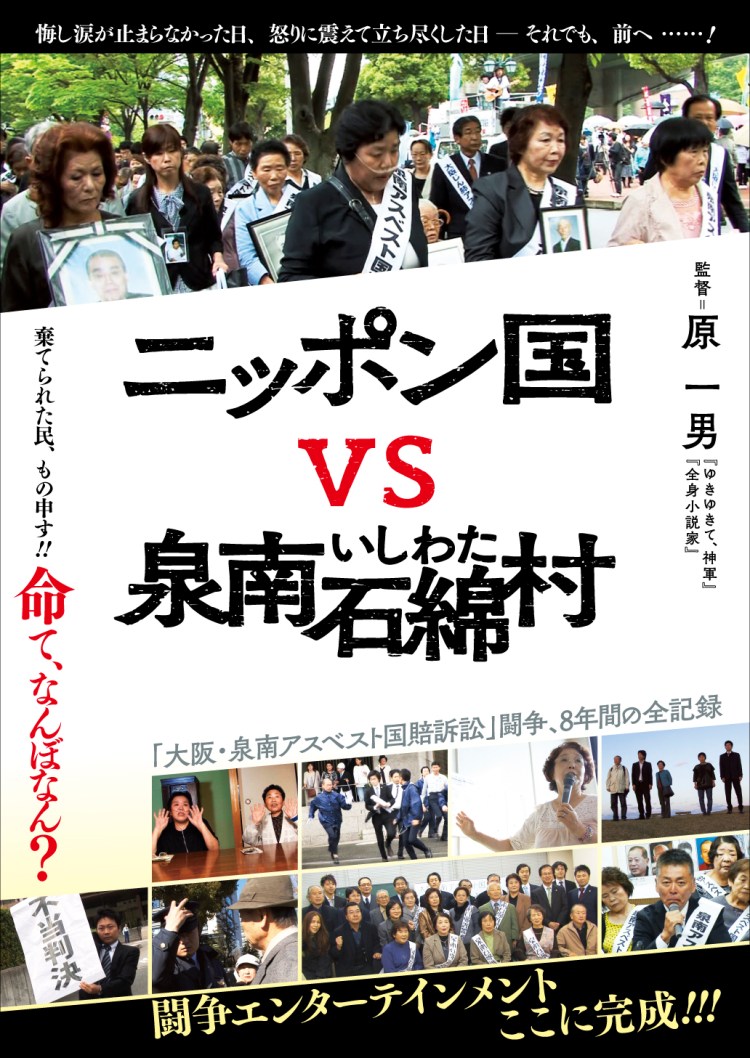
Sennan Asbestos Disaster (ニッポン国VS泉南石綿村, Kazuo Hara, 2017)

Sennan Asbestos Disaster posterIn these troubled times, many may find themselves wondering what the purpose of government really is. Is the primary duty of the state to look after its citizens or to maintain “order” and what exactly is the limit of the state’s responsibility towards those most in need of its care? Director Kazuo Hara had made a career of examining the lives of those who dared to defy the system, but his latest film Sennan Asbestos Disaster (ニッポン国VS泉南石綿村, Nipponkoku vs Sennan Ishiwata Mura) focusses not on an individual but on a group of ordinary people attempting to stand up to governmental bureaucracy after having been betrayed by successive administrations who put economic prosperity ahead of citizens’ welfare.

Asbestos was hailed as something of a wonder for its highly useful properties including sound insulation, fire proofing, strength and durability. Increasing in use throughout the industrial revolution, the harmful affects of asbestos were first discovered in the early 20th century but its use across most of the world was not banned until the turn of the millennium following long campaigns by those whose health had been adversely affected by breathing in its fibres leading to long term respiratory issues and even a risk of cancer.

In Sennan, in the South West of Japan, asbestos production was the dominant economy stretching back into the Meiji era. Concerns had been raised about the possible harmful effects of asbestos before the war and then again afterwards, but successive governments chose to do nothing while workers remained unaware of the risks even while noticing that many of their friends and family members were dying young often of respiratory conditions. Most only became aware that asbestos was dangerous in 2005 following a national scandal known as the “Kubota Shock” in which a well respected manufacturer of machinery was forced to admit that as much as 10% of its workforce had died of asbestos-related conditions.

Hara follows a collective of Sennan residents who have come together to file a class action law suit against the government for failing to ensure safety standards in asbestos production. Led by Kazuyoshi Yuoka whose grandfather owned an asbestos factory before the war, the group members are mainly older men and women who worked in the factories during the economically straitened days of the immediate post-war period. Though many point to the otherwise progressive nature of the factories which were desperate to attract workers and keen to foster a community spirit as well as offering other benefits including access to education, it is true that many of the employees were among those already facing other kinds of oppression aside from the economic – the uneducated rural poor, women, and a large number of minorities including zainichi Koreans. This information is important because it exposes the truth that the state decided these people were expendable and could be sacrificed in the name of the economic prosperity that was deemed necessary in order to rebuild the nation after its crushing wartime defeat.

Unlike the protagonists of Hara’s previous films, the Sennan campaigners are ordinary people – those assumed to have very little social power pressuring their government to take responsibility for having wilfully abandoned them. Unsurprisingly, the government is not very keen to do so. The legal case drags on eight years during which many of the sufferers die while their children or spouses continue the quest for justice. The case itself is wider than it first seems, extending not just to factory workers but to those exposed by general proximity such as famers owning land near asbestos plants and in one poignant case a woman whose parents took her to the factory while they worked when she was a child.

Forming a tightly knit community, the campaigners present a united front but come up against the wall of bureaucracy. As time wears on it’s difficult not to feel a small amount of sympathy for the junior civil servants the government trots out to deal with angry protestors, forced to repeat the same tired phrases without explanation while the group insist on seeing someone with a bit more clout, but even when the case is finally proved, progress is slow and the ritual apology as hollow as it always is. Yet even if some are angered by the perfunctory nature of professional atonement, others actively embrace it and appear grateful even for this small shred of attention from the authority. It’s here that Hara wavers in his sympathy, admiring the kindhearted solidarity of the protestors but lamenting their tendency towards feudal deference when they should be raging against a society which is often content to exploit and discard them, remaining accidentally complicit in enabling a gradual decline of democratic freedoms.

Nevertheless, Sennan Asbestos Disaster is the chronicle of a (partially) successful campaign in which a group of concerned citizens working within the law eventually force the government to concede an error, even if that concession may turn out to have no wider application. The victory, however, can’t bring back lost time nor ease past suffering and only serves to draw a line under one chapter of a struggle which is sadly far from over.


Sennan Asbestos Disaster was screened as part of a Kazuo Hara focus at Open City Documentary Festival 2018.

Original trailer (English subtitles)

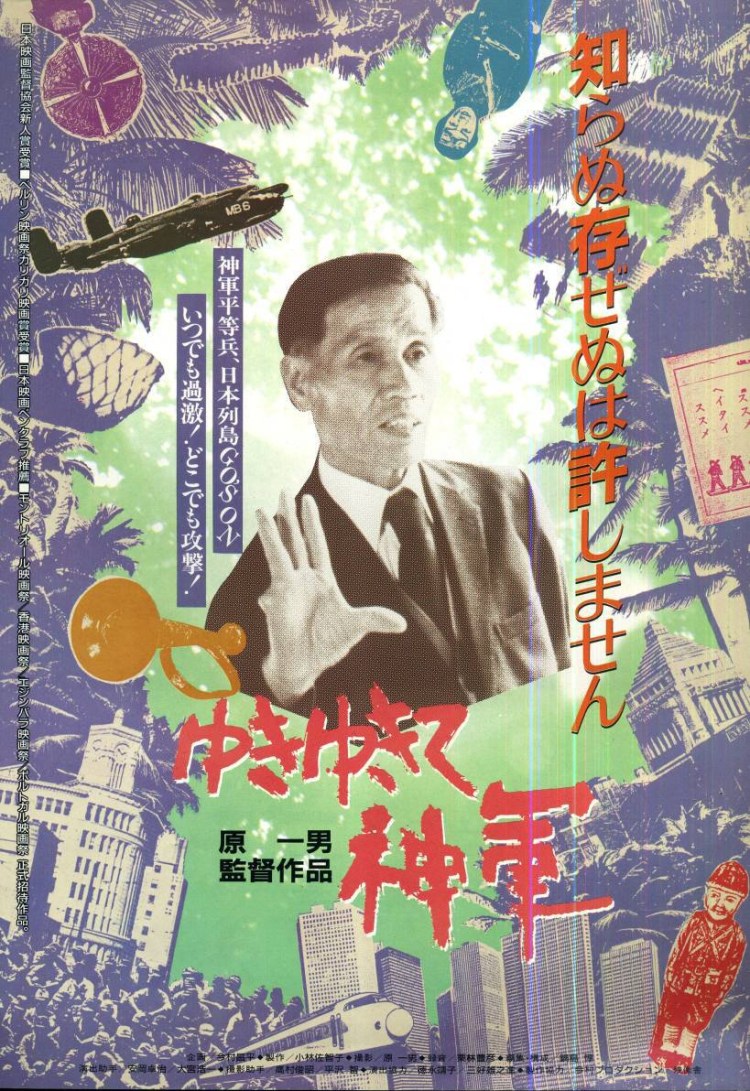
The Emperor’s Naked Army Marches On (ゆきゆきて、神軍, Kazuo Hara, 1987)

The Emperor's Naked Army Marches On PosterThe relationship between a director and a subject can often be a complex one. Who is really leading who and towards what end is a difficult enough question at the best of times, but when your subject is an unhinged crackpot with a definite agenda, a natural love of the camera, and an unpredictable violent streak, it’s an inescapable conundrum. Kenzo Okuzaki, a Pacific War veteran with a deeply seated grudge against the emperor for his refusal to acknowledge his war guilt, first came to the attention of director Shohei Imamura but a second stretch in prison for firing pachinko balls at the object of his wrath put paid to his directorial hopes. 10 years later Imamura passes his subject on to Kazuo Hara who finds himself increasingly at the mercy of his mercurial campaign for truth and reconciliation.

The main thrust of Okuzaki’s current activities lies in uncovering the facts behind the deaths of two enlisted men who were executed in New Guinea three weeks after the war was over. Okuzaki believes the men were murdered and lays the blame at the feet firstly of the officers on the ground and ultimately at those of the emperor who created the circumstances in which all of this horror was allowed to bloom. To assist him in his investigations, Okuzaki ropes in the families of the victims – one a Shinto priestess who is convinced she sees her brother in her dreams and on her altar, and the other a conflicted brother who just wants to know the truth. The truth, however, may be hard to hear, as one of the men Okuzaki corners tries to tell them. Like most of the others questioned about the events of almost forty years before, he advises the family that it’s better not to know while emphasising that their relatives died through no fault of their own.

What is probably obvious to Okuzaki but not to the relatively less cynical family members is that an issue is being skirted. The soldier makes out that he doesn’t want to go into the deaths because the men were executed for desertion – something which is absurd in itself when the war was already over, and that he did not want the family to experience the shame and social stigma of being related to “cowards” who failed in their “duty”. Such notions are already out of date by the late ‘80s, but evidently still weigh heavily on the minds of veterans. Wanting to spare others the pain and shame of discovering the truth about what happened in New Guinea is a frequent excuse offered by those questioned, but perhaps a way of deflecting their own reluctance to speak of such deeply traumatic, extremely difficult events.

Getting them to open up is not Okuzaki’s first thought. Okuzaki himself is a strange man with a disturbing aura and a tendency to self-aggrandisement. When we first meet him he’s acting as a go-between at a wedding of a man he met through his “activism” which is to say a fellow combatant in Okuzaki’s campaign against “The Establishment”. A wedding speech might not be the most appropriate moment to embark on a personal history that involves going to prison for murdering someone you “did not want” to murder as well as a litany of anti-establishment acts including the pachinko ball incident and distributing “pornographic” pictures of the emperor to shoppers at a Tokyo department store. Nevertheless, Okuzaki is extremely proud of these “achievements” which exemplify how he alone has continued to fight the good fight in the post-war world. He sees his original conviction as karma not for his actions in the Pacific but the wastefulness of his life afterwards. He now believes he was saved from New Guinea in order to educate the young about the horrors of war and ensure none of this ever happens again.

Problematically, his main weapon in this fight is violence. Okuzaki’s manner is one of extreme politeness, bordering on obsequiousness, but he is also direct and aggressive, becoming violent when his subjects decline to answer his questions. The relatives are there to shame the officers into speaking the truth through being directly confronted by the human costs of their actions, but Okuzaki’s personal bluster hasn’t thought through the various ways in which his tactics might make it more difficult for them to speak. After all, Okuzaki is a veteran of New Guinea himself, if these men could feel comfortable talking to anyone about their experiences, you’d think they could turn to someone like Okuzaki if only he were not so frightening a presence. Uncomfortably enough, the violence does seem to work and Okuzaki gets his answers through intimidation which leaves his quarry broken and compliant. Despite claiming to work for world peace, Okuzaki believes that his violence is justified by the worthiness of his aims, which you have to admit is an oddly familiar mantra.

His subject’s propensity for violence places Hara in a difficult position, as do his frequent attempts at engineering the situation including roping in his wife and a couple of male friends to pose as relatives of the deceased when the original couple tire of Okuzaki’s exploitative antics. Okuzaki quite obviously has a very clear aim for what he perhaps sees as a propaganda exercise for his ongoing cause which might stand in deep contrast to that of his director who is, after all, a bystander reconstructing narrative after the fact. Okuzaki emerges as a symbol of a nation’s repressed trauma, skittering between officious politeness and belligerent violence while offering a bizarre, quasi-religious philosophy about god’s plan for us all. Hara remains caught between conflicting impulses, unwittingly complicit in Okuzaki’s personal war against war while trying to maintain control in the face of his constant manipulations. As a portrait of a madman The Emperor’s Naked Army Marches On excels, painting Okuzaki as a product of his own mad times while refusing to back away from the bitter truths his madness is so keen to expose.


The Emperor’s Naked Army Marches On (ゆきゆきて、神軍, Yuki Yukite, Shingun) was screened as part of a Kazuo Hara focus at Open City Documentary Festival 2018.

Short clip from the film (English subtitles)

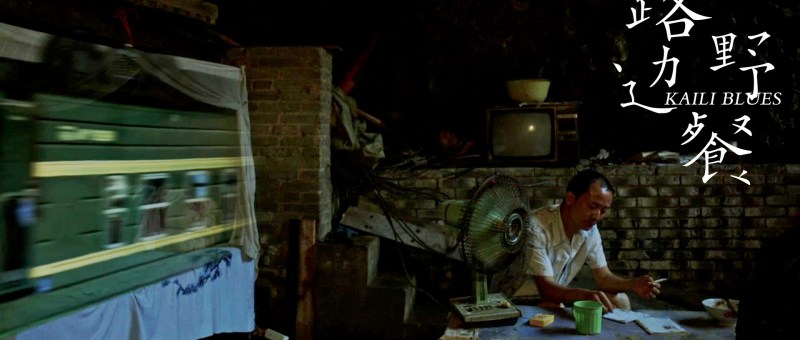
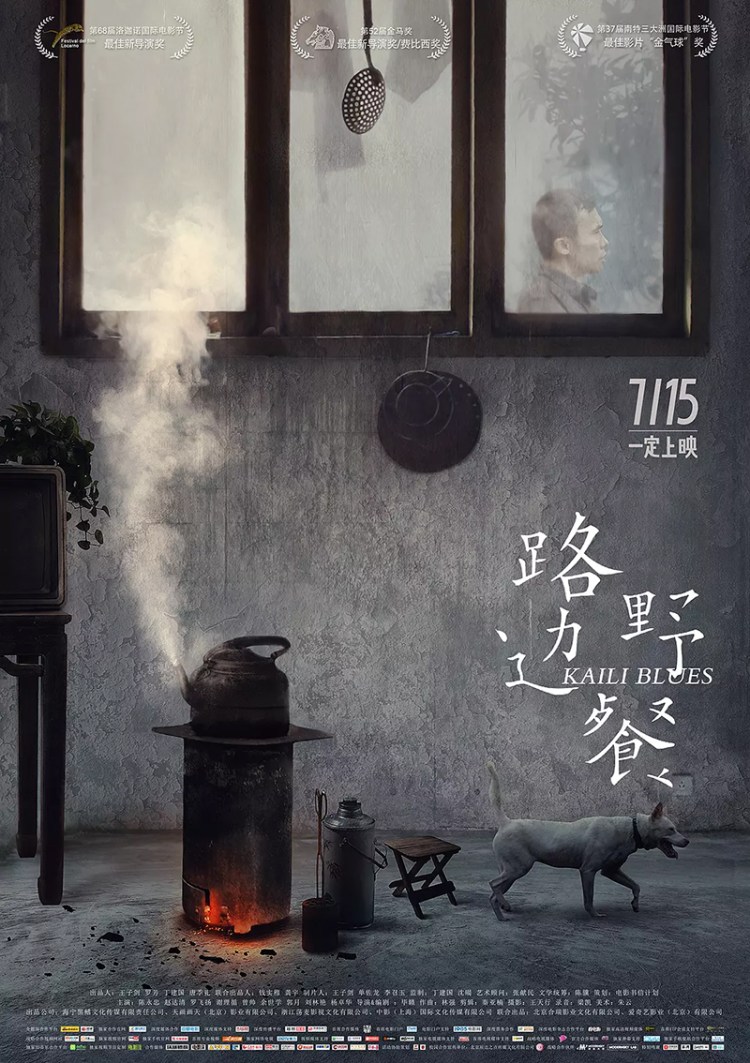
Kaili Blues (路边野餐, Bi Gan, 2015)

Kaili blues poster 5“There is bound to be one who will return, to fill an empty bamboo basket with love.” intones the lonely poet at the centre of Bi Gan’s Kaili Blues (路边野餐, Lùbiān Yěcān) part way through his strange odyssey through the tiny yet infinite village of Dangmai, a place either out of time or entirely made of it. Longing, regret, the temporal impossibilities of memory, injustice, disappointment – a lifetime’s unresolved emotional trauma works its way into a dreamlike exploration of the past as a work in progress, half built but already obsolete. Time is just memory mixed with desire, in the words of another poet, and contrary to conventional wisdom, perhaps it does not flow ceaselessly in only one direction.
Our hero is Chen (Chen Yongzhong) – a middle aged doctor and published poet who once served time prison and inherited the money to start his clinic from his mother who passed away while he was inside. His major preoccupation in life is his young nephew – the son of his half-brother, the aptly named Crazy Face (Xie Lixun). Crazy Face is, to put it mildly, not a reliable father and often locks his son, Weiwei (Luo Feiyang), in their apartment while he wastes his life drinking and gambling. Chen has taken it upon himself to ensure the boy is well looked after – taking him on days out to the amusement park, buying him nutritious dinners, and just generally keeping him company. Chen is even prepared to adopt the boy, but Crazy Face is resentful and vindictive, irritated their mother left the family home to Chen and not to him. Eventually, Crazy Face “sells” Weiwei to an old man in another town, Zhenyuan, and Chen decides to try and fetch him back while delivering a long overdue message from his assistant to a man she once knew there before the cultural revolution who is now gravely ill.

Chen himself was once abandoned in Zhenyuan, by the mother who now haunts his dreams with the sound of lusheng pipes and memories of the Miao people who are now themselves rapidly disappearing. All Chen can see of her in his dreams is her shoes with their floral embroidery, distorted by their journey in the water. His assistant urges him to burn some paper money for her that she can use in the afterlife but to do it when no one’s looking – such ancient superstitions, like the lusheng pipes, are not to be seen or heard in the new “modern” China. Even Chen’s clinic is due to be pulled down, rendering the animosity between himself and his unhinged brother all the more pointless.

Looking for the lonely boy, who is also in a way himself, Chen chases ghosts of future and past. His passage to find the famed lusheng players and the last remnants of the Miao is precipitated by an act of fate – a young man’s attempts to kick start his motorbike to give his “girlfriend” (he seems to think that what she is, she may feel differently) Yangyang (Guo Yue) a lift fails miserably and she gets one from someone else, enabling Chen to climb on. Later we learn the young man’s name is Weiwei, and his mission is that he wants to make time run backwards because Yangyang is leaving to go to Kaili to work as a “tour guide” (it remains unclear who needs a tour in Kaili) and says she will only return if he can “turn back time”. Whether this Weiwei is somehow the teenage version of the boy Chen was looking for or not, he shares his obsession with imagined time, scrawling fake clocks on trains so that time really will be running backwards as one train passes another as if travelling into the past.

If the future can yield its ghosts then the past can too. A young hairdresser is the spitting image of Chen’s late wife who, according to a story he tells her disguised as that of a friend, he discovered had died while he was is in prison but had written him several letters in advance to hide the truth. Chen’s strange life, his time “on the streets” and accidental involvement with a stoic loanshark who accepted the death of his son at the hands of an enemy but demanded vengeance for his severed hand, might as well have been a dream for its all meandering disappointments. The gangster is now a horologist, as luck would have it. Even dreams have their logic. Only on arrival at his secondary destination does it all come together, the dream world and the real somehow merging and becoming whole once again. The past is a call that can’t be answered, but must be heard all the same.


International trailer (English subtitles)

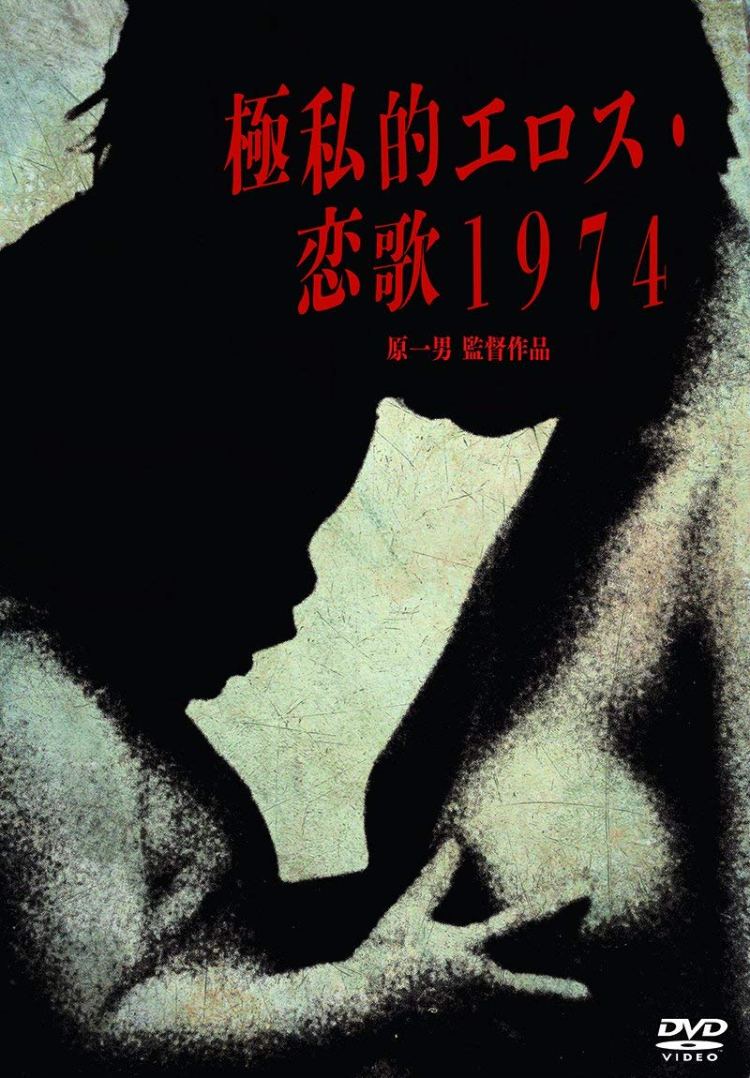
Extreme Private Eros: Love Song 1974 (極私的エロス 恋歌1974, Kazuo Hara, 1974)

Extreme private eros 1974If you’re going to use your camera to interrogate the world, perhaps it’s only fair to let the world interrogate you by means of your own camera. Kazuo Hara’s second documentary is about as personal as its possible to get – a detached, rational examination of the interplay between the director and his subject who happens to be his former lover and the mother of his child. A thinly veiled excuse to maintain contact with a woman who had abandoned him and taken his child with her, Extreme Private Eros: Love Song 1974 (極私的エロス 恋歌1974, Gokushiteki Eros: Renka 1974) is both a tiny snapshot of a nation in flux, and a timeless exploration of the end of love.

Hara and his former lover Miyuki Takeda had lived together for three years and even had a child when she abruptly announced that she no longer wanted to live under the authority of a man or as a member of a “traditional” family and intended to leave in order to live a life of complete independence. Although the relationship was officially over, Miyuki maintained contact with Hara and visited him more or less weekly so it was an additional shock when she suddenly announced she was moving to Okinawa. However, Miyuki made a strange request of her former lover – that he film her attempt to give birth without assistance. Hoping to remain close to her or perhaps to attempt to understand better the reasoning behind her erratic behaviour, Hara agrees.

In Okinawa, Miyuki has moved in with another woman, Sugako, but the relationship between them appears strained and ill defined. Hara’s arrival, he eventually realises, is yet another disruptive influence in this already fraught environment but it’s unclear whether his camera is a deliberate or accidental witness to a series of extremely difficult, not to mention private, conversations taking place in front of a third party in which Miyuki berates her silent roommate for rejecting her desire for a full and exclusive relationship in favour of continuing to sleep with her friend Tommy.

When the relationship with Sugako breaks down, Miyuki takes up with a black GI, Paul, who later becomes the father of the child she intends to birth alone. Though interviewing Miyuki alongside Paul (who speaks no Japanese) is a mild and dispassionate affair, interviewing Miyuki alone about her new lover and the basis of their relationship sends Hara into a spiral of jealousy and despair in which he eventually cedes control of his camera to an assistant and appears on screen breaking down in tears. Wondering if Miyuki is as accidentally jealous of him as he is of Miyuki, Hara muddies the waters by inviting his own new lover, Sachiko – who is also pregnant with his child, to assist him in the making of the documentary. Hara gets his wish. Miyuki is indeed jealous, angrily barking at Sachiko while running down her former lover in every conceivable way, and yet the two women eventually end up bonding, once again excluding Hara from his own attempt at narrative.

The perspective is indeed Hara’s – his weary voiceover and occasionally passive aggressive, exasperated intertitles making plain his own confusion and continued searching for the central question of what exactly he’s trying to achieve, but Miyuki wrestles with him for overall control and to assert her right of ownership over her own story (or at least the presentation of it). Miyuki’s quest seems to be one of total independence – she rejects the world of the patriarchal family, later rejecting love entirely and resolving to live without a man or woman, but remains firmly within its standard ideological parameters in recasting herself as the embodiment of selfless motherhood. She rejects the ideas of traditional Japanese femininity, insisting that her children are raised to be aggressive rather than meek or gentle or kind and going so far as to reject these supposedly feminised qualities as she sees them in her own son as reflections of those same qualities she eventually found unappealing in Hara. She becomes obsessed with the idea of mixed-race children, perhaps as an extension of her desire for a non-Japanese idea of individualism, but later tells her new born daughter that Japan is good and America bad, and pens a damning letter of advice to the women of Okinawa warning them off deceitful GIs.

Miyuki is a woman with scant respect for boundaries and so Hara is granted near unrestricted access to the entirety of her existence as she pursues her various desires and contradictory convictions. Hara’s camera is both unobtrusive and powerfully present, privy to extremely private thoughts and conversations and only occasionally inserting itself into the narrative but unafraid to embrace taboos while perhaps also conflicted in its own defiant pursuit of emotional honesty at all costs. In attempting to capture his subject Hara illuminates both himself and his society, exposing painful truths and unwelcome prejudices but perhaps allowing them to fester unresolved in a future which is both open yet also uncertain.


Extreme Private Eros: Love Song 1974 was screened as part of a Kazuo Hara focus at Open City Documentary Festival 2018.

Trailer (English subtitles)

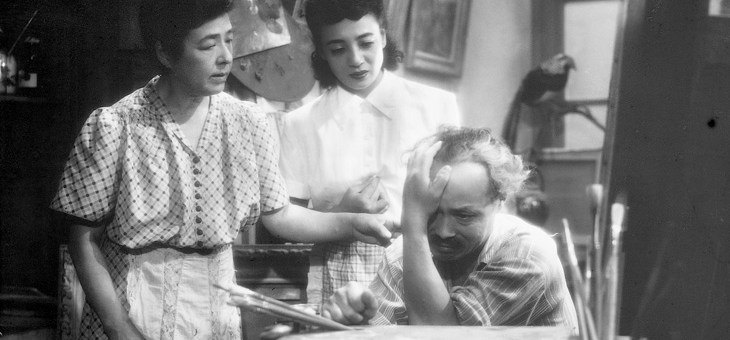
The Portrait (肖像, Keisuke Kinoshita, 1948)

vlcsnap-2018-09-06-01h35m07s763The immediate post-war period was one of fear and hardship. You might survive, but you might not like the person you’ll have to become in order to do so. The (unexpected) heroine of Keisuke Kinoshita’s The Portrait (肖像, Shozo) thought she’d made her peace with her choices, only to be confronted by a vision of her essential self as seen through the eyes of a cheerfully innocent artist. Despite the harshness of the times, there are those who’ve learned to be happy in their lot, but is their talent for happiness inspiration or irritation for those who’ve chosen a different path?

Kinoshita opens with a comic scene in which two shady real estate brokers take a look at a local property. Deciding it’s overpriced and impractical, the pair nevertheless decide to buy it together with the intention of flipping it once they convert the downstairs workspace into more practical living accommodation. There is, however, a slight hitch in that there are sitting tenants – a painter and his family who live in the room upstairs and use the rooms below as a studio. Thinking it will be easy enough to evict them, the men aren’t bothered but the the family are all so relentlessly nice that no one has yet been able to tell them to go. As a last resort, one of the men, Kaneko (Eitaro Ozawa), decides to move into the upstairs with his mistress, Midori (Kuniko Igawa), in the hope that the family will feel so awkward and in the way they will decide to vacate. Innocent and unworldly, the Nomuras all assume Midori is her lover’s daughter rather than his mistress, and start treating her like a well to do young lady. Such sudden and unexpected respect starts to weigh on Midori’s mind as she finds herself playing along, pretending to be “nice” and “respectable” while knowing that the life she’s living is anything but.

The problem is that the Nomuras are so essentially kind and welcoming that they really don’t mind sharing the house. Mr. Nomura (Ichiro Sugai), the middle-aged painter, feels guilty that he doesn’t earn more money and is too poor to move, but he’s also the sort to get over excited about having grown a giant pumpkin that he can’t resist showing to absolutely everyone. As it turns out the Nomuras are also living with a private tragedy – their eldest son Ichiro (Toru Abe) whose wife Kumiko (Kuniko Miyake) and son Koichi also live with the family has not yet returned home from the war and his whereabouts are unknown. Still, they don’t mind talking about it and are as happy as they can be, dancing away under the light of the moon – an unexpected upside to constant power outages. Meanwhile, Kaneko complains loudly as he attempts to finish his accounts in the evening gloom.

Midori half envies, half resents her new neighbours. The longer she lives with the Nomuras the guiltier she starts to feel in deceiving them. Matters begin to come to a head when Mr. Nomura asks permission to paint her portrait. He thinks Midori has a very “interesting” face, in part because he can see a sadness in her eyes that is totally absent in those of his daughter, Yoko (Yoko Katsuragi). Midori agrees and swaps her usual Western attire for the kimono her mother once gave her, but the picture Mr. Nomura paints begins to bother her. The portrait is of a pure young woman, innocent and honest, which is about as far from the way she sees herself as it’s possible to be.

As a friend of Midori’s puts it, you have to survive somehow and Midori thought she’d made her peace with the way she has decided to live but the portrait reminds her that she wasn’t always like this and now she’s not sure which version of herself she ought to despise. She wishes she could paint herself over, but feels her fate is sealed and there’s no way back. Kumiko, a little more worldly wise than her in-laws, is perfectly aware of what’s been going on upstairs but isn’t at all bothered by it. She doesn’t blame Midori for the choices that she’s made and thinks the picture is accurate in capturing her true soul, advising her that it is possible to be that woman again if that’s what she really wants.

The Portrait was scripted by none other than Akira Kurosawa whose belief in the essential goodness of humanity was perhaps not quite as strong as Kinoshita’s but the Nomuras are nevertheless typical Kinoshita heroes and it’s their unguarded warmth and kindness which begins to change the world for those around them. Even the cynical Kaneko is eventually moved by their cheerful selflessness, forced to accept their accidental moral victory rather than continue with his nefarious plan. Midori, forced into a reconsideration of herself, stands in for a generation attempting to make peace with the compromises of the past, learning that they don’t need to define the future and that it isn’t too late to strive for a more authentic life of simple happiness even if you feel you may have already sunk too far.


The Nomuras dancing in the moonlight

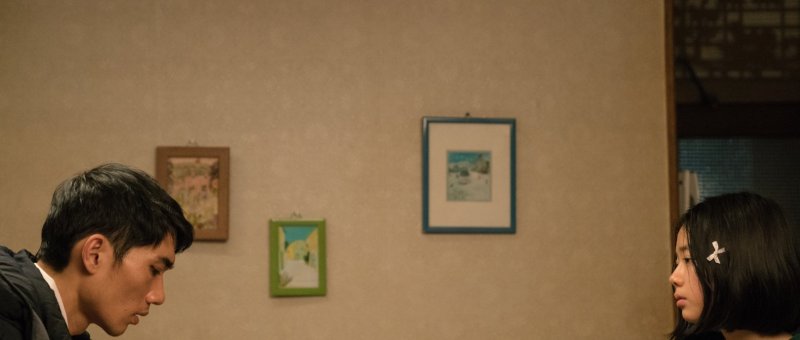
Adulthood (어른도감, Kim In-seon, 2018)

Adulthood poster 2Growing up is a funny thing, most of us are content to let it run as a background task while we get on with our daily lives but some of us are forced to contemplate the nature of “adulthood” from a transitionary perspective when confronted with independence delivered at an unexpected juncture. The debut feature from Kim In-seon, Adulthood (어른도감, Eoreundogam) is a coming of age tale but it’s also one about family, responsibility, integrity, and the social fabric as a teenage girl’s attempts to adjust to life alone are frustrated by the arrival of an irresponsible uncle with issues of his own.

14-year-old Kyung-un’s (Lee Jae-in) father (Choi Duk-moon) has just passed away following a lengthy illness. Her mother left when she was small, and now Kyung-un is all alone. The funeral is lonely, and Kyung-un is otherwise unaccompanied, without friends or relatives to assist in the business of mourning. That is, until a good-looking young man suddenly jumps on the bus to the crematorium and bursts into tears. Jae-min (Um Tae-Goo) claims to be the younger brother of Kyung-un’s father whom she has never met. Sceptical, Kyung-un has no other option than to allow Jae-min to invade her life even though she felt as if she was managing fine on her own.

However, Jae-min’s intentions turn out to be less than honourable. He’s a conman and a gigalo who’s forever failing in various scams and deceptions, and despite Kyung-un’s prudent caution towards him, he manages to trick her out of her dad’s life insurance money thanks to making himself her legal guardian on a pretext of saving her from a foster home. Being the clever little girl she is, Kyung-un manages to track her errant uncle down to a shady part of town, but the only way she’s getting her money back is if she consents to become Jae-min’s accomplice and pose as his daughter in order to win over his latest mark, lonely pharmacist Jum-hee (Seo Jung-yeon).

Forced to care for herself from an early age thanks to her father’s illness, Kyung-un is a mature little girl who can manage perfectly fine on her own, even dealing with complicated formalities like submitting death certificates and dealing with insurance companies. At 14 she probably shouldn’t have to do any of this alone but doesn’t want to lose her independence or have her life further disrupted by being forced out of her home and into foster care. Despite her natural caution there is perhaps a part of her that wants to believe Jae-min’s story, even if the other part of her is cloning his mobile phone and going through his bag to try and figure out what it is he’s after.

Jae-min, however, is a selfish man child perpetually chasing quick fixes and conveniently deciding to ignore whoever might end up getting hurt in the process, though it’s also true that he’s not completely unaffected by the pain he causes to others. His moral scruples do not extend to cheating his niece out of her father’s money which is all she has to live on and probably means she will also become homeless seeing as her landlord (who hasn’t even noticed her dad has died) is pushing the rent up. Eyes always on the prize, Jae-min’s dream of opening a Japanese restaurant is real enough and he doesn’t much care what he has to do to make it a reality.

However, when Jae-min and Kyung-un are forced to start playacting family for the lonely Jum-hee, a genuine connection is set in motion. As it turns out, there’s a reason for Jum-hee’s continued aloofness and fear to engage and her interactions with the “widowed” father and daughter do indeed begin to shift something inside her too. Despite all the lying and the natural mistrust, something true bubbles to the surface even if the continued deceptions threaten to push it all back down again.

In the end perhaps that’s what adulthood means, understanding that sometimes people tell the truth when they lie. Kyung-un and Jae-min, both orphans, both lonely, both doing “fine” on their own, nevertheless come to realise that perhaps it’s not so bad to be doing fine on your own with someone else. It’s not perfect, and perhaps it’s not what you wanted, but then that’s “adulthood” for you. A promising debut from Kim In-seon, Adulthood is a warm and empathetic look at different paths to maturity as a little girl and a hollow man bond in their shared sense of aloneness and come to realise that independence does not necessarily require solitude.


Adulthood gets its North American premiere as the opening night gala of the seventh season of Asian Pop-up Cinema which takes place in Chicago from 12th September to 14th November 2018. Director Kim In-seon and actress Lee Jae-in will be in attendance for the opening night screening at AMC River East 21 on 12th September for an introduction and Q&A. Tickets are already on sale via the official website.

Original trailer (no subtitles)