
Saint Young Men (聖☆おにいさん, Yuichi Fukuda, 2018)

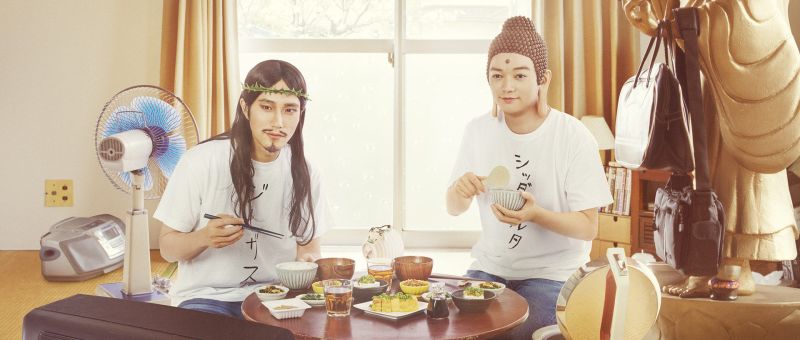
Saint young men posterWhat if Buddha and Jesus were flatmates in modern day Tokyo? Hikaru Nakamura’s much loved manga Saint Young Men (聖☆おにいさん, Saint Oniisan) attempted to find out, casting the two holy beings as conventional manga slackers on “vacation” in the mortal realm, supposedly researching modern Japanese society. A firm favourite with fans, the franchise has already been adapted into a popular anime and now receives the live action treatment from none other than Gintama’s Yuichi Fukuda.

Split into a series of short vignettes mostly featuring only Jesus (Kenichi Matsuyama) and Buddha (Shota Sometani) in their apartment, Saint Young Men first aired as a 10-part web series before being compiled into a 70-minute movie. The central conceit is that Jesus is a cheerful if slightly feckless hippy, while Buddha is the calm and the responsible one making sure he’s well looked after. Perhaps surprisingly, Saint Young Men presents its vision of contemporary Japan from the point of view of the two guys as they explore everyday life, occasionally including explanatory narration from a distant authorial voice which, presumably, contains information widely known to the target audience, such as an explanations of “White Day” – Japan’s secondary Valentines in which men given chocolates are expected to return the favour with gifts three times the cost, and spring festival “Setsubun” in which beans are thrown at people wearing ogre masks to frighten off bad luck.

For the two guys these are fascinating little anthropological details they can get quite excited about despite their thousands of years of existence. On a trip to the convenience store, Jesus is thrilled to think he’s finally “made it” after 2000 years because some high school girls said he looked like Johnny Depp. Buddha goes to see if he looks like someone too, but the girls immediately recognise him as looking “like Buddha” which is both a disappointment and somehow validating. Meanwhile, he laments that the majority of his artistic renderings have only captured him in his “fat period” rather than the handsome figure he currently cuts. 

Bickering like an old married couple, the guys fight about the usual things – money, and the irresponsible use of it. Jesus has a bad habit of buying random stuff he doesn’t need off the internet, causing Buddha to get so annoyed he starts physically glowing and only calms down when Jesus gives him a present, a manga artist’s starter kit. Sadly, Buddha is proved right when Jesus gets bored with his random electric pottery wheel after only a few minutes, but is witness to an unexpected miracle when the clay is magically transformed into bread, turning the wheel into a “bread oven” with which Jesus seems very pleased only to tire of it just as quickly.

Trying to keep their “real” identities secret, the guys are keen to keep their abilities behind closed doors – something Buddha forgets when he hatches on the great idea of levitating to save floor space. Jesus comes home and quickly closes the curtains in case someone thinks they’re some kind of weird cult. The guys consider moving somewhere with a little more room, but discover that even for holy beings it’s almost impossible to find a decent apartment in modern day Tokyo that doesn’t cost the Earth. The primary reason Jesus wanted to move, however, is not so much that the apartment’s a little poky for two full-grown guys, but that the other place was gated which means he won’t be getting bothered by cold calling newspaper sales representatives.

Jesus may be too nice to keep saying no to pushy salesmen, but Buddha has a few unexpected trust issues. Faint from hunger, the guys think about ordering a take away, but Buddha is a strict vegetarian and worries about the chain of communication involved in food preparation. He can only trust that the restaurant follows the instructions he gives them honestly and that the delivery guy won’t do anything weird with the food on his way over. In the end, you just have to have faith, but Buddha is struggling while Jesus is content to let it all hang out. Something similar occurs when earnest Buddha unwisely meditates for hours in the beautiful snow in only his ironic T-shirt and catches a cold with only Jesus to nurse him. Jesus wants to take him to the hospital, but they don’t have insurance and don’t want to risk extortionate medical bills. Jesus’ healing powers apparently don’t work on other holy beings, and so he finds himself healing a bunch of people at the hospital to earn a free visit from a doctor with whom Buddha can only communicate through possession and telepathy.

Obviously very low budget and mostly starring just the two guys with additional appearances from their middle-aged landlady and the confused doctor, Saint Young Men is very much a Fukuda production bearing his familiar hallmark of waiting slightly too long for a joke land, which it often does not. Though seeing all 10 episodes in one go necessarily flags up their essential sameness, they do provide an amusing exploration of slacker life in contemporary Japan with occasional forays into warmhearted cross-cultural exchanges between the serious Buddha and scatterbrained Jesus.


Original trailer (no subtitles)
She Was Like a Wild Chrysanthemum (野菊の如き君なりき, Keisuke Kinoshita, 1955)

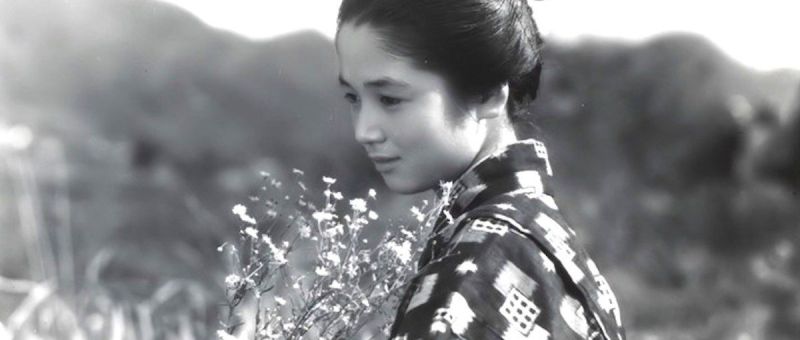
She was like a wild chrysanthemum dvdForemost among the post-war humanists, Keisuke Kinoshita had a somewhat complex relationship with the past, by turns decrying the restrictions of latent feudalism and pining for the lost innocence of an idyllic pastoral Japan untouched by mid-century trauma. She Was Like a Wild Chrysanthemum (野菊の如き君なりき, Nogiku no Gotoki Kimi Nariki) manages to do both at once, lamenting the passing of time and a clear division between then and now while railing against the unfairness of the society which keeps young lovers apart in insisting that broken hearts are merely something that must be endured.

In the contemporary era, 73-year-old Masao (Chishu Ryu) is taking a boat back to his hometown though he no longer has any family there, his brother’s adopted son having inherited the family estate but seemingly rejected it. The local kids treat his abandoned family home as a haunted house. He tells us that he’s going back the way he came, it may be old fashioned to travel by river like this but there was no train back in his day. Masao feels his age. His grandson has just entered college and his mind is no longer what it was. He finds himself lost in sentimental memories, which is what has brought him back here, to the place which stole from him the only thing he ever loved.

Flashing back almost 60 years to the late Meiji-era when Masao (Shinji Tanaka) was but a boy of 15 preparing to leave home to study at high school, the older Masao recalls the happiest time of his life, now ensconced in a nostalgic cameo frame, when he lived with his sickly mother (Haruko Sugimura) and 17-year-old cousin Tamiko (Noriko Arita) with whom he had quietly fallen in love. Though it is not exactly unusual for cousins to marry, especially among the gentry, the closeness of the two youngsters has begun to cause gossip in the village especially as they are no longer children if not quite grown up. Still stuck somewhere between awkward adolescent attachment and the dawning realisation of a greater love, Masao and Tamiko resent the attempts made to keep them apart, but are largely powerless to resist the world in which they live.

That would be, in a largely feudal context, that Tamiko is more or less a “poor relation”, somewhere between servant and beloved daughter, not quite a member of the family, but resented by the maids. As such, she is no match for Masao who will be expected to marry someone of his mother’s choosing. The issue is not so much that the pair are cousins, or the slight squeamishness that they have been raised more or less as siblings, but an anxiety that something dreadful may be about to befall them which should be stopped before it becomes an unsolvable problem.

Masao’s mother tells Tamiko that women must learn “housework” like cleaning and dressmaking which might be a thinly veiled way to excuse the fact that she is using her as an unpaid maid, but it does at least remind us that she must marry someone, someday. At 17, Tamiko is at the age where her marriage becomes a matter for consideration, whereas at 15 Masao will leave home to pursue his education. They know their time together is limited, but still they dare to hope, the proximity of an ending giving them the courage to give tentative voice to their feelings.

Meanwhile, the danger they face is entirely homegrown and as much political and avaricious as it is conservative. The problem is that Masao’s older brother and his wife have no children. The sister-in-law intensely resents Tamiko’s presence, fearing she will somehow end up marrying Masao and getting her hands on the estate. To prevent that happening, she flags up the villagers’ gossip with Masao’s mother, who had been content to let them be because they were “only children” but is beginning to be swayed by the possibility of scandal or social censure. She decides to send Masao away to school ahead of schedule, hoping the whole thing will blow over, but Tamiko is so distraught that the sister-in-law eventually has her sent back to her parents where she receives an offer of marriage from the son of a wealthy family.

Too heartbroken to do much else, Tamiko spends most of her time in bed and flatly rejects the idea of marriage while the rest of her family desperately try to persuade her. Even Masao’s mother who professes to love her as a daughter tells her in no uncertain terms that she could never consent to her marrying her son. Only Tamiko’s melancholy grandmother who regards her own marriage to a man she truly loved as the thing which has given her life meaning, stops for pause, not objecting to the proposal but disappointed with her children’s insensitivity and aware of the dangers in the sacrifice Tamiko would be making if she agreed to marry more or less against her will.

The cruelty of the times is brought home by two near identical sequences, one a funeral procession in bright sunlight and the other a solemn moonlight wedding. The youngsters pledge themselves to each other, but are torn apart by forces beyond their control. In this, Kinoshita perhaps presages a greater tragedy still to come at the hands of implacable authoritarianism, suggesting that this rigid adherence to tradition at the expense of human feeling leads only to an eternal heartbreak and chaos born of resentment. If the relatives had simply let them be, let nature take its course and love find its way, then all of this sadness and regret could have been avoided. Masao apparently lived an ordinary life, suffered in the war, but married and had children, all while living with unutterable regret. His love has lasted 60 years, along with the memory of innocent wild flowers and the tranquility of his rural childhood in a Japan now long gone, inhabited solely by the ghosts of memory. “Only crickets sing by her grave”.


Original trailer (no subtitles)

Merry Christmas (聖誕快樂, Clifton Ko Chi-Sum, 1984)

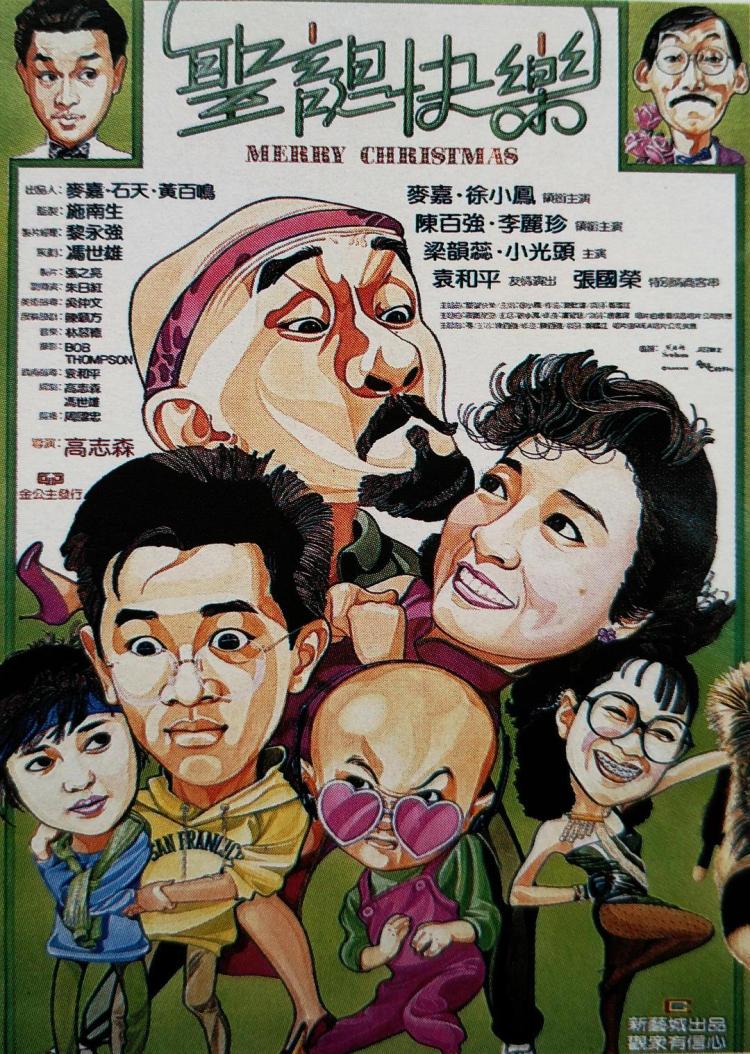
Merry Christmas poster 2The Lunar New Year movie solidified itself as a concept in the early ‘80s and is often an occasion for heartwarming silliness celebrating food and family. Arriving in 1984, Merry Christmas (聖誕快樂) shifts the zany action up to the Western festive season as a widowed Hong Kong dad struggles to express his feelings for the woman next-door who’s been looking after his young son while his two grown up kids contend with romantic troubles of their own in the rapidly developing city.

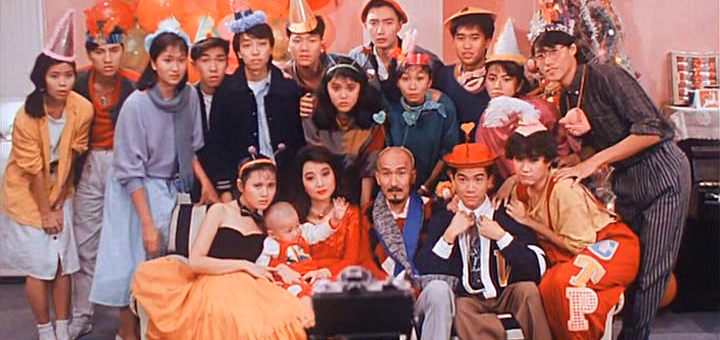
“Baldy” Mak (Karl Maka) is a newspaper editor who lost his wife some time ago. Though everyone else is getting into the holiday spirit, Baldy is celebrating his birthday which gives his goodnatured colleagues an excellent excuse to prank him and though it ends in him getting joke fired, it does eventually bring him a bonus and a new car. Meanwhile, he and the kids – earnest teenage son Danny (Danny Chan Bak-Keung) and aspiring model Jane (Rachel Lee Lai-Chun), are largely dependent on their neighbour, Aunty Paula (Paula Tsui Siu-Fung), for domestic assistance including looking after Baldy’s toddler son, Baldy Junior, while he’s out at work. Danny and Jane are hoping their dad will eventually ask Paula to marry him, but he remains diffident. Until, that is, she drops the bombshell that she might not be able to look after Junior anymore because she’s had a letter from her cousin in America (Yuen Wo-Ping) who wants to marry her and she’s thinking of emigrating to be with him.

Baldy, not a bad man but unafraid to resort to underhanded tactics, spends the rest of the picture avoiding telling Paula how he really feels in favour to trying to break up her possible romance with her cousin. An early joke sees him fighting for parking spaces in his beaten up car, something which eventually gets him into an argument with the good-looking yet similarly underhanded John (Leslie Cheung Kwok-Wing) who fakes a limp to get nearby bystanders to push Baldy’s car out of the way, causing Baldly to try and get his own back only for it to hilariously backfire. John, meanwhile, takes an instant liking to Baldy’s daughter Jane, which instantly gets Baldy on edge. A typically strict dad, he takes Danny aside to instruct him about how to get the best bang for his buck taking girls to the pictures, but is quick to warn Jane that no man can be trusted and she’s to be home by 10pm at the latest. Needless to say, it’s a moment of minor embarrassment for him when the guys at work are looking at tasteful glamour shots to include in the paper only to discover that Jane’s been earning a few extra pennies as a model.

The double standards only increase as Baldy and Danny hatch a plan to put Paula’s cousin off by convincing him she’s actually a sex worker and in debt to a sleazy pimp. Meanwhile, Baldy takes him out on the town to show him a few sights while setting up amusing tableaux that make him out to be a violent pervert, groping women, kissing men, and kicking little kids in the face. Paula, meanwhile, remains thoroughly fed up with Baldy’s antics, keeping her composure when he tries to make her jealous by dressing like a teenager and cosying up to Danny’s love interest “Jaws” (beautified by getting her braces taken off and wearing contacts), but asking her cousin to secretly record everything Baldy says to him on their weird “date” around Hong Kong.

Charming period details abound, like the “3D” adult movies Baldy rents (and inappropriately watches with Baldy Junior) which have to be watched with “sunglasses”, and Baldy’s constant inability to hail a cab coupled with his atrocious parking techniques and delightful pre-photoshop efforts to frame the cousin and then expose him with a slideshow lecture delivered solely for Paula’s benefit. Meanwhile, the festive spirit is ever present with the ubiquitous Christmas trees, Poinsettia forest outside Baldy’s door, and seasonal set piece at Paula’s nightclub. Delightfully silly, Merry Christmas is a zany holiday treat, a middle-aged rom-com in which a slightly ridiculous widower and a lonely nightclub singer discover the courage to fight for love thanks to a little Christmas magic and the fierce support of meddling family members.


Original trailer (no subtitles)

Happiness is a State of Mind – The Japan Foundation Touring Film Programme 2020

bento harrassment still 2

The Japan Foundation Touring Film Programme is back for 2020 with another handpicked selection of recent (and not so recent) Japanese cinema hits. This year’s theme is “happiness”, encompassing not only life’s ups but also its down in the pursuit of fulfilment in contemporary Japan.

My Love Story!!

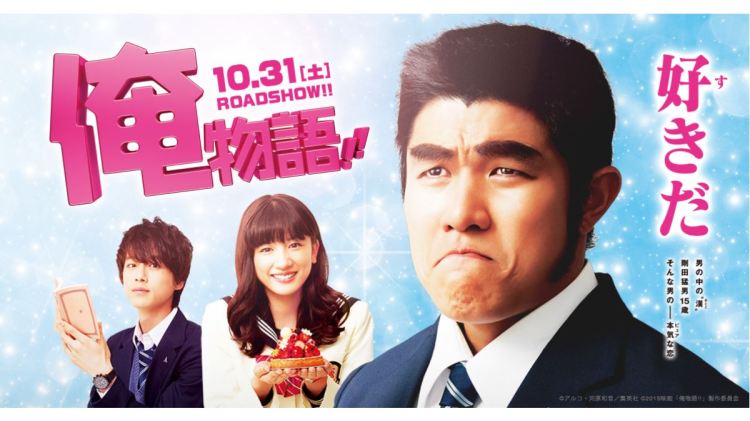
My Love StoryTakeo is a big guy with a big heart but awkward when it comes to romance. When he saves timid transfer student Rinko from a street harasser and falls in love at first sight, he is convinced she must have fallen for his super-handsome friend and determines to get them together in this charmingly innocent high school rom-com. Review.

Our Meal for Tomorrow

Our Meal for tomorrowAn introverted high school boy and outgoing girl grow closer after participating in a joint sack race, but their romance is threatened by a dark secret…
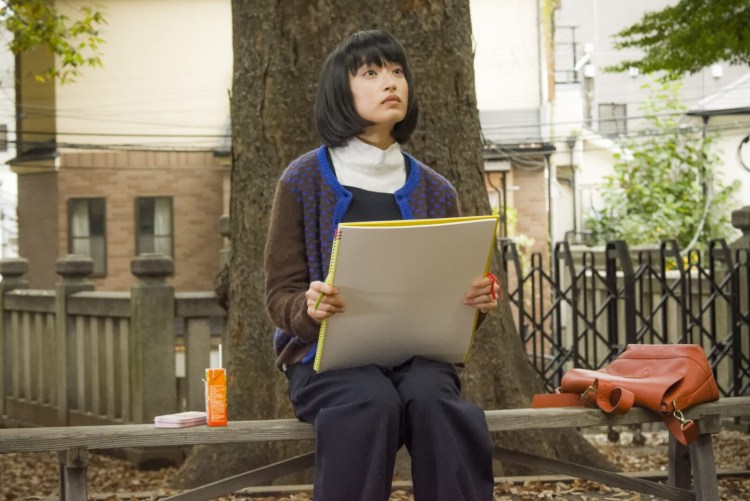
Her Sketchbook

Her sketchpadAn introverted otaku has become a virtual shut in so her father finds her a quiet job testing video games which doesn’t require much interpersonal interaction. Whilst there, she meets a sympathetic colleague who encourages her to express herself designing character illustrations for the games.
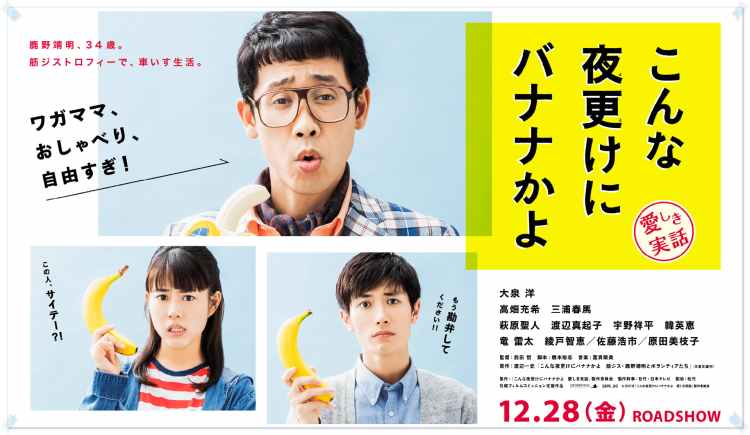
A Banana? At This Time of Night?

A banana at this time of nightYo Oizumi stars as a man with muscular dystrophy who is determined to live an independent life in his own home. After striking up a friendship with medical student Hisashi (Haruma Miura) he falls for volunteer carer Misaki and asks Hisashi to help him woo her little knowing she is his girlfriend.
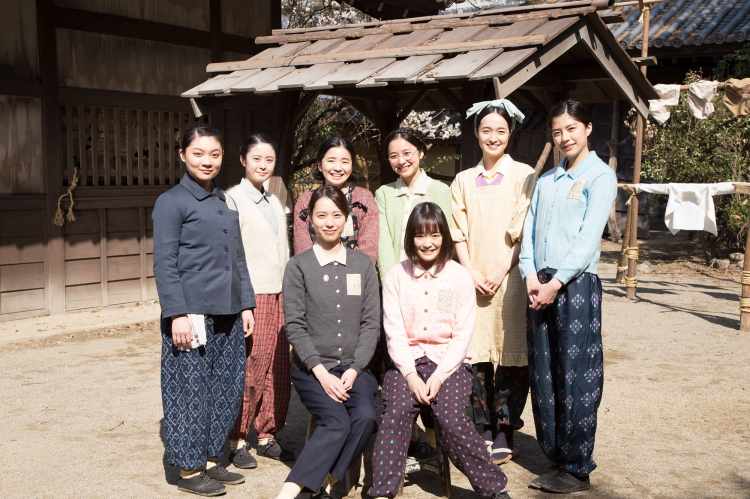
Organ

OrganWartime drama starring Erika Toda as a kindergarten teacher who evacuates her children to a nearby temple to try and protect them from the firebombing of Tokyo.

The Actor

the actorKen Yasuda stars as a jobbing actor experiencing a small revolution when he’s brought in for a big film role for a foreign director and falls for the pretty daughter of a local izakaya owner.
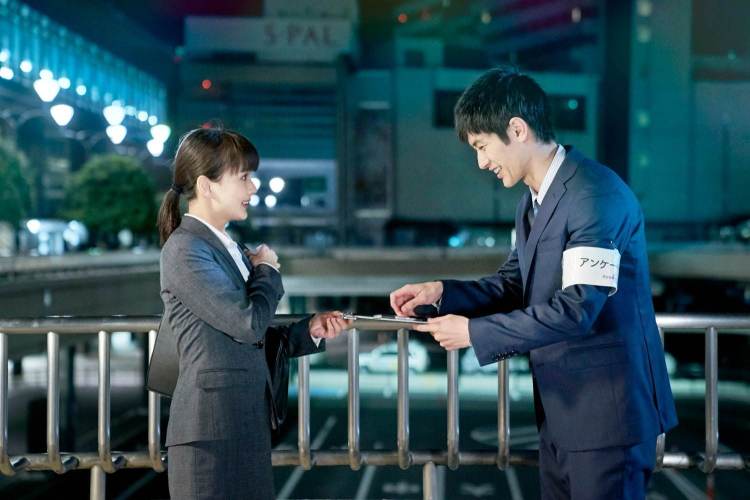
Little Nights, Little Love

little lights little love27-year-old Sato is patiently waiting for love. A chance encounter with a smartly dressed woman who agrees to fill in one of his questionnaires could be just what he’s been looking for…
Jesus

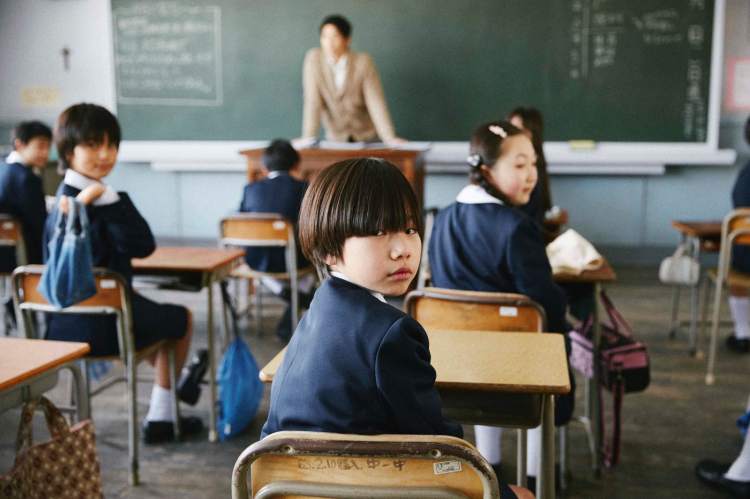
jesus still 1A small boy is forced to relocate to the mountains after his grandfather dies. Though the family is not Christian, he finds himself doubly out of place having to attend a Catholic school where a little bit of religious confusion sees him befriended by a Tiny Jesus. Review.

Another World

Another World still 1Three high school buddies reunite in their small-town home hoping to restore the easy bond of their adolescence while battling middle-aged disappointment in the latest from Junji Sakamoto. Review.
Bento Harassment

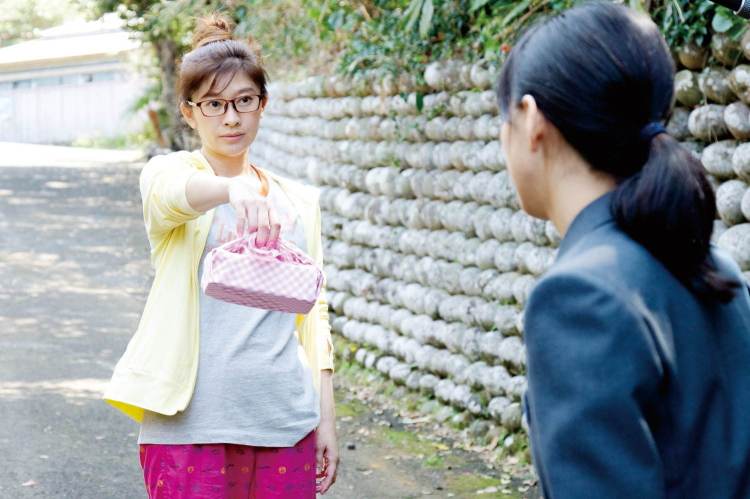
Bento Harrassment still 1Fed up with her teenage daughter’s moodiness, a single mother tries to communicate with her via passive aggressive bento in this charming family drama. Review.
My Dad is a Heel Wrestler

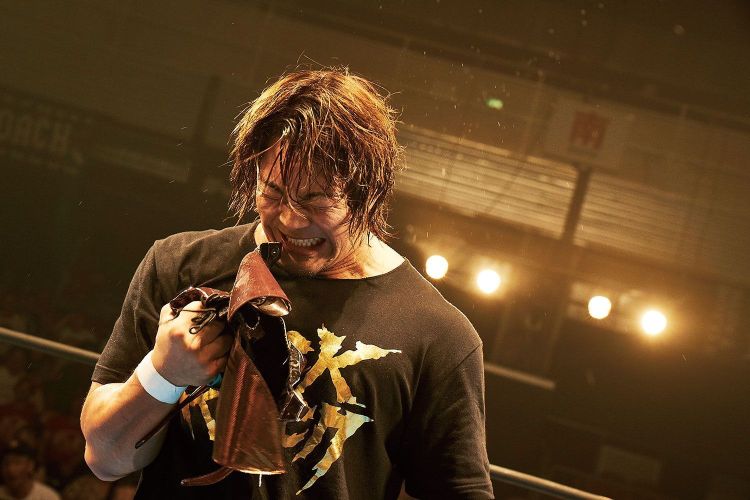
My Dad is a Heel Wrestler still 1Former pro-wrestler Takashi Omura injured his knee and now makes a living playing a “heel” – a cockroach mask-wearing villain of the ring. Takashi’s 9-year-old son Shota had no idea what he does for a living until he snuck into the ring. Horrified to discover he’s such a loser, Shota tells his classmates that his dad’s the hero wrestler Dragon George…
Lying to Mom

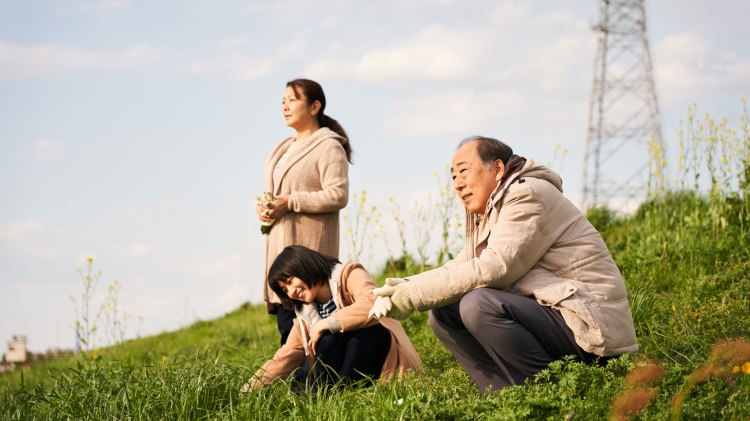
lying to mom still 1Yuko is knocked out trying to save her son who has hanged himself in his bedroom. Unfortunately he didn’t make it, but when she wakes up she has no memory of the incident and her family don’t have the heart to tell her what really happened, electing to keep up the elaborate pretence that he is alive and well and living in Argentina. Review.

Shadowfall

Shadowfall bannnerA burglar gets a nasty surprise when he breaks into a house where a woman is preparing to commit a murder!
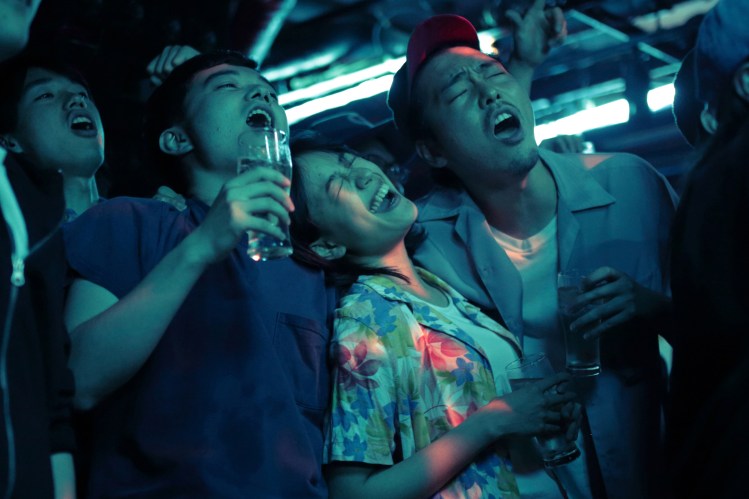
And Your Bird Can Sing

And your bird can sing still 1Three slackers struggle to accept love in modern day Tokyo in Sho Miyake’s contemporary adaptation of Yasushi Sato’s Akutagawa Prize-winning novel. Review.
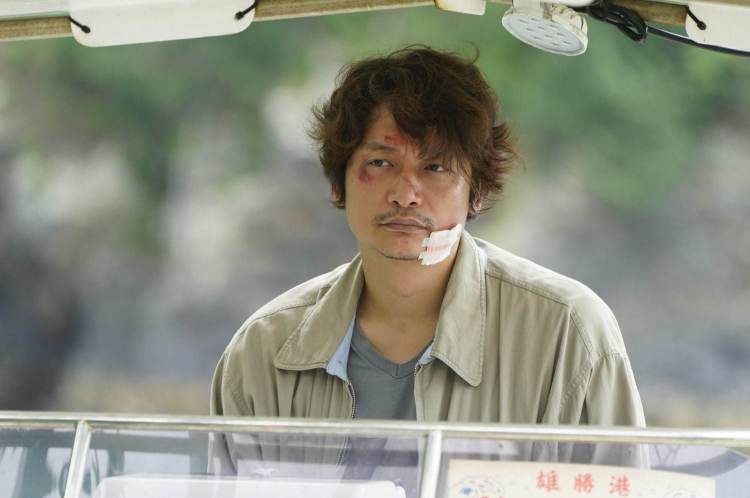
Sea of Revival

Sea of revival still 1A man moves to his partner’s hometown when her father falls ill, but tragedy follows him and his gambling addiction spirals out of control.

The House Where the Mermaid Sleeps

House where the mermaid sleeps still1Kaoruko is separated from her husband and has two small children. One day she gets a call to say that her daughter has drowned in a swimming pool and has been declared brain dead. She and her husband then have a difficult choice to make, donate her organs so another child can live, or wait until her heart stops beating.
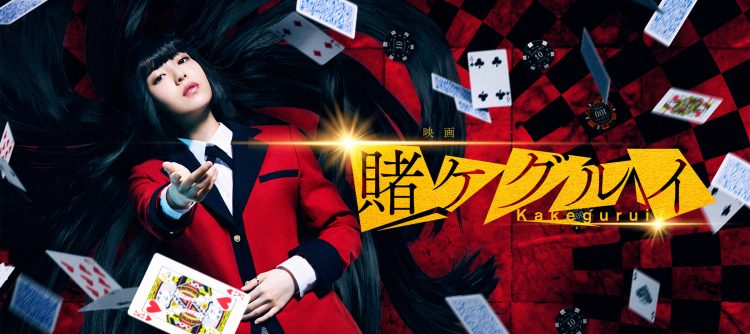
Kakegurui – Compulsive Gambler

Kakegurui bannerIt’s high stakes high school in this adaptation of Homura Kawamoto & Toru Naomura’s gambling manga Kakegurui in which grades are decided at the gaming tables!
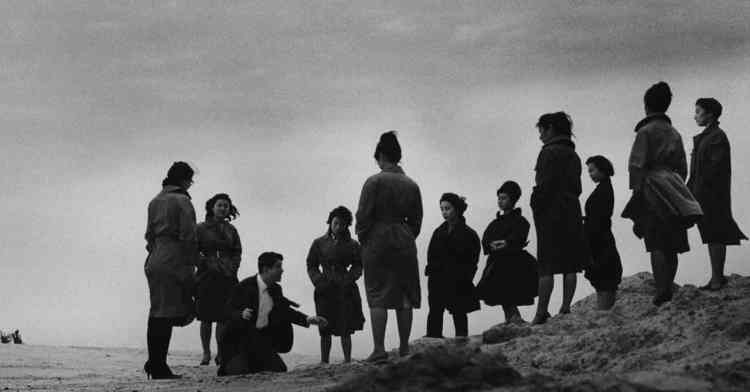
Ten Dark Women

10 dark womenKon Ichikawa’s classic black comedy in which a sleazy TV exec gets his comeuppance when his wife and nine mistresses team up to plot his death.

I Go Gaga, My Dear

I Go Gaga, My Dear bannerTV doc director Naoko Nobutomo follows her ageing parents as her mother’s Alzheimer’s-related dementia intensifies. Review.

Ride Your Wave

ride yourwave bannerThe latest feature from Masaaki Yuasa in which a surfer and fireman fall in love only for him to die in an accident at sea which convinces her to stay away from the water until…



The Japan Foundation Touring Film Programme 2020 runs at London’s ICA from 31st January to 16th February before touring to:

Full details for all the films are available on the official Touring Film Programme website. You can also keep up to date with all the year round events organised by Japan Foundation London via their main siteFacebook page, and Twitter account.

Happy Ero Christmas (해피 에로 크리스마스, Lee Kun-dong, 2003)

Happy Ero ChristmasMany may feel that we’ve forgotten the true meaning of Christmas, but behind the consumerist frenzy aren’t we all just looking for warmth and connection to help us make it through the cold? Well, maybe not, at least as far as one enterprising old man at the centre of Happy Ero Christmas (해피 에로 크리스마스) would have it, but in Korea Christmas is also a time of romance and so our hapless hero hopes to harness the goodwill of the festive season to make this year truly special.

Rookie cop Byung-ki (Cha Tae-hyun) grew up in a hot spring resort famous for its healing waters and inhabited mostly by tourists and gangsters. As a small child dumped by his dad at the baths, Byung-ki suffered a traumatic incident which has defined the course of his life – a horrible gangster decided to throw him into the super hot pool as a kind of hazing exercise, something which caused him both physical and emotional pain. He swore when he grew up he’d get rid of all the gangsters for good, starting with Suk-doo (Park Yeong-gyu) who has a tattoo of the hot springs map symbol but with musical notes instead of steam on his arm.

Unfortunately, however, mostly what Byung-ki does is dress up as the local police mascot “Polibear” and hand out leaflets while taking care of all the other inconvenient station jobs like sweeping the foyer. When he’s not busy dreaming of crime fighting glory, he’s fantasising about the melancholy young woman at the bowling alley, Min-kyung (Kim Sun-a), with whom he’s dreamily in love though she doesn’t seem to know he exists. Min-kyung, as it happens, has hit a rough patch with her fireman boyfriend she started dating when he rescued her from a fire.

Meanwhile, across town, a sleazy old man claims to have discovered the true meaning of Christmas, and it’s X-rated. Rebranding the holiday “Sexmas”, he wants to make an adult movie about a randy Santa who gets kicked out of Santatown for sleeping with all the other Santas’ wives. Coincidentally, the recently released Suk-doo has decided to open a new club, the Sex Palace, during the holiday, while two sexually frustrated teens try to get dates with trombone players and idly fantasise about the abuse of flatfish by sailors at sea.

Suk-doo doesn’t even really remember Byung-ki and is at a bit of a loss as to why he seems to hate him. He spends his life obsessively rewatching Shunji Iwai’s snowy classic Love Letter and getting well and truly into the Christmas spirit to make up for lost time seeing as he spent the last one inside and found it very depressing. Inconveniently for Byung-ki, Suk-doo too develops a liking for Min-kyung after she accidentally spits on him from the roof of the bowling alley after going up there to have a little cry over her rubbish fireman boyfriend.

The thing is, as Min-kyung says, Suk-doo might not actually be that bad. He’s a sensitive soul who knows how to keep Christmas well, which, to be honest is a lot more than you can say for most of the guys in this town. Byung-ki’s efforts to win her heart are so subtle that she hasn’t even noticed most of them, even when he dutifully drops her home after finding her having a drunken karaoke session and she throws up in his police car. Nevertheless, Suk-doo is still a gangster, and gangsters can be awkward too but they’re a lot more dangerous when they are.

Predictably, some of Byung-ki’s most questionable tactics – going through Min-kyung’s bag after it gets left behind in his car when she throws up, quasi-stalking her, putting up a police alarm button right outside her house to let her know he’s only three minutes away etc are written off as awkward goofiness, something which Min-kyung eventually seems to appreciate after realising Suk-doo’s not so nice after all. Suk-doo, meanwhile, gets a sad back story about his mother supposedly dying on Christmas Day, which also happens to be Min-kyung’s birthday, with a series of awkward implications only later undercut by a late confession. As Byung-ki puts it, everyone dreams something special for Christmas be it a weird erotic escapade, or an innocent romance. Mostly everyone gets what they wanted from Santa’s sleigh, riding off into the snow with a new hope for the future whatever that might hold.


Original trailer (extreme low res, no subtitles)

My Long Awaited Love Story (わたしに運命の恋なんてありえないって思ってた, Takafumi Hatano, 2016)

My Long Awaited Love Story posterChristmas is synonymous with romance in Japan, but should you really rush into love just to get a pretty picture under the bright lights of a shopping mall holiday display? Perhaps not, but rom-coms are not generally the best place to look for realistic dating advice. “Realistic dating advice” is what the lovelorn heroine of My Long Awaited Love Story (わたしに運命の恋なんてありえないって思ってた, Watashi ni Unmei no Koi nante Arienaitte Omotteta) ends up giving when she runs into a socially awkward CEO with a crush on an employee, but in true rom-com fashion finds herself falling for him instead.

27-year-old Riko (Mikako Tabe) has given up on love, at least in the “real” world. Ironically enough, her job is writing romantic storylines for dating sims at which she is apparently very successful which is why she’s been hired as a consultant by a tech firm looking to branch out in the hope of capturing the female market. The problem is that the more she observes “real” guys in the world all around her, the more they disappoint. The handsome “prince” at a coffee shop says all the right things but then claims to have forgotten his wallet. The clingy cutie has another girl on the line, and the domineering Type-A hunk crumbles in front of a strong woman. Riko knows that Hollywood-style meet cutes don’t happen in everyday life, but finds herself repeatedly running into them only for something to burst her bubble unexpectedly.

At the meeting for her new game, the assembled team being almost entirely female which, when you think about it, is a little bit depressing because it means the boss has used it to get all the women off the floor, Riko is taken by the handsome, sensitive Midoritani (Jun Shison) but gets a rude awakening when another guy turns up and immediately makes it clear he hates all her ideas. According to him, women who play dating sims must be ugly or stupid, the sort of people unwilling to see reality, retreating into a frothy fantasy land to escape their unhappy lives. Thoroughly fed up, Riko sets him right, only to realise this man, Kurokawa (Issey Takahashi), is actually the president of the company.

They haven’t exactly hit it off, and Riko is further enraged when she overhears him giving an interview to a women’s magazine in which he claims to be “supporting women”, parroting all the words she threw at him to make himself sound progressive. Gently teasing him about his obvious crush on Momose (Aya Ohmasa), a pretty employee, however brings them a little closer and earns her an apology. Kurokawa takes some of her advice, tries out a tactic from a game she wrote, finds it kind of works, and eventually asks her to teach him the ways of love. Despite feeling under confident in her own love life as an unattached 27-year-old, she agrees.

Gradually we discover that Riko’s taste for romantic fantasy is a clear eyed choice designed to keep her “safe” from heartbreak because it’s not real and the idealised 2D guys from her games are never going to let her down. Annoyingly, Kurokawa was right up to a point, but you can’t deny that the world Riko lives in is in itself disappointing, a fiercely sexist society in which the men are timid children and the women socially conditioned not to make the first move. Kurokawa’s courtship of Momose, it has to be said, borders on harassment considering he’s the boss and she’s much younger than he is. Early on, Riko outs herself as a youthful devote of shojo manga, given unrealistic ideas about romance from idealised stories of innocent love filled with charming, handsome princes and infinite happy endings. Riko wanted to fall in love like that, which is to say, unrealistically without fully engaging with all the difficult bits of being in a relationship.

Needless to say, she begins to fall for Kurokawa who, for all his awkwardness, has a good a heart and the willingness to learn. Thanks to him she gets the courage to humiliate a bunch of high school bullies at a reunion, but still struggles with the idea of opening herself up to “real” love and the possibility of heartbreak. When Kurokawa has a crisis and calls her, she knows where he’ll be but sends Momose instead, either out of a sense of awkwardness or perhaps just afraid to face him in such an emotional state. A professional humbling and the miracle of Christmas conspire to convince them both that you’ll never be happy hiding your feelings and if you want “real” love you’ll have to accept the risk of getting hurt. That’s reality for you, but it can probably wait until after the festive season.


Currently available to stream via Viki.

Teaser trailer (no subtitles)

The Girl in the Rumor (噂の娘, Mikio Naruse, 1935)

vlcsnap-2019-12-21-23h50m32s752The world was changing in 1935, but not everyone was swept away by the fickle tides of modernity. The heroine of Naruse’s 1935 drama The Girl in the Rumor (噂の娘, Uwasa no Musume) is like many of his leading ladies betrayed by the world in which she lives, yet she’s also an encapsulation of the conflicts of the age, at once fiercely traditional and personally progressive while her “modern girl” sister is as selfish and judgemental as any of the bright young things who serve as extreme examples of the risks of Western individualism.

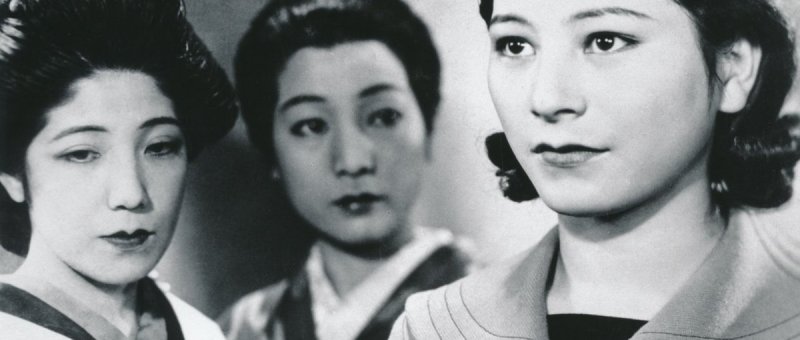
Kunie (Sachiko Chiba), an unmarried young woman, works in her family’s sake shop which is currently struggling to make ends meet. While the guys in the barbers opposite complain that the place has gone downhill since grandpa’s days, the old man himself has begun to worry that there’s something not quite right about their produce. In order to keep the shop going, there’s some talk that Kunie may marry the son of a wealthy family, but her father Kenkichi (Ko Mihashi) is against the idea. He married into his wife’s family and the marriage was intensely unhappy so he is mindful that the same fate doesn’t befall his daughter. His wife now long dead, Kenkichi is free to be more open about his longstanding affair with a bar owner, Oyo (Toshiko Ito), which produced a daughter, Kimiko (Ryuko Umezono), who was raised by Kenkichi and his legal wife and has no idea her birth was illegitimate. Kimiko, unlike her sister, has become a “modern girl”, dressing in Western fashions, listening to jazz, and staying out late going to parties. The trouble starts when Kunie decides to take her sister with her to the omiai for moral support and it becomes obvious that Sato (Heihachiro Okawa) is a bit of a “modern boy” who has lots more in common with the vivacious Kimiko and decides to break protocol by telling the go-between that he’d rather have her instead.

This move comes as a total blindside to the girls’ uncle who arranged the meeting. “The marriage proposal’s turned into something really weird” he tells Kenkichi over the phone while the two men try to work out what the best course of action is. The uncle seems to think it might be a good move to carry on the negotiations with Kimiko instead, after all Kunie is basically running the store so it would be more convenient to keep her around. Kenkichi is unconvinced. He knows Kimiko doesn’t really approve of all this old fashioned arranged marriage business, and to be honest he doesn’t seem to like her much so isn’t keen on talking to her about it but can’t rely on his usual trick of getting Kunie to do it because he doesn’t want to hurt her feelings by letting her know that Sato doesn’t fancy her and has asked her sister out instead.

Kimiko certainly is a “modern girl” and superficially proto-feminist. She mocks her sister’s traditionalism and criticises her for blaming “their” mother for the failure of their parents’ marriage, thinking that she is simply unable to move past the patriarchal mindset and used to blaming everything on the woman. Little knowing that Oyu is her mother, she rejects Kunie’s plan to have her come and live with them as new maternal presence, claiming that she has only contempt for mistresses and thereby exposing herself as being, ironically enough, more judgemental than her superficially conventional sister. Kunie may be “traditional” in her outlook, but she is also empathetic and understanding. It seems her mother may not have been an easy woman, and what she most wants is to repair her family by bringing Oyo into the fold in her “rightful” place at her father’s side. Despite her insistence on her own freedom, however, Kimiko is childishly moralistic, directing her anger with an oppressive system back on the people constrained by it. Yes Kenichi’s life is one of socially condoned hypocrisy, but there’s no point in blaming him or Oyo for trying to find happiness where they can.

Blame them she does, however, and her sister with them. Kimiko meets Sato by chance and starts dating him in the non-serious manner of young people of the time only for the Satos to become worried and again push the idea of a marriage. Having been spotted with Sato in the street by Kunie, Kimiko’s confession is cruel and cutting, delivered almost with glee as she reveals that her uncle and father have been avoiding telling her that Sato turned her down because he liked her sister more. Kunie had professed that she wasn’t all that bothered about the marriage because she had become convinced that she “couldn’t have a happy marriage anyway”, but her tears suggest a deeper hurt than having her hopes for the business dashed and being wounded by her sister’s callousness. Nevertheless, she wants nothing but her sister’s happiness and so if she seriously wanted to marry Sato for the “right” reasons, she would of course support her.

Kimiko however remains selfish and implacable. Kenkichi, hoping to teach her a lesson, brings Oyo into the home and reveals to Kimiko that she is a mistress’ daughter. It does not go well. Kimiko refuses to engage with Oyo, while Kenkichi also asks for an apology on behalf of Kunie who has only ever tried to protect both Kimiko and Oyo by trying to reunite their family, but Kimiko leaves in a huff shouting that she has no need of mothers or fathers or families or anything else. A rapprochement is brokered between the women only when Kenikichi is made to pay for his failure as a patriarch. It turns out grandpa was right after all, he’d been tampering with the sake and now the police want a word with him. With the arrival of Oyo, tacitly accepted by Kimiko’s final return to the home, the family is in some senses restored but also broken. The gossips in the barbers across the way lament the end of the Nadaya Sake store, callously speculating on what will replace it, while all Kunie can do is look on in consternation and disappointment.


Only Cloud Knows (只有芸知道, Feng Xiaogang, 2019)

930161b9ca654d4cac056b550c6d0542If contemporary Chinese cinema has one message, it’s come home to China. Feng Xiaogang, however, has never been keen to go with the flow for all of his occasionally problematic affection for the nation as it was before the ‘80s reforms. A co-production with New Zealand, unabashed romantic tearjerker Only Cloud Knows (只有芸知道, Z Yǒu Yún Zdào) seems primed to speak directly to the diaspora audience, asking if perhaps the meaning of the word “home” has changed, less place than people and, therefore, infinitely portable.

In the present day, recently widowed Dongfeng/Simon (Huang Xuan) prepares to say goodbye to his late wife, Yun/Jennifer (Yang Caiyu), by travelling back through their long years together facing many ups and downs as they strove to make a life for themselves in the laidback greenery of the New Zealand countryside. Dongfeng travels first to the small town where they started a humble restaurant, cooking the kind of food Westerners expect rather than the authentic Chinese dishes they fear no one will try, and using their English names “for convenience”. While there they employ a friendly waitress, Melinda (Lydia Peckham), who is something of a free spirit saving up money to travel to distant lands, touring Asia and Africa.

Though they are blissfully happy, life is not without its difficulties. Working so hard to make the restaurant a success leaves them with time for little else and wondering if they’ve perhaps lost sight of something important. Dongfeng no longer plays his flute, and Yun worries that he’s sacrificed a part of himself to provide for her, becoming a slightly different person in the process. Obsessed with blue whales, Yun craves protection and security, the kind of things many associate with a building a stable home, but she also yearns for freedom and for something more than ordinary happiness. Minor resentment creeps in born of that central contradiction. Dongfeng wants to give Yun the kind of security he assumes she needs by betting everything on the restaurant, but all she really wants is him.

Nevertheless, protection and security were the things which attracted her to Dongfeng in the first place as symbolised by her obsession with blue whales. Somewhat improbably, his hotheaded decision to start a fight with a man who cut them up in a carpark and then insulted Yun only endears him to her further and also gets him a commendation from a local policeman who even tells him he might be cut out for life on the force, but to ease back on the violence because New Zealand is a peaceful place. There are things, however, that one cannot be protected from and as much as fate gives it also takes away. Yun craves protection because she feels insecure in an existential sense, convinced that she is “unlucky” and originally reluctant to agree to Dongfeng’s proposal in fear that she is destined to make him unhappy.

Sadly, that prediction eventually proves correct though through no fault of her own. Lucky in love, the couple face their share of hardships from an inability to start a family to losing beloved pets and dealing with illness, but there’s no joy without sadness and if your time together is shorter perhaps it is equally sweet. In his opening monologue, Dongfeng muses, quoting poetry, that time moved slower in the past and there was only enough of it to love one person before telling us that his life has been about one woman. Only Cloud Knows is the story of how he learned to say goodbye, but also of a 20-year love that endures to transcend time.

Apparently inspired by the true life love story of one Feng’s friends and collaborators, Only Cloud Knows has a rare kind of authenticity in its deeply felt romance which somehow seems all the more real for its clichéd genesis. Foreshadowings of partings echo throughout, reminding us that all love ends one way or another and it’s the ones left behind who mind it most, but rather than dwell on the maudlin, Feng shows that life goes on even in the midst of heartbreak. Houses change hands, old owners with teary eyes making space for bright-eyed youngsters full of hope for the future, while those who are leaving bequeath their unlived years to those they love with hopeful generosity. What Dongfeng discovers is that home is where the heart is, even if the heart is forever in the past.


Currently on limited release in US/UK cinemas courtesy of China Lion.

Original trailer (English subtitles)

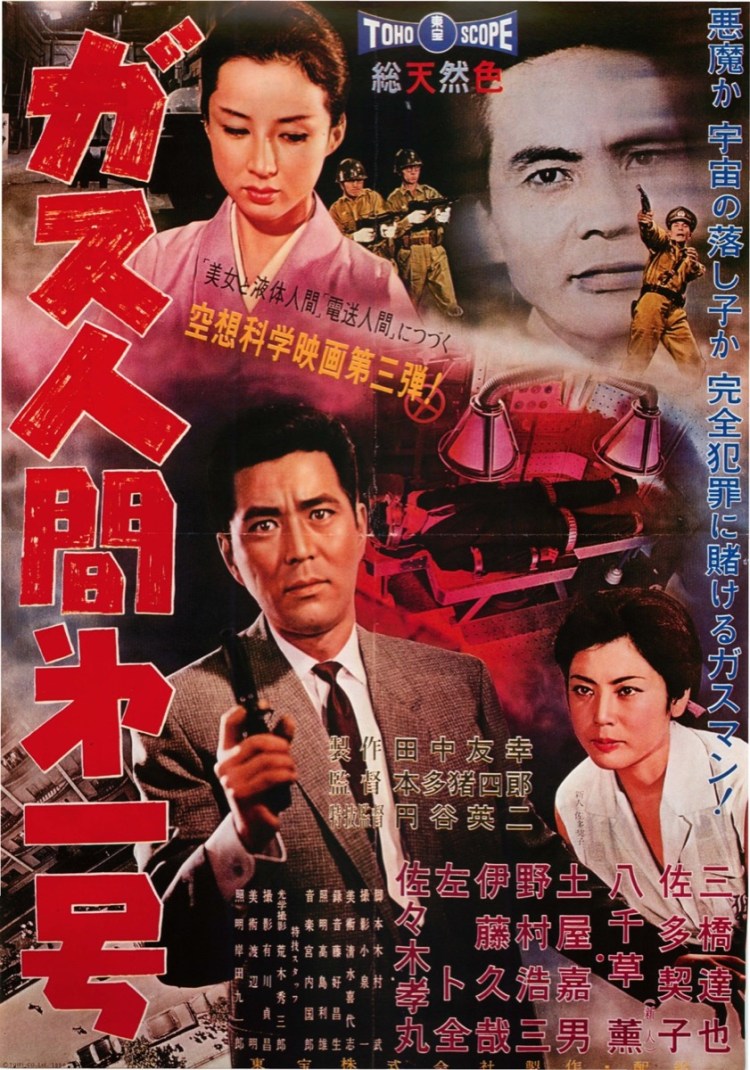
The Human Vapor (ガス人間第一号, Ishiro Honda, 1960)

The Human Vapour poster“The world is full of hysteria towards things they don’t understand” admits the strangely chatty “villain” at the centre of Ishiro Honda’s The Human Vapor (ガス人間第一号, Gas Ningen dai Ichi-go). Third in a loose trilogy of “mutant” films put out by Toho beginning with The H-Man and followed by The Secret of the Telegian, The Human Vapor is at once the most futuristic and the most traditional in that it’s no longer wartime guilt or nuclear anxiety which has corrupted our increasingly amoral hero but unwise ambition in which desperation to win the space race has produced a new and dangerous threat we may not be able to contain.

Honda opens with an exciting bank heist which on later consideration might not make much sense, filled as it is with shots of a faceless man pointing a gun at terrified staff while the vault doors open seemingly on their own. Earnest policeman Okamoto (Tatsuya Mihashi) is on the case, chasing a suspect car down a narrow country road only for it to crash and be discovered empty with no trace of the driver to be found. Okamoto’s feisty reporter girlfriend Kyoko (Keiko Sata) is dismayed to find out he has no leads, but later picks up on his mention of a buyo dancer, Fujichiyo (Kaoru Yachigusa), who lives near the scene and might have something to do with the case. 

Chasing Fujichiyo takes Okamoto to a library, where he becomes further convinced she is in contact with the mysterious bank robber. A strange and isolated woman, Fujichiyo is apparently from a noble, wealthy family but lives alone in a small cottage with only a single male servant where she devotes herself entirely to perfecting the art of traditional Japanese dance. We discover that Fujichiyo has been in poor health, which is why she hasn’t given a public performance in some time. Okamoto posits that the bank robber is bankrolling her comeback, though he never seems to have much of an explanation why she would need him when she has access to her own resources.

He is however correct, though it seems Fujichiyo was not aware that the money was stolen otherwise she might have been more careful in using it. In a contrast with genre norms, honest cop Okamoto never falls for Fujichiyo but does become oddly invested in her sad love story while sparking with his cheerful reporter girlfriend who ends up doing much the same. In fact, Kyoko is the only one doing much investigating but largely finds herself having to do it in spite of the (generally useless) men around her, including an unpleasant younger colleague who mocks all her ideas but does nothing much of anything on his own.

In any case, smirking villain Mizuno (Yoshio Tsuchiya) later makes himself known to the police in a selfless gesture of love in order to clear Fujichiyo’s name and get her released from police custody. He does this by taking the police to a bank and demonstrating how he was able to get in the vault without a key which involves his curious ability to turn himself into a gas. When Fujichiyo is not released, he takes matters into his own hands and frees all the prisoners in the cells, but Fujichiyo refuses to leave, insisting that she has no intention of running away and prefers to stay until the police affirm her innocence by releasing her.

Mizuno’s intention to bypass the law is one of the many signifiers of his increasing danger, that now believes himself “above” the rest of humanity and therefore no longer subject to their laws. He later tells the police exactly that, sitting them down for a mini audience to explain himself during which he recounts his history as an SDF pilot discharged on a diagnosis of lung cancer after which he took the boring job in the library and fell in love with Fujichiyo. A shady doctor, Sano (Fuyuki Murakami), later approached him claiming to be working for Japan’s space programme and suggested that his fighter pilot background made him a perfect fit for becoming an astronaut. Mizuno agreed to participate in his research to “change the existence of the human body” in preparation for life in space, but when Sano’s weird experiments turned him into a “gas man”, the doctor committed suicide in horror leaving Mizuno just another lonely victim of a mad scientist.

Like many other “mutant” heroes, the change in Mizuno’s body has also changed his soul though his love for Fujichiyo remains unchanged. It seems he’s only committing these crimes to fund her ambition of performing traditional buyo dance on the contemporary stage, while she though obviously devoted to her art finds it difficult to accept the man that he’s become. He promises to give her the world, sacrificing anyone that gets in his way. She remains conflicted, not wanting to accept his offer if it involves that kind of cost, and defending him to her colleagues only with the rationale that he is “different from what they are accustomed to”. While some advise caution, that perhaps Mizuno is not as dangerous as they think despite already having killed and should be given the chance to reform, others take a harder line eventually opting to use a different kind of gas to counter him.

Kyoko pleads with Fujichiyo as one woman in love to another, trying to protect Okamoto while advising her to pull Mizuno back from the brink by cancelling her performance, but precisely because of the understanding that exists between them she cannot. Sadly, as many point out, no one is really interested in buyo dance – the only audience members in attendance are there for the drama and the possibility of seeing the gas man in action. “You and I have finally won” Mizuno tells Fujichiyo on completion of her dance, as if this performance was all that ever mattered to either of them. But their victory leaves them with nowhere else to go, and the world unready to accept the latent threat a gas man represents. Fujichiyo makes her choice, one perhaps informed by her art and her love, while the authorities can only wait outside for the vapours to disperse.


Original trailer (No subtitles)

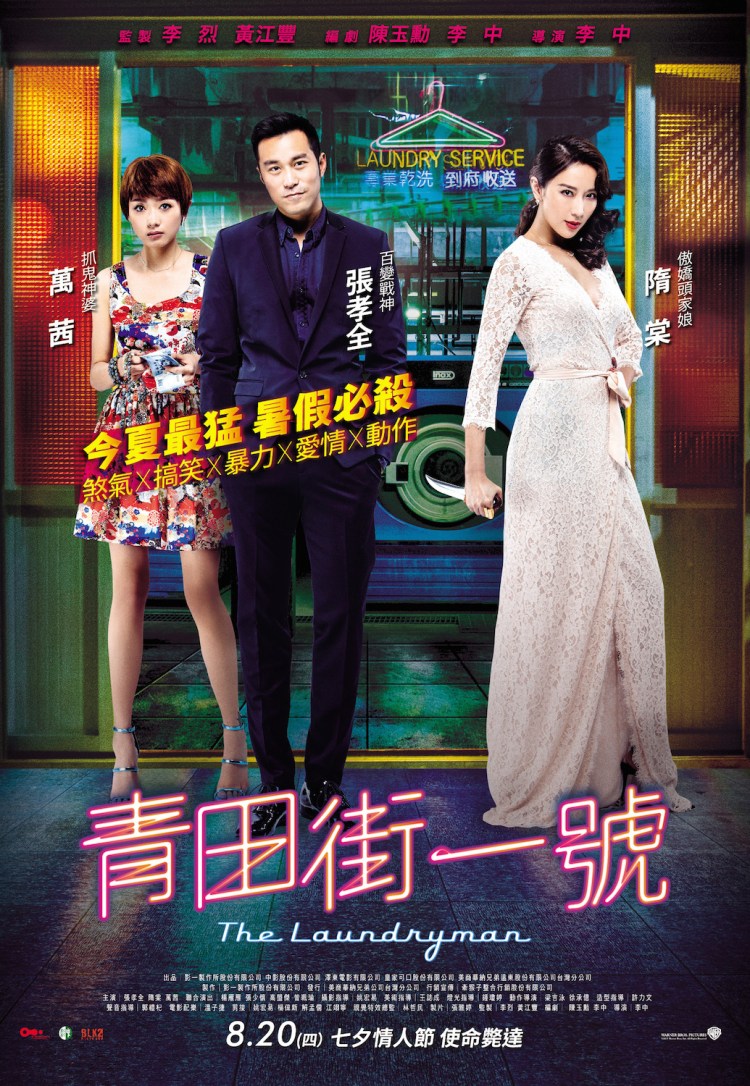
The Laundryman (青田街一號, Lee Chung, 2015)

青田街一號_主海報A_直式_有贊助_OLCould you, should you, attempt to wash away life’s “stains” by erasing them? The hero of Lee Chung’s The Laundryman (青田街一號, Qīngtián J Yīhào) is engaged with just that in his clandestine occupation in which he works as a kind of “cleaner”, smoothing the wrinkles out of life’s little problems for the monied and unscrupulous. Yet he finds himself “haunted” by his crimes, accused by those he so casually dispatched without asking why, and eventually forced into a reexamination of his life and work.

Known only by the cryptic codename “No. 1, Chingtian Street” (Joseph Chang Hsiao-chuan), our hitman is one of many working for the mysterious A-gu (Sonia Sui Tang) at her family laundry which she runs as a cover for her stable of assassins, claiming that they merely clean the stains from people’s lives rather than their clothes. A-gu’s methods are complex and exacting. Picking up concerned citizens in the street, she guides them towards her services before Chingtian or one of his colleagues inserts themselves into their target’s daily routine, knocks them off in a quiet sort of way, then brings the body “home” to be “laundered”.

The snag is that Chingtian has recently become plagued by the spirits of those he’s killed. Three of them, to be exact (and an extra one he didn’t off but has started following him anyway). Traditional therapy proving no help, A-gu sends Chingtian off to see Lin (Regina Wan Qian), a pretty psychic, despite affirming that all of this is some weird thing going on with Chingtian’s head rather than genuine paranormal activity. Lin, spotting his ghostly followers right away, explains to Chingtian that they most likely have unfinished business – i.e. finding out who wanted them dead and why. There is, however, a little more to it than that as a further trail of death begins to linger behind Chingtian that leads back to a dark and repressed memory of his youth.

Despite its whimsical tone, Lee’s drama leans heavily into the darkness in asking why it is someone might decide to pay to have someone else killed. The answers aren’t the ones you’re expecting. No business disputes or political machinations, only frustrated loves and loneliness. A nerdy young loner falls for the larger lady from next-door and is horrified to realise that her boyfriend beats her to the point at which she has begun to consider suicide as a means of escape. He wants to save her, and after all the world might be “better off” without the violent boyfriend, so he gives in to A-gu’s alluring offer to have the guy offed (for a small fee). Meanwhile, another mark decided on his course of action out of an excess of love, or to put it more pointedly, its dark side as he became increasingly convinced he could not live up to its expectation and determined to free himself of the burden, damning himself further into a downward spiral of self-destructive humiliation.

A-gu’s life philosophies lean to towards the callous with all her talk of “cleaning” and affirmations that “useless people should be destroyed”, but as Lin points out it’s quite something else to bump off a lovely older couple – some might even call it heartless. Heartless is what Chingtian has been raised to be, so his recently reawakened humanity is quite a problem. Caught between A-gu who alternates between something like possessive mother and femme fatale (which is just as strange a dynamic as it sounds), the pixyish Lin, and later the dogged policewoman Yang (Yeo Yann Yann) who’s picked up on a trail set down for her to find but followed it further than intended, Chingtian is forced to confront himself and his past, in a sense putting his psyche on a spin cycle to reverse a lifetime’s worth of brainwashing and remember who it is he really is.

Strangely warm and fuzzy, Lee’s whimsical world of colour is a perfect mix of film noir fatalism and fairytale promise as Chingtian walks a precarious path towards reintegration of his personality while trying a fair few others on for size. The childlike silliness of an anti-ghost musical number mingles with the hard edged kung fu of a violent procedural but Lee never loses his sense of cartoonish fun even as Chingtian begins to find his answers and with them a clue to inner darknesses personal and otherwise.


Currently available to stream in the UK (and possibly other territories) via Amazon Prime Video.

International trailer (English subtitles)