The Shonen Merikensack (少年メリケンサック, Kankuro Kudo, 2009)

The Shonen Merikensack posterWhen you spent your youth screaming phrases like “no future” and “fumigate the human race”, how are you supposed to go about being 50-something? A&R girl Kanna is about to find out in Kankuro Kudo’s generation gap comedy The Shonen Merikensack (少年メリケンサック) as she accidentally finds herself needing to sign a gang of ageing never were rockers. A nostalgia trip in more ways than one, Kudo is on a journey to find the true spirit of punk in a still conservative world.

25 year old Kanna (Aoi Miyazaki) is an unsuccessful scout at a major Japanese label which mainly deals with commercial bands and folk guitar outfits. As she’s about to quit any way, Kanna makes a last minute pitch for a punk band she’s found on YouTube, fully expecting to be shown the door for the last time. However, what she didn’t know is that her boss, Tokita (Yusuke Santamaria), is a former punk rocker still dreaming of his glory days of youthful rebellion. With her leaving do mere hours away, Kanna’s contract is extended so that she can bring in these new internet stars whose retro punk style looks set to capture the charts.

Unfortunately, the reason Tokita was so impressed with the band’s authentically ‘80s style is because the video was shot in 1983. The Brass Knuckle Boys hit their heyday 25 years ago and are now middle aged men who’ve done different kinds of inconsequential things with their lives since their musical careers ended. Kanna needs to get the band back together, but she may end up wishing she’d never bothered.

Mixing documentary-style talking heads footage with the contemporary narrative, Kudo points towards an examination of tempestuous youth and rueful middle age as he slips back and fore between the early days of the Brass Knuckle Boys and their attempts to patch up old differences and make an improbable comeback. Kanna, only 25, can’t quite understand all of this shared history but becomes responsible for trying to help them all put it behind them. Her job is complicated by the fact that estranged brothers Akio (Koichi Sato) and Haruo (Yuichi Kimura) made their on stage fighting a part of the act until a stupid accident left the band’s vocalist, Jimmy (Tomorowo Taguchi), in wheelchair.

The spirit of punk burns within them, even if their contemporaries are apt to point and laugh. The Brass Knuckle Boys, when it comes down to it, were successful bandwagon jumpers on the punk gravy train. Craving fame, the guys started out marketing themselves as a very early kind of boy band complete with silly outfits and cute personal branding full of jumpsuits, rainbows, and coordinated dance routines. Yet if the punk movement attracted them merely as the next cool thing, it also caught on to some of their youthful anger and teenage resentment. In the end unrestrained passion destroyed what they had as the ongoing war between the brothers escalated from petty sibling bickering to something less kind.

Twenty-five years later the wounds have not yet healed. Akio is a lousy drunk with a bad attitude, Haruo is an angry cow farmer, drummer Young has a range of health problems, and Jimmy’s barely present. Tokita has become a corporate suit, a symbol of everything he once fought against and his former bandmate is his biggest selling artist – eccentric, glam, and very high concept.

The men are looking back (even those of them who aren’t even really that old), whereas Kanna can only look forwards. Before the Brass Knuckle Boys, she was about to be kicked out of her A&R job and planned to go home with her tail between her legs to help her confused father with his very unsuccessful conveyor belt sushi restaurant. Apparently in a solid relationship with a coffee shop guitarist who keeps urging her to put in a good word for him at the record label with his sappy demo tapes, Kanna’s life is the definition of middle of the road. Neither she not her boyfriend could be any less “punk” if they tried but if they truly want to follow their dreams they will have to find it somewhere within themselves.

At over two hours The Shonen Merikensack is pushing the limit for a comedy and does not quite manage to maintain momentum even as its ending is, appropriately enough, an unexpected anticlimax. Kudo’s generally absurd sense of humour occasionally takes a backseat to a more juvenile kind which is much less satisfying than the madcap action of his previous films but still provides enough off beat laughs to compensate for an otherwise inconsequential narrative.


Original trailer (English subtitles)
The Exclusive: Beat The Devil’s Tattoo (특종: 량첸살인기, Roh Deok, 2015)

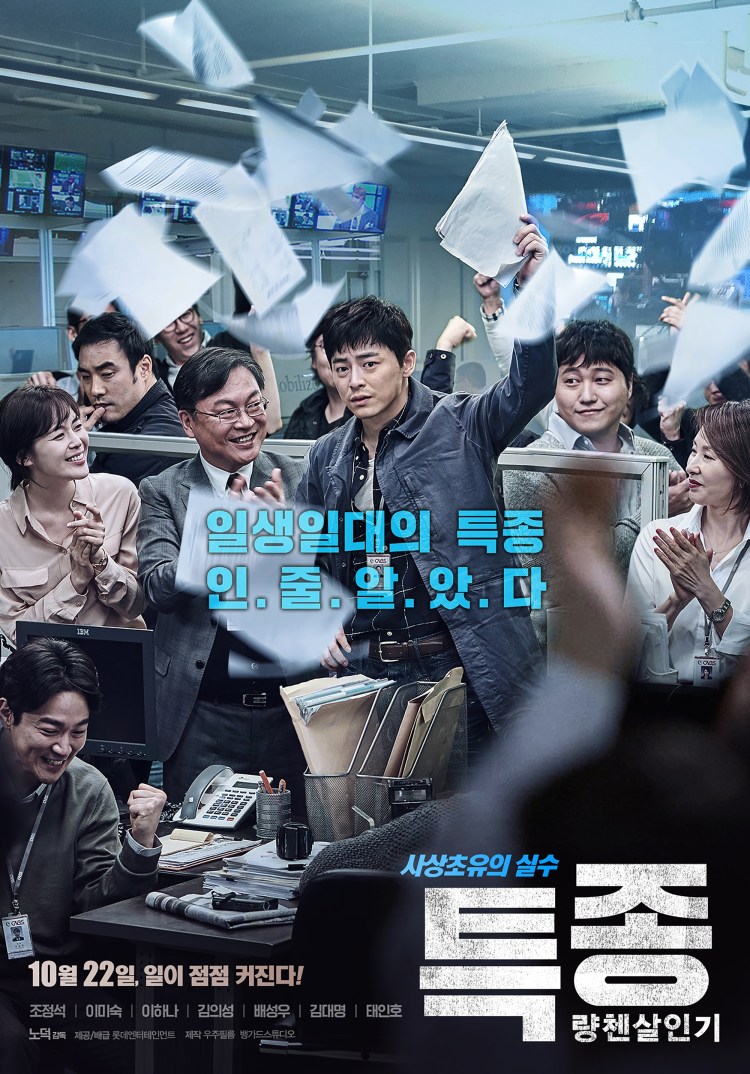
The Exclusive Beat the DevilSome people just can’t keep themselves out of trouble. The down on his luck reporter at the centre of Roh Deok’s The Exclusive: Beat the Devil’s Tattoo (특종: 량첸살인기, Teukjong: Ryangchensalingi) is something of a trouble magnet as he makes mistake after mistake, requiring lie after lie to try and put him back on the straight and narrow. Unfortunately for him the deeper he gets the closer he turns out to be to the “real” truth. Only by that stage everyone has lost interest in “the truth” anyway – who cares about little things like facts against the overwhelming power of a constructed narrative.

Lazy, self obsessed reporter Heo (Cho Jung-Seok) is about to be fired from his job as a TV news reporter after publishing some inaccurate material that causes problems for the station’s sponsors. He also has a bigger problem at home in that his heavily pregnant wife has thrown him out and seems intent on a divorce. When he gets a shady sounding tip from a dubious source regarding a series of murders, Heo decides to check it out alone. Coming to the conclusion that he really has caught a killer, Heo rips a strange handwritten note down from the walls and takes it straight to his boss in the hopes of getting back in her good books. The note goes viral and Heo finds himself reading it out on prime time news but he has a real problem on his hands when he realises the guy from the basement is an actor in a play and has nothing to do with the killings at all.

Attempting to kill the story, Heo forges a second note designed to deflect press attention but it has the opposite effect and only creates more hysteria surrounding the case. Trying to play both sides by exposing the real killer whilst keeping his own involvement a secret, Heo is in way over his head and risks losing far more than just his career if he can’t find a way to smooth all of this out.

The problem here is, everything’s a PR hook. With one eye on the ratings, every reporter is a marketeer, spinning every string of facts into an easily sellable ball of fluff intended to draw in viewers who only read the headline anyway. Heo was never the kind of crusading journalist who has a serious dedication to the craft or an attachment to idealistic notions of holding the nation to account, but even so his self-serving actions begin to create a conflict in his heart as the true nature of his profession is thrown into stark relief. Even whilst lying through his teeth in attempt to save his own skin, Heo is astonished by the cold and cynical actions of his boss who simply does not care if the information is accurate so long as it sells. Far from getting him fired, Heo’s web of duplicity gets him a series of promotions and a not inconsiderable pay bump which is quite something considering a minor mistake was about to end his journalistic career before all of this started.

While all of this is going on, Heo is also busy with the problem of his failing marriage. Fairly dense when it comes to matters of the heart, Heo thinks he can win his wife back now that he’s sort of famous and doing really well at work, which is ignoring the fact that his wife seems to have left him because of his self obsessed and controlling behaviour. Drunk and lurking outside of their previously shared home, Heo doesn’t do himself any favours by jealously attacking an artist his wife had been working with at the gallery she has now opened with a friend (and which Heo had tried to prevent, apparently uncomfortable with the idea of a working wife). His wife’s relationship with her artist will also have an unexpected effect on the serial killer case as it leads her to make a dangerous decision trying to work out what exactly her husband is up to (worried in case he’s secretly been investigating her, but no, Heo is still too self focussed to have even thought about worrying over his wife’s “affairs”).

Roh adopts a quirky, satirical tone backed up by the goofy comedy music which often seems at odds with the grizzly serial killer goings on, but then that’s sort of the point. No one, not even the police who are painted as incompetent idiots both ignorant of and completely dependent on the media, really cares very much about the seven people who have already died or the countless others that might be at risk if the killer is not caught. The only thing that matters is the spin, so long as everything can be massaged into a believable narrative the case will have been solved, facts be hanged (literally). When it comes down to it, Heo solves the case by accident and then can’t say anything about it for fear of incriminating himself, allowing the killer to look like a hero with the frightened public led to believe the threat is still out there. Heo then faces a choice between exposing a truth which might destroy him or continuing to live with the heavy burden of a painful secret but in the end the choice is not even his. No one is listening. The only choices left are raving like a mad man in the face of indifference, or accepting his boss’ aphorism that truth is a relative construct and that “the truth” is whatever you choose to believe. The path of blissful ignorance suddenly seems much more attractive.


International trailer (English subtitles)

Aizen Katsura (愛染かつら, AKA The Tree of Love/Yearning Laurel, Hiromasa Nomura, 1938)

aizen katsura posterJapan’s political climate had become difficult by 1938 with militarism in full swing. Young men were disappearing from their villages and being shipped off to war, and growing economic strife also saw young women sold into prostitution by their families. Cinema needed to be escapist and aspirational but it also needed to reflect the values of the ruling regime. Adapted from a novel by Katsutaro Kawaguchi, Aizen Katsura (愛染かつら) is an attempt to marry both of these aims whilst staying within the realm of the traditional romantic melodrama. The values are modern and even progressive, to a point, but most importantly they imply that there is always room for hope and that happy endings are always possible.
The heroine, Katsue (Kinuyo Tanaka), has found herself in a difficult position for a woman of 1938. Married off at a young age in payment of a family debt yet rejected by her husband’s family, Katsue’s fortunes fall still further when her husband passes away suddenly leaving her alone and eight months pregnant. Her daughter, Toshi (Kazuko Kojima), is now five years old and Katsue has a good job as a nurse at a local hospital. The job allows her to support herself, her daughter, and her older sister but the problem is that the hospital has a strict policy of not employing married women. Katsue isn’t married anymore, she’s a widow, but the fact that she has a daughter she is raising alone makes her familial status a grey area. She’s been hiding her daughter’s existence from her colleagues in case it costs her the job she needs to survive, but a chance encounter in a park threatens to ruin everything.

Thankfully, Katsue’s colleagues at the hospital turn out to be nice, reasonable people who respond sympathetically on hearing Katsue’s explanation about why she’d avoided telling them the truth about her daughter (and that, crucially, she had been married and the child was conceived legitimately). Her next problem occurs when the son of the hospital’s chief doctor, Kozo (Ken Uehara), returns after graduating university and the pair strike up a friendship which eventually blossoms into romance. Kozo’s father, however, is intent on arranging his marriage to a girl from another medical family – a long held tradition and, in an odd mirror of Katsue’s situation, the marriage is a way of getting additional investment for the rapidly failing clinic. Kozo asks Katsue to run away with him to Kyoto but she still hasn’t told him about Toshi or her previous marriage out of fear of losing not only her new love but her position at the hospital if he rejects her. Just as Katsue is about to go to meet Kozo at the station, Toshi falls ill.

Despite the austerity and conservatism of the times, Aizen Katsura is a very “modern” story in which Katsue’s pragmatic solution to her difficulties is praised and even encouraged. Her life has been an unhappy one in many ways – sold into an arranged marriage at 18, forced out of her hometown after rejection by her husband’s family, and finally widowed in the city, Katsue has been let down at each and every juncture. Alone with a baby, her choices were few and her only support seems to come from her older sister who has no husband of her own (at least, not one that is present), and takes care of Toshi while Katsue has to go out and earn the money to support the family.

Society does not quite know what to do with an anomaly like Katsue who cannot rely on extended family. She needs to support herself and her child but many jobs still have a marriage bar which extends to widows with children. The only options for women who can’t find a solution as elegant as Katsue’s aren’t pleasant, the hospital is a dream come true as it both pays well and is a respectable profession, but if the management found out about Toshi, Katsue could be left out in the cold with little prospect of finding more work despite her nursing qualifications.

The times may be harsh, but the world Katsue inhabits places her on the fringes of the middle classes. Kozo, as young doctor and heir to the clinic (Japanese hospitals are often family businesses) is far above her but is, in some ways, equally constrained. Whilst recognising a duty to his father, Kozo is resolute in refusing the idea of an arranged marriage conducted for financial purposes. He determines to set his own course rather than be railroaded into something which is for his father’s benefit and not his own. Deeply hurt by Katsue’s actions but not attempting to find out why she acted as she did, Kozo enters a depressive spell, sitting around resentfully and not doing much of anything. Luckily for him, the woman his father has picked out, Michiko (Michiko Kuwano), is a thoroughly good person who, once she finds out about Katsue, becomes determined to see that true love wins rather than being shackled to a moody young man and spending the rest of her life in a one sided relationship with someone still pining for a first love.

Katsue’s dreams come true only once she begins to give up on them. Leaving the hospital and returning to her home town with no firm plans, Katsue gets herself a career through luck and talent when a song she enters in a competition is picked up by a leading record label. Music rewards her financially but also gives her a sense of confidence and a purpose which puts her on more of an even footing with Kozo even if he sits in the stalls while her colleagues fill the balcony. Her salvation is both self made and something of a deus ex machina, but the broadly happy ending is intended to give hope to a hopeless age, that miracles can happen and second chances appear once two meet each other openly with full understanding and forgiving hearts.


If Cats Disappeared From the World (世界から猫が消えたなら, Akira Nagai, 2016)

If Cats Disappeared from the worldWhat would you give to live another day? What did you give to live this day? What did you take? Adapting the novel by Genki Kawamura, Akira Nagai takes a step back from the broad comedy of Judge for an Iwai-inflected tale of life thrown into sharp relief by impending death. Less a maudlin meditation on the will to life, If Cats Disappeared from the World (世界から猫が消えたなら, Sekai kara Neko ga Kieta nara) is an existential journey into the mind of a man who believed himself an irrelevance, beloved by no one and living an unfulfilling existence, only to rediscover his essential place in the world at the moment he’s about to vacate it.
An unnamed 30 year old postman (Takeru Satoh) has a freak bicycle accident and is subsequently informed that he has an aggressive brain tumour which may take his life at any moment. Following this traumatic news, the postman returns home to discover his own doppelgänger there, waiting for him. The doppelgänger tells him that he will die tomorrow, unless the postman accepts the offer the doppelgänger is about to make him. There are too many unnecessary and irritating things in the modern world, in return for postponing the postman’s death sentence, the doppelgänger will erase one thing from human society – if only the postman will agree.

As in many similarly themed films of recent times, memories are stored not on hard drives or even in notebooks but in seemingly irrelevant objects with unexpected sentimental value. Quite literally “material culture”, it is the objects which provide the path back to the past and their destruction represents not only the severing of a connection but a kind of erasure of the past itself.

The doppelgänger sets about deleting various items at will which might previously have seemed irrelevant to the postman but turn out to have fundamental connections to the most important aspects of his life. The first item to go is phones (all phones, not just mobiles) which reminds him of his first love (Aoi Miyazaki) whom he met after she dialled a wrong number and recognised the score to Fritz Lang’s Metropolis which he happened to be watching at the time. Phones and movies – the second item on the doppelgänger’s hit list, brought the two together but it couldn’t have happened without the cinephile best friend (Gaku Hamada) the postman met at university who has been his movie mule ever since.  Delete the phone and the movies and the postman loses his first love and best friend to win the right to live on alone for just one day. Cats turn out to have an even more essential role in the postman’s life, one which is painful for him to consider but impossible to ignore.

The protagonist’s occupation, which becomes his name and defining feature, is an ironic one. A mere conveyor of items charged with other people’s memories. he feels like an empty vessel, trapped in an existence devoid of meaning. Yet his strange doppelgänger pushes him to reconsider his place in the world, re-entering a sphere he had long absented himself from. Remembering long forgotten yet life changing holidays with the love of his life or finally coming to understand the silent signs of devotion in his emotionally distant father (Eiji Okuda), the postman finally writes his own letter, the first and last of his life, answering the questions he never wanted to ask.

Finally learning to accept his fate, the postman rediscovers the meaning of life. He may leave with regrets and dreams never to be fulfilled, but wants to believe his life has made a difference, meant something at least. Only as he’s about to leave it does the postman feel himself connected to the world, finally noticing the beauty all around him.

On learning of his condition, the postman’s first thoughts turn to all the movies he’ll never see and the books he’ll never read. The doppelgänger’s determination to delete the movies provokes a quietly passionate defence of the arts but, apparently, they are not worth dying for. Nagai films with a low-key dreaminess as magical realism mixes with wistful nostalgia in the melancholy world of a man who has no future finally falling in love with the past. A celebration of the interconnectedness of all things in a world of increasing isolation, If Cats Disappeared from the World advises you make the most of your time, making the difference only you can make before it’s too late.


Hong Kong trailer (English subtitles)

I Was Born, But… ( 大人の見る絵本 生れてはみたけれど, Yasujiro Ozu, 1932)

I was born but stillWhen one thinks of the classic examples of children in Japanese cinema, Hiroshi Shimizu is the name which comes to mind but family chronicler Yasujiro Ozu also made a few notable forays into the genre. I Was Born, But… (大人の見る絵本 生れてはみたけれど, Otona no miru ehon – Umarete wa mita keredo) stars one of the premier child actors of the silent era in Tokkan Kozo (later known as Tomio Aoki) who also worked repeatedly with Shimizu (Children in the Wind, Star Athlete) and Naruse (No Blood Relation, Apart from You, Street Without End, Forget Love for Now) among many others. Like Children in the Wind, I Was Born, But… is the story of two young boys and their well meaning dad only this time the boys’ faith in their father is not entirely justified. Ozu would also revisit this theme some years later with the genial comedy Good Morning which also sees a pair of cute as a button brothers going on strike though theirs is one of silence rather than hunger and provoked by the desire for a television rather than just shock and disillusionment on discovering the unfairness and hypocrisy of the adult world.
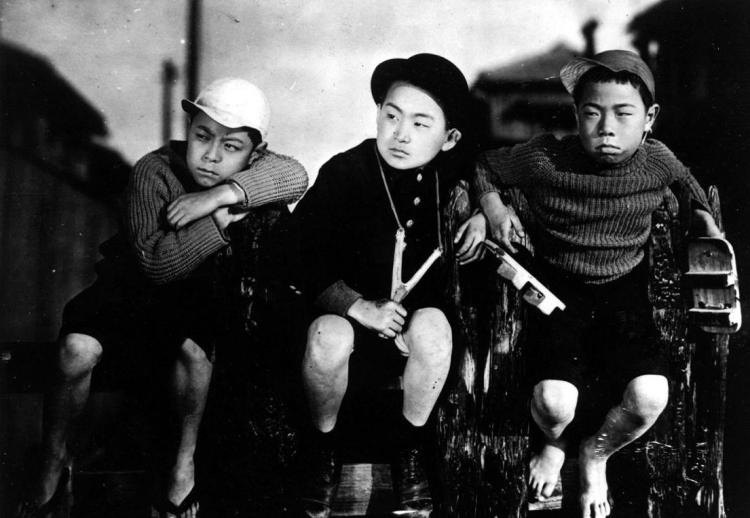
Mr. Yoshi (Tatsuo Saito) has moved his family into a nice house in the suburbs not far from that of his boss, Mr. Iwasaki (Takeshi Sakamoto). His two sons, Keiji (Tomio Aoki/Tokkan Kozo) and Ryoichi (Hideo Sugawara) quickly make enemies of some of the neighbourhood kids and start playing truant from school in order to avoid them. Making an ally of the delivery boy from the local sake shop, Keiji and Ryoichi enlist his efforts to get back at the head bully landing themselves top of the local pack.

However, one of the boys, Taro, is none other than the son of their dad’s boss, Mr. Iwasaki. Furiously engaging in a battle of my dad’s better than your dad, the boys are dismayed to see how their father obsequiously greets his superior. Their faith is well and truly crushed when Mr. Iwasaki invites all the kids over to watch some home movies (cutting edge technology for the time) which features some of the employees goofing off, including Yoshi who enthusiastically gurns and performs silly walks for his boss’ benefit. To Keiji and Ryoichi, Yoshi had been a kind of superhero – austere, but strong, honest and inspiring. Realising he’s just another corporate stooge betraying his true self for commercial gain, the boys are thrown into a period of acute existential confusion.

Yoshi’s mantra dictates that he wants his sons to grow up to become “someone”. Keiji and Ryoichi ironically turn this back on him with the charge that he himself is a “no one”. Yoshi cannot argue with their judgement, he is “no one”, in his own mind at least, and harbours a sense of disappointment in his dull and ordinary middle class life. Checking in with his sons after they’ve fallen asleep, Yoshi offers a different kind of mantra during a speech to his wife in that he hopes neither of his sons become company men like he has. He truly wants them to be “someones” but more than that, he wants them to be their own men, living their lives on their own terms and finding a greater sense of fulfilment than he has been able to in willingly debasing himself to curry favour with a boss he doesn’t particularly like to put food on the table for his family.

Keiji and Ryoichi, in a gesture of defiance, go on a hunger strike to prove that they don’t need their father to humiliate himself daily on their behalf. Yoshi can’t get through to them, his authority is significantly damaged and the boys are stubborn but then again their mother’s rice balls are just so tasty they might eventually be persuaded to abandon their mini protest by the power of a rumbly tum. The lesson they learn is one familiar to Ozu’s general philosophy, that battles must be picked and compromises made in the name of pragmatism even if they may uncomfortable to bear.

Ozu shoots with his characteristic naturalism, allowing the boys to goof off as only children can as they pull faces, dance, and strike poses to poke fun at the other boys but also engage in a strange “resurrection” gimmick rather than a secret handshake to bond with their new frenemines. Forgiveness and reconciliation are all around as the boys learn to accept their slightly less black and white world, embrace their new friends, and stride forward towards their eventual destinies. The children occupy one world, and the adults another but perhaps they aren’t so different after all.


Short scene from the film (English subtitles)

Vestige (面影, Heinosuke Gosho, 1948)

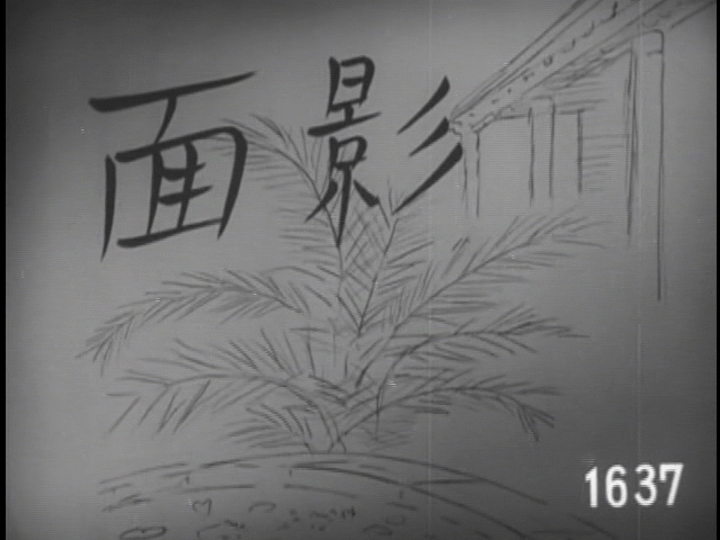
vlcsnap-2017-06-25-03h44m26s663Master of the shomingeki, Heinosuke Gosho goes upscale for the post-war romantic melodrama, Vestige (面影, omokage), even if he goes out of his way to add a layer of expressionistic imagery. Inspired by Gosho’s own experiences, Vestige has an air of melancholy and of frustrated dreams but also of resignation as the two not quite lovers at the centre agree to quell their romantic yearnings and preserve their conventional, bourgeois lives at the expense of greater happiness.
When Kawasaki goes to stay at the seaside retreat of his former professor and mentor Inagaki, he is immediately struck by the professor’s much younger wife, Sachiko, who is the spitting image of his own whom he lost in the war three years previously. Inagaki more or less lives at his spacious seaside villa along with Sachiko, her older sister Fukuko, and Fukuko’s two children. Having married late, Inagaki is a happy man and his home life seems settled and pleasant if conventional.

The couple quickly realise that there’s something deeply sad about Kawasaki, but they attribute it to having lost his wife in such an abrupt manner. Kawasaki is indeed in mourning and nursing feelings of guilt over not having appreciated his wife enough while she was alive – the marriage was an arranged one with a grain of resentment at its core, but still Kawasaki came to be fond of his wife even if his feelings only cemented themselves after she died. Kawasaki keeps his growing feelings for Sachiko to himself though their growing intensity eventually begins to pain him.

Sachiko mainly remains unaware of Kawasaki’s emotional turmoil and she and the professor are secretly hatching a plan to suggest a semi-arranged marriage between Kawasaki and the couple’s niece, Kaoru. Not only insensitive in the extreme, the idea leaves Kawasaki feeling hoodwinked and confused. Kaoru may be approaching marriageable age by the standards of the time but she’s very much a little girl, running around in shorts and pigtails with girlish glee. Even if they don’t intend the marriage right away, Sachiko and Inagaki have almost tried to foist a child bride on a man still eaten up by guilt at not having been a good husband to a woman he only realised he loved after she died. Unsurprisingly, Kawasaki feels even more awkward and begins to make noises about going home.

Like many romantic melodrama players, the relationship between Sachiko and Kawasaki is prefigured by a musical bonding in which Sachiko sings the lyrics to the only song Kawasaki can play on the piano which was taught to him by his pianist wife. Though Sachiko had been happy enough in her marriage, her surfacing feelings for Kawasaki who is, to put it bluntly a more age appropriate partner, are a surprise and a problem. As in Brief Encounter, Sachiko may not have known such violent emotions could happen to ordinary people and now they have arrived there is little she can do about them.

Keeping her true feelings well under-wraps, Sachiko only breaks briefly after Kawasaki has opened the floodgates by confessing his love when she finds the photo of his late wife  and realises that she looks just like her. Hurt and confused, Sachiko is upset by an odd kind of jealousy as she is forced to wonder how much of Kawasaki’s feelings for her are really those for his late wife. Kawasaki seems uncertain, dreaming of Akiko but seeing Sachiko, unable to separate the two women in his mind.

Inagaki, a magnanimous if wounded husband, begins to see a side of his much younger wife that he had not seen before. Fukuko is the first to spot the innocent bond developing between Kawasaki and her sister but trusts Sachiko to do the right thing whilst feeling sorry for lonely piano playing widower. Inagaki truly loves his wife. Proclaiming that if she isn’t happy than he can’t be either, he comforts and protects Sachiko rather than trying to keep her through violence or anger. Despite his original happiness there’s a part of him which feels guilt towards Sachiko for marrying her at such a late age, as if he’s robbed her of her youth. An odd conversation with Kaoru in which he delicately tries to talk to her about the idea of Kawasaki as a husband backfires when he’s forced to realise she’s far too young to talk about this and also that Kawasaki is a much better fit for his wife than his niece. His solution is a painful but pragmatic one, asking Kawasaki to leave he hopes that all of these unwelcome, destabilising feelings can be put back in the box and forgotten about once the intrusive presence of the outsider has been eliminated.

This is, indeed, the conventional wisdom but as in many of his later films Gosho undercuts it through suggesting that it’s never just as simple as sealing off one’s feelings and living happily in the way society dictates. Inagaki might have made the point that “happy” marriages are not always happy – his own was one of ordinary pleasantness which might have grown into a deep love rather than a great romance, but Sachiko’s heart has been opened and being forced to close it so definitively cannot have any other result than breaking it permanently. Resentfully snapping at the menfolk as they agree to shake hands and forget all about all of this love stuff, Sachiko turns her back on her husband weeping at her sister’s confirmation that Kawasaki will never return, only later returning to his side to light his cigarette as he picks up the book titled “A Theory of Happiness” which now seems like a very ironic gift from the sensitive Kawasaki.

Carried along by the lush romantic theme of the folk song which brings together Kawasaki, Akiko, and Sachiko, Vestige is a romantic melodrama of the highest order but Gosho attempts to elevate it by frequent use of expressionist imagery from super imposition and cuts to crashing waves on silent beaches. The war is barely mentioned and little seen – it does not seem to have touched Inagaki’s upperclass life in his idyllic beachside paradise, but the spectre is always there as it haunts Kawasaki with the cruel randomness of his wife’s death mixed with his guilt both about being unable to save her and not having treated her well enough when she was alive. The conventional life wins out, sanctioned bonds are maintained, holding strong against the forces of “irrational” emotion but Gosho imbues the final scenes with a heavier sadness than just that of people sacrificing themselves in service of a social code. These are people already trying to live life along a “theory” of happiness and failing, pretending to find fulfilment in embracing conventionalty but finding only pain and suffering in being unable to acknowledge their true feelings.


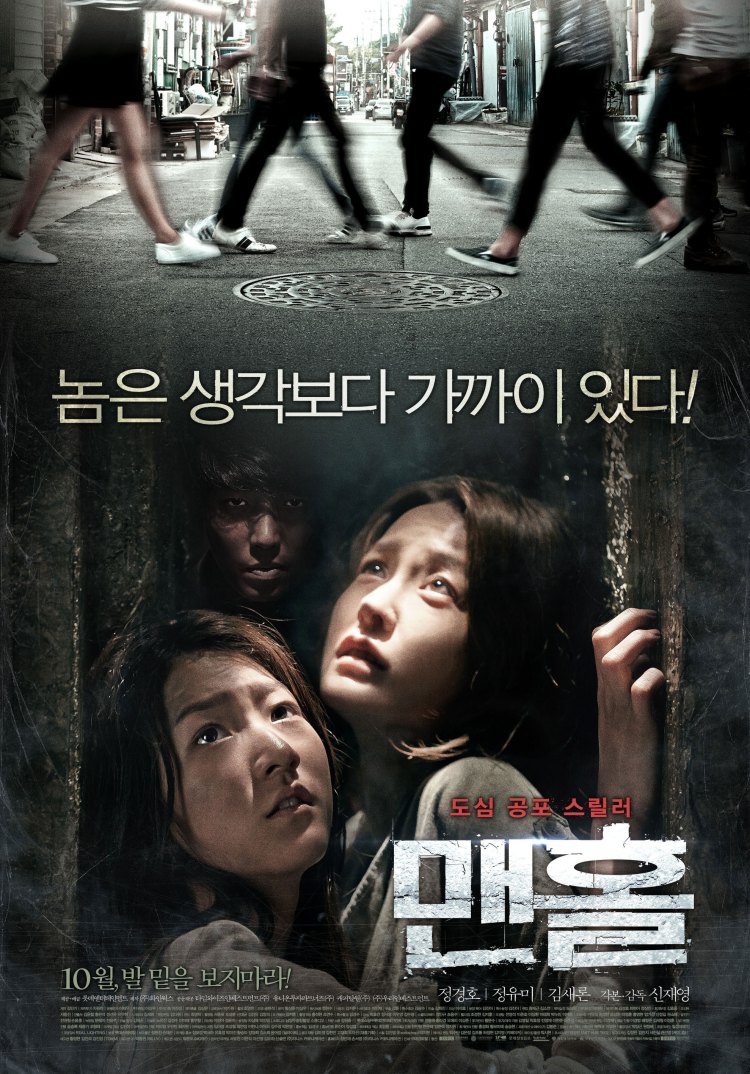
Manhole (맨홀, Shin Jae-young, 2014)

manhole posterFinding the sinister in the commonplace is the key to creating a chilling horror experience, but “finding” it is the key. Attempting to graft something untoward onto a place it can’t take hold is more likely to raise eyebrows than hair or goosebumps. The creators of Korean horror exercise Manhole (맨홀) have decided to make those ubiquitous round discs the subject of their enquiries. They are kind of worrying really aren’t they? Where do they go, what are they for? Only the municipal authorities really know. In this case they go to the lair of a weird serial killer who lives in the shadows and occasionally pulls in pretty girls from above like one of those itazura bank cats after your loose change.
Of course, it’s sort of our first victim’s fault because she’s dared to go out late at night on her own and committed the cardinal sin of shouting at her over protective father on the phone shortly before realising she’s wandered into a horror movie by mistake. The lights start flickering, everything goes wavy and then you’re being pulled down a manhole. Not cool.

Anyway, the real story is about two sisters. Yeon-seo (Jung Yu-Mi) is now the sole guardian of Soo-jeong (Kim Sae-Ron) following the death of their parents and also seems to be harbouring some kind of guilt over an accident that left Soo-jeong permanently deaf. Perhaps a little over protective as a consequence, Yeon-seo instructs Soo-jeong to stay in their apartment and wait for her to get back. Soo-jeong, however, is old enough to push the boundaries and ventures out alone to meet her sister on her way home with an umbrella. Unfortunately, she catches sight of the killer along the way and is soon trapped in the sewer like everyone else, apparently. Yeon-soo tries to call the police but they aren’t interested so she has little choice but to track her sister’s phone and journey underground herself. She’s joined (well, they’re there at the same time) by the father of the first victim (Choi Duk-Moon) who happens to be a former policeman, now in possession of a gun stolen from a friend also set to make a fateful descent at a later point.

Manhole is a very confused film. Unable to decide who its protagonist(s) is (are), it meanders freely between its disparate plot strands without ever managing to build coherent connections between them. Though the sisters are posited as the main element of the story, they take quite a long time to arrive and are then frequently sidelined in favour of other ongoing developments. Their story is undoubtedly the most interesting as it presents an unusual plot device in which they remain unable to communicate verbally during their attempts to escape from the sewers and it’s nice to see sign language used so ordinarily in a genre film, yet even their meagre backstory is painted in broad strokes and through flashbacks once again making it difficult to fully connect with them as they battle the threat in the shadows.

The role of the killer, Soo-chul (Jung Kyoung-Ho), is also a difficult one as he is neither protagonist nor generic threat but given a small amount of flashback backstory delivered in monologue to his victims which only serves to make him a frustrating presence. Manhole seems as if it has a point to make about families in that Soo-chul is a damaged child of a broken home, both trying to avenge himself and regain what he’s lost by, in a sense, “recreating” a family through his kidnappings. Frequent glances towards the prominently displayed portrait of the ideal family contrast with the other relationships in the film – Jong-ho and his hunt for his missing daughter, and the bond between the two sisters. Both of these family units are also missing elements – the sisters who’ve lost their parents and Jong-ho as a lone father. Neither of the parental figures in the film is fully able to protect their charges despite appearing controlling and over protective prior to the incident though no particular reason seems to be offered for this other than praising parental sacrifice in allowing both to fight all out to protect those closest to them.

What Manhole tries to be is a chase film, confining itself to the sewer environment as its crazed killer crawls around it like the literal beast in the shadows, cocooning victims in clingfilm and wearing bug-like bright red night vision goggles. Though exciting enough the frequent cutaways and over reliance on shaky cam disrupt the claustrophobic atmosphere as do the stereotypical jump scares and framing which feel as predictable as the final sequence of a video game in which the idea is to dodge the falling axes. Muddled and inexpertly photographed, Manhole is a disappointing genre exercise which even the generally strong performances of its cast can’t mask. Still, hardcore genre fans may find more to admire in the gore stained darkness of the oddly accessible sewer network and its lizard-like psycho killer.


International trailer (English subtitles)

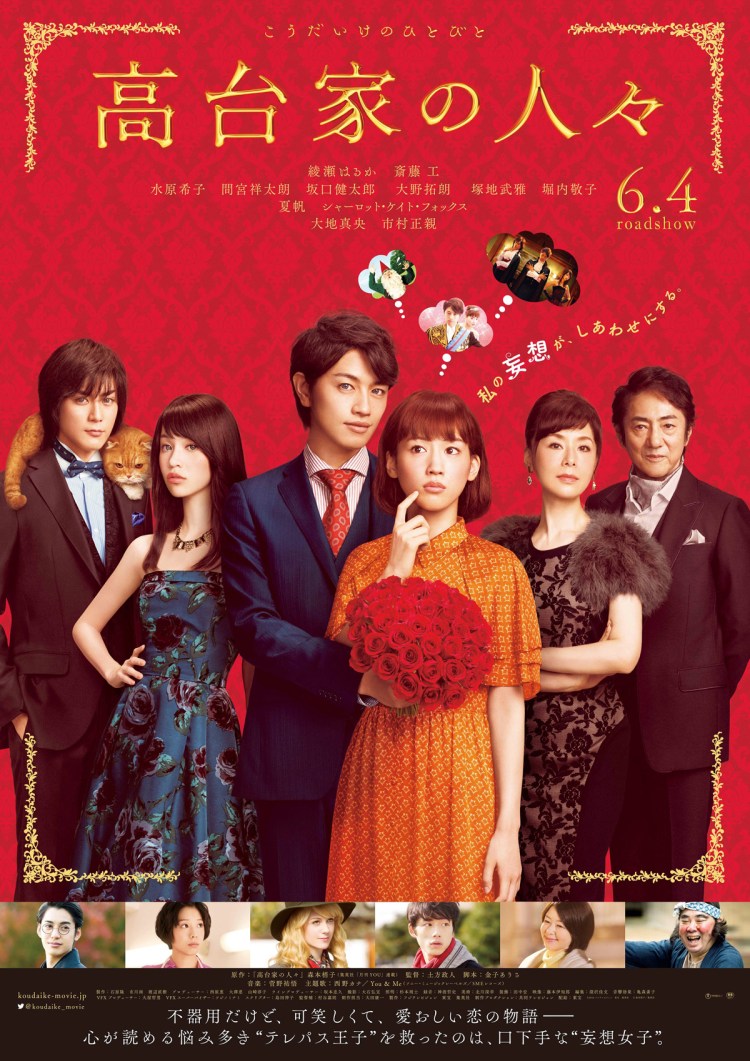
The Kodai Family (高台家の人々, Masato Hijikata, 2016)

kodai family posterFear of “broadcasting” is a classic symptom of psychosis, but supposing there really was someone who could hear all your thoughts as clearly as if you’d spoken them aloud, how would that make you feel? The shy daydreamer at the centre of The Kodai Family (高台家の人々, Kodaike no Hitobito) is about to find out as she becomes embroiled in a very real fairytale with a handsome prince whose lifelong ability to read minds has made him wary of trying to form genuine connections with ordinary people. Walls come down only to jump back up again when the full implications become apparent but there are taller walls to climb than that of discomfort with intimacy including snobby mothers and class based insecurities.

29-year-old Kie (Haruka Ayase) has a dull job as a regular OL in the successful Kodai company. A self-confessed shy person who finds it difficult to talk, Kei spends most of her time alone though she does have a few friends at work. Though Kei’s exterior life may appear dull she has a rich, even overactive imagination which she uses to entertain herself by heading off into wild flights of fancy guided only by a friendly (?) gnome.

Kei’s life begins to change when the oldest son of the Kodai family returns to the office after studying abroad. Mitsumasa (Takumi Saito) is a handsome, if sad-looking man who quickly has all of the office in a flurry of excitement thanks to his dashing good looks and confident stride. Mitsumasa, however, has a secret – the ability to read other people’s thoughts inherited from his British grandmother, Anne. Whilst walking down the corridor and trying to ignore the lewd and avaricious thoughts of some of the ladies (and the worried ones of some of the men now fearing more than one kind of competition), Mitsumasa is treated to one of Kei’s amusing fantasies and is quickly smitten.

For Kei who finds voicing her true feelings difficult, Mitsumasa’s ability seems like the perfect solution. Finally, someone who will just understand her without the need for conversation. However, what Kei hasn’t considered is that a deeper level of intimacy is being asked of her than she’d previously anticipated. From the merely embarrassing to the tactless and tasteless, it is no longer possible to withhold any part of herself other than by an exhausting process of trying to close her mind down completely. Mitsumasa is used to this particular phenomenon in which his enhanced powers of communication only result in additional barriers to connection. Somewhat closed off himself, resigned to the fact he’s going to “overhear” things he’d rather not know, Mitsumasa has made a point of keeping himself aloof from ordinary people who, once they know about his abilities, find him suspicious and threatening.

Yet Mitsumasa’s telepathic powers are not the only obstruction in this fairytale love story. Kei already can’t quite believe what’s happening is real and struggles with the idea someone like Mitsumasa might seriously be interested in her. Though Mitsumasa’s brother (Shotaro Mamiya) and sister (Kiko Mizuhara), who share his ability, are broadly supportive (and equally entertained by Kei’s innocent and quirky flights of fancy), his mother (Mao Daichi) is anything but. Kei’s prospective mother-in-law starts as she means to go on by mistaking Kei for a new maid and then proceeding to further erode her confidence by pointing out that she knows nothing about this upper class world of balls and tennis and horse riding.

When it all becomes too much, Kei does what she always does – retreats to safer ground. Papering over her cowardice with the weak justification that she thinks she’ll only make Mitsumasa miserable, Kei backs away from the idea of baring her whole, unfiltered soul even if she knows it will cost her the man she loves and the ending to her real life fairytale.

Though charming enough and filled with interesting manga-inspired effects, Kodai Family never makes the most of its interesting premise, falling back on standard romantic comedy tropes from parental disapproval to predictable misunderstandings. The irony is that Mitsumasa and his siblings are so busy listening to the thoughts of others that they often can’t hear their own and are so deep in denial that they need a third-party (telepathic or not) to push them into realising how it is they really feel. This is a world of double insulation, in which the walls are both thick and thin, but there is a way a through for those brave enough to kick them down by baring all for love, snobby mothers be damned.


Original trailer (English subtitles)

Doberman Cop (ドーベルマン刑事, Kinji Fukasaku, 1977)

Doberman cop J DVD coverAll things considered, a live pig is a rather insensitive gift to present to your local police station, though any gift at all might be considered in appropriate even if offered by a well meaning colleague keen to help out when a horrific murder may be connected to his missing person case. By 1977 Kinji Fukasaku had made a name for himself through the wildly successful “jitsuroku” or “true record” genre of yakuza movies kickstarted by his own Battles Without Honour and Humanity. Doberman Cop (ドーベルマン刑事, Doberman Deka) is then quite an odd move as its brings him back to the looser, exploitation leaning B-movie action which featured heavily in the earlier part of his career and which the “jitsuroku” movement was set on displacing. Fittingly enough, Doberman Cop also sees Fukasaku reuniting with the frequent star of those early films – Sonny Chiba, now considerably older but still an impressive action star willing to put himself in danger to achieve the heart stopping stunts his fans had come to expect.
Chiba plays Okinawan “crazy cop” Kano, the stranger in town currently on a mission to find a childhood friend at the request of her sickly priestess mother. A body has been discovered, so horribly charred that visual identification is not possible but based on the clues found in the room the police are convinced the woman is Kano’s missing person, Yuna, who had been living as a prostitute under another name. Kano is not convinced, the priestess has conducted rituals which suggest her daughter is alive and there’s something not quite right about this case which the police have attributed to a spate of serial killings targeting prostitutes in the Tokyo area. An encounter with a shady yakuza turned music promoter brings Kano into contact with Miki (Janet Hatta) – an aspiring singer who bears a striking resemblance to the missing Yuna.

Doberman Cop is, loosely, based on the manga by Buronson. Part of the “gekiga” movement which prided itself on gritty, adult stories, Doberman Cop owed much to Dirty Harry with its sarcastic, tough as nails policeman armed with a .44 Magnum and a rock hard desire for justice. Fukasaku’s Kano is reimagined as a genial country bumpkin, a toughened farm boy in a straw hat displaced in the Tokyo jungle. Turning up like a strange relative, Kano has brought along a local delicacy in the form of a live pig he offers to the Tokyo police precinct with the promise that all they need to do is snap its neck and light the barbecue. Unsurprisingly, the city policemen decline his polite offer leaving him trailing the squealing piggy around with him like a burdensome sidekick.

Kano’s Yuna is not the only young woman of Okinawa fetching up in the mainland capital in search of a “better” life, but finding only failure and despair. The country detective alienates the city police with his arcane divinatory ritual which involves tipping out a large bag of small seashells and counting them to ascertain the answer to a binary question, but his methods convince him than Yuna is still alive while another Okinawan woman is dead. That a woman from his island has met such a grim end is of no small regret to Kano, be she Yuna or not, and his quest is one of vengeance for both women ruined by the false promise of city life, tempted from simple village existence by bright lights and urban sophistication.

Miki’s path has followed this pattern to the letter. City life turned her into a prostitute and drug addict, eventually running all the way to New York but failing to escape her ongoing despair. Running into a similarly depressed former yakuza, Hidemori (Hiroki Matsukata), who falls in love with her, reawakens her desire for life, and becomes determined to rescue both of their futures by turning her into a singing star, Miki is at a turning point as she prepares for TV stardom as the winner of a signing competition while Hidemori backtracks to his gangster days to make it happen.

Kano begins to piece things together and comes to realise his worst fears are true. Nevertheless, if he could he’d take Yuna home with him to the village to forget her city ordeal rather than hand her over to the Tokyo police to face justice whatever she might have done. Though the tone is largely a comic one, laced with Fukasaku’s characteristically bleak sense of humour, the conclusion is just as melancholy as any of his other sad stories of broken men as Kano is forced to conclude that whatever the facts, the Yuna who left the village is no longer in this world. Putting a lead on his piggy friend, he resigns himself to leaving the city to take care of itself while he returns home, his mission a failure.

Necessarily less serious than Fukasaku’s other work of the ‘70s, Doberman Cop is a return to the nonsensical B-movie action fests of the past which leaves ample room for Chiba to show off his still potent skills including the famous scene of him abseiling down a tall building to bust into a hotel room where Miki is being held captive by a crazed yakuza. The country bumpkin adapts to this part of city life well enough, karate kicking bad guys and loudly disapproving of drug peddling misogynists (not to mention “righteous” serial killers hellbent on “cleansing” the city of sleaziness). Bonding with the “salt of the earth” residents of the lower class neighbourhoods, including a stripper who takes a fancy to the pig during her routine, and a member a biker gang unfairly hauled in as a suspect, Kano concludes that city life is not all it’s cracked up to be much as he comes to admire these basically “good” people who have gone out of their way to help him for mostly altruistic reasons. Still, the world is a darker place for Kano following his city adventure, and all he can do in the end is return to the relative safety of a sunny Okinawan village, pig in tow.


Available now from Arrow Video!

Original trailer (no subtitles)

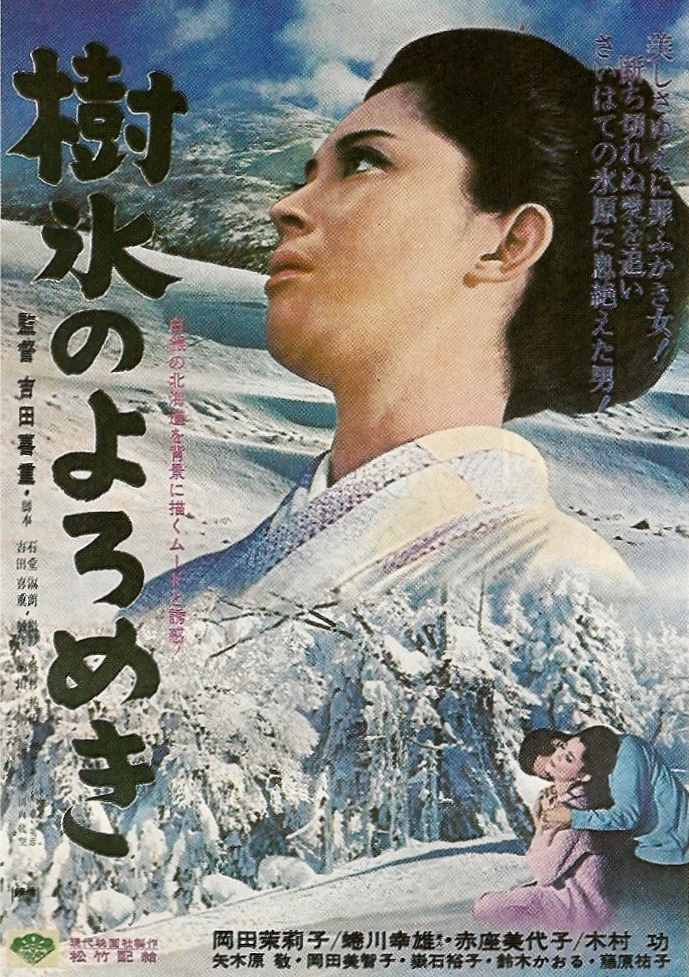
Affair in the Snow (樹氷のよろめき, Kiju Yoshida, 1968)

affair in the snow posterKiju (Yoshishige) Yoshida, along with his wife – the actress Mariko Okada, was responsible for some of the most arresting films of the late ’60s avant-garde art scene. So called “anti-melodramas”, many of Yoshida’s films from this era took what could have been a typical melodrama narrative and filmed it in an alienated, almost emotionless manner somehow reaching a deeper level of an often superficial and overwrought genre. Affair in the Snow (樹氷のよろめき, Juhyo no Yoromeki) is, in essence, the familiar story of an unreasonable love triangle but in Yoshida’s hands it becomes a melancholy yet penetrating examination of love, sex, and transience as the central trio attempt to resolve their ongoing romantic difficulties.

Yuriko (Mariko Okada) works in an upscale beauty salon in Sapporo and is in a relationship with a moody professor, Akira (Yukio Ninagawa), which seems to have run its course. The couple decide to take a trip to figure things out but it all goes wrong when the car breaks down and they’re marooned together in an unfamiliar environment. Akira’s mood swings and jealousy seem to be the main motivators for Yuriko’s dissatisfaction along with his desire for rough and ready sex over genial romance. Fearing she may be pregnant, Yuriko is not sure what to do – especially given that Akira is not particularly supportive.

Running from Akira, Yuriko gets back in touch with an old friend and former lover, Kazuo (Isao Kimura), who she feels can be relied upon to help her whatever she decides to do in this admittedly difficult situation. Yuriko and Kazuo were together for a short while and still share a deep emotional connection but their relationship was eventually frustrated due to Kazuo’s physical impotence. Eventually Akira catches up with the pair and tries to win Yuriko back as the three work through their various problems in the snow covered mountains of Hokkaido.

For Yuriko the two men represent very different pulls – towards the spiritual and the physical. Her relationship with Akira has obviously long gone sour, the two aren’t suited or happy in each other’s company. All they have is the physical though, it seems, this is not enough for Yuriko. Yuriko and Kazuo, by contrast, work well together, complement each other and only exert positive energy but their inability to enjoy a full relationship (which it seems they would both like) is the reason their previous affair failed.

Yuriko needs, in a sense, both men though for the present time her desire is to be rid of Akira with his emotional volatility, cruelty, and possessiveness. Though the relationship may be been on its way out, Akira’s jealousy is inflamed by the deep connection Kazuo shares with Yuriko – bringing home the the fact that his relationship with her is firmly based in the physical. As Yuriko and Kazuo grow closer, Akira becomes increasingly unhinged as it’s he who’s now rendered “impotent” in the quest to win back his former love. Cavorting with the young hippies at the ski lodge, Akira tries to make Yuriko jealous and Kazuo irritated but only succeeds in making himself look ridiculous. Eventually, Yuriko is goaded into admitting that all Akira has ever known of her is superficial, whereas Kazuo has known her soul. Yet even so the love she shares with Kazuo seems doomed to fail, tinged with death as she finds herself blinded and obscured by snow filled fog, screaming into a void.

For Yoshida all love fails, as Kazuo says – no love can last. The central trio are lost and purposeless yet seeking a connection they never seem to find. Yoshida’s beautiful cinematography captures their emotional blankness through the freezing cold snow-covered landscape and infinite expanses of emptiness in which no one can reconcile everything that they want with everything that they are. Death lurks everywhere as skiers pulls bodies past romantic walks and would-be-lovers collapse in exhaustion as if trying to cross the artic plains in search of a lost friend.

Shooting through mirrors Yoshida shows us a collection of people unwilling to look directly either at themselves or at others, missing the final climactic event in their fierce determination not to engage. Lost in a fog, nothing is clear as the lovelorn and lonely seek direction only to remain locked inside themselves unable to find the true and complete connection they each seek.


Original trailer (no subtitles)