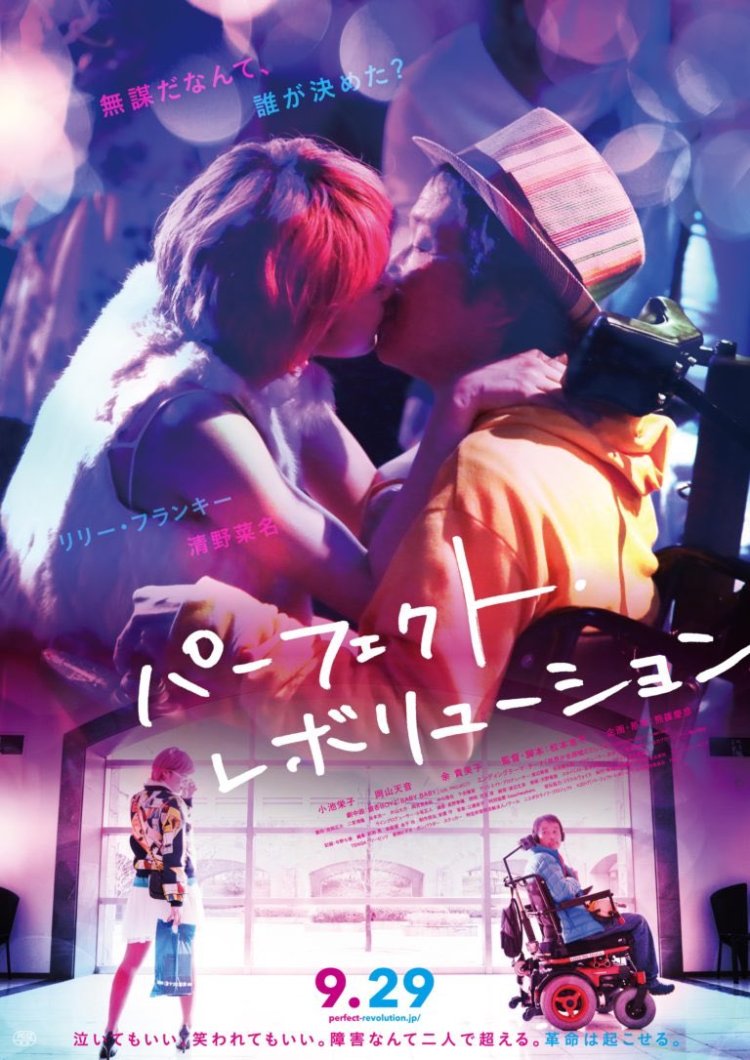
 If there is one group consistently underrepresented in cinema, it surely those living with disability. Even the few films which feature disabled protagonists often focus solely on the nature of their conditions, emphasising their suffering or medical treatment at the expense of telling the story of their lives. Junpei Matsumoto’s Perfect Revolution (パーフェクト・レボリューション) which draws inspiration from the real life experiences of Yoshihiko Kumashino – a Japanese man born with cerebral palsy who operates a not for profit organisation promoting awareness of sexual needs among the disabled community, makes a criticism of the aforementioned approach a central pillar of its narrative. Unlike many on-screen depictions of disabled people, Perfect Revolution attempts to reflect the normality of life with a disability whilst never shying away from some of the difficulties and the often hostile attitude from an undereducated society.
Kumashiro (Lily Franky), a man in his mid-40s, was born with cerebral palsy and has been using a wheelchair for most of his life. An activist for disabled rights, he’s written a book about his experiences and is keen to address the often taboo subject of sexuality among disabled people. Kumashiro has long since given up on the idea of romance or of forming a “normal” relationship leading to marriage and children but his life changes when a strange pink-haired woman barges into his book signing and demands to know why he’s always talking about sex but never about love. Kumashiro thinks about her question and answers fairly (if not quite honestly as he later reveals) that he doesn’t yet know what love is but is just one of many hoping to find out. This impresses the woman who approaches him afterwards and then refuses to leave him alone. Ryoko (Nana Seino), asking to be known as “Mitsu” (which means “honey” in Japanese – a nice paring with “Kuma” which means “bear”), suddenly declares she’s fallen in love with Kumashiro, whom she nicknames Kumapi.
The elephant in the room is that there is clearly something a little different about Mitsu whose brash, loud manner runs from childishly endearing to worryingly reckless. Mitsu is a sex worker at a “soapland” (a brothel disguised as a bathhouse in which the customer is “washed” by an employee) and sees nothing particularly wrong in her choice of occupation though recognises that other people look down on her because of it – something which she doesn’t quite understand and is constantly exasperated by. Perhaps offensively, she sees her own position as a woman (and a sex worker) as akin to being “disabled” in the kind of social stigma she faces but does not identify as being disabled in terms of her undefined mental health problems beyond accepting that she is “different” and has not been able to integrate into “regular” society. Nevertheless, she believes herself to be at one with Kumashiro in his struggle and is determined to foster the “perfect revolution” with him to bring about true happiness for everyone everywhere.
Thankfully Kumashiro is surrounded by supportive friends and family who are keen to help him manage on his own rather than trying to run his life for him but he does regularly encounter less sympathetic people from a drunken couple who decide to lay into him in a restaurant to a well meaning religious woman who runs after Kumashiro to tell him how “inspired” she feels just looking at him before trying to thrust money into his purse. Mitsu’s problems are less immediately obvious but her loud, volatile behaviour is also a problem for many in conformist Japan as is her straightforwardness and inability to understand the rules of her society. Mitsu has no one to look after her save a fortune teller (Kimiko Yo) who has become a surrogate mother figure, but it is a problem that no one has thought to talk to her about seeing a doctor even when her behaviour turns violent or veers towards self-harm.
Despite their struggles to be seen as distinct individuals, both Kumashiro and Mitsu are often reduced simply to their respective “differences”. Kumashiro does a lot of publicity for his book but is exasperated by well-meaning photographers who ask, tentatively, if they can photograph just his hands – literally reducing him to his disability. An “inspirational” TV documentary strand is also interested in interviewing Kumashiro and Mitsu, but only because of the “unusual” quality of their relationship. It quickly becomes apparent to Kumashiro that the documentarians aren’t interested in documenting his life so much as constructing a narrative around “damaged” outsiders that viewers can feel sorry for. Fearing that Kumashiro looks too cheerful, the producers ask him to remove his makeup and colourful clothing whilst explaining to Mitsu that they don’t want her to talk about sex work in a positive manner and would prefer it if she used a more acceptable euphemism rather than calling it what it is. Mitsu doesn’t realise she’s been had, but Kumashiro leaves the shoot feeling humiliated and annoyed.
Matsumoto does his best to present the issues sensitively, never patronising either Kumashiro or Mitsu but depicting them as real people with real faults just living their lives like everybody else. Neatly avoiding the classic Hollywood, happy ever after ending he emphases that there is still a long way to go but it is unfortunate that Mitsu’s situation is treated more lightly than it deserves and that her eventual desire to get treatment is undermined by the film’s liberated ending which is, nevertheless, inspirational as Kumashiro and Mitsu both commit themselves to the “perfect revolution” of a better, happier future both for themselves and for all mankind.
Screened at Raindance 2017.
Original trailer (no subtitles)