Father of the Kamikaze (ゝ決戦航空隊, Kosaku Yamashita, 1974)

By the mid-1970s, Japanese cinema at least had become much more comfortable with critiquing the wartime past, considering it from a greater distance than the often raw depictions of war in the films from the previous two decades. 1974’s Father of the Kamikaze (ゝ決戦航空隊, A Kessen Kokutai), however, is among the few to skew towards the nationalist rather than the ambivalence or simple anti-war messages of other similarly themed films of its era. 

Starring ninkyo icon Koji Tsuruta who served in the air force himself, the film is a kind of biopic dedicated to Admiral Onishi who oversaw the kamikaze operations at the end of the war. As is pointed out, Onishi had been against the war in general terms even before its inception and is originally against the philosophy behind the kamikaze squadrons but as Japan’s fortunes continue to decline he becomes its biggest advocate citing a kind of sunk cost fallacy that it would be in someway unfair to the men that have already died to surrender while insisting that suicide missions are the only feasible way to turn the tide because one kamikaze could take out a hundred men by destroying battleships singlehandedly. 

The film in part attributes this extreme solution to the prevailing with your shield or on it philosophy of the contemporary society which placed extreme shame on the act of being taken prisoner. In the prologue that opens the film, a squadron of downed pilots whose heroic deaths have already been recorded is discovered alive in an American prisoner of war camp but as being a prisoner of war is so shameful and would reflect badly on the military, the decision is taken to fix the books by sending the men on a mission from which they are not intended to return. Onishi is opposed to the plan, he asks why they can’t find a way for the men to live, but the decision is already made. In any case, he describes the action of a suicide mission as a “beautiful ideal” even when insisting that a war cannot be fought in that way not least for purely practical reasons in that they do not have the resources to be wilfully sacrificing skilled pilots and their planes. 

Having come round to the idea, however, Onishi is a crazed zealot who cannot accept the idea of surrender and even goes so far as to barge into a cabinet meeting to urge ministers against a truce even though the war is clearly lost. To his mind, the only way to honour the sacrifices of those who’ve died is to fight to the last man. Kozono (Bunta Sugawara), another officer opposed to the kamikaze, eventually meets a similar fate in refusing to obey the order to lay down his arms and ending up in a psychiatric hospital. His objection had partly been that it’s wrong to turn men into ammunition, but also that the kamikaze project is itself defeatist and self-defeating when there are men such as himself who are committed to fighting on.  

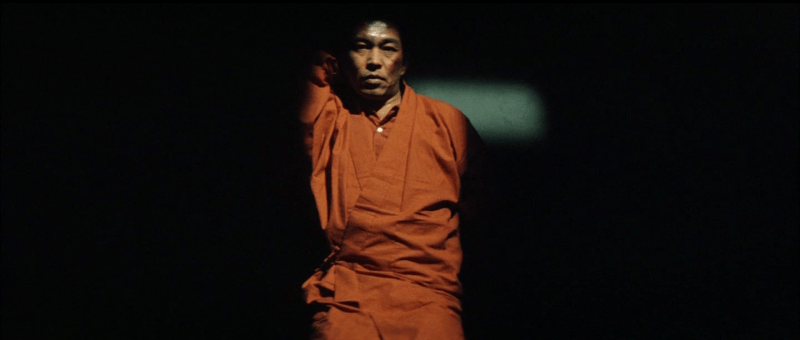
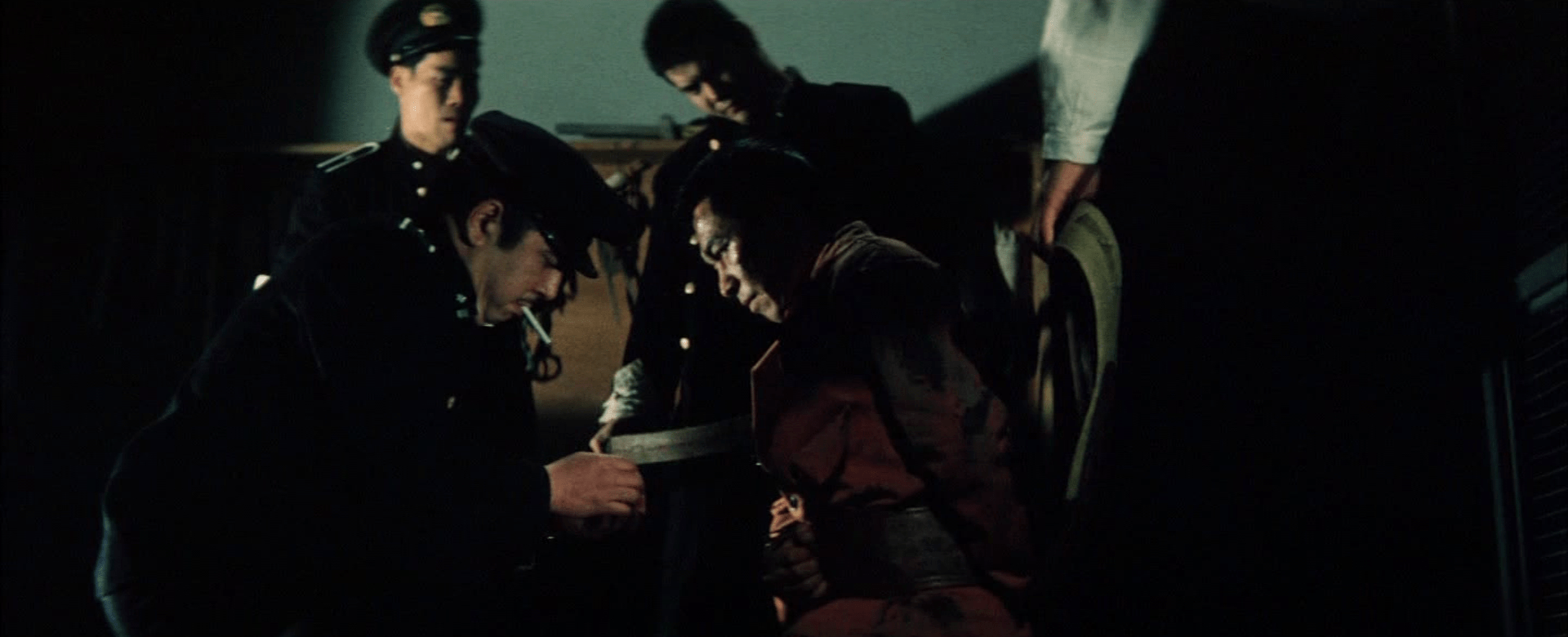
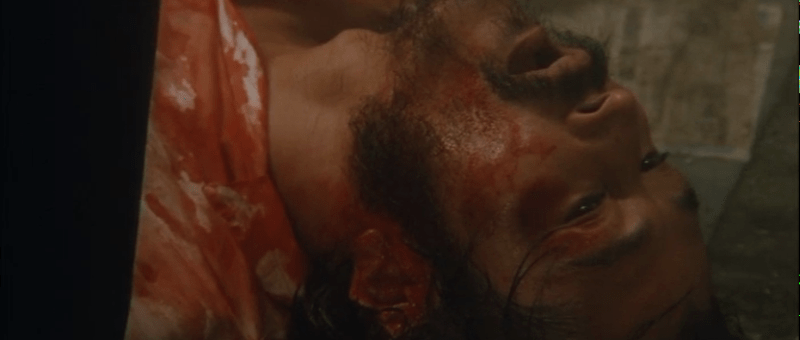
In this the film leans into the image of militarism as a death cult in which dying for the emperor is the only noble goal of the whole imperial expansion. In its eventual lionising of Onishi’s image, his bloody suicide atop a white cloth resembling the flag of Japan while his parting words scroll across the screen in text, it does not shy away from his more problematic aspects in which he fails to object to a request from a junior officer that soldiers should be allowed to test their swords on American prisoners of war, roundly telling a subordinate who breaks protocol to insist that such a thing is not only morally wrong but will ruin their international reputation that he has no need to think of consequences because Japan will win this war. He claims to want to find a way of defeat that will satisfy the living and the dead, but in reality cannot accept it not least in that it would entail admitting that he sent 2600 young men to their deaths for nothing. 

Tsuruta brings the same level of pathos to his performance as he did in playing conflicted yakuza stoically committed to a destructive code, but there’s no getting away from the fact that the film focuses mainly on Onishi’s personal suffering as a man who sent other men to die for a mistaken ideal and then could not admit his mistake offering an apology only in his death in which he urged the young people of Japan to work to rebuild the nation in the name of peace. In switching to the present day and showing us Onishi’s dilapidated former residence and in fact the room in which he died with its tattered shoji and peeling paintwork, he veers towards the nationalistic in uncomfortably reinforcing the nobility of his death rather than the folly of war or absurdist tragedy of the kamikaze programme. Adopting a quasi-jitsuroku approach with frequent use of onscreen text, a narratorial voiceover, and stock footage of kamikaze in action Yamashita may portray war as madness in Onishi’s crazed devotion but cannot help depicting it as a “beautiful ideal” even in the undignified violence of Onishi’s ritual suicide. 


The Cornered Mouse Dreams of Cheese (窮鼠はチーズの夢を見る, Isao Yukisada, 2020)

It’s quite a potent image somehow, a mouse caught in a trap unable to reach out and touch the cheese they’ve risked their life for yet continuing to dream of it as if nothing else really existed. Perhaps love is much the same, at least according to a young woman who warns against falling in love too deeply worrying that in the end you won’t be able to keep it together and so will fall apart. Adapted from a popular Boys Love manga by Setona Mizushiro, Isao Yukisada’s The Cornered Mouse Dreams of Cheese (窮鼠はチーズの夢を見る, Kyuso Wa Chizu No Yume Wo Miru) is in someways in dialogue with his earlier tale of triangulated love between two women Luxurious Bone, if sharing some of that film’s perhaps outdated attitudes towards sexuality. 

The titular mouse is office worker Kyoichi (Tadayoshi Ohkura) who is halfheartedly having an affair with a colleague seemingly just because he can. Unbeknownst to him, his wife has hired a private detective who just happens to be an old friend from university, Wataru (Ryo Narita). Wataru warns him that he’s got pictures of him and his mistress but agrees not to tell his wife, if Kyoichi agrees to accompany him to a hotel for some low level intimacy. The abruptness of the overture seems to hint that the two men had some kind of history in university but this appears not to be the case and Kyoichi continues to struggle with his sexuality partly it seems out of a degree of self-loathing that convinces him he’s not the sort of person anyone should love.

In Luxurious Bone, the problem had been that the two women could not quite accept the validity of their desire for each other and instead ended up having vicarious sex with the same guy. Something similar occurs between Kyoichi and Wataru each in their own way unable to accept the way they feel. Kyoichi repeatedly states that he doesn’t want to cause someone else pain but in fact hurts everyone around him because of his own inability to reckon with his feelings. He continues to womanise, but eventually asks Wataru to move into the grey industrial bachelor pad he gets when his marriage breaks down while keeping him at arm’s length. Wataru is jealous in a direct sense, resenting Kyoichi’s various girlfriends, but also on deeper level lacking faith in his homosexuality or at least ability to accept it fearing he will always in the end choose to be with a woman. 

Both men are imprisoned by an internalised homophobia, Kyoichi most obviously in rejecting his desire for Wataru. “A straight guy can’t handle it” he tells him in an ironic choice of words, earlier having told him that guys like him belonged “in another world”. The film seems to present Kyoichi’s sexuality as a binary choice, men or women, precluding the idea that he might simply be bisexual while inviting the inference that his womanising is an attempt to mask his latent homosexuality and that he is in fact living a lie in betrayal of himself in denying his desire for Wataru. But then Wataru is consumed by insecurity, as if on some level believing he is inherently inferior to a woman and that Kyoichi will always “choose” to be straight while simultaneously certain that he does in fact return his feelings. He tells him that his problem is that he passively accepts love from others but in the end doesn’t trust it and continues to look for it in the next person who shows any interest in him, but it seems Wataru doesn’t have much faith in love either pulling away just as Kyoichi draws closer and unable to accept the validity of his love for him. 

The film maintains some of the more frustrating aspects of BL literature in that it never really considers why Kyoichi rejects his same sex desire nor does it address what the potential complications of his life maybe if he were fully to accept his sexuality and attempt to live openly with Wataru. On the other hand, it perhaps lessons the impact of the darker elements of the interplay between the two men in which Wataru effectively stalks Kyoichi and then blackmails and bullies him into sex which the film justifies on the basis that Kyoichi must on some level want to be liberated from his repressed desire while Kyoichi in turn manipulates and tortures Wataru through his womanising and reluctance to enter a full sexual relationship even while living together. The film’s ambiguous closing scene in which Kyoichi sits on Wataru’s stool and places his yellow ashtray, looking oddly like a wedge of cheese, on his grey coffee table the only splash of colour in his exquisitely decorated yet desolate grey room may also uncomfortably hint that their love is always impossible because it is a love between two men rather than accepting that the only barriers to it lie in internalised homophobia and emotional vulnerability. Even so it is a fairly touching love story of a man learning to accept his sexuality even if in the end it leads to a re-imprisonment rather than a liberation. 


Original trailer (English subtitles)

Beast Alley (けものみち, Eizo Sugawa, 1965)

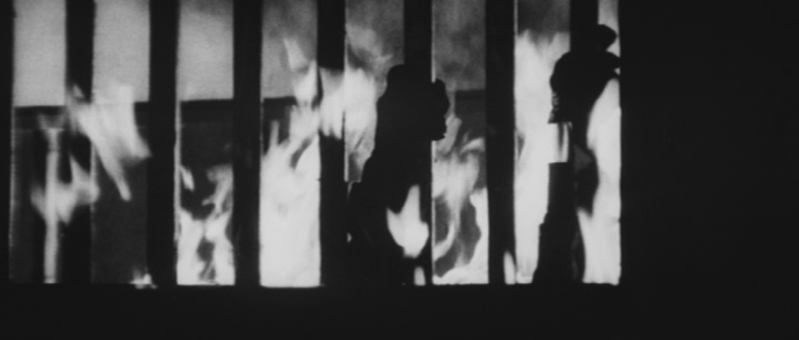
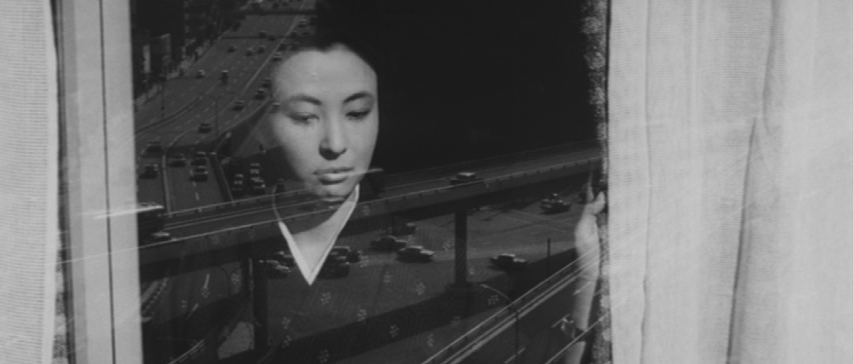
In the opening title sequence of Eizo Sugawa’s Beast Alley (けものみち, Kemonomichi), a thick blob of inky blackness gradually expands over an aerial view of the city until it obscures it entirely. The title card which then appears is written in plain white, but will reappear at the film’s conclusion this time ashen as if it too had been singed by the deeply ironic flames with which the film ends. Based on a novel Seicho Matsumoto and scripted by The Beast Shall Die’s Yoshio Shirasaka, the film similarly takes an incredibly cynical view of the modern post-war society in which it is revealed the militarists are still basically in charge and presiding over a deeply corrupt social order. 

The big bad, Kito (Eitaro Ozawa), says as much when he states the need for reforming the nation’s “rotten political system” by which he means post-war democracy. Kito made his made his money doing deeply dodgy things in Manchuria in addition to running an exploitative coal mine in Japan. Now mainly bedridden, he basically runs the country as a far-right political fixer working in tandem with big business and the yakuza who have traditionally been big supporters of conservative and nationalist forces. Early on we see one of his underlings negotiating with politicians to ensure that Taiyo Roads will be hired be hired for a large scale construction project planning to put highways all the way through Tokyo. As we later discover, he’s prepared to go to great lengths in order to achieve his goal, going so far as to have a sex worker murdered to implicate the uncooperative CEO of a rival construction film into resigning by threatening to frame him for the crime so they can install their stooge in his position. 

It’s into this world that everywoman Tamiko (Junko Ikeuchi) is drawn while working as a hotel maid at a traditional Japanese inn. Trapped in a bad marriage to a man who is also bedridden yet still attempts to rape her when she returns home to find him in bed with the housekeeper, Tamiko longs for escape and is therefore ripe for the picking when approached by Kotaki (Ryo Ikebe), the manager of an upscale Western hotel, to join him in an unspecified enterprise which will apparently make her very rich. The only catch is that she will have to “get rid” of her “dependent”, which she probably wanted to do anyway, by burning down her house with him inside it. Once she’s done this, there is no turning back for her even if she had not developed complicated feelings for Kotaki who is both her salvation and damnation. 

Tamiko’s husband had failed to give her the comfortable life that he had promised, something which she thinks Kotaki can deliver even if it requires her to become the plaything of Kito whom does she actually seem to like even if aware of the precarity of her position and still in thrall to Kotaki. Leaving the hotel so abruptly was however a strategic error as it arouses the suspicious of (originally) earnest cop Hisatsune (Keiju Kobayashi) who quickly realises that Tamiko set the fire to kill her husband. Though he seemed to be motivated by justice, Hisatsune too is soon corrupted explaining to Tamiko that he has become cynical and jaded. Years of police work have shown him that true criminals know how to break the law and get away with it so he can’t do anything about them, but “good” people, like he implies Tamiko, are pushed into crime by desperation and are easily caught. Tamiko wields her sexuality against him by agreeing to a tryst, though when it doesn’t go to plan he tries blackmail and then rape before she, ironically, manages to escape from his bungled crime. 

Hisatsune’s corruption is gradual and self serving. He starts with suspicion, tailing Tamiko in the interests of justice but also because he desires her, before stumbling on the conspiracy, putting the pieces together, attempting to use them for his own gain and trying to blow a whistle mostly out of resentment. Kito’s reach is all encompassing. Hisatsune is warned off investigating certain aspects of the crime by his senior officers and is then fired on Kito’s instructions for fiddling his expenses after harassing Tamiko. He tries to give his findings to his boss but it goes nowhere and then tries the press but is given the brush off, the editor his reporter friend refers him to gently implying he’s just a crank with an axe to grind. Of course, it turns out that the reporter is already in league with dodgy lawyer Hatano (Yunosuke Ito) who is Kito’s right-hand man. 

The connections between the three men, Kotaki who was once a communist, Hatano, and Kito go back to Manchuria and the corruptions of militarist era which it becomes clear has never really ended. Kito has only one rival and it’s another faction of the conservative ruling party who are probably just waiting for him die. Attempts are made on his life and they don’t go well for those who make them. Even if Hatano hoped to simply inherit an empire he, as he points out, put in much of the work to build he is sorely mistaken while Tamiko may intellectually understand that Kito’s death would place her in a precarious position but carries on regardless. “You never know who will betray you in this world” Kotaki laments, echoing Kito’s later claim that his Buddhist statues are the only ones will never betray him even as sleeps next to a statue of Aizen Myo whom he ironically claims protects mankind from their lust and desire. 

It could be said that desire is Tamiko’s undoing, but as Hisatsune had suggested perhaps you couldn’t blame her for longing to be free of the bedridden husband who had not delivered what he promised her. As she said, she was doing what could to survive even if you’d think she’d know putting on a ring taken from the finger of a murdered woman is akin sealing your own fate. Sugawa shoots with a noirish sense of dread, tracking Tamiko with her coat drawn up around her face as she tries to leave the scene of her crime, and makes the most of his fiery imagery before ending on a note of cynical laughter amid the inescapable hell the of post-war society. 


Original trailer (English subtitles)

Eighteen Years in Prison (懲役十八年, Tai Kato, 1967)

Genre star Noburu Ando had a certain cachet in that he had been a yakuza prior to becoming an actor. He had in fact been the head of his own gang which at its high point had over 300 members and controlled much of the lucrative Shibuya nightlife scene. His first onscreen appearance was in a gangster movie in which he played himself. Rather than the jitsuroku epics he would later become associated with, Tai Kato’s Eighteen Years in Prison (懲役十八年, Choueki Juhachi Nen) essentially casts him in a ninkyo role as a noble if compromised former captain of the kamikaze squad who finds himself caught between the contradictions of post-war Japan and the American occupation. 

Indeed, in this as in many other yakuza movies set during the immediate post-war era, the Americans are really just the biggest gang. Suffering with survivor’s guilt, Captain Kawada (Noboru Ando) has set up an association together with former comrade Tsukada (Asao Koike) to look after he dependent relatives of men who fell in war. To do this, he has to resort to criminality raiding American boats for supplies such as sugar and rice which he redistributes to war widows and their families. His ultimate goal is amassing enough money to buy a patch of land in the town centre and do away with the black market which exploits the vulnerable replacing it with a legitimate market so the surviving family members can set up businesses to support themselves. 

Around this time, the association manages to track down the younger sister of one of their men who died as a kamikaze, Hisako (Hiroko Sakuramachi ), and discovers she is living in desperation having lost the family home to aerial bombing. As her mother is seriously ill and she needs money for food and medical treatment, Hisako contemplates turning to sex work and is almost assaulted by a gang of drunk and abusive American servicemen from whom she is rescued by a passing Kawada. This incident makes plain his resentment towards the occupation and sense that it is the American influence that is wilfully suppressing the efforts of the Japanese people to rebuild their society. It’s this resentment that lends a note of justification to Kawada’s decision to rob a nearby factory of valuable copper wire to get the money to save Hisako’s mother thereby saving her from falling into sex work and thereafter helping to achieve their ultimate goal of building the market. The raid, however, goes wrong. Kawada sends an injured Tsukada back to the association and is arrested.

In prison he discovers only more corrupt authority in which guards beat and torture prisoners, just another bigger gang. He finds out that block warden Hanya (Tomisaburo Wakayama) is actively accepting bribes and in cahoots with some of the inmates that attempt to terrorise newbies to the point that one attempts suicide by swallowing glass though Hanya refuses to call for help forcing Kawada and some of the other men to pull the alarm themselves. The sources of moral authority lie in the new college-educated deputy warden recently returned from five years as a POW in Manila, and a veteran yakuza with a grudge against Hanya who apparently had his girlfriend raped leading to her suicide. 

Though the film is titled eighteen years in prison, Kawada becomes eligible for parole in 1952 which is of course the year the occupation ends. By this point he discovers that Tsukada has abandoned their idealistic mission and turned full yakuza, building an immense red-light district on the land they bought for the market and making himself rich through the violent trafficking and exploitation of women. Eventually confronted, he tries to convince Kawada that the world has changed, that the post-war years of privation are over and that he sees only “the ghost of a nation that lost the war” rather than burgeoning new economy stimulated by the Korean War and an ironically a repositioned America now no longer occupiers but still somehow influential if leaving a vacuum a man like Tsukada may step into. It’s no coincidence that he threatens Hisako with deportation to a brothel in Okinawa he’s set up to service American servicemen in a place where the conditions of occupation are still largely in place. 

Tsukada clearly feels that he need have no more responsibility for his wartime conduct, roundly telling Kawada that the families of the fallen are not his responsibility and should “stop leeching off other people and start working for a living”. Hisako’s long lost younger brother Kenichi (Masaomi Kondo) who ended up alone on the streets after being conscripted as a student factory worker and returning to find his home in ashes, turns the blame back on the authorities reminding them that it’s their fault, they started the war the cost him his home and family and turned him into the half-crazed man of violence who immediately introduces himself as “King” on moving up from a juvie prison. Much of Kawada’s prison life is then given over to saving Kenichi, a representative of the next generation, from becoming mired in a life of nihilistic crime. 

In many ways, he remains a squad leader trying to atone for having sent so many young men to die by accepting the responsibility for their families while trying to protect those left behind from the vagaries of the post-war era including the amoral capitalism represented by the infinitely corrupt Tsukada. Dressed in a military uniform ironically pinched from an American soldier he goes on the rampage knowing that he has to deal with Tsukada himself in order to defend the post-war future from those like him who’ve apparently learned nothing much at all even from such recent history. Shooting from his characteristically low angles, Kato explores the seedy underbelly of the beginnings of the economic miracle while his noble hero does his best to offer a course correction to those who have already forgotten their responsibility not just to others but to those they left behind.


Break Out (行き止まりの挽歌 ブレイクアウト, Toru Murakawa, 1988)

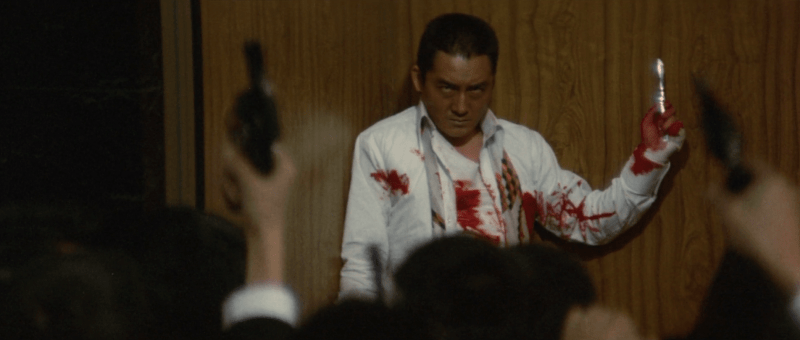
Good cop or bad cop? A maverick detective crosses the line in the name of justice in Toru Murakawa’s hardboiled thriller, Break Out (行き止まりの挽歌 ブレイクアウト, Ikidomari no Banka: Break Out). Like many of Murakawa’s films throughout the ‘80s, the main villain turns out to be political corruption along with a complicit police force which the hero must in a sense divorce realising that he can enforce the law only by breaking it but tragically failing to protect those most in need of his care. 

Kaji (Tatsuya Fuji) is indeed the archetype of the lone wolf cop. Stumbling out of bed with an obvious hangover and fuzzy beard that stands in stark contrast to his clean-shaven colleagues, he immediately butts heads with follow officer Sakura (Renji Ishibashi) who is technically in charge of the latest homicide case which Kaji believes may be connected to the death of a young woman at a hotel that the force has so far proved reluctant to investigate. To him, it all seems to point to local gangster Nakai (Kiyoshi Nakajoe) with whom he seems to have an ongoing rivalry which might be why Nakai has implicated Kaji’s ex wife Saeko (Saiko Isshiki) in his drug smuggling operation. 

Kaji quickly identifies the body as a bass player, Shimada, who just happens to have played at a club connected to Nakai, and soon realises that a young woman, Miki (Yoko Ishino), who belongs to a local biker gang, is most likely responsible for his death. But, somehow feeling sorry for her and suspecting she may have access to information that would help him take out Nakai for good, Kaji actively helps Miki evade the police by harbouring her in his own apartment while they are both stalked by a mysterious, Terminator-esque hitman who seems intent on recovering some kind of evidence obviously harmful to his client whoever that may be. 

Murakawa’s greatest successes had occurred in the 1970s partnering with the great Yusaku Matsuda who had at this point moved away from genre films though he would later reunite with the director in his final screen appearance, a television movie in which he played an earnest policeman investigating a terrorist incident, before sadly passing away of bladder cancer at only 39. In any case the image of Matsuda hangs heavy over Murakawa’s subsequent films and it’s quite obvious that the menacing hitman has a distinctly Matsuda-esque silhouette, while Tatsuya Fuji plays a similar role to that he’d inhabited in Yoichi Sai’s Let Him Rest in Peace only this time as a world weary ‘80s cop who has his own particular code of righteousness he feels the world has failed. 

His more cynical boss, played by Murakawa stalwart Mikio Narita, is quick to tell him that he should have resigned after a previous incident and that if he had done so his wife would not have left him, a sentiment which she later confirms which is in part surprising because the incident involved him fatally shooting her father. The implication is that Kaji is a true defender of justice who refused to surrender to institutional corruption even at great personal cost. Yet we do definitively see him cross the line, coldly executing a suspect who goads him by claiming he has already killed someone he cared about and thereafter little caring for conventional morality deciding to take the bad guys down with him no longer having anything left to lose except perhaps the girl, Miki, with whom he has developed a paternal bond. 

Meanwhile his earnest partner, Nishimura (Hiroaki Murakami), who originally disapproved of Kaji’s old school, maverick policing has changed his tune now seeing the value in his belligerence not least when his own wife is taken hostage by Nakai leaving him equally powerless at police HQ. Kaji is constantly told to back off the hotel case because of pressure from above, eventually discovering a connection to a sleazy politician but knowing that he can’t touch him or Nakai while bizarrely ordered to continue investigating Shimada’s death despite the evidence that suggests they are quite clearly connected. Still as the rather more poetic Japanese title which means something more like “elegy for a dead end” implies, this world is already beyond redemption and the only recourse open to Kaji is to make a sacrifice of himself in the name of justice. A good bad cop, all he can do is pass on his outrage to those left behind. Shot with Murakawa’s trademark hardboiled mist, and a noirish sense of fatalism the film paints a bleak picture of infinite corruption in Bubble-era Japan in which the only hero on offer is a morally compromised cop prepared to die for an illusionary justice. 


Goodbye, Bad Magazines (グッドバイ、バッドマガジンズ, Shoichi Yokoyama, 2022)

With the 2020 Olympics on the horizon, Japan began looking for ways to tidy up its image expecting an influx of foreign visitors which for obvious reasons never actually materialised. As part of this campaign, leading chains of convenience stores announced that they would stop selling pornographic magazines in order to create a more wholesome environment for children and families along with tourists who might be surprised to see such material openly displayed in an ordinary shop. Then again, given the ease of access to pornography online sales had fast been falling and the Olympics was perhaps merely a convenient excuse and effective PR opportunity to cut a product line that was no longer selling. 

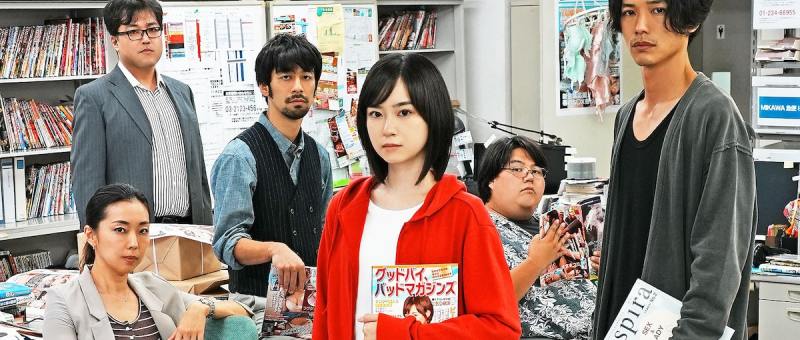
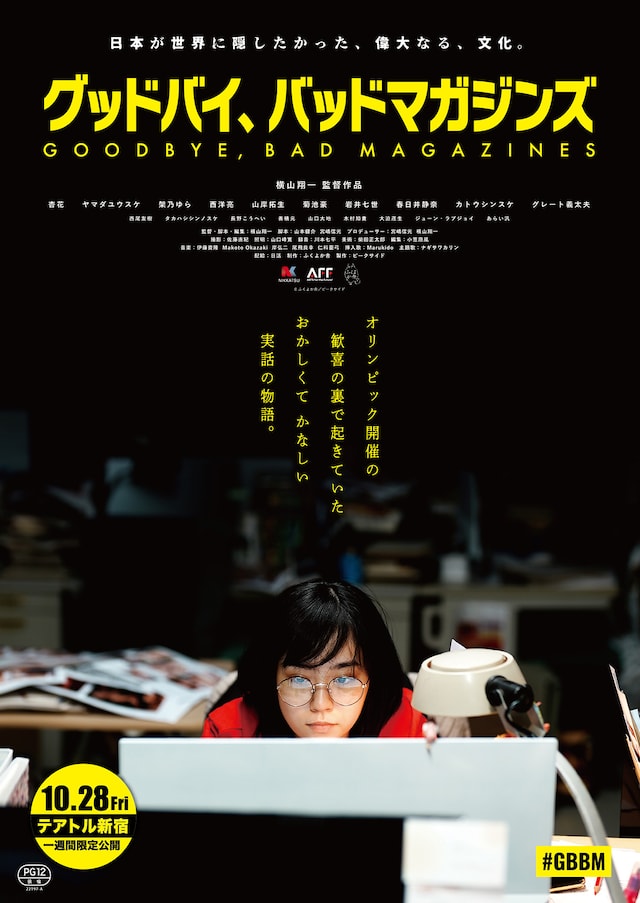
Based on actual events, Shoichi Yokoyama’s Goodbye, Bad Magazines (グッドバイ、バッドマガジンズ) explores the print industry crisis from the inside perspective of the adult magazine division at a major publisher which has just announced the closure of a long running and well respected cultural magazine, Garu. Firstly told they don’t hire right out of college, recent graduate Shiori (Kyoka Shibata) who had dreamed of working in cultural criticism is offered a job working on adult erotica and ends up taking it partly in defiance and encouraged by female editor Sawaki (Seina Kasugai) who tells that if she can make a porn mag she can make anything and be on her way to working on something more suited to her interests with a little experience under her belt. 

Her first job, however, consists entirely of shredding voided pages filled with pictures of nude women which is slightly better than the veteran middle-aged man who joined with her after being transferred from Garu who is responsible for adding mosaics to the porn DVDs they give away with the magazines to ensure they conform to Japan’s strict obscenity laws. Later a mistake is made and mosaics are omitted placing the publishing company bosses at risk of arrest and the magazine closure. Aside from being one of two women in an office full of sleazy men and sex toys, Shiori’s main problem is that she struggles to get a handle on the nature of the erotic at least of the kind that has been commodified before eventually falling into a kind of automatic rhythm. “It’s easy when it does’t mean anything” she explains to sex columnist and former porn star Haru (Yura Kano) who is much franker in her expression but perhaps no more certain than Shiori when it comes to the question asked in her column, why people have sex. 

Shiori asks her sympathetic colleague Mukai (Yusuke Yamada) for advice and he tells her that what’s erotic to him is relationships, but it seems his work has placed a strain on his marriage while his wife wants a baby and he has trouble separating the simple act of meaningless sex with that which has an explicit purpose such as an expression love or conceiving a child. According to Shiori’s editor Isezaki (Shinsuke Kato), the future of erotica will come from women with their boss finally agreeing to an old idea of Sawaki’s to create an adult magazine aimed at a female audience in the hope of opening a new market while handing a progressive opportunity to Sawaki and Shiori to explore female desire, but at the same time magazines are folding one after the other with major retailers canceling their orders and leaving them to ring elderly customers who’ve been subscribing for 30 years but don’t have the internet to let them know the paper edition is going out of circulation. 

The editorial team have an ambivalent attitude to their work, at once proud of what they’ve achieved and viewing it as meaningless and a little embarrassing. Not much more than a few months after working there, Shiori has become a seasoned pro training a new recruit who’s just as nervous and confused as she was but offering little more guidance was than she was given while becoming ever more jaded. When handed evidence that her boss has been embezzling money, she just ignores it though perhaps realising that when he’s found out it means the end for all of them too. Like everyone else, he’d wanted to start his own publishing company but the editor who left to do just that ended up taking his own life when the business failed. Yet, on visiting a small independent family-run convince store near the sea, Shiori hears of an old man who visits specifically to buy the magazines she once published because he can’t get them anywhere else while they have steady trade from fishermen who need paper copies to takes out to sea. The message seems to be there’s a desire and a demand for print media yet, even if it’s not quite enough to satisfy the bottom line. A sympathetic and sometimes humorous take on grim tale of industrial decline, Goodbye, Bad Magazines sees its steely heroine travel from naive idealist to jaded cynic but simultaneously grants her the full freedom of her artistic expression along with solidarity with her similarly burdened colleagues.  


Goodbye, Bad Magazines streamed as part of the 2022 Yubari International Fantastic Film Festival.

Teaser trailer (English subtitles)

Crossroad (死の十字路, Umetsugu Inoue, 1956)

An adulterous industrialist finds himself in a sticky situation after accidentally killing his wife in Umetsugu Inoue’s bizarre noir Crossroad (死の十字路, Shi no Jujiro). Based on a story by Edogawa Rampo, the film like any good noir suggests that in the end you can’t outrun your fate and all transgressions must be paid for but also turns on cosmic irony and strange coincidence in the great “tapestry” of life in which everything really is connected.

Shogo Ise (an aged-up Rentaro Mikuni) is the director of a construction firm about to complete a hugely expensive dam project which requires the sinking of a village and quarry. Apparently unhappily married to a woman obsessed with Nichiren Buddhism believing it helped to cure her of a serious illness during the war, he more or less lives with his secretary/mistress Harumi (Michiyo Aratama) who has been receiving incredibly weird and definitely threatening letters from Shogo’s wife Tomoko (Hisano Yamaoka). Tomoko claims that she has received an order from the “Child of the Sun” insisting that she must exact vengeance for the “great sin” Harumi has committed. The letter seems to be the last straw for Shogo who has decided to leave his wife, despite her incredible wealth, and set up home with Harumi permanently. 

Shogo hadn’t taken the threat very seriously, but sure enough Tomoko later shows up with some kind of ceremonial dagger and barges in to attack Harumi in the bath. During the struggle, Shogo accidentally kills Tomoko while trying to wrestle the knife from her. After briefly considering turning himself in, he realises that doing so will involve them all in scandal so he decides the best thing to do is dump her body in a well at the quarry which is shortly to be sunk. However, the plan soon goes awry and not least because a random man with a head injury climes into his car after he has a fender bender on a set of crossroads and later dies there leaving Shogo no choice but dump him alongside Tomoko. 

Inoue casts the abandoned quarry in truly eerie light, filled with gothic winds as if Shogo were being chastised by the gods themselves. In a sense, he’s paying not only for his sexual transgression but for the breaking of a taboo. A homeless man who once lived in the village later relates that he stayed until the last day because he did not want to leave his ancestors’ land. Shogo is part of the post-war construction boom but there’s also an underlying implication that this industrialisation is harmful to the land itself, not least in constraining a natural flow with the imposition of a dam in addition to causing a displacement of the people who once lived in the village while literally drowning the ancestral spirits. 

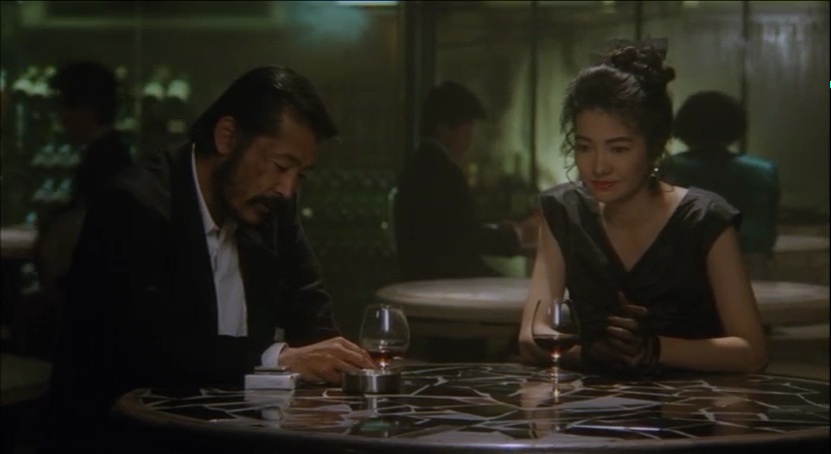
Harumi too speaks of feeling as if they’re both sinking beneath the waves, chasing a happiness to which they have no entitlement though she herself seems completely blameless save for her involvement in an extra-marital affair and strangely wholesome in comparison to the film’s otherwise sordid atmosphere. Even for a noir, Inoue’s sensibility is surprisingly sleazy for the world of 1956 and more than a little suggestive. A detective that randomly shows up, Minami (Shiro Osaka), lives with his foxy assistant and the interaction between them is constantly sexually charged while Inoue frequently returns to the backstreets of a neon city and the bars that line the streets approaching the crossroads where Shogo’s fate will align. 

It could be inferred that Shogo is a man whose life was marked by the war, his marriage perhaps in haste and then regretted while his wife developed her illness and subsequent obsession with Nichiren because of its corruption. Nevertheless, he’s portrayed as a basically “good” man in a very bad situation who made some very bad choices he wasn’t in the end bad enough to carry through properly hence the amazing series of collisions that seal his fate. On the one hand, like the young couple related to the drunk man who ended up in Shogo’s car, he and Harumi are just two otherwise ordinary people who decided to chase happiness albeit through an extra-marital affair only to pay a heavy price for daring to dream of a better future. Inoue has his usual amount of fun playing with noir archetypes as men strike matches in darkened alleyways and silhouettes of mysterious men in trench coats line the walls, not to mention the gothic sense of dread in the abandoned quarry, while constantly wrong footing us only to set us on our own collision course with the vagaries of post-war morality. 


Operation Plazma in Osaka (実録外伝 大阪電撃作戦, Sadao Nakajima, 1976)

The precarious balance of the post-war yakuza society begins to crumble in Sadao Nakajima’s jitsuroku eiga, Operation Plazma in Osaka (実録外伝 大阪電撃作戦, Jitsuroku gaiden: Osaka dengeki sakusen). The Japanese title might more accurately be translated as “shock tactics in Osaka” which is a neat encapsulation of the turf war which arises when a larger gang from Kobe decides to muscle in and take over the city while a small upstart continues to agitate contemplating taking the whole prize for themselves. 

Inspired by a real life turf war which took place in Osaka in 1960, the film opens with classic jitsuroku voiceover revealing that a precarious balance had been held in the local underworld since the Meiji era in part because the city is simply too big to be ruled by any one gang. But times are changing, yakuza conglomerates are in style, and so it is that the Kawada gang mounts a largely political campaign to claim the city without bloodshed, as boss Yamaji (Akira Kobayashi) puts it, by convincing the smaller gangs to join up with them. According to the voiceover, however, it wasn’t Kawada that upset the balance but a small upstart group that came out of nowhere, Soryu. 

The screen then cuts to a map of Osaka, while the stills behind the credits feature the Tsuruhashi Market in Korea town. The thing about the Soryu group is that many of its leading members are ethnically Korean which sets them apart from most of the other mobsters in town. Even so, it’s hotheaded Yasuda (Hiroki Matsukata) that first gets them in trouble by getting into a fight with Takayama (Tsunehiko Watase) at a boxing match after climbing into the ring himself when the guy he bet on looks like he’s about to lose. This sets up a conflict between the Soryu and the Nanbara gang who run the boxing hall, but it never takes off because the recently released Daito suddenly announces that he’s bought the “Dance Hall” the ring is being run from and wants to turn it into a cabaret bar. It seems clear that someone’s backing Daito, but no one quite knows who. 

As Yamaji had said it would be, it starts of as a very modern silent war in which he slowly seduces various yakuza gangs convincing them that they’re stronger together with a slight note of join us or die. Yasuda and Takayama are two men who don’t like being told what to do and each end up exiled from their gangs thanks to their opposition to Kawada. Having failed to assassinate Yamaji, boss Nanbara pathetically rolls over and decides to join him instead while the Soryu gang is sent on the run leaving Yasuda and and Takayama to form an unlikely brotherhood brokered by Yasuda’s odd decision to gift his nightclub singer girlfriend to his sometime rival leaving Takayama permanently in his debt and touched by his selfless gesture.

Even by the standards of the jitsuroku, Operation Plazma in Osaka is rabidly misogynistic and often sleazy with an early scene seeing the Soryu gang cause trouble by stripping a hostess naked as one pours alcohol over her body and another drinks it from between her legs. Naked women are repeatedly fondled by fully clothed men, while nightclub singer Yoshiko (Yuko Katagiri) is treated largely as a pawn, a tool used to mediate the latent homoerotic desire between Yasuda and Takayama. Then again, everything in this world is extreme. The conflicted Miyatake (Tatsuo Umemiya) who had once tried to protect Takayama eventually tries to boil a man alive to get him to reveal Takayama’s location while Nakajima’s anarchic handheld camera desperately tries to keep up with the increasingly nihilistic violence. 

The resolution arrives not with death but total defeat, the traditional yakuza forced into submission by the corporatising giant with the survivors realising they will live the rest of their lives in subjugation making an “unconditional surrender” to changing times. Yasuda had claimed that the Soryu gang was a “free democracy” standing in opposition to the latent fascism of traditional gangsterdom which then finds its way into the corporate and the extreme hostile takeover Yamaji has just performed on the city of Osaka. Suddenly all that’s left of traditional yakuza is a pinkie in a jar, a grim a reminder of what happens when those in a position to resist back down in the face of an authoritarian power.


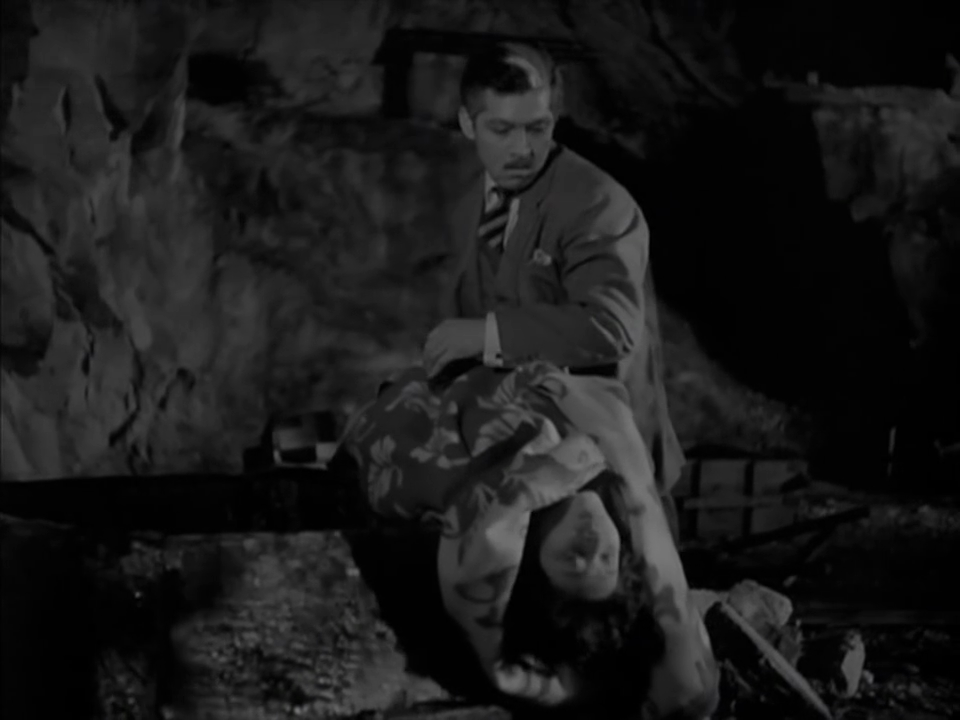
Policeman (警察官, Tomu Uchida, 1933)

“No one knows what will happen to us in this world of illusion” muses a conflicted villain in Tomu Uchida’s seminal proto-procedural, Policeman (警察官, Keisatsukan, AKA Police Officer). Forever an enigma, Uchida had made his name through a series of broadly progressive, left-wing films featuring strong social critique, yet he also made this mildly authoritarian, overtly pro-police piece of militarist propaganda long before it became necessary to do so. But then, look a little closer and you’ll find him subtly undercutting the messaging, reconfiguring his tale of a courageous policeman who sets aside his personal feelings in the pursuit of justice as one of tragedy in which a man ultimately imprisons himself by doing so. 

The hero, earnest policeman Itami (Isamu Kosugi), was once as he later reveals a wayward young man. “The world was against me, I thought. I was young then” he sighs, explaining that he owes his life to his boss and mentor, Sgt. Miyabe (Taisuke Matsumoto), who became a second father and set him on the right path which he now of course follows. His long lost childhood friend Tetsuo (Eiji Nakano), with whom he reconnects during a routine vehicle check, apparently experienced something similar having fallen out with his wealthy industrialist father but claims that he’s become an elite layabout spending all his time at the golf course and asking his dad for money every time he runs out which seems nothing if not contradictory but then familial relationships can be complex. In any case, a repeated motif sees the two men taking diverging paths, literally, the implication being that they’ve each chosen different directions in response in to the same adolescent crisis when in a sense “orphaned” through parental disconnection. 

On hearing Tetsuo’s story, Itami asks him with thinly veiled horror if he hasn’t become a communist, that being a fairly common and fashionable way for a young man from a wealthy family to fall out with his father. Tetsuo laughs it off, wishing it were political but claiming somewhat vaguely that it was a matter of feeling. The exchange is revealing in that screenwriter Eizo Yamauchi had apparently been instructed to portray the criminal gang at the film’s centre, of which Tetsuo is later revealed to be a member, as “communist” though no political ideology or identity is ever directly stated. Nevertheless, the central drama is clearly inspired by the Omori Bank Robbery (1932) in which a three members of the Communist Party robbed the Kawasaki Daiichi Bank without the knowledge or authority of party officials in order to gain funding for the movement. The incident backfired, badly discrediting the Communist Party (illegal at the time) and thereby imploding the most viable source of opposition to rising militarism. Armed bank robbery not being a common occurrence in Japan, most viewers would necessarily associate this brand of criminality with “communism”, killing two birds with one stone as the film does its intended job of making the world seem more dangerous than it is while reinforcing an authoritarian message that the police will protect. 

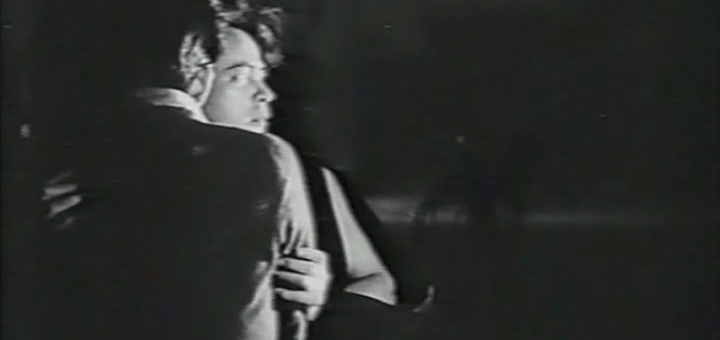
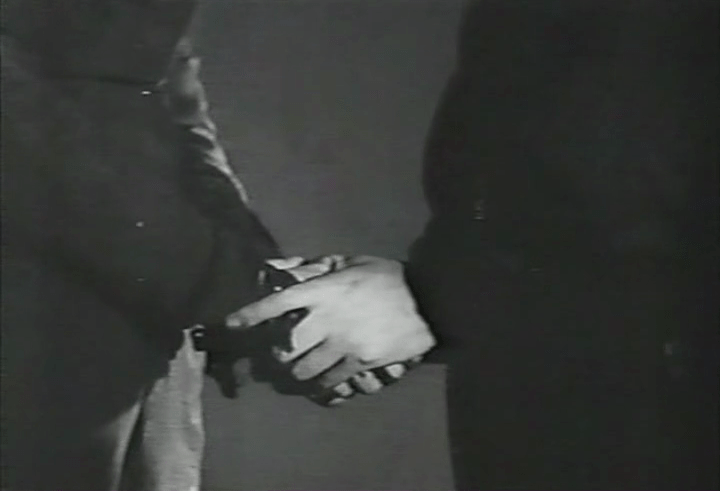
Yet, on the other hand, perhaps it really was “feeling” after all. The relationship between the two men has an intensely homoerotic quality with frequent flashbacks to their carefree high school days during which they read each other romantic German poetry, played rugby, and frolicked on a beach in the company of a very large dog. Itami largely ignores his potential love interest in Miyabe’s pretty daughter, save for briefly thinking about her while on a three-day stakeout of the robbers’ den, while constantly chasing Tetsuo after becoming suspicious that he may be the man responsible for shooting Miyabe and fleeing the scene after a robbery. His inner torment lies partly in the conflict between his responsibilities to friendship and the law, but also perhaps in his unresolved feelings for Tetsuo. Driven half out of his mind, his final epiphany crying out “I am a policeman” is as much a rejection of an identity as a claiming of one, entirely sublimating himself within the image of the role that he has chosen to play in society shedding his personal feeling and desires as he does so. In “saving” Tetsuo, shooting him in the hand to prevent his suicide, tenderly cuffing and then embracing him, he evokes both a sense of return and forgiveness and another of goodbye further enhanced by the abruptness of the transition which follows. 

Taken in this light, the late and extremely jarring slide into overt propaganda through a series of title cards loudly proclaiming the virtue of the police takes on a differing kind of anxiety in its authoritarian dimensions as a force which destroys rather than protects in its capacity to erase individual identity. Nevertheless, Uchida also includes numerous shots of heroic policemen in their dashing uniforms as they assemble for drill or show up en masse on their bikes ready to fight crime. Tetsuo’s final appearance, meanwhile, is extremely sinister dressed as he is in an outfit which would later become associated with fascism, his meticulous uniformity in strong contrast to the then crazed and dishevelled Itami still in his crumpled kimono with messy hair and three days’ worth of beard growth from his stakeout. Yet there’s nothing but pain and fear in his eyes as he realises that his friend has seen through him, Itami rather ostentatiously bundling Tetsuo’s lighter into a handkerchief almost as if he meant to him let know. 

Shooting mainly on location, Uchida’s camera is rarely at rest even employing a series of complicated vehicle tracking shots one of which eventually resolves itself into a first person perspective while the final sequence is tense in the extreme with its gunfire, search lights, and complex choreography. His use of flashback is precise and unusual, far ahead of its time in its acuity as if we actually see Itami’s thought process on screen jumping from one idea to another, while the meeting of the two men on the desolate docks seems to be drenched in loneliness and a sense of futility even while free of the oppressive shadows from the buildings which seemed to dwarf them in the city. Somehow desperately sad despite the catharsis of its final scene, Policeman subtly implies there might not be much difference between hero and villain, or between communist and militarist, save walking one way and not another as two men find their friendship frustrated by time and circumstance coming together only to be driven apart. 


Late Chrysanthemums (晩菊, Mikio Naruse, 1954)

The post-war economy was difficult for most, though by the mid-1950s the situation was perhaps improving. The four former geishas at the centre of Naruse’s Late Chrysanthemums (晩菊, Bangiku) , adapted once again from a series of stories by Fumiko Hayashi, are all in their way attempting to find a way through to the modern society but are nevertheless stuck in the past, unable to move forward as women more or less left behind by a changing idea of “modernity” which no longer has a place for them. 

The most successful of the women, Kin (Haruko Sugimura), has become a ruthless moneylender engaging in real estate speculation. As the film opens she’s waiting for the arrival of a business associate for a meeting about a house she’s trying to flip, clear that they’ll need to kick out the desperate widow who is currently living there. Kin has lent money to her old “friends” with whom she spent her youth as a geisha before the war. Otamae (Chikako Hosokawa) and Otomi (Yuko Mochizuki) are widows with unfilial children, Otamae now working as a maid in a love hotel while her son Kiyoshi (Hiroshi Koizumi) struggles to find a job, and Otomi a washerwoman selling blackmarket cigarettes as a sideline while her daughter Sachiko (Ineko Arima) is a forthright modern woman who refuses to enable her mother’s irresponsible vices. Nobu (Sadako Sawamura), meanwhile, married late to a man from outside of Japan and has opened a small bar where she hopes to start a family, brushing off Kin’s insensitive insistence that she is already too old to bear a child. 

Kin has prospered and become wealthy, but she’s done so largely at the sacrifice of maternity. She disparages the other women, telling them she’s grateful not to have had children because not even they can be depended upon, but is also embittered that she’s missed out on life and love, substituting material wealth for emotional fulfilment. Otomi and Otamae have problems with their children and regrets about their lives, but they both resent Kin for her heartless rationality. Kin is in a sense supporting them with her money, even if she wants it back with interest, and continues to see herself as doing a favour for women she considers friends, hurt that they often run or hide when they see her coming but insisting that she is only trying to survive while implying that the other women have failed to achieve the self-sufficiency she has achieved because they’ve lived irresponsibly by placing their trust in men and frittering their money away on the temporary pleasures of drink and gambling. 

Otomi’s thoroughly modern daughter Sachiko thinks something much the same. When Otomi approaches her for a loan, she says no, fearing that her mother has another lover she will end up subsidising or that she will spend it all on drink and pachinko. Sachiko does, however, offer to buy her mother dinner which at least ensures she will get a good meal. Sachiko’s shock news is that she plans to marry an older man, though he seems not to be particularly wealthy seeing as she later sarcastically asks Kin to buy her a house because they’ll be living with other tenants in a small flat. Otomi objects, not only because Sachiko hasn’t mentioned any of this to her before, but because she thinks Sachiko is being overly practical and gives her some surprisingly transgressive advice to the effect that she should have her fun with various men while she’s young so she’ll be able to figure out which is the best to spend a life with. Sachiko quite reasonably asks how that worked out for her, to which Otomi obviously has no answer and leaves the restaurant feeling dejected enough to ask Kin for the money she was after instead. 

Otamae’s problem is of the opposite order. Her son Kiyoshi cheerfully rolls home in the morning after staying out all night and tells her he’s become a kind of gigalo, dating a slightly older woman who is technically the kept mistress of another man. The situation is ironic in the extreme, but despite her own past as a geisha, Otamae doesn’t like it that her son is engaging in a compensated relationship, while he suggests that perhaps she messed him up by making him refer to her as his sister in public. Eventually Kiyoshi is offered a job in a mine in Hokkaido, salmoning the post-war migratory movement and leaving his mother (as well as the mistress) behind to fuel the economic recovery from the provinces. 

Otomi and Otamae have only each other to rely on, men and children have all proved undependable. Kin, the most fiercely independent, is literally haunted by the spectre of failed romance. Nobu, snaps that Kin made her money by swindling her clients, which might be why she takes the side of Seki (Bontaro Miake), a man who tried to commit double suicide with Kin but survived and was ruined. Kin sees it differently. Seki tried to kill her when she refused to die with him, so understandably she is not keen to reconnect. Nobu advises him to visit her and ask for money as “compensation”, which whichever way you look at it is crass and troubling, that Kin is expected to compensate a man for his ruined prospects caused by his obsessive romantic violence towards her which she claims has put her off men for life. Nevertheless, she continues to meditate on the memory of Tabe (Ken Uehara) whom she loved when he was a student, even visiting him in his Hiroshima barracks after he was drafted. She is thrilled to receive a letter from her first love, but declares herself disappointed minutes after he arrives for a visit. Tabe is just another failed salaryman who thinks women like her have it easy and harps on about how looking at his “old” wife makes him nostalgic for the women he loved in his youth. Like everyone else, he’s after her money. Kin burns the photo of him in uniform and gives up any lingering dream she might have had of romantic fulfilment. 

The women find themselves trapped by conflicting visions of “modernity” which are wildly different from those of their youth. They miss their “carefree” lives as geishas, now perhaps somewhat romanticised, along with the misplaced idealism of their time of Manchuria, while lamenting that as single older women they cannot be anything other than dependent. Only Kin is able to achieve self-sufficiency, but does so effectively as the film suggests at the cost of her “femininity”, becoming hard and cold, ruthlessly practical but not perhaps uncaring even as she continues to subsidise the only “friends” she has perhaps in the knowledge that they fiercely resent her. Yet their lives continue. Nobu runs her bar, Otomi and Otamae send their children off with grudging respect while vowing to follow their examples, and Kin, after a moment of crisis, ventures off towards new prospects. For good or ill they shift towards the modern world, more understanding of its rhythms and their place within it than before, but perhaps no more secure.