
The Bacchus Lady (죽여주는 여자, E J-Yong, 2016)

bacchus-ladyRather than a Maenad in a divine frenzy driven by drunkenness, lust, and hedonistic fury, a “Bacchus Lady” is a humorous nickname used for the older women who solicit men in Korean parks by euphemistically offering to sell them a bottle of Bacchus energy drink. E J-yong reteams with veteran Korean actress Youn Yuh-jung to tell the tragic story of Youn So-young, hooker with a heart of gold and now a member of the older generation permitted to slip through the cracks in the absence of familial connections.

Youn So-young (Youn Yuh-jung) is going to have to close the shop for a few days, she has gonorrhoea thanks to a no good customer who (presumably) paid her extra for no protection. As if that weren’t bad news enough, So-young becomes a witness to a public domestic dispute as the doctor’s Filipina former lover and mother to his unacknowledged son tracks him down to his clinic. During the heated argument conducted in English the jilted lover stabs her no good former beau with a pair of scissors and is hauled off by security, instructing her young son, Min-ho, waiting downstairs, to make a run for it.

Not knowing quite why, So-young chases after the boy and ends up taking him home. With the help of her transgender landlady (An A-zu) and younger neighbour with a prosthetic leg (Yoon Kye-sang), So-young cares for the boy before trying to figure out what’s going on with his mother. So-young returns to work after her initial problems are cleared up which brings her into contact with three former clients who each have a very unusual favour to ask of her…

First and foremost, The Bacchus Lady (죽여주는 여자, Jug-yeo-ju-neun Yeo-ja) wants to ask a lot of questions about the status of the elderly in contemporary Korea. Korea has one of the highest rates of older people living in poverty among the developed nations with many forced to keep working to support themselves even as their health fails. Though many older people have extended family networks, the nature of modern society leaves them isolated as their children may have moved away or even to foreign countries and are not able, or simply not interested, in providing later life care for their relatives. Some, like So-young, are on their own. With no familial connections to rely on and only her neighbours to count as friends, she has few options and opportunities for women of her age are thin on the ground.

Speaking to a client who turned out to be a documentary filmmaker, So-young reveals that she chose prostitution out of pride – she couldn’t bring herself to take a street cleaning job and thinks this is better. In fact, her story is more complex and exposes a deep seem of historical social problems as So-young first became a prostitute at the American air base.

There are odd parallels to be found everywhere – So-young was seduced an abandoned by an American soldier just as Min-ho’s mother has been abandoned by her Korean doctor who returned home and married well, leaving her far behind. In fact, Min-ho has a picture of his happy family which is almost identical to one So-young has stashed away in a drawer (only she’s torn out the painful half of hers). Now the Koreans are making the same mistakes as the previously mentioned occupying forces, sowing their wild oats abroad and forgetting all about their foreign adventures when they come home to settle down.

Parents reject their children, and children reject their parents. When one of So-young’s former customers suffers a stroke, his son’s family come back from the States to visit him but the daughter-in-law coldly announces that they won’t visit again for another year (knowing full well he may not have that long). The grandchildren barely speak Korean and aren’t interested in hanging round the sickbed of a man they don’t quite know, grandfather or not. The son says nothing. The daughter-in-law even tries to stop So-young visiting her husband’s father assuming she’s some kind of granny gold digger (got to protect that inheritance after all). No wonder the poor man becomes the first of many asking So-young to help him to die. Loss of youth, loss of health, loss of relationships – the loneliness and the boredom alone are too much to bear, let alone pecuniary worries.

So-young is an impulsive sort of woman. When asked why she does some of the things she does, So-young replies that she doesn’t know, she must be mad. Yet there’s a kindness and a naivety belying her otherwise straightforward personality. Even if she can feel something is probably a bad idea but it might help, she feels compelled to do it anyway, eventually with disastrous consequences. So-young is a nice woman who’s been unlucky and society continues to make her pay for that. Always left feeling as if she needs to atone for an unforgivable sin, So-young lives an oddly ascetic life, taking few pleasures and giving away most of her rewards. Her story may be an extreme one, but hers is the fate of many older women who find themselves abandoned without pensions, savings, or family to help them survive.

An interesting look at life on the fringes of an affluent city, The Bacchus Lady is sad tale though one filled with compassion and good humour. E avoids outward melodrama or unwelcome sentimentality, approaching So-young’s ultimate destination with the necessary pathos. The gentle accordion based score lends the film a whimsical air which is only undercut by the abrupt tonal shift and suddenness of the coda finale, but E’s aim is a serious one. So-young is her own woman, but she also stands for a disadvantaged stratum of society who have been consistently denied the ability to fend for themselves and are suddenly expected to do so in their old age when they most need society’s help. Sympathy for Lady Bacchus? Society would do well to take note.


Reviewed at the 2016 BFI London Film Festival

Original trailer (English subtitles):
A Good Rain Knows (호우시절, Hur Jin-ho, 2009)

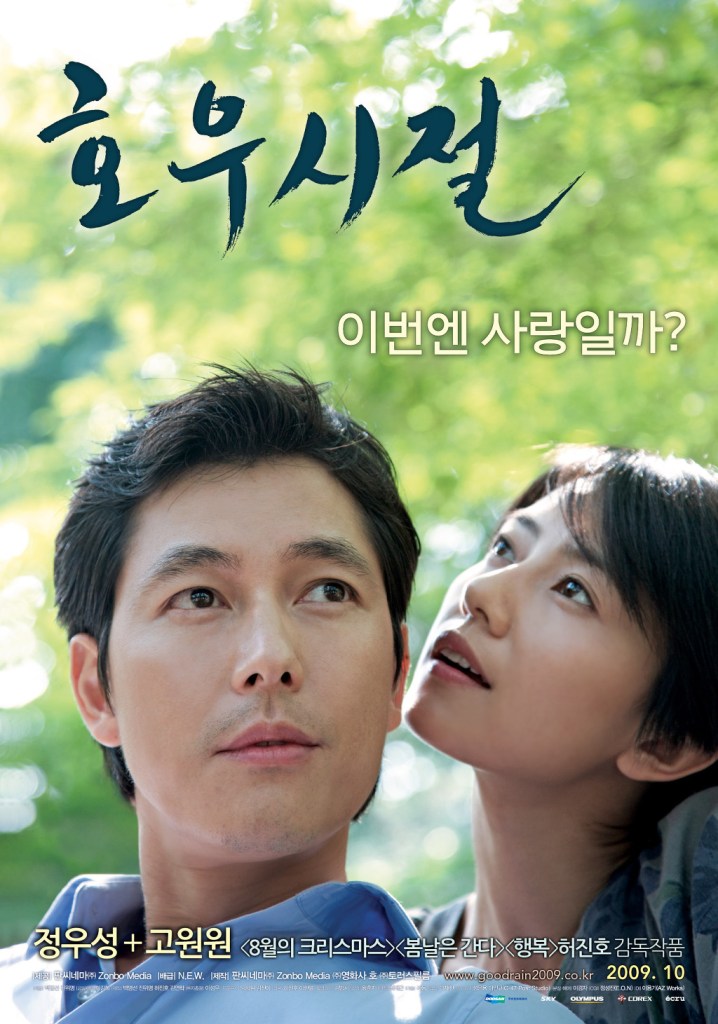
a-good-rain-knowsHur Jin-ho’s A Good Rain Knows (호우시절, Howoosijeol) was originally developed as a short intended to form part of the China/Korea collaborative omnibus film Chengdu, I Love You which was created as a tribute to the area following the devastating 2008 earthquake. However, Hur came to the conclusion that his tale of modern day cross cultural romance required more scope than the tripartite omnibus structure would allow and decided to go solo (Chengdu, I Love You was later released with just Fruit Chan and Cui Jian’s efforts alone). Very much Korean in terms of tone and structure, Hur uses his central love story to explore the effects time, memory, culture, and personal trauma on the lives of everyday people.
Smart suited businessman Park Dong-ha (Jung Woo-sung) has arrived in China as part of the Korean efforts to provide assistance in rebuilding after the 2008 earthquake which took thousands of lives and caused mass destruction. Met by a genial Korean ex-pat acting as his guide, Dong-ha takes in some sightseeing including a park dedicated to Tang dynasty poet Du Fu. As it turns out, an old university friend is also working at the park museum as a multilingual tour guide. There is more than a little unfinished business between Mei (Gao Yuanyuan) and Dong-ha though time has been passing all the while, throwing up obstacles every way you look to try and frustrate this serendipitous reunion.

Though the film is a collaborative effort between China and Korea, the bulk of the dialogue is spoken in English as Mei doesn’t speak Korean and Dong-ha doesn’t know any Mandarin (the pair apparently studied in the US and each returned to their home country separately, subsequently losing touch). Truth be told, the English is not always successful leaving both actors a little adrift – something which is not helped by conflicting Chinese and Korean acting styles. However, in someways this slight hesitance only adds to the restrained quality of their romance as each frequently adds tiny phrases of their own languages, becoming lost for words or trying to find exactly the right thing to say at the right moment.

The romance between Mei and Dong-ha never quite got going in their student days and seems to have taken on the status of a great lost opportunity. Time has moved on and they’re both different people. Student Dong-ha wanted to be a poet but now he’s a company man, even if a slightly conflicted, melancholy and romantic sort. Mei’s life has followed a more natural course though she too carries a deep seated sense of sadness caused by more recent personal tragedies. Both are left in a place of needing to relearn how be themselves – Dong-ha by getting back to writing and Mei by (literally) getting back on a bike but these are more natural, personal problems rather than the familial or social concerns which are the usual barriers to a successful melodrama romance.

Beautifully photographed, A Good Rain Knows takes its cues from Du Fu when it comes to the poetic, filling the screen with its vibrant green scenery. Of course, this contrasts strongly with the ruined buildings Dong-ha visits as well as the upscale hotels and restaurants, but the natural surroundings at least lend a healthy feeling of earthy wholesomeness to the proceedings. Hur has opted for a Korean orientated viewpoint, framing Chengdu as the slightly alien place it is to Dong-ha filled with bizarre foodstuffs and awkward conversations but nevertheless also an opportunity to reassess the current course of one’s life. A mature, realistic romance, A Good Rain Knows ends on a note of hopeful ambiguity – wisely avoiding the big romantic finale, Hur undercuts the inherent melodrama with wistful melancholy, the possibility of a happy ending is still in sight but there are no easy answers here, only a need for time and commitment.


Original trailer (English subtitles)

Revivre (화장, Im Kwon-taek, 2015)

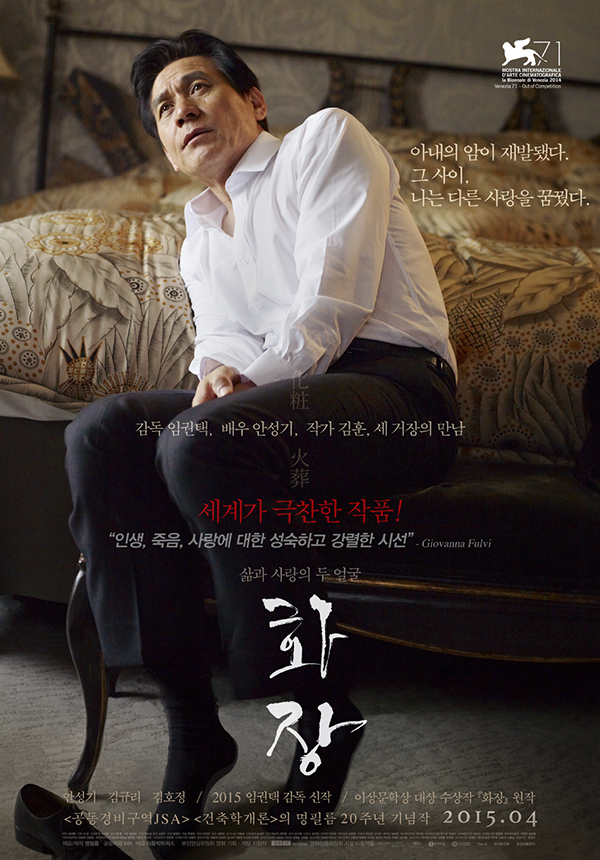
revivreThe 102nd film from veteran Korean film director Im Kwon-taek may appear close to the bone in its depictions death, suffering, and the long look back on a life filled with the quiet kind of love but Revivre (화장, Hwajang) is anything but afraid to ask the questions most would not want to hear as the light dwindles. The inner journey is just too hazy, as one man puts it, unknowingly commenting on the human condition, yet Im does manage bring us nicely into focus, if only for a moment.

Oh (Ahn Sung-ki), a successful salaryman working in marketing for a cosmetics company, finds himself slightly adrift as the brain tumour his wife, Jin-kyung (Kim Ho-Jung), had previously suffered from resurfaces. The treatment this time is apparently not as successful leading to prolonged hospitals stays as Jin-kyung’s condition deteriorates and she begins to require a greater level of medical care. While all of this is going on, Oh is still very much dedicated to his work but has also begun to indulge in an old man’s folly, fantasising about the pretty new girl at the office.

Much of Revivre is concerned with Oh’s inner life, the things he does not say (which are many because Oh is a quiet sort of man). Ahn Sung-ki captures this quality well in playing Oh with a kind of blankness that could be the numbing sensation of grief or an extension of his ordinarily reserved nature. This makes his impromptu verbal attack on the figure of his fixation, Choo Eun-joo (Kim Gyu-ri), all the more unexpected though his remorse over having acted in such an out of character way may actually help to generate a kind of relationship between the pair albeit more of a paternal than romantic one.

Oh’s continuing fixation on Eun-joo, the woman who becomes the accidental focus of his world even though his wife lying dies in a hospital, is intended to be a fantasy and nothing more. An early dream sequence sees Oh participating in an elaborate traditional funeral taking place in a desert in which all of the mourners are dressed in black, except, of course, for Eun-joo – the only fixed point of reference, clothed in vibrant purple and smiling back at him in contrast to the solemn faces of the other guests, each staring at the floor. In the real world time slows down for him as Eun-joo dances youthfully in a nightclub and as he leaves the party early, her’s is the lone still face, haunting him as he looks back at the other revellers still enjoying themselves heartily even outside the club.

Indeed, “looking back” with all of its various advantages and disadvantages becomes another central theme as Oh becomes a kind of Orpheus descending into his own personal hell in the hope of dragging back his departed Eurydice – an idea neatly recreated in one of the film’s few outright fantasy sequences in which Oh dreams himself into an avant-garde dance show. Like Orpheus, Oh cannot help but look back though he risks losing all in the process. What Eun-joo represents for him is perhaps not the woman herself but an image of his own youth and a desire to live again as he once lived before. The present and the past begin to overlap for him, Eun-joo becomes the future he cannot touch as well as the returning spectre of a past he cannot return to.

Oh’s daughter asks him at one point if he ever really loved her mother. His reaction to losing his wife is, it has to be said, restrained, practical. Yet this question is answered with an immediate cut to Oh helping his wife to the bathroom, performing the most intimate of tasks with unwavering devotion. As his wife fades, Oh’s fantasies become a shield against the growing fears of his own mortality as his body also begins to fail him. The melancholy sense of loss and loneliness coupled with the inevitability of the passage of time pervade as each of Oh’s points of reference slips away from him at exactly the same time.

Im opts for a non-linear approach beginning with Jin-kyung’s passing and thereafter moving freely, reflecting Oh’s fleeting memories and interior confusion as he deals with such a traumatic, life altering event. Neatly framing Oh’s dilemma within his work in which he faces a choice of sticking with the current marketing strategy or striking out in a bold new direction, Im plays with the eternal theme of transient beauty in a society which prizes bodily perfection above all else. The film’s Korean title plays on a pun involving a homonym which means both “cremation” and “makeup” perhaps harking back to the central theme that you dig a grave for yourself if you attach the wrong sort of importance to the impermanent, but is in a sense ironic as one represents a final acceptance and the other an attempt to hold off the inevitable. Poetic and intensely moving, Revivre is another characteristically multilayered effort from Im, still at his full strength even in this late career effort.


International trailer (English subtitles/captions)

Tunnel (터널, Kim Seong-hun, 2016)

TunnelIn 1925 an avid cave explorer, Floyd Collins, became trapped in a narrow crawl space. Though he was discovered and help came with food and water, a cave in left him sealed off down there and fourteen days later he died of thirst and exposure. As tragic as this obviously is, Floyd Collins is remembered for another reason – his rescue became one of the earliest mass media crazes. The surrounding media furore also inspired the 1951 Billy Wilder classic Ace in the Hole in which a grizzled reporter attempts to manipulate the fate of a man trapped in a cave for the maximum media coverage with the consequence that his delays cost the man his life. Jung-soo, a father on his way home with a birthday cake for his young daughter is about to join the marooned underground club when a shoddily built tunnel collapses sealing him inside. Unfortunately for Jung-soo, he finds that times have not changed all that much.
Jung-soo (Ha Jung-woo) was having a good day. He’d closed an important deal and has a birthday cake in the back of his car ready for his little girl when he gets home. He also ends up with two free bottles of water for not making a fuss when a hard of hearing old timer working at the petrol station gives him a full tank rather the $30’s worth he’d asked for. It all comes crashing down, literally, when he starts hearing strange noises shortly after entering a newly completed tunnel. Driving as fast as he can, Jung-soo is still trapped under falling debris and unable to escape though otherwise uninjured. Luckily, Jung-soo’s phone still works and he’s able to get enough signal to dial the emergency services but as he’ll discover, the matter of coming to his rescue may not be as straightforward as one might hope.

Just before Jung-soo heads into the tunnel which has only been open for around a month, there’s a sign testifying to happy and safe construction. It transpires that the tunnel was completed far too quickly, corners were cut, and public safety not properly respected. Corporate corruption and margin squeezing become a constant theme as more and more faults are discovered with the tunnel’s structure right down to missing manuals and incorrect blueprints. As one sardonic construction worker puts it, who follows the rules these days anyway? In light of recent tragedies, the government can no longer be trusted to assure public safety by insuring that its infrastructure, and the third party companies which run it, are fit for purpose and operating in line with public safety standards. The fact is that the construction of the sister tunnel to this one is already underway and there have also been hundreds of other recorded safety incidents in other facilities around the country. Construction means jobs, and money, and progress – who would want to let a little thing like safety stand in the way?

If money grabbing culture and government laissez-faire are two of the greatest evils, the third leg of the tripod is mass communications who see only the story and not the human. In fact, the first people to call Jung-soo back after his emergency call are the reporters parked in their van directly outside the tunnel’s entrance. Even Jung-soo’s wife, Se-hyun (Bae Doona), only discovers her husband’s fate from a TV displaying breaking news at a supermarket. Once she drops everything to get to him, she’s quickly trotted out for endless photo-ops with government officials and rescue workers to sell the story that the entire country is behind Jung-soo in his horrendous ordeal and working hard to get him out of there. The mouth of the tunnel is now a media circus as reporters parasitically dig in, raking up whatever kind of news they can spin for good copy. When it looks like Jung-soo may be rescued, one reporter even seems upset that he hasn’t quite broken the record set by the survivors of the Sampoong Department Store collapse in 1995 (notably also directly caused by corporate greed).

Jung-soo himself accepts his situation with a stoic calmness. Sensibly rationing out his water and battery life on his cellphone, he beds in for the long haul. Before long, the TV news has even declared him a national hero for maintaining his compassionate humanity even in the face of crisis. More resourceful than most, Jung-soo is making the best of things when all he can do is wait, hoping that the authorities will finally come to his rescue. Unfortunately the authorities he’s waiting on are largely the same ones responsible for this entire mess and aside from the valiant commander of the rescue squad Dae-kyoung (Oh Dal-su) are more interested in being able to resume construction on the sister tunnel (which involves more of the blasting that may have destabilised the tunnel in first place) and deflecting the embarrassment of this high profile infrastructure project having gone so catastrophically wrong.

Kim Seong-hun keeps the tension high as Jung-soo fights for his life by simply trying to survive long enough for someone to reach him. Genuinely fraught and claustrophic, Tunnel is not without a healthy dose of black humour lightening the mood in even the bleakest of circumstances. The political subtext is refreshingly subtle yet perfectly clear as Jung-soo finds himself literally buried underneath a national scandal and branded an inconvenient truth by those whose interests lie in maintaining the illusion of compassionate government anchored by friendly corporations. Tense, thrilling, and frightening on more than one level, Tunnel is an unexpectedly thoughtful disaster movie detailing one good man’s struggles to escape from underneath the destruction caused by pervasive social ills.


US release trailer (English subtitles)

Train to Busan (부산행, Yeon Sang-ho, 2016)

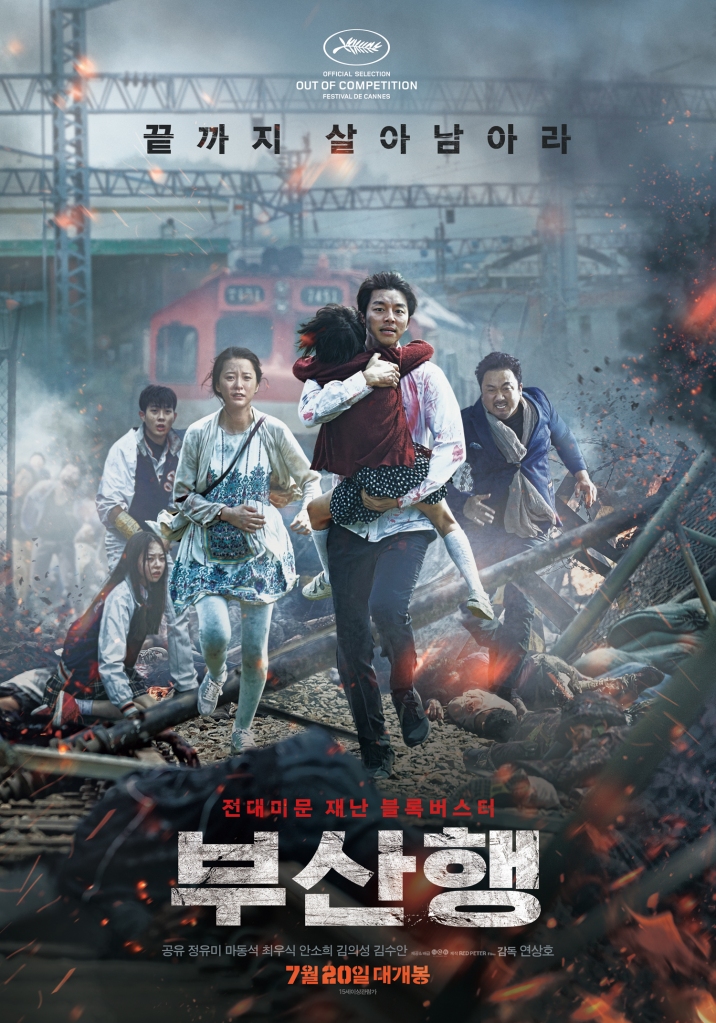
Train to BusanMany people all over the world find themselves on the zombie express each day, ready for arrival at drone central, but at least their fellow passengers are of the slack jawed and sleep deprived kind, soon be revived at their chosen destination with the magic elixir known as coffee. The unfortunate passengers on an early morning train to Busan have something much more serious to deal with. The live action debut from one of the leading lights of Korean animation Yeon Sang-ho, Train to Busan (부산행, Busanhaeng) pays homage to the best of the zombie genre providing both high octane action from its fast zombie monsters and subtle political commentary as a humanity’s best and worst qualities battle it out for survival in the most extreme of situations.
Workaholic fund manager Seok-woo (Gong Yoo) is having a series of very bad days. His wife has left him and for unclear reasons, also left their young daughter, Soo-an (Kim Soo-ahn), in her father’s care though apparently wants custody in the ugly divorce battle that now seems inevitable. It’s Soo-an’s birthday but all she wants is to catch a train to Busan to see her mum and if she has to she’ll even go by herself. After his attempt at a birthday present spectacularly backfires, Seok-woo gives in and agrees to take Soo-an to her mother’s before catching the next train back after dropping her off. Unfortunately, they have picked a very bad day to take the train.

Yeon Sang-ho takes his time to build to the central train based set piece but is is careful to create an atmosphere which makes it plain that there is something very wrong with this seemingly everyday set up. After a brief dig about pig farmers losing out to government policy on foot and mouth disease and irresponsible hit and run drivers leaving deer corpses behind them for someone else to deal with, he has a parade of emergency vehicles racing past Seok-Woo and Soo-an on their trip to the station while ash rains down on their car. Seok-woo is still focussed on work though sleepy on the train so he misses Soo-an’s shocked reaction to a station guard being rugby tackled just as the train is leaving while a mass of improbable early morning revellers are trying to break through the line of staff holding them back at the platform steps.

Patient zero bounds onto the train just as the doors close though one wonders why no one is paying much attention to this obviously distressed young woman as she stumbles and writhes around in the train carriage before the virus fully takes hold. Just as we think someone is about to come to her aid, it turns out to be a case of a snooty passenger taking offence at the presence of an “odd person” on the train. The “odd person” turns out to be a homeless guy whose mutterings of “dead, all dead” take on a prophetic air rather than the ramblings of a mad man that the train guards assume them to be.

This kind of stereotypical othering and the selfish refusal to help fellow humans in need is at the very heart of the film. Seok-woo admonishes his goodhearted daughter when she repeatedly makes an effort to be a kind and decent person by giving up her seat for an old lady or wanting to stop and help others escape the zombie onslaught. However, Soo-an’s goodness wins through as she in turn chastises her father and explains that his selfishness and lack of regard for the feelings of other people is the very reason her mother left the family. Even if he begins by cruelly closing the door on the film’s most heroic character and his pregnant wife, Seok-woo gradually begins to develop a sense of social responsibility whether out of simple pragmatism or genuine fellow feeling.

Workaholic fathers with minimal connections to their offspring may be something of a genre trope but, as father-to-be Sang-hwa says, fathers often get a bad rap – making all of the sacrifices and enjoying none of the rewards. In an attempt to show solidarity with Seok-Woo, Sang-hwa assures him that his daughter will understand why he worked so hard all the time when she grows up and reiterates that true fatherhood is about self-sacrifice. This is one sense plays into the earlier themes of Seok-Woo’s self-centred viewpoint in asking if he really is working hard for his family or only wants to been as such, maintaining his own social status and upperclass lifestyle and completing it with a perfectly posed family photo. A father is supposed to protect his daughter and now Soo-an has only him to rely on, if Seok-woo is going ensure her survival he will have to decide what kind of sacrifices he’s prepared to make on her behalf.

If the film has a villain it isn’t the rabid zombie hordes who, after all, are only obeying their programming, it’s personal, corporate, and political greed. The clearest embodiment of this is in the panicked businessman who frequently tries to issue orders to the train staff and insists the train take him to his preferred destination. After trying to get the homeless man thrown off the train early on, the fascistic businessman picks up a lackey in the form of a steward and begins trying to exclude all the “suspicious” people from his general vicinity. Cruel and cowardly, the businessman’s selfish actions only cause more problems for everyone else whilst whipping up unhelpful paranoia among those who will need to work together to survive. Literally feeding even his most loyal comrades to zombies to buy himself time to escape, this egotistical CEO is the perfect metaphor for cannibalistic nature of the capitalist system which is, as Sang-hwa said, content to let the “useless” fall behind.

That’s not to forget the actual undead threat. Yeon Sang-ho’s walking dead take inspiration from his animated work and move quickly with jerky, uncanny movements more like Butoh dancers than the usual stupefied shufflers. The set pieces are expertly choreographed and well shot, maintaining the tension throughout though the increase in scale towards the final stretch is at odds with the leaner, meaner approach of the early scenes. Despite eventually giving in to melodrama in a heavily signposted script, Yeon Sang-ho’s live action debut is an impressive effort making room for his standard social concerns whilst also providing innovative zombie thrills. Yeon Sang-ho’s message is clear, when disaster strikes no one can survive alone, the only chance for salvation lies in altruistic compassion. In the end the best weapon against the darkness is a children’s song as innocence finally triumphs over fear.


UK release trailer:

The Bow (활, Kim Ki-duk, 2005)

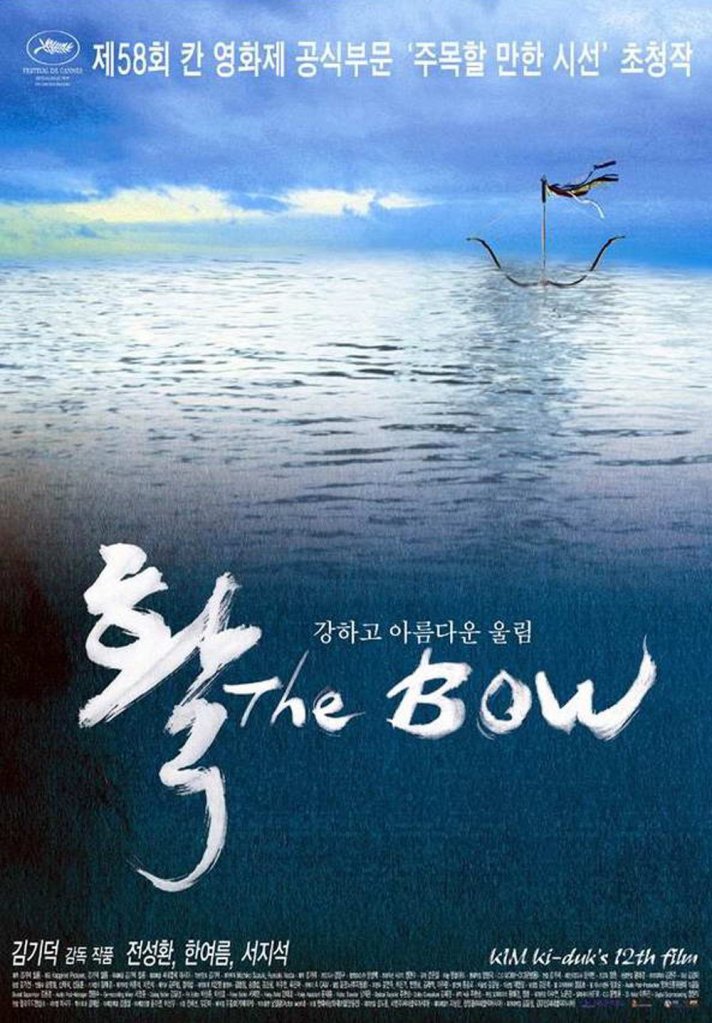
The bowKim Ki-duk is not known for his conventional approach to morality but even so his 12th feature, The Bow (활, Hwal), takes things to a whole new level of uncomfortable complexity. While nowhere near as extreme as some of Kim’s other work, The Bow takes the form of a fable as an old man and a young girl remain locked inside a mutually dependent relationship which, one way to another, is about to change forever.

The old man owns a fishing boat on which he lives with a young girl most assume to be his granddaughter. This theory is quickly disproved by the old man’s obsession with his wall calendar on which he excitedly crosses of the dates, making a note of how many there are left until the circled day on which is marked the word “wedding”. Whose wedding, one is apt to ask but the obvious answer is the correct one. The old man plans to marry the young girl on her 17th birthday. Having “found” her ten years ago, he’s been patiently raising her and now awaits his reward. It’s not clear if he has actually asked the girl, who seems to look to him as a paternal rather than romantic figure, but at any rate the relationship between them seems fairly solid at this point.

That is until one fateful day a young and handsome student boards the boat and immediately captures the girl’s attention. Having been cooped up here for ten a whole years seeing no one other than the old man and the guys who come to fish, the girl is instantly smitten – just like Miranda laying eyes on Ferdinand for the very first time. The old man is worried – is he about to lose his prize bride to a young buck? With the fateful day approaching, the girl becomes increasingly cold and rebellious towards her father/husband-to-be, though which direction she will eventually choose is anyone’s guess.

The old man is very protective of his charge, taking out his bow and arrow when the other guys on the boat try it on (and some take the chase to quite unpleasant places) but perhaps that’s more about defending his property from spoilage than it is about saving a defenceless girl from a traumatic situation. Neither the girl nor the old man speak very much, occasionally one whispers to the other who then passes the message on via another whisper to whomever it was intended for. Perhaps they genuinely have no need for talking but at any rate the girl never voices any objections to her life on the boat and the only signs of rejection given are a sullen look, rebellious courting of the customers and finally a good old fashioned slap to the face.

The bow of the title is both a weapon and a musical instrument when the string is tightened over a drum rather than across an arrow. The artist and the warrior are truly two sides of the same coin, swapping drums for arrows as the occasion calls. The old man, who is more or less cast as the protagonist of the tale meeting a final swan song, has all these qualities. A rough sea hand, he lives a life of isolation alone with the girl on a boat in the middle of the sea, the music their only form of entertainment. As well as the fishing business, the man also tells the fortunes of his customers by firing arrows at a picture of a Buddhist deity while the girl rides a swing in front. The boat itself is a world entire, with its own rules and rituals – all things are contained inside of it, violence mixed with beauty and love mixed with fear.

It’s ironic in one sense that the girl’s would be rescuer is another man with less prurient designs, but still designs all the same, on her as a woman. That she’s apparently lived on this boat for ten years with people coming and going all the time and with no great attempts to maintain a convenient excuse is shocking in itself. Whether the relationship between the old man is entirely genuine or born of a kind of Stockholm syndrome is a matter for debate, but Kim opts not to fully explore the uncomfortable elements of this unusual situation in favour of casting the old man as a kind of love fool.

Though actually featuring much more dialogue than the average Kim film, The Bow is at heart a symbolic exercise which becomes a complex and extended Buddhist metaphor. Playing out like a boat bound The Tempest, the old man becomes Prospero with a bow rather than a staff and as a prophet rather than a magician. The student, like Ferdinand, shatters their peace by bringing the outside world into their idyll with all of its pleasures and complications. The old man faces a choice, burn his books and abandon his kingdom or keep his daughter/wife-to-be fearful enough to stay with him rather than the young man who offers her, literally, the world, which she has never known. Kim descends into a surrealist frenzy as the finale approaches, culminating either in a beyond the grave consummation of true love or a spiritual rape, depending on your point of view. Whichever you choose, The Bow is both a complex and poetic exploration of human relationships but one that proves unpalatable and, ultimately, hollow.


Original English language trailer (dialogue free, English text)

The Himalayas (히말라야, Lee Suk-hoon, 2015)

HimalayasBecause it’s there. As good a reason as any for doing anything but these were the only three words of explanation offered by George Mallory in answer to the question “Why climb Everest?”. In Powell & Pressburger’s The Red Shoes, the heroine reacts in a similarly philosophical fashion when asked “Why do you want to dance?” replying with the question “Why do you want to live?”. What makes some people prepared to dance until their feet bleed and their toes break, and sends others to the peaks of snowcapped mountains staring death in the face as they go, is something which cannot be fully explained in words but cannot be denied by those who hear its calling.

Korea’s most well known mountain climber, Um Hong-gil (Hwang Jung-min), was undoubtedly one who heard the call and The Himalayas (히말라야) is his story (more or less). Based on his real life exploits, the film charts his continuing successes as an international climber until a foot injury forces him to remain on a more usual altitude, but the real heart of the story is in his growing relationship with rookie Moo-taek (Jung Woo) who’s every bit as fearless as he is. Together the pair scale the peaks of the world’s highest mountain ranges until it’s finally time for Hong-gil to hang up his pick and keep his feet on the ground for good.

However, tragedy strikes as one of Hong-gil’s closest friends is suddenly killed after getting caught in an unexpected storm. The mountain ranges of the world are littered with the corpses of unfortunate climbers who got into difficulty and couldn’t be rescued. The bodies remain where they fell, becoming one with mountain itself in a lonely climbers graveyard, frozen and perfect for eternity. Risking your own life to retrieve the lifeless body of a friend may seem like a perverse, irrational thing to do, yet understandable. Wracked with guilt and grief, Hong-gil assembles a team and embarks on a sentimental journey to bring his friend home, and, ironically, learn to let him go.

What starts off as a sports movie with its training sequences and tough coach inspires maverick rookie routine branches off into the classic expeditionary adventure format before falling into its unexpected home genre – the melodrama. Though in one sense a kind of biopic, the realm aim is to get those tears rolling as these brave men and women risk all for glory and comradeship in pushing the limits of the human condition far past their breaking points.

Hong-gil himself is, despite his gruff exterior, a dreamer and idealist in love with the soulful purity of the mountains. His is a journey of self discovery as he tells us that there is no pretence when it comes to mountain climbing. When you’re up there alone, just you and the vast snow covered emptiness, all of your masks and defences fall away. Hong-gil climbs the mountain to explore landscape of his own mind. He also objects to the often uttered phrase “conquer” a mountain as he believes the mountain gives you permission to ascend making this way of thinking disrespectful and even likens the mountain itself to woman when bemoaning Moo-taek’s pointlessly noble romantic gesture by stating that you don’t conquer the “mountain” you console it.

For all that, the real world is ever present as we see in one particularly awkward marketing pitch in which Hong-gil is trotted out as a model to have the prospective sponsor’s logo plastered all over him in the hopes that they will fund an expedition. When someone raises the very sensible point that this could look very bad for them should one of the climbers die with their logo on their chest, the marketing guys slowly start peeling them all off – velcro solves everything, it seems.

The team also becomes a marketing tool for their nation, carrying the Korean flag around with them for any photo opportunities which might present themselves. When tragedy strikes and the remainder of the Korean expeditionary group refuse to go after their fallen friend (the right and practical decision given the weather conditions and the low probability of success), base camp puts out a message over the radio in English pleading for help. The British contingent continue with their crosswords and cups of tea, steadfastly ignoring the emotional mayday call. The Chinese at least begin reassuring each other that it’s far too dangerous to contemplate.

The Himalayas begins as a comedy but the laughs fall away once the tears start rolling. Though it may affect a poetic tone the philosophical meandering is generally at the service of the melodrama which is very much underpinned by male bonding, pride, honour, debt and responsibility. Hong-gil’s “Human Expedition” is one of grief stricken madness but a perfectly understandable one in which he both needs to atone for “abandoning” his mountaineering brother and come to terms with the fact that the death zone has claimed another sacrifice. Often impressively filmed, The Himalayas suffers from its extremely melodramatic, sentimental tone which is only exacerbated by the intrusion of its loud and syrupy score. Anchored by strong performances from its leading players including Hwang Jung-min as the tough yet sensitive Hong-gil and Jung Woo as the young firebrand Moo-taek, The Himalayas spends too long at the destination rather than on the journey and ultimately fails to make either its character drama or expeditionary environment sufficiently engaging.


Seen as part of a teaser programme for the upcoming London Korean Film Festival 2016.

US release trailer:

Daytime Drinking (낮술, Noh Young-seok, 2009)

daytime drinkingPoor old Hyuk-jin is about to have the worst “holiday” of his life in Noh Young-seok’s ultra low budget debut, Daytime Drinking (낮술, Natsul). Currently heartbroken and lovesick as his girlfriend has just broken up with him, Hyuk-jin is trying to cheer himself up with an evening out drinking with old university friends. Truth be told, they aren’t terribly sympathetic to his pain though one of them suddenly suggests they all take a trip together just like they did when they were students. Hyuk-jin plays the party pooper by saying he can’t go because he’s meant to be looking after the family dog but after some gentle ribbing he relents and says he’ll come if he can get someone to look in on the puppy for him while he’s gone. He will regret this.
Sure enough, Hyuk-jin arrives at the bus terminal in the town where his friend supposedly knows someone with a cosy inn where they do delicious barbecues only it’s freezing cold and his friends are nowhere to be seen. That’s right – his ultra flaky friends have forgotten all about it and stood him up. Already quite annoyed, Hyuk-jin argues with his “friend” but later accepts his offer to stay over at the inn on his own at his friend’s expense and wait for him to join him there in a couple of days. However, firstly, Hyuk-jin somehow ends up at the wrong inn which seems to be run by a madman where he also meets a female solo traveller who’s apparently fond of a drink. Everywhere he goes, everyone keeps offering Hyuk-jin a drink in a way which makes it very hard for him to say no, though there’s almost nothing else to do around here anyway. Pretty girls and drink are about to land Hyuk-jin in a series of embarrassing incidents that are most likely only bearable because of the residual booze cloud Hyuk-jin is currently residing under.

Following a loose road trip structure, Daytime Drinking follows Hyuk-jin on his strange and accidental odyssey where just about everything conspires against him. Hyuk-jin is not entirely blameless in his fate – he’s far too taken by pretty faces and gets himself into trouble by behaving rudely towards a not so pretty older woman as she bores him with endless prattle, completely failing to take the hint that he’s finding her constant conversation a little too much to bear. Hyuk-jin’s distress continues to grow as his friend keeps delaying his trip, and his troubles only increase until he is deprived of both his phone and his wallet (not to mention his trousers!), leaving him entirely dependent on the kindness of strangers. Unfortunately, though some strangers may seem kind they often have ulterior motives whether they just want someone else to pay for the drinks or they’ve only booked one bed and are planning to creep into the shower just as you’re lathering up…

Daytime Drinking is the first feature from Noh Young-seok in which he acts as scriptwriter, cinematographer and editor so it’s a real indie production. Made on a true shoestring budget of only $9000, production values are surprisingly high even if obviously filmed on low grade equipment. Noh sticks to straightforward composition with Hong Sang-soo style static camera and zooms though he manages to effortlessly bring out the sympathetic humour inherent in Hyuk-jin’s very disappointing mountain holiday. Hyuk-jin himself is never a figure of fun and though hapless is clearly an ordinary person with ordinary failings such as his weakness for pretty girls and booze or his polite way of being impolite in trying to evade the attentions of a boring fellow traveller when he’s already tired and fed up himself.

Noh’s world view seems quite a bleak one but is also undoubtedly very funny. When things get as bad as this perhaps there’s nothing left to do but laugh. You’d think a trip as disastrous as this one would have Hyuk-jin vowing never to leave the house again, but then there’s yet another pretty face at the train station so perhaps a holiday to get over one’s holiday is order? Don’t do it Hyuk-jin! Some people never learn….


US release trailer:

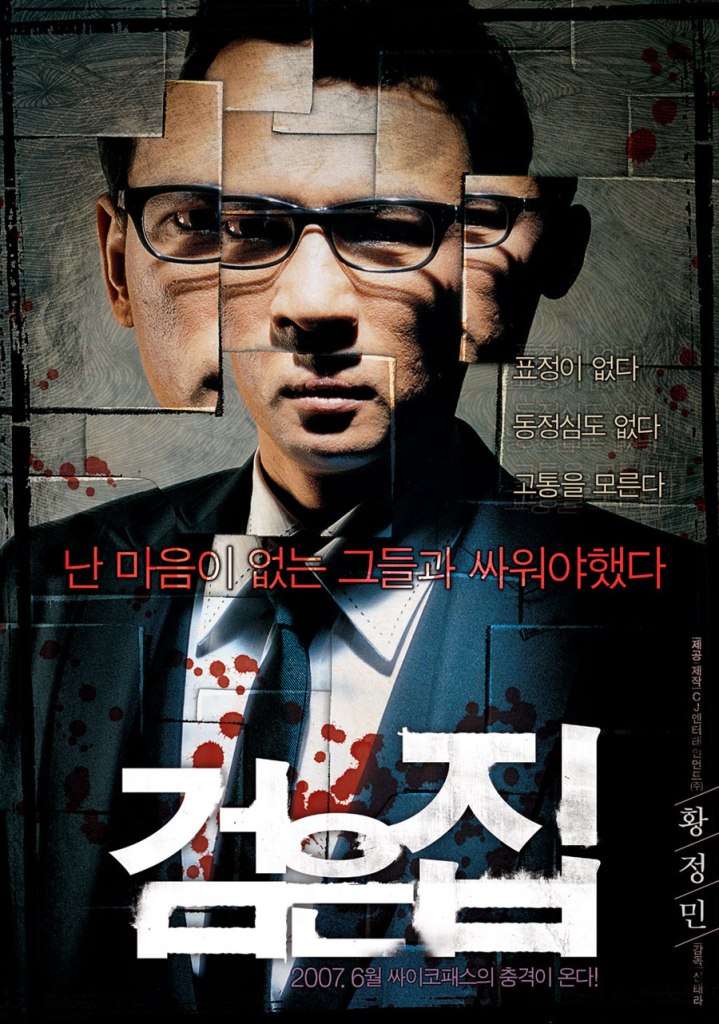
Black House (검은집, Shin Terra, 2007)

Black House (korea)Yusuke Kishi’s Black House source novel was previously adapted by Yoshimitsu Morita in its native Japan back in 1999, but eight years later the tale made its way to Korea by way of director Shin Terra who opts for a much more straightforward approach than Morita’s characteristically bizarre take. Sold as K-horror, the tone is closer to nasty thriller only giving way to classic slasher action in the final stretch. In eschewing Morita’s idiosyncratic tendency to insert himself into the material, Shin crafts a more mainstream aesthetic, but loses the various layers of social and psychological commentary that went with it.
Juno (Hwang Jung-min) is a mild mannered insurance clerk, new on the job and extremely naive. His first case involves a visit to a hospital with his boss to visit a persistent claimant whom they believe is deliberately scamming the system and possibly with the hospital’s help. In many ways, Juno is an innocent, he believed in insurance as a safety net and a power for social good so he’s shocked that anyone would deliberately manipulate the rules in this way – particularly when he discovers some people will go so far as to deliberately maim themselves just to claim on their insurance policies.

Not long after he starts working at the company, Juno gets a strange phone call from a man asking if insurance policies pay out in case of suicide. It’s possible, Juno says – he’ll need to check the policy to make sure. Suddenly worried the person he’s talking to is in a dark place, he starts trying to dissuade him from the idea of taking his own life and unwisely gives a lot of first hand advice despite the highlighted section in his employee guide cautioning him never to reveal personal information to clients. Soon enough, a client has asked for him personally to go out to their remote house and chat about a policy. When he gets there he receives a nasty surprise as the man’s young son has apparently hanged himself in the back room. Appalled, Juno waits to greet the police but becomes convinced the man has deliberately killed the boy, who was his step-son, to get the payout on his life insurance.

Juno refuses the claim but Choong-bae, the claimant, won’t give up and starts coming to the office everyday to ask for his money. Choong-bae is a scary looking guy and frightens most of the other staff with his vacant staring. He also has an insurance policy on his wife leading Juno to fear that she is next but his decision to try and alert her to her husband’s plans will prove a mistaken one, drawing him into the web of a dangerous and psychopathic serial killer.

Shin’s adaptation is most likely closer to the original novel but he is far less interested in the psychological or social implications than Morita was. There is no explanation offered for the actions of the killer though the childhood sequences with their reliance on dreams and hearsay remain intact, only with lesser impact. The question of insurance fraud and scamsters, people so desperate for money that they will literally sacrifice an arm or a leg, only exists as background and isn’t presented as a societal problem so much as just something that happens because there are some shameless people out there who would rather play the system than do an honest days work. Juno has also been given his own tragic backstory which tries to play him off as a mirror of the killer though somehow this never quite works and Juno’s own flashbacks are overplayed.

Beginning as a slow burn thriller where Juno plays the nervous, softhearted neophyte as yet uninured to the murkiness of the insurance world, Black House (검은집, Geomeun Jip) takes a huge detour during the final third which sends it into slasher territory when Juno decides to travel to the titular Black House, alone, during the middle of the night, because the police won’t listen to him and there are people in danger. When he gets there he finds a veritable house of horrors with body parts and nooses hanging from the ceiling, blood and carnage everywhere. Then it’s a straightforward fight to the death as Juno faces off against the psychopathic terror despite his nervous disposition culminating in some unexpectedly gory business with a key.

Like most slasher movies, Black House has several endings and finishes on a note of uncertainty but it never quite manages to make its sudden descent into violence work in its favour. Lacking the depth of Morita’s adaptation, Shin’s Black House may have stronger genre influences but with nothing to back them up all that remains at the end is a darker than usual serial killer tale with mild slasher tendencies. A decent enough mainstream thriller, Black House has a lot to offer despite stumbling in its final third but nevertheless lacks a distinctive element to mark it out from similarly themed genre efforts of recent times.


Unsubbed trailer:

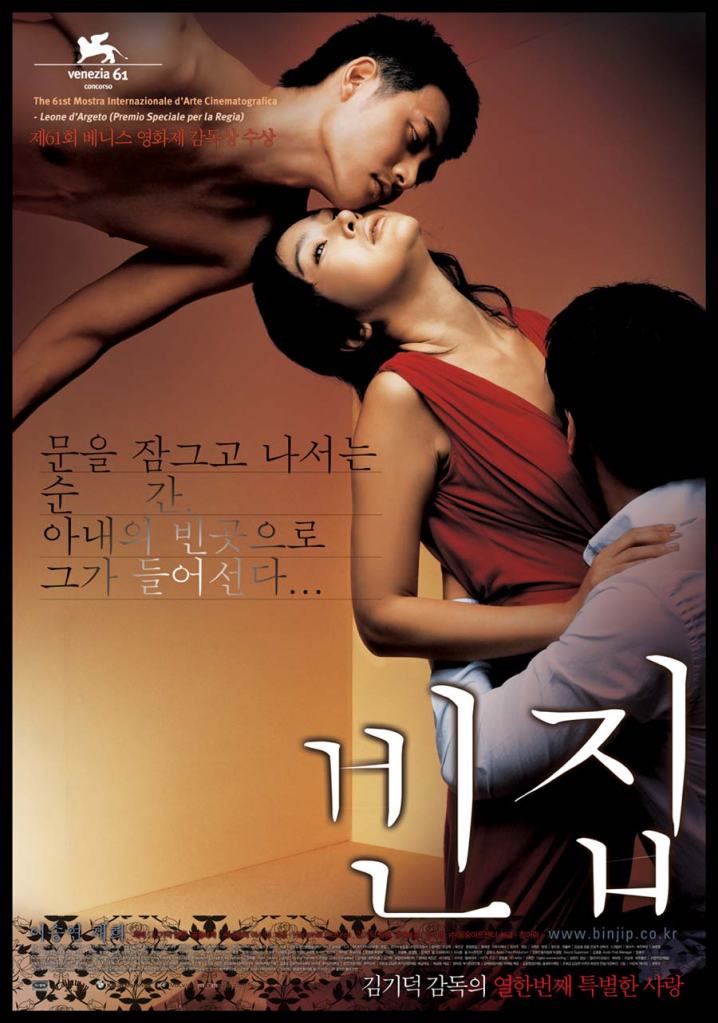
3-Iron (빈집, Kim Ki-duk, 2004)

3-ironYou wouldn’t think it wise but apparently some people are so trusting that they don’t think twice about recording a new answerphone message to let potential callers know that they’ll be away for a while. On the face of things, they’re lucky that the guy who’ll be making use of this valuable information is a young drifter without a place of his own who’s willing to pay his keep by doing some household chores or fixing that random thing that’s been broken for ages but you never get round to seeing to. So what if he likes to take a selfie with your family photos before he goes, he left the place nicer than he found it and you probably won’t even know he was there.

Player 2 joins the young man (credited as Tae-suk but unnamed in the film) when he stays at an upscale mansion which turns out to be “haunted” by the still living but damaged figure of a battered wife. Tae-suk hurriedly leaves once discovered, but later thinks over his encounter with the sad seeming lady and decides to return. After an altercation with her violent husband, Sun-hwa leaves with Tae-suk and the pair sneak into various other “empty” homes together. After one particular dwelling reveals a nasty surprise the two bring themselves to the attention of the police who threaten to end their young love story before it’s hardly begun.

Like much of Kim’s work, 3-Iron (빈집, Bin-jip) is near silent and neither of the two protagonists speak one word to each other until final scene of the film. Tae-suk, in particular, seems to have an obsession with being invisible – hiding in blindspots and always making sure to tidy up after himself so well that no trace of his presence remains. Sliding into these mini universes, he seems oddly interested in their inhabitants as he gazes at their photographs and admires the decor. Despite his need to disappear, he builds connections with absent people even going so far as to take a photo with a photo of them, artificially generating some sort of kinship where there is none.

If Tae-suk is haunting the bourgeoisie, Sun-hwa is both spectre and spectee as she moves silently around her golden cage of a spacious villa like a frightened mouse locked inside the elephant house. Evidently further along the stealth game than Tae-suk has been able to progress, her discovery of him leads to a feeling of defeat. Yet, after reconsideration, he recognises a fellow lost soul and so returns to rescue her from her oppressive ogre of a husband by using his weapon of choice against him. The 3-Iron golf club is not only a symbol of the husband’s middle class pretensions, but its relative lack of wear also points to the lack of respect he reserves for his toys – even extending so far as his wife whom he also seems to regard as an “inautonomous” appendage to his image much like the golf club itself.

Kim ends the film with a caption to the effect that it’s hard to tell if the world we live in is reality or a dream. With the continued silence of the film’s protagonist, bizarre scenario of “borrowed” lives, and general surrealism, Kim creates an etherial atmosphere filled with heightened, everyday strangeness. This could be a ghost story – literally, or figuratively, as our haunted protagonists continue their visitations on the living, or a love story, or even an absurd comedy. Tae-suk and Sun-wha exchange roles, alternately comforting or rescuing one another before, perhaps, becoming one at the film’s conclusion. A strange, romantic fairytale, 3-Iron is Kim in an uncharacteristically cheerful mood though he’s careful to remind us that the world outside of this charming bubble is filled with violence, cruelty, and chaos.


3-Iron is available in the UK from Studiocanal and from Sony Pictures Classics in the US though the R3 Korean disc also includes English subtitles.

US release trailer: