Hello World (ハロー・ワールド, Tomohiko Ito, 2019)

“Hello World” is a phrase familiar to many as the first line of text given to a new program. It signals firstly that the code is functioning correctly, but also expresses a sense of excitement and positivity as if a new entity were standing on the shores of an unfamiliar land eager for adventure. Tomohiko Ito’s sci-fi-inflected anime carefully places the phrase not at its beginning but at its conclusion, affirming that the hero has managed to step into himself, discover his place, and come to an understanding that grants him a sense of agency and possibility in a brand new world that is in a sense of his own creation and choosing. 

Before all that, however, Naomi Katagaki (Takumi Kitamura) is a textbook “regular high school boy” who fears he is just an extra in his own life quietly reading away at the back of the classroom and last in line in the dinner queue. Reading a self-help book on becoming more assertive helps less than he might have hoped, but two changes are slowly introduced into his life albeit passively the first being he is press-ganged onto the library committee and the second that he is approached by a strange man who claims to be himself a decade older. Future Naomi (Tori Matsuzaka) claims not to have come from another time but from “reality”, explaining that the world Naomi currently inhabits is a simulacrum designed to perfectly preserve the city of Kyoto as a digital archive housed inside supercomputer Alltale which has infinite memory. His older self tells him that he is fated to fall in love with classmate Ruri (Minami Hamabe) but she will then be killed by a lightning strike at a festival in three months’ time. Though their actions will have no effect on the “real” world, Future Naomi claims it’s enough for him to “save” Ruri even if it’s only virtually seemingly caring little that he will in fact be completely ruining the Chronicle Kyoto project by introducing a note of the inauthentic perfectly primed for the butterfly effect. 

In any case, what Naomi eventually discovers is that you can’t always trust “yourself” especially if you’re apparently merely data and therefore perhaps infinitely expendable. Young Naomi doesn’t seem particularly fazed by the revelation that his world is not “real”, and is perhaps overly trusting of his new mentor’s guidance following his instructions to the letter in accordance with the “Ultimate Manual” he’s been given to facilitate his romance with Ruri whom he originally claims not to fancy because like many immature teenage boys he only likes “cute” girls like transfer student Misuzu (Haruka Fukuhara) who literally sparkles while Ruri is like him a wallflower obsessed with books, shy and with an aloof, slightly intense aura. What Future Naomi offers him is pure male adolescent fantasy wish fulfilment in gifting him both the means for romantic success and literal superpowers in the form of the Hand of God which allows him to conjure objects from the digital world and will apparently help to save Ruri from her cruel fate.

The universe, however, has other plans. Soon enough he’s being chased by the forces of order, Homeostasis System Droids, trained to eliminate and correct inconsistencies in data appearing as oversize policemen in kitsune masks. Nothing in Naomi’s world makes much concrete sense, even as he’s been told he’s the creation of a simulacrum. Why would Future Naomi fetch up three months before the accident to train him rather than simply altering code, why would someone bother to create these universal super powers, and what exactly are the connections between this world and the “real” from which Future Naomi claims to have come? Some of this might well be explained by a final twist which turns everything we thought we knew upside down, implying perhaps that the gaps and contradictions we see are down to the vagaries of analogue rather than digital memory mixed with trauma both physical and emotional. Nevertheless, it turns out that Naomi’s mission is less to save Ruri than to save himself twice over, allowing Future Naomi to find an accommodation with the traumatic past while essentially giving birth to a “new world” of adulthood in which he is the fully actualised protagonist rather than the bit-playing extra he’s always believed himself to be. 

Featuring character designs by Kyoto Animation stalwart Yukiko Horiguchi, Hello World’s 3D animation fusion of 2D reality and the digital realm makes for interesting production design as Naomi’s world eventually crumbles around him in multi-coloured pixel while he’s chased by giant neon hands under an angry red sky. Nevertheless, its wilful incoherence often proves frustrating even if its myriad plot holes might be explained in part by the final revelation which itself introduces another note of bafflement in its parting scene. Asking some minor questions about the collection, use, and storage of personal data, archival practice, the limits of digital technology, and the nature of “reality”, Hello World is nevertheless a coming of age romance at heart in which the hero saves himself twice over while learning to rediscover a sense of wonder in future possibility.


Hello World streamed as part of the 2021 Japan Foundation Touring Film Programme.

International trailer (English subtitles)

In the Mood for Love (花樣年華, Wong Kar Wai, 2000)

“That era has passed. Nothing that belonged to it exists anymore.” So runs a melancholy title card placed a little before the conclusion of Wong Kar Wai’s Sirkian melodrama, In the Mood For Love (花樣年華). Extracted perhaps from the hero’s nascent foray into romantic fiction, the lines hint both at his plaintive sense of longing for lost love, and also to a changed Hong Kong which leaves the lovers stranded having missed their moment for happiness and thereafter trapped, like so many Wong heroes, in a perpetual evocation of the nostalgic past. 

Set like Days of Being Wild in the Hong Kong of the early 1960s, In the Mood for Love is in a sense an anti-melodrama concerning itself with the other side of an affair as betrayed spouses find in each other a kind of solace which ironically leads to love but a love that can never truly be fulfilled. Reporter Chow Mo-wan (Tony Leung Chiu-wai) first brushes past secretary Su Li-zhen (Maggie Cheung Man-yuk), sharing a name with the lovelorn box office girl of Days of Being Wild, when he attempts to rent a room for himself and his wife only to discover she has already taken it. The couple next door, however, are also looking to rent out their spare room now their son has married and so the pair find themselves next-door neighbours. Their respective spouses, seen only from behind and heard only on the other end of telephone calls or distantly from another room, eventually become more than that, their affair exposed as much as by their excessive business trips and suspicious overtime as by the rather crass practice of buying identical gifts for the illicit lover and legal partner, something also practiced by Li-zhen’s sleazy boss (Kelly Lai Chen) who enlists her husband to pick up a pair of handbags for wife and mistress. 

Li-zhen’s husband Chan (Roy Cheung Yiu-Yeung) seems non-plussed by the request but it perhaps gives him ideas, though not particularly good ones considering his mistress lives next-door, Li-Zhen pointing out to Mo-wan that a woman might not like a gift of a handbag identical to that of her neighbour before admitting she’s noticed his wife carrying just that, while Mo-wan is wearing the same tie as Chan who claimed it was a present from his boss which is why he’s been wearing it every day. Confronted on a similar point, Li-zhen’s boss makes a point of changing his tie before meeting his wife for a birthday dinner. Male adultery is, it seems, normalised and to an extent permissible as long it remains a secret even if openly. With her husband so frequently away, however, Li-zhen becomes a figure of suspicion, her landlady Mrs. Suen (Rebecca Pan Di-hua) warning her that her late night returns have not gone unnoticed while others marvel at her elegance, unable to accept she’s all dressed up just to buy noodles in the rain. 

For all these reasons, the relationship between Mo-wan and Li-zhen must remain chaste and pure even as they consciously role play their adulterous spouses. “We won’t be like them” Li-zhen insists, later echoed by Mo-wan’s admission that “I thought we wouldn’t be like them, but I was wrong.” He wanted to know how it started, and now he does. “Feelings can creep up just like that. I thought I was in control” he remarks in a speech which seems to echo Celia Johnson’s shattering revelation in Brief in Encounter “I didn’t think such violent things could happen to ordinary people”. Like the old busybodies of Coward’s prurient, middle class England, the landlady acts as an enforcer of conventional morality, always on the look out for breach of conduct and believing herself acting in Li-zhen’s best interest even as her admonition leaves her in a moment of virtual collapse, grasping the doorframe for support as her eyes momentarily fill with tears. 

Yet it’s Mrs. Suen’s eventual absence that informs us of a sea change. Years later, in 1966, she’s one of many in an apparent mass exodus fleeing the political instability in the wake of a series of riots against British colonial rule. Mrs. Suen is vacating her apartment to live with her daughter in the US where she may stay indefinitely. The Koos from next-door have already moved to the Philippines to live with their son, laying bare the ongoing expansion of the Hong Kong diaspora. Mo-wan eventually finds himself in Singapore, though fleeing emotional rather than political instability, eventually travelling to Angkor Wat in a failed attempt to exorcise his sadness, while Li-zhen, unable to act on her desires and trapped by patriarchal ideas of conventional morality is, like Happy Together’s Po-Wing, left only with memory living in the metaphorical past of Mrs. Suen’s apartment. Something has changed, a once impossible love may now be possible, but “that era has passed”. The couple have missed their moment, trapped on either side of an unbreachable divide. 

For Mo-wan, “the past is something he could see but not touch” a subject of perpetual longing blurred and indistinct as if seen through a dusty window pane. Working again with Christopher Doyle, Wong’s sweeping cinematography captures Mo-wan’s etherial existence through comparatively restrained composition and use of gentle tracking shots following the lovers as they repeatedly pass each other in shadow on the stairs or wander along the deserted, rainy streets of a midnight city. Like a long slow waltz, In the Mood For Love sends its protagonists spinning back towards opposite sides of the floor, trapped in a world which no longer exists and consumed by an irresolvable longing for the nostalgic past. 


Transfer: presented in the original 1.66:1 aspect ratio though like the other films in the series of 4K restorations featuring the near universal green tint in a significant change for a film known for sumptuous colour and particularly associated with the use of deep reds.


In the Mood for Love is currently available to stream in the UK via BFI Player in its newly restored edition as part of the World Of Wong Kar Wai season.

Restoration trailer (English subtitles)

Happy Together (春光乍洩, Wong Kar Wai, 1997)

4K

“Turns out, lonely people are all the same” according to the hero of Wong Kar Wai’s melancholy handover romance, Happy Together (春光乍洩). A statement cutting straight to the heart of Wong’s sensibility, it at once casts the individual as the universal as a man is forced to see himself from another direction, mirrored in the eyes of his former lover a man he can neither keep or forget. The title’s all too apparent irony becomes plain as the couple find peace only in incapacity, lovers on the run perpetually in search of but unable to attain the image of idealised romance. 

As if to signal his intent, Wong begins with a zoom in on the symbol of the love the two men can never fully realise in the colourful lamp bearing the image of a majestic waterfall they continue to search for but only one of them finds. Switching to a melancholy black and white he shows us for the time at least a semi-explicit sex scene between two men played by two of the biggest stars of the day while the hero, Yiu-Fai (Tony Leung Chiu-Wai), laments in voiceover his tendency to give in when his lover, Po-Wing (Leslie Cheung), utters the phrase “Let’s start over” encapsulating the tempestuous quality of their romance. To do just that, they’ve fled pre-Handover Hong Kong for Argentina in the hope of fixing their relationship but have discovered only more of the same, their contradictory qualities highlighted by their isolation in an unfamiliar environment. 

Tellingly Po-Wing first breaks up with Yiu-Fai on the road after they fail to find the waterfall as if in acknowledgment of the impossibility of mutual acceptance. Both ending up in Buenos Aires the pair awkwardly reunite, Yiu-Fai working earnestly as a bouncer at a tango bar while Po-Wing becomes a sex worker, his sharp outfits and sunshades an immediate contrast with Yiu-Fai’s somber workwear. Nevertheless, when his new life implodes leaving him badly beaten it’s to Yiu-Fai that he returns. By turns resentful, Yiu-Fai will later describe these days as their happiest, those in which Po-Wing was in a sense tethered, incapacitated, and dependent, his worst qualities neutered by his present need. Demonstrative and affectionate, he attempts to rekindle his relationship with the reluctant Yiu-Fai but is soon up to his old tricks again as his wounds begin to heal while strangely jealous as Yiu-Fai develops a friendship with an itinerant young man from Taiwan, Chang (Chang Chen), who works at the restaurant he transfers to after getting into a fight avenging Po-Wing at the tango bar. 

Like Yiu-Fai and Po-Wing, Chang claims he left Taipei because he was “unhappy” and is currently on a journey to the “end of the world”, looking for a lighthouse where it is said the brokenhearted can leave their sadness behind. It isn’t exactly clear if Chang realises Yiu-Fai is gay, seemingly shocked on picking up the phone to hear a man’s voice where he expected a woman’s but saying nothing of it and continuing to frame his conversation in heteronormative terms, though Yiu-Fai certainly seems worried what the fallout might be of Chang’s accidental discovery. Perhaps in flight from an uncertain future in a Hong Kong on the brink of a “reunion” with an authoritarian regime, the two men live freely bathing in the isolation of being two alone together in an unfamiliar culture, but their paths are always set to diverge. Sobbing into Chang’s Walkman, Yiu-Fai bounces to the end of the world and back again, observing the roaring waters for himself before travelling on echoing the footsteps of Chang, representative of another Sinophone nation, coming to realise that his wandering is possible only because he has a place to which he can return. 

Po-Wing, meanwhile, unexpectedly clings to the past, attempting to mend the lamp while living in the apartment he once shared with Yiu-Fai now regretful that they can perhaps never again “start over”. Leaving his sadness at the end of the world, Yiu-Fai extricates himself from a previously toxic relationship in exercising his right to “start over” having accepted the impossibility of his idealised dream of romance. Impassively observing the news of Deng Xiaoping’s death, he travels a nighttime Taipei, apparently resolved to reclaim his home choosing perhaps a kind of rooted independence following Chang’s example as he rides the elevated train into a neon-lit night filled with energy and positivity for the future. Shot with the melancholy greens and woozy ethereality of Wong’s emotional landscape, Happy Together deceptively mines the joys of moving on in a gradual unburdening that spells the end of loneliness.  


Transfer: As the original negative was damaged by fire and could not be fully restored, some of Tony Leung’s monologues have unfortunately been trimmed though the presentation is otherwise more faithful to the original than others in the series if also deepening the greenish tint.


Happy Together is currently available to stream in the UK via BFI Player in its newly restored edition as part of the World Of Wong Kar Wai season.

Restoration trailer (English subtitles)

Fallen Angels (墮落天使, Wong Kar Wai, 1995)

4K

Wong Kar Wai may be associated with a melancholy existentialism but Chunking Express, filmed on the fly in an effort to shake off frustration during the famously difficult shoot on Ashes of Time, had been a breath of fresh air which characterised pre-Handover Hong Kong as a place of anxiety mired in nostalgia but also with tremendous energy and a fervent hope for the future. Its quasi-sequel, however, is the other side of the coin. If Chungking Express’ Hong Kong were heaven Fallen Angels (墮落天使) is its hell. 

As if to signal the connection between the two visions of Hong Kong, the twin protagonists of Fallen Angels each repeat the words of He Qiwu, cop 223, that daily one rubs elbows with a thousand strangers some of whom may later become friends or confidants, but this time around the words spell less of possibility than of a fatalistic inevitability. Indeed, the central drama occurs because melancholy hitman Ming (Leon Lai-ming), tired of his life, yearns for control after years of “lazily” allowing all of his decisions to be made for him. “The best thing about my job is there’s no need to make decisions” he explains, “who’s to die, when, where..it’s all decided by others.” “I don’t know whether it’s a good decision or not” he adds after vowing to make a change, “but at least it’s mine”. 

Good or bad it hardly matters, it is all decided. The protagonists of Fallen Angels live in a kind of purgatory of perpetual longing, looking for a connection which seems to elude them. Ming has been in a non-relationship with his “partner” (Michelle Reis), more of a handler, for 155 weeks, a “dating” method which seems to spell out his preoccupation with time. Despite their long association, however, the pair rarely meet in person, believing that “partners should never get emotionally involved with one another”. That’s something the unnamed partner later comes to accept, explaining that after moving on from Ming she’ll be careful to avoid becoming attached. Mirroring Chungking’s Faye, we find her in Ming’s apartment, sharing his space, tidying up for him, changing his sheets, and repairing his ansaphone but slipping past him at the train station careful that the streams do not cross. Yet she also tells us that sometimes she sits in his favourite seat at their favourite bar because it makes her feel close to him, avowing that sometimes it’s better not to get too close, find out too much about someone and you lose interest. “I know how to make myself happy” she adds, ironically resorting to just that, alone on Ming’s bed while he drifts into another non-relationship with a woman who dyed her hair blonde (Karen Mok) in the hope that it would make her memorable. 

The obsession with blondes recalls Brigitte Lin’s wigged assassin from Chungking Express, another “Blondie” bringing together mute ex-con Ho Chi Moo (Takeshi Kaneshiro), prisoner no. 223 neatly mirroring He Qiwu’s badge number in addition to sharing his nickname and having apparently lost his voice as a child after eating expired tinned pineapple, with his “first love” Charlie Young (Charlie Yeung Choi-Nei) who enlists his help to track down the treacherous young woman about to marry her ex. He later rubs elbows with a changed Charlie, dressed in a stewardess’ uniform ironically mirroring the romantic ending of Chungking Express seconds after Chi Moo’s clumsy mimicking of Faye’s iconic dancing, though she does not remember him. Like Ming, Chi Moo wants control over his life, deciding to be his own boss, but does even this partly out of resignation that his muteness makes it much more difficult to make the kinds of connections he longs to make. He lives parasitically making an illicit living “borrowing” other people’s businesses after hours and intimidating customers into buying his services, eventually losing two father figures in quick succession, thrusting him into an unsought adulthood in which he returns to his former life but tries to pick stronger businesses that won’t “get hurt easily”.

Despite its sense of defeat and melancholy, perhaps even a touch of nihilism, Fallen Angels does however end with a sense of peace and positivity even in that which may or may not be a transitory connection for the gentle warmth it imparts. Collaborating once again with Christopher Doyle, Wong’s underground Hong Kong is a purgatorial dreamland of infinite longing filled with the fatalism of a gangster noir in which there is no future and no freedom only loneliness and death punctuated with brief moments of warmth, but in those brief moments is perhaps a reason for living at least until one’s “expiration date” arrives. 


Transfer: The most radical of the 4K restorations, Fallen Angels is presented in a 2.35:1 aspect ratio, cropped from the 1.79:1 of the original release with the effect that the images appear further constrained while additional distortion occurs at the edges of the frame. In his introduction to the series, Wong offered the following comment on the aspect ratio change:

With Fallen Angels, I have changed the format to CinemaScope, because it was originally what I had intended to release the film in. When we were cutting the film, we accidentally turned the Steenbeck on anamorphic instead of standard. I felt that the film looked much more interesting because the setting[ck] enhanced the distance of the characters on top of the extreme wide angle that we shot with. Back then, it was impossible to shoot a film in standard and release it in anamorphic. With this restoration, we have successfully fulfilled this wish.

Additionally, while the film maintains the distinctive green tint in keeping with the house style of the new restorations, several scenes originally in colour have been regraded to monochrome while others originally in monochrome have been retouched with elements of colour.


Fallen Angels is currently available to stream in the UK via BFI Player in its newly restored edition as part of the World Of Wong Kar Wai season.

Restoration trailer (English subtitles)

Chungking Express (重慶森林, Wong Kar Wai, 1994)

4K

Despite scoring an early success with his debut film As Tears Go By, an atmospheric gangster picture starring some of the most popular actors of the day, Wong Kar Wai’s second feature Days of Being Wild, a melancholy arthouse drama of loneliness and longing set in the heady 1960s, proved disappointing at the box office and divisive with domestic critics. Unable to secure funding for a planned sequel, Wong founded production company Jet Tone Films and agreed to a studio offer to direct a wuxia adventure which was at that time an extremely popular genre. The shoot on Ashes of Time was however notoriously difficult (Wong eventually extensively revised the film for its 2008 “Redux” re-issue), and during a short break from its various demands he shot Chungking Express (重慶森林), an extremely vibrant, zeitgeisty journey through pre-Handover Hong Kong in which a lovelorn policeman is preoccupied with expiration dates while another reflects on new possibilities when his stewardess girlfriend rediscovers her right to make her own choice. 

Lovelorn policeman He Qiwu (Takeshi Kaneshiro), badge number 223, has just been dumped by his girlfriend of five years but as she chose April 1 to break the news, he assumed it was a joke. To go along with it, he’s been buying tins of pineapple which expire on May 1, firstly because his girlfriend May loves pineapple and secondly because May 1 happens to be his birthday. If she hasn’t got back with him by then, he’ll accept that their love has “expired”. A rather melancholy young man, Qiwu gets his emotional release through jogging in the rain, avowing that while running your body sheds water so you don’t cry as much and in the rain no one can see you anyway. The password for his answering service is “love you for 10,000 years”, but his attempts to hook up with old flames from his little black book are a series of embarrassing misfires, the first having turned in early, another already married with two children, and the last not even remembering him. Nevertheless, despite his melancholy he lives in a constant state of possibility as his opening monologue reminds us in his defence of the city as a place in which one may brush past a hundred people a day some of whom may later become friends or lovers. 

Nevertheless, the Hong Kong he inhabits is one of infinite nostalgia. He tells us that his girlfriend is often likened to ‘70s Japanese pop star Momoe Yamaguchi, only to lament that he was never quite her Tomokazu Miura, Yamaguchi’s frequent co-star whom she later married and thereafter left showbiz to become the ideal housewife and mother. The woman that he falls for, a mysterious drug trafficker (Brigitte Lin Ching-hsia) hot on the trail of a group of Indian tailors she’d hired as mules who absconded at the airport, wears a trench coat, blonde wig, and sunglasses seemingly modelled on Gena Rowlands in Gloria. She too however is caught in a moment of crisis, admitting that the sunglasses and raincoat are in a sense an attempt to hedge her bets while the expiry date on an abandoned can reminds her that time is running out. The conclusion Qiwu comes to is that to May he is no different to a can of pineapple, past his best and fit to be abandoned, while the mysterious woman eventually implodes her assumed identity by taking her revenge and thereafter shedding her trademark wig to recede back into the crowd pausing only to send Qiwu a happy birthday message via his pager in another act of distanced communication.  

The irony of Qiwu’s seeming obliviousness to his proximity to crime is never touched upon despite his apparently deep, essential connection with this slightly older mysterious woman whom he manages to woo despite his awkward opening gambit of asking if she likes pineapple in four different languages. Nor does he seem to be familiar with fellow officer badge 663 (Tony Leung Chiu-Wai) who frequents the same late night food stand as he does, while neither of them apparently know the mysterious “Richard” who seems to have beaten them both to win the heart of previous assistant also coincidentally named May who has now been replaced by proprietor’s cousin, Faye (Faye Wong). Obsessively listening to California Dreamin’ at high volume because it stops her thinking too much, Faye falls for 663 who is apparently unceremoniously dumped by his air hostess girlfriend (Valerie Chow Kar-Ling) after being persuaded to alter his regular order of Chef’s Salad for Fish and Chips introduces a new element of choice into their relationship. 

In a kind of meta, expressionistic irony, 663 becomes obsessed with his sadness gently consoling the inanimate objects of his apartment in his girlfriend’s absence, lamenting that his soap bar has grown thin while his dish cloth weeps until finally the whole place floods. This last incident is partly down to the ministrations of Faye who has been, in the nicest possible way, semi-stalking him, using the keys which were returned to the food stand along with a letter 663 refuses to read to break into his flat and literally breathe life back into it by tidying up and replacing the fish in his fish tank. 663 appears not to notice as her distanced care seemingly nurses him back to health even as they begin in a sense to swap roles, he shedding the policeman’s uniform his ex mistakenly thought suited him better for the flannel shirts left by Faye which reflect perhaps his authentic self as observed by the woman who truly loves him. 

Even so she remains restless and bound for (temporary) exile while 663 once again refuses to open correspondence which may prove hurtful or unpleasant, getting a second chance at a fated love only thanks to the magical coincidences of the forever buzzing streets of Hong Kong. At once frenetic and anxious, Christopher Doyle’s swooping, mobile photography with frequent alteration in frame rate and transitions to slow motion capturing a sense of nervous energy, Wong’s take on the pre-Handover society is more positive than most as his neurotic, lovelorn protagonists breeze through their melancholia ultimately discovering a sense of forward motion in hope for the future born of chance connection in an ever moving city. 


Transfer: The 4K restoration is presented in the original 1.66:1 aspect ratio and in keeping with new the house style, has shifted slightly towards the green in terms of colour grading which is overall darker and richer than the previous Criterion release.


Chungking Express is currently available to stream in the UK via BFI Player in its newly restored edition as part of the World Of Wong Kar Wai season.

Restoration trailer (English subtitles)

Days of Being Wild (阿飛正傳, Wong Kar Wai, 1990)

“I used to think a minute could pass so quickly, but actually it can take forever” laments a lovelorn heroine in Wong Kar Wai’s melancholy ‘60s romance Days of Being Wild (阿飛正傳), somehow neatly encapsulating the director’s entire philosophy. The heroes of Days are obsessed with minutes, seconds, hours, years, the barely perceptible passing of time. Clocks pervade the frame, their violent ticking the most prominent element of Wong’s strangely barren soundscape, a constant reminder of a life slowly etched away ceaselessly beaten towards an inevitable conclusion. 

The hero, Yuddy (Leslie Cheung Kwok-wing), describes himself rather poetically as a bird without legs cursed to fly and fly meeting the ground only once at the moment of his death, an overly sentimental metaphor for which he is later taken to task by the equally rootless Tide (Andy Lau Tak-wah), a former policeman turned sailor who wonders if it’s just a line he uses to seduce lonely women with boyish sadness. We might wonder the same thing as he picks up the lonely Li-zhen (Maggie Cheung Man-yuk), a Macao émigré apparently unable to sleep, by telling her she’ll see him in her dreams before forcing her to look at his watch for a whole minute as if that after 3pm on April 16, 1960 were now a sacred date forever etched in time. She thought that sounded “so sweet”, but as he later tells her Yuddy is not the marrying kind and she too is trapped inside that moment, often framed behind bars or the tiny window of her box office booth before the door is cruelly slammed on her romantic delusion seemingly by automatic operation of the clock. 

In a twist of fate, Li-zhen meets Tide during his previous life as a policeman when she makes a fairly embarrassing attempt to get back together with Yuddy after he reacts coolly to her suggestion of marriage only to discover him with his new love, cabaret dancer Mimi (Carina Lau Kar-ling). “I’m not gonna be as stupid as her” Mimi insists flouncing out of his apartment only to find herself just that, making a desperate visit to Li-zhen at the stadium after the affair has ended to tell her to her back off only for the rather unsympathetic Li-zhen to point out they’ve both been deceived, “he treats all women the same”. 

A perpetual lothario Yuddy moves from woman to woman without touching the ground, but his rootlessness is seemingly born of maternal disconnection in his ambivalent relationship with the Hong Kong sex worker who raised him but refuses to disclose the identity of his Filipina birth mother supposedly a noble woman who for unknown reasons paid a foreigner US$50 a month to raise her son. Like the other women in Yuddy’s life, Rebecca (Rebecca Pan Di-hua) does her best to tie him down, apparently unwilling to reveal his origins in fear he’d leave her, but also mirrors him in her constant quest for affection bought from a series of younger men and apparently one older who threatens their relationship in inviting her to a new life overseas. Ironically enough, she soon tells her son to “fly, fly as far as you can” all the way to the Philippines, though Yuddy already suspects he’s been a flightless bird all along, dead from the very beginning.

Yuddy’s search for closure and identity ends disappointment and a painful lack of resolution, as does the nascent romance between the policeman and the box office girl, her mistimed phone calls amounting to a literal missed connection while Tide ponders lost love from foreign seas, and Mimi tragically chases the ghost of Yuddy all the way to Manila pined for by Yuddy’s self-conscious friend Zeb (Jacky Cheung Hok-yau) left behind alone. Trapped in the timeless present, they are each denied either past or future, lost in a lovelorn dream of perpetual longing. As if to ram his point home, Wong shows us another clock and then another man we’ve never seen before (Tony Leung Chiu-wai) as he gets ready for an evening out, crouching slightly in what appears to be a shallow, sub-divided garret making it clear that these stories have no endings, flying and flying until they hit ground and seemingly born in the air. A woozy, zeitgeisty journey through mid-century loneliness, Wong’s second feature leaves its melancholy heroes consumed by nostalgia for an ill-imagined future unable to escape the cruel tyranny of an interminable present. 


Transfer: Among the more faithful of the recent 4K restorations, Days of Being Wild nevertheless shifts to a slightly greener hue in keeping with the house style adopted for the series, adding to Wong’s sense of melancholy nostalgia and perhaps in keeping with Doyle’s original artistic vision.


Days of Being Wild is currently available to stream in the UK via BFI Player in its newly restored edition as part of the World Of Wong Kar Wai season.

Original trailer (unrestored, English subtitles)

Osaka Asian Film Festival 2021 Announces Complete Lineup

The Osaka Asian Film Festival will return for its 16th edition as a physical event to be held in the city from 5th to 14th March. In line with coronavirus precautions, the festival will take place without guests or Q&As while a small selection of films previously screened at OAFF will also be available to stream online in Japan from 28th February. This year’s opening gala is the Ann Hui documentary Keep Rolling while Yuya Ishii’s The Asian Angel makes its World Premiere bringing the festival to a close on 14th March.

Bhutan

  • Lunana: A Yak in the Classroom – a frustrated teacher is dismayed to learn he’s being sent to a remote mountain outpost but is eventually won over by the kids. Review.

China

  • A Song for You – a nomad dreaming of becoming a folk singer encounters a young woman resembling the goddess of music who tells him he must record an album in this indie drama from Dukar Tserang.
  • Leap – Peter Chan’s New Year volleyball drama starring Gong Li as a legendary woman’s Olympic team coach.
  • A Summer Trip – warm hearted drama from Feng Keyu in which a grumpy old Korean war vet and his rebellious grandson go on a road trip in the days before the Beijing Olympics.

Hong Kong

  • Elisa’s Day – a policeman is forced to face a mistake he made 20 years previously while investigating a crime of passion.
  • Hand Rolled Cigarette – debut feature from Chan Kin-long starring Gordon Lam as a former soldier turned triad who bonds with a young South East Asian street thief.
  • Keep Rolling – documentary focussing on the life and career of director Ann Hui. Opening night gala.
  • The Way We Keep Dancing – artists and dancers come together to put on a show in protest to the increasing gentrification of the former Kowloon industrial district where they live.

Indonesia

  • Affliction – horror film from Teddy Soeriaatmadja in which a grieving wife tries to uncover the secret behind her mother-in-law’s decline.
  • Lovely Man – 2011 drama from Teddy Soeriaatmadja in which a young woman with strong religious views comes to the city in search of her estranged father who is now a transgender woman. Streaming online.

Japan

  • (C)Yukari Sakamoto
  • Along the Sea – drama from Akio Fujimoto following three young Vietnamese women who end up undocumented after leaving a training programme in Japan.
  • The Asian Angel – drama from Yuya Ishii in which a recently widowed novelist takes his young son to live with his brother in Seoul only to find his brother had exaggerated the degree of his success.
  • B/B – graduation film from Kosuke Nakahama in which a woman with multiple personality disorder is interviewed by police in connection with the killing of a convenience store owner in a 2020 which has also seen the Olympics cancelled due to corruption and a failed poison gas attack by a new religion.
  • Born in Hiroshima – personal documentary in which the director, born in Hiroshima but from Peking, charts his roots through the story of his izakaya-running family with whom he lived until the age of three.
  • Come and Go – A detective investigates the connection between the discovery of an old woman’s skeleton and a series of real estate scams by interviewing the local residents many of whom are migrant workers from other areas of Asia.
  • For Rei – A confused young woman begins to gain a degree of self-acceptance after facing the image of her absent father in Yukari Sakamoto’s indie drama. Review. First screened last year now streaming online.
  • Goto-san – drama following a young man living and working in a manga cafe who falls in love but then loses his job and place to live when the cafe is closed due to the coronavirus pandemic.
  • Green Jail – documentary focussing on an old woman who is the last survivor of forced labourers trafficked from Taiwan to work in Okinawa’s “Green Jail” during the colonial era.
  • itomichi – latest drama from Satoko Yokohama (The Actor, Bare Essence of Life) in which a young woman skilled in playing the Tsugaru-shamisen starts working in a maid cafe in order to get over her shyness.
  • JOINT – yakuza drama in which a man gets out of prison and enlists two old friends to start a business selling data for telephone fraud to the yakuza only to find himself trapped in the criminal underworld.
  • Love and the Grand Tug-of-war – love story between a young man who’s staked his youth on the local tug-of-war, and a medical student from Korea.
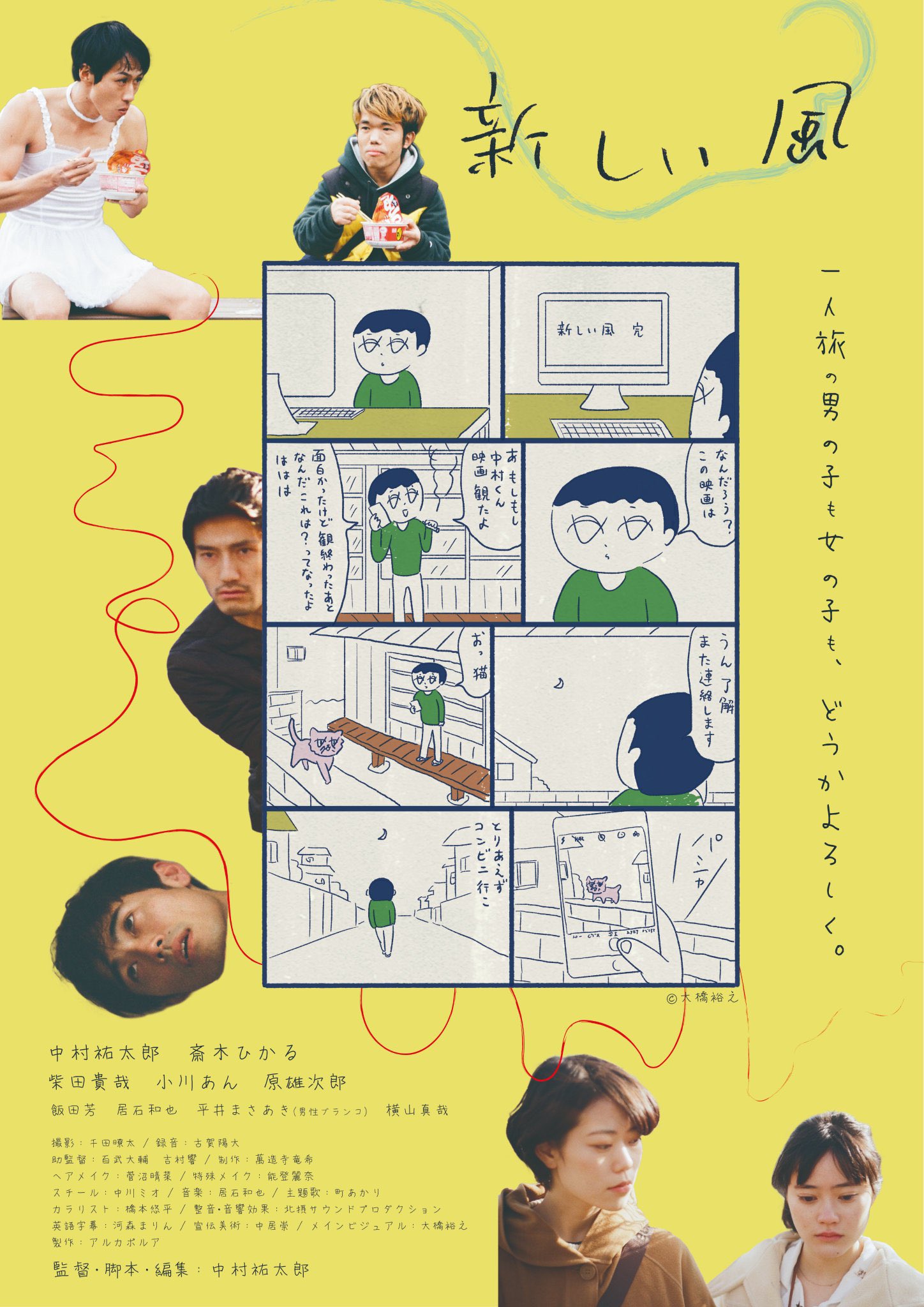
  • A New Wind Blows – latest indie film from Yutaro Nakamura focussing on romantic confusion.
  • Over the Town – ensemble drama from Rikiya Imaizumi following a young man who rarely leaves Shimokitazawa where he works in a vintage clothing store whose life changes when he’s asked to appear in an indie film.
  • OZU – third in Zon Pilone’s trilogy of films focussing on Sadao Yamanaka, Setsuko Hara, and Yasujiro Ozu.
  • POP! – collaboration between The Man Who Was Eaten screenwriter Masashi Komura and musician Aru-2
  • Sweet Bitter Candy – strange sad tale of a young woman on the cusp of adulthood and a misfit man from Yutaro Nakamura.
  • yes, yes, yes – story of a family’s destruction and rebirth from Akihiko Yano.
  • Young Birds – youth drama at which a trio of students at Digital Hollywood University, one Japanese, one Chinese, and one Thai, team up to complete their graduation movie.

Korea

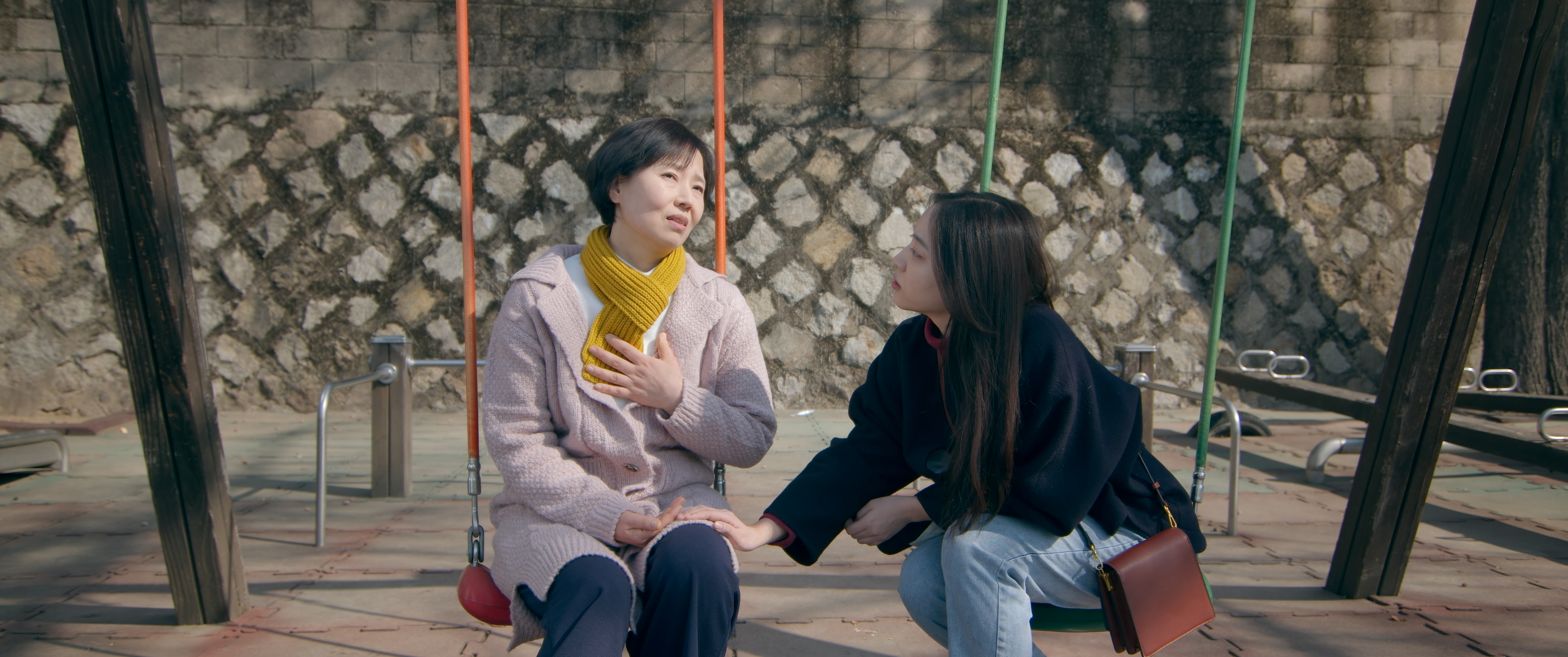
  • Beyond You – latest from Alone/A Fish director Park Hong-min in which a man confronts the daughter of his first love who thinks he might be her father.
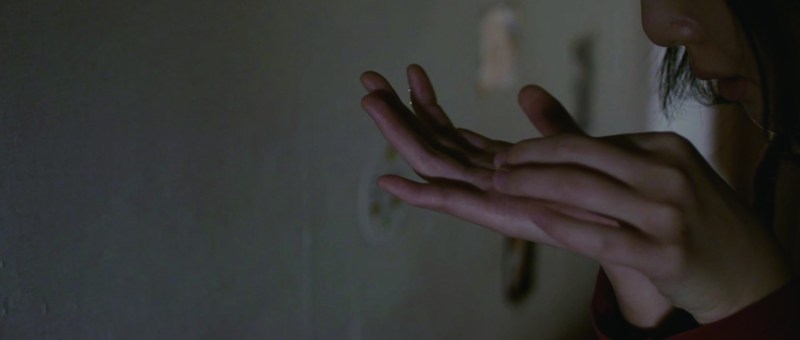
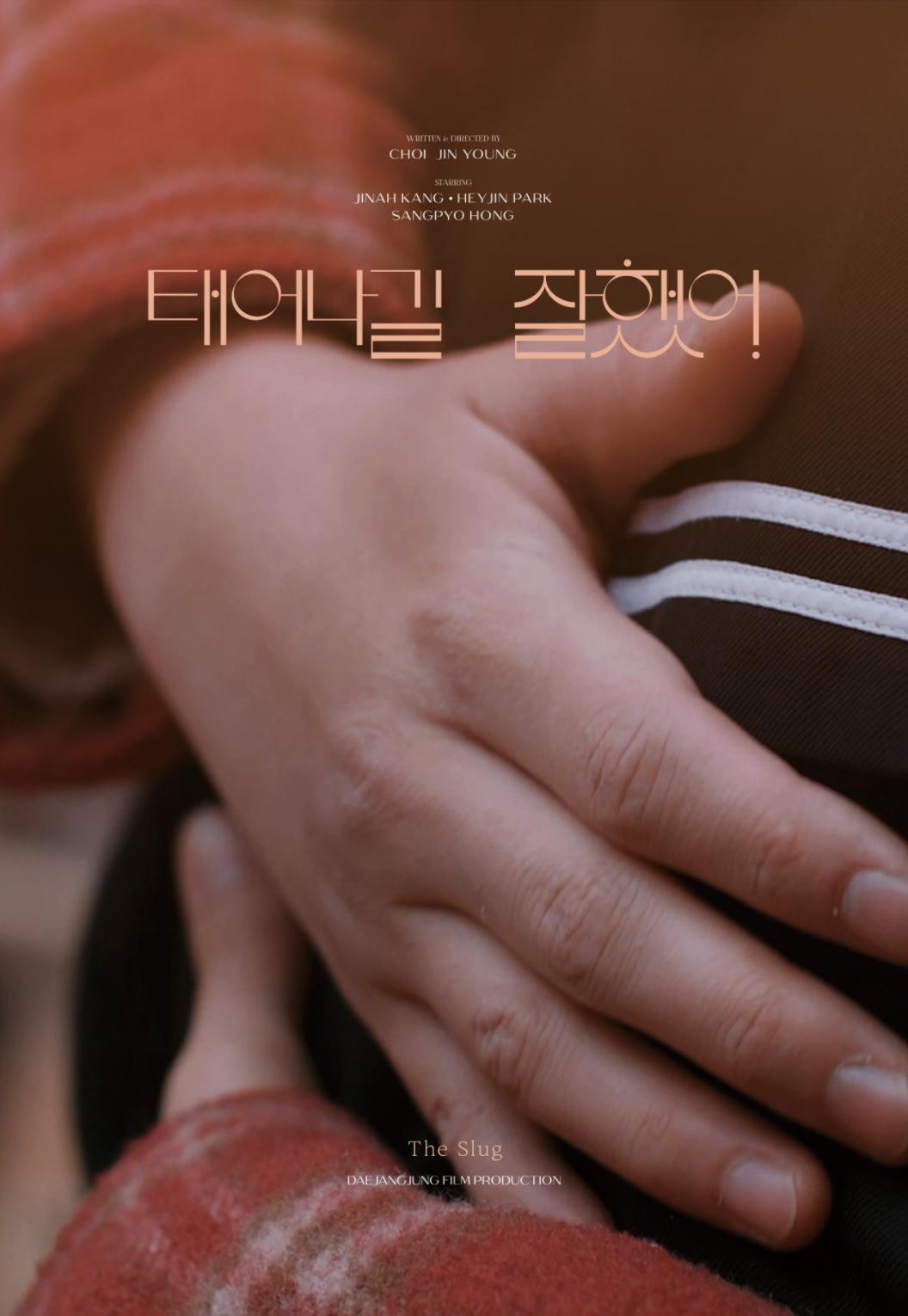
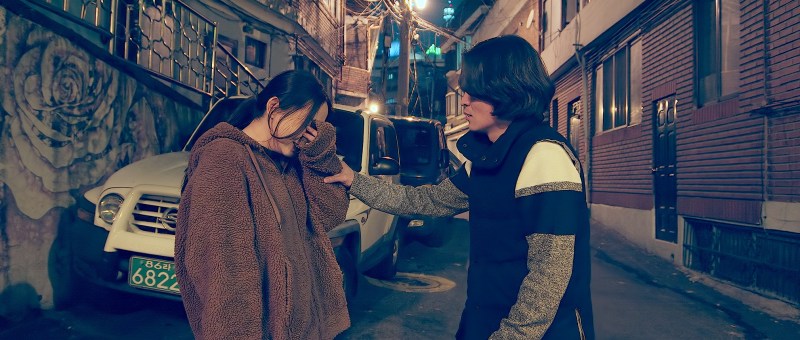
  • The Slug – whimsical time-shifting drama in which a young woman is haunted by the image of her traumatised childhood self.
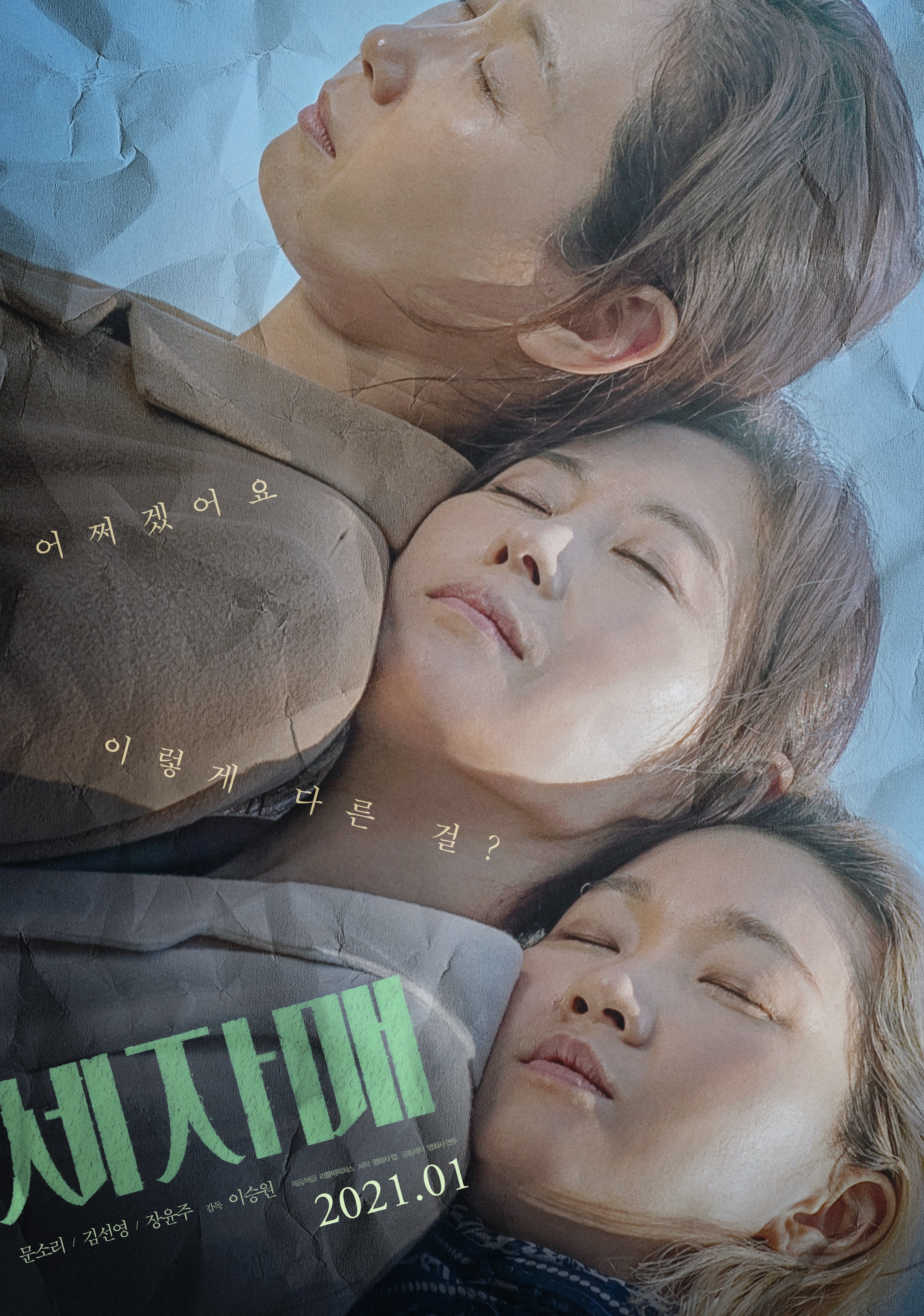
  • Three Sisters – drama starring Moon So-ri, Kim Sun-young and Jang Yoon-ju as a trio of sisters returning home for their father’s birthday only for their younger brother to start causing trouble.

Mongolia

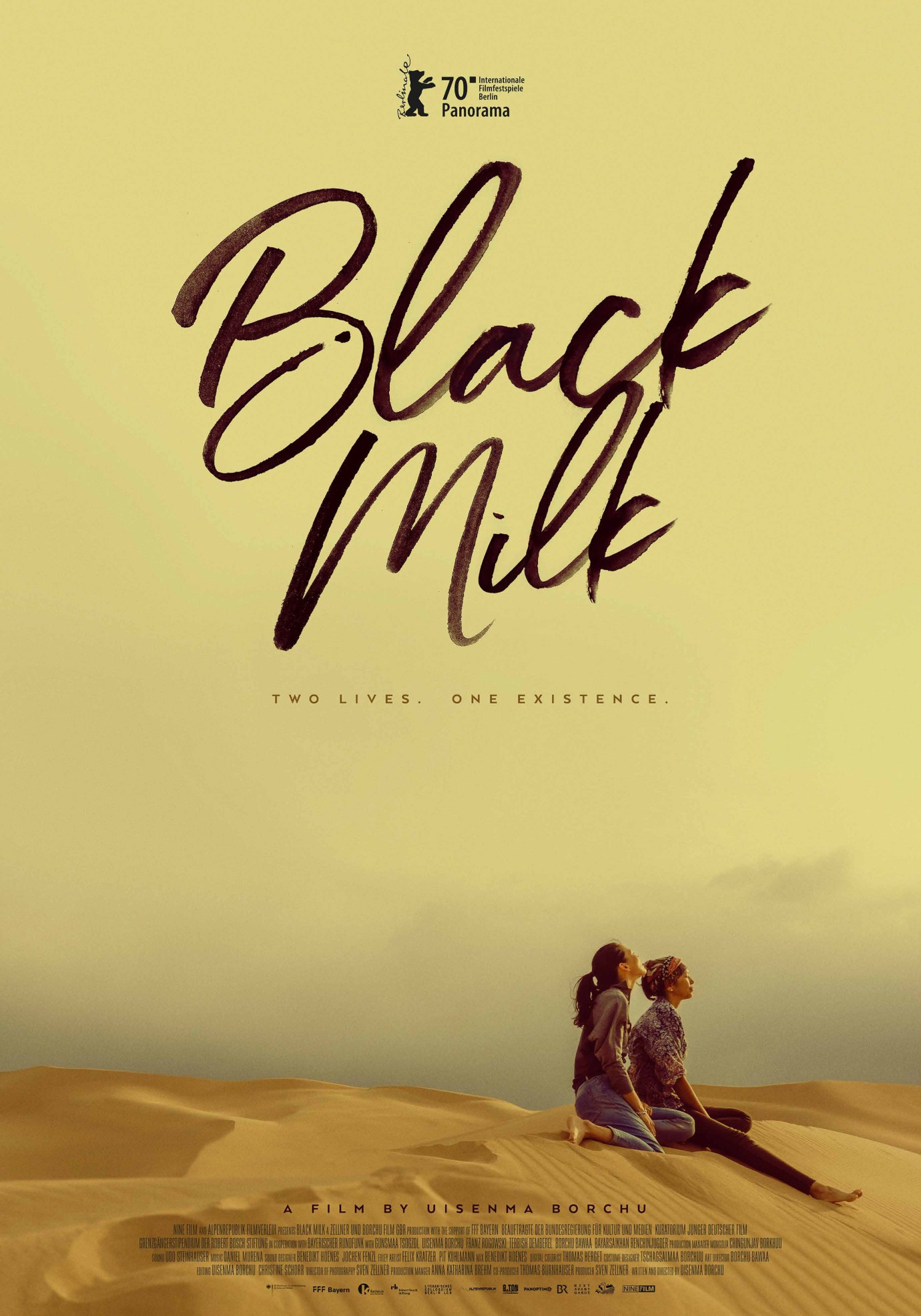
  • Black Milk – two sisters find their bond frustrated by cultural differences when one returns after many years of living in Germany.

Philippines

  • Here and There – love story about a young couple who meet remotely amid the coronavirus pandemic.
  • KINTSUGI – romantic drama in which a Filipino man travels to Japan to expand his pottery business and falls in love with the Japanese heiress of a pottery factory.

Singapore

  • Tiong Bahru Social Club – a young man goes on a comical journey through a data-driven project to create the happiest neighbourhood in the world.

Taiwan

  • Born to be Human – drama in which a 14-year-old boy discovers he is intersex.
  • Get the Hell Out – An idealistic former MP and a hapless, besotted security guard attempt to fight their way out of a zombiefied parliament in Wang I-Fan’s absurdist satire. Review.
  • Gwan Gung Vs. Aliens – newly restored 1976 SFX drama in which an ancient general is reincarnated to fend off an attack from laser-wielding giant aliens. Streaming online.
  • Hotel Iris – adaptation of Yoko Ogawa’s novel shifted to Taiwan and starring Masatoshi Nagase as a translator who develops a twisted relationship with a young woman working at the hotel.
  • The Rice Dumpling Vendors – An arrogant businessman rediscovers what’s really important after he unfairly throws out his wife and is cheated out of his riches by a wily mistress in Hsin Chi’s male melodrama Taiyupian. Review. Streaming online.
  • Wrath of Desire – latest drama from lesbian filmmaker Zero Chou in which a traumatised judge struggling with her Catholic upbringing and brother’s suicide enters a rebound marriage with a genderless young man in fear of her feelings for a woman she sent to prison for killing a man who broke into her home.

Thailand

  • The Con-Heartist – a woman whose boyfriend ran out on her saddling her with his debts is targeted by a conman but convinces him to help her swindle her ex instead!
  • P-047 – 2011 drama in which a locksmith and a novelist develop a hobby of breaking into people’s homes not to steal but to temporarily experience the lives of others. Streaming online.

Vietnam

  • ROM – The residents of a rundown slum awaiting demolition stake everything on lucky numbers in Trần Thanh Huy’s gritty portrait of modern Saigon. Review.
  • Sister Sister – psychological drama in which a TV presenter takes in a young runaway only to discover she has ulterior motives.

The Osaka Asian Film Festival runs from 5th to 14th March at venues across the city (coronavirus regulations permitting) with a selection of films screened in previous years also available online from 28th February. Full details for all the films as well as ticketing links are available via the official website. You can also keep up with all the latest details by following the festival on Facebook, TwitterInstagram, and YouTube.

The Water Magician (瀧の白糸, Kenji Mizoguchi, 1933)

“As long as I breathe, I’ll remember my debt to you” avows a young man to his unexpected benefactor becoming one of many claiming they will never forget her kindness though in his case he actually means it. Kenji Mizoguchi would later become known for tragic tales of female suffering, but his central themes were established early on and very much in evidence in 1933 silent The Water Magician (瀧の白糸, Taki no Shiraito) in which a truly good woman tries to use her independent success to improve the lives of those around her but finds herself cruelly betrayed by a greedy and self-interested patriarchal society. 

Tomo Mizushima (Takako Irie) goes by the stage name Taki no Shiraito, which means something like white threads of the waterfall, particularly apt seeing as she is a “water magician” with a troupe of itinerant players. A beautiful woman who can make the water dance, she has her share of followers and is financially independent if subject to the vagaries of the show business existence. Her life changes one day when she is travelling in a horse-drawn coach that is embarrassingly overtaken by a fast running rickshaw man. The passengers are irate, wondering what they’re paying for, while the driver ignores their pleas not to spare the horses. Tomo decides to use her feminine appeal and then her financial power to convince him to speed up, but he ignores her too until he eventually decides to gallop forward recklessly while the passengers shake inside until the coach’s axle finally snaps and leaves them stranded. A gallant young man, the driver grabs Tomo and throws her on his horse to get her to the next town. She faints on the journey and only comes round after the coachman has left but discovers herself in possession of a complicated law book she assumes is his.  

Tomo cannot stop thinking about the dashing young man, only identified as “Kin” (Tokihiko Okada). She is surprised to reencounter him asleep on a bridge though he seems not to remember her. After finding out that he is an unluckily orphaned former samurai who was fired from the coach for breaking the axle and endangering the passengers, she resolves to use her financial power to help him achieve his dreams of studying law in Tokyo. Tomo does this because she is in love and asks for nothing in return except a future promise of romantic union to which the young man does not exactly agree but does take her money and vows to live up to the faith she has shown in him. 

Alone once again Tomo tries to contend with the world around her while dreaming of Kinya, sending him her savings for his upkeep while the troupe continues to suffer especially during the traditional dry spells of the heavy winter. The troupe’s leader makes the decision to get involved with dangerous loanshark Iwabushi (Ichiro Sugai), a huge hulking man with a mean look and lecherous temperament. While Tomo dreams of Kinya, two romances mirror each other in the failed relationship of the cruel knife thrower Minami (Koju Murata) and his terrorised wife Gin (Kumeko Urabe), and the innocent young love of the beautiful Nadeshiko (Suzuko Taki) and the barker Shinzo (Bontaro Miake). Gin also borrows money from Tomo which she was reluctant to surrender because she saved it for Kinya, claiming she needs it to visit her sick mother in Tokyo and vowing once again never to forget Tomo’s kindness but later skipping out with a stagehand to escape Minami’s control. Nadeshiko and Shinzo, however, are forced to flee on learning that Minami plans to sell her to Iwabushi to settle his private debts. The couple regret leaving Tomo who has always supported them in the lurch, but she helps them escape, ushering them out the back towards a waiting boat and handing them still more money asking only that they be happy and stay together always. 

That’s not perhaps a power that’s in their keep, but the youngsters keep it as best they can and eventually attempt to protect her in the way she has protected them. The world, however, is cruel. With work thin on the ground Tomo finds herself unable to go on funding Kinya as she’d promised, and is only shamed by his well-meaning letter explaining that he’ll try to find a way of supporting himself until his studies are finished so she needn’t worry. She cuts a deal with Iwabushi and sells her body on Kinya’s behalf, but he is in league with Minami who sets his goons on her to retrieve the money seconds after she’s obtained it. 

Her hopes are at least repaid on discovering that her love is true to his word, has never forgotten her, and is well on the way to achieving his dreams as person of note. “Chance and fate, that’s all there is” Kinya had lamented on their second meeting, but he couldn’t know how right he’d be. Tomo’s dreams are fulfilled only their negation. Kinya must do his duty even if it does her harm, yet he too feels responsible and wants to share her burden though that, ironically, would only destroy everything for which she has sacrificed so much. “The river flows on as it always has and always will” the Benshi adds in solemn contemplation of this romantic tragedy, somehow inevitable in its cruelty. Tomo finds herself at the mercy of her times in which money is all, goodness is a weakness, and love too fragile to survive. The woman who made the water dance floats away on a river of tears, a victim of a cruel and unforgiving society.


I Belonged to You (从你的全世界路过, Zhang Yibai, 2016)

A collection of lovelorn souls meditate on love and loneliness in Zhang Yibai’s adaptation of a series of popular short stories by internet author Zhang Jiajia. Perhaps misleadingly titled, I Belonged to You (从你的全世界路过, Cóng nǐ de Quánshìjiè Lùguò) is less tearjerking melodrama than humorous exploration of romantic disaffection in the modern society in which even love itself has perhaps become both duplicitous cliché and an unattainable dream. For smug DJ Chen Mo (Deng Chao), being in love means staying together forever, but for his co-host/longterm girlfriend Xiaorong (Du Juan) adolescent love has already run its course. Thoroughly fed up with his empty, somewhat cheesy words of advice to lovelorn callers, she abruptly breaks up with him live on air. 

Two years later Chen Mo hosts the show alone amid declining ratings, listeners now fed up with with his total capitulation to depressed cynicism and advertisers getting ready to pull the plug. Xiaorong has joined station management but seemingly has little desire to save the show, later entering into an unwise bet that should Mo be able to climb to the number one spot, she’ll marry him but if he fails he must parade through the town with a sign reading “I’m an idiot” which, as we later discover, is a callback to their uni days when they were young and in love. Mo laments that the only couple still together from way back when is his best friend Chubby (Yue Yunpeng), who currently lives with him, and the beautiful Yanzi (Liu Yan) whose heart he won being the only person willing to defend her when she was accused of thievery. Pure-hearted, Chubby does every job going, even allowing people to punch him for monetary compensation, so he can send the money to Yanzi who is currently abroad travelling the world. Mo seems fairly unconvinced by the arrangement, but also regards Chubby as his “anchor”, that as long as Chubby loves Yanzi, they are all still young and love is real.  

His other roommate, meanwhile, his cousin Shiba (Yang Yang) is being semi-stalked by the local police woman whose constant flirting he doesn’t seem to have picked up on. As we later discover, Officer Lychee (Bai Baihe) has also been disappointed in love, previously jilted at the altar by a foreign boyfriend who apparently did a disappearing act, but has apparently maintained her faith eventually entering to a wholesome relationship with the eccentric young man who spends all his time inventing new gadgets. Despite the evidence, however, Mo remains cynical and hung up on Xiaorong who seems to have defied the narrative destiny of their uni love story. Describing him as immature, she feels as if something changed with Mo during the radio show, that somewhere along the way he lost his sense of warmth. “It’s only when we are filled with love that our show passes on love. When we feel lonely we can’t warm anybody up” she tearfully explains taking over the broadcast, adding that Chen Mo might be the loneliest of all in his false bravado and prickly tendency to make off-colour jokes as a childish defence mechanism. 

Ironically, however, the ratings start to pick up thanks to mild-mannered intern Birdie’s (Zhang Tianai) unexpected outburst at a disgruntled caller who took Mo to task for his terrible, unsympathetic advice for his romantic problem. Silently in love with Chen Mo after his certain presence on the radio saved her from loneliness, Birdie does her best to “save” him, even later giving up her dream of romance to try and help him win back Xiaorong only for him to get the message too late, realising that Xiaorong has outgrown him and they’re on different paths while maybe what he needed was a spiky little bird to peck him out of his shell. 

Chen Mo called his show “Passing Through Your World” as if in acknowledgement that some people are supposed to brush past each other meeting only for a moment, but naively hoping to encounter someone that would make the world brighter just by being in it. Shooting with a whimsical arthouse lens, Zhang opens in a rainy Chongqing as if reflecting the loneliness and despair which plague each of his protagonists who each in one way or another find solace in the presence of Chen Mo through his radio show acting as a beacon for lonely souls everywhere, before ending in bright sunshine and golden fields leaving the neon-tinted city behind for a dream of a more innocent love. Nevertheless, not everyone gets their happy ending, and there’s something in the film’s most romantic gesture being the drawing of an umbrella on cutesy mural to help a lost little girl weather the storm. A breezy stroll through urban malaise and millennial love, I Belonged to You ultimately sheds its cynicism for a pure hearted faith in romantic destiny but does so with a healthy dose of maturity in acknowledging that the path of true love never did run smooth.


I Belonged to You streams in the US Feb. 12 to 18 as part of Asian Pop-Up Cinema’s “Happy Lunar New Year!”

Original trailer (English subtitles)

Last Letter (你好,之华, Shunji Iwai, 2018)

“Anything we need to change?” asks a young woman looking for feedback on a speech, “Nothing. It’s fine” her mentor replies in an exchange which takes on a peculiar poignancy, hinting at a gentle accommodation with the ordinary tragedies of life which is perhaps itself the hallmark of director Shunji Iwai’s career. Adapting his own novel and calling back to his 1995 masterpiece Love Letter, Iwai makes his first foray into Sinophone cinema with the Peter Chan-produced Last Letter (你好,之华, Nǐhǎo Zhīhuā) taking his key concerns with him as a collection of lovelorn souls ponder the what ifs of romantic misconnections and the “limitless possibilities” of youth. 

In the present day, the now middle-aged Zhihua (Zhou Xun) attends the funeral of her elder sister, mother of two Zhinan, who sadly took her own life though the family have been telling people she died of an illness which is in a sense not exactly untrue. Zhinan left behind her only two things, a letter to her children daughter Mumu (Deng Enxi) and son Chen Chen (Hu Changling), and an invitation to the 30-year reunion for her middle school class. Attending the reunion with the intention of letting everyone know that her sister has passed away, Zhihua is mistaken for Zhinan and ends up going along with it, even reconnecting with a teenage crush, Yin Chuan (Qin Hao) now an unsuccessful novelist, for whom she became an unfaithful go-between charged with delivering his love letters to the sister she feared was always prettier and cleverer than she was. After her husband, Zhou (Du Jiang), destroys her phone in a jealous rage, Zhihua finds herself ironically mirroring her teenage years in continuing a one-sided correspondence with her first love in the guise of her sister.  

As in Love Letter the older protagonists find themselves trapped in a nostalgic past, Yin Chuan complaining that he’s stuck with memories of Zhinan, the subject of his first novel, leaving him with perpetual writer’s block. Like misdirected letters the past is filled with missed opportunities and painful misunderstandings, but then again there are no guarantees that it would have been different if only the message had made it home. Little Zhihua (Zhang Zifeng in a double role), chastened to have been discovered frustrating Yin Chuan’s teenage attempts at romancing her sister (doubled by Deng Enxi) by not delivering the letters, plucks up the courage to write one of her own but finds it rejected while as her adult self is perhaps engaging in a little self delusion little realising that Yin Chuan may have already seen through her ruse but is as intent on attempting to communicate with the past in the form of her departed sister as she is. 

Perhaps slightly unfulfilled if not exactly unhappy (husband’s unexpected act of violence aside), Zhihua ponders lost love while attempting to come to terms with her sister’s death, denied an explanation for her apparently abrupt decision to run off with a rough man with no family who turned out to be a violent drunk exorcising his class resentment by beating up an educated, middle-class woman. Mumu, meanwhile, afraid to read her mother’s last letter, engages in a little epistolatory deception of her own, accidentally causing confusion in also replying to Yin Chuan’s letters posing as her mother when he tries writing to her old address with fond memories of their youth. “Life is not something you can write on a whim” he’s reminded, and it’s true enough that, as echoed in the poignant graduation speech, some will achieve their dreams and others won’t. Those limitless possibilities of youth don’t last forever, life doesn’t obey the rules of narrative destiny and you don’t always get a happy ending or in fact an ending at all. 

Yet unlike Love Letter, the man and the letter eventually arrive at the correct destination if much later than intended. The message reaches those it is intended to and a kind of closure comes with it. Mirroring her teenage self, Zhihua finds herself a go-between once again, passing letters between her lonely mother-in-law and her former professor whom she’s been secretly meeting in a local park, while reflecting on her own role as perpetual bystander not quite destined for the position of protagonist. As she had her daughter Saran (Zhang Zifeng) struggles with a nascent crush preferring to stay with grandma and keen to avoid going back to school in order not to have to face him, while Mumu attempts to deal both with the loss of her mother and with her legacy as a figure of romantic tragedy. Little Chen Chen is sadly forgotten, putting a brave face on grief and largely left to get on with it on his own until forced to face his sense of rootlessness as an orphaned child wondering if the world still has a place for him to call home. Shot with Iwai’s customarily lush, wandering camera filled with a sense of painful melancholy, the lasting message is nevertheless one of accommodation with life’s disappointments that even in moments of despair and hopelessness lack of resolution can also spark possibility and the memory of those “wonderful choices” of youth need not foreground their absence so much as sustain.


Last Letter streams in the US Feb. 12 to 18 as part of Asian Pop-Up Cinema’s “Happy Lunar New Year!”

Original trailer (English subtitles)