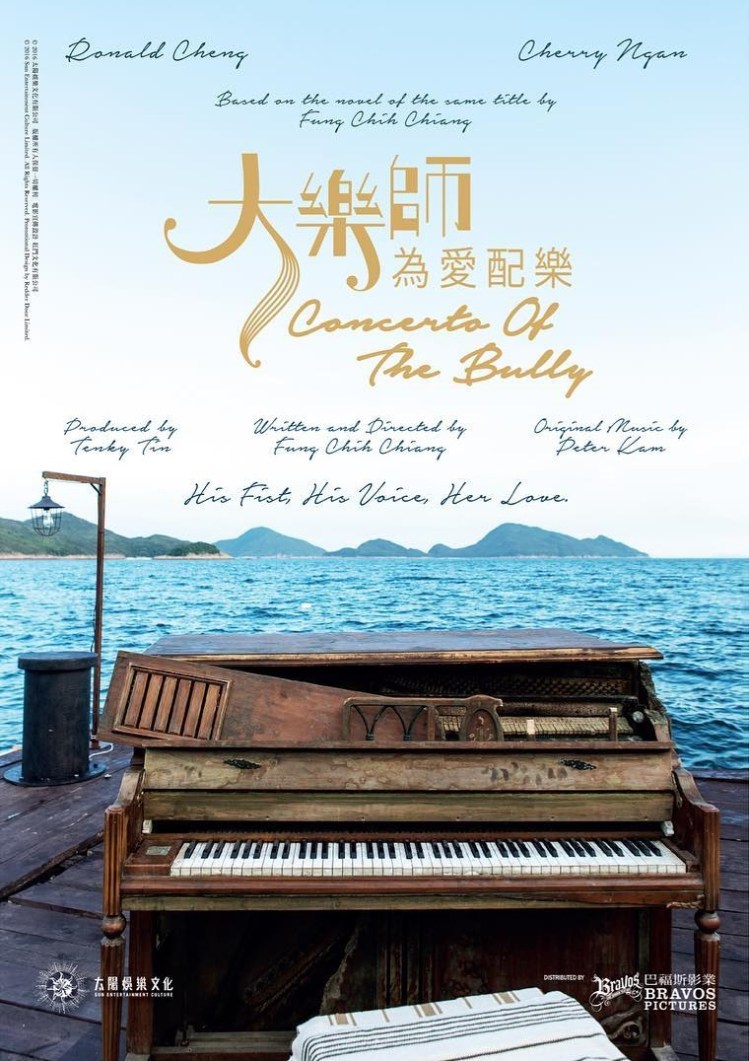
Concerto of the Bully (大樂師.為愛配樂, Fung Chih-chiang, 2018)

Concerto of the Bully posterRemember the heady heydays of the Hong Kong rom-com in which a series of zany, often entirely random adventures eventually led to true love? Director Fung Chih-chiang evidently does judging by the innocent charms of Concerto of the Bully (大樂師.為愛配樂) – a beautifully pitched soulmates thrown together romance with a kidnapping at its centre. For many things to work, they need to be in sync, as an unexpected utterance from the vacuous pop star boyfriend of the female lead points out, but sometimes you have to turn the volume down in order to hear the harmony.

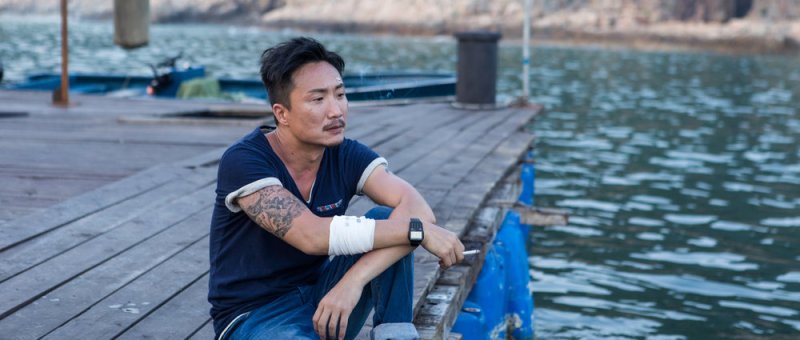
Yung (Ronald Cheng Chung-kei) is a petty thug with a difference. Unable to cope with the noisiness of modern life which often pushes him into fits of erratic violence when overwhelmed, he lives out on a remote fishing raft and carries around with him a soothing track he discovered on the internet by an artist known as “Hit Girl”. His life becomes a lot more complicated when he returns home one evening to find a mysterious sack lying in the middle of the floor with a note reading “please feed” right above it. Yung’s no good gangster friend has kidnapped a young woman, Jamie (Cherry Ngan Cheuk-ling), after recognising her as the girlfriend of a famous pop star from whom he hopes to arrange a ransom. Yung is not very keen on this plan for several reasons but finds himself going along with it. Meanwhile Jamie, who is secretly “Hit Girl”, attempts to plan her escape by ingratiating herself with the guys while thinking about her unfinished composition to keep her mind off the potential danger of her predicament.

The central irony is that Jamie is a girl who loves noise – all the sounds of the world, natural and manmade, are music to her ears and part of the great song of the universe. Yung, however, prefers things quiet save for Hit Girl’s calming song. Forced to babysit Jamie, Yung begins to fall under her spell which is partly weaved solely to lower his guard so that she can escape, but soon enough both begin to get a glimpse of what it is that might be missing in each of their lives.

All the standard romantic comedy tropes are out in force – the boyfriend is a no good heel who isn’t keen on paying the ransom and already has someone else, while Yung is a noble and good man who has been brought low by his no good buddies who have once again gotten him into a lot of trouble. Yung’s inability to process sound turns out to be a life limiting condition which has forced him into a career of violence but Jamie’s musical philosophy eventually allows him to see “another world” – literally, as he re-imagines a crowd of street thugs performing an epic dance routine to Mozart’s Seranade No. 13 in G Major. Unmasked as “Little Fairy”, Hit Girl’s only fan, the shy and under confident Yung gets a new lease on life thanks to Jamie’s less than patient tutelage as she tries to convince him to help her complete her masterwork in time for the big concert finale.

Like her boyfriend said, sometimes it’s no good if it’s not in sync. Many things in the relationship of Yung and Jamie are fake – Jamie has been kidnapped and is taking care to be “nice” and “useful” to her captors, while the pair begin with playacting music through a series of homemade mock up instruments until the arrival of a beaten up tinny piano which might be just the sound Jamie has been looking for. Gradually, the melody begins to come together, working towards a graceful harmony even while the distant drums of trouble in the city continue to threaten their quietly growing romance just as it begins to hit a more authentic key. A strangely sweet love story with a kernel of darkness at its centre, Concerto of the Bully is a hopelessly innocent fairy tale about an unwitting musical genius who never learned to hear his own voice, and a melancholy songstress who finally finds the key to her musical dreams in an unexpected place, as they meet on a floating musical stage which is both silent and somehow alive with all the quiet joys of a melodious life.


Concerto of the Bully is screening in Chicago as part of the seventh season of Asian Pop-up Cinema on 2nd October, 7pm, at AMC River East 21 where Director Fung Chih-chiang and Art Director Chet Chan will be present for an intro and Q&A. Tickets on sale now!

Original trailer (English subtitles)
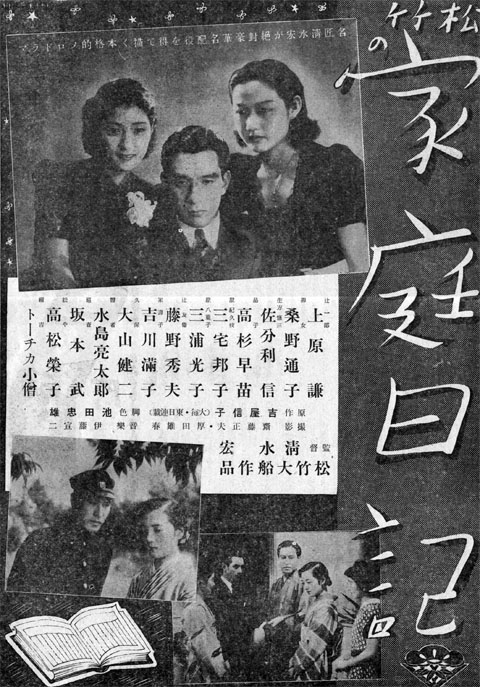
Family Diary (家庭日記, Hiroshi Shimizu, 1938)

Family Diary posterDespite the unending popularity of the romantic melodrama, Hiroshi Shimizu never quite got the bug. For Shimizu, romance is always abstracted – it either goes unresolved or reaches a point of resolution but only through unpleasant or unpalatable circumstances. There are few unambiguously “happy” couples in Shimizu’s movies, but Family Diary (家庭日記, Katei Nikki) takes things one step further in its twin tales of the romantic destinies of two very different students one of whom took the sensible path and the other the path of foolish love.

First we meet the sensible one. Fuji (Shin Saburi) takes a last twilight stroll with his current girlfriend, Kikue (Kuniko Miyake), after which they burn their letters as a symbol of their parting. Now that his brother’s business has failed, Fuji is marrying into a wealthy family who will pay for the remainder of his studies. Meanwhile his best friend, Tsuji (Ken Uehara), is grumpily drinking with a bar girl he plans to marry despite the objection of his parents. Fuji marries Shinako (Sanae Takasugi) and becomes an Ubukata while Tsuji marries Ume (Michiko Kuwano) and goes to Dalian in Manchuria. Some years later when Tsuji returns to Tokyo along with his wife and son, Ubukata has become a successful, happily married man. Coincidentally, Kikue who had gone to Manchuria to escape her heartbreak has also returned and opened up a small hairdressing shop which runs herself as a single woman looking after her younger sister, Yaeko (Mitsuko Miura).

The contrast between Ubukata and Tsuji is set up early on as Ubukata is repeatedly categorised as cold and unfeeling where as Tsuji is unmanly and oversensitive. Ubukata describes Tsuji as “sentimental”, “too delicate”, “almost the artistic type” for his compassionate desire to avoid awkwardness between their wives who, after all, must at least try to become friends if the relationship between the men is to be maintained. He urges him to “think about simpler things” which is most often the way Ubukata appears to think. That is not to say it didn’t hurt to abandon Kikue, but he comforted himself in the knowledge that he was doing the “best” thing based on a series of practical calculations. Ubukata is not heartless, but he is a committed pragmatist and sometimes insensitive to the suffering of others who might not agree with the way he works things out as his wife suggests when she (cheerfully enough) reproaches him for not paying attention to other people’s feelings.

Tsuji, having chosen to marry for love, at times seems envious of Ubukata’s settled home life with his traditional Japanese wife who trails behind him in kimono and rarely goes out without informing her husband first. Where Ubukata’s match might be seen as a betrayal of love for money, his home is harmonious whereas the Tsujis’ is not. Ubukata, it has to be said, is polite enough to Ume but makes no secret of his distaste for her unrefined character. Tsuji’s parents objected to the match because Ume was a bar girl (and, it is implied, a casual prostitute) and though Tsuji has no problem with her past, the snobbish attitudes of men like Ubukata continue to plague her however much she tries to play by the rules of their society. When Ubukata takes Tsuji to dinner, Tsuji asks him not to tell Shinako about Ume’s past in case she looks down on her to which Ubukata tells him he’s being over sensitive but later consents if only because he finds the subject distasteful in any case and is an old fashioned gallant sort of man.

Ume is however out of place in this upper middle-class environment as she demonstrates by provocatively lighting a cigarette while entertaining Ubukata and Shinako who ends up lighting it for her with a look of mild awe in her eyes. Ume fears this world will reject her – something it ultimately does when Tsuji tries to reconnect with his family, but in reality she has already rejected it herself. Unable to see past her own fears and regrets she doubts her husband’s love and lives in constant anxiety, waiting for the next slight from a hoity toity housewife to remind her that she doesn’t deserve all of this “happiness”. Though the Tsujis are “unhappy” there is also love, even if it is complicated and often misunderstood.

Both marriages are ultimately destabilised by external forces – Tsuji’s by his family’s attempts to expunge Ume by “stealing” her son and later plotting to pay her off on the condition she absent herself, and Ubukata’s by the resurfacing of the romantic love that he sacrificed for material gain. Though Ubukata has no intention of rehashing the past, he does want to be of service to Kikue (again, misreading her feelings and attempting to make himself feel better rather than improve the fortunes of another) – something which places a wedge between himself and his wife when she eventually learns of the circumstances which led to her marriage. Yet the wedge itself is not so much caused by Kikue as by Ubukata’s supreme coolness in which he sees no reason to explain himself to his wife because his actions have satisfied his own sense of righteousness and must therefore also satisfy hers.

Though Shinako is tempted by the sophisticated, westernised ways of “modern girl” Ume, and later pressed by fears her husband has never loved her, she remains a steadfast Japanese wife, effortlessly poised and always polite even under emotional duress. Despite their obvious differences, Shinako comes to care for Ume – even becoming something like her only friend, but Ume is only “accepted” by the world of the film after she “proves” herself as an emotional woman through an act of self inflicted violence which somehow demonstrates her essential purity and goodheartedness. Ume prepares to make an exit before being shown the door, but her act of pure desperation and extreme wretchedness becomes her social salvation and finally earns her a place in the moral universe of practical men like Ubukata who now rate her worthy. Thus the social order is restored, the official bonds of marriage held up, and Ubukata’s callous and calculating way of life found to be the better course, but there’s something less than convincing in Shinako’s assertion that everything will be alright now as she and her husband become another of Shimizu’s figures disappearing over a distant bridge.


A Crimson Star (真っ赤な星, Aya Igashi, 2018)

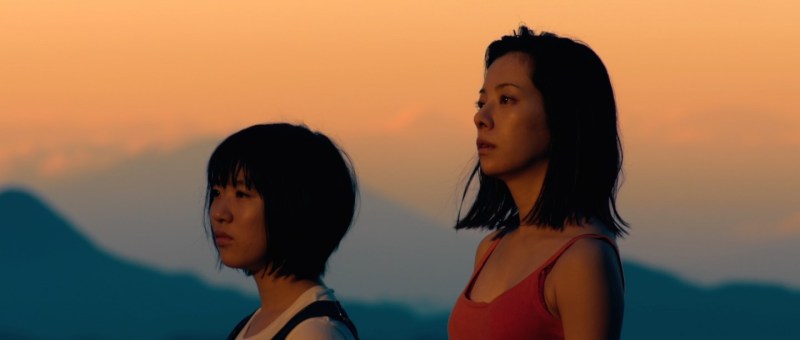
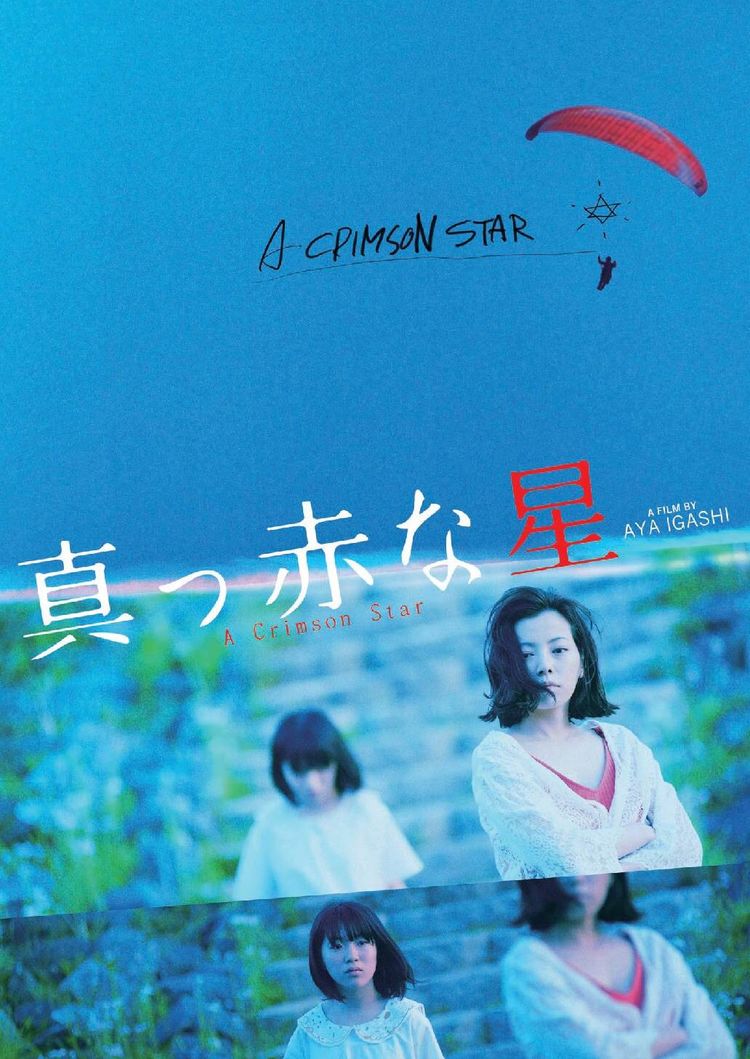
A Crimson Star posterFalling in love is, perhaps, like standing too close to the sun and for the young heroine of Aya Igashi’s debut feature A Crimson Star (真っ赤な星, Makkana Hoshi), it means nothing unless it burns. Set in the otherwise serene environment of a rural Japanese summer, full of blue skies and green fields bursting with life, A Crimson Star is the story of two ostensibly very different women in very different places who nevertheless develop an essential and inescapable bond in their shared sense of loneliness and isolation, but their relationship is also a problematic one in which the familial and the romantic have become inextricably linked.

14-year-old Yo (Miku Komatsu), undergoing a lengthy period of hospitalisation for an undisclosed illness, develops an intense fondness for her kindly nurse, Yayoi (Yuki Sakurai). On her discharge, however, Yo is stunned to learn that Yayoi has abruptly resigned and all but disappeared. Meanwhile, Yo’s family life continues to deteriorate. Her disinterested mother has got a new boyfriend who is often drunk and violent. In order to escape him, Yo takes a trip to the corner shop and makes a surprising discovery in a street of parked cars which turns out to be (as yet unknown to the the naive Yo) the secluded byroad used for secret assignations seeing as this is such a one horse little town that there isn’t even a love hotel. Yayoi has become an embittered sex worker and her lonely degradation breaks Yo’s heart. When her mother’s boyfriend eventually begins molesting her, it’s to Yayoi that Yo turns looking for care and support from a woman who had nursed her but is no longer a nurse.

The “crimson star” of the title most obviously refers to the wings of the paraglider gazed at so often by the earthbound Yo, but it is also echoed in the tiny scars and wounds which define the relationship between the two women. In the first scene of the film, the hospitalised Yo has a prominent bruise on her foot apparently caused by Yayoi nicking a vein when taking a blood sample. Even so, Yo leans in tell her that she is her favourite nurse – words which bring tears to Yayoi’s eyes and perhaps precipitate her decision to leave the hospital. For Yo, who is emotionally neglected by her mother and has never known true care and affection, the bruise becomes an odd kind of proof of love which she has come to associate with pain. Later, Yo spots an odd mark on Yayoi’s neck – she is of course too young to know what it is. Yayoi shows her, literally, by biting her slightly below the shoulder and creating another kind of “crimson star”.

Yo’s early attraction to the 27-year-old Yayoi has a distinctly maternal quality in which she looks for the same kind of compassionate care she experienced in hospital and which her mother refuses to give her. There is also, however, a nascent sexual attraction which provokes intense jealousy as Yo attempts to get closer to Yayoi but finds herself unable to achieve the kind of all encompassing love she is seeking. Given Yo’s extreme youth, the relationship is in many ways extremely inappropriate and infinitely confused, a combination of familial, platonic, and romantic longings which appear to be unbreakable but remain unresolved. Yo, almost becoming the thing she wants to find, begins to take care of the depressed, broken Yayoi – tidying the apartment, folding washing, and repairing external signs of damage, while Yayoi becomes care taker rather than care giver presenting her with an opportunity to reexamine her self-destructive tendencies including a dead end relationship with married paraglider Kengo (Katsuya Maiguma).

Kengo becomes a particular point of contention for Yo, not just for reasons of jealousy but because he causes Yayoi to suffer. Early on she spots him on his bike with his small daughter, every inch the doting dad which is, of course, something she never had. Kengo is also a symbol of familial betrayal as he undermines his seemingly happy family by continuing to string Yayoi along on what is, ironically enough, a no strings basis. Family has betrayed both women who find themselves adrift and alone with no clear anchor except perhaps each other.

Yet what Yo wants is to escape – to soar in the quiet skies high above all, free of earthly constraints like the paraglider she so often sees, but paragliders are crafts built for two and Yo wants to go with Yayoi, strapped together enveloped in a private world into which nothing else may enter. The “crimson star” then becomes the unattainable feeling of closeness and total connection that continues to elude her, furthering her view that love is pain and the pain she feels must be love. Backed by a crimson sky, the future is both hopeful and filled with light, but perhaps also tethered and marked by a melancholy resignation. Beautifully composed, Igarashi’s debut is a raw, often uncomfortable examination of an elemental bond forged between two lonely, damaged women each seeking impossible connection as an escape from a loveless existence.


A Crimson Star made its World Premiere at the 2018 Raindance Film Festival.

Original trailer (English subtitles)

The Last Verse (最後的詩句, Tseng Ying-Ting, 2017)

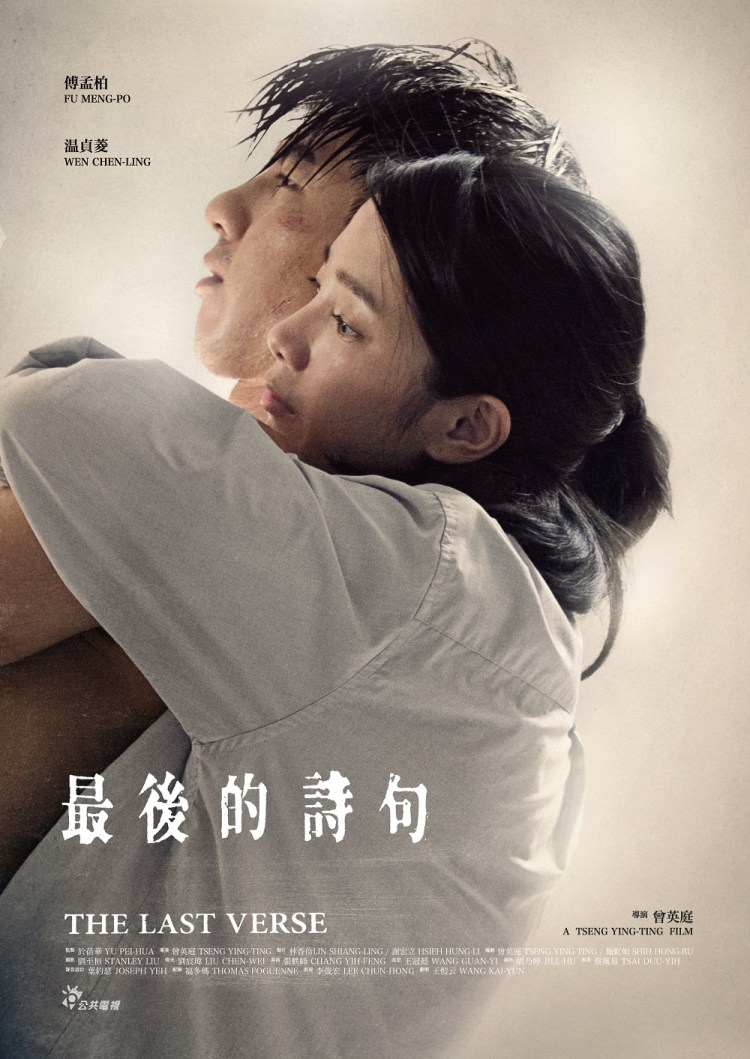
The last verse posterThe dreams of youth seem destined to elude two idealistic Taiwanese romantics as they fall in love, out of love, into debt and then despair. Set against 16 years of turbulent Taiwanese history, The Last Verse (最後的詩句, Zhòu de S) follows two ordinary teenage sweethearts whose humble dreams of conventional success are consistently undermined by familial legacy and economic instability. Society crushes the dreams of those who refuse to abandon their youthful idealism, but then again perhaps they destroy themselves through chronic insecurity and a refusal to address their own failings rather than conveniently assigning blame to all but themselves.

In the golden summer of 2000, Ren-jie (Fu Meng-Po), nicknamed “poet” meets Xiao-ping (Wen Chen-Ling), the love of his life. The pair start dating and are sure enough about their future to be discussing long term financial plans, but Ren-jie still needs to complete his military service and so their lives are currently in a mild hiatus. Everything starts to go wrong when Ren-jie receives visit a from his estranged father – a broken shadow of a man whose wife left him because of his drunken violence in the face of the humiliating failure of his business when his towel factory went bust. Ren-jie didn’t want anything to do with his dad and sent him packing, only to bitterly regret his decision when he commits suicide on the way home by gassing himself in his car.

This original failing is the fracture line from which all Ren-jie’s subsequent sufferings unfold. Despite signing away any right to his inheritance in order to avoid taking on his dad’s debt, Ren-jie can’t shake off the vicious loansharks his dad once borrowed money from. Having managed to get a well paid, if morally dubious, job as an investment broker Ren-jie’s life ought to be progressing towards middle-class success. He lives with but is not legally married to Xiao-ping who also has a good job at a magazine, but is putting off legalities until the advent of financial stability. Ren-jie is therefore stubborn. He won’t pay the gangsters off because he doesn’t want his father’s legacy and resents their intrusion into his otherwise “respectable” life. He will learn, however, that there are things that cannot just be overcome through bloodymindedness and his male need to avoid being seen to back down is primed to put those he loves in great danger.

Ren-jie’s life is indeed ruined by the precarious era in which he lives as well as the legacy of that which came before, but his destruction is also at his own hands as he falls into a well of toxic masculinity which eventually leads him to harm and then betray the innocent love of his youth. During Ren-jie’s military service, some of the other men suggest staying on in the armed forces – most laugh off the idea but it does at least offer a secure paycheque, a fixed term contract, and the possibility for advancement – all things useful if, like Ren-jie, what you want is to get married and start a family even while still relatively young. Ren-jie, however, did not take this path. We don’t find out why he lost his well paid banking job, if it was the gangsters or the economy, but a few years later sees him an embittered estate agent trying to sell rundown flats in the middle of a housing crash to clients who know they’re better off waiting. Embarrassed not to be able to “provide” for a “wife”, Ren-jie’s male pride cracks under the twin pressures of being forced to give in to the gangsters and fearing that he is not good enough for Xiao-ping, paranoid that she will eventually leave him for someone with more money.

Xiao-ping, however, remains fiercely, idealistically in love with the boy she met at the river all those years ago. Ren-jie, making a common enough though self obsessed mistake, fails to see that financial success is not something that Xiao-ping worries about in any other way than wanting to see the man she loves fulfilled. What Xiao-ping wants is a conventional family life, but Ren-jie’s constant money worries and personal insecurities consistently deny her before he eventually makes another cruel and selfish decision that will only cause her additional suffering.

Ren-jie’s internalised self-loathing eventually boils over into violence, recalling the unwelcome legacy of the father he did not want to become. Yet Ren-jie is also a failure, a drunk, a violent man having meaningless sex with married women in empty apartments in order to try and reassert some kind of control in his largely powerless life. Unfairly burdened by his father’s literal debts, a legacy of violence, and the crushing hopelessness of his existence, Ren-jie has lost the sense of “poetry” which so endeared Xiao-ping to him all those years ago at the river. The memory of those sunswept days, romanticised as it might be, becomes both a touchstone and a dangerous symbol of all that has been lost and can never be regained. Unable to reconcile themselves to the compromises of adult life, the ballad of Ren-jie and Xiao-ping is destined to end in tragedy, self-inflicted wounds the only escape from the crushing hopelessness of a relentlessly indifferent society.


The Last Verse was screened as part of the 2018 New York Asian Film Festival.

Original trailer (traditional Chinese subtitles only)

Interview with director Tseng Ying-Ting from the 2017 Busan International Film Festival.

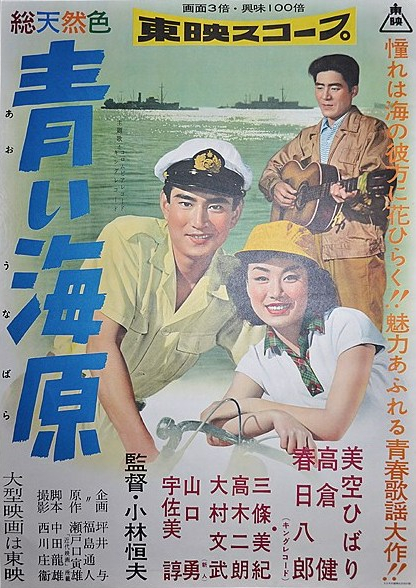
The Deep Blue Sea (青い海原, Tsuneo Kobayashi, 1957)

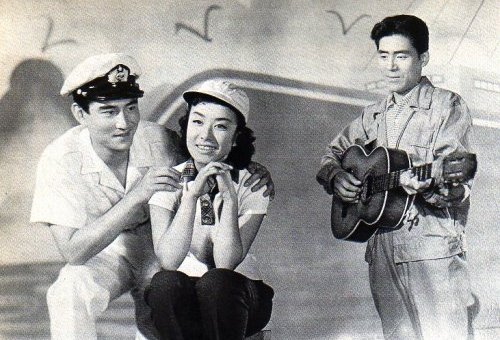
Deep Blue Sea posterHibari Misora turned 20 in 1957, but she’d already been working for eight years and was well on her way to becoming one of the most successful stars of the post-war era. The Deep Blue Sea (青い海原, Aoi Unabara) is one of her earliest grown up musical dramas and finds her sharing the bill with another of the biggest acts of the day in Hachiro Kasuga who, despite being stuck in second lead limbo, does the bulk of the musical heavy lifting. It also sees her star opposite an actor who would become her frequent leading man which might come as something of a surprise to those most familiar with his later work – Ken Takakura, then very fresh faced and playing the juvenile lead.

The action begins with Takakura’s Ken as the stranger who walks into town. In fact he’s not that much of a stranger – he runs into an acquaintance, Saburo (Hachiro Kasuga), right away, but he’s come on a mission. He’s looking for the friend of a man who died in an accident on his boat in order to give him a photograph and some money he’d saved for the daughter he had to leave behind. Before any of that happens, however, he ends up in a meet cute with Misora’s Harumi who manages to tip a whole bucket of water over him, and then later a jug of beer when he fetches up at the bar where she works (and where Saburo is a regular). As coincidence would have it, the man Ken is looking for also lives at the bar and is actually Harumi’s father. Harumi never knew she was adopted and is stunned when she overhears the conversation between the two men but decides to go on pretending not to know anything.

The real drama revolves around a lecherous gangster, Sakazaki (Isamu Yamaguchi), who is having an “affair” with the owner of the bar where Harumi and her dad live. He’s taken a liking to Harumi who wants nothing to do with him, but when her dad gets into an accident and needs money for medical treatment, Saburo makes a deal and unwittingly gives him an additional angle to start railroading Harumi into his arms.

Director Tsuneo Kobayashi would later be best known for genre pieces and tokusatsu. Besides some quite beautiful and unusually convincing work with backdrops, there are no shocks or special effects in Deep Blue Sea but there is plenty of music, most of it sung by Hachiro Kasuga with Misora taking centre stage for a few solo numbers of her own as well as humming an odd tune here and there. Despite not being an integrated musical (all of the songs have a diegetic genesis) and in contrast with many of Misora’s films, The Deep Blue Sea is otherwise a fairly typical musical drama in which the songs drive the narrative rather than being an aside to it.

It does however begin to blur genres, shifting into familiar Toei territory with the introduction of the sleazy yakuza tough guys who are willing to go to quite a lot of trouble to ruin the life of an ordinary girl like Harumi. The central romance follows a familiar pattern as Ken comes to care about Harumi and her dad through his connection with her birth father and becomes their noble protector, while Saburo, who’d silently harboured a crush on Harumi all along hovers sadly on the sidelines, wanting to support his friends in their romantic endeavour but also somewhat grateful when Ken decides to sacrifice himself on Harumi’s behalf. Ken’s sacrifice, however, doesn’t entirely work – you can’t get rid of men like Sakazaki through honest or logical ways and simply paying them off is never enough, in fact it might just make everything worse.

The Deep Blue Sea may be a little darker than most musical romances with its seedy port town setting, gangsters, smuggling action, and the constant sense of things always floating away with the boats that come and go, but in true musical fashion it all works out in the end. Despite learning that she is adopted and that a wealthier blood relative was keen to take her in, Harumi chooses to stay with her adopted father, steadfastly choosing real feeling over blood ties or pragmatic concerns – unlike the greedy bar owner who steals the money her father left her, or the nefarious gangster who tries to manipulate her into giving up her principles and stepping into his world of betrayal and avarice. As usual for a Toei film, the forces of good (for a given definition of “good”) eventually triumph and the bad pay for all their mistakes while the merely unlucky accept their fates with good grace and resolve to make the most of new opportunities. It may not have made any great waves, but The Deep Blue Sea is cheerful and fun and chock full of post-war humanism as the noble Ken comes to the rescue of the goodhearted Harumi and her steadfast father to stand up against the forces of corruption.


Some of Hibari’s musical numbers (no subtitles)

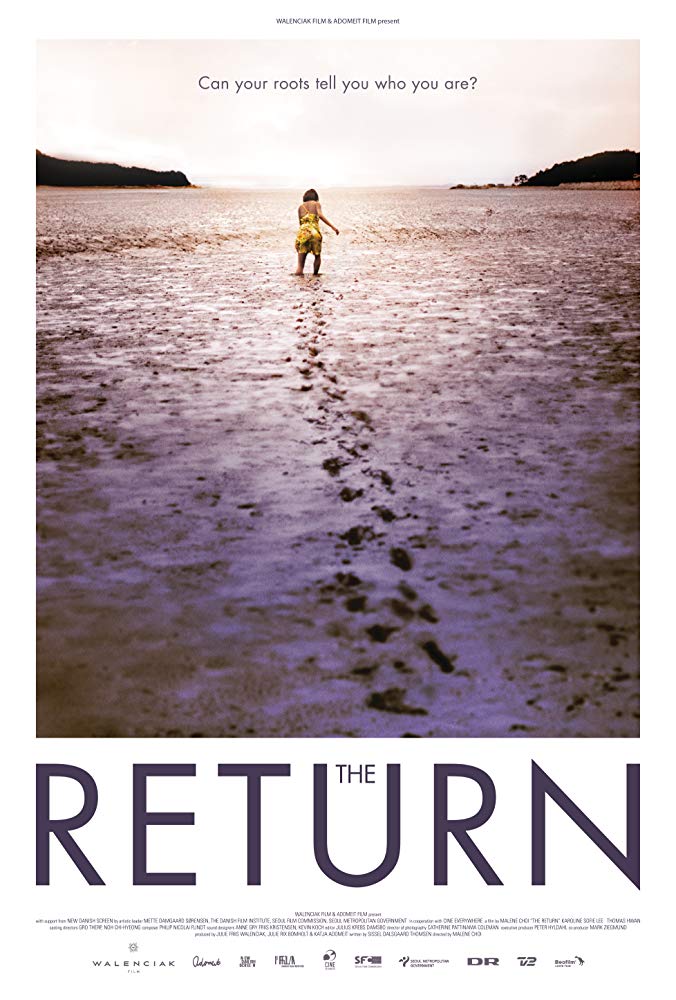
The Return (Malene Choi, 2018)

the returm posterIn today’s sometimes hostile political environment, the question of transnational adoption has become a hot button issue with adoptees raised abroad in sometimes difficult circumstances where paper work was never correctly filed finding themselves exiled to the land of their birth despite having no knowledge of the culture and no means to support themselves. Documentarian Malene Choi, a Korean-Danish adoptee herself, frames her first narrative feature around this very thorny issue, taking inspiration from her own experiences and from those of fellow adoptees from around the world she encountered during her own attempts to find her birth parents and unlock the secrets of her history.

The central narrative revolves around two Korean-Danish adoptees, Karoline (Karoline Sofie Lee) and Thomas (Thomas Hwan), who meet for the first time at a hostel exclusively for “returnees” traveling to Korea to find their birth parents. Karoline, nervous and conflicted, talks to some of the other guests hoping to find strength in their stories of successful reunion but the stories she gathers are generally less conclusive than she perhaps expected them to be. Choi, originally planning to make a documentary focussing on the hostel itself, often found the same things – that guests would appear and disappear after only a few weeks, returning perhaps years later either to visit their birth families or to try pressing the adoption agencies again in the hope of finding more information.

Karoline’s own visit to the adoption agency turns out to less positive than she’d envisaged. The “excessively polite” employee managing her case explains that although there is actually “quite a lot” of information attached to Karoline’s file – her mother’s full name (only without her Chinese characters to help narrow it down further), a verified date and place of birth, and a reason the adoption was sought, none of it is much use in trying to find her birth mother. Later discussing the meeting with Thomas who seems a little more experienced, Karoline begins to doubt she was told the whole story and is convinced that the adoption agency is either wilfully holding information back or is simply disinterested in helping her.

Given the various circumstances surrounding international adoption from Korea from the end of the Korean War through the pre-democratic period, the government and adoption agencies might have reasons to avoid revealing the entirety of the truth. In an interview talking about the genesis of her film, Choi mentions meeting a British researcher who described the process of adoptions in this period as akin to “human trafficking”. Children, not only infants but those old enough to have memories of Korea and of their birth families, were sometimes taken without it being fully understood that they were being adopted and sent abroad, never to be returned to their parents or relatives.

A fictionalised scene of a child reuniting with a mother tells a common yet tragic story of a young girl taken advantage of by an older boy, falling pregnant, and then being disowned by her family. Talked into signing adoption papers she tries to change her mind once the child is born, but it’s whisked away from her after only seconds and she is powerless to resist. A combination of oppressive social forces from an unforgiving conformist society which looks down on “immoral” women pregnant out of wedlock to economic impossibilities and bureaucratic concerns all conspire to remove children from their birth families without proper scrutiny or much thought for where exactly they might be going.

Though Karoline and Thomas appear to have been raised well in loving families, they have each experienced other difficulties which have left them feeling adrift, caught between two cultures an unsure where exactly they fit. Karoline’s socially conservative parents were ill equipped to support her when she experienced racial bullying from the other children. They saw her as their daughter and a Dane and therefore could not understand why others didn’t because to them she “doesn’t even look Korean” – well meaning though they might have been, their solution to her suffering was an attempt to erase her ethnicity rather than embrace it. Though Thomas’ experiences were different he too experienced typically xenophobic micro aggressions, but it was the aggressors’ constant taunts of “go back to where you came from” that most hurt him. His persecutors seemed to have such a clear idea of where he “belonged” when he himself did not.

This sense of dislocation is further brought out by Thomas and Karoline’s experiences in Korea where they find themselves supposedly “at home” yet unable to communicate as neither of them speak Korean or have the necessary cultural knowledge to easily navigate the city. It also puts them at a disadvantage in their respective quests, leaving them reliant on the kindness of the hosts at the hostel to help explain some of the information they’ve been able to find as well as interpreting for them when they need to ask further questions.

Yet for others, a return Korea has become a kind of answer in itself. Another American adoptee Thomas meets at the hostel first came to Korea for only a few days but felt an instant connection, as if he’d finally found what it was he’d been looking for. His adopted family, however, were far from happy with his desire to explore his Korean roots and made him an ultimatum (something which might explain why he had previously felt so unhappy) which convinced him to move “back” to Korea on a more permanent basis, certain it was the place he was “truly” supposed to be. The hostel becomes a kind of community base in itself, connecting Korean adoptees from across the world who have each had very different experiences but share something otherwise unique. Thomas, however, remains conflicted, unsure if the connection to his fellow adoptees is real or illusionary, created out of his own desire to find in them what he sought in himself.

Making use of her documentary background, Choi mixes the real and the fictional, blending unscripted sequences and interactions with non-actors with a fiercely hyper naturalist approach only to undercut it with the artifice of strange and unexpected cuts to remind us we are watching a construction. Rather than an attempt to undermine the idea of adoption itself transnational or otherwise, Choi’s aims to look at the complicated, often uncomfortable, ideas of identity, belonging, and family through her protagonists’ continuing struggle to find resolution. Feeling as if they’ve been robbed of their histories, Karoline and Thomas’ quest is an attempt to come to terms with the loss of something which perhaps cannot be returned, but only eased through the restoration of a severed connection.


The Return was screened as part of the New York Asian Film Festival 2018 and will also be screened plus Q&A with actress Karoline Sofie Lee in London on 14th November as the closing night gala of the London Korean Film Festival.

Original trailer (English language dialogue/subtitles)

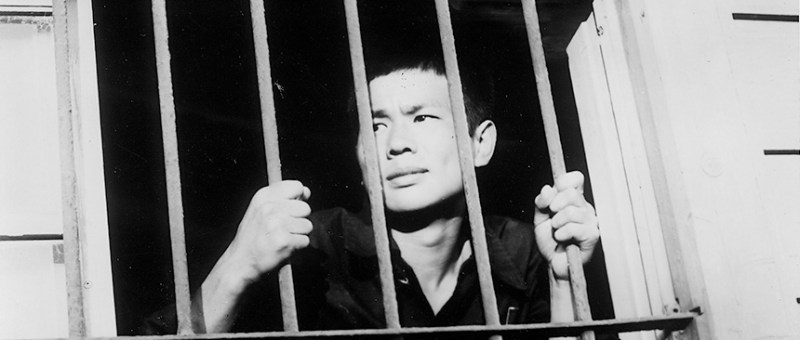
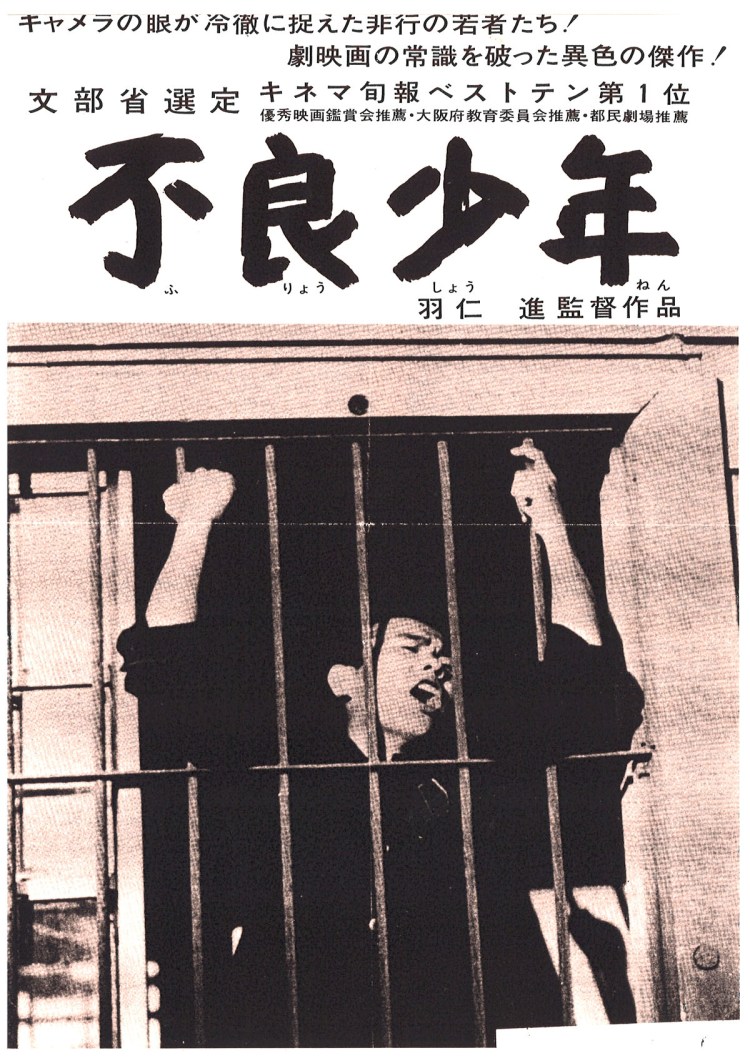
Bad Boys (不良少年, Susumu Hani, 1961)

Bad Boys posterIn the mid-1950s, the “Sun Tribe” movies had evoked a series of conflicting reactions in their depictions of the new bright young things of the post-war era who, caught in a period of intense confusion, rejected the future their parents’ had been trying to build while revelling in nihilistic hedonism enabled by the new freedoms. Though the films proved popular with their target audience, they also produced a moral panic in the older generation which saw youth as dangerously out of control and desperately in need of correction. Meanwhile, reform school drama also became something of a recurring motif in the more progressive youth movies put out by Nikkatsu (including one starring Hani’s soon-to-be wife, Sachiko Hidari) which sought to humanise the figure of the “bad boy” by pointing out all the various circumstances which led to his fall from grace.

Susumu Hani’s Bad Boys (不良少年, Furyo Shonen) is often regarded as an important precursor to what might later be termed the “new wave” in its radical departure from the cinematic norm of the times. Loosely inspired by a book titled “Wings that Cannot Fly” which collected the stories of boys who’d been through the same reform school, Hani repurposes the tools of neorealism in his use of non-actors, improvised dialogue, natural light and location shooting, for a hybridised avant-garde “documentary style” which is, in a sense, realer than “real”.

We follow a disaffected young man, Asai (Yukio Yamada), who has been arrested for the aggravated robbery of an upscale Ginza jewellers. Asai, who sadly laments that he has only seen the famously posh neighbourhood from the back of a police van, did indeed commit the crime and could be thought of as the “ringleader” of the group of boys arrested which also includes young men from “good” families who’ve fallen in with a “bad” crowd. Some of the other boys are released when their parents plead for them, but Asai, as we discover, has no parents – his father died in the war when Asai was three and for reasons unexplained he is estranged from his mother. Undergoing a series of psychological tests which prove inconclusive, it’s decided that Asai might benefit from some time in reform school to reflect on his life and hopefully emerge with a better sense of civic responsibility.

Hani’s depiction of the reform school system paints it as an obvious remnant of the militarist or perhaps even feudal past in which discipline and physical strength are the primary virtues. The boys salute, march in file, and are taught to respect authority. Inside the school, natural factions arise with a strictly observed series of hierarchies enforced by violence and intimidation. Asai, a determinedly independent sort, refuses to obey and stands up to the bullies only to suffer defeat. Eventually he becomes the leader of his own faction of similarly oppressed youngsters, but when the time comes he discovers he is all alone once again and unable to break the chain which constrains them in a cycle of fear and violence.

Nevertheless, the failed battle against oppression has an unexpected positive outcome when Asai is moved to another cell. Up to this point, there’s been relatively little sign of positive “reform” on offer – no education, no counselling, no practical advice which might help these young men escape the circumstances which brought them here, but on being moved to the carpentry workshop Asai does at least begin to learn a useful skill as well as mixing with more “serious” boys who can have a laugh together while getting on with work. His attitude seems to relax, he “grows up”, and begins to see a different future only to be abruptly released back onto the same streets no better off than before with only the kind hearted platitudes of the softly spoken social worker to guide him into a “better” tomorrow.

The question remains what sort of men the reform school system was designed to engineer and to what end – a collection of deindividualised authoritarians who stand to attention and salute on demand may not be much of an asset to post-war humanism. Meanwhile, the emphasis on strength and discipline unwittingly reinforces the law of the street where violence rules all and morality is an unaffordable luxury, encouraging the perpetuation of a system of mutual oppressions while ignoring the many and various social issues which make it impossible to escape. Hani wanted to capture the lingering spirit of “totalitarianism” in which even those superficially rebelling against the system obey ancient social codes which restrict their own freedom and exist solely to keep them in their place. In doing so he lays bare the wider hypocrisies of the post-war democratic era which promises freedom but delivers only the same old compromises.


Bad Boys was screened as part of the Japanese Avant-garde and Experimental Film Festival 2018.

DVD release trailer (no subtitles)

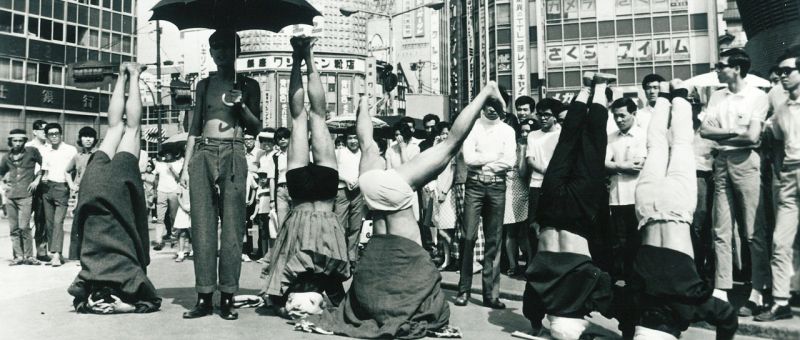
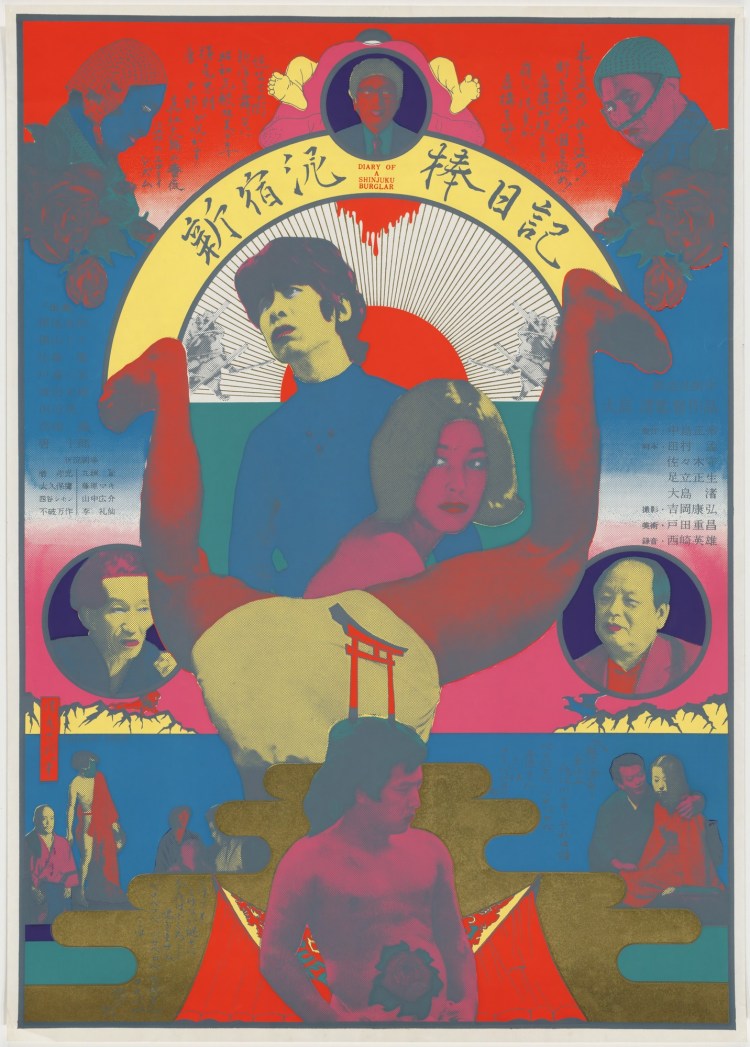
Diary of a Shinjuku Thief (新宿泥棒日記, Nagisa Oshima, 1969)

Shinjuku thief posterIn Sing a Song of Sex, Nagisa Oshima had lamented the depressing decline of political consciousness among the young who remained so preoccupied with their sexual desires that they’d forgotten all about the revolution. In Diary of a Shinjuku Thief (新宿泥棒日記, Shinjuku Dorobo Nikki), once again a story told through song, he examines the same problem from the other side – if repressed desires frustrate the battle for social change, then perhaps the sexual revolution must precede the political.

Our “hero” if you can call him that, is a man calling himself “Birdey Hilltop” (Tadanori Yokoo). Birdey gets off on shoplifting books from the huge Kunokuniya bookstore in Shinjuku. One day he is caught by a feisty young woman, Umeko (Rie Yokoyama), who we later discover is merely posing as an employee in one of the film’s many acts of role play. Umeko drags the shoplifting Birdey up to see her “boss”, Mr. Tanabe (the real life boss of Kunokuniya playing “himself”), who, to be honest, isn’t very interested in dealing with a petty thief but is quite interested in this strange pair of awkward young people and becomes something between invested audience member and accidental director in setting them off on a journey to explore the nature of their peculiar sexualities.

These largely seem to lean on the idea of anonymous theft, that neither Birdey nor Umeko are able to accept the reality of altruistic connection and value only that which is actively taken (preferably in secret). Umeko allows herself to be “stolen” in skipping out on already arranged date with a man who had threatened to take what he wanted by force to undergo an unfulfilling sexual experience with Birdey which nevertheless provokes in her a desire to shatter the realities of time and space. Given money to enjoy themselves, neither of the pair quite want to accept it – the idea of splitting it amicably isn’t appealing, or perhaps the magnanimity of insisting the other take it all more pleasurable, but neither of them want anything that isn’t in some way a transgressive transaction.

Yet perhaps what it is they long to steal is an identity. Neither Birdey nor Umeko has been entirely truthful with the other and they are each only too happy to inhabit various other roles as they act their way through life. The final apotheosis of the self occurs solely in the theatrical realm but apparently carries a level of essential truth which finally allows the pair to integrate their identities into a comfortable whole which liberates their bodies from sexual repression and perhaps becomes a kind of revolution of its own.

Nevertheless, their strange journey is massaged by a number of dubious guides from the sex therapist who reaches a series of bizarre conclusions based on little more than appearance and vague reactions to classic pornography to the gentle machinations of Tanabe who eventually declares himself too old for this particular game, and the entire legacy of world literature which crowds their heads with competing thoughts and leaves no room for originality. During their “therapy” session the pair are encouraged to get literally naked in front of the analyst who correctly points outs that they are each wearing masks (though his eagerness to see them disrobe does not seem entirely innocent) while also poking and prodding at their various dualities – Birdey is too “effeminate” and Umeko “too strong”, their gender atypicality apparently the root of all their problems. Birdey wonders if on some level he would rather be a woman, and if Umeko would rather be a man before deciding to search for himself on the stage.

Another of the dubious mentors, avant-garde stage performer and legendary figure of the Japanese underground theatre movement Juro Kara makes frequent appearances throughout the film strumming a guitar and singing a song about Alibaba while dressed in a deliberately gaudy modern take on traditional stage costuming. One of several real life figures Oshima cast in the film, Juro Kara more than any of the others is here to remind us that everything we see is affectation – something Oshima further rams home with his jarring transitions from elegant black and white photography to oversaturated colour filled with the deep red of passion and desire. Frequent title cards, surrealist imagery, rapid shifts in tone and style, and a free floating approach to narrative – Oshima out Godards Godard and even if his messages are obscure in the extreme, his images hold their power all the same.


Diary of a Shinjuku Thief was screened as part of the Japanese Avant-garde and Experimental Film Festival 2018.

Opening sequence (no subtitles)

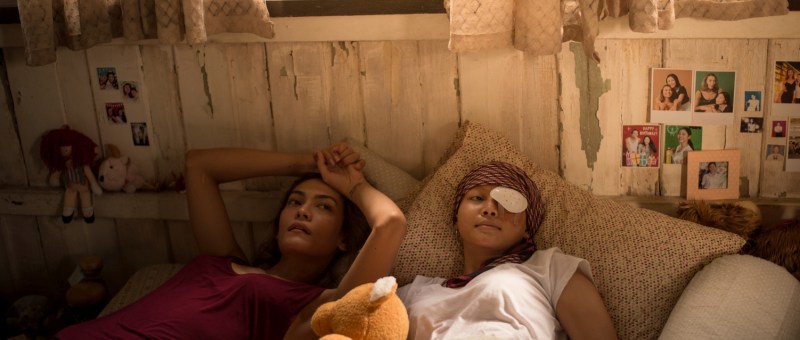
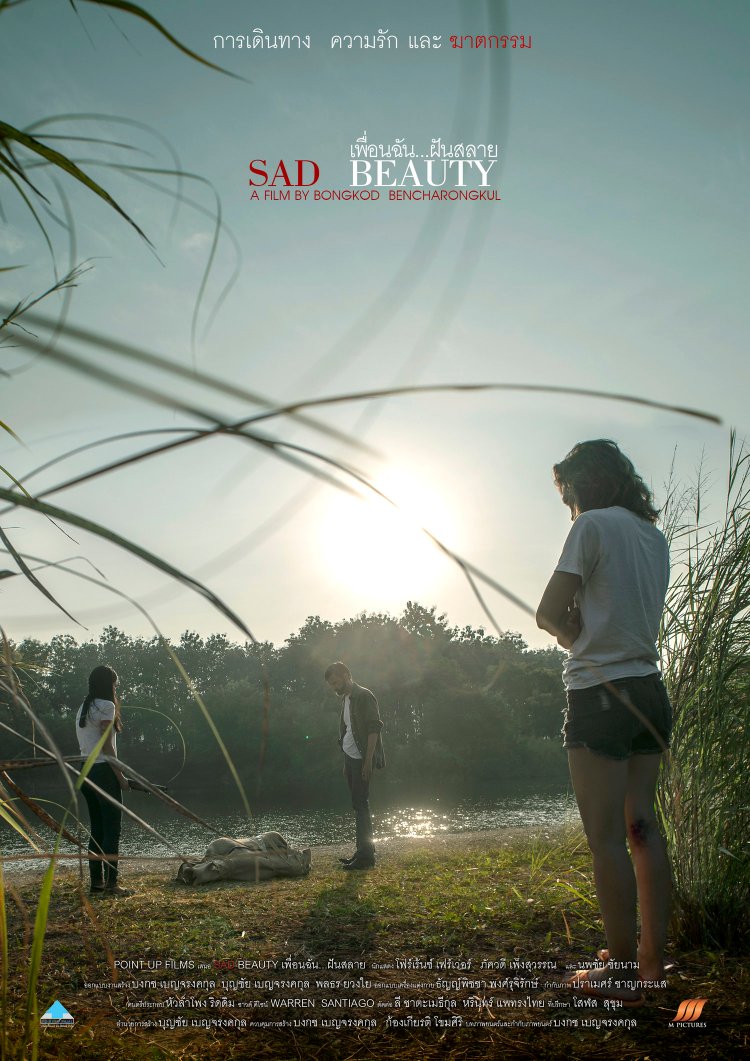
Sad Beauty (เพื่อนฉัน…ฝันสลาย, Bongkod Bencharongkul, 2018)

Sad Beauty posterToxic friendship poisons the lives of two young women each somewhat adrift in the modern Thai society in Bongkod Bencharongkul’s noir-infused tale of betrayals and frustrated futures, Sad Beauty (เพื่อนฉัน…ฝันสลาย). A former actress, Bencharongkul’s post-credit’s dedication may imply a degree of autobiographical inspiration, but the film’s uneasy mix of the upscale world of the showbiz elite and the relatively humble lives of the ordinary people on its fringes can be no accident as the two women at its centre struggle to maintain their lifelong friendship in the face of intransigent social pressures.

Yo (Florence Faivre), a famous actress and model, and Pim (Pakkawadee Pengsuwan), an ordinary young woman, have been friends ever since they were little. The friendship is close and intense, but Yo often over relies on Pim’s unwavering kindness, all take and no give, while Pim remains in awe of her beautiful and talented friend, unwittingly fulfilling the role of an unofficial assistant. Yo’s career has hit a rough patch thanks to an unwise public rant and subsequent refusal to apologise while her personal life is also threatening to implode thanks to an increasing drug and party habit. Pim maybe the only one able to prevent Yo’s self-destructive habits from going nuclear, but Pim has problems of her own – she has recently been diagnosed with cancer and, for a change, is now the one in need of care and support. Already strained, things go from bad to worse when the girls return home to Pim’s one night and discover her mother badly beaten by Pim’s drunken and abusive step-father who then turns on them. During the struggle, the step-father is killed and the two friends find themselves on the run with a dead body they don’t know how to get rid of.

A friend will help you move, a real friend will help you move a body – so the old adage goes, but the sudden introduction of crime on top of cancer and persistent narcissism injects another layer of complication into the friendship of the two women. Whether they like it or not they are now bound by something more than natural affection or loyalty and the increasing claustrophobia of their guilt forged connection cannot but paradoxically push them apart. Though Pim, who is perhaps in a way glad to have ended her mother’s suffering, seems to put the trauma of the crime and its aftermath behind her while consumed with mortal fear and the pain of her illness, Yo is haunted and even if her chastened attitude helps to put her career back on track, her self-destructive pursuit of sex and drugs and continues unabated.

When Pim tearfully revealed her cancer diagnosis to Yo, Yo promised she would be there for her no matter what. She promised the same thing again when Pim was trying to decide between chemo and “natural” treatments, but Yo is selfish and afraid – she fails her friend by refusing to accept the seriousness of the situation and offering only superficial reassurances that everything will be alright. Somehow or other, Yo manages to make even Pim’s suffering all about her, finally ready to be “supportive” only in time for the tragic finale in which she realises what she had only in losing it.

Strangely, the murder and its grisly coverup recede into the background – the real “crime” here is in the failure of friendship and the betrayal of a sacred trust. Yo took Pim for granted, relying on her for unconditional emotional support but refusing to offer much of anything in return. She basked in Pim’s admiration but also in her essential ordinariness as way of making herself feel superior, irritated when handsome men show an interest in Pim and not in her. Meanwhile Pim pines for her friend, longing for the reciprocity which is so defiantly absent yet also grateful for the sentiment of friendship and understanding (if also resentful) of Yo’s various reasons for retreating into solipsistic oblivion. This is perhaps the “sad beauty” of the title as the two women attempt to cling on to their friendship even while knowing that it must someday end, allowing the spectre of that final disappointment to poison what it is they have in the present.


Sad Beauty + introduction and Q&A with Director Bongkod Bencharongkul screens as part of the seventh season of Chicago’s Asian Pop-Up Cinema at AMC River East 21 on 26th September, 6.30pm. Tickets on sale now!

Original trailer (English subtitles)
Ramen Samurai (ラーメン侍, Naoki Segi, 2011)

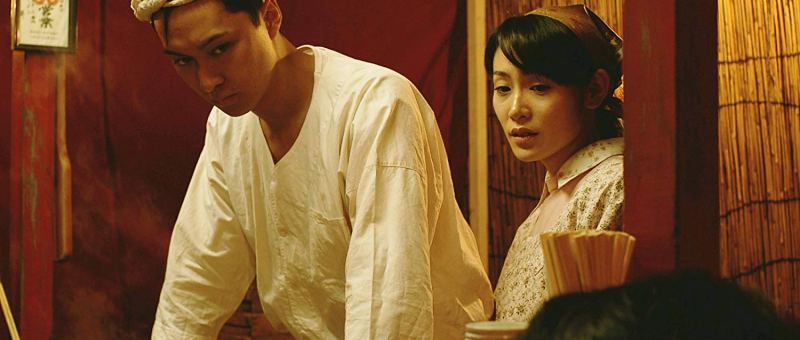
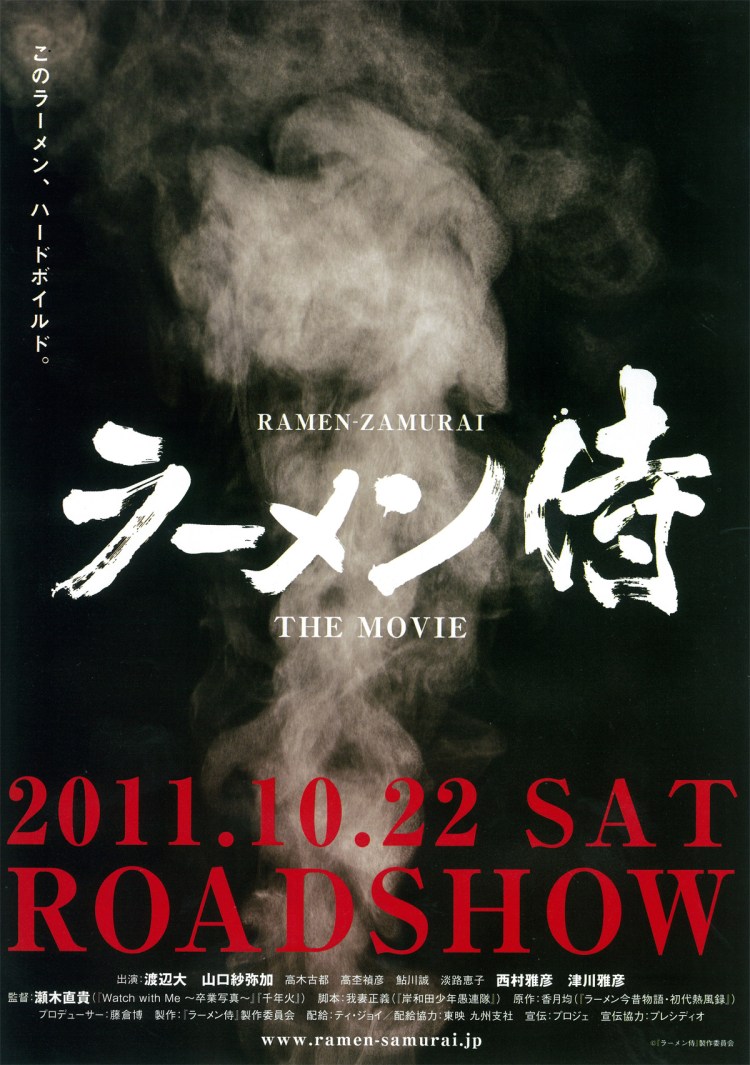
Ramen Samurai posterSet in the ‘90s, Ramen Samurai (ラーメン侍) is in many ways a post-Showa story or a tale of one man’s reaction to bubble era disillusionment. It’s also in the fine tradition of legacy movies in which a troubled child reflects on a complicated relationship with a late parent and struggles to accept their role as an inheritor of skills and knowledge they’d spent much of their youth attempting to reject. Yet the hero of Ramen Samurai, though he maybe reluctant, is more willing than most to pick up his father’s burden, walking back through family history with his long-suffering mother and rediscovering the heroism which lay behind his sometimes difficult father’s tough guy exterior. Hikaru (Dai Watanabe) does not see himself as a man like his father – he’s no “hero” and bears no natural inclination towards rebellion, but only through addressing his father’s life can he learn to define his own. This is all, of course, a roundabout way to discovering the soul of ramen lies in the confidence of the chef.

In 1990 Hikaru, a graphic designer, gets a call at work from his mum to let him know his father has had a stroke. Hikaru left town in a hurry some years earlier, rejecting the idea of taking over the ramen restaurant for a life in bubble era Tokyo. On his father’s death he assumes his natural responsibility and comes home but customers say his ramen’s not as good as his dad’s, and he has trouble keeping his staff in line because they simply don’t accept him. Try as he might, Hikaru just can’t seem to find a way to replicate his father’s recipe, in the store or in life.

Yet there’s a nostalgia in him that sees him want to try. Kurume, a small town in Kyushu, is defined by its ramen – a local delicacy that once brought tourists and general prosperity to the area, but during bubble era “modernisation”, the “backward” yatai ramen stands with their colourful tarpaulins were deemed too reminiscent of post-war privation to survive. The carts were shunted away from the new sophisticated city centre while the police started restricting licenses to run them, eventually prohibiting their sale and limiting their inheritance to direct family members. Hikaru is at least his father’s son and so has a natural right to take over the business even if he has hitherto rejected it.

Rather than a cooking tale, Ramen Samurai steps back to tell the story of its vicarious protagonist – the problematic figure of Hikaru’s dad who is, in many ways, the idealised figure of the Showa era “hero”. That’s not to say he was perfect – he drank to the point of financial ruin and frequently caused problems for his family, but his heart was always in the right place and so he was mostly forgiven. A salt of the Earth type and cool with it, Hikaru’s dad was the big man around town and the defacto leader of the yatai owner community. He brooked no injustice, stood up to the yakuza (who only had the profoundest respect for him), and sought to protect those who were unable to protect themselves. Seeing a sleazy yakuza molesting a young girl, Hikaru’s dad kicked him out and later offered the girl, who is mute, a job and a place to stay, almost adopting her into his family until another act of random kindness accidentally reunites her with her own long-lost father.

Faced with such an intense legacy, it’s no wonder Hikaru struggled. A sensitive, artistic soul he tried his luck in bubble era Tokyo working in an advertising agency where he found the coolness of his colleagues puzzling and difficult to bear. Hikaru’s boss loudly discusses pub lunches and evenings spent in hostess bars, often throwing away the lovingly made bento provided by his wife. Returning home with an empty lunchbox is, he says, his way of showing love though his refusal to eat it perhaps a reaction against a salaryman’s lack of freedom. Nevertheless, even if they clashed in terms of personal morality, Hikaru’s boss compliments him on his commitment to hard work and growth as an artist even whilst admitting that the work itself is often frivolous and ultimately thankless.

Hikaru eventually learns to channel his artistic inclinations into his ramen, seeing himself as a “ramen artist” incorporating his father’s legacy into a dish which is entirely his own. In a sense, Hikaru retreats into the safety of the Showa era past, or that is the cosy 1970s in which he lived a comfortable, if eventful, childhood under a yatai’s awning while dad made trouble but only for the best of reasons. A samurai’s duty is, after all, to protect and Hikaru has decided to do exactly that in “restoring” his hometown to its former glory, dragging retro yatai culture into the rapidly disintegrating post-bubble world and bringing warmth and community back with it.


Original trailer (no subtitles)