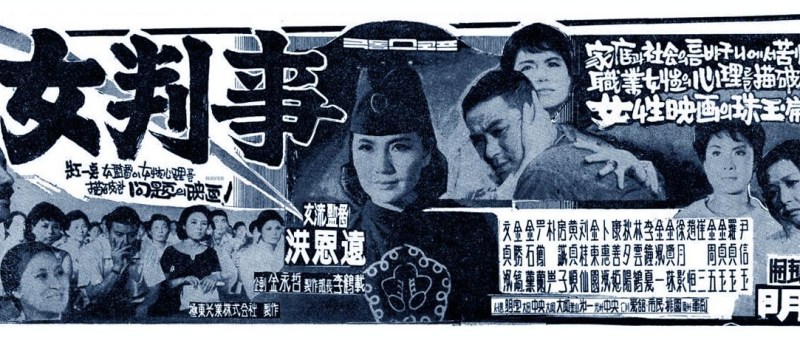
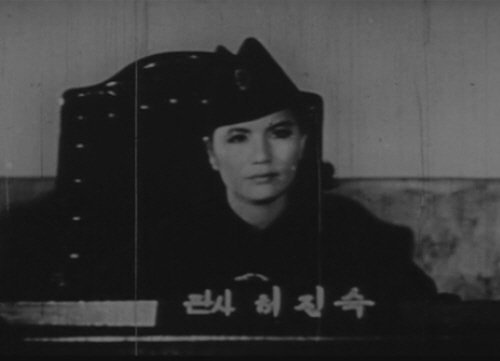
A Woman Judge (女判亊 / 여판사, Hong Eun-won, 1962)

The 1960s were a time of great social change the world over, but while Doris Day was showing the world how to have it all (to a point, at least), not everywhere found the idea of women’s liberation quite so aspirational. In the comparatively more liberal period before the Motion Picture Law brought in by Park Chung-hee there had indeed been a fair few films challenging persistent misogyny and advancing the cause of equality, but there had also been those which ran the other way and pushed an intensely conservative message. Han Hyung-mo’s A Female Boss from 1959, for example, centres around a seemingly successful female editor of a woman’s magazine whose business is in trouble. Eventually she ends up marrying an employee and becomes a housewife, neatly reinforcing the idea that women do not belong in the work force. Three years later and just just before the advent of a more stringent censorship environment, Hong Eun-won’s A Woman Judge (女判亊 / 여판사, Yeopansa) takes a much more positive attitude to the idea of women having the right to personal fulfilment outside of the home but again only to a point and only partially.

Jin-suk (Moon Jeong-suk), a youngish woman from a humble home, is studying for the judges’ exams. Though her father is supportive and encourages her to study, Jin-suk’s mother (Hwang Jung-seun) worries – she cannot envisage a life for a woman who does not marry and doesn’t want her daughter to end up alone, unhappy, and isolated. Jin-suk also finds unexpected resistance from her childhood sweetheart, Dong-hoon (Park Am), who makes a motion to solidify a long held but never spoken promise that the pair would marry but only on the condition that Jin-suk give up her intentions of becoming a judge and agree to be solely his wife. Jin-suk, of course, refuses. Meanwhile, a construction magnate who caught sight of her on the road has taken a liking to her which is only deepened when he reads of her success in the papers. He becomes determined to get Jin-suk to marry his son, Gyu-sik (Kim Seok-hun), and add some sophisticated modernity to his otherwise soulless home.

The great surprise (or perhaps it is in its own way unsurprising) is that Jin-suk’s greatest supporters are two middle-aged men – literally her patriarchal elders in the form of her own father and her father-in-law. Each of the two men is impressed by Jin-suk’s fortitude and intelligence, they believe in her and want her to succeed. The women, however, feel quite differently. Jin-suk’s mother is caring and supportive but locked into the social codes of her youth, unable to envisage a successful life for a woman which does not involve marriage or children. Jin-suk’s mother-in-law by contrast is harsher, actively resenting Jin-suk’s insistence on maintaining her career and seeing it as a rejection of the idea of the good wife. The most surprising enemy, however, is Jin-suk’s new sister-law, Geum-won, who, despite being a modern woman exhibits extremely conservative values even at one point berating Jin-suk for not showing the proper respect to her husband and failing in her wifely duties. Women oppress other women, making it almost impossible to break free of the conspiratorial forces of a conservative social order even when there are women as brave and determined as Jin-suk willing to pave the way.

That said, Jin-suk is only prepared to go half the distance. She marries and then resigns herself to double duties, insisting that she can manage both a career and a home with no support. There is no suggestion of a rebalancing of the domestic world, no one asks anything of Jin-suk’s petulant husband Gyu-sik other than he do what he’s told. Gyu-sik married Jin-suk knowing she would prioritise her career, but it’s less the fact that she works that begins to irritate him than her growing “celebrity” as “the woman judge” coupled with the paternal oppression he too feels as his father’s son. Even though he is head of accounts, his secretary won’t cash his checks without his dad’s signature – he’s not “in charge” at home or at work and feels himself increasingly emasculated. Which is perhaps why he lets his sister manipulate him into an affair with his mousy secretary who conforms much more strongly to the feminine ideal and therefore allows him to feel like “a man”.

The affair between Gyu-sik, and his lonely secretary, Miss Oh, eventually turns dark and leads the pair to consider double suicide. Gyu-sik, a coward, is unwilling to leave his “unhappy” marriage but Miss Oh does not want to end up a perpetual mistress. The first case Jin-suk presides over is a divorce in which a man has cited his own adultery to divorce his wife because she works too much. Obviously, Jin-suk does not approve of his reasoning but it’s the accomplice who becomes unexpectedly sympathetic. Jin-suk asks her if she knew her lover was married to which she says she did not and that had she known she would never have become involved with him. When the woman affirms that she only slept with the man because she believed they would be married, Jin-suk asks her a perhaps cruel question with a wry smile – if she thought the same thing with each and every man she had ever slept with (implying there must have been many in an unintentional act of slut shaming). Rather sadly, the woman replies that yes she did – she may be naive, but she loved them all and firmly believed they would marry her only to be let down just as she’s being let down now.

Such is the difficult position in which women find themselves in a liberalising but not liberal society. One of Gyu-sik’s friends even petitions him to get Jin-suk to help him get rid of a paternity suit filed by a girl he’s got into trouble while engaged to marry someone else and has now disowned. In fact one of the frustrations fuelling Gyu-sik’s resentment is that he has become a mini conduit to Jin-suk as just about everyone attempts to make use of the familial connection to ease their legal woes, little knowing that Jin-suk is not that kind of judge. She entered the law to heal society like a doctor heals the sick, but begins to doubt herself when the disorder in her own home threatens to boil over.

Disorder shifts into murder. A surprising second act twist puts us back in the realms of the courtroom drama as Jin-suk finds herself first a suspect and then presumed an intended victim before being forced to interrogate, literally, her own family and prove her devotion to it in the process. Though it’s Jin-suk determination, perseverance and legal skill coupled with compassion and emotional intelligence that eventually save “the family”, the jury is still out on whether she will be allowed to continue her legal career or be forced to give it up to fully repair the fracturing family home. While Jin-suk is committed to the idea that all women have the right to fulfil their potential, she too is wedded to the patriarchal ideas of the home and family and never truly considers living outside of them, only insisting on being allowed to continue working as a wife if not, ultimately, as a mother (though it is also interesting that she never suggests her career necessitates a rejection of those things or that there is an active choice available to her). A Woman Judge provides a fascinating insight into the prevailing social codes of Korean society in the early 1960s, even if taking only small steps towards a larger goal.


A Woman Judge was screened as part of the Rebels With a Cause season of free film screenings at the Korean Cultural Centre London. You can also stream the film for free via the Korean Film Archive’s YouTube Channel.


Tokyo Vampire Hotel (東京ヴァンパイアホテル, Sion Sono, 2017) [Fantasia 2018]

Tokyo Vampire Hotel PosterAbridging a work of fiction can be a taxing task. The job of a judicious abridger is the use their own judgement to reduce a larger work to its most essential elements either for those who, for one reason or another, need a more immediate digest or for those looking for greater accessibility. When it comes to a work of art, abridgement can be a dubious task and, unfortunately, the temptation is simply to excise the “best bits” shorn of all the “heavy stuff” and supporting material. Sion Sono who had been in a particularly prolific phase was given something of an unusual opportunity in creating Tokyo Vampire Hotel (東京ヴァンパイアホテル) – a chance to do as he pleased with a sizeable budget to create a television series for Amazon Prime, which is to say marrying mainstream commercial concerns with idiosyncratic artistry. The 6.5hr, eight episode, series was released via the streaming platform in June 2017 (initially in Japan only with international streaming available a few months later) but Sono also took the step of creating a 2hr22min feature length cut for film festival distribution.

The titular Tokyo hotel is the lair of a sect of modern day vampires. As a long prophesied war between rival clans – the Corvins in Japan and the ancient Draculas of Romania, brews, the Corvins have engineered a plan to lure lonely unsuspecting Tokyoites to an exclusive singles mixer where they will not only be given a sizeable fee for attending but also tempted with the possibility of meeting the love of their life, never suspecting that all this is too good to be true and they are really being recruited for a kind of blood farm to feed the various appetites of their bonkers captors.

Meanwhile, “the chosen one”, Manami (Ami Tomite), is about to come of age. Born during an “auspicious” alignment of the stars, Manami is one of three children given special vampire blood and thought to be all powerful, species saving hybrids. As such she is wanted by every side and is eventually “rescued” from a massacre at a restaurant by ice cool vampire K. (Kaho) – a Japanese vamp currently working for Dracula.

It has to be said that Sono’s original TV cut is extremely convoluted and initially confusing. The hotel, a Japanese vampire hub, is connected to the vampire capital in Romania by a magical tunnel with the narrative flowing freely between both spaces. What we lose in condensing to feature length is the entirety of the extensive back story with the consequence of shifting the focus from the protagonist of the TV series, Manami, to the more exciting figure of second lead K. whose gradual disillusionment with becoming a puppet in someone else’s revolution coupled with romantic heartbreak eventually reawakens her sense of “humanity” as she becomes committed to “saving” Manami from becoming yet another slave to the Dracula cause.

Meanwhile, Sono satirises modern Japan’s ambivalence towards romance as a collection of youngsters are forced into an extreme situation in order to successfully couple off and form a “traditional” family solely to satisfy the demands of a bunch of vampire overlords standing in for a bloodsucking state. Yamada (Shinnosuke Mitsushima), the conflicted hero of the Corvins who longs for escape from his unwanted immortality and an egotistical, individualist world harbours intense resentment towards his own “hypocritical” father who “sold” him to the vampires as a baby in return for various favours by which he has now become the “Romantic Party” Prime Minster of Japan preaching traditional family values and a “wholesome” future for the little children who otherwise face a difficult existence in a country which has “lost its way”.

Sono doubles down on his usual sense of romanticism as his flamboyant vampires adopt an oddly foppish, Regency era aesthetic whilst speaking in a deliberately theatrical manner filled with bold philosophical statements and a florid sense of repressed melodrama. Harking back to Bad Film – another attempt to reorder extensive footage into a narratively cohesive whole, the conflicts are often about love more than death with suffering and sorrow marking the lives of our gloomy immortals, oppressed by their own inability to transcend their natures and find the escape they so desperately crave.

Sono seems to reemphasise their unhappy fates by engineering an altogether different, infinitely abrupt ending which, in contrast to the TV drama, hands the victory back to the people but does so in historically uncomfortable fashion as the victorious hotel guests revel in acts of atrocity against their captors which are framed as a kind of genocide and accompanied by stills from violent classical paintings featuring scenes of unbridled carnage. A contrarian to the last, Sono mutilates his own endeavour and then frankensteins it into something else, twisting his own words and tying himself in knots in the process. Viewers seeking clarification would be well advised to invest their time in the 6.5hr experience rather than opting for the convenient shortcut of an edited version, but there is certainly plenty to ponder in Sono’s truncated tale of love and death in post-Olympic Tokyo.


This review refers to the theatrical cut of Tokyo Vampire Hotel which was screened as part of the Fantasia International Film Festival 2018. You can also stream the original TV drama in most territories via Amazon Prime.

Trailer for the TV drama (no subtitles)

Penguin Highway (ペンギン・ハイウェイ, Hiroyasu Ishida, 2018) [Fantasia 2018]

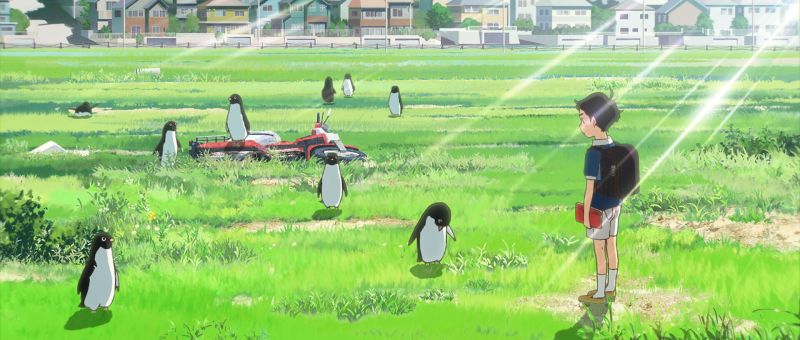
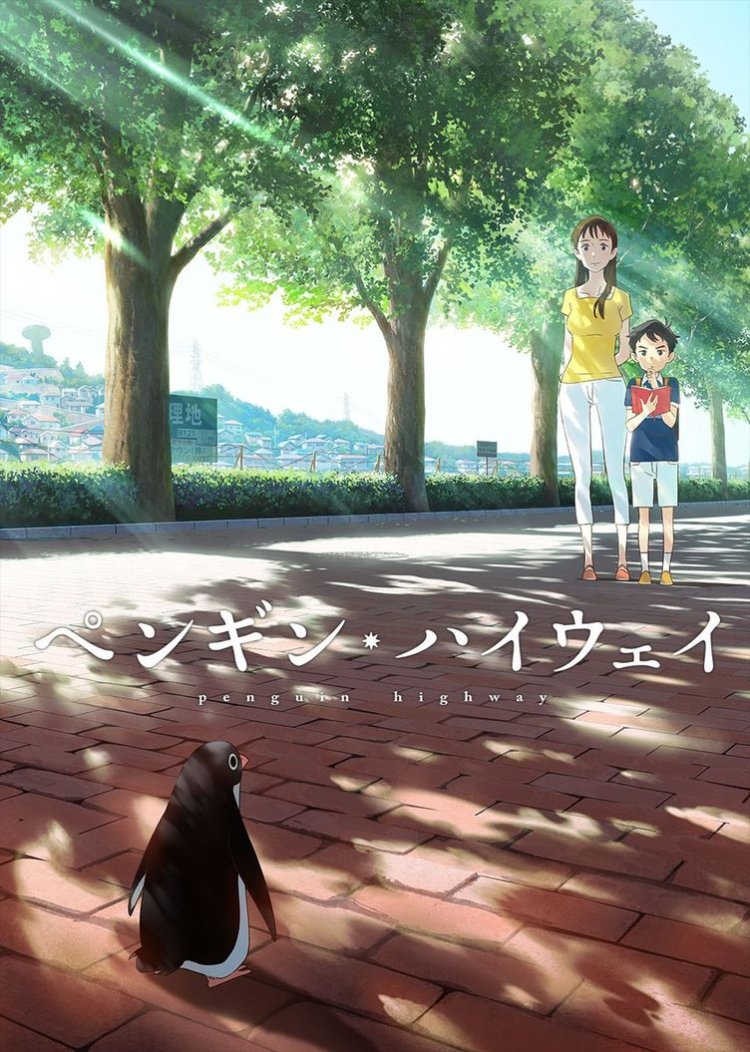
Penguin Highway posterRandom penguins might be the very opposite of a problem, but what exactly does it all mean? Tomihiko Morimi has provided the source material for some of the most interesting Japanese animation of recent times from Masaaki Yuasa’s wonderfully surreal Tatami Galaxy and Night is Short, Walk on Girl, to the comparatively calmer Eccentric Family. Hiroyasu Ishida’s adaptation of Morimi’s Penguin Highway (ペンギン・ハイウェイ) may be a far less abstract attempt to capture the author’s unique world view than Yuasa’s anarchic psychedelia, but preserves the author’s sense of every day strangeness as an ordinary primary school boy’s peaceful life is suddenly derailed by the appearance of random penguins in a small town way in land in the middle of a hot and humid Japanese summer.

Aoyama (Kana Kita) is, as he tells us, “very smart”. He thinks its OK to tell us this because unlike some of his classmates he isn’t conceited, which is what makes him so great. He’s absolutely positive that he’s going to become an important person in the future and can’t wait to find out just how amazing he’s going to be once he’s grown up. Aoyama is also sure that crowds of girls will be lining up to marry him, but they’re all out of luck because he already has a special someone in mind – the friendly young receptionist from the dentist’s (Yu Aoi) who has been coaching him at chess and just generally hanging out with him chatting about life.

Everything begins to change one day when random penguins start appearing all over town. Penguins are, after all, cold climate creatures and this is a glorious summer in Southern Japan so even if these are rogue penguins who’ve managed to escape from a zoo, it’s anyone’s guess how they’ve managed to survive. Being the scientifically minded young man he is, Aoyama becomes determined to solve the penguin mystery, especially as it seems to have something to do with the young lady from the dentist’s who he can’t seem to get out of his mind.

Aoyama is, despite his opening gambit, a fairly conceited young man who thinks himself much cleverer than those around him – not only his schoolmates but the adults too (possibly with the exception of the lady from the dentist’s who is after all teaching him how to be better at chess). With an intense superiority complex, Aoyama has few friends (not that that bothers him, particularly) and is often bullied by the class bruiser, Suzuki (Miki Fukui), and his minions, all of which he takes in his stride. He is, however, slightly thrown by the presence of an extremely bright girl in his class, Hamamoto (Megumi Han), who regularly beats him at chess and is interested in black holes among other areas of scientific endeavour Aoyama had earmarked as his own.

Despite suspecting that Hamamoto might be “even more amazing” than he is, Aoyama is not resentful or jealous but remains seemingly oblivious to her attempts to make friends with him. Aoyama, as an intensely “rational” person, is also sometimes insensitive and remains entirely unable to pick up on social cues unlike his more perceptive friend/assitant, Uchida (Rie Kugimiya), who is well aware of the reason Suzuki keeps picking on Hamamoto, but is unable to convey his instinctual understanding of human nature to the logical Aoyama. Armed with this new fragment of information from Uchida, Aoyama uses it in a predictably “rational” fashion by suddenly bringing it up in front of both Hamamoto and Suzuki in “advising” him that liking someone isn’t “embarrassing” and Suzuki should just say what he means rather than making passive aggressive attempts to get attention by being unpleasant. All of which is, ironically enough, quite awkward.

Through carrying out his investigation into the penguin phenomenon, Aoyama is forced to confront his less rational side, eventually affirming that he’ll live his life based on a “personal belief” rather than a scientific principle. Getting a glimpse of the edge of the world and coming to accept that not matter how much fun you’re having there will always come an end, Aoyama decides to live his life in haste anyway running fast towards an inevitable conclusion in the hope of a longed for reconciliation. Sadly, his discoveries don’t seem to have made him any less conceited but he is at least good hearted and eager to help even if he remains determined to walk his “Penguin Highway” all alone while concentrating on becoming a better person. Beautifully animated and tempering its inherent surrealism with gentle whimsy, Penguin Highway is a promising start for Studio Colorido, mixing Ghibli-esque charm with Morimi’s trademark surrealism for a moving coming of age tale in which a rigid young man learns to find the sweet spot between faith and rationality and pledges to live his life in earnest in expectation of its end.


Penguin Highway was screened as part of Fantasia International Film Festival 2018.

Original trailer (no subtitles)

Violence Voyager (バイオレンス・ボイジャー, Ujicha, 2018) [Fantasia 2018]

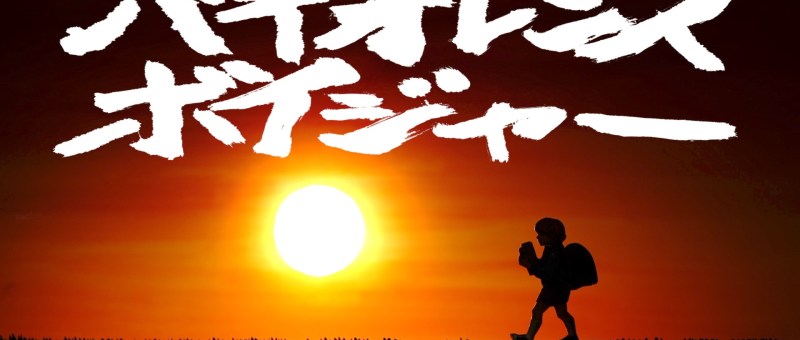
violence voyager posterWeird stuff happens out in the mountains, stuff you wouldn’t even believe. Ujicha’s Burning Buddha Man followup Violence Voyager (バイオレンス・ボイジャー) is a pleasantly retro treat, set sometime in the more innocent past when the landscape still held hidden mysteries for small boys to find and anything goes so long as you’re home in time for tea. There are some mysteries, however, that it’s better not to solve and if something seems too good to be true, that’s usually because it is. Little Bobby (Aoi Yuki) is about to become a hero, but his journey will be a one way trip of unwelcome transformations, losses, and betrayals.

Bobby, an American boy with a blond bowl cut living in a little rural town with his distant dad and bedridden mum for otherwise unexplained reasons, has impressed his best friend Akkun (Shigeo Takahashi) with his high-tech pinball baseball computer console he made for the science fair, even if it has put the strange monster toys Akkun and his brother Yakkun entered with the intention of masking a lack of skill with pure strangeness to shame. Ostracised by the other kids, Bobby and Akkun long to cross the mountain and find their other friend, Takaaki (Daisuke Ono), who moved away to the next village. Akkun has heard tell of a secret mountain path which would take them there for free and it’s only *slightly* dangerous even if it does take time. Luckily it’s the summer holidays so time is something the boys have plenty of.

Setting off despite the warnings of Old Man Lucky Monkey (who actually lives with a chimpanzee as a “friend”), the boys are sidetracked when Bobby spots a fallen sign for something called “Violence Voyager” which sounds like too good an opportunity to miss. Ending up at an abandoned theme park, the boys are surprised to find the proprietor (Tomorowo Taguchi) still hanging around and overjoyed when he offers to let them in for free seeing as he rarely gets any business owing to the rapidly declining number of children in the area (alarm bells should be ringing right about now). Handed a “voyager suit” (an anorak and pair of wellies), the boys are shown an informational video explaining that the world has been invaded by aliens in the form of robot soldiers who shoot alkaline from their plant-like hands. Choosing a “weapon” (water pistol) each (Bobby a rifle, Akkun a tiny little dolphin), the boys set off but it’s not long before they start to suspect something isn’t quite right. Discovering another little girl lying injured, Bobby and Akkun plan an escape only to find their bullying classmates also facing the same dilemma.

It will come as no surprise that there really is something not quite right going at Violence Voyager. Like a combination of Westworld and Soylent Green, the park exists to strip the young of their innocence by exploiting it. A mad scientist desperately trying to save his only family is literally eating his young – sacrificing the souls of innocent children and “remaking” them in his own image to feed his ruined son. Meanwhile, Bobby’s dad fights equally hard to track down and rescue his own errant boy from an obviously bad situation.

Bobby emerges scarred and fundamentally “changed” mentally and physically but with his humanity fully intact, carrying a pretty bunch of flowers to take to his mum to cheer up her sickbed (and presumably lessen the shock of seeing him as he now is). An extreme coming of age tale, Violence Voyager runs from exposing the cynicism of businesses aimed at children to the desperation faced by a parent prepared to protect their offspring at all costs (including their remaining family).

Ujicha’s trademark “geki-animation” is a perfect fit for the bizarre tale at hand, filled with beautiful hand painted backgrounds and accompanied by the sonorous narration of comedian Hitoshi Matsumoto (Symbol, Big Man Japan). The retro design from Bobby’s bowl cut to the ‘70s musical score and noticeably old-fashioned composition (one shot even seems to reference the poster for Fukasaku’s Virus) allows the warmth of nostalgia to mix with its less positive elements all while indulging in a surreal B-movie adventure which starts with “aliens” and ends with the horror that men do. Whether a metaphor for the conformist meat grinder which strips children of their individuality to trap them in the straight jacket of the salaryman world, the ravages of grief, or just a B-movie body horror adventure, Violence Voyager is a surreal fever dream of bodily corruption but undercut with its own sense of fantastical whimsy and an oddly innocent heart for so dark a tale.


Violence Voyager was screened as part of Fantasia International Film Festival 2018.

Original trailer (English subtitles)

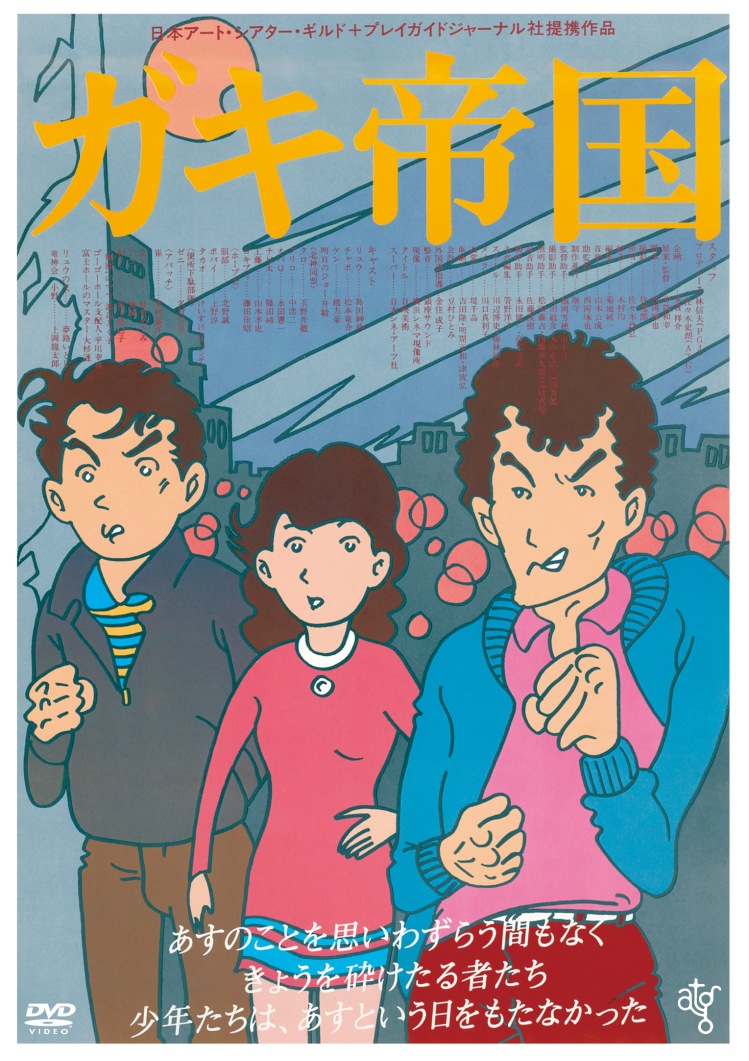
Empire of Kids (ガキ帝国, Kazuyuki Izutsu, 1981)

Empire of Kids posterJapan in 1981 was a vastly different place than the Japan of 1967. Rising economic prosperity had produced an amiable social calm in which desire for conventional success and increasingly aspirational consumerism had replaced the firebrand need for social change which had defined the previous decade. Filmmaker, film critic, and sometimes outspoken TV personality Kazuyuki Izutsu was presumedly not a huge fan of consumerism and for this, his first “mainstream” film made for ATG, retreats back to the Osaka of 1967 in which petty street punks lamented their lack of opportunities by banding together and battling for control of their respective neighbourhoods like boys in the schoolyard only armed with knives and filled with nihilistic desperation.

The film opens with our “hero”, Ryu (Shinsuke Shimada), being released from juvie after presumably getting into trouble for his petty punk antics. Waiting for him are his two best friends – soulful zainichi Korean Ken (Cho Bang-ho), and rockabilly Chabo (Ryusuke Matsumoto). Ryu is released alongside another boy, Ko (Takeshi Masu), whom he tries to recruit into their mini gang but quickly becomes an enemy, teaming up with the boys’ rivals – the Hokushin Alliance, while also becoming a potential rival for Ryu’s old girlfriend with dancing dreams, Kyoko (Megumi Sanuki). The boys, still in their last year of high school, become obsessed with trouncing their competition, proving their manhood on the streets while asserting their rightful place as the dominant forces in their native area, but as it increases in intensity the game becomes frighteningly serious and its dangers all too apparent.

Izutsu’s film fits comfortably into the “delinquent” genre but perhaps takes its cues from the Hollywood cinema of alienation more than the tough guy antics of the youth movie past. From Chabo’s bright red jacket and neatly greased quiff, the starting point is Rebel Without a Cause as these otherwise not too bad kids struggle with their place in the world, unable to see a clear path and direction for themselves in the society of 1967 which seemed both frustratingly open and closed to unremarkable lower middle-class boys. Ryu’s brother is going to give up football to go to cram school so he doesn’t end up like Ryu, while Ryu has taken to reading brain training books to try and get back on the academic path to success which he fears may have already passed him by. Ken, idly talking of the future, can’t see much beyond winding up in the yakuza, opening a bowling alley, or maybe becoming a comedian (this is Osaka after all). None of these guys is going to university or getting a salaryman job, they know not much awaits them outside of low-paid manual work, marriage, children, family and death, so they take their frustrations out on each other playing at gangsterism out on the streets.

For Ryu, Ken, and Chabo the reasons for their violence are “honourable” – they want to keep their local space local and are committed to defending it from the “external” threat of the shadier street punks from uptown. Apparently from stable economic backgrounds, the boys’ acts of street justice have no particular economic component, in contrast to those of the Hokushin Alliance which positions itself as a yakuza training school with a brutal hazing regime for new recruits and a business plan which involves hunting young women and trapping them through rape and blackmail to force them into prostitution. 

Aside from lack of direction, Ken – the most introspective of the boys, also has to deal with the constant threat of discrimination due to his roots as an ethnic Korean living in Japan. One of the reasons he hates the Hokushin Alliance and distrusts some of the other gangs is that they deliberately target Koreans in racially motivated attacks. One of his old friends, Zeni (Masaaki Namura), is a member of an all Korean street gang which attempts to defend itself against the strong anti-Korean sentiment out on the streets but finds itself outgunned by the sheer weight of numbers. Ken speaks Korean openly with his friends (even when there are non-Koreans close-by) and has no interest in hiding his ethnic identity even if he uses his Japanese name in his every day life, while Ko (whom we later realise is also ethnically Korean) hides his ethnicity completely and subsumes himself into the Hokushin with a view to finally joining the yakuza even whilst knowing that the gangs he has joined are extremely prejudiced against “foreigners” and Koreans in particular. Ken would never out someone deliberately, but finds Ko’s attitude difficult to stomach, not only in his willingness to hide his roots to fit in with gangster thugs, but in his willingness to persecute his own in order to do it.

The atmosphere that surrounds the boys is one of intense futility. They fight each other pointlessly, like children in the playground, and it’s all fun and games until someone reaches for a knife. Petty disputes quickly escalate when the yakuza gets itself involved in children’s games – an assault rifle, after all, has little place in a kids’ disco where teenagers come to drink Coca Cola and slow dance to a terrible covers band singing the “uncool” music of the day. Despite the melancholy air of frustration and inevitability, Empire of Kids (ガキ帝国, Gaki Teikoku) adopts the otherwise warm and nostalgic tone of the Japanese teen movie, embracing the typically Osakan need for spiky comedy even as our guys fall ever deeper into the hole their society has cut out for them. There are few rays of sunshine to be found here, friendships are broken, trusts betrayed, and futures ruined but then again, that was only life, in Osaka, in 1967.


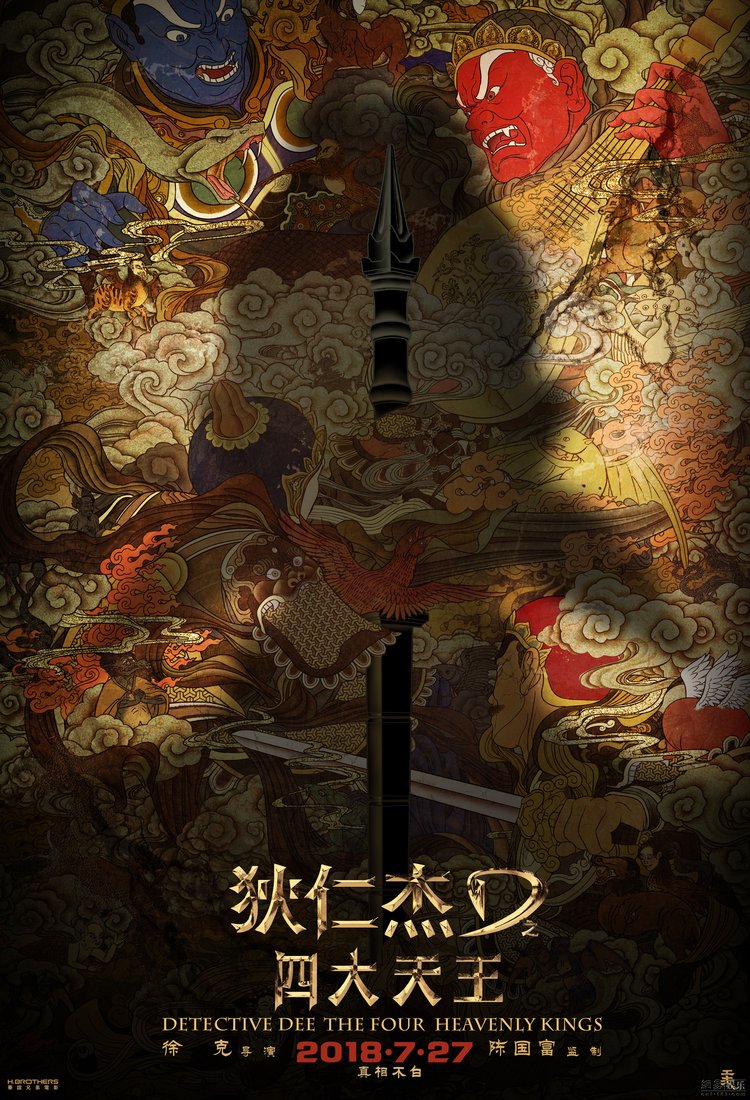
Detective Dee: The Four Heavenly Kings (狄仁杰之四大天王, Tsui Hark, 2018)

Detective Dee four heavenlu kings posterMaybe we could use a Detective Dee or two in this bold new age of fake news and powerful ideologies. Tsui Hark at least finds another case for the famed Tang Dynasty detective though this time one which sees him at the centre of a conspiracy, a bug in the system which must be squashed in order to pave the way for someone else’s revolution. The Four Heavenly Kings (狄仁杰之四大天王, Rénjié zhī Sìtiānwáng) of the title (no, sadly Andy Lau has not returned with a few of his friends in tow) refers to the four Buddhist deities which ought to tip us off to the kind of story this is as personal desires, of one sort or another, threaten to destabilise a state.

At the end of the previous film, Young Detective Dee: Rise of the Sea Dragon, Dee (Mark Chao) was “rewarded” with a place in the inspectorate and guardianship of the Dragon Taming Mace. However, scheming consort Wu Zetian (Carina Lau) is not particularly happy about her husband’s grand gesture and still has her doubts about Dee. Claiming that she fears such a powerful weapon/symbol being in the hands of someone who may betray the crown, Wu instructs Dee’s Sworn Brother and head of the Justice department Yuchi Zhenjin (Feng Shaofeng) to retrieve the Mace at any cost. Yuchi is reassured that Dee is not in danger and so agrees to work alongside Wu’s handpicked troop of “magical” crooks (who have actually been hired to take care of Dee to stop him messing up Wu’s grand plan). Needless to say all is not as it seems and Wu has fallen under the influence of nefarious forces who are merely using her lust for power as a convenient mechanism for facilitating their own agenda of revenge for a past era’s betrayal and oppression.

Dee’s methods are, more or less, inspired by Sherlock Holmes, granting him almost supernatural powers of foresight and observation though this time he is not occupied with one specific case so much as solving the mystery of the hidden insurrection within the Tang. The Mace may seem like a MacGuffin but its power is real and eventually holds the key to defeating the forces of chaos which threaten to bring down the state. Wu’s quartet of “Taoist” magical mercenaries are quickly exposed as expert wielders of tricks and trinkets rather than supernaturally charged avengers, but the state can’t help being captivated by the “magic” which finally puts paid to their ambition and is rocked by the power of the false images which continue to assault their senses.

Tellingly the big bad here is a foreign cult which makes extensive use of “hypnosis”, strange potions, and smokescreens in order to create the illusion of magic. Illusion, however, is as good as or perhaps better than the truth when it comes to political manipulation. The cult’s powers apparently aided the creation of the Tang state but once they were no longer needed, they found themselves cast out, tortured, and humiliated. Unsurprisingly they want their revenge and will settle for nothing less than the humiliating fall of the nation they helped to build.

Good old fashioned deduction and rationality are useless in the battle to free infected minds from the hypnotic power of fake news perfectly tailored to embrace one’s darker instincts. Wu, secretly or otherwise, lusts for power of her own and was easily manipulated by the promise of support in her campaign to seize the throne. Meanwhile, the leader of the Wind Warriors is infected with an intense desire for violence and killing to ease his deep seated rage over the misuse of his people. The answer is, of course, Buddhism. Life is too beautiful to be marred by hate while the act of forgiveness is the ultimate show of strength. Nevertheless, Tsui abandons Dee’s cool, analytical approach for a strangely spiritual final battle in which the fake news machines wielded by the Wind Warriors are pitted against the intense calm of a finely tuned mind (and the slightly moodier one of a giant white gorilla). Hell is full of suffering, Dee reminds the monk, enlightenment will have to wait. Perhaps “enlightenment” is merely another selfish desire won at the expense of blocking out the calls for help from those in need.

The Dragon Taming Mace is the ultimate symbol of justice, literally able to cut through the spell of illusion to expose the truth below. Wu had reason to fear it, even if she was not in the position to understand why. Dee is indeed a worthy guardian and unsullied soul, committed to the pursuit of compassionate justice wherever he goes even if he does so as a representative of the authority. Wu may have regained her senses, but that doesn’t mean she’s cured of the underlying causes of her possession as the large statue of Guan Yin which looks mysteriously like her seems to prove. Dee may have another mystery on his hands, but in any case his work is far from done in a land of intrigue and duplicity in which justice hangs by a slippery thread.


Detective Dee: The Four Heavenly Kings is currently on limited UK cinema release courtesy of Cine Asia. Find out where it’s playing near you via the official website.

Original trailer (English subtitles)

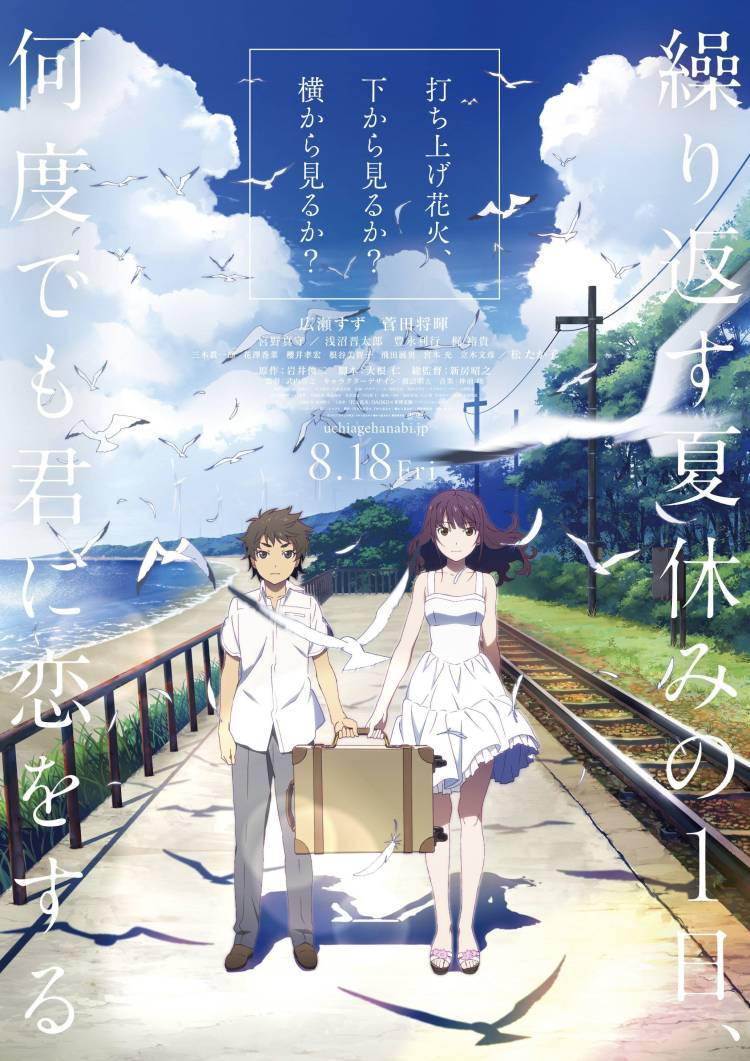
Fireworks (打ち上げ花火、下から見るか? 横から見るか?, Akiyuki Shinbo & Nobuyuki Takeuchi, 2017) [Fantasia 2018]

Fireworks posterBack in 1993, Fireworks, Should We See it From the Side or From the Bottom? (打ち上げ花火、下から見るか? 横から見るか?, Uchiage Hanabi, Shita kara Miru ka? Yoko kara Miru ka?), became something of a sliding doors moment for the young Shunji Iwai who received an award from the Directors Guild of Japan for what was in essence a single episode in an anthology TV series dedicated to the idea of “what if”. “What if” is, it has to be said, a constant theme in nostalgic Japanese cinema as slightly older protagonists look back on the hazy days of youth and wonder what might have been if they’d only known then what they know now. Scripted by Hitoshi One (Scoop!) and produced by Shaft, the anime adaption attempts to do something similar, floating in with a gentle summer breeze that could easily be from 30 years ago or yesterday while its conflicted hero ponders where it is he ought to stand to get the most beautiful view of life passing him by.

The central dilemma that seems to obsess the boys this particular summer is whether fireworks are flat or three dimensional and whether your perception of them changes depending on where you stand. Norimichi (Masaki Suda) risks falling out with his best friend Yusuke (Mamoru Miyano) and so has avoided revealing the fact that they both have a crush on the same girl – Nazuna (Suzu Hirose), who (neither of them have noticed) has a dilemma of her own. A chance meeting at the swimming pool seems primed to dictate the romantic fate of all concerned. Norimichi and Yusuke race for the affections of Nazuna who, in the original timeline, ends up asking Yusuke to see the summer fireworks with her even though it’s Norimichi she went there to meet.

Unfortunately Yusuke is a flake and nothing goes to plan. He stands Nazuna up to hang with his buddies and figure out the answer to their inane riddle leaving her to run into Norimichi who gets an unexpected glimpse at her inner turmoil. A mysterious orb salvaged by Nazuna from the nearby sea gives Norimichi a chance to start over, be braver, do things differently thanks to the benefit of hindsight, and so he begins a path to idealised romance by manipulating the events around him to finally “save” Nazuna from making a rash decision (or at least from making it alone).

In 1993, Nazuna’s dilemma was perhaps a little more unusual than it might seem now. Her twice married single-mother (Takako Matsu) is planning to marry again which requires the teenage Nazuna to leave her home behind to live with a strange man in a strange town. Though her new step-dad seems nice and is obviously trying his best, Nazuna is not of a mind to give in. She consents to accepting one of the ice-creams he’s bought to curry favour (after all, there’s no need to be “rude”), but is not about to go so far as to say thank you or to enjoy eating it together with the rest of the family when she could guzzle it sulkily in the comfort of her bedroom. Nazuna wants to escape, but her ideas of doing so are childishly naive even if she puts on a sophisticated front by joking about going to Tokyo to work on the fringes of the sex trade by lying about her age. Hence, she asks a boy she likes but barely knows to take her away from this place, but the boy is just a boy and not quite equipped for rescuing damsels in distress from suffering he doesn’t understand.

Like many Japanese teen dramas, Norimichi’s interior monologue takes on a rueful quality, as if he’s eulogising his youth while still inside it. He doesn’t know whether there’s a difference if you look at things from one angle or another because he’s not particularly used to thinking about things and his first few experiments with the orb are pure reactions to events rather than thought through decisions about effects and consequences. Nevertheless, use of the orb shifts him into a philosophical contemplation of what it is to live a life. Finally realising he should probably ask Nazuna what it is she really wants, the process the pair undergo is one of learning to live in the now rather than obsessing about the end of something that might never begin if you never find the courage to start.

In the end their beautiful dream world is ruptured by a drunken old man, shattering into a thousand shards of memory of things that never were. Fireworks wants to ask if you can have a more fulfilling life by simply changing your perspective, but its central messages never quite coalesce. There is something about Iwai’s original concept which inescapably of its time, sliding neatly into the melancholy world of early ‘90s teen drama drenched in nostalgia for an era not yet past. Reaching for poignant philosophising, Fireworks falls short through, ironically enough, focussing too heavily on a single point of view. An oddly “flat” exercise, Shinbo’s adaptation misses the mark in its climactic moments but perhaps manages to offer something to the lovelorn teens of today if only by yanking them back to a more innocent time.


Fireworks was screened as part of Fantasia International Film Festival 2018.

International trailer (English subtitles)

The original 1986 Seiko Matsuda song reprised by Nazuna at a climactic moment.

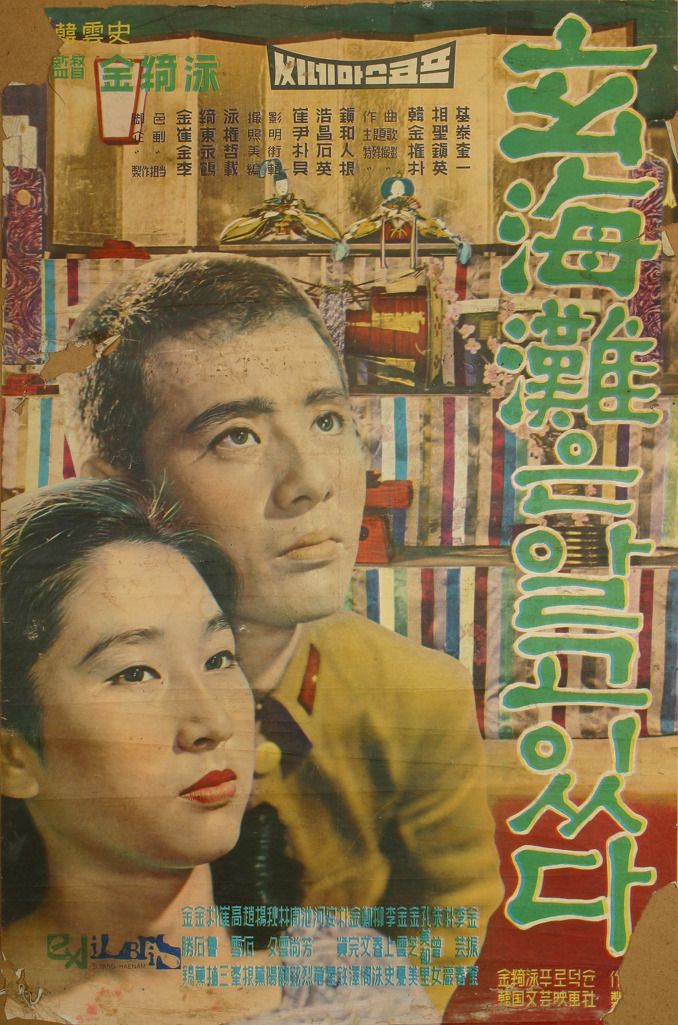
The Sea Knows (玄海灘은 알고 있다 / 현해탄은 알고 있다, Kim Ki-young, 1961)

The Sea Knows posterThe Korea of 1961 was a land in flux. The corrupt regime of Rhee Syngman had been brought to its knees following mass protests regarding the rigged 1960 elections but hopes for a new democracy were cut short when military General Park Chung-hee staged a coup, later declaring himself president for life and continuing his authoritarian rule until he was assassinated by one of his own subordinates. Kim Ki-young’s The Sea Knows (玄海灘은 알고 있다 / 현해탄은 알고 있다, Hyeonhaetaneun Algoitta) arrived perhaps at just the right time, ducking under the radar before the Motion Picture Law of 1962 would forever change the industry and if not prevent at least frustrate any attempt to discuss the controversial themes at the heart of Kim’s drama. The Sea Knows is, like much of Kim’s work, a tale of power and desire only this time on a wider scale as he examines the complicated relationship between Korea and Japan as mediated through romantic melodrama.

We open in 1944. Korean student Aro-un (Kim Wun-ha) has been conscripted into the Japanese army following an incident in which he embarrassed a high-ranking official (something which has made him a local hero at home). Despite the fact that Korea has been inducted into the Japanese empire and Koreans are now sons of the emperor too, the regular Japanese troops are not exactly grateful for service of their brethren from across the sea. Koreans are a pain, they decry. They’re always going on about justice and fairness. They won’t just shut up and take their lumps like regular Japanese soldiers. The “50 year tradition” of the Japanese army is to break the will of new recruits through violence, strip them of their individuality, and reduce them to a finely tuned hive mind.

Needless to say, Aro-un is not eager to comply. There’s a strong strain of homoeroticism in the strangely camp banter between the higher-ups. At the first inspection the commanding officer takes a good look at Aro-un, decides he resembles a “cute puppy” and recommends he come to his room to get some “biscuits”. Meanwhile a particularly sadistic NCO, Mori (Lee Ye-chun), pinches the chest of Aro-run’s judo champion friend Inoue (Lee Sang-sa) and decides he’ll not be an easy target – unlike the short and wiry Aro-un who is too righteous to know what’s good for him. Mori, an insecure and under qualified NCO, makes use of men like Aro-un to entrench his own position through the “50 year tradition” of military discipline. The humiliations mount until Aro-un is forced to lick Mori’s excrement encrusted boots in punishment for having failed to polish them to his satisfaction.

Yet, unlike in the majority of Korean films dealing with war and occupation, the Japanese are not universally bad – there are many just like Aro-un who are uncomfortable with the militarist line and are doing what they can to resist, albeit often passively. Aro-un’s university friend, Nakamura (Kim Jin-kyu), is just such a man, turning down the possibilities of promotion to avoid endorsing the regime while acknowledging that there is little more he can do to free himself from it. It’s through Nakamura that Aro-un meets his own source of salvation in the unlikely figure of a young Japanese woman – Nakamura’s sister Hideko (Gong Midori). Hideko originally betrays the common prejudice against Koreans in claiming that the perpetrators of a nearby robbery were most likely Korean seeing as Koreans can’t get jobs and therefore have no other options than to steal, though in retrospect perhaps her assertions were a more logical comment on poverty and entrenched oppression than they were on racial stereotyping.

Hideko is, as Aro-un later points out, a very unusual Japanese woman. A free spirit, she finds herself drawn to Aro-un and is committed to pursuing a course of true feeling over that laid down by the codes of her society, choosing his sensitivity over the brutalisation of her militarist nation. War, Aro-un muses philosophically, is about the manipulation of the present. Love is about the foundation of a future. Yet there is also something dark and imbalanced even in their otherwise pure romance as each finds themselves becoming a symbol of suffering and violence. Aro-un is drawn to Hideko’s unexpected warmth as she sheds tears for his suffering on hearing of his various degradations, seeing no difference in the tears of a Japanese woman and those of his Korean mother who each felt his pain as their own, but Hideko’s insistence on hearing of his latest humiliations almost takes on a sadistic quality as the pair become bound by suffering as much as by innocent connection.

Kim’s central tenet is a bold one for the increasingly volatile world of 1961, making a case for borderless connection over nationalistic chest thumping and championing the resilience of the human spirit as well as the enduring power of love as a counter to the horrors of war. War is, in another of Aro-un’s philosophical musings, just something that happens to you and makes enemies of those who might have been friends. Making extensive use of stock footage and model shots, Kim plunges Aro-un into a fiery hell from which only love and will can save him. An unexpectedly nuanced but no less harrowing tale of wartime brutalisation and spiritual resistance, The Sea Knows is an impassioned plea for humanity in an inhumane age in which there are no heroes and no villains, only victims and resistors caught in a vast web of power and madness.


The Sea Knows was screened as part of the Korean Cultural Centre’s Korean Film Nights 2018: Rebels with a Cause series. You can also watch it online for free courtesy of the Korean Film Archive’s YouTube channel. The existing print is, however, incomplete and badly damaged – four sequences in which there is picture but no sound or sound but no picture are missing / unsubtitled in the online version but are present in the restoration.

Lôi Báo (Victor Vu, 2017) [Fantasia 2018]

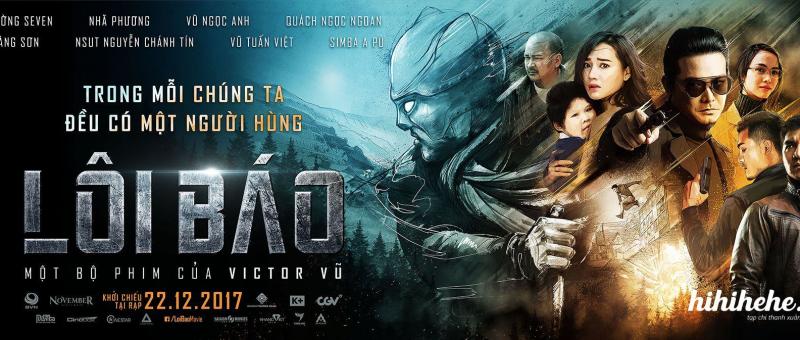
Lôi Báo posterThe world can be a strange place. Tam (Cuòng Seven) felt safe in his small town surrounded by his wife and son who were determined to support his artistic dream despite its long genesis, but a dark shadow is about to be cast over his otherwise pleasant existence that will threaten to destroy everything he has built. Victor Vu’s Lôi Báo is perhaps Vietnam’s first superhero movie but it’s also a familiar tale of a conflicted man entering middle-age learning to reaccept his responsibilities, both to his wife and son and to his society as he attempts to balance his desire to help others with that of protecting his family. With great power comes great responsibility as the saying goes and Tam is a responsible guy but the past is calling him and he’ll need to face it head on if he’s to put his fracturing family back together.

Six years after his critically acclaimed graphic novel Descendents of the Crossbow, comic book artist Tam has just come out of a period of writer’s block and is working on a new project – an American-style Superhero book about a pure hearted warrior for justice with intense fighting skills and extreme athletic ability. Not many people are convinced by Tam’s desire to create a Vietnamese superhero, but his family support him and that’s all that matters. In fact, they literally support him because his wife Linh’s (Tran Thi Nha Phuong) coffeeshop is the family’s sole source of income. Tam has a tendency to get lost in his work, which is one reason he’s been putting off seeing the doctor about a serious cough that just won’t go away. When he finally decides to get it checked out it’s already too late – he has terminal lung cancer and only a few months left to live. It’s at this point that his life starts to take a strange, unexpected turn. Uncle Ma (Huàng Son), an older man Tam thought was a farmer, is actually a secret mad scientist who has a hidden laboratory in his garden where he continues to research human head transplants. The obvious conclusion presents itself – Tam decides to undergo experimental surgery to abandon his cancer ridden body and move into a nice new model.

Lôi Báo is the latest in the long line of movies indulging in the thoroughly B-movie science of “Cellular Memory”. Illegal head transplantation is already somewhat unethical, but Tam and Ma acquired their donor body through less than ethical means by grabbing a guy who was mysteriously gunned down in a forest where Tam had just tried to commit suicide out of total despair. Of course, the dead “gangster” came with his own share of baggage which leaves Tam feeling much more impulsive had than he had done before and though he seems to have lost the ability to draw, Tam is thrilled that his new body seems to be a much stronger, faster model than his old one. Not quite able to leap tall buildings in a single bound, Tam can now scale them with little difficulty and lift heavy vehicles all alone. Now he no longer needs to draw superhero stories, he can be a hero for real fulfilling his lifelong dream of being able to save lives and protect the vulnerable from evil.

Only, his new body is not quite so altruistic as he once was, and Tam begins to get off on the fame his newfound heroism is bringing him even while it puts his family danger should anyone find out about all the illegal head transplantation action that’s been going down at uncle Ma’s. He also finds himself strangely drawn to a pretty young doctor who might have been something to the dead gangster, further distancing him from Linh and his son Bu. As expected, there was a little more to the gunfight in the woods than a gangster squabble and Tam will have to learn to put body and soul back together while also dealing with the ghosts of his past and a latent discomfort with the idea of being a husband and father which betrays a lack of faith in the idea of “family” itself.

With plenty of high octane action scenes, Lôi Báo more than does its home genre justice, creating a notably mature origin story for a new kind of superhero who accepts that perhaps he’s not the hero in this story after all. Justice is served, the family repaired, the past laid to rest and there might even be a new book in it too. It has been a busy a few months for Tam, but at least he’s learnt the true meaning of heroism – something which will place him in good stead during his eagerly awaited further adventures!


Lôi Báo was screened as part of Fantasia International Film Festival 2018.

Original trailer (English subtitles)

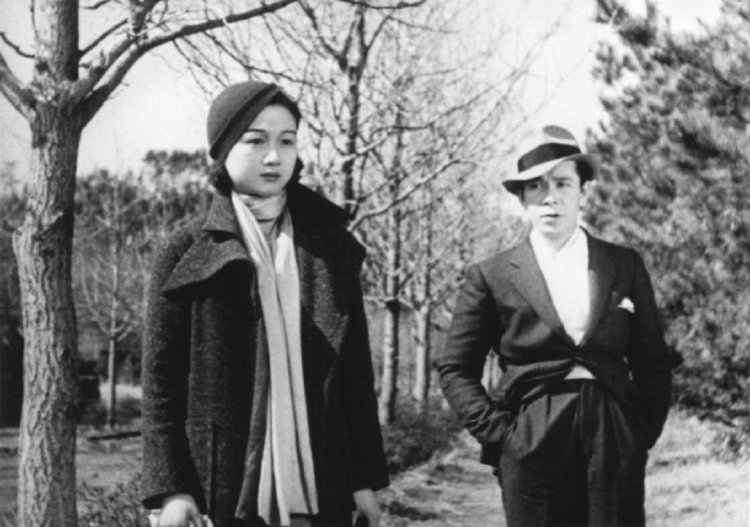
A Hero of Tokyo (東京の英雄, Hiroshi Shimizu, 1935)

Hero of Tokyo still 1Hiroshi Shimizu’s ‘30s films, made against the backdrop of the increasingly censorious militarist regime, had an ambivalent attitude to Japan’s wider foreign policy, its economic impact, and prospects for the future. His final silent film, A Hero of Tokyo (東京の英雄, Tokyo no Eiyu), the title of which is perhaps either deceptive or mildly ironic, is among the bleakest of Shimizu’s depictions of a changing society he perhaps saw as increasingly corrupted by greed and inhumanity. A hahamono of sorts, Hero is not as crushing as Forget Love For Now, but ends on a note of frustrated ambiguity in which wrongdoing has been exposed and justice served but at a terrible cost, leaving the institution of the family itself and therefore the entire social order lying in pieces and broken beyond repair.

The film begins among Shimizu’s familiar milieu of small boys as they watch the trains that will eventually bring their fathers home to them coming and going. Some of the boys stay to play but eventually only one is left behind – Kanichi (Tomio Aoki), whose widowed father constantly works late and leaves him alone in the care of their maid. Kanichi’s father, Nemoto (Yukichi Iwata), is engaged in a local mining concern and, berated by the maid who reminds him that his son is often lonely, decides to marry again to bring order to his house. After placing an ad which states he is a widowed CEO with a good salary, Nemoto marries Haruko (Mitsuko Yoshikawa) – a widow with two children of her own, Hideo (Jun Yokoyama) and Kayoko (Mitsuko Ichimura). A short time later it is discovered that Nemoto’s business is a scam and he flees town leaving his family to face the music alone. Haruko, committed to raising all three children equally, must now find a way to support herself but as a woman with young children and few qualifications there are few jobs available to her. Soon she falls into bar work which may not be “respectable” but allows her to support her family.

10 years later, Haruko owns a fine suburban house and the children appear to be leading a fine middle-class life. Trouble begins when Kayoko (Michiko Kuwano) marries a nice middle-class young man only to be “sent back” soon after the wedding when his family find out about Haruko’s “shameful” past. Though Haruko had told the children that she worked “in a club where executives come to relax” when they were small, Kayoko is shocked and appalled to discover her mother is tainted with the stigma of the sex trade and even more so when her mother’s past threatens to destroy her future. Haruko begs her not to tell her brothers, but Hideo (Koji Mitsui) finds out from his girlfriend, who also dumps him on hearing the rumours, and goes off the rails. Only Kanichi (Mitsugu Fujii), the step-son, stands by the mother he regards as the “best in Japan”, feeling both profound gratitude and sorrowful empathy for the sacrifice she has made on his behalf.

At heart a hahamono, A Hero of Tokyo fits neatly into Shimizu’s career long interest in female oppression in casting Haruko’s trials as entirely caused by being badly let down by a patriarchal society. Having lost one husband and being betrayed by the second, Haruko is forced to stand alone in a society which refuses to forgive her for it. As a “married” woman, she can gain no “honest” work and the necessity to care for her children means that she cannot take a role in service which in effect means dedicating oneself to a family which is not one’s own. She lacks qualifications or connections and has no family to support her and so she is forced into the only remaining line of work available to women in her situation. Haruko makes a great success of herself and becomes an upright businesswoman running her own establishment even if she cannot be exactly proud of the achievement which does (to her own shame and regret) rely on the degradation of other women just like her, though she tries to do the best for them that she can.

Yet her children, as all ungrateful children of a hahamono, are unable to forgive her for the transgressions she was forced to make entirely for their benefit. Having cast their mother as a saint of elegance and decorum, they cannot accept this new information which renders her a mere woman at the mercy of a cruel society. Kayoko, having run away from home, ironically finds herself in the same, or perhaps a worse, position, becoming a streetwalker – by her own admission “famous” and an accidental subject for one of Kanichi’s episodes of investigative reporting as a rookie newspaper man. Meanwhile Hideo has crossed to the other side and joined the ranks of exploiters of women in joining a gang only to get himself into trouble for trying to leave it when he realises he has become a hired goon for one of Nemoto’s stooge companies. The children are “ruined” not by their mother’s “sin” but by the conservative society that forced her into it and by the paternal failures of Nemoto whose abandonment reduced them to dire desperation.

It is, in this sense, Haruko rather than Kanichi who is the “hero” of the title – valiantly battling against the prejudices and cruelties of the city whilst retaining her innate sense of honour decency and steadfastly shielding her children from suffering. Her attempt to protect them perhaps backfires, leaving them without the necessary perspective and humanitarian spirit to feel empathy for others rather than succumbing to the judgemental attitudes of the age. Thus both of the biological children are condemned to suffer in the very way Haruko suffered to prevent and then find themselves too ashamed to return to her. Only Kanichi who had already suffered in his childhood loneliness, in his shame for the transgression of his father, and his position as a step-son doubting his place in a family which was not his by blood, is able to accept and sympathise with his mother’s suffering and experiences only guilt and gratitude that she had chosen to sacrifice herself for his greater happiness.

Yet Kanichi’s role as the good son is also tainted by his filial opposition to his father as it necessarily conflicts with his desire for social justice as a crusading reporter. Kanichi’s desire to expose corruption is ultimately for the common good – to save innocent people being deceived by his father’s dishonourable scheming, but it’s also an act of revenge aimed squarely at a symbol of broken patriarchal responsibilities. In the various names Shimizu attaches to Nemoto’s sham businesses, he aligns him with the expansionist Japanese state which was currently attempting a similarly dishonourable attempt to sell the economic gains of its imperialist project built on the back of international exploitation and dishonesty. It is not just a father who has failed his family, but “the” father which is failing its people in leading them down a dark and disturbing alleyway in which honour and morality no longer have any currency.

Kanichi too profits from his father’s crime – his first bonus is a direct result of the exposé of his father’s company and so he also becomes part of a system of corruption. His actions, however, are not entirely accepted by Haruko who is ashamed and troubled by Kanichi’s crime against filial piety and therefore by his betrayal of the social codes which define his society. Kanichi has picked a side, but in doing so he has also damned himself and emerges not victorious but compromised. Despite the “happy” ending, in which justice has been done and the emotional bonds of the true family restored, the concluding scenes remain ominous as the newspaper boy delivers the sorry news all over town and ruptures the tranquil middle-class peace of Haruko’s once happy suburban home.