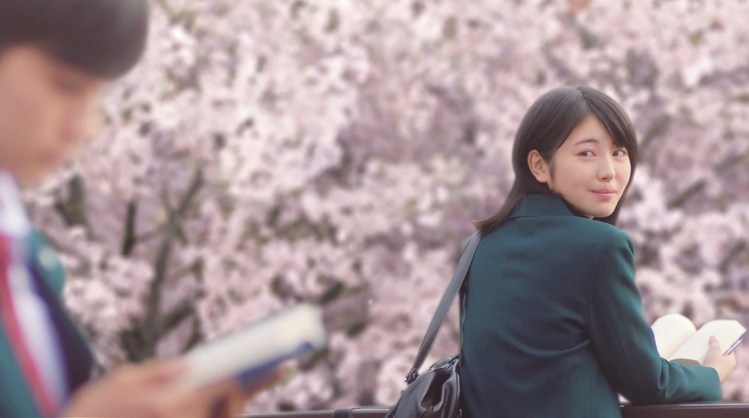
The Neighbor’s Wife and Mine (マダムと女房, Heinosuke Gosho, 1931)

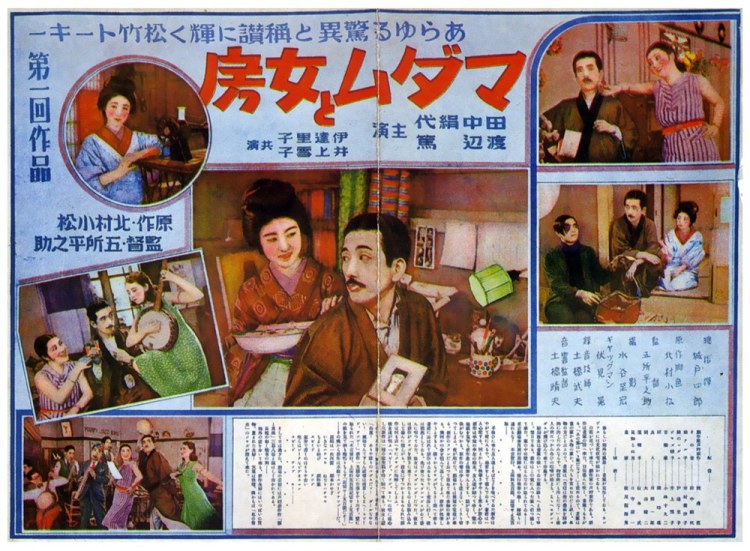
Neighbor's wife and mine flyerThere’s an especial irony in the fact that Japan’s first talkie is essentially all about how annoying sound can be. Directed by Heinosuke Gosho, pioneer of the shomingeki and a longstanding devotee of melancholy comedy, The Neighbor’s Wife and Mine (マダムと女房, Madame to Nyobo) is another in a long line of contemporary farces set in an idealised middle-class world but as much as Gosho goes out of his way to include as much soundplay as humanly possible he never lets the gimmick get the better of him.

Gosho opens with a brief prologue sequence otherwise detached from the main narrative in which down on his luck playwright Shibano (Atsushi Watanabe) gets into an argument with a precious artist busily painting a canvas of the house opposite him and gleefully admiring his own work. The painter likes this spot because of its silent serenity – an atmosphere quickly broken when Shibano struts up, whistling loudly, humming, making conversation. Unfortunately Shibano doesn’t rate the painter’s work and is also non-plussed that he doesn’t know who Shibano, apparently a “famous” playwright, is and doesn’t seem to respect writers as fellow artists anyway. A fight breaks out and all because of some unwanted noise pollution. Eventually the two men end up friends again after bonding in their mutual appreciation of the charms of “madame” (Satoko Date) the woman who lives in the house next to the one Shibano has just decided to rent on a whim with the intention of getting some “peace and quiet” in the countryside to finish his overdue manuscript.

The country is, as it turns out, not as quiet as you’d think. No sooner has Shibano moved in than he’s assailed by noise – mostly from within his own household as he’s a father of two, a little girl of perhaps four or five, and a bawling infant son. He doesn’t help matters by winding up his exhausted wife Kinuyo (Kinuyo Tanaka) by loudly impersonating a distressed cat during the middle of the night but a bigger problem is about to present itself in the form of the Mammy Jazz Band who, led by the woman Shibano was so smitten with after bumping into her during his altercation with the painter, use the house next-door as their rehearsal studio.

The house of Shibano is, apparently, a fairly happy one though long suffering wife and mother Kinuyo has reason enough for exasperation as her husband wastes his time drinking and playing mahjong while the deadline for the manuscript he’s supposed to be writing draws ever closer. In charge of the household finances, Kinuyo is keenly aware the family are low on funds – something presumably not helped by Shibano’s impulsive decision to rent a cottage in the country. He’s left himself a dozen inspirational notes reminding himself that manuscripts don’t write themselves, but still Shibano can’t buckle down. Having come to the country to escape the noise of city life, he finds himself assaulted by a silence differential in dealing first with his noisy children and responsibilities as a father, and then the constant intrusion of unexpected sounds which, in the city, might hardly be noticed against the constant background hum.

Trying everything from plugging his ears to tying a scarf around his head and finally jumping inside a cardboard box, Shibano decides to enlist Kinuyo to tell next-door to keep it down but she, an elegant Japanese wife, would hardly dare to disturb the “peace”. She tells her lazy husband to sort it out himself only to regret her decision when she spots him laughing away with the sophisticated modern woman next-door, drinking in the party atmosphere of her Bohemian home and enjoying a private concert as the “noisy” jazz band rehearse their latest numbers.

Despite his occupation which might imply a little Bohemianism in itself, Shibano is a traditionally minded sort. He may have turned up in swanky hat and pinstripe suit carrying a cane, but in his new home he dresses exclusively in kimono, as does his dutiful wife, who can only trail behind her husband in exasperation offering the occasional barbed comment as her only form of mild resistance. His household demands quietude, but cannot attain it. He is, therefore, naturally led away to the woman next door like a time traveller suddenly given a glimpse of the new and exciting future. The musical repertoire of the Mammy Jazz Band is all about “speed”, they move fast and with no thought to the disturbance they trail through the air around them. They are going somewhere, in contrast to Shibano who has been in a state of inertia for quite sometime.

It is, however, a little sad that it’s “madame” that finally speeds on Shibano rather than his wife and children even if there is nothing improper in their relationship – Madame is not particularly interested in Shibano in anything other than a neighbourly fashion, her people pleasing friendliness and genuine kindness perhaps running in contrast to the conventional depiction of a “modern” woman as Kinuyo later points out in jealousy when she remarks that women like that are all “100% sex delinquents”.

The film’s Japanese title is certainly drawing a contrast between the modern “madame” and the traditionally minded “nyobo” though it comes down on neither side, allowing room for both sorts of women in this rapidly changing society. Shibano maybe a lazy, easily distracted sort of man but he’s knows what’s good for him and when all’s said and done his relationship with his wife is as solid as they come despite their frequent financial woes, childcare spats, and momentary pangs of jealousy or anguish. The family, repaired and in motion once again, finally get their day in the sun enjoying a rare moment of blissful happiness as they break into a chorus of “My Blue Heaven”, positively rupturing the silence with their own joyful voices as they join the “noisy” cavalcade heading towards the exciting “speed era” waiting for them in the future.



Distant Thunder (遠雷, Kichitaro Negishi, 1981)

distant thunder dvd coverBy 1981 Japan’s economic recovery was more or less complete and the consumerist future had all but arrived. Based on the novel by Wahei Tatematsu, Distant Thunder (遠雷, Enrai) is the story of impending doom staved off by those clinging fast to the their ancestral traditions even whilst the modern world threatens to engulf them. Kichitaro Negishi already had a long career directing Nikkatsu’s Roman Porno, but made his mainstream debut with this quietly affecting social drama for Art Theatre Guild which relies on the strong performances of its cast to convey the subtitles of youth caught between past and future.

In the contemporary world of 1981, 23-year-old Mitsuo (Toshiyuki Nagashima) is a tomato farmer stubbornly hanging on to his family’s ancestral land which happens to be inconveniently placed in the middle of a modern housing complex. Women from the estate sometimes pop round to ogle Mitsuo under the pretext of buying super fresh tomatoes. Mitsuo is happy for them to enjoy the fruits of his labour, but refuses to accept them as “neighbours” lamenting the death of the village in which he grew up.

It transpires that Mitsuo’s father (Casey Takamine) sold off most of the farmland without consulting the rest of the family and used the proceeds to open a bar with the hostess he ran off with. Mitsuo hasn’t forgiven him for this and continues to work the tomatoes alone while his older brother is married and living a modern salaryman life in the city. At 23 it’s high time Mituso got himself a wife, but a flirtation with a barmaid, Kaede (Rie Yokoyama), who claims to be a divorced single parent proves diverting enough for the time being. Mitsuo knows being a farmer’s wife is no prize, so when his mother comes up with a possible match Mitsuo thinks it’s worth a try even if she’s probably none too pretty.

An old soul in many ways, Mitsuo wants to hang on to his family’s farm despite the constant offers he gets from salesmen at the door who want him to sell. Where once there was a village, now there are high rise apartment blocks. Mitsuo misses the world he grew up in where farmers helped each other out in difficult times and wandered in and out of each other’s houses like one big happy family. Not content with ruining his own, it’s also this wider concept of community as family that Mitsuo’s father has ruined for him in rejecting his traditional responsibilities for the irresponsible pleasures of taking up with a fancy woman and starting again as a bar owner.

Sadly, the bar hostess really does seem to love Mitsuo’s feckless father, perhaps seeing him as her last chance for happiness. Kaede, by contrast, is looking for something far less permanent. She claims to be divorced but is married to a mild-mannered man (Keizo Kanie) with a tattoo poking out of his collar who accepts her need for new conquests but would rather they not become regular arrangements. Kaede whips up more potential destruction when she comes between Mitsuo and his childhood best friend, Koji (Johnny Okura), who also likes her and has been led to believe Kaede’s relationship with Mitsuo was not altogether consensual. Meanwhile, Mitsuo’s blind date went far better than expected and it looks like he’s on course to find a wife in petrol station assistant Ayako (Eri Ishida).

Ayako, like Mitsuo, is a more old fashioned sort though she’s no prude and is of an earthier yet somehow “purer” nature than the comparatively urban Kaede. Mitsuo finds himself pulled in different directions – Ayako and the tomato farm, or the freely given pleasures of Kaede who threatens to burn everything to the ground with her mysterious, self destructive lifestyle. Mitsuo doesn’t want to be like his dad – a philanderer who runs out on his responsibilities and makes a fool of himself in the process, cosying up to local politicians and playing fast and loose with the law, but he’s late to see the danger a woman like Kaede might cause him. His friend, Koji, is not quite so perceptive and naively falls for her charms. Mitsuo knows deep down that his friend has in a sense saved him from making a ruinous life decision and helped him rediscover the happiness of his traditional, simple way of life.

Filming in 4:3, Negishi’s camera is soft and unobtrusive yet pointed, capturing the minor details of the everyday with a poetic beauty. Filled with realistic detail and anchored by strong performances, Distant Thunder is both a picture of innocents battling the inevitable death of their way of life with determination and purity, and a document of changing times in which the confusions of the modern world threaten to destroy those who cannot reconcile themselves to their fated paths.


Short clip from the ending (English subtitles)

Operation Red Sea (红海行动, Dante Lam, 2018)

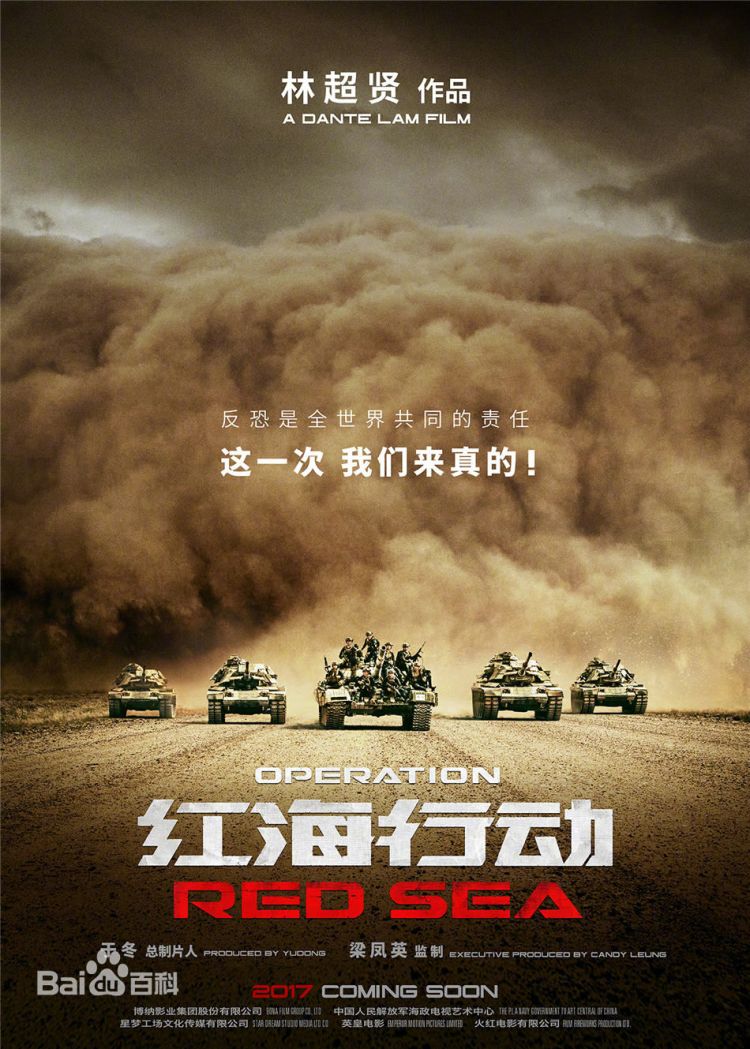
Operation Red Sea posterDante Lam, a Hong Kong action icon, is one of many to have begun looking North, tempted by the bigger budgets and audience potential of the Mainland. Following 2016’s Operation Mekong, Lam is back on manoeuvres with a second in what may develop into a series, Operation Red Sea (红海行动, Hónghǎi Xíngdòng). Red Sea is not connected to Mekong in terms of narrative and only features a cameo by the earlier film’s star, Zhang Hanyu, who remains firmly ensconced on the bridge of the all powerful Chinese warship while an elite troop of special forces handles the rapidly deteriorating situation on the ground, but it is once again “inspired” by a true story and perfectly positioned to show the Chinese security services in a more than favourable light.

The action begins in 2015 when the Chinese navy wades in to defend a merchant ship attacked by Somali pirates, managing to apprehend the “bad guys” with a minimum of bloodshed before they escape Chinese waters. Having suffered a casualty, the squad are then dispatched to rescue Chinese citizens caught up in an Middle Eastern coup. Their mission is helped and hindered by intrepid Chinese-French journalist, Xia Nan (Hai Qing), who has discovered evidence that a dodgy “businessman” caught up in the attack is in possession of a consignment of “yellowcake” along with a deadly dirty bomb formula which he plans to sell on to the terrorists currently waging war on the city.

Though Operation Red Sea is, perhaps, no more jingoistic than any British or American war film, its focus is more definitively centred on home concerns than an attempt to police the world. The Chinese military exists to defend Chinese citizens, even if those citizens are increasingly scattered throughout an unstable world. This presents a point of conflict between idealistic, and occasionally reckless, journalist Xia Nan whose mission is to stop the terrorists and rescue her friends, and the soldiers whose primary mission is to evacuate Chinese citizens though they hope to be able to provide assistance to citizens of other nations too if their mission parameters allow.

The Jiaolong, elite Chinese special forces, are indeed an impressive fighting force who proceed with military precision but are not without compassion. Informed by a local soldier that the terrorists often force civilians to become suicide bombers, the team’s bomb disposal officer puts himself at great risk to defuse a device and free a man destined to become a car bomb, rather than simply neutralising the threat. Protecting Chinese in peril is the official goal, but on a human level the soldiers are overcome with sorrow and anger for the local population, lamenting that they may have saved some lives but many have lost their homes and they will simply leave them behind to deal with the situation alone when they succeed in their mission of evacuating stranded Chinese diplomatic personnel.

Despite the overtly propagandistic elements which paint the Chinese military as a force for good, fighting bravely for their countrymen overseas, the landscape of war Lam paints is a hellish one full of blood, guts, and scattered body parts. Much of the film plays as a two hour recruiting video for the Chinese navy – it’s almost a surprise there aren’t people waiting with clipboards outside the theatre, but it’s difficult to believe anyone would be in a big hurry to sign up after witnessing the pure human carnage of a foreign battlefield and the very real threats the soldiers subject themselves to all while stoically pursuing their mission, committed to the protection of their nation and people.

Nevertheless Lam’s spectacle is impressive and action choreography unsurpassed. Working on a huge scale with everything from snipers to tank battles, Lam keeps the tension high as the team attempt to adapt to a situation which is rapidly deteriorating leaving them all but stranded behind enemy lines where each and every one of them faces a very real threat of death or serious injury. Despite an overuse of CGI slow motion bullet vision, Operation Red Sea largely earns its bombast with relentless fury, leaving its propaganda aims to dangle the background until the final coda which seeks to remind us that China rules the waves and will protect its citizens and territory wherever they may be.


Currently on limited release in UK cinemas courtesy of China Lion.

Original trailer (English subtitles)

Fullmetal Alchemist (鋼の錬金術師, Fumihiko Sori, 2017)

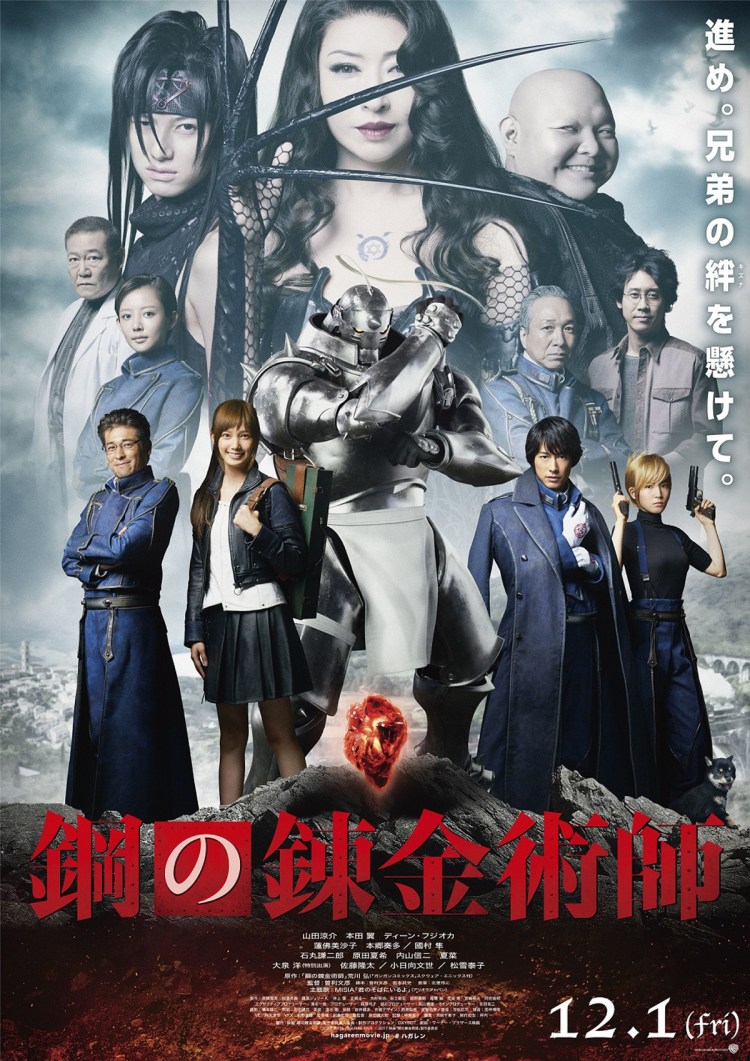
Fullmetal Alchemist posterEvery so often a film comes along which makes you question everything you thought you knew. Fullmetal Alchemist (鋼の錬金術師, Hagane no Renkinjutsushi) is just such as film but less for the philosophical questions fans of the source manga may have been expecting, than for the frankly incomprehensible fact that it exists at all. Produced not by a major studio but by Square Enix – best known as a video game studio but also the publisher of manga magazine Monthly Shonen Gangan in which the series was originally serialised, and effects studio Oxybot Inc., Fullmetal Alchemist is not the big budget extravaganza a franchise of this size might be expected to generate but a cut price blockbuster attempting to pack a much loved, long running saga into just over two hours.

For the uninitiated, the movie begins with the little Elric Brothers – Ed and Al, who live in the countryside with their doting mother while their father is away. When their mother is struck down by a sudden illness and dies, the boys raid their dad’s Alchemy library for clues as to how to bring her back. There is, however, a taboo surrounding human transmutation and when the brothers cast their spell they pay a heavy price – Al loses his entire body though Ed manages to save his soul and bind it to a suit of armour by sacrificing his own right arm.

Many years later, Ed (Ryosuke Yamada) and Al (Atomu Mizuishi) are still looking for the mythical “Philosopher’s Stone” which they believe will allow them to cast another spell and get their fleshy bodies fully restored. This takes them to a small town where they encounter a dodgy priest and their old commander, Captain Roy Mustang (Dean Fujioka), who wants to bring them back into the State Alchemist fold. The priest’s stone turns out to be a fake though his connections to the film’s shady antagonists are all too real, and the brothers are soon faced with another dilemma in their quest to restore all they’ve lost.

Sori shifts away from the frozen Northern European atmosphere of the manga for something sunnier and less austere, shooting in Italy’s Volterra with its narrow medieval streets and iconic Tuscan red roofs. He is, however, working on a budget and it shows as his cast are costumed at cosplay level with awkward blond wigs attempting to recreate the manga’s European aesthetics. Al, rendered entirely (and expensively) in CGI, is deliberately kept off screen while the quality of the effects often leaves much to be desired.

Al’s frequent absence is a major problem seeing as the series’ major theme is brotherhood and Ed’s tremendous sense of guilt over his brother’s condition coupled with his recklessness in his need to put things right is only explained in a piece of bald exposition following a fight between the pair after Al’s mind has been corrupted by a mad scientist who implied that he may not really be “real” after all. While Al’s false memory paranoia may be among the more interesting issues the film attempts to raise, it’s quickly pushed into the background, eclipsed by the ongoing conspiracy narrative which places the Elric Brothers in a difficult position regarding their need to get their body parts back. 

A symptom of the attempt to condense such a much loved and well known manga into a two hour movie, there is rather a lot of plot going on and numerous side characters on hand to enact it. Though fans of the original manga may be pleased to see their favourite characters have made it into the movie, they maybe less pleased about how one note they often are or the various ways their personalities have needed to shift in order to fit into the new narrative arcs the film employs. Aside from the young and pretty cast, Fullmetal Alchemist also finds room for a host of veteran talent from the ubiquitous Jun Kunimura in a small role to Yo Oizumi turning villainous and Fumiyo Kohinata at his most Machiavellian.

Extremely silly, poorly put together and burdened with some very unfortunate wigs, the Fullmetal Alchemist live action adaptation is as much of a misfire as it’s possible to be but viewers hoping for a continuation to the tale would do well to stay tuned for a post-credits sting strongly hinting at a part two.


Streaming worldwide on Netflix.

Original trailer (English subtitles)

Night Journey (야행 / 夜行, Kim Soo-yong, 1977)

Night Journey posterIncreasing economic prosperity dangles tantalising rewards for the young and ambitious, but for women trapped by outdated social codes the pleasures of success are largely off limits. Director Kim Soo-yong was well known for literary adaptations and Night Journey (야행 / 夜行, Yahaeng) is, like Mist, inspired by a Kim Seung-ok novel but Kim makes a point of shifting the focus, telling the story not just of a jaded bank clerk but also of the effects of living under an authoritarian regime which demands (superficial) conformity, insists on productivity, and slowly destroys the souls of all those caught in its perilous march forwards into the corporate future.

Lee Hyeon-ju (Yoon Jeong-hee) is a woman of a certain age, unmarried, and working as a teller in a bank in Seoul. One of two “old maids” in the office, Hyeon-ju is shocked to find out that her fellow bachelorette from the adjacent desk is about to marry Mr. Choi – the couple had kept their relationship a secret but now that the engagement is public, Miss Oh will be quitting her job the day before the wedding. Alongside the joy such news surely brings, everyone seems to be making a point of being “sensitive” around Hyeon-ju, worried she will be hurt or embarrassed to learn of another woman getting married while she remains single and alone. Hyeon-ju seems more annoyed by the attempts at sympathy than anything else, but accepts her boss’ offer of a few days vacation even if she seems aware it’s mostly to get her out of the way and avoid any potential awkwardness.

Awkwardness is not something that’s going to go away though because Hyeon-ju is leading a double life in which she is actually living with bank clerk Mr. Park (Shin Seong-il) who manages the desk behind her but doesn’t want anyone at work to know about their relationship. Hyeon-ju goes home early to make dinner, but Park plays the after work drinking game, rolling in drunk and collecting the sleeping Hyeon-ju off the couch to deposit on the bed where he climbs on top of her and sates himself before rolling over in a drunken snooze. The relationship between the pair is, effectively, that of a bored middle-aged couple only they do not have the security of a marriage certificate and live in constant uncertainty.

When Hyeon-ju returns home from her brief trip back to the town where she grew up, Park does not say that he missed her, just that things have been very “inconvenient” with her away. “Convenient” is something Hyeon-ju worries defines Park’s feelings towards her, that he regards her as a part of the furniture, as something merely to serve his own desires. A rare evening at home together finds them enjoying a boxing match on TV which later leads to an amorous moment on the floor but just as he did before, Park gives up half way through to go back to the boxing, almost forgetting Hyeon-ju is even there. The other marriage at work prompts Hyeon-ju to wonder if it isn’t time they too made things official, but Park lazily brushes the question off, claiming to find marriage and all that sort of thing very boring. Spying on her partner at work, Hyeon-ju perhaps worries he plans to dump her for a match more advantageous to his career while she remains trapped in her dead-end bank teller job with a marriage her only realistic path to a successful middle age.

Hyeon-ju craves satisfaction – some real connection with Park that makes her feel alive, needed, wanted, and seen as a distinct individual. Returning to her hometown she reverts to her teenage self – putting on her high school uniform and taking her little sister down to the beach to ride her bike just as she had done. It is however not all happy memories – Hyeon-ju was drummed out of town as a hussy, the entire community know and remember her sordid past and if she were to consider an arranged marriage back home she could not expect to marry very well. Nevertheless, a now widowed son of a wealthy family takes an interest but Hyeon-ju is disappointed to realise that despite his bad boy exterior and fancy motorbike, her suitor is a small-town boy after all with a bashful attitude to love and sex which stands in contrast to Heyon-ju’s own passionate, seemingly free nature.

Freedom, however, is something she seems to have little of. We catch her catching sight of a man being handcuffed as she stands atop a busy bridge and we assume she recognises it as a echo of her own oppression but in actuality she fetishes the act of being manacled, almost compelled to place herself in a position of relative powerlessness. Later, on the same bridge, she’s dragged off by a rough man who apparently takes her to a nearby hotel and assaults her while her attempts to resist read more like playing along. Later she goes back to the same bridge, perhaps hoping to see the man again, violent acts of passion seemingly the only ones that wake her from her restlessness.

Fed up with Park, she roams the city streets alone – something respectable women rarely do as she proves when an attempt to enjoy a solo drink arouses the interest of an entire room filled with drunk salarymen in which she is the only female. Drunk men in the street attempt to pick her up and again she seems to enjoy deflecting them, often with little more than a glare though she is mildly surprised when one of them turns out to be the recently married Choi who reveals to her that he is disappointed with married life after discovering Miss Oh was not a virgin during their honeymoon.

The separation of the sexes seems to dictate that men spend the majority of their lives in the deliberately homosocial world of work with its frequent after-hours drinking sessions, while women (excluded) are left with little to occupy their time outside of becoming wives and mothers. Hyeon-ju seems to want something more, but her nighttime catwalk affords her only the mild sensation of pleasure in attracting attention solely so she can exercise the power to reject it.

Yet her attitude to men and sex is perhaps also due to having experienced betrayal and manipulation at a young age. The reason for her expulsion from her hometown was an illicit affair with her middle-aged teacher whose deflowering of her on that same beach on which she rode her bike seems to have occurred with a degree of violence which she continues to crave in all her subsequent couplings. The teacher, with whom she seems to have shared some kind of wedding ritual, was killed in Vietnam, ruining both her reputation and her future prospects through a relationship that was certainly unethical but she alone has payed the price for. He lies in the military cemetery opposite her apartment where she makes awkward, flirtatious eye contact with the soldier on guard each time she walks past.

Hyeon-ju’s hometown ruminations and odyssey through nighttime Seoul only serve to ram home to her how impotent she has been in her dull yet ordinary city life. Seoul may seem like a bustling metropolis of burgeoning modernity but it’s still full of the same tired old ideas where men are men and women are not much of anything. She fantasises about going on a crime spree with a rough looking guy from a cafe but ends up paying for his coffee before becoming the only grownup in an arcade among a group of kids in an attempt to dissolve some of her frustration. Eventually getting what she thought it was she wanted, Hyeon-ju has come too far not realise she doesn’t want it anymore. Literally railroaded into conventionality, she makes the staggering decision to just get off the train altogether, leaving her lover only the cryptic message that the holiday is now over.


Available on DVD as part of the Korean Film Archive’s Kim Soo-yong box set. Also available to stream for free via the Korean Film Archive’s YouTube Channel.

The Third Murder Sweeps 41st Japan Academy Prize

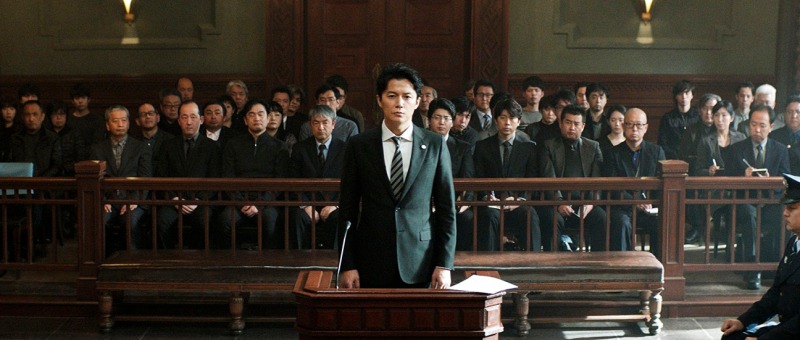
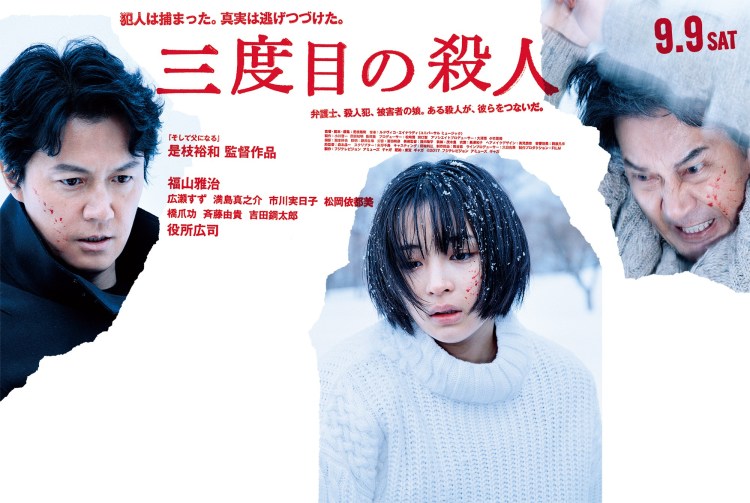
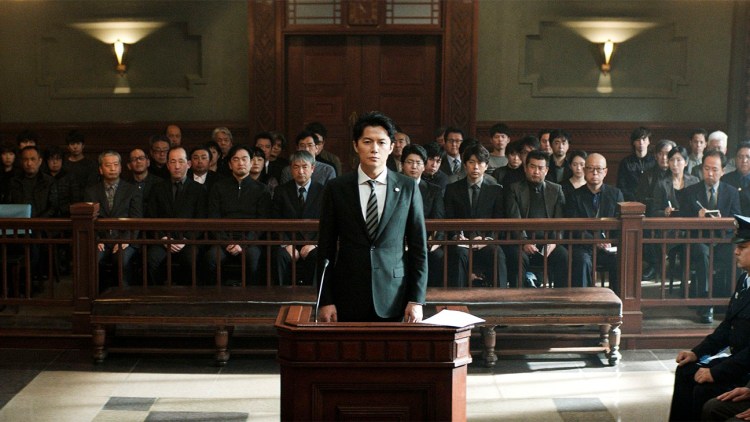
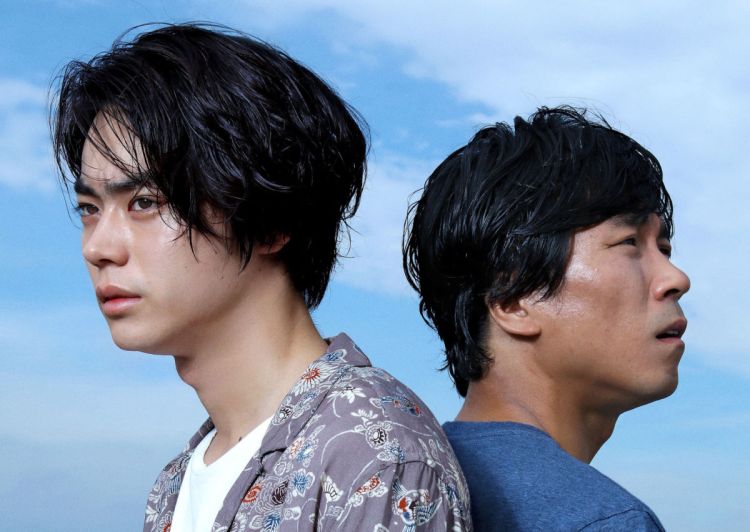
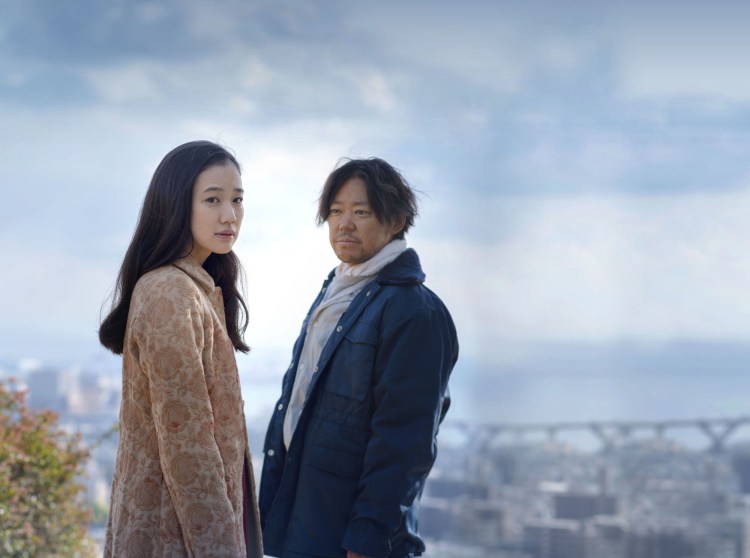
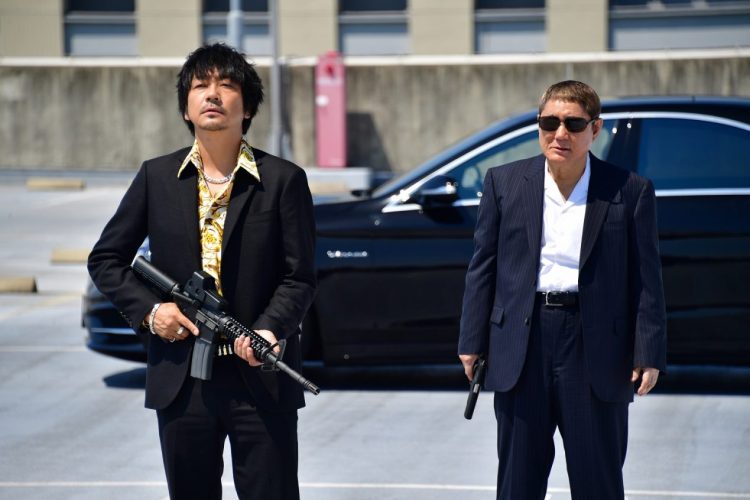
The Third Murder still 2The 41st Japan Academy Prize was presented at Grand Prince Hotel New Takanawa on 2nd March 2018. Hirokazu Koreeda’s latest, his first foray into the murder mystery, swept the board with six awards including the big ticket items of best picture, director, supporting actor and supporting actress. Despite numerous nominations popular hit Let Me Eat Your Pancreas went away with only the previously announced newcomer awards while period epic Sekigahara had some success in technical categories.

Winners and nominees in full:

Picture of the Year

third murder horizontal poster

Animation of the Year

The night is short still

Director of the Year

The third murder still 1

Best Screenplay

third murder still 3

Outstanding Performance by an Actor in a Leading Role

wilderness still 2

Outstanding Performance by an Actress in a Leading Role

birds without names still 2

Outstanding Performance by an Actor in a Supporting Role

third murder still 4

Outstanding Performance by an Actress in a Supporting Role

third murder still siz

Outstanding Achievement in Music

outrage coda still

Outstanding Achievement in Cinematography

Sekigahara still 1

Outstanding Achievement in Lighting Direction

Sekigahara still 2

Outstanding Achievement in Art Direction

flower and sword poster horizontal

Outstanding Achievement in Sound Recording

Sekigahara still 3

  • Satoshi Ozaki (Flower and Sword)
  • Kazumi Kishida (What a Wonderful Family! 2)
  • Yoshifumi Kureishi (Outrage Coda)
  • Kazuhiko Toyama (The Third Murder)
  • Masahito Yano (Sekigahara)

Outstanding Achievement in Film Editing

Third murder still 5

  • Hirohide Abe (Flower and Sword)
  • Iwao Ishii (What a Wonderful Family! 2)
  • Takeshi Kitano & Yoshinori Ohta (Outrage Coda)
  • Hirokazu Koreeda (The Third Murder)
  • Eugene Harada (Sekigahara)

Newcomer of the Year 

let me eat your pancreas still 1

(awarded to all four nominees equally – announced along with nominations)

Special Award of Honour from the Association

(Lifetime achievement awards – technical fields)

  • Etsuko Egawa (makeup & prosthetics)
  • Katsutoshi Osawa (art direction)
  • Midori Onuma (hair & makeup)
  • Hiroshi Koto (costumes)
  • Takefumi Yoshikawa (casting)

Special Award of Honour from the Chairman

(Lifetime achievement awards celebrating contribution to the film industry)

  • Kyoko Kagawa (actress)
  • Takashi Kawamata (cinematographer)
  • Masahiro Shinoda (director)
  • Kenichi Benitani (sound engineer)
  • Toshio Masuda (director)
  • Fujiko Yamamoto (actress)

Special Award from the Chairman 

(Lifetime achievement award presented to members of the film industry who passed away during 2017)

  • Iwao Otani (audio engineer)
  • Hiroki Matsukata (actor)
  • Tsunehiko Watase (actor)
  • Akira Hayasaka (screenwriter)

In Memoriam 

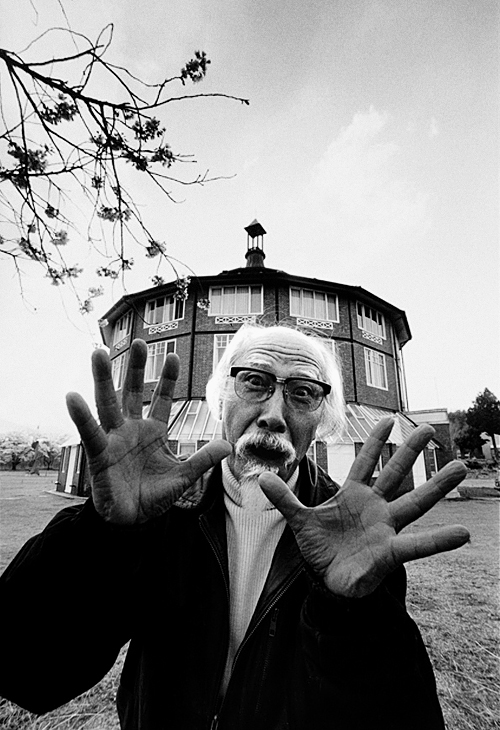
suzukiSeijun Suzuki (director) – As a previous recipient of the Special Award of Honour, Suzuki is ineligible for a second lifetime achievement award but his passing is marked with this special mention.
Popularity Awards

(nominated by an All Night Nippon audience poll)

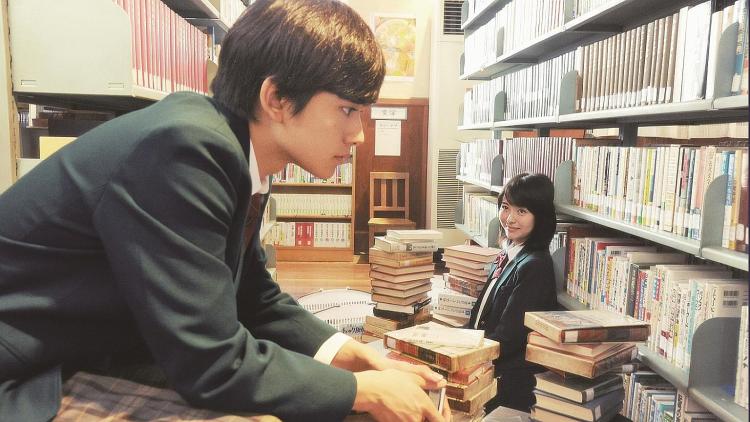
Movie: Let Me Eat Your Pancreas

let me eat your pancreas still 2

Actor: Masaki Suda (Teiichi: Battle of Supreme High)

teiichi still

Source: Japan Academy Prize official website

Mist (안개, Kim Soo-yong, 1967)

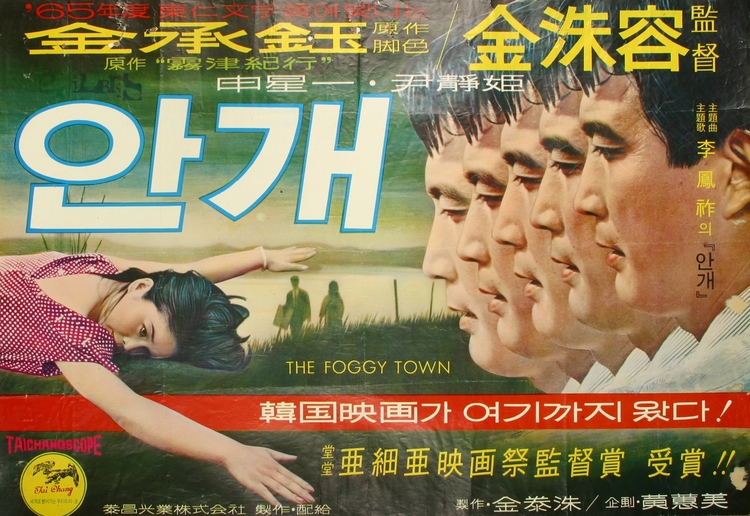
Mist 1967 posterBy 1967 Korea’s fortunes were beginning to expand. For the young, the future held promise but the nature of that promise was still indistinct. Often considered his masterpiece, 1967’s Mist (안개, Angae, AKA The Foggy Town) was another in the series of literary adaptations for which director Kim Soo-yong had become well known but its avant-garde mise-en-scène and gloomy outlook stand in stark contrast to the heartrending melodramas with which the genre was synonymous. Economic prosperity and superficial success have provoked only emptiness and despair, but a return to source provides little clarity for one harried salaryman lost in the expanding landscape of Korea’s global ambitions.

A poor boy from a remote coastal village, Gi-joon (Shin Seong-il) is now a successful salaryman in the capital where the constant clacking of typewriters, ringing of telephones, and racing of traffic rub at his tired mind. The fact of the matter is Gi-joon is not all that successful – he owes his position to having married the widowed daughter of the CEO. His wife and father-in-law, however, have relatively little faith in his business acumen and so, with the annual shareholders meeting on the horizon, they suggest he get out of the way by paying a visit to his hometown. Gi-joon is not all that happy to be going back, he hated Mujin with its unrelenting fog and general air of existential malaise, but he’s spineless and so he goes, despite himself.

Taking the train, Gi-joon has plenty of time to dwell on his past, literally seeing reflections of his younger self and entering extended flashbacks of memory. Mimicking the stream of consciousness approach of the novel, Gi-joon provides frequent voiceover, introducing his hometown in a less than favourable light as a place which traps its young who yearn to be free of its oppressive boredom. According to the irritated dialogue of two passengers on the bus (which Gi-joon has to take after his lengthy train journey), Mujin is a nothing sort of town where the sea is too shallow for fishing and the fields to narrow for farming, yet the population is large and largely survives on desperation alone, isolated by the oppressive fog that envelops the landscape each and every morning.

Gi-joon characterises the residents of Mujin as petty and materialistic. Having longed to escape, he thought he’d achieved his dreams in Seoul but a trip home forces him to reconsider what it is he’s become. In truth he’s no different from the petty and materialistic villagers he looked down on in their need to look down on each other. Powerlessness has defined his life. As a young man, he resorted to hiding in a cupboard to escape the draft on the orders of his terrified mother and later suffered from weak lungs which made him something of a local laughing stock. Now he’s set for a big promotion in the city but, as his wife reminds him, he wouldn’t even be there if it weren’t for her. Gi-joon’s marriage is one of convenience but it’s clear his wife holds all the cards – a wealthy widow with ambition needs a husband to act as a foil, and a weak willed man like Gi-joon is just the sort to submit himself to her authority in return for the obvious benefits she can offer him. Gi-joon has gained everything he ever dreamed of, but he feels only despair, oppressed by the very system he longed to be a part of.

Back in Mujin his various self delusions are rammed home to him. Trapped once again by the unrelenting fog, he longs to escape from his Seoul life and free himself from the yoke of his marriage and career. Whilst in town he meets up with old friends who introduce him to recent arrival Ha In-sook ( Yoon Jeong-hee) – an opera student turned music teacher who has joined the local school. In-sook is by far the most exciting thing in the extremely boring town, but Gi-joon is worried he’s stepped into the middle of something when he realises his old friend, Park, now a teacher, has a crush on In-sook while another old friend, Cho, now a status obsessed tax inspector, may also have marital designs.

Gi-joon didn’t need to worry about the tax inspector – as it turns out, he thinks he can do better than a mere music teacher and plans to marry up, much like Gi-joon has. Gi-joon bristles slightly at this, as he does to Cho’s lewd story about how he trapped In-sook on an overnight trip and planned to have a fling with her but she managed to get away (much to Gi-joon’s relief). Back home Gi-joon sees reflections of himself everywhere and particularly doesn’t like this alignment of himself with the ugly ambition of men like Cho who only want to lord it over their former friends. More flatteringly he sees his younger self in the depressed, conflicted In-sook who is already going half mad in the stultifying rural town and longs to go back to Seoul. Despite mild qualms about his friends’ feelings, Gi-joon finds himself bonding with the melancholy young woman who again forces him to see himself the way he really is rather than as the idealised personality he’d constructed for himself as a successful Seoul salaryman.

Bonding in their existential loneliness, the two eventually embark on a tender if melancholy affair which, despite their protestations to the contrary, is built on self delusions if not exactly on lies. Gi-joon intends to take In-sook to Seoul, but he won’t, and In-sook knows she won’t leave even if she wants to believe in the possibility of rescue. The world for them is as foggy and indistinct as the mists around the beaches of Mujin. Filled with emptiness and despair, they remain adrift in the post-war society unable to accept the soulless compromises of conventionality but finding no escape from their self imposed prisons.


Available on DVD as part of the Korean Film Archive’s Kim Soo-yong box set. Also available to stream for free via the Korean Film Archive’s YouTube Channel.

Confession of an Actress (어느 여배우의 고백 / 어느女俳優의告白, Kim Soo-yong, 1967)

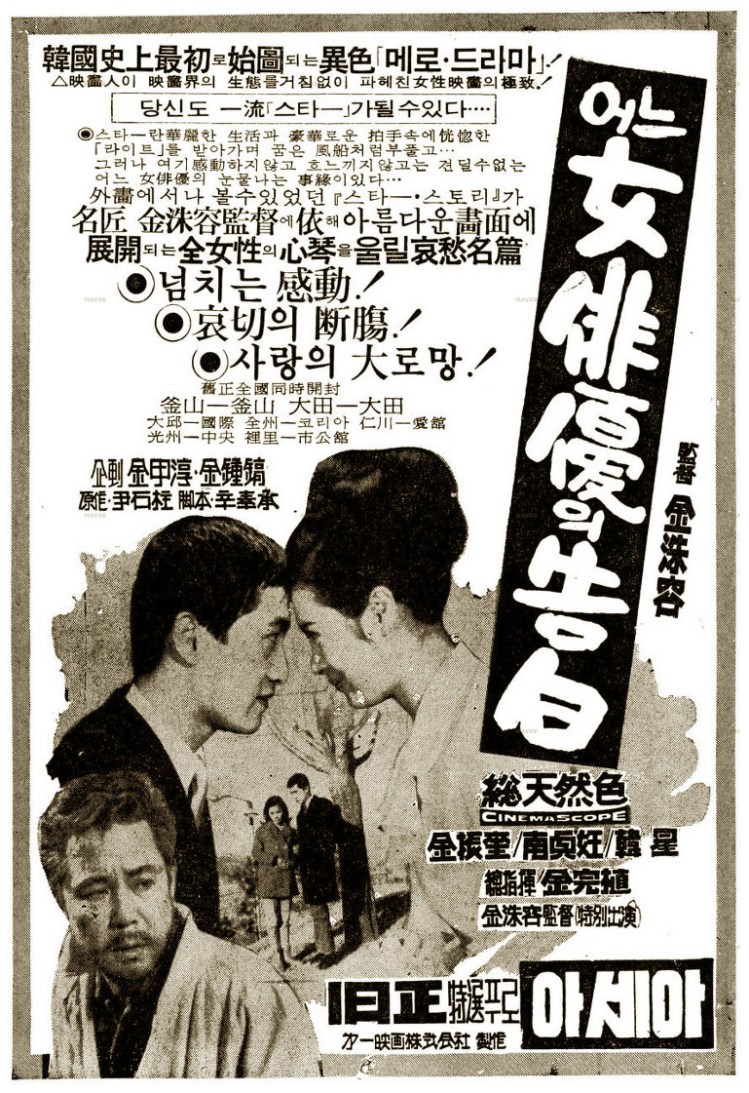
Confession of an actress posterKorean filmmaking of the 1960s is sometimes referred to as a “golden age”, but the reality is that films were often churned out at a rapid pace for immediate distribution. Producers got an advance from local distributors, picked a scenario, assigned a suitable director and slotted in big name stars they already had under contract. For this reason production values are often low, but performance standard high despite the fact that many stars are bouncing around from one film to another shooting a scene here and a scene there. Director Kim Soo-yong filmed 10 features in 1967 – including his masterpiece Mist. Confessions of an Actress (어느 여배우의 고백 / 어느女俳優의告白, Eoneu Yeobaeu-ui Gobaek), inspired by a novel by Yun Seok-ju, is the kind of straightforward melodrama that was going out of style – a virtual remake of Chaplin’s Limelight with a little Phantom of the Opera thrown in, but Kim neatly repurposes it as a meta take on the Korean film industry of the day.

Kim Jin-kyu (played by the actor of the same name) was once a famous movie star, but heartbreaking tragedy ruined his career and now he’s a washed up drunk dreaming of the past. Hearing the dreaded “hey mister, didn’t you used to be somebody?”, Jin-kyu wanders into a film shoot and is thrown back to a happier time when he starred in prestige pictures with his regular co-star who was also his lover. Sadly, Miyong died of an illness leaving their last picture unfinished. The studio producers wanted to replace her and complete the movie, but Jin-kyu wouldn’t have it. They sued him for obstruction and his career was ruined. Jin-kyu was told that the child Miyong was carrying had died, but unbeknownst to him, a daughter was born and Miyong asked her friend Hwang Jung-seun to give the baby up for adoption and save it from the stigma of being illegitimate. Running into Jung-Seung at the shoot, Jin-kyu finds out his daughter is alive and determines to turn her into a great star – the only thing he can do for her as her father now that he is in such a sorry state.

Almost all of the characters in the film are named for their actors, though they are obviously not playing themselves in any biographical sense. Nevertheless, there is an intentional reflexivity in Kim’s decision to shift away from his literary source to towards one more immediately cinematic. Much as in Chaplin’s Limelight which does seem to provide a blueprint for the narrative, the arc is one of tragedy and redemption as Jin-kyu attempts to make up for lost time by imparting all his professional knowledge to the daughter he never knew and ensuring her success even at the cost of his own. Ashamed to introduce himself to her as a father given that long years of lonely drinking have reduced him to a broken old man, Jin-kyu gives his advice via letter and avoids seeing Jeong-im, longing to embrace her but afraid he’ll bring shame on her growing fortunes.

When Jin-kyu gets Jeong-im into show business, Kim gets a chance to put the Korean film industry on screen. He starts with a mildly sleazy producer and the established star who’s getting too old for ingenue roles but is desperate to hang on to her leading lady status. Nevertheless, she does have the option, as she points out, of a dignified escape through marriage should her career fail – something that is not an option for her male co-stars. As a young hopeful with no experience and nothing to recommend her beyond a pretty face, Jeong-im’s entry into the world of film is a baptism of fire. Rushed through makeup with its uncomfortable fake eyelashes and into an unfamiliar costume, Jeong-im’s rabbit in the headlights performance does not endear her to the director or more particularly the producer who is looking on from the wings in exasperation quietly calculating how much all of these extra takes are costing in wasted film. Nevertheless, the film is a success and, thanks to Jin-kyu’s careful tutoring, Jeong-im is on track for stardom.

Kim fetishises the camera, the process of filming with its bright artificial lights, tricks and techniques from the ice cold studio shoots to the difficult trips out on location. He makes full use of the relatively rare colour format utilising frequent superimpositions and montages, overlaying the bright neon lights of Seoul with the interior journey of our leading lady as she begins to find her voice. Making a final self cameo, Kim gives in to the inherently melodramatic quality of the underlying narrative but he does so somewhat ironically, rolling his eyes at the need for overly dramatic emotionality while actively embracing it, and lamenting the hardships of filmmaking while churning out his third picture in as many months. Confession of an Actress is not the salacious exposé promised by the title, but it is an illicit look at the decidedly unglamorous side of film production a world away from the bright lights and glossy magazines. 


Available on DVD as part of the Korean Film Archive’s Kim Soo-yong box set. Not currently available to stream online.

The Seashore Village (갯마을, Kim Soo-yong, 1965)

The Seashore village posterKorean cinema of the 1960s was a tightly controlled affair. The authoritarian government of Park Chung-hee had instituted the Motion Picture Law of 1962 which insisted on a studio system with stars under contract and a turnover of at least 15 films a year. The law intended to increase the amount of films produced for mass consumption, giving free reign to the melodrama and thereby accidentally undermining its more censorious aims. Nevertheless, The Seashore Village (갯마을, Gaenma-eul), adapted from a novel by Oh Yeong-su and part of the “literature film” genre for which director Kim Soo-yong would remain famous, goes much further than one would reasonably expect given the conservative nature of Korean filmmaking across the ages. A story of village life with all of its various superstitions and primitive practices, Kim’s film is a daring exploration of female sexuality and the collective power of women away from men.

An opening voice over introduces us to a melancholy fishing village where the life is hard and the people resigned to loss. The boats depart to great fanfare, but just as they are leaving someone remarks that he’s had a bad dream – bad dreams are one of many bad omens for sailors. New wife Hae-sun (Ko Eun-ah) doesn’t wait to watch her husband disappear over the horizon, she takes to the clifftop shrine of the Dragon King and prays for his safe return.

Her prayers are unanswered. A typhoon strikes and Hae-sun’s husband, along with another sailor, is killed. So young a widow, Hae-sun becomes an awkward problem for the villagers. Sang-su (Shin Young-kyun), a shady drifter, begins making subtle overtures which eventually turn into outright harassment and attempted rape. Hae-sun likes the family she married into and wants to stay true to her husband’s memory, but the forces of nature conspire against her.

While Hae-sun is a classically “good” woman who rejects the advances of Sang-su, the other village wives feel rather differently. Everyone except Hae-sun’s widowed mother-in-law (Hwang Jung-seun) knows about Sang-su’s obvious desire for Hae-sun but they see nothing wrong in it. Rather than the conservative atmosphere of the middle-class urban melodrama in which bodies of surrounding middle-aged women act as enforcers of moral discipline, these literal fishwives are of an earthier disposition. Many of them have been widowed with husbands lost at sea – the way they see it, you’d best take your pleasures where you can and there’s nothing wrong with a quick roll in the hay if it eases frustration and aids productivity. They laugh at Hae-sun’s prudery and marvel at her ability to carry on as normal after losing her husband not because of the grief, but because of the lack of intimacy.

It might be 1965 outside of the village, but the old ways still rule here even if they’re on their way out. In the old days, women did not remarry – a serious problem in a small village with few men around to replace those lost at sea. Hence, women have learned to live alone, supporting each other in place of men and often forced to do without them. In a surprising development, Kim flirts with the taboo of lesbianism – something which is addressed half-jokingly by the gossipy widows but eventually gives way to a literal roll in the hay with half the village women looking on in hilarity rather than horror. The women joke about living together but lesbianism does seem to be presented as an imperfect solution to their present problem in the lack of satisfaction available to them due to the absence of men. Far from a taboo, sexual desire is a normal part of life in the village – something ranked alongside eating and sleeping and no more or less embarrassing than any other bodily function. The widows crave men and are unafraid to say so even if some of them are content to make do with each other in resignation to their awkward status as older single women.

Hae-sun is in a slightly better position given that remarriage is apparently no longer so much of a taboo. Unfortunately that presents a problem for her as all she wants to do is stay with her family just as she is. She doesn’t like Sang-su and his increasingly aggressive behaviour towards her is unlikely to change that but nevertheless she eventually finds herself given to him almost against her will. Despite becoming a wife once again, Hae-sun’s beauty continues to curse her by causing problems between men wherever she sets foot. The problems, however, are definitively on the male side – men long to possess her, with violence if necessary, and ruin themselves in their immoral pursuit of a “pure” woman. The village widows rejoice in their earthy pleasures, finding comfort and release in each other but the male impulse, by contrast, is always towards conquest and control, domination rather than mutual support.

Life in the village is hard and often sad, but the women are happy and optimistic. They live the lives that are given to them, and do the best they can with what they have. The very antithesis of the lurch towards modernity, the simple life of the villagers harks back to something purer and more honest without the pretension of urban civility and apparently free from the political concerns of the day. Bold in its outlook, The Seashore Village is a surprisingly progressive effort from the Korea of 1965, subverting its “primitive” setting to present a positive picture of female power and sexuality.


Available on DVD as part of the Korean Film Archive’s Kim Soo-yong box set. Also available to stream for free via the Korean Film Archive’s YouTube Channel.

Ambiguous Places (うろんなところ, Akira Ikeda, 2017)

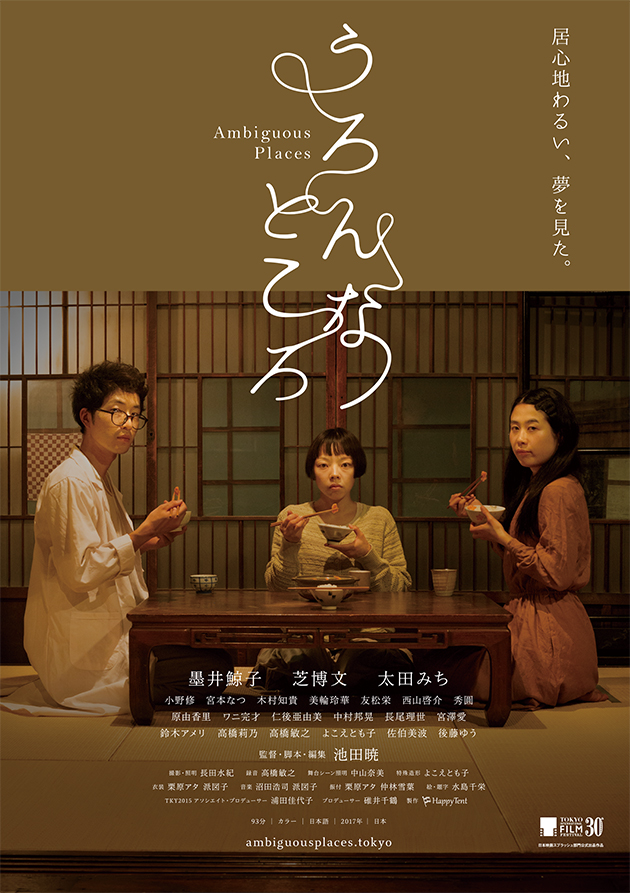
Ambiguous places poster

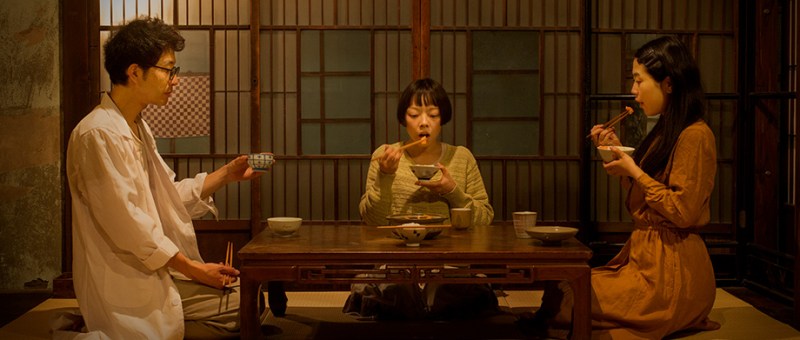
The world is quite a strange place at the best of times, but for a small collection of people living in between some Ambiguous Places (うろんなところ, Uronna Tokoro) everything seems pretty much normal. Akira Ikeda whose Anatomy of a Paperclip won a Tiger Award at International Film Festival Rotterdam, returns with another surreal tale inspired by the land of dreams. 

Konoko (lit. “this girl”) washes up on a beach trapped in a net and tries to sing but the other people on the beach tell her to stop, because she’s rubbish. Konoko’s other problem is that she’s got a bug stuck in her hair and will need to find a barber to take it out. Travelling with a man whom a strange lady looking for “nuts” on a beach assures her is her dad, Konoko wanders off to look for a hairdresser only to sell her “dad” to a couple of near silent dango makers and then discover that the only barber’s in town is actually a soba shop (which serves udon) and she needs to go the pharmacy only the pharmacist is out at the moment because he had to get some gloves made in celebration of his wife’s pregnancy…

Ambiguous Places is actually a cyclical collection of three stories running more or less concurrently in which the same collection of strange people reappear in different stages of their own adventures. Konoko’s “Meeting Nyoraga” segues into the pharmacist’s odyssey of glove making and forced marriage “Celebrate with Gloves”, and that in turn leads into “Get My Hair Washed” which pops out of the pharmacist’s dream about a girl with foamy hair and features a quest to rid one’s home of scary blue ghosts only to end with everyone sitting down and having dinner together instead.

To begin with everything seems very strange but like the best of dreams it eventually starts to make sense and though there is more than a little violence and hostility, broadly everyone seems to accept things just the way they are. Still, from our point of view this is all terribly surreal. At one point the pharmacist, who has just spent ages having gloves knitted around his hands in a bizarre ritual encounters the man who will later own the dango shop just as he’s carting his wife around covered by a sheet and sitting in a wheel barrow filled with vegetables. The man explains that this is his people’s way of celebrating. The pharmacist looks him dead in the eye and remarks “strange custom”. Well, quite. Mozart’s The Magic Flute also plays a large role in the proceedings in somewhat mangled German with bits of Japanese creeping in until a young lady is forced to have a go after criticising Konoko’s singing and finds she is able to sing the Queen of the Night aria complete with coloratura almost faultlessly.

The atmosphere is indeed dreamlike as the various tales weave in and out of each other with a kind of surreal logic that has its own internal consistency even if it’s quite hard to pin down. Absurd in the extreme, Ikeda opts for deadpan delivery that adds to the bizarre humour and ethereal quality of the strange “ambiguous places” which seem to exist in this odd little seaside town. Yet also like dreams the deeper meaning (if there is any) is hard to discern. Nevertheless, even if it is all random and essentially meaningless, Ambiguous Places is unexpectedly warm and filled with enough zany humour to keep things ticking along even when wondering if one needs to be afraid of the postman or if Nyoraga is really as dangerous as they say…


Streamed via Festival Scope as part of their International Film Festival Rotterdam tie-up.

Original trailer (English subtitles)