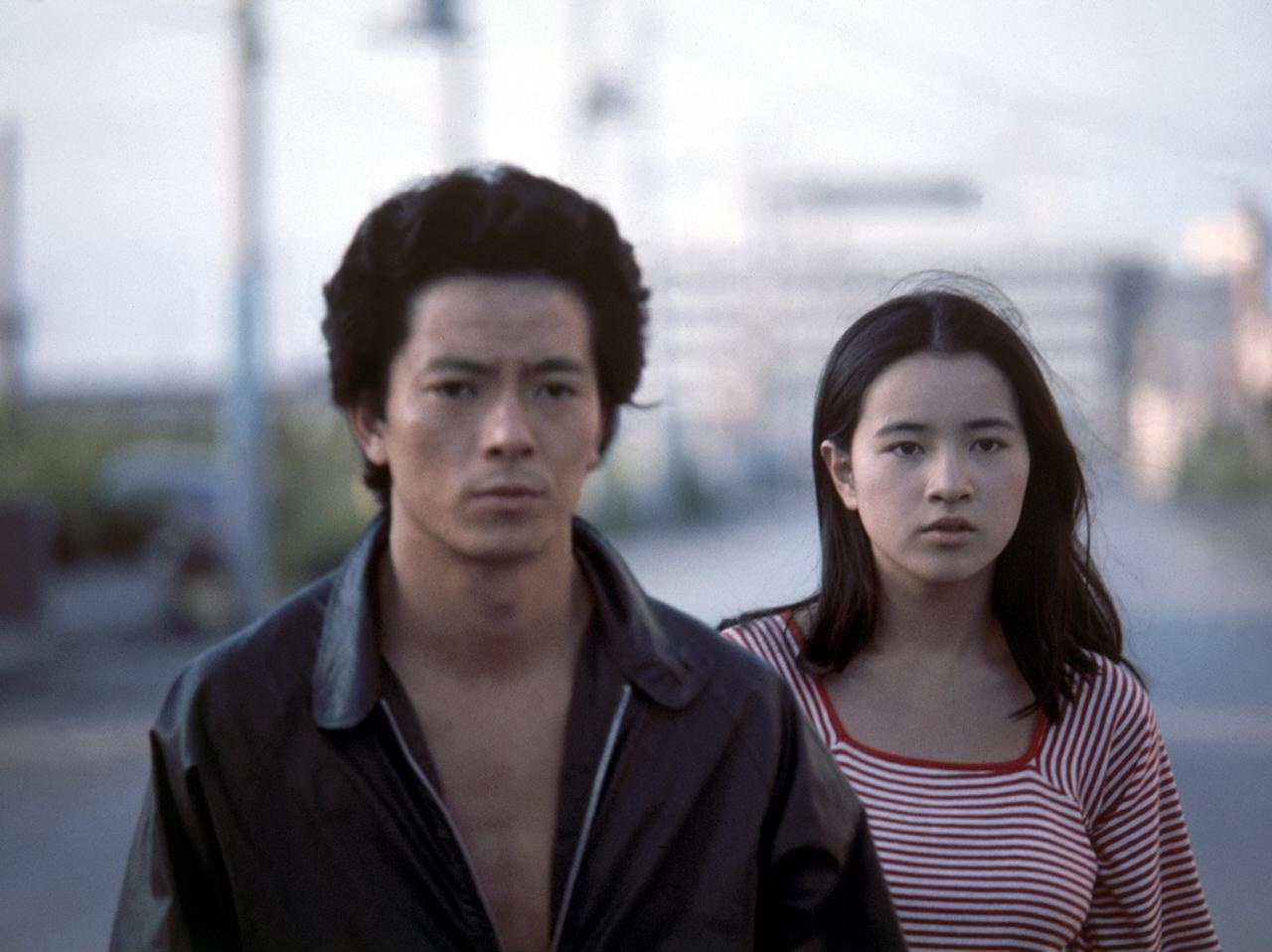
The Youth Killer (青春の殺人者, Kazuhiko Hasegawa, 1976)

An angry young man railing against “family imperialism” eventually kills both parents in a moment of intense frustration, abandons his girlfriend, and ends up alone, but what he discovers maybe less the freedom he was seeking than only more loneliness and despair. Adapted from a story by Kenji Nakagami that was itself inspired by a real-life case of patricide, Kazuhiko Hasegawa’s The Youth Killer (青春の殺人者, Seishun no Satsujinha) is imbued with the nihilistic sense of powerlessness that coloured the 1970s as its Hamlet-like hero tries to free himself from an oppressive social system only to find it indifferent to his existence.

Part of Jun’s (Yutaka Mizutani) problem is a protected adolescence as evidenced in the opening scenes in which he and his girlfriend Keiko (Mieko Harada) run round playfully reciting nursery rhymes. The irony may be that his name means “pure”, and that he is too thin-skinned to survive in this overly complex world. His father (Ryohei Uchida) stopped him from going to university like many of his friends, preventing him from moving on into a more settled adulthood. He did this, he says, because of the student protests not out of fear that harm would come to him but fear that he would cause it. The farmland surrounding Jun’s parents has been earmarked for Narita airport and despite angry clashes between local farmers and an uneasy alliance with student protesters, will eventually go ahead. Those like Jun are being squeezed off of their land and have nowhere else to turn.

Perhaps sensing his listlessness, Jun’s father gives him the money to open a bar and capitalise ion the new custom from the airport, but this too leaves Jun feeling childish and emasculated, as if it’s his father who will actually be in charge. The two men hug and wrestle, alternately showing affection and tussling for power. His secondary problem is that his parents apparently don’t approve of his girlfriend Keiko with whom he is running the bar. His father has hired a private detective who tells him that Keiko was raped by her mother’s lover resulting in her mother hitting her and causing her to lose the hearing in one ear. Jun’s father does not believe that Keiko was raped and insists that it was Keiko who seduced her mother’s lover.

It seems to have been this fracture point that caused Jun to snap and kill his father, less because of his attachment to Keiko than because of the challenge to his masculinity implied by the suggestion that his girlfriend simply sleeps with anyone she pleases. In fact, Jun doesn’t seem to particularly like Keiko and is wary of committing to relationships owing to his fear of “family imperialism”. He becomes fixated on the question of her deafness, niggled by the possibility she lied about its cause and his father is right. Never examining why Keiko might choose to create a different truth around what happened to her, he in fact tries to rape her himself and is obsessed with tying to find out whether not there was a fig tree near their old home as Keiko says or an azalea as others would have it.

The conflict he has with Keiko is not so different from that with his mother who, on learning of her husband’s death, quickly shifts to protecting her son, but then seizes on it as a chance to claim her own freedom. Sick of the drudgery of working at the family’s auto repair shop, she suggests running away with Jun to start a new life in a new place just the two of them. Her language becomes increasingly romantic before she eventually asks Jun to make love to her. When he eventually kills her, she tells him to stick it in and be gentle as if she were talking to a lover. But she too also doubts him, fearing he means to take the money from the safe and escape alone. Not even maternal love can overcome this kind of cynicism in a society ruled by money.

Hasegawa frames Jun’s progress as a series of confrontations, between his father, his mother, Keiko, and eventually himself in which he discovers he is still a child. He has killed his parents, but has failed to become a man. Sitting on a beach with Keiko he is overwhelmed by loneliness remembering a happy family moment when his father sold ice lollies rather than toiling at the garage. Scenes in his student film contain imagery echoing self-immolations and this is what he eventually tries to do himself in setting the bar on fire with him inside it only to be rescued by Keiko. After fleeing the scene he stows away on a truck and removes the bandage from his hand symbolising the transgression of his parents’ murder, but he is quite literally being driven to a destination not of this own choosing. Rather than freedom in solitude, he’s discovered only loneliness and despair. Condemned to a limbo state, he has nowhere to go and can only travel in circles looking for an elusive exit from this very particular kind of hell.


The Youth Killer screened as part of Japan Society New York’s Kazuhiko Hasegawa’s Anarchic Ethos.
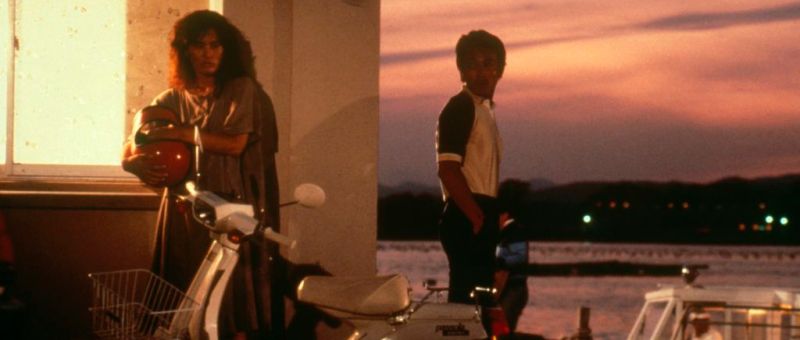
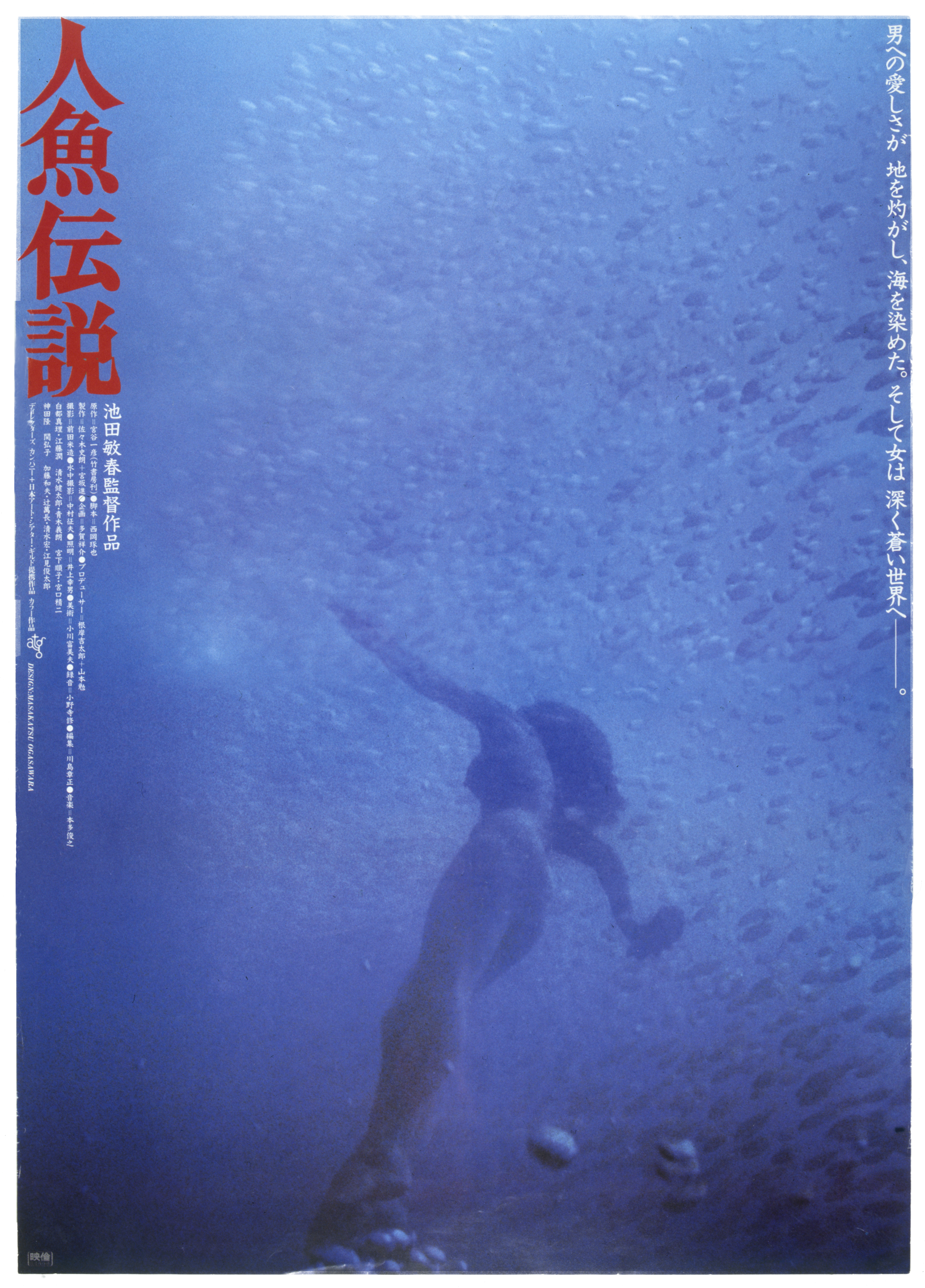
Mermaid Legend (人魚伝説, Toshiharu Ikeda, 1984)

“Even if someone kills you, you wouldn’t die,” a drunken husband somewhat sarcastically replies having pledged to come back and haunt his wife if he died and she married a man who didn’t drink. His words take on a prophetic quality given that the heroine of Toshiharu Ikeda’s Mermaid Legend (人魚伝説, Ningyo Densetsu) takes on a quasi-supernatural quality as an embodiment of nature’s revenge after someone tries, and fails, to kill her having already killed her husband for witnessing their murder of another man who’d tried to resist their plans of buying up half the town to build a nuclear plant. 

By the mid-1980s, Japan’s economy had fully recovered from post-war privation and was heading into an era of unprecedented prosperity which is to say that the coming of a power plant was not welcomed with the same degree of hope and excitement as it may have been in the 1950s when it was sold not only as a new source of employment for moribund small towns but an engine that would fuel the new post-war society. Several industrial scandals such as the Minamata disease had indeed left those in rural areas fearful of the consequences of entering a faustian pact with big business, which is one reason why the guys from Kinki Electric Power sell it as an amusement park project though even this has the locals wary not just of the disruption it will bring to their lives and potential ruin of their livelihoods which are dependent on the protection of the natural environment but that what is promised simply won’t be delivered. Fisherman Keisuke (Jun Eto) says as much when lamenting a previous aquaculture programme which didn’t pan out and caused lasting damage to marine life. 

In any case, as others say there’s no money in going out to sea anymore and its clear that the old-fashioned, traditional way of life practiced by Keisuke and his newlywed wife Migiwa (Mari Shirato) is no longer sustainable. Migiwa is an abalone diver working without modern equipment but using heavy weights to dive deep enough to reach the shells. As such she’s dependent on her husband to pull her back up to the boat when she tugs the rope. She must put her life entirely in his hands though in truth, he does not seem to take his responsibility all that seriously. The couple bicker relentlessly and not even she really believes him when he says he witnessed a murder which might be understandable given the extent of his drinking. All of which is further evidence against her when she manages to escape from the assassination plot and runs straight to the nearest policeman who thanks her for turning herself in implying he believes she is responsible for Keisuke’s death. 

The possible collusion of the policeman hints as a further sense of distrust in authority which has become far too close to corporate interests. Shady industrialist Miyamoto (Yoshiro Aoki) ropes in both the mayor and the head of the fishing association in his talks with Kinki Electric Power along with Shimogawa from the local tourist board who evidently opposes the plans as he is the man Keisuke witnesses being murdered. As Miyamoto says “sometimes your hands get a little dirty” though he never “directly” involves himself matters such as these. The situation is complicated by an unresolved love triangle between Miyamoto’s spineless son Shohei (Kentaro Shimizu), a sometime photographer, who is resentful of Keisuke and in love with Migiwa complaining that Keisuke always outdrinks him and gets the girl too hinting at his sense of wounded masculinity. Isolated by his class difference, he appears not to approve of his father’s actions but later does little to stop them and eventually sides with corporate interest over his feelings for Migiwa who in any case seems to have become more attached to Keisuke following his death which she vows to avenge. 

There is there is something quite strange in the prophetical quality of Keisuke’s words also predicting the “black sweat” of the Jizo on the beach and the mystical storm which does eventually sweep everything clean destroying the signs for the new nuclear power plant already installed on the beach. In this way, Migiwa becomes a vengeful force of nature taking up arms against those who wilfully ravage and pollute the natural environment while damaging the lives of those who lived on its shores such as herself and Keisuke. She takes revenge not only for the murder of her husband by corrupt capitalists but against that corruption itself even as she laments that “no matter how many I kill, they just keep coming.” “Don’t worry, maybe all this was just a dream,” Keisuke once again prophetically intones though it’s difficult to know if it’s defeating the capitalist order that is a fantasy or the maintenance of the idealised rural life to which Migiwa seemingly finds her way back swimming into an unpolluted sea surrounded by the floating barrels of ama divers and clear blue skies, a creature of nature once again.


Mermaid Legend screened as part of this year’s JAPAN CUTS.

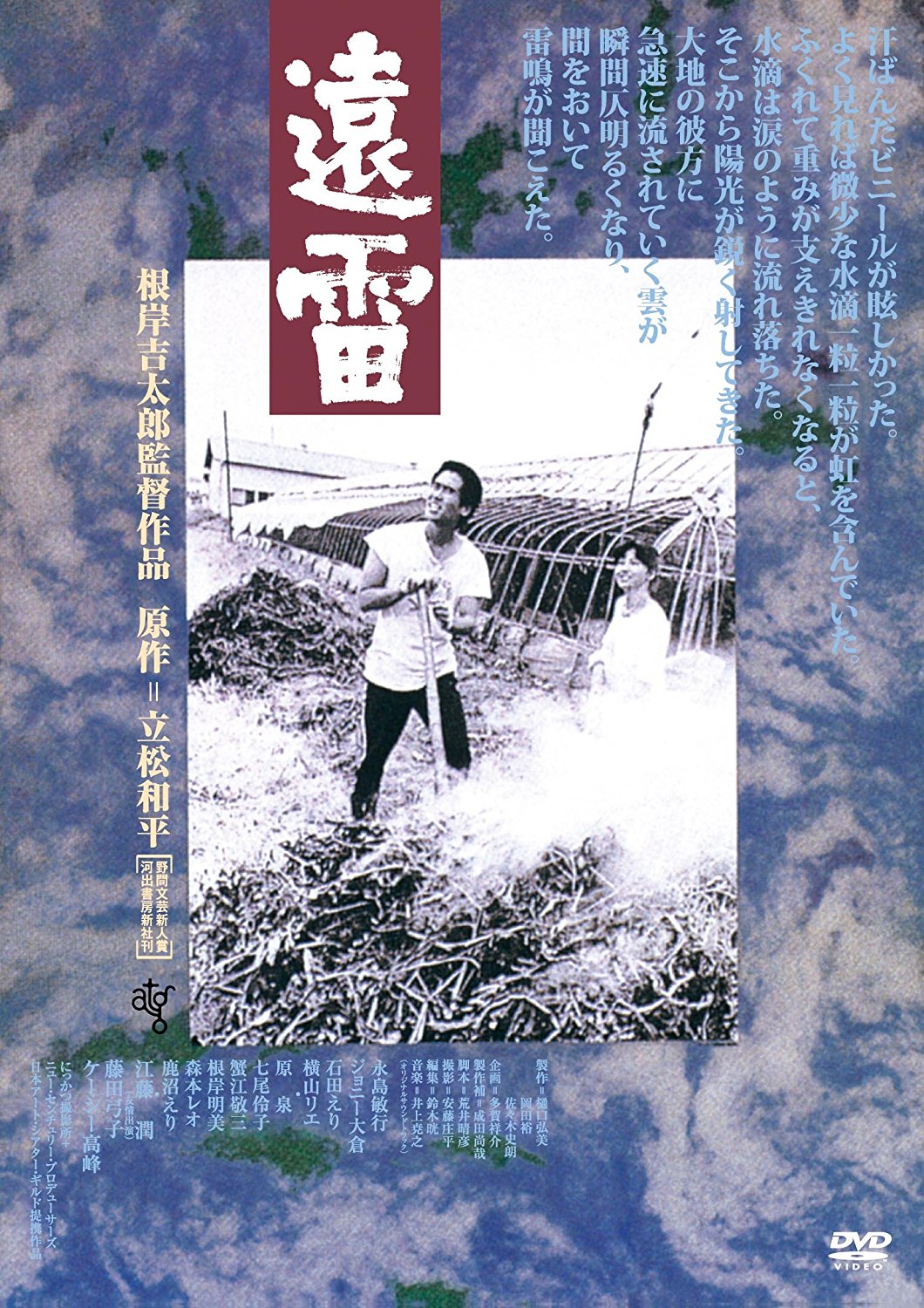
Distant Thunder (遠雷, Kichitaro Negishi, 1981)

distant thunder dvd coverBy 1981 Japan’s economic recovery was more or less complete and the consumerist future had all but arrived. Based on the novel by Wahei Tatematsu, Distant Thunder (遠雷, Enrai) is the story of impending doom staved off by those clinging fast to the their ancestral traditions even whilst the modern world threatens to engulf them. Kichitaro Negishi already had a long career directing Nikkatsu’s Roman Porno, but made his mainstream debut with this quietly affecting social drama for Art Theatre Guild which relies on the strong performances of its cast to convey the subtitles of youth caught between past and future.

In the contemporary world of 1981, 23-year-old Mitsuo (Toshiyuki Nagashima) is a tomato farmer stubbornly hanging on to his family’s ancestral land which happens to be inconveniently placed in the middle of a modern housing complex. Women from the estate sometimes pop round to ogle Mitsuo under the pretext of buying super fresh tomatoes. Mitsuo is happy for them to enjoy the fruits of his labour, but refuses to accept them as “neighbours” lamenting the death of the village in which he grew up.

It transpires that Mitsuo’s father (Casey Takamine) sold off most of the farmland without consulting the rest of the family and used the proceeds to open a bar with the hostess he ran off with. Mitsuo hasn’t forgiven him for this and continues to work the tomatoes alone while his older brother is married and living a modern salaryman life in the city. At 23 it’s high time Mituso got himself a wife, but a flirtation with a barmaid, Kaede (Rie Yokoyama), who claims to be a divorced single parent proves diverting enough for the time being. Mitsuo knows being a farmer’s wife is no prize, so when his mother comes up with a possible match Mitsuo thinks it’s worth a try even if she’s probably none too pretty.

An old soul in many ways, Mitsuo wants to hang on to his family’s farm despite the constant offers he gets from salesmen at the door who want him to sell. Where once there was a village, now there are high rise apartment blocks. Mitsuo misses the world he grew up in where farmers helped each other out in difficult times and wandered in and out of each other’s houses like one big happy family. Not content with ruining his own, it’s also this wider concept of community as family that Mitsuo’s father has ruined for him in rejecting his traditional responsibilities for the irresponsible pleasures of taking up with a fancy woman and starting again as a bar owner.

Sadly, the bar hostess really does seem to love Mitsuo’s feckless father, perhaps seeing him as her last chance for happiness. Kaede, by contrast, is looking for something far less permanent. She claims to be divorced but is married to a mild-mannered man (Keizo Kanie) with a tattoo poking out of his collar who accepts her need for new conquests but would rather they not become regular arrangements. Kaede whips up more potential destruction when she comes between Mitsuo and his childhood best friend, Koji (Johnny Okura), who also likes her and has been led to believe Kaede’s relationship with Mitsuo was not altogether consensual. Meanwhile, Mitsuo’s blind date went far better than expected and it looks like he’s on course to find a wife in petrol station assistant Ayako (Eri Ishida).

Ayako, like Mitsuo, is a more old fashioned sort though she’s no prude and is of an earthier yet somehow “purer” nature than the comparatively urban Kaede. Mitsuo finds himself pulled in different directions – Ayako and the tomato farm, or the freely given pleasures of Kaede who threatens to burn everything to the ground with her mysterious, self destructive lifestyle. Mitsuo doesn’t want to be like his dad – a philanderer who runs out on his responsibilities and makes a fool of himself in the process, cosying up to local politicians and playing fast and loose with the law, but he’s late to see the danger a woman like Kaede might cause him. His friend, Koji, is not quite so perceptive and naively falls for her charms. Mitsuo knows deep down that his friend has in a sense saved him from making a ruinous life decision and helped him rediscover the happiness of his traditional, simple way of life.

Filming in 4:3, Negishi’s camera is soft and unobtrusive yet pointed, capturing the minor details of the everyday with a poetic beauty. Filled with realistic detail and anchored by strong performances, Distant Thunder is both a picture of innocents battling the inevitable death of their way of life with determination and purity, and a document of changing times in which the confusions of the modern world threaten to destroy those who cannot reconcile themselves to their fated paths.


Short clip from the ending (English subtitles)