
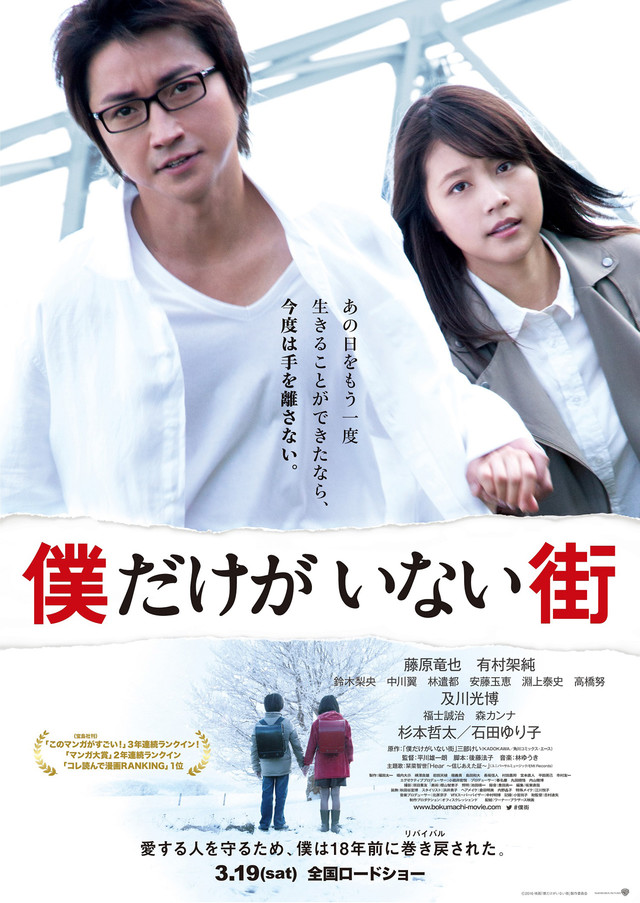
 Erased (僕だけがいない街, Boku Dake ga Inai Machi), a best selling manga by Kai Sanbe, has become this year’s big media spectacle with a 12 episode TV anime adaptation and spin-off novel series all preceding the release of this big budget blockbuster movie. Directed by TV drama stalwart Yuichiro Hirakawa, the live action iteration of the admittedly complicated yet ultimately affecting story of a man who decides to sacrifice himself to ensure his friends’ happiness, acquits itself well enough for the most part but changes two crucial details in its concluding section which unwisely undermine its internal logic and make for an unsatisfying conclusion to the ongoing puzzle.
Beginning in the “present” of 2006, Satoru Fujinuma (Tatsuya Fujiwara) is an aspiring mangaka making ends meet with a part-time job as a pizza delivery guy (a kind of “Hiro Protagonist”, if you will). Aloof and sullen, Satoru has no real friends but does possess an unusual supernatural ability – if a tragedy is about to occur in his general vicinity, he will enter a “Revival” loop in which he temporarily rewinds time, allowing him to figure out the problem and save everyone’s lives. Rescuing a child about to be hit by an out of control lorry, Satoru rides his pizza delivery bike into an oncoming car and winds up in hospital.
When he comes to he finds cheerful co-worker Airi (Kasumi Arimura), who witnessed the accident, waiting for him as well as his mother (Yuriko Ishida) coming in for visit. Reconnecting with his mother and getting closer to Airi (albeit reluctantly) Satoru’s life appears to be brightening up but the good times are short lived as Satoru’s mother is brutally murdered in his apartment leaving him looking like the prime suspect. This time when Revival kicks in it doesn’t just rewind a few minutes but 18 years, back to the winter of 1988 when Satoru’s small town was rocked by a series of child murders and abductions which resulted in the arrest of a local boy (Kento Hayashi) whom Satoru had always believed to be innocent.
Repossessing his childhood body but with a grown man’s mind, the “younger” Satoru is considerably less jaded than his 2006 counterpart, determined to change the future and save his mother’s life. The root causes of her death, he is sure, rest in this unresolved and traumatic period of his childhood. Swapping back and forth between 2006 and 1988 as Satoru makes the best of his opportunity to investigate from both sides, Erased is a tightly controlled time travel puzzle of trial and error in which Satoru must use all of the evidence he can gather to unmask the criminal in order to save both the lives of his friends in 1988 and that of his mother in 2006.
As in many similarly themed franchises, the plot turns on the bonds formed in childhood as the connections between Satoru and his friends become the binding glue in an otherwise fluid time travel dilemma. Older Satoru is better equipped to recognise the trouble one of his friends is in – Kayo, a sad and lonely girl who, in the original timeline, eventually became one of the victims attributed to the serial murders plaguing the town. Trapped in an abusive home environment, Kayo isolates herself for reasons of self preservation, both too afraid and too ashamed to let anyone know what’s going on at home. Managing to befriend her, Satoru does indeed help to change something for the better but only finds himself becoming more deeply entrenched in the central mystery.
It’s at this point that the film begins to diverge from its source material as Satoru is attacked by the murderer and “wakes up” back in 2006 but rather than having been in a coma for 18 years has apparently been leading a much more successful life than his previous incarnation. Within the peculiar laws of the franchise which don’t always match standard time travel logic, Satoru’s central timeline does not change – only his mind moves between bodies, he retains full knowledge of his original timeline as well as the changes he brings about. However, he now seems to magically receive memories of the life he never lived whilst also retaining his previous ones. Now knowing the identity of the real murderer and the probability that they are still out there, Satoru decides to re-team with his old friends but his showdown with the psychotic killer is entirely contrived to engineer a “tragic” ending, oddly more like something that might have befallen the 11yr old Satoru than his older counterpart, further undermining the already shaken sense of internal consistency.
The film’s Japanese title, Boku Dake ga Inai Machi (the town where only I am missing), takes inspiration from the short story which Kayo writes in school. Wishing that she alone could be transported to another life free of abuse and loneliness, Kayo writes herself into a better place. Satoru reimagines a similar scenario with himself in the lead as he makes the decision to sacrifice himself to save his friends. The ending of the original source material both undercuts and reinforces this idea as Satoru’s friends are both extremely proud and grateful for his efforts, but are also keen to point out that the world is a much better place with him in it than without. In removing the opportunity for Satoru’s friends to come to his rescue, the live action version of Erased also removes its most crucial message – that heroes are never “alone”, and Satoru’s salvation lies in that of his friends and family.
Yuichiro Hirakawa mostly opts for a lighter tone than the children investigating a serial killer whilst also trying to rescue their friend from her abusive mother narrative might indicate. There are some nice visual ideas including a switch to POV during the first time skip to 1988, the repeated hero of justice hand gestures, and thoughtful use of manga, but given the obvious problems with internal consistency, the high quality of the performances and cinematography can’t reconcile the various cracks within the film’s structure. Uneven, but strong until its contrived and illogical end point, Erased is a slightly disappointing live action adaptation of its source material in which it might have been (ironically enough) better to have more faith rather than pushing for the predictably melodramatic conclusion.
Original trailer (no subtitles)
 Lav Diaz has never been accused of directness, but even so his 8.5hr epic, Heremias (Book 1: The Legend of the Lizard Princess) (Unang aklat: Ang alamat ng prinsesang bayawak) is a curiously symbolic piece, casting its titular hero in the role of the prophet Jeremiah, adrift in an odyssey of faith. With long sections playing out in near real time, extreme long distance shots often static in nature, and black and white photography captured on low res digital video which makes it almost impossible to detect emotional subtlety in the performances of its cast, Heremias is a challenging prospect yet an oddly hypnotic, ultimately moving one.
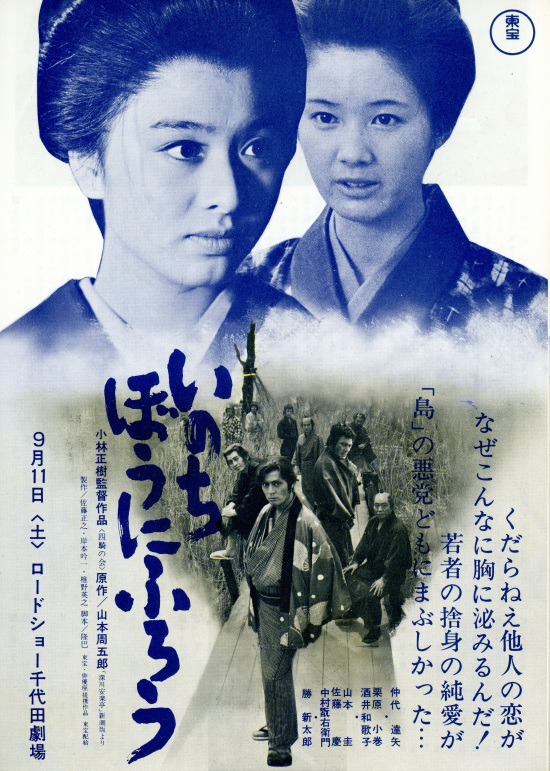 “Sometimes it feels good to risk your life for something other people think is stupid”, says one of the leading players of Masaki Kobayashi’s strangely retitled Inn of Evil (いのちぼうにふろう, Inochi Bonifuro), neatly summing up the director’s key philosophy in a few simple words. The original Japanese title “Inochi Bonifuro” means something more like “To Throw One’s Life Away”, which more directly signals the tragic character drama that’s about to unfold. Though it most obviously relates to the decision that this gang of hardened criminals is about to make, the criticism is a wider one as the film stops to ask why it is this group of unusual characters have found themselves living under the roof of the Easy Tavern engaged in benign acts of smuggling during Japan’s isolationist period.
 When
When 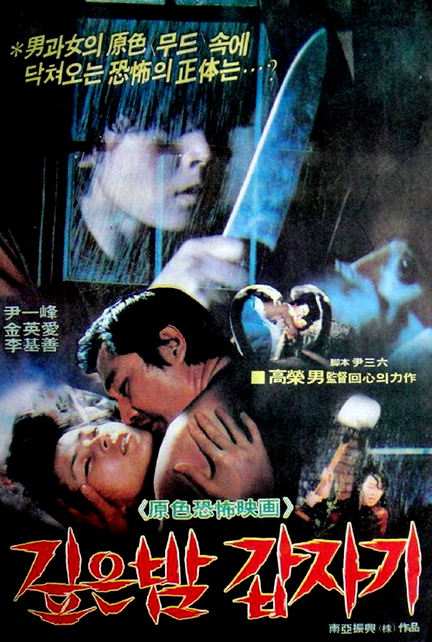 Everybody ought to have a maid, goes the old adage, but finding one you can trust can be a tall order. Kim Ki-young’s The Housemaid clearly sounds a warning call to husbands everywhere not to be tempted by the enticements of pretty young girls or conniving social climbers with designs on upending the domestic order by supplanting the legitimate wife from within her own home. The Housemaid is melodrama rewritten as horror in which a parasitical force colonises the domestic environment hell bent on taking it over through a subversion of its binding yet taboo foundation – sexual desire. Twenty years later, Suddenly in the Dark (깊은밤 갑자기, Gipeun Bam, Gapjagi) returns to the same theme but from a different angle. A once harmonious household is suddenly turned upside down following the introduction of a second female, provoking a series of crises within the already strained mind of its wife and mother.
 Ogami (Tomisaburo Wakayama) and his son Daigoro (Akihiro Tomikawa) have been following the Demon Way for five films, chasing the elusive Lord Retsudo (Minoru Oki) of the villainous Yagyu clan who was responsible for the murder of Ogami’s wife and his subsequent framing for treason. The Demon Way is never easy, and Ogami has committed himself to following it to its conclusion, but recent encounters have broadened a conflict in his heart as innocents and seekers of justice have died alongside guilty men and cowards. Lone Wolf and Cub: White Heaven in Hell (子連れ狼 地獄へ行くぞ!大五郎, Kozure Okami: Jigoku e Ikuzo! Daigoro) moves him closer to his target but also further deepens his descent into the underworld as he’s forced to confront the wake of his ongoing quest for vengeance.
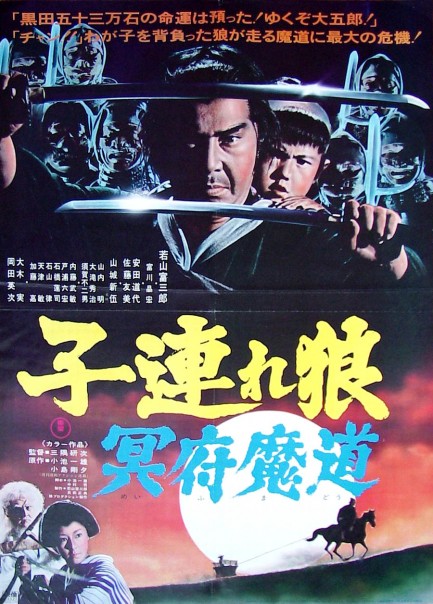 Ogami (Tomisaburo Wakayama), former Shogun executioner now a fugitive in search of justice after being framed for treason by the villainous Yagyu clan who are also responsible for the death of his wife, is still on the Demon’s Way with his young son Daigoro (Akihiro Tomikawa). Five films into this six film cycle, the pair are edging closer to their goal as the evil Lord Retsudo continues to make shadowy appearances at the corners of their world. However, the Demon’s Way carries a heavy toll, littered with corpses of unlucky challengers, the road has, of late, begun to claim the lives of the virtuous along with the venal. Conflicted as he was in his execution of a contract to assassinate the tragic Oyuki in the previous instalment,
 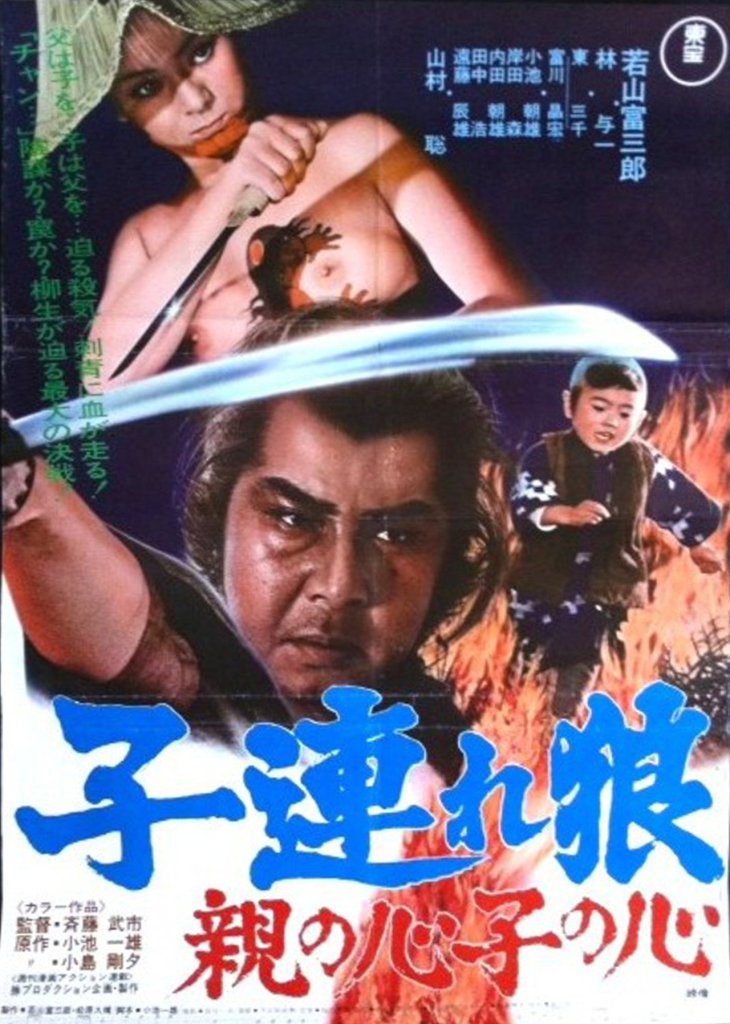 Now four instalments into the Lone Wolf and Cub series, Ogami (Tomisaburo Wakayama) and Daigoro (Akihiro Tomikawa) have been on the road for quite some time, seeking vengeance against the Yagyu clan who framed Ogami for treason, murdered his wife, and stole his prized position as the official Shogun executioner. Lone Wolf and Cub: Baby Cart in Peril (子連れ狼 親の心子の心, Kozure Okami: Oya no Kokoro Ko no Kokoro) is the first in the series not to be directed by Kenji Misumi (though he would return for the following chapter) and the change in approach is very much in evidence as veteran Nikkatsu director Buichi Saito picks up the reins and takes things in a much more active, full on ‘70s exploitation direction. Where
 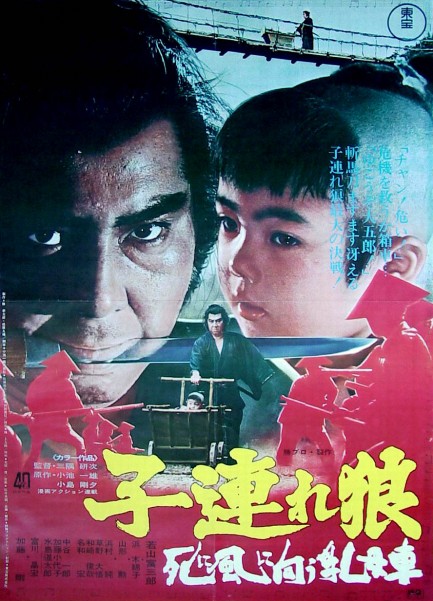 Ogami Itto (Tomisaburo Wakayama) and his (slightly less) young son Daigoro (Akihiro Tomikawa) are going to hell in a baby cart in this third instalment of the six film series, Lone Wolf and Cub: Baby Cart to Hades (子連れ狼 死に風に向う乳母車, Kozure Okami: Shinikazeni Mukau Ubaguruma). The former shogun executioner, framed for treason by the villainous Yagyu clan intent on assuming his position, is still on the “Demon’s Way”, seeking vengeance and the restoration of his clan’s honour with his toddler son safely ensconced within a bamboo cart which also holds its fair share of secrets. In the previous chapter,
 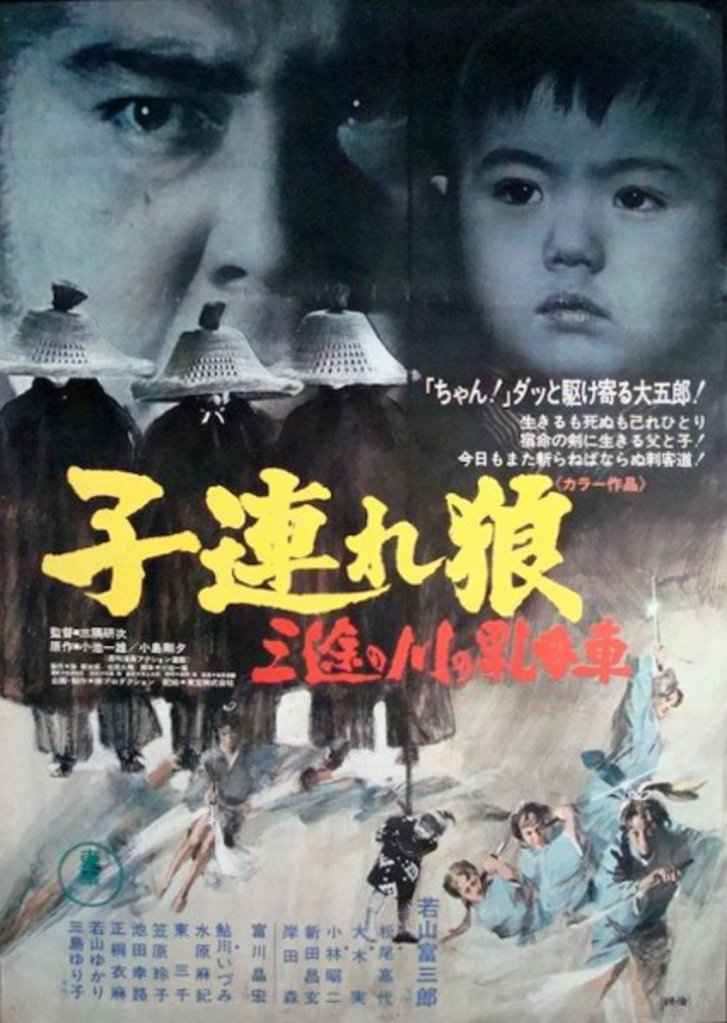 The first instalment of the
  Windows on Worlds