The Good Fairy (善魔, Keisuke Kinoshita, 1951)

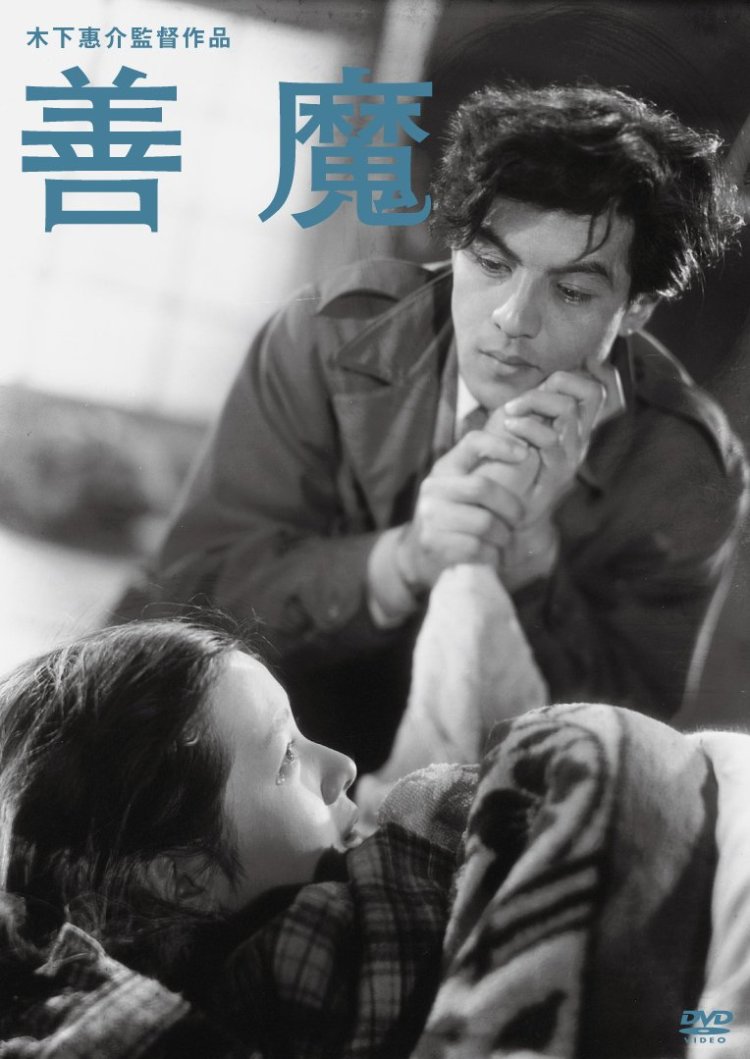
Good fairy DVDAlthough one of the more prominent names in post-war cinema, the work of Keisuke Kinoshita has often been out of fashion, derided for its sentimental naivety. It is true to say that Kinoshita values heroes whose essential goodness improves the world around them though that is not to say that he is entirely without sympathy for the conflicted or imperfect even if his equanimity begins to waver with age. 1951’s The Good Fairy (善魔, Zemma), however, working from a script penned not by himself but Kogo Noda and adapted from the novel by Kunio Kishida, seems to turn his life philosophy on its head, wondering whether the tyranny of puritanical goodness is an evil in itself or merely the best weapon against it.

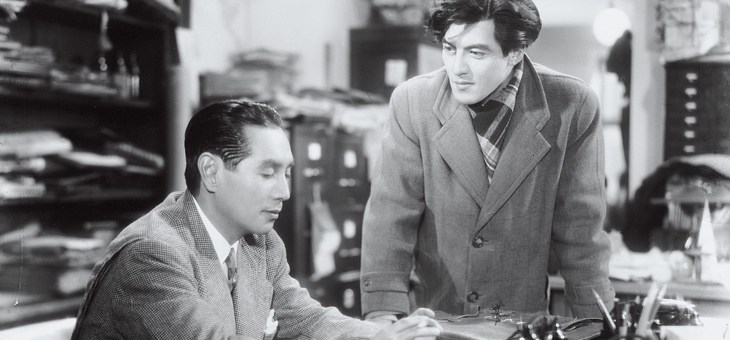
After beginning with a hellish, ominous title sequence set against the flames, the film opens with newspaper editor Nakanuma (Masayuki Mori) getting a hot tip regarding a politician’s wife who seems to have mysteriously disappeared. He hands the assignment to rookie reporter Rentaro Mikuni (played by the actor Rentaro Mikuni who subsequently took his stage name from this his debut role) who specialises in political corruption. Mikuni doesn’t like the assignment. He thinks it’s unethical and whatever happens between a man and his wife is no one’s business, but ends up going to see the politician, Kitaura (Koreya Senda), anyway and instantly dislikes him. Mildly worried by Kitaura’s lack of concern over his wife’s sudden absence, Mikuni stays on the case and visits the wife’s father (Chishu Ryu) up in the mountains where he also meets her sister, Mikako (Yoko Katsuragi), who eventually leads him to the woman herself, Itsuko (Chikage Awashima), who has taken refuge with a friend after becoming disillusioned with her husband’s “vulgar” pursuit of success at the continuing cost of human decency.

To pull back for a second, in any other Kinoshita film, Itsuko would be among the heroes in standing up against her husband’s corrupting influences, but for reasons which will later be explained she lingers on the borders of righteousness owing to having made a mistaken choice in her youth which was, in many ways, defined by the times in which she lived. Nukanuma had not been entirely honest with Mikuni in that he had known and secretly been in love with Itsuko when they were both students but he was poor and diffident and so he never declared himself, his only attempt to hint as his feelings either tragically or wilfully misunderstood. Where Itsuko, who married for money and status as a young woman was expected to do in the pre-war society, has mellowed with age and gained compassionate morality, Nakanuma who became a reporter to fight for justice against the background of fascist oppression has become cynical and selfish. Never having quite forgotten Itsuko, he has been in a casual relationship with a young actress, Suzue (Toshiko Kobayashi), for the last two years never realising that she has really fallen in love with him.

Thinking back on his college relationship with Itsuko, Nakanuma remembers talking with her about unsuccessful romances, that if a man tries his best to make a woman happy but isn’t able to then it must be because she doesn’t love him. Itsuko agrees, adding that men never seem to know what makes a woman happy in love but that friendship is a different matter. She says something similar when she tells him she’s getting married but doesn’t want to lose his friendship, and when he begins floating the idea of marriage hinting that he wants to marry her but perhaps giving the mistaken impression that there’s someone else in stating that it’s sad when a friend marries because the relationship with never be the same again and knowing that he intends to marry she now treasures their friendship even more. In a sense, Nakanuma thinks of Suzue as a “friend” with whom he occasionally sleeps, believing that their relationship is only ever liminal and temporary but mutually beneficial and capable of continuing even if the sexual component had to end.

Having failed once in love, Nakanuma is resolved not to do so again and determined to fight to win Itsuko rather than lose her through cowardice, but to do so he will cruelly wound Suzue who has treated him with nothing other than tenderness. By this time, Mikuni has fallen in chaste, innocent love with Mikako who reminds him of the parts of himself he feels are being erased by his compromising job as part of the mass media machine. Mikuni’s terrifying “goodness” is largely a positive quality which leads him to fight for justice against oppression even within his own organisation but his love for the saintly Mikako only intensifies his moral purity and threatens not only to turn him into an insufferable prig but to create in him a new oppressor, spreading guilt and unhappiness like the self-righteous hero of an Ibsen play.

Early on, following their mild disagreement about journalistic ethics, Mikuni and Nakanuma have dinner together over which they debate the power of the press to bring about social change and hold power to account. Nakanuma says he’s become cynical because hating injustice isn’t enough and there’s nothing that the individual can do against an oppressive system. What he’s telling Mikuni is that he used to be like him, but time has taught him righteousness is not an effective weapon against entrenched social privilege. He recounts a dark story from a Buddhist monk who told him that good can never win over evil because it isn’t strong enough, only evil is strong enough to fight evil and so in order to counter it you will need to affect its weapons. Later, crazed by grief and exhaustion, Mikuni’s “goodness” seems to pulse out of him with ominous supernatural force as he takes Nakanuma to task for his callous treatment of Suzue only for he and Itsuko to come to the conclusion that they’ve heard the voice of “evil” and are now condemned by their past choices to lives of morally pure unhappiness.

This central conundrum seems to contradict Kinoshita’s otherwise open philosophies in its unwelcome rigidity which says that there are no second chances and no possibility of ever moving on from the past with positivity. Itsuko made the “wrong” choice when she was young in choosing to marry for material gain, but she was only making the choice her society expected her to make in the absence of other options – it wasn’t as if she had any reason to wait around for Nakanuma whose regret over his romantic cowardice has made him cold and bitter. She realised her mistake too late and resolved to correct it, but the “Good Fairy” won’t let her, it says she has to pay (for the crimes of an oppressive society) by sacrificing again her chance of happiness in the full knowledge of all she’s giving up. Kinoshita’s films advocate the right to love by will, free of oppressive social codes or obligations but Itsuko is denied a romantic resolution despite having “reformed” herself and made consistently “correct” choices since discovering her husband’s “fraud”. She is denied this largely because of Nakunuma’s failing in being unkind to one who loved him, which is, in a round about way, still her fault for not having realised he loved her and deciding to marry him instead. In fact, the only one who seems to get off scot-free is Kitaura whose fraudulent activities will be covered up on the condition he consent to Itsuko’s divorce petition and sets her fully “free” so she can be fully burdened by the weight of her romantic sacrifice.

In the end, it’s difficult to see a positive outcome which could emerge from all this unhappiness which seems primed only to spread and reproduce itself with potentially disastrous consequences. Mikuni’s purity has become puritanical, unforgiving and rigid, condemning all to a hellish misery from which there can be no escape. The cure is worse than the disease. No one could live like this, and no one should. Goodness, tempered by compassion and understanding, might not be enough to fight the darkness all alone but it might be better to live in the half-light than in the hellish flickering of the fires of righteousness.


Title sequence and opening scene (no subtitles)
Growing Up (たけくらべ, Heinosuke Gosho, 1955)

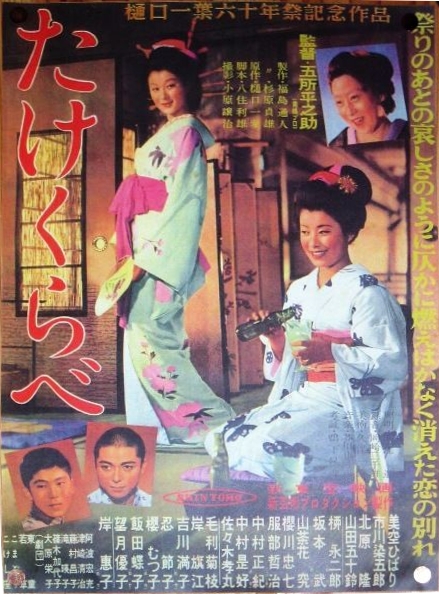
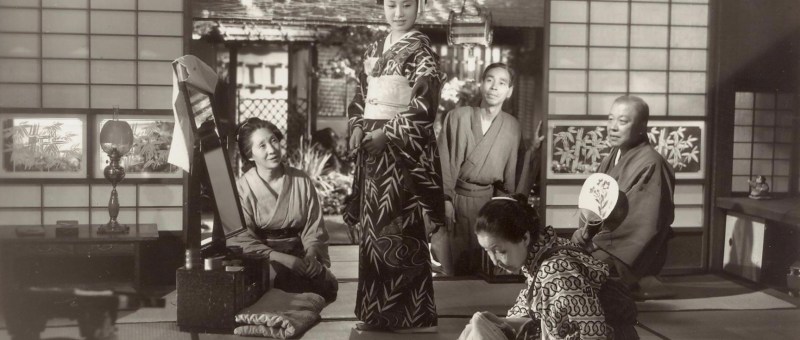
Gosho Growing UpCaught in a moment of transition, it’s no great mystery that post-war Japanese cinema began to look back at the Meiji past. Progress had indeed been rapid but ended in national tragedy and collective madness. The post-war humanists were eager for a different outcome, to avoid the mistakes of the last fifty years and build a society that was kinder and freer than that which had come before. Though on the surface it might seem as if much had changed since the dawn of a new century, the problems were still the same and a failure to address them only likely to add new tragedies in place of the better future many hoped for. Among the foremost proponents of post-war humanism, Heinosuke Gosho made a rare trip back into the Meiji past in 1955’s Growing Up (たけくらべ, Takekurabe), an adaptation of the well known short story by Ichiyo Higuchi, finding that nothing much had really changed when it came to the fates of women and the poor in an often wilfully indifferent society.

The action opens on the outskirts of the Yoshiwara in 1894. Our heroes are a collection of children who find themselves dealing with typically adolescent problems but also, by modern standards, expected to grow up all too fast. Chief among them is 13-year-old Midori (Hibari Misora) whose sister, Omaki (Keiko Kishi), is the most famous courtesan of the red light district. Although she knows on some level that her parents have already sold her to the brothel owner in whose house they live as servants, Midori has not yet quite processed the full implications of her destiny or that her world of childhood innocence is rapidly drawing to a close. She is in love with a local boy, Shinnyo (Takashi Kitahara), who seems to return her feelings but is as awkward and confused by them as any teenage boy and treats her by turns with coldness and contempt mixed with grudging affection.

Shinnyo, meanwhile, is the son of a greedy and heartless monk (Takamaru Sasaki) who has decided to sell his older sister as a concubine to a wealthy man who already has a wife. As he loves his sister dearly and has a naive, childish sense of absolute morality, this is a sin Shinnyo cannot forgive. He argues with his father but has no real power to change the situation and then decides on rebelling against his father’s wishes that he not become a monk by leaving for the main temple in Kyoto to take holy orders. Of course, this also means he must sacrifice any youthful idea he might have had of pursuing his love for Midori.

The title, in a sense, could refer not only to the increasingly melancholy youngsters coming of age in an oppressive society, but also to Japan itself as it emerged into modernity in an effort to prove itself the equal of any other major power in the late 19th century. It is, however, an ironic a title as any could be. To “grow up” here is to abandon one’s humanity and conform to the kind of “real world” thinking that codifies cruelty and makes a virtue of heartlessness. Still an innocent child, Midori bounces her ball and basks in her somewhat elevated position as a wealthy young girl and sister of a “notorious” woman without fully understanding all that entails. When her sister tells her about a dream she had of climbing trees and picking persimmons, she is incapable of understanding her warning about the loss of innocence she’s about to experience, but her world is brought crashing down when a gang of rival boys rudely attack her and point out that all her finery was bought through “whoring” and that she is nothing more than a “whore” in waiting.

Another of the boys, Sangoro (Masanori Nakamura), whose family is poor, says he can’t wait to be “grown up”, reacting with less than sensitivity to Midori’s pained pleas that she wishes everything could stay as it was and they could be children forever. Sangoro sees adulthood as freedom. He’ll be free to earn his own living and maybe he won’t have to be like his father, too afraid to stand up to people with money because when you don’t have any you’re always reliant on their kindness. Sangoro may be poor, but he’s a man (or will be) and can’t process the total lack of agency that comes with being an adult female whose future is decided entirely by her closest male relative. Midori, like Shinnyo’s sister, has been sold by her father and there’s nothing she or anyone else can do about it now.

Nevertheless, confronted by her fate, Midori decides to own it. She encourages her parents to think of her as dead, cooly hitting back at their callousness but acknowledging an obligation as she goes. The final scenes preceding her passage across the small bridge which will forever sever her from her childhood are filled with dread and anger as if crying out for someone to stop the inevitable from happening, but of course, no one can. An old woman and former courtesan, Okichi (Isuzu Yamada), who owns a shop where Midori used to spend time and is indirectly responsible for Midori’s acceptance of her fate in some cruel, drunken words she threw at her, puts it best when she briefly feels as if she could have done something in affirming that it isn’t her fault, and it isn’t Midori’s, it’s simply “the world”.

Midori meets her fate not with resignation but rage and defiance. Shinnyo, who runs away from his inability to help his sister by becoming a monk, is forever incapable of declaring his real feelings in words but leaves a flower in front of her window in echo of another he gave her long ago. At first Midori picks it up and cherishes it for the innocent symbol of love that it is, but by the time she has travelled half way along the bridge which will take her to the Yoshiwara, she has realised this kind of innocence does not belong inside. She throws the flower to the mud and leaves her youthful dreams of love and happiness behind as she prepares to step through the doorway into a future which is not of her making and over which she has no say. To “grow up”, in this world, is a kind of spiritual death in which there exists nothing other than emptiness and indifference.


Tokyo Profile (都会の横顔, Hiroshi Shimizu, 1953)

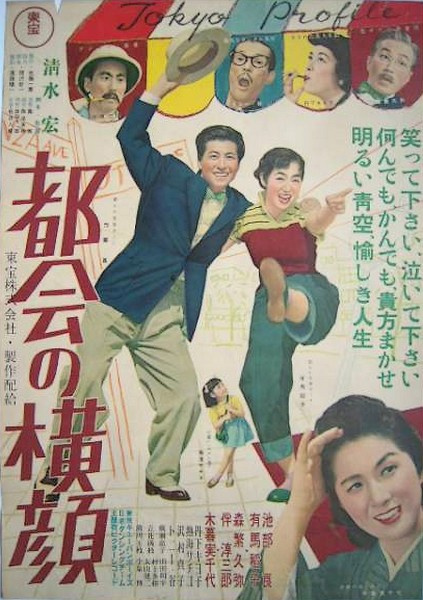
Tokyo Profile posterJudging by the vision presented in the cinema of the time, the Japan of 1953 was one still fighting to emerge from post-war disillusionment and destruction. Set in the glittering Ginza, Hiroshi Shimizu’s Tokyo Profile (都会の横顔,Tokai no Yokogao) is, like much of the director’s work, a more cheerful affair. This world is a very different one from the dingy attics and rundown tenements of the average social drama in which the struggling urban poor battle economic impossibilities while earnestly investing in their future, a somewhat barbed aspirational comedy which lays bare the increasing gap between rich and poor but in a humorous, perhaps resigned fashion save for its strangely cutting finale.

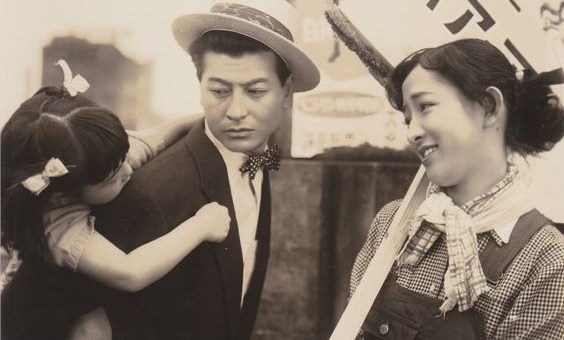
Shooting once again almost entirely on location, Shimizu opens with a lengthy shot captured from the back of a tram traveling through contemporary Ginza – then and now an elegant and refined part of town home to numerous upscale department stores from all around the world. It’s an ordinary Saturday afternoon and the streets are only middling busy. A crowd has gathered around something mysterious, gradually attracting more people and becoming a spectacle in its own right. Thankfully there hasn’t been an accident. A shoeshine girl (Ineko Arima) is trying to comfort a crying child, Michiko (Sachiko Atami), who has become separated from her mother. Michiko is five years old and knows her parents’ names by rote, but all she can tell the concerned people trying to help about her home is the general vicinity it might be located in and that it’s next to Yoshiko’s house, which is not very helpful. Luckily a young man, nicknamed “Mr. Sandwich”  (Ryo Ikebe) because he’s one of Ginza’s many sign carriers, offers to take her to the police station while looking around and attracting attention with his sign (and patented silly walk) in case they spot her mum in the street.

Meanwhile, Michiko’s mother Asako (Michiyo Kogure) is wandering around frantically terrified she might never see her daughter again. Unfortunately she is accosted by a pushy neighbour who promises to help her look for Michiko but keeps pulling her into other business before finally landing her with the bill for two cream sodas which, needless to say, she cannot afford (and didn’t even want).

Michiko and her family are from Meguro which is quite a way out from the centre of the city and one gets the impression this is quite a rare day out for them. Michiko is very excited when she tells the shoeshine girl that they came to buy her a hat and a pair of red shoes, but as we later hear from Asako, Michiko’s presents are tiny splash of luxury in an otherwise economically anxious home. Shinji, Michiko’s father, was a Lieutenant-Commander during in the war but like many of his generation found himself unwanted after its end and struggled to find proper employment. Much to the family’s relief, he’s recently got a steady job as an accountant, but it still doesn’t pay enough to live on. Wanting to buy summer clothes for the children, Shinji worked overtime and walked to work rather than taking the train but little Yoshiko’s parents have bought her little red shoes and now Michiko wants a pair too. Doting parents, Asako and Shinji feel dreadful that they aren’t able to buy their daughter the things that other children have, but today she’s come to Ginza to see what she can do with what she has (which isn’t much either way).

Shimizu follows Michiko as she travels round the city with various adults looking for her mum but also having a grand adventure. Though she was originally quite distressed, Michiko is a clever little girl and quickly decides to start having fun instead of being sad. The sandwich man takes her all around Ginza, bumping into various people that he knows including a philandering boyfriend and the girl waiting for him, the girl he was with who has several boyfriends but has the most fun when standing them up, a shady gangster type not normally around during the day (he’s on his way to Osaka), and a geisha girl who’s taking classes in English for the “service” industry from an extremely camp instructor.

The irony is that Michiko and her family aside, the sandwich man, shoeshine girl, and everyone else they meet are people with no money who earn their living on the streets where rich people come to play. The gangster offers sandwich man a cigarette and he takes it, only to consider throwing it away when he sniffs it and realises it’s a cheap and nasty variety. Meanwhile, Asako’s horrible neighbour convinces her to ask a streetside psychic to help finding Michiko but he keeps interrupting their consultation to chase after discarded cigarette butts which he puts in a big pot and later smokes with the help of his pipe-like cigarette holder. The people who come to Ginza to play don’t care about smoking their cigarettes down to the last because they know they can buy more. Streetside psychics can’t even afford to buy any.

Nevertheless, no one seems to be unhappy with their life in Ginza. Sandwich man is nursing a crush on shoeshine girl which she might or might not return. So obviously good with children he longs for many, which is a problem because the one thing shoeshine girl dislikes about the city is that there are too many people – she only wants two. His desire for a big family means he doesn’t envisage spending the rest of his life as a sandwich man, but then it seems to be alright for the time being while he waits for something better to come along (which he seems to think it will). Shimizu takes us on a jaunty journey through the glitzy Ginza, taking in the musical halls and cafes while now famous tunes celebrating the area play unironically in the background, but as much as he celebrates the aspirational swankiness of the recovering city he’s always keen to remind us that not everyone who lives here lives in the same world and little girls like Michiko risk getting left behind for good if no one stops to think about that.


Thus Another Day (今日もまたかくてありなん, Keisuke Kinoshita, 1959)

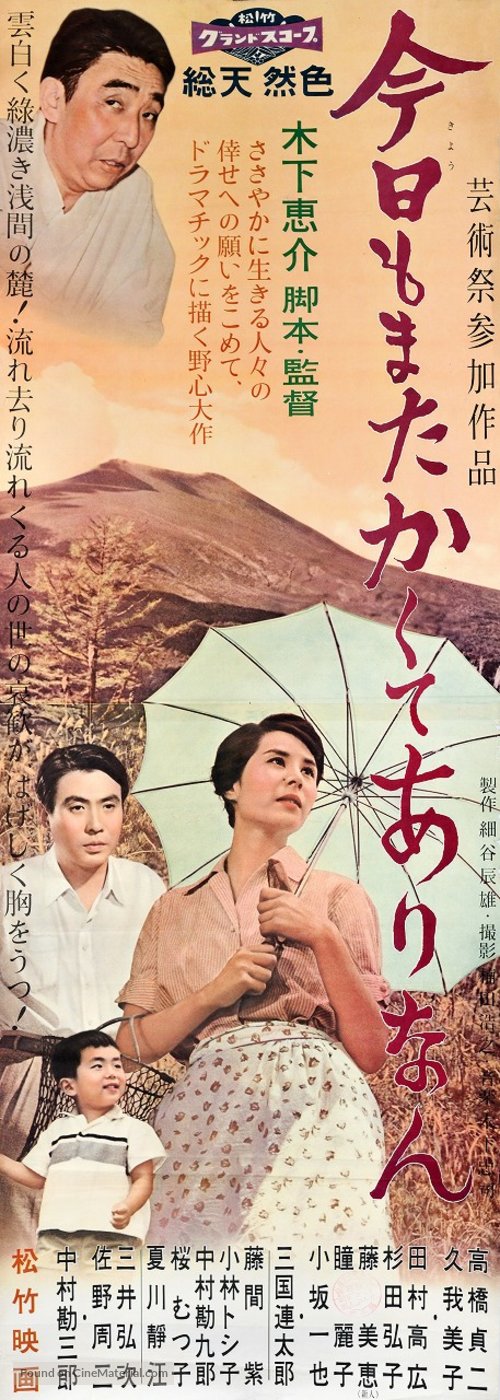
Thus Another Day vertical bannerThe cinema of the immediate post-war era, contrary to expectation, is generally hopeful and filled with the spirit of industry. Keisuke Kinoshita might be thought of as the primary proponent of post-war humanism in his fierce defence of the power of human goodness, but looking below the surface he’s also among the most critical of what the modern Japan was becoming, worried about a gradual loss of values in an increasingly consumerist society which refuses to deal with its wartime trauma in favour of burying itself in intense forward motion.

The housewife at the centre of Thus Another Day (今日もまたかくてありなん, Kyo mo mata Kakute ari nan), Yasuko (Yoshiko Kuga), is a perfect example of this internal conflict. She and her husband Shoichi (Teiji Takahashi) have built a modest house way out of the city in the still underdeveloped suburbs for which they are still burdened by an oppressive mortgage. Shoichi has a regular job as an entry level salaryman but his pay is extremely low and Yasuko is forced to scrimp and save just to get by. The central conflict occurs one summer when Shoichi’s boss declares he’s looking to rent a summer house in the quiet area where the family live. Shoichi thinks it would be a great idea to rent out their house to his boss earning both money and favour. Yasuko can go stay with her family who live in a pleasant resort town while he will stay with a friend in a city apartment. Yasuko does not really like the idea, but ends up going along with it.

Shoichi is trying to live the salaryman dream, but it isn’t really going anywhere. Yasuko is home alone all day with the couple’s small son, Kazuo, who is too young to understand why the family lives the way it does and continuously asks probing questions which upset and embarrass his mother. Watching her painstakingly washing clothes by hand, Kazuo wants to know why they don’t have an electric washing machine like some of his friends’ mothers do. Yasuko tells him they’re saving money to get one, at which point he pipes up that he personally would rather have a TV set. Like his father, he is rather self-centred but being only four can perhaps be forgiven. Nevertheless, Yasuko is constantly embarrassed by the family’s relative poverty. When another neighbour spots her out shopping and decides to accompany her, she is visibly distressed that the stall she takes her to is a little more expensive than the one she had in mind. Wanting to save face, she buys expensive fish but is mindful of there being less money for the rest of the week.

Meanwhile, Shoichi is obsessed with “getting ahead” by ingratiating himself with his bosses – hence why he decided to let out his own house over the summer. The house is, after all, Yasuko’s domain and she perhaps feels family atmosphere isn’t something you should be selling. She resents that the family will be split up over the summer even if it gives her an opportunity to visit her mother and sister out in the country. Even when Shochi arrives to visit, he makes them trot out to a neighbouring town to visit his boss’ wife also on holiday in the area, and stays there all day playing mahjong while Yasuko and Kazuo are bored out of their minds sitting idly by. The second time he doesn’t even bother to invite them.

The small resort town itself is something of a haven from the demands of the city but there is trouble and strife even here. Shortly after her arrival Yasuko meets a strange, rather sad middle-aged man who is a stay at home dad to his beloved little girl, Yoko. Takemura (Nakamura Kanzaburo XVIII) came of age in the militarist era, attending a military university to become one of the elite. The world changed on him and he remains unable to reconcile himself to the demands of the post-war society. Experiencing extreme survivor’s guilt, Takemura is filled with regret and resentment towards the ruined dreams of his misguided youth in which he abandoned a woman he loved to marry a wealthy man’s daughter who he has also let down by refusing his military pension, forcing her into the world of work and eventually onto the fringes of the sex trade as a hard drinking bar girl.

As if to underscore the looming danger, a thuggish gang of yakuza have also decided to spend the summer in the resort, holing up at the inn where Takemura’s wife is working. The young guys terrorise the youngsters of the town, disrupting the well established social hierarchy with acts of violence and intimidation. The punks cause particular consternation to Takemura who remembers all the men their age who went to war and never came back only for the successive generation to live like this. Having lost everything which made his life worth living, Takemura decides to take a stand against modern disorder, hoping to die in battle the way he feels he ought to have done all those years ago.

Thus Another Day is among the darkest of Kinoshita’s post-war dramas, suggesting that there really is no hope and that past innocence really has been lost for good. The values of Takemura’s youth, however, would not perhaps line up particularly well with those most often advanced in Kinoshita’s cinema, as kind and melancholy as he seems to be. Yasuko goes back to her crushing world of unfulfillable aspirations with her obsequious husband and demanding son with only gentle wind chimes to remind her of happier days while she tries to reaccommodate herself to the soullessness of post-war consumerism .


Original trailer (no subtitles)

Farewell to Spring (惜春鳥, Keisuke Kinoshita, 1959)

(C) Shochiku 1959

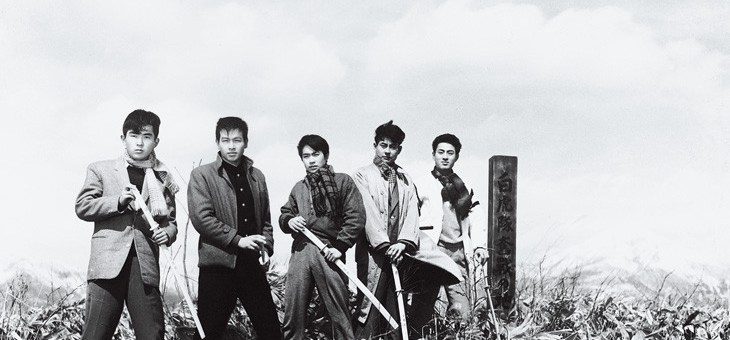
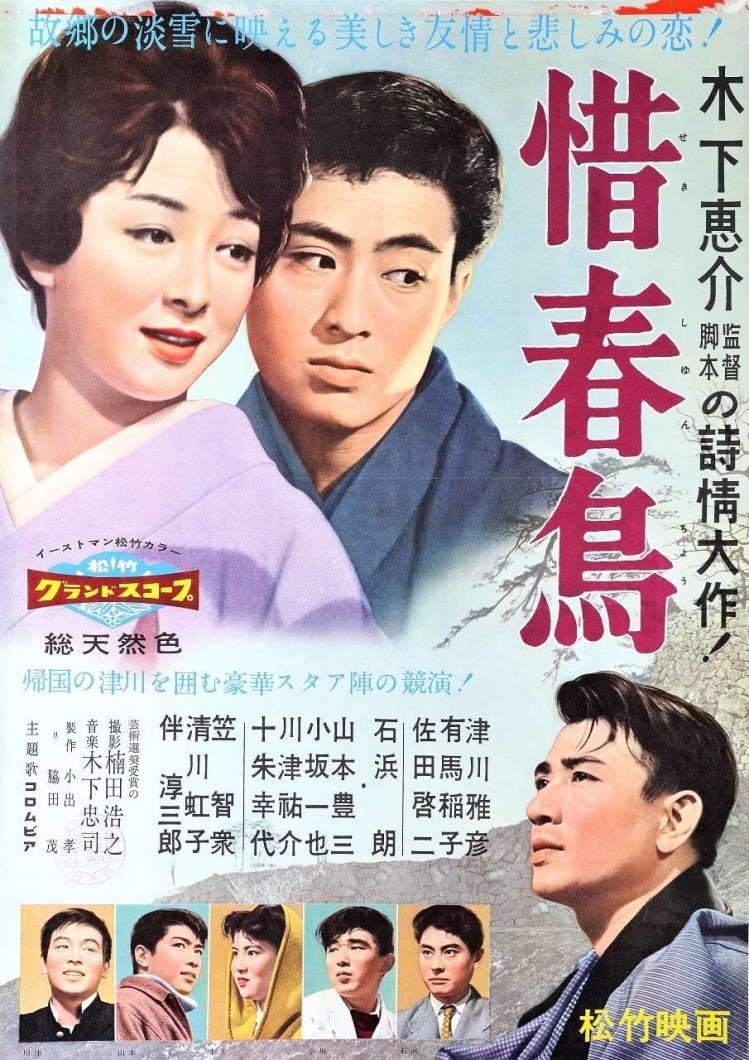
Farewell to Spring posterFor Keisuke Kinoshita, people are basically good even if the world around them often isn’t. Even so, there are limits to goodness. Can friendship survive if an intimate trust is abused, or will betrayal cut the cord once and for all? Unlike many of his contemporaries, “youth” was not a theme in which Kinoshita was particularly interested – or, at least, not quite in the same way. Farewell to Spring (惜春鳥, Sekishuncho) is in some senses an awkward fit for his usual concerns but then the concerns here are perhaps closer to the personal in examining the changing fortunes of a group of five male childhood friends who find themselves scattered in the complicated post-war landscape, facing their mutual troubles in solitary, manly fashion while their friendship withers under the weight of their individual sorrows.

The drama begins when Iwagaki (Yusuke Kawazu) returns to his Aizu mountain village after being away at university for the previous two years. As Iwagaki’s parents have died and his half-brother moved to Hokkaido with his family, Iwagaki has no “home” in his hometown as he sadly tells a familiar face spotted on the train. Nevertheless, his friends are very excited to see him and have all rallied round without even being asked. Iwagaki will be staying at an inn owned by the family of his friend, Minemura (Kazuya Kosaka). The other boys all stayed in the village – Makita (Masahiko Tsugawa), the illegitimate son of a bar owner is being primed to take over the family business while sort of dating the step-daughter of his estranged father; Teshirogi (Akira Ishihama), the younger son of an impoverished former samurai family, is working at a local factory and heavily involved in the labour movement; while Masugi (Toyozo Yamamoto), who is disabled with a lame leg thanks to a childhood accident, works alongside his parents in a traditional lacquerwork shop but finds his livelihood threatened by political troubles with China.

Once a tight group of small-town friends, none of the boys quite wants to acknowledge how far they have drifted apart – not just from each other, but from the young men they once were even though comparatively little time has actually passed. Nevertheless, the shadow of their old bond still exists – it is obvious to all the boys that Iwagaki has returned in some kind of disgrace. A favourite of their teacher, Iwagaki had been given a valuable opportunity to better himself by going to university in Tokyo but has apparently fallen out with his sponsor and into hard times. The story he tells his friends is dark – they’d heard it had to do with a “dalliance” with a maid which annoyed his patron but the way he describes it sounds more like a rape revenge followed by an unwanted romance which he eventually ran away from. Iwagaki is not making himself look good which might suggest that he trusts his friends enough to tell them the truth, or perhaps just doesn’t quite see the various ways in which his conduct discredits him, but either way there is deepening gulf between each of the men in which none is quite being honest with the other.

Iwagaki’s arrival doesn’t so much stir up old troubles as occur alongside them. The central drama revolves around a squaring off between Makita and Teshirogi over a girl, Yoko (Yukiyo Toake), who is the niece of Makita’s biological father – a nouveau riche pawnbroker with a steely wife, Tane (Teruko Kishi), who hates Makita’s mother for obvious reasons. The mistress and the wife are locked into an internecine battle of wills and resentments and so both are opposed to a marriage between Makita and Yoko even though they have fallen in love independently. As there is no son in the family, Makita’s father needs someone to marry in through marrying Yoko – it would obviously be ideal for him if his “real” son could inherit his estate, but Makita’s mother wants him to take over her bar and Tane is directly opposed to suffering the humiliation of a mistress’ son living under her roof and so they are at an impasse. Meanwhile, Tane has been trying to arrange a socially beneficial marriage and has settled on Teshirogi – the impoverished son of an aristocratic family.

A confluence of post-war problems, the first question pits the traditional arranged marriage against the youngster’s right to choose. Yoko doesn’t want the arranged marriage – she’s doing everything she can to fight it even if she ends up alone, but Makita has already given up believing the situation is futile. Teshirogi tries to ask him if it’s OK to pursue Yoko, but Makita doesn’t really answer. What he says is does as you see fit, but Teshirogi hears only what he wants to hear and fails to notice that Makita minds quite a lot and has only said that out of a sense of despondency and a possible romanticisation of his emotional suffering. Yoko is living in the post-war reality – she rejects the idea of arranged marriage and of her adoptive parents’ right to control her future, but she is unable to fully resist alone – she needs Makita to stand with her, but he doesn’t have her courage. Meanwhile, Makita is also consumed by thoughts of romantic impossibility thanks to the sad story of his melancholy uncle (Keiji Sada) who tried to run off with a geisha (Ineko Arima) only for her to be dragged back by her madam because of an outstanding debt.

Debt bondage is something else that’s thankfully on its way out in the post-war world thanks to the prostitution laws which are contributing to a decline in the fortunes of Minemura’s inn. Feudalism, however, is doing its best to cling on – especially in tiny mountain backwaters. Teshirogi may now be a proletarian factory worker flying the red flag and taking an active part in the labour movement as a striker protesting for better pay and conditions, but at heart he’s still a nobleman and has a natural sense of entitlement and superiority towards his friends which is only deepened by his resentment over his comparative financial inferiority. Yoko asks him to turn down the marriage proposal because she’s in love with Makita and fears her family won’t listen to her alone, but Teshirogi roughly tells her he doesn’t care much for her feelings and will make his own decision. Later he insists on giving his answer “the proper way” by going through his father, and submits himself entirely to the processes of the pre-war society. Making a half-hearted justification to Makita, Teshirogi confesses that his decision to push for the marriage was motivated by his poverty and a desire to regain his status if also partly because he too is attracted to Yoko and admires her spiky spirit even if it otherwise seems to contradict his conservative views.

Teshirogi breaks the bro code in favour of self interest, not actually caring very much if it costs him friendships which he appears not to value. As openly gay as it was possible to be in the late 1950s, Kinoshita creates an intensely homosocial world of male honour-based bonding, but makes a tragic hero of the innocent Masugi who is in a sense feminised by his disability which prevents him from participating in the manly rituals of the other boys – most notably in the coming of age sword dance in which he becomes narrator rather than sword bearer. Teshirogi, in an early instance of smug insensitivity, throws a mildly barbed comment at Masugi in tersely suggesting that his affection for Iwagaki runs beyond friendship – something which the group seems to be aware of but does not want to go into, or at least not really like this. Masugi and Minemura emerge as the most pure hearted and the most hurt among the friends, clinging on to the idea of their friendship even as they are betrayed by those closest to them while Makita wonders if betrayal is an essential component of connection or merely its inevitable end.

Despite the central betrayal, the boys eventually manage to salvage something of their friendships, leaving the field of battle together and alive if also wounded and sorrowful. Unlike the tragic White Tigers in the song which recurs throughout the film who elected mass suicide on believing their battle was lost, the boys move forward – Makita, at least, spurred on by his uncle’s tragic romance decides that love is worth fighting for after all and that he doesn’t have to blindly accept the profound inertia of small-town Aizu life or the natural authority if the hypocritical Teshirogi who shouts socialist slogans but insists on his social superiority. Friendship may not survive the compromises of adulthood, but perhaps the bonds between people aren’t so easily broken after all even if they consistently break your heart.


Original trailer (no subtitles)

Ghost in the Well (怪談番町皿屋敷, Toshikazu Kono, 1957)

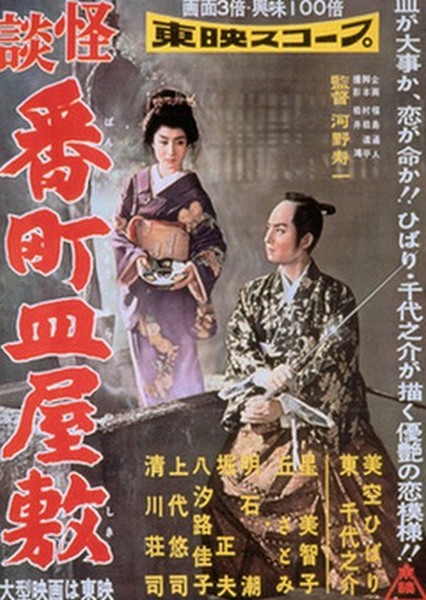
Ghost in the Well poster 2Love across the class divide threatens to overthrow the social order. Inspired by the classic folktale Bancho Sarayashiki, Ghost in the Well (怪談番町皿屋敷, Kaidan Bancho Sarayashiki) is indeed the story of a haunting though perhaps not altogether of the kind you might be expecting. This is a tale of romance, but also one of impossible love in which the only possible union is in death. The pure love of a servant girl is deemed incompatible with the oppressive world of samurai honour, and so she must die, but her lord cannot survive it. He cannot reconcile himself to having chosen to preserve his honour, his status, his lineage at the cost of her life and his love.

Rowdy samurai Harima (Chiyonosuke Azuma) loves making trouble in the streets. As the lord’s bannerman he knows he has a degree of status and likes to throw his weight around in the yoshiwara, much to the lord’s consternation. Harima has also taken a fancy to one of his maids, Okiku (Hibari Misora), who continues to reject his advances despite returning his affections because she knows the class difference makes a legitimate relationship between them impossible and a dalliance with her lord means losing the opportunity to marry anyone else. Harima tells her that there’s no such thing as status when it comes to love and that he doesn’t think of her as a passing infatuation. Eventually Okiku gives in and a kind of promise is made between them.

Nevertheless, it’s a promise which can’t be kept. The Aoyama family is in trouble and the obvious answer is to make a good match for Harima that will restore both status and wealth. When one of Harima’s friends is ordered to commit seppuku for the exact same petty punk antics Harima gets up to all the time matters come to a crunch. To keep him safe, Harima’s uncle arranges a marriage with an influential family. Harima tries to refuse but he too is more or less powerless even if he weren’t torn between the obligation to his samurai code and his illicit love for servant girl whom he would never be permitted to make his wife. To cement the match, Harima’s uncle has prepared 10 precious plates as a dowry, but Okiku, catching sight of Harima’s bride-to-be, drops one and breaks it in two. Her fate is sealed. Harima draws his sword on her and she backs away, eventually falling into the well and dying there.

The broken plate is, of course, a symbol of their broken covenant but also of Okiku’s shattered dreams as she watches a beautiful but haughty woman steal away her last hope of happiness solely through the accident of noble birth. As her friend tells her, a commoner cannot become the wife of a samurai and all Okiku can do is resign herself to her unhappy fate. Having broken the plate, however, all is lost. The men of the household admit their responsibility for entrusting the entirety of their future to a mere slip of a girl in the middle of intense heartbreak, but Okiku cannot go unpunished and Harima must claim his new life by destroying his past love.

Harima does what he’s supposed to do, if in passion and half by accident. Yet the marriage remains broken, the family in jeopardy, and Harima without hope of future. The ghost of Okiku, real or imagined, haunts him while he remains guilt ridden and filled with regrets. Despite his rowdiness and manly pride, he chose his samurai honour and condemned his one true love to a lonely death. Her love has, however, survived and resurrected her not as a demon of vengeance come to lead him to his doom but as a lovelorn woman keen to remind him of the promise he made and broke but which might be mended.

Harima pays for his transgressions, though more as a mischievous samurai who allowed his over inflated ego to convince him he had the right to oppress his fellow retainers than as a man who caused the death of an innocent woman, first by corrupting her and then by the same rigidity which has led to his present predicament. There can be no “love” in a such a society, let alone the love of a bannerman and a servant girl. Theirs is a blood wedding, uniting them in death, consumed by the impossibilities of the samurai era. At only 45 minutes, Ghost in the Well is perhaps a slight retelling of the tale and somewhat in imbalanced in its presentation of the fates of the two lovers but is nevertheless a refreshingly romantic take on an often dark story in which a scorned woman’s vengeance is reframed as a powerful condemnation of an oppressive society.


The Deep Blue Sea (青い海原, Tsuneo Kobayashi, 1957)

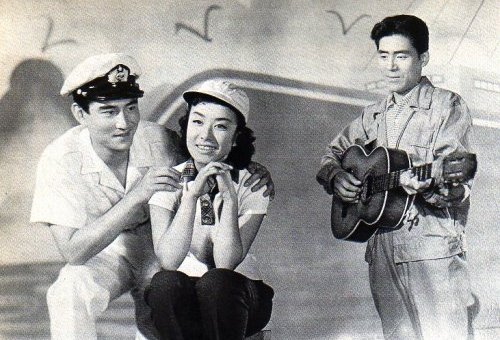
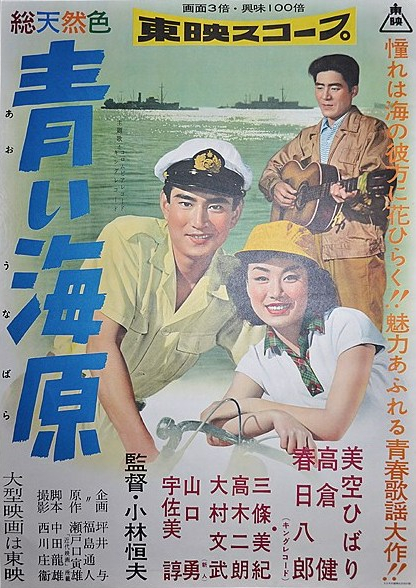
Deep Blue Sea posterHibari Misora turned 20 in 1957, but she’d already been working for eight years and was well on her way to becoming one of the most successful stars of the post-war era. The Deep Blue Sea (青い海原, Aoi Unabara) is one of her earliest grown up musical dramas and finds her sharing the bill with another of the biggest acts of the day in Hachiro Kasuga who, despite being stuck in second lead limbo, does the bulk of the musical heavy lifting. It also sees her star opposite an actor who would become her frequent leading man which might come as something of a surprise to those most familiar with his later work – Ken Takakura, then very fresh faced and playing the juvenile lead.

The action begins with Takakura’s Ken as the stranger who walks into town. In fact he’s not that much of a stranger – he runs into an acquaintance, Saburo (Hachiro Kasuga), right away, but he’s come on a mission. He’s looking for the friend of a man who died in an accident on his boat in order to give him a photograph and some money he’d saved for the daughter he had to leave behind. Before any of that happens, however, he ends up in a meet cute with Misora’s Harumi who manages to tip a whole bucket of water over him, and then later a jug of beer when he fetches up at the bar where she works (and where Saburo is a regular). As coincidence would have it, the man Ken is looking for also lives at the bar and is actually Harumi’s father. Harumi never knew she was adopted and is stunned when she overhears the conversation between the two men but decides to go on pretending not to know anything.

The real drama revolves around a lecherous gangster, Sakazaki (Isamu Yamaguchi), who is having an “affair” with the owner of the bar where Harumi and her dad live. He’s taken a liking to Harumi who wants nothing to do with him, but when her dad gets into an accident and needs money for medical treatment, Saburo makes a deal and unwittingly gives him an additional angle to start railroading Harumi into his arms.

Director Tsuneo Kobayashi would later be best known for genre pieces and tokusatsu. Besides some quite beautiful and unusually convincing work with backdrops, there are no shocks or special effects in Deep Blue Sea but there is plenty of music, most of it sung by Hachiro Kasuga with Misora taking centre stage for a few solo numbers of her own as well as humming an odd tune here and there. Despite not being an integrated musical (all of the songs have a diegetic genesis) and in contrast with many of Misora’s films, The Deep Blue Sea is otherwise a fairly typical musical drama in which the songs drive the narrative rather than being an aside to it.

It does however begin to blur genres, shifting into familiar Toei territory with the introduction of the sleazy yakuza tough guys who are willing to go to quite a lot of trouble to ruin the life of an ordinary girl like Harumi. The central romance follows a familiar pattern as Ken comes to care about Harumi and her dad through his connection with her birth father and becomes their noble protector, while Saburo, who’d silently harboured a crush on Harumi all along hovers sadly on the sidelines, wanting to support his friends in their romantic endeavour but also somewhat grateful when Ken decides to sacrifice himself on Harumi’s behalf. Ken’s sacrifice, however, doesn’t entirely work – you can’t get rid of men like Sakazaki through honest or logical ways and simply paying them off is never enough, in fact it might just make everything worse.

The Deep Blue Sea may be a little darker than most musical romances with its seedy port town setting, gangsters, smuggling action, and the constant sense of things always floating away with the boats that come and go, but in true musical fashion it all works out in the end. Despite learning that she is adopted and that a wealthier blood relative was keen to take her in, Harumi chooses to stay with her adopted father, steadfastly choosing real feeling over blood ties or pragmatic concerns – unlike the greedy bar owner who steals the money her father left her, or the nefarious gangster who tries to manipulate her into giving up her principles and stepping into his world of betrayal and avarice. As usual for a Toei film, the forces of good (for a given definition of “good”) eventually triumph and the bad pay for all their mistakes while the merely unlucky accept their fates with good grace and resolve to make the most of new opportunities. It may not have made any great waves, but The Deep Blue Sea is cheerful and fun and chock full of post-war humanism as the noble Ken comes to the rescue of the goodhearted Harumi and her steadfast father to stand up against the forces of corruption.


Some of Hibari’s musical numbers (no subtitles)

Bloody Spear at Mount Fuji (血槍富士, Tomu Uchida, 1955)

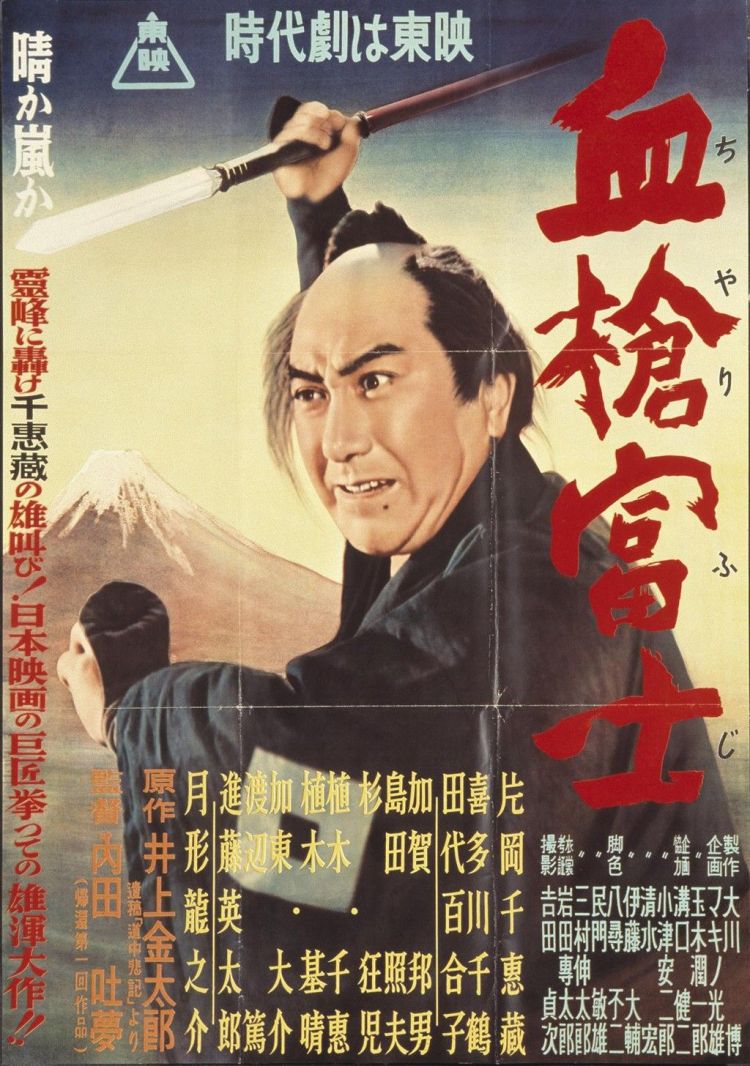
Bloody Spear Mount Fuji posterThere was a reason that the occupation authorities were suspicious of period films, but the jidaigeki of the post-war years are not generally interested in nationalistic pride so much as in interrogating the myths of the samurai legacy in order to pick apart the compromises of the modern era and the follies of the immediate past. Tomu Uchida had been among the most prominent directors of pre-war cinema but left to join the Manchurian Film Cooperative in 1942, remaining in China until 1953. Bloody Spear at Mount Fuji (血槍富士, Chiyari Fuji) was his “comeback” film, brought into existence through the good offices of fellow directors Yasujiro Ozu, Hiroshi Shimizu, and Daisuke Ito who had been the pioneer of samurai movies in the silent era. Like the later films of Masaki Kobayashi, Uchida takes aim at the hypocritical falsehoods of the samurai order and at a series of still prevalent social codes which oblige one human to oppress another in order to avoid acknowledging the fact that one is oneself oppressed.

Ironically enough we begin on the road to Edo as a goodhearted but compromised samurai, Sawaka (Teruo Shimada), makes the journey to the capital to make his name with a precious teacup in tow. He may be a samurai, but he’s making this lengthy journey on foot and accompanied by only two retainers – veteran spearman Genpachi (Chiezo Kataoka), and manservant Genta (Daisuke Kento). While on the road, the trio come across various other travellers including a shamisen player (Chizuru Kitagawa) and her daughter, a cheeky orphan who wants to be a samurai, and a melancholy father and daughter en route to visit a relative in the hope of financial assistance. There is also a notorious bandit on the loose going by the name of Rokuemon, which is one reason that the “recently wealthy” miner Tozaburo (Ryunosuke Tsukigata) is arousing suspicion with local law enforcement.

In contrast to many a jidaigeki epic, the travellers on the road to Edo are mostly good people if wise enough to be wary and on the look out for trouble. Genta and Genpachi have been given strict instructions that Sawaka is not to drink during the journey. Though he’s a nice enough soul when sober, Sawaka is a mean drunk with a tendency to start random fights and his mother doesn’t want him messing up his big chance by causing trouble on the road. This maternal solicitude can’t help but annoy Sawaka who overhears Genta complaining to a servant at the inn as he enjoys a quick glass of solo sake in the kitchen. There may be a sword on Sawaka’s belt, but he’s a middle ranker at best – something rammed home to him when the party is held up by a roadblock which turns out to be solely caused by three elite samurai having a picnic who wish to enjoy the view uninterrupted. Later he grips the handle on his sword in rage and desire to help a young woman in trouble before his hand begins to slip as he realises how little power he really has. The only thing to help her was money, and money is something Sawaka evidently does not have.

Sawaka’s “power” is entirely illusionary and dictated by the complex hierarchies of the samurai era. Breaking all the rules, he considers selling his “priceless ancestral spear” to get money to help the girl, but is told that the spear is a fake and hardly worth anything. With the help of the plucky little boy Jiro, Genpachi helps to apprehend a wanted criminal but it’s Sawaka who gets a commendation – something which causes him not a little consternation but his attempts to transfer the praise onto the rightful parties falls on deaf ears. In any case, the reward is just a piece of paper filled with more empty words and not much practical use to anyone. A fake spear begets a fake reward, he quips, becoming ever more disillusioned with the rights and responsibilities of the samurai order while somewhat romanticising the lives of the “ordinary” who might be more “free” in one sense but then Sawaka is never going to worry about being hungry or have to think about selling his daughter to avoid certain ruin even if he resents the ways in which is social class obliges him to affect coldheartedness.

Sawaka’s rejection of “samurai” values eventually leads to his downfall when an invitation to a servant to join him at his drinking table as an equal provokes outrage in a fellow nobleman who feels his own status threatened by this genial act of meaningless equality. Sawaka’s attempts to insist that he and his servant are both human beings only makes things worse and it doesn’t take long to figure out that he has picked the wrong battle if what he wanted was to strike a blow at samurai hypocrisy. Sawaka himself is no innocent in this game, terrorising a trio of peasants simply because one of them had an interesting nose and the drink was in him. Sawaka’s servant eventually pays the price for his mistake, bearing out his earlier frustrations with the chain of “shadows” that defines the samurai order and seemingly has no end.

Genpachi is the embodiment of the good retainer, but he’s also a kind and sympathetic man who takes an interest in the lonely orphan boy and, to a lesser extent, the shamisen player and her little daughter. The four of them form a kind of makeshift family, but the samurai order destroys even this small slice of happiness as the road prepares to force them apart. Having bloodied his spear but had his act of rage “approved” by the powers that be, Genpachi emerges broken and masterless, his fatherly attentions to Jiro relegated to a literal instruction not to follow in his footsteps and never to become a “spear carrier”, a mere tool at the mercy of a cruel and corrupt regime. Uchida begins in comedy complete with a whimsical contemporary score but makes clear that his ending is inevitable tragedy only made worse by the superficial rubber stamping that neatly sanctions the hero’s moment of madness as one perfectly in keeping with his moral universe.


Bloody Spear at Mount Fuji is available on blu-ray from Arrow Academy with a typically expansive feature commentary by film scholar Jasper Sharp including a minor digression into the career of director Hiroshi Shimizu – another sadly neglected figure of pre-war/golden age Japanese cinema. Other on-disc extras includes a series of interviews ported over from the French release – though it is nice to have them, it’s a shame that they are presented with the hardcoded French subtitles blurred out and English ones placed over the top which is less than ideal but perhaps cannot be helped. First pressing also includes a booklet featuring a lengthy essay by James Oliver which duplicates much of the information from the commentary while also situating the film within the context of Uchida’s career and the wider post-war world, as well as a complete filmography both for Uchida’s directing and acting work compiled by Sharp.

Short clip from an unrestored version of the film (no subtitles)

The Love Marriage (自由結婚 / 자유결혼, Lee Byung-il, 1958)

The love marriage posteA hot button issue at the centre of the tradition vs modernity debate – who knows best when it comes to love, a bevvy of relatives with lifetimes of experience behind them or the youngsters themselves still filled with youthful idealism? Then again, as the wise father of Lee Byung-il’s The Love Marriage (自由結婚 / 자유결혼, Ja-yugyeolhon) points out, perhaps both options are bad. An arranged marriage may not work out for a variety of reasons, and a love match may only result in heartbreak, but perhaps there is a third way after all – something which he intends to figure out through gentle manipulations of his lovelorn daughters and feisty conservative wife.

Inverting the normal pattern, Lee opens with the wedding. Dr. Ko’s (Choi Nam-Hyun) eldest daughter, Suk-hee (Choi Eun-hee), has scandalised her family by marrying for love, making a modern future in a modernising world. However, her new husband, Seung-il (Seong So-min), is pensive. He has something he feels he needs to get off his chest to start married life on the right foot. Seung-il confesses that he was once in love before, somehow believing this is a terrible secret which his new wife needs to know. Suk-hee is of course sympathetic and understanding, she never assumed herself to be marrying someone without a past. In an effort to console him she makes a confession of her own. She too was once in love with someone else – the older brother of a school friend who died tragically years ago never knowing of her deeply held affection. Despite his earlier plea, Seung-il is horrified, abruptly walks out on his new wife on their wedding night, and sails to America to make a new life for himself alone.

Flashforward four years and Suk-hee, humiliated, has retreated to her bedroom, seldom leaving the house and only then to walk along the paths she used to take with Seung-il when she does. Dr. Ko has two more daughters – Moon-hee (Lee Min-ja) and college student Myeong-hee (Jo Mi-ryeong), as well as a young son, Gwang-sik (Park Gwang-su), still in school. Ko’s wife, Mrs. Ahn (Seok Geum-seong), is convinced all Suk-hee’s problems are down to getting married for love – after all, Mrs. Ahn was always against it. To prevent the same thing happening again she plans to find good matches for her other two daughters, hoping to set Moon-hee up with the son of one of her best friends, Wan-seop (Lee Ryong), who has recently returned from studying abroad. Moon-hee, however, has taken a liking to the timid college student who has been tutoring Gwang-sik, Jun-cheol (Choe Hyeon). Meanwhile, Myeong-hee has also developed a fondness for Ko’s assistant, Yeong-su (Park Am).

The times are changing, but only to an extent. Mrs. Ahn doesn’t like it that they’re changing at all. The romantic destiny of her daughters was, perhaps, one of the few things over which she exercised complete control and control seems to be something she is reluctant to give up. Suk-hee’s decision to get married for love is a new one – a rejection of the oppressive pre-war system of total deference to one’s elders in favour of exercising her individual right to choice. Her choice, however, did not work out, in part at least because of some very old fashioned ideas embedded in the head of Seung-il who is unable to cope with the idea of his wife as a real flesh and blood woman rather than the idealised picture of passive femininity he had conjured for himself.

Love and marriage enter a conflict with each other. Ko and Mrs. Ahn have extremely different temperaments but seem to have built a happy and harmonious home for their four children, raising love between them as they go. Yet not all arranged marriages work out, especially when relatives might not have their children’s future happiness as a priority. Meanwhile, young people in love might not be best placed to make serious decisions about a long term future whilst caught in the throws of passion. Ko, otherwise sympathetic, has his doubts about Moon-hee and Jun-cheol, not because of Jun-cheol’s “weak” character which is his wife’s chief complaint, but because he worries that though they are in “love” they have not yet reached an understanding of each other. Rejecting both ideas – the hyperrationality of the “arranged” marriage, and the emotional volatility of the “love” match, Ko wonders if there isn’t a way to meet in the middle, that if the older generation could perhaps guide the youngsters towards a series of likely candidates they believe to be well suited, love might blossom in a place it can take root.

Ko, quiet yet wise and permanently amused, tries out his idea on his youngest daughter, Myeong-hee, who might be the most like him and also the most modern among her sisters. Spotting the obvious attraction between Myeong-hee and his assitant Yeong-su, Ko tries to set them up and then puts a wedge between them through using Wan-Seop who is at a loose end while Moon-hee pines after Jun-cheol and refuses to meet any other suitor. Wan-seop, despite Mrs. Ahn’s obvious esteem for him, is the very example of the new Korean man who tries to make a virtue of his modernity but only exposes his old fashioned conservatism. Caught in a small debate with Yeong-su and Myeong-hee, Wan-seop who has recently returned from study in America sings the praises of life overseas and declares himself a feminist – he hates the way women are treated in Korea which is why, when he’s married, he plans to 100% obey the housekeeper and not make waves in the domestic domain. Yeong-su, quite fairly, finds this ridiculous and even if his ideas are perhaps no more “progressive” he is at least transparent in his constant verbal sparring with the confident Myeong-hee.

For all its inherent comedy, love is still a painful business and parental rigidity has a potential dark side as we see in an attempted suicide brought about by heartbreak and frustration at not being listened to by parents who insist they know best. Yet in the end love conquers all. Ko’s gentle manipulations eventually work their magic, guiding each of his daughters towards their most hopeful path but leaving the decision to take it entirely up to them. Even Mrs. Ahn begins to see the beauty of young love rather than its destabilising qualities and cannot help being touched by the happiness each of the sisters seems to have found in their chosen men even if they’ve suffered quite a lot along the way. Love is never easy, but it doesn’t need to be so hard and it only takes a little bit of understanding to set it on its way.


The Love Marriage is the second of three films included in the Korean Film Archive’s Romantic Comedy Collection of the 1950s box set. It is also available to stream online from the Korean Film Archive‘s YouTube Channel.

Holiday in Seoul (서울의 休日 / 서울의 휴일, Lee Yong-min, 1956)

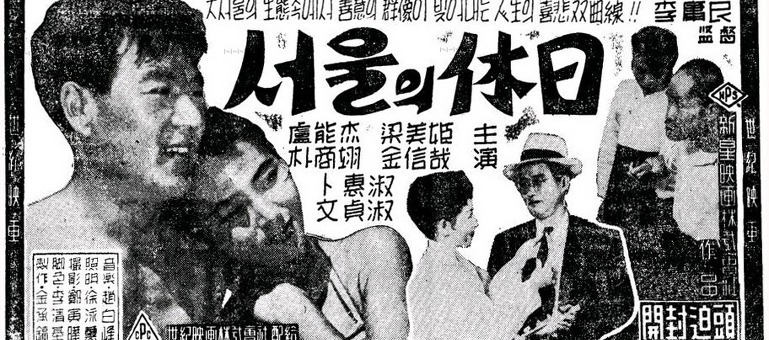
Holiday in Seoul title cardUnlike many “golden age” directors, Lee Yong-min was not especially prolific and left behind him only 23 films when he abruptly disappeared without trace. Perhaps a fitting legacy for a director so strongly associated with the horror genre, but Lee had begun his career as a documentarian working for a Japanese company during the Colonial era. It’s Lee’s documentary background rather than his taste for genre which is most strongly in evidence in his second film, Holiday in Seoul (서울의 休日 / 서울의 휴일, Seoul-ui Hyuil), which, while containing a fair few genre elements, is an anarchic romantic comedy set entirely in a small residential area of the capital over the course one day – a public holiday, in which a series of couples are separated by accident or design on this very day which has been specifically set aside for them to spend together.

Lee opens with a series of location shots of various Seoul landmarks, elegantly composed and somewhat romanticised as if to recast the burgeoning city as a capital of love with all the promise and mystery of Roman Holiday’s Italy which even gets a brief namecheck later on. Again unconventionally, he then breaks into a lengthy POV shot with additional voice over from a narrator who locates a drunk snoozing on a bench and follows him home hoping something more interesting is happening over in the residential quarter. The narrator settles on the house opposite which belongs to a young couple recently married – she an obstetrician running a clinic out of the house, and he a hotshot reporter who’s just made a big splash with a story about a violent murder.

This is, however, a public holiday so work should be strictly off limits. Hee-won (Yang Mi-hee) has designed a packed itinerary, while her husband Jae-kwan (No Neung-geol) would rather have just lazed around at home, but as it turns out neither of them is going to get what they wanted. Minor disagreements about how to spend a rare day off aside, Hee-won and Jae-kwan are a happy young couple who have apparently married for love, are each professionally successful, and are living a comfortable middle-class life in a period of increasing economic prosperity. Their marriage is directly contrasted with the families around them which include that of the drunk we first met on the bench whose daughter Ok-i eventually descends on Hee-won for help in fear she may have fallen pregnant out of wedlock to a man who won’t take responsibility, and a middle-aged couple who have the opposite problem to that of Hee-won and Jae-kwan. Mr. Ju, a regular salaryman, is excited about spending the day with his wife but she skips out on him to go to the beauty parlour and spends most of the day with a wealthy friend and her opera loving toyboys on a well appointed yacht.

Nevertheless, marital bliss is indeed tested by the demands of the day. Though Jae-kwan had promised to go along with Hee-won’s carefully crafted plan, he gets a phone call he thinks is an important tip off about the murder case but is actually a trick set up by his colleagues who were hoping to get him to buy them a few drinks. Unfortunately, due to an odd coincidence, Jae-kwan thinks he witnesses a kidnapping that might be related to the killings and takes off in hot pursuit only to find himself dealing with another sad case of a woman brought low by love. While Hee-won is busy trying to help Ok-i sort out her predicament with both her sad/angry father and the boyfriend that’s thrown her over, Jae-kwan finds himself locked in a room with a poor young girl (Moon Jeong-suk) who is apparently also pregnant by a man who’s disappeared and has gone out of her mind with heartbreak, actively adopting the role of Ophelia and reciting potent lines from Hamlet while absolutely convinced that Jae-kwan is her long absent lover.

While the new freedoms of the post-Colonial era have enabled Hee-won not only to find love and an elected marriage but also a successful professional career as the head of her own clinic, other women have not been so lucky and have suffered doubly at the hands of men who feel bolder in their casual pursuits but also know they cannot be held to account for their actions in the same way they might have been before. Ok-i’s story does at least have a happy ending but is symptomatic of the times in which she lives as she recounts going for a job at a factory only to be molested by the foreman who thought she was a “prostitute” because he found out she had a boyfriend, while the boyfriend sort of thought the same in assuming she had been taken advantage of by the foreman. At least Ok-i has her father who might be have been enraged to begin with but later comes to her defence as does the warmhearted Hee-won, while Jae-kwan’s young woman is all alone save for her mother who is worried sick over her daughter’s mental health and has no real way to help her.

Hee-won is indeed a force for good. Despite her worry about her husband’s whereabouts (she ends up going drinking with his work buddies who, along with her other married female friends, have half convinced her he’s gone off with another woman), Hee-won comes to the aid of a crying little girl who’s desperately looking for help because her heavily pregnant mother is in a very bad way at home while dad went out a few days ago and hasn’t come back. Needless to say, Hee-won’s emergency dovetails into Jae-kwan’s dogged pursuit of crime which eventually sees him arrest a murderer after accidentally getting into a cab with him. The killer, perhaps annoyed about the previous article, makes a point of explaining to Jae-kwan that his job isn’t quite as morally upright as he’d like to believe. You can’t just go printing things in papers, he tells him, it ruins people’s lives. Jae-kwan thinks it’s murdering people that ruins lives so anything after that is fair game but his heartless rationality brings him into conflict with Hee-won when he wants to photograph and interview one of her patients who is seriously ill and might not survive if she finds out the unpleasant truth Jae-kwan wants to get her reaction to on camera. To Jae-kwan, people are just his “subjects”, mere materials for his essays, but to Hee-won they are literally flesh and blood – less fortunate than herself, they are her responsibility and she will do all she can to help them even at great personal cost.

Yet in the end the conflicts resolve themselves satisfactorily and the couples are each reunited in time to spend the last of the holiday gazing up at the moon glowing above the twinkling lights of Seoul. Having spent the day apart, each spouse emerges with a greater understanding of their partner (or in Mr. Ju’s case perhaps just a greater talent for (self)deception) and remains committed to working on their relationship. Mostly shooting on location, Lee’s camera is as sophisticated as they come shifting effortlessly from documentary-style naturalism to a silent movie aesthetic while maintaining a high level of cinematic wit throughout. Cheerfully romantic and carefree even considering its darker themes, Holiday in Seoul is an oddly anarchic romantic comedy though one with total faith in true connection and emotional honesty.


Holiday in Seoul is the first of three films included in the Korean Film Archive’s Romantic Comedy Collection of the 1950s box set. It is also available to stream online from the Korean Film Archive‘s YouTube Channel.