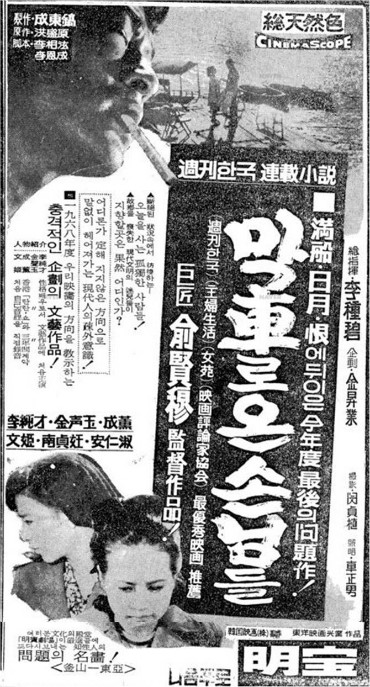
The Guests of the Last Train (막차로 온 손님들 / 막車로 온 손님들, Yu Hyun-mok, 1967)

guests who came by train 2Despite ongoing social and political oppression, the Korea of the 1960s was an upwardly mobile world in which increasing economic prosperity and global ambition was beginning to offer the promise of financial stability and a life of comfort to millions of young men and women, albeit at a price. Yu Hyun-mok, often thought of as among the most intellectual of “golden age” film directors, was a relatively infrequent visitor to the “literary film” but Guests of the Last Train (막차로 온 손님들 / 막車로 온 손님들, Makcharo on Sonnimdeul, AKA Guests Who Arrived on the Last Train), adapted from a novel by Hong Seong-won, is perhaps comfortably in line with his career long concerns in its focus on those who for one reason or another have been running to catch the rapidly departing train of modernity, pulling themselves on board just it prepares to pull away. A disparate tale of three men and their respective love interests, Yu’s film once again rejects the consumerism of the modern society in its cold and lonely search for soulless acquisition and finds comfort only in the fragile connections between the lost and hopeless.

The film opens behind a train station where a young woman, Bo-yong (Bo-yong), staggers and stumbles, grasping for something to hold on to but hardly able to stand. Eventually a man, Dong-min (Lee Soon-jae), turns up and tries to hail a taxi. Noticing the distressed woman, he manages to get her into a car and when she tells him she has nowhere to go, takes her home with him. Dong-min is currently off work with an illness which turns out to be terminal lung cancer and has only a few months left to live as a second opinion from his doctor friend, Kyeong-Seok (Seong Hoon), makes clear. Kyeong-seok is also facing a problem with a female patient, Se-jeong (Nam Jeong-im), suffering a nervous complaint after losing her wealthy husband and subsequently being hounded by her relatives over the inheritance. When Se-jeong leaves the hospital the pair end up having an affair but the money continues to present a problem – neither of them want the hassle of dealing with it. Meanwhile, Dong-min and Kyeong-seok reunite with another old friend, Choong-hyeon (Kim Seong-ok), who has just returned from Japan apparently having become fabulously wealthy. Choong-hyeon has pretensions of becoming an avant-garde artist, but is unable to get over his ex-wife who has left him to become a famous actress.

Each of the three men is in someway arrested, unable to move past something towards the future rapidly rolling away from them like a train leaving the station. Dong-min’s depression and listlessness is understandable given that he’s facing a terminal illness and knows that he has already reached the end of the line. Yet his ennui began long before. Kyeong-seok, describing his friend to a colleague, disapprovingly remarks that he used to be a mild-mannered bank teller but left to become a freelance translator and journalist. Unable to put up with the stringent, high pressure world of work Dong-min removed himself from it to try and grasp his freedom only to remain dissatisfied and eventually defeated by a cruel and arbitrary illness. Even so he retains his human feeling as demonstrated by his decision to help Bo-yong rather than leave a vulnerable woman alone to suffer on the streets. Staring blankly at the calendar on his wall, avoiding tearing off the sheets which serve as an all too obvious symbol of his limited time, he falls slowly in love with the woman who remains at his side whilst knowing that his existence is futile and doomed only to tragedy.

Kyeong-seok, by contrast, is merely disaffected. Dragged into a relationship with Se-jeong originally unwillingly, what he resists is responsibility. He wants to help her, but he does not want to get involved with her complicated familial and financial problems. As so often in Yu’s films, money is the root of all evil, presenting barriers between people where there should be none. Neither Kyeong-seok or Se-jeong are very interested in the money for its own sake, they want only simple lives of adequate comfort and emotional fulfilment – something which the hassle of dealing with other people’s money hungry machinations will actively destroy.

Money has also, in a sense, destroyed Choong-hyeon’s hopes though more through his misplaced faith in its ability to buy him back what he’s lost. His relationship with his wife is clearly over, she has chosen something else which is her right and privilege, but Choong-hyeon can not accept it and continues to look for her in all he does. Attempting to become an “artist” himself, he uses his money to get himself a show featuring his avant-garde pop art creations but neither of his friends rate his work or is careful enough about his feelings to avoid criticising it. Choong-hyeon spirals out of control, becoming dangerously obsessed with a schoolgirl he somehow wants to imagine as his wife. Dong-min and Kyeong-seok suspect that he will kill himself, but by this point they aren’t sure if they should care. What would they be saving him for? There is no possible salvation – no one can save anyone else, and no one can save themselves. Each is an individual and can offer no excuses. Love and friendship are but scant comfort in a cold and lonely world.

Meanwhile, the women continue to suffer in silence. Yu chooses to focus on his trio of male misfits rather than the pair of unlucky women whose story lies at the centre of the narrative. Se-jeong married an older man for apparently legitimate reasons but the marriage was unsuccessful and also ruined her friendship with her husband’s daughter who, unsurprisingly, turns out to be Bo-yong. Looking for love and not money, Se-jeong is only holding on to her inheritance in the hope of someday reconciling with Bo-yong and handing it all to her. Meanwhile, Bo-yong has been on the run from her former life. Once an air stewardess, Bo-yong dropped off the radar when a former fiancé planted drugs in her suitcase and got her sent to prison. Like Se-jeong she is looking for support and companionship and finds it in the kind if melancholy Dong-min, vowing to stay by his side even if she knows their time it limited. The two women are eventually “reunited” at a wedding, but the crowd keeps them apart, breaking into factions fighting over the inheritance that neither Se-jeon or Bo-yong actually want.

Yu declines to tell us whether the women are eventually able to meet and repair their friendship, but he does make clear that both have rejected the superficial comforts of wealth in asking for a small and simple life with their respective partners. In this he offers both hope and despair. The couples are rejecting the new future their nation has planned for them, yearning for small comforts and an end to their loneliness and struggling to find it in an increasingly alienated world. Bo-yong, at least, steps forward to grasp her chance at happiness however small it maybe, waiting for the train and seeing red lights change to green only when her gesture of sincerity is finally accepted.


Available on DVD as part of the Korean Film Archive’s Yu Hyun-mok boxset. Not currently available to stream online.
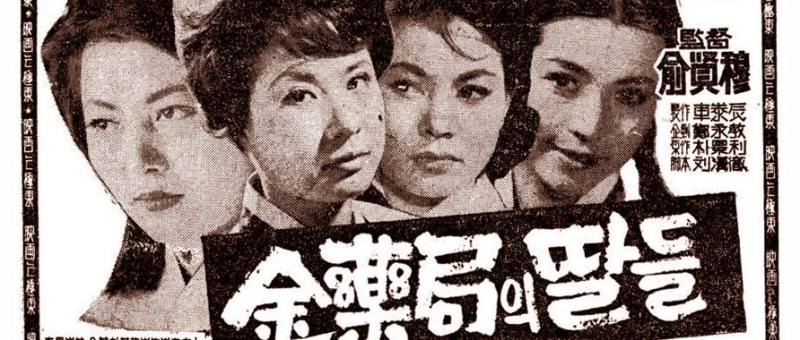
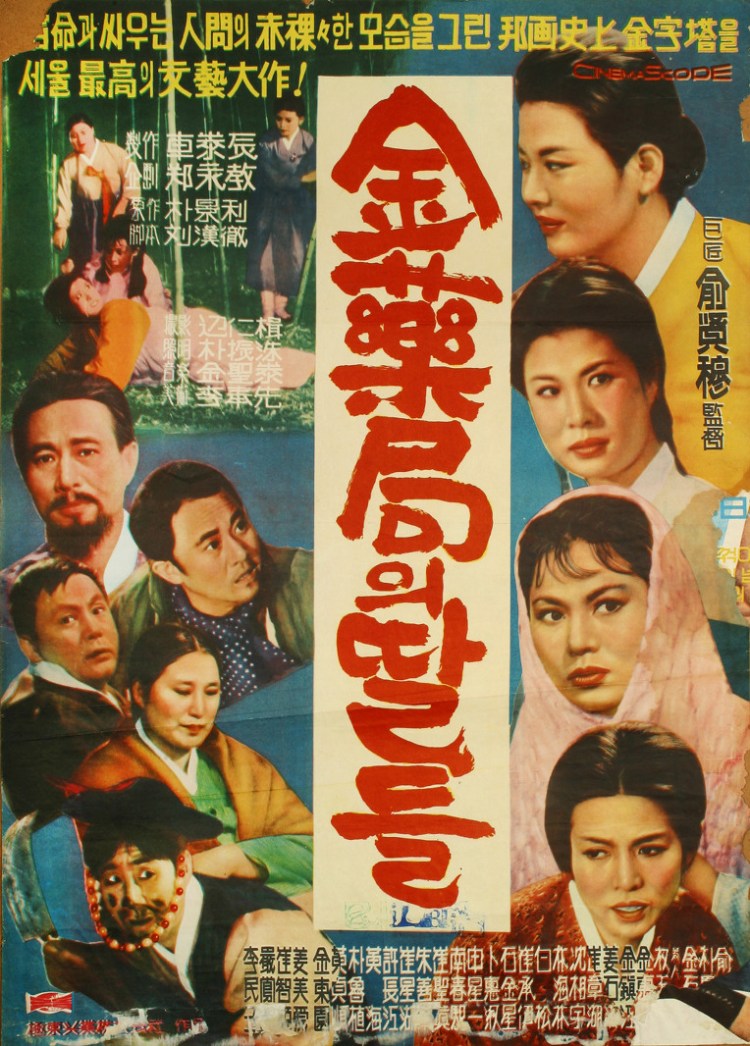
The Daughters of Kim’s Pharmacy (김약국의 딸들 / 金薬局의딸들, Yu Hyun-mok, 1963)

Daughters of Kim's Pharmacy poster“Literary Film” had become a kind of genre of its own in Korean cinema, both embracing and rejecting the nation’s taste for melodrama with differing degrees of artiness. Director Yu Hyun-mok, however, was not generally associated with the kind of affectation coupled intense sentimentality that sometimes marked the worst examples of the genre but with a unique brand of cinematic realism which attempted to address the social issues of the day whilst still getting past the censors who were hot on politics but increasingly lax on sex and violence. Nevertheless, The Daughters of Kim’s Pharmacy (김약국의 딸들, Kim yakgukjib daldeul) is a “literary film” adapted from a novel by Park Gyoung-li and set firmly in the recent past. Yu eventually gives in to the inherent melodrama of a small family battling a legacy of pain and destruction, but tellingly subverts it by discarding the tragic ending of the original novel for something that offers a degree of hope albeit in an all but hopeless world.

The film begins at the close of the Joseon Dynasty as a young man runs into another man’s house and desperately reaffirms his love for a woman who is now married to someone else while he is also married to woman from his village. The woman refuses to see him while he pleads with her, sobbing, but when her husband returns home unexpectedly he doubts his wife’s virtue. Threatening her and then chasing off the lover, the husband kills him by accident and is forced to flee while the woman takes poison and kills herself in her misery leaving her son, who will later become Kim the pharmacist, orphaned and alone, and the family forever “cursed” by her unquiet spirit.

18 years later Kim himself is forced into an arranged marriage which he wanders away from on the wedding day, leaving his aunts to wonder if he hasn’t been “possessed” by the vengeful spirit of his late mother. Despite the “curse” the marriage is successful in that it is not particularly unhappy and produces four daughters who are each of age when the story begins thirty years after Kim’s wedding.

The central heroine, Yong-bin (Um Aing-ran), is a “modern woman” of the colonial era, taking advantage of a shift forward into a progressive new world by leaving her tiny home village for university in Seoul. Though she longs to be free of the primitivism of her origins with its shamanistic rituals and patriarchal traditions, she is also of an elegant, conservative disposition and loves her parents deeply – something that provokes conflict in her desire for the comforts of home and the promise of away.

Of the other three daughters, each represents a particular kind of trap of the age. The oldest, Yong-sook (Lee Min-ja), has given birth to a child out of wedlock and lives alone independently raising her son in penury. Meanwhile third sister Yong-ran (Choi Ji-hee) is no longer a child but continues to loll around the house showing off her legs and posing provocatively. Her father is thinking of marrying her off to a local fisherman who has taken a liking to her, but the plan is scuppered when it is revealed that Yong-ran has been taking frequent nighttime excursions to the graveyard in the forest for secret trysts with one of the servants. When they are discovered, Kim chases the man away leaving Yong-ran publicly shamed and heartbroken. Eventually she is married off to someone befitting her social class only to discover that her new husband is impotent thanks to an opium addiction. She is routinely beaten and abused but can do nothing to escape her life of violence and terror. Yong-oak (Kang Mi-ae), the youngest sister, will eventually suffer a similar fate if one more usual, when she marries Yong-ran’s fisherman suitor only to find him rough and resentful as the fishing industry continues to fluctuate.

When Yong-bin’s mother (Hwang Jung-seun) meets her at the harbour on her return from Seoul she mentions the family curse by way of bemoaning their increasing ill fortunes. Yong-bin dismisses her mother’s concerns, preferring to think that its one’s own deeds that determine one’s future, but her mother sadly shakes her head and repeats that it’s all fated. Yong-bin’s modern way of thinking will increasingly come into conflict with her superstitious upbringing, but there’s no denying her family has had a run of bad luck – one which is only set to intensify as time moves on.

This is the central tragedy – the Kim family, trapped in the past, is unable to move beyond its “curse” and whether fated or not is set to destroy itself through outdated thinking. Though it is undoubtedly not the message the film is intended to convey, it’s impossible to ignore the degree of unhappiness which has been caused by the system of arranged marriages and the convention that true feelings must be suppressed in order to maintain ancient social codes. The Kims’ “curse” comes from the death of a woman scorned in love and betrayed by a prideful husband. If only she had been allowed to marry the man she chose, there would be no curse, no violence, no fear. As long as personal happiness is undervalued, there will be only suffering and misery for all but most particularly for the young women of Korea.

Yong-bin, an urban sophisticate, knows this more than most. Her father thinks he ought to marry her off first so he can marry off Yong-ran whose precociousness is beginning to alarm him. Yong-bin, however, wants to finish her education before submitting herself to a lifetime of servitude as someone’s wife and later mother. Her father has his eye on a match – the son of a usurious loanshark who is also a Japanese collaborator. Luckily, Yong-bin likes the man her father has chosen and sees only a romantic fantasy in marrying a childhood friend despite a warning from another mutual acquaintance that Hong-sub is a timid yet ambitious man – a dangerous combination which is unlikely to yield much happiness. She is going to get her heartbroken in more ways than one, her illusions of innocent romantic destiny shattered and her heart wounded by a spiritual as well as physical betrayal by the feckless Hong-sub who turns out to be not the man she thought he was but the one she was warned about.

Yet there is something in Yong-bin’s modernism that cannot be denied. This being the colonial era, the influence of the Japanese is felt even in this tiny village. Kim has sold the family pharmacy because of the influx of Western medicine coming in through Japan. He invested heavily in fishing, but the Japanese are ruining that too through invading local waters and overfishing them. Yet Kim still thinks of himself as a feudal lord with a real duty towards the people of his village. When his boat is ruined in a shipwreck and many sailors killed, he feels he must compensate the victims’ families who are now without the means to support themselves. This leaves him open to exploitation by Hong-sub’s usurious father who is in big with the Japanese who are, to an extent, the route cause of all these problems. Hong-sub’s father laughs when Kim declares his need of extra cash to support those who’ve suffered because of his failed fishing venture, thinking his sense of duty merely stupid but also seeing that it’s another hook for him to exploit that brings him closer to his goal of harnessing Kim’s ancestral estate with its large amount of farmland and property.

The Japanese play into a small sub-plot in which Yong-bin’s cousin (Shin Seong-il) is engaged in the resistance movement and eventually leaves for a covert mission in Japan. Before he leaves he introduces Yong-bin to a friend, Kang-geuk, who has been arrested and is being carted off to Japan for trial but has apparently fallen in love with her based only on his friend’s stories and a photograph. She’s back to a romantic fantasy once again and gravitating towards the spectre of arranged marriage which the film has already done such a great job of discrediting. It is, however, the perfect symbiosis of the film’s themes allowing Yong-bin to embrace both sides of herself. Meeting again after the liberation and a succession of terrible tragedies for the Kim family, Kang-geuk responds to Yong-bin’s intention to leave her hometown forever by asking her to name a place which is not tinged by loss and tragedy, and of course she can’t. Suddenly, her village doesn’t seem so bad anymore.

The “curse” is broken in being acknowledged and Yong-bin exercises her freedom to choose, consenting to a marriage, and making a decision to stay rather than being forced to leave. Yu’s comparatively hopeful ending in which Yong-bin nevertheless places herself back within a patriarchal value system stands in sharp contrast to that of the novel in which the Kim family’s failure to reconcile themselves to modernity provokes their downfall, but there is only so much hope in this hopeless world and Yong-bin, like her surviving sisters, will continue to suffer in an existence which offers little else to Korea’s oppressed women, remaining complicit in her own misery.   


Available on DVD as part of the Korean Film Archive’s Yu Hyun-mok boxset. Also available to stream via the Korean Film Archive’s official YouTube Channel.

Death on the Mountain (黒い画集 ある遭難, Toshio Sugie, 1961)

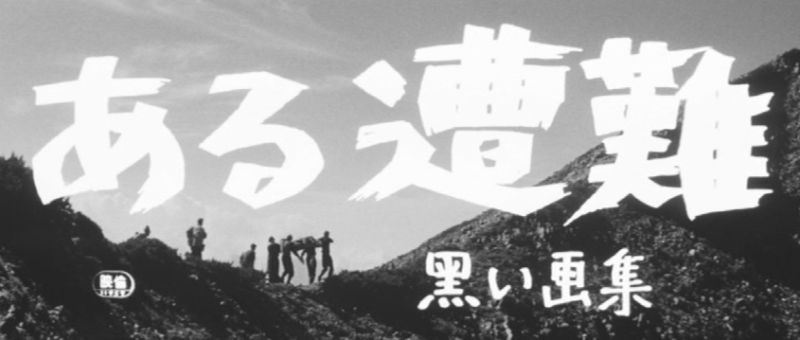
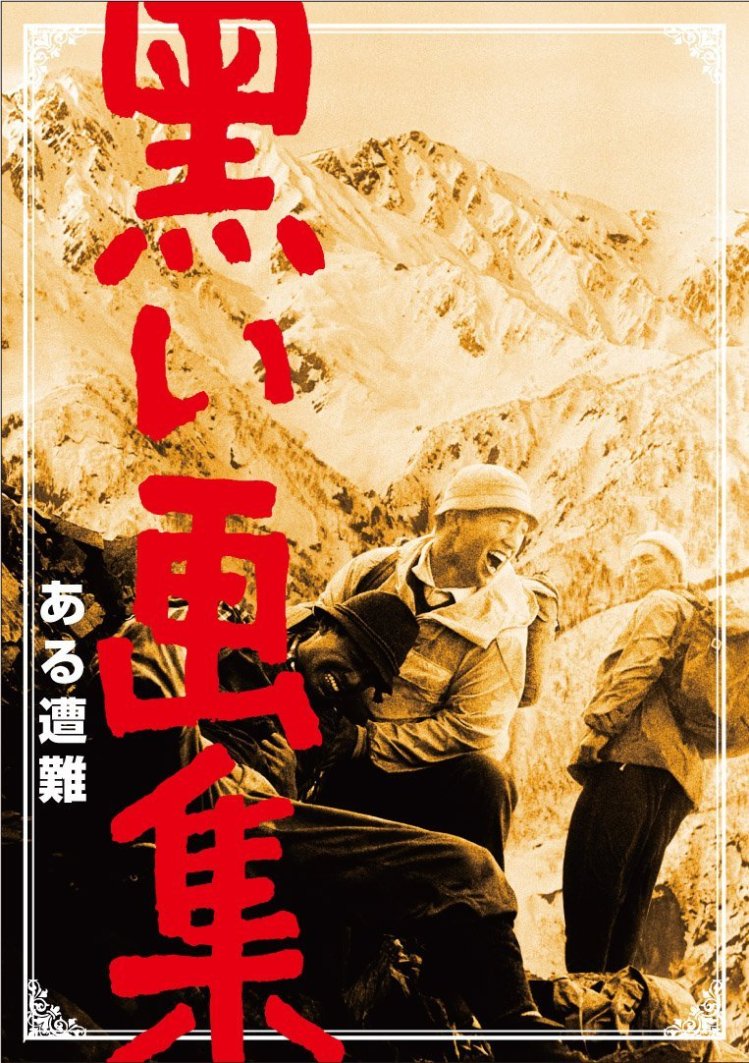
Death on the Mountain DVD coverThere can be few films with as accurate a title as Death on the Mountain (黒い画集 ある遭難, Kuroi Gashu: Aru Sonan) , but Toshio Sugie’s 1961 psychological melodrama certainly makes good on its promise. The Japanese title of the film is prefaced by “The Black Album” which is a title given to a series of novellas penned by one of Japan’s most prominent mystery writers, Seicho Matsumoto, whose work was frequently adapted for the screen including eight collaborations with director Yoshitaro Nomura of such well known mysteries as Zero Focus and Castle of Sand. Death on the Mountain was, like the others in the Black Album series, serialised in Shukan Asahi, in this case between 5th October and 14th December 1958 under the title “Sonan”. “Sonan” literally means “distress” or “disaster”, but it has another telling association – “Sonanshi”, meaning “accidental death” such as might occur while mountain climbing, sailing, or engaged in some other dangerous yet normalised activity. The death at the centre of Death on the Mountain is accidental in once sense, but very much not in another.

The film begins with a body being winched from a lower platform back up to a snowy ridge. Iwase (Kiyoshi Kodama), an experienced mountain climber, has perished in a freak accident. Packed inside his backpack, Iwase’s body is burned at the foot of his beloved mountains while his mother looks on sadly, his sister Masako (Kyoko Kagawa) angrily wondering how her brother, a true mountain man, could have died in such a bizarre way while a much less experienced climber, Urahashi (Takashi Wada), survived. The secret may lie with the leader of the expedition, Eda (Hisaya Ito), who has been looking sheepish ever since the incident but otherwise comports himself in a cool, detached manner.

Like many of Matsumoto’s mysteries, Death on the Mountain turns on a secret but Sugie’s adaptation never seriously considers that Eda is not in someway at fault or questions that Urahashi’s recollection of events, published in a popular mountaineering journal, is anything other than accurate. The facts, as laid out firstly by Urahashi’s article, state that Iwase had not been himself on the day of the climb. Eda had treated them all to first class sleeper cabins but Iwase spent the night drinking, chain-smoking and brooding, meaning he was tired before they even arrived at the mountain. He didn’t sleep at the inn either because of someone whispering all night long and needed to take frequent rests during the early part of the climb. Resting is, however, dangerous – as is excessive thirst, and Iwase spent a lot of time guzzling water and sitting down all of which made him even more exhausted. Coupled with a turn in the weather which left him cold and wet, Iwase’s exhaustion got the better of him and he finally lost his mind. At least, that’s the way Urahashi described it, and Eda seems not to dispute his version of events even if the failures – not bringing a map for both mountains they intended to climb but only one, pressing on despite the weather, and mistaking the trail back to the standard path, all rest squarely with him.

Japanese mysteries by and large are much more concerned with the how rather than the why, though in Death on the Mountain the how is a much greyer area than one might assume. As Masako’s cousin, an experienced mountaineer himself, points out, Iwase’s death was caused by a series of unfortunate circumstances but that doesn’t necessarily preclude that there was ill will or that someone didn’t help the “unfortunate circumstances” along in the hope that they would lead to the “accidental death” of the title. There was, therefore, not quite a murder but definitely a lot of ill will and gentle coaxing towards an act of guilty self destruction. As for the why, well that turns out to be far less interesting and suitably petty. Morally speaking, the act of “murder” becomes moot, though the “murderer” finally meets justice head on, only for the tale to end on a note of ambiguity as Masako, whose investigations have resulted only in further deaths, blames herself for daring to disturb the peace. If she’d only have let the “murder” of her brother lie, no one else would have died. Is Masako now an accidental “murderess” or a frustrated seeker of justice? Whatever the answer, all her efforts have been in vein.

Death on the Mountain was previously adapted as a TV drama shortly after the novel’s release, broadcast between 31st August and 7th September 1959, though presumably with lesser production values than Sugie’s admittedly minimal yet authentically detailed exploration of modern mountaineering. Shooting on location and making much of crunching snow, swirling fog, and pelting rain, Sugie runs high on atmosphere but fails to capitalise on the noirish sense of malevolence that lies at the centre of Matsumoto’s mystery, that evil can come dressed as kindness and the line between murder and accident is much thinner than might otherwise be presumed. Matsumoto seems to want to ask a few questions about causality and personal responsibility, the degree to which a man’s death is his own failing, how much the fault of “unfortunate circumstance”, and how much ill intentions from the world around him. Sugie, however, is content to let the suspense peter out with the solution offered in true detective style through a suppositional monologue delivered in front of the presumed murderer but for the audience’s benefit. Nevertheless, even if the mystery falls flat the mountain air rings true and Sugie has, at least, captured something of nature’s awesome power and terrifying beauty.


Thirst for Love (愛の渇き, Koreyoshi Kurahara, 1967)

(C) Nikkatsu 1967

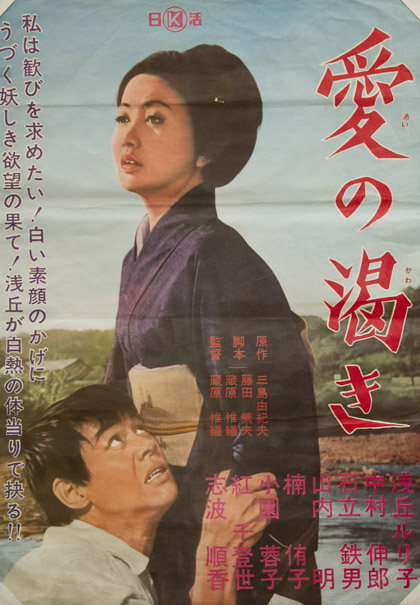
Thrill for love posterIf The Warped Ones showed us a hellish, uncivilised world in which people acted on their base desires with little thought for others, Thirst for Love (愛の渇き, Ai no Kawaki) shows us the opposite as desire repressed eats away at those unable to find fulfilment in their assigned social roles. Koreyoshi Kurahara’s swirling artistry may have proved too much for studio bosses at Nikkatsu (Thirst for Love would be the last film he’d make as a regular director for the studio), but it finds a perfect match in the florid world of Yukio Mishima.  A tale of inequalities and misunderstandings, the rarefied atmosphere of Thirst for Love is just as “warped” as that of Nikkatsu’s gritty youth dramas in which desire and gratification become tools of currency in a grand game of wounds given and received.

Our heroine, Etsuko (Ruriko Asaoka), is a young widow living with her late husband’s family. Following the death of her husband, Etsuko has become the mistress of the family’s tyrannical patriarch, Yakichi (Nobuo Nakamura) – a successful businessman apparently forced out of the company he founded and into an early retirement. Yakichi resents the rest of his family whom he regards as feckless freeloaders. Oldest son Kensuke (Akira Yamanouchi) is a part-time classics professor and full-time neurotic intellectual. He and his wife Chieko (Yuko Kusunokiare unable to have children of their own (something else that annoys Yakichi), while daughter Asako (Yoko Ozono) has come back to her family home following a divorce with two children in tow. The family are all “aware” of the strange dynamic between Yakichi and his daughter-in-law but are too polite to bring it up. Nevertheless, Kensuke also has a thing for Etsuko which Chieko is aware of but not particularly worried about because she really does respect and trust her husband.

Etsuko is not particularly interested in Kensuke. There’s nothing he could really offer her. Though she keeps up a pretence of happiness with her current living standards, even going so far as to write a fake diary expressly intended for Yakichi to read, Etsuko feels nothing but contempt for and boredom with the emotionally cold and controlling family patriarch. Her faith in human emotions is low, but still she feels desire. When the teenage gardener Saburo (Tetsuo Ishidate) catches her admiring a beautiful statue and remarks on Etsuko’s own beauty, he puts untoward ideas in her head.

Even in the post-war world, women like Estuko have little agency. After her husband died, she could have stuck it out alone – found a job, supported herself. She could have remarried or perhaps have received financial support from the family while living alone, but she’s chosen to remain with them even given her somewhat degrading role as her father-in-law’s mistress-cum-plaything. When Saburo tells her she is beautiful he oversteps the established laws of class separation and Etsuko is too clever not to know how clichéd her new found lust for a peasant boy really is but she can’t unsee his broad shoulders and muscular frame or the sweat that crowds his brow as he labours on her behalf.

She begins making coy overtures which Saburo, unwittingly or otherwise, deflects. The situation is complicated by another woman, Miyo (Chitose Kurenai), who may or may not be something like Saburo’s girlfriend though as we will later find out, Saburo is a typically immature young man who regards his relationships with women as essentially inconsequential. Deferent towards his mistress, he demands to be released from her cruel games. Yet Etsuko had hardly realised that’s what they were. She cannot simply voice her desire or make her interest plain. Hers is not the first move to make. Several times Etsuko comes close to crossing a line but she always pulls back – inflicting necessary suffering on herself through her inability realise her desires.

Suffering, in a sense, becomes the point and almost a bizarre source of pleasure. In a climactic moment of drunken dinner party truthfulness, Kensuke attempts to apologise for a potentially destructive speech by revealing that he meant to smash everything to bits but has only succeeded in destroying himself. Etsuko too means to hurt others, partly as a kind of revenge, but in truth only to increase her own suffering. Her plan stumbles when she realises that Saburo is and always has been entirely indifferent towards her. He saw her as the mistress of the manor, an elegant and attractive woman, but felt no more desire for her than for any other. As he puts it, they live in different worlds – she is nothing to him, and nothing she does can change that. Etsuko has only destroyed herself, a self-immolation of repressed desire which threatens to burn the world with its ferocious intensity.

If Etsuko is to free herself from the burden of her need, she will pay a heavy price to do so. Kurahara shifts into an avant-garde register more in keeping with the more or less contemporary work of Kiju Yoshida in his anti-melodrama phase, but Kurahara’s approach is, in keeping with the source material, altogether less serious, fully embracing the melodramatic but taking pains to underpin it with deeply felt emotion. Asaoka excels as the neurotic housewife driven slowly mad in a stultifying, moribund household where she is forced to submit to the sexual whims of her bossy father-in-law and has little more to occupy her time than walking the dog and dreaming of a roll in the hay with the not yet 20 gardener.

Kurahara paints her world as one of sensations – the blood that becomes both symbol of life and death, the symbolic pleasures of a pomelo, and the fearsome flapping of chickens even as their throats are slit. Shifting to still frames for moments of high emotion – much as Shinoda had done in the finale of With Beauty and Sorrow two years before, Kurahara mixes ironic voiceover with intertitles and unexpected editing choices to capture the flightiness of Etsuko’s mind but he allows himself one luxury in letting her leave to a bright red sky, a woman on fire thirsting for love.


Original trailer (no subtitles)

Black Sun (黒い太陽, Koreyoshi Kurahara, 1964)

black sun still 2The Warped Ones showed us a nihilistic world of aimless youth living not so much on their wits as by their pleasures, indulging their every animalistic whim while respectable society looked on in horror. By 1964 things have only got worse. Tokyo might have got the Olympics, Japan might be back on the international map, and economic prosperity might be on the rise but all around the city there’s an arid wasteland – a literal dumping ground in which the unburied past has been left to fester as a grim reminder of historical follies and the present’s reluctance to deal with them.

Akira (Tamio Kawaji), now calling himself “Mei” (perhaps a play on the reading of the character for his name 明), seems to have mellowed since the heady days of his youth. Living alone save for a dog named Thelonious Monk, Mei has co-opted a disused church and turned it into a shrine for jazz. The walls and ceilings are covered in photographs of famous jazz musicians and posters for club nights and solo shows. He has his own turntable and a well stocked selection of LPs, though he still seems to frequent the same kind of jazz clubs that so defined his earlier life.

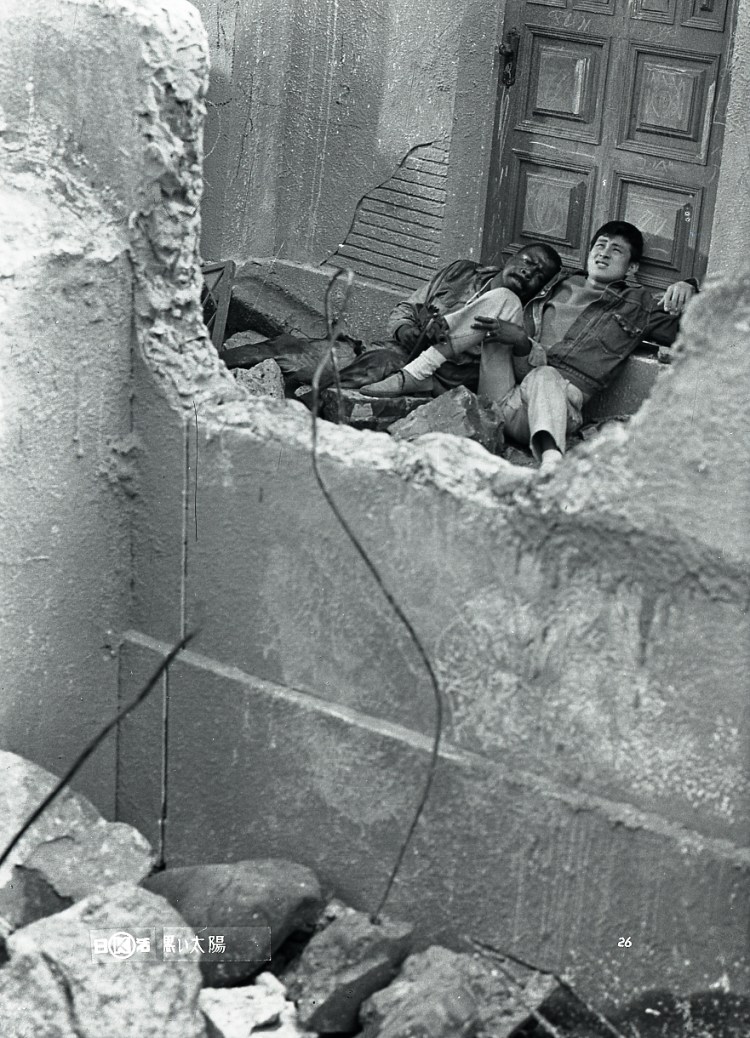
Change arrives when Mei boosts a fancy car and is almost caught in a police net caused by the body of an American serviceman found floating in the harbour. Apparently the crime is the product of an internal GI squabble, but the offending soldier is on the run with a machine gun. As coincidence would have it, the wounded killer, Gil (Chico Lourant), fetches up at Mei’s church and, as Gil is a black man, Mei assumes that they will definitely be friends. It is, however, not quite that simple.

As in the earlier film, jazz is the force which keeps Mei’s mind from fracturing. His life still moves to improvisational rhythms even if apparently not quite so frenetically as it once did. Rather than the rampant animal of The Warped Ones, this Mei has embraced his outsider status through literally removing himself from the city in favour of self-exile and isolation as a squatter in the house of God – a place about to be torn down.

While Mei has been literally pushed out with only his beloved dog as evidence of his latent human feelings, his formerly delinquent friend, Yuki (Yuko Chishiro), has gone on to bigger and better things. No longer (it seems) a casual prostitute catering to foreigners, Yuki has repurposed the skills her former life gave her to shift into an aspirational middle-class world as a translator for those same American troops she once performed another service for. The American occupation is long over, but the US Army is everywhere.

Mei thinks of himself as one of Japan’s oppressed outsiders – an outcast in a land subjugated by a foreign power. He squats in a ruined church while the Americans “squat” in his ruined country. He likes jazz because it fits the rhythms of his mind but also because he believes it to be the music of the oppressed. In Gil he thinks he sees another like him, a man oppressed in his own homeland and ironically enough by the same forces that are (in part) oppressing him. Mei has a lot of strange, stereotypical ideas about black men – he’s excited to meet Gil because he thinks all black men must love jazz and that Gil must be some kind of jazz god, but Gil is a frightened rabbit on the run, terrified and bleeding. Thinking he’s in the middle of a visitation, Mei tries to make plain his enthusiasm despite the obvious language barrier, pointing wildly at his shrine to jazz, but all Gil wants is quiet and help with the bullet wound currently suppurating on his thigh.

The “relationship” deteriorates, but a strange kind of camaraderie is eventually born between the two men. Things take a turn for the surreal when Mei dons black face and paints Gil’s white, only to get stopped by GIs who want to see an ID from a “foreigner” driving a fancy car, and for Mei to introduce Gil at his favourite jazz bar as his new “slave”. In hindsight it’s all a little awkward as Kurahara throws in stock footage of the civil rights movement and tries to equate it both to the recent protest movements in Japan and to Mei’s self-identified status as one of Japan’s oppressed masses. Still, you can’t argue with the fact that the two men have found a bond in their shared alienation and desire to escape from the impotence of their current situations.

Ironically enough Kurahara does seem to believe in an escape, though it’s perhaps not so positive as it sounds. The tragic friendship of the two men in which one must save the other by releasing him towards the sea and the sun pushes Mei out of his self-exile and back into the “real” world even if he still considers himself to be an outsider within it. The sun is bright but it’s also dull, shining not with hope but with consolation for a hopeless world in which the only victory lies in the final act of surrender.


Short scene from the beginning of the film (English subtitles)

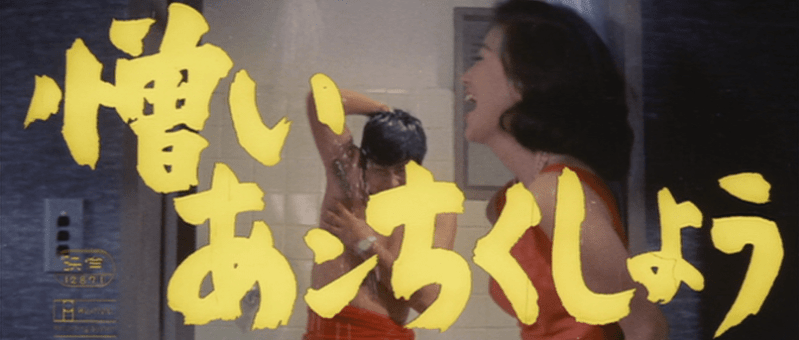
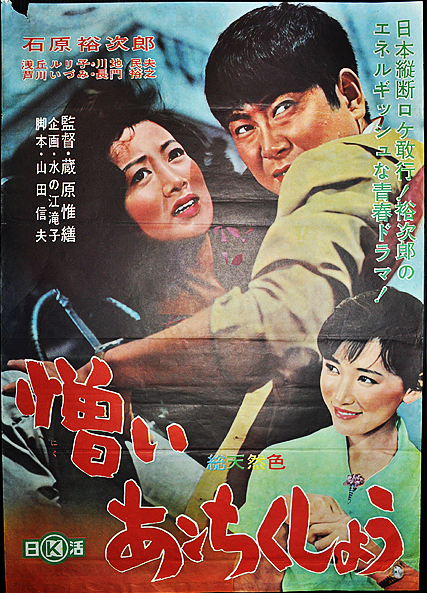
I Hate But Love (憎いあンちくしょう, Koreyoshi Kurahara, 1962)

I hate but love posterDoes “pure love” exist in the Japan of 1962, and if so what does it look like? Yujiro Ishihara, the poster boy for youthful rebellion, might not be the best person to ask but it’s his unfulfilled media superstar that ultimately determines to find out. In I Hate But Love (憎いあンちくしょう, Nikui Anchikusho) Koreyoshi Kurahara puts the jazz clubs and delinquency of The Warped Ones to one side for a Technicolor romp that owes more to Day/Hudson than it perhaps does to James Dean or Marlon Brando. Yet there is something mildly subversive in its low level criticism of Japan’s lurch towards the consumerist future, finding only emptiness in fame and success while the central couple’s deliberately repressed desires push them towards a point of both spiritual and physical exhaustion.

Daisaku (Yujiro Ishihara) and Noriko (Ruriko Asaoka) have been a couple for two years. Noriko is also Daisaku’s manager and has been with him since he was broke and an aspiring poet. Now he’s one of Japan’s top DJs and she looks after his schedule which is packed in the extreme – in fact it leaves him no time for sleeping between his radio show, TV appearances, and meetings in bars, not to mention a late night date starting at 2am! Raiding the local papers for a suitable human interest story they can flag up on the show, Noriko stumbles over the tale of a local woman who is looking for a “driver who understands humanism”. Intrigued, Daisaku and his producer Ichiro (Hiroyuki Nagato) set off to interview her but the woman doesn’t want to be involved with the media – she doesn’t want to sully her love! The fact of the matter is, Yoshiko (Izumi Ashikawa) has kept up a romance with a doctor in a rural town by letter alone and used all her savings to buy a jeep to help transport his patients more effectively. Yoshiko doesn’t need to see Toshio (Asao Koike) – her dashing doctor fiancé, she believes in their love and that’s good enough for her. She just needs someone to actually take the jeep to Kyushu where it is most needed.

Just at this point, Daisaku’s relationship with Noriko reaches a crisis point. Lovers for two years, they each feared the sparks would fade and so to keep them popping they’ve committed to a rule of no physical contact. Spark they do (though not always in a good way), but when trapped in Daisaku’s apartment one rainy afternoon and bored out of their minds they nearly give in – damaging the fragile balance they’ve managed to build through mutual rejection of their equally mutual attraction. Though Noriko remains committed to their plan for long term romance, the non-encounter pushes Daisaku into a profound state of crisis in pondering the nature of his relationship – does “pure love” exist, does he really “love” Noriko, what is the point and the purpose of their central bond of negation? Hoping to find all of that out, Daisaku makes a surprise on air announcement that he himself will drive Yoshiko’s truck to Kyushu and see what her Toshio does with that.   

Yoshiko and Noriko set themselves up as rivals – not for Daisaku’s heart but for the true nature of “love”. “Reclaiming” Daisaku’s Jaguar so she can chase after him, Noriko has a few words for Yoshiko, pointing out that she’s been patiently “building” her love with Daisaku for 737 days. Yoshiko looks at her pityingly – you don’t “build” love, she tells her, you just believe it. For Yoshiko her letters were enough, her love an act of faith, but for Noriko love is a process and an almost scientific endeavour filled with recordable and quantifiable data. Yet everything Noriko says about Daisaku is correct – she knows who he is and truly understands him, every part of him is welcome to her and so she is perfectly placed to find him off on his magic quest even if her desire to bring him back to the city is misplaced.

Daisaku’s journey puts them both through the ringer though their bond is never seriously in question. He runs and she follows, though neither of them can quite escape the net of the society in which they live. Daisaku’s flight is perhaps more from his micromanaged yet extremely comfortable life than it is just of a difficult romance. Taking to the road he wants to feel something, to know that there is something real out there. Unfortunately, even his attempt to embrace something “real” is subverted by his media buddies who secretly film him and air the footage like it’s all been a giant publicity stunt. Fearing that their cash cow is “drunk on humanism”, they ready a contingency plan to bring him back into the fold.

Ichiro tells Noriko that her desire to “tie Daisaku down” is not love but “female egotism”. What drives Noriko isn’t really a desire for control (Daisaku seemingly allows her enough of that), but a need to be needed and fear that Daisaku, now rich and famous, will eventually leave her. Paranoid their love will fail, she rejects its consummation. Yet faith alone is not enough, as Yoshiko painfully finds out on witnessing the disconnect between her imagined love created through her letters and the real flesh and blood man before her to whom she essentially has no real connection. Reaching the end of their journey, Daisaku and Noriko are forced together again, each abandoning some part of their Tokyo lives and personas to break through to something deeper and more essential. Their path takes them straight into a bizarre summer festival complete with giant floats and excited men in traditional Japanese underwear throwing water everywhere. When they finally reach their destination, their love transcends faith to become ritual, their ennui somehow transformed into an ironic celebration of life in fulfilled desire.   

Ichiro categorises Noriko and Daisaku as stingy children – defiantly saving the best for last. There is certainly something immature in their constant bickering and bargaining, the superstition that they can keep their love alive by continually rejecting it and repressing their desire for each other, but there’s also something faintly realistic in the messy grown-up commitment phobia of it all even if it joyfully strays into the absurd. Light and bright and breezy, Kurahara works in the darknesses of early ‘60s Japan from the destructive effects of celebrity and media manipulation to the emptiness of a life of excess but even if he doesn’t quite find “pure love” he does find something close to it in a perfect merger of faith and industry.


The Warped Ones (狂熱の季節, Koreyoshi Kurahara, 1960)

warped ones posterYouth was at an intense point of crisis in the Japan of 1960. The old pre-war ways were out, but what was youth supposed to do now – a question which found no answers. Whereas the intervening 15 years since the end of the war had been filled with somber soul searching and an intense dedication to forging a way through, the young of the late ‘50s were losing interest in rehashing the past and becoming keener to voice their concerns over what some saw as an undue influence wielded by the Americans. 1960 saw the biggest public protests in public memory as the citizens of Tokyo – many of them students and young people, took to the streets in protest of Japan’s continued reliance on America for military protection and the various comprises and complicities they felt that entailed.

Meanwhile, in cinema rebellious youth had become a bone of contention – the so called “Sun Tribe” movies of the mid 50s, inspired by the novels of Shintaro Ishihara, had painted an unflattering picture of decreasing morality among the young. Rising economic prosperity had given birth to a class of overindulged, privileged young men and women who frittered their parents’ money away on fast cars, drugs, jazz, and promiscuous (often violent) sex. The bright young things of the early ‘60s, young people who lived without morality or purpose, terrified the older generations who feared their kids too might wind up devotees of the sun tribe and reject the world they had strived so hard to rebuild.

The Sun Tribe movies were so controversial that the studio, Nikkatsu, was eventually forced to halt production but Japan’s rebellious youth was a subject which refused to go quietly. Koreyoshi Kurahara’s The Warped Ones (狂熱の季節, Kyonetsu no Kisetsu), released in 1960, revised the myth of the Sun Tribe by looking at it from the other side – these were no ennui filled elites, the crazed youth of the Warped Ones are poor boys and dropouts living by their wits and caring nothing for the rules of a society which has continually rejected them.

Akira (Tamio Kawaji), a petty teenage delinquent, gets caught pickpocketing in a jazz club and is sent for a spell in a reform school. Inside he meets another young man in a similar situation, Masaru (Eiji Go), and decides to team up with him after they’re released. Meeting up with fellow delinquent Yuki (Yuko Chishiro) – a casual prostitute hooking foreigners, the three decide to have some fun. Boosting a car and heading to the beach, they spot additional spice in the very reporter who got Akira arrested in the Jazz bar out for a promenade with his fiancée. The trio drive fast at Kashiwagi (Hiroyuki Nagato), knocking him flying before Yuki jumps out and grabs the girlfriend, Fumiko (Noriko Matsumoto), and bundles her into the car. Driving to a secluded spot, Masaru and Yuki pair off while Akira rapes Fumiko and then cruelly abandons her with only the “kindness” of pointing her towards a local police station.

Akira is the new kind of delinquent so feared by traditional society. He has no job or intention of forging a career – he lives on the thrill of petty crime, giving full vent to each and every urge his adolescent body conjures. His friendship with Masaru is perhaps his only redeeming feature but it’s unclear how far this really runs even if his only particular code makes the idea of any non transactional action with Yuki off limits. Masaru’s romance by contrast does appear to be deep and genuine – he can get past Yuki’s life as a casual prostitute and is even willing to support her when she falls pregnant with a child that is most likely not his. To does this, Masaru considers joining a gang which is something Akira’s individualism will not permit him to do. “Only people who don’t listen to jazz join gangs” he opines superciliously. His is a life of freestyle joys and hedonistic pursuits in which his will is all and his body his only instrument.   

Kurahara opens with a heady, swirling shot of the ceiling in the jazz club Akira likes to frequent while the score dances wildly in the background. Akira’s head is filled with the sound of “good” jazz. He moves, breathes and lives his own symphony. His world is indeed noisy – cramped tenements with paper thin walls and and the ever present rumble of passing trains give his life its own kind of oppressive rhythms, echoing the inescapability of his dead end existence. The music is his escape and the only thing keeping him “sane”, only “sane” means his self destructive tendencies become externalised as a cruel and sadistic game of revenge on the society which refuses to accept him. Akira is indeed “warped”, life is an absurd joke to him, but he is far from alone and his alienation has very real causes which lie not in the evils of Jazz music and American individualism but in a stratified, high pressure society which leaves its restless young with little to survive on save the instant gratification of their baser urges.


Opening (English subtitles)

Intimidation (ある脅迫, Koreyoshi Kurahara, 1960)

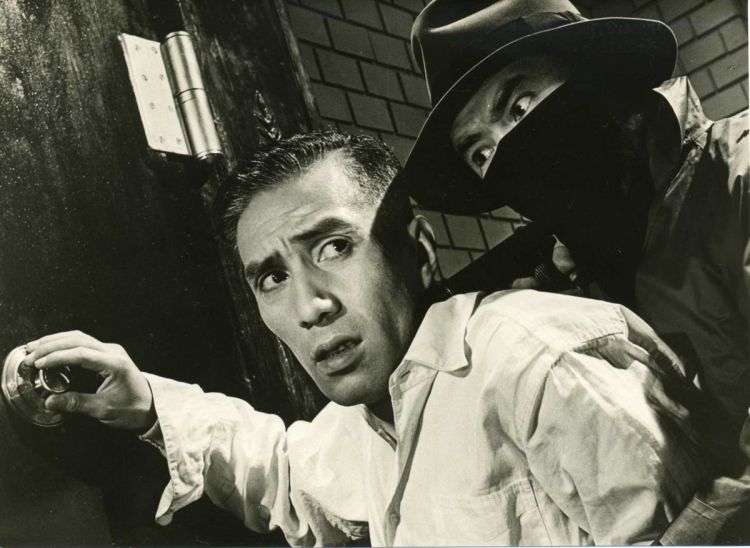
Intimidation still 1Social class as a means of social control is rarely dealt with overtly in Japanese cinema, but it’s been there all along from the feudal concerns of the jidaigeki to the inherent unfairness of the post-war world which made so many false promises to ambitious young go-getters, misselling dreams of social mobility in a newly meritocratic society. Koreyoshi Kurahara’s Intimidation (ある脅迫, Aru Kyohaku) is a noirish tale of blackmail and inexorable fall, but the title refers not just to the act literal act but to the oppression of a society in which the unscrupulous prosper and friendship, even love, is willingly sacrificed for the superficial comforts of wealth and status.

Bank manager Takita (Nobuo Kaneko) is riding high. He’s just been awarded an important new promotion but his success is less down to his innate talents, than to the fact he’s married the chairman’s daughter, Kumiko (Yoko Kosono). While Takita went to university and catapulted himself into the upper middle-classes, his childhood friend Nakaike (Ko Nishimura) only graduated middle school and has been working hard as a clerk in the same bank ever since. To make matters worse, Kumiko was once Nakaike’s sweetheart and Takita the lover of Nakaike’s sister, Yukie (Mari Shiraki). Where Nakaike is meek and earnest, Takita has abused every privilege he’s been given – illegal loans, backhanders, dodgy business deals and even an affair or two have left him wide open to blackmail. Takita’s party is about to end – Kumaki (Kojiro Kusanagi), a Tokyo hood, has proof of Takita’s improprieties and he threatens to expose all if he doesn’t get a sizeable amount of cash. It’s money that Takita doesn’t have, but Kumaki has a plan – Takita needs to rob his own bank. After all, who would expect the bank manager to raid his own vault?

Takita’s rise is as much down to societal corruption as it is his own lack of moral integrity. He’s got on by the traditionally “corrupt” ways that society condones – i.e. a dynastic marriage. He may have worked hard to get into university and get a good job that would enable him to be the kind of match a middle-class father would seek to arrange for his daughter, but everything after that is as straightforward and inevitable as a pair of train tracks. Takita has made it – his father-in-law will take care of everything else, all he has to do is sit back and avoid making any catastrophic mistakes. Perhaps because of the oppressive simplicity of his life, Takita has a lot going on the side – the “playing with fire” that he jokes about in his affairs and illicit backdoor deals are perhaps his ways of bucking the system, laughing at if not quite biting the hand that feeds. 

Meanwhile, mild-mannered Nakaike has been patiently muddling through waiting for a break that society just does not want to give him. Leaving school early (for circumstances which are never revealed but probably easy to guess) has defined his life prospects. Takita went to university, married Nakaike’s teenage sweetheart, and then became his boss – it isn’t fair, but it’s how things work. Not content with swiping Nakaike’s prospects, Takita continues to lord it over him, pretending to be “friends” like old times but belittling Nakaike behind his back and even continuing to carry on with his sister Yukie who has never given up on the childhood sweetheart who threw her over for career opportunity. Nakaike is bound by the superficial rules of society and men like Takita laugh at him for it, they think he’s a fool who doesn’t understand how the system works and only exists as a mechanism for them to exploit.

When Takita gets Nakaike roaring drunk as a part of his nefarious plan, Nakaike admits that he always found Kumiko intimidating – he has a natural deference to and mild fear of her upper-class elegance. Takita has no such qualms – he wants into that club, and he doesn’t care what he has to do or who he has to step on to get there. Yukie blames her brother for their present situation. She thinks his meekness makes him an obvious doormat, that if he had any kind of spine he wouldn’t have let Takita walk all over him and marry Kumiko which would mean she wouldn’t be trapped in the never-ending torment that is being Takita’s mistress rather than his wife. Playing lady Macbeth she needles and provokes her brother, though even if he should snap there’s not a lot that he could do.

Kurahara begins with the passage of a train and later ends on the same image. Our two protagonists are each railroaded towards their fates even if they think they can make a break for pursuing their own destinies. They both think they’ve won, got ahead of the other and the various things which chased them, beaten the intimidation of the society in which they live which attempts to “railroad” them onto a set of pre-ordained courses, but all each of them do is lose. The train rolls silently onward, there is no point of disembarkation save that which it allows, and its conductors are everywhere.


Robbery scene (dialogue free)

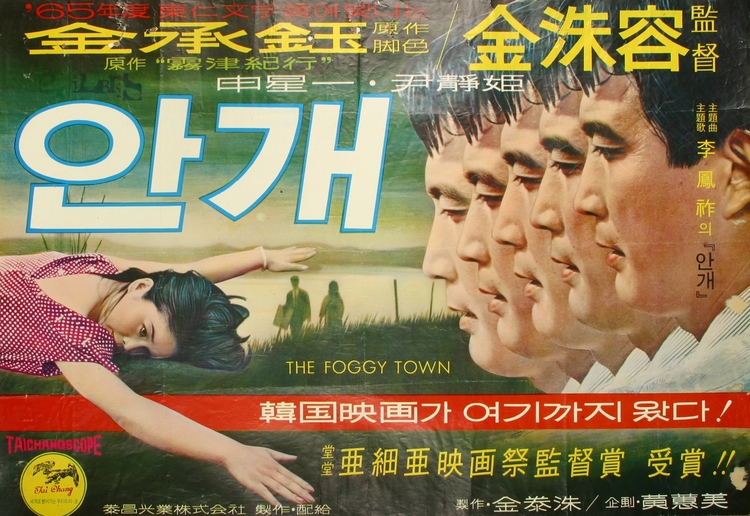
Mist (안개, Kim Soo-yong, 1967)

Mist 1967 posterBy 1967 Korea’s fortunes were beginning to expand. For the young, the future held promise but the nature of that promise was still indistinct. Often considered his masterpiece, 1967’s Mist (안개, Angae, AKA The Foggy Town) was another in the series of literary adaptations for which director Kim Soo-yong had become well known but its avant-garde mise-en-scène and gloomy outlook stand in stark contrast to the heartrending melodramas with which the genre was synonymous. Economic prosperity and superficial success have provoked only emptiness and despair, but a return to source provides little clarity for one harried salaryman lost in the expanding landscape of Korea’s global ambitions.

A poor boy from a remote coastal village, Gi-joon (Shin Seong-il) is now a successful salaryman in the capital where the constant clacking of typewriters, ringing of telephones, and racing of traffic rub at his tired mind. The fact of the matter is Gi-joon is not all that successful – he owes his position to having married the widowed daughter of the CEO. His wife and father-in-law, however, have relatively little faith in his business acumen and so, with the annual shareholders meeting on the horizon, they suggest he get out of the way by paying a visit to his hometown. Gi-joon is not all that happy to be going back, he hated Mujin with its unrelenting fog and general air of existential malaise, but he’s spineless and so he goes, despite himself.

Taking the train, Gi-joon has plenty of time to dwell on his past, literally seeing reflections of his younger self and entering extended flashbacks of memory. Mimicking the stream of consciousness approach of the novel, Gi-joon provides frequent voiceover, introducing his hometown in a less than favourable light as a place which traps its young who yearn to be free of its oppressive boredom. According to the irritated dialogue of two passengers on the bus (which Gi-joon has to take after his lengthy train journey), Mujin is a nothing sort of town where the sea is too shallow for fishing and the fields to narrow for farming, yet the population is large and largely survives on desperation alone, isolated by the oppressive fog that envelops the landscape each and every morning.

Gi-joon characterises the residents of Mujin as petty and materialistic. Having longed to escape, he thought he’d achieved his dreams in Seoul but a trip home forces him to reconsider what it is he’s become. In truth he’s no different from the petty and materialistic villagers he looked down on in their need to look down on each other. Powerlessness has defined his life. As a young man, he resorted to hiding in a cupboard to escape the draft on the orders of his terrified mother and later suffered from weak lungs which made him something of a local laughing stock. Now he’s set for a big promotion in the city but, as his wife reminds him, he wouldn’t even be there if it weren’t for her. Gi-joon’s marriage is one of convenience but it’s clear his wife holds all the cards – a wealthy widow with ambition needs a husband to act as a foil, and a weak willed man like Gi-joon is just the sort to submit himself to her authority in return for the obvious benefits she can offer him. Gi-joon has gained everything he ever dreamed of, but he feels only despair, oppressed by the very system he longed to be a part of.

Back in Mujin his various self delusions are rammed home to him. Trapped once again by the unrelenting fog, he longs to escape from his Seoul life and free himself from the yoke of his marriage and career. Whilst in town he meets up with old friends who introduce him to recent arrival Ha In-sook ( Yoon Jeong-hee) – an opera student turned music teacher who has joined the local school. In-sook is by far the most exciting thing in the extremely boring town, but Gi-joon is worried he’s stepped into the middle of something when he realises his old friend, Park, now a teacher, has a crush on In-sook while another old friend, Cho, now a status obsessed tax inspector, may also have marital designs.

Gi-joon didn’t need to worry about the tax inspector – as it turns out, he thinks he can do better than a mere music teacher and plans to marry up, much like Gi-joon has. Gi-joon bristles slightly at this, as he does to Cho’s lewd story about how he trapped In-sook on an overnight trip and planned to have a fling with her but she managed to get away (much to Gi-joon’s relief). Back home Gi-joon sees reflections of himself everywhere and particularly doesn’t like this alignment of himself with the ugly ambition of men like Cho who only want to lord it over their former friends. More flatteringly he sees his younger self in the depressed, conflicted In-sook who is already going half mad in the stultifying rural town and longs to go back to Seoul. Despite mild qualms about his friends’ feelings, Gi-joon finds himself bonding with the melancholy young woman who again forces him to see himself the way he really is rather than as the idealised personality he’d constructed for himself as a successful Seoul salaryman.

Bonding in their existential loneliness, the two eventually embark on a tender if melancholy affair which, despite their protestations to the contrary, is built on self delusions if not exactly on lies. Gi-joon intends to take In-sook to Seoul, but he won’t, and In-sook knows she won’t leave even if she wants to believe in the possibility of rescue. The world for them is as foggy and indistinct as the mists around the beaches of Mujin. Filled with emptiness and despair, they remain adrift in the post-war society unable to accept the soulless compromises of conventionality but finding no escape from their self imposed prisons.


Available on DVD as part of the Korean Film Archive’s Kim Soo-yong box set. Also available to stream for free via the Korean Film Archive’s YouTube Channel.

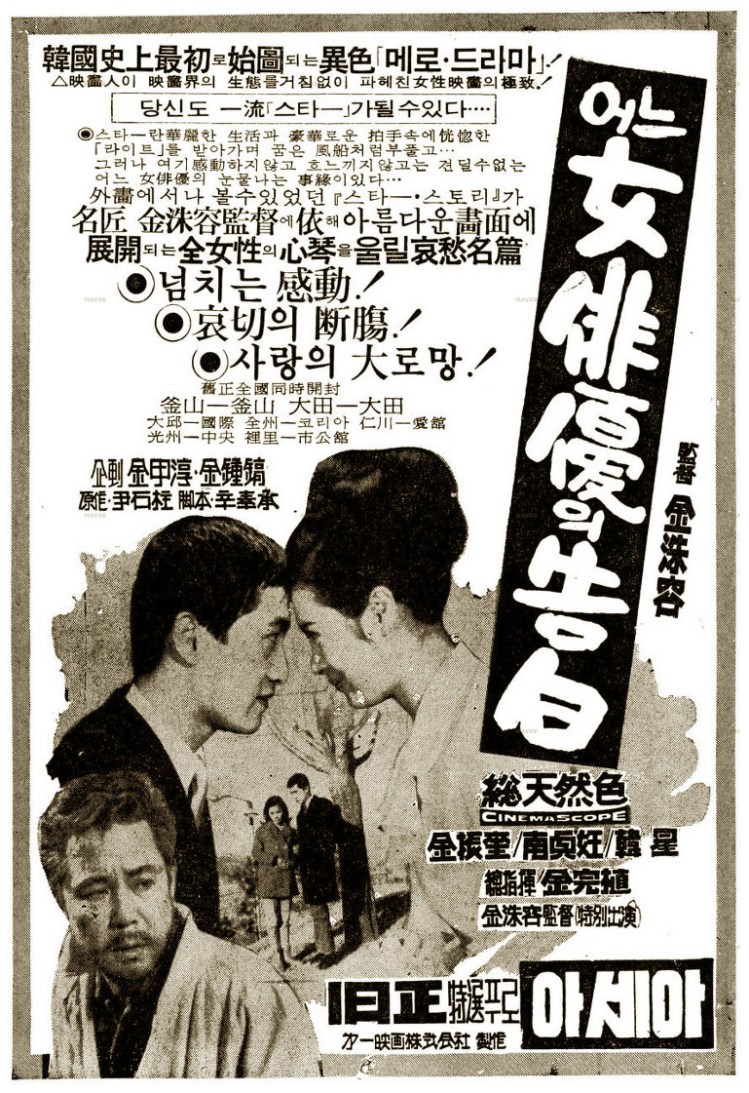
Confession of an Actress (어느 여배우의 고백 / 어느女俳優의告白, Kim Soo-yong, 1967)

Confession of an actress posterKorean filmmaking of the 1960s is sometimes referred to as a “golden age”, but the reality is that films were often churned out at a rapid pace for immediate distribution. Producers got an advance from local distributors, picked a scenario, assigned a suitable director and slotted in big name stars they already had under contract. For this reason production values are often low, but performance standard high despite the fact that many stars are bouncing around from one film to another shooting a scene here and a scene there. Director Kim Soo-yong filmed 10 features in 1967 – including his masterpiece Mist. Confessions of an Actress (어느 여배우의 고백 / 어느女俳優의告白, Eoneu Yeobaeu-ui Gobaek), inspired by a novel by Yun Seok-ju, is the kind of straightforward melodrama that was going out of style – a virtual remake of Chaplin’s Limelight with a little Phantom of the Opera thrown in, but Kim neatly repurposes it as a meta take on the Korean film industry of the day.

Kim Jin-kyu (played by the actor of the same name) was once a famous movie star, but heartbreaking tragedy ruined his career and now he’s a washed up drunk dreaming of the past. Hearing the dreaded “hey mister, didn’t you used to be somebody?”, Jin-kyu wanders into a film shoot and is thrown back to a happier time when he starred in prestige pictures with his regular co-star who was also his lover. Sadly, Miyong died of an illness leaving their last picture unfinished. The studio producers wanted to replace her and complete the movie, but Jin-kyu wouldn’t have it. They sued him for obstruction and his career was ruined. Jin-kyu was told that the child Miyong was carrying had died, but unbeknownst to him, a daughter was born and Miyong asked her friend Hwang Jung-seun to give the baby up for adoption and save it from the stigma of being illegitimate. Running into Jung-Seung at the shoot, Jin-kyu finds out his daughter is alive and determines to turn her into a great star – the only thing he can do for her as her father now that he is in such a sorry state.

Almost all of the characters in the film are named for their actors, though they are obviously not playing themselves in any biographical sense. Nevertheless, there is an intentional reflexivity in Kim’s decision to shift away from his literary source to towards one more immediately cinematic. Much as in Chaplin’s Limelight which does seem to provide a blueprint for the narrative, the arc is one of tragedy and redemption as Jin-kyu attempts to make up for lost time by imparting all his professional knowledge to the daughter he never knew and ensuring her success even at the cost of his own. Ashamed to introduce himself to her as a father given that long years of lonely drinking have reduced him to a broken old man, Jin-kyu gives his advice via letter and avoids seeing Jeong-im, longing to embrace her but afraid he’ll bring shame on her growing fortunes.

When Jin-kyu gets Jeong-im into show business, Kim gets a chance to put the Korean film industry on screen. He starts with a mildly sleazy producer and the established star who’s getting too old for ingenue roles but is desperate to hang on to her leading lady status. Nevertheless, she does have the option, as she points out, of a dignified escape through marriage should her career fail – something that is not an option for her male co-stars. As a young hopeful with no experience and nothing to recommend her beyond a pretty face, Jeong-im’s entry into the world of film is a baptism of fire. Rushed through makeup with its uncomfortable fake eyelashes and into an unfamiliar costume, Jeong-im’s rabbit in the headlights performance does not endear her to the director or more particularly the producer who is looking on from the wings in exasperation quietly calculating how much all of these extra takes are costing in wasted film. Nevertheless, the film is a success and, thanks to Jin-kyu’s careful tutoring, Jeong-im is on track for stardom.

Kim fetishises the camera, the process of filming with its bright artificial lights, tricks and techniques from the ice cold studio shoots to the difficult trips out on location. He makes full use of the relatively rare colour format utilising frequent superimpositions and montages, overlaying the bright neon lights of Seoul with the interior journey of our leading lady as she begins to find her voice. Making a final self cameo, Kim gives in to the inherently melodramatic quality of the underlying narrative but he does so somewhat ironically, rolling his eyes at the need for overly dramatic emotionality while actively embracing it, and lamenting the hardships of filmmaking while churning out his third picture in as many months. Confession of an Actress is not the salacious exposé promised by the title, but it is an illicit look at the decidedly unglamorous side of film production a world away from the bright lights and glossy magazines. 


Available on DVD as part of the Korean Film Archive’s Kim Soo-yong box set. Not currently available to stream online.