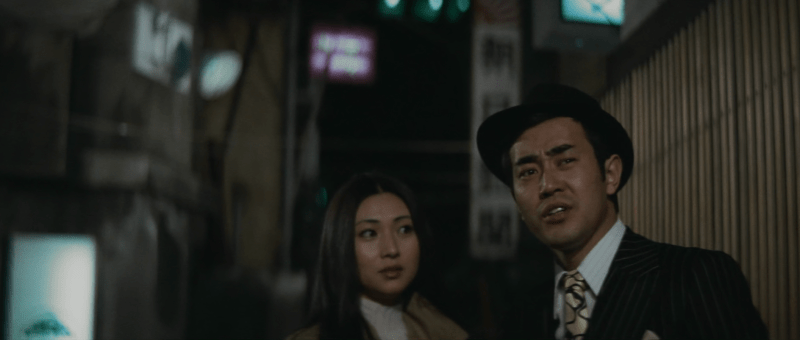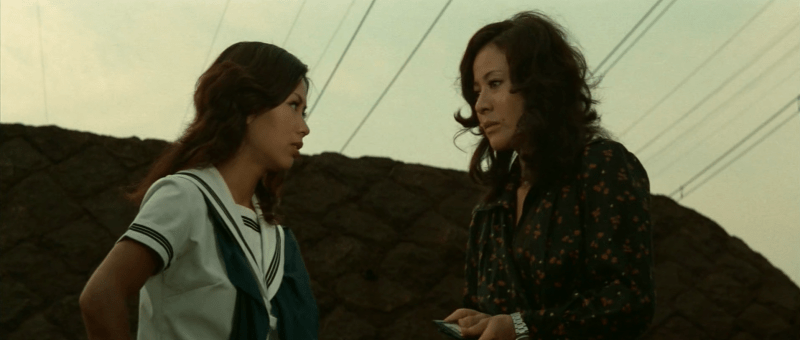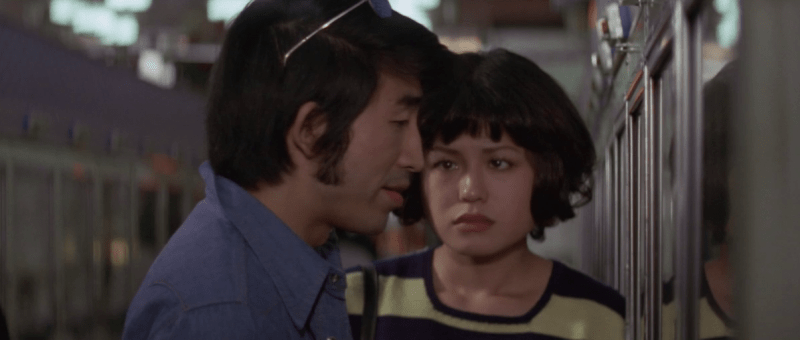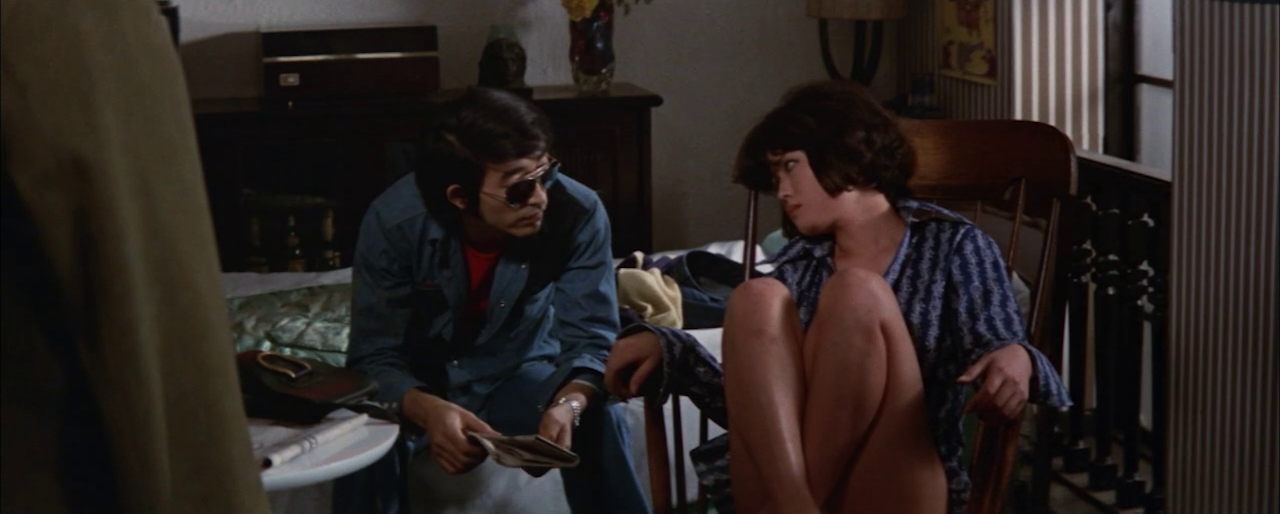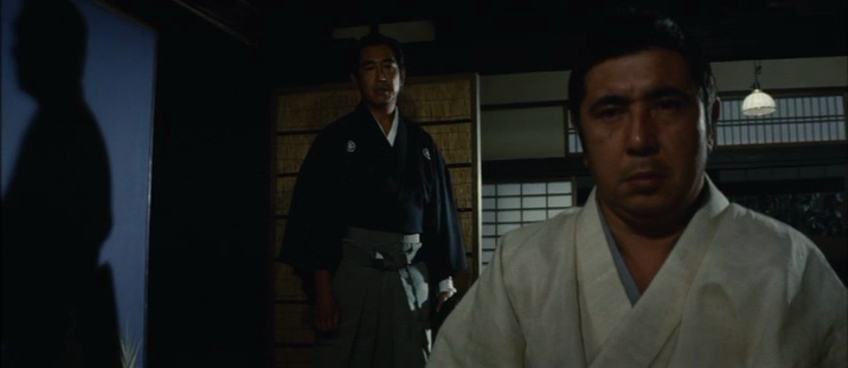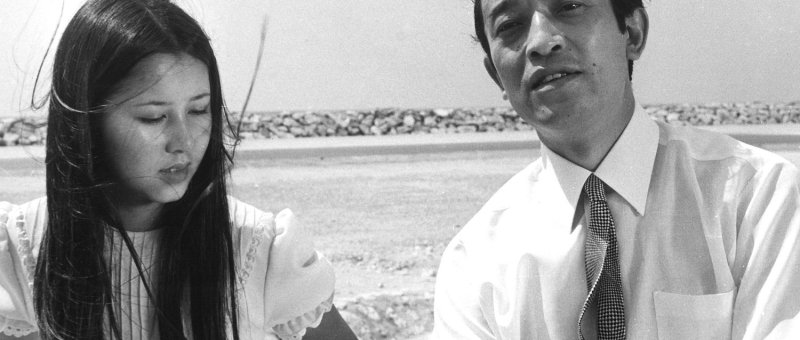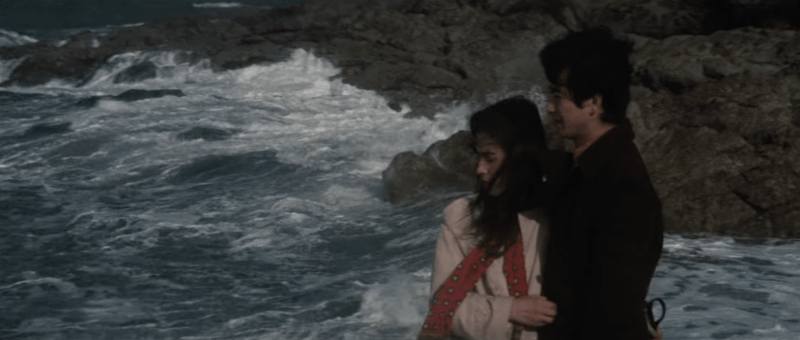
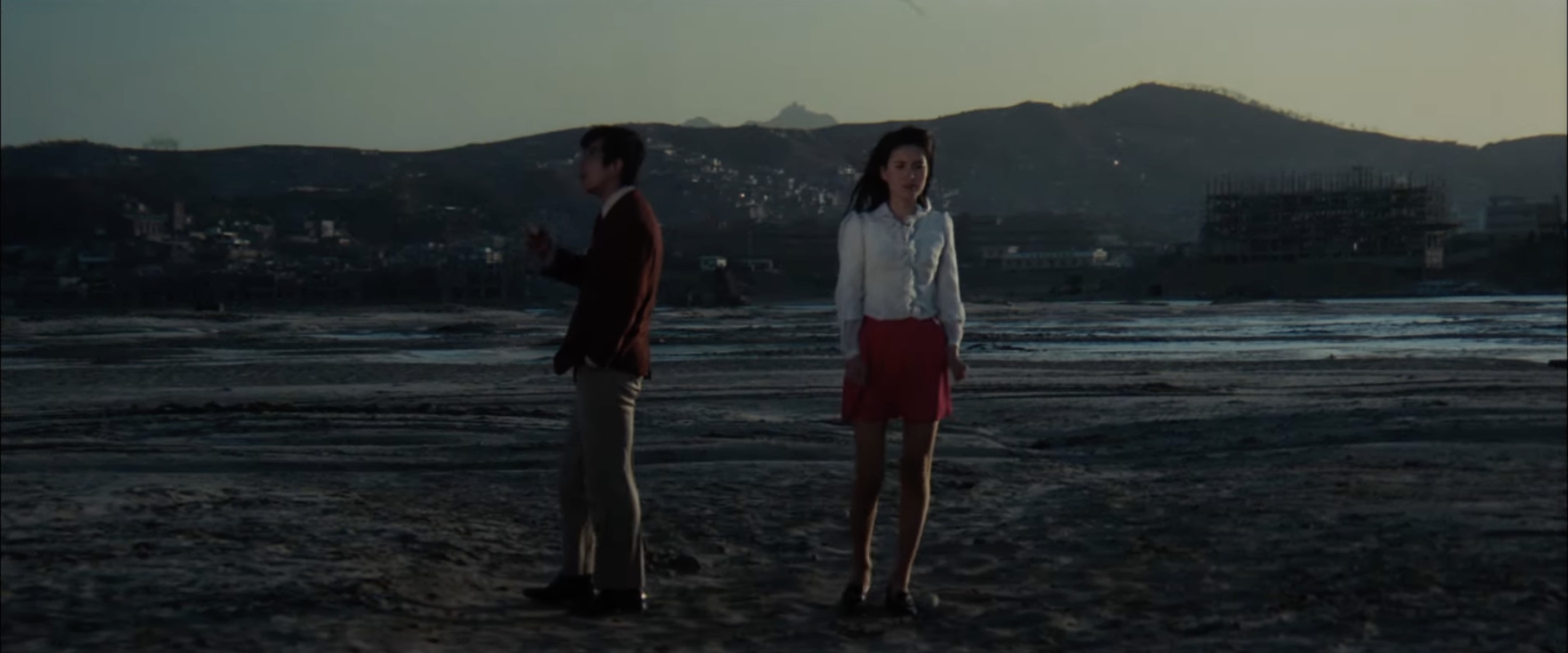
Wandering Ginza Butterfly (銀蝶渡り鳥, Kazuhiko Yamaguchi, 1972)

Having made a name for herself at Nikkatsu, Meiko Kaji was one of many who declined to continue working with the studio after it shifted production entirely to its Roman Porno line of softcore erotic cinema. Her exit, however, proved fortuitous for rival studio Toei who were urgently looking for a new female star following the sudden retirement of Junko Fuji who gave up acting after marrying a kabuki actor (she’d return a few years later working in television and subsequently films under the name Sumiko Fuji). With her feisty intensity and zeitgeisty energy Kaji would seem to be exactly what Toei were looking for. Her first vehicle for the studio, Wandering Ginza Butterfly (銀蝶渡り鳥, Gincho Wataridori) finds her attempting to forge a new star identity stepping into the space vacated by Fuji and making it her own in the midst of Toei’s ninkyo eiga decline. 

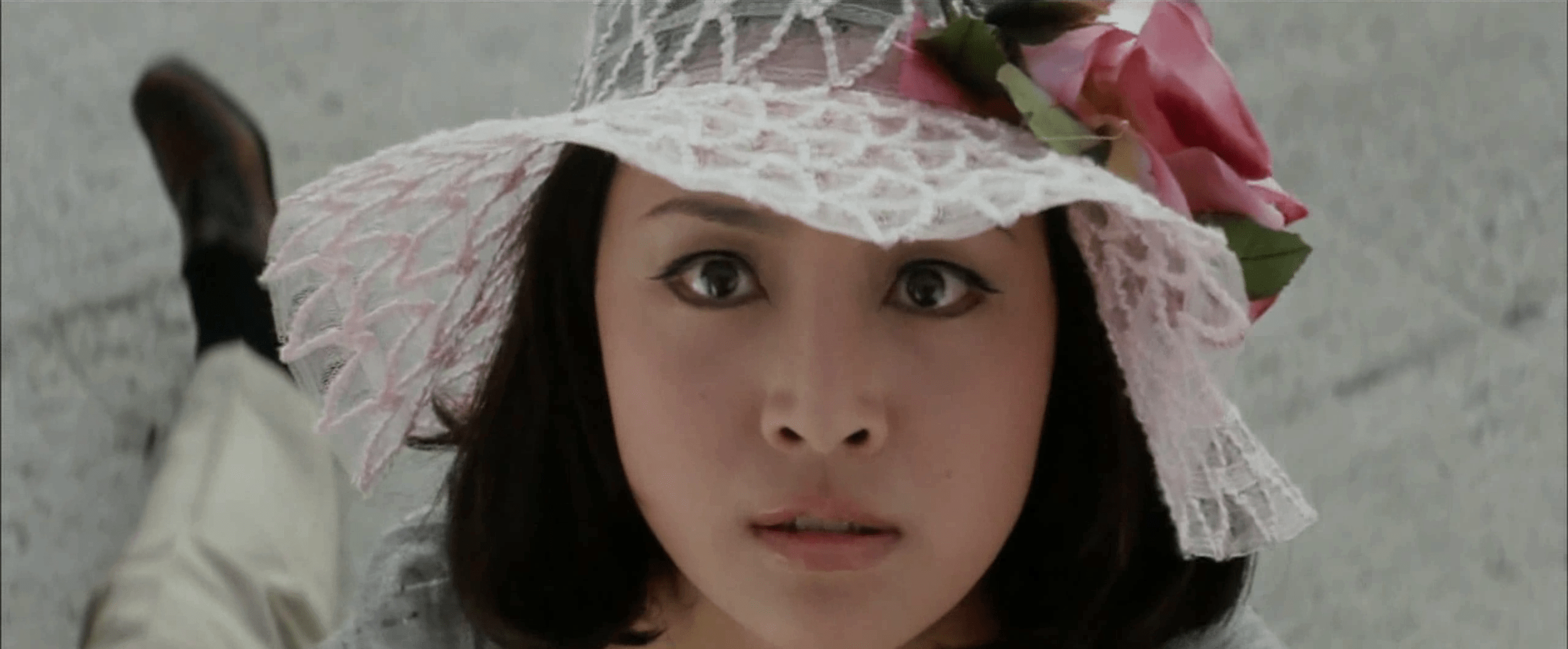
Set in the contemporary era, the film opens with a brief prologue at a woman’s prison in which new girl Tome (Kayako Sono) attempts to claim a space for herself by immediately challenging the boss of her new cell only for Nami (Meiko Kaji) to calmly defuse the situation with a traditional gambler’s introduction very much in keeping with Toei’s gambling films many of which had starred Fuji such as the Red Peony Gambler series which is perhaps referenced in Nami’s nickname of the Red Cherry Blossom. The action then shifts to a year later with Nami returning to Ginza in the hope of locating a woman, Saeko (Mieko Aoyagi), to thank her for writing a petition to get her prison sentence for killing a yakuza boss who had killed two members of her all-female biker gang reduced. On the train, however, she’s accosted by a mysterious man who rudely kisses her in order to hide from gangsters chasing him and is thereafter dragged into local intrigue after realising that a shady new yakuza group, Owada Enterprises, is at the centre of the injustice affecting all her friends new and old. 

As one of her new friends puts it, every girl in Ginza has a wound from the past she’d rather not talk about yet Nami’s particular sense of shame regarding her misspent biker girl youth and desire to atone are singular markers of her ninkyo inspired path to heroism. She’s just come out of prison, and now she’s going to clean up Ginza getting rid of rubbish, post-war yakuza who ignore the code and exploit “honest” people through underhanded methods such as buying up their debts to force them out of business. Discovering that Saeko has lost her business to Owada and thereafter became a regular bar girl but is now suffering with a serious illness and unable to work, Nami takes her spot at Bar Broncho while funnelling money to her through a mutual friend worried she wouldn’t take it if she knew where it came from. As a bar hostess, she is smart and coquettish, playing cute in a side not often seen from Kaji later in her career in order to get the punters to pay up, but unafraid to go all in that doesn’t work even pinching a construction worker’s truck as collateral when he refuses to pay his tab.

Nevertheless, the film subverts expectation by shifting away from the gambling movie model including only one round of cards which Nami easily wins and then immediately leaves explaining that you have to know when to quit in a fight or in gambling. The central conflict is, in fact, played out through an intense game of pool, a few brief moments of onscreen text explaining the rules before Nami squares off against a drug-addled Owada henchman whose face begins to glow in an ominous yellow as the stuff wears off. Nevertheless, when Owada reneges on his promises violence is all that remains. Nami and new friend Ryuji (Tsunehiko Watase) team up to take revenge on the sleazy gangsters in order to set Ginza to rights. 

Nevertheless, there’s a kind of poignancy in the fact the central trio are all war orphans, “wandering birds” trying to find a foothold in the complicated post-war landscape while attempting to hold on to their sense of integrity. When Nami’s past as an ex-con is exposed to the other ladies at the bar they roundly reject her, though one assumes they’ve sad stories of their own, leaving her consumed by shame. Reformed by Saeko’s unexpected generosity of spirit and compassionate forgiveness, she bitterly regrets the moral compromises of her biker girl life and commits herself to fighting injustice, unwavering in her refusal to be complicit in the increasingly amoral venality of the post-war society. Sadly, Wandering Ginza Butterfly did not entirely succeed in stealing Fuji’s crown, the contemporary setting unable to overcome audience fatigue with the ninkyo genre which was shortly to implode in the wake of the jitsuroku revolution. It spawned only one sequel, but did perhaps pave the way for Kaji’s path to Toei stardom as the face of pinky violence. 


Terrifying Girls’ High School: Women’s Violent Classroom (恐怖女子高校 女暴力教室, Norifumi Suzuki, 1972)

“Society fucking sucks” according to the delinquent teens at the centre of Terrifying Girls’ High School: Women’s Violent Classroom (恐怖女子高校 女暴力教室, Kyofu joshikoko: Onna boryoku kyoshitsu). The first of four in a Toei pinky violence series, the film presents a feminine rebellion against the societal tenets of womanhood, if doing so largely within the realms of male fantasy, but nevertheless kicks back against the corruption and hypocrisy of the older generation otherwise hellbent on controlling them.

Seiko Girls’ High School is, we’re told, both a private institution and a “trash bin” established to handle the “trash” transferred from “normal” schools. Nevertheless, the sign which hangs outside proclaims conservative values playing on the “good wife, wise mother” truism of traditional femininity in insisting the girls must become wise wives and kind mothers. Needless to say, most of the young women are quite uninterested in becoming any such thing. The unruliness of the school is signalled in the opening sequence as an older male teacher gives a boring lesson about curves while the girls all ignore him. Some are putting on makeup, others are eating or talking amongst themselves. After all, what’s the point of their education if the expectation is they’ll all become obedient housewives dependent on their husbands for support and allowed little in the way of free thought or interest?

A teacher later ironically suggests that the school’s reputation will later reflect badly on them when it comes to getting jobs or getting married only for one of the girls to snap back no one here is going to university and their reputations are all ruined anyway. It might be tempting to assume the problem is mostly generational, but the arrival of a young male teacher who has himself been transferred for violent conduct suggests a kind of backlash to the increasing freedoms of the contemporary society. He tells the girls that he won’t be soft on enforcing his three rules for education which are surprisingly gentle, being friendship, companionship, and harmony, but they simply laugh at him. Not only do they pelt the new teacher with pants and condoms but insist that it they who make the rules here and he will have to follow them. 

Then again there don’t seem to be any rules of any sort other than the absurdity of social hierarchy as they girls square off in various factions vying for dominance of the school, The implication is that gang leader Michiko (Miki Sugimoto) turned rebellious after being raped by strangers on her way home and witnessing her father, a politician, actively cover it up while she continues to feel shamed by her family. Another girl, Yoko (Natsuko Miura), otherwise not involved in the school violence, is working as a hostess to support herself as an orphan living with her grandmother but is lusted after by lecherous teacher who eventually forces her into a sexual relationship and then drops her when she becomes pregnant despite giving the implication he would marry her. Takeo tries to force her to have an abortion though she is determined to have the child despite the scandal causing him to hire another delinquent faction to beat her into a miscarriage. When she takes her own life, the school is most concerned about its reputation despite having done nothing when it was discovered the headmistress’ own daughter, the leader of the other gang, was also engaging in sex work. 

Takeo is also the target of a revenge plot at the hands of mysterious transfer student Yuki who avoids taking any categorical side until pulled into the conflict because of her friendship with Yoko and the growing sense of solidarity between the young women oppressed by a corrupt social system that uses shame to control them. “The rapists win in our society,” one sighs in an oddly contemporary moment. To celebrate their liberation, they burn their sailor suits having stripped and bound their teachers before posing before a sign announcing that they have enacted justice on the “three pigs” who financially exploited them through abusing the educational system. Full of ironic details such as the girls introducing themselves through the classic gambler’s pose, Suzuki films with a punkish irony quite clearly fetishising female violence yet also poking fun at lecherous middle-aged men, youthful hard cases, and matronly older women while in the end handing agency back to the girls even if society continues to suck. 


Delicate Skillful Fingers (白い指の戯れ, Toru Murakawa, 1972)

Toru Murakawa is most closely associated with his long and fruitful partnership with Yusaku Matsuda which came to define a certain kind of 1970s cinema, but he began his career at Nikkatsu in 1959 in the sales department before resigning and rejoining a year later as an aspiring director. At Nikkatsu he worked with established directors such as Toshio Masuda and Ko Nakahira, as well as with external directors such as Shiro Moritani before making his directorial debut in Nikkatsu Roman Porno, a line of soft core pornography the studio launched amid the collapse of the studio system, with Delicate Skillful Fingers (白い指の戯れ, Shiroi Yubi no Tawamure), in 1972.

Murakawa would actually leave the studio in the same year having completed two more Roman Porno films, returning to his hometown of Yamagata where he had married into the family of well-known metalwork artist Kenten Takahashi both training with him and helping his older brother Chiaki Murakawa set up the Yamagata Symphony Orchestra. In any case, his temporary withdrawal from the film industry had nothing to with a lack of success in his debut feature. Delicate Skillful Fingers was a critical hit and the first of Nikkatsu’s Roman Porno line to feature in Kinema Junpo’s prestigious Best Ten. It was also the debut film for lead actress Hiroko Isayama and, perhaps not entirely coincidentally, the first time the studio put the male star front and centre in their branding campaign. 

Co-scripted by another top Roman Porno name Tatsumi Kumashiro, the film follows the innocent and naive Yuki (Hiroko Isayama), who is so sensitive that the sight of a wrecked car makes her cry in sympathy, as she falls deeper into the world of petty street crime after being chatted up in a cafe by a goofy guy who just happens to have a problem with kleptomania. At least according to his sometime girlfriend Shoko, Jiro (Hajime Tanimoto) came from a wealthy family and attended a fee-paying school, seemingly stealing for the thrill of it rather than financial need. It has to be said that Yuki is rather ditsy, bamboozled into buying food to cook Jiro dinner while entering into a strange dialogue with a robot offering greetings in Chinese as to whether she should give him her virginity which she eventually does, perhaps recklessly, though it ends up not going particularly well, with Jiro having to explain that “the ceremony is now ended” without it seems much fanfare. In any case when he’s picked up by the police and put away for three years because he already had a record, Yuki has to quite her factory job because of persistent police harassment and bizarrely ends up living with Shoko who has predatory lesbian designs on her Yuki responds to but with a degree of internalised shame. 

Shoko’s desire for other women is in someways depicted as an expression of corruption caused by her pickpocket lifestyle as she implies sometime later in suggesting that Yuki will “come to like it” linking the idea of lesbian sex and the act of pickpocketing as implied by “delicate skilful fingers” of the film’s title. Yuki’s bodily submission but mental resistance is intended to suggest her lingering innocence, yet to submit herself to the hedonistic amorality of the pickpocket lifestyle. Rejecting Shoko, she later becomes sexually involved with Jiro’s former cellmate Taku (Ichiro Araki) who is responsible for teaching her how to pickpocket. Taku is otherwise seemingly less interested in sex, but allows Yuki to take the lead while he remains somewhat passive, lying still and still and chewing gum, always with his sunshades remaining firmly on. He even at one point passes her off to an associate in the middle of making love to her, Yuki first resisting on realising what’s going on but eventually giving in to it though clearly not willingly. 

The contrast between the two men, Jiro and Taku, is stark with Jiro clearly asking for consent at each step and waiting for Yuki to confirm it even if in the end he fails to perform whereas Taku seems to be merely using sex which doesn’t interest him to earn her trust and convince her to help him out in his various criminal operations. Yuki is seduced into a world of crime, but remains romantically naive, foolishly sacrificing herself for Taku and insisting she alone was responsible when cornered by the police while he simply walks away and then jokes with a policeman that he’ll look after her when she’s out. Even so, her loyalty to Taku, in contrast with Shoko’s continuing cynicism, proves that she is not fully corrupted by the pickpocket life, even if she foolishly damns herself by needlessly protecting him at the cost of her own future and wellbeing. On the other hand, to so is entirely her own choice just as it was her own choice to sleep with Jiro in the full embrace of her agency. Murakawa’s Nikkatsu debut is a gritty, grimy urban tale of amoral post-war youth but, even in its tragic conclusion, signals the hero’s spineless indifference and hands victory to the heroine who remains uncorrupted but only to her eternal cost. 


Eight Men to Kill (賞金首 一瞬八人斬り, Shigehiro Ozawa, 1972)

In the first instalment of the Bounty Hunter series, Shikoro Ichibei (Tomisaburo Wakayama) had been a shogunate spy intent on putting down rebellion to their oppression, but by the third, it seems he’s thoroughly fed up with the ills of feudalism and apparently no admirer of the Tokugawa who he feels to have failed in their responsibility to the people along with their personal greed and desire to hold on to their power.

Ichibei’s chief objection is their lack of healthcare provision, seeing as he is a doctor who mainly cares for the poor. That’s one reason he agrees to the job, asking for a large percentage of the gold he’s been asked to retrieve by a worried retainer who explains that the Edo government is relying on it to bridge a gap on their finances. If the gold’s not returned, the entire economy may crash. The government’s heartlessness is further borne out by the retainer’s words that it’s not the time to be concerned about one boy whose importance pales in contrast to that of the Tokugawa Shogunate when a rogue ronin kidnaps the son of the man responsible for the theft of the gold from a local mine. 

In a repeated motif, men attempt to swallow the gold as a means either of stealing or hiding it but it gets stuck in their digestive system and causes them a great deal of pain that could lead to death. The cruel mine owner Kanoke Tatsu (Minoru Oki) forces Ichibei to cut open the man’s stomach to get the gold out, while he insists on sewing him back up again because as a doctor it would be wrong not to. What he’s really performed maybe a kind of gold-ectomy, removing the toxic substance from the men’s stomachs even if he may not be able to save their lives or improve their circumstances.

Ichibei tells the bandit, Yasha the Wolf (Kenji Imai), who is held responsible for the theft of the gold, that he is as bad as him and is only looking for a fast way to make money, yet he wants it to use to build better hospitals for the poor, ironically using the government’s cash to make up for their failing. Meanwhile, he finds himself coming up against a man much like himself only inverted in the form of wandering assassin Yajuro (Shigeru Amachi), a former secret policeman in the rebellious Bishu domain who doubt crosses everyone he comes across in an attempt to get his hands on the gold. Ichibei asks the man who hired him why they don’t want to use government spies but he tells him that it’s because they’d run out. The ones they sent to investigate have all been killed, presumably by the treacherous Yajuro.

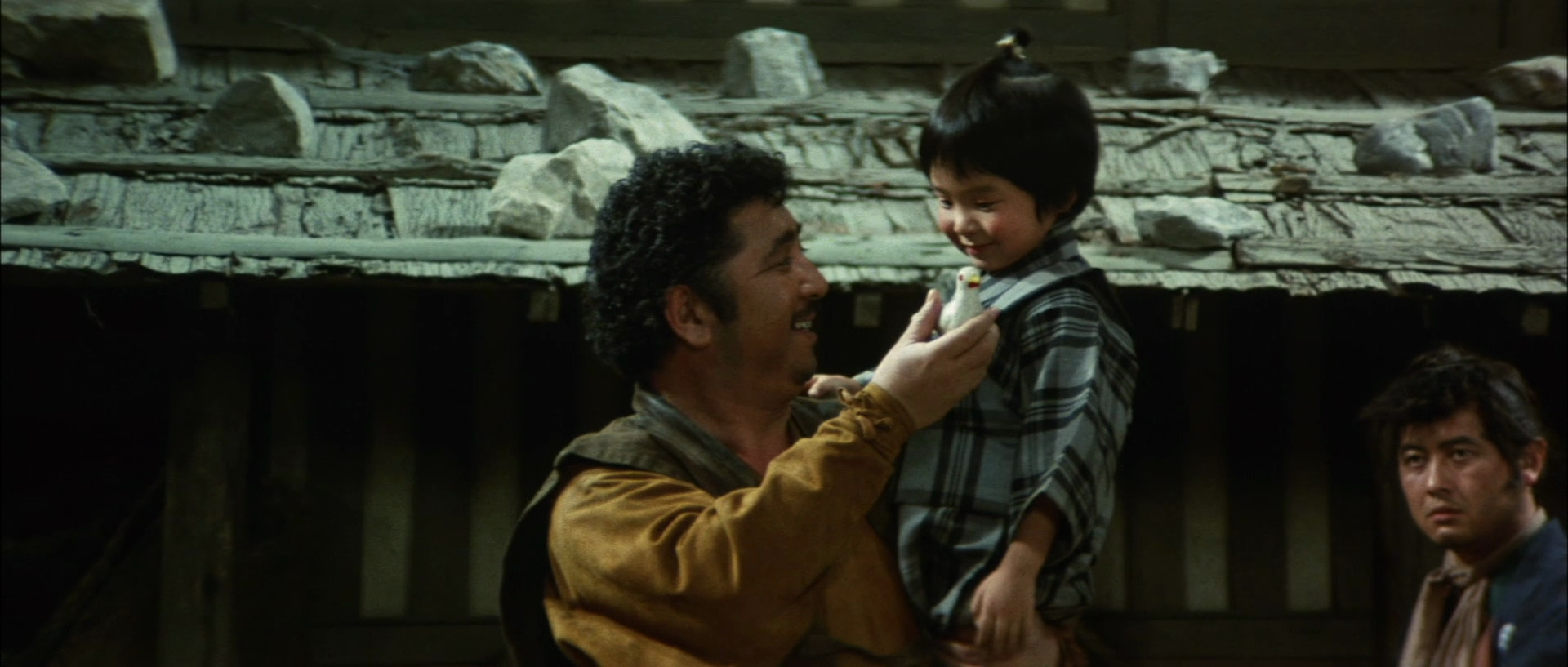
All around him, Ichibei discovers only omnipresent greed. A geisha he comes across is working with the mine owner to steal the cash, but simultaneously seducing Ichibei and the apparently won over by his bedroom prowess though it’s difficult to know which is an act, her fondness for Ichibei or pledges to sell him out to Kanoke. Meanwhile, Kanoke vacillates when presented with a binary choice by Yajuro, his adorable three-year-old son, or the gold. As always, it’s the innocent who suffer while personal greed and governmental indifference leave ordinary people little room to manoeuvre. 

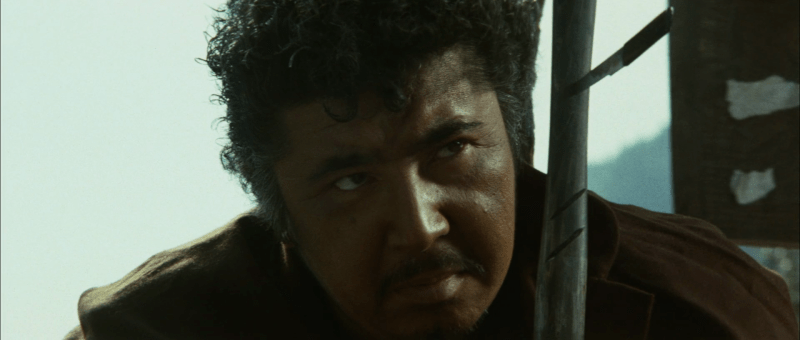
This time around, the righteous Ichibei cuts a solitary figure. He no longer has a posse and is supported only by an older gentleman who is mute. As a result of his mission, he even ends up on a wanted poster himself with the shogunate, presumably unwilling recognise him, yet eventually congratulating him on a job well done, much to his shame and embarrassment having witnessed shogunate soldiers committing an atrocity. Very much in the western vein, Ozawa lends the dusty old mining town a sense of dread and decay as it rots from the inside out thanks to the corrupt authority of a weakened shogunate seeking only ways to cement its own power. The red-tinted final taking place during a solar eclipse seems to emphasise the hellishness of the situation even as Ichibei announces that they can all go to hell but he’s sending the money to heaven where it can be put to better use. 


The Black Tavern (黑店, Teddy Yip Wing-Cho, 1972)

One of the reasons that martial arts films are so popular is that it’s often easy to tell who is good and who is bad. In general, the just hero vanquishes the source of evil and corruption, thereby restoring a sense of moral order to a world that may in other ways be chaotic. But chaotic is probably the best way to describe the world of The Black Tavern (黑店) in which the titular inn becomes a nexus of greed and villainy where it is impossible to tell who, if anyone, is good, while almost everyone is actually bad and the heroine only really intervenes in the closing scenes.

One way you can tell that something is very rotten at the Gao Family Inn is that the cook suddenly emerges from a pit underground carrying someone’s leg, which he then chops up and uses to make buns. No one ever mentions this again. It’s a just symbol of how corrupt and hellish this world has become. The inn is apparently the only staging post on this route, which is presumably how they continue to get custom despite bumping off their guests, taking all their stuff, and then chopping them up to put in buns to serve to the next unfortunate person who arrives in search of a bed for the night. 

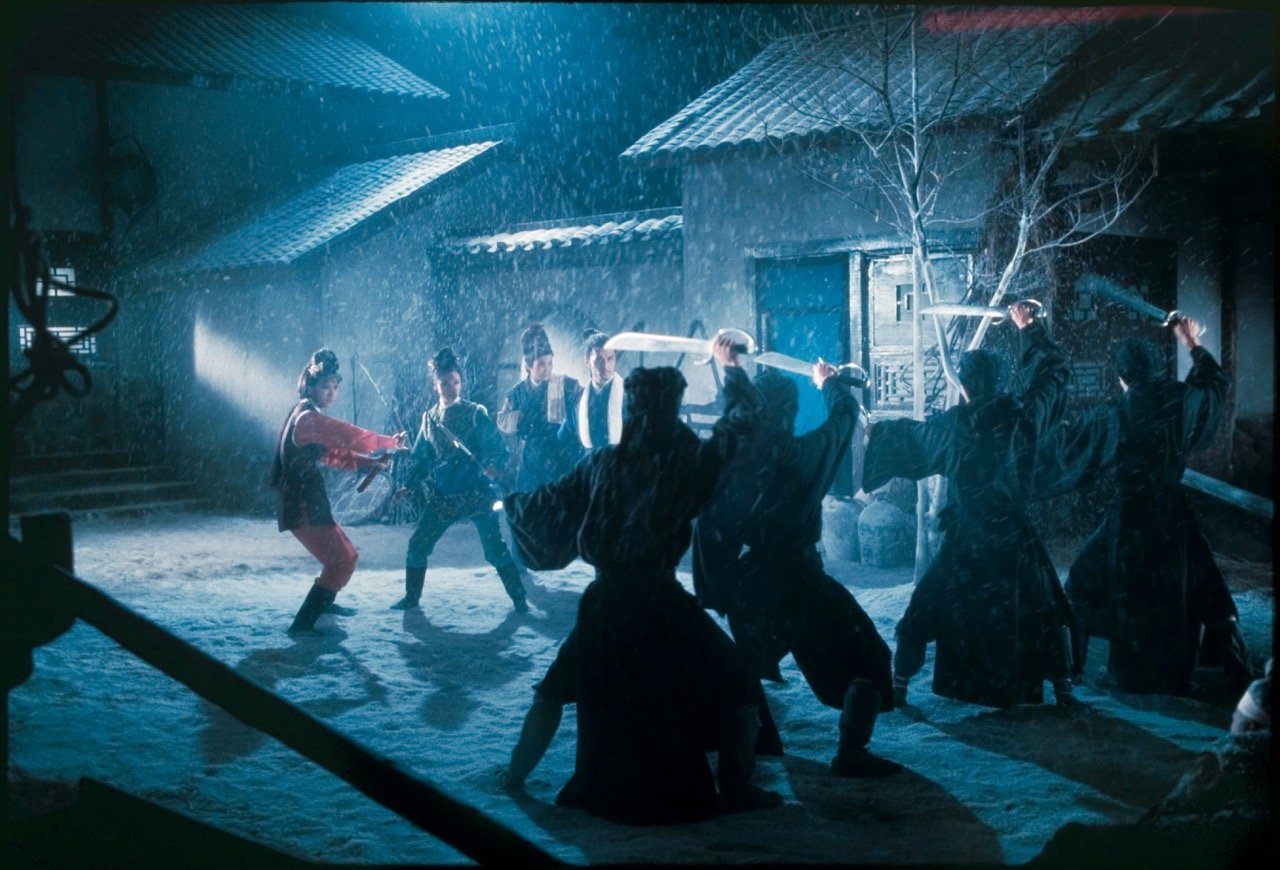
But the reason so many venal bandits are drawn here is that a beggar monk (Dean Shek) tells them he saw vast riches fall out of a chest belonging to Hai Gangfeng, a former official returning to his home province with all his ill-gotten gains from accepting bribes. Assuming Gangfeng will be stopping at the inn, everyone who heard the monk is on their way there. Only, as it turns out, the man we thought was Hai Gangfeng is actually a bandit, “Whipmaster” Zheng Shoushan (Ku Feng), who cunningly pretended to be him to take over the inn and wait for the real Gangfeng’s arrival. He does not, however, seem to have anticipated so many other bandit gangs each more outlandish than the last having the same idea.

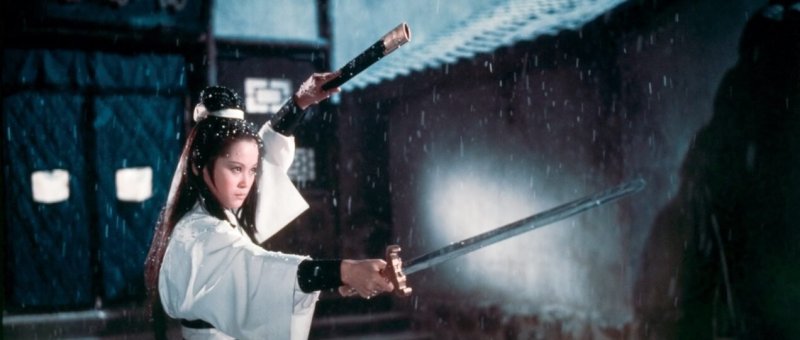
One turns up with a band of hopping vampires who turn out to be crooks in disguise, while another is wearing a horned helmet that gets stuck in things when he’s trying to fight. Of course, they’re all trying to kill each other so they can be the ones in control when Gangfeng finally arrives. What they don’t realise is that the whole thing’s a honeytrap designed to lure them all to the inn for just this purpose, so that they’ll all kill each other and spare the forces of justice some trouble. Those would be Zhang Caibing (Shih Szu), a disciple of the Lady Hermit making this a kind of extended universe film of the Cheng Pei-Pei classic. Continuing her mentor’s mission, she’s out to skim off the “scum of the martial arts world,” explaining to Shoushan that if he doesn’t like it, he should have thought of that before committing so many “evil deeds”. 

On the other hand, Caibing does seem to be enjoying this quite a lot so perhaps she’s not quite so entitled to the moral high ground as she’d like to think. While taking a leaf out of King Hu’s book, Yip adds an edge of slapstick absurdity in setting up elaborate action sequences with well-deserved pay offs and indulging in goreless yet extreme kills such as a series of surprise decapitations. Shoushan’s bladed whip becomes a versatile weapon but also an extension of his character in his cowardliness and lack of morality. It’s only really any good at long range, which means that he keeps his opponents at arms’ length rather than confront them directly as in the typical tests of skill that define a martial arts battle. He coils it around their necks, snake-like, then either pops their heads off or strangles them to death. Just like the innkeeper he killed off at the start, he seems to have genuine affection for his female companions but eventually meets a similar fate as his trademark whip is ironically turned against him. 

There’s also a genuine, if underplayed, sense of ambiguity in the attraction between the mysterious swordsman (Tung Li ) and Shoushan’s daughter that prevents him from killing her while suggesting that he too was on some level attracted to banditry. Even if he rides off in the end with Caibing, it does not appear that their relationship is romantic. Nor is he allowed to claim victory by swooping in when all seemed lost for Caibing during the final fight, immediately encountering difficulty with Shoushan who puts up a good fight that again seems contrary to his moral character in the amount of skill and effort needed to beat him. Indeed, it often seems as if he will win after all. This world will fall to men like him and turn into one giant Black Tavern. In the end, it’s a team effort that takes him down, including the strange intrusion of the beggar monk who was after all the person who started all this by repeating the rumour in the last rest stop and may or may not actually be working with Caibing. In any case, the incredibly fast-paced action sequences and the dark humour that accompanies them lend the film an epic quality despite its tight duration along with an ironic kind of cynicism that insists this world is simply too silly to be evil but that the scum of the martial arts world will pay all the same.


The Black Tavern screened as part of this year’s Focus Hong Kong.

King Boxer (天下第一拳, Jeong Chang-hwa, 1972)

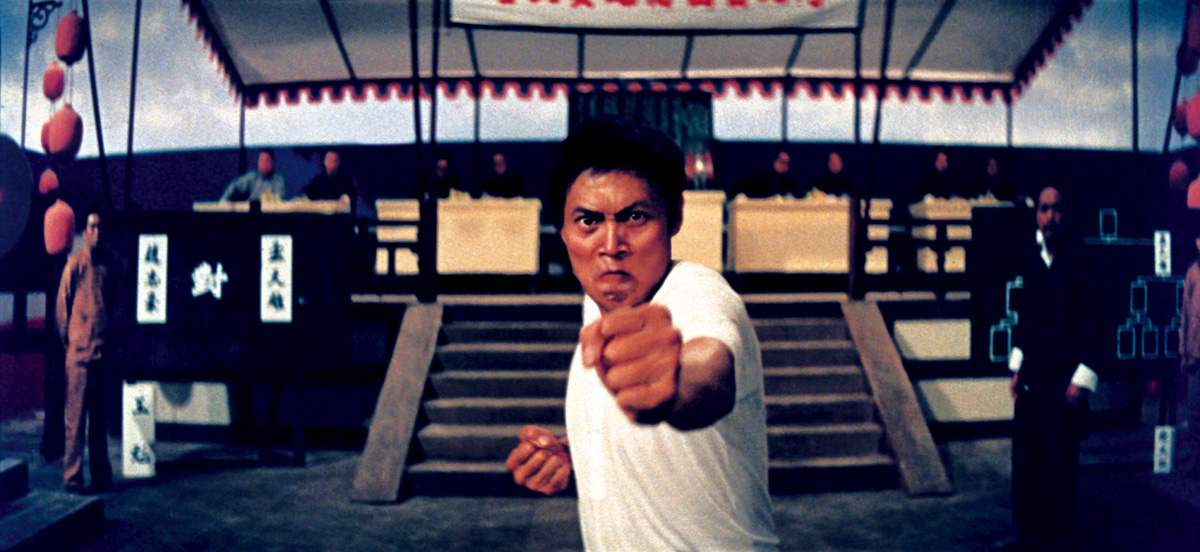
Legend has it that Shaw Brothers’ main motivation in making King Boxer (天下第一拳) was retaliation against Golden Harvest who’d managed to sign Bruce Lee after he turned them down because they offered him the standard studio contract which was at the very least unattractive. Until that point, the studio had mainly been making wuxia pictures and musicals, but had begun to shift towards unarmed combat with the success of The Chinese Boxer in 1970. 

Released internationally under the title Five Fingers of Death, the film kickstarted the 1970s kung fu craze with its vast success in America and helped to solidify a new genre that was then only just being formed through the use of the trampoline technique pioneered by wuxia master King Hu along with his fast cuts and a surprisingly gory take on violence even having the floor shift and give off puffs of dust for added realism. Otherwise it weaves a fairly standard tale of warring schools each vying to win a top contest which confers on the winner the right to control five territories in the north, though this is not of course the goal of the righteous contenders who desire neither fame nor fortune only to improve their skills. The earnest Zhihao (Lo Lieh) just wants to stay with his master and adopted father, Song (Ku Wen-Chung), with whose daughter Ying-ying (Wang Ping) he has also fallen in love, but when and former pupil Daming (Jin Bong-Jin) returns after training with Master Sun and Song is attacked by bandits which leaves him feeling past his best, he decides Zhihao should be sent away too until he wins the contest and returns to take over the school. 

Meanwhile, the evil Meng (Tien Feng) is scheming to have his son Tianxiong (Tung Lam), who lacks martial arts talent, win the contest so that they can control the territory and oppress everybody in its domain. Meng is fond of talking about honour and the martial arts spirit, but actually plans to win the competition by cheating which is why he had his goons attack Master Song. He plans to take out his rivals ahead of time so Tianxiong will have a clear path to victory. 

Zhihao, however, is floundering, forced to toil in Sun’s kitchen’s for a year training through practical means before even being accepted as pupil. Sun’s top student, Han Long (Nam Seok-hoon), appears to take an instant dislike of him that may just be down to his insecurity and fear of competition but eventually becomes a source of weakness in the Sun school. It’s clear that Han resents Zhihao for stealing the place he feels to have been his by right, especially on learning that Sun has given him the manual for the Iron Palm technique, and is even more annoyed when he runs into singer Yan who asks him about Zhihao though he is obviously interested in her himself. This romantic rivalry seems to further undermine his sense of masculinity and causes him to betray everything he stands for as a martial artist by cutting a deal with Meng in the hope he’ll get rid of Zhihao so he can take his place in the contest even if doing so likely means he’ll have to lose to Tianxiong. 

The romantic subplot has a gentle poignancy as we obviously know that Yan will never end up with Zhihao because he is in love with Ying-ying while Yan also tries to convince him to leave the martial arts world which is something that just isn’t going to happen. In any case, Zhihao remains committed to opposing injustice, facing off against Meng and battling the three karate masters he’s imported from Japan to do his dirty his work as well as the ace up his sleeve, wandering fighter Chen Lang (Kim Ki-Joo) who eventually begins to realise he’s chosen the wrong side on witnessing Meng’s ruthlessness which breaks every rule in the martial arts book. 

Korean director Jeong Chang-hwa, however, slightly wrong foots us denying Zhihao his vengeance against Meng while Han takes him on instead as an act of redemption though he too is eventually denied. This not quite final fight is among the most impressive in the film, fought in near darkness as Han has by this point lost his sight. Zhihao meanwhile takes on Okada (Chao Hsiung), the karate master, demonstrating his “Iron Palm” technique which Jeong lends an eerie supernatural quality through the use of red lighting and the sting of synths. Though the plot plays out like a western, Jeong’s aesthetics otherwise strongly recall the colour of Nikkatsu youth drama of the earlier 1960s most especially in his colour palette and lighting. Unfortunately this would be the last film he made for Shaw Brothers after apparently becoming fed up with Mona Fong’s cost cutting and jumping ship to Golden Harvest where he stayed for the rest of his career, but he did help to create a genre of kung fu cinema and popularise it all over the world.


The Target of Roses (薔薇の標的, Kiyoshi Nishimura, 1972)

One of a series of internationalist conspiracy thrillers arriving in the early 1970s, Kiyoshi Nishimura’s Target of Roses (薔薇の標的, Bara no Hyoteki, AKA Red Target) finds itself at a particular moment of paranoid anxiety. In the immediate wake of Asama-Sanso, its villains are a band of revolutionaries hiding out in the mountains behind the shield of “New Religion” as they plot the over throw of the state. Yet these villains are not left-wing former student protestors but Nazi holdovers branding themselves as the “Fourth Reich” while insisting that they are not “fascists” but merely trying to create a new world order free of “corrupt governments”. 

The hero, Akira, in keeping with similar roles Yuzo Kayama played in this period, is a former Olympic sharpshooter who fled to America after being implicated in the death of a teammate. You can tell that things haven’t been going well for him by the terrible mutton chops haircut he is forced to wear throughout the film, but his problem seems to be that he has lost all interest in living. That’s one reason he’s recruited by the Fourth Reich’s local leader Tachibana who theorises that Akira is a man who lives for the gun and is good as dead without one. He and his one-eyed associate Nomura (Toby Kadoguchi), a former sharpshooter himself, begin training him with various strange exercises never revealing their true purpose until asking him to shoot a prisoner they’ve tricked into trying to escape from their secret base. Realising the target is human Akira refuses but then changes his mind shooting the man at much closer range as he runs through a forest. 

Meanwhile, foreign photographer Robert (Ralph Jesser) and his assistant Ling Ling (Taiwanese actress Chen Chen) accidentally end up finding the secret camp after becoming lost in the forest, Robert returning later to investigate and take more photos. Akira is then sent to Hong Kong where the pair have travelled to visit the grave of Ling Ling’s brother, a war photographer killed by a landmine in Laos, in order to take out Robert before he exposes their operation in the newspapers. Never asking any questions of his new job, Akira is unexpectedly moved on seeing Ling Ling’s distress over Robert’s body, later striking up a relationship with her when she too becomes a target for the Fourth Reich. 

In a surprising contrast to similar contemporary crime thrillers, Hong Konger Ling Ling represents a kind of innocent beauty as symbolised in her interest in photographing flowers rather than the war zones covered by her brother. At one point she and Akira are even seen tiptoeing on the railway tracks just like innocent lovers only for Akira to then reflect on the sight of an obsolete steam train likening it to himself, abandoned and destined to be torn to pieces. His love for Ling Ling gives him new reason to live, breaking the nihilistic spell which he claims had led him to want to destroy everything. To that extent Tachibana is correct when he says that Akira has no interest in the future of mankind, but he has become determined to preserve the world of two which exists between himself and Ling Ling which leads him to oppose The Fourth Reich, of whose activities he had been previously ignorant. 

It has to be said that Nishimura’s repurposing of Holocaust imagery, the failed “trainees” of the Fourth Reich’s re-education programme driven to vacant madness and piled up on wooden bunk beds later to be gassed and burned on mass funeral pyres, may be a little inappropriate in its accidental flippancy. Nomura’s claim that the Fourth Reich is not a resurrection of fascism is somewhat disingenuous even if they seem to have no other ideology than their weird super soldier brainwashing programme designed to create some kind of new society, later suggesting that the conspiracy already has assets within the Japanese government. Yet Akira is indifferent to fascism, as Tachibana had framed him a man of the gun born only to pull a trigger a function he later uses in order to convince him to destroy himself. Often marred by overly theatrical dialogue rendered in sometimes awkward English which plays much less well than it might in Japanese, Target of Roses remains a little on the pretentious side despite Nishimura’s characteristic artistry but nevertheless embraces its nihilistic philosophy in the vast emptiness of its internecine conclusion. 


The Pledge (博奕打ち外伝, Kosaku Yamashita, 1972)

The gangster code slowly consumes series of men each trying to do the right thing but hamstrung by the actions of others in Kosaku Yamashita’s yakuza tragedy, The Pledge (博奕打ち外伝, Bakuchiuchi Gaiden). It is indeed a promise between brothers which damns them all, but the roots of it lie in repressed emotion and a desire to protect other people’s feelings by keeping a destructive secret while trying to satisfy oneself that one has behaved properly even if no one else understands. 

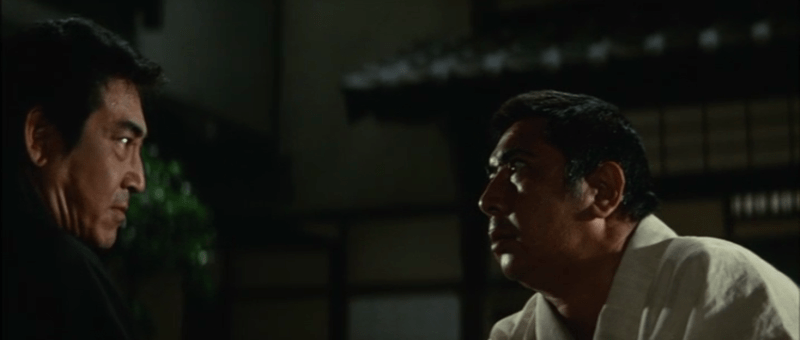
The battleground is Wakamatsu, Kyushu, where outsider Egawa (Koji Tsuruta) has united the local boatmen and is undercutting the prices of a rival gang led by Omuro (Tomisaburo Wakayama). While Omuro is out of town, his right-hand man Taki (Hiroki Matsukata) has decided to take advantage of a minor squabble between some of his guys and Egawa’s to initiate a small scale turf war hoping to take the river back under their control. He does this by kidnapping Egawa’s younger brother Masakazu (Goro Ibuki) to lure him to their headquarters alone, something of which Omuro does not approve on his return but decides to go with as an excuse to bring his rivalry with Egawa to a head. Just as the pair are squaring off, a mutual friend, Hanai (Ken Takakura), arrives and intervenes convincing the two men to lay down their arms for the moment at least.

It could be argued that it is this interrupted fight that is resolved in the film’s conclusion if only by inexorable fate. In a repeated motif, Omuro keeps to the code and is exasperated and disapproving of Taki’s underhanded tactics but accepts the responsibility for them himself knowing that Taki acted only on his behalf and his recklessness is only an expression of his love for him. There is indeed something homoerotic in the relationship between the two men as Omuro cradles a wounded Taki and attempts to comfort him that the fault is all his own, while resolving to accept Taki’s actions and build on them rather than try to deescalate or try to apologise. 

The real crisis occurs when the boss, approaching 60 which represents the full circle of a life, decides to name Omuro as a successor rather than the anticipated Hanai. Hanai stoically accepts though intending to leave the gang and travel to another part of Japan but other members of the clan are perplexed, little understanding the boss’ decision in feeling that Omuro is not of good character whereas Hanai is easily the better choice. As it transpires, the boss has made his decision deliberately in order to mitigate the fact that Hanai is secretly his illegitimate son whose origins he has kept secret in deference to his legal wife. He chooses not to name him as a successor in order to avoid causing him problems in his later life while justifying himself that he has not made the decision for dynastic reasons or out of simple favouritism. Yet the relationship between the two men, father and son, is raw and painful if founded on a deep understanding that leaves them unable to meet each other directly with emotional honesty. 

Because of his father’s decision, Hanai forces Egawa to promise that he will not antagonise Omuro which leads to problems in his own gang with his men angry and confused, unable to understand why Egawa is letting Omuro walk all over him. Compounding the problem, Egawa’s errant brother Tetsu (Bunta Sugawara) returns unexpectedly and as Egawa cannot tell him about the pledge without disclosing Hanai’s secret, thinks his brother is being messed around and raids Omuro’s offices to reclaim money he had extorted from Egawa. He learns the truth from devoted geisha Hideko (Yuko Hama) who is deeply in love with Egawa yet largely unable to act on it again because of the gangster code while pledging that she’d sooner die and prove her devotion to him than summit herself to Taki, who is also in love with her, even when he threatens her with a knife. 

The yakuza code dictates that Omuro must die though he is little more than a passive antagonist all too willing to accept the evil deeds that Taki did on his behalf because of the code of loyalty though he would not have dared to do them himself. Secrecy and repressed emotion drag all into a dark web of self-destructive violence until reaching their inevitable conclusion and perhaps bringing one cycle to a close if only in the birth of another. 


Original trailer (no subtitles)

Dear Summer Sister (夏の妹, Nagisa Oshima, 1972)

The complicated relationship between mainland Japan and the Okinawan islands is played out in the youthful identity crises of two adolescents struggling to understand the world their parents have left to them in an uncharacteristically breezy effort from Nagisa Oshima, Dear Summer Sister (Dear Summer Sister (夏の妹, Natsu no Imoto). Part Rohmerian travelogue, Oshima takes a tour around the island in the immediate aftermath of its reversion to Japan but rather than the busy tourist spots explores a legacy of colonialism and exploitation in the islands’ war memorials and red light districts. 

The irony is that Sunaoko (Hiromi Kurita) finds the person she’s looking for immediately after disembarking from the boat she’s taken from the mainland only she never realises it. Having received a letter from a boy, Tsuruo (Shoji Ishibashi), claiming that he may be her half-brother but isn’t entirely sure, Sunaoko has accepted his offer to come to Okinawa where he will show her his “brotherly affection”. Unbeknownst to her, however, he mistook the figure of her father’s much younger fiancée Momoko (Lily) for that of the teenage Sunaoko with the older woman half-heartedly trying to head off a potential crisis while understandably curious and seeking to know the truth behind her future husband’s hidden past. 

The figure of Tsuruo’s mother, Tsuru (Akiko Koyama), comes to stand in for that of Okinawa yet the central problem as we discover is that she was raped firstly by Sunaoko’s father Kikuchi (Hosei Komatsu) and subsequently by local Okinawan policeman Kuniyoshi (Kei Sato) who had previously passed her off as his younger sister. Even so the trio seem to interact with each other as if nothing had happened and they were simply old university friends reuniting after years of separation. Despite his present occupation in law enforcement, Kuniyoshi had been in prison at the time having been arrested as a student protestor and on his release raped Tsuru after she told him she had been raped by Kuniyoshi in an attempt to reclaim her body and send his sperm as a kind of advance division to prevent Kikuchi’s successfully colonising her womb with the consequence that Tsuru cannot of course be sure whose child Tsuruo is settling finally for “mine” in an answer which at least earns her Sunaoko’s respect. 

Obviously still somewhat naive and additionally provoked on discovering the attraction between Momoko and Tsuruo, Sunaoko had been unfairly judgmental in preemptively accusing Tsuru implying that she been immoral in maintaining relationships with two men at the same time. What occurs is a gradual sense of disillusionment in her father the judge when confronted, it has to be said with confusing frankness, with his own immorality in his misuse of Tsuru which is also of course a metaphor for Japan’s misuse of Okinawa, a thread picked up more directly by the old soldier Sakurada (Taiji Tonoyama) who has apparently come to Okinawa looking for a local willing to kill him in atonement for atrocities he half-heartedly claims not to have committed himself but feels responsible for simply as a Japanese person. Ironically enough he finds such a person in Rintoku (Rokko Toura), a teacher of traditional Okinawan folk music who is looking for “a Japanese who deserves my killing him”.

Nevertheless the relationship between the old men turns into one of playful animosity which does not seem to hint towards violence, a playful fight breaking out between the pair on a boat in the middle of the sea in the film’s concluding scenes in which Sunaoko offers an ironic commentary to the effect that the “killer” and his “victim” are still “singing and drinking” despite the earlier claim that there were only two kinds of people, Okinawans and Japanese, in counter to the claim that the only two kinds of people were men and women. Meanwhile, Kikuchi attempts to process the implications of his friendship and actions explaining that Kuniyoshi’s Okinawan roots were not an obstacle between them while admitting that he never thought about the position of Okinawa during their youth and wonders what he thought back then as to Okinawa’s future, whether it should revert to Japan or become independent. Kuniyoshi claims not to remember, while Tsuru explains how difficult it was to travel to the mainland under the occupation and implies that it’s better now that “we can go where we please”. 

The implication is, perhaps, that Tsuruo is his mother’s child but also a kind of orphan creating a new identity in a new Okinawa having symbolically rejected both of his potential fathers if seeking a brotherhood with his half-sister though even in this the waters are muddied with the undercurrents of incestuous desire which seem to run both ways. Even so Oshima hints at the secondary colonisation of America in conducting what doesn’t seem to be an entirely appropriate series of conversations with the young Sunaoko concerning the history of sex work on the island and the number of bars geared towards American servicemen returning from Vietnam with the suggestion that the islands remain economically dependent on the US despite the reversion while Sukurada makes similarly crass comments about his relationships with Okinawan sex workers during the war. They cast themselves as Urashima Taro travelling to the magical underwater palace of the Dragon King but wary of opening the box of truth they’ve been given lest their world crumble beneath their feet. Picturesque and strangely cheerful, Oshima’s Okinawan odyssey shot with breezy immediacy offers a characteristically thorny take on relations between the two island nations but reaches an unexpectedly hopeful conclusion in the young people’s rejection of their parents’ legacy and intention to move forward in mutual solidarity. 


Dear Summer Sister screens at Japan Society New York May 14 at 7pm as part of Visions of Okinawa: Cinematic Reflections

Images: © 1971 Oshima Productions

Execution in Autumn (秋決, Li Hsing, 1972)

“We all have to die, but we must die in peace and honour” the hero of Li Hsing’s tale of spiritual redemption Execution in Autumn (秋決, Qiū Jué) finally realises, resigning himself to the cruelty of his fate. Partly an advocation for “responsible” childrearing, Li’s philosophical tale is also one of growing enlightenment as the boorish, entitled hero is cajoled towards a sense of social responsibility through the ministrations firstly of his cellmates and then of a good woman who finally learns to see the good in him if through a gentle process of emotional excavation. 

As the opening voiceover explains, at this time it was thought somehow offensive to conduct an execution during the seasons of life and rebirth and so they were relegated to the autumn amid its ominous mists. As we first meet Pei Gang (Ou Wei), however, he’s on the run, trying to make a break for it in refusing to accept the judgement which has been passed on him. The sole heir of a wealthy family, he has been convicted and sentenced to death for the murder of two men and a woman who claimed he was the father of her child (as for what became of the baby, no further mention is made). His grandmother (Fuh Bih-Huei) vows to get him out of jail, pulling every trick in the book and bribing a local official to engineer a good outcome at the upcoming retrial. But in an ironic indication of his buried goodness, Pei Gang refuses to lie to the court and freely admits his crime claiming he was “overcome with rage” believing the woman and her cousins intended to blackmail him but was otherwise in sound mind when he murdered her because he was “sick of being duped” and wanted to vindicate his family honour by taking vengeance on those who’d wronged him. 

Unable to save her grandson, Gang’s grandmother blames herself realising that her failure to discipline him in childhood has led to his immense sense of entitlement and conviction that the rules do not apply to him. Grandma promised that whatever sort of trouble he got into, she would get him out which is obviously a promise she wouldn’t be able to keep but also somewhat irresponsible. For these reasons, Gang regards his treatment as extremely unfair, unable to understand why any of this is happening to him or to accept that this is one fix grandma won’t be able to smooth over even with her money and the power of her name.  

The lesson would seem to be that you have to be cruel to be kind, a message later confirmed by Gang’s conflicted jailor (Ko Hsiang-Ting) who we learn had a son of his own he wrongly indulged which led to him becoming a wayward lad like Gang drowning in a river in the middle of a fist fight. Learning that his grandmother has passed away, Gang once again rails against his fate offering proclamations of hate which are really of love while blaming his grandmother for never having beaten him when he was a child recognising her problematic love for him, mixed as it was with his importance to her as the heir, but also his own abuse of her indulgence. Bad parenting may be the cause of Gang’s amorality, but he is not and never was blameless. He had a free choice to become a better person but did not take it, engaging in persistent boundary pushing even as an adult culminating in the murder of three people mostly out of spite. 

At first Gang can’t bear the mention of the word death, caught between the earthy philosophies of the street thief in the cell to him and the Confucianist scholar opposite serving a one year term as a proxy for his elderly, debt-laden father. Slowly he begins to come around the scholar’s way of thinking, coming to accept death as an inevitability of life as certain as the seasons. His second lessons begin on realising he cannot escape his sentence, his grandmother has given up on him and enacted her back up plan to ensure the family line continues by marrying him to his adopted “sister” Lian (Tang Pao-Yun). Other signs of his buried goodness manifest themselves in his initial reluctance to go along with the plan, not only resenting being used as a stud but unwilling to make Lian an instant widow. “I don’t want you to hate me the rest of your life” he adds in a moment of vulnerability, trying to convince his new bride to find someone more able to give her a happy life stretching further than the next autumn. 

Gang’s tragedy is, in a sense, that as he approaches his execution he experiences true happiness and is genuinely reformed but only by accepting the necessity of his death can he fully redeem himself. Though he tried to escape, he refuses to leave even when the jailor offers to let him go fearing both for the jailor’s fate and for that of his wife and child if he were to become a fugitive. Nevertheless he cannot prevent their victimhood, knowing that just as grandma and Lian had done he must sacrifice himself in order to protect his family accepting not just his moral and social responsibility but the filial. Taking place mostly within the claustrophobic confines of the prison, Li’s melancholy existential drama uses the rhythm of the seasons as a metaphor for life but also as a kind of ticking clock accelerating Gang’s remaining time as he lives out his glory days and twilight years in the span of months awaiting his execution as the first leaves fall. It might be tempting to draw the conclusion that they are each victims of a cruel and oppressive social system taken to authoritarian extremes though Li may have intended the opposite in reminding parents, literal and figural, that the moral education of their children through physical discipline is their primary duty. Nevertheless, Gang’s spiritual awakening and subsequent redemption prove profoundly moving even in their concurrent tragedy. 


Execution in Autumn screened as part of this year’s San Diego Asian Film Festival

Trailer (English subtitles)