Summer Holiday Everyday (毎日が夏休み, Shusuke Kaneko, 1994)

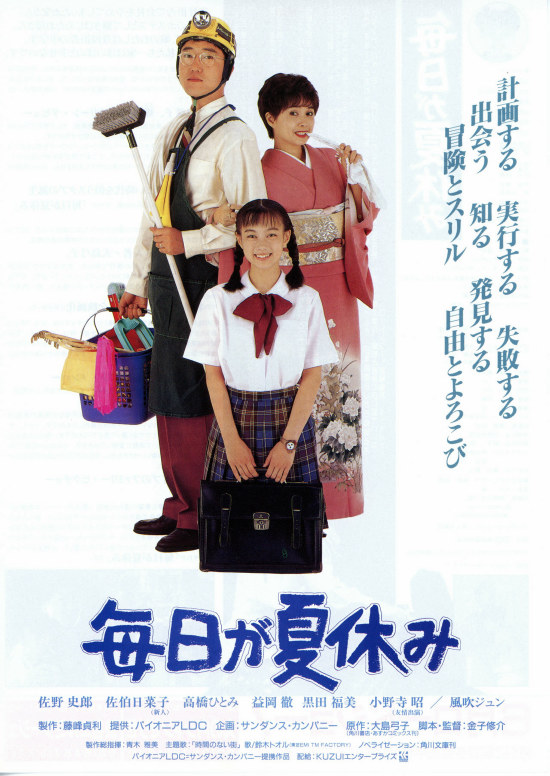
Summer Holiday EverydaySummer Holiday Everyday – It’s certainly an upbeat way to describe unemployment but then everything is improbably upbeat and cheerful in the always sunny world of Shusuke Kaneko’s adaptation of Yumiko Oshima’s shoujo manga. Published in the mid-bubble era of 1988, Oshima’s world is one in which anything is possible but by the time of the live action movie release in 1994 perhaps this was not so much the case. Nevertheless, Kaneko’s film retains the happy-go-lucky tone and offers note of celebration for the unconventional as a path to success and individual happiness.
Told from the point of view of 14 year old Sugina (Hinako Saeki) who offers us a voiceover guide to her everyday life, Summer Holiday Everyday (毎日が夏休み, Mainichi ga Natsuyasumi) follows the adventures of the slightly unusual Rinkaiji family. Sugina’s mother is divorced from her father and has remarried a successful salary man, himself a divorcee, ten years ago. The family lives in fairly peaceful domesticity and Sugina’s mother, Yoshiko (Jun Fubuki), even remarks how glad she is that her daughter gets on so well with her step-father, Nariyuki (Shiro Sano), though Sugina claims this is largely because she can’t remember actually speaking to him very much over the last ten years.

The pair are about become closer though it risks tearing their perfectly normal family apart. Sugina has been skipping school due to bullying and spends her days in the local park where, unbeknownst to her, her step-father has also been wasting his days after quitting a job he could no longer stand. After getting over the embarrassment of this accidental encounter, Sugina and Nariyuki confess everything to each other and Nariyuki makes a bold decision. Sugina can quit school (seeing as her grades were terrible anyway) and come work with him in his new enterprise – the Rinakaiji Heart Service, helping the community 24/7 with assistance in those difficult to handle odd jobs everyone needs doing.

Quitting a lucrative and secure job for the risk associated with staring a new business is a difficult decision in any society but is more or less unthinkable in Japan. Yoshiko is beyond stunned by her husband’s decision, not to mention the fact that her daughter has been deceiving her by skipping school and faking her report cards to make it look like her grades were much better than they are. Immediately worrying about what the neighbours will think, Yoshiko finds it hard to deal with the embarrassment of her husband and teenage daughter going door-to-door and doing menial work in the community, especially when she overhears the snickers of gossipy housewives in the local supermarket. For Yoshiko, whose sense of self worth was bound up with having a successful husband employed at a top tier company, Nariyuki’s sudden lurch towards individual freedom has destabilised her entire existence. Her world ceases to make sense.

Yoshiko’s sense of displacement is deepened when the fledgling company’s second job offer comes from Nariyuki’s ex-wife. Beniko (Hitomi Takahashi) left Nariyuki for another man because she failed to appreciate Nariyuki’s gentle charms and he was too mild mannered to fight for his wife even if he loved her deeply. What’s more, Nariyuki’s unconventional approach to life has earned him a spot in the papers and brought the family back to the attention of Sugina’s father, Ejima (Akira Onodera).

Early on Nariyuki states that life’s true radiance is only visible through suffering and later says that pain and suffering are essential parts of human existence. Nariyuki, now making a stand for himself for the first time in his life, remains philosophical in the face of hardship though perhaps has more faith in Yoshiko’s ability to follow him down this untrodden path than was wise. As a son and then a husband, Nariyuki may be a methodical sort but he’s unused to the idea of caring for himself as his comical attempts at doing the housework show. After almost burning the house down several times, Nariyuki does indeed figure out an efficient way of managing the household chores and seeing to Sugina’s education whilst also allowing his wife become the family breadwinner. However, Yoshiko’s new line of work is one she finds both unpleasant and degrading and she probably hoped that Nariyuki would strenuously try to stop her doing it so it’s not quite as much of a progressive approach as might be hoped.

After countless setbacks, humorous adventures, and a major fire Nariyuki’s enterprise begins to catch on. Brought together in shared crisis, the family unit only becomes stronger and more committed to their shared destinies. In fact, the family expands as Sugina rebuilds her relationship with birth father and even gains a new aunt figure in the form of her step-father’s youthful ex-wife. When you love what you do everyday is a holiday, and Sugina’s path, unconventional as it is, is one that leads her into the sunlight guided by Nariyuki’s oddly philosophical wisdom.


Original trailer (no subtitles)

Goodbye for Tomorrow (あした, Nobuhiko Obayashi, 1995)

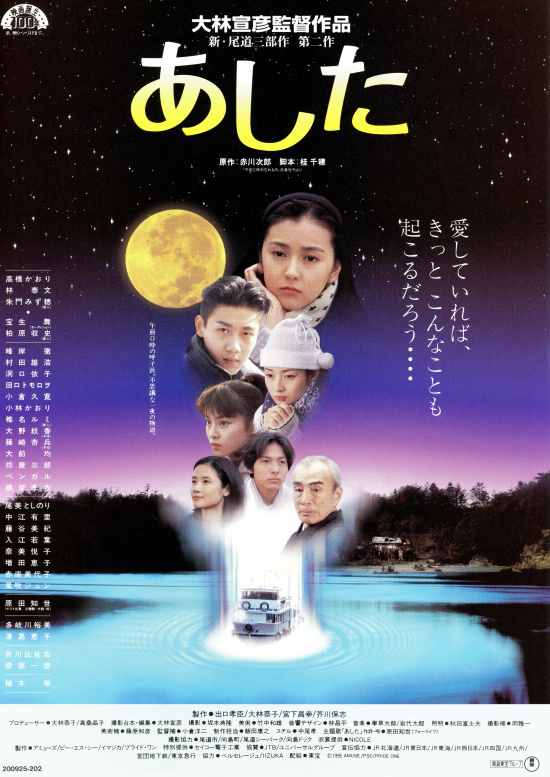
goodbye for tomorrowAfter completing his first “Onomichi Trilogy” in the 1980s, Obayashi returned a decade later for round two with another three films using his picturesque home town as a backdrop. Goodbye For Tomorrow (あした, Ashita) is the second of these, but unlike Chizuko’s Younger Sister or One Summer’s Day which both return to Obayashi’s concern with youth, Goodbye For Tomorrow casts its net a little wider as it explores the grief stricken inertia of a group of people from all ages and backgrounds left behind when a routine ferry journey turns into an unexpected tragedy.
Three months after nine people were drowned when a local ferry sank in the harbour, friends and relatives of the dead begin to receive messages signed by their loved ones instructing them to be at a small island at midnight. Cruel joke or not, each of the still grieving recipients makes their way to the boathouse, clutching the desperate hope that the dead will really return to them. Sure enough, on the stroke of midnight the ghostly boat rises from the ocean floor bringing a collection of lost souls with it, but its stay is a temporary one – just long enough to say goodbye.

Obayashi once again begins the film with an intertile-style message to the effect that sometimes meetings are arranged just to say goodbye. He then includes two brief “prequel” sequences to the contemporary set main narrative. The first of these takes place ten years previously in which a boy called Mitsugu throws a message wrapped around a rock into a school room where his friend Noriko is studying. We then flash forward to three months before the main action, around the time of the boat accident, where an assassination attempt is made on the life of a local gangster in a barber shop. At first the connection between these events is unclear as messages begin to arrive in innovative ways in the film’s “present”. After a while we begin to realise that the recipients of the messages are so shocked to receive them because they believe the senders to be dead.

At three months since the sinking, the grief is still raw and each of our protagonists has found themselves trapped in a kind of inertia, left alone so suddenly without the chance to say goodbye. The left behind range from a teenager whose young love story has been severed by tragedy, a middle aged man who lost a wife and daughter and now regrets spending so much time on something as trivial as work, a middle aged trophy wife and the colleague who both loved a successful businessman, two swimmers with unresolved romances, and the yakuza boss who lost his wife and grandson. For some the desire is to join their loved ones wherever it is that they’re going, others feel they need to live on with double the passion in the name of the dead but they are all brought together by a need to meet the past head on and come to terms with it so that they can emerge from a living limbo and decide which side of the divide they need to be on.

Aside from the temporary transparency of the border between the mortal world and that of the dead, the living make an intrusion in the form of the ongoing yakuza gang war. The Noriko (Kaori Takahashi) from the film’s prequel sequence also ends up at the meeting point through sheer chance, as does the Mitsugu (Yasufumi Hayashi), now a gangster and charged with the unpleasant task of offing the old man despite his longstanding debt of loyalty to him. These are the only two still living souls brought together by an unresolved message bringing the events full circle as they achieve a kind of closure (with the hope of a new beginning) on their frustrated childhood romance.

The other two hangers on, an ambitious yakuza with a toothache played by frequent Obayashi collaborator Ittoku Kishibe, and a lunatic wildcat sociopath played by the ubiquitous Tomorowo Taguchi, are more or less comic relief as they hide out in the forrest confused by the massing group of unexpected visitors who’ve completely ruined their plot to assassinate the old yakuza boss and assume control of the clan. However, they too are also forced to face the relationship problems which bought them to this point and receive unexpected support from the boss’ retuned spouse who points out that this situation is partly his own fault for failing to appreciate the skills of each of his men individually. The boss decides to make a sacrifice in favour of the younger generation but his final acts are those of forgiveness and a plea for those staying behind to forget their differences and work together.

Revisiting Obayashi’s frequent themes of loss and the need to keep living after tragedy strikes, Goodbye For Tomorrow is a melancholy character study of the effects of grief when loved ones are taken without the chance for goodbyes. Aside from the earliest sepia tinged sequence, Obayashi plays with colour less than in his other films but manages to make the improbable sight of the sunken boat rising from the bottom of the sea genuinely unsettling. The supernatural mixes with the natural in unexplained ways and Obayashi even makes room for The Little Girl Who Conquered Time’s Tomoyo Harada as a mysterious spirit of loneliness, as well as a cameo for ‘80s leading man Toshinori Omi. The Japanese title of the film simply means “tomorrow” which gives a hint as to the broadly positive sense of forward motion in the film though the importance “goodbye” is also paramount. The slight awkwardness of the English title is therefore explained – saying goodbye to yesterday is a painful act but necessary for tomorrow’s sake.


Twinkle (きらきらひかる, Joji Matsuoka, 1992)

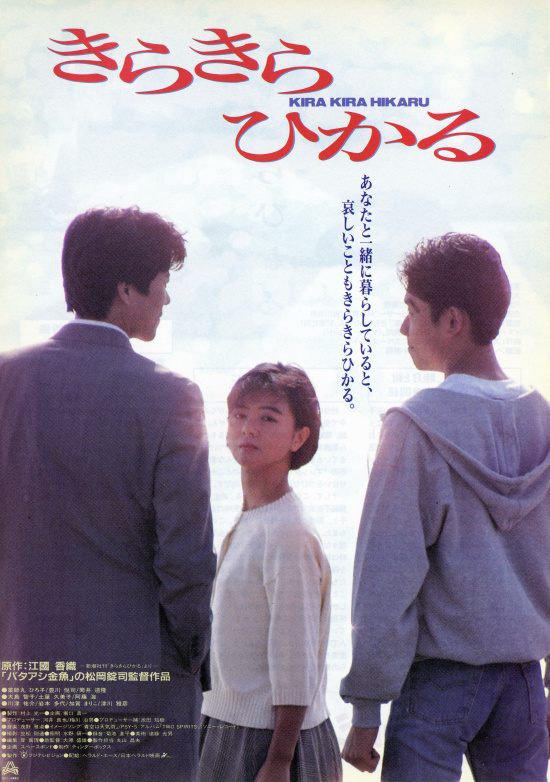
TwinkleThe end of the Bubble Economy created a profound sense of national confusion in Japan, leading to what become known as a “lost generation” left behind in the difficult ‘90s. Yet for all of the cultural trauma it also presented an opportunity and a willingness to investigate hitherto taboo subject matters. In the early ‘90s homosexuality finally began to become mainstream as the “gay boom” saw media embracing homosexual storylines with even ultra independent movies such as A Touch of Fever becoming unexpected box office hits. Based on the book by Kaori Ekuni, Joji Matsuoka’s Twinkle (きらきらひかる, Kira Kira Hikaru) tackles this subject head on in examining the changing nature of the modern family as personal freedom and greater social liberalism conflict with familial duty and centuries old tradition.
We first meet Shoko (Hiroko Yakushimaru) in the office of a doctor who assures her that her “problems” are nothing to worry about and the best thing to do is find “a nice man” and get married after which she’s sure to feel much better. On the taxi ride home, her mother suddenly pulls out an omiai photo she’s apparently been carrying in her bag the whole time and proposes Shoko try meeting this particular prospect just as the doctor suggested.

Her “date” is Mitsuki (Etsushi Toyokawa) – an unmarried middled aged doctor who doesn’t seem very interested in the omiai business either. After a brief period of bickering, Shoko and Mitsuki get some time to themselves at which point Mitsuki reveals that the reason he isn’t married is because he has a boyfriend. Despite this, the pair come to an understanding and decide to get married to finally get their relatives off their backs. However, if they thought the pressure would go away after the wedding, they were mistaken. Though both sets of parents know about their children’s reasons for originally avoiding marriage, they don’t know about those of the spouses and when they find out it’s just going to get even more complicated.

We don’t find out exactly what “problems” Shoko may have had in the past. On the morning of the omiai her family dog dies meaning she has an obvious reason to appear visibly upset, yet she also displays symptoms of ongoing depression right the way through the film, flitting between upbeat cheerfulness to impulsive behaviour and crying fits. She also has a long standing drink problem which can result in dangerous accidents such as an incident where Mitsuki returns home to find her passed out on the floor with the iron in one hand and an empty glass of whiskey apparently fallen out of the other.

Mitsuki is in a relationship with a much younger college student and, though they don’t seem to go out of their way to hide their relationship, they can’t exactly be open about it either. Kon did not approve of Mitsuki’s decision to get married and has been avoiding him but Shoko is keen for the two men’s relationship to continue, eventually befriending the young man and bringing him home as fully fledged member of their family. Mitsuki finds this arrangement quite confusing, trapped between two spouses and feeling a responsibility to both of them. In one notable exchange he’s asked to make the relatively simple choice between strawberry and vanilla ice-cream, but the question has taken on a much wider implication than just tonight’s dessert.

The arrangement starts out well enough, except that the growing affection between the married couple eventually begins to place a wedge between them, each knowing that they can never truly satisfy the demands of the other. Not satisfied with a marriage, the parents also expect children which is going to require medical assistance given the circumstances, but Mitsuki is still unsure about taking this next step. Shoko, though experiencing a intensification of her emotional volatility, now suggests a truly radical solution for the early ‘90s – that she undergo artificial insemination using the mixed sperm of both Mitsuki and Kon to essentially have “their” baby.

Shoko and Mitsuki are both trapped, in a sense, by their societal obligations – particularly that of producing children. Mitsuki’s parents know he’s gay, though they tolerate more than accept, yet they still pressure him into fathering a child for appearance’s sake alone. His father had come to terms with his son’s sexuality, even if Mitsuki refers to himself as a son who has “betrayed” his father, but he was against the marriage viewing it as cruel and irresponsible. Once Shoko’s parents discover the real reasoning they try to take over, ignoring Shoko’s views (and even her first clear stating of her problems with alcohol), acting as if they were the injured party.

Though slightly older, Shoko and Mitsuki have found themselves at the centre of a generational conflict as they fight to free themselves from parental control even in adulthood. The future they propose for themselves is an unusual one and unlikely to be accepted by society, yet it is finally their own decision and only by unshackling themselves from the same social pressures which brought them together can they learn to forge a new future. Ten years later, Ryosuke Hashiguchi’s Hush! would suggest a similar scenario which, though still not universally accepted, is greeted with much less resistance than the entirely radical arrangement of Shoko, Mitsuki, and Kon. An interesting look at the changing nature of  social bonds in the immediate post-bubble era, Twinkle is a melancholic though ultimately hopeful tale of three individuals who might be able to provide the stability each needs if only they can learn to withstand the overwhelming external pressures.


Original trailer (no subtitles)

Bad Film (Sion Sono, 1995/2012)

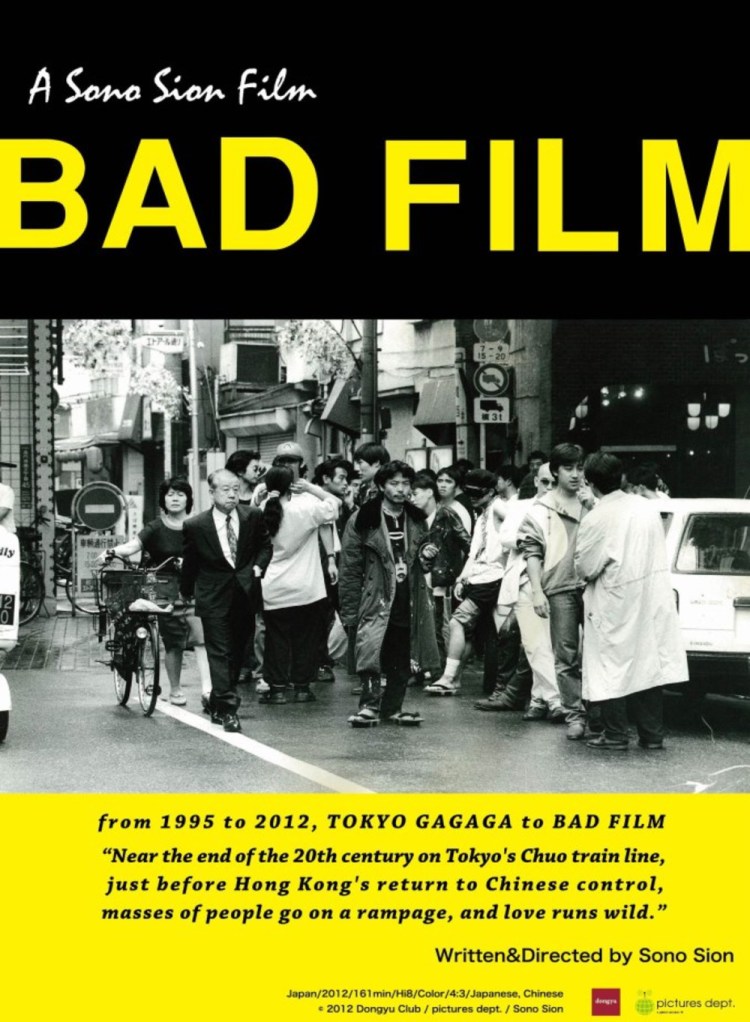
Bad_FilmThe recently prolific Sion Sono actually has a more sporadic film career dating back to the early 1980s though most would judge his real breakthrough to 2001’s Suicide Club. Back in the ‘90s Sono was most active as the leader of anarchic performance art troupe Tokyo Gagaga. Taking inspiration from the avant-garde theatre scene of the 1960s, Tokyo Gagaga took to the streets for flag waving protests and impressive, guerrilla stunts. Bad Film is the result of one of their projects – shot intermittently over a year using the then newly accessible Hi8 video rather the traditionally underground 8 or 16mm, Bad Film is near future set street story centring on gang warfare between the Chinese community and xenophobic Japanese petty gangsters with a side line in shifiting sexual politics.

Momentous things were at play in 1997, not least amongst them the looming handover of Hong Kong when it would cease to operate under British rule and embark upon the “one country, two systems” era with ultimate authority passing to Beijing. Fascism has bloomed in Tokyo with intense anti-foreigner activity targeting all non-Japanese including those from other areas of Asia. By 1997, the yakuza have infiltrated the fascist infrastructure and amped up gang violence between the Chinese community and the ultra-nationalist Japanese.

Fast forward a little and the Chinese and Japanese groups have managed to iron out some of their differences largely thanks to a different kind of divide which ultimately proves a unifying factor – many of the men and women on either side are gay and are sick of the prevailing “hetero hegemony”. Eventually the gay contingent manages to assume control of their respective factions and enact the gay alliance. This is very successful and brings peace and love to the city but unfortunately two members of opposing factions just can’t get over their cultural differences and are prepared to go to great lengths to restart the Japan/China gang war.

Sono shot the entirety of the movie back in 1995 ending up with around 150 hours before abandoning the project for financial reasons. In 2012 Sono re-edited his existing footage into something resembling a feature length film. The project was designed to make use of the entire Tokyo Gagaga company (over 2000 people took part) and was shot guerrilla style with no permits or warnings (you can see at least one face blurred out during their city centre protests). This goes someway to explaining why the narrative diverges unexpectedly at random junctures and the voiceover is there largely to corral the footage into some kind of coherent structure aided by the occasional on screen text. It’s a “Bad Film” in that it’s not quite a film at all but an activist’s poetic documentation of his artistic street warfare even including going so far as to include a justification for the visibility of the cameraman.

Hi8 was what it was – a convenient low-res format for the domestic market. Bad Film is not a pretty film, it looks rough and low rent though that often works in its favour and the film takes on a considered aesthetic that is never concerned with trying to be more than it is. Consequently, it makes the most of its roughness to bring out the grungy, time capsule-esque atmosphere that it’s looking looking for. Sono also experiments with fish eye lenses, odd angles and hand held multi-camera chaos to bring the streets to life. His world is weird, and it’s filmed weird, but it always makes sense in terms of its own particular look.

The action turns on the unexpected love story between two women – one Japanese, and one Chinese, and despite all of the resulting chaos and carnage, the final image we’re left with is one of love. The forces of destruction are those who cannot abandon their hate to live in harmony, subverting this very force for peace and using it to wreak vengeance. Sono launches into absurd mode at full throttle and, as per usual, it’s hard to tell when he’s in earnest and when just being facetious. Bad Film is, loosely speaking, an anti-prejudice themed performance art piece documenting the passion and commitment of the Tokyo Gagaga collective. An interesting case of a belated “director’s cut” Bad Film is necessarily an imperfect beast, but perhaps all the more interesting for it.


Opening sequence (no subtitles)

Like Grains of Sand (渚のシンドバッド, Ryosuke Hashiguchi, 1995)

Like grains of sand posterAdolescent romance is complicated enough at the best of times but the barriers are ever higher if you happen to be gay in a less than tolerant society. Ryosuke Hashiguchi’s second feature Like Grains of Sand (渚のシンドバッド, Nagisa no Sinbad) takes a slight step back in time from A Touch of Fever but retains its very ordinary world as a collection of boys and girls embark on a process of self discovery whilst also locked into the unbreakable straightjacket of the high school world.

Ito (Yoshinori Okada) is an ordinary high school boy with a crush on his oblivious best friend, Yoshida (Kouta Kusano). Though Yoshida defends him from the homophobic bullies in his class, he seems confused about his true feelings, at once stating that what he feels for Ito is more that friendship but also unwilling to address what that “more” may mean. After Ito’s father intercepts a reply to a personal ad he placed hoping to meet older men, Ito ends up at a psychiatrist’s office where his father hopes he might be “cured” though the doctor is quick to point out that they no longer view homosexuality as a medical matter.

Whilst at the clinic, Ito strikes a up a friendship with another girl from his class, Aihara (Ayumi Hamasaki) – a recent transfer student, who, we learn, has experienced a traumatic event which is also the reason she had to leave her previous place of education. Aihara is the only person with whom Ito can discuss his sexuality honestly though he’s also sure to “protect” Yoshida by claiming he rejected his advances outright rather than explaining the confusing series of events as they actually occurred. When Aihara and Ito accidentally end up on an awkward double date with Yoshida and his girlfriend Shimizu (Kumi Takada), Yoshida also begins to develop an (unreturned) attraction to Aihara which only further complicates the delicate nature of the growing emotional ties among this small group of young people.

A real step up from the promising yet flawed A Touch of Fever, Like Grains of Sand proves Hashiguchi’s skill in building an extremely natural environment filled with believable well rounded characters. The high school world is a cruel one populated by unsteady teenagers, each by times rebellious and insecure. Aihara, as a recent transfer student, is already an outsider but finds herself excluded even further thanks to her direct and aloof character. Early on in the film two of the other girls, evidently the popular set, begin running a bizarre extortion scam in which they claim a friend of theirs has fallen pregnant and needs to get an abortion right away so they’re collecting money to help her. Shimizu doesn’t seem to buy their explanation but is bamboozled into paying up to not cause offence. Aihara, however, brands the pair “sympathy fascists” and abruptly walks away.

Ito is also an outsider, though partially a self-exile, longing yet fearful. At the beginning of the film he’s overwhelmed watching the unexpectedly sensual action of Yoshida pouring a bag of sand into a container destined for the sports field. After they’ve finished, Ito faints right in front of his fellow schoolmates, though at least the convenient hot weather might prove his ally. When the other boys draw a lewd drawing on the blackboard and start teasing Ito, Yoshida comes to his rescue even though he knows that’s likely to cause trouble for himself. Reassuring his friend that it would be OK even if it was true, Yoshida continues to act in a non committal manner. Ito confesses, Yoshida accepts the confession but at the same time is uncertain permitting both a kiss and an embrace before pushing his friend away and leaving as if nothing out of the ordinary had happened.

After an impromptu hug on a rooftop, Shimizu makes attempt to ask Aihara is she’s gay with no particular judgement attached except a slight reticence in terms of language. Aihara seems slightly confused, replying only that Shimizu is preoccupied with the wrong questions. Later, Ito ends up escorting the smitten Yoshida to Aihara’s childhood home where things come to a climax during an intense finale on a secluded beach. Night is falling and Ito has put on Aihara’s white dress and hat while she goes for a swim just as Yoshida returns for a second stab at confessions. Hiding behind a rock while Yoshida thinks Ito is her, Aihara continues to conduct a philosophically based dissection of Yoshida’s approach to sexuality. She asks him, would you still love me if I were a man, and if not, is it more that what you want is a woman and not really “me” at all, along with other questions designed to prompt a response as to the importance of gender when it comes to love. That all this happens as a kind of Cyrano de Bergerac-like three way sequence with Ito dressed as Aihara, and Yoshida talking to Aihara through someone else only lends to the surreal, increasingly symbolic atmosphere.

Gentle and softly nuanced, Like Grains of Sand is a delicate exploration of ordinary young people caught in a confusing storm of emotions as they each address their burgeoning sexuality. Rich with complexity yet also effortlessly straightforward, Hashiguchi has created a beautifully naturalistic portrait of adolescence in flux which is filled with empathy and acceptance for each of its angst ridden teens and even for their less forgiving friends and relatives. A noticeable progression from Touch of Fever, Like Grains of Sand further proves Hashiguchi’s skill for character drama and marks him as one of the most incisive writer/directors working today.


Original trailer (no subtitles)

The Japanese title of the film, Nagisa no Sinbad, is also the title of a hit single by 1970s super duo Pink Lady! (Beware – extremely catchy)

A Touch of Fever (二十才の微熱, Ryosuke Hashiguchi, 1993)

Touch of FeverRyosuke Hashiguchi’s debut feature A Touch of Fever (二十才の微熱, Hatachi no Binetsu) proved a surprise box office hit in Japan and is also credited for helping to bring male homosexuality into the mainstream. A no-budget movie shot on 16mm, A Touch of Fever is the story of two ordinary boys each going about their everyday lives whilst also beginning to understand themselves in terms of their sexualities, mirroring each other perfectly in their inner confusion.

Tatsuru is a college student by day, but he spends his nights working at Pinocchio’s where he entertains male customers looking for some no strings action with a disinterested young man. Among the other youngish guys working at the club is Shin who is actually still in high school. Shin is out to his parents, but they haven’t taken it well so he’s couch surfing, leading to him to ask Tatsuru if he could temporarily move in with him. Along with all of the practical problems this may raise, Shin has something of a crush on his older colleague, but Tatsuru is filled with doubts about many things and his apartment is in no way big enough to contain this particular elephant in the room.

Tatsuru is about as detached as they come. He claims that he can separate love and sex and that for him his work is just a mechanical action that he happens to be pretty good at. The first client we see him with interrogates him about his non-compensatory love life, assuming that he must have a girlfriend. Tatsuru gives a non-committal answer about whether he also sleeps with women which offers the first indication of his slight resistance to the idea of being gay even if he has no problem earning a living through sleeping with men. Throughout the film he also conducts a parallel (platonic, if fliratious) relationship with an older female student, though when he decides to try and take things further she more or less shuts him down explaining that she’s confused about her feelings for him – she wants him in her life, but probably not in a romantic way. As if to underline the point, an attendant begins to spray cleaning fluid over the passenger side window of the car Tatsuru is sitting in, effectively painting him out of the picture.

Shin, on the other hand, is very clear about his sexuality but less so about the idea of selling it for money. Uncomfortable with the atmosphere at the club, Shin has decided he only wants to do it with people he likes, as impractical as that may turn out to be. What Shin wants is romance, but that’s exactly what Tatsuru is currently unable to acknowledge. When taken to task by one of Shin’s female friends, Tatsuru offers a series of justifications about different kinds of love but remains rational and closed down. At the moment it appears something may happen between the pair, it’s Shin who ultimately can’t follow through. Whether due to “chickening out” as his friend accuses, a lack of belief in his object of affection, or simple vulnerability, Shin is not quite ready to acknowledge his true feelings either.

Both boys have also become estranged from their families and particularly with their fathers. Tatsuru’s father leaves gruff answerphone messages and then when he finally gets through, suggests that his son is a drain on his resources that he could well do without. Having left Tatsuru’s mother for another woman, dad is now cash strapped – so much so that his new partner has had to have an abortion because of all the loans he’s taken out for Tatsuru’s fees. The final parting blow is to say that (contrary to the suggestion of a complete divorce between father and son) Tatsuru is now the sole heir of the Shinomori name which is yet another burden for guy who may be gay and therefore may not necessarily be looking to pass that name on. Shin’s father had something of an apoplexy when he found out his son was gay and threatened to have him sent away to the self defence force for some “toughening” up, going so far to trample all over Shin’s dreams of becoming a fashion designer and leading him to leave home at such a young age.

Hashiguchi’s first feature is his most melancholy but also oddly innocent. A theme which recurs throughout his career – that love is sad and ultimately impossible, rears its head during the film’s final scene in which Hashiguchi himself plays a sinister customer. This uncomfortably long sequence which breaks with the formalist camera movements of the the earlier part in favour of destabilising, unbroken handheld, acts as the climax of the film as the pair are once again symmetrically opposed. Tatsuru likes things impersonal but this guy wants to talk, whereas Shin craves connection but finds the customer unpleasant in his wheedling, direct and almost forceful approach. “You wouldn’t know the pain of being unable to speak out about how you really feel”, says the customer, oblivious to the obvious subtext. This long, strange, and uncomfortable encounter does at least lead both boys into the centre ground, making each clearer both about themselves independently and about whatever it is that exists between them.

Contrary to the customer’s assertion about the impossibility of true connection, the film ends on a note of hope as the boys walk home together with a little more lightness in their steps. When Shin enquires how much Tatsuru was paid for something that he previously disapproved of but seems to have got over now, he tells him he’s underselling himself and ought to value himself more. Tatsuru says he’ll bear that in mind – that has, after all, been the problem all along. In one sense, the “fever” has broken – a weight has been lifted, leaving both boys freer to go about their lives with more clarity and less angst. Perhaps it isn’t all so sad and impossible after all.


Original trailer (no subtitles)

Lost Paradise (失楽園, Yoshimitsu Morita, 1997)

lost paradiseYoshitmitsu Morita tackled many different genres during his extremely varied career taking in everything from absurd social satire to teen idol vehicles and high art films. 1997’s Lost Paradise (失楽園, Shitsurakuen) again finds him in the art house realm as he prepares a tastefully erotic exploration of middle aged amour fou. Based on the bestselling novel by Junichi Watanabe, Lost Paradise also became a breakout box office hit as audiences were drawn by the tragic tale of doomed late love frustrated by societal expectations.

We meet Kuki (Koji Yakusho) and Rinko (Hitomi Kuroki) about to bid each other goodbye for the day, playfully in love though perhaps self conscious. It’s not until later that we realise they are both already married – just not to each other. Kuki, 50 years old, has reached an impasse in his life. Effectively demoted and sidelined at work, his homelife is not exactly unhappy but has long since lost his interest. His daughter is grown up and married herself, his wife has a career of her own, his mortgage is already paid off. There is really nothing left for him to do. That is until he meets calligraphy teacher Rinko and falls passionately in love for the first time in his life.

Rinko, 38, entered into an arranged marriage at 25 though the kindest way of describing it would be “unfulfilling”. Haruhiko (Toshio Shiba), her husband, is a doctor by profession and cuts a cold and distant figure. Prone to violent outbursts and pettiness, he treats Rinko more as a house keeper than a wife ordering her to buy his favourite kind of cheese (even urging her to travel to a different shop if the first one doesn’t have it) but then not even looking up when she brings it into his study for him. Lasciviously poking a spoon into the soupy mess, he pauses only briefly after savouring his first taste to give Rinko her next set of orders with no word of thanks or even acknowledgement of her success in obtaining this oddly specific cheese related request.

Finally in each other Rinko and Kuki find completeness long after they’d stopped seeking it. Rinko is unhappy in an arranged marriage which offers scant comfort, though Kuki’s problems are more akin to a mid life crisis as he finds himself an unnecessary presence at home whilst also realising that he’s already passed the high point of his career. Though there are no real barriers to Rinko and Kuki simply leaving their spouses and starting again together, it’s never quite that simple as the social stigma of an extra-marital affair continues to undermine their new found romance.

As in many of Morita’s films, the overall tone is one of pessimism as Rinko and Kuki face opposition from all sides whilst falling ever deeper into a whirlwind of self destructive passion. Rinko confides in a recently divorced friend who has guessed her secret and urges her to try and be happy, but Kuki keeps matters to himself whilst listening to the romantic problems of his workmates many of whom state that they too would like to fall madly in love, just once. When one of Kuki’s most valued colleagues falls ill, he laments having lived his life in the straightforward way expected by society. He’s done everything right – spent all his time working hard, built a career which was about to go south anyway. If all that happens is that you get old and die what was it all for – perhaps you’re better off just doing as you please, social expectations be damned.

Eventually the pair get an apartment and indulge in some part-time domesticity though an ill thought out blackmail plot soon changes things for both of them. Haruhiko refuses to divorce Rinko but Kuki’s wife is more sympathetic and open to the idea of sorting things out as quickly as possible. Though he suffers in other ways, Kuki finds it easier to accept the idea of moving on than Rinko who also faces opposition from her own mother who brands her as immoral and someone to be pitied for having given in to weakness and allowed her baser instincts to take over. Soon the couple find themselves thinking about a way to be together for eternity even if it lies in another world than this one.

Likened to the famous case of Sada Abe (also the inspiration for Oshima’s In the Realm of the Senses), Rinko and Kuki are consumed by their own passion and ultimately unable to continue living outside it. Morita opts for an artful aesthetic and keeps his eroticism on the classy side rather than descending into exploitation or salaciousness. Making use of frequent handheld camera and odd angles to bring out the giddy, unbalanced mindset of the central couple Morita also experiments with colour often cutting to black and white or sepia mid-scene. The tragedy of this love story is that it occurs at a societally inconvenient time – there is nothing wrong in Rinko and Kuki’s romance save that it started after they were already married to other people. This may not seem such a great problem but in a society which demands conformity and adherence to its rules, those who break them must be prepared to pay a heavy price. Perhaps the last words ought to belong to Kuki’s poetic friend who points out that life if short and rarely rewards those who play by the rules, it may be better to burn out brightly rather than flicker away for an eternity.


Original trailer (no subs)

Shark Skin Man and Peach Hip Girl (鮫肌男と桃尻女, Katsuhito Ishii, 1999)

Shark_Skin_Man_And_Peach_Hip_Girl_(1998)If you’re going on the run you might as well do it in style. Wait, that’s terrible advice isn’t it? Perhaps there’s something to be said for planning a cunning double bluff by becoming so flamboyant that everyone starts ignoring you out of a mild sense of embarrassment but that’s quite a risk for someone whose original gamble has so obviously gone massively wrong. An adaptation of a manga, Katsuhito Ishii’s debut feature Sharkskin Man and Peach Hip Girl (鮫肌男と桃尻女,  Samehada Otoko to Momojiri Onna) follows a mysterious criminal trying to head off the gang he just stole a bunch of money from whilst also accompanying a strange young girl, also on the run but from her perverted, hotel owning “uncle” who has also sent an equally eccentric hitman after the absconding pair with instructions to bring her back.

Like Ishii’s subsequent efforts, Shark Skin Man and Peach Hip Girl is a riot of full on craziness from the get go, though he largely manages to avoid manga adaptation cliches. The gangster, Samehada (Tadanobu Asano), is pursued by an eccentric set of former gang members – the sanest amongst them being Sawada (Susumu Terajima), his former partner who wants to track him down first to prevent the bloody retribution his guys have in store for him. The gang’s boss (Ittoku Kishibe), lovingly caresses a harpoon, dresses in a gestapo style shiny black leather overcoat, wears one glove, and is on a quest to track down rare vintage posters of much loved Japanese comedian Kon Omura. One of his henchmen is a guy with bleach blond hair who dresses all in white and has an extremely sensitive sense of smell but an intense aversion to water.

The heat coming from the other side is equally strange as the leacherous uncle is apparently friends with Japan’s weirdest hitman, Yamada, who dresses in a retro style and has a unibrow and a high pitched voice. In fact, he’s basically Ken Omura himself, creeping about, being odd in a ridiculous cartoon character way. Unfortunately, Yamada has a weakness and just as he’s about to complete his mission he falls in love with his target! Apparently this is something that happens to him often though you’d think it would be quite a liability given his line of work. In this instance who could really blame him, but his new found romance means he won’t be able to pull the trigger  – and not only that, he can’t bring the girl back either because he doesn’t want to break the beautiful gangster’s heart! Ah, true love!

There is quite a lot going on. Too much, really. For all the craziness which ensues, it’s hard to build up an attachment to any of our strange little gangsters and their petty plots or bids for freedom. Things build to a whirlwind of chaos in the final stretch but when it’s all supposed to calm down for a little spiritual contemplation at the end, the effect begins to fall apart.

There are however a few quieter sections such as a surprisingly maudlin one in which yakuza sons of yakuza fathers lament their unhappy childhoods which saw them bullied and excluded by their law abiding peers. One even says that he thought the tattoos were something which just appeared on everyone when they grew up. Ishii employs some strange jump cuts, moving us ahead a little jerkily as the time passes slowly for this motley crew of veteran bad guys. He later employs a similar technique where he shifts some of his violence into the expressionist realm by cutting on the sound of landing punches.

As the title suggests, Shark Shin Man and Peach Hip Girl is the story of two crazy kids on the run, and the bizarre collection of people who end up chasing them. Ishii could never be accused of subtlety but the punk infused, anarchic and ironic tone are difficult to resist even if the end result is a necessarily slight one. An imperfect, though impressive debut, Shark Skin Man and Peach Hipped Girl is an interesting genre infused tale that uses absurd humour as a foil for the darkness and violence which underpins it.


Original trailer (no English subs – French subs available via settings menu)

Midway through this film someone starts singing a Japanese language cover of Donna Donna which was a surprise! Can’t find a clip so here’s Joan Baez’s version live in Japan in 1967!

The Room (部屋, Sion Sono, 1993)

The roomThough the later work of Sion Sono is often noted for its cinematic excess, his earlier career saw him embracing the art of minimalism. The Room (部屋, Heya) finds him in the realms of existentialist noir as a grumpy hitman whiles away his remaining time in the search for the perfect apartment guided only by a detached estate agent.

Sono begins the film with an uncomfortably long static camera shot of a warehouse area where nothing moves until a man suddenly turns a corner and sits down on a bench. We then cut to a rear shot of the same man who’s now sitting facing a harbour filled with boats coming and going as the sun bounces of the rippling sea. We don’t know very much about him but he’s dressed in the crumpled mac and fedora familiar to every fan of hardboiled fiction and walks with the steady invisibility of the typical genre anti-hero.

Before we head into the main “narrative” such as it is, Sono presents us with another uncomfortably long shot of the title card which takes the form of a street sign simply reading The Room, over which someone is whistling a traditional Japanese tune. Eventually we catch up with the hitman as he meets a young female estate agent identified only by the extremely long number she wears on the jacket of her official looking business suit. The hitman gruffly lists his poetical demands for his new home – must be quiet, have the gentle smell of spring flowers wafting through it, and above all it must have an open, unoverlooked view from a well lit window. The estate agent reacts with dispassionate efficiency, her gaze vacantly directed at the floor or around the rundown apartments which she recommends to her client. Together, the pair travel the city looking for the elusive “Room” though perhaps that isn’t quite what they’re seeking after all.

Sono shoots the entire film in grainy black and white and in academy ratio. He largely avoids dialogue in favour of visual storytelling though what dialogue there is is direct, if poetic, almost symbolic in terms of tone and delivery. The occasional intrusion of the jazzy score coupled with the deserted streets and stark black and white photography underlines the noir atmosphere though like the best hardboiled tales this is one filled emptiness led by a man seeking the end of the world, even if he doesn’t quite know it.

In fact, the relationship between our hitman and the passive figure of the estate agent can’t help but recall Lemmy Caution and the unemotional Natasha from Godard’s Alphaville – also set in an eerily cold city. If Sono is channelling Godard for much of the film, he also brings in a little of Tarkovsky as the hitman and estate agent make an oddly arduous train journey around the city looking for this magical space much like the explorers of the Zone in Stalker. Yet for all that there’s a touch of early Fassbinder too in Sono’s deliberately theatrical staging which attempts both to alienate and to engage at the same time.

The Room’s central conceit is its use of extremely long shots filled with minimal action or movement. In a 90 minute film, Sono has given us only 44 takes, lingering on empty streets and abandoned buildings long enough to test the patience of even the most forgiving viewer. Deliberately tedious, The Room won’t counter arguments of indulgence but its increasing minimalism eventually takes on a hypnotic quality, lending to its dreamlike, etherial atmosphere.

Here the city seems strange, a half formed place made up of half remembered images and crumbling buildings. Empty trains, scattered papers, and lonely bars are its mainstays yet it’s still somehow recognisable. Leaning more towards Sono’s poetic ambitions than the anarchism of his more aggressive work, The Room is a beautifully oblique exploration of the landscape of a tired mind as it prepares to meet the end of its journey.


Original trailer (no subtitles):

Sharaku (写楽, Masahiro Shinoda, 1995)

SharakuEvery once in a while an artist emerges whose work is so far ahead of its time that the audience of the day is unwilling to accept but generations to come will finally recognise for the achievement it represents. So it is for Sharaku – a young man whose abilities and ambitions are ruthlessly manipulated by those around him for their own gain. Brought to the screen by veteran new wave director Masahiro Shinoda, Sharaku (写楽) is an attempt to throw some light on the life of this mysterious historical figure who comes to symbolise, in many ways, the turbulence of his era.

The Edo of 1791 is a world of extreme austerity. All art is suspect and all “pornography” outlawed. Any sign of extravagance is frowned on, including the “frivolous” arts leading to a decline in the world of classic entertainment as kabuki artists struggle to survive. Tombo (Hiroyuki Sanada) was one such kabuki performer but after an onstage accident leaves him with a damaged foot he joins a rag tag group of street performers. Whilst there he begins drawing bringing him to the attention of an art seller, Tsutaya (Frankie Sakai), who has an idea to create prints of famous actors as a way of promoting local theatre shows.

Rechristened with the artist’s name of Sharaku, Tombo’s artwork creates a sensation with its never seen before style which places a new emphasis on realism rather than flattery. Popularity brings its own problems as Sharaku finds himself a virtual prisoner of Tsutaya whose demands are ever expanding, as well as facing the intense opposition of Tsutaya’s former cash cow – renowned artist Utamaro, who is prepared to go to great lengths to ensure his traditional painting style is the one that wins out.

This is a time of extreme conservatism and Sharaku’s work is a risky proposition as it rejects accepted stylisation in favour of undoctored reality. Dynamically posed, his portraits of kabuki actors display no pandering but reflect all of the subject’s less flattering qualities. Striking and unusual, Sharaku’s insistence on capturing internal truth is entirely at odds with the need for compliance with the “truths” handed down by the government. The public aren’t ready for such radically honest art and even champions of a more naturalistic style such as the universally lauded Utamaro also reject it (though largely out of fear and self interest).

Sharaku is, of course, an artist’s name and not a man’s and therefore is easily manipulated. Held a virtual prisoner by Tsutaya, Tombo begins to resent his new life of exploitation by his master who wants him to work in a more commercial fashion yet took him on precisely because of the novel, aggressive nature of his untrained drawing. Sharaku’s commitment to artistry over conformity is at odds with the era which is entirely founded on everyone obeying the accepted order of things. The times are changing, but not fast enough for Sharaku.

Shinoda paints an exciting vision of Edo era Tokyo filled with colour and energy despite the supposed austerity of the times. He brings kabuki out into the streets with beautifully balletic street brawls and strange acrobatic feats that appear extremely incongruous in the off stage world. However, Sharaku attempts to juggle a number of themes and subplots which never manage to coalesce into something whole. The side story of a depressed geisha and her star crossed love for Tombo even whilst she finds herself the favourite misteress of Utamaro is the most interesting but is never satisfactorily resolved.

After beginning with some oddly old fashioned on screen graphics, Shinoda opts for a stately directing style though makes frequent use of freeze frames and dissolves. The film takes on an appropriately etherial quality with sudden interruptions of theatre and the rhythms of classical drama yet even the free floating dream-like atmosphere can’t quite makeup for its central lack of coherence. Tombo himself, as played by Hiroyuki Sanada, is too much of a cypher to lead the picture yet the attempt to branch out into an ensemble drama doesn’t take hold either. A late, flawed effort from an old master, Sharaku has a lot to say about the nature of art, about artists, about reception and legacy, and also about its era but much of the message is lost in the faded paper on which it is painted.


Unsubbed trailer: