Audition (オーディション, Takashi Miike, 1999)

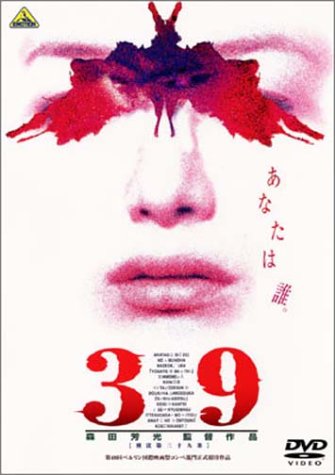
audition-posterReview of Takashi Miike’s Audition (オーディション) – first published by UK Anime Network.


The world was a much more innocent place back in 1999. Takashi Miike already had 34 films to his name before Audition became his breakout hit even whilst seeing him branded “sick” by a disgusted audience member at the film’s otherwise successful screening at the Rotterdam film festival. Based on the book of the same name by Japan’s master of the nasty psychological thriller Ryu Murakami, Audition is the twisted romantic nightmare to end all twisted romantic nightmares.

Aoyama is a widower with an almost grown-up child. Now that his parental responsibilities are changing, and spurred on by his encouraging son, Aoyama perhaps feels ready to move into another phase of his life by considering the idea of getting married again. However, Aoyama is a sensitive and romantic man who’s actually a little naive when it comes to matters of the heart and obviously hasn’t had much experience in the dating world in the last twenty years. He turns to an old friend who happens to be a casting director and comes up with the novel (if somewhat inappropriate) idea of letting Aoyama sit in on an audition to look for a new wife.

In glancing over the headshot resumés, one catches his eye – that of a former ballet dancer who equates having had to abandon her dream of becoming a professional dancer because of an injury with a sort of spiritual death. This deep sense of loss strikes a chord in the widowed Aoyama and despite his friend’s warnings that she gives him the creeps, Asami is the one he’s set his heart on. However, Asami is not the sweet and innocent girl she first appears to be…

In the intervening 15 years since its original release, Audition has amassed something of a reputation which is to say that viewers will almost certainly be aware of its “extreme” nature. However, Audition arguably works best when seen blind as it begins as a fairly straightforward romantic drama in which a broken hearted widower begins to live again thanks to the attentions of a shy young woman. Of course, Miike is peppering the otherwise anodyne love story with subtle (and not so subtle) clues all the way through, planting doubts in our minds right away. Is Aoyama just an old fool who’s lost his head over a young beauty or is he right to grow suspicious in the face of the ever increasing, yet circumstantial, evidence of Asami’s strangeness?

Is Asami hiding a dark secret, or is Aoyama projecting his fears of romantic entanglements onto her  silhouette and therefore creating, in some sense, a villainess worthy of his anxieties? According to Miike himself, Audition is not a horror movie (Japanese horror movies are linked with the supernatural and Audition’s terrors are very much of the real world) – Murakami in fact wrote the book as a strange kind of “love letter” to a woman he had wronged. Miike sought to envisage her reply and gives her an opportunity to offer a series of extremely dark explanations of her own. Neither Aoyama or Asami have been honest with themselves or each other. Aoyama is looking for a cookie cutter ideal to fit into the pre-made box marked “wife”, and well, it would be better not to go into all the various ways Asami has misrepresented herself but she does have a point when she calls Aoyama on how easy it was to make him fall for her meek and feeble innocent act.

Asami and Aoyama are always working at cross purposes to each other, engaged in a macabre dance where Asami leads by stealth, waltzing Aoyama into her spider’s web of vengeance by neatly subverting his ideas of femininity. However, this is not to cast Asami as a vile temptress or the predatory female born of male fears of emasculation (though these ideas are definitely in play), nor is she an avenging feminist warrior so much as a lonely, damaged woman. At the very end of the film the pair have perhaps reached a kind of understanding as, according to Asami, only in extreme pain does one understand one’s own mind. Left maimed and helpless, each is scarred and broken but alive and, perhaps, at peace at last.


Audition is now re-released on blu-ray in the UK from Arrow Films in a significantly better transfer than the previous US blu-ray from Shout Factory.


Kikujiro (菊次郎の夏, Takeshi Kitano, 1999)

b97b89932bReview of Takeshi Kitano’s 1999 masterpiece Kikujiro AKA Kikujiro’s Summer (菊次郎の夏, Kikujiro no Natsu) first published by UK Anime Network.


When thinking about the career of iconoclastic Japanese director Takeshi Kitano, “cute” is not a word which immediately springs to mind. Nevertheless, it’s a fairly apt one for describing the bittersweet tale of one summer in the life of a lonely little boy and the roughhousing ex-yakuza who becomes his reluctant guardian.

Masao is a mournful looking schoolboy who lives alone with his grandmother. It’s almost the school summer holidays and all the other kids are excited about family trips and activities but Masao’s grandmother still has to work so they won’t be doing anything and he’ll have to entertain himself throughout all of the long, hot break. Seeing as all of his friends have gone away, and after finding a photograph of his parents and another of his mother and grandmother with him as an infant, Masao decides to take off for an adventure of his own to track down his long absent mum. However, he doesn’t get very far before some bigger boys have taken all his money and actually seem annoyed he doesn’t have more. Luckily, a former neighbour and her husband turn up and get the money back for him but they explain the town where Masao’s mother lives is too far for a little boy to travel all on his lonesome. The wife makes her husband, Kikujiro (Kitano) take the boy on summer trip of their own but what they find there isn’t exactly what either of them had been expecting.

In many ways, Kikujiro is in the best tradition of odd couple road trips. Kikujiro didn’t really want to escort this sad little boy on a strange family holiday but his wife insisted (and she gave him quite a lot of spending money) so he reluctantly takes Masao on a journey but introduces him to some of his favourite pursuits such as gambling on bicycle races and hanging out in hostess bars. Little by little he starts to warm to the boy and the pair go on to have several strange encounters throughout their trip, largely down to Kikujiro now being broke after losing all the money gambling at the beginning.

Sending a little boy off with a total stranger doesn’t seem like the best idea in retrospect, even if it’s preferable to letting Masao head off alone. Kikujiro is very much not an appropriate baby sitter which makes for a lot of comedic scenes from an outsider’s view though perhaps Masao’s grandmother might not find it so funny if anyone ever decides to tell her about any of this. There is only one scene in the film where something very untoward threatens to befall Masao involving a “scary man” in a park but luckily Kikujiro turns up just in the nick of time. This episode is, in truth, a little hard to take alongside the otherwise fun encounters which showcase Kikujiro’s own clownish, immature qualities.

The film is seen more or less through the innocent viewpoint of Masao and broken up into chapters seemingly taken from his “what I did on my holidays” scrapbook project. Perhaps not having the material to complete this inevitable post-summer assignment was one of the motives for Masao finally taking off on his own to solve the mystery of his absent mother but what his teacher’s going to make of this strange collection adventures is anyone’s guess (perhaps if he’s lucky no one will believe it anyway).

The story doesn’t finish once Masao and Kikujiro have reached the furthest point of the journey but carries on through their way back too as Kikujiro tries to cheer the boy up and begins to reflect on his troubled relationship with his own mother. The true reason for film’s name becomes apparent towards the end as Kikujiro mournfully watches Masao run off back home perhaps feeling sorry for him but also a little wistful that his own summer adventure is over and he might never have such a fun trip again.

Warm and funny, Kikujiro employs a hearty dose of sardonic black humour for its tale of a childlike gangster’s growth process as he morphs into the figure of a guardian angel for a sad little boy. Aided by Joe Hisaishi’s wistful score and the beautiful landscape of a Japanese summer by the sea, Kikujiro proves a slightly unusual entry in Kitano’s filmography (though only up to a point) and an often underrated one though it ranks among his highest achievements for its sheer poetic power alone.


Kikujiro is re-released on blu-ray today in the UK courtesy of Third Window Films who will shortly also be re-releasing Dolls and, it’s recently been announced, Kids Return and A Scene at the Sea.

This is the only trailer I could find and it’s from the original US VHS release so it’s extremely irritating (sorry), film is not this annoying (promise).

Hazy Life (どんてん生活, Nobuhiro Yamashita, 1999)

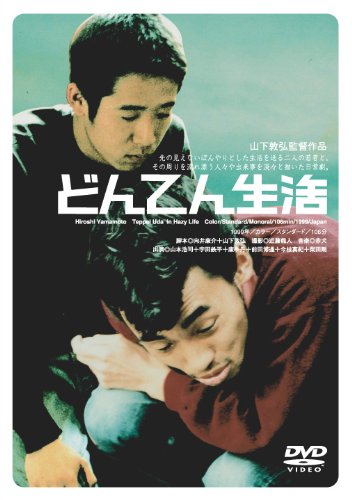
51GlvZf-iiLStarting as he meant to go on, Nobuhiro Yamashita’s debut feature film is the story of two slackers, each aimlessly drifting through life without a sense of purpose or trajectory in sight. His humour here is even drier than in his later films and though the tone is predominantly sardonic, one can’t help feeling a little sorry for his hapless, lonely “heroes” trapped in their vacuous, empty lives.
Kee (Hiroshi Yamamoto), a rocker with a giant quiff, meets Tsutomu (Teppei Uda) outside a pachinko parlour and the two strike up an unlikely friendship. Tsumtomu, a little gormless looking and near silent, ends up moving into Kee’s apartment where his main “job” appears to be copying videotapes of the amateur porn (sorry, “erotic cinema” movies) made by his friend Todokoro and his girlfriend(?) Akiko. In fact, Kee sometimes “stars” in the films too, which is something he might have wanted to tell Tsutomu before showing him the video. Kee also has a four year old child he doesn’t really get to see who lives with his ex-partner and only knows him as “uncle”.

As in many of Yamashita’s other films, nothing much happens as Kee and Tsutomu kill time whilst worrying and not worrying about the future. Neither of the guys has a proper job or any concrete ambitions, they mostly just eat time playing pachinko, drinking and hanging out with Tadokoro and Akiko. Kee is still mooning over his ex-girlfriend and, though it’s not clear why they split up, his own fecklessness may be the reason he’s not more involved in his child’s life even if he clearly would like to be. Tsutomu has developed a bit of a crush on Akiko but he never really tries to do very much about it (though he does have the good grace to turn down Kee’s invitation to become a star in one of the videos).

In constrast to his later work, Yamashita injects a number of fantasy sequences which seem to take place entirely within Tsutomu’s mind. Mostly they’re quite gentle – making a bunch of money at Pachinko and taking Akiko out for a slap-up meal or the poignant final scene of all the characters together as they enjoy a picnic under the cherry blossoms like one big happy family. However, there is one very unexpected scene which occurs after Tsutomu is caught shoplifting (which he does very badly) offering only the excuse that he’s forgotten his wallet and was too lazy to go back and get it. This fairly shocking scene of violence is one that does not typically re-occur in Yamashita’s later work and is notable for its extreme bloodiness and direct contrast to the overall tone. Perhaps intended to show Tsutomu’s inner frustrations (he spends much of the rest of the film asleep), this scene becomes one of the most intriguing in the film.

Hazy Life is a “zero budget” affair and makes no attempt to hide that. Shot on low quality equipment and committed to a “natural” look, it makes no claim to aesthetic prettiness though it does display Yamashita’s gift for interesting compositions this time working within a 4:3 frame. The fantasy sequences themselves are presented as reality bar one use of double exposure which is in general out of keeping with Yamashita’s naturalistic style as is the brief use of time-lapse photography.

Not uninteresting, but perhaps more interesting as a taste of things to come rather than as a feature in its own right. Hazy Life is just that, hazy and somewhat meandering as Kee and Tsutomu muddle through life with an air of mild depression and no particular hope in sight. “what day is it?”, “I don’t know”, “Well never mind – at least we’re alive”. This late conversation more or less sums the entire film and it’s poignantly sweet, fantasy sequence ending adds another layer of pathos to this subtly humorous look at laid-back modern life at the bottom of the heap.


Poppoya (鉄道員, Yasuo Furuhata, 1999)

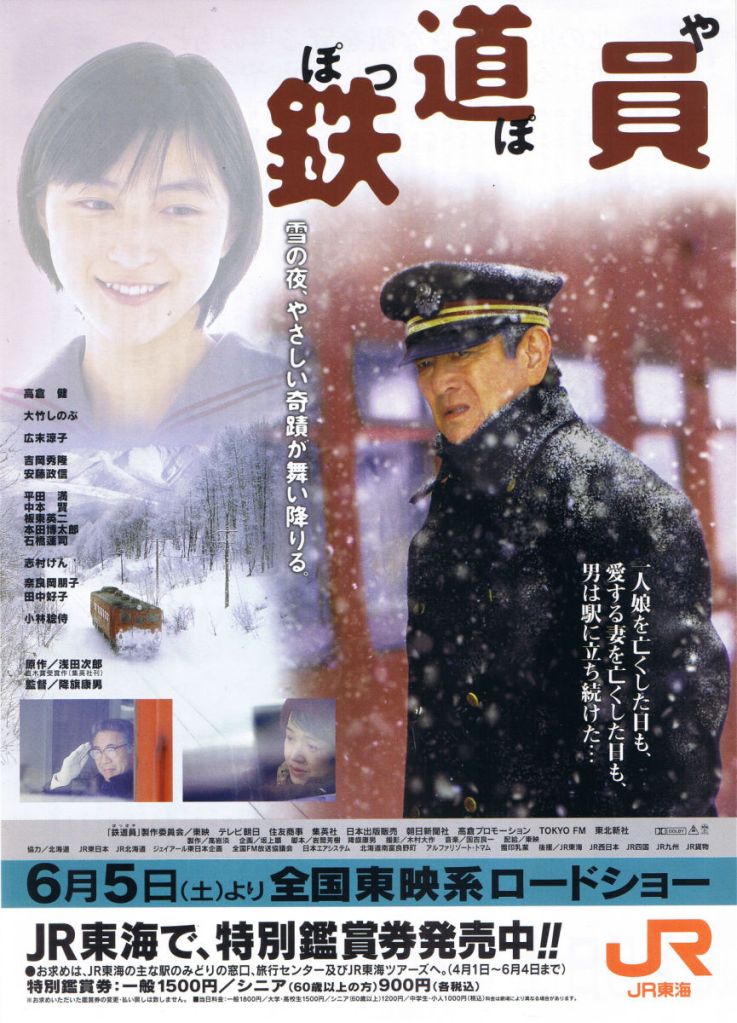
img_0The late Ken Takakura is best remembered as cinema’s original hard man but when the occasion arose he could provoke the odd tear or two just the same. 1999’s Poppoya (鉄道員) directed by frequent collaborator Yasuo Furuhata sees him once again playing the tough guy with a battered heart only this time he’s an ageing station master of a small town in deepest snow country which was once a prosperous mining village but is now a rural backwater.

Otomatsu Sato has spent his life in service to the railway. Like his father before him who believed the key to the modernisation of Japan after its defeat in the second world war was in its transportation network, Sato started as an engineer before being promoted to station master. Morning and evening in the freezing cold he bid in and sent out each passenger and freight train travelling through his one track station. However, though he clearly loves his job Sato has experienced a great deal of personal tragedy in pursuit of his career. He wasn’t there when his baby daughter died, nor was he there when his wife lay dying in hospital. He was where he always is, on the platform until the last train goes out. Now, however, the mine has closed, the town is full of old people and there are no passengers on the train so the line will be closing. Having given his life to something which will be so unceremoniously erased, what is a man like Sato to do now?

In true Takakura fashion, Sato appears tough and fairly unapproachable on the outside but actually he’s quite well respected in the town and even if some of the other residents bemoan his rigid ways, they grudgingly respect him for being the way he is. He takes his duties seriously and would never countenance breaching them for something as trivial as personal concerns, even when those concerns are something as understandable as the death of a family member. The way he sees things, this is his duty and must be fulfilled, properly each day no matter what. This may seem a little obsequious in Western eyes, though many of the other (particularly female) characters also agree Sato takes things much further than he needs to, but dedication to one’s duty is, after all, an admirable trait.

However, now it’s all been for nowt. The railway line is to be closed, the land will engulf it once again erasing the years of Sato’s work just as if he were never there. He’s sacrificed final moments with his wife and child – not even that, just sacrificed moments. He’s given all to the railway and now there’s no place left there for him. His best friend, the father of a son also in the railway business, is to take another job at a hotel complex but Sato is a railwayman through and through – he’ll work on the tracks or not at all.

Around this time Sato also starts seeing some strange new children around. He assumes they’ve come to stay with grandparents in the village, this being the time of the New Year holiday. The little one has a strangely old fashioned looking doll that reminds Sato of one he bought for his infant daughter only she never really had the chance to enjoy it. Then he meets an older sister who’s kind of a live wire before meeting the oldest – a high school student dressed in an old fashioned looking uniform who really reminds him of someone he used to know. All these strange encounters force Sato to further re-examine his past, reliving old regrets and assessing a life lived in service to an ideal at the expense of the joy he might have felt as a happy family man.

Beautifully photographed with picturesque shots of trains against the deep snows of Northern Japan, Poppoya was Japan’s submission for the 1999 Oscars and does have all the trappings of a prestige melodrama. It unabashedly pulls at the hearts strings and even if the rather sentimental score takes things too far, Poppoya does nevertheless manage to draw the odd tear for Sato’s lonely, regretful old age. Sentimental yet genuinely affecting, Poppoya is an effectively crafted weepy which serves as a timely reminder to embrace the things which are most important to you while there’s still time.


The Hong Kong blu-ray release of Poppoya includes English subtitles (though they are a little “imperfect”).

Only trailer I can find has Korean subs:


Gentle 12 (12人の優しい日本人, Shun Nakahara, 1991)

161_img_1_oAs you might be able to tell from its title, Gentle 12 (12人の優しい日本人, Juninin no Yasashii Nihonjin) is a loose Japanese parody of the stage play 12 Angry Men notably filmed by Sidney Lumet back in 1957. The Japanese title literally translates as “12 Kindly Japanese Guys” and the film takes the same premise of twelve jurors debating the verdict in a murder case which was previously thought fairly straightforward. This time our jury is a little more balanced as it’s not just guys in the room and even the men are of a more diverse background.

In contrast to the American version, each of our twelve jurors is immediately inclined to acquit and some of them are even walking out the door before one juror, Juror no. 2, raises an objection. He thinks the defendant may be guilty and they should at least talk about it a little more. Irritated, the jurors walk back into the room and enquire why he’s had this sudden change of heart. They will, of course, be entitled to some refreshments now, so what’s the harm in hanging round to talk things through. Eventually people start to switch sides, some in confusion or just wanting to get it over with, but gradually each is exposed as having a personal reason for feeling the way they do that has relatively little to do with the facts of the case.

In contrast to the original stage play, the first instinct of the Japanese jurors is to acquit. No one wants to believe the defendant, who is the mother of a young child accused of pushing her violent ex-husband into the path of an oncoming truck, could have wilfully planned such an outrageous crime in advance. Whatever the facts are, she has clearly suffered enough and her child certainly doesn’t deserve to be orphaned through having its mother taken away by over zealous seekers of “justice”. Nevertheless Juror no.2 doesn’t believe her story and thinks there’s at least the possibility that she pushed him deliberately if not having engineered the entire situation in someway.

As in the American version, they proceed to debate the facts of the case in detail but while some change sides after thinking over the arguments, others are rigidly committed to their positions. Of those in the not guilty camp, some of them can’t quite articulate their reasoning beyond “it’s just a feeling” which proves particularly infuriating to Juror No. 2. The US version placed more emphasis on societal prejudices with personal ones largely backing them up – i.e. they took against the defendant in that case because he was a poor boy from the slums so in their middle class, majority culture minds it was natural that he was guilty. Here, there’s a great deal of sympathy for the defendant who seems to have experienced a lot of misfortune but continues to try and do the best for her young son.

Even so, some take against her because she reminds them of past misfortune of their own, or take against the victim because even as a thoroughly unpleasant man he’d managed to attract himself a pretty wife and son only to misuse and abandon them. Some believe themselves to be excellent judges of character or to be good at spotting a liar only to have their opinions about themselves undermined when scrutinised. The revelations here are personal rather than societal, but the central fact remains that you can’t really ever know or prove what happened and even having witnessed something with your own eyes doesn’t necessarily mean you’ve totally understood the situation fully. Much of the juror’s deliberations consist of creating a narrative out of scattered facts and exercises in supposition. In the end, it more or less comes down to gut feeling anyway.

Originating as a stage play and scripted by Japanese comedy master Koki Mitani, Gentle 12 has its moments of humour and never really takes itself too seriously. What else could you say about a case which seems to hinge on the smallest size of pizza available from a delivery company and how someone might say the words “ginger ale” when really, really angry. The “kindly” jurors also have a wonderful tendency towards tolerance or towards restrained anger that sees them getting quite annoyed whilst trying not to lose their tempers in exasperation or just calmly restating their arguments (or lack thereof) and infuriating everyone else in the process. Neatly filmed by Shun Nakahara, Gentle 12 might not have the same level of cultural bite as its original work suggests but it does prove an enjoyably absurd confined space drama which offers a few cultural revelations of its own.


Hana-bi (はなび, AKA Fireworks, Takeshi Kitano, 1997)

Original quad poster from UK theatrical release (some of these cinemas no longer exist. Also, sponsored by Yo! Sushi.)

Review of Takeshi Kitano’s Hana-bi (はなび) first published by UK Anime Network.


Takeshi Kitano might still be best known for his ultra violent gangster pics, but after making it into the international arthouse repertoire with Sonatine back in the early ‘90s it was Hana-bi which put him on the map as one of Japan’s most prominent exports. Kitano plays the lead in the film once more adopting his cooler than cool persona with occasional flashes of violence only this time on the side of the law (to begin with, anyway).

Told in an initially confusing, flashback structure, Hana-bi follows middle aged policeman Nishi who experiences several life changing events in a short space of time. At the beginning of the film he’s let off a stakeout and told to go visit his wife who’s ill in hospital. Unfortunately, as we later find out, this will prove to be a poor decision as pretty much everything goes wrong – Nishi’s partner, Horibe, is shot and ends up paralysed, one of his other men is wounded and tragically another killed right in front of Nishi’s eyes. After being told that nothing more can be done for his wife and it’s better that she just come home from the hospital, Nishi quits the police force, gets involved with the yakuza and robs a bank before taking off with his wife for one last holiday.

Actually, the film skips over its climactic event until quite a way into its running time. Kitano unsettles us right away by giving us very little explanation for what we’re seeing. He shows us Nishi meeting with the widow of a man we didn’t even know was dead yet (not that he really told us who she was anyway). We’re left to piece events together like a detective listening to a confused witness testimony only our information is primarily visual – there isn’t even a lot of dialogue to guide us on our way. This refreshing technique is one the generally laconic Kitano seems to favour and greatly adds to Hana-bi’s low-key style.

Kitano never says too much in his movies anyway, but this time his is wife also near silent uttering the grand total of two words in the entire film and both of those come in the final scene. We know that she has a terminal illness (though it isn’t clear that she knows this, or how much she understands). Nishi and his wife also apparently lost their young daughter not long ago and it’s implied that perhaps she just hasn’t been fully present ever since. Her lack of speech, shyness and constant game playing coupled with her outwardly cheerful (if sometimes vacant) demeanour give her a childlike quality but the two words she does offer at the film’s conclusion imply (at least in that moment) that she knows what’s going on and understands what is about to happen.

Nishi and his wife have an extremely close relationship, they rarely need to speak to each other. However, Nishi’s partner, Horibe, discovers that his marriage was not as secure as he assumed as his wife and daughter walk out on him after his accident. In an effort to give him something to strive for, Nishi sends him some painting supplies and henceforth Horibe’s artwork (actually designed by Kitano himself) becomes a prominent motif in the film. The first series takes animals and then people and paints them with the heads of flowers but this then gives way to more complicated pointillist scenes. Many of Horibe’s works feature a repeated motif of a man, woman and child (neatly echoed in the films closing scenes) seemingly enjoying a happy family occasion. Perhaps this is an odd sort of masochism on Horibe’s part, lamenting everything he’s lost since his accident but the two figures could also represent the Nishis reunited with their lost daughter.

Shot in Kitano’s trademark blues, Hana-bi is a melancholy tale. Flowers and fire, Kitano shows us both extreme tenderness and fits of violence as he’s both the loving husband, grieving father, nurturing best friend and hardline cop who bears personal responsibility for the loss of his own. This path only leads in one direction and we’ve figured out where we’re headed long before nearing the end of our journey. Nevertheless, Hana-bi is a rich, poetic experience which continues to prove deeply moving and endlessly fascinating.


Hana-bi is re-released in the UK today on blu-ray courtesy of Third Window Films who will also be releasing Dolls and Kikujiro in the near future.