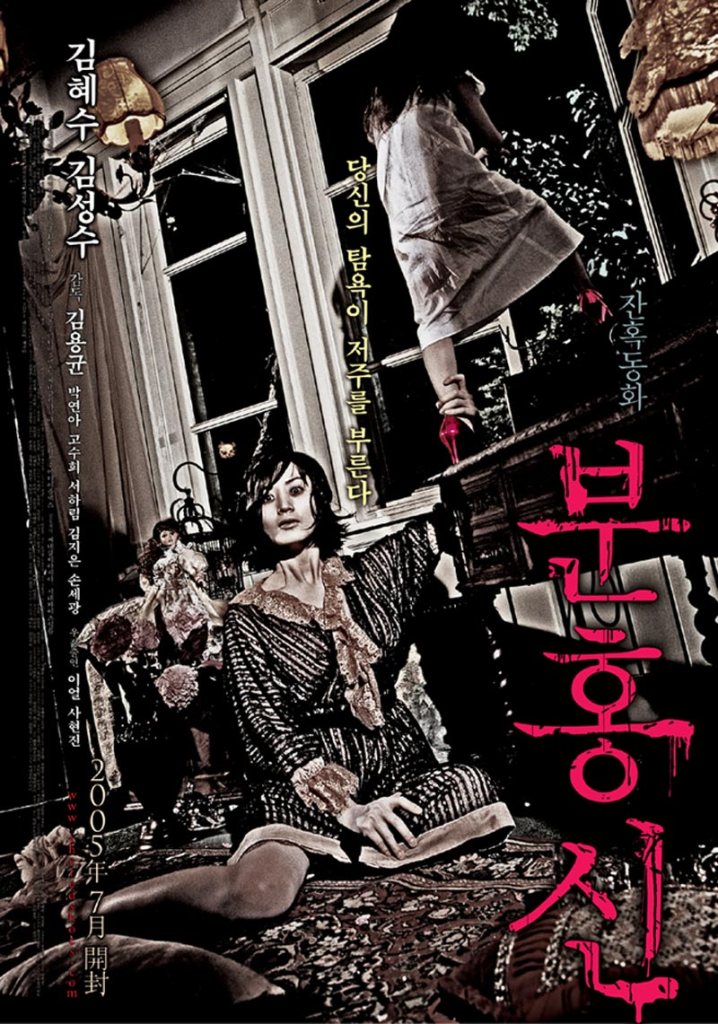
The Red Shoes (분홍신, Kim Yong-gyun, 2005)

the-red-shoesWalk a mile in a man’s shoes, they say, if you really want to understand him. If Kim Yong-gyun’s The Red Shoes (분홍신, Bunhongsin, 2005) is anything to go by, you’d better make sure you ask first and return them to their rightful owner afterwards without fear or covetousness. Loosely based on the classic Hans Christian Andersen tale this Korean take replaces dancing with murder and also mixes in elements from other popular Asian horror movies of the day, most notably Dark Water in its dank and supernaturally tinged dingy apartment setting.
Late one night at a deserted train station in Seoul, a high school girl complains that she’s been waiting ages for her friend to arrive before noticing a pair of hot pink high heels resting incongruously on the platform’s edge. Strangely drawn to them, the girl puts the shoes on only for her friend to turn up and immediately become infatuated with the unexpected footwear herself, suddenly exclaiming that she saw them first. The two fight as the first girl is almost pushed onto the tracks by her friend and all over a random pair of actually quite ugly funny coloured shoes. The eventual winner will come to regret their victory as that night in an otherwise empty train station a teenage girl will loose her footing to a pair of high heels which slowly fill with blood and then disappear leaving only a pair of severed legs behind them.

After this grim opening, we meet another little girl who has definite opinions about her footwear in the form of little Tae-soo who wanted to wear her red shoes to ballet but mum Sun-jae (Kim Hye-soo) says no and they’re already late. Letting Tae-soo learn independence by telling her to make her own way but surreptitiously following her backfires when Tae-soo somehow evades the net leading Sun-jae to head home earlier than expected and discover her husband pleasuring another woman who is also wearing a pair of Sun-jae’s favourite shoes, just to add insult to injury. Next thing you know Sun-jae and Tae-soo have moved into a horrible (but presumably cheap) apartment while they wait for Sun-jae’s new optometrist’s clinic to be finished. It’s all kind of OK, until Sun-jae notices a pair of hot pink high heels all alone on the subway and in obvious need of adoption by a pair of loving feet…

Anyone with a even a passing knowledge of the genre will have figured out the central twist well ahead of time though, strangely, it seems almost irrelevant. The shoes are cursed, but they’re cursed with jealous desire as they both contain the entirety of a scorned woman’s rage and humiliation, and a lingering want for that which has been lost. Spreading like a virus, the shoes pick a host and then target those whom it infects with the need to posses them. This tension manifests itself in odd ways as mother and daughter become rivals in the tug of war over who the rightful owner of the shoes should be. A precocious child, Tae-soo has soon tried on her mother’s new shoes and there after progressed to makeup and pretty dresses. Her mother, rather than using authority or reason to regain her lost treasure, fights with her daughter like a child eventually resorting to violence but with all the force of adulthood. The shoes corrupt even this most innocent and essential of relationships as Sun-jae continues to struggle with maternity as Tae-soo’s overwhelming need to possess the shoes and eclipse her mother’s femininity arrives well ahead of schedule.

Shoes aside, Sun-jae does not seem to be a well woman. Problems with her eyes do not quite explain the flashbacks she’s been experiencing to an apparently traumatic episode in the 1940s in which the shoes seem to feature. She’s also begun having strange waking dreams which involve blood, lots of blood – far more blood than any one body could realistically contain, and bad things happening to Tae-soo. Eventually Sun-jae figures out that the shoes were a bad idea and that there may be other stuff going on in her life that she isn’t exactly aware of, but the extent to which cursed footwear is influencing her behaviour may be open to debate given later (though extremely obvious) revelations.

It just goes to show that misplaced desire can leave you footless and fancy free. Kim does his best to make modern day Seoul a supernaturally scary place, overlaying eerily empty shots of intersections and train stations with gothic infused musical cues whilst having Sun-jae move into the kind of place which only someone trying to disappear would consider. Adding in touches of surrealism from the aesthetically beautiful fantasy sequences to snowing blood, Kim creates the atmosphere of fairy tale whilst allowing for an imbalance of perception in the possibly fracturing mind of his heroine. Despite the often impressive cinematography and strong leading performance from Kim Hye-soo, The Red Shoes never manages to transcend its lack of originality and frequent callbacks to similarly themed genre efforts but nevertheless offers its share of elegantly composed scares even if its internal integrity fails to convince.


Original trailer (English subtitles)

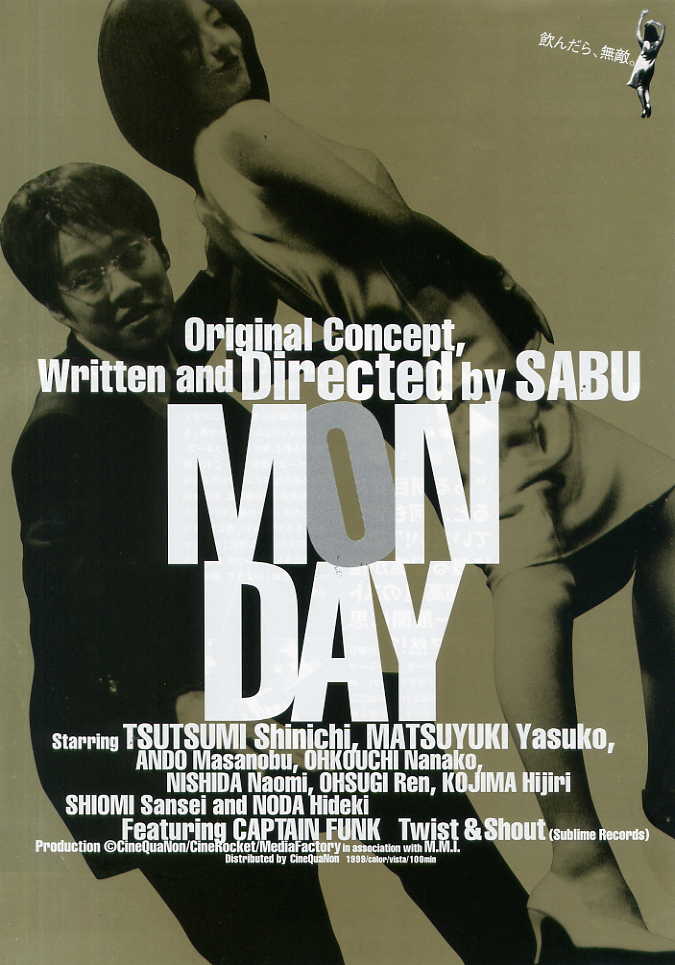
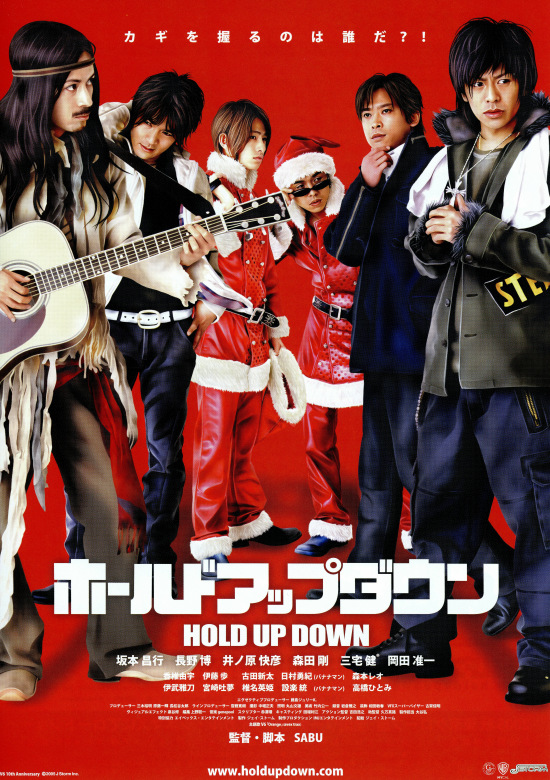
Hold Up Down (ホールドアップダウン, SABU, 2005)

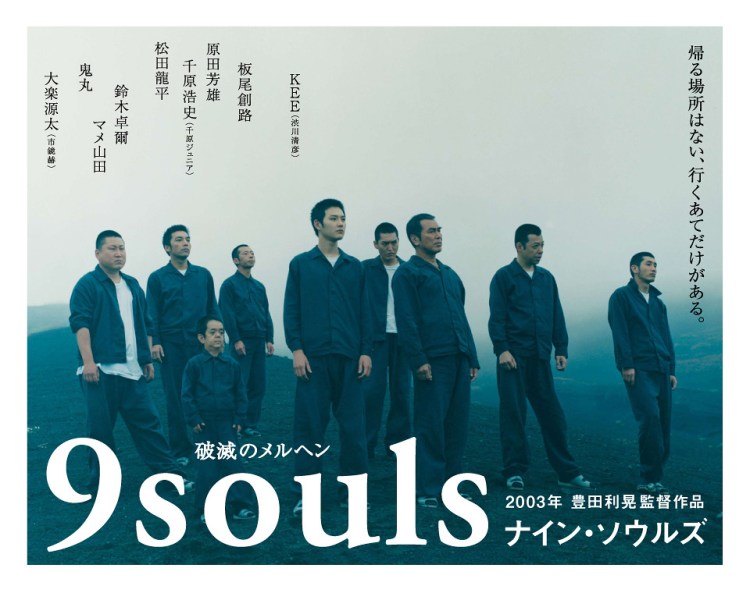
hold-up-downReteaming with popular boy band V6, SABU returns with another madcap caper in the form of surreal farce Hold Up Down (ホールドアップダウン). Holding up is, as usual, not on SABU’s roadmap as he proceeds at a necessarily brisk pace, weaving these disparate plot strands into their inevitable climax. Perhaps a little shallower than the director’s other similarly themed offerings, Hold Up Down mixes everything from reverse Father Christmasing gone wrong, to gun obsessed policemen, train obsessed policewomen, clumsy defrocked priests carrying the cross of frozen Jesus, and a Shining-esque hotel filled with creepy ghosts. Quite a lot to be going on with but if SABU has proved anything it’s that he’s very adept at juggling.
Christmas Eve – two guys hold up a bank whilst cunningly disguised as Santas, but emerging with the money they find their getaway car getting away from them on the back of a tow truck. Still dressed as Father Christmases, the guys head for the subway and decide to stash the cash in a coin locker only neither of them has any change. After robbing a busker at gunpoint for 800 yen, the duo get rid of the loot but the guy chases after them at which point they lose the key which the busker swallows after being hit by a speeding police car. Trying to cover up the crime the two policeman bundle him into the car but crash a short time later at which time the busker gets thrown in a lake and then retrieved by a defrocked priest under the misapprehension that he is Japanese Jesus!

Following SABU’s usual spiralling chase formula, events quickly escalate as one random incident eventually leads to another. Christmas is a time of romance in Japan, though encountering the love of your life during a bank robbery is less than ideal. After a love at first sight moment heralded by a musical cue, the thieves head back on the run with the girl in tow but the course of true love never did run smooth. If romance is one motivator – death is another. On this holiest of days, our defrocked priest is caught in a moment of despair, contemplating the ultimate religious taboo in taking his own life and ending the torment he feels in having failed God so badly. Therefore, when our scruffy hippy busker washes up right nearby he draws the obvious conclusion – Jesus has returned to save him! Attempting to make up for his numerous mistakes, the priest is determined to save and preserve his Lord, but, again, his clumsiness results in more catastrophes.

The situation resolves itself as each of the players winds up at the same abandoned hot springs resort which turns out to be not quite so closed down as everyone thought. Filled with ghostly charm, the gloomy haunted house atmosphere sends everyone over the edge as they thrash out their various issues as if possessed by madness. Culminating in a sequence of extreme slapstick in which everyone fights with everyone else and frozen Jesus plays an unexpectedly active part, Hold Up Down brings all of its surreal goings on to a suitably absurd conclusion in which it seems perfectly reasonable that those wishing to leave limbo land could take a 2.5hr bus trip back to the afterlife.

Pure farce and lacking the heavier themes of other SABU outings, Hold Up Down, can’t help but feel something of a lightweight exercise but that’s not to belittle the extreme intricacy of the plotting or elegance of its resolution. An innovativeIy integrated early fantasy sequence begins the voyage into the surreal which is completed in the strangely spiritual haunted house set piece as the disillusioned priest spends some time with congenial demons before attempting to make his peace with God only for it all to go wrong again. If there is a god here, it’s the Lord of Misrule but thankfully they prove a benevolent one as somehow everything seems to shake itself out with each of our troubled protagonists discovering some kind of inner calm as a result of their strange adventure, as improbable as it seems (in one way or another). Christmas is a time for ghost stories, after all, but you’ll rarely find one as joyful as Hold Up Down.


Scene from the end of the film:

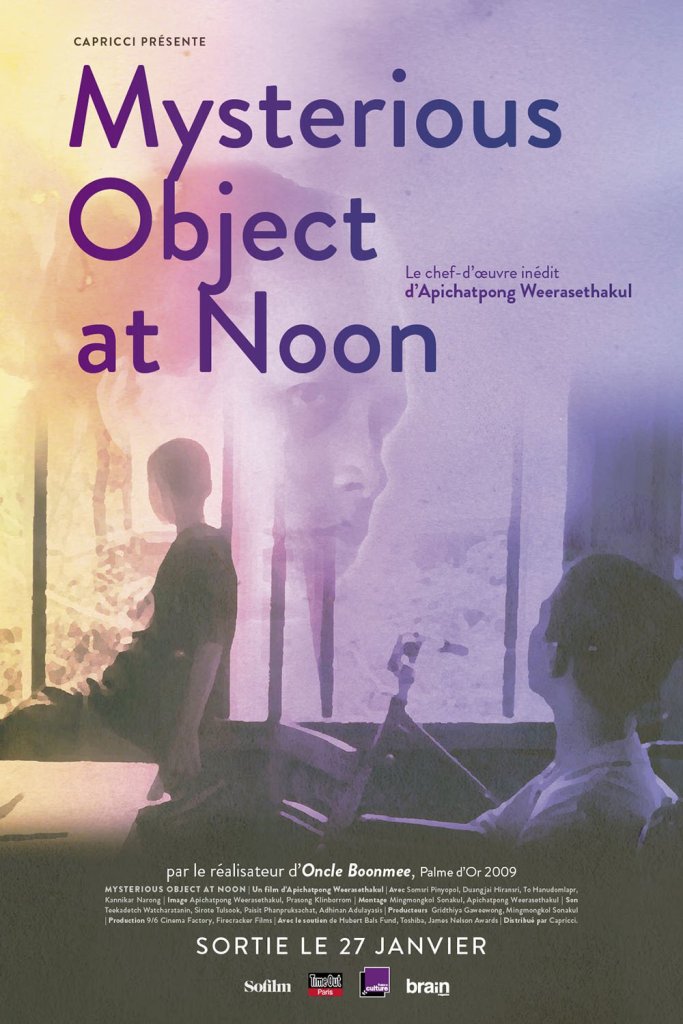
Mysterious Object at Noon (ดอกฟ้าในมือมาร, Apichatpong Weerasethakul, 2000)

mysterious-object-at-noonApichatpong Weerasethakul started as he meant to go on with his debut feature, straddling the borders between art film and surrealist exercise. A cinematic riff on the classic “exquisite corpse” game, Mysterious Object at Noon (ดอกฟ้าในมือมาร, Dokfa Nai Meuman) is equal parts neorealist odyssey and commentary on the human need for constructed narrative (something which the film itself consistently rejects). Shot in a grainy black and white, Apitchatpong’s first effort was filmed over three years travelling the length of the country from North to South inviting everyone from all walks of life to contribute something to the ongoing and increasingly strange brand new oral history.
Beginning with a travelling shot from inside a van peddling fish sauce, Apitchatpong fills the air with naturalistic background noise including our very first story – a sappy sounding radio drama called “I’ll Love You Tomorrow” about a guy who loses touch with the love of his life only to find her engaged to another man. The genesis for the ongoing narrative comes from the woman working on the truck who first recounts her own true story of having been sold by her father for nothing more than the money for his train fare home. She then tells us about a disabled boy and his home teacher who will become the central players in the background tale.

The boy and his teacher get on well and are very close, but one day he finds her collapsed with a strange sphere rolling out from underneath her skirt. This “mysterious object” then transforms into a boy who hides the teacher’s body in a cupboard before taking on her form when he realises the first boy misses her. The odd story grows and develops as each person brings something new to it, reflecting their own lives and histories as a kind of brand new myth making occurs in which ordinary people try to make sense of extraordinary events. Consequently, we have everything from kidnapping to hostess bars and aliens suddenly creeping into this magical realist exercise.

Beginning in the city and ending in the country, Apichatpong talks to anyone and everyone, getting old grannies drunk and letting children run riot. Nearing the end of the journey, he recreates the constructed narrative as a travelling show complete with singing and dancing though his country players are quick to criticise the lack of proper script and random nature of the story. Realising they’ll need some kind of explanation as to why the disabled boy is in a wheelchair, the in movie director decides to film an insert sequence along the lines of an archive news segment. More archive footage follows before Apichatpong takes things in the opposite direction by letting the camera roll on with his cast for the invented story as the second boy becomes keen to remind everyone he was promised some KFC on the way home and Apitchatpong himself steps in front of the camera to fix a lighting setup.

Stories are the way we define our worlds, though given enough leeway the ones we imagine for ourselves are much stranger than conventional logic would allow. The real world is, however, ever present in the sappy radio adverts, political posters, elephants and boxing rings which give way to the darker elements of child abductions and human trafficking. Real life is here, but its deeper layer is here too in the stories which we tell to make sense of it. Using narrative devices from intertitles to sign language, Mysterious Object at Noon embraces all kinds of storytelling from the dramatic to the literary, but its heart is always with the people and the random craziness that emerges when attempting to explain the inexplicable. A necessarily disparate and strange experience, Mysterious Object at Noon neatly heralds the direction of Apichatpong’s ongoing career in its effortless playfulness and sympathetic exploration of this most basic of human needs.


French release trailer (subtitles/captions in French only)

Tears for You (涙そうそう, Nobuhiro Doi, 2006)

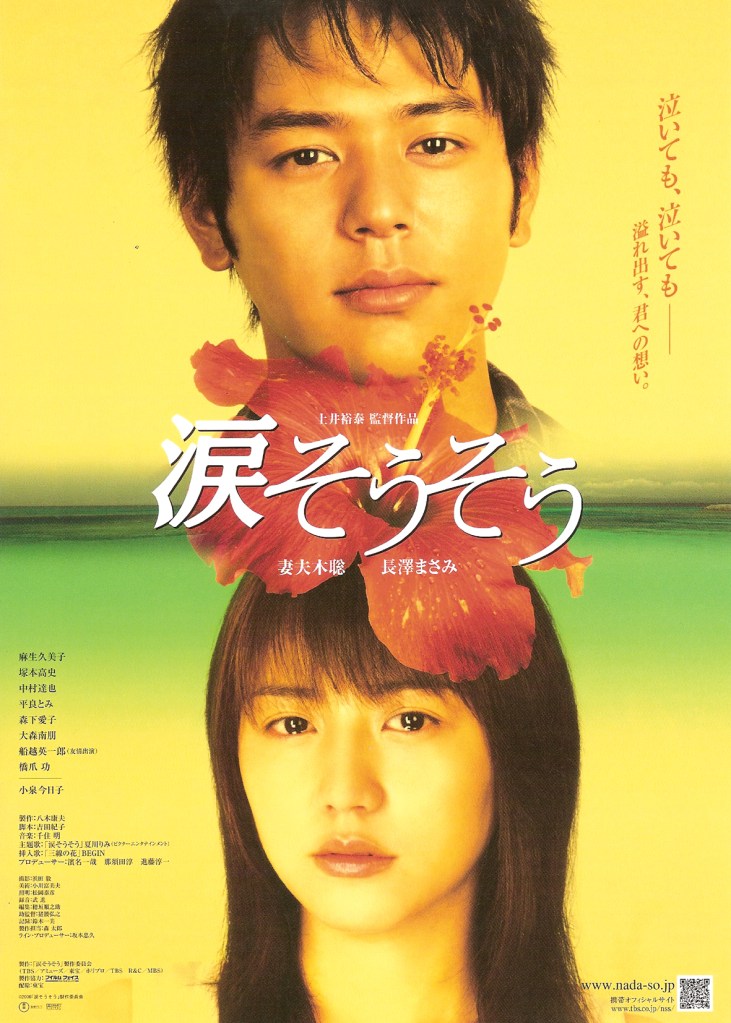
tears-for-youComing in at the end of the “pure love” boom, Nobuhiro Doi’s second feature, Tears for You (涙そうそう, Nada So So) is presumably named to tie in with his smash hit debut Be With You, and continues in the same general vein but with a much less satisfying melodrama at its core. A complicated love story centring on a pair of orphaned step-siblings, Tears for You edges into some difficult, perhaps unpalatable, territory but neatly skirts around it with a childish innocence intended to enhance its romantic credentials. Starring the jun-ai icon Masami Nasagawa, the tragic heroine at the centre of Crying Out Love in the Center of the World, alongside the then up and coming leading man Satoshi Tsumabuki, Tears for You is never quite as heartrending as it would like to be but does its best to wring its sorrowful narrative for all of its inherent tragedy.

21yr old Yota (Satoshi Tsumabuki) is a young man with big dreams but he’s put lots of them on hold in order to take care of his younger step-sister, Kaoru (Masami Nagasawa), who has only him to depend on. Yota’s mother married Kaoru’s father when both the children were small but her new husband soon ran off leaving his daughter behind. The three of them continued as a tightly knit family until Yota’s mother became ill and passed away, making Yota promise to take care of Kaoru no matter what even whilst on her deathbed. The two then moved back to an Okinawan island to live with Yota’s grandmother until Yota came back to Naha for high school. Kaoru is now about to make that same journey but the siblings’ happy reunion also provokes a number of questions about the nature of their relationship and the course each of their lives will take in the future.

This being a “pure love” movie, tragedy is coming though Tears for You does its best to disguise where it’s coming from even if the eventual outcome is quite obviously signposted. The original barrier between Kaoru and Yota is raised by their nature as accidental siblings, not related by blood but raised alongside each other with a familial bond stronger than that of just childhood friends. This, of course, becomes a problem as they grow older and begin to find it difficult to draw the line between their familial love and a possibly romantic one which would allow their family of two to continue forever.

Yota, the self sacrificing older brother has indeed become everything to Kaoru – a brother, father, and friend all in one. Dropping out of high school early, Yota has been sending a pay check home since the age of sixteen, putting his own future to one side in order to provide for Kaoru. Determined that Kaoru should prosper and escape their lowly, poverty stricken island existence through getting to university and into a middle class profession, Yota has been working three different jobs. When it looks as if he’s about to be able to realise his own dream of opening a restaurant, it all comes crashing down around his ears as he realises he’s been duped by a con artist and is now on the hook to a gang of loansharks.

In addition to adding to his financial burdens, causing him embarrassment, and further deepening his worry about providing for Kaoru, the situation also creates instability in his romantic life when the father of his longterm medical student girlfriend finds out about his predicament and offers to help – but only at a price. Keiko (Isao Hashizume), he reminds him, is a middle class girl on track to take over her father’s clinic. Yota is a poor boy with limited expectations. The implications are clear and already known to Yota who has internalised a degree of shame over his lowly origins and lack of education which he overcomes through hard work and enthusiasm. Keiko is not the sort to worry about a petty class difference even if her father is, but his words get to Yota who has always felt Keiko is too good for him. She does, however, care slightly about Yota’s ongoing and complicated relationship with his younger sister whom, she fears, will always eclipse any other woman in his life.

As in all pure love stories, love is an impossibility, surrounded by unassailable walls of culture and fate. Though there is no blood relation between Yota and Kaoru, their familial circumstances make romantic love a taboo which leads the film into a rather odd corner in which the familial side of their relationship is the one which gains the upper hand as the love of a brother and sister eclipses that of a tragic missed opportunity. As such the nature of the heartrending conclusion does not reach the melodramatic heights of other genre hits, even if it adheres to the form in maintaining the “purity” of the love through the final impossibility of its realisation. Doi employs many of the same techniques he used so well in Be With You, artfully shifting between past and present and making the most of repeated motifs to bring home the circularity of the relationship between the pair of tragic lovers but never achieves the same kind of emotional depth. Nevertheless, Tears for You is a suitably melancholy weepy anchored by strong performances from its two leads which does ultimately prove moving even if not quite reaching the degree of melodrama implied by the title.


Original trailer (no subtitles)

And here’s the original song, Nada Sou Sou, in its cover version by Rimi Natsukawa which spawned a mini industry of its own encompassing two TV dramas and this standalone film (English translation):

Fighting for Love (同居蜜友, Joe Ma, 2001)

fighting-for-loveTony Leung Chiu-wai may have just won a best actor prize in Cannes, but that didn’t stop him getting right back on the HK treadmill with the run of the mill rom-com, Fighting for Love (同居蜜友). Reuniting director Jack Ma with Feel 100% star Sammi Cheng, Fighting for Love is the kind of wacky, thrown together romantic comedy that no one really makes any more (not that that’s altogether a bad thing). Still, even if the film is over reliant on its two leads to overcome the overabundance of subplots, it also makes use of their sparky chemistry to keep things moving along.
Deborah (Sammi Cheng) and Tung Choi (Tony Leung Chiu-wai) are both driving to the hospital to visit family members whilst arguing with someone on their cellphones. Deborah is a hardline business woman with a tendency to make her employees cry and a total refusal to give into anyone else’s demands whereas Tung Choi is the third generation manager of successful family noodle restaurant. When Deborah’s reckless driving knocks off Tung Choi’s wing mirror, he chases her and she runs away until they have a physical altercation in the hospital carpark. The police turn up and decide they’re both as bad as each other but eventually Tung Choi convinces Deborah to come to a meeting in a karaoke bar at which they both get roaring drunk and end up in a one night stand.

An unexpected outcome, to be sure. Tung Choi already has a girlfriend, and she’s a well known TV personality to boot. Deborah’s major relationship has been her career, but after some work place shenanigans she’s fired and later finds herself sort of homeless after losing her father’s dog. Running into Tung choi again at the hospital where she decides to try sleeping in her sister’s room, the pair meet in a more civilised manner leading him to offer her the sofa in his family’s home. His girlfriend, Mindy (Niki Chow), is overseas, but can Tung Choi and Deborah really find love before she gets back?

Fighting for Love works best when it focuses on Tung Choi and Deborah as they fight and fall in love reluctantly and almost by accident. Deborah is portrayed as an overly aggressive, grumpy woman with a tendency to scare people away though she softens and becomes less deliberately abrasive throughout her courtship with Tung Choi where as Tung Choi is portrayed as a weak willed man, bossed around by his famous girlfriend and avoiding making any decisions of his own but starts to find his voice when Deborah prompts him to make an active choice. Tony Leung and Sammi Cheng have great chemistry fuelling the central dynamic and keeping the film afloat despite its otherwise non-sensical plot.

Subplots include the ongoing problems at Deborah’s workplace where her colleagues alternate between loathing and pity without much in the way of explanation, culminating in an episode where Deborah offers to sell her car and cash in her savings to pay another woman’s team members after the company lets them down. This gets her invited to the company’s anniversary party despite no longer being an employee where she also has an improbable onstage showdown with Mindy. Further bonding with Tung Choi by getting herself a job at his noodle restaurant, Deborah accidentally destroys his secret recipe soup, allowing them more time to work together to find a solution. While all of this is going on, Deborah also has to contend with Tung Choi’s crazy extended family who originally start off supporting Mindy but then later seem on Deborah’s side. Deborah’s own family fade from the narrative fairly quickly as her work takes precedence over her family life.

Like many classic Hong Kong rom-coms, nothing really makes much sense in Fighting for Love. The situations become increasingly contrived as Deborah and Tung Choi advance and retreat in terms of their growing romance, and the additional subplots including the unconvincingly bland, airhead TV star Mindy (why is she so dead set on marrying the manager of a noodle shop she doesn’t really love when she’s such a high flying celebrity?) only detract from rather than add to the ongoing narrative. Nevertheless, Tony Leung and Sammi Cheng have great chemistry and make the most of their quick fire, screwball style scenes which make the central romance, if not the film as a whole, worth spending time with.


Original trailer (no subtitles)

9 Souls (ナイン・ソウルズ, Toshiaki Toyoda, 2003)

9-soulsToshiaki Toyoda has never been one for doing things in a straightforward way and so his third narrative feature sees him turning to the prison escape genre but giving it a characteristically existential twist as each of the title’s 9 Souls (ナイン・ソウルズ) search for release even outside of the literal walls of their communal cell. What begins as a quirky buddy movie about nine mismatched misfits hunting buried treasure whilst avoiding the police, ends as a melancholy character study about the fate of society’s rejected outcasts. Continuing his journey into the surreal, Toyoda’s third film is an oneiric exercise in visual poetry committed to the liberation of the form itself but also of its unlucky collection of reluctant criminals in this world or another.
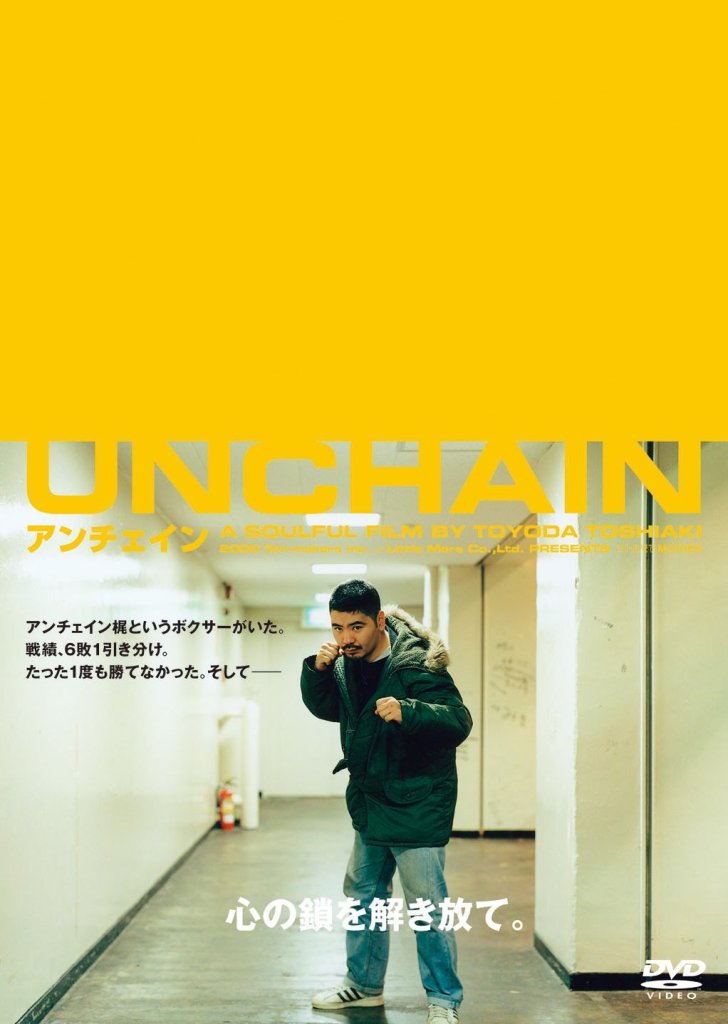
Former hikkikomori Michiru (Ryuhei Matsuda) is being thrown in at the deep end as the 10th prisoner in a crowded communal cell to which he has been consigned after the murder of his father. Not long after he arrives, one of the veteran inmates who had been assigned to him as a mentor and goes by the nickname of The King of Counterfeiters (Jun Kunimura), suddenly has some kind of psychotic episode where he goes off on a long monologue about a buried time capsule and the key to the universe before being dragged off somewhere by the guards. Right after that, a little mouse turns up signalling the probability of a mouse hole somewhere in the cell. Master escape artist Shiratori (Mame Yamada) somehow comes up with a plan to use this information in order for everyone to escape, which they do, emerging from a pipe into the blue tinted landscape and making a break for freedom.

Commandeering a camper van from a young man terrified of ghosts, the gang of nine hit the road heading for a primary school where their cellmate’s time capsule promises an untold fortune in counterfeit currency. What they find there is unimpressive except for a strange looking key which they decide to give to Michiru because they’re a bunch of guys who appreciate irony. At a loss again, each begins to think about the circumstances which brought them to this point, wondering if there’s a way back or if anyone is still waiting for them.

Less than a prison break movie, 9 Souls shares more in common with the return to Earth genre in which a recently deceased person is given a second chance to deal with some unfinished business until they are finally able to accept the inevitable. Though the prisoners have each committed heinous, often violent or unforgivable crimes, they each have dreams and aspirations which were previously denied to them but may just be possible now given their extremely unusual circumstances. Sometimes those dreams are heartbreakingly ordinary – falling in love, getting married and opening a small cafe in the countryside, for example, or attending your daughter’s wedding and being able to give her a wedding present in person. Try as they might, the prisoners are only able to gain a small taste of their hopes and dreams before they all come crashing down again, leaving them with only their fellow escapees to rely on.

Looking forward to Toyoda’s next film, The Hanging Garden, 9 Souls also takes a sideways view of that most Japanese of topics – the family. Michiru came from an extremely dysfunctional environment in which his mother abandoned him and he was forced to kill his own father only for his younger brother to then betray him. Veteran prisoner Torakichi (Yoshio Harada) unwillingly becomes the “father” of the group though he was imprisoned for the murder of his son. This perfect symmetry of a fatherless son and sonless father adds to the circularity of Toyoda’s tale as each is forced to reassume their familial roles within the equally forced genesis of the prison cell family. In the outside world, each of the prisoners is searching for only one thing – acceptance, but each finds only that which they feared most, rejection. Once again cast out from mainstream society as they had been all their lives, the prisoners are left with nowhere else to go but the mystical destination offered to them by the counterfeiter’s magic key.

The truck driver’s strange fear of ghosts comes back to haunt us at the end of the film as the van, now painted a peaceful sky blue complete with fluffy clouds as opposed to the hellish red of the ironically named “lucky hole”, begins to fill up with departing spirits each finding their exit in one way or another. A man who helped his son to die will now have to save another, while a boy who locked himself inside his room will have to turn the key and open a door on eternity. Swerving from absurd comedy to deeply melancholic meditations on guilt, redemption, and a failing society, 9 Souls is among the most poetic of Toyoda’s early works swapping the rage which imbued the young of Pornostar for the sorrowful resignation of experience.


Available now in the UK as part of Third Window Films’ Toshiaki Toyoda: The Early Years box set.

Original trailer (English subtitles)

Unchain (アンチェイン, Toshiaki Toyoda, 2000)

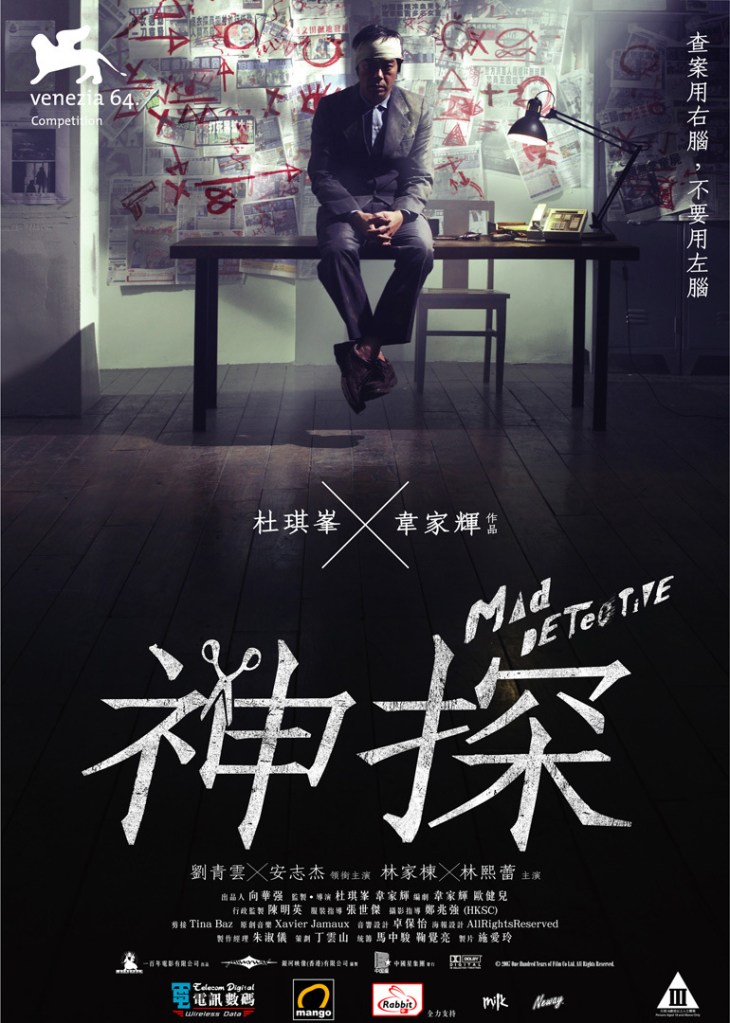
unchainTo date, Toshiaki Toyoda has released only one feature length documentary. Unchain (アンチェイン), the story of four boxers from Toyoda’s own home town of Osaka, was released between his debut feature, Pornostar, and followup film Blue Spring, but Toyoda had, in fact, been following his subjects since the mid-90s as they battled with themselves, the ring, and life’s unending tests. Like the fictional heroes of many of Toyoda’s subsequent works, his real life subjects are frustrated young men seeking release through a pugilistic purgatory all the while finding themselves trapped against the ropes.

The film takes its title from the ring name of the group’s lynchpin, “Unchain” Kaji who, it has to be said, may be the most “unchained” person whoever lived. An angry young man from unusual family circumstances in which he discovered he’d been adopted by an uncle as a baby only after his adopted father had died and he was in the process of applying for a driving license, Kaji took to boxing early only to wash out after just seven bouts.

Losing each and every match he ever fought and eventually forced to leave the ring on medical grounds, Kaji remained in the world of boxing as an ardent supporter of his boxing friends – long haired Garuda, second generation Korean Nagaishi, and “shoot boxer” (Japanese kick boxin based mixed martial arts) Nishibayashi. A big hearted man who wanted to make a difference and help people, Kaji drifted through several occupations post boxing from working in an all night cinema and DJ-ing to caring for disabled children. However, his violent impulses always got in the way of his good intentions and an enraged attack on a job centre in which he took the younger Nishibayashi with him for support landed him in a mental hospital where he stayed for the next few years.

Toyoda then follows the other three boxers as they continue their quest for glory in the ring but encounter mostly defeats and setbacks. Garuda and Nishibayashi fight hardest to stay with Nishibayashi eventually giving up after a brutal defeat leaves him with a sour looking wound under his eye, but Nagaishi drifts away from boxing after marrying Kaji’s former girlfriend, Sachiko, and becoming a father to her two children as well as a few of his own later on. The only one to find fulfilment outside of the ring, Nagaishi eventually finds his place as a family man, given a new kind of hope by familial bond rather than fraternal opposition.

Toyoda makes no secret of the fact that he staged some scenes and slightly manipulated his footage but his documentary approach shares much with his narrative filmmaking in its study of young men looking for an escape through violence. Kaji describes the ring as a place where is killing legal but also as a kind of promised land they’ve all been trying conquer. As his name suggests, Kaji was seeking freedom through the ring, a chance to let his soul fly, but never found it leading to his life of picking fights with anyone and everyone. The Kaji released from the hospital is a calmer, though perhaps no less passionate, figure, but one who finds his friends waiting for him with a mix of good humour and exasperation. Even the potentially difficult reunion with Nagaishi finds Kaji in a philosophical mood, grateful for all his friend has done for him and harbouring no ill will.

Filming with mostly the low grade digital cameras of the time, Toyoda captures the fight sequences either from high balconies or heat of the action ringside. Garuda’s final fight is captured unusually well thanks to Toyoda’s fortunate position which allows him to literally get right up in Garuda’s face at a crucial point when it seems all may be lost. Sticking to mostly a talking heads approach, Toyoda also incorporates other archive footage from family photos to documents and news reports as well as a handful of street scenes and recreations offered with Toyoda’s distinctly surreal visual flare. Like many of Toyoda’s heroes, Unchain and his friends are trying to live free in an oppressive environment where they each have reasons to feel constrained thanks to their socio-economic circumstances. They may not find their release, but their quest goes on, alive in the ring even if floundering outside it.


Available now in the UK as part of Third Window Films’ Toshiaki Toyoda: The Early Years box set.

Original trailer (no subtitles)

Heremias (Book One: The Legend of the Lizard Princess) (Unang aklat: Ang alamat ng prinsesang bayawak, Lav Diaz, 2006)

heremiasLav Diaz has never been accused of directness, but even so his 8.5hr epic, Heremias (Book 1: The Legend of the Lizard Princess) (Unang aklat: Ang alamat ng prinsesang bayawak) is a curiously symbolic piece, casting its titular hero in the role of the prophet Jeremiah, adrift in an odyssey of faith. With long sections playing out in near real time, extreme long distance shots often static in nature, and black and white photography captured on low res digital video which makes it almost impossible to detect emotional subtlety in the performances of its cast, Heremias is a challenging prospect yet an oddly hypnotic, ultimately moving one.
Diaz begins with a long, static take of a roadway in which a convoy of pedlars is parked while the modern world passes them by in the form of speeding motor cars. Heremias (Ronnie Lazaro) is a member of this timeless nomadic community, travelling along the road selling handicrafts from a cart pulled by a cow. The other pedlars seem worried about Heremias, they describe him as seeming “unwell” and are concerned because he hasn’t been eating. Eventually Heremias makes the fateful decision to go his own way, leaving the safety of the caravan behind to tread his own path. Yet what he finds out on his own amounts to trouble and strife beginning with the theft of his cart and ending with his overhearing a gang of teenage boys outline their plan to rape and murder a local girl.

Diaz spends the first few hours of the film immersing us in the world of the caravan with its routines of singing and eating broken with children’s lullabies and games of basketball. Heremias, however, wants something more than his simple life of community and the security of the familiar. Rather than simply retread familiar routes alone, Heremias follows a solitary, untravelled path which promises little more than aloneness. His cow, in a fine supporting performance, is often less certain of the wisdom of his master’s decision and makes his displeasure known, though Heremias is unwavering. When the cow is suddenly removed from the picture, its absence is very much felt as Heremias is left entirely alone without hope or guidance.

On trying to report the crime to the authorities, Heremias finds that all of his faith in the rule of law has been misplaced. Though the police begin to investigate, it’s clear that they have little interest in solving the crime, eventually asking for a sizeable bribe to complete the job. Later, when Heremias hears the terrible plan of the drunken young men, he tries the police again but finds them unwilling to help as the young men in question are sons of important people. Finally Heremias turns to the church but the priest is unwilling to offer anything more than prayer to save the life of a vulnerable young girl. Heremias, disappointed and with his faith shaken to the core, is left with no other recourse than to strike a bargain with God. Fasting and wandering, Heremias hopes that God will save the girl whom he seems incapable of helping in any other way though Diaz offers no clue if his faith will be repaid.

The film’s title comes from the name of a town which Heremias passes through. A couple once lived there and had a beautiful daughter who was abducted and never seen again, save perhaps for a baby lizard appearing at her parents’ home. This story repeats itself in that of Helena – the young woman who will be raped and murdered according to the tale Heremias overhears whilst watching the young men waste their time on drugs and alcohol inside an abandoned home. Old stories seem to resurface in new but no less tragic ways as the lizard who can tell good men from bad gives way to a discussion of the Japanese who hid in the forests after the war, too ashamed (as the villagers describe it) to return home. Among the executed soldiers was a colonel, Oshima, but the men can’t decide if the Oshima who died was the bad Oshima or another one altogether or if the bad Oshima was really bad at all – he did, so they say, design the water sanitation system at the school to the great benefit of everyone.

Heremias wanders alone through the difficult terrain, falling ever deeper into despair. Though generally impassive, Heremias is allowed two great moments of emotion – the first as he’s overtaken by the enormity of the loss of his cart and cow, and then after his greatest test which leads him to make his fateful bargain with God. The police have failed him, the priest ignored him, and there’s nothing to say he’ll have any more luck with the invisible protector yet with this last descent into the depths of hopelessness he emerges changed, almost saintly, as he agrees to make a personal sacrifice for only the hope that the girl will be saved from her grizzly fate. Aimlessness gives way to purpose, as Heremias adopts the path of the fallen prophet.

Though the low res cinematography and extreme distance shots add to the film’s alienating approach, there are moments of rare beauty as Diaz captures the natural landscape even as it proves hazardous or threatening to man. Unusual sound design completes the effect as the boys’ loud rock music suddenly cuts out while they detail their heinous plans, or ancient folk songs float through the background, eerily echoing ongoing events. Oblique and detached, Diaz’s lengthy spiritual epic resolutely rejects connection yet the cumulative effect of its distancing approach leads to its ambiguous if ultimately moving conclusion.


Heremias loses his cow (dialogue free)

Mad Detective (神探, Johnnie To & Wai Ka-Fai, 2007)

mad-detective

The border between “eccentric” and just “insane” can be quite a thin one but that tiny liminal space of uncertainty is where the hero of Johnnie To and Wai Ka-Fai’s Mad Detective (神探) resides. The titular Mad Detective, Bun (Sean Lau Ching-Wan), is about as unreliable a narrator as they come owing to the fact that he experiences frequent hallucinations and delusions meaning that absolutely nothing of his perception can be taken at face value. Despite his unorthodox approach, Bun is a fine a detective with an almost supernatural crime solving ability but, tragically, sometimes he sees more than he would like of human nature.

The day rookie detective Ho (Andy On) joins the force, he walks in on an unusual scene. Knives and cutting implements are lined up on a table while a pig’s carcass hangs from the ceiling. Veteran cop Bun then enters into the mind of a killer by viciously stabbing the pig carcass (and lovingly caressing it afterwards), before tucking himself inside a suitcase which he asks Ho to throw down the stairs only so he can then leap out and shout “The guy at the ice-cream store did it!”. A montage of newspaper cuttings testifies to Bun’s track record, but his career is over when he suddenly decides to cut off his own ear and present it to his boss at his retirement party.

Not so long after, two cops enter a forrest and only one leaves. That’s one problem, but the missing cop’s gun has been used in a series of robbery/homicides which is another. Exhausting all leads in trying to find out what happened between gun losing Wong (Lee Kwok-Lun) and his shady partner Chi-wai (Gordon Lam Ka-Tung) in a dark forest 18 months previously, Ho turns to Bun despite the misgivings of his colleagues. Bun’s wife begs him not to go back to police work, fearing for both his life and his mental state but Bun would rather live crazy than bored and so it’s back to burying himself alive and chatting with ghosts among other strange pursuits undertaken in the name of law enforcement.

Bun’s major talent is his ability to see people’s “inner personalities” which take the form of personified aspects of their psyches. We see through Bun’s POV as the figures in front of him change without warning – fighting one moment with a lady cop in a men’s bathroom but turning to see an overweight veteran in her place at the next. Bun comes to suspect Chi-wan thanks to his overly complicated personality which has seven different “ghosts” – an amusing sight when they all end up piled into the back of his tiny car. This goes someway to explaining the bemused looks Bun often attracts as he chats with people no one else can see.

Reactions to Bun’s outburst in a convenience store seem like they might just be mild embarrassment at his causing a scene, but could also easily be because he’s shouting at someone who isn’t really there. Whether “real” or not, it’s clear that Bun’s emotional intelligence and ability to read people are key to his crime solving talent. As he later tells Ho, it’s not about logic, it’s about emotion. Through “extreme profiling”, Bun “becomes” the killer, experiencing their emotions to get to the heart of the crime. Bun, like Manhunter’s Will Graham, absorbs too much of the world he sees around him and is unable to reconcile his reality with the commonly accepted one. Quite mad, but also brilliant, Bun’s genius makes him dangerous in a hundred different ways.

To and Wai create doubles and dualities left, right, and centre. Fittingly enough, Mad Detective takes inspiration from The Lady from Shanghai for its shoot out finale which occurs in a house of mirrors. This time it’s not just Bun’s vision which is uncertain even as he can see multiples of ghosting personalities, but ours too as reality fractures into tiny, reflective fragments. Ho, by the film’s conclusion, may have absorbed too much of Bun, but also perhaps of the worst aspects of his profession. Bun’s tragedy is his innocence – he literally sees the bad the in people and tries to exorcise demons through exposing their presence, but Ho’s is cowardice in his refusal to truly look at the people in front of him rather than blindly follow the nearest available leader. A supremely complex and original thriller, To and Wai’s Mad Detective is a fascinating psychological journey constructed with unusual rigour and as oblique and elliptical as it is entertaining.


Original trailer (English subtitles)

Welcome to the Quiet Room (クワイエットルームにようこそ, Suzuki Matsuo, 2007)

welcome-to-the-quiet-roomEveryone has those little moments in life where you think “how did I get here?”, but thankfully most of them do not occur strapped to a table in an entirely white, windowless room. This is, indeed, where the heroine of Suzuki Matsuo’s adaptation of his own novel Welcome to the Quiet Room (クワイエットルームにようこそ, Quiet Room ni Yokoso) finds herself after a series of events she can’t remember but which seem to have involved pills and booze. A much needed wake up call, Asuka’s spell in the Quiet Room provides a long overdue opportunity to slow down and take a long hard look at herself but self knowledge can be a heavy burden.

After her initial confusion, Asuka (Yuki Uchida) is informed by the no nonsense matron, Eguchi (Ryo), that she’s been brought in after an overdose. Everyone seems to assume it’s a suicide attempt, though Asuka can’t remember a thing. Apparently her roommate found her and called and ambulance and has now signed the committal papers which means Asuka is stuck here until the doctors say she’s fit to leave. Aside from the obvious, this is bad news because Asuka has a series of tight deadlines she’s been busting her gut to meet and is worried about losing her contracts. Whatever she might feel about it, it seems as if Asuka will have to rely on the kindness of strangers a little longer before she can finally get back to her exciting freelance world.

Aspects of Asuka’s previous life are illuminated gradually through flashback accompanied by her post-committal deadpan voiceover. After a brief career as a model, Asuka got married, divorced, and then hooked up with her present roommate, Tetsuo (Kankuro Kudo), who hooked her up with a series of freelance writing gigs which have only contributed to her stress levels with their ever present deadlines. Prior to her hospitalisation, Asuka was a rather silly, perky woman with a self confessed preference for “idiots” when it came to her circle of friends. Slowly and in the absence of her regular methods of self medication, all of Asuka’s illusions about herself and the way she was living her life begin to crumble. Finally able to cut through the noise, Asuka is forced to come to terms with a significant amount of guilt relating to a decision taken during her marriage whilst also acknowledging the effect crippling depression has had on her way of life.

Whilst in the hospital, Asuka comes in to contact with the other residents who have various needs and demands, each exemplifying the problems plaguing modern women. Tellingly, the majority of the women on the ward are younger – some just teenagers or young adults, all suffering with various kinds of eating disorders. One such patient, Miki (Yu Aoi), quickly befriends Asuka and teaches her how to survive in the increasingly surreal hospital environment. Asuka later makes friends with another recovering overdose patient around her own age, Kurita (Yuko Nakamura), but conversely finds herself harassed by the ward’s resident fixer, former adult video actress Nishino (Shinobu Ootake), while other residents make repeated escape attempts or go to great lengths to set their hair on fire.

Asuka’s Wizard of Oz inspired outfit, hair, and the silver Dorothy slippers which play into a repeated motif of Asuka’s memories of a high school culture festival, all reinforce the idea of the hospital as a strange otherworldly place in which Asuka will be residing temporarily until she completes her quest. The temporary nature of the space gives Asuka’s journey a rather melancholy atmosphere as she’s encouraged to forget all about her time there when transitioning back to the “real world” meaning that the fragile bonds and friendships created during in her hospital sojourn will have to be left behind. Finally learning to calm down and take charge of herself, Asuka rediscovers a long absent inner strength and the last image we see of her is in raucous laughter after an catching sight of an improbable event through a car window.

Matsuo opts for a less madcap treatment than the far out comedy of Otakus in Love but carefully balances an absurd sense of humour with dramatic weight as Asuka’s personal discoveries are intercut with increasingly surreal episodes. Yuki Uchida shines in a early comeback role as the two very different Asukas even if she almost has the show stolen out from her by another beautiful performance from Yu Aoi as the sensitive goth Miki. Tackling a weighty subject with warmth and good humour, Welcome to the Quiet Room is another characteristically off the wall character piece from Suzuki, but all the better for it.


Original trailer (no subtitles)