Be With You (いま、会いにゆきます, Nobuhiro Doi, 2004)

be-with-youWhen it comes to tragic romances, no one does them better than Japan. Adapted from a best selling novel by Takuji Ichikawa, Be With You (いま、会いにゆきます, Ima, ai ni Yukimasu) is very much part of the “Jun-ai” or “pure love” boom kickstarted by Crying Out Love In the Center of the World released the same year but taps into Japan’s long history of supernaturally tinged love stories, filled with the weight of impending tragedy and the essential transience of the human experience.
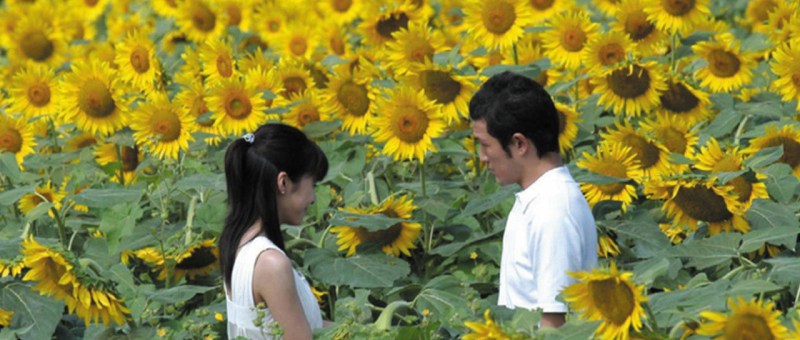
Like many such tales, Be With You begins with a framing sequence set 12 years after the main events, but unusually it’s directed from the point of view of the soon-to-be 18 year old, Yuji (Yuta Hiraoka). Receiving a birthday cake from a bakery which has apparently only stayed open because of its promise to deliver birthday cakes to him every year until he turns 18, Yuji begins to reflect on the “miracle” which he and his father experienced all those years ago.

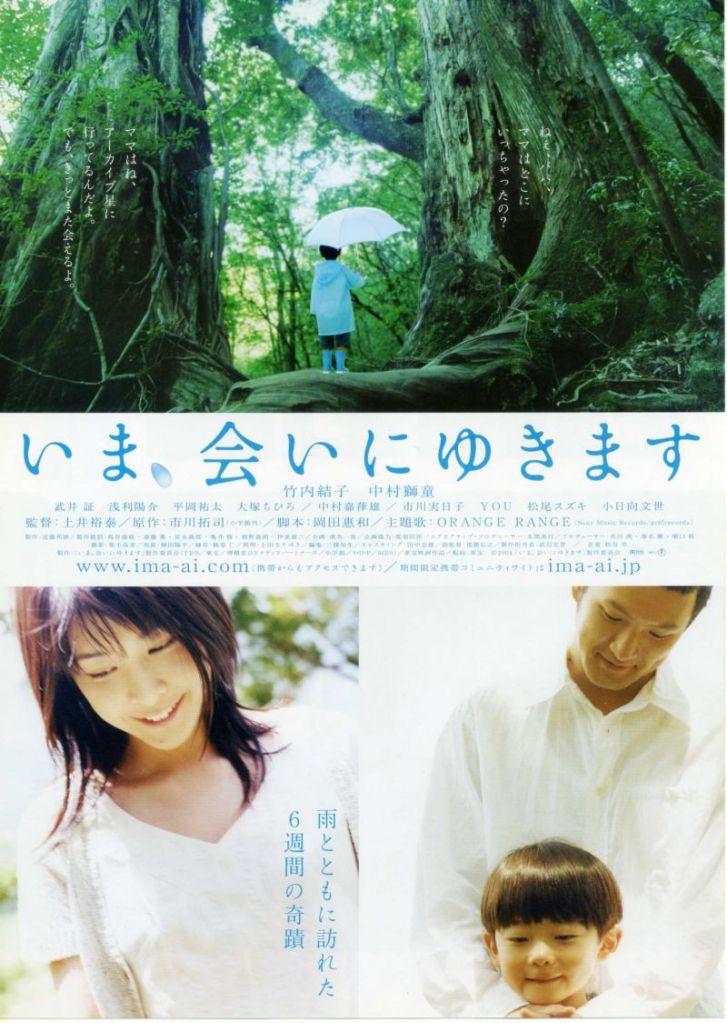
Yuji’s mother passed away at the age of 28 when he was only 5 years old. However, before she died, Mio (Yuko Takeuchi) had prepared a special picture book for Yuji to try and help him process what was happening. In the book, Mio has gone to a place called “Archive Star” and will return for the first rainy season a year after her death. Improbable as it is, Yuji and his father Takumi (Shido Nakamura) discover a woman who looks exactly like Mio lost in the forest during the first rains. Stunned the pair take her home but Mio has no knowledge of her former life as a wife and mother. Gradually, Mio begins to fall in love with her husband all over again whilst bonding with her young son, but their happiness is short lived as Mio realises her time with them is limited.

Because Mio can’t remember, we experience the love story between the teenage Takumi and Mio firstly through his eyes as he tells her of his unrequited high school crush when she sat at the desk across from him for two years during in which he was too shy to say anything. Later we hear the same story again from Mio’s perspective through her diary where we learn, not altogether surprisingly, that she felt the same way. The pair mirror each other throughout their courtship, wanting to say something but lacking the courage and looking for excuses to try and push the situation in a better direction. Other than the mutually unresolved attempts at phone calls and an unreturned pen, Mio and Takumi essentially relive their original romance in the brief time they are able to share together from repeated motifs of untied shoelaces and clumsiness with a bicycle, to innocent in pocket hand holding.

Takumi has an ongoing medical condition which interferes with his motor functions, slowing him down and giving him an air of soulful melancholy later compounded by his romantic tragedy. Having been a champion runner on a sports scholarship to college, the diagnosis causes extreme disruption to his life and leads him to the typically jun-ai decision to break up with Mio because he feels as if he’d be a burden to her. A year after Mio passed away, Takumi is doing his best to bring up his son but is a little distant and struggling to take care of the domestic environment. When Mio realises that she can’t take care of them forever, she switches her focus to trying to prepare her husband and son for life alone – teaching Yuji how to fry eggs and do the laundry, whilst renewing her emotional bond with Takumi. There’s no happy ending in store for Mio, the loss cannot be avoided and perhaps it might even be worse to have had this brief respite from the ongoing pain, but the six week rainy season does, at least, provide an opportunity to say those things that might have otherwise gone unsaid.

Nobuhiro Doi films in a typically elegant fashion making great use of the area’s natural beauty to create a fairy tale atmosphere from the mysterious, life giving forest. The poignancy of the tale is all the deeper knowing that Mio eventually understood what would happen to her, but chose a brief life with Takumi and her son over the possibility of a longer one without them. Heartbreakingly sad, yet a testament to the importance of appreciating the present which all too soon becomes the past, Be With You is a genuinely romantic love story, not only between a husband and a wife but an entire family carrying the weight of a tragic loss but easing the burden by treasuring the memory of the intense love shared between them.


Original trailer (no subtitles)

La Maison de Himiko (メゾン・ド・ヒミコ, Isshin Inudo, 2005)

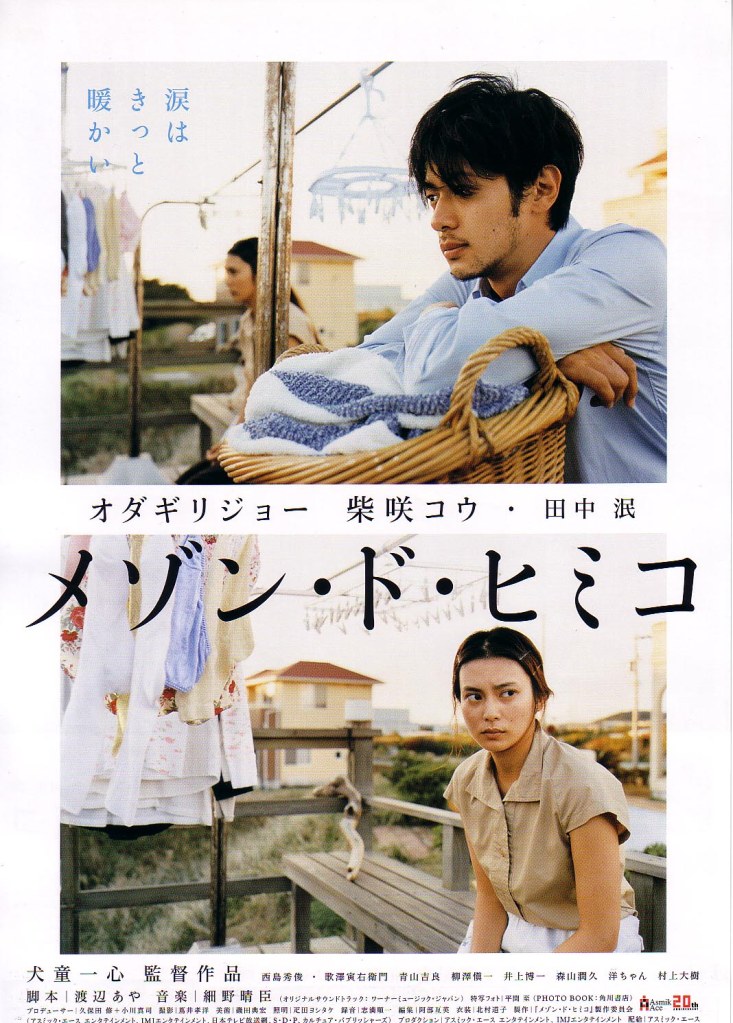
la-maison-de-himikoIn Japan’s rapidly ageing society, there are many older people who find themselves left alone without the safety net traditionally provided by the extended family. This problem is compounded for those who’ve lived their lives outside of the mainstream which is so deeply rooted in the “traditional” familial system. La Maison de Himiko (メゾン・ド・ヒミコ) is the name of an old people’s home with a difference – it caters exclusively to older gay men who have often become estranged from their families because of their sexuality. The proprietoress, Himiko (Min Tanaka), formerly ran an upscale gay bar in Ginza before retiring to open the home but the future of the Maison is threatened now that Himiko has contracted a terminal illness and their long term patron seems set to withdraw his support.
Haruhiko (Joe Odagiri), Himiko’s much younger lover and the manager of the home, is determined to reunite his boss with his estranged daughter, Saori (Kou Shibasaki), before it’s too late. Saori is a rather sour faced and sullen woman carrying a decades long grudge against the father who abandoned her as a child and consigned her mother to a life of misery and heartbreak, so Haruhiko’s invitations are not warmly received. Haruhiko is not the giving up type and manages to sweet talk Saori’s colleague into revealing her desperate financial situation which has her already working two jobs with a part-time stint in a combini on top of her regular work during which she finds herself looking at lucrative ads for work on sex lines. When Haruhiko offers her a well paying gig helping out at the home, she has no choice but to put her pride aside.

The exclusively male residents of La Maison de Himiko lived their lives during a time when it was almost impossible to be openly gay. Consequently many of them have been married and had children but later left their families to live a more authentic life. Unfortunately, times being what they were, this often meant that they lost contact with their sons or daughters, even if they were able to keep in touch with their ex-wives or other family members for updates. For these reasons, La Maison de Himiko provides an invaluable refuge for older men who have nowhere else to go as they enter the later stages of their lives. The home provides not only a safe space where everybody is free to be themselves but also a sense of community and interdependence.

Though the situation is much improved, it is still imperfect as the home and its residents continue to face prejudice from the outside world. Saori, still carrying the pain of her father’s rejection, views his choice as a selfish one which placed his own desires above the duty he should have felt towards his wife and child. Partly driven by her resentment, Saori has a somewhat negative view of homosexuality on arriving at the home, offering up a selection of homophobic slurs, and is slow to warm to the residents. Gradually getting to know her father again and through her experiences at the home, her attitude slowly changes until she finds herself physically defending her new found friend when he’s set upon by a drunken former colleague who publicly shames him in a nightclub.

The home is also plagued by a gang of bratty kids who often leave homophobic graffiti scrawled across the front wall. One of their early tricks involves throwing a bunch of firecrackers under a parked car to stun Saori so they can hold her captive for a bit because they have really a lot of questions about lesbians and they wondered if she was one, though one wonders what they’d do if someone answered them seriously. Predictably, the leader of the bratty kids may be engaging in these kinds of behaviours because he’s confused himself. Thankfully La Maison de Himiko is an open and forgiving place, welcoming the boy inside to offer support to a young man still trying to figure himself out.

This is not a coming out story, but it is a plea for tolerance and acceptance through which Saori herself begins to blossom, easing her anger and resentment and sending her trademark scowl away with them. One of her closest friends at the home is a shy man who lived most of his life in the closet but makes the most beautiful embroidered clothes and elegant dresses. Sadly, the most lovely of them is reserved for his funeral – he’s too ashamed to wear it alive because he doesn’t like the way he looks in the mirror. Eventually he and Saori end up having an unconventional fancy dress party in which they both break out of their self imposed prisons culminating in a joyous group dance routine in a local nightclub.

Joe Odagiri turns in another nuanced, conflicted performance as the increasingly confused Haruhiko who finds himself oddly drawn to Saori’s sullen charms though the film thankfully avoids “turning” its male lead for an uncomfortable romantic conclusion. A young man among old ones, Haruhiko is somewhat out of place but has his own empty spaces. Revealing to Saori that he lives only for desire he betrays a nagging fear of his own emptiness and journey into a possibly lonely old age. Nevertheless, La Maison de Himiko is generally bright and cheerful despite some of the pain and sadness which also reside there. A warm and friendly tribute to the power of community, La Maison de Himiko is a hymn in praise of tolerance and inclusivity which, as it makes plain, bloom from the inside out.


Original trailer (no subtitles)

And the fantastic dance sequence from the film

Plus the original version of the song (Mata Au Hi Made) by Kiyohiko Ozaki

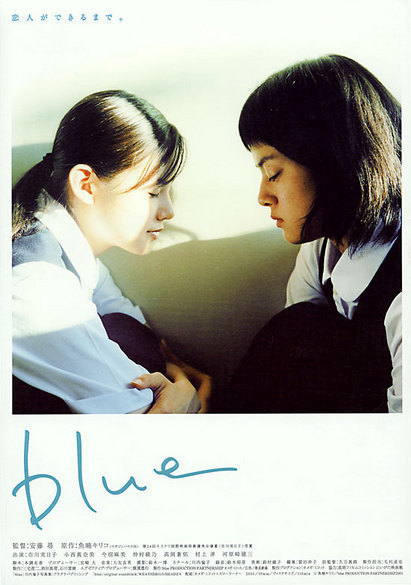
Blue (ブルー, Hiroshi Ando, 2003)

blue03Growing up is hard to do. So it is for the teenage protagonists of Hiroshi Ando’s debut mainstream feature, Blue (ブルー), adapted from the manga by Kiriko Nananan. Like Nananan’s original comic, the cinematic adaptation of Blue is refreshingly angst free in its examination of first love and the burgeoning sexuality of two lonely high school girls. Shot with a chilly stillness which echoes the emptiness of this small town existence, Blue is no nostalgic retreat into cosy teenage dreams but a cold hard look at the messiness and pain of adolescent love.
Kayako’s (Mikako Ichikawa) life changes one day as she sees a fellow pupil at her all girls school being carried into an ambulance and spirited away. Curious yet unknowing, Kayako continues with her day to day existence until she happens to catch sight of another girl from her school, Masami (Manami Konishi), on the local bus. The two become friends after Masami expresses sympathy for Kayako when their teacher humiliates her in class. Masami is repeating the year after completing a long term suspension and has been ostracised by the other girls though no one quite seems to know exactly what happened. Before long Kayako’s feelings for her new acquaintance have transcended friendship but confused and jealous of Masami’s other friends, Kayako is at a loss. Eventually revealing her true feelings she discovers they aren’t unrequited after all, but Masami’s past contains its share of troubles which threaten to place a barrier between the two girls and destroy their growing romance.

Kayako is quiet and a bit of a dreamer. She eats lunch everyday with the same three girls on the rooftop but seems to feel isolated and listless in her small town existence. Masami, by contrast, is chattier and more outgoing but much of the persona she presents to the world is a way of coping with the circumstances which led to her leaving school. Kayako is drawn to Masami because of her outward sophistication – smoking, drinking, listening to foreign music, and reading books about impressionist artists. Later it transpires that at least some of these tastes were acquired from an older man with whom Masami had had an inappropriate relationship and are both a symptom of her desire to import personality traits from others because her own identity is so ill defined, and of wanting to seem much more mature than she really is.

Whilst Kayako is introverted yet solid and growing to be confident in who she really is, Masami, by contrast, appears only half formed but making up for her lack of self esteem with bravado and cheerfulness. It is this lack of certainty which eventually threatens to drive a wedge between the pair as Masami is unable to accept the kind of intimacy that Kayako wants to offer her. Repeating that she is “nothing”, has no future, and is an entirely passive presence simply floating along on the breeze, Masami is unable to make the kind of active choice which Kayako has already made, and may never be in a position to make it entirely of her own volition. Masami is always looking to run away, talking of moving to somewhere like Tokyo with a city’s anonymity, but when it comes down to it she lacks the courage to act.

Ando shoots at a stately pace mostly using static shots and distance takes though his slow pans across empty corridors help to bring out the utter loneliness and emptiness of the girls’ lives. Similarly a mild POV effect takes over panning around school windows as Masami looks for Kayako hoping to make a mends but finds her hurt, conflicted, and unwilling to engage. The two leads each give fantastically nuanced performances despite the plainness of the script and share an intense chemistry lending weight to the emotional resonance of the film. Ando creates a melancholy atmosphere of longing punctuated by fleeting glances and accidental touches, allowing the space and time for the physical performances to come to fruition. A subtly affecting tale of a difficult, yet mutually rewarding, teenage romance Blue has its share of early feature jitters, but makes up for them with an unusual dose of realism perfectly anchored by the strong performances of its leading ladies.


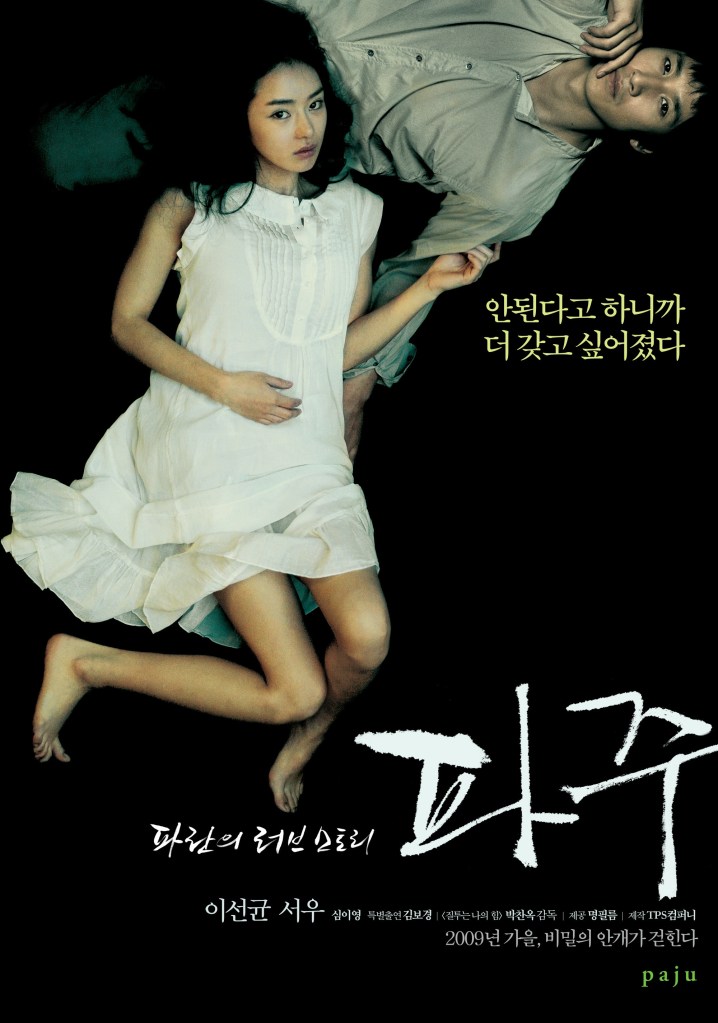
Paju (파주, Park Chan-ok, 2009)

pajuPaju (파주) is the name of a city in the far north of Korea, not far from “the” North, to be precise. Like the characters who inhabit it, Paju is a in a state of flux. Recently invaded by gangsters in the pay of developers, the old landscape is in ruins, awaiting the arrival of the future but fearing an uncertain dawn. Told across four time periods, Paju begins with Eun-mo’s (Seo Woo) return from a self imposed three year exile in India, trying to atone for something she does not understand. Much of this has to do with her brother-in-law, Joong-shik (Lee Sun-kyun), an local activist and school teacher with a troubled past. Love lands unwelcomely at the feet of two people each unable to make us of it in this melancholy coming of age tale shot through with tragic irony.
To begin at the beginning, eight years prior to Eun-mo’s return from India, Joong-sik is hiding from the police in the home of his first love, now the wife of a comrade who, unlike Joong-sik, is serving time for unspecified political crimes. After Ja-young (Kim Bo-kyung) returns home from failing to see her husband in prison and aggressively ignores Joong-shik, he somehow manages to seduce her only for a tragic accident to befall her young son while the couple are busy in the bedroom.

Guilt ridden, Joong-sik runs away to religious friends in Paju in an attempt to evade the police and the unpleasant domestic mess he’s just created back in the city. Whilst there he meets the teenage Eun-mo and ends up marrying her older sister, Eun-su (Shim Yi-young). When Eun-su is killed in an accident, the pair end up living together as a family but Eun-mo’s growing maturity and Joong-sik’s past traumas conspire to ensure the nature of their relationship is, like their environment, in constant flux.

Joong-shik is a man with an uncertain outlook. Believing himself to be bad, he’s constantly trying to overcompensate in goodness by participating in church activities and getting involved in social activism. His political activity is more born out of a desire to appear to care, than actual caring, as he later confesses to Eun-mo. He got involved because he thought it was “cool”, stayed out of loyalty, and finally continues because he doesn’t know how to stop even though he thinks the struggle is pointless. Joong-shik is man who’s convinced himself he doesn’t deserve what he wants, so he avoids wanting anything at all and has become hollow as a result.

It may be this quality of vagueness that sets Eun-mo’s alarm bells ringing, aside from the obvious intrusion of a stranger into her necessarily close relationship with her older sister who is her last remaining relative following the deaths of their parents. Eun-su seems overjoyed in her unexpected marriage but cracks appear when Joong-shik remains unwilling to consummate the union. Ironically enough, Eun-su has a series of burn scars across her back which she speculates is the cause of Joong-shik’s aversion. Joong-shik does indeed have a habit of “burning” other people – from the accidental scalding of Ja-young’s son to Eun-su’s eventual fiery death of which her scars are a grim foreshadowing. This fear of being the harbinger of misfortune is perhaps why he finds honesty such a difficult concept, even if his main aim is to protect those he truly cares about from being burned by a truth which only he possesses.

With a touch of Antonioni inspired astuteness, Park begins the film in thick fog as Eun-mo attempts to chart her way back home to a town she no longer quite knows. The mist eventually lifts but Eun-mo spends the rest of the film lost in the haze, perpetually prevented from seeing anything clearly. Realising Joong-shik has lied to her about the circumstances of her sister’s death she becomes increasingly suspicious of him just as she’s forced to confront her (she judges) inappropriate feelings for a man who is technically a relative even if she didn’t suspect him of contributing to whatever it is that really happened to Eun-su. Each is hiding something, unwilling to reveal themselves fully to the other, intentionally blurring the world around them and damaging their own vision in the process.

Anchored by a stand out performance from actress Seo Woo in the difficult role of the emotionally fragile Eun-mo, Paju is a sad tale of the corrosive effects of guilt and unresolved longing. Eun-mo has returned home in search of answers to questions to she’s too afraid to ask, whereas Joong-shik has too many answers to questions he never stops examining. Sacrifices are made as Eun-mo and Joong-shik attempt to move forward but once again find themselves facing different directions as Eun-mo looks to the future and Joong-shik to the past. Beautifully shot with an intriguing non-linear structure, Paju is an ambitious indie drama realised with unusual skill and genuinely affecting human emotion.


International trailer (English subtitles) – WARNING! Contains major spoilers.

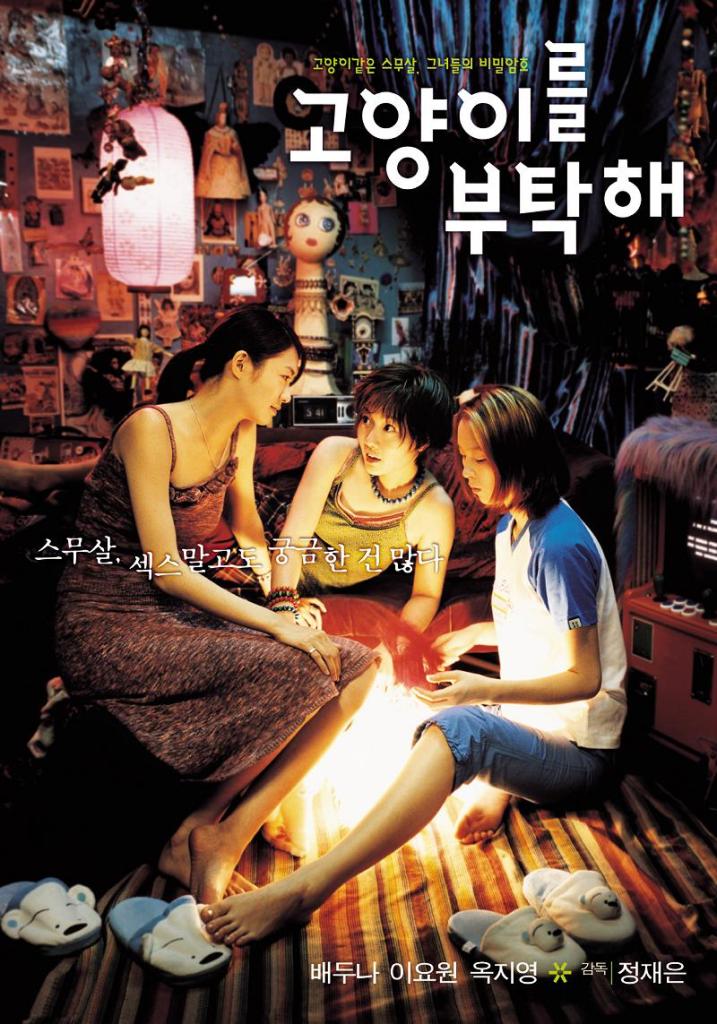
Take Care of My Cat (고양이를 부탁해, Jeong Jae-eun, 2001)

take-care-of-my-catThe time after high school is often destabilising as even once close groups of friends find themselves being pulled in all kinds of different directions. So it is for the group of five young women at the centre of Jeong Jae-eun’s debut feature, Take Care of My Cat (고양이를 부탁해, Goyangileul Butaghae). All at or around 20, the age of majority in Korea, the girls were a tightly banded unit during high school but have all sought different paths on leaving. Lynchpin Tae-hee (Bae Doo-na) is responsible for trying to keep the gang together through organising regular meet ups but it’s getting harder to get everyone in the same place and minor differences which hardly mattered during school grow ever wider as adulthood sets in.
Cheerful scenes of high school mischief give way to the uncertain present as five old friends prepare to celebrate the 20th birthday of the group’s self appointed star, Hye-joo (Lee Yo-won). Hye-joo, however, has moved on to a high level office job in Seoul and is about to blow off her high school friends to hang out with her possibly sleazy boss, only to revert back to plan A when he cancels on her. Too cowardly to ring her friends in person, Hye-joo leaves the business of calling off the party to the chief organiser, Tae-hee, who rings round letting the other three girls – jobless Ji-young (Ok Ji-young), and half Chinese twins Bi-ryu (Lee Eun-sil) and Ohn-jo (Lee Eun-ju), know (and presumably has to then ring them all back to tell them the party’s back on).

Hye-joo moved farthest away from her roots both in terms of location and of her social ambitions through taking a well paid admin job in the city. Increasingly materialistic and status orientated, her friendship with the other girls suffers as she sees herself as transitioning to a higher social class. Ironically, her views are equally deluded as she continues to believe that her dedication and willingness to work hard can make up for her lack of a degree but quickly finds herself displaced when the next batch of newbies arrive.

This growing desire for material status has also contributed to a seemingly unbridgeable rift with Ji-young whose economic status is the most vulnerable. Orphaned and living in a shack with her elderly grandparents, Ji-young has recently lost her job and is having difficulty finding another one precisely because of her circumstances – one firm even point blank refuses her application because both of her parents are dead and they need a direct family member to vouch for her. Hye-joo is insensitive in the extreme and often flashes her money around whilst rubbing salt in Ji-young’s wounds by emphasising her lack of it and pouring cold water over her ideas of saving money to study abroad. Small digs like these and insisting that all the girls leave their home town to visit her in Seoul (leaving aside the additional costs for Ji-young whom she knows is having difficulty making ends meet) point to Hye-joon’s own sense of neediness and insecurity.

As a result, Ji-young distances herself from her friends, ashamed of her desperation and feeling unable to ask them for help. It is she who finds the cat of the title when she hears it mewing whilst trapped behind debris on her way home. The cat becomes almost a mirror of Ji-young – alone and abandoned on the streets with no one to look after her. Originally, Ji-young tries to give the kitten to Hye-joon as a birthday present only to have it immediately returned. The cat is then passed around among each of the friends looking for a more permanent kind of affection, but finding little in the way of stability.

The longest and most devoted guardian turns out to be Tae-hee who is perhaps most affected by the loss of her friends and changing circumstances. Tae-hee is from a moderately well off middle class family and has been helping out in her father’s business since leaving school (apparently without pay). Despite her lack of worry over material comforts, she finds herself feeling restless and increasingly interested in the “foreign” with dreams of taking off alone for adventures overseas. Her desire for freedom is partly down to her domineering father who simply overrules all of her decisions even down to ordering food in a restaurant. Tae-hee is the only one to reach out to Ji-young when she realises she might be in trouble and is the only one still there for her at the end. Their economic and familial circumstances may be different, but in their desire to escape the confines of the rundown Incheon for something outside of what it might have planned for them, the two girls are a perfect match.

Of the group of friends the twins receive the least attention, hovering on the sidelines, separate from the mini dramas erupting between the insensitive and self obsessed Hye-joo and the increasingly desperate Tae-hee and Ji-young. As a unit of two they have their own little world which seems much happier and more solid than that of any of the other girls and arguably have less need for the immediacy of their old friendships. They are therefore the ideal place to deposit them, in the form of a stray cat finally finding a home. The past has its place – in the past, the memories are warm and fluffy and deserve to be taken care of, but there comes a time you have to surrender full custody and be content to visit from time to time.

An extraordinarily well composed debut feature, Take Care of My Cat has a more European feeling than many a Korean coming of age drama but is filled with realistic detail such as the constant ringing of the girls’ ever present mobile phones and the onscreen representation of their straightforward text based conversation. There’s a kind of sadness associated with the transition from carefree adolescence to the difficult journey into adulthood with each of the girls discovering what it is they want out of life, or more aptly what it is they don’t want. Hye-joo emerges as the quasi-villain of the piece as she makes an obvious, superficial choice to follow the consumerist trend over valuing human relationships though it’s hard not to feel sorry for her when it appears she’s being set up for disappointment. Ending on a note of hopeful uncertainty, Jeong’s debut feature is a hymn to the theme of moving on but is careful to admit the bittersweet quality of a new beginning.


International trailer (English subtitles)

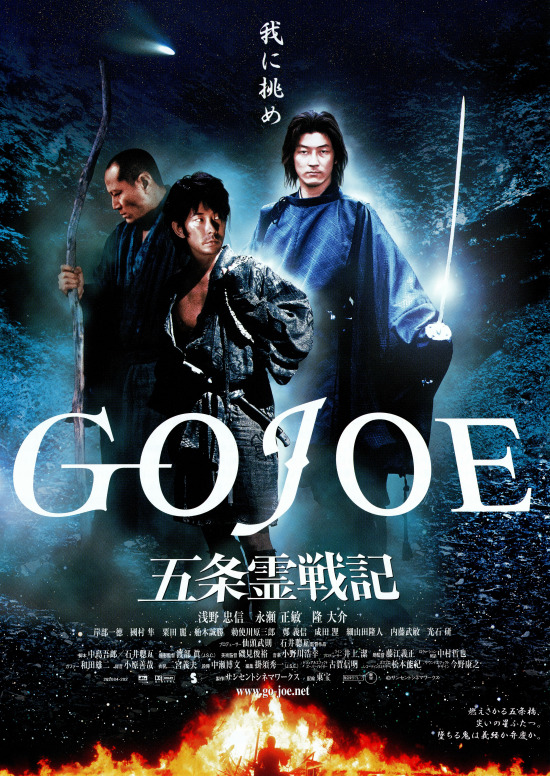
Gojoe (五条霊戦記, Sogo Ishii, 2000)

gojoe-2Not your mama’s jidaigeki – the punk messiah who brought us such landmarks of energetic, surreal filmmaking as Crazy Family and Burst City casts himself back to the Middle Ages for an experimental take on the samurai genre. In Gojoe (五条霊戦記, Gojo reisenki), Sogo Ishii remains a radical even within this often most conservative of genres through reinterpreting one of the best loved Japanese historical legends – the battle at Kyoto’s Gojoe Bridge . Far from the firm friends of the legends, this Benkei and this Shanao (Yoshitsune in waiting) are mortal enemies, bound to each other by cosmic fate but locked in combat.

Following a war between the Heike and Genji clans, the Heike have assumed power sending the Genji into retreat and exile. All should be well, but a mysterious force is taking the lives of Heike guardsmen. Around this time, former bloody warrior turned Buddhist monk Benkei (Daisuke Ryu) has received a prophecy that his path to enlightenment lies in vanquishing the “demon” which is killing soldiers in needlessly bloodthirsty ways. The Heike are not so much afraid of a supernatural threat as they are of a predictable one – the first son of the Genji whom they intended to murder as a child but later set free. Shanao (Tadanobu Asano ), only just come of age, wants his right and just revenge to restore his clan to its rightful place, but this is a dark time and there are more powerful forces at play than traumatised monks and disinherited princes.

The world of the jidaigeki, though often violent, has its own degree of careful order – rules which must be followed, pledges which must be honoured, and causes which must be seen through at any cost. The world of Gojoe is a necessarily chaotic one in which a fragile peace has been forged through violence and trickery but the sins of the past weigh heavy on those trying to forge ahead in the new era.

The Benkei of the legends is fiercely loyal to his lord, but this Benkei is very much a lone wolf, standing apart in his desire to expiate his sins. Though his fellow monk tries to convince him that the prophecy he’s been given is nothing but a delusion, Benkei is determined to find his peace through killing a literal demon rather than tackle the ones inside his mind. Nevertheless, the past is ever present through flashbacks, even at one point revisiting one of the darker elements of the Benkei story – the killing of a child who might be his own.

The “demon” which Benkei seeks turns out to be three orphaned children who have been trained by the remnants of their clan to seek nothing other than revenge. Shanao is more killing machine than man, thinking of nothing other than assuming his rightful role as the head of the Genji and restoring his family honour. When the two meet, each regards the other as “demonic” but Shanao has a point when he asks Benkei if it’s not his own heart which is unquiet. Where Benkei is contained rage, Shanao is calmness and refinement personified.

Benkei is joined for some of his journey by the comparatively more everyman presence of Tetsukichi (Masatoshi Nagase), formerly a master sword maker who’s taken to robbing corpses after growing disillusioned with his craft which often saw his beautiful handiwork in the hands of hypocritical warrior monks. “What’s so great about being alive anyway?” he asks at one point, not long after reminding Benkei that “this hell” is all of his making. Hell this is, Ishii’s world is bathed in fire and blood as petty clan conflict burns the villages of ordinary peasants who are so far removed from this sword bearing society as to be otherwise unaware of it. The peasants have their own problems to deal with as a shaman calls for the brutal beating to death of a pregnant woman supposedly infected by a “demon” and about to give birth to a “demon child”, but even if Benkei is moved to counter this instance of injustice, he is not willing to follow through when it comes to the larger implications of his decision.

The supernatural elements are more a means of cosmological explanation than they are of real threat yet Ishii conjures a dark and creepy world of ominous shadows and ever present danger. Fantasy tinged action allows for giant blood sprays as heads come off with abandon, but the sword fights themselves are both beautifully choreographed and filled with intensity. The final battle between Shanao and Benkei heads off in an unexpectedly experimental direction as swords spark against a starless sky until a cosmic event allows their fierce conflict to erupt into a raging fire, destroying the bridge and everything it stands for. There is no resolution here, only a passage of one state to the next as Benkei and Shanao live on in altered forms. Conducted to the pulsing, warlike drumbeats of a typically exhilarating Ishii score (composed by Ishii’s own band, Mach 1.67), Gojoe is jidaigeki reimagined for the modern era bringing all of the genre’s anxiety and spiritual conflict with it.


Original trailer (no subtitles)

Dark Water (仄暗い水の底から, Hideo Nakata, 2002)

dark-water

Review of Hideo Nakata’s Dark Water first published by UK Anime Network.


For good or ill, the J-horror boom came to dominate Japanese cinema at the turn of the century and if anyone can be said to have been instrumental in ushering it in, director Hideo Nakata and novelist Koji Suzuki, whose landmark collaboration on The Ring has become symbolic of the entire genre, must be at the head of the list. Dark Water (仄暗い水の底から, Honogurai Mizu no Soko Kara) finds the pair working together again on another supernaturally tinged, creepy psychological thriller. Neatly marrying the classic J-horror tropes of freaky children and dripping wet ghosts, Dark Water also embraces aspects of the uniquely Japanese “hahamono” or mother movie which prizes maternal sacrifice and suffering above all else.

Yoshimi (Hitomi Kuroki), a nervous middle aged woman, is in the middle of a messy divorce with her exceedingly smug salaryman husband. Despite having been less than present during the marriage, Yoshimi’s husband now wants full custody of the couple’s five year old daughter, Ikuko (Rio Kanno). In order to aid her case, Yoshimi quickly finds an apartment and starts looking for a job. All seems to be going well except for the mysterious dripping stain on the ceiling which the building manager doesn’t seem very interested in fixing. Before long, strange events begin unfolding including unexplained puddles, a mysterious red children’s shoulder bag which keeps reappearing after being thrown out, and brief sightings of a little girl in a yellow raincoat….

Nakata opens the film with what is in effect a flashback sequence as Yoshimi waits for her own mother to pick her up from primary school. It quickly becomes apparent that Yoshimi’s relationship with her birth mother was an imperfect one which later ended in neglect and abandonment. Yoshimi continues to have frequent flashbacks to her childhood and harbours and intense fear of inflicting the same kind of damage her mother inflicted on her onto her own daughter. Ikuko is also left waiting at school when Yoshimi is kept late at a job interview – something which is eventually used against her in the court case. Though Yoshimi’s aunt reassures her that she’s doing a much better job than her mother did for her, Yoshimi is filled with doubts as to her suitability as a mother which are only further compounded by her intense love for her daughter and fear of losing her.

On top of her maternal worries and residual abandonment issues, Yoshimi also has a history of mental distress which her ex-husband uses to discredit her. It’s open to debate exactly how much of what appears to be happening is actually happening and how much a manifestation of a possible nervous breakdown, but aside from the supernatural shenanigans there are also real world dangers to consider including the missing posters for a girl who was around Ikuko’s age when she disappeared two years previously. The primary school headmaster is convinced that the girl was abducted by a third party but it also transpires that Mitsuko, like Yoshimi and as Yoshimi fears for Ikuko, was abandoned by her mother.

When it comes right down to it, Dark Water lays the blame for its supernaturally tinged evil firmly at the feet of divorce and family breakdown. The supposedly progressive primary school in which the main aim is to allow children freedom of expression is quick to tell the already overwrought Yoshimi that the “strange behaviour” they’ve been witnessing in Ikuko is essentially all her fault because of the divorce and disruption to Ikuko’s home life. Similarly, the central supernatural threat is born of maternal neglect, a symptom of the selfish individualism of the mother who has chosen to leave her child behind. Yoshimi has been jettisoned by her controlling ex-husband and her only thought is to keep her daughter with her, yet she is being made to pay for a social prejudice against atypical families such as those resulting from a “selfish” decision to dissolve a marriage.

Dark Water cleverly recasts Yoshimi as an idealised mother willing to sacrifice all to protect her child. As the situation intensifies, Yoshimi begins to feel as if she’s becoming a toxic presence in her daughter’s life. Rather than risk the same fate befalling her own daughter as has befallen her, Yoshimi opts to make herself the last link in the chain of abuse, freeing her daughter from her own baggage. In contrast with both Yoshimi and Mitsuko, Ikuko will always know that her mother loved her and will always be with her even if protecting her from afar.

Nakata conjures up a supremely creepy atmosphere filled with everyday horrors. The run down apartment complex in which Yoshimi finds her (presumably very reasonably priced) apartment is an unsettling world of its own with its strangely moist, dripping walls, eccentric residents, and rapidly decaying exterior. One of the most effective and visually interesting entries in the J-horror genre, Dark Water perfectly mixes creepy, supernatural horror with psychological drama culminating in a final sequence which doesn’t stint on the scares but proves emotionally devastating in the process.


Original trailer (English subtitles)

700 Days of Battle: Us vs. the Police (ぼくたちと駐在さんの700日戦争, Renpei Tsukamoto, 2008)

700days-of-battleThose golden last few summers of high school have provided ample material for countless nostalgia filled Japanese comedies and 700 Days of Battle: Us vs. the Police (ぼくたちと駐在さんの700日戦争, Bokutachi to Chuzai-san no 700 Nichi Senso) is no exception. Set in a small rural town in 1979, this is an innocent story of bored teenagers letting off steam in an age before mass communications ruined everyone’s fun.
In the summer of 1979, a group of teenage high school students get their kicks pulling pranks around the neighbourhood. They finally meet their match when a new policeman, Chuzai (Kuranosuke Sasaki), arrives in town intent on actually enforcing the law. When one of the boys is fined for speeding after coming down a steep hill on his bicycle, the guys decide to make Chuzai their new enemy, virtually daring him to arrest them with their constant trolling.

However, things take a turn when the boys move their prank planning meetings to a local cafe and discover the beautiful waitress working there, Kanako (Kumiko Aso). Instantly smitten the boys step up their romance game (donning some fancy outfits in the process) and semi-forget about their mission. Unfortunately Kanako is a married woman and worse than that she’s married to Chuzai! This whole thing just got real.

Chuzai, for all his uptight authoritarianism is onto the boys and their generally innocent mischief. Finding it all very irritating rather than actually dangerous, Chuzai gradually starts playing them at their own game by attempting to prank them back such as in one notable incident where he makes them attend a public behaviour seminar but gives the entire lecture through a ventriloquist’s dummy called Taru-kun. As a slightly older man, Chuzai can see the boys are just hopelessly bored in their backwater town. Breaking with his hitherto austere persona, Chuzai drops the authoritarian line to offer some fatherly advice to the effect that these summers are precious times,  soon the boys’ high school lives will be over and they’ll most likely leave their pleasant small town for the bustling metropolis of Tokyo so they’d better make the most of these aimless days while they can.

Idyllic as it is, the nature of the boys’ mission changes in the second half as the war against Chuzai takes on a slightly more affectionate quality. At this point they decide to use their pranking powers for good to help a little girl who’s stuck in the hospital finally enjoy the summer fireworks she’s been longing for even though the doctors won’t let her out to go to the festival. With the fireworks heist hovering in the background the guys get into various romanctic difficulties while enjoying archetypal teenage summer adventures.

Infused with period detail, 700 Days of Battle: Us vs. the Police has an authentically ‘70s soundtrack with some of the biggest hits of the era running in the background. Frequent cultural references such as a brief appearance from Ultraman add to the atmosphere which has a kind of retro, nostalgic innocence behind it as these kids live in a golden era of friendship and bike riding when the sun is always shining and graduation is still a long way off.

Director Tsukamoto keeps things simple though the production values are high and visual gags are spot on. Somewhat episodic in nature, the tale is split up into various chapters by means of title cards which helps to break up the seemingly endless summer as the boys attempt to fill their otherwise empty days. Apparently this was only the beginning of the “war” against the police, occupying only 108 days of a “conflict” which would finally run to 700. Presumably the guys have finished up their high school days by that point but at least they’ve succeeded in making some amusing memories of their elaborate and sometimes fiendishly clever schemes to take revenge on the surprisingly patient Chuzai-san. Filled with innocent, witty and whimsical comedy 700 Days of Battle: Us vs. the Police offers no great leap forward even within the realm of quirky teen comedies but still manages to provide some old fashioned, wholesome summer themed fun.


Original trailer (English subtitles)

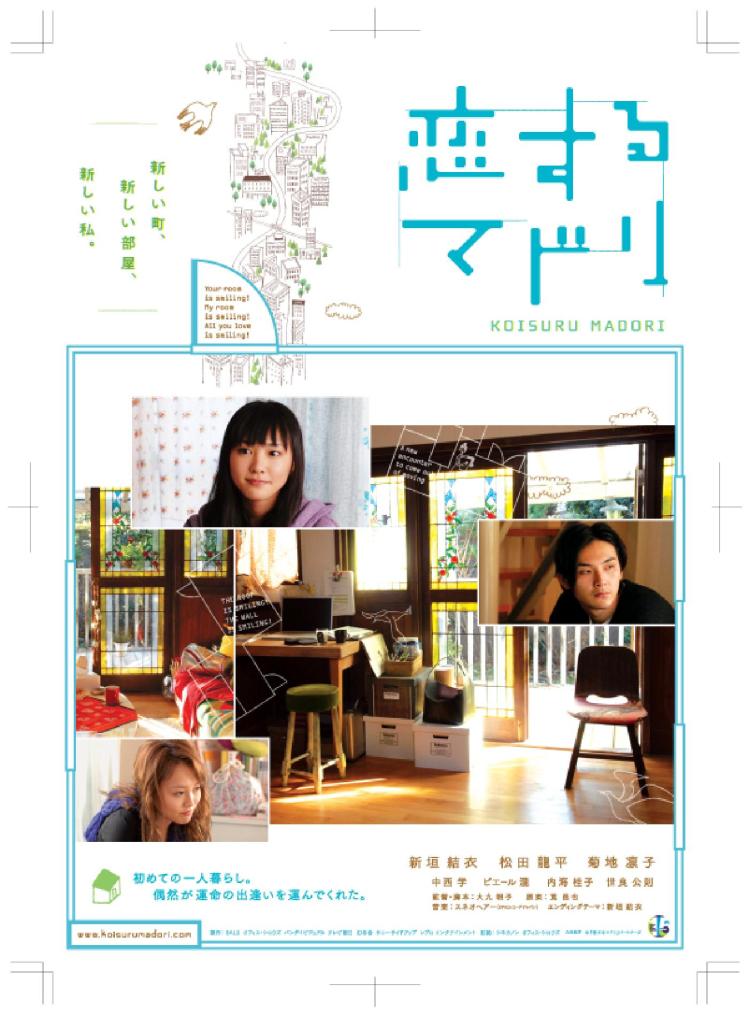
Tokyo Serendipity (恋するマドリ, Akiko Ohku, 2007)

tokyo-serendipityCities are often serendipitous places, prone to improbable coincidences no matter how large or densely populated they may be. Tokyo Serendipity (恋するマドリ, Koisuru Madori) takes this quality of its stereotypically “quirky” city to the limit as a young art student finds herself caught up in other people’s unfulfilled romance only to fall straight into the same trap herself. Its tale may be an unlikely one, but director Akiko Ohku neatly subverts genre norms whilst resolutely sticking to a mid-2000s indie movie blueprint.

Yui Aoki (Yui Aragaki) is in search of a new apartment. She had been living in an unusual old fashioned building with beautiful stained-glass windows, but her sister’s in line for a shotgun marriage and if that weren’t trouble enough the apartment is set for demolition. Living on her own for the very first time, Yui moves into a smallish modern apartment in a building filled with various eccentric residents.

One in particular catches Yui’s attention – her mysterious upstairs neighbour, Takashi (Ryuhei Matsuda). By coincidence, Yui ends up working with Takashi at his lab where she learns he’s still broken up about a girlfriend that left him flat without even a word of goodbye. Remembering she left something behind at her old place she ends up meeting the new tenant, Atsuko (Rinko Kikuchi), and striking up a friendship with her over a shared interest in homemade furnishings. The coincidences continue as Yui discovers she and Atsuko have accidentally swapped apartments! Through this odd chain of events Yui also figures out that Atsuko is Takashi’s long lost love, but is hopelessly trapped in the middle, unsure of whether she should reveal this information to either party. Of course, her developing feelings for both Atsuko and Takashi place her in a series of difficult positions.

Tokyo Serendipity was sponsored by an interior design company and so it’s no surprise that the film makes quite a lot out of its production design. The fashion choices are very much of the time and favour quirky, individual aesthetics rather than an Ikea-esque off the peg minimalism. The original apartment which is soon to by bulldozed is an artist’s dream with its hidden fireplace, old fashioned furniture, stained glass windows and well lit interior. Broadly inspirational in this regard, it’s a thrifty kind of homestyle which prizes recycled materials and repurposed furnishings as opposed to the trendy high price surroundings of other parts of the city.

Like many other films of its kind from this era, Tokyo Serendipity adopts a natural, if occasionally surreal, approach filmed with a deadpan camera. The film’s one repeated large scale gag – a group of lucha libre wrestlers who work as removal men during the day, is a good example of this as their not improbable existence somehow seems oddly funny. They drop things but only in the ring – so they say, each of them well built men treating Yui’s precious goods as daintily as children using real china at a tea party. The humour could best be described as subtle, yet does succeed in raising a smile here and there.

Smiling turns out to be the film’s main message. In fact Ohku even states that her intention in making the film was solely to leave people with a smile of their faces – something which she broadly achieves. Atsuko, a slightly lost middle aged woman, claims she became an architect as she wanted to build a house with everybody smiling – something Yui echoes as she comes to a few conclusions of her own nearing the end of the film. However, Atsuko’s desire for harmony in all things is one she’s never been able to fulfil as childhood abandonment has left her with lingering commitment issues. Simply put, she always leaves first. Interestingly enough, Yui’s burgeoning romance takes a backseat to her growing friendship with Atsuko and a half-formed acknowledgment of middle-aged regrets she’s still to young to fully understand.

Despite amassing almost all of the conventional romantic comedy/drama motifs from a last minute dash to the airport and misdirected letters to an embarrassing scene where a relative is mistaken for a lover, Ohku rejects the romantic model as her central character wisely recognises exactly where she stands in this awkward situation and makes a sensible decision motivated by the best interests of both of her friends. Straightforwardly indie in style, Ohku keeps the quirk on a low simmer but manages to make her heightened reality seem perfectly natural. An unusual coming of age film trapped inside an indie romance, Tokyo Serendipity is like one of the tiny hidden spaces the film seems to like so much, though upon opening the door some will be more impressed with what they find than others.


Original trailer (no subtitles)

The Mamiya Brothers (間宮兄弟, Yoshimitsu Morita, 2006)

mamiya-brothersEver the populist, Yoshitmitsu Morita returns to the world of quirky comedy during the genre’s heyday in the first decade of the 21st century. Adapting a novel by Kaori Ekuni, The Mamiya Brothers (間宮兄弟, Mamiya Kyodai) centres on the unchanging world of its arrested central duo who, whilst leading perfectly successful, independent adult lives outside the home, seem incapable of leaving their boyhood bond behind in order to create new families of their own.

Older bother Akinobu (Kuranosuke Sasaki) and younger brother Tetsunobu (Muga Tsukaji) live together in a small apartment in Tokyo where they enjoy hanging out keeping track of baseball games and watching movies rented from the local store where Akinobu has a crush on the cashier, Naomi (Erika Sawajiri). They are perfectly happy but sometimes frustrated that they don’t have girlfriends so they decide to host a curry party and invite Naomi over in the hopes that she might develop an affection for Akinobu. So that she won’t feel weird about going to the house of two middle-aged guys she doesn’t really know, Tetsunobu invites a reserved teacher, Yoriko (Takako Tokiwa), from the primary school he works at as a caretaker though he “never dates coworkers” and is only really asking her as a backup for Akinobu.

Against expectation the both ladies agree to attend the curry party which actually goes pretty well though neither man is fully capable of following up on the opportunities presented to him. Outside events provide a distraction as Akinobu is swept into his adulterous boss’ divorce crisis and Tetsunobu becomes fixated on a damsel in distress who has no desire to be rescued by him. As much as the boys might want to form independent relationships for female companionship, their brotherly bond is more akin to a marriage in itself leaving both of them unwilling to abandon the status quo for a new kind of happiness.

These kinds of closely interdependent sibling relationships are more often seen between sisters, often as one or both of them has rejected offers of marriage for fear of leaving the other on the shelf. Elderly spinsters and their histories of unhappy romance are almost a genre in themselves though they often present the peaceful co-existence of the two women as a double failure and ongoing tragedy rather than a perfectly legitimate choice each may have made to reject the normal social path and rely solely on each other. The Mamiya Brothers neatly subverts this stereotype, presenting the relationship of the two men as a broadly happy one though perhaps tinged with sadness as it becomes clear that the intense bond they share is holding each of them back in a kind of never ending childhood.

Indeed, though they live alone together and have steady jobs, whilst in each other’s company the brothers regress back to childhood by spending their spare time riding bikes around the neighbourhood and playing on the beach. They are each keenly aware of how they must appear to members of the opposite sex and are always mindful not to appear “creepy”. Accordingly, they’re careful about which DVDs they check out so that Naomi doesn’t get a bad impression of them, and they’re sure to make it clear that both girls can bring other people to their parties so they won’t think there’s anything untoward going on. Throwing quick fire questions back for and constantly making references to private jokes the boys are effectively a manzai duo performing for an audience of two, perpetually suffocating inside their self made bubble.

Though they might not find love, the boys do at least make some new friends. Naomi’s sister, Yumi (Keiko Kitagawa), is exactly the kind of girl they’d usually steer clear of lest she begins to make fun of their old fashioned ways yet she actually becomes an ally and even a friend after spending time hanging out in the brothers’ odd little world. Yumi and Naomi are, in many ways, almost as closely connected as Akinobu and Tetsunobu though they both currently have boyfriends even if they find them equally disappointing.

The teacher, Yoriko, also finds herself unlucky in love as she pursues a relationship with a colleague who doesn’t seem particularly invested in her and is lackadaisical about even the smallest forms of commitment. Tetsunobu seems to have discounted her as a romantic partner under his “no coworkers” rule and is either unaware or deliberately ignoring her growing feelings for him. It may be that he invited Yoriko as a love interest for his brother precisely because he was interested himself and wanted to eliminate the problem, but he may come to regret outwardly rejecting this chance of mutual affection turning into something more solid.

When push comes to shove it might just be that the Mamiya Brothers are happiest in their own company and have no desire to move on and leave their arrested development behind. Though tinged with a degree of lingering sadness as it appears the boys do have a desire to form bonds outside of their mutually dependent bubble, they are after all quite happy and mostly fulfilled in their life together. Cute and quirky, if at times melancholic, The Mamiya Brothers is a strange tale of modern romance in a world where no one really grows up anymore. The brothers are clearly not afraid of broadening their horizons, but might prefer to continue doing so together rather than finding their own, independent, paths.


Original trailer (no subtitles)