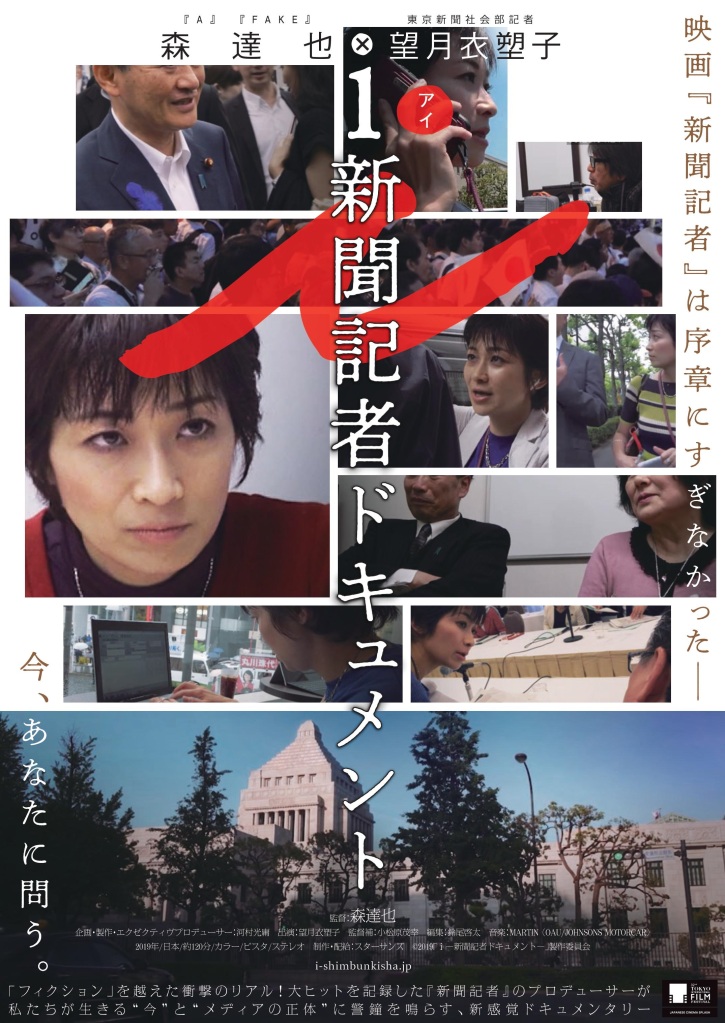
i -Documentary of the Journalist- (i-新聞記者ドキュメント-, Tatsuya Mori, 2019)

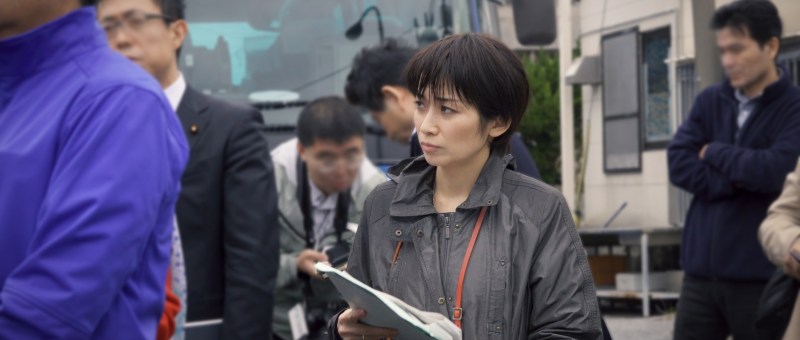
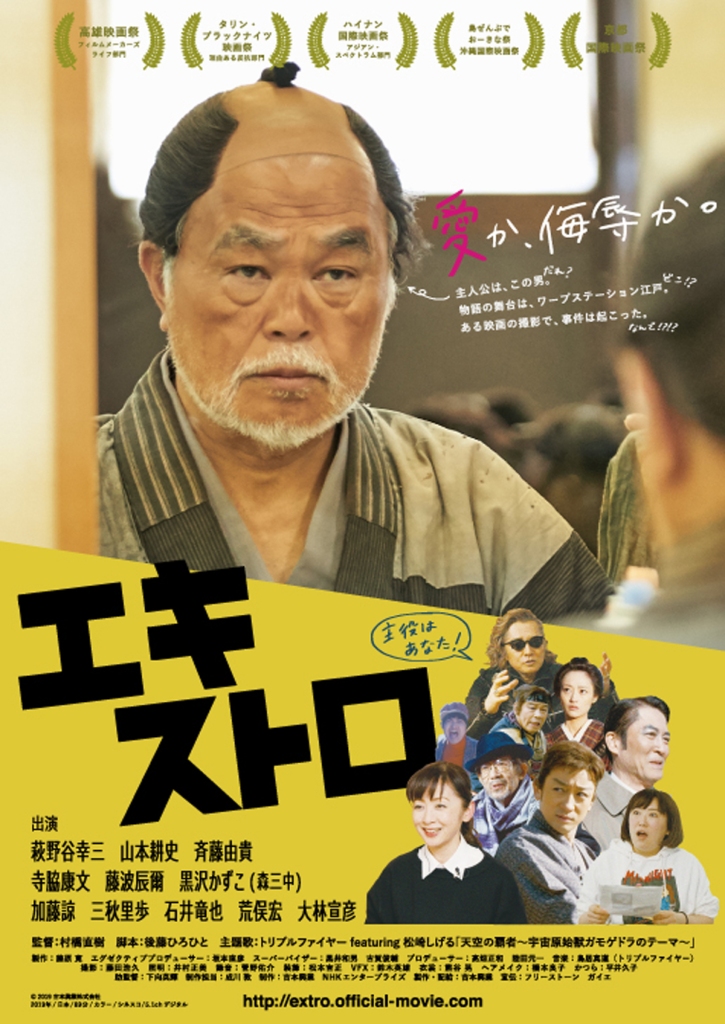
“I’m not obliged to answer you” Chief Cabinet Secretary Yoshihide Suga irritably tells a journalist part way through a press briefing. It begs the question, if you’re not willing to be interrogated then what are the briefings really for? Something which unflappable reporter Isoko Mochizuki, subject of Tatsuya Mori’s documentary i -Documentary of the Journalist- (i-新聞記者ドキュメント-, i -Shimbun Kisha Document-) makes a point of asking but of course receives no reply. Reporting for Tokyo Shimbun, Mochizuki has earned a reputation for being “troublesome”, refusing to let politicians off the hook without getting a proper answer. This is of course what a reporter is supposed to do, she’s only doing her job in holding those in power to account in the name of the people, but Japanese politicians are used to deference from journalists who pull in their punches in fear of losing access. She is also the author of the book which inspired last year’s box office smash political thriller The Journalist in which a dogged reporter finds herself an unlikely ally of a conflicted bureaucrat who is minded to blow the whistle on a governmental land scandal. 

As we see, Mochizuki’s everyday life is nowhere near as glamorous or sensational. In fact, Mori struggles to keep up with her as she finds herself constantly on the move dragging a small suitcase and large tote bag all around town while displaying an ironic tendency to get lost trying to exit official buildings. Meanwhile, none of the people she attempts to visit for comment on the relocation of an SDF facility in Okinawa is in when she calls and, again, she has trouble gaining access to the building in order to leave them a note. 

Access, as we soon realise, is the pressing issue. Mochizuki is a well known reporter for a major paper so it would not be politically expedient to have her removed from the room, but even so the powers that be do their best to obstruct her ability to gain answers, firstly by having an usher loudly instruct her to get to the question while she patiently tries to make her point. It amounts to a kind of game. Mochizuki knows Suga will issue a non-reply, insist that the government is acting in accordance with regulations while refusing further comment, and so is using the question to raise awareness of the issue which necessarily takes time in providing context. They then introduce an unofficial policy restricting Mochizuki, but no other reporter, to two questions only to prevent her pressing her point, before escalating matters by crudely issuing an open directive to journalists to avoid basing their comments on “fake” information, attempting to invalidate her line of questioning by implying it is partisan and offered in bad faith. 

The problem is partly that, as Mori is keen to suggest, the system is rigged because of press complicity with government. We learn that the Abe administration, which has long been beset by scandal, has been keeping a stranglehold on the official press club since it took office in 2012. Mori himself tries to get access to briefings to film Mochizuki but is told that it is almost impossible for freelance journalists to gain approval, while a visit to the Foreign Correspondents’ Club reveals that it is no easier for international journalists who may gain access but are not generally given the opportunity to ask questions nor can they speak directly to members of government whom, it is said, are not terribly interested in Japan’s overseas reputation. Papers afraid of losing their spot in the room avoid directly criticising the government, while the rightwing press is content to do the government’s bidding such as in its vilification of the Kagoikes, the couple at the centre of the Moritomo Gakuen scandal in which Prime Minister Abe’s wife was herself implicated, or its attempt to smear a whistleblower on a possibly corrupt sale of land for a veterinary school to an old friend of Abe’s. 

For those reasons while other journalists and politicians may be sympathetic to Mochizuki’s cause in private she receives little support in the room. An increased profile and persistent harassment campaign also brings out the cranks including a death threat from a man who uses a word many would regard as a racial slur to brand her a North Korean spy. The people, however, approve organising a demo in support outside the Diet building insisting on press freedom and government accountability. The title may take things too far in its emphatic “I”, the reporter is not the story, but advocates for an end to the conformist culture of deference to power in which journalists willing to ask difficult questions will no longer be a “troublesome” aberration but the welcomed norm. 


i -Documentary of the Journalist- streamed as part of this year’s Udine Far East Film Festival. Viewers in America will also have the opportunity to catch the film when it streams as part of this year’s Japan Cuts.

Original trailer (no subtitles)

Chasing Dream (我的拳王男友, Johnnie To, 2019)

“You gotta give everything to get everything” according to an intense rocker in Johnnie To’s musical boxing romance, Chasing Dream (我的拳王男友). What turns out to be most important however is not physical endurance but emotional authenticity, if you want to be taken seriously then you have to take yourself seriously first and that means learning to find the courage to embrace your authentic self. A tale of two crazy kids chasing the Chinese Dream, To’s colourful fantasy world is not without its bite as he leans in hard to what it costs to succeed and not in what is often a merciless society.

Our hero Tiger (Jacky Heung Cho), “The Gluttonous Boxer”, is a young man who broke with his boxing master to step into the MMA ring but is also an enforcer for a shady local loansharking gang run by his manager. Aware he is approaching the end of his career – a doctor later tells him he’s in danger of going blind, rupturing his liver, and getting Parkinson’s – Tiger’s life changes one day when he recognises one of the ring girls, Cuckoo (Wang Keru), as the granddaughter of an old woman who used to sell noodles back when he studied boxing in his rural hometown. Unfortunately, Tiger’s boss has also recognised her because she is in deep debt with the mob. Some of the guys want to cut their losses and sell her on to the sex trade but Tiger, seemingly indifferent, claims he can find her a way to work off her debt and thereby kickstarts his rescue not only of her but of himself from the increasingly empty life of an ageing prize fighter. 

What he discovers is that Cuckoo is harbouring intense resentment over being seduced and betrayed by one of China’s biggest pop stars who made himself a name as the “king of originality” after stealing all of her songs and leaving her in the lurch. Qu Fengfeng (Ma Xiaohui) is now a judge on China’s biggest TV singing competition Perfect Diva and Cuckoo has a plan to confront him by getting on the show, the only snag being that she is extremely unpolished as a performer. Tiger, meanwhile, wants to get out of the ring and has a plan to start his own hotpot empire essentially by copying all the best bits of the major chains and bringing them together. He vows to help Cuckoo train by having her mimic the performance styles of major stars, but what she quickly discovers is that there is no substitute for emotional authenticity. A fellow constant decides to switch her routine at the last minute after catching sight of Cuckoo rehearsing, but is unceremoniously voted off by judges who’d rather she “performed a tacky fan dance” (as she was originally planning to do) than simply copycatting famous artists. Challenged that her songs are too similar to Qu Fengfeng’s Cuckoo snaps back that it’s his style that’s close to hers, earning the admiration of astute female judge Zhao Ying (Wu Yitong) who can perhaps detect the artist inside her beginning to free itself from her sense of insecurity. 

Achieving your dreams can however come at a heavy cost. Pearl “the kick ass rocker” (Kelly Yu Wenwen) has an intense, aggressive performance style but in a running gag turns up at each consecutive audition with a new incapacity, eventually using a wheelchair and wearing a back brace only able to move her arms. “Totally worth it in the name of music!” she cheerfully explains, literally destroying herself to get to the top. Tiger does something much the same exploited as he is by his unscrupulous gangster manager, shouting out “it doesn’t hurt” as he trains by having people jump on his belly, but the battering he takes is not so much for himself as for others, stepping back into the ring in defence first of Cuckoo and then of his dejected master, Ma Qing (Shao Bing), whose attempt to defend the dignity of the noble art of boxing against the modern upstart MMA goes horribly wrong. But Tiger cannot fight others’ battles for them, and the only way he can win is by being himself while honouring their legacy. 

Finally finding how to bare their souls for all to see and “have someone share the fatigue of loneliness”, the pair learn to recalibrate their dreams while falling in love discovering that mutual support is their guiding light as they give each other the strength to be all they can be. Ostensibly somewhere in Mainland China, To’s make believe, retro future city has a colourful comic book intensity that adds a mythic quality to the saga of Tiger and Cuckoo that is perfectly in tune with his dreamy romanticism in which sudden flights of fancy including a full-blown Bollywood-style dance sequence seem entirely natural. A surprisingly moving, wilfully absurd musical love story between wildly grinning pugilist and a young woman learning to sing from the the heart, Chasing Dream is a delightful sugar pop confection in which two crazy kids find love in the ring and with it the power to believe in themselves and a better future.


Chasing Dream streamed as part of this year’s Udine Far East Film Festival.

Original trailer (Cantonese, no subtitles)

Vertigo (버티고, Jeon Gye-soo, 2019)

To many, the word “vertigo” is synonymous with a fear of heights, but in essence it refers more to a sense of unbalance, a giddiness born of having lost sight of the ground, temporarily unable to orient yourself within an environment which no longer seems to make sense. The heroine of Jeon Gye-soo’s artfully composed Vertigo (버티고) fears she is suffering with the medical variety caused by an ongoing problem with her inner ear which leaves her with recurrent tinnitus and a permanent sense of wooziness. She is also, however, suffering with a kind of existential dizziness, trapped in a constant state of anxiety in feeling entirely untethered to the world. 

30-something Seo-young (Chun Woo-hee), is a contract worker at an ad company with an office on the upper floors of a high-rise building. Unbeknownst to her colleagues, she’s been having an affair with her handsome, once divorced boss, Jin-soo (Yoo Teo), but he seems to be holding something back from her, insisting on keeping their relationship secret and reluctant to introduce her to his grown-up son. Meanwhile, she’s subject to most of the minor micro-aggressions plaguing women in the work place which run from being expected to come in early to do menial tasks like refilling the photocopier and tidying the shelves, to casual sexual harassment. Somewhat out of it, Seo-young has managed to avoid most of that and thinks she’s moved past the stage of having to play the office lady game by keeping the men entertained at the not-technically-compulsory-but-you-still-have-to-go afterwork get-togethers. Her friend Yedam (Park Ye-young), however, has her getting worried, at once complaining about their sleazy team leader asking for massages and reminding her that they need to turn on the charm at least until their contracts are renewed. 

Being a “contract worker” and not a salaried employee is certainly a major cause of Seo-young’s anxiety, leaving her feeling unanchored in her professional life in the knowledge that she could soon be unceremoniously cut loose for reasons largely unconnected to her performance. As a woman in her 30s it will be increasingly difficult to find a new job while a still patriarchal society will most likely write her off for daring to reject marriage in favour of work but failing to make a success of it. Her male bosses and colleagues, regular employees all, use her precarious status against her, expecting that she “play nice” to get a recommendation for further employment and threatening to tank her career if she doesn’t toe the line. She muses on going “far away” with Jin-soo, perhaps to Argentina, a land of passion where people dance the tango and drink wine late into the evening, but on some level knows it’s a just a comforting fantasy. 

Regularly visiting an ear doctor, Seo-young tries to overcome her sense of unease through medical means, unwittingly returning to the source of her trauma buried in a painful childhood which regularly resurrects itself in her toxic relationship with her mother who only rings to belittle her success while complaining about her string of relationships with terrible men and unsatisfying life with Seo-young’s step-father. Seo-young can’t find firm ground because she is essentially unanchored, left dangling by a failure of the traditional family and seemingly with no “real” friends. She begins experiencing panic attacks at work, retreating to unoccupied rooms to calm herself by looking out at the horizon. 

Meanwhile, her growing despair has been spotted by window cleaner and bookshop clown Gwan-woo (Jeong Jae-kwang) who is carrying a sadness of his own. He pities and protects her, supporting from the other side of the glass in a way which is not, strictly speaking, OK but is filled with such innocence and unspoken connection that it largely overcomes the otherwise unpalatable quality of his stalkerish devotion. Gwan-woo is, in a sense, a man who’s unafraid to fall, secure in his ties to the world and literally anchored by his position in society. Seo-young yearns to overcome her sense of anxiety, find firm footing and a sense of support, at once reassured by the presence of Gwan-woo and perhaps disturbed by it. She is, however, feeling her way back to solid ground, gaining the desire to climb safe in the knowledge that someone will be there to catch her even when she feels like falling. 


Vertigo streamed as part of this year’s Udine Far East Film Festival. It was also due to screen as part of the 10th Season of Asian Pop-Up Cinema.

International trailer (English subtitles)

colorless (猿楽町で会いましょう, Takashi Koyama, 2019)

“I think I could capture the real you” a photographer pleads of a subject he has become obsessed with, little knowing the deeply problematic implications of his statement. Shot with a photographer’s eye, Takashi Koyama’s colorless (猿楽町で会いましょう, Sarugakucho de Aimasho), paints its heroes as just that, wandering zombies of modern day Tokyo as estranged from themselves as they are from others, but even as it attempts to draw similarities between their mutual lifelessness cannot help but reflect a misogynistic world view in which the conflicted heroine remains little more than an empty shell, a blank canvas onto which various men project their inner desires leaving her essentially robbed of an identity by an exploitative society. 

When we first meet aspiring freelance photographer Shu (Daichi Kaneko), he is in much the same position, kept waiting by an arrogant magazine editor who has stepped out of the office despite having arranged an appointment to look over his portfolio. When he eventually arrives, Kasamura (Kenta Maeno) rudely dismisses his work, claiming that the selection of photos he’s assembled doesn’t make sense in that it gives no clear indication of his style or intent and aside from that his shots are cold and lifeless. He attributes this lack of passion to the likelihood that Shu has never truly been in love, something which turns out to be true though as we later discover Kasamura is also a cold and cynical man who proudly proclaims the same of himself. Nevertheless, he hooks Shu up with a side job shooting publicity shots for an acquaintance, Yuka (Ruka Ishikawa), hoping to become a “reader’s model” as a path to fame. 

For whatever reason, Yuka seems to incite in him the passion which Kasamura claimed was missing in his work, becoming both muse and object of desire. She describes herself as colourless and wonders if there is a “her” that can be captured, while Shu assures her that he feels much the same but fails to appreciate the various ways in which he is attempting to colour her with his camera, filled with nothing but jealous anxiety when confronted by the possibility that she exists outside of the image he has created of her. The incongruities between what she tells him of herself, his own self created vision, and the evidence presented to him by others bring out an unpleasantly chauvinistic side of him which he perhaps does not even like in himself, abruptly attempting to stop her leaving his apartment without consenting to sex by threatening to withhold the data for the pictures he took, breaking into her phone to check her messages, and later feeling humiliated in realising that she may have hidden from him a prior (or current) life in sex work.

Yuka, meanwhile, remains a cipher. Unexpectedly interviewed as part of an audition she is asked to describe herself but can only reply in terms of the way others see her, answering only that she is often said to have a sunny disposition. We see her parrot back lines she’s heard from one man to another in an attempt to please him, as if wilfully erasing her essential identity to better conform to male desires in an attempt to keep herself safe but also perhaps betraying that she has few words of her own to offer. Yet in private we see a much less complimentary side of her in which she is petty and jealous, resentful of a friend’s success while she seems to get nowhere and, the film uncomfortably insists, willing to use men by exploiting their desire for her which is in essence a desire for a colourlessness they can dye with their own self projected ideals. 

Yuka claims that she does not want to know who she really is, perhaps afraid to know or realising that there really is no value in knowing because her existence is defined by male desire. Her tragedy may be that she isn’t cynical enough, unable to manipulate men to the same extent as her more successful friend, still longing to be known and loved for who she is even while insisting that she does not exist and wilfully misrepresenting herself to those around her out of embarrassment and dissatisfaction with her life. The story she tells in her interview implies a lasting trauma of male abuse which has caused a rupture in her sense of self, unable to grasp an identity other than that granted by others, but still we’re largely left with Shu’s resentment in his inability to “capture” that which cannot be captured in his desire to possess not only Yuka’s body but her image by replacing it with that of his own creation. A dark and cynical take on modern romance, colorless leaves its heroes much where it found them, floundering in an inherently patriarchal society itself devoid of the colour they each desire. 


colorless streamed as part of this year’s Udine Far East Film Festival.

International trailer (English subtitles)

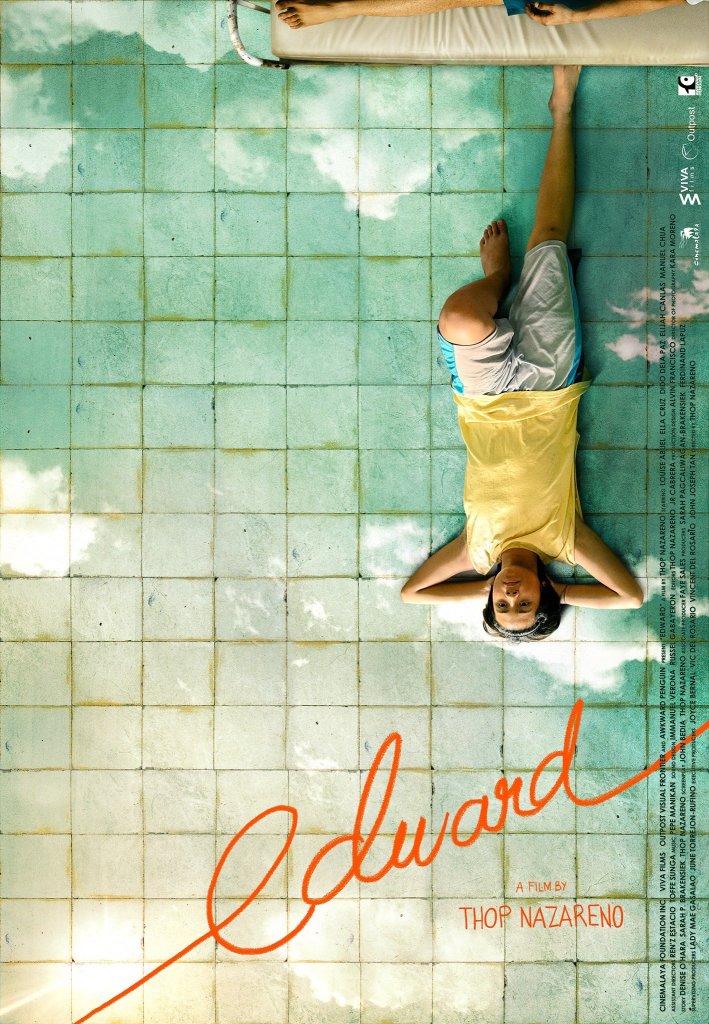
Edward (Thop Nazareno, 2019)

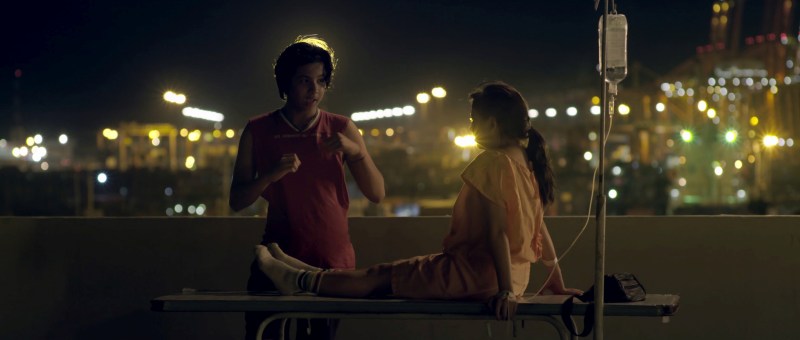
Maybe there’s no better place to learn about life and death than a hospital, but it’s a devastatingly cruel one in which to come of age in Thop Nazareno’s infinitely warm second feature Edward. A sharp condemnation of failing health policies with minor jabs to the political realities of the day, Edward finds its titular hero forced to grow up all too soon thanks to a confluence of personal tragedy, parental disappointment, and shattered dreams all of which are brought home to him as he begins to bond with his distant father while forced to care for him during his hospitalisation for an as yet undiagnosed respiratory complaint. 

Just a teenager, Edward (Louise Abuel) should probably be in school but he’s left his rural home to be with his father Mario (Dido de la Paz) at a hospital in Manila where he sleeps on the floor under his bed and is expected to provide care such as making sure he’s washed, changing sheets, and generally watching over him to be able to update the doctors on his condition. Technically speaking, Edward shouldn’t be taking on this responsibility, but his older half-brother Renato has had to leave and there are no other relatives available so the hospital has made an exception. As you might expect, he’s not as diligent as one might hope, especially as his relationship with his father is already strained, spending most of his time goofing off with another boy, Renz (Elijah Canlas), who is giving him a few life lessons of his own in drinking and weed while they help out running errands for the hospital staff. 

When we first meet the two boys they’re playing a grim game, taking bets on whether or not the emergency patients are going to make it. Nazareno opens with a long tracking shot following just one such casualty into the hospital, shifting chaotically from one bed to another while those in the crowded waiting area loudly call out for a doctor but are told only to wait their turn. Edward’s insensitivity bears out firstly how used he’s become to the liminal space of the hospital where death is never far away, but also his youth and impressionability, taken in as he is by Renz’ rather cool and cavalier approach to life. Later he bonds with a young woman, Agnes (Ella Cruz), herself an accident victim, who takes him to task for his callousness pointing out that she’s a real live human not the subject for a game, showing him it seems for the first time how inappropriate his behaviour has been. 

Though he knows very little about her aside from her name and that she seems to be around the same age, Edward enjoys spending time with the refreshingly direct young woman and comes to see it as something of a respite from being forced to care for his dad whom he is technically neglecting. We realise that Mario is perhaps not an easy man and the family network seems to have broken down, Renato declaring himself at the end of his tether and no longer prepared to care for a father who abandoned his family for another woman only to expect filial deference on becoming ill. Like Agnes, Edward is all alone but actively avoids looking forward, little realising that his father’s condition may be far more serious than they’d assumed, preferring to lose himself in the small absurdities of hospital life as if he were on a strange kind of holiday. 

Meanwhile, he discovers just how unequal and unfair the hospital system can be. During the chaotic opening we witness a congressman’s cook attempt to get bumped up the queue using his political clout while a boy bleeds out from gunshot wounds on a gurney behind reception. Mario’s original doctor leaves his position to move away, while the new one has his own private clinic and only works at the hospital on Tuesdays. Tests take three whole weeks to come back because they have to outsource and until then all they can do is guess and treat symptoms. While hanging out with Renz, Edward finds out about some decidedly dark and very untoward goings on at the hospital morgue which it perhaps doesn’t quite occur to him to feel disturbed by until much later.

For all that, Edward still hasn’t grasped that sometimes when they tell you you can go home, it’s not necessarily a good thing. Still, for the time that he’s there the hospital is a home. Mothered by overworked nurses and beginning to warm to his rather gruff father who only wants to talk to Renato (who doesn’t want to talk to him) while experiencing his first brush with romance, Edward comes of age staring death in the face. With its moody jazz score and wistful folk rock soundtrack, Thop Nazareno’s second feature doesn’t so much tug at the heart strings as play a merry tune with them, finding all the warmth there is in tragedy as Edward learns to navigate his hospital life towards its inevitable exit. 


Edward streamed as part of this year’s Udine Far East Film Festival.

Festival trailer (English subtitles)

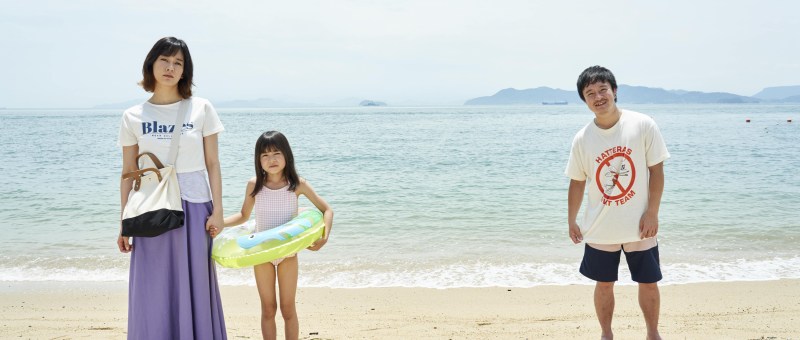
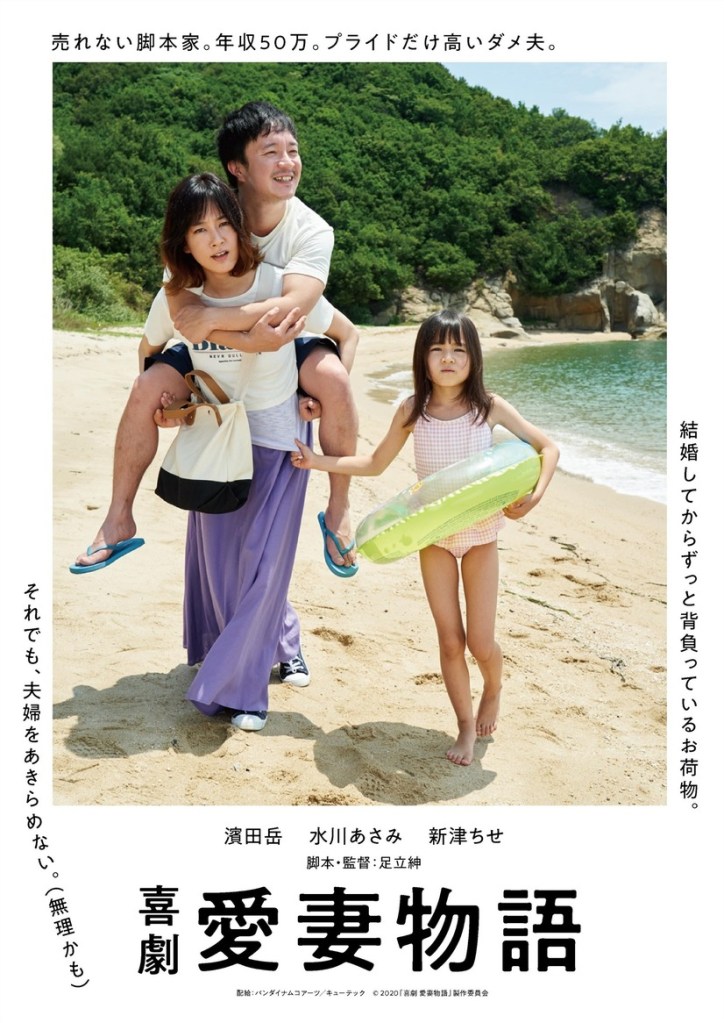
A Beloved Wife (喜劇 愛妻物語, Shin Adachi, 2019)

Adapting his own autobiographical novel, screenwriter and director Shin Adachi claims that the events and characters of A Beloved Wife (喜劇 愛妻物語, Kigeki Aisai Monogatari) are exactly as they are in real life, only the film makes it all look better. Even if true, Adachi can’t be faulted for his honesty. His protagonist stand-in, Gota (Gaku Hamada), has almost no redeeming qualities, while his long-suffering wife receives little sympathy even while giving as good as she gets as a sake-guzzling harridan apparently ready to run her husband down at every opportunity, of which there are many, but Gota is quite simply useless. The Japanese title is careful to include the word “comedy” as a prefix, but this is humour of an extremely cruel variety. 

Married for 10 years with a small daughter, Gota’s chief preoccupation in his life seems to be that his wife, Chika (Asami Mizukawa), no longer finds him sexually desirable and they are rarely intimate. Rather than lament the distance in their marriage, all Gota does is go on a long, misogynistic rant about how he’d get a mistress or visit a sex worker only he has no money while complaining that he has to humiliate himself by helping out with the housework and childcare which he only does to curry favour in the hope that he will eventually be able to have sex with his wife. After some minor success as a screenwriter, his career is on the slide and he’s had no work in months, something which seems to damage his sense of masculinity and in his mind contributes to his wife’s animosity towards him.

He is right in one regard in that Chika is thoroughly fed up being forced to pick up the slack while he sits around watching VR porn, not writing or looking for a job but insisting that the next movie is always just round the corner. She’s tired and overworked, sick of penny pinching and resentful that she has to do everything herself, but it’s not so much the money that bothers her as Gota’s fecklessness while all he seems to care about is sex, meeting his own needs and no one else’s. Even when he takes his daughter, Aki (Chise Niitsu), to the park he ignores her to ogle other women, becoming embarrassed on running into a neighbour we later learn he slept with and then ghosted. He does the same thing again later on a beach, so busy sexting that he doesn’t see her wander off and is roundly chewed out by the lifeguard (an amusing cameo from director Hirobumi Watanabe, giving him the hard stare) who eventually finds her and brings her back. Not content with that, he rounds out the bad dad card by frequently bribing Aki with treats so she won’t spill the beans to her mum about his many questionable parental decisions. 

Really, we have to ask ourselves, why does Chika not leave him? The perspective we’re given is Gota’s and he appears not to understand that any of his behaviour is problematic, which might be why he seems genuinely shocked when Chika reaches the end of her tether and once again suggests divorce. He seems to think some of this at least is performative, part of the act of “marriage”, and she does indeed make a show of her frugality – insisting on sharing a 200 yen bowl of udon with her daughter to save money and climbing up a utility pole to sneak into a hotel after booking only a single occupancy room for the three of them, but is there more in her decision not to leave than habit? Gota seems to think so, especially on noticing her wearing the lucky red pants she bought back when they were young and in love and she believed in his potential. But then perhaps she really is just being economical.  

Nevertheless, she appears to keep supporting him, once again typing up his latest screenplay because he claims not to be able to use a word processor, and laughing off the rather more serious incident in which he is arrested after being discovered by a policeman molesting a drunk woman in the street. Adachi doesn’t appear to have very much to say in favour of the modern marriage, as if this one is no worse than any other (even a friend who married well (Kaho) badmouths her husband and giggles about a young lover), but Gota seems to have learned absolutely nothing even while declaring his love to his sleeping family and vowing to make a success of himself at last. It would be funny, if it weren’t so sad. 


A Beloved Wife is available to stream worldwide until July 4 as part of this year’s Udine Far East Film Festival.

Festival trailer (English subtitles)

Cry (叫び声, Hirobumi Watanabe, 2019)

Hirobumi Watanabe has become closely associated with a particular brand of deadpan, black and white comedy, often casting himself in a prominent role as a motormouth monologuer. Cry (叫び声, Sakebigoe), however, returns him to the themes of 7 Days which proved divisive with critics following as it did the lowkey absurdist charms of And the Mud Ship Sails Away… Once again set in rural Tochigi, the (almost entirely) wordless Cry stars Watanabe this time as a pig farmer rather than cattleman and follows the crushing mundanity of his life over the course of an ordinary week. 

Replete with agricultural detail, Cry is at pains to dramatise the cyclical, rhythmic qualities of a life lived in tune with nature even as that of a pig farmer is in some ways perhaps in conflict with it in the cultivation and constraint of other living creatures. There is perhaps something rather ironic in recalling that Watanabe’s production company is called Foolish Piggies Films, and it’s all but impossible to ignore the odd kind of symmetry in the life of the farmer and his animals who are each in their own way imprisoned on either side of the bars. The major difference between them lies in crowding and solitude, cacophony and silence. Aside from the equally silent grandmother (sadly the final onscreen appearance of Watanabe’s own grandmother Misao Hirayama who sadly passed away last year and had been a constant fixture in each of the director’s films to date) with whom he lives, the farmer has no other human contact, indeed his only “social” outlet is a solo trip to the cinema where he is the sole spectator and the only other person with whom he interacts is the usher who says nothing more than “enjoy the movie”. 

We can infer that the farmer goes to the pictures every Sunday at around the same time after seeing to the pigs, that he likely does so alone, and that this is a fixed part of his weekly routine. On a weekday, we see him rise, eat breakfast with his grandmother, muck out the pigs and break for lunch, usually taking a moment of rest on windswept rooftop under an incongruous electricity pylon as if to signal the encroachment of modernity on his simple life, or in event of rain returning home to read the paper. In the evenings he reads by the light of a small lamp and writes in a diary. Sunday aside, his days are almost identical yet, unlike the heroes of other Watanabe films who often comically walk the exact same routes they came by only in reverse, he seems to vary his path, making the surprisingly long journey between his home and the pens a little less predictable than the other areas of his life. 

The “cry” of the title might express this desire for an interruption to the maddening mundanity of his existence, but otherwise the farmer does not appear to be particularly unhappy with the simplicity of his life save for the intense drumming of the taiko score which accompanies him as he walks along the quiet country paths towards the pens as if he were heading to a battlefield which, in a way, he perhaps is as he engages in the paradoxical task of caring for animals he will one day surrender for slaughter and in fact consume.

He does not seem to be withholding a wail of existential despair, merely living an ordinary life in ordinary ways. Even on his trip to the cinema, he appears to be watching, until he falls asleep, footage from Watanabe’s own I’m Really Good (a poster for And the Mud Ship Sails Away… also sits in the foyer) in which farmland kids walk the same paths he walks but entertain themselves with games of shiritori which is generally much less fun to play on your own even if not exactly impossible. At home he cares patiently for his grandmother, diligently cleaning her dentures, again another part of his routine, while bathing in the calming silence free of the noisy cacophony of the pig pens and of the roar of the wind which sweeps the rooftop. His life may be simple, but perhaps no less repetitive than that of many others and with its own small joys even in its mundanity. 


Cry is available to stream worldwide until July 4 as part of this year’s Udine Far East Film Festival.

Festival trailer (English captions)

Life Finds a Way (普通は走り出す, Hirobumi Watanabe, 2018)

Hirobumi Watanabe goes full 8 1/2 with the decidedly meta comedy, Life Finds a Way (普通は走り出す, Futsu wa Hashiridasu). After the joyful celebration of Party ‘Round the Globe, he returns in a noticeably self-reflective mood once again playing a version of himself as a self-involved, childish blocked filmmaker who fears he is falling out of love with film. Unable to come up with ideas, he fobs off producers and ignores phone calls while hanging out with grandma (Misao Hirayama) and making a nuisance of himself at the library but a mini-nervous breakdown and a reconnection with the film-loving little boy he once was perhaps offer him new direction though the jury’s out on whether “Hirobumi” is ever going to grow up. 

Once again locating itself in peaceful Tochigi and shot in crisp black and white with Watanabe’s trademark deadpan static camera, Life Finds a Way opens with Hirobumi fielding a phone call from a producer in which he confesses that he’s supposed to be working on a script created in collaboration with rock band Triple Fire but he’s getting nowhere so he’s hanging out in a cafe to “relax” while playing Dragon Quest. Later he rings his cinematographer, Bang Woohyun, and makes a similar apology, admitting that he’s going to take some time off to watch the World Cup because, after all, it’s a once in every four years opportunity. Meanwhile, he’s mostly snoozing at home with grandma, or driving around with his almost entirely silent and extremely patient strawberry farmer friend Kurosaki (Kurosaki Takanori). 

One of his early rants offered as a monologue to Kurosaki who seems to be used to them, revolves around his sense of inferiority as a creative unfairly maligned as a lazy good-for-nothing by workaholic Japanese society. In Japan, he says, we worship the worker ant who survives because he works away earnestly, while in France they honour the grasshopper because his beautiful music can cheer you up even in the depths of winter. Hirobumi thinks the French have it right, that Japanese people are too obsessed with doing everything “properly”, always worrying about trivial things. According to him, there are far too many worker ant types in the Japanese film industry. He thinks films should be free and unconstrained, not bound by some kind of ideal. 

In any case, while being quite rude to “worker ant” Kurosaki who labours all day long on his strawberry farm, Hirobumi blames all his problems on having been unlucky enough to have been born in Japan rather than somewhere like France where they appreciate people like him. Later, he interviews a few locals and asks them what they think is the problem with the Japanese film industry, only for Kurosaki to repeatedly answer “it’s Hirobumi”, perhaps getting his own back. In fact, Kurosaki, apparently meaning well, shows Hirobumi a piece about of one of his films in a glossy magazine only it’s uncomplimentary in the extreme which sends him into a rage, ranting furiously about ungrateful audiences and how much he hates film critics. Hirobumi seemingly blames everyone but himself for his faults and failures, climbing all the way up to a hilltop shrine to pray that he wins the Palme d’Or while also asking that the gods not give good jobs to successful directors but give them all to him instead, and for bad things to happen to someone who sent him a strongly worded letter. 

Hirobumi’s “fan mail” appears to be from a stuffy old woman who states that she has “kindly” written to him several times already to explain that his work is an insult to cinema yet he keeps “selfishly” making films. She’d liked to have told him this in person, but was apparently “too busy” so has written another letter urging him to reflect on his life choices and either make “good” films like Koreeda and Miyazaki, or find himself another career. Hirobumi wonders what the point of films is if they don’t make people happy or have the capacity to change the world. Asked what films meant to them most of his interview subjects either had no answer or regarded them only as entertainment. An encounter with himself perhaps reminds him what it was he saw in cinema and allows hims him to begin moving forward creatively. 

But even having finished his script, has Hirobumi really changed? He seems permanently to be surrounded by children, hanging out reading the manga in the kids’ section of the library, lining up behind a string of obedient primary school students to check out his DVDs where he sets a bad example by having a series of Tora-san movies already overdue but using grandma’s card to take out more, and hanging out with his niece catching crayfish in the local stream with a bucket and net just like he must have done since he was little. He lies about missing the World Cup, ignores phone calls from the library to snooze while spending time with grandma, and is not really any nicer to the patient Kurosaki than he was before. But life finds its way, Hirobumi escapes his creative malaise by rediscovering the joy of cinema, healing himself body and soul, and feeling more positive about the future even if nothing has really changed. 


Life Finds a Way is available to stream worldwide until July 4 as part of this year’s Udine Far East Film Festival. It was also scheduled to screen as part of the 10th season of Asian Pop-Up Cinema.

Festival Trailer (English captions)

Original trailer (no subtitles)
Crazy Romance (가장 보통의 연애, Kim Han-gyeol, 2019)

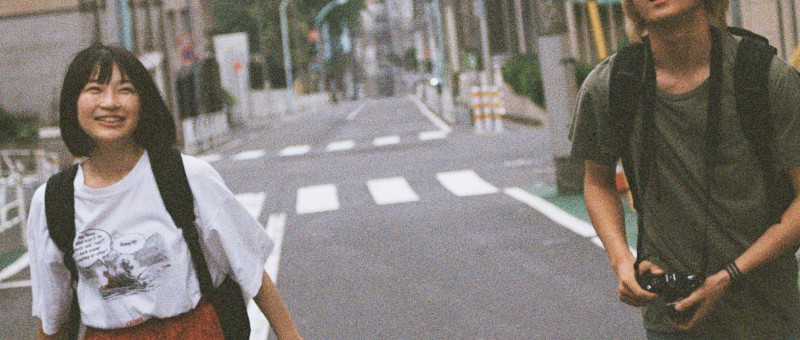
Can you find love in a crazy world? According to Crazy Romance (가장 보통의 연애, Gajang Botong-ui Yeonae), yes and then again no. The Korean title translates as something like the most ordinary of romances, which, considering what we’re about to see, is in someways quite depressing. Achingly contemporary in its Ephron-esque air of sophistication, Crazy Romance nevertheless lays bare the costs to both men and women of living in a rabidly patriarchal, misogynistic society.

Our heroine, Sun-young (Gong Hyo-jin), has just joined a small advertising company in what many seem to feel is an unexpected step down in her career. At the awkward welcome drinks she’s asked a series of inappropriate, sexist questions, but her claims of not currently having a boyfriend are quickly disproved when a young man barges into the restaurant with flowers and abruptly proposes to her. It seems, Sun-young had attempted to break up with him that very morning, but he refused to listen and has now caused embarrassment at her job (which he expects her to quit anyway because they’ll be getting married). Meanwhile, Jae-hoon (Kim Rae-won) wasn’t really paying attention because he’s had too much to drink and is obsessively texting his ex who hasn’t replied in months. 

Jae-hoon’s alcoholism doesn’t seem to have affected his work, but has become a talking point around the office. The day after the party we see him wake up on the floor of his apartment surrounded by the detritus of drinking including, for some reason, several bags of corn on the cob, not to mention a cat which is apparently not his but might as well be now. Ever since his engagement ended, he’s been unable to move on, getting blackout drunk nearly every night and texting his ex who resolutely ignores him (not that you can blame her).

We can immediately see that there is not much difference in practical terms between Sun-young’s abusive ex Dong-hwa (Ji Il-joo) and Jae-hoon who is being positioned as the unfairly maligned nice guy, derided for his maudlin romanticism in being unable to forget his past love even though, as we alter discover, he broke off the engagement because she cheated on him while he was busy working hard for their future, neglecting their relationship as he fulfilled what he saw as his male responsibility to provide financial stability. Jae-hoon does, however, leave it at drunk texting and while privately resenting the fact she never replies, does not become dangerously obsessive, belligerent, or threatening as Dong-hwa later does in refusing to accept that Sun-young has ended their relationship. Nevertheless, witnessing their intense encounter in the car park and perhaps projecting, Jae-hoon tells Sun-young that he feels she’s been unfair to Dong-hwa who is after all “trying very hard” while implying that it’s romantic disappointment that has led to the apparent downgrade in her career prospects in the wake of derailed marriage plans. 

Jae-hoon’s embittered tone might suggest he’s mildly intimidated by Sun-young’s previously successful track record, but it is in a manner of speaking romantic disappointment which has done for her career in that Sun-young is now incredibly sick of having to deal with misogynistic workplace practices and persistent sexual harassment. Finding out the truth, Jae-hoon is outraged on her behalf but contributes to an ironic kind of victim blaming in berating her for not defending herself, as if she had the same right of recourse as he would have in her situation which of course she does not. As they bond in a shared sense of romantic disillusionment, the other team members start to turn against Sun-young, branding her a workplace hussy, while she in turn points out the hypocrisy of their interoffice gossip where everyone has a secret nickname from an employee everyone assumes is gay but is afraid to come out (he might have good reason, judging by his colleagues’ snide comments), to a female office worker’s decades-long unrequited love for their now married boss who is frequently derided for being thoroughly henpecked which is why he forces them into unnecessary company bonding sessions so he won’t have to go home and spend time with his family. 

The problem is that romance, or at least being vulnerable, is still embarrassing even in your 30s which is why everyone has to at least pretend to be drunk to pursue it. Both Jae-hoon and Sun-young are offered extremely problematic dating advice which effectively normalises abusive behaviour, childishly incapable of any kind of emotional honestly as they awkwardly spar with each other while their exes hover in the background. Sun-young tries to take Jae-hoon to task for his hypocrisy, pointing out that he thinks of himself as “better” than all the other useless men, but ultimately the film more or less agrees with him even if clear that he’s still a product of a misogynistic society and extremely self-centred while also genuinely nice as proved when we realise how he ended up with all that random corn. While he is maudlin and romantic, Sun-young is (understandably) cynical, but her spiky aggressiveness finds far less favour even if she is perhaps the one finally in charge of the direction of their relationship. Nevertheless, Crazy Romance cannot help but reinforce contemporary conservative social codes even as it critiques them, insisting that ordinary love is in itself crazy because the world is mad.


Crazy Romance is available to stream worldwide until July 4 as part of this year’s Udine Far East Film Festival.

Original trailer (English subtitles)

Ashfall (백두산, Lee Hae-jun & Kim Byung-seo, 2019)

The Korean Peninsula once again faces existential threat though this time of a natural genesis, and ironically the only way to save it might be nukes from the North. Ashfall (백두산, Baekdusan) is the latest and the largest of Korea’s big budget disaster movies featuring a veritable host of A-list talent and action sequences on an epic scale, but also doubles down on the less palatable sides of the genre in an overt and sometimes uncomfortable nationalism which nevertheless has its positive sides in its temporary elision of the North/South divide as the heroes pursue their cross-border mission to save the people of Korea not only from volcanic threat but from becoming mere pawns in geopolitical brinksmanship. 

The most obvious problem, however, is that long dormant volcano and pregnant national symbol Mt. Baekdu has erupted, provoking massive earthquakes which quickly reduce most of the high tech capital to mere rubble. This is particularly bad news for heroic army bomb disposal expert Captain Cho (Ha Jung-woo) because, in true disaster movie fashion, today was supposed to be his last day. Cho’s wife (Bae Suzy) is heavily pregnant, and it seems he’s opted for a safer occupation in the light of his impending fatherhood. According to the predictions of previously derided Korean-American scientist “Robert” Kang Bong-rae (Ma Dong-seok, cast brilliantly against type), Mt. Baekdu will continue erupting with the third and most powerful wave taking out most of the peninsula, but he has a plan to stop it. He wants to use nuclear weapons to blow a hole in the side of the chamber, relieving the pressure. To do that, they need to hijack some of the uranium from very recently decommissioned North Korean missiles, which means sending a small military expedition over the border in secret to track down a possible double agent who knows where all the nuclear material is before loading up their own detonators and driving them into a mine under the volcano. 

All of this takes place against the backdrop of North Korea’s long awaited denuclearisation which is in the process of being witnessed by American forces who are very much not in favour of Kang’s plan seeing as it effectively means detonating a nuclear bomb right on the Chinese border. Once again, the film suggests, Korea finds itself the battleground in a proxy war, its sovereignty denied as it attempts to use whatever means it has to save itself but is actively prevented by various kinds of outside forces. Kang, who idolises America to the point that he rejects his Korean name and tries to leave the country as soon as possible on his US passport, eventually makes the ironic statement that the ensuing chaos is all down to this “incompetant government that can’t decide its own fate” as the American army shutdown a Korean operation to put his plan in action while Cho and his guys also find themselves actively targeted by US military acting covertly in North Korea. 

Somewhat unexpectedly, Cho is not quite the heroic action hero one would expect. He’s anxious and inexperienced, out of his depth as a man unused to being in the field, trained to defuse bombs not launch them and unfamiliar with standard weaponry. Because his guys are the good guys, the North Korean mission is supposed to be “non-lethal”, so they’re wading into this with tasers and rubber bullets while his opposing numbers have no such scruples. Ri (Lee Byung-hun), the North Korean double agent, runs rings around them, playing every advantage while his motives remain unclear until finally sitting comfortably within the realms of action movie melodrama as he and Cho develop an awkward mismatched buddy dynamic, bonding over paternal worries and North/South pop-cultural exchange. 

The familiar message is that all things are possible when working together for a common cause, making a possibly subversive argument that North/South solidarity is the most powerful weapon against entrenched American imperialism and a resurgent China while advocating strongly for a greater national sovereignty less beholden to foreign powers for military support. It comes as little surprise that Kang eventually decides to go back to his original name and stay in Korea for good rather than return to a discredited US, having rediscovered his Koreaness thanks to his role in saving the nation. Subtle this is not, but then who ever asked for subtlety from a big budget disaster movie?


Ashfall is available to stream in Europe until July 4 as part of this year’s Udine Far East Film Festival.

International trailer (English subtitles)