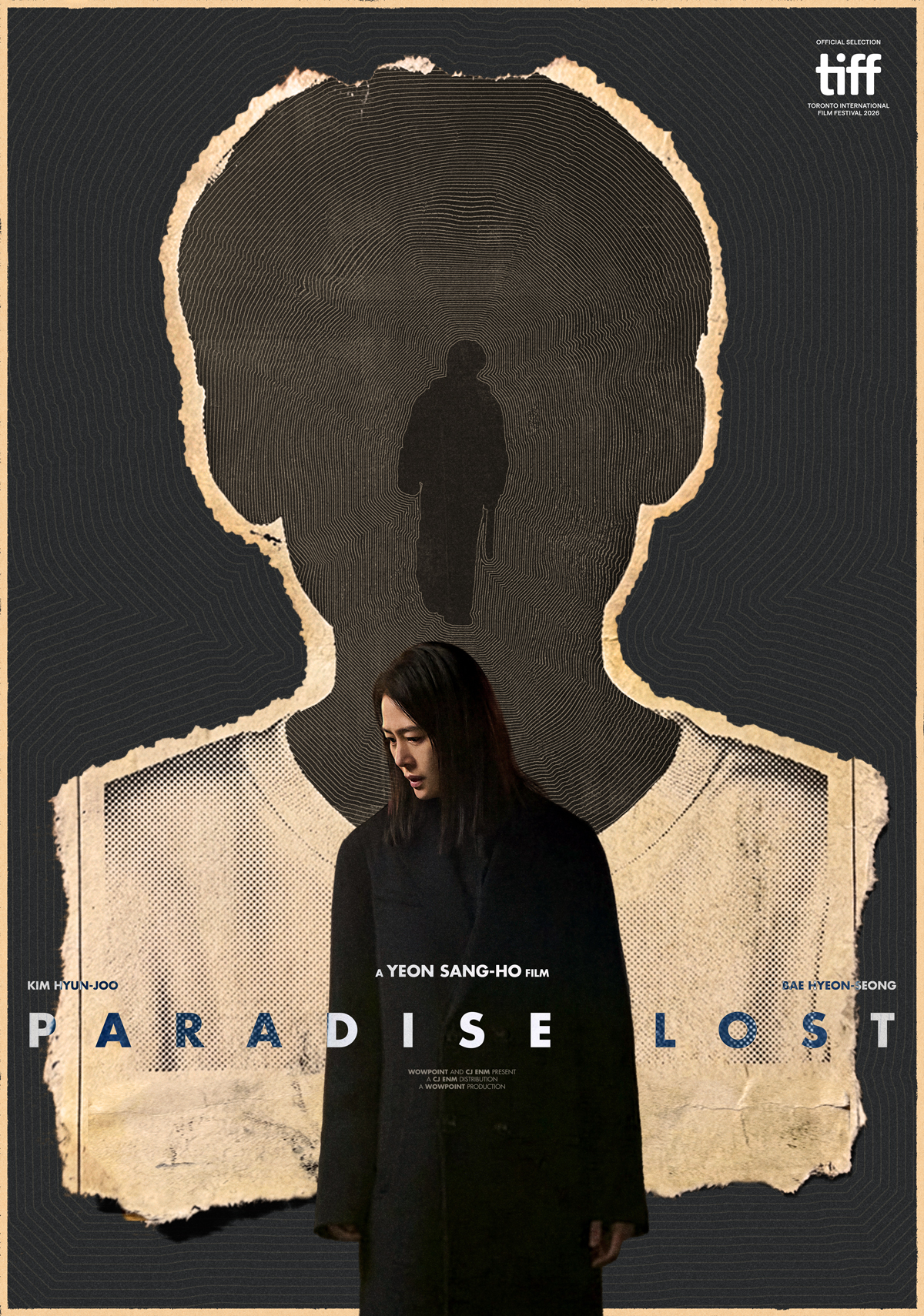
Paradise Lost (실낙원, Yeon Sang-ho, 2026)

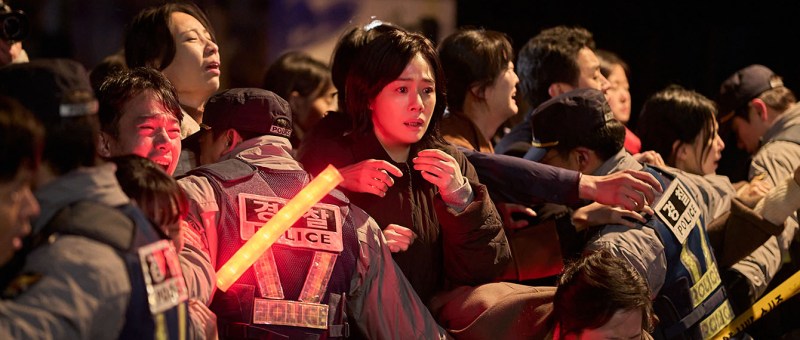
“I hope you can accept reality,” So-young’s (Kim Hyun-joo) well-meaning boss advises her on handing over a literal key to unlocking the source of her trauma, but for many reasons, reality does not seem to be something that So-young will ever be ready to accept. Less about AI than the pull of grief and the complicated relationship between a parent and a child, Yeon Sang-ho’s dark maternal drama Paradise Lost (실낙원, Sillagwon) asks if we can actually accept our children when they grow into something that we no longer recognise or cannot approve of.

Thirteen years previously, So-young’s young son Sun-woo was one of 13 children aboard a bus that was hijacked by its driver and abandoned in a former mining area. The body of their teacher was found close to the bus, with the bodies of five children recovered nearby along with evidence that the others, including Sun-woo, may have suffered a similar fate though their remains were not recovered as the abandoned mine in which the police suspected the killer had disposed of them was judged too unstable for rescuers to enter safely. As expected, the crime provoked national mourning leading to an AI company stepping in to help ease the parents’ grief by creating avatars of their children they could interact with in a virtual reality world.

This appears quite exploitative on behalf of the AI company which is clearly making use of the parents’ grief to promote their products. It’s later said that they deleted the avatar of one child when one of their parents was arrested for drink driving fearing bad publicity. But when So-young visits them later, they remind her that the programme was only supposed to be a temporary diversion to help her adjust to the loss of her child. Even they think it’s time she stopped using it so often, while other parents have apparently made the decision to give up the service or consented to their child’s avatar being deleted. But on the other hand, the virtual Sun-woo becomes sullen when So-young does not turn up at the usual time and tearfully begs her not to abandon him like the other parents, or at least not to do it without warning.

The film is pretty clear that it at least does not accept that virtual Sun-woo is a “real” entity that is capable of emotions such as sadness, and that So-young is delusional in believing that it is. She only does so because she cannot accept the reality of her son’s death, and the avatar is then more like a reflection of her grief, no different from a ghost and the AI company akin to spiritualists of dubious intentions. But on the other hand, the programme offers her a more convenient kind of parenthood or a maternal paradise in which Sun-woo will always be her perfect little boy, never growing older or changing in ways the displease or challenge her. When the flesh and blood Sun-woo (Bae Hyun-sung) reappears years later as a young man, he’s basically a stranger and she is incapable of accepting him, not least because she discovers that he himself has become a violent and sadistic killer who may be responsible for the disappearance of the adorable little boy next door who reminds her so much of the younger Sun-woo.

In some ways, what this might really be about is the kind grief a mother might feel for a child that’s grown up or a mourning for a family life she longs to return to that only exists in the past. This is a fairly extreme example, but the film attempts to paint the flesh and blood adult Sun-woo as an avatar of the demonic, and the perfect child Sun-woo in the app as that of the angelic. So-young must choose between the “reality” of what her flesh and blood son has become and the “fantasy” of a perpetual childhood in which he will forever be her lovely little boy who just wants to eat his mother’s omelettes and play hide-and-seek. In the end it seems as if she cannot quite find it within herself to move on and prefers to stay in this purgatorial existence with each of her sons, ending up in both heaven and hell simultaneously. Intensely bleak, Yeon’s drama likens the abyss of grief to the shaft of a disused mine, descending forever into the darkness with no end in sight, while its heroine, in the end, has no desire to climb out.


Paradise Lost opens in US cinemas Nov. 6 courtesy of Well Go USA.

Trailer (English subtitles)
Crazy Romance (가장 보통의 연애, Kim Han-gyeol, 2019)

Can you find love in a crazy world? According to Crazy Romance (가장 보통의 연애, Gajang Botong-ui Yeonae), yes and then again no. The Korean title translates as something like the most ordinary of romances, which, considering what we’re about to see, is in someways quite depressing. Achingly contemporary in its Ephron-esque air of sophistication, Crazy Romance nevertheless lays bare the costs to both men and women of living in a rabidly patriarchal, misogynistic society.

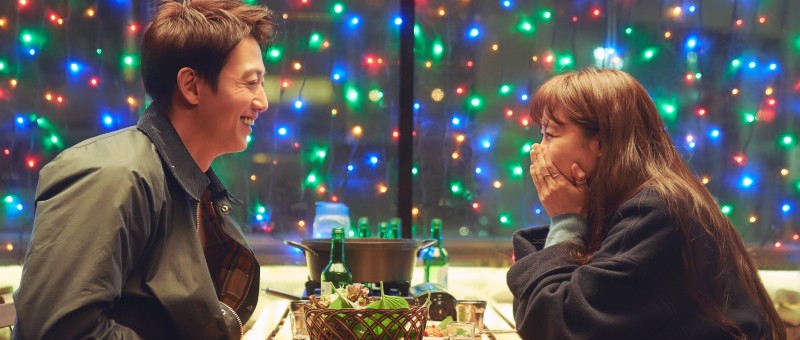
Our heroine, Sun-young (Gong Hyo-jin), has just joined a small advertising company in what many seem to feel is an unexpected step down in her career. At the awkward welcome drinks she’s asked a series of inappropriate, sexist questions, but her claims of not currently having a boyfriend are quickly disproved when a young man barges into the restaurant with flowers and abruptly proposes to her. It seems, Sun-young had attempted to break up with him that very morning, but he refused to listen and has now caused embarrassment at her job (which he expects her to quit anyway because they’ll be getting married). Meanwhile, Jae-hoon (Kim Rae-won) wasn’t really paying attention because he’s had too much to drink and is obsessively texting his ex who hasn’t replied in months. 

Jae-hoon’s alcoholism doesn’t seem to have affected his work, but has become a talking point around the office. The day after the party we see him wake up on the floor of his apartment surrounded by the detritus of drinking including, for some reason, several bags of corn on the cob, not to mention a cat which is apparently not his but might as well be now. Ever since his engagement ended, he’s been unable to move on, getting blackout drunk nearly every night and texting his ex who resolutely ignores him (not that you can blame her).

We can immediately see that there is not much difference in practical terms between Sun-young’s abusive ex Dong-hwa (Ji Il-joo) and Jae-hoon who is being positioned as the unfairly maligned nice guy, derided for his maudlin romanticism in being unable to forget his past love even though, as we alter discover, he broke off the engagement because she cheated on him while he was busy working hard for their future, neglecting their relationship as he fulfilled what he saw as his male responsibility to provide financial stability. Jae-hoon does, however, leave it at drunk texting and while privately resenting the fact she never replies, does not become dangerously obsessive, belligerent, or threatening as Dong-hwa later does in refusing to accept that Sun-young has ended their relationship. Nevertheless, witnessing their intense encounter in the car park and perhaps projecting, Jae-hoon tells Sun-young that he feels she’s been unfair to Dong-hwa who is after all “trying very hard” while implying that it’s romantic disappointment that has led to the apparent downgrade in her career prospects in the wake of derailed marriage plans. 

Jae-hoon’s embittered tone might suggest he’s mildly intimidated by Sun-young’s previously successful track record, but it is in a manner of speaking romantic disappointment which has done for her career in that Sun-young is now incredibly sick of having to deal with misogynistic workplace practices and persistent sexual harassment. Finding out the truth, Jae-hoon is outraged on her behalf but contributes to an ironic kind of victim blaming in berating her for not defending herself, as if she had the same right of recourse as he would have in her situation which of course she does not. As they bond in a shared sense of romantic disillusionment, the other team members start to turn against Sun-young, branding her a workplace hussy, while she in turn points out the hypocrisy of their interoffice gossip where everyone has a secret nickname from an employee everyone assumes is gay but is afraid to come out (he might have good reason, judging by his colleagues’ snide comments), to a female office worker’s decades-long unrequited love for their now married boss who is frequently derided for being thoroughly henpecked which is why he forces them into unnecessary company bonding sessions so he won’t have to go home and spend time with his family. 

The problem is that romance, or at least being vulnerable, is still embarrassing even in your 30s which is why everyone has to at least pretend to be drunk to pursue it. Both Jae-hoon and Sun-young are offered extremely problematic dating advice which effectively normalises abusive behaviour, childishly incapable of any kind of emotional honestly as they awkwardly spar with each other while their exes hover in the background. Sun-young tries to take Jae-hoon to task for his hypocrisy, pointing out that he thinks of himself as “better” than all the other useless men, but ultimately the film more or less agrees with him even if clear that he’s still a product of a misogynistic society and extremely self-centred while also genuinely nice as proved when we realise how he ended up with all that random corn. While he is maudlin and romantic, Sun-young is (understandably) cynical, but her spiky aggressiveness finds far less favour even if she is perhaps the one finally in charge of the direction of their relationship. Nevertheless, Crazy Romance cannot help but reinforce contemporary conservative social codes even as it critiques them, insisting that ordinary love is in itself crazy because the world is mad.


Crazy Romance is available to stream worldwide until July 4 as part of this year’s Udine Far East Film Festival.

Original trailer (English subtitles)