The Climbers (攀登者, Daniel Lee, 2019)

The Climbers poster 1“Because it’s there” George Mallory famously said when questioned why exactly he wanted to climb Mount Everest. The hero of Daniel Lee’s The Climbers (攀登者, Pāndēngzhĕ) who regards Mallory as his idol has a slightly more reasoned response when similarly questioned by a student, pausing before explaining that humans are always eager to climb towards the future. That will prove to be a rather ironic statement in that Fang Wuzhou (Wu Jing) is a man in many ways trapped by past injustice, unable to move on from simultaneously achieving his dream and being denied its glory.

Narrated by meteorologist and Wuzhou’s innocent love interest Xu Ying (Zhang Ziyi), the action begins in 1960 when the Chinese National Mountaineering Team makes an attempt to conquer Everest from the North Face in response to a territorial challenge from the other side. During the ascent, the team’s captain is killed leaving the three remaining members to press on to the summit alone. Having conquered the mountain, they are unable to record their achievement because they lost the camera during an avalanche and so their success goes unrecognised by the international community. This is particularly bad news for Wuzhou whose intensely romantic attempt to woo shy meteorology student Xu Ying is interrupted at the critical moment by the news they’ve been denied and all their dreams are dashed. Wuzhou becomes sullen and withdrawn, resentful at being thought a fraud. The failure costs him the courage he had mustered to pursue his romantic destiny, allowing Xu Ying to leave for many years of research in the Soviet Union without telling her how he really feels.

Xu Ying’s commentary opts for understatement when it briefly remarks that the nation entered a period of “darkness” following the “failure” of the Everest attempt after which the Chinese National Mountaineering Team was disbanded. Wuzhou is relegated to the boiler room in a factory while his surviving friends, Jiebu (Lawang Lop) and Songlin (Zhang Yi), pursue their separate destinies, Jiebu returning to his sheep farm and Songlin, whose foot was ruined by frostbite, joining a sports training facility. By 1975, times have changed and the powers that be see fit to mount another attempt on Everest in order to measure it “properly” and restore China’s international mountain climbing reputation.

For all that The Climbers is a propaganda epic filled with calls to “show the world what Chinese men can do”, it has its share of flawed heroes failing to measure up to a vision of themselves as fearless champions of their nation. Wuzhou is understandably an embittered man obsessed with the rejection of his first summit, but he’s also an emotional coward who ties the need to have his success validated with the right to speak his heart to the improbably patient Xu Ying who apparently continues holding a torch for him throughout her long years in Russia, only implying she can’t wait for him any longer by putting their relationship on a professional footing when she arrives to lead the meteorological department on the 1975 summit attempt. Nevertheless, the pair share an array of meaningful looks filled with poignant longing while Xu Ying laments the presence of the mountain which stands between them before seemingly deciding to sacrifice herself for Wuzhou’s dream in the forlorn hope of finally conquering it.

Songlin, meanwhile, is resentful not so much towards the mountain or the fact that he will never be able to climb it again but towards Wuzhou who saved his life and let the camera fall, thereby bringing shame on the Chinese nation. Later, a brave young man opts to sacrifice his life to ensure the camera’s survival, and as Songlin later comes to understand the climb is a heavy responsibility which puts young lives at risk for a fairly meaningless prize which may not bring the glory to their nation that the young men and women trying to reach the summit might expect. Nevertheless, they plough on regardless. 1960 leads to 1975, and then to 2019 in which intrepid Chinese climbers once again attempt to conquer Everest in the company of a (in some ways not terribly) surprising star cameo in order to reemphasise the nation’s manly prowess and overwhelming desire to protect what it sees as its territory. Lee makes the most of the snowy vistas for a series of death defying stunts as the team (repeatedly) encounter avalanches, rock falls, and dangerous storms, risking all to bring glory to China but remaining resolute in their determination to make it all the way to the top.


The Climbers is currently on limited release in UK cinemas courtesy of Cine Asia, and in the US from Well Go USA.

Original trailer (English subtitles)
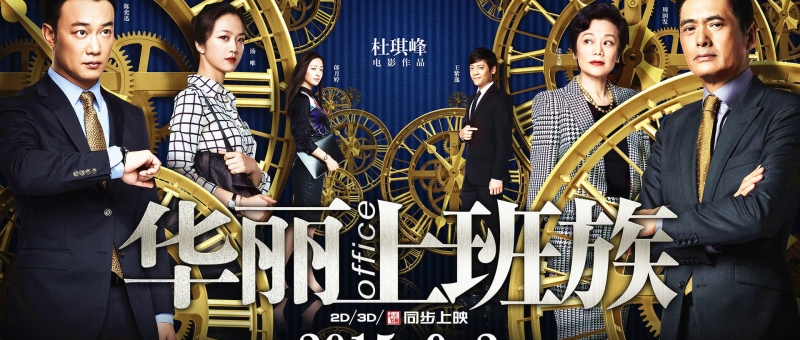
Office (華麗上班族, Johnnie To, 2015)

Johnnie To office poster 1Can love and capitalism walk hand in hand? Perhaps not, at least in Johnnie To’s beautifully choreographed musical exploration of high stakes finance and moral bankruptcy, Office (華麗上班族). Adapted from Sylvia Chang’s stage play, Office situates itself on the edge of an abyss as the 2008 financial crisis edges its way towards Hong Kong while enterprising businessmen try to figure out how to ride the waves even if that means standing on someone else’s shoulders as they sink deeper into the moral morass that is the modern economy.

Top Hong Kong trading company Jones & Sunn is about to go public. CEO Winnie Chang (Sylvia Chang) has long been running the show for her boss and lover, Chairman Ho (Chow Yun-fat), who has promised her a sizeable dividend once the floatation is complete. Meanwhile, two new interns have just joined the company, eager to make their marks in the corporate world and ensure they survive their three month probation. Bright-eyed and bushy-tailed Li Xiang (Wang Ziyi), “Lee like Ang Lee, Xiang like dream”, just wants to work hard and get rich so he can live a nice life, while his colleague Kat Ho (Lang Yueting) has just returned from studying economics at Harvard and appears to be slumming it in a lowly internship while (unconvincingly) pretending to be from a humble background. The funny thing is no one seems to pick up on the fact Kat has the same surname as the company’s owner, or they might have figured out she’s the boss’ daughter either forced to learn the trade from the ground up or working as a spy among the regular employees. In any case, Li Xiang is smitten.

Love, it seems, is the destabilising force at the centre of this great machine. CEO Chang, an all powerful woman in a male dominated industry, rules the office with a will of iron but allows herself to be manipulated by Ho with whom she has been having a longstanding affair. Ho has a wife in a coma, but neither of the pair object to the office gossip which brands Chang as “Mrs. Ho”, seeing it only as cutely romantic rather than a slight on Chang’s very real authority. Meanwhile, lonely in Ho’s lack of serious commitment, Chang has also been sleeping with her favourite underling, the feted David (Eason Chan), who in turn is getting fed up with feeling like a spare part who’s hit the peak of his career. Unbeknownst to Chang who may have taken her all-seeing eye off the ball, David has started playing with fire in gambling with company money and losing badly. As a counter measure, he’s begun romancing lovelorn accountant Sophie (Tang Wei), who unlike Chang, is still facing the work/home dilemma in that her fiancé back on the Mainland is pressuring her to give up work and settle down.

Li Xiang is very keen on following his “dreams” which in the beginning are charmingly naive – he wants a nice life for himself and the ability to pay off his friends’ debts (seemingly for entirely altruistic reasons, not as an excuse to show off). Slowly, however, his new world begins to corrupt him. He’s irritated that he’s not allowed to ride the executive elevator and badly wants in, but is still green enough to chivalrously cover up for Kat’s mistakes, while Kat is so clueless that she forgets turning up to work in designer outfits and in a chauffeur driven car is going to blow her cover. Li Xiang sees through her, but only to the nice part – it never really occurs to him she’s a mole or planning to betray Mrs. Chang who is kind of her step-mother. Chang isn’t blind to office politics. She sees Li Xiang take the blame for Kat and even likes him for it. She also likes his “originality” and plans to take him under her wing for her new expansionist plans but finds herself once again blindsided by all the difficult romantic drama bubbling under the surface of coldhearted capitalism.

David and Sophie decide they want to start a “love revolution”, but David has already gone to a dark place and his romantic confession is immediately followed by a manipulative request to get Sophie to help him with his nefarious plans. Meanwhile, Li Xiang’s gradual descent into corporatism begins to sour Kat who’d taken a liking to him because he wasn’t like everyone else. They didn’t mean to do it, but they’ve betrayed themselves and others in their relentless pursuit of conventional success. Drunken salarymen at a local bar ask themselves what all of this is for when their kids don’t recognise them and they barely recognise themselves, yet no one quite has the guts to get off the corporate train and go do something else.

In To’s elaborate set design, no one is ever truly able to leave the office. An elegant construction of neon and steel, the abstract theatricality of To’s artificial universe only underlines its essential meaninglessness – something the Office’s denizens eventually come to understand whether they choose to stay or not. As Chang quips, smart guys control money and stupid ones are controlled by it, but she herself is wise enough to know when the game is up and it’s time to move on. Did love destroy the system or did the system destroy love? Beautiful melodies telling us terrible things, To’s anti-capitalist musical crushes its earnest heroes under the wheel of progress while they dance blithely all the way over the edge.


Office screens in Chicago on Oct. 5 as part of Asian Pop-Up Cinema.

Original trailer (English subtitles)

Signal Rock (Chito S. Roño, 2018)

kinopoisk.ru“Family is family, I can’t just say no” a young woman tells her boyfriend in response to his angry outburst on discovering that, like all the young women round these parts, she’s being dispatched to another part of the country to work in a bar. Inspired by true events in the ‘90s, Chito S. Roño’s Signal Rock situates itself in an idyllic fishing community left behind by the modern world like a lonely rock pool after the tide has pulled out. A microcosm of the nation itself, the island has become used to its transitory status as a conduit between two worlds, dependent on those who leave for its survival while the young men rendered incongruously obsolete have little more to do than battle their feelings of resentment and powerlessness.

Our hero, Intoy (Christian Bables), is the youngest son of the Abakan family, charged like so many young men with responsibility over technical things – in this case, maintaining the mobile phone which is the only point of contact that they have with oldest daughter Vicky who is supporting them all while working overseas in Finland. Remote as it is, the only place you can get a signal on the island is by climbing to the top of a rocky outcrop so communication has to be carefully planned in advance. This becomes a particular problem when Intoy discovers that the reason the money from Vicky hasn’t been coming through is that her relationship with a Finnish man with whom she has a small daughter is falling apart because he is both abusive and adulterous. As her daughter Sofia was born in Finland, Vicky fears that her boyfriend will try to seize custody and prevent her returning home to her family. Intoy, a fiercely protective brother, is not about to let that happen and sets about mobilising the community to hatch a plan to ensure Vicky and Sofia come home safely.

Despite Intoy’s protective instincts, the rest of the family’s relationship with Vicky is ambivalent. Oldest son Joaquin (Arnold Reyes), one of many resentful middle-aged men left on the island with not much to do, endlessly complains about the lack of ready money from his sister which he claims he needs to buy a motorbike in order to work. Joaquin also resents the shame of Vicky’s out of wedlock pregnancy, while the parents are still a little put out about the financial sacrifices they had to make in order for Vicky to achieve her “dream” of going abroad.

In order to sell the fantasy that Vicky comes from a wealthy family in the Philippines which is perfectly well equipped to support herself and her daughter, the Abakans are forced to confront their longstanding family issues. Intoy’s parents have been estranged for some time with his father technically living in a shed outside the main house, apparently loathed by his wife who claims the youngest two children are a result of marital rape. Another product of the patriarchal society, Intoy’s parents apparently eloped at a young age so that his mother could escape a marriage arranged by her father, only for the relationship to sour when Intoy’s dad lost his job at an American-run factory causing his wife to become disillusioned with his ordinariness.

Little seems to have changed in the last 30 years in that the lives of women are still largely dictated by the whims of their fathers. Vicky may have made a free choice to go abroad, but seeing as work is easier to come by for women, it is the norm for girls of the island to be sent away while the boys remain home alone. While dealing with his sister’s plight, Intoy is also facing the inevitable heartbreak of losing his girlfriend Rachel whose father has arranged for her to work in a bar in the city. As Intoy points out, from the parents’ point of view bar work is a pathway to finding a rich foreign husband – like Gina, another young woman from the village, who is returning home to celebrate her marriage to an elderly German (official now that his divorce has come through). Hardly pausing at the dockside, Gina introduces her former lover as a “cousin” before whispering in his ear that her feelings haven’t changed and she hopes to bring him to Germany for a better life after the old man snuffs it.

Intoy makes a kind of living on the island running errands for older people and acting as an MC during village celebrations, but as there is no real work round here and all the girls are gone, the young men largely spend their time playing basketball and getting into fights. They resent being forced to live off their sisters and seeing the women they love promised to other men, but have no other option than to make uneasy peace with their lack of possibilities. Intoy battles against his baser emotions, remaining kind and cheerful as he convinces his friends and neighbours to help him forge documents that imply his sister owns property while cosying up to the local mayor who hopes to hang on to power at the next election by convincing his wife to stand as a candidate.

Intoy alone is desperate to preserve the integrity of his family, even when spread across continents, standing out on Signal Rock as a kind of beacon left behind solely to convey information from one point to another. Having helped his sister, however, he discovers the depths of her resentment in her embarrassment at the idea of returning home after receiving the help of so many people. He loses his temper, unable to understand his sister’s rejection of everything he has worked so to protect at great cost to himself. Even so, Intoy manages to maintain his cheerfulness and desire to help others, sinking back into island life with his customary stoicism even if mildly troubled by a bargain he may have committed to without fully comprehending its implications. An ambivalent depiction of idyllic island life built on the back of female exploitation and entrenched patriarchy, Signal Rock nevertheless finds finds hope in community spirit and in its hero’s essential goodness.


Signal Rock screens in Chicago on Oct. 3 as part of the ninth season of Asian Pop-Up Cinema where actor Christian Bables will be present for an introduction and Q&A.

Original trailer (English subtitles)

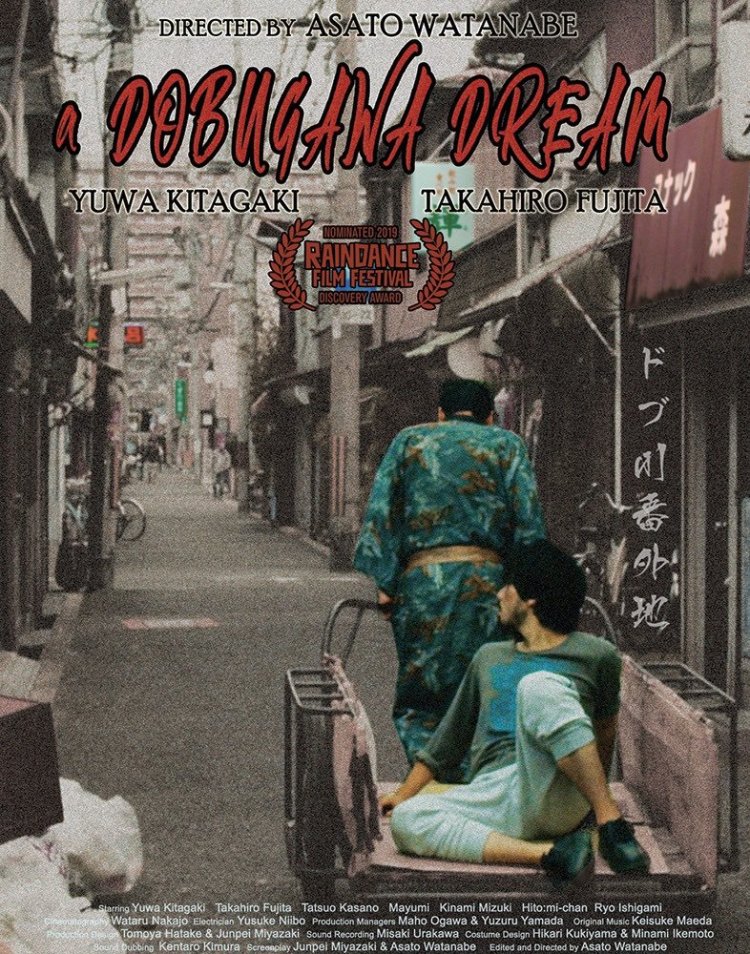
A Dobugawa Dream (ドブ川番外地, Asato Watanabe, 2018)

Dobugawa Dream Raindance posterCan you outrun sorrow or should you just accept defeat and remain within a bubble of despair? Forced out of his self-isolation, the hero of Asato Watanabe’s debut feature A Dobugawa Dream (ドブ川番外地, Dobugawa Bangaichi) tries to find out, looking for a home among those who’ve fallen through the cracks. This down and out ditch town maybe where you end up when you don’t know where else to go, but there’s comfort in knowing others got there before you, if not so much in realising that they have all failed to leave, either accepting the imperfect present in rejection of a possible future, or wilfully residing in the past.

Highschooler Tatsumi (Yuwa Kitagaki) is a lost young man filled with pent-up rage and frustration. He hasn’t filled in his career survey because he has no idea what to put in it and no amount of irritated cajoling from a less than well-meaning teacher is likely to change that. His only outlet is the dream of sailing away with his best friend on the makeshift raft they’ve crafted from refuse at a disused boatyard, but that dream dies when he discovers him hanging, barefoot his body swaying in the breeze. Unable to process his loss and the guilt that accompanies it, Tatsumi imprisons himself in his room watching VHS tapes of old TV shows until a series of angry voices from the other side of the door eventually forces him out of his place of safety and into a strange new world.

Running blindly, Tatsumi wanders through a dream until he is eventually engulfed by a cheerful street funeral which turns out to be in honour of a man still alive – Tsuchiro, a middle-aged former shogi champ now a drunken rogue and what passes around here for a guardian spirit. Questioned by the local bobby, Tsuchiro passes Tatsumi off as his own son, a ruse no one believes but one with a grain of truth. In Tsuchiro, an infinitely cool presence all sunshades, yukata, and shit-eating grin, Tatsumi finds both a father figure and a double. Just as he is chasing the ghost of a friend he couldn’t save, Tsuchiro is in flight from himself, uncertain of his own identity now he no longer sees it reflected in the eyes of an opponent.

Trapped in this strange netherland, Tsuchiro has chosen oblivion. He drowns his sorrows but secretly plays shogi alone by nights while Tatsumi listens in silent consternation from the next room as his tiles click down on the bloodied board. Originally reluctant, Tatsumi finds himself becoming the older man, dressing in the cast-off clothes of the street and drinking himself out his sorrow but quickly becomes disillusioned with what he sees as Tsuchiro’s hypocrisy. The older man offers him a home among those who have nowhere else to go, but the wily bar hostess, though trapped herself, cautions him that he might not want to stay here, among the perpetually lost, for evermore.

A climactic argument sees Tsuchiro offer some tough love, telling Tatsumi that if he wants to stay he needs to leave his darkness at the door, but Tatsumi doesn’t want the superficial solution the older man has found. He’s angry, and he’s powerless, and not yet ready to face his pain but there are other people he will fail to save precisely because of his solipsistic rage – a lesson age tried to teach him but he was too impatient to see. Further loss and an altruistic act of sacrifice push him towards a reckoning in a deeper dream which allows him to interrogate the ghosts of the traumatic past and, perhaps, make his peace with them.

Alternating between bleak despair and absurd humour, A Dobugawa Dream takes its broken hero on an oneiric odyssey through grief, despair, and eventual rebirth as he learns to reconnect with the world around him and prepares to sail away from the traumatic past into the dreamed of future. Escaping the Dobugawa dreamscape, he takes its wisdom with him, no longer running but moving forward all the same. A beautifully composed and remarkably assured debut from Asato Watanabe, A Dobugawa Dream is both a tale of marginalised lives and the corrosive effects of unresolved trauma, and a gentle hymn to the sadness of letting go.


A Dobugawa Dream made its international premiere at Raindance 2019 courtesy of Third Window Films.

Teaser trailer

Bento Harassment (今日も嫌がらせ弁当, Renpei Tsukamoto, 2019)

Bento harrassment posterChildhood’s a funny thing. Obviously lacking life experience and used to being the centre of someone’s universe, children can be curiously self-centred, little knowing the hard work their parents put in to try and make them happy until they suddenly realise years later that their mothers must have toiled through the night just to finish that costume for fancy dress that they didn’t really want to wear. Fed up with her teenage daughter’s sullen indifference, the heroine of Bento Harassment (今日も嫌がらせ弁当, Kyo mo Iyagarase Bento) comes up with an ingenious solution – increasingly elaborate lunchboxes designed to vent her frustration in a way that’s impossible for her daughter to ignore.

12 years previously Kaori (Ryoko Shinohara) was blissfully happy with her two little daughters, Wakaba (Rena Matsui) and Futaba (Kyoko Yoshine), but then her husband was killed in an accident and her life was turned upside down. Now she lives alone with her youngest daughter Futaba who has entered something of a rebellious phase, never directly talking to her mother but communicating through pithy, passive aggressive texts. In a bid to get her attention, Kaori decides to play her at her own game – by becoming so annoying that she’s impossible to ignore. From the day that Futaba enters high school she commits herself to making one “annoying” bento every day, eventually adding a message or two into the mix. Much to Futaba’s chagrin, her mother’s bento becomes a cause of daily excitement among her school friends who can’t wait to see how her mother has chosen to troll her on this particular day.

Perhaps tellingly, Kaori and her daughters live on a small island, Hachijojima, which is technically classed as “Tokyo” though in another sense almost as far from the bustling metropolis as it’s possible to get. There are no trains, or shopping malls, or convenience stores, just cows and wholesome wisdom. Caught between one thing and another, Futaba quits her after school athletics club to sit in a field and write angsty poetry about how she’s all alone in the universe. She doesn’t understand why her mum’s so extra and is confused by her attraction to a childhood friend (Kanta Sato) who has now become buff after developing an obsession with taiko drumming. Beginning to figure out why her daughter’s so moody lately, Kaori doubles down on the annoying bento plan but tries to put a little guidance in there too to push the indecisive Futaba towards making concrete decisions about her future.

Unlike the typically self-sacrificing mothers of “hahamono”, Kaori has her spiky side and never particularly looks for thanks or recognition from her daughters only basic civility. She works two jobs (one in a bento shop and another in a pub) and still makes time to devote herself to the petty art of annoying bento which she also posts online on a blog which becomes an instant hit with similarly stressed out parents looking for a little innocent revenge. Through the blog she finds herself bonding with Shunsuke (Ryuta Sato), a widowed father of a five-year-old boy who is struggling to perfect the art of bento though his aim is less revenge than trying to bond with his son who obviously misses his mum. Yet even “annoying” bento comes from a fundamental place of love – after all, you don’t spend all night cooking to send a passive aggressive message to someone you don’t like. Rising to the challenge, Futaba refuses to admit defeat and makes a point of eating all of the annoying bento without a word of complaint, allowing a kind of communication to arise between herself and her extremely patient mother.

Seeing all her dreams crushed on one extremely bad day, however, makes Futaba lose faith in her mother’s gentle wisdom. Kaori tries to convince her that nothing’s ever really “wasted” because even when things don’t work out the way you hoped they still teach you something else but that’s a hard lesson to learn when you’re young and unused to disappointment. Nevertheless, thanks to her mother’s relentless trolling and some careful words from her sister, she comes to realise just how much her mother has sacrificed on her behalf and understand her mother’s love. A warmhearted tale of mother daughter bonding and an ode to persevering through life’s various difficulties, Bento Harassment is a wholesome treat and inspirational tribute to living life without regrets.


Bento Harassment screens in Chicago on Sept. 27 as part of the ninth season of Asian Pop-Up Cinema.

Original trailer (English subtitles)

Aberdeen (香港仔, Pang Ho-cheung, 2014)

Aberdeen posterFamilies, eh? Too much history, not enough past. In Aberdeen (香港仔), Pang Ho-cheung applies his cheeky magic to the family drama, taking a long hard look at an ordinary collection of “close” relatives each with individual secrets, lies, and hidden insecurities which could destroy the whole at any given second. Fishermen driven ashore by the tyranny of “progress”, these troubled souls will need to decide in which direction to swim – “home” towards sometimes uncertain comforts, or away towards who knows what.

Grandpa Dong (Ng Man-tat), a Taoist priest, lost grandma a long time ago and is now in a relationship with Ta (Carrie Ng), a night club hostess. Dong’s son Tao (Louis Koo Tin-lok), a celebrity motivational speaker, does not entirely approve, feeling that the slightly taboo nature of Ta’s profession tarnishes his own veneer of glamour and may eventually cause him a public image crisis. Meanwhile, Tao’s wife Ceci’s (Gigi Leung Wing-kei) showbiz career is floundering now that she’s no longer as young as she was and she finds herself slipping into the seedier aspects of the business as her manager encourages her to “entertain” wealthy men to secure roles while her friend keeps inviting her to paid “parties”. Dong’s daughter, Wai-ching (Miriam Yeung), is married to a doctor, Yau (Eric Tsang Chi-wai), who unbeknownst to her is involved (unlikely as it seems) in a passionate affair with his nurse (Dada Chan) which she seems to think is more serious than it is.

Dong laments that his family can’t seem to stand being in the same room for more than a few seconds before someone ruins the whole thing with a stupid argument which might be a fairly common phenomenon in many families, but he worries that it’s all down to the fact that his ancestors were fishermen and now they’re paying for the bad karma of having killed all those fish. In fact, bad karma was one of the reasons his dad got him apprenticed to a relative who trained him up to be a Taoist priest so he could atone for generations of sin but it seems like the well ran far too deep.

Each of our protagonists is individually insecure, lacking the confidence that their family members truly accept them. Tao, vain and deeply cynical, doubts his daughter Chloe (Lee Man-kwai), whom he insists on calling “Piggy”, is really his because he thinks she isn’t very pretty and doesn’t fit with his slick, celebrity image. Nevertheless, he does love her deeply and worries that she will suffer in the long term through her lack of looks though this too is partly a self-centred projection stemming from long buried guilt over having bullied another “plain” girl while they were at school. He is also blind to the effect his constant references to Chloe’s supposed plainness are having on his wife, Ceci, who is carrying the scars of longterm insecurity regarding her appearance on top of the difficulties she is facing in her career.

Wai-ching’s problems run a little deeper in that she is convinced her mother stopped loving her after a slightly embarrassing childhood incident. The past literally returns to haunt her in the form of some paper offerings she made to her mother’s spirit which have been mysteriously sent back “return to sender” by the Hong Kong Post Office. Wai-ching’s mental instability seems to be a worry to her husband, but not so much so that he can’t just forget about it when his nurse comes calling with one of her cute little notes announcing that she’s in the mood.

Dong and Yau are in similar positions, each identifying with the figure of a beached whale – all washed up with nowhere else to go. As Dong puts it, as soon as you’re beached a part of you at least has died. Each of the older men has to accept that a choice has already been made and the energy needed to change it is no longer available. Pang allows each of the family members to find some kind of individual resolution, the family seemingly repaired as they chow down on generic fast food without making too much of a fuss, but then their solutions to their issues are paper thin and perhaps the family itself is merely the ribbon that flimsily binds an imperfectly wrapped gift that everyone has to pretend to like to avoid creating a scene. Still, sometimes the wrapping is the best part and it doesn’t do to go peeking inside lest you get a disappointing surprise.


Original trailer (English subtitles)
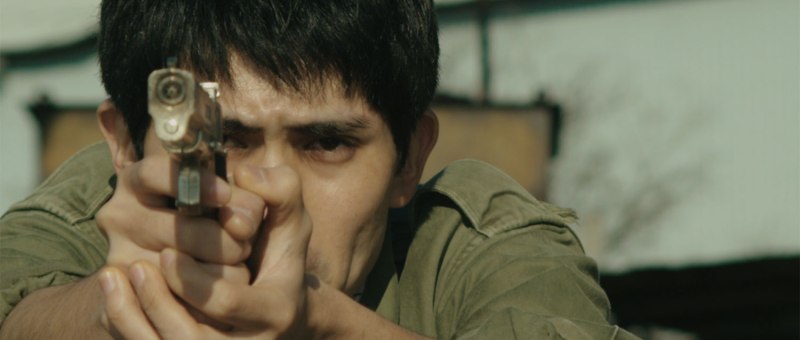
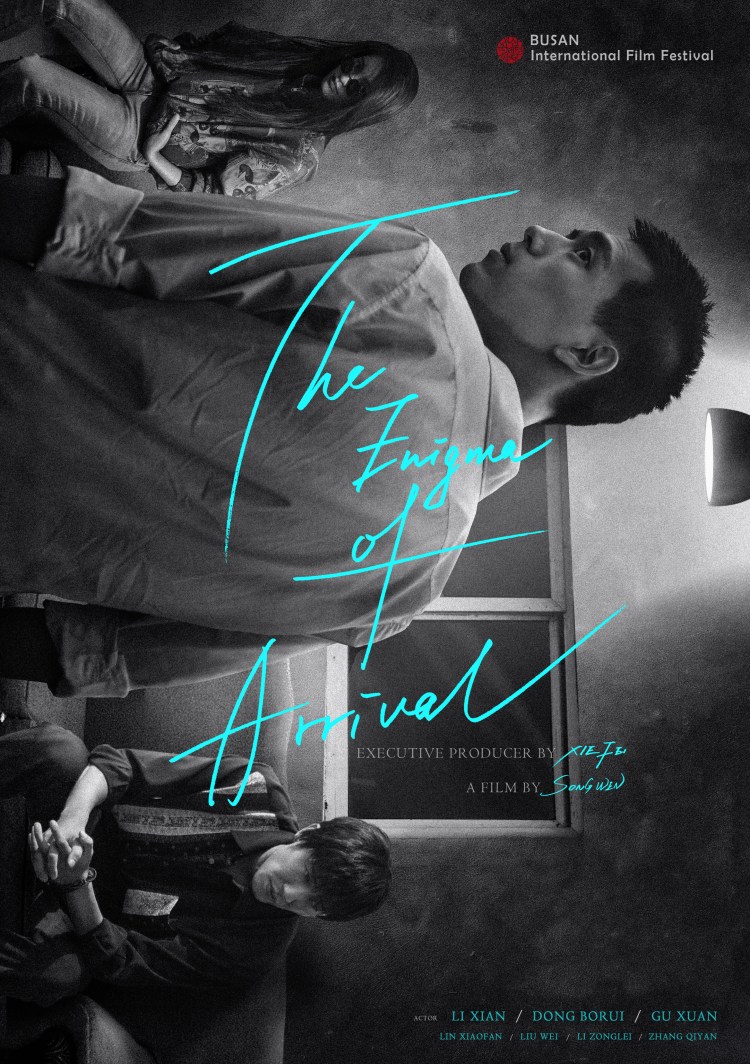
The Enigma of Arrival (抵达之谜, Song Wen, 2018)

The Enigma of the Arrival posterChinese cinema has always had a fondness for melancholy nostalgia. Perhaps its natural enough to romanticise one’s youth and long for a simpler time of possibility, though that same desire for “innocence” has often been read as a rebuke on the “soulless” modern economy and critique of Westernising individualism of a China some feel has lost its way since the economic reforms of the ‘80s and beyond. Song Wen’s The Enigma of Arrival (抵达之谜, Dǐ Zhī Mí), seemingly borrowing a title from the novel by VS Naipaul, seems more straightforwardly personal in its universality as it locates a single fracturing point in the lives of a collection of young people forced apart yet eternally connected by tragedy and disappointment.

Song begins in the present day with his 40-ish narrator, San Pi (Liu Wei), who tells us that he is looking forward to reuniting with his old friends with whom he has largely lost touch. Falling into a reverie, he takes us back to their harbourside hometown some 15 years or so previously when he used to hang out with three friends from school – Feng Yuan (Dong Borui), Xiaolong (Li Xian), and Da Si (Lin Xiaofan). Young men, they spent their time watching “cool” Hong Kong movies like Days of Being Wild and A Better Tomorrow, which were always followed by a blue movie watched incongruously in public. The trouble starts when the guys meet local beauty Dongdong (Gu Xuan) and are all instantly smitten. Hoping to get themselves a more impressive motorbike, they make a fateful decision to steal some diesel and sell it on, only the fuel they steal belongs to gangsters which lands them in a world of trouble they are ill-equipped to deal with despite their adolescent male posturing. Dongdong disappears without trace leaving the guys wounded and confused.

As San Pi tells us in his opening monologue, things are not always as they seem, “Life is floating between fiction and reality”. It’s a particularly apt comment from him because, as we later find out, he was present only for the single climactic events not for the ones which preceded and followed them. He didn’t go with the guys when they, mistakenly, tagged along with Dongdong to an athletics tournament to which she only intended to invite Xiaolong, and as he left soon after Dongdong disappeared his memories of those times are not first hand. He invites us to assume that each of the men has their own narrative which necessarily places themselves at the centre and offers a flattering portrait of their actions which attempts to absolve them of guilt for whatever they did or did not do to lose Dongdong.

A case in point, though it seems that Dongdong favoured Xiaolong who has spent the remainder of his life pining for her, Fang Yuan always thought she fancied him while Da Si was technically dating her friend Xiaomei (Zhang Qiyuan) but seems to have developed some kind of protective sympathy towards her which may have an edge of puritanical resentment. San Pi is the only one who does not seem to have engaged in sad romance, a perpetual outsider looking on from the edges. That might be why he seems to be the one eulogising their friendship, less hung up on what happened to Dongdong than on the effect it had on the later course of his life and that of his friends. Reuniting in a Japanese-style onsen, an ironic reminder of their youthful dreams to see Japan, he wonders if they might return to their teenage intimacy but discovers that youthful innocence cannot be reclaimed once lost, some secrets must stay secret, and some betrayals are too much to bear. They will never go to Japan together, or even catch a movie in a rundown theatre. It would be embarrassing; the moment has passed.

Song frames his tale in a mix of hazy images and black and white, neatly symbolising the patchwork quality of narrative assembled from memory and wishful thinking, coloured by a single perspective that lacks the composite whole of accepting the reality of others’ perceptions. In contrast to the longing for the old China that marks many a youth drama, Song’s young guys yearn for the world – they worship Hong Kong tough guys, listen to Western music, and dream of seeing Japan, but their present life is one of settled middle-aged disappointment marked by the unresolved tragedy of their pasts which both binds them together and forces them apart. “No one is flawless” Xiaolong is reminded, but somehow that only makes it worse. A melancholy ode to ruined friendship and the nostalgia of bygone adolescent possibility, Enigma of Arrival is a suitably abstract effort from the founder of the XINING FIRST International Film Festival and signals a bold new voice on the Chinese indie scene.


The Enigma of Arrival screens in Chicago on Sept. 19 as part of the ninth season of Asian Pop-Up Cinema where director Song Wen will be present for an intro and Q&A.

Original trailer (English subtitles)
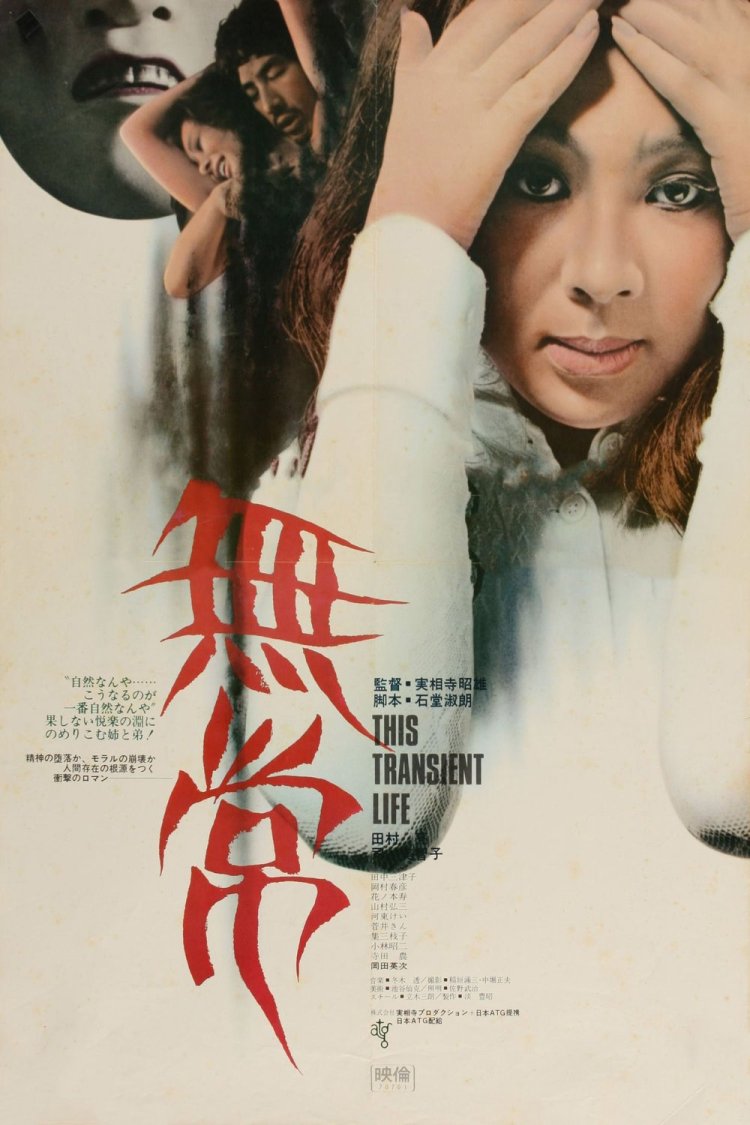
This Transient Life (無常, Akio Jissoji, 1970)

this transient life poster“People should do whatever pleases them, it’s because people suppress their desires that the world has become so complicated” the “hero” of Akio Jissoji’s 1970 Buddhist epic This Transient Life (無常, Mujo) impassively intones, “If we just do whatever pleases us, then everything will turn out fine”. As we will see, there are definite problems with Masao’s (Ryo Tamura) philosophy, but he may have something in the inherent paradox of Buddhism which finds serenity in nothingness while decrying nihilism.

We first meet Masao, a wealthy young man from a noble family, jumping over a wall in defiant violation of a no trespassing sign. He is in hiding, avoiding going home because his austere father (Kozo Yamamura) is due to arrive for another dose of parental oppression. His sister, Yuri (Michiko Tsukasa), comes to fetch him knowing that they cannot resist forever. Like her brother who rejects university and the corporate life, Yuri rejects marriage and seems intent on deciding her own future, only she does not seem to have any other path in mind. Left alone in the house while their parents attend a family function, disinviting the kids because of their ongoing recalcitrance, the siblings put on a pair of noh masks and chase each other around the house. Gradually a primal spirit takes over. Masao seduces his own sister, beginning a dangerous and necessarily illicit affair for no other reason than to prove that he can.

Ogino (Haruhiko Okamura), a reluctant Buddhist priest at the local temple who is perhaps himself in love with Yuri though apparently unwilling to pursue her even though there is nothing in his religion which forbids him, later takes Masao to task for his dark philosophy. Branding him a chaos agent who creates hell wherever he goes, Ogino urges him to absent himself from the society of others, go travelling, keep his hedonistic nihilism to himself. Masao, however, counters that he has only made the world more “colourful”, that in the end all he has done is dig out the true essence from the hearts of those around him. People do what they want, and nothing he says or does is in any way relevant save that they each faced their own destinies as they intersected with his. To Ogino’s mind, being overly aware of your destiny is no good thing, in fact Buddha will place his hand over your eyes to prevent just that, but to Masao the power to discern his own fate that which gives him the terrifying power to act solely according to his desires.

Meanwhile, the men around him seem to flounder in their own repression. Discovering the transgressive relationship between Masao and his sister, Ogino keeps quiet but finds himself caressing a statue of the goddess Kanon, while the family’s servant Iwashita (Kotobuki Hananomoto) secretly peeps on Yuri in the bath, and Masao’s later mentor, the sculptor Mori (Eiji Okada), actively encourages him to sleep with his much younger wife looking on as he does. “Women are nothing” Masao coldly exclaims, they are “curious animals” who want “immediate pleasure”. Seduced by Mori’s lonely wife Reiko (Mitsuko Tanaka), he later leaves decrying her as a whore who has commodified the act of love as if she were merely a receptacle for his desires much like the shapeless wood which receives the passions of the sculptor and eventually assumes its chosen form.

Masao and Yuri rebel against conventionality and bourgeois values through the ultimate taboo, bearing out Ogino’s criticism of Masao’s philosophy as “nothing but disorder”. Their transgression spirals and informs others. A disruptive influence in his master’s household, Masao pushes Mori’s resentful son (Isao Sasaki) into a quasi-incestuous relationship with his step-mother, while pushing his sister into a socially transgressive marriage to a servant to cover-up the “crime” of a child conceived not only out wedlock but with incestuous blood. He absolves himself for the blood on his hands claiming that every man makes his own choice, and posits himself as the only truly enlightened being as an embodiment of realised desire. Ogino calls him a mad man, but he alone is able to achieve a kind of enlightenment and enter a higher plane, transcending normal human consciousness. “Life and death are a great matter, treasure your time” the title card advises us. Masao rejects the “unappealing” simplicity of heaven for the chaotic pleasures of a transient existence, impressing his own desires on a repressive society and watching indifferently as their terrible flowers bloom.


This Transient Life is the first of four films included in Arrow’s Akio Jissoji: The Buddhist Trilogy box set which also features an introduction and selected scene commentaries by scholar of the Japanese New Wave David Desser plus a 60-page booklet with new writing by Tom Mes and Anton Bitel.

 Opening scene (English subtitles)

Tokyo Ghoul S (東京喰種 トーキョーグール【S】, Kazuhiko Hiramaki & Takuya Kawasaki, 2019)

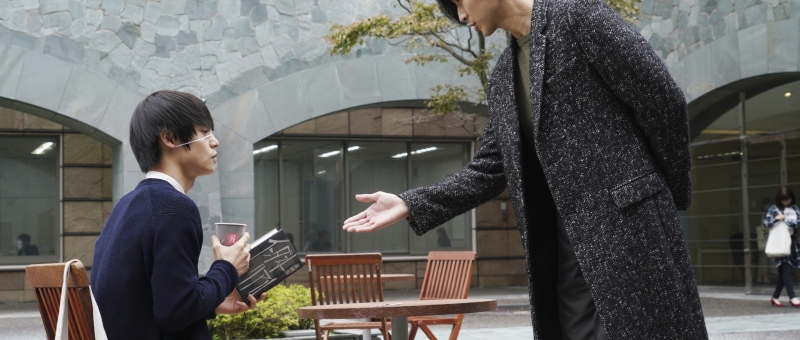
tg2_poster_3校B_ol_6In Tokyo Ghoul, regular university student Ken Kaneki (Masataka Kubota) had to learn to accept the parts of himself he didn’t like in order to become the kind of man he wanted to be. Of course, the situation was more complicated than that faced by most young men because Ken Kaneki’s darkness was born of being seduced by a beautiful woman who turned out to be a “ghoul” – a supernatural being craving human flesh, something he later became himself when they were both injured in a freak accident after which he got some of her organs. The sequel, Tokyo Ghoul S (東京喰種 トーキョーグール【S】) finds him in a more centred place, having accepted his new nature as neither human nor ghoul but a bridge between the two. Now he has a series of different questions to face in trying help others accept themselves in the same way as they too wonder if there are some parts of themselves so dark that if they revealed them they could never be loved.

While Ken goes about his regular student life working part-time at ethical ghoul cafe Anteiku, a ghoul serial killer known as “The Gourmet” (Shota Matsuda) has been making the news after targeting a high profile model (Maggy) whom he stalked and killed simply to taste her heterochromatic eyes. Tsukiyama, as we later learn his name to be, is a dandyish fopp living in a Western-style country house complete with servants who serve him only the finest meals well presented to hide their dark genesis. On catching a whiff of Ken’s unique human/ghoul scent, he knows he must taste him and puts a nefarious plan in motion in order to lure him to a mysterious ghoul-only restaurant where humans are butchered live for show while the clientele salivate over scenes of intense cruelty.

That’s all too much for poor Ken. He can’t understand how anybody could act with so little regard for life. The cafe owner pointedly asks him if he feels pity when looking at the butchered flesh of an animal, which he of course does not. The ghouls feel much the same, humans are their prey – they can’t help what they are, but living under the intense fear of discovery in an obviously hostile world has made them cruel and resentful to the extent that they no longer understand the value of life. The ghouls that Ken knows, the ones which frequent Anteiku, are different. They have resolved to live ethically and respect lives both human and ghoul equally.

Ken’s friend and colleague Touka (Maika Yamamoto), however, is beginning to have her doubts. In the first film we saw her pursue a touching friendship with classmate Yoriko (Nana Mori) whose cooking she made a point of eating solely as a means of connection despite the fact that human food makes her ill. Now she fears she’s doing the wrong thing, that it will only hurt more if her friend finds out her secret and rejects her, or worse that she may put her in danger. Therefore, she counsels Ken to distance himself from his overly cheerful friend Hide (Kai Ogasawara) and the human world in general, threatening that she herself will kill Hide if he discovers that Ken is a ghoul. As expected, Ken ignores her advice but is mildly shaken by it. Deciding to intervene when his sometime enemy Nishiki (Shunya Shiraishi) is being beaten up in the street, he discovers a better future on learning that Nishiki is living with a human woman who knows he is a ghoul, but loves him anyway.

Though Kimi’s (Mai Kiryu) justifications that she can live with the fact her boyfriend kills people and eats them so long as he leaves her friends and family alone is a little worrying, it is a touching example of the film’s positive message that there is no secret so terrible that it means someone can’t be loved. Kimi accepts Nishiki’s nature as a ghoul, aware of the fact he can’t help what he is and that if she had been born a ghoul she would be the same. Touka fears rejection, but on catching sight of her bright red wings Kimi utters the single word “beautiful”, seeing only goodness without fear or hate.

Tsukiyama meanwhile seems to have gone in the opposite direction, pursuing his desires to the point of obsession in a quest for ever greater sensation. He stalks and murders the model to devour her eyes in an especial piece of irony, while his pursuit of Ken takes on an intensely homoerotic quality. Using the same tactics as Tokyo Ghoul‘s Rize, Tsukiyama picks Ken up through bonding over books, invites him to “dinner” and later sends him an invitation accompanied by a single red rose. Despite the romanticism, however, he soon reverts to type in blaming Ken for his actions. “You’re making me this way”, he insists, “take responsibility”, like every abuser ever simultaneously accepting that his behaviour is inappropriate and justifying it as a consequence of someone else’s actions. In the end, Tsukiyama’s illicit desires consume him, while Ken’s act of self-sacrifice once again allows him to be the human/ghoul bridge combatting Tsukiyama’s rapacious cruelty with an open-hearted generosity which pushes Touka to the fore so that she too can learn that peaceful co-existence is possible when there is trust and understanding on both sides.

Nishiki tells Ken his problem is that he’s too nice, but that’s not a bad thing to be because he just might “save somebody someday”. Niceness as a superpower might be an odd message for a movie about flesh eating monsters almost indistinguishable from regular humans, but perhaps that’s what will save us in the end, a generosity of spirit that makes it possible for us each to accept each other’s darkness in acknowledgement of our own. Less stylistically interesting than the first instalment, Tokyo Ghoul S may be a kind of bridge movie in a possible trilogy (a sequel is teased in a brief mid-credits sequence featuring a mysterious character who makes several unexplained appearances throughout the film), but nevertheless does its best to further the Tokyo Ghoul mythology as its hero finds his strength in difference and mutual understanding.


Tokyo Ghoul S screens in the US for three nights only on Sept. 16/18/20 courtesy of Funimation. Check the official website to find out where it’s playing near you!

Original trailer (English subtitles)

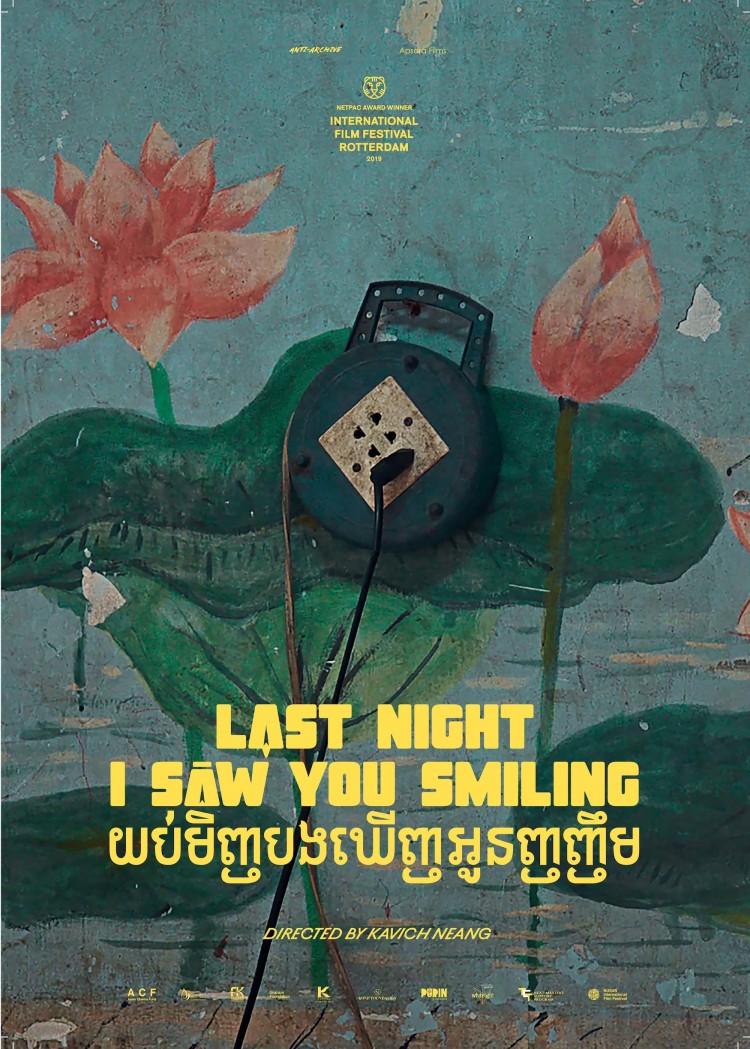
Last Night I Saw You Smiling (យប់មិញបងឃើញអូនញញឹម, Kavich Neang, 2019)

LastNightISawYouSmiling“We’re used to seeing a house for its roof, windows, and walls. But in the end, as we move out of here, it breaks my heart.” Words ironically offered by a sculptor, one who might above all have learned to fall in love with the shape of things, as he prepares to leave a place in which he has made his life. Filmmaker Kavich Neang grew up in the iconic “White Building” of Phnom Penh, Cambodia. Built in 1963, the building was a bold statement from a new nation as it threw off the colonial yoke to claim a new identity, literally extending the territory as it situated itself on reclaimed land – a well appointed complex of bright white stone amid the serenity of spacious parkland.

Intended to house those of moderate income, the White Building first fell into disrepair during the brutalising reign of the Khmer Rouge whose evacuation of the city left it empty for four years. In 1979 after the regime fell, the people began to return and the building once again became a beacon of culture in a modernising city, a vertical village home to artists and civil servants. Progress, however, began to work it against it, and by the time it was condemned in 2015 the building was regarded by many as a slum associated with drugs, crime, and sex work. Nevertheless, it was still home to 493 families, Neang’s among them, many of whom had lived there since the ‘80s and vividly recall the last time they were told they would need to vacate.

The anxieties are, of course, different, but they are there all the same. No one is marching them out by gunpoint, and they have a choice in where they go (in theory, at least), but the truth remains that people are being forced out of their homes against their will. While it is true that the building may have become unsafe and has been deemed unsalvageable despite attempts to preserve its architectural history, many worry that the promised compensation will never arrive or that, for those who lived in the smaller flats, they have been priced out of the modern Phnom Penh and will not be able to find equivalent accommodation using only the money they have been offered but have not yet received. This turns out to be more or less the case with many of the elderly residents returning to live with extended family, in some cases leaving the city entirely, while others retreat to the suburban margins. 

In this sense, Neang documents his neighbours and family “burying” the building as they slowly dismantle the history of their lives within it. At an early meeting with officials, some are keen to confirm that they will be allowed to take doors and windows with them, and so we gradually see doorframes pulled away from walls and fretwork removed from the outside to be incongruously pulled back in. Yet others struggle to bundle their personal belongings, unsure of where they’re going or what they will need in the knowledge they will never, can never return because this place will eventually cease to exist.

Indeed, taking its name from a nostalgic pop song, Last Night I Saw You Smiling (យប់មិញបងឃើញអូនញញឹម) is a funeral elegy for the spirit of a place now departing. Neang opens with a silent corridor and then fills it with life – children playing, women singing, doors open in neighbourly communion. He ends in the same place as the building breathes its last, either liberated or devoured, transitioning to bright white light as if its soul really had departed to a better place. Retro pop songs fill the air singing of lost love, not only of its immediate pain but of the incurable longing of unfulfilled desire for a world that no longer exists and lives only in the halls of memory. You can never go home again, because “home” is a moment, a feeling which is always passing and forever elusive. People give a place soul, only to for that connection to be painfully severed when they must inevitably leave it leaving a piece of themselves behind. The White Building is gone, the community scattered, but the ghost of it lives on, invisible yet ever present.


Screened as part of the 2019 Open City Documentary Festival in partnership with Day For Night who will be distributing the film in the UK.

Festival trailer (English subtitles)