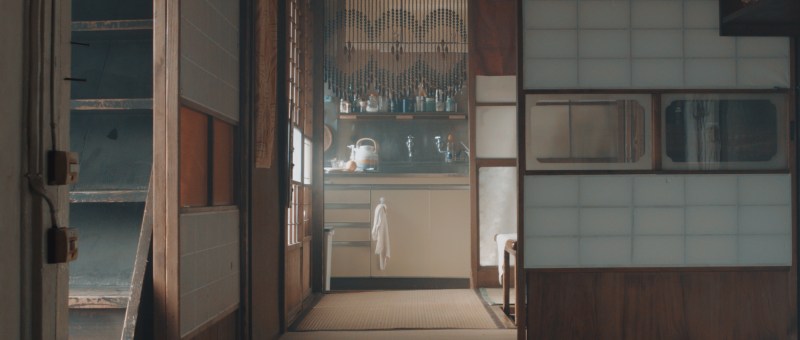
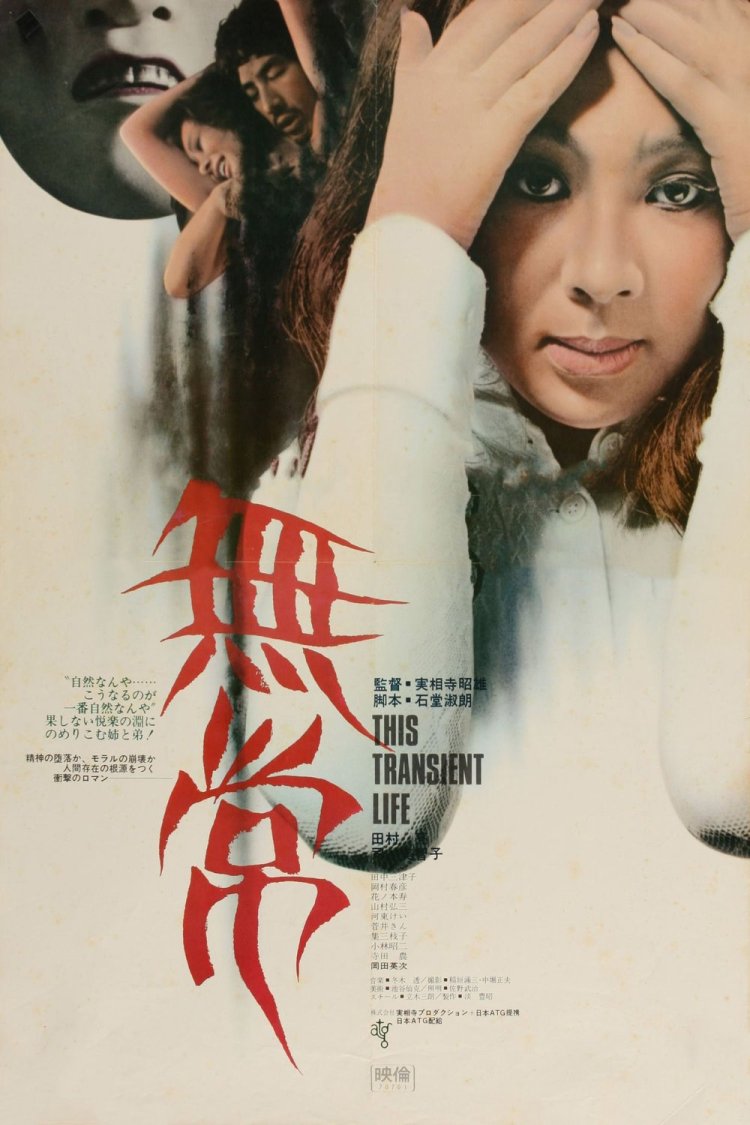
This Transient Life (無常, Akio Jissoji, 1970)

this transient life poster“People should do whatever pleases them, it’s because people suppress their desires that the world has become so complicated” the “hero” of Akio Jissoji’s 1970 Buddhist epic This Transient Life (無常, Mujo) impassively intones, “If we just do whatever pleases us, then everything will turn out fine”. As we will see, there are definite problems with Masao’s (Ryo Tamura) philosophy, but he may have something in the inherent paradox of Buddhism which finds serenity in nothingness while decrying nihilism.

We first meet Masao, a wealthy young man from a noble family, jumping over a wall in defiant violation of a no trespassing sign. He is in hiding, avoiding going home because his austere father (Kozo Yamamura) is due to arrive for another dose of parental oppression. His sister, Yuri (Michiko Tsukasa), comes to fetch him knowing that they cannot resist forever. Like her brother who rejects university and the corporate life, Yuri rejects marriage and seems intent on deciding her own future, only she does not seem to have any other path in mind. Left alone in the house while their parents attend a family function, disinviting the kids because of their ongoing recalcitrance, the siblings put on a pair of noh masks and chase each other around the house. Gradually a primal spirit takes over. Masao seduces his own sister, beginning a dangerous and necessarily illicit affair for no other reason than to prove that he can.

Ogino (Haruhiko Okamura), a reluctant Buddhist priest at the local temple who is perhaps himself in love with Yuri though apparently unwilling to pursue her even though there is nothing in his religion which forbids him, later takes Masao to task for his dark philosophy. Branding him a chaos agent who creates hell wherever he goes, Ogino urges him to absent himself from the society of others, go travelling, keep his hedonistic nihilism to himself. Masao, however, counters that he has only made the world more “colourful”, that in the end all he has done is dig out the true essence from the hearts of those around him. People do what they want, and nothing he says or does is in any way relevant save that they each faced their own destinies as they intersected with his. To Ogino’s mind, being overly aware of your destiny is no good thing, in fact Buddha will place his hand over your eyes to prevent just that, but to Masao the power to discern his own fate that which gives him the terrifying power to act solely according to his desires.

Meanwhile, the men around him seem to flounder in their own repression. Discovering the transgressive relationship between Masao and his sister, Ogino keeps quiet but finds himself caressing a statue of the goddess Kanon, while the family’s servant Iwashita (Kotobuki Hananomoto) secretly peeps on Yuri in the bath, and Masao’s later mentor, the sculptor Mori (Eiji Okada), actively encourages him to sleep with his much younger wife looking on as he does. “Women are nothing” Masao coldly exclaims, they are “curious animals” who want “immediate pleasure”. Seduced by Mori’s lonely wife Reiko (Mitsuko Tanaka), he later leaves decrying her as a whore who has commodified the act of love as if she were merely a receptacle for his desires much like the shapeless wood which receives the passions of the sculptor and eventually assumes its chosen form.

Masao and Yuri rebel against conventionality and bourgeois values through the ultimate taboo, bearing out Ogino’s criticism of Masao’s philosophy as “nothing but disorder”. Their transgression spirals and informs others. A disruptive influence in his master’s household, Masao pushes Mori’s resentful son (Isao Sasaki) into a quasi-incestuous relationship with his step-mother, while pushing his sister into a socially transgressive marriage to a servant to cover-up the “crime” of a child conceived not only out wedlock but with incestuous blood. He absolves himself for the blood on his hands claiming that every man makes his own choice, and posits himself as the only truly enlightened being as an embodiment of realised desire. Ogino calls him a mad man, but he alone is able to achieve a kind of enlightenment and enter a higher plane, transcending normal human consciousness. “Life and death are a great matter, treasure your time” the title card advises us. Masao rejects the “unappealing” simplicity of heaven for the chaotic pleasures of a transient existence, impressing his own desires on a repressive society and watching indifferently as their terrible flowers bloom.


This Transient Life is the first of four films included in Arrow’s Akio Jissoji: The Buddhist Trilogy box set which also features an introduction and selected scene commentaries by scholar of the Japanese New Wave David Desser plus a 60-page booklet with new writing by Tom Mes and Anton Bitel.

 Opening scene (English subtitles)

Tokyo Ghoul S (東京喰種 トーキョーグール【S】, Kazuhiko Hiramaki & Takuya Kawasaki, 2019)

tg2_poster_3校B_ol_6In Tokyo Ghoul, regular university student Ken Kaneki (Masataka Kubota) had to learn to accept the parts of himself he didn’t like in order to become the kind of man he wanted to be. Of course, the situation was more complicated than that faced by most young men because Ken Kaneki’s darkness was born of being seduced by a beautiful woman who turned out to be a “ghoul” – a supernatural being craving human flesh, something he later became himself when they were both injured in a freak accident after which he got some of her organs. The sequel, Tokyo Ghoul S (東京喰種 トーキョーグール【S】) finds him in a more centred place, having accepted his new nature as neither human nor ghoul but a bridge between the two. Now he has a series of different questions to face in trying help others accept themselves in the same way as they too wonder if there are some parts of themselves so dark that if they revealed them they could never be loved.

While Ken goes about his regular student life working part-time at ethical ghoul cafe Anteiku, a ghoul serial killer known as “The Gourmet” (Shota Matsuda) has been making the news after targeting a high profile model (Maggy) whom he stalked and killed simply to taste her heterochromatic eyes. Tsukiyama, as we later learn his name to be, is a dandyish fopp living in a Western-style country house complete with servants who serve him only the finest meals well presented to hide their dark genesis. On catching a whiff of Ken’s unique human/ghoul scent, he knows he must taste him and puts a nefarious plan in motion in order to lure him to a mysterious ghoul-only restaurant where humans are butchered live for show while the clientele salivate over scenes of intense cruelty.

That’s all too much for poor Ken. He can’t understand how anybody could act with so little regard for life. The cafe owner pointedly asks him if he feels pity when looking at the butchered flesh of an animal, which he of course does not. The ghouls feel much the same, humans are their prey – they can’t help what they are, but living under the intense fear of discovery in an obviously hostile world has made them cruel and resentful to the extent that they no longer understand the value of life. The ghouls that Ken knows, the ones which frequent Anteiku, are different. They have resolved to live ethically and respect lives both human and ghoul equally.

Ken’s friend and colleague Touka (Maika Yamamoto), however, is beginning to have her doubts. In the first film we saw her pursue a touching friendship with classmate Yoriko (Nana Mori) whose cooking she made a point of eating solely as a means of connection despite the fact that human food makes her ill. Now she fears she’s doing the wrong thing, that it will only hurt more if her friend finds out her secret and rejects her, or worse that she may put her in danger. Therefore, she counsels Ken to distance himself from his overly cheerful friend Hide (Kai Ogasawara) and the human world in general, threatening that she herself will kill Hide if he discovers that Ken is a ghoul. As expected, Ken ignores her advice but is mildly shaken by it. Deciding to intervene when his sometime enemy Nishiki (Shunya Shiraishi) is being beaten up in the street, he discovers a better future on learning that Nishiki is living with a human woman who knows he is a ghoul, but loves him anyway.

Though Kimi’s (Mai Kiryu) justifications that she can live with the fact her boyfriend kills people and eats them so long as he leaves her friends and family alone is a little worrying, it is a touching example of the film’s positive message that there is no secret so terrible that it means someone can’t be loved. Kimi accepts Nishiki’s nature as a ghoul, aware of the fact he can’t help what he is and that if she had been born a ghoul she would be the same. Touka fears rejection, but on catching sight of her bright red wings Kimi utters the single word “beautiful”, seeing only goodness without fear or hate.

Tsukiyama meanwhile seems to have gone in the opposite direction, pursuing his desires to the point of obsession in a quest for ever greater sensation. He stalks and murders the model to devour her eyes in an especial piece of irony, while his pursuit of Ken takes on an intensely homoerotic quality. Using the same tactics as Tokyo Ghoul‘s Rize, Tsukiyama picks Ken up through bonding over books, invites him to “dinner” and later sends him an invitation accompanied by a single red rose. Despite the romanticism, however, he soon reverts to type in blaming Ken for his actions. “You’re making me this way”, he insists, “take responsibility”, like every abuser ever simultaneously accepting that his behaviour is inappropriate and justifying it as a consequence of someone else’s actions. In the end, Tsukiyama’s illicit desires consume him, while Ken’s act of self-sacrifice once again allows him to be the human/ghoul bridge combatting Tsukiyama’s rapacious cruelty with an open-hearted generosity which pushes Touka to the fore so that she too can learn that peaceful co-existence is possible when there is trust and understanding on both sides.

Nishiki tells Ken his problem is that he’s too nice, but that’s not a bad thing to be because he just might “save somebody someday”. Niceness as a superpower might be an odd message for a movie about flesh eating monsters almost indistinguishable from regular humans, but perhaps that’s what will save us in the end, a generosity of spirit that makes it possible for us each to accept each other’s darkness in acknowledgement of our own. Less stylistically interesting than the first instalment, Tokyo Ghoul S may be a kind of bridge movie in a possible trilogy (a sequel is teased in a brief mid-credits sequence featuring a mysterious character who makes several unexplained appearances throughout the film), but nevertheless does its best to further the Tokyo Ghoul mythology as its hero finds his strength in difference and mutual understanding.


Tokyo Ghoul S screens in the US for three nights only on Sept. 16/18/20 courtesy of Funimation. Check the official website to find out where it’s playing near you!

Original trailer (English subtitles)

Last Night I Saw You Smiling (យប់មិញបងឃើញអូនញញឹម, Kavich Neang, 2019)

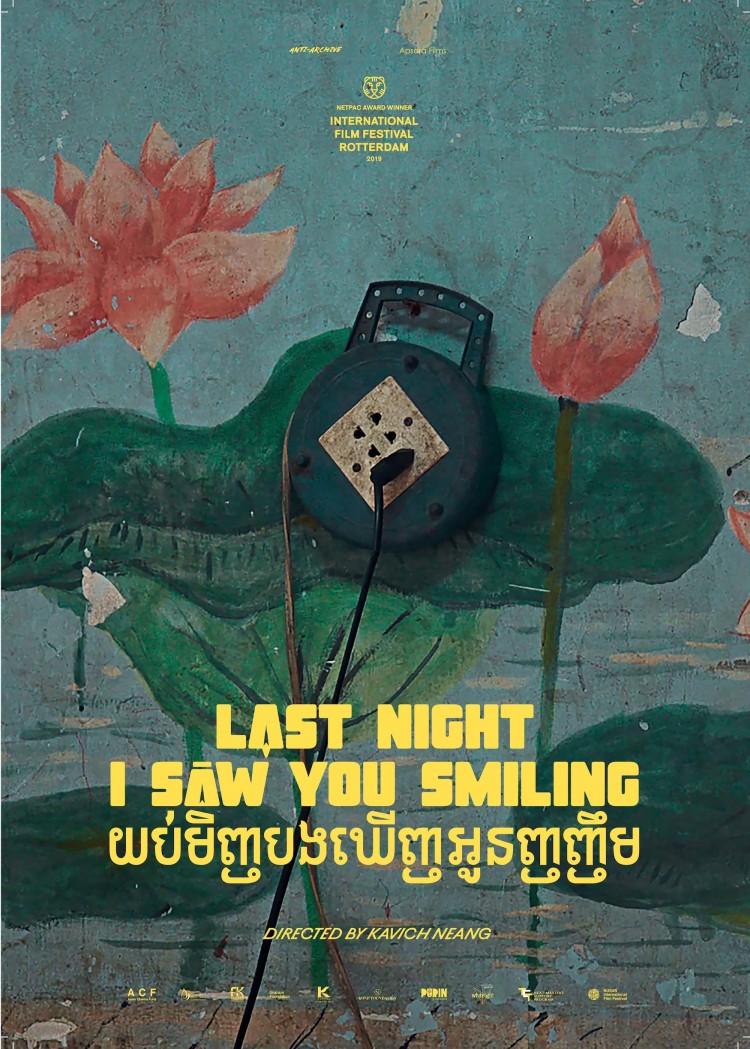
LastNightISawYouSmiling“We’re used to seeing a house for its roof, windows, and walls. But in the end, as we move out of here, it breaks my heart.” Words ironically offered by a sculptor, one who might above all have learned to fall in love with the shape of things, as he prepares to leave a place in which he has made his life. Filmmaker Kavich Neang grew up in the iconic “White Building” of Phnom Penh, Cambodia. Built in 1963, the building was a bold statement from a new nation as it threw off the colonial yoke to claim a new identity, literally extending the territory as it situated itself on reclaimed land – a well appointed complex of bright white stone amid the serenity of spacious parkland.

Intended to house those of moderate income, the White Building first fell into disrepair during the brutalising reign of the Khmer Rouge whose evacuation of the city left it empty for four years. In 1979 after the regime fell, the people began to return and the building once again became a beacon of culture in a modernising city, a vertical village home to artists and civil servants. Progress, however, began to work it against it, and by the time it was condemned in 2015 the building was regarded by many as a slum associated with drugs, crime, and sex work. Nevertheless, it was still home to 493 families, Neang’s among them, many of whom had lived there since the ‘80s and vividly recall the last time they were told they would need to vacate.

The anxieties are, of course, different, but they are there all the same. No one is marching them out by gunpoint, and they have a choice in where they go (in theory, at least), but the truth remains that people are being forced out of their homes against their will. While it is true that the building may have become unsafe and has been deemed unsalvageable despite attempts to preserve its architectural history, many worry that the promised compensation will never arrive or that, for those who lived in the smaller flats, they have been priced out of the modern Phnom Penh and will not be able to find equivalent accommodation using only the money they have been offered but have not yet received. This turns out to be more or less the case with many of the elderly residents returning to live with extended family, in some cases leaving the city entirely, while others retreat to the suburban margins. 

In this sense, Neang documents his neighbours and family “burying” the building as they slowly dismantle the history of their lives within it. At an early meeting with officials, some are keen to confirm that they will be allowed to take doors and windows with them, and so we gradually see doorframes pulled away from walls and fretwork removed from the outside to be incongruously pulled back in. Yet others struggle to bundle their personal belongings, unsure of where they’re going or what they will need in the knowledge they will never, can never return because this place will eventually cease to exist.

Indeed, taking its name from a nostalgic pop song, Last Night I Saw You Smiling (យប់មិញបងឃើញអូនញញឹម) is a funeral elegy for the spirit of a place now departing. Neang opens with a silent corridor and then fills it with life – children playing, women singing, doors open in neighbourly communion. He ends in the same place as the building breathes its last, either liberated or devoured, transitioning to bright white light as if its soul really had departed to a better place. Retro pop songs fill the air singing of lost love, not only of its immediate pain but of the incurable longing of unfulfilled desire for a world that no longer exists and lives only in the halls of memory. You can never go home again, because “home” is a moment, a feeling which is always passing and forever elusive. People give a place soul, only to for that connection to be painfully severed when they must inevitably leave it leaving a piece of themselves behind. The White Building is gone, the community scattered, but the ghost of it lives on, invisible yet ever present.


Screened as part of the 2019 Open City Documentary Festival in partnership with Day For Night who will be distributing the film in the UK.

Festival trailer (English subtitles)

Ne Zha (哪吒之魔童降世, Jiaozi, 2019)

2755835c-570e-44bc-b2f2-515f706369bd_64fa474eb6b5a53c36be9bcd9311f283ce949be6_w1290_h1905Can you choose who you are, or is your identity constructed by accidents of birth and the society all around you? It’s a complicated question and even more so if you happen to have been born part demon thanks to a cosmological mixup. An origin movie of sorts for the titular hero familiar to most from classical Chinese folklore, Ne Zha (哪吒之魔童降世, Nézhā zhī Mótóng Jiàngshì) asks just that through the story of an extremely naughty, all powerful little boy who might be evil or just misunderstood and resentfully lonely because of the prejudice held against him by those fearful of his differences.

The trouble begins with the Chaos Pill which can pull power from sun and moon equally, threatening the integrity of the universe itself. Thankfully, the Heavenly King manages to split it into the Demon Pill and the Spirit Pill, enclosing both inside a lotus flower. He intends to send the Spirit Pill into the third son of general Li Jing (Chen Hao) and has put a curse on the Demon Pill so that it will be destroyed by lightening in three years’ time. Predictably nothing goes to plan because drunken deity Taiyi Zhenren (Zhang Jiaming) fails to stop the evil Shen Gongbao (Yang Wei) sending his minions in to steal the Spirit Pill and use it for his own ends. The Demon Pill ends up in the son of Li Jing, Ne Zha (Lü Yanting), who emerges from his mother’s womb as a bouncing ball of flesh before transforming himself into a small boy and proceeding to wreak havoc all over town.

Doting parents Li Jing and Madam Yin (Lü Qi) refuse to believe their son is all “bad” but recognise that they have a duty to the townspeople who are quickly fed up with Ne Zha’s antics and traumatised by years of being terrorised by “demons”. They would rather do away with the irascible little rascal, but could it be that he’s just bored and lonely? Given the increased demon threat, Madam Yin is often away slaying things and regrets she doesn’t have more time for her son while the other kids are afraid of him, both for quite rational reasons and also because his main way of making friends is quite mean. Increasingly resentful at being shunned as a “demon”, Ne Zha strikes back at the villagers in ways which are really just naughty rather than actually “evil” but obviously aren’t going to win him any friends.

Having failed to get help from the Heavenly Father who has predictably waltzed off for a bit as gods seem to do anytime there’s an actual problem in the mortal realm that they probably caused through inefficient planning, Li Jing decides to lie to his son that he’s really the Spirit Pill and has a duty to slay demons and help mankind. The deception begins to work. Imprisoned in a painting where Zhenren tries to teach him useful magic, Ne Zha takes his new responsibilities seriously, eventually escaping and trying to rescue a little girl who has been kidnapped by a water troll. Sadly, he goes about it all wrong and the townspeople embrace their prejudice to jump to the conclusion that he kidnapped the kid himself and has become even more dangerous.

Meanwhile, evil Shen Gongbao faces a similar problem as a deity shunned because he’s jaguar spirit who took human form. Allying with the villainous Dragons who have been given an ironic punishment to run a prison from which they can’t escape either, he gives the Spirit Pill to their bright hope Ao Bing (Han Mo) who, mirroring Ne Zha, struggles to accept his “evil” parentage and continues to do good and noble things behind his parents’ backs. Meeting by chance, the pair became friends but inevitably have to do battle before realising that they are two halves of one whole and thus represent a kind of salvation in linking hands rather than raising them.

Ao Bing, despite himself, is the more filial in that he thinks he has to accept the “destiny” his parents have given him as a liberator even if he doesn’t quite agree with their methods or reasoning. Ne Zha, by contrast, concludes that his fate is to resist his fate. He might not win, but he’ll fight it all the way and decide for himself who he is rather than allowing others to tell him. Genuinely funny, filled with amusing gags, and packed full of heart, Ne Zha is a gorgeously animated family fantasy and an impassioned advocation for living by your own principles while refusing to be bound by the unsolicited opinions of others.


Currently on limited cinema release courtesy of Cine Asia in the UK, and Well Go in the US.

Original trailer (English subtitles)
Love and Goodbye and Hawaii (恋とさよならとハワイ, Shingo Matsumura, 2017)

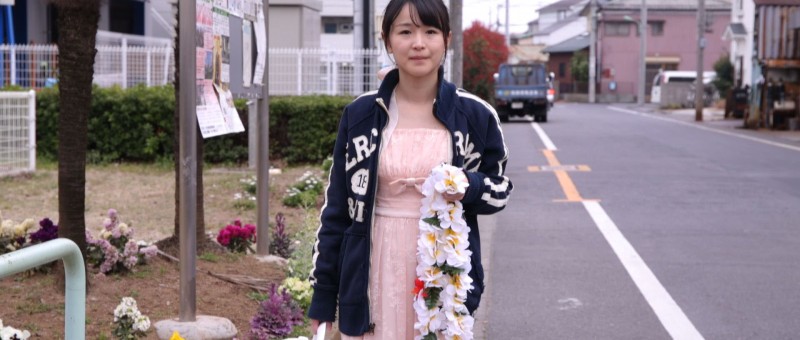
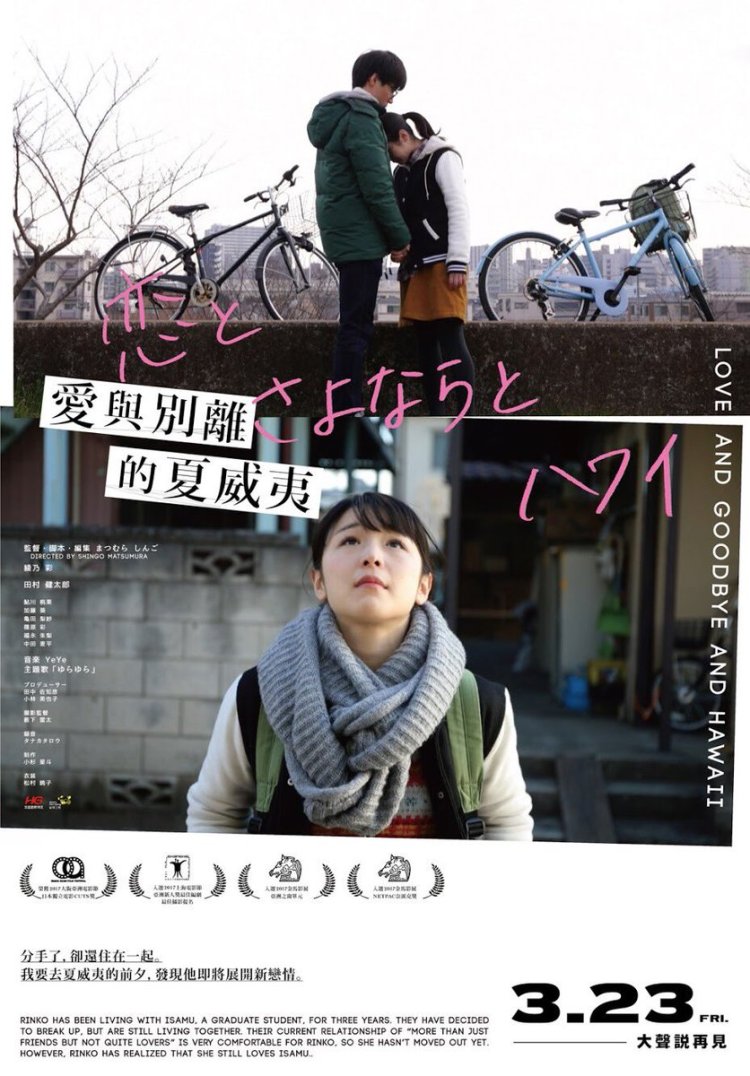
Love and Goodbye and Hawaii poster 1“To end something requires more courage than anything else” the conflicted heroine of Shingo Matsumura’s Love and Goodbye and Hawaii (恋とさよならとハワイ, Koi to Sayonara to Hawaii) is told by her well-meaning ex, but it’s a lesson she’s struggling to learn. Life may very well be a “road made of decisions”, but Rinko (Aya Ayano) doesn’t know how to make them and is rapidly becoming aware that if you don’t hit the relevant dialogue box fast enough they will largely be made for you. Less a tale of romantic confusion, Love and Goodbye and Hawaii is a young woman’s gradual path towards accepting that her attachment to the status quo is as much about the fear of moving forward as it is the pain of faded love.

Office worker Rinko has been living with her graduate student boyfriend Isamu (Kentaro Tamura) for the last three years. To all of their friends, they seem to have the perfect relationship but what no one knows is that, though they continue to live together, the couple broke up some months previously. Seeing as it was Isamu’s apartment in the first place, Rinko plans to move out as soon as she’s saved enough money to find somewhere new in the precarious Tokyo housing market, but then again now that they’re no longer “together” the arrangement has become so comfortable that there’s really no hurry to make a change. Matters come to a head, however, when Rinko discovers that a fellow student at Isamu’s university has taken a liking to him, and it seems he to her.

Despite having been broken up for almost six months, Rinko hasn’t quite accepted that it’s over. She demurs when her friends ask her if she’ll be getting married soon, only latterly admitting that they’ve technically broken up, and explaining that she really has it good now because it was too “heavy” before which is why they fought all the time. Now that there’s “nothing” to fight over and they’ve gone back to being platonic friends it’s all so much easier. Too easy, in fact, which why she isn’t really ready to move on.

Rinko’s unconventional living arrangements seem extremely strange to her friends. “Break up like normal people and never see him again” her friend tells her, offering her a space on the sofa if it’s money that’s the issue. Not that money’s not a problem, but even when well-meaning people offer financial help to end this “weird” situation, Rinko doesn’t really want to take it. She tells her friend that relationships are like driving and you don’t want to jump on the breaks incase they jam and you end up on the skids, but as her perceptive younger sister points out perhaps she just wants to get back together and doesn’t know how to go about it.

Analogies are something Rinko seems to have a taste for, unable to state her feelings plainly in a way others will understand she wraps them up in a more palatable narrative. So it is that she ends up telling her friend’s drunken younger sister that with Isamu she felt like she was CD no other player had worked out how to play. She figured out she liked the sound inside her when she was with him, but time moves on and it feels like she’s still a CD but Isamu is now an iPod and she doesn’t really know what to do with that. What she’s trying to say is that they’ve grown apart, but what she hasn’t quite admitted to herself is that maybe it’s not Isamu that she’s afraid of leaving but the vision of herself as reflected in him.

“Show your real self, put your real feelings out there” the younger woman tells her, but that’s something that doesn’t necessarily get easier with age. Finally gathering the courage, Rinko makes her way back to Isamu for a “serious talk”, only to run into her romantic rival but contrary to expectation the two women find that they have no interest in competition and only wish each other well. Rather than that “serious talk” however, Rinko ends up trying to sort out her romantic dilemma through the familiar medium of a walking race which does at least allow the diffident Isamu to make his feelings plain without actually having to say anything. Sometimes actions are kinder than words, and easier to understand. What Rinko needs to learn is that you can find self acceptance without needing to see it reflected in someone else, and that fear of moving forward is not a good reason for holding back. A quiet and melancholy look at life after love, Love, Goodbye and Hawaii is a gentle ode to the art of moving on with no hard feelings, looking straight ahead.


Original trailer (English subtitles)

Our House (わたしたちの家, Yui Kiyohara, 2017)

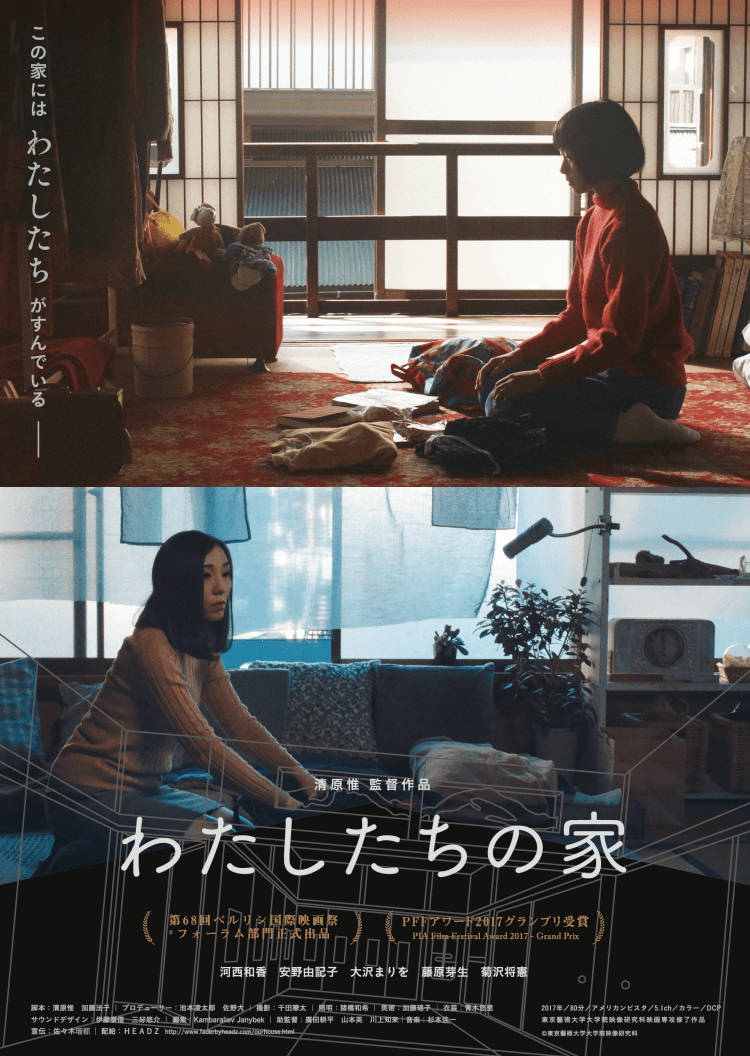
our house posterIs the definition of “space” defined by absence as much as presence? Do we carve out pieces of the world to inhabit, or simply shift into an idea of place which we construct entirely around ourselves? Yui Kiyohara’s feature debut Our House (わたしたちの家, Watashitachi no Ie), completed as part of her graduation project for a masters at Tokyo University of the Arts, hints at the eeriness of a shared existential continuum as four women bridge inter-dimensional connections while living in the “same” two-storey house in Yokohama.

We begin with 14-year-old Seri (Nodoka Kawanishi) dancing cheerfully with a few of her friends presumably on a sleepover wearing incongruously old-fashioned nightgowns like the heroines of a gothic boarding school drama. The fun stops however when Seri thinks she hears a funny noise, half convinced the house is haunted. Her friends tell her it’s all in her mind, but something seems odd and she can’t seem to shake the sense of presence in the house.

Part of that might be because, though Seri’s father appears to have left long ago, she still dwells on his memory and perhaps feels the echo of him in their family home. It may seem particularly poignant to her right now because her mother, Kiriko (Yukiko Yasuno), has found a new man – Takashi (Toshio Furuya), who drives the local rubbish truck. Kiriko wants to get married again, and Seri, entering adolescence herself and playfully teasing her friend about a possible romance, cannot quite accept that her mum’s moved on.

Changing tack, a young woman wakes up on a ferry with seemingly no memory of how she got there or of her previous life aside from her name, Sana (Mariwo Osawa). Another woman on the boat, Toko (Mei Fujiwara), stops to ask if she’s alright and then offers to let her stay at her place, which happens to be an identical house to the one in which Seri and her mum live, until she remembers who she is.

Though Seri’s story has its whimsy, it remains firmly within the realms of the natural while there’s something decidedly odd about the world Toko and Sana inhabit. There is, however, a strange symmetry to their relationships. Both sets of women are keeping things from one another if for slightly different reasons. There are after all secrets which must exist between a teenage girl and her mother, so perhaps Kiriko doesn’t quite discuss her relationship with Takashi with her daughter, and Seri doesn’t talk to her mother about the kinds of things she talks to her friend about, but there are also additional communication difficulties in their shared reluctance to talk about the “ghost” of Seri’s absent father or about Seri’s various anxieties which manifest in her preoccupation with a possible haunting.

With Toko and Sana there is of course the issue of amnesia, but in this case it’s Toko who appears to be keeping secrets in her well concealed paranoia and illicit activities which see her handing over plain envelopes in dingy corridors and asking pointed questions about water pollution. Does she know more about Sana than she lets on, or is Sana perhaps a spy herself faking her amnesia to get close to Toko? In any case, Toko seems to want to keep her around, letting her know she can stay for as long as she wants, but it’s not entirely clear if that’s altogether a good thing or if Toko has more or less kidnapped a friend to keep safely at home. When she recommends drinking from the bottled water in the fridge rather than from the tap, we’re apt to wonder which source it is that might be “polluted”.

In that sense, both environments, hitherto exclusively female spaces, are eventually “polluted” by unexpected male intrusion. The spectre of Seri’s father may be ever present in the home, but it’s Takashi who places a strain on the relationship of mother and daughter, whereas Sana’s coffeeshop buddy Natsuki (Masanori Kikuzawa) sets off Toko’s alarm bells in more ways than one as he simultaneously encourages her to doubt her new friend, become jealous on an emotional level, and then anxious on a professional one as she wonders if Natsuki has befriended Sana to get into the house and look for a mysterious “something” she quickly tells him is no longer there. 

“Things embedded in the mind can never be lost” Toko reassures Sana, but also affirms that “nobody can prove who they are”, which might be true but doesn’t do much to help her identity-shorn friend. Natsuki too, claiming that Sana resembles someone he used to know, describes his old acquaintance as if she were “filled with a light that can’t be seen” perhaps alluding to the hidden depths he could only be aware existed within her but was never permitted to see. Toko says she lives the way she does so that she “won’t be defeated by gravity” but offers no reply when asked if she knows of anyone who has ever successfully defied it.

What we’re left with, is two mutually dependent realities though we’ve no way of knowing if each is located in the same temporal space or if one is past and another future. There’s a curious timelessness to Seri’s innocent world of birthday parties and walking on the beach with a friend, whereas Toko’s odd attire and slightly robotic manner of speaking hint towards a kind of retro futurism. The space, it seems, remains the same. Seri’s aunt, looking around, notices cracks in the walls but admires the house’s resilience prompting Kiriko to describe it as “still healthy”, as if it were a living entity which envelops them rather than a space they shape themselves. Yet the space is what connects them, one location existing at an intersection between two worlds. Events mirror each other, actions begin to have effect on each side though unknowingly. The curious symmetry might go someway to explaining life’s uncanniness, the sense of echoing we all feel on entering a dark and empty room, but it also provides a mechanism for harmony as items find themselves transferred to the place in which they are most needed. The space defines itself, but then perhaps it really is all “our house” – a shared universe in which we remain aware of each other but painfully unable to connect.


Available to stream via Mubi (UK) until Sept. 27.

Original trailer (English subtitles)
The Crimes That Bind (祈りの幕が下りる時, Katsuo Fukuzawa, 2018)

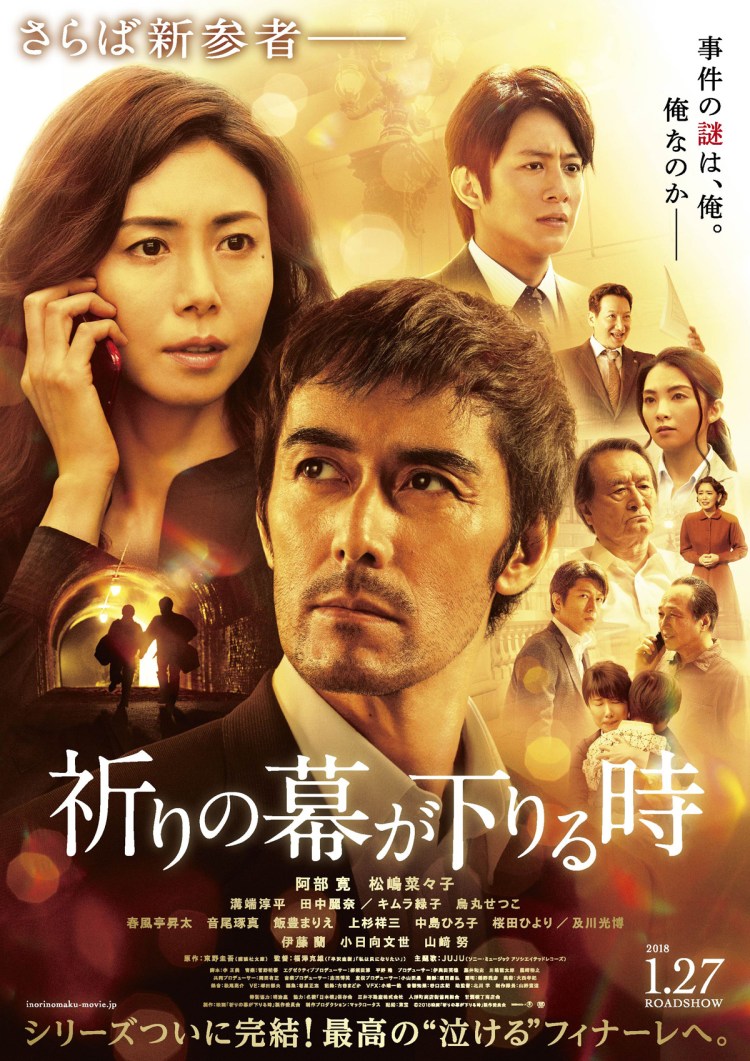
Crimes that bind posterDetective Kyoichiro Kaga has become a familiar screen presence over the last decade or so in a series of films and TV dramas starring popular actor Hiroshi Abe which might make it something of a surprise that The Crimes That Bind (祈りの幕が下りる時, Inori no Maku ga Oriru toki) is, after a fashion, a kind of origin story and touted as the culmination of the long running franchise. Another of prolific author Keigo Higashino’s key detectives, Kaga’s stalking ground has always been Nihonbashi where he has managed to make himself a friendly neighbourhood cop but, as it turns out, dedication is not the only reason he’s refused promotions and transfers to stay in what is, professionally at least, something of a backwater.

In fact, the film begins way back in 1983 when a young woman, Yuriko (Ran Ito), ran away from her husband and son to become a bar hostess in Sendai offering only the explanation that she felt herself unworthy of being a wife and mother. Some years later in 1997, she met a nice man – Watabe, but died of natural causes in 2001 at which point we discover that she is none other than the long lost mother of our master detective whom she abandoned when he was only eight years old. Being a compassionate man, Kyoichiro Kaga is not angry with his mother only sorry he did not get to see her before she passed and eager to meet the man who made her last years a little happier. Only, it appears, Watabe has also disappeared without trace. The only thing the Mama-san at the bar where Yuriko worked can remember about him is that he once said he often went to Nihonbashi. Kaga searches for the next 16 years with no leads, which is when the main case kicks into gear with the discovery of a badly decomposed body of a woman in a rundown Tokyo flat.

Of course, the two cases will turn out to be connected, giving Kaga an opportunity to investigate himself and come to terms with his difficult family circumstances including his strained relationship with his late father whose coldness he blames for driving his mother away. Parents and children will indeed develop into a theme as Kaga digs into why his mother might have done the things she did while also trying to reverse engineer his clues to figure out why he seems to be at the centre of an otherwise completely unrelated case.

Meanwhile, pieces of the puzzle seem to drop into place at random such as the fortuitous discovery of an old woman claiming to have lost her memory so that she can stay in hospital who may or may not be linked to one of the prime suspects – a top theatre director also known to Kaga thanks to a chance encounter some years earlier. In a neat twist, the theatre production she is currently trying to put on is Love Suicides at Sonezaki – a sad tale of young lovers, an adopted son of a merchant and a courtesan, who realise that they have no freedom to pursue their desires and so decide that their only solution is double suicide. The truth that Kaga uncovers leads him in much the same direction only the love at stake is familial rather than romantic and built on the strange filial interplay of the connection between a parent and a child.

It is quite literally “crimes that bind”, but Kaga’s repeated mantra that lies are the shadow of truth, illuminating as much as they conceal, does not quite fit with the incident he has been investigating which largely hinges on coincidences which place him, improbably, at the centre and tip him off to the hidden connections which will crack the case. Which is to say, the solution lies in the killer overplaying their hand (though for reasons unrelated to crime) and thereby undermining their carefully won subterfuge. Torn between solving the murder and exploring Kaga’s melancholy backstory, The Crimes That Bind finds itself falling between two stools even as its twin plot strands begin to dovetail as neatly as one assumes they eventually will, laying bare the central themes of parental sacrifice and belated filial gratitude. Playing best to those already invested in the Kaga franchise, Katsuo Fukuzawa’s adaptation may serve as a fitting conclusion (to this arc at least) but cannot quite overcome its over-reliance on confessional flashback as method of investigation or the improbable qualities of its admittedly twist filled central mystery.


International trailer (English subtitles)

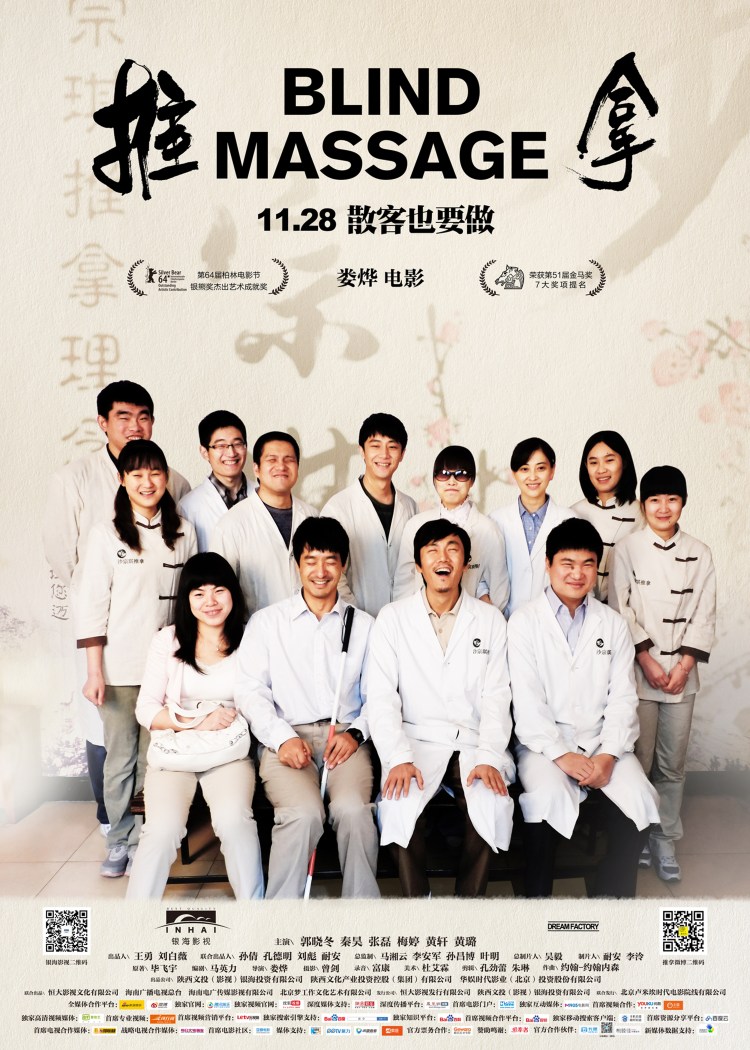
Blind Massage (推拿, Lou Ye, 2014)

Blind Massafe poster 1Lou Ye, defiantly controversial, has made those who cannot, for one reason or another, embrace their own desires the centre of his cinema. Seeking connection, his protagonists reel desperately from one traumatic event to the next but resist full commitment, no longer able to believe in the truth of their feelings in a society which has so often betrayed them. Blind Massage (推拿, T), a radical departure from the provocative politicisation that has hitherto marked his cinema, takes this one step further in setting itself inside what it sees as an entirely isolationist world – that of the blind who occupy a particular liminal space within modern Chinese society.

Lou begins with a voiceover and fractured vision of our most prominent protagonist, Xiao Ma (Huang Xuan), as he emerges from a childhood accident which killed his mother and cost him his sight. Though he is assured that his condition is only temporary and his eyes will eventually be healed, Xiao Ma later attempts suicide when he comes to understand that his doctors have been deceiving him and his sight will never return. Surviving, he learns to accept his blindness and attends a special school for those with disabilities where he learns to read braille and is trained as a masseuse – a traditional occupation for the blind in Chinese society. Once qualified he gets a job at the Sha Zongqi Massage Center which is staffed exclusively by those with visual impairments who live together on site and exist as a small and exclusive community.

The trouble begins when the two partners, Sha Fuming (Qin Hao) and Zhong Zongqi (Wang Zhihua), invite an old colleague, Dr. Wang (Guo Xiaodong), to join them. Wang brings with him his fiancée, Xiao Kong (Zhang Lei), with whom the young Xiao Ma eventually develops a fascination. Meanwhile, Fuming has also developed a fascination for another newcomer, Du Hong (Mei Ting), who, he has been told, is very “beautiful”. Du Hong, in turn, is attracted to the morose figure of Xiao Ma but perhaps understands that for one reason or another he is unable to “see” her (which might be one of the reasons she continues to pine for him).

As in his previous films, Lou centres himself in a question of haptic connection. The residents of the clinic feel themselves cut off from what they see as “mainstream society” which they believe belongs exclusively to the sighted. Mainstream society, unadaptable and perhaps unwelcoming, has seen fit to exile them to the extent that they are unable to survive outside of the specific career track it has laid down for them and without the support of their own community. Yet their occupation also depends on deep sensory perception on a level deemed inaccessible to the fully sighted and the ability to “see” the things which can’t be “seen”.

Fuming, outgoing and sociable, looks for outlets outside of his own community but is criticised by those within who worry that he is in someway attempting to deny his blindness by adhering to the conceptual world of the sighted which he is otherwise unable to comprehend on a sensory level. His “love” for Du Hong is rooted in ideas of “conventional” beauty which is, in fact, more an expression of his vanity as he longs to possess the “best” girl as Du Hong points out when she reminds him that he has no idea whether she is “beautiful” or not or even what visual “beauty” might be, and that in becoming obsessed with these incomprehensible ideas he has in fact missed all of the things which might be “beautiful” about her on another level than the visual.

Meanwhile, another resident at the clinic has become worried about Xiao Ma’s fixation on Kong and decided the best way to sort him out is to take him to a brothel (ironically, also a kind of “massage parlour”). Though originally reluctant Xiao Ma begins to develop a relationship with sex worker Mann (Huang Lu) which is forged through touch but occurs on a deeper level. A fight with one of Mann’s other clients has the ironic effect of restoring some of his vision, leaving him stumbling and confused but also excited and drunk on a kind of sensory euphoria as he tries to reconcile his differing kinds of perception to make his way home. Yet by this point in his life Xiao Ma’s entire identity and existence revolves around being a blind person – he cannot tell anyone at the clinic that his vision has begun to return for fear of losing his place in their community as well as his ability to support himself.

Eventually the community of the clinic becomes scattered as its residents begin to reassert themselves as individuals re-entering “mainstream society”. Casting visually impaired actors alongside familiar faces, Lou treats his subject with the utmost respect and demonstrates that many of the problems faced by those at the clinic are exactly the same as those faced by the protagonists of his previous films while also reflecting the various ways that society remains intolerant to those who have differing needs. Asking quite profound questions about the nature of “beauty” and “connection” when images have been absented from the frame Lou attempts to “visualise” what it might feel like to “see” without “seeing” in an exploration of defiant hidden realities which often go wilfully unseen in our own blinkered perceptions.


Original trailer (English subtitles)
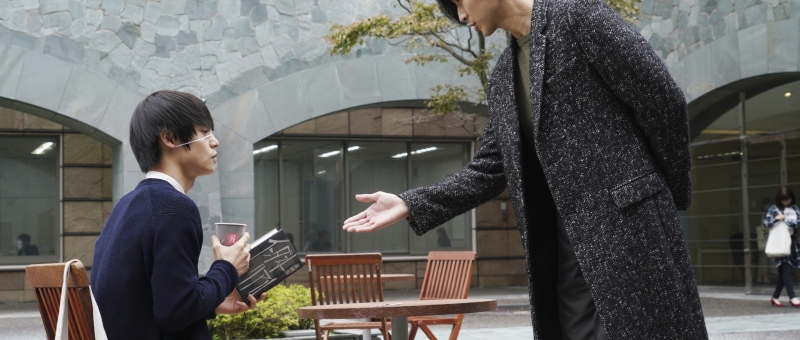
Ode to the Goose (군산: 거위를 노래하다, Zhang Lü, 2018)

15eeddc21a2c46f3992b2b459ee3ceb3Past and present flow as one in Zhang Lü’s elliptical Ode to the Goose (군산: 거위를 노래하다, Gunsan: Geowileul Nolaehada). Making a perhaps controversial point, Zhang sets the majority of his tale in the harbour town of Gunsan which echoes ‘30s Korea when the nation was still brutally oppressed by the Japanese to which the many graphic photographs and monuments on display stand testament. Yet Zhang seems to ask, returning to his favourite theme, if they’re all Koreans no matter where they were born, why are some more oppressed than others?

The film opens with the hero, struggling poet Yoon-young (Park Hae-il), standing in front of a street map, lost in his mother’s home town. He is then joined by a slightly older woman, Song-hyun (Moon So-ri), whom he has apparently asked to accompany him to Gunsan on a whim without really explaining why. Still hung over from the night before, they stop off at an odd little noodle joint run by an elegant older woman (Moon Sook) who seems oddly fascinated by their strange chemistry. Yoon-young, innocently enough, makes conversation by asking about her home town only for her to shut him down. “What home town?” she fires back, “home is where you settle”.

Later we discover she speaks fluent Japanese, cheerfully conversing with the autistic daughter of the inn owner (Park So-dam) where the couple eventually stay after being judged “lucky” enough to be allowed in. The daughter of Japanese-Korean parents apparently “returned” from Fukuoka, the girl rarely speaks to strangers and only ever in Japanese, though she seems to take a liking to Yoon-young and is keen to try and connect with him, making sure he is always well taken care of while Song-hyun has turned her attentions to the girl’s father, melancholy widower Mr. Lee (Jung Jin-young) who likes to take photographs but only ever of landscapes and not of people.

The Lees are Korean too, even if one of them only speaks Japanese and they run a Japanese-style inn in the middle of a moribund museum to colonial horror (the local shrine even has a comfort woman statue standing in the back). Meanwhile, a passerby mistakes Song-hyun for a Chinese-Korean woman she once knew and insists on speaking to her in Yanbian dialect which Song-hyun, as we later learn, is unable to understand even if there is a Chinese-Korean connection in her family history. Song-hyun muses that had her grandfather, like his brother, chosen to stay in Manchuria after the war then she’d be Chinese-Korean too, as would famed poet of the colonial era Yun Dong-ju if he hadn’t died a political prisoner in a Japanese jail in Fukuoka which is, coincidentally, where the Lees were “from”. It is all “coincidental”.

So why does Yoon-young’s “right wing nut job” (as Song-hyun calls him) father hate Chinese-Koreans so much, blaming them for all the faults of the modern nation and decrying those who left for Shanghai with the Independence Movement as traitorous communist collaborators? A whimsical prequel (or a kind of re-imagining) of the Gunsan incident sees Yoon-young walking through his own “hometown” while a man who probably is not actually Chinese-Korean himself and may just be out to claim a buck or two, holds a rally for the rights of “foreign” Koreans in order to avoid exploitative employment practices and affirm that Koreans from other parts are the same as Koreans from Korea. Are “native” Koreans perhaps oppressing “non-native” ones in the same way that they were oppressed by the Japanese? In practical terms no, obviously not – there are no essential horrors here, but there is deeply ingrained prejudice and wilful exploitation. Interestingly enough, despite his conservatism, Yoon-young’s dad had him attend Chinese language classes, if ones that were run by the Taiwanese who are obviously not “communist” but were also formerly a Japanese colony.

Meanwhile, Yoon-young’s life takes him on a curious symmetry in which everything reminds him of something else. He repeatedly asks the women he meets if they’ve met before, experiences eerily similar moments in Gunsan and at home, and continues to look for connections between himself and a world of universal poetry stretching from the classical Chinese of the film’s title to the melancholy odes of Yun Dong-ju, writing in his “native” language in defiance of colonial authority. Dualities predominate – beauty/horror, attraction/indifference, silence/language, here/there, then/now, but through it all there is commonality. Yoon-young’s failure to communicate leaves him feeling defeated and depressed, trapped in a self-imposed exile while the gregarious Song-hyun gleefully moves forward little caring of the costs. Whimsical and “ambiguous”, Zhang’s playful poetry is difficult to parse but nevertheless carries an essential warmth in its reassuring familiarities and openhearted commitment to the universality of human connections.


Ode to the Goose was screened as the latest teaser for the upcoming London Korean Film Festival. Tickets are already on sale for the next and final teaser screening, Kokdu, which will take place at Regent Street Cinema on 16th September.

Original trailer (no subtitles)

The Wonderland (バースデー・ワンダーランド, Keiichi Hara, 2019) [Fantasia 2019]

birthday wonderland poster 1The demands of adulthood are apt to overshadow any young teen’s life, but you can’t shake them off just by lying in bed and refusing to age. So the heroine of Keiichi Hara’s The Wonderland (バースデー・ワンダーランド, Birthday Wonderland) discovers as she determines to hideout from emotional complexity, waiting for the storm to pass and cowardly failing to defend a friend in the process. The last thing she wants is the responsibility of being “the chosen one”, but the thing about that is that you don’t get to choose and if the universe has plans for you it would be very irresponsible to refuse.

After (not) getting involved in a minor spat amongst friends about coloured hair clips, Akane (Mayu Matsuoka) decides the best solution is to feign illness, turn off her phone, and avoid going to school. Her kindly mother (Kumiko Aso), seemingly aware she’s not really ill, decides to let her stay home anyway but all she ends up doing is mistreating the cat in frustration and moping about, so her mum despatches her to her aunt Chii’s (Anne Watanabe) place to pick up her birthday gift which she presumably can’t open until the big day tomorrow. Truth be told, Akane doesn’t much like her aunt Chii, she’s far too free spirited and unpredictable for the neurotic teen, but she could stand to learn something from her irrepressible lust for life.

Akane gets the perfect opportunity to do just that when she sticks her hand onto a palm print in her aunt’s shop and is promptly greeted by a dapper-looking man with a fabulous moustache and his tiny minion (Nao Toyama) who crawl up through the hidden basement to explain that she is the “Goddess of the Green Wind” they’ve been searching for and must come with them right away because their nation is in peril! As expected, Akane doesn’t want to go, but is chivvied along by her overexcited aunt and a strange amulet the man, an alchemist named Hippocrates (Masachika Ichimura), places around her neck.

The amulet, he tells her, helps you move forward even if you want to go back. That is, in a sense, Akane’s entire dilemma as she finds herself on the cusp of adulthood, afraid to step forward and accept the responsibilities of maturity while longing to return to carefree childhood days when there was nothing much to worry about and always someone around to look after her. Like any good fairytale, she finds her mirror in the other world in a melancholy prince who remains so reluctant to take part in an essential ritual that he is almost willing to burn the world to avoid having to acknowledge his royal responsibilities.

Meanwhile, Akane is slow to adjust to the charms of her new Wonderland, refusing to engage and loudly stating her desire to go home while her aunt tries to encourage her to embrace a sense of adventure. Chii, the film’s best asset who proclaims “no alcohol no life” while thoroughly enjoying sparring with the uptight Hippocrates (who perhaps is also enjoying the challenge though might not want to admit it), might in some senses be a barrier to Akane’s self-actualisation but is also an important source of safety for her in an unsafe world and just irresponsible enough to push her niece towards taking the right kind of risks in order to do the right thing and save the kingdom.

The reasons the kingdom is in peril in the first place are hugely symbolic – an ongoing water crisis caused by governmental negligence is draining the world of colour while literally drying it out. Getting used to her new surroundings, Akane begins to see their charm. This world, near identical to her own in many ways, diverged around the industrial revolution. Where “our” world rocketed into a frenetic lust for convenience, the rhythms of this one stayed the same, a perpetual village society in which cheerful people live laidback lives surrounded by the beauty of nature – something Akane later comes to worry her own world is losing. Gradually letting go of her fear and getting a better idea of the kind of life she might want, Akane gains the courage to embrace responsibility through directly supporting someone else as they learn to do the same.

A whimsical coming of age tale, The Wonderland excels in world building but somehow never quite achieves the level of emotional engagement it seems to be looking for even as its sullen, detached heroine perhaps begins to realise she did a great disservice to her friend when she failed to defend her during the silly hair ornament argument largely because she personally didn’t want to rock the boat and put herself in the firing line. Her horizons suitably expanded, Akane finds she no longer needs an amulet to keep moving forward even when longing to look back and resolves to step into adulthood with an easy, laidback confidence learned from her palls on the other side.


The Wonderland was screened as part of the 2019 Fantasia International Film Festival.

Original trailer (English subtitles)