
How to Steal a Dog (개를 훔치는 완벽한 방법, Kim Sung-ho, 2014)

how to steal a dog posterEverything seems so simple to children. The logic maybe surreal, but it is direct. Problems have solutions and there are clear pathways to achieve them even if they seem odd to a more adult way of thinking. Perhaps we’d all be better off if we thought about social issues in the same way children do, though naivety and innocence often prove blindspots in otherwise solid plans. How to Steal a Dog (개를 훔치는 완벽한 방법, Gaereul Hoomchineun Wanbyeokhan Bangbub) is basically a heist movie in which two adorable little girls plan to kidnap a beloved pooch from a rich old lady who will then be only too happy to part with her millions to get it back but it’s also a subtle social satire on class relations and the economic causes of family breakdown in modern Korea.

Little Ji-soo (Lee Re) tries her best to put brave face on it, but at home everything’s gone wrong. In fact, they don’t even have a home any more – Ji-soo’s dad’s pizza business failed and he’s run off and left them. Evicted, the family have been living in the old pizza van while Ji-soo’s mum (Kang Hye-jung) has convinced an old flame (Lee Chun-hee) to give her a job as a waitress in a posh cafe. It’s approaching crunch time because Ji-soo’s birthday is coming up and the other kids are expecting to be invited to a party at a house Ji-soo doesn’t have. When she spots an ad for a lost dog which promises a reward, Ji-soo strikes on an idea. Together with a new found friend (Lee Ji-won), she hatches a complicated plan to steal the beloved dog of the grumpy old lady (Kim Hye-ja) who owns the cafe where her mother works and extort enough money to buy a lovely new house for her family where she can have her birthday in style.

Ji-soo’s worldview is both cheerfully innocent and extremely cynical. Sad and lonely with her dad gone, she blames her mother’s fecklessness for their present plight, berating her lack of practicality and failure to get her kids into a proper home in good time. Playing the sensible one for her family of three, Ji-soo is always on the look out for scams and trickery, assuming most people are up to something especially when it comes to innocent little girls. Hence she quickly has the number of the local pizza boy (Lee Hong-ki) who takes orders for family size pizzas but writes regular on the order slips and then pockets the difference from the unsuspecting customer. When she spots an ad in an estate agent’s window for houses at 5 million won she becomes fixated on gaining exactly that amount of money, thinking “per three square metre” is the name of an area and little knowing that 5 million won won’t even buy you a front porch in Seoul let alone an entire house.

Though living in a van is not exactly pleasant, Ji-soo’s problem is more one of social shame than it is of actual discomfort. All the kids at school have already been indoctrinated with class competitiveness and everyone is still talking about the last birthday party, the subject of which is getting a little nervous in case Ji-soo’s house turns out to be nicer than his. No one knows Ji-soo’s dad has run off and they’re living in a van, even the teacher seems curious enough about Ji-soo’s putative birthday party to actively remind her about it and enquire when she plans to make some kind of announcement to her schoolmates.

Thankfully, Ji-soon does eventually learn that money and status aren’t everything. The mean old lady turns out just to be sad and lonely, filled with regrets about a mistake made in her past. The scary homeless man (Choi Min-soo) turns out to be a goodhearted free spirit, and Ji-soo’s mum finally finds her feet after buckling down in an honest yet low paying job which requires a lot of early morning starts. From Ji-soo’s point of view, adults are still a bit rubbish but everything seems to be working out for the best. Oddly pure hearted for a story about dognapping, How to Steal a Dog is a charming, whimsical adventure in which a little girl’s faith in the goodness of the world is finally rewarded, even if not quite in the way she imagined.


Original trailer (no subtitles)

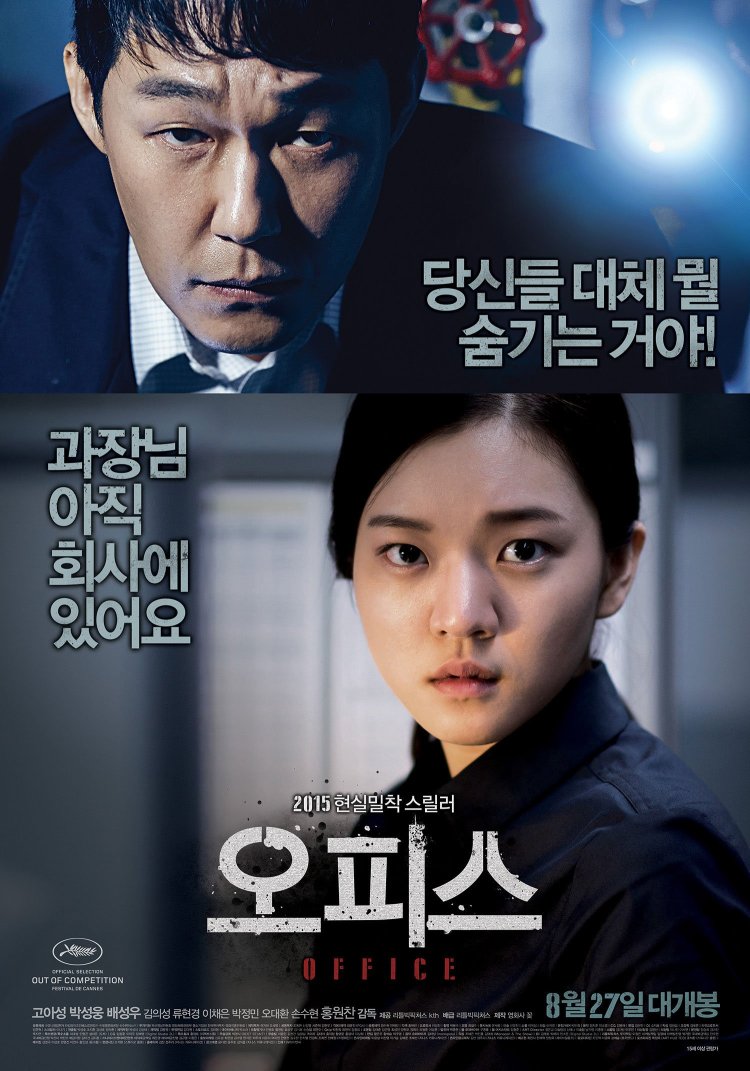
Office (오피스, Hong Won-chan, 2015)

office posterThe pressure cooker society threatens to explode in Hong Won-chan’s Office (오피스). The writer of recent genre hits The Chaser and The Yellow Sea, Hong has long experience of examining those living on the edge but in his directorial debut he takes things one step further in depicting an entire society running to keep up with itself, furiously chasing its own tail with barely suppressed rage. Not so much survival of the fittest as survival of the least scrupulous, the world of Office is the one in which the mad become the most sane, escaping the constraints of corporate oppression through social revenge but taking the innocent along with them.

Salaryman Byun-guk (Bae Seong-woo) has the soulless eyes of one whose dreams have already died. Dejectedly he sits alone at a coffee shop before cramming himself into the commuter train home where he sits, silently, among his busy family. They wonder why he hasn’t changed out of his suit, shed his corporate persona for his familial one, but when Byung-guk gets up he returns brandishing a hammer which he then, as if in a trance, uses to bludgeon to death his loving wife, disabled son, and senile mother.

Byun-guk flees the scene of crime and is loose somewhere in the city. The police search his office for clues but his colleagues have already come up with their unified version of events, keeping the company out of it by claiming that they all loved Byun-guk and are shocked that he could have done something so horrifying. Meanwhile, intern Mi-rae (Go Ah-sung), who regarded Byun-guk as her only friend in the office, is upset but perhaps not quite so shocked. Excluded from the interoffice cliquery, no one has thought to brief Mi-rae on the party line leaving her a prime target for police inspector Choi (Park Sung-woong).

Byun-guk and Mi-rae are two of a piece – members of the upright and hardworking lower classes who have done everything right but somehow have never been accepted by their peers. Mi-rae, an ordinary girl from Gwangju who worked to lose her accent in her teens dreaming of the high life in Seoul, is shy and mousy but works hard – harder than anyone, to prove herself worthy of Seoul’s unrealistic demands. Her colleagues, privileged, confident, and also harried, do not forgive her for this. They find her earnestness “creepy”, her desire to succeed “suspicious”. Cruelly taken down a peg or two by a colleague taking out her own frustrations on the office nobody, another tries to comfort her with some advice – don’t try so hard, you make us all look bad and we wonder what your need is hiding. Mi-rae isn’t really hiding anything save her slowly fragmenting mental state and the overwhelming need to be accepted to a club that, in truth, is not open to people like her who value their integrity and still believe deep down that working hard and being honest are the only paths to true success.

Korean society, it seems, has become a giant chain of screaming. Byun-guk has been repeatedly passed over for promotion despite being the most reliable employee in the office but his ineffectual boss is overly wedded to the shouting school of business management. Faced with results he doesn’t like, Byun-guk’s boss picks someone to shout at to make them better but offers no further guidance. Railing at the police for not doing their job as if screaming will some how provoke major results even outside of the office, the boss can’t know that police also have their own chain of screaming and Choi has his own boss already taking care of that side of things, demanding results rather than truth or justice.

The meek are taking their inheritance ahead of schedule, but their revenge is born both of societal corruption and rejection. People like Byun-guk and Mi-rae, who are quiet, honest, kind but perhaps not good with people, become the bugs in a system which simultaneously holds them up as essential cogs. Those who cannot just pretend, grease the wheels with superficial social niceties, and accepted their place in the chain of screaming in order to climb further up it are condemned to wander idly around its lower levels going quietly mad until, perhaps, the system crushes them or else collapses.


International trailer (English subtitles)

The Liquidator (心理罪:城市之光, Xu Jizhou, 2017)

The Liquidator posterGiven a strangely ‘80s nonsensical two word title, Xu Jizhou’s The Liquidator (心理罪:城市之光, Xīnlǐ Zuì: Chéngshì Zhī Guāng) is a retro throwback to the lurid macho pulp which has largely faded from the crime procedural since its ‘90s heyday. Adapted from a novel by Lei Mi, the film follows last year’s Guilty of Mind as the second in the Fang Mu series only this time the eccentric profiler is played by marquee star Deng Chao rather than Guilty Mind’s Li Yifeng or Chen Ruo Xuan who starred in the Fang Mu TV drama, Evil Minds. A pulpy battle of wits between a crazed vigilante and a world weary cop, The Liquidator is already treading on some overly familiar territory but its main target is the rule of law apparently under threat of mob justice now that China too has entered the social media age.

Fang Mu (Deng Chao) is no longer a police officer after becoming the prime suspect in the disappearance of a man who escaped justice through judicial corruption, but he’s pulled back into the law enforcement fold when young policewoman Mi Nan (Cecilia Liu) is dispatched to get his profiling opinion on a difficult murder case. Calling himself “The Light of the City”, a vigilante killer is already amassing a collection of dedicated online followers thanks to his choice of targets which, to put it bluntly, are not law breakers just terrible people that most would like to get revenge on for one reason or another.

Originally reluctant, Fang Mu is soon hooked on the case only to realise that the crime scenes are being created entirely for his benefit – the killer is attempting to pull him into a battle of wits and taking innocent lives to do it. As it transpires the killer’s name, Light of the City, is inspired by something Fang Mu said in his graduation speech to the effect that the police are the light that shines in the darkness. The killer thinks the law doesn’t go far enough – his targets are bullying teachers, impious sons, and greedy lawyers, the immoral rather than the criminal. He exposes their transgressions online and then allows “netizens” to have their say. Netizens, as they have often been in the “real” world, are not a particularly understanding bunch and are firmly behind the “entertainment” the killer is providing, even down to the decision to live stream a murder.

Fang Mu’s defining trait is his liminal status as a law enforcement officer often pulled towards the dark side – hence why many of his colleagues think it’s perfectly possible that he’s guilty of the crime that got him kicked off the force. The vigilante’s “plan” is to pull him over the line by forcing Fang Mu to execute The City of Light and thereby become the thing he most fears. The Liquidator posits that a robust judicial system free from interference from both government and people is a prerequisite of a well functioning society and the police must be the shining beacons of these laws – if not even law enforcement obeys the law, then all is lost.

What transpires is a battle of minds between the brainy Fang Mu and the psychotic killer, but it’s also a battle for the soul of “society” which ought to place compassion and rationality over the sensationalism of trial by media and arbitrary mob justice. The killer works out his frustrations by proxy through attacking those who committed the same “crimes” which have led to their feelings of frustration and humiliation – chief among them being Fang Mu who has, apparently, offended solely in his continued excellence, but the killer’s personal vengeance is harsh and unforgiving, handing down a death sentence simply for unpleasant or anti-social behaviour.

Beginning in a promising vein, Xu nevertheless introduces his dedicated female cop only to sideline her in favour of Fang Mu before turning her into a mild love interest, potential victim, and sometime comic relief. Filled with macho histrionics (including, at one point, a gun fired in the air followed by a manly wail of grief), The Liquidator is an old fashioned action drama filtered through pulp noir and ‘90s horror with its grimy walls and dingy basements, but it straddles a fine line between ridiculous slasher serial killer thriller and serious cerebral procedural, landing somewhere around heroic bloodshed without the bromance. Ridiculous and melodramatic, Xu’s debut feature boasts excellent production design and innovative photography, but its slick aesthetic cannot overcome the more outlandish elements of the otherwise generic script.


Currently on limited release in UK cinemas courtesy of Cine Asia

Original trailer (Mandarin with English subtitles)

Namiya (解憂雜貨店, Han Jie, 2017)

Namiya posterKeigo Higashino is almost certainly best known for his crime novels and in particular his most famous detective, Galileo, whose exploits have spawned a successful TV drama series and a fair few cinematic adaptations including the international bestseller, The Devotion of Suspect X. One might expect a writer of mystery novels to be a fierce rationalist, but Higashino occasionally dabbles in the fantastic – The Miracles of the Namiya General Store is more or less a nostalgia fest praising the pre-bubble Japan, implying that the modern world is colder and less kind than the aspiring society of 1979. Adapted for the Chinese market by Han Jie, Namiya (解憂雜貨店, Jiě Yōu Zá Huò Diàn) retains the corner shop where time stands still but locates it in 1993, which is not so much a significant date save being 25 years in the past.

On New Year’s Eve 2017, three teens break into a woman’s home with the idea of causing some damage, but the event goes south when she comes home early and one of the three decides to tie her up and steal a bunch of her stuff. Having gone further than they meant to, the trio wind up in an unfamiliar part of town when the car they’ve stolen runs out of petrol. An improbably quaint, apparently disused corner shop attracts their attention but when they break in to shelter for the night they discover that this is no ordinary store. A ghostly miasma gradually creeps its way in and the three youngsters find themselves answering a collection of letters meant for the store’s owner written in 1993 but only dropping through the letter box now. They funny thing is, they get almost immediate replies.

As one of the teens points out, they weren’t even born in 1993 – this store might as well be from 1793 as far as they’re concerned. Though it drips with nostalgia for a simpler time, Namiya treads (understandably) more carefully in painting early ‘90s Beijing and its rural backwater setting, strenuously avoiding any mention of politics and characterising China’s economic development as an entirely good thing despite the troubles the three teens at the centre have been subject to throughout their apparently difficult lives.

The letter writers have various problems but each in someway relates to being a little lost, a little bit confused about how to move forward in life. A frustrated musician (Lee Hong-chi) whose career is not taking off wants to know whether he should give up and come home, a little boy has a bad relationship with his go-getter parents who have lost all their money and got into trouble with loan sharks, and a melancholy bar hostess (Hao Lei) wants to know if she should become the mistress of a gangster who promises to set her up in a shop that would get her out of her dead end life and still enable her to support her family. The kids are not really qualified to offer any kind of real life advice, with sensitive Xiaobo (Karry Wang) and plucky Tong Tong (Dilraba Dilmurat) reacting in broadly sympathetic terms while the sullen Jie takes a hardline moralist stance in which he just wants to write angry letters to everyone telling them they’re doing everything wrong.

Jie has his own reasons for being so angry, especially as one of the letters touches a nerve in his own personal history but his ambivalence was at one point shared by Papa Namiya (Jackie Chan) himself after he feared his treasured advice might have ended up having a negative effect on people’s lives. Papa Namiya tells the troubled little boy to stick with his parents no matter what because family is the most important thing in a person’s life which might be true much of the time, but not when the parents actively endanger their child. What he finally reassures himself with is that his advice was largely meaningless because most people have already made up their minds what they’re going to do, they just want someone to help them feel like they’re doing the right thing. In fact, no one really follows Papa Namiya’s advice anyway, but the kids are able to make a concrete change when they reveal the economic realities of modern China to a young hopeful who then uses the knowledge to build an international business empire (but makes sure to pay it forward whilst paying tribute to their roots by committing to sponsor an orphanage in need of renovation/expansion).

The slightly awkward message Namiya leaves behind is that dreams come true when people work hard to achieve them but that the young are also free to forge their own destinies, that the world is, for them, infinite and filled with boundless possibility. Optimistic and inspiring as it is, it isn’t terribly realistic and does rather imply that those who haven’t made it are either lazy or dishonest as echoed in the mildly moralistic tone taken with the bar hostess’ dilemma or the odiousness of the corrupt businessman and his failure to protect his family from his own mistakes. Moral judgements and naivety aside, Namiya is an otherwise heartwarming, deliberately uncynical New Year tale which does its best to engender hope for the future in an otherwise cold and unforgiving month.


Currently on limited release in UK cinemas.

Original trailer (Mandarin with English subtitles)

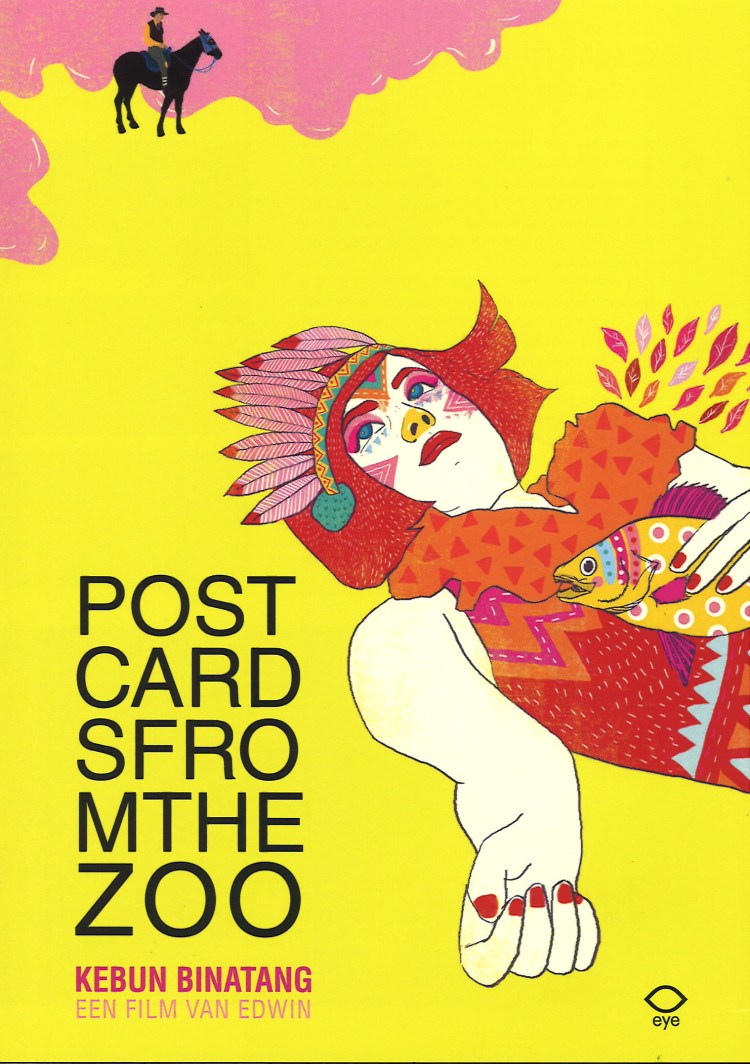
Postcards from the Zoo (Kebun Binatang, Edwin, 2012)

postcards from the zoo posterThe thing about zoos is, how can you be sure which side of the bars you’re really on? The heroine of Edwin’s whimsical adventure, Postcards From the Zoo (Kebun Binatang), finds herself at home among the animals after being abandoned by her human father with the consequence that, to her, the outside world is the inverted mirror of her theme park home. Themes of exploitation, exoticisation, innocence and experience run side by side but then perhaps Edwin has tried to pack too much into his day out lending a degree of incoherence to his meandering itinerary.

As a young child, Lana (Ladya Cheryl) is abandoned in the zoo by her father. All alone, trapped in the park overnight, she wanders around exploring and calling out for her dad to come and get her. He doesn’t, years pass and suddenly Lana is a beautiful young woman, still living in the zoo after having been taken in by a giraffe handler, Oom Dave. Her life changes when a new authority takes over and immediately sets about trying to evict the collection of people who’ve made the zoo their home without the proper permission. Taking off with a handsome magician (Nicholas Saputra), Lana begins to explore the world outside but quickly finds that there are invisible bars everywhere.

Edwin ties Lana to the figure of the zoo’s solitary giraffe – a herd animal forced to live alone in Jakarta’s zoo as the sole representative of its kind. Certifiably nuts about giraffes, Lana rolls off various animal facts and expresses the long held desire the touch the giraffe’s stomach. Her status is confused; she’s both visitor and exhibit, caretaker and resident. The zoo is all Lana has ever known or wanted to know, and so when she must leave it, she does so with curious eyes, examining the regular world like a traveller on a journey to untold lands.

Becoming the magician’s assistant – a Tiger Lily to his cowboy, Lana travels the city as a co-conspirator in his life of hustling. Their odyssey brings them into the seedy underbelly of the modern capital with its heartless gangsters and oppressed women. Once again abandoned, Lana finds herself sinking into this world as one of many generic young women dressed in white, given a number (33), and placed behind glass waiting to be called forth by male visitors. Now literally an exhibit in a human zoo, Lana finds that things on this side of the enclosure are no different. While her customer asks her to dress up in a “tiger” suit (it’s a leopard, she quickly corrects him), a family with young children pose with a “tamed” python at the zoo. The twin pictures of exploitation neatly ram Edwin’s point home even if he allows Lana’s experiences to remain in the realms of whimsy, only hinting at the darkness of the “massage” industry in an early humiliating scene in which a naked, frightened woman is awkwardly sat with a grinning gangster as a kind of living trophy.

Broken with a series of title cards explaining zoo-related terminology each of which relate to the latest stages of Lana’s journey – “ex-situ conservation”, “reintroduction”, etc, Postcards from the Zoo maintains a kind of distanced affectation which undermines the whimsy of its magical realist stance. Lana’s journey is one of youthful exploration in which the adolescent must venture away from home in order to become adult and return home with wiser eyes but Lana’s quest, with her series of abandonments and mysteries, may perhaps never be finished. Edwin finds the whimsy of the zoo with its dinosaur shaped carts and strangely designed cowbus mimicked in the outside world with monkeys wearing doll masks and wandering magicians selling snake oil claiming to provide “instant youth” and cure roundworm, fungus, and stab wounds,  returning him to the “all the world’s a zoo” ethos which seems to pervade but even if he fails to bring his tale full circle he does at least allow a kind of harmony in the reunion of his twin symbols of the solitary, imprisoned giraffe and the curious little girl.


Original trailer (no subtitles)

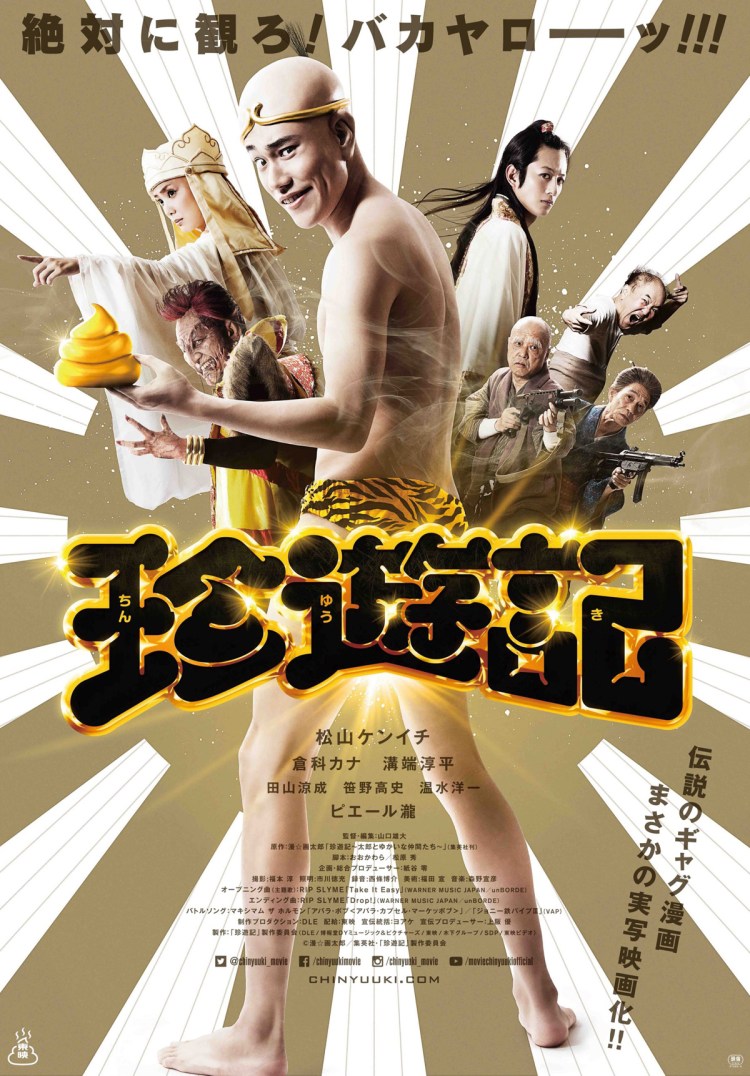
Chin-yu-ki: The Journey to the West with Farts (珍遊記, Yudai Yamaguchi, 2016)

Chin-yu-ki posterWhen a film tells you what it is, you should believe it the first time. Many fine films are undone by unwise titles, but if you were expecting anything more than what is promised by the title of Chin-yu-ki: Journey to the West with Farts (珍遊記), you have only yourself to blame. Director Yudai Yamaguchi is known for his distinctly lowbrow, zany humour and it seems he’s met his match in adapting the much loved Journey to the West parody manga, Chin-yu-ki – Taro to Yukaina Nakamatachi. Set in Japan in an indistinct period possibly somewhere around the Meiji restoration, Chin-yu-ki is a bawdy story of penis power, fantastic farts, romantic disappointments, and the ongoing path to enlightenment of its slightly more than cheeky hero.

Beginning as it means to go on, the film opens with a Buddhist nun, Genzo (Kana Kurashina – renamed “Shenzang” in the subtitles on this HK blu-ray to match the original Journey to the West), talking to an older couple referred to as “Old Fart” (Ryosei Tayama) and “Old Bag” (Takashi Sasano). The couple were never blessed with children of their own and so when they notice a great flash and something falling to Earth, they are delighted to find a lovely baby boy lying in the crater. Unfortunately, Taro Yamada (Kenichi Matsuyama), as the baby is called, is a wrong ‘un. Now 16 years old, Taro is a fiery demon who has robbed the entire area to build himself a giant mansion where he lives on his own and has provided his adoptive parents with a small hovel on the outskirts of town. Old Fart and Old Bag try to warn Genzo that Taro is not your average sinner – he controls people with his giant penis and stinky farts.

Genzo is undeterred and demonstrates her various skills which, strangely, centre around the ability to unping a bra at 20 paces (yes, apparently in this version of the Meiji era, people wear bras). Her other trick is magically hurling buns into people’s mouths which does at least shut them up for a bit. Against the odds she manages to tame Taro, reducing him to his basic, naked state in which she manages to shove a magic crown on his head which allows her to control him and stop him doing naughty things. Genzo determines to take Taro to Tianzhu to purify his soul and so the pair walk off together towards their joint destiny.

The road trip format provides plenty of scope for set piece gags as Genzo and Taro encounter various strange characters along the way who often make surprising returns. This is no character drama, but Taro does indeed learn a few things even as he remains as wilfully naughty as in his unreformed state. As it turns out, the major narrative event revolves around a grudge held by a man who previously encountered Taro at his most cruel. Ryusho (Junpei Mizobata), now a famous pretty boy actor, is still nursing a broken heart after Taro ruined his true love dream which had proved so difficult for him to win as a shy young schoolboy. Now backed by a series of strange companions including a dominatrix-type assistant who dresses in shiny leather and carries a whip, a woman in Cheongsam, and a man in anachronistic Chinese PLA uniform, Ryusho is still a hopeless romantic and develops an unlikely crush on Genzo, which she returns but is unable to act on because of her vows and her mission to reform Taro.

Misunderstandings abound and it has to be said, the crosstalk between Ryusho who has been abandoned by his buddies and has hired a series of Vietnam-era American mercenaries, Genzo, and Taro as they argue about an unclear subject is genuinely quite funny as is the reaction when Taro unmasks himself in a local bar full of bounty hunters who don’t believe he is who he says he is because he’s wearing a shirt with the name of a guy he just robbed on it. The rest of the humour is, however, of a lower order even if the penis and fart jokes fade out in the middle section of the film which does have a few amusing jokes of its own. Matsuyama delivers a surprisingly energetic performance which is in strong contrast with the distant, inscrutable characters he often plays but as cheerful as his Monkey King stand in is, he can’t compensate for the film’s otherwise disposable quality which seems primed to appeal to those seeking zany, lowbrow humour but offers very little else.


Original trailer (no subtitles)
It All Began When I Met You (すべては君に逢えたから, Katsuhide Motoki, 2013)

It All Began When I Met You posterChristmas, in Japan, is an occasion for romance. Strangely, the Christmas date movie has never quite taken off though there are a fair few examples of this oft maligned genre even if they don’t generally help to ameliorate the contempt in which it is held. Truth be told, It All Began When I Met You (すべては君に逢えたから, Subete wa Kimi ni Aeta kara) won’t help to do that either but then it isn’t really intended to so much as provide a little warmth combat the to Christmas cold whilst celebrating the centenary of Tokyo Station (a destination surely as romantic as meeting under the clock at Waterloo).

Spinning out from Tokyo Station, the film splits into six interconnected stories of love ranging from dealing with long distance romance to an orphaned little girl who has projected her need to believe in the existence of her parents onto a faith in Santa Claus. Counting down to Christmas Day, the protagonists each progress towards some kind of crisis point which will allow them to deal with their various problems whilst getting into the holiday spirit.

Couple one are a pair of youngsters, one a fashion designer, Setsuna (Fumino Kimura), and the other an engineer, Takumi (Masahiro Higashide), who are separated because of differing work commitments. She’s in Tokyo, he’s up North, but they chat on the phone all the time and seem close despite the distance between them. The truth is revealed when Takumi comes to Tokyo and is supposed to meet up with Setsuna but stays out all night drinking with a (female) colleague instead.

Meanwhile, a college student (Tsubasa Honda) is invited to a karaoke party but isn’t sure whether to go because her crush is going and she can’t pluck up the courage to confess to him. Her boss at the pastry shop (Chieko Baisho) where she works tells her to go get him rather than allow her true love to slip away as, we later find out, happened to her when her boyfriend failed to appear at Tokyo Station 49 years earlier when they had arranged to elope. One of their regular customers, a Shinkansen driver (Saburo Tokito), has just retired early and, it turns out, may not have long to live but wants to make the most of his last Christmas with his son (Ryutaro Yamasaki) who is preoccupied about a “half-coming of age” ceremony they’re having at school.

Across down, the train driver’s brother-in-law, an arrogant CEO (Hiroshi Tamaki), runs into an aspiring actress (Rin Takanashi) who is currently in rehearsals for a play she puts on every year at a local orphanage. This year might be her last, however, because she’s begun to accept that her acting career will never take off and it’s time to go home. One of the little girls at the orphanage, Akane (Emiri Kai), is particularly looking forward to the festivities because she’s invested in the unseen figure of Santa as a substitute for believing in the unseen figures of the parents she never knew.

Each of the stories is intended to capture something of the complicated business of modern city living – a long distance relationship is, perhaps, something that many will be familiar with, relating to the pain and confusion of being not quite sure where each party currently is in terms of commitment. The pace of contemporary life frustrates romance, but the station is there to connect people and bring them back together. The conclusion is perhaps a little optimistic in its sudden cementing of a romantic bond but broadly in keeping with the Christmas theme.

The CEO and the actress, by contrast, are a much more conventional rom-com couple. Serendipitously meeting each other at various upscale joints, the CEO immediately tags the actress as a gold digger after she (accidentally) catches him flashing his premium credit card. Offended she spins him a yarn about a dead boyfriend as payback but finds it backfiring when he is unexpectedly moved and tries to make it up to her. Warmer in tone, this strand sets the station up as a symbol of the interconnectedness of city life where such mini miracles are indeed possible even if the perfectly rational reason for all the coincidental meetings is later explained to us.

However, where there’s joy there’s also heartbreak. The train driver’s tale seems out of place here, but plays into other themes of coming to terms with reality and committing to enjoying the now rather than worrying about the past or future. Similarly, the little girl begins to work out her faith in Santa maybe misplaced because the letter he’s written her is in Japanese, which is weird because isn’t Santa Swedish? Learning to accept that not having parents is not due to a lack of faith and that she has good people looking after her helps Akane move past her loneliness while the baker gets a surprise visitor who helps fill in a few details about her failed romance which in turn helps her offer advice to her young assistant faced with her own typically adolescent love worries.

Miracles really do take place at Tokyo Station, which, it has to be said, is quite picturesque. Saccharin and superficial, It All Began When I Met You is nevertheless a heartwarming tribute to the strange serendipity of city life, throwing in a good amount of Christmas cheer with hope for the future and presumably a happy new year.


Original trailer (no subtitles)

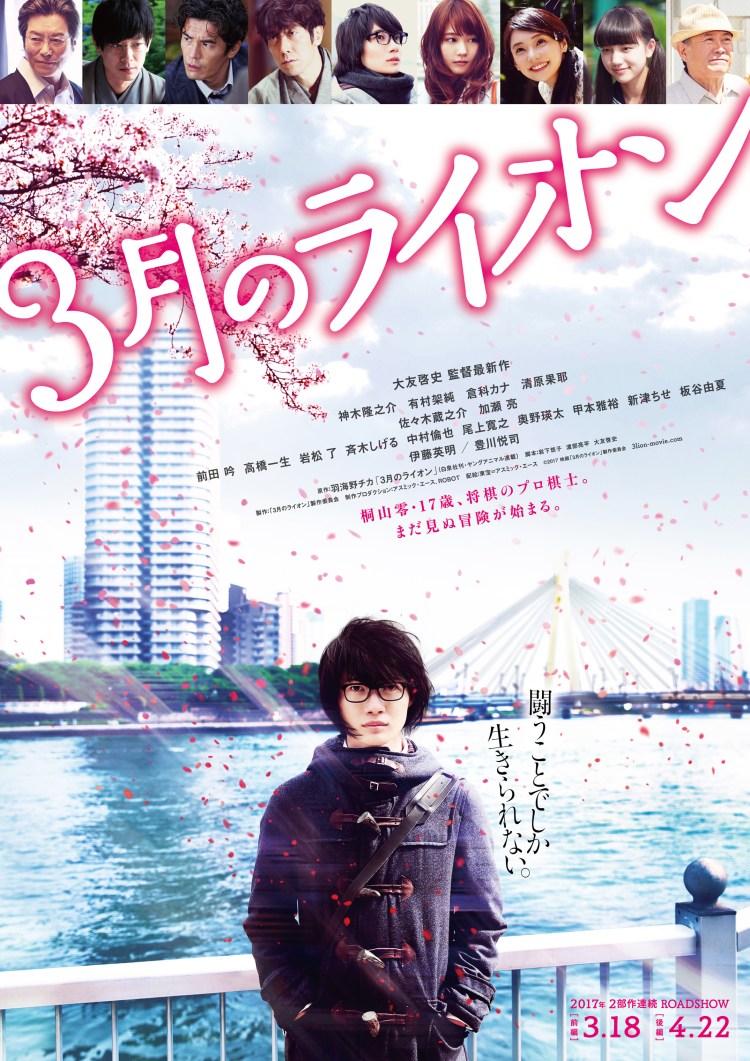
March Comes in Like a Lion (3月のライオン, Keishi Ohtomo, 2017)

march comes in like a lion posterShogi seems to have entered the spotlight of late. Not only is there a new teenage challenger hitting the headlines in Japan, but 2017 has even seen two tentpole Japanese pictures dedicated to the cerebral sport. Following the real life biopic Satoshi: A Move for Tomorrow, March Comes in Like a Lion (3月のライオン, Sangatsu no Lion) adapts the popular manga by Chica Umino in which an orphaned boy attempts to block out his emotional pain through the taxing strategising becoming a top player entails. Shogi, however, turns out to be a dangerous addiction, ruining lives and hearts left, right and centre but, then again, it’s not so much “shogi” which causes problems but the emotional volatility its intense rigidity is often masking.

Rei Kiriyama (Ryunosuke Kamiki) lost his family at a young age when both parents and his little sister were tragically killed in a car accident. Taken in by a family friend, Rei takes up shogi (a game also apparently beloved by his late father) in the hope of being accepted in his new home. A few year’s later, Rei’s plan has worked too well. Better than either of his foster-siblings, Kyoko (Kasumi Arimura) and Ayumu, Rei has become his foster-father’s favourite child causing resentment and disconnection in the family home. Believing himself to be a disruptive influence among those he loves (even if he suspects they still do not love him), Rei removes himself by deciding to live independently, shunning all personal relationships and dedicating his life to the art of shogi.

Everything changes when Rei is taken for a night out by some senior colleagues and is encouraged to drink alcohol for the first time despite being underage. A kindly young woman who lives nearby finds Rei collapsed in the street and takes him home to sleep things off. The oldest of three sisters, Akari (Kana Kurashina) has a habit of picking up strays and determines to welcome the lonely high schooler into her happy home. Suddenly experiencing a positive familial environment, Rei’s views on interpersonal connection begin to shift but people are not like shogi and you can’t you can’t expect them to just fall into place like a well played tile. 

Like Satoshi, the real life subject of which is also echoed in March through the performance of an unrecognisable Shota Sometani who piles on the pounds to play the sickly yet intense shogi enthusiast and Rei supporter Harunobu Nikaido, March dares to suggest that shogi is not an altogether healthy obsession. Koda (Etsushi Toyokawa), Rei’s foster-father, is a shogi master who trained both his children to follow in his footsteps only to pull the rug from under them by ordering the pair to give up the game because they’ll never be as good as Rei. Thinking only of shogi, he thinks nothing of the effect this complete rejection will have on his family, seeming surprised when neither of his children want much more to do with him and have been unable to move forward with their own lives because of the crushing blow to their self confidence and emotional well being that he has dealt them.

Kyoko, Rei’s big sister figure, remains resentful and hurt, embarking on an unwise affair with a married shogi master (Hideaki Ito) who is also emotionally closed off to her because he too is using shogi as a kind of drug to numb the pain of having a wife in a longterm coma. Believing himself to be a disruptive influence who brings ruin to everything he touches, Rei has decided that shogi is his safe place in which he can do no harm to others whilst protecting himself through intense forethought. He is, however, very affected by the results of his victories and failures, feeling guilty about the negative effects of defeat on losing challengers whilst knowing that loss is a part of the game.

Drawing closer to the three Kawamoto sisters, Rei rediscovers the joy of connection but he’s slow to follow that thread to its natural conclusion. His shogi game struggles to progress precisely because of his rigid tunnel vision. Time and again he either fails to see or misreads his opponents, only belatedly coming to realise that strategy and psychology are inextricably linked. Yet in his quest to become more open, he eventually overplays his hand in failing to realise that his viewpoint is essentially self-centred – he learned shogi to fit in with the Kodas, now he’s learning warmth to be a Kawamoto but applying the rules of shogi to interpersonal relationships provokes only more hurt and shame sending Rei right back into the self imposed black hole he’d created for himself immersed in the superficial safety of the shogi world.

As Koda explains to Kyoko (somewhat insensitively) it’s not shogi which ruins lives, but the lack of confidence in oneself that it often exposes. Rei’s problem is less one of intellectual self belief than a continuing refusal to deal with the emotional trauma of losing his birth family followed by the lingering suspicion that he is a toxic presence to everyone he loves. Only in his final battle does the realisation that his relationships with his new found friends are a strength and not a weakness finally allow him to move forward, both personally and in terms of his game. Rei may have come in like a lion, all superficial roar and bluster, but he’s going out like a lamb – softer and happier but also stronger and more secure. Only now is he ready to face his greatest rival, with his various families waiting in his corner silently cheering him on as finally learns to accept that even in shogi one is never truly alone.


Released in two parts – 3月のライオン 前編 (Sangatsu no Lion Zenpen, March Comes in Like a Lion) / 3月のライオン 後編 (Sangatsu no Lion Kouhen, March Goes Out Like a Lamb).

Original trailer (no subtitles)
Youth (芳华, Feng Xiaogang, 2017)

youth posterOn the surface of things, one might be forgiven for thinking that Feng Xiaogang, “China’s Spielberg” – the director of such fluffy hits as If You Are the One and the prestige picture The Banquet, might not be the one to look to for nuanced takes on the state of his nation but, as he proved with the irony filled I am Not Madame Bovary, there has always been a persistent resistance in his superficially crowd-pleasing filmography. The exact nature and extent of that resistance is however harder to assess. Youth (芳华, Fāng huá), Feng’s latest historically probing epic, made headlines when its mainland release was blocked at short notice immediately before its international premiere at the Toronto International Film Festival and in some respects it’s easy to see why it may have raised an eyebrow or two at the censor’s board. A literal story of “youth” and the various ways that the concept becomes romanticised even when one’s own coming of age took place in otherwise difficult times, Feng’s film is also the story of modern China, baptised in the fire of the Cultural Revolution only to finally succumb to the consumerist one 15 years later.

Narrated by bystander Suizi (Zhong Chuxi), later a successful author apparently looking back on her own “youth” with a writerly eye, the tale begins in the early 1970s with two pillars of the arts division of the People’s Liberation Army. Suizi informs us the the protagonists of this story are Lui Feng (Huang Xuan) – a model soldier, and Xiaoping (Miao Miao) – a poor girl mercilessly tormented by everyone throughout her entire life. Xiaoping’s birth father has long been languishing in a re-education camp but as she’s taken her step-father’s name, Liu Feng assures her that he’s kept her bad class background off her record and will make sure no one else knows about it.

Performing propaganda ballets, the arts division is at its zenith at the height of the Cultural Revolution. The troop as a whole enjoys extreme privilege – they are well fed and cared for, evade the dangerous front line work many other members of the armed forces are subject to, and receive the respect due to them as the embodiment of a revolutionary ideal. They are, however, still guilty of the various hypocrisies coded into the system. Though many of the dancers have family members with “bad class backgrounds”, undergoing re-education or otherwise better not mentioned, the top guys and girls are the ones with parents high up in the party who use their untouchable status to paper over cracks in their own development with inherited superiority.

Lui Feng is perhaps an aberration. Nicknamed “Lei Feng” – a mythical figure created for propaganda purposes to embody the “ideal” revolutionary soldier in his selfless dedication to his comrades and communist virtues, Lui Feng is indeed a model party member whose goodness and kindness know no bounds. Unlike Lei Feng, however, he is a real man of flesh and blood not some far off and untouchable god. Having sanctified him in this way, the collective has effectively raised Lui Feng up to an unfair and unattainable ideal and is then “betrayed” on realising that Lui Feng is a man with a man’s hopes and desires. Lui Feng’s transgression is inappropriate to be sure but also somehow innocent in its naivety and his counter betrayal by the system to which he has dedicated his life all the more difficult to bear because of the unfair deification his better qualities have earned him.

Xiaoping meanwhile, who expected only betrayal, betrays the system through passive resistance in resentment of the way it has treated her friend. “Abandoned” by the collective which is the arts troop, Xiaoping exiles herself from a society she thinks has little need of her yet she then continues to serve it fully as a frontline nurse. The “youthful” idealism of Lui Feng and Xiaoping is tested as they find themselves caught up in a far off war while their former comrades dance around with wooden swords on a painted stage. Wounded in body and mind, the pair continue onwards even as their nation conspires to leave them behind.

Shifting into the ‘90s and then the 21st century, Feng’s messages become muddier and harder to grasp. In one sense what is celebrated is “youth” itself which, in this case, happened to take place against the backdrop of terrible events (albeit it ones from which many of the protagonists save Lui Feng and Xiaoping were largely shielded) enabling the growth of a generational family destroyed by a change in the political wind. It is however hard not to infer that everything was better during the turbulent ‘70s in which the delusion of innocence, if not its actual existence, was easier to bear than the soulless march into the future of Coca-Cola signs, Transformers toys and fathers who never come home because they’re too busy making money. Feng’s heroes are the ones who exiled themselves from the reality of China as a modern economic superpower, holding fast to their innate senses of honour and justice, yet in this Feng does to them exactly what he criticises his society for doing – he makes them martyrs, mythologises them as embodiments of revolutionary ideals, a pair of real life Lei Fengs all over again. In telling a story of how the revolution betrays and is betrayed, Feng makes the heroes emerge damaged but unbroken, chaste children trapped by the “innocence” of the pre-capitalist age, but whether their survival is victory or defeat remains unclear. 


Youth is currently screening at selected cinemas across the UK courtesy of CineAsia.

UK release trailer (English subtitles)

HENTAIDA (I am a Pervert) (変態だ, Hajime Anzai, 2016)

B2_0912_OLYou can’t call your film “I am a Pervert” and not expect a certain sort of reaction. Then again, the debut feature from illustrator Hajime Anzai isn’t quite sure what reaction it wants. Part indie journey movie about a conflicted folk singer and part coming of age comedy in which a middle-aged man is forced to own his “perversion” following a horrific bear attack, HENTAIDA (I am a Pervert) (変態だ) is nothing if not perverse.

The nameless protagonist (Kenta Maeno) begins his feature-length voiceover by letting us in on his ignominious teenage history. A shy and lonely boy, he had no girlfriends or even friends of any kind. He took to his room and practiced guitar while the others his age misspent their youths in more exciting ways. No great academic success either, he took a year out to resit his college exams but even then only got into a second-rate institution. It was, at least, in Tokyo – his dream city, and therefore a partial answer to his dreams but when he overslept and missed orientation he found himself on a different path altogether when a large woman with giant frizzy hair press ganged him into joining the university’s rock group.

Bored with his lessons, the protagonist starts to enjoy playing in a band even if he was kind of forced into it. When the bandleader is arrested, the remaining members form a new mini group – The Rejection Letters, and go on to some minor success. Life, however, comes to the protagonist’s bandmates who cut their hair and get regular jobs after uni like you’re supposed to. Now calling himself “Reject Letter”, (or just “Reject” to his friends), the protagonist has been married for five years and has a young son. He’s happy, but he cannot rid himself of the need to visit regularly with an old groupie, Kaoruko (Tsukifuna Sarara), who happens to be a dominatrix (and his sometime manager).

Shooting in black and white, Anzai breaks into colour only twice – during a lengthy and exaggerated sex scene, and then again on a scene of extreme violence. The implication is that Reject’s world is cold and grey, devoid of sensation outside of physical communion with his wife and the final, visceral shock which leads to the inevitable declaration that he is indeed a “pervert”. Truth be told, Reject’s “perversion” is not such a serious one – his early relationship with Kaoruko awakened him to sadomasochism and he has been unable to give up this part of his life or indeed share it with his wife, continuing an “arrangement” if not quite an affair whilst being consumed by shame.

Events come to a head when Reject is invited to perform at a Christmas gig way up in the snowy mountains with some other acts from the circuit both musical and variety. Under the twin tortures of a very boring coach companion and Kaoruko’s desire to provide some “excitement”, Reject’s mind begins to crack. Remembering his wife’s desire to come see him play, he becomes paranoid that she’s hiding somewhere in the (extremely sparse) crowd and will therefore discover the existence of Kaoruko. His shame is so great that he doesn’t seem to realise it might be perfectly normal for his wife to meet his manager and not realise she’s also a dominatrix, and so he steals Kaoruko away and runs off up a snowy trail to certain doom where a very strange adventure awaits him.

Anzai tries to have it both ways, so to speak, in mixing an arty, ironic aesthetic with strange sex scenes running from the semi-explicit weirdness of the consensual lovemaking between Reject and his loving wife, and the slightly less consensual one with a rapidly disintegrating Kaoruko in subzero, bear infested territories. Modesty fog couples with a man throwing vibrators at a rampaging bear as odd mirrors of the implicit and explicit while Reject progresses towards his end goal of being able to own his “perversion” though it’s far from clear whether it’s loud and proud or a grudging confession considering what there is lying in wait in the woods. Perhaps too strange and lowkey for its own good, HENTAIDA (I am a Pervert) does at least live up to its name if only in its bizarre tale of a repressed man’s passage to some kind of self acceptance through a surreal, shame filled adventure.


Original trailer (no subtitles)