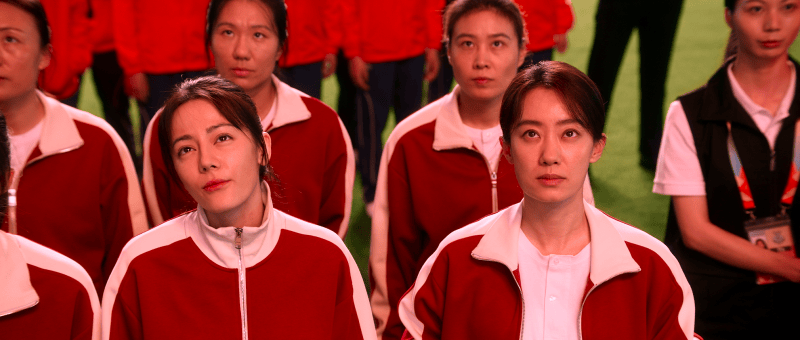
Kung Fu Soccer (功夫女足, Stephen Chow, 2026)

Seven years on from New King of Comedy, Stephen Chow returns with another reimagining of a past hit in Kung Fu Soccer (功夫女足, gōngfu nǚzú), a new take on the 2001 global sensation Shaolin Soccer. Throughout the ‘90s, Chow had been one of Hong Kong cinema’s most bankable talents with a series of mo lei tau or “nonsense” comedies. There’s no getting away from the fact that the Cantonese language is intrinsic to the genre which heavily relies on zany puns and wordplay in addition to slapstick humour, though the later phase of Chow’s career has largely been in Mainland-friendly Mandarin as is Kung Fu Soccer.

As such, the film struggles to achieve the kind of comedic rhythm that made Chow’s earlier work so popular while its nonsense gags such as a man burning his leg in order to get rid of unwanted hair after mistakenly thinking someone talking on the phone about cooking pork was talking to him play out less successfully. As in Shaolin Soccer, Chow turns subpar CGI into a kitsch feature, leaning in to the unreality of virtual stadia and the uncanniness of a CGI ball being knocked around the pitch to create a cartoon world where the normal rules of physics do not apply.

This time around, the action follows the Emei women’s football team who face ageism and sexism after making a belated bid to win an Asian championship. Headstrong captain Shuang (Zhang Xiaofei) and her childhood friend Jade (Dilraba Dilmurat) are struggling to overcome a falling-out over Jade’s decision to leave the sport and get married only to return following her divorce, while Shuang has dedicated her life to football and kung fu but now at almost 40 is beginning to realise that she may have missed out on other life experiences and has no plans for the future. Shuang is an orphan who found a place within the team and fears abandonment, whereas Jade is a wealthy heiress whose devil-may-care attitude is informed by her financial security.

As expected, part of the path for the team’s success is getting the pair to patch things up, which they eventually do after a little manipulation by “Grand Uncle” Xu Feng (Lay Zhang), another childhood friend with a longstanding crush on Shuang she in fact returns but is unable to act on due to being arrested emotionally having done nothing but sport and kung fu since she was a child. The conclusion that Shuang is gradually guided towards is that she’s too intense and has lost her love of playing the game. She has a lack of empathy for her teammates and an autocratic management style that alienates those around her, a criticism that has been levelled at Chow himself in the past. It’s this internalised pressure that makes it difficult for the players to perform. If they chilled out a bit and rediscovered the joy of it, they might be better placed to face their opponents who also have their own particular quirks.

The film has also come in for criticism for the ways that it depicts the other Asian nations in the competition, most particularly the South Koreans who are shown to be obsessed with beauty and play in underhanded ways while the Korean spoken in the film is delivered unconvincingly. The team from India similarly have some kind of super-stretchy ability and the Australians are defined by aggression and tactlessness. The Japanese team, coached by Takeru Satoh in a cameo appearance, are mainly just violent while the decision to make their goalie a figure of fun for not being considered conventionally attractive seems very outdated and undercuts the film’s other messages of female power and solidarity. The Emei team face questions of ageism and are forced to constantly prove themselves, but eventually come out on top after learning to trust each other, pool their respective strengths, and just have fun playing the game. Backed by Carina Lau’s mahjong-obsessed grandmaster, they have perhaps learned to integrate their martial arts abilities and love of sport to overcome not only the prejudice held against them, but their own internalised anxieties.


Kung Fu Soccer is in North American, UK, & Ireland cinemas from 23rd October.

Trailer (Simplified Chinese / English subtitles)
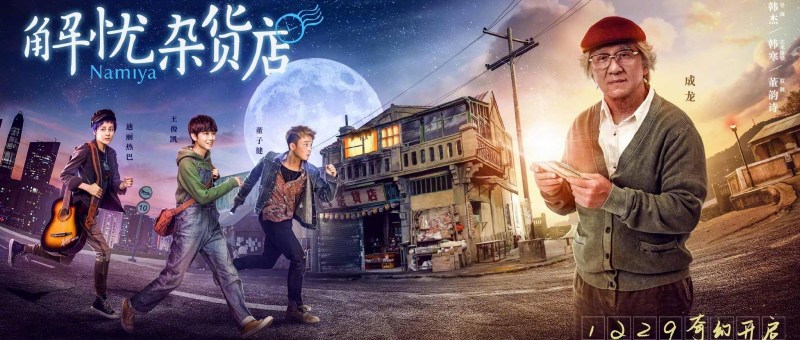
Namiya (解憂雜貨店, Han Jie, 2017)

Namiya posterKeigo Higashino is almost certainly best known for his crime novels and in particular his most famous detective, Galileo, whose exploits have spawned a successful TV drama series and a fair few cinematic adaptations including the international bestseller, The Devotion of Suspect X. One might expect a writer of mystery novels to be a fierce rationalist, but Higashino occasionally dabbles in the fantastic – The Miracles of the Namiya General Store is more or less a nostalgia fest praising the pre-bubble Japan, implying that the modern world is colder and less kind than the aspiring society of 1979. Adapted for the Chinese market by Han Jie, Namiya (解憂雜貨店, Jiě Yōu Zá Huò Diàn) retains the corner shop where time stands still but locates it in 1993, which is not so much a significant date save being 25 years in the past.

On New Year’s Eve 2017, three teens break into a woman’s home with the idea of causing some damage, but the event goes south when she comes home early and one of the three decides to tie her up and steal a bunch of her stuff. Having gone further than they meant to, the trio wind up in an unfamiliar part of town when the car they’ve stolen runs out of petrol. An improbably quaint, apparently disused corner shop attracts their attention but when they break in to shelter for the night they discover that this is no ordinary store. A ghostly miasma gradually creeps its way in and the three youngsters find themselves answering a collection of letters meant for the store’s owner written in 1993 but only dropping through the letter box now. They funny thing is, they get almost immediate replies.

As one of the teens points out, they weren’t even born in 1993 – this store might as well be from 1793 as far as they’re concerned. Though it drips with nostalgia for a simpler time, Namiya treads (understandably) more carefully in painting early ‘90s Beijing and its rural backwater setting, strenuously avoiding any mention of politics and characterising China’s economic development as an entirely good thing despite the troubles the three teens at the centre have been subject to throughout their apparently difficult lives.

The letter writers have various problems but each in someway relates to being a little lost, a little bit confused about how to move forward in life. A frustrated musician (Lee Hong-chi) whose career is not taking off wants to know whether he should give up and come home, a little boy has a bad relationship with his go-getter parents who have lost all their money and got into trouble with loan sharks, and a melancholy bar hostess (Hao Lei) wants to know if she should become the mistress of a gangster who promises to set her up in a shop that would get her out of her dead end life and still enable her to support her family. The kids are not really qualified to offer any kind of real life advice, with sensitive Xiaobo (Karry Wang) and plucky Tong Tong (Dilraba Dilmurat) reacting in broadly sympathetic terms while the sullen Jie takes a hardline moralist stance in which he just wants to write angry letters to everyone telling them they’re doing everything wrong.

Jie has his own reasons for being so angry, especially as one of the letters touches a nerve in his own personal history but his ambivalence was at one point shared by Papa Namiya (Jackie Chan) himself after he feared his treasured advice might have ended up having a negative effect on people’s lives. Papa Namiya tells the troubled little boy to stick with his parents no matter what because family is the most important thing in a person’s life which might be true much of the time, but not when the parents actively endanger their child. What he finally reassures himself with is that his advice was largely meaningless because most people have already made up their minds what they’re going to do, they just want someone to help them feel like they’re doing the right thing. In fact, no one really follows Papa Namiya’s advice anyway, but the kids are able to make a concrete change when they reveal the economic realities of modern China to a young hopeful who then uses the knowledge to build an international business empire (but makes sure to pay it forward whilst paying tribute to their roots by committing to sponsor an orphanage in need of renovation/expansion).

The slightly awkward message Namiya leaves behind is that dreams come true when people work hard to achieve them but that the young are also free to forge their own destinies, that the world is, for them, infinite and filled with boundless possibility. Optimistic and inspiring as it is, it isn’t terribly realistic and does rather imply that those who haven’t made it are either lazy or dishonest as echoed in the mildly moralistic tone taken with the bar hostess’ dilemma or the odiousness of the corrupt businessman and his failure to protect his family from his own mistakes. Moral judgements and naivety aside, Namiya is an otherwise heartwarming, deliberately uncynical New Year tale which does its best to engender hope for the future in an otherwise cold and unforgiving month.


Currently on limited release in UK cinemas.

Original trailer (Mandarin with English subtitles)