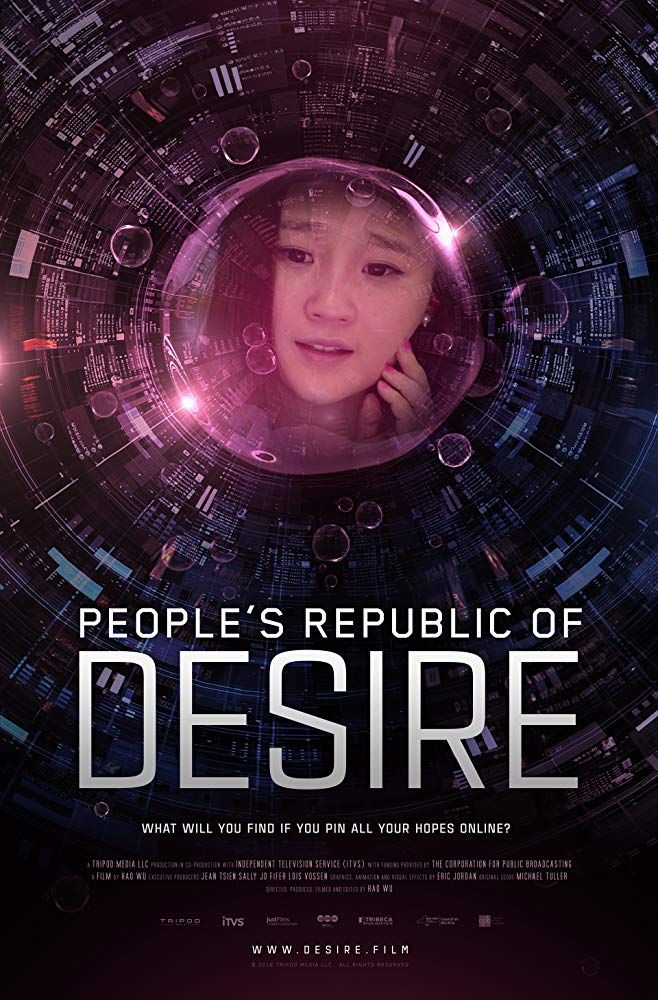
People’s Republic of Desire (欲望共和国, Wu Hao, 2018) [Fantasia 2018]

People's Republic of Desire PosterCan you outsource a dream? According to Wu Hao’s People’s Republic of Desire (欲望共和国, Yùwàng gòngguó), many in modern China have resigned themselves to doing just that. Feeling lonely, disconnected, hopeless, they turn to people just like them who’ve been luckier and have not yet decided to give up the fight. Video streaming service YY acts like the future’s version of pirate radio, lining up a selection “personalities” male and female offering pretty much anything from stand up comedy and political diatribes to off key singing and a window into someone else’s every day life from breakfast to dinner. Of course, it all comes at a price – one which YY gleefully takes a 60% cut of, but there are hidden costs too – to a society, to the deluded fans, and even to the aspiring stars themselves forced into various debasing acts in the knowledge that their time in the spotlight will soon come to an end.

Wu follows two very different YY stars – 21-year-old former nurse Shen Man, and Big Li – a former migrant worker whose rough voice and man’s man attitudes have endeared him to a host of other “diaosi” fans. “Diaosi”, once an unpleasant slur meaning “loser” and most often applied to those stuck in the lower orders of China’s rapidly increasing social equality gap, has been reclaimed by those who self identify with its sense of ironic hopelessness. As Shen Man explains, YY works as a kind of pyramid system in which millions of dreaming diaosi throw money they don’t really have at online stars in the hope of connection while Tuhao – the nouveau riche looking for new ways to splash the cash, act as patrons deciding the direction of the service.

What many diaosi forget to factor in is that in reality the entire service is run by agents and promoters who push their various stars to steal “votes” from their online fans. YY is not a public service platform, but a vast money making machine which sucks in cash from every conceivable angle. As cynical patron Songge points out, those seeking fame on YY cannot expect to make any money. In order to win the site’s popularity contest, they need to get an agent and their agent will need to spend a vast amount of money to promote them which the star will then need to make back.

Shen Man, on one level naive, is perfectly aware of the way the system works. She knows she needs to keep her fans happy or they’ll leave. Like Big Li she’s a poor girl made good, a figure her female fans can look up to as someone just like them that’s been able to escape the world of diaosi drudgery. Her male fans, by contrast, are probably looking for something different. Some of them like the idea of her ordinariness, that she comes from the same place they do and is therefore attainable while also being unattainable thanks to her quickly acquired wealth which allows her to live the life of a modern princess. There is however a cost. In order to hook more fans the youthful 21-year-old has already spent a lot of money on extensive plastic surgery (perhaps veering dangerously close to destroying her “natural charm” selling point), and is expected to play nice with her sometimes insulting clientele. One patron, chatting idly on the phone, tries to throw money at her in return for sex whilst simultaneously insisting that she’s not like the other YY girls who will do anything for money. Shen Man points out that she has money already and is not that sort of girl while her patron continues along the same line of argument insisting that all you need to do get a girl is flash the cash.

Big Li, by contrast, is much less cynical. He recognises that he’s become a kind of leader for his diaosi brothers and is eager not to let his fans down. Married to YY talent manager Dabao and with a young son to take care of, Big Li is originally grateful for his rock star life, but the pressure begins to get to him and he longs for the simple days of the village filled with the warmth of family and friends rather than the lonely false connection of YY’s race to fame mentality. Big Li genuinely cares, but this is his downfall. He wants the freedom that YY promises and refuses to play the game, but the game continues to play him.

Adoration quickly to hate. Shen Man finds herself out in the cold when she is publicly slut shamed, accused of taking money from fans in return for sexual favours, earning the nickname of “300 Man” as a woman who can be brought so cheaply she has no value at all. The constant double standard – that she must be beautiful and desirable, yet pure and chaste, has something to say about the nature of China’s conservative social values even in a modernising age. Once your reputation has gone it cannot be rebuilt and even the loyalist fans will find themselves moving on. Big Li might not have to put up with the same kind of pressures as Shen Man, but is personally hurt when fans call him “scammer” because of his constant failures to take home the big prize.

So what of the fans themselves? There are those who’ve made vast amounts money thanks to China’s rapidly modernising economy and don’t know what to do with it other than show off by giving it away. They too are trying to buy connection through becoming patrons, “owning” someone less fortunate and taking pleasure in dictating their lives. Meanwhile, on the opposite end of the scale, the diaosi have all but given up on their own dreams and so “enjoy” investing money to “support” the dreams of those just like them out of a sense of frustrated solidarity.

The picture Wu paints of modern China is one of a world spiralling out of control in which intense loneliness and alienation have corrupted the nature of social connection. Money rules all. Wealth is all that matters and in the crowded online world, if you want to be noticed you’ll have to pay. Interactions are bought and paid for with petty, entirely virtual trinkets, while in the offline world all there is is work and sleep and cheap fast food. Only the platform is the winner, as one unlucky hopeful puts it. The sad truth is that everyone knows it’s a losing game and has resigned themselves to conceding defeat in a society already leaving them behind.


People’s Republic of Desire was screened as part of Fantasia International Film Festival 2018.

Original trailer (English subtitles)
Being Natural (天然☆生活, Tadashi Nagayama, 2018) [Fantasia 2018]

Being Natural posterModern life is stressful and perhaps does not offer the kinds of material rewards that previous generations took for granted. Moving back to the country to experience a simpler, more sincere kind of life has become a mini trope in contemporary Japanese cinema as the young men and women of Japan become disillusioned with a stagnating economy and, feeling trapped within a conformist society, decide to embark on a life of self sufficiency free of material burdens. What such stories have not yet asked is if the influx of outsiders from the city amounts to a colonisation of so far untouched land as the newcomers bring with them their newfangled desires and attitudes. Tadashi Nagayama’s gentle satire Being Natural (天然☆生活, Tennen Seikatsu) is partly an attack on rampart xenophobia and small scale colonialism but also a mild condemnation of corporatised hippiedom and its tendency to destroy the thing it claims to honour in remaking it to fit a city dweller’s ideal of idyllic country life.

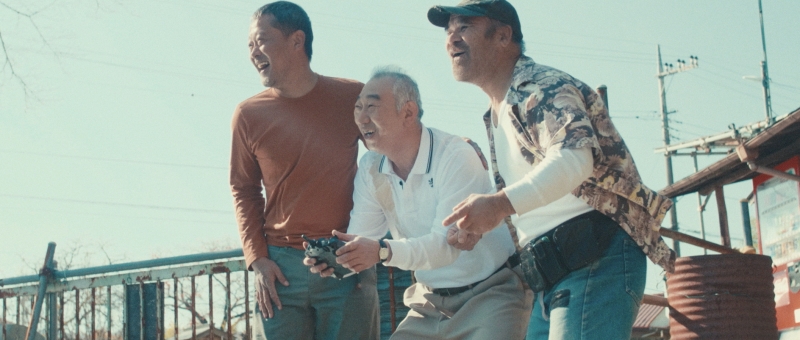
Shy and awkward, Taka (Yota Kawase) is an unemployed middle-aged man who lives with his elderly uncle in the ancestral family home. Taka’s uncle suffers from dementia and, it seems, was always a “difficult” person even in his youth which is perhaps why the rest of the family have abandoned him with only the gentle Taka prepared to stay behind and look after the ageing patriarch. When his uncle dies, Taka’s world threatens to collapse but thankfully his embittered cousin Mitsuaki (Shoichiro Tanigawa) is talked round by his sister and decides to let Taka stay in the family home as a thank you for taking care of everything for so long. Not only that, Mitsuaki also gets Taka a job working at the local fishing pool alongside another old friend, Sho (Tadahiro Tsuru).

Reverting to childhood, the three men generate an easy camaraderie, looking after turtles, having barbecues, and making music together under the moonlight. The idyllic days are not to last, however. The harbingers of doom are a hippyish family from Tokyo who moved into the village with the intention of opening a coffee shop. The Kuriharas – Keigo (Kanji Tsuda), his wife Satomi (Natsuki Mieda), and daughter Itsumi (Kazua Akieda), are into the “natural” way of life and have moved from Tokyo for the benefit of their health. Rather than shop at the supermarket like everyone else, they’re keen to buy from Sho’s grocery store even when he explains to them that all his veg is old and shrivelled rather than freshly plucked from local fields. Still, the family are determined even if it means projecting their vision of “rural life” onto the evident reality.

The Kuriharas are literally intrusive – rudely opening the sliding doors of Taka’s house without permission and waking him up, offering the excuse that they were unable to find the “intercom” on this traditional Japanese house that they claim to admire so much. The original site having fallen through, they’ve set their sights on setting up shop in Taka’s home, exploiting the “traditional” architecture for their warm and welcoming cafe. This is all very well but it does of course mean displacing Taka from his natural habitat. As shy and mild mannered as he is, there’s only so much a man can take and Taka resents being evicted from his family home by a bunch of invading interlopers with commercial concerns.

While Satomi natters on about organic veg, Itsumi skips the English classes her controlling mother makes he go to and guzzles additive loaded instant ramen when she thinks no one’s looking. Wanting to preserve the “natural beauty of glorious Japan”, Keigo goes slightly nuts when he realises Taka’s pet turtles are a non-native breed, exploding with xenophobic fury over the dangerous presence of a disease laden predator whose presence threatens the safety of the true Japanese amphibian. Wondering exactly who or what is the “non native” threat, Taka launches a full scale resistance movement, papering the house in giant graffiti posters reminiscent of the student protest era reminding all that turtles, no matter where they’re from, have a right to life too and must be defended. Yet the corporately minded hippies will stop at nothing to get what they want – manipulating Mitsuaki with a new girlfriend and then turning the town against Taka by means of a heinous, life ruining rumour. 

Forced out and heading to the city, Taka is reminded that he is now the hostile foreign element – that the park is not his “home” but belongs to “everyone”. When his beloved bongos are ruptured, Taka’s rage turns radioactive and sends him off on a quest of vengeance only to recede as his better nature regains control and he commits himself to using his new found powers to improve the lives of those around him in small but important ways. A satirical take on the romanticisation of country life by self-interested city dwellers, Being Natural eventually takes a turn for the macabre that possibly undercuts rather than reinforces some of its central concerns but makes a case for according the proper respect to the natural world as well as the people who live within it rather than attempting to exploit it for oneself whilst wilfully ruining it for others.


Being Natural received its international premiere at Fantasia International Film Festival 2018.

Original trailer (English subtitles)
Men on the Dragon (逆流大叔, Sunny Chan, 2018)

Men on the dragon posterLife is tough for the middle-aged man in contemporary Hong Kong, at least according to the directorial debut from screenwriter Sunny Chan, Men on the Dragon (逆流大叔). Economic woes, a precarious employment environment, familial strife, and elusive Andy Lau tickets all conspire to make our guys feel powerless in a society that seems primed to crush their spirits. Can dragon boating really help put their fire back in their bellies? Conventional wisdom would say no, but then there is something about physically demanding team sports that is particularly good at inflaming individual desires.

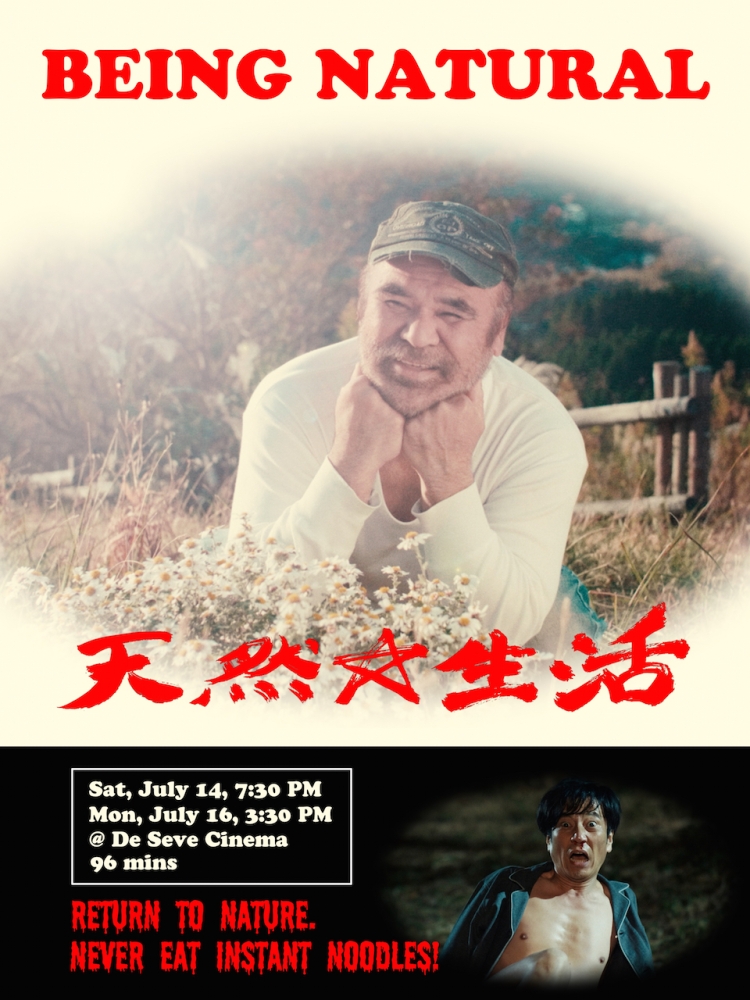
Pegasus Broadband is about to announce another round of mass layoffs which has each of our heroes worried. Participating in a mini protest strike puts them straight in the firing line (even if they were clever enough not to write their real names on the petition forms), but when they’re seemingly lucky enough to escape the axe for now at least they think they can breathe easy. An unexpected call from the boss instructing them to appear at a mysterious location with swimming trunks in hand even has them wondering if they’re being given some kind of bribe to play nice but as it turns out the reverse is true. Pegasus Broadband wants to improve its public image and has decided to do that by entering a team in the upcoming dragon boat races. The race, which they fully expect to win, will be streamed live online to demonstrate the company’s infrastructural superiority. Fearing they’ll be bumped up the redundancy list if they refuse, our guys resign themselves to becoming unlikely dragon boat champions but end up discovering unexpected sides of their potential which prove essential in solving their individual crises.

Suk-yi (Poon Chan Leung), bespectacled and mild-mannered, is the least athletic of the Pegasus Broadband employees but is half grateful for the dragon boating opportunity because it gets him out of the house where his wife and mother constantly bicker while his small daughters can’t stop fighting. Feeling pushed out and unwelcome in his house full of angry women, Suk-yi is desperately looking for some kind of escape or possibility of reasserting his authority which he begins to find while training for the dragon boat races and nursing a small crush on the pretty coach, Dorothy (Jennifer Yu). Meanwhile, Lung (Francis Ng) is unmarried but has found himself in an awkward non-relationship with the woman next-door for whom he cooks and cleans, even taking care of her moody teenage daughter. He dreams of making a real family but lacks both the courage and financial resources to make a move. The youngest of the gang, William (Tony Wu), has the opposite problem in that he’s given up his dream of being a top Ping Pong player to build a future with his girlfriend but begins to realise that he hasn’t given up on his athletic hopes while boss Tai (Kenny Wang) is secretly torn apart by the worry that his wife is having an affair with a sleazy real estate agent.

All four guys have found themselves swept along by the current of modern Hong Kong, coasting without aim or purpose but filled with middle-aged anxiety as they wonder where the river is taking them and if it’s already too late to change the destination. Suk-yi’s dilemma is perhaps the most cliched of the three as he contemplates swapping his disharmonious household for the unattainable charms of an idealised younger woman while Lung chases easy familial bliss, Tai tries to repair a relationship corrupted by modern social pressures, and William wonders if it’s worth giving up a part of yourself to make a relationship work knowing that kernel of resentment will only grow with time. Men on the Dragon is, in this sense, a very “male” story in which four put upon men feel themselves emasculated by oppressive social forces yet learn to rediscover their “manhood” through the intensely physical act of dragon boating.

They are however guided along by an austere young woman who bangs the drum to which they must all march. This is not Dorothy’s story and she gets short shrift among all the guys but there’s something interesting in the fact that she had to hire a “male foreigner” to pretend to be the “real” coach because no one would hire a female dragon boater despite her impressive list of qualifications and credentials. Gently rebuffing Suk-yi’s interest, she nevertheless guides him towards a confrontation he’d long been avoiding in reasserting himself in his own household, restoring his standing in his wife’s eyes and brokering piece with his feisty mother who can’t seem to get on with her Mainland daughter-in-law. It’s the rhythm of life that’s important, Dorothy reminds the guys – you don’t get anywhere unless you’re all pulling together. That might sound like we’re back where we started, being swept along in a mass current without control or direction but it’s individual will which drives the communal enterprise and there can be no progress without agency. Not all dreams work out, but you won’t know unless you try and at least if you crash and burn there are plenty of guys waiting to pull you out of the water.


Men on the Dragon made its world premiere at the New York Asian Film Festival 2018.

Original trailer (English subtitles)
What a Man Wants (바람 바람 바람, Lee Byeong-heon, 2018)

What a man Wants posterMarriage, eh? Bit of a rollercoaster. Lee Byeong-heon’s sex farce What a Man Wants (바람 바람 바람, Baram Baram Baram) takes two ordinary couples and exposes the various hypocrisies which underpin their existences as they battle boredom and excitement in turn before finally figuring out exactly which relationship(s) they would ideally like to be in full time. The sexual politics are distinctly old fashioned, as is the male fantasy wish fulfilment at the film’s centre, but Lee chooses wryness over cynicism in asking if a little infidelity here and there might actually strengthen an otherwise shaky connection.

Seok-guen (Lee Sung-min) used to design rollercoasters all over the world, but now he drives a taxi on Jeju and gets his kicks “picking up” fares. That’s not to say he doesn’t love his wife, the patient Dam-deok (Jang Young-Nam), but he enjoys the thrill of the chase and favours instant gratification over the patient pleasures of married life. Seok-guen is often aided and abetted in his assignations by his straight laced brother-in-law, Bong-soo (Shin Ha-kyun), who is married to Seuk-guen’s forthright sister, Mi-young (Song Ji-hyo). Bong-soo doesn’t really approve of Seok-guen’s carrying on and doesn’t see the appeal of extra-marital affairs, but realises he has little choice other than to help Seok-guen out or risk his family life imploding. The couples live next-door to one another and are extremely close.

The trouble starts when Seok-guen tries to pick up the alluring Jenny (Lee El) at a pool bar. Bong-soo, not normally smitten, is seemingly hit by a lightening bolt and finds himself suddenly fantasising about another woman. Seok-guen had long been urging Bong-soo to have an affair (which is odd seeing as Bong-soo is married to his little sister), but he probably hadn’t envisaged him stealing Jenny out from under him. Flattered when Jenny starts paying him attention, Bong-soo succumbs only to make a rookie mistake of going home with her panties in his jacket pocket. Bong-soo takes revenge for years of being an alibi and blames the whole thing on Seok-guen who is mock thrown out by Dam-deok though she only really means to teach him a lesson rather than get rid of him for good.

The problem with Jenny is she’s not really real. She’s an embodiment of a male fantasy that might as well have been conjured up by the otherwise dull Bong-soo. With her sexy outfits, self consciously cute way of speaking, and frankly unbelievable interest in a boring failed restaurateur you really have to wonder if she’s not some kind of spy or a master criminal lining up a mark (except that neither Seok-guen or Bong-soo have any money). Sadly, no. She’s just the archetypal sexpot ripped straight from a ‘70s farce with little more to her character than sauciness with a side order of harlotry, despite the valiant efforts of actress Lee El who attempts to imbue her later emotional scenes with depth and sincerity to make up for her underwritten role. Jenny repeatedly claims to know what men “want” and then gives it to them, like some sort of temptress from a folktale, never allowed to express what it is she might “want” but only ever hanging around to be “won” by one of the two guys.

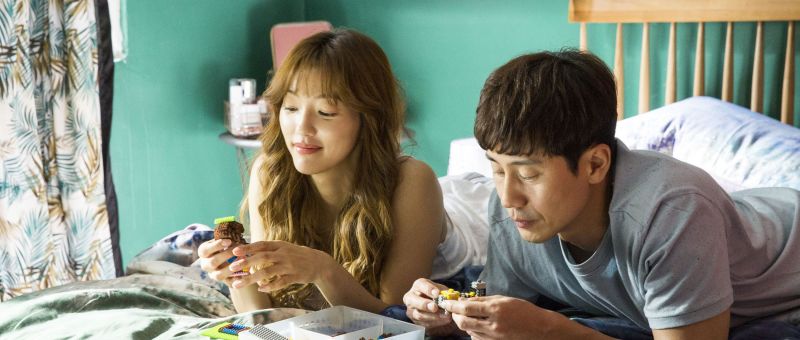
Bong-soo and Seok-guen undergo a role reversal when an unexpected tragedy forces Seok-gun to reassess his philandering ways while Bong-soo becomes a practiced adulterer. The marriage of Mi-young and Bong-soo is already on shaky ground – their sex life is all but dead and they’ve been having trouble conceiving. Mi-young is addicted to social media while Bong-soo spends his spare time building LEGO models, and in addition to being marital partners they also co-own an “Italian” restaurant which Bong-soo has long wanted to turn into a Chinese one (he trained as a Chinese chef) but Mi-young continually ignores his dream despite the fact that the restaurant is permanently empty and about to go bankrupt. Partly mid-life crisis, Bong-soo’s affair is motivated by a need to reassert his “manhood” while Jenny flatters him, strokes his ego, and does all the “wifely” things the “bossy” Mi-young refuses to do.

Yet just as Seok-guen said they would, Bong-soo’s fortunes improve thanks his to philandering – he becomes a better chef, the business takes off, and Mi-young (paradoxically) seems to develop more faith him as well as additional respect for his increasing “manliness”. Both men, through their interactions with the almost non-existent Jenny, are then forced to consider what, or who, it is they really want though Lee’s message seems to be that there are “secrets” in every marriage and perhaps it’s better not to ask too many questions if you want to maintain a happy married life. Cynical, though gleefully so, What a Man Wants is a salty affair but one which ultimately places its faith in “love” to find its way home despite the messiness of the journey.


What a Man Wants was screened as part of the New York Asian Film Festival 2018.

International trailer (English subtitles)

Dude’s Manual (脫單告急, Kevin Ko, 2018)

Dude's Manual posterPersonas – university can be all about figuring them out but more often than not the key comes from an unexpected direction. An unexpected direction is where Dude’s Manual (脫單告急, Tdān Gào) eventually takes us after kicking off with a scary crime thriller opening in which our hero gets himself temporally mixed up with a serial killer investigation only to earn himself the embarrassing nickname “Air Pump” when his “victim” is revealed to be a blow up doll. An unlikely meet cute brings him into the orbit of the most popular girl at school and subsequently into her plan to win back her reputation after getting it tarnished with his naffness at the expense of another shy and lonely student, but then again, isn’t everyone going to get what they wanted? Perhaps yes, perhaps, no.

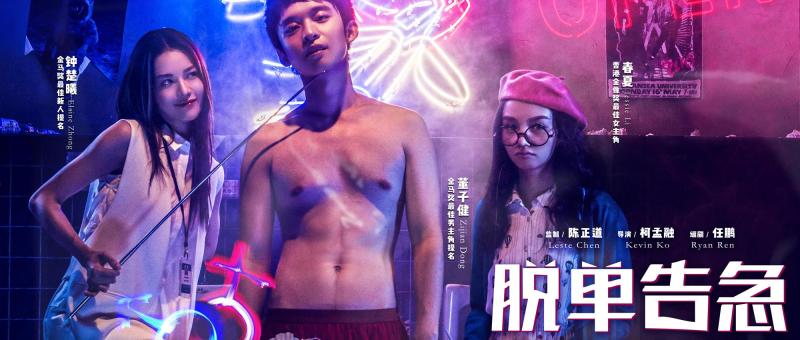
He Xiaoyang (Dong Zijian) is in the last year of uni and is still single, never having had a girlfriend. An embarrassing incident with a blowup doll has earned him the nickname “Air Pump” around campus, while his roommates – “sexpert” Boshi (Yuan Fufu), and rich kid Ren Yi (Jin Jin), are doing a little better when it comes to the ladies, but neither of them is much help to the nerdy Xiaoyang whose main passion is the homemade flying machine he’s crafting in preparation for a competition. At an exclusive party Ren Yi gets the boys into, Xiaoyang’s life takes a dramatic shift when popular pretty girl Guan Xin (Elaine Zhong) throws up on his T-shirt and then becomes trapped with him in a bathroom from which they fail to escape before a budding paparazzo snaps them together in a compromising position. Guan Xin, mortified that anyone might think she hooked up with “Air Pump”, hatches a plan to get Xiaoyang a “real” girlfriend to clear her name and retrieve her top girl status.

As rom-com plots go it’s a fairly old fashioned one. Guan Xin decides to set Xiaoyang up with a shy concert pianist, Li Shushu (Jessie Li), who hardly ever comes to parties because of her intense social anxiety. She is therefore, Guan Xin rationalises, perhaps grateful for the interest and Guan Xin is really “helping” two people by manipulating them both into a possible relationship which might just have legs. Of course, while she’s doing that she and Xiaoyang can’t help but grow closer even if Guan Xin can’t quite bring herself to admit it.

The spanner in the works is that Xiaoyang, despite himself, is a pretty nice guy. He plays along with Guan Xin’s scheme but quickly goes off book, demonstrating genuine understanding and connection with the shy Shushu as he gently helps to bring her out of her shell. He is, however, also falling for Guan Xin but doubting that she will ever set aside her haughty attitude and accept her growing feelings for him.

The central irony is that Guan Xin can’t see all the ways in which she and Xiaoyang have already progressed through the standard rom-com gateways to love. Meanwhile, Xiaoyang’s friends are also enjoying a lesson in romance with both of their respective girlfriends as sex obsessed Boshi has to learn to be less superficial, and Ren Yi that money really doesn’t buy everything. It is hard to get past the unethical using of poor Shushu who becomes a sacrificial pawn in Guan Xin’s grand plan, but then again perhaps she learns a thing or two herself even if it’s just how to subvert someone else’s nefarious plan in order to engineer a happier out come for all.

Ko has a few laughs at the expense of the young men and women of modern China. Lives lived online have contributed to an already shame hungry culture and given birth to a fair few unscrupulous paparazzo gossip hounds who might be better sticking their cameras in more useful places, while also reinforcing traditional ideas about social hierarchy. Guan Xin, in many ways taking on the masculine Svengali role as she “fixes” the feminised ugly duckling of Xiaoyang, has some pretty cynical ideas about modern dating – using jealously as a weapon, trying to turn the “nice” Xiaoyang into a hot bad boy player that all the women will go crazy for, but then her plans do seem to work and Xiaoyang sees himself rising through the loser ranks to become an eligible campus catch. Like all good rom-coms, however, he doesn’t let himself be changed on the inside so much as rediscover what it is that makes him him, flying off into the sky on the wings of a romantic dream crafted with his own hands.


Dude’s Manual screens as part of New York Asian Film Festival on 14th July at 2.45pm.

Original trailer (English subtitles)

Dukun (Dain Iskandar Said, 2018)

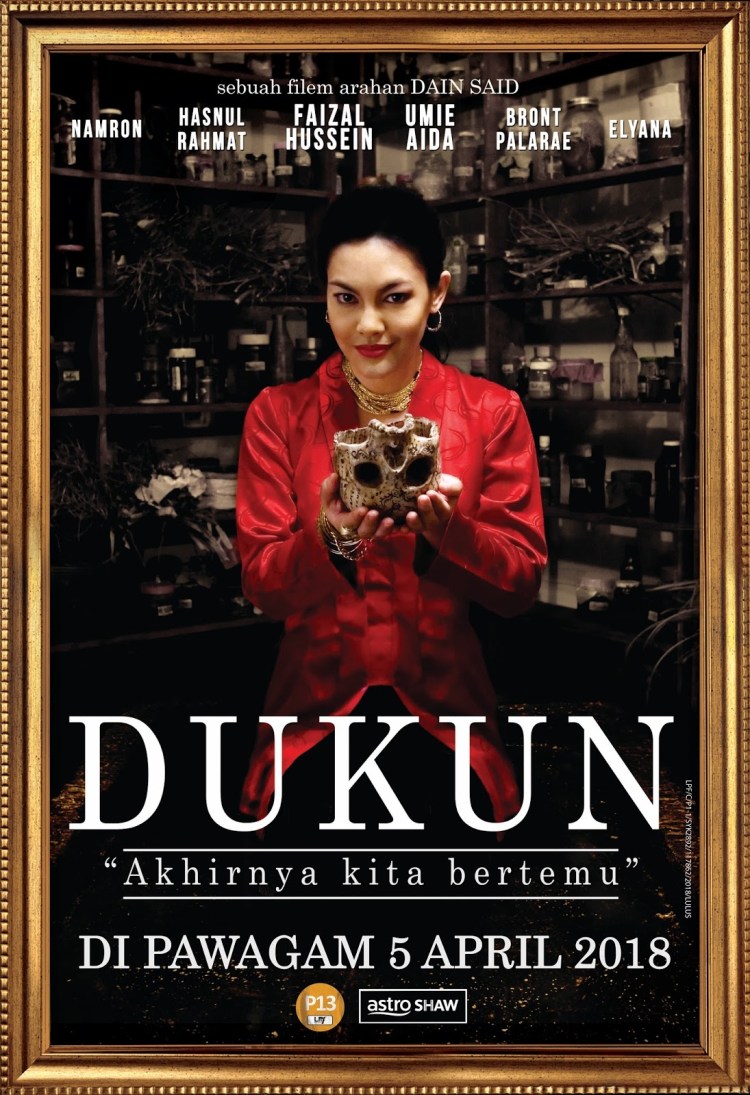
Dukun posterInspired by a notorious real life crime, Dain Iskandar Said’s Dukun proved too controversial Malaysia’s censors and is only now reaching cinema screens after languishing on a studio shelf for the last twelve years. It arrives, however, alongside a number of similarly themed East Asian horror films which pit ancient “superstitions” against “respectable” religions and, unlike many, broadly comes down on the side of Islam which perhaps makes the fact that it was banned a little surprising. Then again, as a lawyer points out midway through the unconventional femme fatale’s murder trial, there are many who believe in “black magic” and perhaps faith is not enough to hold off the overwhelming supernatural dread of incomprehensible otherworldly forces.

Said opens with the conclusion as Diana (Umie Aida), the “gifted” shamaness and glamorous nightclub singer, dolls up in a beautiful ballgown to be sure of making an impression at her own hanging. Dialling back a little, the dismembered body of a businessman is discovered with evidence that suggests a ritualised killing. Meanwhile, veteran lawyer Karim (Faizal Hussein) is desperately searching for his 17-year-old daughter Nadia (Elyana) who ran away from home after an argument. Fearing Nadia has gotten herself mixed up with drugs, Karim hopes to get an old police contact to help him keep tabs on new arrests but in return he finds himself agreeing to defend a difficult client who has already rejected all 23 public defenders put in front of her. Diana argues that the businessman died as a result of a ritual intended to make him invincible because he didn’t listen to her instructions and the spells didn’t work – his death, therefore, is not her “fault” but the unfortunate consequence of improper respect for shamanistic practices.

Dukun’s banning is apparently not so much down to a direct confrontation of Islam and shamanism, but the sensitivity surrounding the real life case which inspired it. In 1993, former pop-singer Mona Fandey, who had rebranded herself as a top shaman catering to the rich and famous, was arrested for the murder of a politician whose dismembered body was eventually discovered in her storehouse. As the investigation progressed, more bodies were discovered as was a lengthly paper trail detailing a shopping spree which even included a face lift. Unsurprisingly given all the grizzly details and celebrity connections, the trial was a media sensation which Fandey milked for all it was worth.

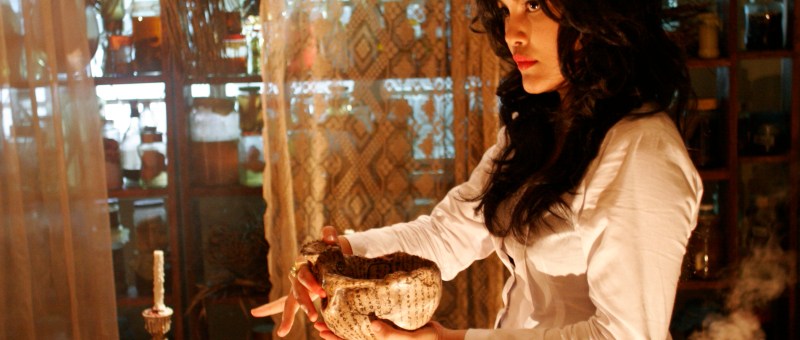
Though the narrative and facts of the case have obviously been fictionalised, the comparisons are obvious – the accused shamanesss is even called “Diana” which was the title of one of Fandey’s unsuccessful albums. Actress Umie Aida perfectly mimics Fandey’s deluded fame hungry creepiness but also adds the oddly alluring quality of a film noir femme fatale as she shifts between elegant nightclub singer and all powerful practitioner of black magic. Diana plays to the gallery, attempts to charm the court, and acts as if her trial is just another show conducted in front of her adoring fans while preparing herself for the grand “finale” which, unbeknownst to the legal system, may all be a part of her greatest work of ritual magic.

Meanwhile, Karim attempts to defend her with a keen application of the law, pitting “irrational” ritual against state sponsored logic which itself is perhaps largely under the sway of conventionally religious thinking. Karim’s wife disappeared ten years previously, leaving him to raise his daughter alone only to have her disappear too. Diana seems oddly familiar with Karim’s difficult family circumstances and offers to “help” him in return for delivering makeup and a mysterious object from her apartment. Karim is desperate enough to accept, but in accepting may have already betrayed himself even if he’s careful to also consult his local Imam as to the best course of action.

As in the all best supernatural noir, darkness is coming for Karim. Engulfed in an inescapable spiral of dread and despair, Karim finds himself sinking ever deeper in his quest to rescue his daughter little knowing that they are all involved in an ancient conspiracy over which they have little or no control. You can’t play around with the supernatural, Diana counsels, but the supernatural may very well play around with you.


Dukun screens as part of the New York Asian Film Festival 2018 on 13th July 6.15pm

Official trailer (English subtitles for dialogue, contains disturbing imagery)

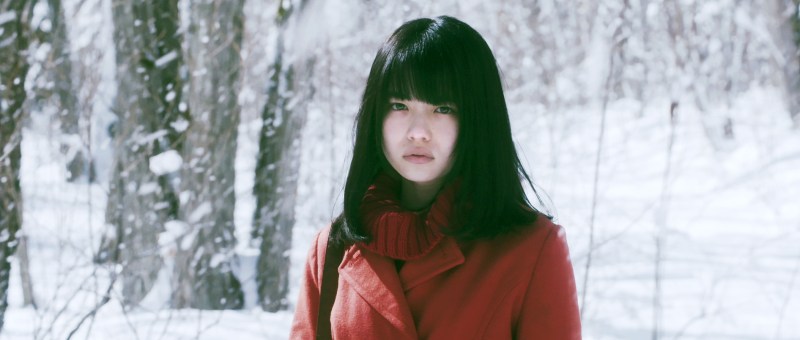
Liverleaf (ミスミソウ, Eisuke Naito, 2018)

(C)押切蓮介/双葉社 (C)2017「ミスミソウ」製作委員会

Liverleaf poster“How have things turned out this way?” Asks the heroine of Eisuke Naito’s Liverleaf (ミスミソウ, Misumisou) after receiving a poignant (non)explanation for the cause of all her sufferings. Adolescence is cruel at the best of times, but when you’re stuck in a tiny no horse town with nothing to do, violence can become an easy pastime. The kids of Liverleaf take the art of bullying to all new heights, stopping not at humiliation, ostracisation, or conspiratorial acts of emotional ruin but allowing their petty games to run all the way to arson and murder.

Haruka (Anna Yamada), unlike most of her classmates, is a relatively new resident of a small rural town where she and her family have moved for her father’s job. Her only friend at school, and the only one to stand up for her against the gang of popular kids making her life a misery, is another transfer student, Aiba (Hiroya Shimizu), living alone with his grandmother for mysterious reasons. The usual high school girl tricks of making another girl feel unwelcome – stolen shoes, name calling, silent stalking etc eventually progress into direct violence at which point her father (Masahiro Toda) tries to go to the school to complain. Unfortunately, Haruka’s teacher (Aki Morita) is an almost absent, hollow source of authority who cannot control the kids and nor does she try. She tells Haruka’s dad that as the school will be closing down at the end of the academic year it’s hardly the time to make waves and she sees no need to get involved in such trivial matters. Matters come to a head when the kids, egging each other on, set fire to Haruka’s house with her mother (Reiko Kataoka), father, and little sister Shoko (Sena Tamayori) trapped inside.

It’s true enough to say Haruka reacted to her bullying in the way that society expects – she kept her head down and tried to put up with it without making a fuss. Some may read Liverleaf as a tale of vengeance, but it isn’t. As passive as she’s always been, Haruka’s acts of violence are a matter of extreme self defence. She doesn’t go looking for the ones who’ve done her wrong, but they come looking for her and thereafter pay a heavy price for their continued campaign of subjugation.

Haruka became an easy subject for bullying because she was a literal outsider – Aiba escaped this particular fate through being male, conventionally attractive, and with a confidence and maturity which set him apart from the bratty kids trying to prove their status by belittling others. Once Haruka decides to sit out the rest of the school term rather than put up with constant torment, she activates an extreme chain of events when the next likely target, a strange girl with a stammer (Rena Ohtsuka), decides to do whatever it takes to become one of the bullies rather than their latest victim. Morality goes out the window when fear takes over and some will to whatever it takes to make sure it’s someone else in the firing line rather than themselves.

Yet for all the fear and violence, there’s another, perhaps more interesting, story buried under all the senseless bloodletting. It’s not so much that teenage emotions are running wild, but that they barely have them at all and those they do have find no available outlet. Romantic jealousy spirals out of control, turning in on itself as love denied masquerades as hate. Unable to freely voice their innermost anxieties, the kids take their resentments out on each other, getting their kicks through cruel games which bind them with complicity in the absence of real feeling.

Naito attempts to lend an air of realism to the increasingly bizarre middle school warfare but cannot escape the manga origins of his source material. The violence itself is cartoonish and absurd, but there’s also an unpleasant layer of fetishisation which takes over as the blood starts flowing, almost revelling in acts of extreme cruelty as a young man exults in beating the face of a young girl to a bloody pulp. Unremittingly bleak, Liverleaf makes a bid for pathos in its closing coda as it takes us back to a case of ruined friendships and broken dreams but it can’t overcome the uneasy stylisation of all that’s gone before in swapping emptiness for wistful melancholy.


Liverleaf screens as part of New York Asian Film Festival 2018 on 8th July, 7pm with director Eisuke Naito in attendance for a Q&A.

Original trailer (English subtitles/captions)

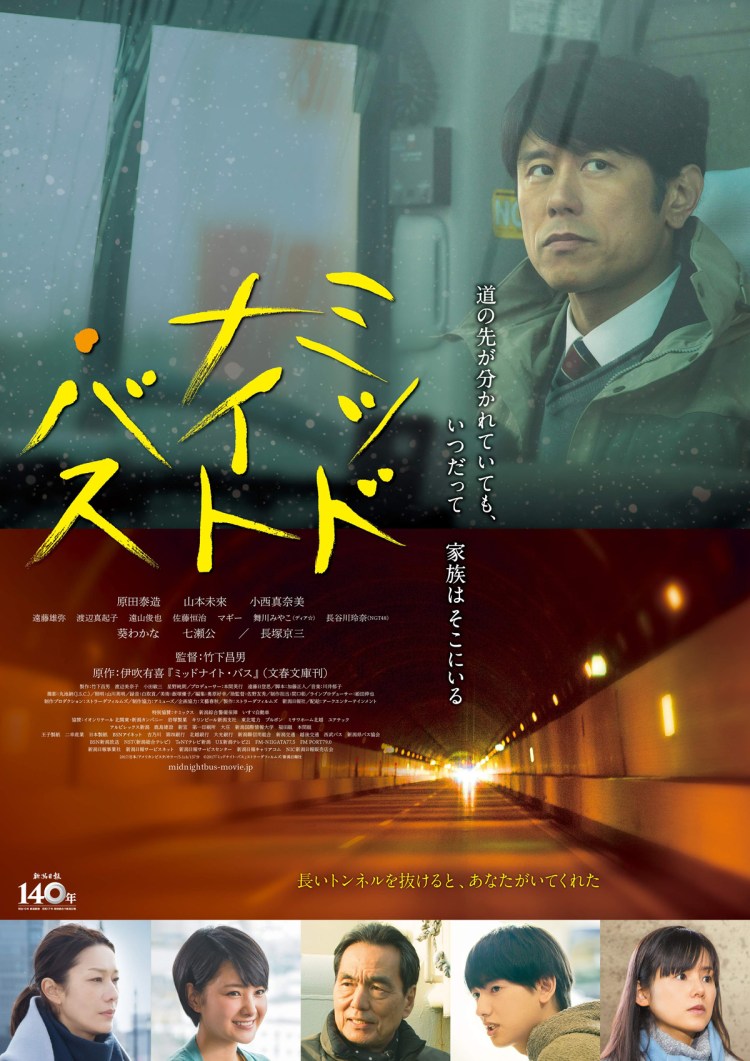
Midnight Bus (ミッドナイト・バス, Masao Takeshita, 2018)

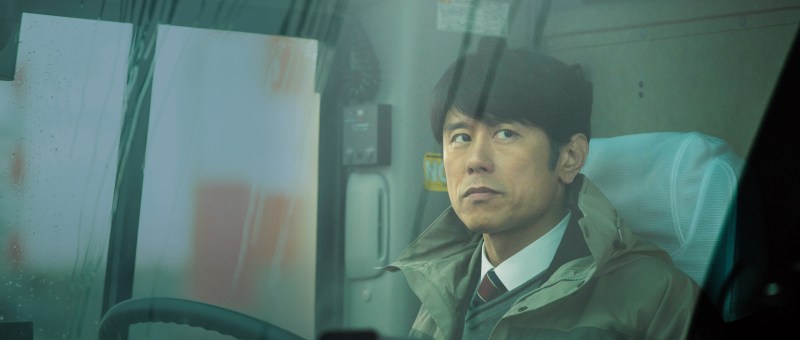
midnight bus posterYou know how it is, you coast along empty inside for what seems like a millennia until you finally decide to change your life and life says no, not like that. The hero of Masao Takeshita’s adaptation of the Naoki Prize nominated novel by Yuki Ibuki Midnight Bus (ミッドナイト・バス) must be well acquainted with phenomenon as his attempts to move a new relationship to the next level are scuppered by the unexpected arrival of not only boomerang children, but an estranged ex-wife and in-laws to boot. Caught between two places, two families, and a number of possible futures it might be time to head off road but the courage to leave the familiar route behind is a hard thing to find when you’ve been used to the security of travelling in tunnels.

Riichi Takamiya (Taizo Harada) drives the overnight bus from Niigata to Tokyo. In the capital, he has a tentative relationship with a younger woman, Shiho (Manami Konishi), who runs a small cafe/bar but his attempts to introduce her to his home life back in the country run aground when grown-up son, Reiiji (Ko Nanase), picks exactly the wrong moment to come home after having abruptly given up his lucrative IT job and moved out of his Tokyo flat. Meanwhile, Riichi’s daughter, Ayana (Wakana Aoi), has embarked on a wacky cosplay career and is thinking about marrying her longterm boyfriend. At this extremely sensitive time, Riichi spots a familiar face on the bus one day – his estranged former wife, Miyuki (Mirai Yamamoto), who has returned to Niigata to visit her ailing father and take care of “family” business.

All three Takamiyas are in a sense adrift, never having properly dealt with the abrupt exit of Miyuki who left when both the children were small. As a young scrappy couple in post-bubble Tokyo, Riichi and Miyuki had been happy but when Riichi decided to move the family back to Niigata for a “less stressful” existence everything began to go wrong, largely because of Riichi’s unforgiving mother who made her daughter-in-law’s life a misery. Now Reiji is facing a similar dilemma in finding city life too demanding, but unlike his father he can afford the time to take a break and figure things out seeing as he is single and unburdened by the need to support a family. Ayana, meanwhile, is about to find herself in a similar position to her mother as she discovers when she plans to introduce her intended to her father only to have him bring his snooty parents along unannounced and change the venue to an upscale restaurant more in keeping with their tastes. Poking into family details, looking down on Riichi’s job, and finally making a pointed comment about Reiji’s stress-related skin condition and a “concern” regarding her son’s children being “contaminated”, it’s obvious Ayana and her boyfriend’s mother will never get on.

Riichi is a kind and patient man, though sometimes a little insensitive in his far seeing plan to ensure everybody’s happiness. He bears no ill will towards Miyuki and hopes that she will be able to rebuild a relationship with her children, engineering a plan to bring them together while he helps her cope with the events that have brought her back to Niigata. Meanwhile, he also tries to keep things going with Shiho who has been hurt before and understands the reasons for Riichi’s hot and cold attitudes but is increasingly frustrated by the abrupt changes in his feelings and intensions. Riichi will have to make a choice between past and future, but if he chooses to put his family back together again it must be short lived as he prepares to push his children back out into the world with a little more direction and confidence after having addressed their deep seated familial traumas.

The bus journey becomes a point of transition in more ways than one – between city and country but also between two personas and two ways of being. In Niigata Riichi is “dad”, the family lynchpin, while Tokyo affords him the opportunity to be a “man” in relative freedom, free to pursue a second chance at romance with all his baggage safely stored at home. Like his children he will need to find a way to integrate his past self with his future one if he wants to forge a way forward, but in order to do that he’ll have to accept the risks a putative future entails and make peace with his old life in order to start all over again. A sometimes poignant family drama, Midnight Bus is a restrained affair but one filled with empathy and a generosity of spirit as its various protagonists learn to free themselves from familial legacy in order to pursue their individual destinies with kind eyes and clear hearts. 


Midnight Bus screens as part of New York Asian Film Festival 2018 on 11th July at 6pm.

Original trailer (no subtitles)

We Will Not Die Tonight (Richard V. Somes, 2018)

We Will not Die Tonight poster“Your moves are so old”, complains the director of a filmset towards the beginning of Richard V. Somes’ We Will Not Die Tonight, “it’s like the ‘80s”. An homage to The Warriors among other punk infused action classics of the 70s and beyond, We Will Not Die Tonight is as gritty and as grimy as they come following a pack of cornered desperados who unexpectedly find themselves to be the good guys when confronted by an evil unthinkable even on the streets of Duterte’s Philippines. Each in need of fast dough, a desperate gang of martial artists determines on the job to end all jobs, but it’s no surprise that they get a lot more than they bargained for just trying to survive in an unforgiving world.

Our heroine, Kray (Erich Gonzales), is a principled young woman who prides herself on her sense of justice, her good heart, and her ability to survive. Each of these qualities will stand her in good stead in the chaos that’s about to engulf her but for the moment they’re all that sustains her in her frustrating life as a stunt double for low budget movies. Berated by a director (Lehner Mendoza) who seems like he just wants to shout at someone while the “real” actress (Dani Baretto) blithely insists the stunt woman is an unnecessary waste of money, Kray can do little more than grin and bear it, unable even to make much of a fuss when she realises she’s only getting half pay on account of the director’s bad mood. She needs the money because her father (Baldo Marro) is ill and needs medical treatment, though he urges her to give up the stunt work which is dangerous and leaves her feeling humiliated to take a low paid but steady job working for a friend’s catering company.

Kray isn’t suspicious when a couple of her old friends turn up out of the blue, but quickly catches on when her ex, Ramil (Alex Medina), fetches up too. He wants to get the gang back together for one last hurrah. Having let them all down before, Ramil’s suggestion is not universally popular but as everyone is so desperate for money they eventually agree. Unfortunately, Ramil’s plan is once again a bust as it turns out the contacts he’s made are not into drug trafficking (itself a dangerous prospect given the current regime) but something far darker – snatching kids off the street for illegal organ trafficking. Now, our guys aren’t saints but they didn’t sign up for murdering children and even the slimy Ramil manages to suddenly develop enough of a backbone to firmly refuse and walk away. You can’t walk away from this sort of thing, however, and all hell breaks loose as they find themselves on the run with a little girl they save from the bad guys while they try to get to relative safety.

Unlike many similar genre examples, Kray and her friends aren’t hardened street gangsters or young punks, they’re way out of their depth in the murky Philippine underworld where drugs have become too much hassle while disappearing street children might even be viewed as a public service by the current regime. A bunch of martial arts experts with broken dreams and ruined hearts, all they want is to survive. Kray wants to help her dad, Cheche (Max Eigenmann) wants to move back to the country and open a shop, Jonesky (Thou Reyes) is just sick of being poor, and Reneboy (Nico Dans) is looking for a family seeing as his own has moved to Germany without him. Ramil, the slick pretty boy leader just wants to lead with a mild ulterior motive of using his friends to get rich and perhaps winning back the respect of old flame Kray. This world, however, is not going to let them have any of that – they are going to have to fight not only for their lives but also for what’s right if they want to survive.

Somes backgrounds an authoritarian regime as the enabler of such a dark and amoral world as it thinks nothing of gunning down “drug dealers” in the streets while turning a blind eye to other kinds of violence and horror which, in a strange way, perhaps play into its continuous propaganda machine. Yet as much as our heroes are essentially trying to fight their way out of inescapable poverty, Somes’ grime fuelled action picture is pure B-movie, filled with gritty street violence enacted with makeshift weapons and fierce ingenuity. The fighting is ugly, and real (not to mention bloody), but our heroes are fighting for more than just their lives, they’re fighting for the soul of the society in which they live. Desperate to survive, they would rather die fighting than give in to the darkness but the night is long and the battle only just beginning.


We Will Not Die Tonight was screened at the New York Asian Film Festival 2018.

Original trailer (dialogue free, English captions)

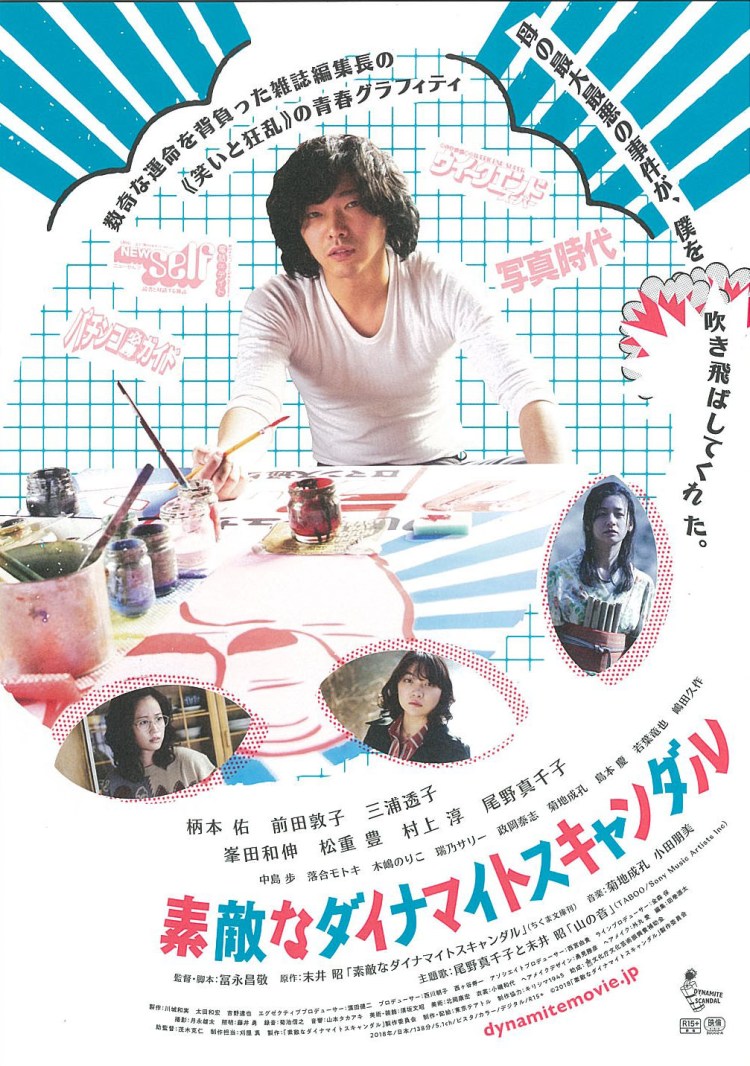
Dynamite Graffiti (素敵なダイナマイトスキャンダル, Masanori Tominaga, 2018)

Dynamite Graffiti posterThe division between “art” and “porn” is as fuzzy as the modesty fog which still occasionally finds itself masking “obscene” images in Japanese cinema, but for accidental king of the skin rag trade Akira Suei it’s question he finds himself increasingly unwilling to answer even while he employs it to his own benefit. Back in the heady pre-internet days of the 1980s, Suei was the public face behind a series of magazines along differing themes but which all included “artistic” images of underdressed women in provocative poses alongside more “serious” content provided by such esteemed figures as Daido Moriyama and Nobuyoshi Araki in addition to stories and essays penned by “legitimate” authors and the more scurrilous fare written by Suei himself. Inspired by one of Suei’s essays “Dynamite Graffiti” (素敵なダイナマイトスキャンダル, Sutekina Dynamite Scandal), Masanori Tominaga’s ramshackle biopic has the informal feel of a man telling his sad life story to a less than attentive bar girl as he takes us on a long, strange walk through the back alleys of ‘70s Japan.

The entirety of Suei’s (Tasuku Emoto) life is lived in the wake of a bizarre childhood incident in which his mother (Machiko Ono), suffering with TB and trapped in an unhappy marriage to a violent drunk, chose to commit double suicide with the young man from next door. Perhaps there’s nothing so strange about that in the straightened Japan of 1955, but Suei’s mother chose to end her life in the most explosive of ways – with dynamite stolen from the local mine. Carrying the legacy of abandonment as well as mild embarrassment as to the means of his mother’s dramatic exit, Suei finds himself a perpetual outsider drifting along without the need to feel bound by conventional social moralities as symbolised by the “ideal” family.

What he longs for, by contrast is freedom and independence. Bored by country life he dreamt of moving to the city to work in a factory, but the problem with factories is that they’re mechanical and turn their employees into mere tools with no possibility of personal expression or fulfilment. Spotting an advert for courses in “graphic design”, Suei’s world begins to open up as he embraces the bold new possibilities of art even as it wilfully intersects with commerce.

Taken with the new philosophy of design as the message, a means of “exposing” oneself and ultimately enabling true human connection, Suei remains frustrated by the limitations of his role as a draughtsman for local advertisers and, inspired by a friend’s beautiful poster, finds himself entering the relatively freer creative world of the “cabaret” scene as a crafter of signboards and flyers. The cabaret bars are little better than the factories, exploiting the labour of women who themselves are the product, but Suei’s distaste is soon worn down by constant exposure. From the clubs and cabarets it’s only a natural step towards erotic artwork, nudie photographs, and finally a vast magazine empire of “literary” pornography.

Suei’s accounts of his youth are filled with a lot of high talk about the possibilities of art, of his desire to remove the masks which keep us divided so that we might all know “true” human love. Whether his adventures in adult magazines can be said to do that is very much up for debate. They are, as he freely admits, expressions of male fantasy – exposing a perhaps unwelcome truth about the relationships between men and women even as they continue to exploit them. Yet Suei’s own desire to find something more than a potential for titillation in his work continues to dwindle as he finds himself engaged in increasingly complicated schemes to avoid censure from the police while simultaneously insisting that his magazines are both “artistic” and not.

His insistence that the photographs are “artistic” becomes his primary weapon in getting sometimes vulnerable young women to agree to take their clothes off. Abandoning his loftier aspirations, Suei sinks still further into the smutty morass whilst still maintaining the pretension that his magazines are not like the others. He neglects his wife (Atsuko Maeda) to chase fleeting affections with unsuitable or unstable women, one of whom eventually descends into a mental breakdown which provokes in him only the realisation that his desire for her was a romantic fantasy which her illness has now dissipated. Art is an explosion, Suei claims, but his mother was the explosive force in his life, blowing him off course and leaving him too wounded to embrace the reality he so desperately claims to crave but continues to reject in favour of the same kind of male fantasies his magazines peddle.

Everyone around Suei seems to be damaged. Nary a face in the red light district is without a bandage or bruise of some sort. These are people who’ve found themselves at the bottom of the ladder and are desperately trying to scrap their way up. Times change and Suei’s empire implodes. Porn is swapped for pachinko as the exploitable pleasure of choice paving the way for yet another reinvention which sees him throw on a kimono to rebrand himself as his own mother and self-styled pachinko expert. You couldn’t make it up. Still, perhaps there is something more honest in Suei’s pachinko persona than it might first appear even if his present “art” is unlikely to enlighten us to the true nature of love.


Dynamite Graffiti is screening as the opening night movie of this year’s New York Asian Film Festival.

Original trailer (no subtitles)