The Twilight Years (恍惚の人, Shiro Toyoda, 1973)

In the early 1970s Japanese society was not as concerned with population slowdown as it would come to be, but Shiro Toyoda’s sympathetic ageing drama The Twilight Years (恍惚の人, Kokotsu no Hito) is evidence of a growing consciousness that traditional ideas about how one cares for the elderly may now be becoming incompatible with the functioning of modern society. Based on a best-selling novel by Sawako Ariyoshi, the film has profound empathy both for the ageing patriarch once apparently a tyrant but now a meek and frightened child, and the daughter-in-law to whom his care largely falls.

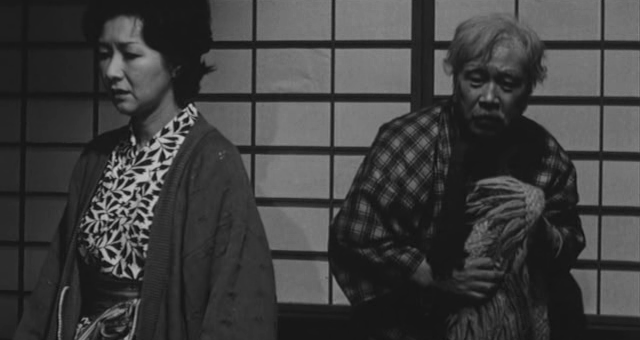
In fact, it’s caring for Shigezo (Hisaya Morishige) that some believed shortened the lifespan of his late wife who passes away in the film’s opening scenes. Already somewhat detached from reality, Shigezo simply reports that his wife won’t wake up no matter how much he tries to wake her, much like a child who’s discovered someone no longer living. While his daughter-in-law Akiko (Hideko Takamine) rushes to her room with a sense of foreboding, Shigezo merely stays in the kitchen eating boiled potatoes straight out of the pan. It’s the odd behaviour that seems to irk his son Nobuyoshi (Takahiro Tamura) but it’s only now that the couple seem to be realising that there’s something wrong especially as Shigezo does not appear to understand that his wife has died. Pitiably, he chides her for lounging around so late in the day when she’s already been laid out for her funeral.

When his daughter, Kyoko (Nobuko Otowa), arrives having actually missed the funeral itself due to transport issues and a conflicting responsibility to act as a matchmaker at a wedding, Shigezo doesn’t recognise her. He continues to ask for Akiko and gradually forgets most of the other people in his life, screaming when encountering Nobuyoshi and instructing Akiko to call the police to report a burglar in their home. According to both women, Shigeyoshi had treated Akiko poorly ever since she joined their family, which makes caring for him so much harder. The reason he becomes so attached to Akiko is likely simply that she is the person who is always around him so he has less time to forget her. He may realise on some level that she may not wish to care for him given his previous behaviour which may be why he becomes preoccupied with the idea she may “disappear” and cries out in the night when he can no longer see her.

But Akiko also has other responsibilities including a job outside the home and a teenage son studying for his exams. Nobuyoshi expresses regret that he hasn’t been more help and voluntarily tries to pitch in, but lets himself off the hook given that his father doesn’t recognise him and becomes anxious in his presence. Satoshi (Izumi Ichikawa) meanwhile does try to do his bit but is young and a little resentful of the responsibility. As his dementia becomes more severe, Shigezo begins calling Satoshi “Dad” as if he were a child again. Which is all to say, Shigezo becomes Akiko’s responsibility and the strain of caring for him begins to affect her own mental and physical health leading her to fear that she too may die younger than she otherwise might have. 

Yet in exploring her options, Akiko finds little by way of support. Most nursing homes won’t accept patients with complex needs like Shigezo and conditions such dementia are often regarded as mental illnesses meaning her only option might be to put him in an asylum. Shigezo was attending an old person’s daycare centre, but later says he doesn’t want to go anymore because it’s full of old people and therefore no fun. While the film is sympathetic towards Akiko and the difficulties she is facing in caring for her father-in-law it also has profound empathy for Shigezo for though he has so many people who are doing their best to look after him, his increasing mental confusion quite obviously leaves him isolated and he must be incredibly lonely while trapped within his own reality. He develops a habit of saying “hello, hello,” as if he were answering the telephone which may be his attempt to communicate while he is also fascinated with a caged bird which may reflect his own sense of being constrained by his condition.

Later, the bird seems to symbolise Akiko too, trapped as she is within the domestic environment where all responsibility seemingly falls to her. Even so a young student couple she rents the annex to for a lower price in exchange for keeping an eye on Shigezo during the day remark that he may be in the ideal state for a human being having returned to early childhood in which there are no concerns or responsibilities and he is therefore unburdened by the weight of what is to live. Toyoda often uses handheld camera to symbolise the desperation and destabilisation of Shigezo’s existence in which Akiko has become his only fixed point. One of Nobuyoshi’s friends remarks that perhaps it was better when the average life expectancy was 50 and Nobuyoshi’s mother might have been lucky passing away peacefully while otherwise in good health. Still, as Nobuyoshi says, it comes for us all in the end and we should all try to be kinder to each other while we’re here.


Terror in the Streets (悪魔が呼んでいる, Michio Yamamoto, 1970)

How much bad luck can one person have before they start thinking someone’s out to get them? Released as part of double bill with The Vampire Doll and based on a novel by Kikuo Tsunoda, Terror in the Streets (悪魔が呼んでいる, Akuma ga Yondeiru) draws inspiration from contemporary folk horror and the paranoia thriller as one young woman finds herself in the crosshairs of mysterious forces seemingly hellbent on derailing her otherwise very ordinary and aspirational existence. 

Yuri (Wakako Sakai) worries that her status as an orphan has set her back in life, attributing her inability to find permanent employment after managing to put herself through university by working as tutor to a societal stigma against people with no families. Up to now, things had been going pretty well. Though she was only a temp, she had a good gig as office admin staff at big company in the city, lived in a modest but homely flat complete with a small television, and was dating her college sweetheart. But then one day her boss looks at her with an odd expression and then abruptly drops the bombshell that he’s terminating her contract without offering a reason why. When Yuri calls her boyfriend he gives her the same look and says he’s breaking up with her, also refusing to give any kind of explanation aside from not wanting to see her anymore. If all that weren’t enough, her landlady then explains that someone else is very interested in her flat and will pay double for it so she wants Yuri out by the end of the month. 

It’s undoubtedly been quite a bad day, but Yuri tries to stay upbeat reflecting that she didn’t particularly like the job anyway and intends to apply for a position as an editor on literary magazine which would suit her better. But after that nothing quite goes to plan and everything she tries to improve her situation backfires until she finally considers taking her own life at railway crossing only to be rescued by a mysterious man, Fujimura (Takashi Fujiki), who appears as her saviour but then convinces her to take some kind of pill to calm her nerves which predictably leaves her dazed and confused. He then takes her back to her apartment and claims they’re legally married, but when Yuri wakes up the following morning he’s dead with a knife in his chest. 

It’s not the first time that Yuri has experienced an apparent gap in her memory which causes her re-evaluate her sense of reality. She’s beginning to feel as if something or someone is out to get her, realising that Fujimura was the same sinister man she’d caught sight of before staring into her window. Meanwhile, she often hears a strange tune played on an ocarina that sounds like a medieval fugue. The film’s Japanese title is “the Devil calls” and it’s not a huge stretch to assume that Yuri’s been caught up in some kind of dark magic or supernatural curse, yet it’s also the collision of outdated and feudalistic notions of class and patriarchy that have her in their clutches. All of these weird men seemingly want to marry her or at least make her theirs with less than romantic overtures while chief among her aggressors Katagiri (Hideji Otaki) describes himself as an Earl and insists that noble blood is the most valuable thing in the world.

But far as she knows Yuri has no noble blood and is alone and friendless as an orphan with only a “distant relative” she mentions in passing who does not live in Tokyo. She has in effect been made a pawn in a cruel and ironic game played by a distant aristocracy which makes sport of the innocent and powerless by wielding the privileges of wealth and class. The only way she can escape is by renouncing her claim on its legacy, declaring herself uninterested in their games or rewards while ceding the prize to another woman who seems to have been driven out of her mind by a similar series of torments that may have lasted her entire adult life. Yamamoto films the contemporary city in an eerie light, a place of greed and darkness inhabited by sinister and shady forces that prey on the innocent and earnest like Yuri but then there is something to be said for the idea that in the end you can’t con an honest man and Yuri’s pure hearted rejection of unearned wealth just might be her salvation.


Original trailer (no subtitles)

Cash Calls Hell (五匹の紳士, Hideo Gosha, 1966)

“Life is made of gambles” according to the villain of Hideo Gosha’s 1966 Shochiku Noir Cash Calls Hell (五匹の紳士, Gohiki no Shinshi). Sometimes dismissed by contemporary critics for the wilful vulgarity of his late career yakuza films, Gosha was most closely associated with jidaigeki but here makes a rare foray into B-movie crime, a genre which perhaps aligned with the so-called “manly way” philosophy which imbued much of his work. Led by frequent star Tatsuya Nakadai the men of Cash Calls Hell are indeed all suffering manfully, each desperately floundering in the post-war society while quietly resentful in being locked out of its growing prosperity. 

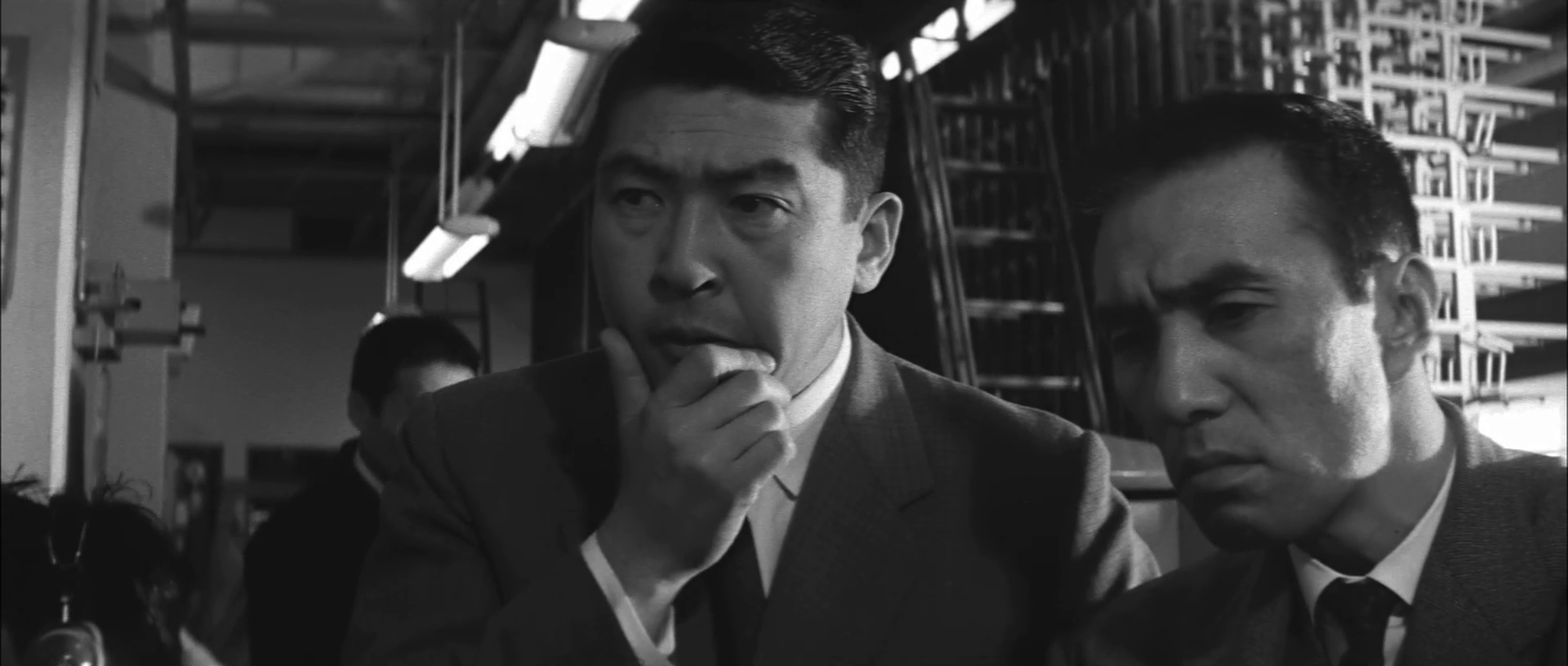
The hero, Oida (Tatsuya Nakadai), is the son of a meek civil servant whom he resented for his passivity. Oida was determined to make something of himself, and so he invested his efforts not in hard work and dedication but in personal relationships, seducing the boss’ daughter in order to win her hand and thereby advancement and security. Meanwhile, he was preparing to unceremoniously ditch the bar hostess who’d been supporting him while he made his way to the top, only after arguing with her on a car drive home he gets into an accident in which a father and his little girl are killed. Oida’s bright future is ruined in an instant. He’s asked to backdate a resignation letter, his engagement is cancelled, and he also owes compensation to the widowed mother Natsuko (Miyuki Kuwano) whose face, filled with rage and resentment, he is unable to forget. With no money to pay her, he winds up in prison which is where he meets soon-to-be released Sengoku (Mikijiro Hira) who has a proposition for him but refuses to give any further details, instructing him to find a woman named Utako (Atsuko Kawaguchi) as soon as he’s released. 

As Utako relates, the job involves knocking off the three men on her hit list for which he will be paid a cool 15 million yen (5 million each). Advised to not to ask any further questions, Oida decides to go along with it after all he has nothing left to lose, but as he begins his investigations he becomes increasingly confused and conflicted. As we discover, the men were all part of a gang that robbed a syndicate of Hong Kong drug dealers, and it doesn’t take a genius to figure out that Sengoku wants them out of the way so he won’t have to divide the loot when he gets out. The money is many ways beside the point, what the men wanted was a way to kick back against the various forces which oppressed them and took their revenge on society through crime. The first, Motoki (Hisashi Igawa), is a former policeman who ran off with a gangster’s wife and subsequently went all the way to the dark side. Umegaya (Kunie Tanaka) is the son of a career criminal who wanted some control over his life and to care for the woman he loved. Embittered former boxer Fuyujima (Ichiro Nakatani) had his dreams shattered when gangsters crushed his hand because he refused to throw a fight. 

Sengoku, who was left lame after being injured in the aerial bombing during the war, recruited them all by exploiting their resentment. Fuyujima describes the men as wandering like ravenous dogs. They are already imprisoned, framed by the chainlink fence which divides them from the well-to-do salarymen killing time at the driving range. “Life is half made of luck and circumstances” Sengoku tells them, echoing his words to Oida, handing them agency in crime in asking them to “bet” on him. “We can’t sink any lower” he rationalises, “now we must get back on our feet”. Oida is much the same. He’d sunk as far as he could and thought nothing of taking these men’s lives to save his own, but resents being used by Sengoku and is probably figuring out that a man who doesn’t want to split his loot in four won’t be keen to split it in half either. He is also burdened by a sense of guilt and responsibility, both to the widow of the man he killed in the accident and to Motoki’s small daughter Tomoe (Yukari Uehara), about the same age as the little girl who died with him. 

Natsuko, it turns out, has since become a bar hostess, herself sinking in the cruelty of the post-war landscape, now wearing a sparkly cheongsam in echo of the “Golden Dragon” syndicate running the club where Umegawa works and the Hong Kong gangsters hot on Oida’s trail. Indulging in a stereotypical B-movie Sinophobia, the implication is that crime is a foreign phenomenon, the threat lurking in the shadows dressed oddly more like a 30s bootlegger from a Hollywood gangster flick than a triad drug trafficker and killing with the point of his umbrella. Oida’s redemption is sparked by his sense of responsibility towards the orphaned little girl who continues to follow him around, latching on to him as a sympathetic figure entirely unaware of his relationship to her father. In the end he declares that he wants the money in order to buy back his soul having sold it to Sengoku in agreeing to take on the job without knowing what it was, but also wants to make restitution to Natsuko which he later does in a poetic if perhaps insensitive fashion that implies he can in a sense restore the child he killed by substituting it with another. 

Oida is one of Gosha’s “manly” heroes, surviving at all costs but finally defending his sense of honour in regaining his humanity. Nevertheless, Gosha is also keen to demonstrate the various ways the women suffer at the hands of irresponsible men, each of the wives endangered by their husbands’ transgressions and Natsuko forced onto the fringes of the sex trade by Oida’s thoughtless crime. Opening in a bold negative with the heist that started it all, Gosha shoots in true noir style all shadows and canted angles through a series of episodic set pieces including a chase pregnant with symbolism through a “purification station” scored by moody jazz before ending on a fatalistic POV shot. Life is a gamble after all, but is this a loss or a victory? With the world the way it is, who could really say.


Red Beard (赤ひげ, Akira Kurosawa, 1965)

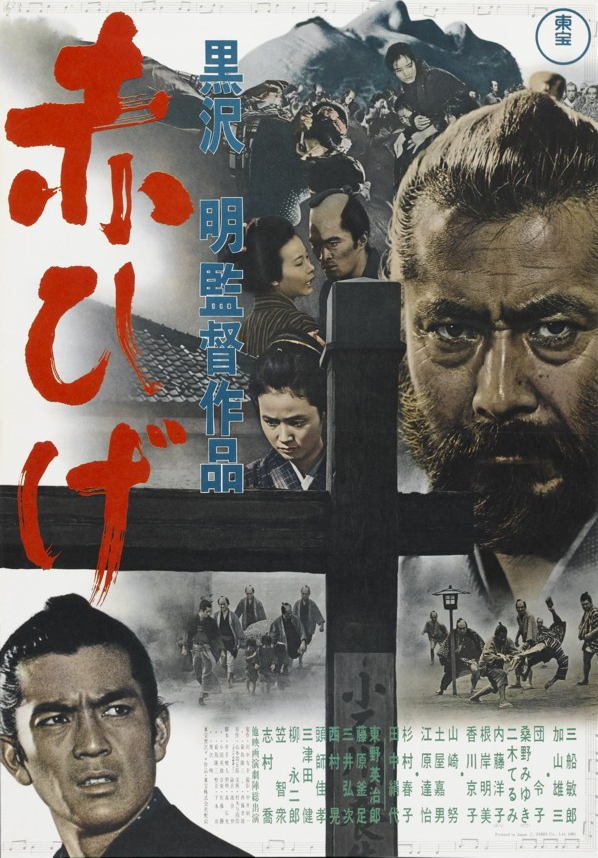
Red Beard posterAkira Kurosawa may be the most familiar golden age director of Japanese cinema to international audiences, but he was in many senses somewhat atypical. Where many of his contemporaries were eager to tell the stories of women, Kurosawa’s films are resolutely male and where many were keen to find the good among the bad, Kurosawa was often keen on the reverse. Nevertheless, that does not mean that he did not see goodness, merely that it was something which needed to be rooted out and fought for rather than simply permitted to exist. His final collaboration with Toshiro Mifune, Red Beard (赤ひげ, Akahige) finds the director at his most optimistic, fully embracing his natural tendency towards humanism even while making plain that goodness can often be hard to find, especially within yourself, and there may be no real cure for injustice but you have to treat the symptoms anyway.

The tale begins at the close of the Tokugawa era as a young doctor, Yasumoto (Yuzo Kayama), pays a courtesy call to the Koishikawa public clinic presided over by an old friend of his father’s, Doctor Niide (Toshiro Mifune) – otherwise known as “Red Beard”. Yasumoto, having just graduated from studying under the Dutch in Nagasaki, had only intended to make a brief visit on his way home and is therefore shocked to realise that he has been tricked into accepting a position at a hospital for the poor.

Our introduction to the Koishikawa clinic is through the eyes of Yasumoto as he receives a tour from another doctor who loudly remarks that he is glad that Yasumoto has now arrived because that means he can finally be free of this wretched place. Yasumoto’s nose wrinkles on smelling the “rotting fruit” of the poor waiting for afternoon appointments, while one of the patients complains about the “sterility” of the environment and his plain hospital clothes before a genial inpatient, Sahachi (Tsutomu Yamazaki), explains the reasoning behind such austerity and praises the attention to detail of head doctor Red Beard who has thought carefully about the best way to ensure his patients experience the best of care.

Yasumoto is extremely displeased by his predicament. He had believed himself on track to become a royal doctor working for the Emperor and being sent to poor clinic seems like a poor joke. He is indeed extremely full of himself, refusing to surrender his medical notes from Nagasaki as if he had made some great discovery and hoped to profit from it. Hoping Red Beard will fire him, Yasumoto behaves like a petulant child – refusing to wear his uniform, deliberately stepping into areas he knows are out of bounds, refusing to see patients, and just generally being unpleasant to have around. Red Beard is stoic and patient, though it gradually becomes apparent that perhaps Yasumoto has been sent here deliberately for a humbling everyone believes he had coming to him. Asked to perform the most routine of tasks, Yasumoto is forced to realise that the medical knowledge of which he was so proud is mostly book learning. He doesn’t know how to diagnose a living patient, has never been present at an operation, and has never sat with someone while they died knowing there was nothing more he could do for them. Reluctantly, he has to accept that the advice he received from the other doctors on his first day, that there was much to be learned here for those who wanted to learn it, was as true as it could be.

The first half of the film is indeed Yasumoto’s humbling as he begins to come around to the mysterious workings of Red Beard who gradually leads him to understand his first duty as a doctor is help those in need. Then again, Red Beard is an unwilling mentor. He is fully aware of the corruptions of the world in which he lives but has made a decision with which he remains conflicted to bend them to his advantage. Enraged to discover his government funding is being cut, Red Beard deliberately over charges the local lord whom he, amusingly enough, puts on a diet as he snorts like a piggy short of breath thanks to his unhealthy life of luxury. He also blackmails another local lord to save a young mother who turned a knife on an abusive husband, and later uses his medical knowledge to unfair advantage to take out a whole gang of yakuza. Red Beard isn’t sure he’s in a position to become anyone’s role model, but that only seems to make Yasumoto respect him more.

Nevertheless, there is darkness too in Red Beard’s philosophy. The real enemy here and perhaps everywhere is poverty and the selfishness which enables it. Most of the diseases Red Beard treats in his clinic are a direct result of impoverished living, mostly those of malnutrition and overwork as well as the necessity of living in cramped, unsanitary conditions. Yasumoto, a young man of means, has a puffed up sense of self and a natural ambition that tells him he is destined for the court and so he looks down on these unfortunate people as something other, something that does not concern him and is not worthy of his attention. He won’t put on his uniform out of spite, but eventually relents when Sahachi explains to him that the uniform marks him out as member of the clinic meaning that ordinary people who cannot afford to pay a doctor know that he is someone they can ask for help when no one else will help them.

As Red Beard says, there may be no real cures for disease. All they can do is fight poverty and mask their ignorance. Yasumoto learns by experience. He discovers the rampant injustice of his society in the sad stories that he hears. A “mad” woman who became a serial killer after years of childhood abuse, a woman who rejected a good father out of fear and allowed a bad mother to marry her to a bad man who was also her mother’s lover, a little girl adopted by a cruel madam who turned in on herself when she tried to press her into sex work at only 12 years old, a sex worker suffering with syphilis but too valuable to be released and sent home. This world is built is built on female suffering which is not, perhaps, something which Red Beard is in much of a position to treat.

The mad woman tries to hang herself and Red Beard wonders if it would have been kinder let her die, while the mother of a family who decided on group suicide asks him what the point was in saving her. The world is not an easy place to live in, but Red Beard’s prescription is refreshingly simple. One heals oneself by helping others, as he proves to Yasumoto through making him both doctor and patient to a wounded little girl who then passes her new found humanity on to another needy soul eventually reformed by kindness alone. Day by day, Red Beard goes to war against selfishness and indifference, treating the symptoms in order to undermine the disease which has infected his society in the hope that it might eventually decide to cure itself.


Original trailer (No subtitles)

Twilight Story (濹東綺譚, Shiro Toyoda, 1960)

Director Shiro Toyoda, closely associated with high minded literary adaptations, nevertheless had a talent for melancholy comedy and for capturing the everyday reality of ordinary people. A fierce condemnation of the patriarchal society at a moment of intense masculinity, Twilight Story (濹東綺譚, Bokuto Kitan), an adaptation of the novel by Kafu Nagai, follows an ambivalent author as he covertly observes the life and love of a former geisha daring to dream of romantic salvation while fully aware of the world’s cruelty.

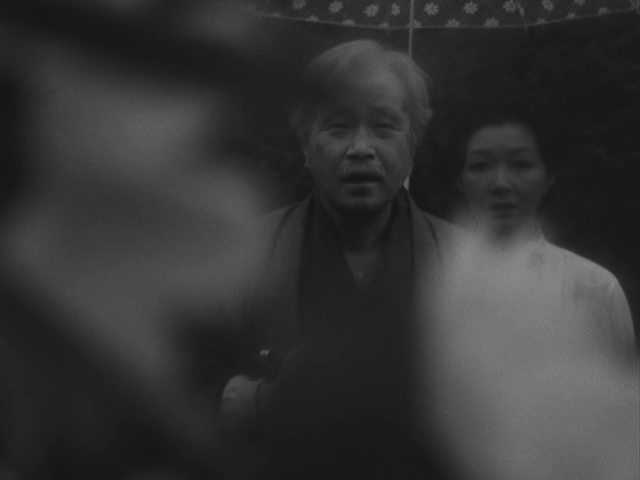
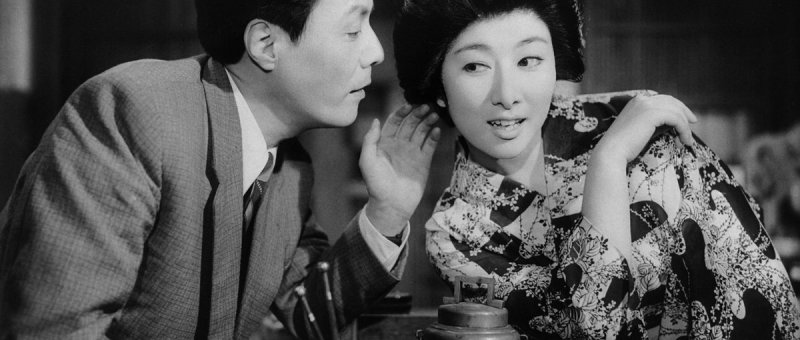
Set in 1936, the film opens with an author on a research trip who guides us into the world of the Tamanoi pleasure quarter which he seems to disdain but is drawn to all the same. Whilst there he runs into a nervous middle-aged man, Junpei (Hiroshi Akutagawa), who is later accosted by sex worker Oyuki (Fujiko Yamamoto) for use of his umbrella during a violent storm. A mild-mannered sort, Junpei is unused to the ways of the red light district and quickly makes his escape after being invited into Oyuki’s home. After a swift drink, however, he returns and the pair begin an awkward semi-romantic relationship.

Despite his affirmation that he is single, Junpei is in fact already married if (for the moment) unhappily. Though he knew his future wife Mitsuko (Michiyo Aratama) had given birth to an illegitimate child fathered by her employer, Junpei chose to marry her anyway because he was in love. The pair married, they say, for “genuine” reasons but the father of Mitsuko’s son continues to send maintenance money for the boy’s education and his constant presence has begun to play on Junpei’s mind especially as his teacher’s salary is dwindling in this age of militarism in which educational hours are decreasing in favour of compulsory military drills. Meanwhile, Mitsuko also seems to have got religion and spends most of her time reciting sutras with the implication that she has begun to neglect her husband, emotionally, spiritually, and most particularly physically. In order to escape his depressing home life, Junpei hangs out in the Tamanoi where men’s hearts are lighter and people talk frankly about love.

This is, of course, not quite the case, but the fantasy the pleasure quarters sell of themselves. Our jaded author is perfectly aware of that and broadly sympathetic towards the women caught in its web. Oyuki, a former geisha, has “debased” herself in order to earn extra money to send home to her family and pay the medical fees for her sickly mother. Her uncles constantly pressure her for more and she wonders if they are not merely exploiting her, using her money for their own benefit and refusing to chip in for her mother’s care. Nevertheless, she is trapped. On meeting Junpei with whom she seems to develop a genuine emotional connection, she dares to dream that one day they might marry, that she could leave this life behind and build a stable family home of her own.

Of course, it’s not to be. Like all men in the Tamanoi, Junpei is misrepresenting himself for his own ends. He is only using Oyuki as an idealised point of refuge from the unhappy marriage he shows no other signs of leaving. As the author points out, the men think they’re using women but the women are also using them though they do so without calculation. Denied power or agency of their own, the women of the Tamanoi have no other option than to manipulate that of men, though the author sympathises with them so strongly that to expose the hidden “vulgarity” seems to him an act of intense cruelty.

Junpei falls in love with the world of the Tamanoi because he thinks it’s more emotionally honest, but the truth is quite the reverse. Wandering through the narrow streets at night, the author pities the women in the windows, knowing that men come here to escape their isolation but there is no escape for these women who are forced to delude themselves that a better future is waiting in order to go on living. Meanwhile Junpei’s colleague, looking back over his shoulder towards the young men in uniform, declares that he too has lost all hope for a promising future. With militarism on the rise, hyper-masculinity has led to a further decline in the already woeful status of women with even the girls’ sympathetic pimp lamenting that the army, who have been rounding up sex workers for forced service in Manchuria, regard them as little more than products to be poked and prodded and giggled over as they are cruelly bought and sold.

Reuniting with his wife, Junpei is forced to face his emotional cowardice, that he was just playing with Oyuki’s feelings in indulging the fantasy of an idealised romantic union. Oyuki, meanwhile, faces the destruction of all her dreams when she realises her uncle has betrayed her, her mother is dead, and all her sacrifices have been for nothing. On some level she may have known Junpei had another woman, but needed to believe in the fantasy of his love for her in order to make her life bearable. Even so, she now sees no other future for herself than a return to work shorn of all her hope. Toyoda’s condemnation of the red light district is bleak and total, even as the jaded author himself becomes an ambivalent part of it, but the Tamanoi is only a symptom of longstanding social oppression exacerbated by militarist fervour as the lights go out all over town.


Illusion of Blood (四谷怪談, AKA Yotsuya Kaidan, Shiro Toyoda, 1965)

vlcsnap-2017-07-01-00h50m36s347Shiro Toyoda, despite being among the most successful directors of Japan’s golden age, is also among the most neglected when it comes to overseas exposure. Best known for literary adaptations, Toyoda’s laid back lensing and elegant restraint have perhaps attracted less attention than some of his flashier contemporaries but he was often at his best in allowing his material to take centre stage. Though his trademark style might not necessarily lend itself well to horror, Toyoda had made other successful forays into the genre before being tasked with directing yet another take on the classic ghost story Yotsuya Kaidan (四谷怪談) but, hampered by poor production values and an overly simplistic script, Toyoda never succeeds in capturing the deep-seated dread which defines the tale of maddening ambition followed by ruinous guilt.

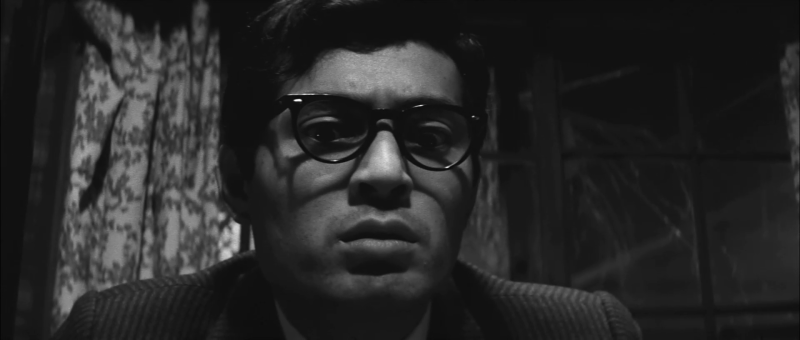
As usual, Iemon (Tatsuya Nakadai) is a disenfranchised samurai contemplating selling his sword due to his extreme poverty. Iemon had been married to a woman he loved, Oiwa (Mariko Okada), whose father called her home when Iemon lost his lord and therefore his income. Oiwa’s father is also in financial difficulty and Iemon has now discovered that he has been prostituting Oiwa’s sister, Osode (Junko Ikeuchi), and plans a similar fate for Oiwa.

Still in love with his wife, Iemon decides that his precious sword is not just for show and determines to take what he wants by force. Murdering Oiwa’s father, Iemon teams up with another reprobate, Naosuke (Kanzaburo Nakamura), who is in love with Osode and means to kill her estranged fiancee. Framing Osode’s lover Yoshimichi (Mikijiro Hira) as the killer, Iemon resumes his life with Oiwa who subsequently bears their child but as his poverty and lowly status continue Iemon remains frustrated. When a better offer arrives to marry into a wealthier family, Iemon makes a drastic decision in the name of living well.

The themes are those familiar to the classic tale as Iemon’s all consuming need to restore himself to his rightful position ruins everything positive in his life. Tatsuya Nakadai’s Iemon is among the less kind interpretations as even his original claims of romantic distress over the loss of his wife ring more of wounded pride and a desire for possession rather than a broken heart. Selling one’s sword is the final step for a samurai – it is literally selling one’s soul. Iemon’s ultimate decision not to is both an indicator of his inability to let go of his samurai past and his violent intentions as the fury of rebellion is already burning within him.

Iemon defines his quest as a desire to find “place worth living in”, but he is incapable of attuning himself to the world around him, constantly working against himself as he tries to forge a way forward. Oiwa’s desires are left largely unexplored despite the valiant efforts of Mariko Okada saddled with an underwritten part, but hers is an existence largely defined by love and duty, pulled between a husband and a father. Unaware that Iemon was responsible for her father’s death, Oiwa is happy to be reunited with him and expects that he will honour her father by enacting vengeance. Only too late does she begin to wonder what her changeable husband’s intentions really are.

An amoral man in an amoral world, Iemon’s machinations buy him nothing. Haunted by the vengeful spirit of the wife he betrayed, Iemon cannot enjoy the life he’d always wanted after purchasing it with blood, fear, and treachery. Despite the odd presence of disturbing imagery from hands in water butts to ghostly presences, Toyoda never quite achieves the level of claustrophobic inevitability on which the tale is founded. Hampered by poor production values, shooting on obvious stage sets with dull costuming and a run of the mill script, Illusion of Blood has a depressingly unambitious atmosphere content to simply retell the classic tale with the minimum of fuss. Only the final scenes offer any of Toyoda’s formal beauty as Okada appears under the cherry blossoms to offer the gloomy message that there is no true happiness and her husband’s quest has been a vain one. Achieving her vengeance even whilst Iemon affirms his intention to keep fighting right until the end, Oiwa leaves like the melancholy ghost of eternal regret but it’s all too little too late to make Illusion of Blood anything more than a middling adaptation of the classic ghost story.