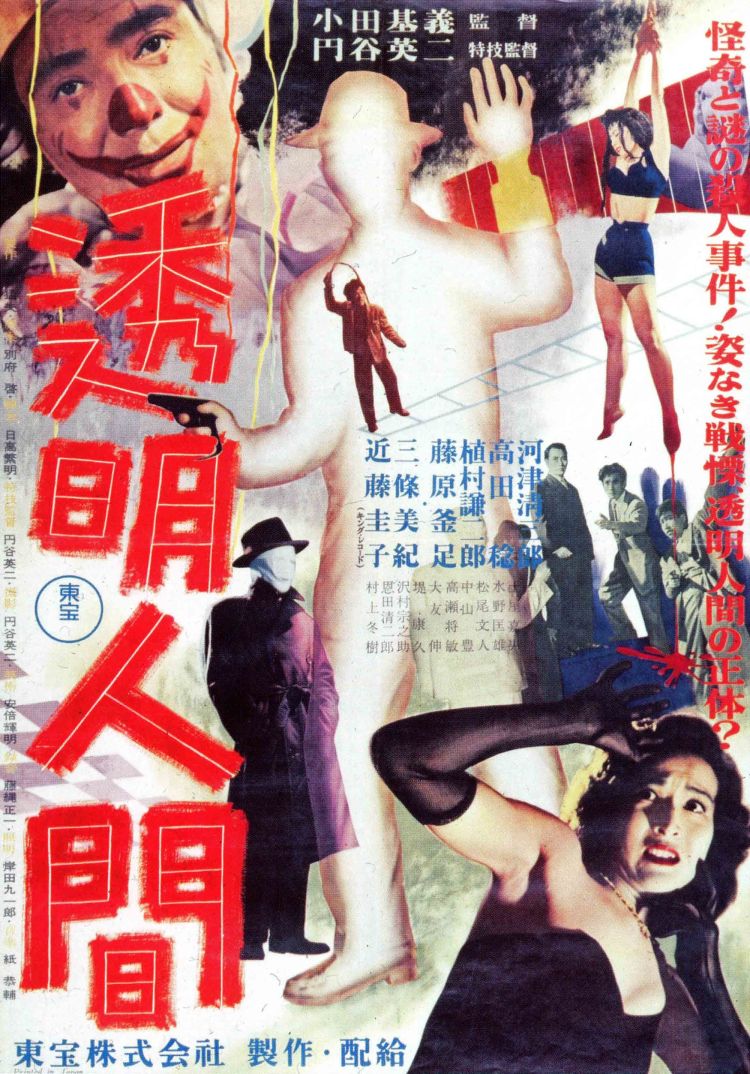
Invisible Man (透明人間, Motoyoshi Oda, 1954)

invisible man 1954 posterThe Invisible Man is a frightening presence precisely because he isn’t there. The living manifestation of the fear of the unknown, he stalks and spies, lurking in our imaginations instilling terror of evil deeds we are powerless to stop. Daiei made Japan’s first Invisible Man movie back in 1949 – a fun crime romp with the underlying message that scientific research is important but not as important as ensuring knowledge is placed in the right hands. Toho brought Eiji Tsuburaya back for another go at the same material in 1954 as part of their burgeoning tokusaku industry fathered by Godzilla. The 1954 Invisible Man (透明人間, Toumei Ningen), directed by Motoyoshi Oda, is once again a criticism of Japan’s wartime past but also perhaps of its future. This Invisible Man is an invisible hero but one whose heroism is only recognised once the mask is removed.

Opening in grand style, the film gets off to a mysterious start when a speeding car hits “something” in the road. The “something” turns out to be a previously invisible man whose appearance is returned to him as blood leaks out from under the now stopped car. In his pocket, the man has a suicide note explaining that living life invisible is just too depressing and he can’t go on. Seeing as the note is addressed to a “friend” who is also apparently an Invisible Man that means there are more out there. Despite there being no real threat involved in any of this, the newscasters are alarmed and the public frightened.

This is quite useful for some – a shady gang quickly starts putting on Invisible Man suits including wrapping their heads in bandages just like in the movies, and robbing banks. Admittedly this makes no practical sense but adds to the ongoing fear of an “invisible” threat. An intrepid reporter, Komatsu (Yoshio Tsuchiya), links the crimes to a nightclub where the head of the gang is also trying to pressure the headline star, Michiyo (Miki Sanjo), into a career as a drug mule. Besides violence, their leverage is the little girl who lives across from Michiyo and is blind – the money they would be paying her could also be used to pay for the girl’s eye surgery. Mariko is waiting patiently for her grandfather to make the money, unaware that he has also fallen under the spell of the criminal gang.

The real “Invisible Man” is doing a good job of hiding in plain sight by proudly standing out in a traditional clown outfit complete with makeup and a fluffy nose. Nanjo (Seizaburo Kawazu) works as a promoter for the club and is also good friends with little Mariko who is unable to see him either with or without his clown suit. Unlike other Invisible Men, Nanjo is good and kind – the curse of his condition has not ruined soul.

He is, however, afraid of being exposed. Aside from social ostracism (perhaps someone who wears a clown suit 24/7 isn’t particularly bothered about that), Nanjo fears what his government would do to him if they discovered he was still alive. Like his friend who later committed suicide, Nanjo was a member of an experimental army squad recruited towards the end of the war as Japan sought to create the ultimate warriors to turn the tide in the battle against the Americans. The Invisible Men were born but the war lost, and it was assumed that they had all fallen. Nanjo, surviving, has been abandoned by the land that he fought for. His existence is a secret, an embarrassing relic of Japan’s attempt at scientific warfare, and something which no one wants to deal with. Nando’s friend could no longer cope with his non-existence. Unable to return home, unable to work, unable to marry, there was no “visible” future which presented itself to him.

In this sense, Nanjo represents a point of view many might have identified with in 1954. These men fought and risked their lives for a god they now say is only a man, to come home to a land ruled by the “enemy” in which they can neither criticise the occupation or the former authorities. These men may well feel “invisible” in the new post-war order in which the younger generation are beginning to break free while they suffer the continuing effects of their wartime service even if not quite as literally as Nanjo.

Yet there’s a kind of internalised resentment within Nanjo who describes himself as a “monster created by militarism”. Disguising himself as a clown he attempts to live a “normal” life though one segregated from mainstream society. A half-hearted romance with club girl Michiyo and a well meaning paternalism for the orphaned little blind girl point to Nanjo’s altruistic heroism but also to a reluctance to fully engage with either of them due to a lingering sense of guilt and shame.

The Invisible Man is the hero here while the bad guys subvert and misuse his name to do their evil deeds, terrorising women and threatening to burn the city down rather than surrender to authority. Even more than others in Toho’s expanding universe of tokusatsu heroes, Invisible Man is a defence of the other as not only valid but morally good even in the face of extreme prejudice and violence. It is, however, also one of their less well considered efforts and Tsuburaya’s effects remain few and far between, rarely moving beyond his work on Daiei’s Invisible Man five years previously. Bulked out with musical numbers and dance sequences, Toho’s Invisible Man is a less satisfying affair than Daei’s puply sci-fi adventure but is nevertheless interesting in its defence of the sad clown who all alone has decided to shoulder the burdens of his world.


Aizen Katsura (愛染かつら, AKA The Tree of Love/Yearning Laurel, Hiromasa Nomura, 1938)

aizen katsura posterJapan’s political climate had become difficult by 1938 with militarism in full swing. Young men were disappearing from their villages and being shipped off to war, and growing economic strife also saw young women sold into prostitution by their families. Cinema needed to be escapist and aspirational but it also needed to reflect the values of the ruling regime. Adapted from a novel by Katsutaro Kawaguchi, Aizen Katsura (愛染かつら) is an attempt to marry both of these aims whilst staying within the realm of the traditional romantic melodrama. The values are modern and even progressive, to a point, but most importantly they imply that there is always room for hope and that happy endings are always possible.
The heroine, Katsue (Kinuyo Tanaka), has found herself in a difficult position for a woman of 1938. Married off at a young age in payment of a family debt yet rejected by her husband’s family, Katsue’s fortunes fall still further when her husband passes away suddenly leaving her alone and eight months pregnant. Her daughter, Toshi (Kazuko Kojima), is now five years old and Katsue has a good job as a nurse at a local hospital. The job allows her to support herself, her daughter, and her older sister but the problem is that the hospital has a strict policy of not employing married women. Katsue isn’t married anymore, she’s a widow, but the fact that she has a daughter she is raising alone makes her familial status a grey area. She’s been hiding her daughter’s existence from her colleagues in case it costs her the job she needs to survive, but a chance encounter in a park threatens to ruin everything.

Thankfully, Katsue’s colleagues at the hospital turn out to be nice, reasonable people who respond sympathetically on hearing Katsue’s explanation about why she’d avoided telling them the truth about her daughter (and that, crucially, she had been married and the child was conceived legitimately). Her next problem occurs when the son of the hospital’s chief doctor, Kozo (Ken Uehara), returns after graduating university and the pair strike up a friendship which eventually blossoms into romance. Kozo’s father, however, is intent on arranging his marriage to a girl from another medical family – a long held tradition and, in an odd mirror of Katsue’s situation, the marriage is a way of getting additional investment for the rapidly failing clinic. Kozo asks Katsue to run away with him to Kyoto but she still hasn’t told him about Toshi or her previous marriage out of fear of losing not only her new love but her position at the hospital if he rejects her. Just as Katsue is about to go to meet Kozo at the station, Toshi falls ill.

Despite the austerity and conservatism of the times, Aizen Katsura is a very “modern” story in which Katsue’s pragmatic solution to her difficulties is praised and even encouraged. Her life has been an unhappy one in many ways – sold into an arranged marriage at 18, forced out of her hometown after rejection by her husband’s family, and finally widowed in the city, Katsue has been let down at each and every juncture. Alone with a baby, her choices were few and her only support seems to come from her older sister who has no husband of her own (at least, not one that is present), and takes care of Toshi while Katsue has to go out and earn the money to support the family.

Society does not quite know what to do with an anomaly like Katsue who cannot rely on extended family. She needs to support herself and her child but many jobs still have a marriage bar which extends to widows with children. The only options for women who can’t find a solution as elegant as Katsue’s aren’t pleasant, the hospital is a dream come true as it both pays well and is a respectable profession, but if the management found out about Toshi, Katsue could be left out in the cold with little prospect of finding more work despite her nursing qualifications.

The times may be harsh, but the world Katsue inhabits places her on the fringes of the middle classes. Kozo, as young doctor and heir to the clinic (Japanese hospitals are often family businesses) is far above her but is, in some ways, equally constrained. Whilst recognising a duty to his father, Kozo is resolute in refusing the idea of an arranged marriage conducted for financial purposes. He determines to set his own course rather than be railroaded into something which is for his father’s benefit and not his own. Deeply hurt by Katsue’s actions but not attempting to find out why she acted as she did, Kozo enters a depressive spell, sitting around resentfully and not doing much of anything. Luckily for him, the woman his father has picked out, Michiko (Michiko Kuwano), is a thoroughly good person who, once she finds out about Katsue, becomes determined to see that true love wins rather than being shackled to a moody young man and spending the rest of her life in a one sided relationship with someone still pining for a first love.

Katsue’s dreams come true only once she begins to give up on them. Leaving the hospital and returning to her home town with no firm plans, Katsue gets herself a career through luck and talent when a song she enters in a competition is picked up by a leading record label. Music rewards her financially but also gives her a sense of confidence and a purpose which puts her on more of an even footing with Kozo even if he sits in the stalls while her colleagues fill the balcony. Her salvation is both self made and something of a deus ex machina, but the broadly happy ending is intended to give hope to a hopeless age, that miracles can happen and second chances appear once two meet each other openly with full understanding and forgiving hearts.


Vestige (面影, Heinosuke Gosho, 1948)

vlcsnap-2017-06-25-03h44m26s663Master of the shomingeki, Heinosuke Gosho goes upscale for the post-war romantic melodrama, Vestige (面影, omokage), even if he goes out of his way to add a layer of expressionistic imagery. Inspired by Gosho’s own experiences, Vestige has an air of melancholy and of frustrated dreams but also of resignation as the two not quite lovers at the centre agree to quell their romantic yearnings and preserve their conventional, bourgeois lives at the expense of greater happiness.
When Kawasaki goes to stay at the seaside retreat of his former professor and mentor Inagaki, he is immediately struck by the professor’s much younger wife, Sachiko, who is the spitting image of his own whom he lost in the war three years previously. Inagaki more or less lives at his spacious seaside villa along with Sachiko, her older sister Fukuko, and Fukuko’s two children. Having married late, Inagaki is a happy man and his home life seems settled and pleasant if conventional.

The couple quickly realise that there’s something deeply sad about Kawasaki, but they attribute it to having lost his wife in such an abrupt manner. Kawasaki is indeed in mourning and nursing feelings of guilt over not having appreciated his wife enough while she was alive – the marriage was an arranged one with a grain of resentment at its core, but still Kawasaki came to be fond of his wife even if his feelings only cemented themselves after she died. Kawasaki keeps his growing feelings for Sachiko to himself though their growing intensity eventually begins to pain him.

Sachiko mainly remains unaware of Kawasaki’s emotional turmoil and she and the professor are secretly hatching a plan to suggest a semi-arranged marriage between Kawasaki and the couple’s niece, Kaoru. Not only insensitive in the extreme, the idea leaves Kawasaki feeling hoodwinked and confused. Kaoru may be approaching marriageable age by the standards of the time but she’s very much a little girl, running around in shorts and pigtails with girlish glee. Even if they don’t intend the marriage right away, Sachiko and Inagaki have almost tried to foist a child bride on a man still eaten up by guilt at not having been a good husband to a woman he only realised he loved after she died. Unsurprisingly, Kawasaki feels even more awkward and begins to make noises about going home.

Like many romantic melodrama players, the relationship between Sachiko and Kawasaki is prefigured by a musical bonding in which Sachiko sings the lyrics to the only song Kawasaki can play on the piano which was taught to him by his pianist wife. Though Sachiko had been happy enough in her marriage, her surfacing feelings for Kawasaki who is, to put it bluntly a more age appropriate partner, are a surprise and a problem. As in Brief Encounter, Sachiko may not have known such violent emotions could happen to ordinary people and now they have arrived there is little she can do about them.

Keeping her true feelings well under-wraps, Sachiko only breaks briefly after Kawasaki has opened the floodgates by confessing his love when she finds the photo of his late wife  and realises that she looks just like her. Hurt and confused, Sachiko is upset by an odd kind of jealousy as she is forced to wonder how much of Kawasaki’s feelings for her are really those for his late wife. Kawasaki seems uncertain, dreaming of Akiko but seeing Sachiko, unable to separate the two women in his mind.

Inagaki, a magnanimous if wounded husband, begins to see a side of his much younger wife that he had not seen before. Fukuko is the first to spot the innocent bond developing between Kawasaki and her sister but trusts Sachiko to do the right thing whilst feeling sorry for lonely piano playing widower. Inagaki truly loves his wife. Proclaiming that if she isn’t happy than he can’t be either, he comforts and protects Sachiko rather than trying to keep her through violence or anger. Despite his original happiness there’s a part of him which feels guilt towards Sachiko for marrying her at such a late age, as if he’s robbed her of her youth. An odd conversation with Kaoru in which he delicately tries to talk to her about the idea of Kawasaki as a husband backfires when he’s forced to realise she’s far too young to talk about this and also that Kawasaki is a much better fit for his wife than his niece. His solution is a painful but pragmatic one, asking Kawasaki to leave he hopes that all of these unwelcome, destabilising feelings can be put back in the box and forgotten about once the intrusive presence of the outsider has been eliminated.

This is, indeed, the conventional wisdom but as in many of his later films Gosho undercuts it through suggesting that it’s never just as simple as sealing off one’s feelings and living happily in the way society dictates. Inagaki might have made the point that “happy” marriages are not always happy – his own was one of ordinary pleasantness which might have grown into a deep love rather than a great romance, but Sachiko’s heart has been opened and being forced to close it so definitively cannot have any other result than breaking it permanently. Resentfully snapping at the menfolk as they agree to shake hands and forget all about all of this love stuff, Sachiko turns her back on her husband weeping at her sister’s confirmation that Kawasaki will never return, only later returning to his side to light his cigarette as he picks up the book titled “A Theory of Happiness” which now seems like a very ironic gift from the sensitive Kawasaki.

Carried along by the lush romantic theme of the folk song which brings together Kawasaki, Akiko, and Sachiko, Vestige is a romantic melodrama of the highest order but Gosho attempts to elevate it by frequent use of expressionist imagery from super imposition and cuts to crashing waves on silent beaches. The war is barely mentioned and little seen – it does not seem to have touched Inagaki’s upperclass life in his idyllic beachside paradise, but the spectre is always there as it haunts Kawasaki with the cruel randomness of his wife’s death mixed with his guilt both about being unable to save her and not having treated her well enough when she was alive. The conventional life wins out, sanctioned bonds are maintained, holding strong against the forces of “irrational” emotion but Gosho imbues the final scenes with a heavier sadness than just that of people sacrificing themselves in service of a social code. These are people already trying to live life along a “theory” of happiness and failing, pretending to find fulfilment in embracing conventionalty but finding only pain and suffering in being unable to acknowledge their true feelings.


The Affair (情炎, Kiju Yoshida, 1967)

the affair 1967After leaving Shochiku and forming an independent production company with his actress wife Mariko Okada, Kiju (Yoshishige) Yoshida continued in the Shochiku vein, after a fashion, through crafting what came to be known as “anti-melodramas”. Taking the familiar melodrama a studio like Shochiku was well known for, Yoshida transformed the material through radical cinematography designed to alienate and drain the overwrought drama of its empty emotion in order to drive to something deeper. The Affair (情炎, Jouen), released in 1967, is just such an experiment as it paints the cold and repressed world of its heroine in steely black and white, imprisoning her within its widescreen frame, and setting her at odds with the younger, more liberated generation who get their kicks through groovy beatnik jazz and an eternal party.
Oriko (Mariko Okada) is a married, middle-aged woman who has never been able to find fulfilment with her successful executive husband Takashi (Tadahiko Sugano). The marriage has long been cold and Oriko has discovered that her husband has a younger mistress leading her to seek a divorce but Takashi will not give her one. Her one confidant is a poet and sculptor whom she first met as her mother’s lover – something she tried to put a stop to. Oriko’s mother died a year ago in a traffic accident though she’d long been a heavy drinker and Oriko is convinced her mother was probably drunk at the time of her death. Aside from a drink and poetry habit, Oriko’s mother also had a taste for love – Mitsuharu (Isao Kimura), now an odd kind of friend, was merely one of her many lovers. Oriko’s intense disgust of her mother’s “decadent” lifestyle has left her with a deep seated repression, unable to allow herself to experience any kind of pleasure in case she too succumbs to a life of base desire.

Yoshida imbues Oriko’s life with a kind of dread and stillness, defined by its emptiness and sterility. At odds with her mother while she was alive, Oriko cannot let her go even in death. Yet she is not ready to break through to the new post-war world inhabited by her hippyish sister-in-law Yuko (Shigako Shimegi) and her well to do friends. Oriko dresses in western style for her office job but sticks to kimono at home and on the move, hers is an old fashioned world of propriety and elegance but the gesture is less conformist than rebellious – she is in revolt against herself as she represses and refuses her desires.

Despite her inability to adapt to married life with her husband, Oriko is eventually awakened by witnessing her sister-in-law’s quasi-rape by a local labourer. Originally reluctant, Yuko eventually gives in and allows the labourer to have his wicked way with her while, unbeknownst to her, Oriko watches through a frosted window. Later she finds herself setting off through the dark and mysterious night to the shack where the labourer takes refuge to warn him off trying anything with Yuko again only to find herself succumbing to his “charms”.

The encounter is a shocking one which ultimately destabilises Oriko’s entire personality. Having spent so long repressing herself, Oriko is not sure what to do – only that she still doesn’t want her husband and may be in love with an equally problematic suitor in the man who had been a lover of the very woman she was so desperate not to become. Yet Oriko must finally accept that she is not so different from the mother she despised, feeling the same desire and the same need even if her deepening self loathing makes pleasure a knife which wounds.

Mitsuharu has long been in love with Oriko but unable to express himself firstly through the taboo of having been intimate with her mother and then because of her marriage. The two have become awkward friends as Mitsuharu tries to help Oriko navigate her marital problems only daring to hint at his true feelings as Oriko details her frustrations with her husband. A sculptor by trade and a poet in soul, Mitsuharu chips away at Oriko’s reserve like one of his sculptures, literally opening her up and exposing her true form to the air. Eventually crushed by his own desire, Mitsuharu may be robbed of a direct connection to the very force which has come to define this recent stage of Oriko’s life but this only reinforces her devotion to him. Leaving a final poem for her unpoetical husband, Oriko writes the words “this flower, still vital, resigns herself to her fate” as she acknowledges her desires but subsumes them into her love for Mitsuharu rather than repressing them into herself.

Yoshida’s camerawork is once again astounding, marooning his disparate cast inside their own individual space, unable to connect with each other or the outside world. Framed in mirrors and windows, caught alone among a crowd of indifferent passengers on a bus, separated by shoji, Yoshida’s characters are endlessly divided but the prisons are all of their own making.


Original trailer (Traditional Chinese subtitles only)

https://www.youtube.com/watch?v=6Y8Xb-IZtE0&t=3s

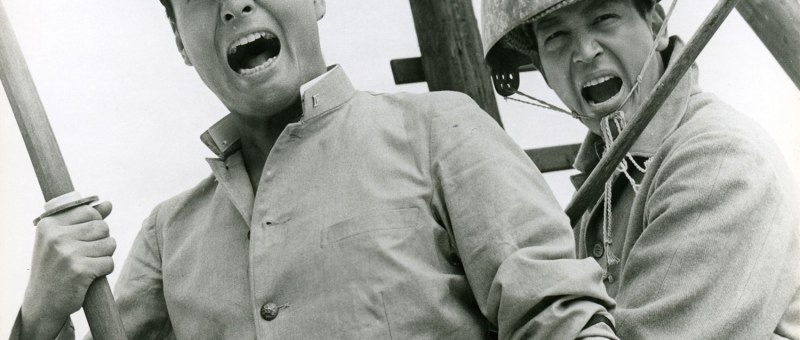
Fighting Elegy (けんかえれじい, Seijun Suzuki, 1966)

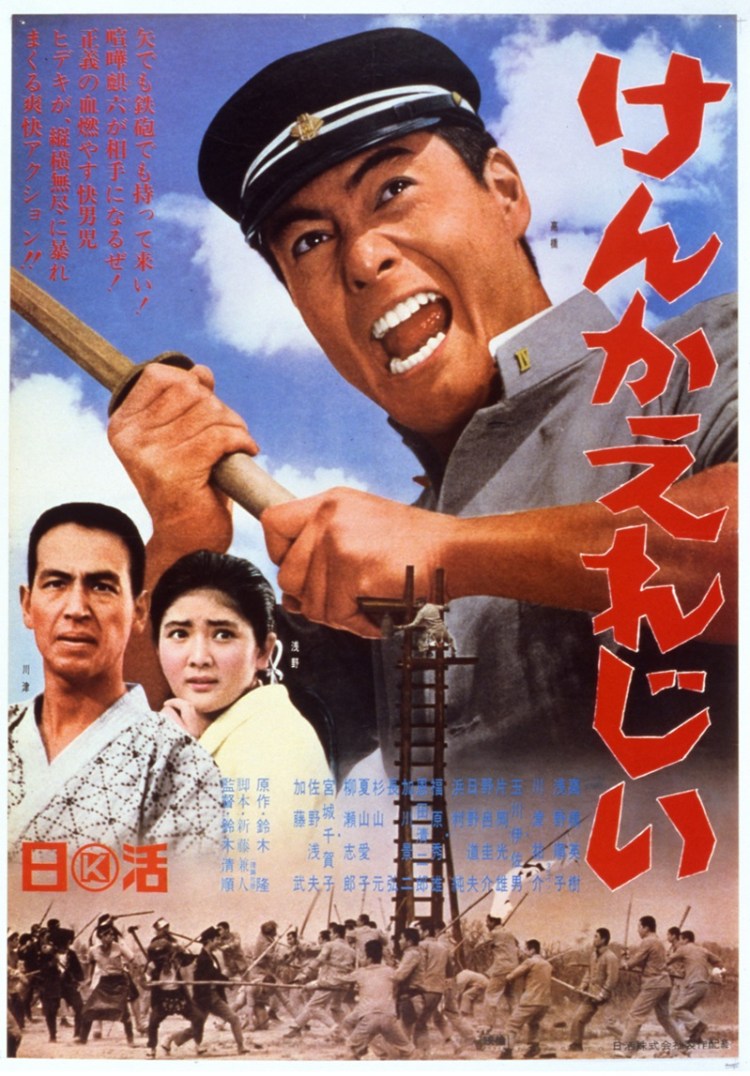
Fighting Elegy PosterAh, youth. It explains so many things though, sadly, only long after it’s passed. For the young men who had the misfortune to come of age in the 1930s, their glory days are filled with bittersweet memories as their personal development occurred against a backdrop of increasing political division. Seijun Suzuki was not exactly apolitical in his filmmaking despite his reputation for “nonsense”, but in Fighting Elegy (けんかえれじい, Kenka Elegy) he turns a wry eye back to his contemporaries for a rueful exploration of militarism’s appeal to the angry young man. When emotion must be sublimated and desire repressed, all that youthful energy has to go somewhere and so the unresolved tensions of the young men of Japan brought about an unwelcome revolution in a misguided attempt at mastery over the self.
Kiroku (Hideki Takahashi) is an impulsive young man with a magnetic personality who, like many of his age, has found himself at a military training school designed to toughen up the boys of Japan for the glorious services they will later be expected to provide for the emperor. Very much into his training, Kiroku submits himself to the rigid codes of the school which prize virility and encourage competitive brawling between the boys. Despite the strict prohibition on soft stuff like getting it on with girls, Kiroku has developed a heavy crush on the daughter at his Catholic boarding house, Michiko (Junko Asano). Delighting in her piano playing, Kiroku cannot find a permissible way to express his desires and so records them in a very frank diary. Michiko, it seems, may return his feelings but times being what they are cannot say or do anything until he declares them and so things are left to simmer between the two with no useful place to go.

Despite belonging to a military school, Kiroku’s main outlet is in a kind of extracurricular club which is obsessed with being manly but also with rebelliousness and showing how individualist they can be through a series of challenges which often involve flagrantly breaking the rules of the school. Kiroku’s violent escapades eventually get him expelled and sent to a different institution a few towns over which explicitly prizes the “Aizu Spirit”. By now truly invidualist in his isolation, Kiroku is disappointed in the tenets of the “Aizu Spirit”. Calling all of his fellow students “wild monkeys”, Kiroku makes some odd comments on the nature of oppression and dominance by pointing out that the students all willingly submit to the teacher who demonstrates authentic authority, but refuse to respect the ones who simply don’t have it. This is, in a sense, the opposite of the philosophy which Kiroku has come to follow in which pleasure comes from rebelliousness and the natural tendency of the young to resist all forms of constraining power.

However, the most primal constraining force acting on Kiroku is sexual desire as a running joke finds him consistently bothered by unwanted erections which he then has to hide from his comrades to avoid embarrassment. Kiroku is quite passionately obsessed with Michiko to the point that he thinks of little else despite the total prohibition on female contact advanced by his military training. His diaries are full of notes about how he dreams of her delicate hands though he lies about refusing to masturbate in favour of pouring all of his virility into his violent pursuits. The situation is complicated by the presence of Christian religion which places a further taboo on the young people’s desires as they glance guiltily at the crosses on the walls each time impure thoughts arrive. Michiko is not much better off, though her own frustrations result in internalised rather externalised violence which looks set to rob her of her own happiness but lacks the all encompassing destructive element of Kiroku’s unresolved energy.

Suzuki’s message is clear, if somewhat blunt. If only these young men and women had been allowed to work out their frustrations in a more normalised way, the entire folly of warfare and imperialist expansion could have been avoided. The Christian context does add to the levels of guilt and repression, but it is one layer further than the average farm boy from rural Japan who suddenly found himself caught up in the fascist movement would have experienced. Events reach their natural conclusion at the end of the film as Kiroku reads a newspaper report of the declaration of martial law in Tokyo following the February 26th Incident in which a cabal of hotheaded young military officers launched a broadly leftwing yet authoritarian coup designed to delegitimise the government and restore power to the emperor in a return to paternalistic feudalism. His romantic dream shattered, Kiroku recognises a kindred spirit and finds a calling in the call to arms but his vocation is a false one in its negation of everything it is to be alive. The path of militarism leads only to death and destruction in its pointless and nihilistic quest to overcome rather than satisfy ordinary desires and the forces which divide Kiroku and Michiko are those same forces which bring such overriding misery to a society caught in its own difficult adolescence.


Original trailer (English subtitles)

https://www.youtube.com/watch?v=j4Hy7WJtnI8

My House (Yukihiko Tsutsumi, 2012)

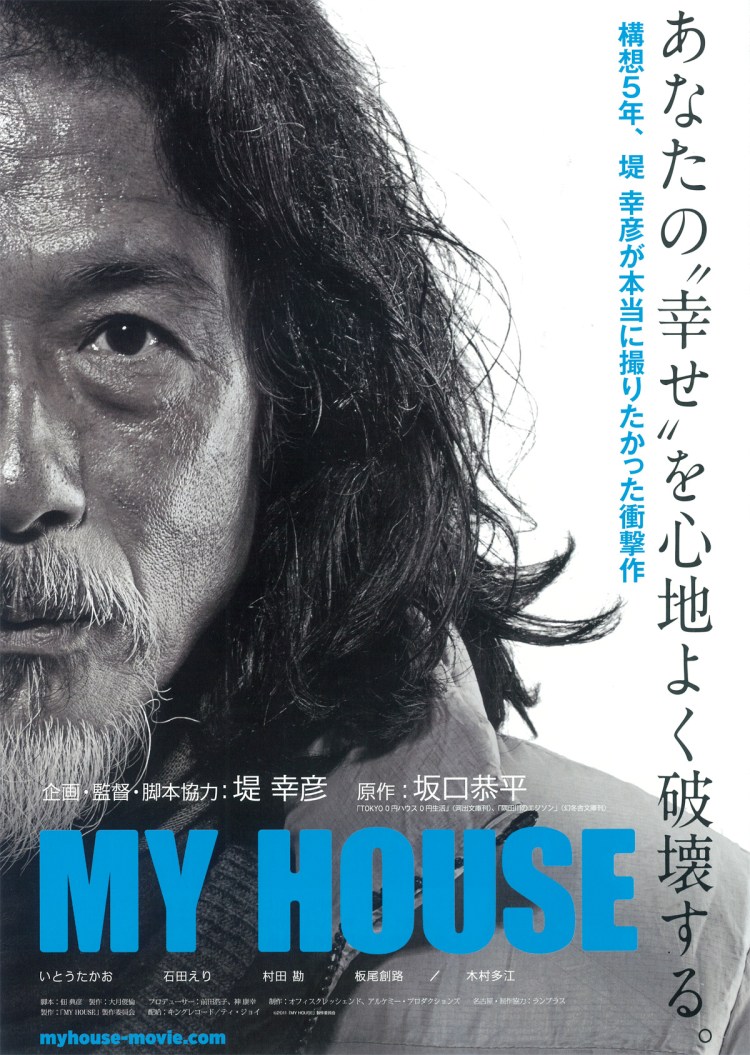
my houseYukihiko Tsutsumi has made some of the most popular films at the Japanese box office yet his name might not be one that’s instantly familiar to filmgoers. Tsutsumi has become a top level creator of mainstream blockbusters, often inspired by established franchises such as TV drama or manga. Skilled in many genres from the epic sci-fi of Twentieth Century Boys to the mysterious comedy of Trick and the action of SPEC, Tsutsumi’s consumate abilities have taken on an anonymous quality as the franchise takes centre stage which makes this indie leaning black and white exploration of the lives of a group of homeless people in Nagoya all the more surprising.
The film begins with its hero, Suzumoto, pulling a cart followed by his friends with other supplies and equipment. Arriving at their appointed destination, the men and women embark on a process they’ve obviously enacted a thousand times before. Dismantling their cart, they arrange the components for a kind of prefab house made out of found materials and propped up on crates.

Though the life may seem impossible to those from the outside – as it does to the well meaning men from the council eager to get the mini commune to move on by dangling a promise of sheltered accommodation or assistance, but thanks to Suzumoto’s innovations they have access to many of the benefits of the modern world from television to laptops. The main source of income comes from recycling – collecting tin cans, bottles, cardboard etc to be sold back to scrap merchants and recycling plants. It’s not easy money to make and there isn’t much of it but Suzumoto has his routine well worked out and is able to maximise his takings by cutting deals with householders and businesses for handiwork in return for what is essentially rubbish.

Getting into a discussion with a hotelier, Suzumoto is offered a regular job and a place in company accommodation but turns it down. He likes his life. It might seem hard to others and it is annoying to be continually dismantling and rebuilding your house, but the innovation appeals to him. He likes to work and to make things work. He wouldn’t want to be cooped up and constrained by the world of contracts and salaries and taxes.

The freedom and simplicity of Suzumoto’s life is contrasted with a seemingly ordinary middle class household which is defined by its tension and sterility. School boy Shota is an ace student but his austere father pushes him hard, allowing him little freedom or responsibility. Nursing a mild addiction to Pepsi, Shota’s only friend is the pet turtle he keeps in a tank in his wardrobe. While his father returns home only to shout at everyone and then go to bed, Shota’s mother is as obsessed with cleaning as he is with Pepsi and rarely leaves the house. Talking to almost no one, Shota’s mother’s existence is one of cold rigidity, living in fear of her domineering husband and accidentally neglecting her stressed out son in the process.

Through a series of inevitable coincidences the two worlds will clash with tragic consequences on each side. Tsutsumi doesn’t seek to glamorise life on the streets or paint it as some kind of hippyish quest for better living, but he does dare to suggest that Suzumoto’s self reliance and inner calm are much more healthy than the fear and repression which make Shota’s home as much of a prison as the tank he traps his turtle in. Suzumoto and his friends are looked down on, hassled by the authorities, and accused of crimes they did not commit but they are the victims and not the instigators of violence. Tension bubbles over and misses its target as rage against authority and society at large is redirected towards its most vulnerable citizens.

Suzumoto takes all of this in his stride, as he always does, dismantling his house only to rebuild somewhere else hoping only to continue the cycle while Shota is left to ruminate on the consequences of his actions still trapped inside the empty pressure cooker of his family home. Tsutsumi’s elegantly composed black and white aesthetic adds to the contemplative edge as two worlds are thrown into stark contrast but the one central tenet is the enabling factor for both – the intense pressures and total indifference of the mainstream world towards those attempting to live within in it.


Original trailer (no subtitles)

One-Way Ticket to Love (恋の片道切符, Masahiro Shinoda, 1960)

vlcsnap-2017-04-14-00h33m57s991Although Masahiro Shinoda has long been admitted into the pantheon of Japanese New Wave masters, he is mostly remembered only for his 1969 adaptation of a Chikamatsu play, Double Suicide. Less overtly political than many of his contemporaries during the heady years of protest and rebellion, Shinoda was a consummate stylist whose films aimed to dazzle with visual flair or often to deliberately disorientate with their worlds of constant uncertainty. Like so many of the directors who would go on to form what would retrospectively become known as the Japanese New Wave, Shinoda also started out as a junior AD, in this case at Shochiku where he felt himself stifled by the studio’s famously safe, inoffensive approach to filmmaking.
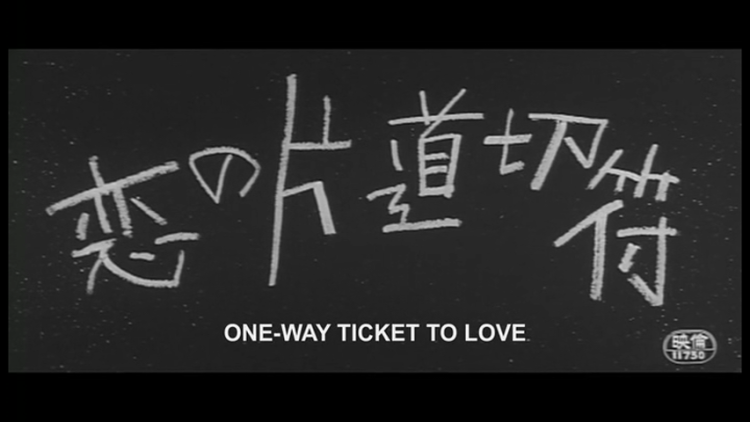
By the late ‘60s that approach was itself failing and so the studio began to take a few chances on new young directors including Shinoda who was afforded the opportunity to script and direct his first feature – One-way Ticket to Love (恋の片道切符, Koi no katamichi kippu). Studio mandated programme picture as it was, Shinoda still had to play by some of the rules – notably that the title song which is a Japanese cover of the 1959 Neil Sedaka hit needed to feature prominently. Shinoda does indeed showcase the song throughout the film though he also paints a dark and unforgiving picture of the burgeoning talent management industry whilst sympathising with those trapped in the underworld to which the effects of growing economic prosperity have yet to trickle down.

Down on his luck 20 year old alto-sax player Kenji Shirai (Kazuya Kosaka) has resorted to hanging around stations in Tokyo alongside a host of other unemployed artists trying to get picked up for a job and having little success. His luck changes when a young female talent fixer, Miss Yoshinaga (Yachiyo Otori), finds herself in need of an alto sax player with immediate effect. Kenji is elated to find work but somewhat troubled when the club is abruptly raided, giving him a taste of the precariousness of the underground club scene. Nevertheless, Yoshinaga hands him a card and tells him to come to her office tomorrow in case she has any more work for him.

On his way home, Kenji comes across a distressed woman crying her heart out dangerously near a high bridge. Fearing she is about to commit suicide, Kenji comforts her and then takes her home for the night before introducing her to Yoshinaga the next day in the hope that she may also have work for a young woman – she does, but as a nudie dancer. Mitsuko (Noriko Maki) reluctantly takes the job leaving Kenji conflicted but there’s more drama in both of their lives to come in the form of “The Japanese Elvis” Ueno (Masaaki Hirao), Mitsuko’s married ex-boyfriend Tajima, and an errant pistol belonging to Kenji’s petty yakuza roommate.

Although Shinoda was less noticeably political than many of the other directors of the time, his sympathy remains with those who feels themselves to be oppressed or have in someway been cast aside by an unforgiving world. Kenji in particular feels himself to be just such a person, remarking that the world is a cruel place in which people look after their own interests and are prepared to use and discard those less fortunate in order to get what they want. Describing himself and Mitsuko as nothing more than offerings fit for burning on the altar that is the post-war economy, Kenji’s sense of hopelessness is palpable. Despite having acted to rescue Mitsuko from her suicidal contemplation, he feels powerless to help her in any other way and honestly tells her so each time she comes to him for comfort or assistance. Though his earnestness has an honest quality in its determination not to deceive, it also has an air of cowardice as he refuses to even discourage the woman he loves from doing something he knows she will regret because he has already decided that resistance is futile.

Mitsuko, by contrast, finds herself entirely without agency. Betrayed by the man she loved on discovering that he was already married and had been stringing her along, she finds it difficult to adjust to living life alone. Consequently she finds herself wooed by the big idol star of the day, Ueno, and then swept into a studio scam in which the pair are tricked into a sexual relationship with dire consequences for both. Ueno, who sings the all important title song at several points throughout the film, might be in a more comfortable position than Kenji but he is no more free. The studio’s prime cash cow, Ueno is pimped out to his hoards of screaming teenage girls and denied anything like a private life outside of studio control. As the latest dancer at the club, Mitsuko is assured that she’s going out there a rookie and coming back a star but her fate, along with Ueno’s, is entirely in the hands of the managers who can make or break a career at will.

If the interpersonal drama fails to convince, Shinoda makes up for it with unusually dynamic and interesting cinematography much more like the youth movies Nikkatsu were making at the time than the usual Shochiku stateliness. Looking much more like the European New Wave, Shinoda makes fantastic use of tracking shots and unusual framing to draw attention to the isolation of his protagonists. The club set finale featuring the title song is a masterclass in tension as Kenji roams around the audience, caught among the crowd of screaming girls before pausing for an up close contemplation of Ueno which leads him to his final decision. A programme picture, but one in which Shinoda declared his stylistic intentions if not his scripting prowess. One-way Ticket to Love dazzles with visual flair but never captivates on anything other than a superficial level as its story of love frustrated by social inequality and controlling authority fails to deliver on the melancholy promise of the title.


Final sequence featuring the title song by Masaaki Hirao (English subtitles)

A Quiet Dream (춘몽, Zhang Lu, 2016)

Review of Zhang Lu’s A Quiet Dream (춘몽, Chun-mong) first published by UK Anime Network.

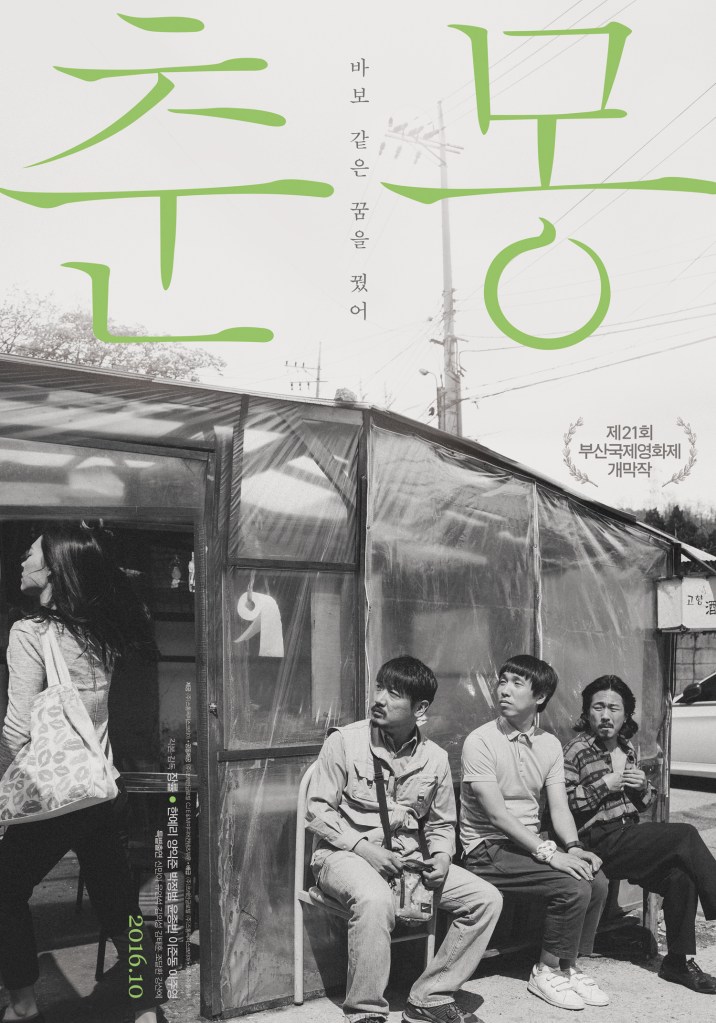
A North Korean defector, a lonely orphan, and a nerdy landlord walk into a bar but also, perhaps, into a dream or several dreams in Zhang Lu’s latest chronicle of lovelorn city dwellers and their eccentric days of tiresome banality. Dreams, reality, and wish fulfilment mingle freely in this run down land of cheerful hopelessness populated by the displaced and permanently fugitive. Zhang’s film is as elusive as it is melancholy but offers its painful meditations with good humour and kindness even if it sees little possibility of escape.

Everyone is in love with pretty barmaid, Yeri (Han Ye-ri). Yeri bears this with good grace as she divides her attentions equally between her three suitors, nervous landlord Jong-bin (Yoon Jong-bin), petty criminal Ik-june (Yang Ik-june), and sorrowful North Korean defector Jung-bum (Park Jung-bum). Having come to Korea as a teenager after her mother died, Yeri tracked down her estranged father only for him to suffer a serious illness requiring round the clock care soon after. When she’s not serving drinks or looking after dad, Yeri spends her time with the three guys, drinking, visiting the Korean Film Archive, or chatting with the romantic teenage poetess (Lee Joo-young) so obviously, painfully, in love with her that Yeri is able to do little other than ignore it in an attempt to let her down gently.

Dreamscape aside, the problems each of the protagonists is facing is real enough. Yeri’s life yields its own sorrows as her heartfelt rendition of Li Bai’s famous ode to homesickness makes plain as do her frequent references to her mother and the quest for a mysterious crater bound lake. Having lost a mother and found a father she loses again when he is taken ill and she is left to care for a man she barely knew in the most intimate of ways. Her burden is a heavy one and her dreams filled with the idea of abandoning it as her father’s wheelchair careers emptily down the hill on which they live. A visit to a fortune teller proves far from reassuring when he informs her that her father will live a long life, but abruptly changes the subject when it comes to a more personal projection.

The three guys could almost be aspects of her own personality turning up to haunt her but each of Yeri’s men (as she later describes them) is battling his own kind of despair. Jung-bum’s is the most pronounced as he battles bipolar disorder and possible PTSD from North Korean labour camps. A refugee with no one to protect him, Jung-bum falls victim to workplace exploitation only be fired because his eyes are “too sad” and it’s bringing his boss down. Ik-june, kinder than anyone gives him credit for, thinks he can help him through his gangland godfather “Mr. Jellyfish” but Ik-june can’t decide how far he really wants to be in the criminal underworld and is in disgrace after laughing at a funeral. Jong-bim lays claim to control over everything in sight as he’s “the landlord” only it’s his father who actually owns the land and Jong-bim is arrested in an almost adolescent sense of powerlessness.

Nevertheless, their days are ones of gentle dreaming as the guys push their luck but refuse to compete for the love of Yeri, preferring to share the unique light she seems to bring into their darkened world. Dreams and reality flow into one another without thought or warning leaving each indistinct as Yeri dances drunkenly on a rooftop only to turn around and find her trio of suitors disappeared, though the surreal characters which people the city including an old lady who collects cans, bottles and cardboard to place outside an old wardrobe on the side of the road which she uses “to pray” might make “reality” a difficult thing to believe in in any case.

Purgatorial as their existence is, the melancholy collective seem to find a comforting symbiosis in their personal miseries. Filming through mirrors and opaque curtains Zhang rejects any idea of certainty or concrete realities. The Chinese characters which accompany the film’s original title effectively mean “short lived illusion”, lending a poetic air to the otherwise surreal goings on, painting this greyed out land as a temporary container for eternal woes. At the film’s end we either wake up or fall asleep, or perhaps merely exchange one dream for another but despite all of the heartache and desperation this strange world is one defined by warmth and basic human goodness.


A Quiet Dream was screened as part of a teaser programme for the London Korean Film Festival. The next screening in the series will be E Oni’s Missing at Picturehouse Central on April 10, 2017. Tickets on sale now directly from Picturehouse.

Original trailer (English subtitles)

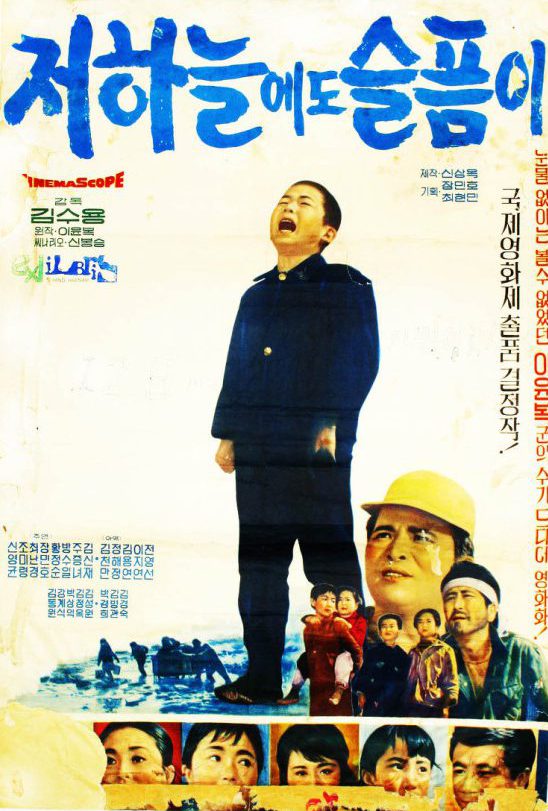
Sorrow Even Up in Heaven (저 하늘에도 슬픔이, Kim Soo-yong, 1965)

It’s a sorry enough tale to hear that many silent classics no longer exist, regarded only as disposable entertainment and only latterly collected into archives and preserved as valuable film history, but in the case of South Korea even mid and late 20th century films are unavailable thanks to the country’s turbulent political history. Though often listed among the greats of 1960s Korean cinema, Sorrow Even Up in Heaven (저 하늘에도 슬픔이, Jeo Haneuledo Seulpeumi) was presumed lost until a Mandarin subtitled print was discovered in an archive in Taiwan. Now given a full restoration by the Korean Film Archive, Kim’s tale of societal indifference to childhood poverty has finally been returned to its rightful place in cinema history but, as Kim’s own attempt to remake the film 20 years later bears out, how much has really changed?
11 year old Yun-bok has been forced out of his home and into a makeshift hovel near the river thanks to his gambling addicted invalid father’s inability to look after his four now destitute children. Yun-bok likes to narrate his life as a kind of letter to his absent mother who seems to have abandoned the family for unclear reasons possibly related to her husband’s drinking and gambling problem. Attending school as normal in an attempt to work hard and get an education so he can take care of the family in an adult world, Yun-bok, along with his younger sister Sun-na, spends his free time selling sticks of gum in the streets to try and earn enough money to feed everyone before his father drinks and gambles it all away.

Despite his obviously difficult circumstances, Yun-bok remains steadfast in his desire to stick by his family and take care of his siblings. Berated by the teacher for arriving late, Yun-bok finds an ally in a schoolmate who just wants to help even though many of the others shun him because of his raggedy clothes and lice infested hair. Eventually a teacher notices Yun-bok’s distress and urges him to write his struggles in a diary – which he does much as he’d been narrating his days in his imagined conversations with his mother. Moved by Yun-bok’s heartending descriptions of his life on the starvation line, the teacher manages to get the diaries to the newspapers who begin publishing them as a public interest column but just when it looks as if things maybe looking up for the family, Yun-bok loses heart and hops a freight train to look for Sun-na who has run away from home after an argument.

Korea in the 1960s was a difficult place, still bearing the scars of both WWII and the Korean War not to mention the resultant political turmoil. Nevertheless, by 1965 things had begun to pick up as seen in the flip side to Yun-bok’s sorry state of affairs – the various bars and drinking establishments he manages to work his way into in order to sell a few more sticks of gum. These places are filled with the sound of popular music where affluent young couples dance The Twist and salarymen in dark suits cement their business relationships over drinks. For some, everything is going fine but a concerted effort is being made to unsee the kind of unpleasantness which lurks below growing economic prosperity as manifested by 11 year old boys somehow responsible for the maintenance of a family of five.

As one teacher puts it, you can’t break the mirror because you don’t like what you see. Though there are some willing to help Yun-bok (at least to an extent) including his school friend who comes from a well to do family only too glad to set some food aside for Yun-bok and his siblings, out in the real world he finds only other desperate people willing to stoop to theft and violence against a child for nothing more than a few pennies. Many of these episodes are distressing as Yun-bok has his shoeshine kit stolen by an older boy or is violently beaten by a grown man at the harbour but the most serious occurs in the city when he is accused of pickpocketing by some louts who kidnap him and strip him naked for otherwise unclear reasons.

Though Sorrow Even Up in Heaven has a broadly positive ending as Yun-bok’s circumstances seem set to improve thanks to his accidental fame, Kim is quick to point out that there are many Yun-boks out there who can’t all become media sensations. Like many child heroes of classic Korean cinema, Yun-bok remains morally good – the idea of theft occurs to him but he remembers his teacher saying that everything will work out as long as his heart is pure, and his only transgression lies in spending a few pennies on himself to get something to eat and thereby work harder for his family (and for this he pays a heavy price). Even so his circumstances are portrayed in a naturalistic rather than melodramatic fashion neatly undercutting the inherent sentimentality of the material. Though Kim’s approach is closer to neorealism in the early scenes, he mixes in touches of magical realism with the ghostly appearances of Yun-bok’s mother which, alongside impressive montage and superimposition sequences, lend Yun-bok’s story an elevated cinematic quality. Remade several times over the last forty years, Sorrow Even up in Heaven remains sadly timeless in its depiction of an earnest young boy who knows only kindness and honesty even while those around him remain wilfully indifferent or actively cruel in the face of his continued suffering.


The Assignation (密会, Ko Nakahira, 1959)

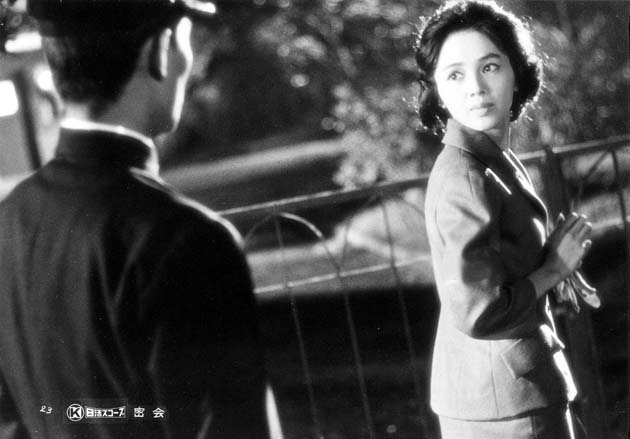
Aside from the genre defining Crazed Fruit which kick-started the era of the “seishun eiga” and, in its own way, the Japanese New Wave, Ko Nakahira has remained under seen and under appreciated outside of Japan. Completed just three years after the youth fuelled frenzy of Crazed Fruit with its freewheeling playboys and their speedboat crises, The Assignation (密会, Mikkai) is a much more measured, mature meditation on social constraint, guilt and the slow drip feed of poisonous thought. Nakahira wastes none of his characteristic energy in the necessarily tight 76 minute runtime, but this is an exercise in high tension as a pair of illicit lovers are suddenly confronted with their crime after accidentally witnessing a murder.

Neglected at home by her studious professor husband, Kikuko (Yoko Katsuragi) has embarked on affair with one of his students, Ikuo (Seiji Miyaguchi). Canoodling at a deserted woodland spot, the pair muse on their impossible love prompting Ikuo to wonder how it would be if Kikuko’s husband simply died. Kikuko quickly puts a stop to Ikuo’s dark and desperate thought but the seed of death has already been sown in the relationship as they’re quickly spotlighted by a pair of unexpected car headlights. Hiding behind a nearby bush, Kikuko and Ikuo witness some kind of struggle inside a taxi before a young man drags and older one out of the car and takes off at a run.

Traumatised, Ikuo and Kikuko finish dressing and attempt to rejoin regular society by avoiding the unusual level of traffic in this remote spot which includes another truck and, as luck would have it, a policeman on a bike. Troubled, the pair bid each other goodbye with the suggestion that they’d better not see each other for a while but the tension continues to mount as Ikuo’s youthful desire to do his civic duty conflicts with Kikuko’s middle aged preoccupation with her reputation and the possible scandal that would occur should the police discover the whole story of their sordid love affair.

Nakahira begins with a careful panning of trees against the film’s bouncy jazz soundtrack neatly underlining the dread hanging somewhere overhead. Scandalous for 1959, the ongoing affair between the naive student and the melancholy housewife is already tinged with doom from the outset despite the relaxed quality of their post-coital coversation. Ikuo is pained, he wants a full life with Kikuko, but she dampens his youthful dreams by already thinking of the end. Adopting a maternal tone, she talks about his future – graduation, a successful career, a lovely young girl his own age who become will his wife. She even wonders if he’ll invite her to the wedding so she can meet the woman who will complete his life in a way she never can. Though she may say she wants to stay with him forever in the throws of passion, hers is a pragmatic love which is more need than desire. The archetypal middle-class housewife, Kikuko may have made this brief weekday evening transgression but throwing off the constraints of propriety is not a step she she envisages taking.

Already guilt ridden over her moral transgression, Kikuko views the incident in the woods as some kind of karmic revenge for her carnal sin. A very frank discussion with her forthright sister-in-law who quizzes her about the marriage’s lack of offspring reveals the depths of her despair and loneliness as her husband barely acknowledges her existence and there is almost nothing for her to do around the house. Taking cooking classes just to get out for a while, she runs into Ikuo whose story is an equally common one of a young man’s infatuation with the pretty yet sad younger wife of his professor.

If mutual loneliness brought them together, guilt and fear will later tear them apart as they face their shared “crime” from opposing sides. For Kikuko her illicit meetings with man much younger than herself are a shameful secret which must be concealed at all costs. Ikuo, however, is in love and sees nothing “wrong” in his courtship of the older woman even if he sympathises with her desire to avoid a scandal and does not want to cause her pain. What bothers him is a sense of justice and social responsibility. He saw the killer’s face – if he goes to the police, the victim’s wife and children might at least be able to gain some peace of mind knowing that the perpetrator is behind bars even if little else will change for them. Kikuko, by contrast, can think of nothing other than herself and is willing to sacrifice all to keep her reputation intact.

The threat of discovery is ever present as Nakahira litters the scene with clues and threats from the constant flagging of possible witnesses to an errant leaf resting on the pot which Kikuko has so calculatedly prepared to back up her cooking class alibi. A dreamlike atmosphere pervades as superimposition and montage segue into Kikuko’s flights of fancy from her memories of the beginning of the affair to a premonition of the newspaper furore which awaits her should Ikuo follow through with his intention of revealing all to the police. In the end, someone is always watching. Despite the youthful tone and jaunty jazz soundtrack, the morality police will tolerate no transgression. The wages of sin are death, but it’s fear driven by guilt and social constraint which is its executioner.