The Descendants of Cain (카인의 후예 / 카인의 後裔, Yu Hyun-mok, 1968)

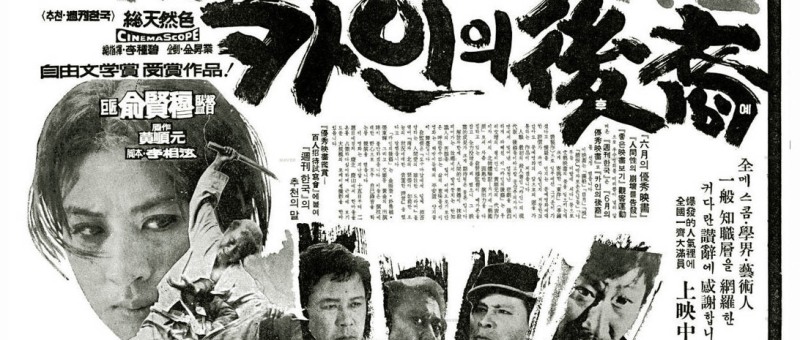
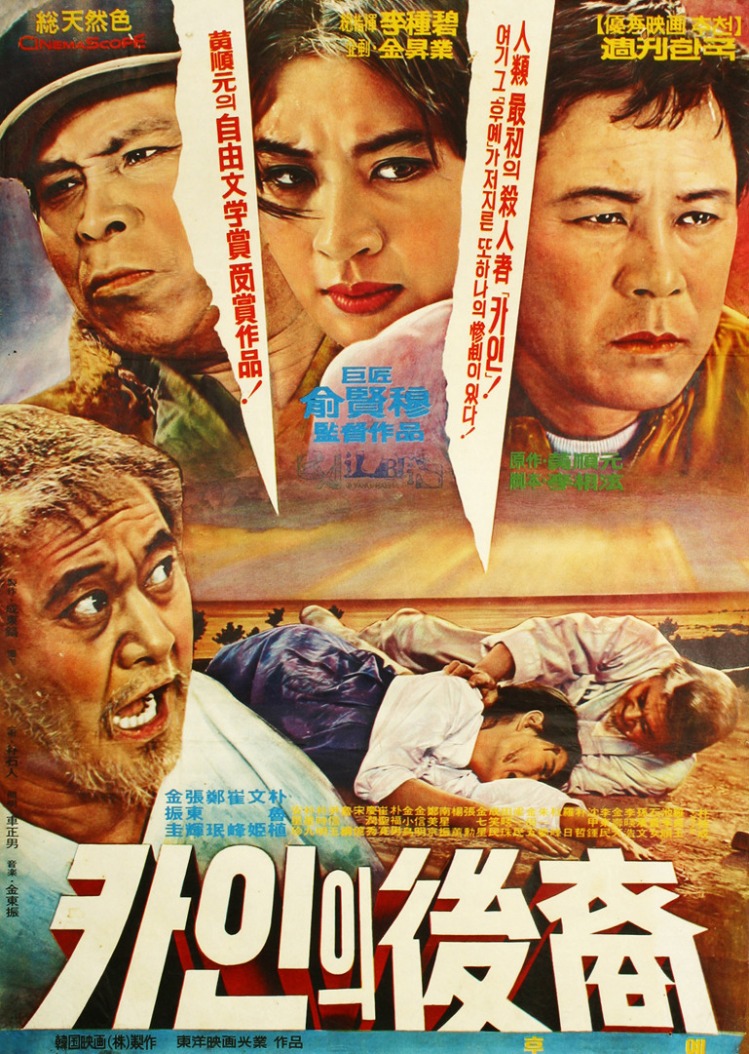
Descendents of Cain poster 1Yu Hyun-mok, often regarded as among the more “intellectual” of film directors in Korea’s Golden Age, is also among those to have been arrested for violation of the Anti-Communist laws. Yu was later exonerated and went back to filmmaking as before but it remains true that Yu betrays a little more ambivalence to the anti-communist message so often required than many of his colleagues. That is to say, Yu often leans economically left in his frequent criticism of social inequality and his anti-consumerist stance, but remains socially conservative if with a strong desire for social justice. The Descendants of Cain (카인의 후예 / 카인의 後裔, Kainui Huyea), adapted from a novel by Hwang Sun-won, is as anti-communist as they come, but also offers its share of ironies in painting “communism” as a kind of disease born of greed and self-interest which thrives on fear and eventually consumes those who are seduced by its false promises.

Irony is indeed our starting point as our cheerful villagers enjoy a raucous celebration in honour of Independence Day only for the communists to suddenly turn up and spoil the party. Worst of all, one of the communists is a long lost son of the village – Choe is the absentee husband of Ojaknyeo (Moon Hee), a maid, who has developed an affection for her boss, the nephew of the local landlord, Park Hun (Kim Jin-kyu). The communists’ first action is to close down the school that Park Hun opened to provide education for the peasants and co-opt it as their base. Park knows he’s in a dangerous position and has little power to resist, opting to wait it out and see how far the communists really intend to go. The peasants, however, are becoming excited hearing about the land redistribution programme and are starting to forget everything that Park and his family have done for them over the generations, swayed by the false promises of the communists who preach equality while insisting on deference.

The central conflict is, in many ways, between the feudal past and the “democratic” future. Set in what would shortly the “the north” in 1946, Descendants of Cain positions itself on more than one kind of dividing line with the lingering spectre of tragedy always on the horizon. High on a ridge there’s a large stone slab erected as a memorial to the late Park, Park Hun’s grandfather, whose solicitous care for the villagers had earned their eternal respect and perhaps their love. The Parks are “good” landlords. They take their “feudal” responsibilities seriously as evidenced by Park Hun’s school and his father’s desire to finish construction on the local reservoir which is both his legacy and an important failsafe precaution against draught which is in the interests of all. By all appearances this is a well functioning village where no one is hungry or alone. The peasants have not felt “oppressed” or been unhappy, which is not to say they don’t want to better their lot but they have no burning desire for revolution and have nothing in particular to rebel against.

This leaves the communists with a problem – they have little leverage over happy peasantry which has never acknowledged its own oppression let alone longed for freedom from it. Their approach is therefore one of divide and conquer. Cynical in the extreme, the communists set about exploiting petty village disputes to foster discord between people – something which eventually contributes to a murder which they also manipulate for political gain. The “landowners” are of course a prime target, but their judgement must be at the hands of “the people” by means of a farmers’ trial. Having recruited something close to a former village leader, the communists assume they will have the villagers on side but they all (bar two) refuse to indict the Parks. The communist leader, fond of irony, gestures towards towards his armed men and reminds the villagers that no one here is “impinging on their freedom”. That is, their freedom to express the views they are required to express or suffer the consequences.

Threatened with violence and intimidation, feudal deference bends or perhaps shifts to a different master. The villagers, losing their attachment to the Parks, salivate over the possibility of “redistribution” and of being handed “free land”. Their desires are material and not political. Thus when the Parks’ estate is “returned” to the people, they simply walk in and start taking things. Not the most sensible way to redistribute wealth concentrated in the hands of the elite – the fast get horses, the indecisive dented pans which sounds like a recipe for rancour and discontent. When the old village chief becomes disillusioned with his choices and smashes the memorial to old Park, a small fight breaks out among villagers keen to snag the large pieces of stone for various other projects. Happy peasants who once shared everything and wanted for nothing, are now fighting with each other over rubble and trinkets.

The communists, far from fostering collective spirit, have become the evil feudal lords they rail against, oppressing the peasants with their rules and regulations while wilfully creating an atmosphere of fear in order to better oppress them. Their hypocrisy is rammed home early on by the slimy Cheol who complains about his wife’s supposed faithlessness while molesting a barmaid and smugly repeating the story of a large scar he has on his forearm. His superior, believing he got the scar during a labour dispute at a mine, promoted him for his communist spirit, but Cheol really got the scar in a scuffle over a girl (not his wife, incidentally).

Cheol is “a” force which comes between the two lovers, Ojaknyeo and Park Hun, as both are too morally upright to pursue a full romance when Ojaknyeo is still married to another man, even if the other man’s first action on seeing her is to throw her to the ground and begin kicking the living daylights out of her. Later Ojaknyeo gets another, more serious, beating from her father but this time because she’s chosen the wrong side in refusing to step away from the feudal world in her responsibility to Park Hun and his household, even if that responsibility is partly romantic desire. Yet Park Hun and Ojaknyeo are also separated by the feudal world’s rules in their obvious class difference. Communism is supposed to break down these barriers, not to mention removing the “patriarchal tyranny” of marriage, yet the communists would rather award Ojaknyeo to her former husband, little caring that he is abusive and neglectful. Ojaknyeo, at least, will not be freed from her oppression any time soon.

If Yu is making a mild defence of paternalistic feudalism as a metaphor for compassionate government, it is probably a little ambitious given the times in which he lived. Following a regular pattern, Yu paints the world as a terrible place where fear and self interest trump all, only to find small rays of light in the closing moments when an act of violence provokes a series of unexpected epiphanies and reconciliations. He ends on a note of hope in which an older man sacrifices himself for a younger one but is then rewarded with the possibility of salvation and a happier future with the woman he loves (and is now unafraid to pursue) south of the border. Communism seduces and betrays, whereas liberal democracy at least affords the “freedom” to be miserable with personal integrity.


Screened as part of the Korean Novels on Screen season at the Korean Cultural Centre London.
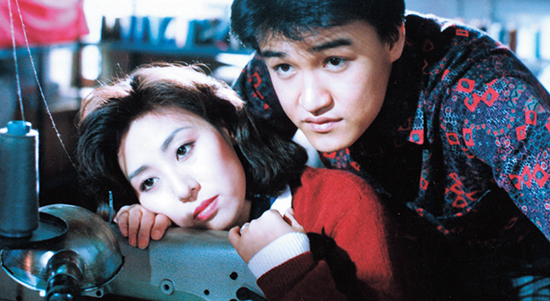
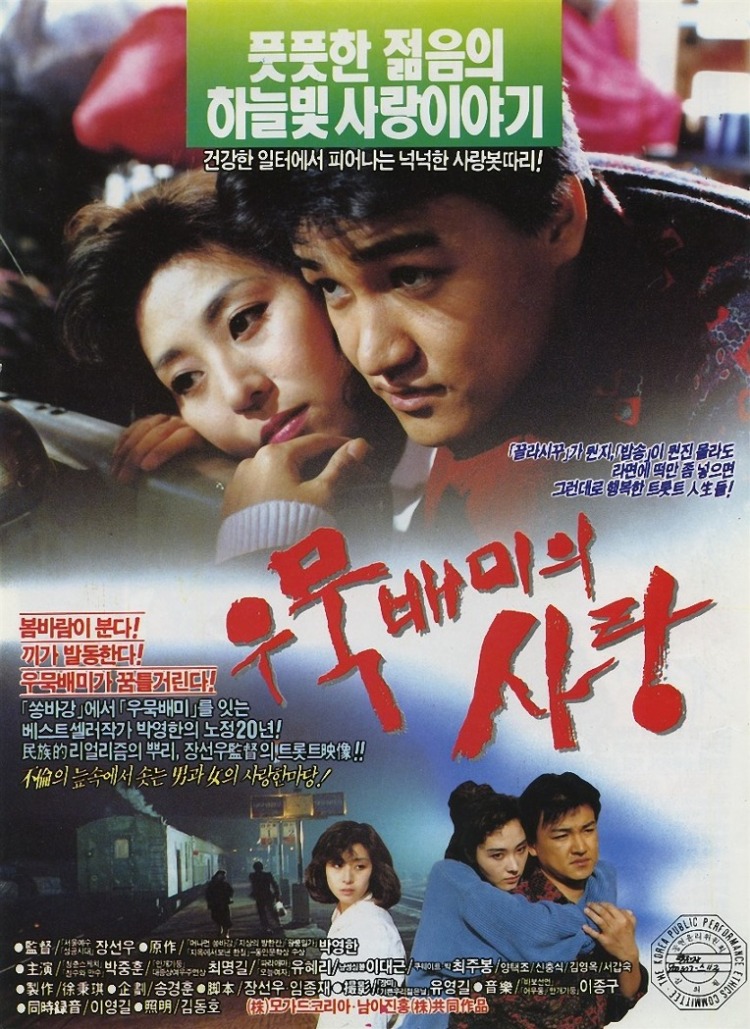
Lovers of Woomuk-Baemi (우묵배미의 사랑, Jang Sun-woo, 1990)

The Lovers of Woomook-baemi posterJang Sun-woo, a former political activist and underground filmmaker, is best remembered for formal experimentation and pointed social commentary, but his third feature The Lovers of Woomook-Baemi (우묵배미의 사랑, Umukbaemi Eui Sarang), stands out in his filmography in its fiercely naturalistic portrayal of working class life on the margins of a society in flux. Based on a novel by Park Yeong-han, The Lovers of Woomook-baemi, is a classic melodrama with infidelity at its core but it’s also a story of futility, the destructive effects of patriarchal social codes and toxic masculinity, and the frustrated promises of a new era for those excluded from its various benefits.

Jang begins his tale in the middle as Bae Il-do (Park Joong-hoon), a frustrated husband, returns home late to a troubled “wife” (Yoo Hye-ri) who promptly kicks him out again. Complaining furiously, Il-do dreams of another woman, Gong-ryae (Choi Myung-gil), with whom he had a brief affair, idly thinking that he might have been happy if he hadn’t got his current partner pregnant and got himself stuck with her for life even if they aren’t technically “married” in the legal sense.

Moving backwards, we see Il-do, having failed in Seoul, returning to his home village with his common-law wife Sae-daek and infant child after an offer of work in a small seamstressing firm. The only man among a room full of mostly elderly women, Il-do is something of a novelty but is also taken by the woman on the machine next to him, Gong-ryae, who he later learns is also unhappily married and intensely lonely in her small-town existence. After some initial indecision, the pair embark on an affair, (still illegal at the time of the film’s release) but their prospects for future happiness seem slim given the restrictive quality of their lives.

The world that Jang depicts, for all its naturalistic flair, is intensely misogynistic. Il-do’s early recollections of Gong-ryae revolve around her bad marriage to an impotent man (Lee Dae-Geun) who mercilessly beats her. Indeed, we later see Gong-ryae turning up for work after suspicion has arisen about her relationship with Il-do with a black eye and bruises on her face while the other women giggle over the obviously awkward gossip. Domestic violence is, however, just a part of life in the village and the older women in particular view it as a sign of a healthy marriage. One woman even exclaims that she wishes she had a man to beat her, but thinks she’s unlikely to find anyone given her age and the fact that she already has numerous children.

Il-do, by contrast, proves somewhat popular among the ladies at the shop because of his relative lack of machismo. Like Gong-ryae, Il-do is also a victim of domestic violence. His wife beats, slaps, and attacks him verbally, later even dragging him home by the testicles along a very public walk of shame. He is not above violence or aggression, but as in much of Jang’s work, male violence is a sign of weakness rather than strength and each of Il-do’s violent episodes is more to do with defeat and repressed emotion than it is about strength or conquest. This also seems to be true for Gong-ryae’s husband whose violence and jealously is perhaps a reaction to his impotence, but when we later meet him we find a man much like Il-do. Chastened, Gong-ryae’s husband politely asks the man who bedded his wife if he knows where she is and if he sees her to please tell Gong-ryae that he’s sorry and wants her to come home.

As he does with Gong-ryae’s husband, Jang plays with our sympathies and allegiances, switching perspective to reveal to us that villains and victims are often one and the same. Sae-daek originally seems like our villain, a shrewish, henpecking “wife” who won’t let our hero go despite the evident toxicity of the pair’s non-marriage, but seen from her point of view we understand her plight. After running away from a violent home environment she winds up a bar hostess in the city where she builds up a spiky relationship with Il-do which goes south when he gets her pregnant. Despite this being the age of illegal adultery, it’s not so much a marriage certificate that binds a man and a woman together for good or ill but a child. As a neighbour puts it, a woman might leave her husband, but what sort of woman leaves a child? Sae-deok cannot care for her child alone and she cannot abandon it with Il-do and so she must keep him no matter how much personal suffering she must endure as the common law wife of a no good philandering ne’er do well.

Il-do likes to drift off into philosophical reveries in which he idly remarks on the futility of his existence, but in a very real sense he’s not wrong. He tried life in the city but it didn’t want him and he came home. Sae-deok, oddly enough, likes it in the village with its sense of community especially among the other put upon and oppressed women who attempt to support each other (whilst accidentally supporting the mechanisms which continue to oppress them), but there’s no pretending there’s anything more to life in Woomuk-Baemi than work and drink. Il-do knows this, as does Gong-ryae, and it’s their mutual sense of existential ennui which finally forces them together in an impossible attempt to rebel against the futility of their existence through transgressive sex and an attempt at emotional connection.

In the end, Il-do is dragged (by the short and curlies) back into the past, literally, as Sae-deok takes him back to his mother’s house to complain about the terrible way she’s been treated. Creating a scene outside, Sae-deok eventually manages to get through to her mother-in-law who had previously rejected her because of her lowly peasant background and history of sex work, enabling the two women to bond in their shared disappointment with Il-do who has now failed as a “man” on every possible level. Briefly reuniting with Gong-ryae in the greenhouse in which they used to meet, now reduced to ruins, Il-do declares that his love is like a mummy, wrapped so well it will endure for thousands of years without decay, but it’s already too late. Choices have been made, implicitly, which cannot be reversed. Jang leaves his protagonist where he started, frustrated and inert, suffering without hope in an oppressive environment which he knows, in his heart, he does not possess the courage to resist.


Available on region free blu-ray courtesy of the Korean Film Archive which also includes an audio commentary in English from film scholars Darcy Paquet and Marc Raymond, and Tony Rayns’ documentary The Jang Sun-woo Variations, as well as a 36 page bilingual booklet featuring essays by Rayns and film critic Lee Yeon-ho. Also available to stream via the Korean Film Archive’s YouTube Channel.

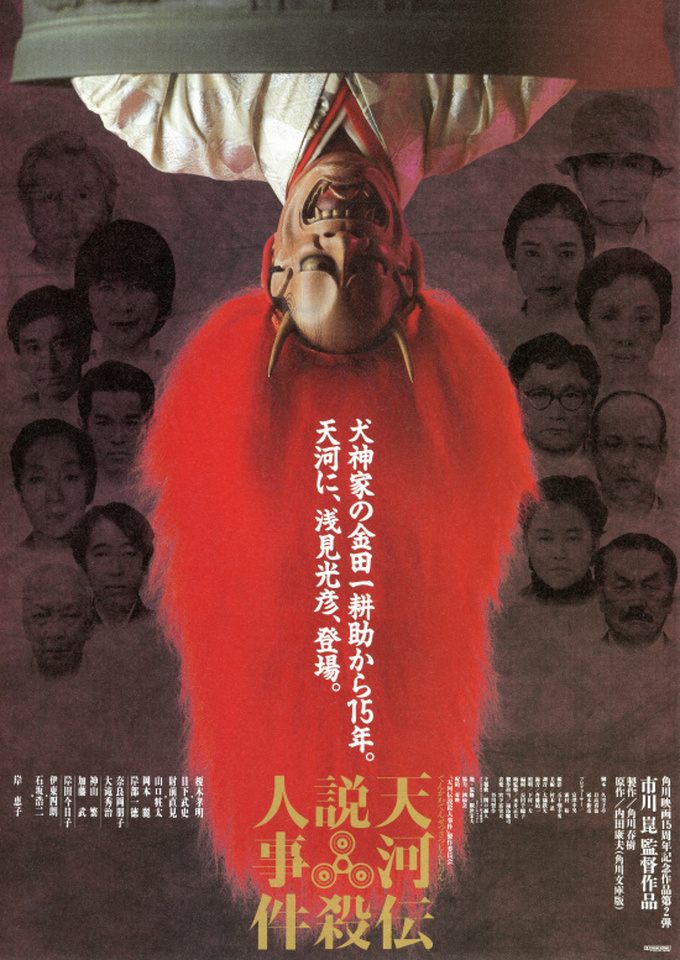
Noh Mask Murders (天河伝説殺人事件, Kon Ichikawa, 1991)

noh mask murders posterFor one reason or another, Japanese mystery novels have yet to achieve the impact recently afforded to their Scandinavian brethren. Japan does however have a long and distinguished history of detective fiction and a number of distinctive, eccentric sleuths echoing the European classics. Mitsuhiko Asami is just one among many of Japan’s not quite normal investigators, and though Noh Mask Murders (天河伝説殺人事件, Tenkawa Densetsu Satsujin Jiken) is technically the 23rd in the Asami series, Kon Ichikawa’s adaptation sets itself up as the very first Asami case file and as something close to an origin story.

Ichikawa, though he may be best remembered for his ‘60s arthouse masterpieces, was able to go on filmmaking where others perhaps were not precisely because of his forays into the populist with a series of mystery thrillers including several featuring top Japanese detective Kindaichi (who receives brief name check in Noh Mask Murders). Published by Kadokawa, Noh Mask Murders is produced by Haruki Kadokawa towards the end of his populist heyday and features many of the hallmarks of a “Kadokawa” film but Ichikawa also takes the opportunity for a little formal experimentation to supplement what is perhaps a weaker locked room mystery.

Asami (Takaaki Enoki) begins with a voice over as four plot strands occur at the same temporal moment at different spaces across the city. In Shinjuku, a salaryman drops dead on the street, while a young couple enjoy a secret tryst in a secluded forest, a troupe of actors rehearse a noh play, and Asami himself is arrested by an officious policeman who notices him walking around with a dead bird in his hand and accuses him of poaching. As he will later prove, all of these moments are connected either by fate or coincidence but setting in motion a series of events which will eventually claim a few more lives before its sorry conclusion.

To begin with Asami, he is a slightly strange and ethereal man from an elite background who has been content to drift aimlessly through life to the consternation of his conservative family which includes a police chief brother. He harbours no particular desire to become a detective and is originally irritated by a family friend’s attempts to foist a job on him but gives in when he learns he will have the opportunity to visit Tenkawa which is where, he’s been told, the mysterious woman who helped him out with the policeman in the opening sequence keeps an inn. Hoping to learn more about her, he agrees to write a book about the history of Noh and then becomes embroiled in a second murder which links back to the Mizugami Noh Family which is currently facing a succession crisis as the grandfather finds himself torn over choosing his heir – he wants to choose his granddaughter Hidemi (Naomi Zaizen) who is the better performer but the troupe has never had a female leader and there are other reasons which push him towards picking his grandson, Kazutaka (Shota Yamaguchi).

As with almost all Japanese mysteries, the solution depends on a secret and the possibilities of blackmail and/or potential scandal. The mechanics of murders themselves (save perhaps the first one) are not particularly difficult to figure out and the identity of the killer almost certainly obvious to those who count themselves mystery fans though there are a few red herrings thrown in including a very “obvious” suspect presented early on who turns out to be entirely incidental.

Ichikawa attempts to reinforce the everything is connected moral of the story through an innovative and deliberately disorientating cross cutting technique which begins in the prologue as Ichikawa allows the conversations between the grandchildren to bleed into those of Asami and his friend as if they were in direct dialogue with each other. He foregrounds a sad story of persistent female subjugation and undue reliance on superstition and tradition which is indirectly to blame for the events which come to pass. Everyone regrets the past, and after a little murder begins to see things more clearly in acknowledging the wickedness of their own actions as well as their own sense of guilt and complicity. Noh is, apparently, like a marriage, a matter of mutual responsibility, fostering understanding between people and so, apparently is murder, and one way or another Asami seems to have found his calling.


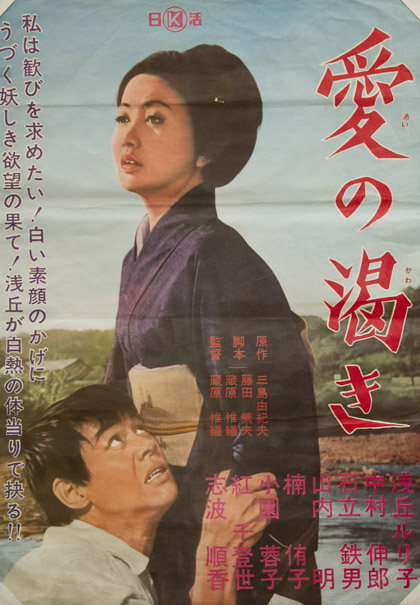
Thirst for Love (愛の渇き, Koreyoshi Kurahara, 1967)

(C) Nikkatsu 1967

Thrill for love posterIf The Warped Ones showed us a hellish, uncivilised world in which people acted on their base desires with little thought for others, Thirst for Love (愛の渇き, Ai no Kawaki) shows us the opposite as desire repressed eats away at those unable to find fulfilment in their assigned social roles. Koreyoshi Kurahara’s swirling artistry may have proved too much for studio bosses at Nikkatsu (Thirst for Love would be the last film he’d make as a regular director for the studio), but it finds a perfect match in the florid world of Yukio Mishima.  A tale of inequalities and misunderstandings, the rarefied atmosphere of Thirst for Love is just as “warped” as that of Nikkatsu’s gritty youth dramas in which desire and gratification become tools of currency in a grand game of wounds given and received.

Our heroine, Etsuko (Ruriko Asaoka), is a young widow living with her late husband’s family. Following the death of her husband, Etsuko has become the mistress of the family’s tyrannical patriarch, Yakichi (Nobuo Nakamura) – a successful businessman apparently forced out of the company he founded and into an early retirement. Yakichi resents the rest of his family whom he regards as feckless freeloaders. Oldest son Kensuke (Akira Yamanouchi) is a part-time classics professor and full-time neurotic intellectual. He and his wife Chieko (Yuko Kusunokiare unable to have children of their own (something else that annoys Yakichi), while daughter Asako (Yoko Ozono) has come back to her family home following a divorce with two children in tow. The family are all “aware” of the strange dynamic between Yakichi and his daughter-in-law but are too polite to bring it up. Nevertheless, Kensuke also has a thing for Etsuko which Chieko is aware of but not particularly worried about because she really does respect and trust her husband.

Etsuko is not particularly interested in Kensuke. There’s nothing he could really offer her. Though she keeps up a pretence of happiness with her current living standards, even going so far as to write a fake diary expressly intended for Yakichi to read, Etsuko feels nothing but contempt for and boredom with the emotionally cold and controlling family patriarch. Her faith in human emotions is low, but still she feels desire. When the teenage gardener Saburo (Tetsuo Ishidate) catches her admiring a beautiful statue and remarks on Etsuko’s own beauty, he puts untoward ideas in her head.

Even in the post-war world, women like Estuko have little agency. After her husband died, she could have stuck it out alone – found a job, supported herself. She could have remarried or perhaps have received financial support from the family while living alone, but she’s chosen to remain with them even given her somewhat degrading role as her father-in-law’s mistress-cum-plaything. When Saburo tells her she is beautiful he oversteps the established laws of class separation and Etsuko is too clever not to know how clichéd her new found lust for a peasant boy really is but she can’t unsee his broad shoulders and muscular frame or the sweat that crowds his brow as he labours on her behalf.

She begins making coy overtures which Saburo, unwittingly or otherwise, deflects. The situation is complicated by another woman, Miyo (Chitose Kurenai), who may or may not be something like Saburo’s girlfriend though as we will later find out, Saburo is a typically immature young man who regards his relationships with women as essentially inconsequential. Deferent towards his mistress, he demands to be released from her cruel games. Yet Etsuko had hardly realised that’s what they were. She cannot simply voice her desire or make her interest plain. Hers is not the first move to make. Several times Etsuko comes close to crossing a line but she always pulls back – inflicting necessary suffering on herself through her inability realise her desires.

Suffering, in a sense, becomes the point and almost a bizarre source of pleasure. In a climactic moment of drunken dinner party truthfulness, Kensuke attempts to apologise for a potentially destructive speech by revealing that he meant to smash everything to bits but has only succeeded in destroying himself. Etsuko too means to hurt others, partly as a kind of revenge, but in truth only to increase her own suffering. Her plan stumbles when she realises that Saburo is and always has been entirely indifferent towards her. He saw her as the mistress of the manor, an elegant and attractive woman, but felt no more desire for her than for any other. As he puts it, they live in different worlds – she is nothing to him, and nothing she does can change that. Etsuko has only destroyed herself, a self-immolation of repressed desire which threatens to burn the world with its ferocious intensity.

If Etsuko is to free herself from the burden of her need, she will pay a heavy price to do so. Kurahara shifts into an avant-garde register more in keeping with the more or less contemporary work of Kiju Yoshida in his anti-melodrama phase, but Kurahara’s approach is, in keeping with the source material, altogether less serious, fully embracing the melodramatic but taking pains to underpin it with deeply felt emotion. Asaoka excels as the neurotic housewife driven slowly mad in a stultifying, moribund household where she is forced to submit to the sexual whims of her bossy father-in-law and has little more to occupy her time than walking the dog and dreaming of a roll in the hay with the not yet 20 gardener.

Kurahara paints her world as one of sensations – the blood that becomes both symbol of life and death, the symbolic pleasures of a pomelo, and the fearsome flapping of chickens even as their throats are slit. Shifting to still frames for moments of high emotion – much as Shinoda had done in the finale of With Beauty and Sorrow two years before, Kurahara mixes ironic voiceover with intertitles and unexpected editing choices to capture the flightiness of Etsuko’s mind but he allows himself one luxury in letting her leave to a bright red sky, a woman on fire thirsting for love.


Original trailer (no subtitles)

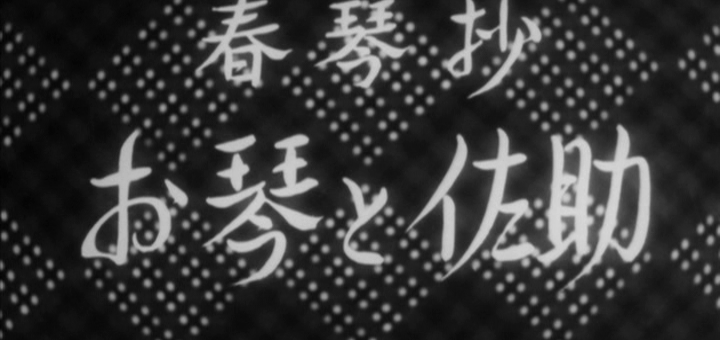
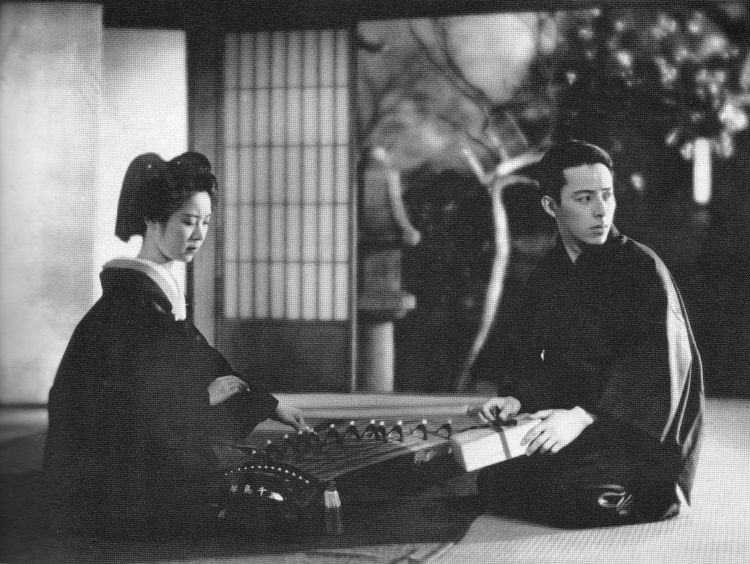
Okoto and Sasuke (春琴抄 お琴と佐助, Yasujiro Shimazu, 1935)

Okoto to SasukeYasujiro Shimazu had been a pioneer of the “shomin-geki” – naturalistic tales of ordinary working people in the contemporary era, but 1935’s Okoto and Sasuke (春琴抄 お琴と佐助, Shunkinsho: Okoto to Sasuke) sees him step back from the modern world in adapting a soon to be classic novella by contemporary novelist Junichiro Tanizaki. Published in 1933 under the title Shunkinsho and set in late Meiji, Okoto and Sasuke is another in the author’s long series of dark erotic dramas which aim to explore the baser elements of the human heart while engaging in a kind of cultural soul searching. The first of many adaptations, Shimazu’s scales back on Tanizaki’s taste for the perverse as well as his wry sense of humour, spinning a tender tale of love which finally finds its home only in the shared darkness of two becoming one in self imposed exile from the visible world.

Okoto (Kinuyo Tanaka) has been blind since she was nine and, though her parents appear to dote on her, has a proud and imperious manner which sees her mistreat those who only seek her friendship. Fearing that, due to her disability, Okoto will never find a suitable husband, the family have decided to let her study the koto and shamisen (traditionally strong areas for the blind) so that she might be able to support herself and have some degree of accomplishment. Sasuke (Kokichi Takada), a young servant at the pharmacy run by Okoto’s father, began escorting Okoto to her classes for no especial reason but as he is one of the few who can cope with Okoto’s moods, and is one of the few Okoto seems to tolerate, he quickly became her personal companion.

Sasuke remains completely devoted to Okoto even when she treats him cruelly. So many areas of their relationship are an inversion of the customs of the time – Okoto is the mistress, while Sasuke is the servant, she is strong while he is weak, she is cruel and he is kind. She has all the power, and he has none but seems to revel in his degradation, obeying each and every one of Okoto’s commands and rarely minding even when she strikes him. Nevertheless, despite her outward contempt for him Okoto is also dependent of Sasuke – not only for the assistance he provides, but for the gentle touch of his hands and his willingness to place himself entirely under her authority in worshipful devotion.

The relationship between the pair is one of (seemingly) chaste sadomasochism in which both reject the “normal” romantic affectations of their time. Despite the obvious class difference, Okoto’s family are secretly hoping Okoto and Sasuke will someday marry – an idea floated with intense seriousness when it is discovered that Okoto has become pregnant though she refuses to name the father of the child, denying that her lover is Sasuke and vowing that she would find it “humiliating” to be married to a mere servant.

There is something, as uncomfortable as it is, which presents Okoto’s pride as a kind of rebellion born of her blindness, a rejection of the world which has rejected her as “imperfect” and which she literally cannot see. Despite her family’s reservations Okoto does acquire a suitor, but he is only interested in her precisely because of her blindness. A playboy, Ritaro has fetishised Okoto’s “difference” and sees her almost as a trophy, captivated by her intense beauty and only spurred on by her haughtiness. A friend of Sasuke’s, by contrast, hearing the rumour of Okoto’s pregnancy, expresses horror at the idea of a “disabled” woman with a child, avowing that society would never stand for such a thing, rejecting and salivating over the salacious rumour at the same time. Okoto will pay a heavy price for her violent rejection of Ritaro’s attempt to reduce her to a mere conquest, ironically allowing him to rob her of something, but eventually leading her towards the destiny which will bind her forever to her devoted servant, Sasuke.

Okoto, having suffered facial disfigurement, comes to realise the true nature of her feelings for Sasuke but cannot bear for him to see her ruined face, and he, dutifully, resolves to keep his eyes closed as if blind. Ultimately Sasuke opts for the traditionally female act of sacrifice in deciding to shift from his own world into that of Okoto. Together they cut themselves off from the outside world, electing to live in a world made for two alone in which none else may enter. Their act is one of intense individualism taken as a pair who have become one in their mutual devotion, rejoicing in a love born of darkness. Shimazu undercuts Tanizaki’s need for discomfort to present the final union of Okoto and Sasuke as the uncomplicated realisation of a love deep and true – concluding with an intertitle rather than succumb to the inherently melodramatic resolution of Tanizaki’s eroguro love story. Nevertheless through the powerful performance of Kinuyo Tanaka as the increasingly conflicted Okoto, Shimazu manages to capture something of the “pure” love of equals who find their place in a changing world only by removing themselves from it.


Distant Thunder (遠雷, Kichitaro Negishi, 1981)

distant thunder dvd coverBy 1981 Japan’s economic recovery was more or less complete and the consumerist future had all but arrived. Based on the novel by Wahei Tatematsu, Distant Thunder (遠雷, Enrai) is the story of impending doom staved off by those clinging fast to the their ancestral traditions even whilst the modern world threatens to engulf them. Kichitaro Negishi already had a long career directing Nikkatsu’s Roman Porno, but made his mainstream debut with this quietly affecting social drama for Art Theatre Guild which relies on the strong performances of its cast to convey the subtitles of youth caught between past and future.

In the contemporary world of 1981, 23-year-old Mitsuo (Toshiyuki Nagashima) is a tomato farmer stubbornly hanging on to his family’s ancestral land which happens to be inconveniently placed in the middle of a modern housing complex. Women from the estate sometimes pop round to ogle Mitsuo under the pretext of buying super fresh tomatoes. Mitsuo is happy for them to enjoy the fruits of his labour, but refuses to accept them as “neighbours” lamenting the death of the village in which he grew up.

It transpires that Mitsuo’s father (Casey Takamine) sold off most of the farmland without consulting the rest of the family and used the proceeds to open a bar with the hostess he ran off with. Mitsuo hasn’t forgiven him for this and continues to work the tomatoes alone while his older brother is married and living a modern salaryman life in the city. At 23 it’s high time Mituso got himself a wife, but a flirtation with a barmaid, Kaede (Rie Yokoyama), who claims to be a divorced single parent proves diverting enough for the time being. Mitsuo knows being a farmer’s wife is no prize, so when his mother comes up with a possible match Mitsuo thinks it’s worth a try even if she’s probably none too pretty.

An old soul in many ways, Mitsuo wants to hang on to his family’s farm despite the constant offers he gets from salesmen at the door who want him to sell. Where once there was a village, now there are high rise apartment blocks. Mitsuo misses the world he grew up in where farmers helped each other out in difficult times and wandered in and out of each other’s houses like one big happy family. Not content with ruining his own, it’s also this wider concept of community as family that Mitsuo’s father has ruined for him in rejecting his traditional responsibilities for the irresponsible pleasures of taking up with a fancy woman and starting again as a bar owner.

Sadly, the bar hostess really does seem to love Mitsuo’s feckless father, perhaps seeing him as her last chance for happiness. Kaede, by contrast, is looking for something far less permanent. She claims to be divorced but is married to a mild-mannered man (Keizo Kanie) with a tattoo poking out of his collar who accepts her need for new conquests but would rather they not become regular arrangements. Kaede whips up more potential destruction when she comes between Mitsuo and his childhood best friend, Koji (Johnny Okura), who also likes her and has been led to believe Kaede’s relationship with Mitsuo was not altogether consensual. Meanwhile, Mitsuo’s blind date went far better than expected and it looks like he’s on course to find a wife in petrol station assistant Ayako (Eri Ishida).

Ayako, like Mitsuo, is a more old fashioned sort though she’s no prude and is of an earthier yet somehow “purer” nature than the comparatively urban Kaede. Mitsuo finds himself pulled in different directions – Ayako and the tomato farm, or the freely given pleasures of Kaede who threatens to burn everything to the ground with her mysterious, self destructive lifestyle. Mitsuo doesn’t want to be like his dad – a philanderer who runs out on his responsibilities and makes a fool of himself in the process, cosying up to local politicians and playing fast and loose with the law, but he’s late to see the danger a woman like Kaede might cause him. His friend, Koji, is not quite so perceptive and naively falls for her charms. Mitsuo knows deep down that his friend has in a sense saved him from making a ruinous life decision and helped him rediscover the happiness of his traditional, simple way of life.

Filming in 4:3, Negishi’s camera is soft and unobtrusive yet pointed, capturing the minor details of the everyday with a poetic beauty. Filled with realistic detail and anchored by strong performances, Distant Thunder is both a picture of innocents battling the inevitable death of their way of life with determination and purity, and a document of changing times in which the confusions of the modern world threaten to destroy those who cannot reconcile themselves to their fated paths.


Short clip from the ending (English subtitles)

Night Journey (야행 / 夜行, Kim Soo-yong, 1977)

Night Journey posterIncreasing economic prosperity dangles tantalising rewards for the young and ambitious, but for women trapped by outdated social codes the pleasures of success are largely off limits. Director Kim Soo-yong was well known for literary adaptations and Night Journey (야행 / 夜行, Yahaeng) is, like Mist, inspired by a Kim Seung-ok novel but Kim makes a point of shifting the focus, telling the story not just of a jaded bank clerk but also of the effects of living under an authoritarian regime which demands (superficial) conformity, insists on productivity, and slowly destroys the souls of all those caught in its perilous march forwards into the corporate future.

Lee Hyeon-ju (Yoon Jeong-hee) is a woman of a certain age, unmarried, and working as a teller in a bank in Seoul. One of two “old maids” in the office, Hyeon-ju is shocked to find out that her fellow bachelorette from the adjacent desk is about to marry Mr. Choi – the couple had kept their relationship a secret but now that the engagement is public, Miss Oh will be quitting her job the day before the wedding. Alongside the joy such news surely brings, everyone seems to be making a point of being “sensitive” around Hyeon-ju, worried she will be hurt or embarrassed to learn of another woman getting married while she remains single and alone. Hyeon-ju seems more annoyed by the attempts at sympathy than anything else, but accepts her boss’ offer of a few days vacation even if she seems aware it’s mostly to get her out of the way and avoid any potential awkwardness.

Awkwardness is not something that’s going to go away though because Hyeon-ju is leading a double life in which she is actually living with bank clerk Mr. Park (Shin Seong-il) who manages the desk behind her but doesn’t want anyone at work to know about their relationship. Hyeon-ju goes home early to make dinner, but Park plays the after work drinking game, rolling in drunk and collecting the sleeping Hyeon-ju off the couch to deposit on the bed where he climbs on top of her and sates himself before rolling over in a drunken snooze. The relationship between the pair is, effectively, that of a bored middle-aged couple only they do not have the security of a marriage certificate and live in constant uncertainty.

When Hyeon-ju returns home from her brief trip back to the town where she grew up, Park does not say that he missed her, just that things have been very “inconvenient” with her away. “Convenient” is something Hyeon-ju worries defines Park’s feelings towards her, that he regards her as a part of the furniture, as something merely to serve his own desires. A rare evening at home together finds them enjoying a boxing match on TV which later leads to an amorous moment on the floor but just as he did before, Park gives up half way through to go back to the boxing, almost forgetting Hyeon-ju is even there. The other marriage at work prompts Hyeon-ju to wonder if it isn’t time they too made things official, but Park lazily brushes the question off, claiming to find marriage and all that sort of thing very boring. Spying on her partner at work, Hyeon-ju perhaps worries he plans to dump her for a match more advantageous to his career while she remains trapped in her dead-end bank teller job with a marriage her only realistic path to a successful middle age.

Hyeon-ju craves satisfaction – some real connection with Park that makes her feel alive, needed, wanted, and seen as a distinct individual. Returning to her hometown she reverts to her teenage self – putting on her high school uniform and taking her little sister down to the beach to ride her bike just as she had done. It is however not all happy memories – Hyeon-ju was drummed out of town as a hussy, the entire community know and remember her sordid past and if she were to consider an arranged marriage back home she could not expect to marry very well. Nevertheless, a now widowed son of a wealthy family takes an interest but Hyeon-ju is disappointed to realise that despite his bad boy exterior and fancy motorbike, her suitor is a small-town boy after all with a bashful attitude to love and sex which stands in contrast to Heyon-ju’s own passionate, seemingly free nature.

Freedom, however, is something she seems to have little of. We catch her catching sight of a man being handcuffed as she stands atop a busy bridge and we assume she recognises it as a echo of her own oppression but in actuality she fetishes the act of being manacled, almost compelled to place herself in a position of relative powerlessness. Later, on the same bridge, she’s dragged off by a rough man who apparently takes her to a nearby hotel and assaults her while her attempts to resist read more like playing along. Later she goes back to the same bridge, perhaps hoping to see the man again, violent acts of passion seemingly the only ones that wake her from her restlessness.

Fed up with Park, she roams the city streets alone – something respectable women rarely do as she proves when an attempt to enjoy a solo drink arouses the interest of an entire room filled with drunk salarymen in which she is the only female. Drunk men in the street attempt to pick her up and again she seems to enjoy deflecting them, often with little more than a glare though she is mildly surprised when one of them turns out to be the recently married Choi who reveals to her that he is disappointed with married life after discovering Miss Oh was not a virgin during their honeymoon.

The separation of the sexes seems to dictate that men spend the majority of their lives in the deliberately homosocial world of work with its frequent after-hours drinking sessions, while women (excluded) are left with little to occupy their time outside of becoming wives and mothers. Hyeon-ju seems to want something more, but her nighttime catwalk affords her only the mild sensation of pleasure in attracting attention solely so she can exercise the power to reject it.

Yet her attitude to men and sex is perhaps also due to having experienced betrayal and manipulation at a young age. The reason for her expulsion from her hometown was an illicit affair with her middle-aged teacher whose deflowering of her on that same beach on which she rode her bike seems to have occurred with a degree of violence which she continues to crave in all her subsequent couplings. The teacher, with whom she seems to have shared some kind of wedding ritual, was killed in Vietnam, ruining both her reputation and her future prospects through a relationship that was certainly unethical but she alone has payed the price for. He lies in the military cemetery opposite her apartment where she makes awkward, flirtatious eye contact with the soldier on guard each time she walks past.

Hyeon-ju’s hometown ruminations and odyssey through nighttime Seoul only serve to ram home to her how impotent she has been in her dull yet ordinary city life. Seoul may seem like a bustling metropolis of burgeoning modernity but it’s still full of the same tired old ideas where men are men and women are not much of anything. She fantasises about going on a crime spree with a rough looking guy from a cafe but ends up paying for his coffee before becoming the only grownup in an arcade among a group of kids in an attempt to dissolve some of her frustration. Eventually getting what she thought it was she wanted, Hyeon-ju has come too far not realise she doesn’t want it anymore. Literally railroaded into conventionality, she makes the staggering decision to just get off the train altogether, leaving her lover only the cryptic message that the holiday is now over.


Available on DVD as part of the Korean Film Archive’s Kim Soo-yong box set. Also available to stream for free via the Korean Film Archive’s YouTube Channel.

Mist (안개, Kim Soo-yong, 1967)

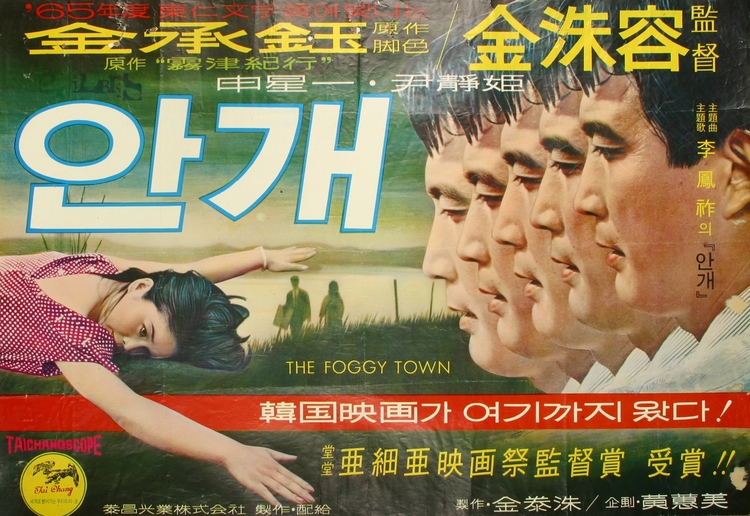
Mist 1967 posterBy 1967 Korea’s fortunes were beginning to expand. For the young, the future held promise but the nature of that promise was still indistinct. Often considered his masterpiece, 1967’s Mist (안개, Angae, AKA The Foggy Town) was another in the series of literary adaptations for which director Kim Soo-yong had become well known but its avant-garde mise-en-scène and gloomy outlook stand in stark contrast to the heartrending melodramas with which the genre was synonymous. Economic prosperity and superficial success have provoked only emptiness and despair, but a return to source provides little clarity for one harried salaryman lost in the expanding landscape of Korea’s global ambitions.

A poor boy from a remote coastal village, Gi-joon (Shin Seong-il) is now a successful salaryman in the capital where the constant clacking of typewriters, ringing of telephones, and racing of traffic rub at his tired mind. The fact of the matter is Gi-joon is not all that successful – he owes his position to having married the widowed daughter of the CEO. His wife and father-in-law, however, have relatively little faith in his business acumen and so, with the annual shareholders meeting on the horizon, they suggest he get out of the way by paying a visit to his hometown. Gi-joon is not all that happy to be going back, he hated Mujin with its unrelenting fog and general air of existential malaise, but he’s spineless and so he goes, despite himself.

Taking the train, Gi-joon has plenty of time to dwell on his past, literally seeing reflections of his younger self and entering extended flashbacks of memory. Mimicking the stream of consciousness approach of the novel, Gi-joon provides frequent voiceover, introducing his hometown in a less than favourable light as a place which traps its young who yearn to be free of its oppressive boredom. According to the irritated dialogue of two passengers on the bus (which Gi-joon has to take after his lengthy train journey), Mujin is a nothing sort of town where the sea is too shallow for fishing and the fields to narrow for farming, yet the population is large and largely survives on desperation alone, isolated by the oppressive fog that envelops the landscape each and every morning.

Gi-joon characterises the residents of Mujin as petty and materialistic. Having longed to escape, he thought he’d achieved his dreams in Seoul but a trip home forces him to reconsider what it is he’s become. In truth he’s no different from the petty and materialistic villagers he looked down on in their need to look down on each other. Powerlessness has defined his life. As a young man, he resorted to hiding in a cupboard to escape the draft on the orders of his terrified mother and later suffered from weak lungs which made him something of a local laughing stock. Now he’s set for a big promotion in the city but, as his wife reminds him, he wouldn’t even be there if it weren’t for her. Gi-joon’s marriage is one of convenience but it’s clear his wife holds all the cards – a wealthy widow with ambition needs a husband to act as a foil, and a weak willed man like Gi-joon is just the sort to submit himself to her authority in return for the obvious benefits she can offer him. Gi-joon has gained everything he ever dreamed of, but he feels only despair, oppressed by the very system he longed to be a part of.

Back in Mujin his various self delusions are rammed home to him. Trapped once again by the unrelenting fog, he longs to escape from his Seoul life and free himself from the yoke of his marriage and career. Whilst in town he meets up with old friends who introduce him to recent arrival Ha In-sook ( Yoon Jeong-hee) – an opera student turned music teacher who has joined the local school. In-sook is by far the most exciting thing in the extremely boring town, but Gi-joon is worried he’s stepped into the middle of something when he realises his old friend, Park, now a teacher, has a crush on In-sook while another old friend, Cho, now a status obsessed tax inspector, may also have marital designs.

Gi-joon didn’t need to worry about the tax inspector – as it turns out, he thinks he can do better than a mere music teacher and plans to marry up, much like Gi-joon has. Gi-joon bristles slightly at this, as he does to Cho’s lewd story about how he trapped In-sook on an overnight trip and planned to have a fling with her but she managed to get away (much to Gi-joon’s relief). Back home Gi-joon sees reflections of himself everywhere and particularly doesn’t like this alignment of himself with the ugly ambition of men like Cho who only want to lord it over their former friends. More flatteringly he sees his younger self in the depressed, conflicted In-sook who is already going half mad in the stultifying rural town and longs to go back to Seoul. Despite mild qualms about his friends’ feelings, Gi-joon finds himself bonding with the melancholy young woman who again forces him to see himself the way he really is rather than as the idealised personality he’d constructed for himself as a successful Seoul salaryman.

Bonding in their existential loneliness, the two eventually embark on a tender if melancholy affair which, despite their protestations to the contrary, is built on self delusions if not exactly on lies. Gi-joon intends to take In-sook to Seoul, but he won’t, and In-sook knows she won’t leave even if she wants to believe in the possibility of rescue. The world for them is as foggy and indistinct as the mists around the beaches of Mujin. Filled with emptiness and despair, they remain adrift in the post-war society unable to accept the soulless compromises of conventionality but finding no escape from their self imposed prisons.


Available on DVD as part of the Korean Film Archive’s Kim Soo-yong box set. Also available to stream for free via the Korean Film Archive’s YouTube Channel.

The Seashore Village (갯마을, Kim Soo-yong, 1965)

The Seashore village posterKorean cinema of the 1960s was a tightly controlled affair. The authoritarian government of Park Chung-hee had instituted the Motion Picture Law of 1962 which insisted on a studio system with stars under contract and a turnover of at least 15 films a year. The law intended to increase the amount of films produced for mass consumption, giving free reign to the melodrama and thereby accidentally undermining its more censorious aims. Nevertheless, The Seashore Village (갯마을, Gaenma-eul), adapted from a novel by Oh Yeong-su and part of the “literature film” genre for which director Kim Soo-yong would remain famous, goes much further than one would reasonably expect given the conservative nature of Korean filmmaking across the ages. A story of village life with all of its various superstitions and primitive practices, Kim’s film is a daring exploration of female sexuality and the collective power of women away from men.

An opening voice over introduces us to a melancholy fishing village where the life is hard and the people resigned to loss. The boats depart to great fanfare, but just as they are leaving someone remarks that he’s had a bad dream – bad dreams are one of many bad omens for sailors. New wife Hae-sun (Ko Eun-ah) doesn’t wait to watch her husband disappear over the horizon, she takes to the clifftop shrine of the Dragon King and prays for his safe return.

Her prayers are unanswered. A typhoon strikes and Hae-sun’s husband, along with another sailor, is killed. So young a widow, Hae-sun becomes an awkward problem for the villagers. Sang-su (Shin Young-kyun), a shady drifter, begins making subtle overtures which eventually turn into outright harassment and attempted rape. Hae-sun likes the family she married into and wants to stay true to her husband’s memory, but the forces of nature conspire against her.

While Hae-sun is a classically “good” woman who rejects the advances of Sang-su, the other village wives feel rather differently. Everyone except Hae-sun’s widowed mother-in-law (Hwang Jung-seun) knows about Sang-su’s obvious desire for Hae-sun but they see nothing wrong in it. Rather than the conservative atmosphere of the middle-class urban melodrama in which bodies of surrounding middle-aged women act as enforcers of moral discipline, these literal fishwives are of an earthier disposition. Many of them have been widowed with husbands lost at sea – the way they see it, you’d best take your pleasures where you can and there’s nothing wrong with a quick roll in the hay if it eases frustration and aids productivity. They laugh at Hae-sun’s prudery and marvel at her ability to carry on as normal after losing her husband not because of the grief, but because of the lack of intimacy.

It might be 1965 outside of the village, but the old ways still rule here even if they’re on their way out. In the old days, women did not remarry – a serious problem in a small village with few men around to replace those lost at sea. Hence, women have learned to live alone, supporting each other in place of men and often forced to do without them. In a surprising development, Kim flirts with the taboo of lesbianism – something which is addressed half-jokingly by the gossipy widows but eventually gives way to a literal roll in the hay with half the village women looking on in hilarity rather than horror. The women joke about living together but lesbianism does seem to be presented as an imperfect solution to their present problem in the lack of satisfaction available to them due to the absence of men. Far from a taboo, sexual desire is a normal part of life in the village – something ranked alongside eating and sleeping and no more or less embarrassing than any other bodily function. The widows crave men and are unafraid to say so even if some of them are content to make do with each other in resignation to their awkward status as older single women.

Hae-sun is in a slightly better position given that remarriage is apparently no longer so much of a taboo. Unfortunately that presents a problem for her as all she wants to do is stay with her family just as she is. She doesn’t like Sang-su and his increasingly aggressive behaviour towards her is unlikely to change that but nevertheless she eventually finds herself given to him almost against her will. Despite becoming a wife once again, Hae-sun’s beauty continues to curse her by causing problems between men wherever she sets foot. The problems, however, are definitively on the male side – men long to possess her, with violence if necessary, and ruin themselves in their immoral pursuit of a “pure” woman. The village widows rejoice in their earthy pleasures, finding comfort and release in each other but the male impulse, by contrast, is always towards conquest and control, domination rather than mutual support.

Life in the village is hard and often sad, but the women are happy and optimistic. They live the lives that are given to them, and do the best they can with what they have. The very antithesis of the lurch towards modernity, the simple life of the villagers harks back to something purer and more honest without the pretension of urban civility and apparently free from the political concerns of the day. Bold in its outlook, The Seashore Village is a surprisingly progressive effort from the Korea of 1965, subverting its “primitive” setting to present a positive picture of female power and sexuality.


Available on DVD as part of the Korean Film Archive’s Kim Soo-yong box set. Also available to stream for free via the Korean Film Archive’s YouTube Channel.

Initiation Love (イニシエーション・ラブ, Yukihiko Tsutsumi, 2015)

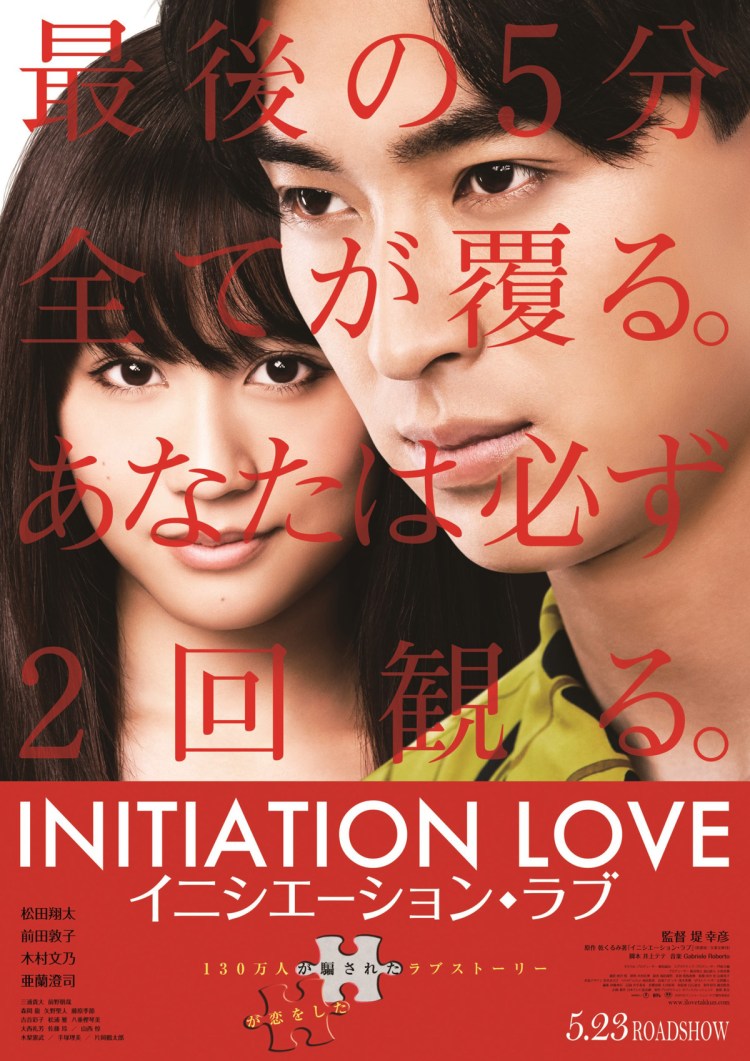
initiation loveMost romantic comedies don’t come with warnings about twist endings and a plea not to give them way, but Initiation Love (イニシエーション・ラブ) is not your average romantic comedy. Set in the early bubble era, Yukihiko Tsutsumi’s double sided feature is itself a wry look at the problematic nature of nostalgia. Harking back to a perhaps more innocent era in which lack of political and economic turmoil left plenty of time for romantic confusion coupled with the corruption of the consumerist dream, Initiation Love pits innocent romance against cynical success but subtly suggests that grown up love is a kind of compromise in itself.

Side A: In the summer of 1987, Yuki Suzuki (Kanro Morita) – a geeky, overweight young man who is shy but has a kind heart, is unexpectedly invited to a college drinking party where he earns some major white knight points for interrupting the increasingly inappropriate grilling of new invitee Mayuko (Atsuko Maeda). Mayuko is pretty, sweet, and cute if in a slightly affected way. She is way out of Suzuki’s league, but later confesses that she’s looking for someone a bit different, like Suzuki, an awkward-type who won’t lie to her or play around. Bonding over a shared love of reading, the pair grow closer, Mayuko rechristens Suzuki “Takkun”, and he vows to spruce himself up to become “worthy” of her.

Side B: Takkun (Shota Matsuda), now slim and handsome, is given a surprise promotion to Tokyo. Rather than suggest marriage or that Mayuko come with him, he settles on long distance and promises to come back to Shizuoka at weekends while waiting to be approved for a transfer back home. In Tokyo, however, Takkun’s personality begins to shift. Seduced by city sophistication and the promises of an elite salaryman lifestyle, Takkun draws closer to upper-class career woman Miyako (Fumino Kimura) whose jaded straightforward confidence he regards as “grown up” in contrast to the innocent charms of Mayuko waiting patiently at home.

The overarching narrative is provided to us via a melancholy voice over and accompanied, in the manner of a classic mix-tape, by a song from the era which is deliberately on the nose in terms of its aptness – a song about giving up on summer just as the couple are stuck in a traffic jam on the way to the beach and about to have a gigantic row, or a song about lucky chances coming up on TV just as our hero is plucking up the courage to allow himself to be bamboozled into going on a date with the girl of his dreams. The carefully placed positioning of the songs reminds us that we are inside someone’s carefully curated memories. Just as Takkun’s vision of Mayu-chan is one surrounded by flowers and light, the early days of romance are a condensed and romanticised version of real events seen entirely from one perspective and coloured with the gradual fading of time. Nostalgia is an unreliable narrator, recasting real life as Hollywood fiction.

The warm and fuzzy glow of Side A is undercut by the subtly questionable actions of Mayuko and our own prejudices about why she might be with a guy like Takkun. Self-consciously cute, Mayuko makes needling suggestions – dress better, get contacts, learn to drive, which, objectively speaking, might all help Takkun to gain some much needed confidence if only he were not doing all of them solely because he fears losing a woman like Mayuko. If Mayuko wanted a guy she could remake and boss around, she might have come to the right place but she does, at least, also try to insist that she likes Takkun anyway and so any changes he makes to himself will make no difference to her.

Side B, by contrast, turns the dynamic on its head as Takkun’s Tokyo persona becomes increasingly violent, resentful, and cruel while Mayuko seems genuine, innocent, and hurt by the increasing distance between herself and the man she loves. Seduced by city sophistications, Takkun leans ever closer to dumping the innocent country bumpkin, a love he has now outgrown, for a leg up into the middle-classes by marrying the elegant daughter of a wealthy Tokyo businessman. He is, however, torn – between the nostalgic glow of first love’s innocence, and the realities of adult life, the certain past and the uncertain future.

This is the philosophy ascribed by Miyako (apparently given to her by her own first love) that the first failed romance is a crucial part of growing up, an “Initiation Love” that breaks your heart by revealing the idea of true love as a romantic fallacy, allowing you move into the adult world with a degree of emotional clarity. A sound idea, but also sad and cruel in its own way. The final twist, offered as a cynical punchline, can’t help but feel cheap, carrying mildly misogynistic undertones dressed up as a kind of joke aimed at cowardly men who are incapable making clear choices and refuse to see their romantic partners as real people rather than the self created images of them they maintain. Takkun remains torn, between past and future, town and country, old love and new but nostalgia is always a trap – a false impression of a true emotion that impedes forward motion with a promise of a return to something which can never be delivered.


Screened as part of the Japan Foundation Touring Film Programme 2018.

Screening again:

  • QUAD – 10 February 2018
  • Brewery Arts Centre – 2 March 2018
  • Filmhouse – 9 March 2018

Playlist: Side A

Yureru Manazashi (Kei Ogura)

Kimi wa 1000% (1986 Omega Tribe)

https://www.youtube.com/watch?v=MeEEOrOFYuw

Yes-No (Of Course)

Lucky Chance wo Mo Ichido (C-C-B)

https://www.youtube.com/watch?v=zUzkzxGR9sw

Ai no Memory (Shigeru Matsuzaki)

https://www.youtube.com/watch?v=OHX1d6sObf4

Kimi Dake ni (Shonentai)

https://www.youtube.com/watch?v=KlLcKJL6jeE

Side B:

Momen no Handkerchief (Hiromi Ota)

https://www.youtube.com/watch?v=ylF3dNFrAio

Dance (Shogo Hamada)

https://www.youtube.com/watch?v=LX6Kx-NWy0o

Natsu wo Akiramete (Naoko Ken)

Kokoro no Iro (Masatoshi Nakamura)

https://www.youtube.com/watch?v=JXqwzYXMDLc

Ruby no Yubiwa (Akira Teruo)

https://www.youtube.com/watch?v=HgLaQKp8EaA

Show Me (Yukari Morikawa)

https://www.youtube.com/watch?v=7DzpcRHsIWg