
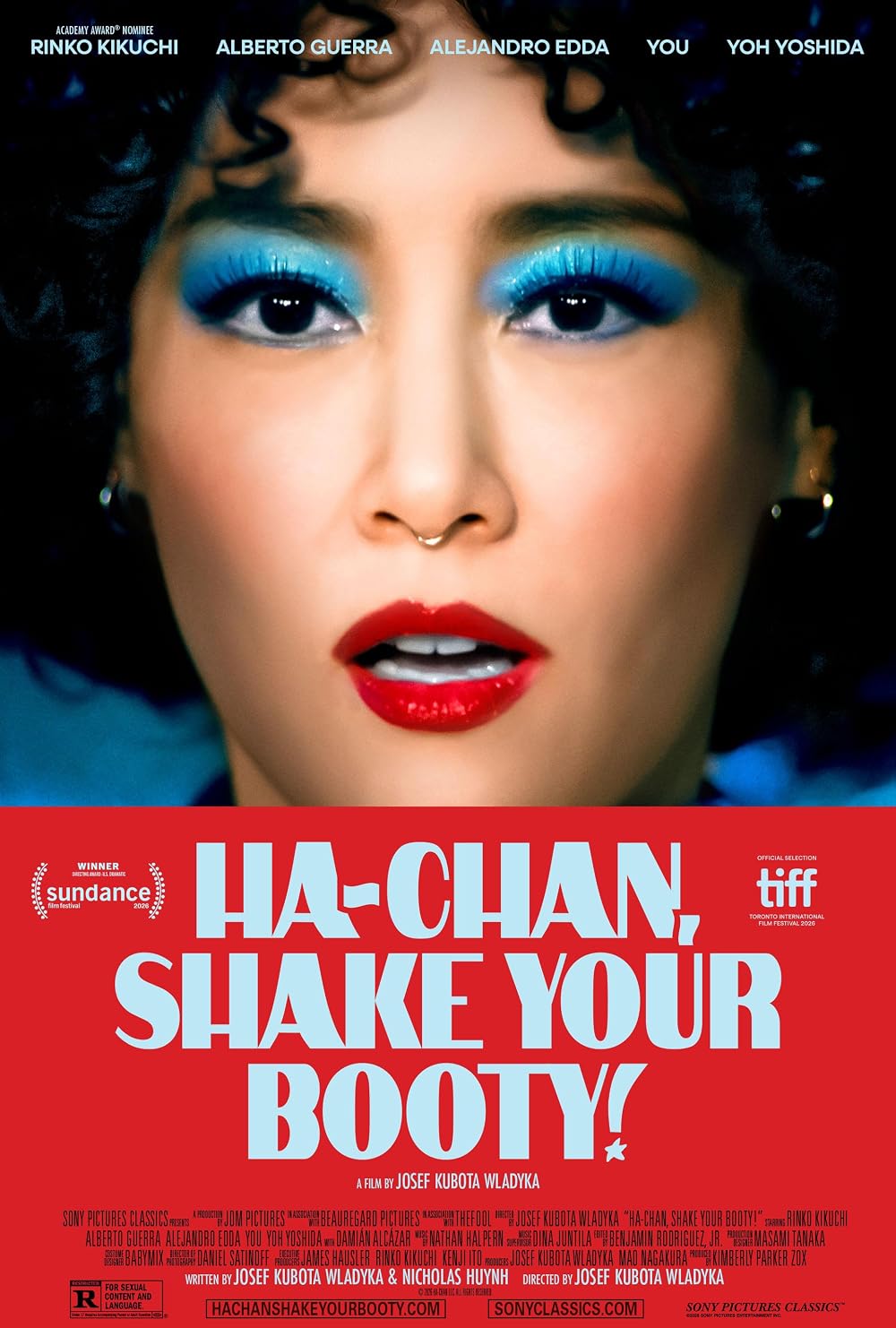
Sooner or later, the dance must end. Like Taichi Kimura’s Fujiko, Josef Kubota Wladyka’s Ha-chan, Shake Your Booty! is a story inspired by and dedicated to the director’s mother featuring a bold visual style that harks back to the 1970s. A character study in grief, it is also an exploration of the dance between languages, the connection between motion and emotion, and the slow waltz we do with grief as a means of letting go.
Part of the reason that Haru (Rinko Kikuchi) cannot move forward, however, is that she is prevented from performing the culturally specific death ritual that would help her to so because it directly conflicts with the prevailing mores of her husband’s Mexican background. There are cultural and perhaps religious reasons that the family cannot accept the idea of his being cremated, but equally there is some territorial push and pull over who the remains ultimately belong to with Luis’ father in particular keen to bring the body “home” to Mexico. Haru, meanwhile, understandably feels that Luis’ home was with her in Japan and she better than anyone knew what his wishes were in the event of his death. In requesting his body, it’s as if his father is denying that she and Luis (Alejandro Edda) were a family or the choice that he had made in coming to Japan. Even so, in this way she must in the end let him go even if that means his spirit cannot really rest in peace and is haunting her in both a spiritual and literal sense.
Really what Haru comes to give Luis at the end is a kind of cremation that signals her decision to set them both free by accepting his death. Before that, however, she must try to find some kind of accommodation with it but largely becomes isolated and mired within her grief. The couple had been keen ballroom dancers, but Haru is unable to dance alone. Ironically, she song she dances to in the opening sequence, Watashi to Watashi by the Peanuts, expresses the idea of there being two people within one person (the Peanuts were a pair of twin sisters) as if Haru were already dating for/with an absent lover. After Luis’ death, she is visited by his ghost inside a cute crow mascot suit that symbolises that grief and sadness that hangs over her life and equally her own inability to let it go.
Her sister and cousin try to get her resume dancing a means of getting her life moving again, but doing so brings her into the presence of Latin dancer Fedir (Alberto Guerra)who on some level reminds her of Luis while her attraction to him simultaneously pulls her away from her late husband. The interplay between the two in her mind is neatly signalled in a fantasy sequence that seems to be an homage to Y tu mamá también, though the situation is as Haru puts it “messy”. Fedir is in an open marriage which is a concept that Haru struggles to understand. She pretends that Luis is still alive and their marriage is “open” too to facilitate a relationship, but at the same time becomes over emotionally invested in Fedir and jealous of his wife despite knowing intellectually that the relationship has no future and that Fedir is not Luis returned.
The situation is primed for an implosion, but as erratic as her behaviour becomes, it does eventually provide Haru with a path out of her grief and the realisation that she will have to let Luis go. Her sister and cousin perhaps preset two opposing poles, Yuki (Yo Yoshida) having been in a stable and conventional marriage for over 20 years with a grown up daughter, while Hiromi (You) has been living abroad in New in York and is enthusiastically playing the field following her divorce. Haru doesn’t necessarily have to choose either in her widowhood, and even in the film’s otherwise joyful conclusion is seen sitting alone in a train carriage with a large, empty space beside her. She has however rediscovered the joy dance, once again dancing alone but finding that others soon join in as she embraces her inner boogie-woogie. Broken with multilingual title cards and playing with interplay between various languages, the film has a playful quality that elides the heaviness of its subject but nevertheless lends true poignancy to its heroine’s gentle waltz with death as she prepares herself to let go of its hand.
Ha-Chan, Shake Your Booty! screens 10th/11th October as part of this year’s BFI London Film Festival.
Trailer (English subtitles)

