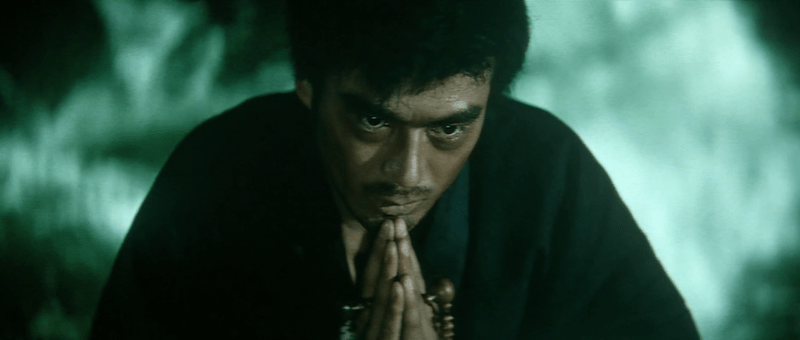
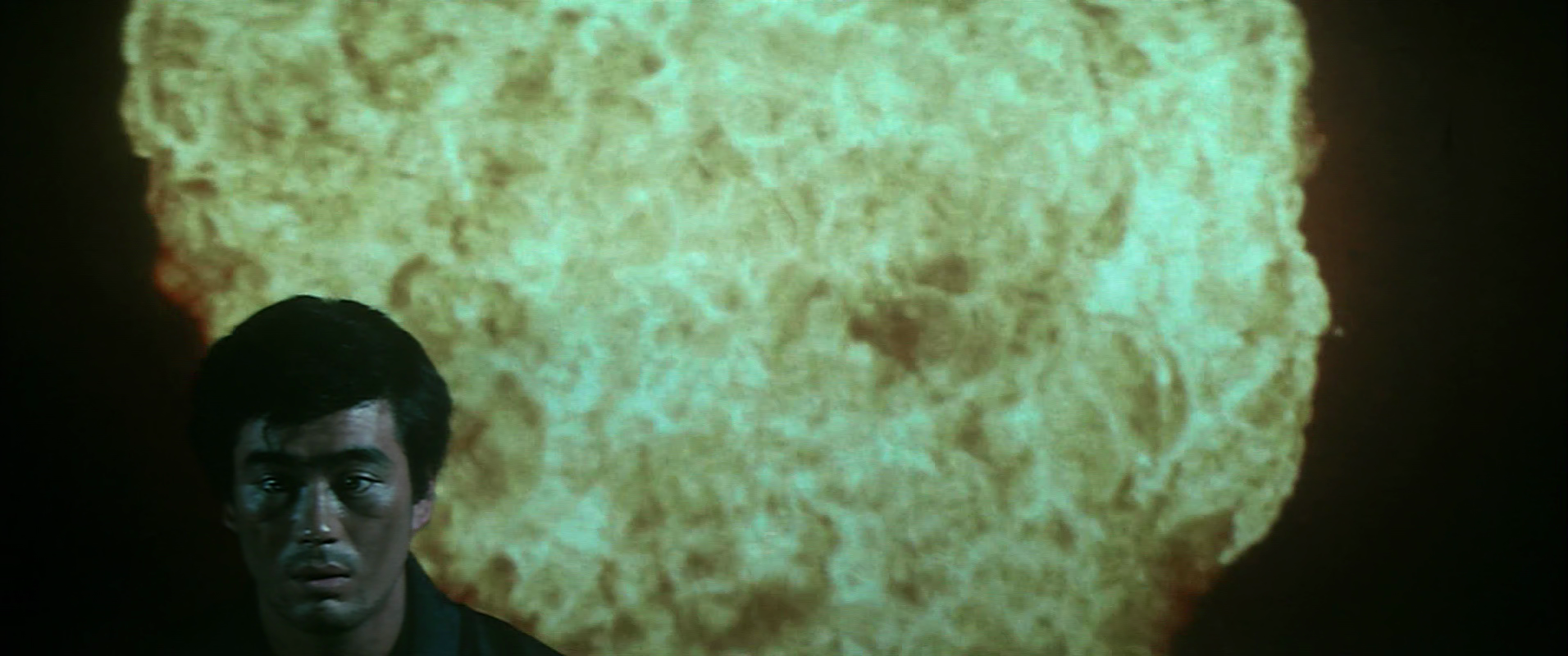
Memoir of Japanese Assassinations (日本暗殺秘録, Sadao Nakajima, 1969)

According to the narrator of Sadao Nakajima’s artistically daring Memoir of Japanese Assassins (日本暗殺秘録, Nihon ansatsu hiroku) the practice of assassination had got so out of hand in the early years of Meiji that the emperor was forced to institute a law banning it while accepting responsibility for the lawlessness his imperfect governance had produced. But by opening with the Sakurada Gate Indecent from 1860, the film seems to be asking what went wrong in Meiji and why the assassinations have still not stopped with the implication that more may be on their way in rather febrile political atmosphere of the late 1960s in the run up to the renewal of the Anpo security treaty with Asama Sanso still a few years away.

The answer to the question that it presents, is that oppression has still not ended in Japan and that most of these assassinations took place because people had enough of difficult social conditions those in power little did to address. However, the first few pre-20th century  assassinations which are presented in the form of short vignettes, are largely a product of the confusion of the bakumatsu era as reactionaries attempt to halt Japan’s increasing openness to the wider world and what they see as a loss of national identity and sovereignty. The implication is that this sense of ideological conflict is a direct cause of the nationalism that defined the first half of the 20th century. 

It’s not until we reach the early 1920s that the secondary cause of Japan’s dire economic situation rears its head as the right-wing nationalist leader of Righteousness Corps of the Divine Land (Bunta Sugawara), a society dedicated to workers’ rights, assassinates the head of a family-run conglomerate he accuses of feeding on the blood on the common man. From this incident we can see that it is not as easy to draw a line between left and right in terms of political ideology as it might be at other times or in other nations as otherwise nationalist forces share ideas that might lean more towards socialist ideals. Ikki Kita whose philosophy informed the February 26th Incident that ends the film described himself as socialist, but is also regarded by some as the architect of Japanese fascism. With the so-called “Showa Restoration”, he advocated for the elimination of private property and a doctrine of socialism from above in which the emperor would assist in the reorganisation of society. Which is to say, the clarification of the Meiji Restoration actually meant.

In any case, it’s easy to see the reasons that these ideas caught hold and that concepts such as “revolution” were a counter to the persistent hopelessness of the depression and the extreme poverty of Japanese society while the large conglomerates prospered through trading with the United States. The bulk of the film focuses on Onuma who assassinated Junnosuke Inoue in 1932 as part of an intended reign of terror known as the League of Blood instituted by the far right Nichizen Buddhism cult led by Nissho Inoue (Chiezo Kataoka),. Onuma was still alive at the time the film was made and apparently acted as a consultant. Played by a fresh-faced Shinichi Chiba, he’s depicted as an earnest young man who is driven into the ground by the increasingly capitalist mentality of the 1920s, a time of high unemployment and frequent labour disputes only exacerbated by the Great Depression. 

Though he had been a bright and attentive student, Onuma was forced to leave education because of his father’s early death and thereafter worked a series of causal jobs before leaving a position at a kimono dyers because of their callous treatment of another employee who was forced to embezzle money because his mother was ill and he was denied a loan by the boss who justifies his position by stating that he’s already given the man several advances on his salary. Onuma’s brother also resigned from his job to take responsibility for failing to spot someone else’s embezzlement, leading Onuma to conclude that being honest gets you nowhere in this morally corrupt society. This is rammed home for him at his next job at a cake baker’s where he becomes almost part of the family and draws closer to the maid, Takako (Junko Fuji). The boss intends to rapidly expand the business by building a bigger factory hoping to capitalise on the coronation of the new emperor. Staking everything on the factory, he takes out loans from loan sharks but fails to get a business permit from the police later remarking that he was naive thinking he could do business honestly not realising that the police expected a bribe.

Tuberculosis and the death of a girl who like him could not afford medical treatment further leave Onuma feeling resentful and hopeless leading to a suicide attempt after which he is born again in Nichiren Buddhism and becomes a servant to Nissho. It’s easy to see how Nichiren could offer an escape to young men like him who burn with rage and a desire to change society, though in essence it’s no different from the militarism that was growing in parallel being rooted in nationalist ideology and for the early part at least centred in the military. The May 15 Incident saw the military and members of the League of Blood assassinate the prime minister to enact the Showa Restoration and reorganise society. The revolution failed, but the 11 young officers who took part in received little punishment, furthering cause of the militarism, while directly contributing to the February 26th Incident which though it also achieved little further cemented the power of the military over the government. 

Though imperialism is subtly presented as another form of injustice as the nation spends money on warmongering while the people starve, the film straddles an awkward line in struggling to avoid glorifying the actions of the far right in painting Onuma and leader of the February 26th Incident Isobe (Koji Tsuruta) as dashing, idealistic heroes whose only wish was to save Japan and remake it in a way they believed to be better. This was pretty much the antithesis of what Nakajima intended, though it was picked up by some as a piece of right-wing propaganda. The film courted controversy both with Toei studio bosses and the government who ordered Nakajima to soften the excerpts from Isobe’s diary fearing they were too incendiary, though Nakajima had already shot the footage and was forced to find a compromise. Toei as a studio did rather lean towards the conservative and especially in its yakuza films which is perhaps unavoidable given that yakuza organisation did often have strongly nationalistic sensibilities. Accordingly, the film stars almost their entire roster of Toei’s yakuza and ninkyo eiga stars from Tomisaburo Wakayama to Ken Takakura and Koji Tsuruta along with Junko Fuji as as Onuma’s love interest who is eventually forced into sex work because of the economic conditions of the 1920s, and perhaps comes with some of that baggage. Its closing question, however, given the fact that all these assignations achieved almost nothing of what they were intended to, seems to be posited at the current society mired in the Anpo protests and the declining student movement to ask how else society might be changed and revolution enacted to create a fairer society for all through an ideology that could end this cycle of political violence.
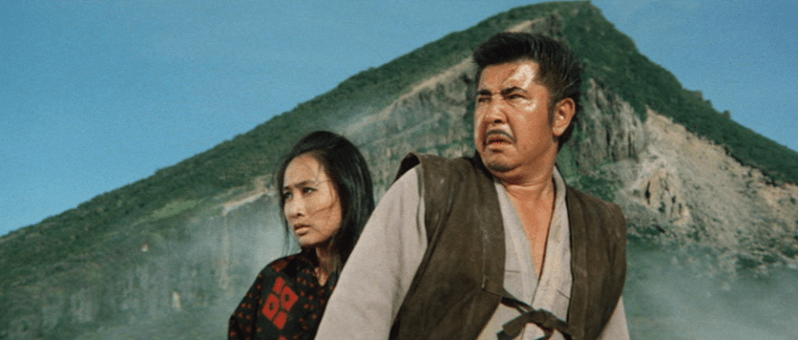
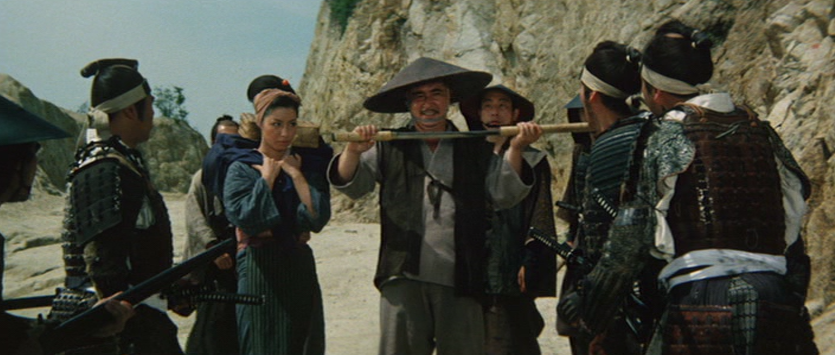
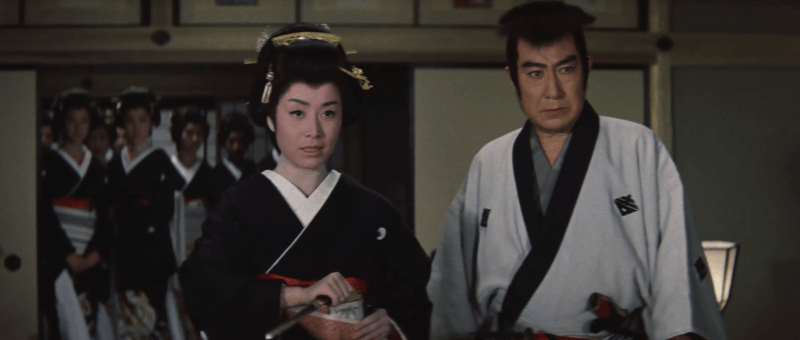
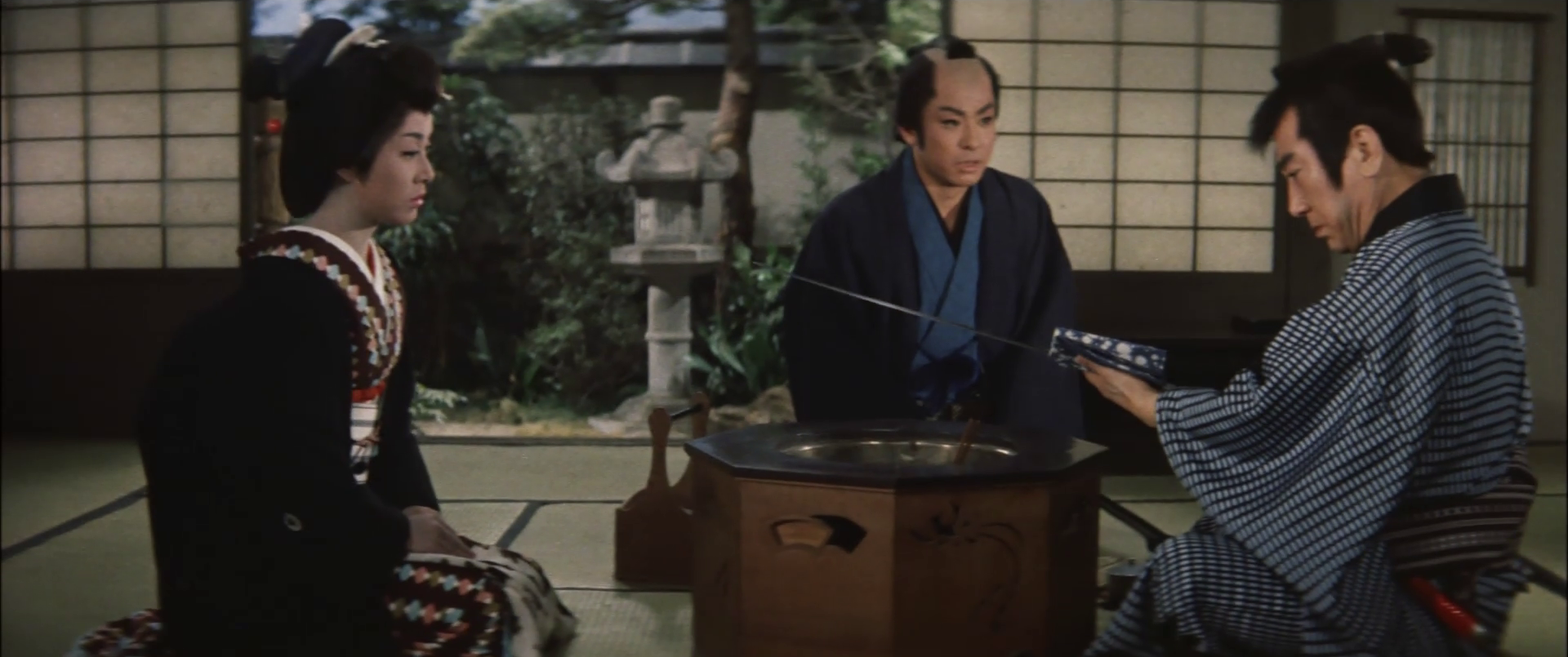
Killer’s Mission (賞金稼ぎ, Shigehiro Ozawa, 1969)

According to the title card at the beginning of Shigehiro Ozawa’s Killer’s Mission (賞金稼ぎ, Shokin Kasegi), none of the events it depicts have been recorded in history because the shogunate decided to erase them all in fear of the effect they may have on the nation’s geopolitical stability. Nevertheless, it gives some very concrete dates for its historical action, even if they may not make complete sense while foreshadowing the political turbulence of the following century. 

What it essentially attempts to do is tell a James Bond-style tale of political intrigue in a feudal Japan in which perpetual peace has begun to create its own problems. Here played in a cameo appearance from Koji Tsuruta, the Shogun Ieshige was weak in part because he was in poor health and had a speech impediment which led him to be rejected by his retainers. The problem here, however, is with Satsuma which has been on bad terms with the Tokugawa shogunate since the Battle of Sekigahara after which they took power. Satsuma will in fact be at the centre of the conspiracy to overthrow the government in the following century, but for the purposes of the film have fallen foul of a rumour that the plan to do an arms deal with some Dutch sailors who sailed South to Kyushu after being rebuffed in Edo. 

A civil war is feared and in the interests of maintaining peace, Ieshige sends his trusted spy Ichibei (Tomisaburo Wakayama) to protect Satsuma official Ijuin Ukiyo (Chiezo Kataoka) in the hope that he will be able to talk his young and naive lord out of doing the deal. Ostensibly a doctor by trade, Ichibei has a series of spy gadgets such as hidden blades and collapsible guns stored in a secret room at his surgery which he then carries in a black leather utility belt. He keeps the nature of his mission close to his chest, but often double bluffs by simply telling people he is a shogunate spy or otherwise adopting a disguise as he does in a moment of meta comedy impersonating the signature role of his brother Shintaro Katsu by posing as a Zatoichi-style blind masseur. 

As if to signal the cruelty of the feudal world, Ichibei comes across the corpses of suspected spies abandoned outside Satsuma territory while his enemies meditate on their ancient slight and consider taking the deal in the hope of avenging their defeat and overthrowing the Tokugawa. They are warned that creating unrest and sowing division may be exactly what foreign powers like the Dutch crave, but aren’t particularly bothered, preferring to take their chances with them rather than curry favour with the Shogun and possibly destabilising the entire society along with it. 

Of course, much of this is anachronistic with the Dutch sailors appearing in a distinctly 19th century fashion carrying weapons which are also too advanced for the era as are Ichibei’s folding pistols. Through his travels, he runs into a female Iga spy who too can do some nifty ninja tricks and has a gadget of her own in a comb which can shoot poison darts, though luckily it’s one of the poisons Ichibei has already developed an immunity to. Ichibei is fond of crying that you kill him he’ll simply come back to life, barrelling through the air with feats of improbable human agility and generally behaving like some kind of supernatural entity with a secondary talent for violent seduction. 

Though ironic and often darkly comic, there is an unavoidable poignancy in the inner conflict of Ijuin who knows his clan is about to do something very foolish but is torn between his duty to obey them and that to act in their best interests, eventually backed into a corner and left with no real way out of his predicament. As Ichibei points out, it’s difficult to keep the peace, especially when restless young samurai spot opportunities to cause chaos and the outside world knocks on the door of a closed community. Even so, Ozawa ends on a romantic image of a beach at sunset somehow undercutting the violence and tragedy with the restoration of an order that might itself be imperfect in its peacefulness.


Tengu Priest (お坊主天狗, Yasushi Sasaki, 1962)

Disparate denizens of Edo are united in one thing in Yasushi Sasaki’s light hearted jidaigeki, Tengu Priest (お坊主天狗, Obozu tengu), revenge. Like many jidaigeki, what they really want is revenge against the evils of feudalism to which they have each fallen victim, but also acknowledge that they have found something better in being outside it in the solidarity that exists between them as outsiders free from the obligations of samurai society if also with loose ends waiting to be tied.

Once a hatamoto with a 1000 Koku stipend, Obo Kichiza (Chiezo Kataoka) is now a much feared figure keeping order in Edo. When some yakuza toughs are hassling the geisha Kozome (Hibari Misora) at the theatre, insisting that she serve them sake even as she reminds them she’s off the clock, one look from him stops them dead though Kichizo is also impressed with Kozome’s nerve. Like him, Kozome is also in Edo for revenge. Formerly a samurai’s daughter, she became a geisha to look for the man who killed her father in a stupid quarrel over a fencing duel. Kichiza, meanwhile, seeks revenge against the local lord, Honda Etsu (Masao Mishima), who killed his father in a fit of temper when he ordered him to commit seppuku for causing his son-in-law to fall off his horse but he refused. 

Loyal retainer Kinpei (Ryutaro Otomo) had begged for his forgiveness and insisted that he could get Etsu to reform but three years have passed and not only has he bribed his way to head office but his behaviour has declined still further. We see him cruelly cut down a maid seemingly for no reason, simply ordering his men to get rid of the body. Etsu has a reputation for random violence while drunk, but as he is the lord, there are no real consequences for him. His retainers cover up his crimes, and Kinpei’s sole attempt to talk some sense into him goes nowhere, meanwhile his chief adviser Shichinosuke (Sentaro Fushimi) is basically running the show telling others the lord is not in his right mind and cannot make decisions so he must make them for him.

They are all, including Etsu himself, victims of the feudal order in which the systems of power are necessarily corrupt. In his yakuza persona, Kichiza has struck up a friendship with another geisha, Kozuru (Naoko Kubo), who was actually a lady in waiting working as a maid at his estate. She has long been in love with him, but the class difference would have made any union impossible. Ironically, she remarks to Kozome that even in their present state they are still a Hatamoto and a lady in waiting so she dare not express her love for him. Only once his revenge is concluded and he’s fully abandoned his samurai status can Kichiza truly be free to embrace a relationship with Kozuru while conversely Kozome regains her life as a samurai’s daughter by avenging the death of her father.

Kozome asks for Kichiza’s help to track down the target of her revenge, but he also respects her wishes and understands that it’s something she must do herself as does eccentric sword sharpener Shinzaburo (Hashizo Okawa ) who actively stands back so she, another wronged woman, can stick the knife in. Hibari Misora’s role in the film is smaller than one might expect as her revenge subplot is secondary to Kichiza’s and she has relatively little screen time with only a brief musical sequence during a naginata dance though she does participate in the high octane final showdown in which all grievances are exorcised and a kind of order returned to the samurai realm even if it must be destroyed to so as Kinpei resolves to protect both the lives and livelihoods of their many retainers and the integrity of Kichiza, going so far as to congratulate Kozome on the successful completion of her revenge. 

Yet what made the whole thing possible was Kichiza’s own band of outlaw drifters whom he allowed to live in his home he later says just so that they would have a place to come and be together so that they might more easily reintegrate into mainstream society. He might have lost his domain and samurai status but has discovered something better in this accidental community. They may be in a sense almost like retainers to him, but if so they stay by choice rather than obligation and help out of a genuine sense of loyalty and affection. In essence, in taking his revenge, he frees himself from the oppressive nature of the samurai code and is able to live like an ordinary man lamenting that if only he and Kinpei had both been ronin they could have enjoyed their time together for longer. Lighthearted and cheerful despite its dark themes, the film is nevertheless a condemnation of the hypocrisies and abuses of a feudal society in which freedom is to be found only among those who live outside it.


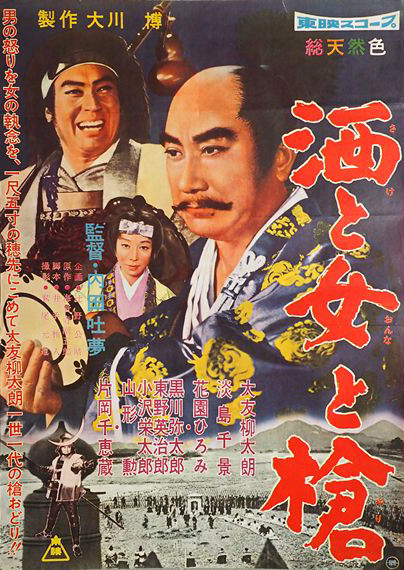
The Master Spearman (酒と女と槍, Tomu Uchida, 1960)

After the war during the American occupation, the samurai film encountered a de facto ban with the authorities worried that historical epics may encourage outdated fuedal and fascistic ideology. The period films of the post-war era, however, are often fiercely critical of the samurai order even as it stands in for the hypocrisies of the contemporary society. Two years before Masaki Kobayashi launched a similar assault on the notion of samurai honour in Harakiri, Tomu Uchida’s The Master Spearman (酒と女と槍, Sake to Onna to Yari) finds a loyal retainer similarly troubled when he is ordered to die only to be ordered not to and then finally told that yes he must commit suicide to serve a kind of honour in which he no longer believes. 

Takasada (Ryutaro Otomo) is a battlefield veteran with the Tomita clan much revered for his skill with the spear. As a retainer to the current regent, Hidetsugu (Yataro Kurokawa), he finds himself in trouble when the ageing Hideyoshi (Eijiro Tono) stages a coup to solidify his power, accusing his nephew of treason on abruptly “discovering” a stash of illegally obtained rifles. Takasada is outraged not to have been ordered to die with his master, but later resents being “strongly encouraged” to do so by his brother, the head of their clan. Storming out, he temporarily retreats into a drunken haze during which he convinces his favourite actress, Umeme (Hiromi Hanazono), to stay with him (just serving drinks, no funny business), before committing himself to public seppuku on a date of his own choosing. When the day arrives, Takasada is greeted by parades of “well wishers” keen to congratulate him for being such a fine samurai. Encouraging those in line to step out of it and stand horizontally without account of rank or status, he agrees to drink with them all, with the consequence that he becomes extremely drunk and passes out. 

Just as he’s about to cut his belly, a messenger arrives from Hideyoshi himself ruling Takasada’s suicide illegal. He if goes ahead and does it anyway, his clan will be disgraced. Takasada’s brother changes his tune and begs him not to proceed for the sake of the Tomita honour. Thoroughly fed up, Takasada has a sudden epiphany about the hypocrisies of the samurai code and decides to renounce his status, dropping out of court life to live simply in the country where he is eventually joined by Umeme who has fallen in love with him. 

Meanwhile, court intrigue intensifies. These are the quiet years leading up to the decisive battle of Sekigahara which in itself decided the course of Japanese history. While the elderly Hideyoshi attempts to hold on to power by ruling as a regent on behalf of his sickly son Hideyori, Tokugawa Ieyasu (Eitaro Ozawa) plots on the sidelines. Hideyoshi is advised by his steward Mitsunari (Isao Yamagata) to take a hard line with treachery, executing all 36 “spies” planted in his household by Ieyasu, including a number of women and children. Mitsunari is himself working with the other side, and the executions are nothing short of a PR disaster for Hideyoshi, provoking fear and resentment in the general populace who can’t accept the inherent cruelty of putting women and children to the sword. Sakon (Chikage Awashima), a kabuki actress and fiercely protective friend of Umeme, comes to a similar conclusion to Takasada, hating the samurai order for its merciless savagery. 

That’s perhaps why she’s originally wary of Takasada’s interest in Umeme, uncertain he will keep his promise to keep his hands off her and so staying over one night herself to make sure Umeme is safe. Umeme, meanwhile, may not have wanted him to be quite so honourable, leaving in the morning visibly irritated and exclaiming that Takasada is drunk on himself and understands nothing of women. That may be quite true, but it’s his sense of honour which eventually tells him that he must reject the samurai ideal. First they tell him honour dictates he must die, then that he must not, then when Hideyoshi dies and the prohibition is lifted, that he must die after all because his entire clan is embarrassed by his continuing existence. By this point, Takasada has decided to accept his “cowardice”. Sickened by the spectacle of his ritual suicide and the humiliation of its cancelation, he came to the conclusion that “loyalty and honour for world fame, glorious exploits etc” is all a big joke. He loves food, and wine, and his wife, and if that means others call him coward so be it because he’s finally happy and perhaps free. 

His spear, however still hangs over his hearth. He hasn’t truly let go of it or of the code with which he was raised. Sakon, perhaps on one level jealous and guarding her own feelings as she accepts that Umeme has chosen to leave the stage to retreat into an individual world with Takasada, warns her that her happiness will end if Takasada is convinced to accept a commission from the Tokugawa. He surprises her by once again renouncing his status as a samurai, choosing to stay a “coward” living a simple life of love and happiness. But as soon as he puts his hand on the spear intending to break it for good something in him is reawakened. He can’t do it. He finds himself at Sekigahara, confronted not only by samurai hypocrisy but by his own as Sakon does what he could not do to show him what he has betrayed. His rage explodes and he raises his spear once again but not for the Tokugawa, against the samurai order itself piercing the very banners which define it in an ironic assault on an empty ideology.  


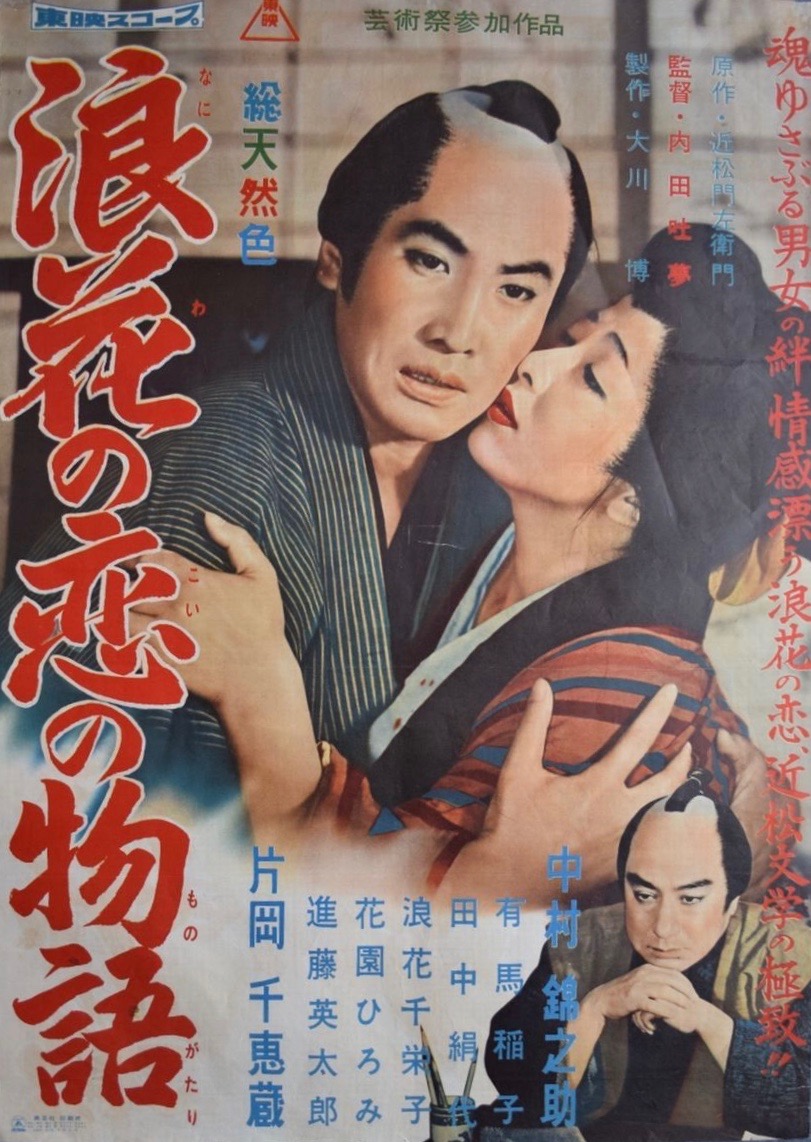
Chikamatsu’s Love in Osaka (浪花の恋の物語, Tomu Uchida, 1959)

Chikamatsu's love in Osaka poster“Money is the enemy” a dejected geisha declares in an attempt to explain her desperate circumstances to a naive young man part way  through Tomu Uchida’s Chikamatsu’s Love in Osaka (浪花の恋の物語, Naniwa no Koi no Monogatari). Before a wartime flirtation with the militarist far right, Uchida had been closely involved with the leftwing “tendency film” movement and his post-war work perhaps displays much the same spirit only with a world weary resignation to the inherent unfairness of human society. Chikamatsu, as cited in the slightly awkward English language title, was a Japanese playwright of the 17th/18th century who also specialised in tales of social oppression, most notably in frustrated romance and eventual double suicides.

Uchida’s masterstroke is that he retells Chikamatsu’s well known bunraku play The Courier for Hell and its kabuki counterpart Couriers of Love Fleeing to Yamato from the inside out. Among Chikamatsu’s most famous works the play was in fact inspired by a real life event which took place in Osaka (then known as “Naniwa”) in 1710. Uchida places the grumpy, worldweary figure of the playwright directly into the action as a powerless observer, trapped on the wrong side of the stage able only to observe and comment but, crucially, with the ability to remake reality in altering his tale in the telling.

The tale is familiar enough and possibly a little too close to that of Chikamatsu’s previous hits including Love Suicides at Sonezaki which is given a grim namecheck as events begin to mirror one of his plays. Our hero, Chubei (Kinnosuke Nakamura), is an earnest young man who has been adopted into the Kameya family with the intention that he will marry its only daughter and take over the courier business now being run by stern widow Myokan (Kinuyo Tanaka). Early foreshadowing reminds us that immense responsibility is regularly placed in Chubei’s hands and he must remain above suspicion. Embezzlement is a capital offence in the increasingly austere 18th century society.

Chubei is an honest man, but meek. Unable to risk offending a bawdy client, he allows himself to be bamboozled into the red light district where Hachiemon (Minoru Chiaki) buys him the prettiest courtesan in the place, Umegawa (Ineko Arima). Chubei tries to leave as soon as Hachiemon disappears but is convinced to stay by Umegawa’s entreaties that his sudden exit will reflect badly on her and possibly result in censure or punishment. Struck by her predicament, Chubei falls in love. He makes repeated returns, dips into his savings, and finally makes the fateful decision to spend money not his own when he discovers that a lascivious magnate has made an offer to buy out Umegawa’s contract.

Meanwhile, Chikamatsu hovers on the edges conducting “research” for a new play to save his failing theatre company which itself is suffering due to lack of monetary receipts seeing as audience members obviously prefer the heartrending melodrama of Sonezaki to the more artistic fare he’s currently running. Though he is obviously a frequenter of the red light district and its surrounding drinking establishments, Chikamatsu has a noticeably ambivalent stance towards its existence. His sympathy is instantly caught by the melancholy Umegawa when he notices her tenderly bandage the hand of a little girl who serves in the brothel, only to have her beautiful gesture of human kindness immediately mocked by the lascivious magnate who witnesses the same thing but chooses to ask her to repeat the act on him.

Chikamatsu was supposed to come to the teahouse in order to schmooze the magnate so that he will invest in the theatre company which perhaps generates an odd commonality between the playwright and courtesan both at the mercy of wealthy patrons who, one might say, are all money and no class. Umegawa, however, as Chikamatsu is painfully aware is in no way free and entirely dependent on pleasing men like the magnate whether she likes them or not. As she tells Chubei, Umegawa didn’t choose this line of work but people judge her for it anyway. She has no bodily autonomy and is bought and sold daily with no right to refuse. She is “merchandise” that “talks, laughs, cries, and gets angry” and the sole concern in all of her life is money which she now regards as “the enemy” for the subjugated position in which the need for it has placed her.

Of course, the playwright (our stand-in) has been listening all along. He too would like to free Umegawa from her torment, but he is powerless and can only blame the world that created the circumstances that trap her. Chubei is no hero either, he is weak and feckless even if his eventual willingness to damn himself by embezzling other people’s money (and ruining his adopted family in the process) proves the depth both of his love and of his rage at the social injustice which prevents him from pursuing his romantic desires. Chikamatsu can’t save his fatalistic heroes, but he can create a more fitting vision of their love imbued with all world nearly grandeur of tragic romance that returns our eyes to the cruelty of the world that wouldn’t let them be. A stunning final shot pulls us from Chikamatsu once again in the background as he watches his own play onto the other side of the stage and then back again as the playwright’s eyes burn with silent rage and impotence as he offers the only kind of resistance he can in the face of a cruel and indifferent society.


Killing in Yoshiwara (妖刀物語花の吉原百人斬り, Tomu Uchida, 1960)

Killing Yoshiwara posterHaving led a somewhat floating life, Tomu Uchida returned to Japan in only in 1953 after a sustained period with the Manchurian Film Cooperative followed by a brief flirtation with Maoism. Before the war Uchida had been closely identified with the Keiko Eiga movement of broadly left-wing filmmaking but later fell hard for the inherent romanticism of militarist ideology during his time in Manchuria. Nevertheless it was apparently the Maoist doctrines of progress through contradiction that influenced his later dramatic philosophy in which he came to think of narrative as a series of conflicts which culminate in an explosive act designed to resolve them (or not, as we will see). 1960’s Killing in Yoshiwara (妖刀物語花の吉原百人斬り, Yoto Monogatari: Hana no Yoshiwara Hyakunin-giri, AKA Hero of the Red Light District) is perhaps a prime example as it takes a seemingly generic story inspired by a kabuki play and uses it to tell a melancholy tale of parallel yet mutually thwarted desires for vengeance against a cruel and oppressive society.

Ostensibly, our “hero” is Jiro (Chiezo Kataoka) – a successful silk merchant. A good and kind man, Jiro is beloved of all his staff for his careful consideration of them as people as well as employees. This concern is, however, perhaps not as wholly “good” as it seems. Jiro’s major problem in life is that he is an adopted child, taken in by his parents who auspiciously discovered him abandoned on the anniversary of their own child’s death. Jiro, apparently of noble birth, was abandoned because he has a prominent grey birthmark “staining” his face. This is the reason he has so far been unable to find a wife despite his good character and relative wealth. Desperately grateful to the couple who took him in “despite” his “imperfection”, Jiro feels this failure heavily in his current inability to provide them with a male heir to take over the family business.

Being good and earnest, Jiro has never dared to fritter money away in the red light district but is tempted when invited by a valued client whom he would not want to offend by refusing. Nevertheless, his first visit to the Yoshiwara is not an altogether pleasant experience as even the seasoned courtesans find it difficult to bear the sight of his “monstrous” face. Embarrassed, the innkeepers finally decide to employ a lowly servant, Otsuru (Yoshie Mizutani), who is not a trained courtesan but a woman convicted for illegal prostitution, to minister solely to Jiro. Otsuru does her work and is relatively unbothered by Jiro’s facial abnormality – something which endears her to Jiro’s heart and has the desired effect of hooking him through his weakness.

Otsuru, later “Tamarazu” the courtesan, is in many ways our villainess but she is also Jiro’s mirror and merely another outsider trying to escape oppression through any means possible. Uchida is careful to frame Otsuru not as a cruel and amoral adventurer, but someone who has decided to survive and can at least be honest about her intentions. We see her caged, imprisoned inside the Yoshiwara to do inside it what was declared “illegal” outside and acknowledging that she may well die here to met by a lonely funeral and rest unnamed in a communal grave. Otsuru decides that if she has to stay in the Yoshiwara then she will be its queen and then use that success to catapult herself into a more comfortable life even if she knows that it will be little more than a nicer kind of cage.

Jiro and Otsuru are each victims of the oppressive society in which they live as symbolised by the cruelly hypocritical worldview of the brothel owners who set out to exploit them both. Otsuru, worldly wise, is fully aware of the ways in which she is and will continue to be exploited but has chosen to be complicit within them as a means of effecting her escape. Jiro, meanwhile, is obviously aware that the “stain” across his face is the reason for his unhappy destiny but has only ever sought to minimise the distress his appearance causes to others. Thus he overcompensates by being relentlessly nice and infinitely humble, grateful for each and every concession which is extended to him as a fully human being rather than the “monster” which he is later branded by the innkeepers in a rare moment of candour which exposes their venial desires. 

This extreme desire for acceptance is in itself a symptom of his self loathing and internalised shame regarding his appearance which is after all merely an accident of birth over which he had no control. Abandoned by his birthparents who left him with a “cursed” destiny in the form of an unlucky sword, Jiro has been working overtime to overcome social prejudice but finding his path continually blocked. He latches on to Otsuru simply because she was nice to him without understanding the peculiar rules of interactions within the Yoshiwara, or as she later puts it “no money, no love”. Jiro ruins himself out of frustrated loneliness and a forlorn hope of repaying the debt he owes the couple who took him in by being able to provide them with a male heir to inherit the family business.

It is these mutual conflicts which eventually lead to the explosive finale hinted at by the violence of the title. Otsuru’s star rises while Jiro’s falls – not only is he fleeced by the innkeepers and an unrepentant Otsuru, his business also fails thanks to an act of God while his reputation lies in tatters once his associates get to know of his “frivolous” behaviour in the Yoshiwara. This in itself is doubly hypocritical as it was this same major client who introduced Jiro to the “pleasure” quarters in the first place only to remind him that business is a matter of trust and that they no longer trust him because he has broken his promise of keeping away from the Yoshiwara.

Pushed to the brink by successive humiliations, Jiro’s rage erupts in a singular act of violence which takes the sword not only to the Yoshiwara but the entrenched systems of oppression and exploitation which it represents. Otsuru, now an oiran, is literally trapped by her ostentatious outfit (in reality the very purpose it is designed to serve) as she struggles to escape male violence, her hand on the gate of the Yoshiwara which refuses to release her. Their parallel quests for revenge eventually converge only to defeat each other in a staggering act of futility which remains unresolved as the curtain falls on a moment of unanswerable rage.


Singing Lovebirds (鴛鴦歌合戦, Masahiro Makino, 1939)

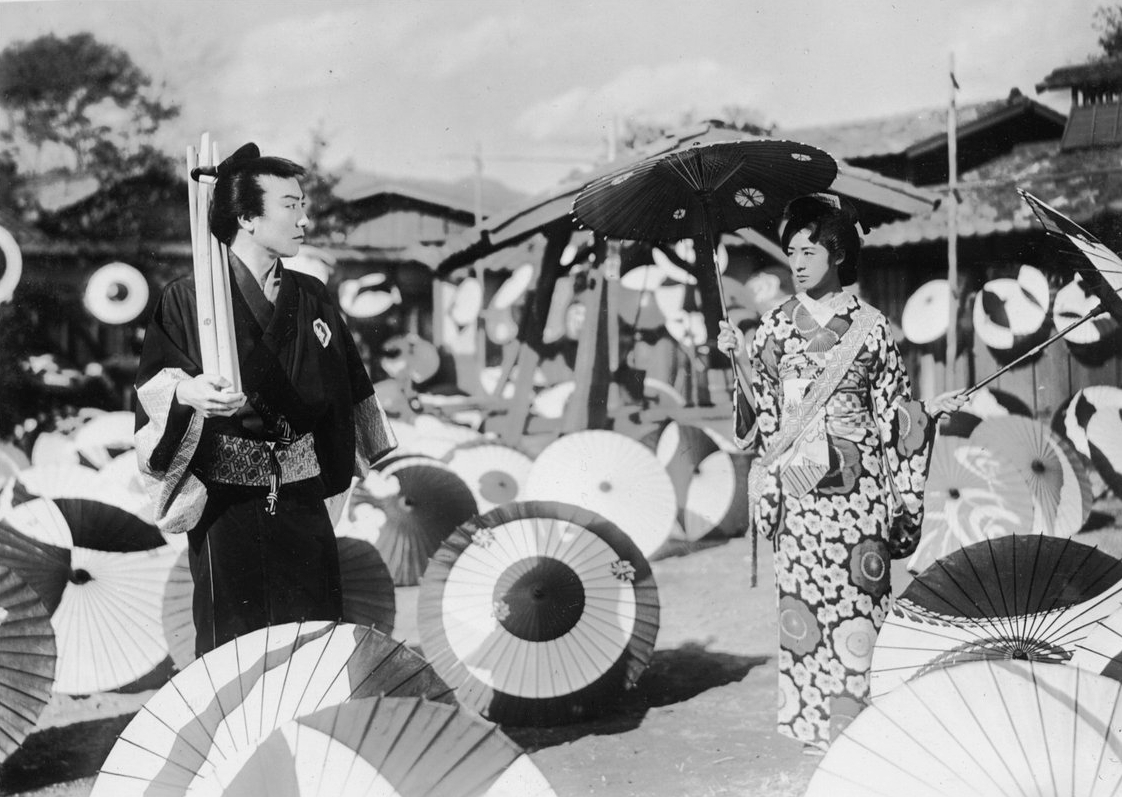
singing lovebirds still 5With things the way they were in the Japan of 1939, you might have expected cinema to have taken a universal turn to the dark side but surprisingly enough there was still room on the silver screen for silliness as the improbable marvel of Singing Lovebirds (鴛鴦歌合戦, Oshidori Utagassen) makes plain. Legend has it that musical master of the jidaigeki Masahiro Makino threw Lovebirds together in record time in order to fill a production gap after big time star Chiezo Kataoka was struck down by appendicitis in the middle of filming On the Road with Yaji and Kita. Kataoka is also Lovebird’s nominal male star though his appearance is understandably limited (his scenes were shot later and apparently in a matter of hours) leaving veteran actor Takashi Shimura to pick up the slack as an antiques obsessed disenfranchised former samurai who finds himself at the centre of a dastardly plot orchestrated by the higher ups to solve an ongoing romantic crisis among the youngsters.

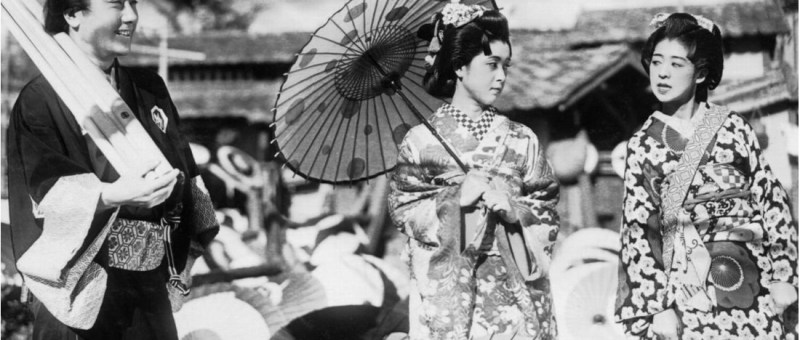
The crisis revolves around the handsome Reizo (Chiezo Kataoka) – a young ronin betrothed to a young lady from a well to do family, Fujio (Fujiko Fukamizu), whose father is keen to make the marriage official as quickly as possible. Reizo, however, has fallen for Oharu (Haruyo Ichikawa) – the daughter of ronin umbrella maker Shimura (Takashi Shimura). Meanwhile, Reizo has also become an object of affection for the daughter of a wealthy local merchant, Otomi (Tomiko Hattori), who is spoilt and entitled to the extent that Reizo’s resistance only enflames her ardour. If all that weren’t enough to be going on with, a randy local lord (Dick Mine) is also actively chasing most of the women in the area and after getting turned down by Otomi has his sights set on Oharu.

Peaceful times allow for small bursts of chaos and ongoing romantic silliness which is where we find our conflicted heroes, yet there is a persistent strain of anxiety in the precarious lives of the disenfranchised ronin who find themselves trapped in a cycle of wilful degradation which prevents them from taking on work unbefitting of a gentlemen and, consequently, permanently on the brink of starvation. Umbrella making, a frequent ronin-friendly occupation in the world of the jidaigeki, is one such way of making ends meet, but Shimura can only afford to feed his daughter barley much to her consternation. Rather than use his meagre resources for short term satisfaction he’s decided to “invest” them in various “antiques” which he believes both bolster his status and can be sold to provide a dowry for Oharu when she decides to marry.

Unfortunately, Shimura is mistaken – he’s not got as good an eye for antiques as he thought and is a well known mark for the local hawker. Everything he has is a fake and he’s wasted a small fortune on useless trinkets. Shimura’s antiques mania also leaves him open to other kinds of scams and manipulation when he gets himself into a small amount of debt to the randy lord and Fujio’s dad (Mitsuru Toyama) who have tricked him in order to try and get Oharu out of the Reizo picture and into the lord’s bedchamber. Unlike many Jidaigeki dads, however, Shimura is a nice guy and tells the higher ups where to get off because what kind of father sells his daughter for the price of a pretty tea bowl?

Shimura’s logic might not make much sense to the lords, or to many other residents of the jidiaigeki world, but is perfectly in keeping with the film’s surprisingly humanist morality in which all are made to realise that greed is bad, money is silly, and at the end of the day all that really matters is true love (even if you have to live in a hovel and survive on barley gruel for the rest of your life). Even the spoilt Otomi is finally forced to realise that you can’t force love and the best you can do is try to support other people’s happiness while you wait for yours to come along (which it is more likely to do once you start being nicer to everyone including your long suffering manservant).

Bright, cheerful, and filled with zany humour Singing Lovebirds is a refreshingly warmhearted piece of eminently hummable escapist fluff providing a much needed distraction from the austere world of 1939 in which its particular brand of anti-capitalist humanism would seem to be extremely out of place. Nevertheless, the corrupt and oppressive samurai order gets a much needed comeuppance, the little guy realises he doesn’t need to play their game anymore, and a young woman realises the only person she needed to feel good enough for was herself. A happy ending for all and an umbrella wielding dance routine to boot – who could ask for anything more?


Brief clip (extremely poor quality, no subtitles)

https://www.youtube.com/watch?v=GGQIzCN22tk

Bloody Spear at Mount Fuji (血槍富士, Tomu Uchida, 1955)

Bloody Spear Mount Fuji posterThere was a reason that the occupation authorities were suspicious of period films, but the jidaigeki of the post-war years are not generally interested in nationalistic pride so much as in interrogating the myths of the samurai legacy in order to pick apart the compromises of the modern era and the follies of the immediate past. Tomu Uchida had been among the most prominent directors of pre-war cinema but left to join the Manchurian Film Cooperative in 1942, remaining in China until 1953. Bloody Spear at Mount Fuji (血槍富士, Chiyari Fuji) was his “comeback” film, brought into existence through the good offices of fellow directors Yasujiro Ozu, Hiroshi Shimizu, and Daisuke Ito who had been the pioneer of samurai movies in the silent era. Like the later films of Masaki Kobayashi, Uchida takes aim at the hypocritical falsehoods of the samurai order and at a series of still prevalent social codes which oblige one human to oppress another in order to avoid acknowledging the fact that one is oneself oppressed.

Ironically enough we begin on the road to Edo as a goodhearted but compromised samurai, Sawaka (Teruo Shimada), makes the journey to the capital to make his name with a precious teacup in tow. He may be a samurai, but he’s making this lengthy journey on foot and accompanied by only two retainers – veteran spearman Genpachi (Chiezo Kataoka), and manservant Genta (Daisuke Kento). While on the road, the trio come across various other travellers including a shamisen player (Chizuru Kitagawa) and her daughter, a cheeky orphan who wants to be a samurai, and a melancholy father and daughter en route to visit a relative in the hope of financial assistance. There is also a notorious bandit on the loose going by the name of Rokuemon, which is one reason that the “recently wealthy” miner Tozaburo (Ryunosuke Tsukigata) is arousing suspicion with local law enforcement.

In contrast to many a jidaigeki epic, the travellers on the road to Edo are mostly good people if wise enough to be wary and on the look out for trouble. Genta and Genpachi have been given strict instructions that Sawaka is not to drink during the journey. Though he’s a nice enough soul when sober, Sawaka is a mean drunk with a tendency to start random fights and his mother doesn’t want him messing up his big chance by causing trouble on the road. This maternal solicitude can’t help but annoy Sawaka who overhears Genta complaining to a servant at the inn as he enjoys a quick glass of solo sake in the kitchen. There may be a sword on Sawaka’s belt, but he’s a middle ranker at best – something rammed home to him when the party is held up by a roadblock which turns out to be solely caused by three elite samurai having a picnic who wish to enjoy the view uninterrupted. Later he grips the handle on his sword in rage and desire to help a young woman in trouble before his hand begins to slip as he realises how little power he really has. The only thing to help her was money, and money is something Sawaka evidently does not have.

Sawaka’s “power” is entirely illusionary and dictated by the complex hierarchies of the samurai era. Breaking all the rules, he considers selling his “priceless ancestral spear” to get money to help the girl, but is told that the spear is a fake and hardly worth anything. With the help of the plucky little boy Jiro, Genpachi helps to apprehend a wanted criminal but it’s Sawaka who gets a commendation – something which causes him not a little consternation but his attempts to transfer the praise onto the rightful parties falls on deaf ears. In any case, the reward is just a piece of paper filled with more empty words and not much practical use to anyone. A fake spear begets a fake reward, he quips, becoming ever more disillusioned with the rights and responsibilities of the samurai order while somewhat romanticising the lives of the “ordinary” who might be more “free” in one sense but then Sawaka is never going to worry about being hungry or have to think about selling his daughter to avoid certain ruin even if he resents the ways in which is social class obliges him to affect coldheartedness.

Sawaka’s rejection of “samurai” values eventually leads to his downfall when an invitation to a servant to join him at his drinking table as an equal provokes outrage in a fellow nobleman who feels his own status threatened by this genial act of meaningless equality. Sawaka’s attempts to insist that he and his servant are both human beings only makes things worse and it doesn’t take long to figure out that he has picked the wrong battle if what he wanted was to strike a blow at samurai hypocrisy. Sawaka himself is no innocent in this game, terrorising a trio of peasants simply because one of them had an interesting nose and the drink was in him. Sawaka’s servant eventually pays the price for his mistake, bearing out his earlier frustrations with the chain of “shadows” that defines the samurai order and seemingly has no end.

Genpachi is the embodiment of the good retainer, but he’s also a kind and sympathetic man who takes an interest in the lonely orphan boy and, to a lesser extent, the shamisen player and her little daughter. The four of them form a kind of makeshift family, but the samurai order destroys even this small slice of happiness as the road prepares to force them apart. Having bloodied his spear but had his act of rage “approved” by the powers that be, Genpachi emerges broken and masterless, his fatherly attentions to Jiro relegated to a literal instruction not to follow in his footsteps and never to become a “spear carrier”, a mere tool at the mercy of a cruel and corrupt regime. Uchida begins in comedy complete with a whimsical contemporary score but makes clear that his ending is inevitable tragedy only made worse by the superficial rubber stamping that neatly sanctions the hero’s moment of madness as one perfectly in keeping with his moral universe.


Bloody Spear at Mount Fuji is available on blu-ray from Arrow Academy with a typically expansive feature commentary by film scholar Jasper Sharp including a minor digression into the career of director Hiroshi Shimizu – another sadly neglected figure of pre-war/golden age Japanese cinema. Other on-disc extras includes a series of interviews ported over from the French release – though it is nice to have them, it’s a shame that they are presented with the hardcoded French subtitles blurred out and English ones placed over the top which is less than ideal but perhaps cannot be helped. First pressing also includes a booklet featuring a lengthy essay by James Oliver which duplicates much of the information from the commentary while also situating the film within the context of Uchida’s career and the wider post-war world, as well as a complete filmography both for Uchida’s directing and acting work compiled by Sharp.

Short clip from an unrestored version of the film (no subtitles)