The Fourth Portrait (第四張畫, Chung Mong-Hong, 2010)

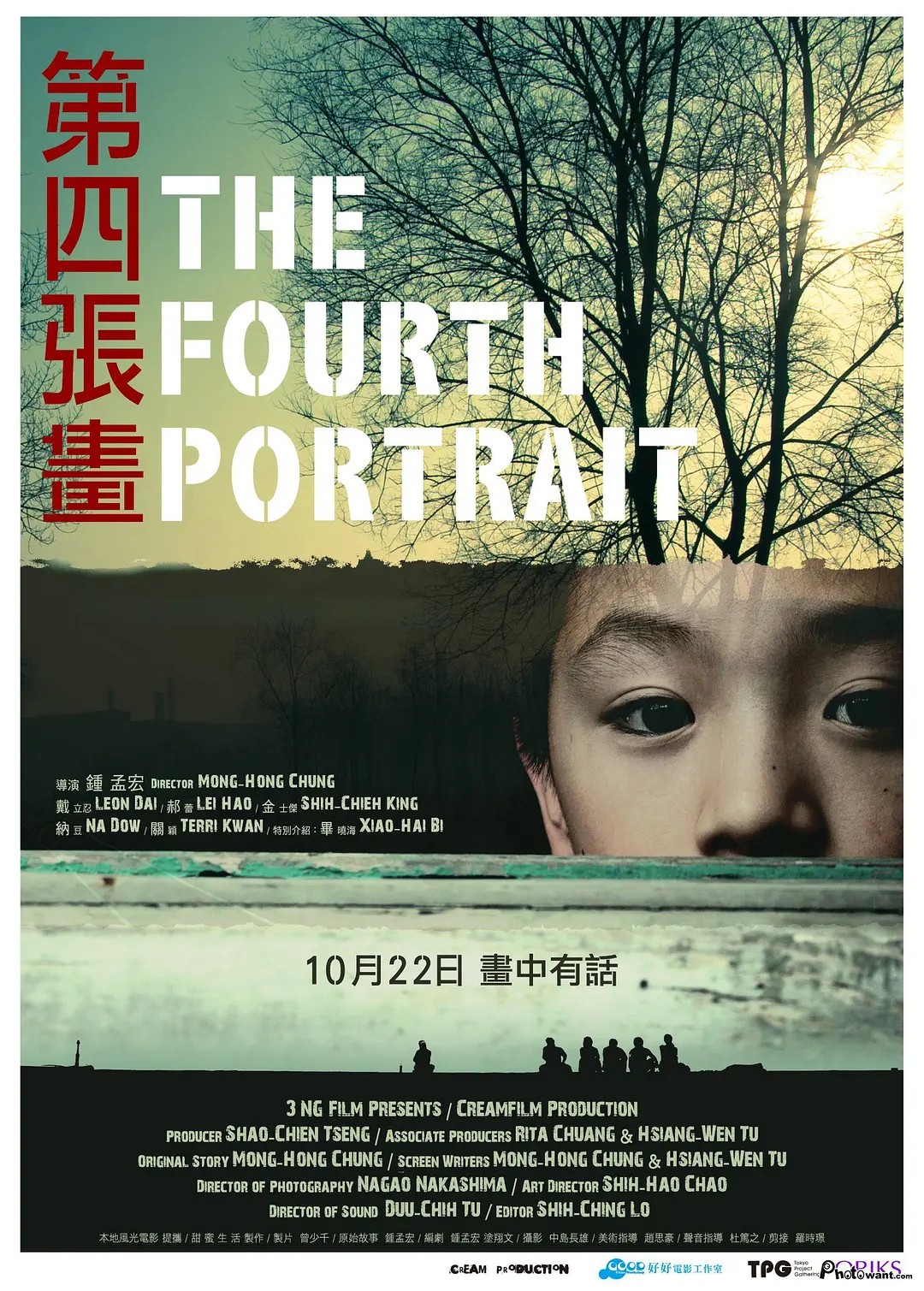
A young boy struggles to forge his own identity while lost amid the legacy of perpetual displacement in Chung Mong-Hong’s whimsical coming-of-age drama The Fourth Portrait (第四張畫). As the title implies, Chung structures his tale around four images as the boy looks for guidance through each of his relationships but perhaps finally discovers only that he is on his own and has only himself for protection yet must find the courage to try and escape even if it causes him pain. 

At 10 years old, young Xiang (Bi Xiao-Hai) is impossibly burdened in the way no child should be as a doctor coldly tells him that his father will soon pass, a nurse instructing him to stay put and let them know when his father is gone. Xiang impassively places a napkin over his father’s face, the undertakers bickering amongst themselves while deciding to do the funeral for free seeing as this child is now all alone and seemingly has no other family. Yet no one comes to take care of Xiang, he has to go home on his own and begins living independently eventually resorting to stealing lunch boxes at school only to be caught and scolded by a grumpy janitor who both tenderly offers him food but then roughly slaps him when he notices the boy is crying. 

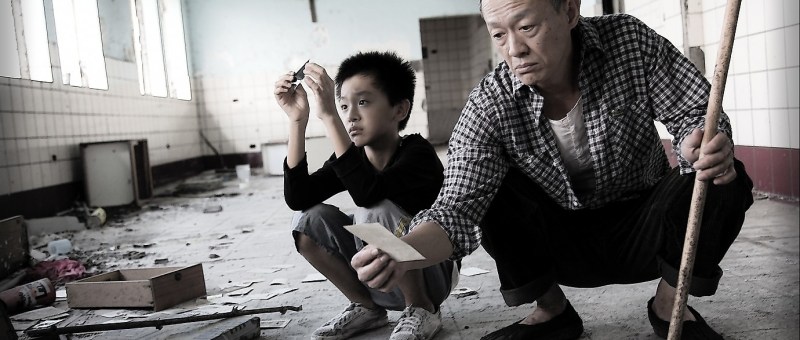
As Xiang is about to become, the old man, Zhang (Chin Shih-Chieh), is also a displaced person having travelled from the Mainland 50 years previously. He takes him to scavenge abandoned buildings meditating on what it is that gets left behind, why it has value to some and apparently not to others. Xiang himself was abandoned by his mother who took his older brother with her but chose to leave him with his father, wondering perhaps if he is valuable or not. Technically if not literally orphaned, Xiang is later reunited with his mother, Chun-lang (Hao Lei), but is then displaced himself, forced to move to the city and into the house she shares with her second husband and infant child. Like Zhang his mother came from the Mainland in search of a better life she did not find and is living with a sense of disappointed futility trapped in her marriage to a dejected and violent man (Leon Dai) while forced to support the family through sex work at a nearby hostess club frequented largely by Mainland gangsters. 

Unanchored and insecure in his new environment, Xiang begins having strange dreams of his apparently absent brother Yi but his attempts to discover the truth about the past only further destabilise the foundations of his new home. His mother cannot fully embrace him because of her guilt over leaving him behind while unable to fully process the reality of what may have happened to Yi too frightened of the truth to risk poking around. His stepfather meanwhile is a haunted man, unable to work and seemingly the primary carer to their small child though neither them are ever really seen paying much attention to the baby. When Chun-lang tells Xiang that he is a stranger in their house, that she is no longer the mother she once was because she has married another man and has another child with him, she does so perhaps partly to encourage him to leave advising him to steer clear of his stepfather in a bid to keep him safe yet blaming herself for all the tragedy which has befallen her accepting it would not have happened if she had not “messed up” her life. 

Perhaps this is why Xiang finds himself bonding with a decidedly strange middle-aged man he meets by accident in a public toilet. “Big Gun” paints himself as something of a big brother figure, suggesting that they can drift together travelling around on his moped. His conduct towards the boy is extremely inappropriate in more ways than one involving him in his life of petty crime, yet Xiang finds in him a sense of acceptance that he doesn’t get from the other adults along with a new sense of independence. Yet Xiang’s illusions are eventually shattered twice over, the first revelation paving the way for a greater loss of innocence in discovering the truth about his brother while the second perhaps leads him to feel that he really is alone, continually displaced, and entirely unanchored in a world with offers little prospect of warmth, affection, or a place to belong. 

Like Zhang and his mother, Xiang is fails to settle in contemporary Taiwan lost amid a stream of constant dislocations and bound only for endless wandering. Yet staring into a mirror preparing for his fourth portrait he perhaps begins to forge an image of himself informed by those he’s drawn before and giving him the sense of confidence to survive the emptiness of the world around him. Beautifully shot with a lingering ethereality, Chung’s enigmatic storytelling coupled with the whimsical score lend a note cheerfulness to what in many ways is a fairly bleak situation but perhaps reflects the surreality of the boy’s life in his constant quest for belonging. 


International trailer (English subtitles)
A Place Called Silence (默杀, Sam Quah Boon Lip, 2024)

Can the hammer of truth break the rock of silence? At the end of Sam Quah’s remake of his own 2022 film by the same name, A Place Called Silence (默杀, mò shā), you might ask if you really want to or if some secrets are best kept that way. Then again, Quah’s persistent focus on leaky roofs suggests the truth will out and that the slow drip of quietly collecting water will eventually erode even the strongest stone.

Though remade for the Mainland market, the film takes place in the fictional city of Doma which like many recent similarly themed films is ostensibly not located China but another area of South East Asia, the police uniforms and complex mix of languages and cultures strongly echoing those of the original Malaysian setting. This also extends to the increasingly Christianising imagery which leads back to a cult-like local charity that pedals a good book full of aphorisms landing somewhere between Confucius and Proverbs and are at best a superficial salve for the deeply rooted problems in what turns out to be a judgemental and classist society. 

At least, the reason no one challenges the increasingly extreme behaviour of school bully and queen bee Angie is because she’s the headmaster’s daughter. Angie has been relentlessly tormenting Tong largely because she has a disability and had until recently been taught in the special needs class. According to her mother, Han, Tong has been mute since birth and it’s in an attempt to get her a better education that she’s given up her job in accounting and taken a position as a cleaner at the school. Her mother’s profession is also another reason for Angie to bully Tong, though she also accuses Han of having seduced her father which does not appear to be true though his later admission to an “abuse of power” that gives Han leverage over him puts a different spin on the situation and does not cast him in a very good light. 

Neither does the state of disrepair at the school which has a persistently leaky roof that is at least according to handyman Zaifu structurally unsound and may cave in any minute. Some of the blame is placed on a recent tsunami which caused mass loss of life, and the school seems to be proud of itself for having taken in pupils from another institution that was swept away though they don’t appear to have been welcomed by everyone. When a pupil ends up dying because of Angie’s bullying, the headmaster delays calling for help in part it seems to evade a scandal while planning to simply bribe anyone who tries to look into the matter. 

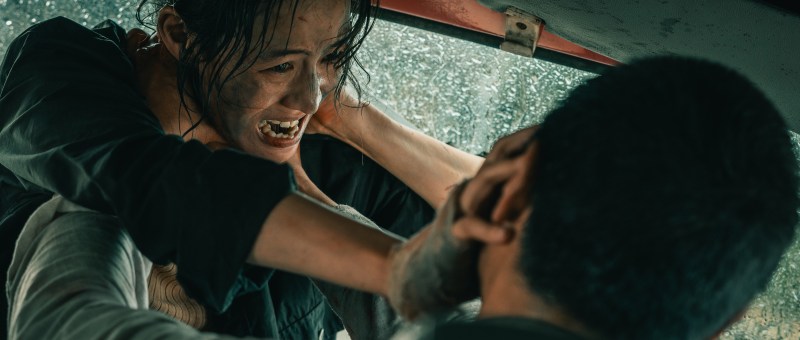
In short, it’s not difficult to see why someone may feel they’d have to take the law into their hands to break the persistent silence that protects the wealthy and the powerful from the consequences of their actions. Though, truth be told, not everyone is very interested in the disappearance of the girls, Han is driven to distraction when she suspects that Tong has been abducted by a serial killer with a very particular motive who also seems to be aware of some secrets she herself had been keeping. Then again there are a lot of wilful silences, like that of Mrs Xu who later snaps that the whole building knew Han had suffered domestic violence yet apparently did nothing help her other than maintaining superficial politeness by avoiding bringing it up. 

Silence seems to be the only refuge for the bullied whether in school or the wider world for there’s little good in speaking up anyway. Tong tries to help a bullied friend, but her mother stops her, wary of their own need for silence and that Tong will simply become the next target which of course she does. Terrible things are done in the name of protection, but sometimes silence is necessary too and a means of atonement if not a weapon against life’s unfairness. An ambiguous mid-credits sequence somewhat muddies the waters in its implications though perhaps a concession to the censors demanding that crimes must be answered, but Quah otherwise depicts a hellish society of violence and powerlessness in which the only choices are silent complicity or murderous revenge.


A Place Called Silence is in UK cinemas now courtesy of CineAsia.

UK trailer (Simplified Chinese / English subtitles)

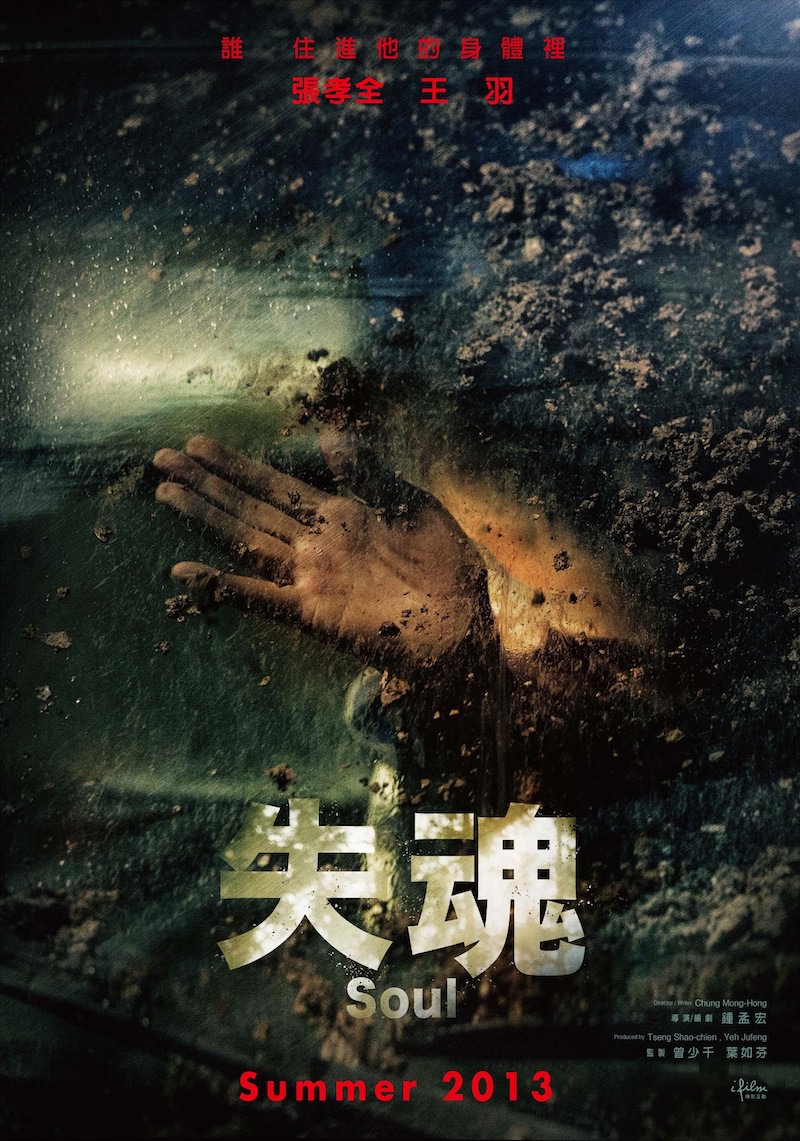
Soul (失魂, Chung Mong-Hong, 2013)

“Sometimes the things you see aren’t what they seem” the stoical father at the centre of Chung Mong-Hong’s supernatural psycho-drama Soul (失魂, Shī hún) later advises, for the moment creating a new, more convenient reality but also hinting at the mutability of memory and perception. Distinctly eerie and beautifully shot amidst the gothic atmosphere of the misty Taiwan mountain forests, Chung’s ethereal drama is at heart a tale of fathers and sons and the griefs and traumas which exist between them. 

When sushi chef Ah-Chuan (Joseph Chang) collapses at work, no one can figure out what’s wrong with him, finally suggesting perhaps it may be depression. His boss instructs three of his colleagues to take him back to his apparently estranged family to recuperate for reasons perhaps not altogether altruistic. In a near catatonic state, Ah-chuan is barely present offering no response to his name and staring vacantly in no particular direction. When he finally does begin talking, it’s to insist he’s no longer Ah-Chuan explaining that this body happened to be vacant and so he’s moved in while Ah-Chuan will apparently be off wandering for some time. Ah-Chuan, however, then abruptly stabs his sister Yun (Chen Shiang-chyi), who had travelled from Taipei to look after him, to death and is discovered covered in blood sitting calmly over her body offering only the justification that she was intending to harm him. 

Wang (Jimmy Wang), Ah-Chuan’s father barely reacts to finding his daughter’s corpse, merely rolling her under a bench and attempting to mop up the blood when a family friend, Wu (Chen Yu-hsun), who happens to be a policeman suddenly comes calling. Wang is either infinitely pragmatic instantly deciding there’s nothing he can do for his daughter so he’ll try his best to save his son, or else near sociopathic appearing to care nothing at all that Yun is dead. Nevertheless, realising that Ah-Chuan may be dangerous he takes him up to his remote cabin near the orchid garden and locks him inside while trying to figure out what or who this presence that has his son’s appearance might or might not be. As he later says, this brief time together is the most he’s spoken to his “son” if that’s who he is in years even if acknowledging that this Ah-Chuan is quite different from the old. Yet if it were not for the obvious fact that others see and interact with him we might wonder if Wang had simply conjured Ah-Chuan, projecting his own latent violence, guilt, and regret onto the figure of his son who is also in a way himself. 

Yet whatever Ah-Chuan now is he finds himself growing closer to the old man, feeling a filial responsibility towards him that he otherwise would not own. He contacts a “messenger” from “across the woods” to help his find Ah-Chuan’s wandering soul to tell him that his dad’s not doing so well, entering a space of dream and memory that reveals the trauma at the heart of their relationship that might in part help explain Wang’s apparent coldness. Just as the two Ah-Chuans begin to blur into each other, so perhaps to father and son, Wang prepared to go to great lengths to protect his only remaining child while, ironically, offering some harsh words to his son-in-law for not better protecting “the only daughter I have”. 

Chung hints at a kind fluidity of consciousness, each episode of “death” or “possession” accompanied by that of another creature, fish gasping and flapping around, a tired bug trying desperately to cling onto a leaf but failing, or a pair of snakes twisting themselves into a knot. Is Ah-Chuan merely experiencing a protracted dissociative episode under the delusion he is “possessed” while his essential selves “wander” the recesses of his consciousness or has someone else, a second soul, taken up residence in a body left vacant by a man who was in a way already “dead”. Wang in fact hints at this, telling the doctor that he had sometimes thought of Ah-Chuan as dead, or at least wondered if he might be seeing as they had long been estranged, suggesting that the Ah-Chuan of his heart and memory was already gone Wang believing himself to have killed something in him through his own violence when he was only a child. 

The two men mirror each other, growing closer yet also further apart as they make their way back towards the truth that might set them, metaphorically at least, free. Often viscerally violent not least in its jagged, abrupt cuts to black that feel almost like dropping out of consciousness or else waking fitfully with brief flickers of other realities, Chung’s eerie, ethereal drama ventures into the metaphysical but in its strangely surreal final scenes returns us to a more concrete “reality” in which the way home is found it seems only in dreams. 


Original trailer (Traditional Chinese / English subtitles)

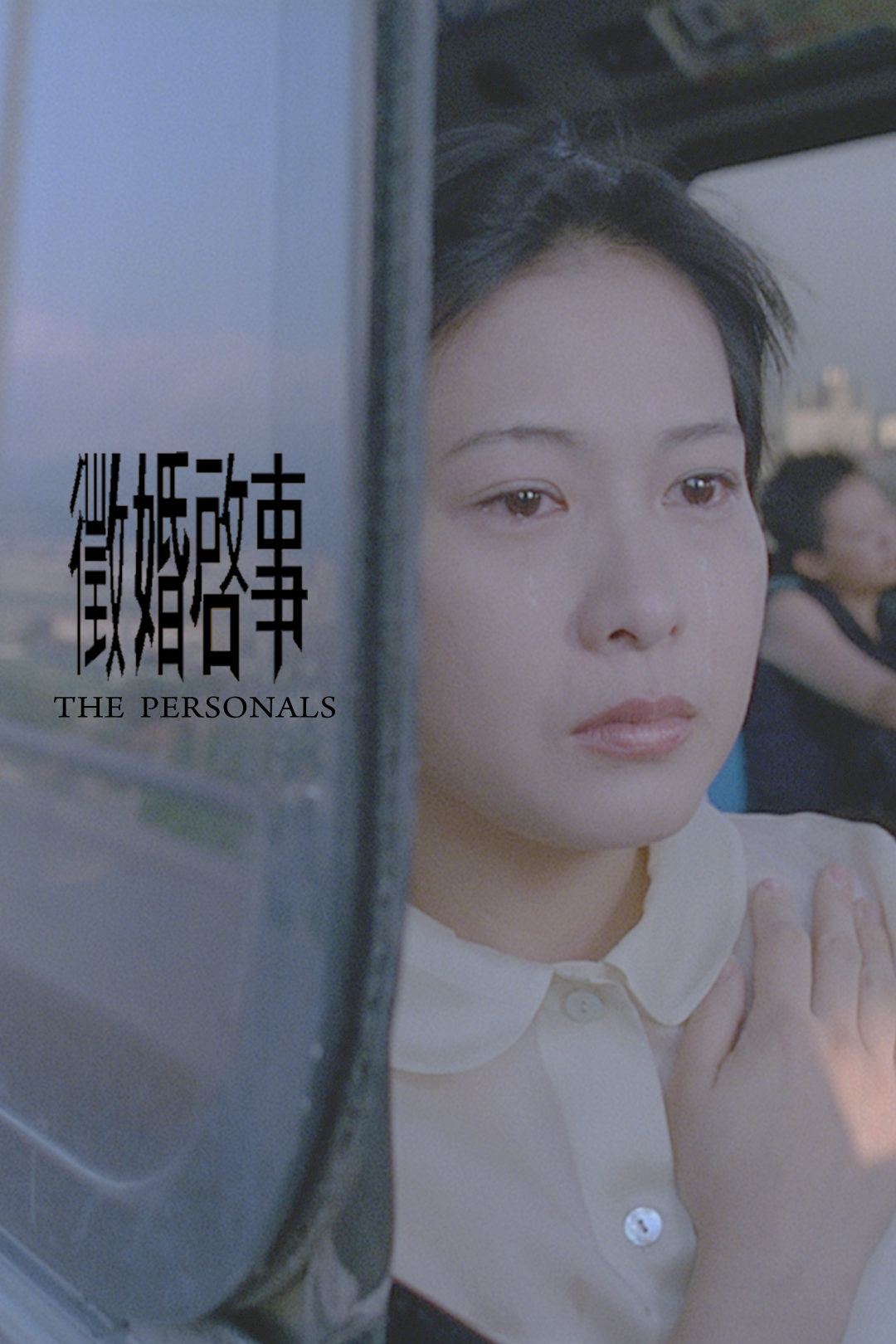
The Personals (徵婚啓事, Chen Kuo-fu, 1998)

Looking for love in all the wrong places, a Taipei career woman suddenly decides to give up her life and place a personal ad stating that she’s looking for a husband, “Who knows, maybe I’ll find happiness” she unconvincingly explains. Chen Kuo-fu’s sophisticated dramedy The Personals (徵婚啓事, Zhēnghūn Qǐ Shì) sends its heroine on a dating odyssey through the contemporary capital but is at heart the story of a woman learning to see herself while grieving a failed relationship and the married ex who won’t return her calls. 

Tu Chia-wen (Rene Liu Ruo-ying) was a successful eye doctor at a Taipei hospital, explaining to a patient that some people lose the ability to produce enough tears after the age of 30, but abruptly quits her job later claiming that she wanted sever connections with her past which is another reason why she’s decided to place an ad rather than asking friends to set her up with eligible bachelors. Implicitly, it also seems that Chia-wen feels her status as a doctor may be intimidating to some men in the still patriarchal society, if also a clue to her true identity which she has otherwise chosen to keep hidden going instead by the name of Miss “Wu” which just happens to be the name of her lover’s wife. 

Of course, it’s illogical to use a false identity if your end goal is finding a life partner, a factor which later feeds in to Chia-wen’s half-hearted conclusion that it isn’t the fault of the men she’s been meeting that they didn’t hit it off but her own in that she’s so far failed to fully “open up” to any of them. Despite newspaper personal ads not featuring photos, Chia-wen receives 100 messages in the three days after her details are posted from a varied cross section of applicants some more suitable than others. One gentleman who unconvincingly claims to be in his 30s reels off his CV as if he were introducing himself at a job interview while wearing a cheerful farmer-style straw hat. A factory worker chews betel nut and smokes tobacco at the same time while exposing an insecurity over his financial situation in complaining that modern women are too materialistic. One suitor is a woman who struggles to explain her gender and sexual identity with the terminology of the time causing Chia-Wen a degree of consternation. Another potential date is a shoe fetishist with a large suitcase intent on some kind of cinderella role-play closely followed by an executive who enthusiastically explains his only hobby outside of drinking is an encyclopaedic knowledge of S&M porn, while a son brings his father as a potential match because his mum’s “gone abroad” and in a heartbreaking moment a worried mother tries to negotiate on behalf of her son who appears to have learning difficulties and might not be sure what’s going on, hoping to find someone to look after him when she’s gone. 

It may be a biased sample, but it doesn’t speak well for the men of Taipei and that’s without even getting into the guy trying to recruit Chia-wen as a high class call girl, the obvious married man after no strings sex, or the salesman trying to peddle women’s self defence equipment with a case full of tasers and pepper spray. Chia-wen pours out her frustrations in daily calls to her ex’s answering machine, leaving long messages she knows he won’t reply to but somehow it makes her feel close to him. Gradually through her monologues we begin to piece together the trauma that she’s struggling to accommodate while a late and unexpected twist keys us in to the cosmic tragedy of her frustrated romance. “Choose what you can endure” she’s advised by a professor friend who confesses to her that he’s chosen to suppress his homosexuality out of a desire for a “normal” life as a husband and father hinting at the still conservative nature of the contemporary society. 

It’s not until she’s caught off guard by a potential match seeing through her ruse that Chia-wen begins to reconsider her experiment, eventually captivated by a sensitive young man who’s not long come out of prison but has an endearingly awkward smile that reminds her of her own. She meets each of the men in the same cafe where she had her first date with her former lover, taking on a slightly different character as she attempts to interview them about their lives, getting to know their hopes and desires often tinged with a note of loneliness or despair. They seldom seem very interested in her, but instantly propose marriage or at least some sort of serious courtship without even finding out about her hopes and aspirations in life. Chia-wen’s often comical encounters from the teenage boys trying their luck to the old men taking their last chance each expose something of contemporary gender dynamics as well as hinting at increasing urban loneliness and romantic desperation but in the end it’s herself Chia-wen must face in learning to let go of past trauma in order to give herself permission to move on in her ever evolving quest for love.


The Personals streams in the UK 25th to 31st October as part of this year’s Taiwan Film Festival Edinburgh.

Trailer (Traditional Chinese / English subtitles)

A Leg (腿, Chang Yao-sheng, 2020)

“Life is long. We all have some regrets.” a grieving widow is told by a disingenuous doctor in full damage limitation mode. He’s not necessarily wrong, nor is his advice that the widow’s pointless quest to retrieve her late husband’s amputated limb has little practical value though of course it means something to her and as he’d pointed out seconds earlier a physician’s duty is to alleviate suffering of all kinds. Apparently inspired by the true story of director Chang Yao-sheng’s mother, A Leg (腿, Tuǐ) is in many ways a story of letting go as the deceased man himself makes a presumably unheard ghostly confession while his wife attempts to do the only thing she can in order to lay him to rest. 

Husband Zi-han (Tony Yang) is in hospital to deal with a painful, seemingly necrotic foot which eventually has to be amputated in a last ditch attempt to cure his septicaemia. “Keep the leg and lose your life, or keep your life and lose the leg” the otherwise unsympathetic doctor advices wife Yu-ying (Gwei Lun-mei) in a remark which will come to seem ironic as, unfortunately, Zi-han’s case turns out to be more serious than first thought and he doesn’t make it through the night. Grief-stricken, Yu-ying leaves in an ambulance with the body but later turns back, determined to retrieve the amputated foot in order that her husband be buried “complete” only it turns out that it’s not as simple as she assumed it would be. 

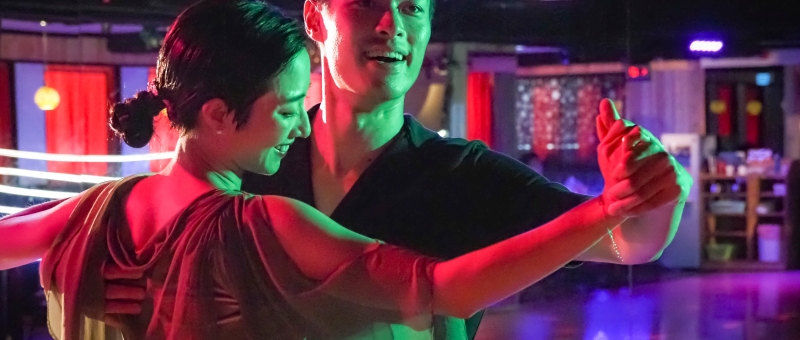
The loss of Zi-han’s foot is all the more ironic as the couple had been a pair of ballroom dancers. As Yu-ying makes a nuisance of herself at the hospital, Zi-han begins to narrate the story of their romance which began when he fell in love with a photo of her dancing in the window of his friend’s photography studio. Explaining that, having died, he’s reached the realisation that everything beautiful is in the past only he was too foolish to appreciate it, Zi-han looks back over his tragic love story acknowledging that he was at best an imperfect husband who caused his wife nothing but pain and disappointment until the marriage finally broke down. He offers no real explanation for his self-destructive behaviour save the unrealistic justification that he only wanted Yu-ying to live comfortably and perhaps implies that his death is partly a means of freeing her from the series of catastrophes he brought into her life. 

Given Zi-han’s beyond the grave testimony, the accusation levelled at Yu-ying by his doctor that the couple could not have been on good terms because Zi-han must have been ill for a long time with no one to look after him seems unfair though perhaps hints at the guilt Yu-ying feels in not having been there for her husband when he needed her. As we later discover, however, this is also partly Zi-han’s fault in that he over invested in a single piece of medical advice and resisted getting checked out by a hospital until he managed to sort out an insurance scam using his photographer friend, wrongly as it turned out believing he had a few months slack before the situation became critical and paying a high price for his tendency to do everything on the cheap. Nevertheless, Yu-ying’s quest to reattach his leg is her way of making amends, doing this one last thing for the husband whom she loved deeply even though he appears to have caused her nothing but misery since the day they met. 

In order to placate her, the slimy hospital chief offers to have a buddhist sculptor carve a wooden replica of Zi-han’s leg made from wood destined for a statue of Guan-yin goddess of mercy but Yu-ying eventually turns it down, struck by the beauty of the object but convinced that turning it to ash along with her husband’s body would be wrong while believing that wood ash and bone ash are fundamentally different. She regrets having ticked the box on the consent form stating she didn’t want to keep the “specimen”, never for one moment assuming that her husband would not recover. Despite their dancing dreams, she thought the leg was worth sacrificing against the long years they would have spent together after, though this too seems a little unlikely considering the state of their relationship prior to her discovery of Zi-han’s precarious health. Zi-han meanwhile is filled with regret for his continually awful behaviour and the obvious pain he caused his wife. Getting his leg back allows him to begin “moving on” while doing something much the same for Yu-ying though his afterlife pledge about the endurance of love seems a little trite given how he behaved while alive. A little more maudlin than your average quirky rom-com, A Leg nevertheless takes a few potshots at a sometimes cold, cynical, and inefficient medical system, inserting a plea for a little more empathy from a pair of unexpectedly sympathetic police officers, while insisting that it’s important to dance through life with feeling for as long as you’re allowed. 


A Leg screens Aug. 14  & streams in the US Aug. 15 – 20 as part of this year’s New York Asian Film Festival.

Original trailer (English/Traditional Chinese subtitles)

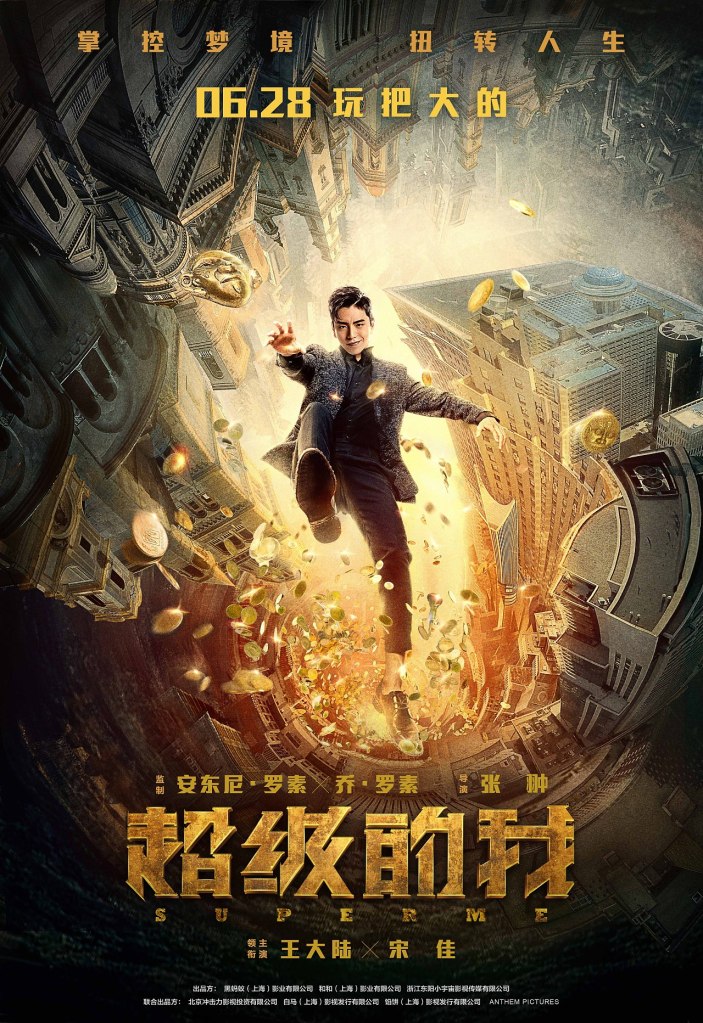
Super Me (超级的我, Zhang Chong, 2019)

Can you dream yourself into a better reality, or should you concentrate on being your best self in this one? That’s a dilemma that the hero of Zhang Chong’s Super Me (超级的我, Chāojí de Wǒ) barely has time to think about as he battles despair-fuelled hopelessness and possibly unrequited love for the beautiful woman who runs his local cafe. If only I were rich, he might well think, but though poverty is undoubtedly a factor in his malaise it’s his sense of inferiority which has him beaten down and all the money in the world won’t change that. 

We first meet Sang Yu (Darren Wang Talu) on a subway train where he recites a mantra to himself about how he’s “not an ordinary man”, he has the ability to work under pressure, and though his parents died and he has no friends those are merely tests from God which he has overcome. He is “brilliant and talented, diligent and motivated”, he expects success will soon arrive only he hasn’t slept a wink in the last six months because of the constant night terrors which plague him such as the one we’re about to witness. Sang Yu is asleep, and a nightmare is stalking him. 

Killed by having his head plunged through the train’s floor, Sang Yu wakes up and we realise his waking life is also quite depressing. A 20-something screenwriter, he’s behind on his rent and in debt to his friend/agent while unable to work because of his insomnia. Wandering around in a daze after being evicted from his apartment and getting his laptop stolen, he writes a note to his friend telling him he’ll have to pay him back in the next life and prepares to jump off the roof opposite the cafe where his true love, Hua (Song Jia), works, only to be saved by the intervention of the jian bing seller (Chin Shih-chieh) from down below who advises him to try waking up from his dreams before he gets killed by reminding himself that he is dreaming. Sang Yu takes him at his word and manages to emerge from the dreamworld unscathed clutching the weapon that once belonged to his attacker. After selling the antique sword to weapons brokers, he realises he’s sitting on a cash cow, routinely looting the dreamworld of many of its treasures and quickly harnessing its power to become a wealthy and successful man. All of which gives him the courage to finally approach Hua, wielding his newfound economic power to invest in the apparently failing cafe. 

A modern day take on Jack and the Beanstalk, Super Me finds its nice guy hero corrupted by his wealth, abandoning his artistic dreams and becoming a debauched playboy living in a five star hotel even if he continues to pine for Hua while his friend, Sangge (Cao Bingkun), reverts to being something like a minion riding on his coattails to enjoy the life of the rich and famous without really having to do anything. The irony is that the money and the fancy clothes give Sang Yu the confidence to talk to Hua, but those aren’t things she particularly cares about and may in a sense actually turn her off. Enjoying romantic evening walks, she guesses he’s a screenwriter from his veiled hints about robbing the dreamworld and is interested more in his artistic self than the wealthy man of mystery, all of which gives Sang Yu the inspiration to finish that screenplay which of course becomes a hit beyond his wildest dreams. 

After a while, Sang Yu starts to suspect there must be a cost involved in all this good fortune, realising that he’s traded some of his life away in return for riches and will perhaps never be free of his nightmares. Yet, as a cruel gangster tells him, everyone’s wealth comes at the sacrifice of life, echoing his earlier thoughts that those who are successful are either those who’ve chosen to sacrifice things that others won’t or are unscrupulous thieves and exploiters. “A person who betrays himself can never control his own destiny”, according to the gangster. Asleep or awake, Sang Yu realises he’s battling himself, that there are no quick fixes, and illusionary success is as hollow and as fleeting as the dreamworld from which he has perhaps failed to learn the appropriate lessons. As the old man told him, perhaps what he needs is to wake up, not only to life’s possibilities but to his own. Echoing his earlier The Fourth Wall, Zhang allows Sang Yu to walk through a door into a “better” reality which is perhaps the one he inhabited before but was too intimidated to actually live in. He hasn’t definitively beaten his demons, but perhaps subdued them while his new life seems determined to reward him for his choice in unexpected ways. Nevertheless, can you trust this reality more than any other? There may be no way to know, but you’ll have to learn to trust it all the same. 


Super Me is represented by Fortissimo Films.

Original trailer (no subtitles)