The Lower Depths (どん底, Akira Kurosawa, 1957)

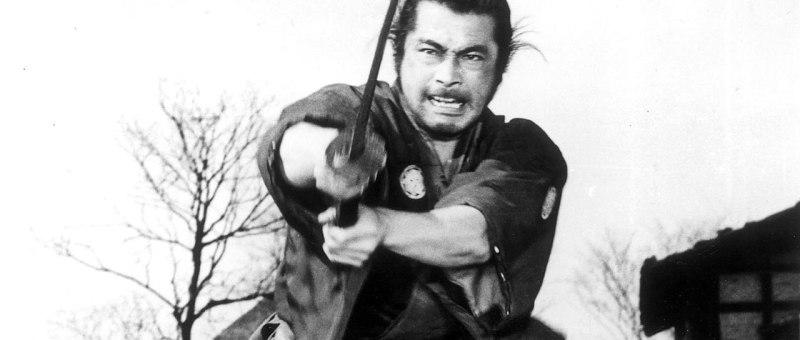
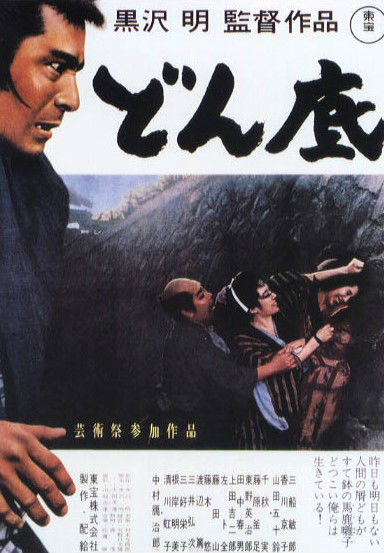
“How can you go to hell if you’re already there?” quips a stoical gangster, perhaps the only denizen of a rundown tenement block no longer looking for escape in Akira Kurosawa’s adaptation of the Gorky play The Lower Depths (どん底, Donzoko). In general, much of Kurosawa’s post-war work decries deliberate falsehood but paradoxically suggests that some degree of self-delusion is essential for surviving an otherwise hopeless world. The wandering pilgrim who arrives like some kind of emissary from the land above says as much as he offers what may turn out to be false promises of a better world to come, but as one of his charges points out he does so “out of pity for those beyond hope.”

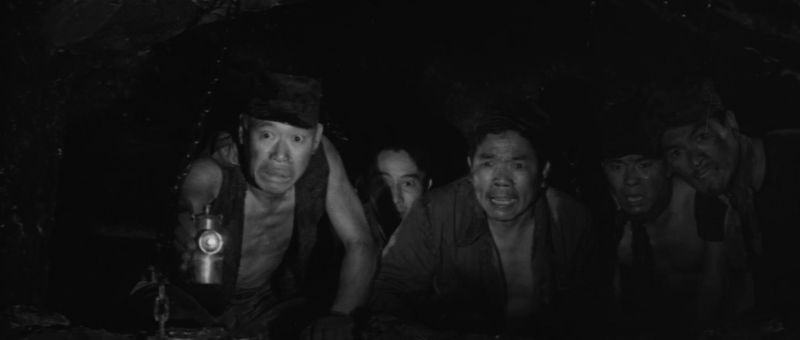
Then again, perhaps spirituality won’t save you either. As the film opens, it’s two monks who are seen throwing leaves over a cliff describing the settlement below as “just an old rubbish dump”, which in a sense it is if that were not such a cruel thing to say. In any case, the people who live here are all those who have already fallen into desperation, exiled from mainstream society and caught between a fierce desire to claw their way back up and the despair of knowing that in all likelihood they never will. A man who claims to be a former samurai waxes on his illustrious past, while a melancholy sex worker meditates on the lost love that reduced her to current position, and a stage actor laments his failing memory his mind now fogged by years of alcohol abuse that he says have already poisoned his “bitol organs”. A tinker secretly thinks he’s better than those around him. He’s only been here six months and insists that he’s a skilled craftsman who can continue working, but blames his desperate circumstances on the sickly wife whose death he quietly awaits assuming it will free him of this burden and thereafter this place.

It doesn’t, of course. He sells his tools to pay for her funeral, and otherwise appears lost no longer a husband to a dying wife. In essence the film revolves around a confrontation between the pilgrim who offers what may well be an illusion of salvation and the thief Sutekichi (Toshiro Mifune) who challenges him but begins to believe that it really may be possible for him to leave this place and take the woman he loves, Okayo (Kyoko Kagawa), with him or else fall further and remain trapped in this mortal hellscape. The problem there is that Sutekichi had previously been having an affair with the landlord’s wife Osugi (Isuzu Yamada) who is Okayo’s sister. Though Osugi, whose hope of escape through romance is dashed, first takes against her sister, she later offers to surrender her to Sutekichi if only he will assist her by killing her greedy husband Rokubei (Ganjiro Nakamura). 

In this cold and austere place which is in effect a living hell, there is a sense that many of the residents are already dead. Rokubei’s face is the palest of them all, suggesting that he is already too far gone ever to be saved and most likely doesn’t want to be anyway for in this terrible place he is in effect the king. Osugi is the queen, but often framed behind bars now a prisoner already too corrupt to leave the tenement behind. Her uncle, Deputy Shimazo (Kichijiro Ueda), has a largely illusionary sense of power in his position in a policeman which he prosecutes selectively and mostly at the service of the landlord. In the climactic closing scenes, his policeman’s baton is stolen by the drunkard Unokichi (Yu Fujiki) who dances through the streets with it demonstrating just how little authority he actually wields finally losing his position when the landlord is deposed and his familial connections become irrelevant. He inherits the landlord’s residence, but is reduced to the husband of the sweet seller Otaki (Nijiko Kiyokawa) whose status as a working woman is perhaps higher than his. 

Yet the pilgrim seems to think there is still time to save Sutekichi who at heart wants to go straight but is also resentful admitting that in a world where swindlers prosper perhaps it is foolish not to be a swindler. The pilgrim promises all of them a “better place”. “As long as you believe you’ll find it, you surely will”, he explains telling the actor about a temple that can help him cure his alcoholism while simultaneously urging the tinker’s suffering wife to give in to her fate and go to Buddha’s embrace as soon as possible. Perhaps he sincerely believes these things to be true, but also seems to have a sense that even if they weren’t these hopeless people could not go on if they knew there was no way out. They all say they’ll leave, but discover there are only two means of escape, to die or fall still further in banishment from this already banished place. Only Okayo whose final whereabouts remain unknown may finally have been able to free herself. Staying almost exclusively with the claustrophobic confines of the drafty tenement as wind the whistles through it, Kurosawa frames the space of one of existential purgatory but perhaps suggests that in the absence of salvation a comforting falsehood is the only means of survival.


The Lower Depths screens at the BFI Southbank, London on 19th & 30th January 2023 as part of the Kurosawa season.

High and Low (天国と地獄, Akira Kurosawa, 1963)

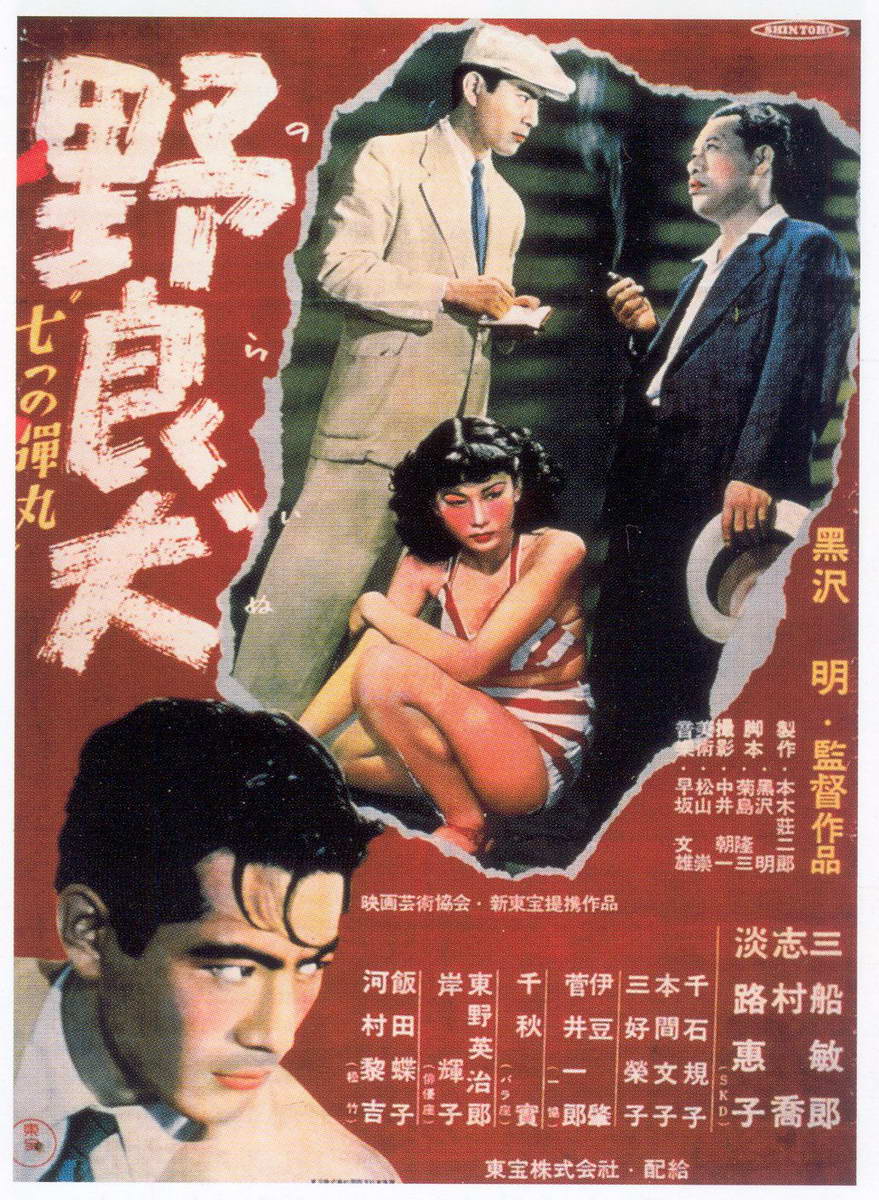
A self-made man is landed with an unthinkable dilemma when his chauffeur’s son is kidnapped in place of his own just at the moment he’s staked his entire fortune on a manoeuvre to outsmart cynical executives set on taking over his company in Kurosawa’s post-war crime film, High and Low (天国と地獄, Tengoku to Jigoku). The movie’s Japanese title, Heaven and Hell, might hint more strongly at the growing economic disparities in the era of the economic miracle but also at the dualities embodied in the hero’s choices. “Success isn’t worth losing your humanity” his wife tells him, but he still struggles with the validity of choosing his heart over his head knowing that to pay anyway even though it’s another man’s son means financial ruin, the final question being if he is really prepared to allow a child to die simply to maintain his own wealth and status. 

The problem is that Gondo (Toshiro Mifune) has attempted to mount a rebellion against the evils of consumerism, incurring the ire of the cynical executives who attempt to get him on their side in their attempt to oust the boss whose outdated ideas are running the business into the ground. Though Gondo appears sympathetic, hinting that he might be interested if there’s a good enough promotion in it, he later tells them where to go on seeing that their business plan is to start producing poor quality disposable footwear. Gondo started on the factory floor and he doesn’t want to put the company’s name on such shoddy produce nor does he think that their admittedly fair point that if the shoes are well made and last a long time no one will need to buy any is a good way to do business. He doesn’t think the boss is right either and wants to make shoes his own way which is why he’s remortgaged the sizeable mansion he owns on top of a hill overlooking the city and has pretty much run through his wife’s dowry to buy a majority stake in the company.

On top of a hill is a good place to live if you want a good vantage point to oversee the land below, but while you’re looking down others look up and not all of them kindly. Gondo is as he says a self-made man, but also out of touch with contemporary society and not so far from an ambitious courtier always after a little more. He says it isn’t about getting the top job but getting shoes made right, but it seems he too had been bitten by the consumerist bug and is otherwise unable to affirm his status without material proof. When he thinks it’s his own son that’s been kidnapped, he’d have given it all away but when it’s the driver’s boy it’s a different question. Shinichi (Masahiko Shimazu) isn’t his responsibility and as he points out there are plenty of other wealthy men, why is he the only one to pay? While his wife (Kyoko Kagawa) tearfully urges him to do the right thing, his assistant (Tatsuya Mihashi) tries stop him, insisting he should take the sizeable cheque they’ve had drawn up to Osaka and the stakeholder he’s buying the shares from. 

While he vacillates, the driver, Aoki (Yutaka Sada), is humiliated and forced into servitude. Gondo seems to have the old-fashioned idea that the kidnappers would simply let Shinichi go on realising they’ve got the wrong boy and his father can’t pay, but Aoki knows there’s nothing he can do to save his son but throw himself on Gondo’s mercy. He falls to the ground and prostrates himself, but later retracts all telling Gondo it doesn’t matter, that he hadn’t realised what he was asking of him, and insisting that Shinichi is a bright boy who will look for a chance to escape on his own. Once the boy is returned he treats him harshly, interrogating him about anything he might have forgotten and later driving him around looking for the hideout where he was kept in an attempt to do something and repay the debt he now feels he owes to Gondo by helping the police retrieve the money Gondo eventually agreed to pay for him. 

In agreeing to give up the money, Gondo is in a sense unburdened knowing he has made the right choice and realising that he would never live a comfortable life in that house if cost a child’s life to keep it. Part of his rationale for not wanting to pay had been that though he had been poor before and might be again, his wife had not been and does not truly understand what it is to live in poverty much as she says her life of luxury means nothing to her. She has never wanted for anything, after all. As for the kidnapper, Ginjiro (Tsutomu Yamazaki), we know little of his motives save for his intense resentment living quite literally in the shadow of Gondo’s mansion and feeling as if it were mocking him. Then again, though his life is hard Ginjiro already had a path to success in that he would soon have completed his medical studies implying at least that he or someone else was able to cover his tuition and costs of living, that he was able to continue in education, and really had no need to take such drastic action in rebellion against the antagonistic capitalism of the post-war society. “Do you think we have to hate each other?” Gondo asks him, but Ginjiro has no answer only his intense resentment for everything he represents.

The “hell” that Gondo inhabits is a backstreet wasteland peopled by the hopeless. Tokura (Tatsuya Nakadai), the earnest policeman, follows him through thronging clubs and on into “dope alley” where Ginjiro picked up his accomplices so desperate to escape their suffering that they’d agree to help him kidnap a child. Though it costs him his job, Gondo decision to do the right thing makes him a national hero, the working class millionaire who mows his own lawn and can still knock up a pair of shoes should the occasion call while women across the country decide to boycott the company in protest at his treatment. Ginjiro can only howl like a caged animal while facing a death sentence for the coldblooded murder of his accomplices. The light bouncing off his mirrored sunshades gives him an eerie supernatural quality, a demon arising from depths of hell to wreak havoc in heaven but finding only infinite tragedy in the contradictions of the consumerist post-war society.


High and Low screens at the BFI Southbank, London on 19th January 2023 as part of the Kurosawa season.

Original trailer (English subtitles)

The Vampire Moth (吸血蛾, Nobuo Nakagawa, 1956)

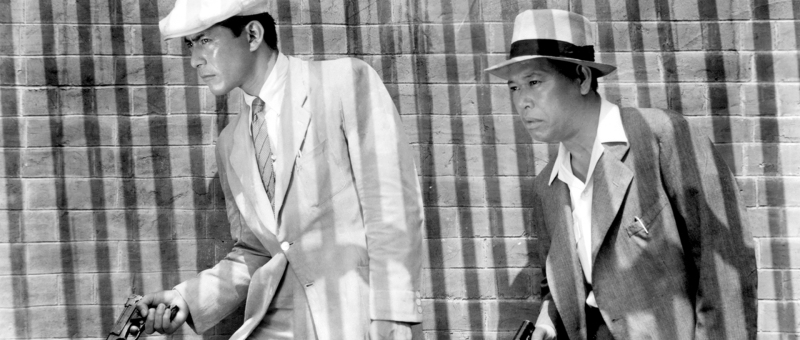
“You’ve become an evil beast that sucks blood!” intones ace detective Kindaichi, though just as his later The Lady Vampire featured no lady vampires, there is no literal bloodsucker involved in Noburu Nakagawa’s Vampire Moth (吸血蛾, Kyuketsuga). Inspired by one of Seishi Yokomizo’s mysteries featuring his iconic detective here played by the rather suave Ryo Ikebe cutting a very noirish figure in contrast to the famously disheveled eccentric from the original novels, the film is for a time at least a werewolf movie though as usual the villain turns out to be post-war greed and amorality. 

This is perhaps rammed home in the open sequence as the camera pans around the neon-lit nighttime city before entering a small cabaret bar where a fashion competition is currently in progress. A note of discord is immediately introduced by a white-haired grumpy old man (Eijiro Tono) sitting in the front row who appears to be in an incredibly bad mood, later exclaiming that the winning design by rising star Fumiyo Asaji (Asami Kuji) does not seem very original to him. Some of the models later complain about the strange spectator who’s evidently come to several other shows and has begun to creep them out. Meanwhile, an aloof, conservatively dressed woman brushes past them. Fumiyo’s assistant Toru (Ichiro Arishima) explains that she is Tazuko Kusakata (Chieko Nakakita) who had been the previous number one before Fumiyo returned to Japan after an extended stay in France. The real drama begins however with the arrival of a masked man with a box for Fumiyo who reveals his wolf-like face to Toru in an effort to convince him to deliver it. After opening the box and finding an apple with a few distinctive bite marks on the outside, Fumiyo promptly collapses.  

From the introduction of the three loose “suspects” an ominous atmosphere takes hold in the certainty that something untoward is about to happen. Soon enough some of the models start getting bumped off in quite bizarre and unpleasant ways. The first girl’s body is shipped back to the studio in a mannequin box which later leaks blood, while the gang are then delivered a cake with the next victim’s name on it in pretty icing with a butterfly moth motif above. There may not be any vampires, but there are certainly moths. The old creepy guy is revealed to be a moth specialist living a giant gothic mansion with a butterfly room in the middle full of specimens nailed to boards. His front door even has a moth motif above it like a coat of arms, while a butterfly mural lies behind it in the hallway. The killer places a decorative moth on each of his victims to cover their modesty which would seem to indicate the grumpy professor but, once he finally arrives, Kindaichi isn’t quite so sure. 

Though this is technically a Kindaichi mystery and he does finally get to unmask the criminal, he is not actually in it very much and as previously mentioned is nothing like later incarnations of the famous detective such as that of Kon Ichikawa’s series of Kindaichi movies released throughout the 1970s. In a common B-movie motif, the main detective work falls to a male and female team in dogged reporter Kawase (Minoru Chiaki) and intrepid model Yumiko (Kyoko Anzai) who eventually succeed in digging up clues at the creepy mansion while simultaneously stumbling across a subplot involving plagiarism in the world of fashion with Tazuko implying that Fumiyo stole her winning outfit from another designer and then passed it off as her own thereby robbing Tazuko of her rightful place as the best designer in Japan. Partly because of all this stress and the vast amounts of money apparently needed to sustain a career in the fashion industry, Fumiyo’s well-meaning boyfriend wants her to abandon the profession but also admits that asking her to give up fashion would be like asking her to give up her life. 

Nakagawa ramps up the tension with a series of elegantly presented reversals, making us think we’re witnessing the killer stalking Fumiyo before pulling back to reveal it’s someone else or presenting the same scene of a masked man ominously peering out from behind a tree. The presence of the “wolf man” links back to a Japanese traveller who supposedly fell victim to a supernatural curse in France described as being akin to possession by a fox in Japanese mythology causing the infected person to gain wolf-like characteristics, become violent, and eventually be consumed by an overwhelming desire for human flesh, but perhaps also hints at the sense of voracious greed that has overtaken the killer and caused them to abandon their sense of of humanity in favour of material riches. Filled with a sense of the gothic along with noirish dread in Nakagawa’s foggy, kilted angles eventually giving way to an atmospheric chase sequence strongly recalling that of The Third Man, The Vampire Moth presents a banal evil with palpable anxiety yet suggests justice will be done to those who however briefly stray from the path. 


A Hen in the Wind (風の中の牝鶏, Yasujiro Ozu, 1948)

Sometimes melancholy as he might have been, the cinema of Yasujiro Ozu leans toward the wholesome. His families may experience crises, but they are good people who have generally learned how to be cheerful in the face of adversity. 1948’s A Hen in the Wind (風の中の牝鶏, Kaze no naka no Mendori), however, is unusually dark though perhaps not inappropriately so as it tries to make sense of a painful moment in time by re-envisaging it in terms of a marriage. 

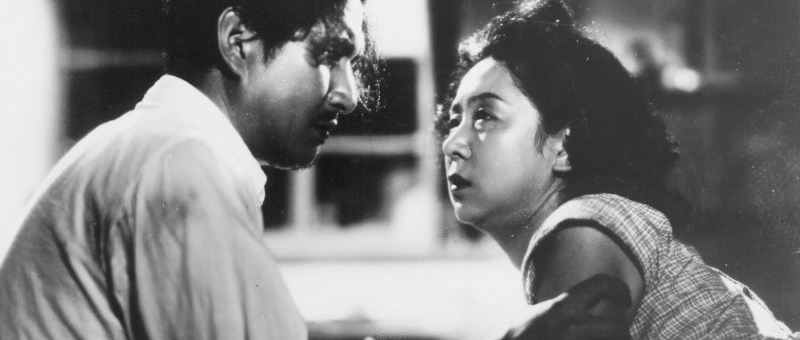
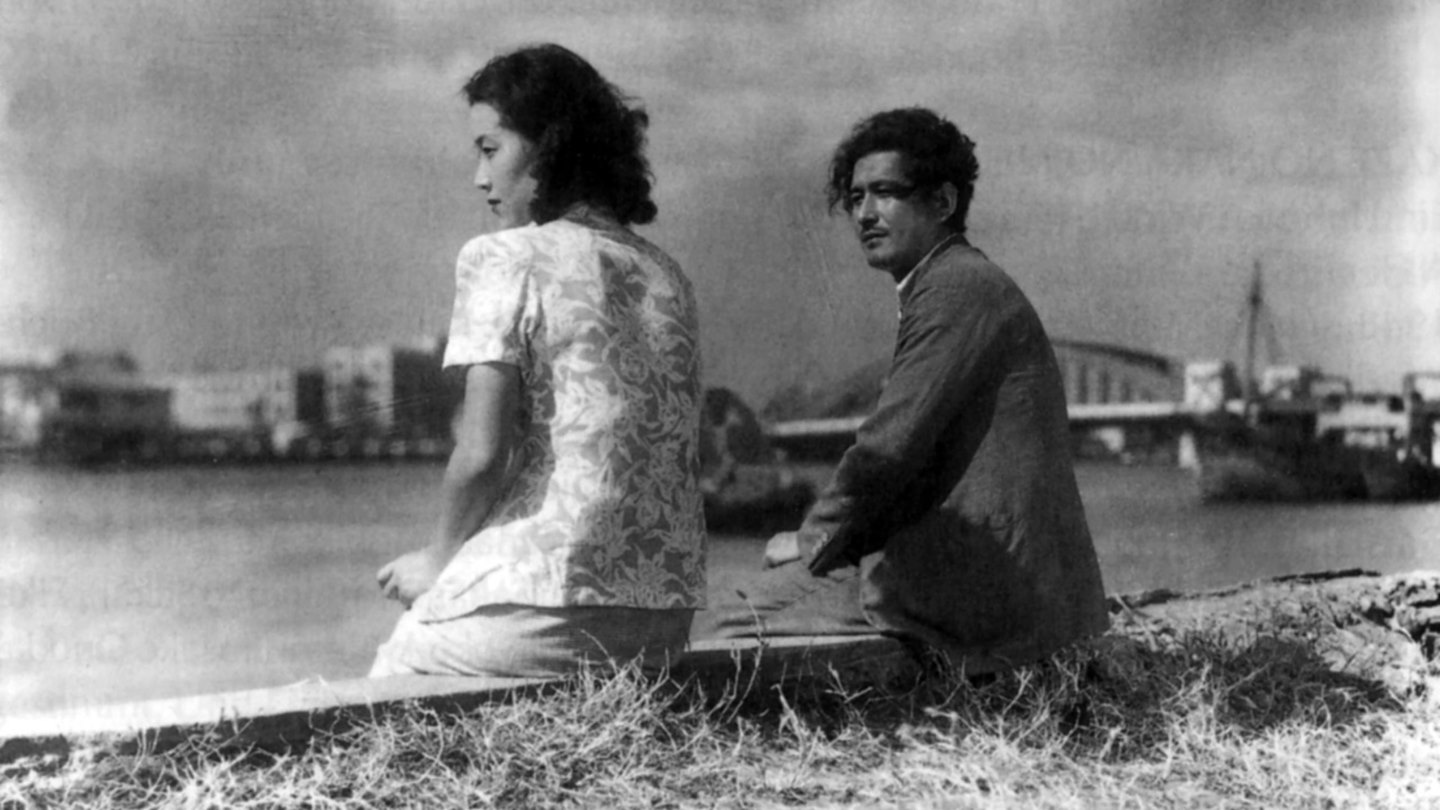
Set very much in the immediacy of the contemporary era, the film opens ominously with an intimidating policeman taking a local census which introduces us to Tokiko (Kinuyo Tanaka) who lodges in the upstairs of a small, run-down building along with her young son Hiroshi while her husband Shuichi (Shuji Sano) has not yet returned from the war. Times are tough for everyone, and Tokiko is finding it increasingly difficult to make ends meet with her seamstressing job as prices rise everywhere. She’s down to her last kimonos which she asks an old friend, Akiko (Chieko Murata), to help her sell. Akiko turns to broker/madam Orie (Reiko Mizukami) who feigns exasperation to advise that a pretty woman like Tokiko, still comparatively young at 28, could make more money in her line of work. Akiko is offended on her friend’s behalf and the two laugh it off together, but when Hiroshi suddenly develops colitis and needs to be admitted to hospital Tokiko is left with no choice but throw herself on the mercy of Orie. 

Akiko scolds her friend, hurt that she didn’t come to her first and disappointed that she has chosen to degrade herself. Tokiko is sorry too, worried that if she had asked Akiko for the money she’d have found a way to get it even if she had none to spare and Tokiko would rather carry the burden herself. She wonders if she made the right choice. There was still furniture she might have been able to sell, but she wanted to keep it so that her husband would have a home to come home to. What else could a mother with a sick child do? This way at least she got the money quickly and Hiroshi recovered. It was a one time thing already in the past and no one needs to know. The friends agree to put it behind them as just another minor humiliation of life in the immediate post-war period. 

And then less than a month later Shuichi returns. The joyful reunion is disrupted when he idly asks about Hiroshi’s health and then becomes fixated on how Tokiko managed to pay the hospital bills. She doesn’t want to lie and would rather there be no secrets between them so she tells him the truth. Shuichi does not take it well. He tries to readjust to their married life but finds himself consumed with rage and unable to sleep. Intellectually, he knows his wife had no choice given the situation she was in and in one sense does not blame her but in the other he cannot accept it. 

Tokiko’s transgression undermines his fragile sense of masculinity in every possible way. He feels partly responisble. He wasn’t there to protect her because he was away at the war. If he’d returned a month earlier, she wouldn’t have needed to make such a sacrifice. Unlike many late returning soldiers, Shuichi walks straight back into his old job, easing the family’s financial hardship even as its harmony is strained by his ongoing resentment. Shuichi cannot help making this all about him. His wounded pride, his broken future, his romantic disappointment. He becomes obsessed with the idea of his wife defiled, insisting on tracking down the brothel where Orie brought her to ask if it really was just the one time while exploring the business for himself.

While schoolchildren sing cheerful folksongs in the playground behind, Shuichi talks to a 21-year-old who has only contempt for customers like him who ask too many hypocritical questions. She explains the she didn’t choose this sort of work, it’s the only way she can support her family, once again, ironically, because of a male failure in this case her father being unable to provide for them while her mother has passed away. Shuichi didn’t come for the full service, and so he eventually leaves, discarding money as he goes partly out of pity and partly in atonement. He runs into the girl again later and even shares her lunch during which he talks to her in a more fatherly fashion, encouraging her that she is not ruined and still has the right to strive for a brighter future. To further prove his point, he commits to finding her an “honest” job, asking with his friend at the company who is sympathetic and also wants to help. Only, his friend can’t understand. If Shuichi can sympathise so much with this young girl why can’t he forgive his wife who, to his mind, has done nothing wrong? 

Tokiko is perhaps a symbol of the pure Japan debased by the male violence that is militarism. Shuichi has come home from the war but carrying trauma of his own which he projects onto the loyal self-sacrificing wife who waited patiently for his return. Yet Tokiko blames herself, she begs him to beat her, hate her, only not to leave and not to be unhappy. Shuichi only comes round after accidentally pushing her down the stairs in a rare moment of shocking domestic violence totally unexpected in an Ozu movie (even if not quite unique). Suddenly overcome with post-war humanism, Shuichi forgives his wife essentially giving her the same speech he’d given to the girl only with greater emphasis. Life is long and their path is hard. They need to “be more accepting and love one another”, “conquer hardship through laughter and trust”, so that they might have a “true marriage”. Tokiko’s redemption, and perhaps that of her nation, is dependent on the former soldier Shuichi’s forgiveness, and of her acceptance of it, rather than a recognition of her blamelessness. In any case, a line has been drawn. The future starts now and it’s going to be a better one built on compassion and mutual forgiveness rather than selfishness and resentment.


A Hen in the Wind screens at BFI Southbank on 10th/14th September as part of Kinuyo Tanaka: A Life in Film

Kill! (斬る, Kihachi Okamoto, 1968)

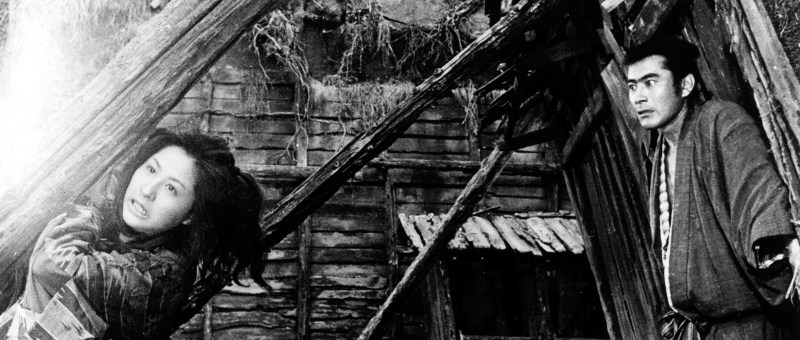
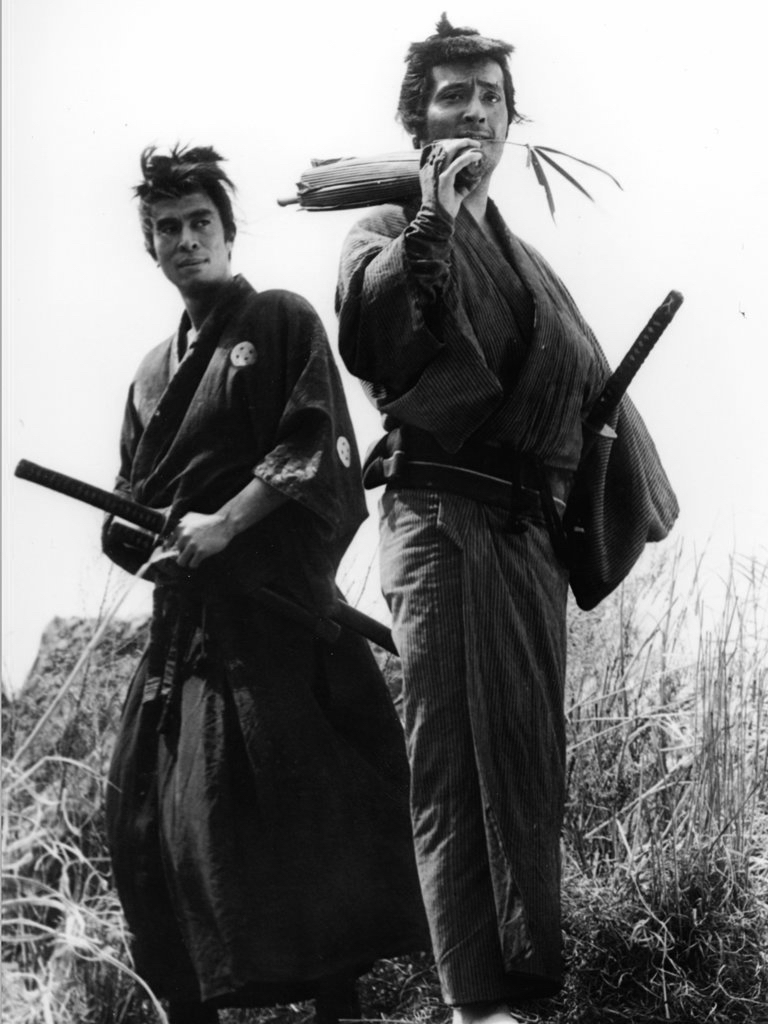
“Samurai aren’t as great as you might think” according to a jaded retainer in Kihachi Okamoto’s Kill! (斬る, Kiru) but it’s a message that the ambitious farmer at the film’s centre struggles to take in. Having been a victim of samurai violence he resolves to become a samurai while a former samurai turned yakuza drifter attempts to show him the hypocritical realities of the samurai life as they find themselves swept into local intrigue when a band of young revolutionaries arrive to cut down a corrupt and oppressive lord. 

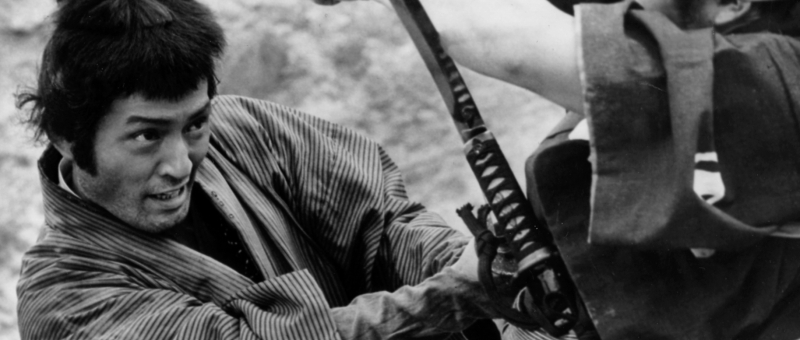
Corrupt and oppressive is perhaps the defining image of the samurai in post-war cinema, but like the film’s title that cuts both ways. Farmer Tabata (Etsushi Takahashi) sold his lands to buy a sword after witnessing peasants cut down during an uprising but he’s decided the best way out of oppression is to become an oppressor and is dead set on achieving samurai glory through the time-honoured method of distinguishing himself in battle. That may prove a little difficult given that his new boss, Ayuzawa (Shigeru Koyama), immediately mocks him for swinging his sword as if it were a scythe. Then again as former samurai Genta (Tatsuya Nakadai) explains to him, if you don’t know what you’re doing you can always just stab people which at the end of the day does rather undermine the idea of samurai elegance in the art of killing. 

Genta keeps trying to tell Tabata that “samurai are no good” but Tabata still wants to be one anyway even after learning that Ayuzawa means to double cross them, hiring ronin to take out the young samurai whose sense of honour he manipulated to eliminate the admittedly corrupt (but aren’t they all?) lord for his own political gain while planning to send in his retainers to finish off the job to ensure there are no witnesses. Genta gave up his samurai status because he was “disgusted” by just this sort of duplicity along with the meaningless codes of loyalty that govern samurai society and caused him to betray a friend who was acting only in the interests of justice. Leader of the ronin Jurota (Shin Kishida) did something similar though in his case for love when his fiancée’s father was condemned on false charges and she and her mother exiled. He wants not land or status but only money in order to redeem the woman he loves from a geisha house and like Genta is under no illusions about the nature of samurai life having figured out most of what’s going on but hoping to emerge with the means to liberate both himself and his wife from samurai oppression. 

Even the elderly chamberlain later rescued by Genta tries to warn Tabata that the samurai life isn’t all it’s cracked up to be, hinting at the ways they are also oppressed by their own code while clearly gleeful to have had the opportunity of stepping into a teahouse for the first time responding to Genta’s request to stay put that if he could he’d like to stay put for the rest of his days. Both former samurai, neither Genta nor Jurota are minded to draw their swords knowing that whatever the outcome it would be unhappy while the young who thought it was their duty to change the world by removing one who brought shame on their names are faced with the realisation that they have been used and their resistance will count for nothing. Even their bond as brothers banding together to achieve a common goal is eventually disrupted by alcohol and petty jealousy.

Genta acts as a kind of chorus, touched by the naivety of the seven samurai holed up in a mountain lodge because they believed in justice, while knowing that the society itself is innately unjust and already beyond redemption. Tabata eventually comes to a similar conclusion having gained samurai status but found it quite literally uncomfortable deciding to shake off his newfound nobility and rejoin Genta as a cynical yet pure hearted wanderer because the only way to escape samurai oppression is to actively live outside it. The final irony is that it’s the elderly chamberlain who eventually sets him, and all they women trapped in indentured servitude at the geisha house, free using samurai gold to enable them to escape a system he himself cannot escape but does not exactly support while Genta enlists the help of local peasants to hold a festival of rebellion to cover the final assault. Marked by Okamoto’s characteristically absurd humour and cartoonish composition along with the eerily gothic emptiness of the deserted ghost town where not even yakuza can survive the film takes on a quasi-spiritual dimension in which Genta and the gang eventually walk out of hell if only into a purgatorial freedom. 


Kill! screens at Japan Society New York on Sept. 2 as part of the Monthly Classics series.

Original trailer (no subtitles)

The Great White Tower (白い巨塔, Satsuo Yamamoto, 1966)

“It’s about the right thing to do, it’s about conscience, and Prof. Zaizen lacks conscience” according to a star witness at the conclusion of a medical malpractice trial in Satsuo Yamamoto’s adaptation of the novel by Toyoko Yamasaki, The Great White Tower (白い巨塔, Shiroi Kyoto). One of a series of films heavily critical of the medical system in the midst of rising economic prosperity, Yamamoto’s tense political drama presents the succession intrigue at a university hospital as an allegory for the nation as a whole implying that lingering feudalistic and authoritarian thinking has poisoned the contemporary society. 

This is in part reflected in the way in which major hospitals are often run as large family businesses where succession is a dynastic matter. In this case, however, the scene is a prominent university hospital in Osaka at which the head of the surgical department, Azuma (Eijiro Tono), is about to retire. Generally, one of his assistant professors would simply move up after being approved by a board comprised of other department heads but the problem is no one, and especially not Azuma, is particularly happy with the most likely candidate, Zaizen (Jiro Tamiya). The issue between them seems to be one of ambition and authority. Zaizen is regarded by all as an excellent doctor with a stellar track record but he is also cold and arrogant with no regard for departmental protocol all of which of course offends Azuma as does his background and person. The son of a country teacher, Zaizen prospered through the dedicated labour of his widowed mother along with family connections before marrying into the extraordinarily wealthy and influential Zaizen family who run a large obstetrics clinic. Consequently, he is free to pursue his interests and lacks the economic anxiety that might make another employee wary of pushing his luck. 

His humble background might have placed a chip on Zaizen’s shoulder but it’s also clear he’s part of a new generation that does things differently from the last, apparently keen to build a public media brand appearing in a glossy magazine which brands him “the magic scalpel” thanks to his success in treating pancreatic cancer. While they might not be able to argue with his track record, other doctors worry that Zaizen has developed a god complex and is slapdash with his practice often timing his operations and smugly pleased with himself when hitting a new record. Azuma first picks him up on this in the case of elderly patient, questioning his treatment decisions in accusing him of neglecting to fully consider the patient’s post-op wellbeing. This then becomes something of a recurring theme as good doctor Satomi (Takahiro Tamura) is minded to bring Zaizen in on the tricky case of a man, Sasaki (Nobuo Minamikata), he suspects may have pancreatic cancer but has been repeatedly diagnosed with chronic gastritis. 

Though it’s political intrigue that in some senses leads him to Zaizen, Satomi is otherwise depicted as the responsible physician who deeply cares for his patients’ wellbeing and not much at all for interoffice politics. Thus he continues to investigate Sasaki’s case even when other doctors tell him he’s wasting too much time on one patient and should just leave it at gastritis. Zaizen, meanwhile, is the exact opposite taking one look at the X-rays and deciding it is pancreatic cancer after all but thereafter ignoring Satomi’s advice after taking over the case refusing to run a CT scan to verify that the cancer hasn’t spread to the lungs as Satomi fears it might have. 

For Zaizen Sasaki ceases to matter, to him the human body is no different to a machine and he perhaps more engineer than doctor even as he proclaims medicine more art than science in insisting that he just knows the early signs of pancreatic cancer while others are unable to detect them. After the first operation we see him perform, a grateful wife stops to thank him profusely for saving her husband’s life though he treats her coldly and implies it’s all part of the job before going outside to celebrate his private glory in his record-breaking feat. It’s then a minor irony that he finds himself later slapped with a malpractice suit by Sasaki’s wife upset that he was unavailable as her husband was dying because he was preoccupied with the ongoing elections for Azuma’s successor.

The implication is that the dehumanisation of the health industry has reduced it to the status of any other company, the head doctors no better than ambitious salarymen whose lives are defined by their job titles. The various department heads eventually descend into factions with Azuma plumping for an external candidate, Kikukawa (Eiji Funakoshi), while others line up behind Zaizen or his internal rival Kasai (Koichi Ito). Influence is brokered largely by outright bribery or industry manipulation by external influential players including Zaizen’s wealthy father-in-law and a professor in Tokyo who can offer monetary perks, access to funding, and potential promotions to those willing to vote for their chosen candidate. The main argument against Zaizen is his bad character, yet the fact he has been carrying on an affair with a bar hostess is never used against him even as they prepare to smear a rival candidate with his mistress even suggesting they hire a hitman to take him out completely. Zaizen’s minions meanwhile make an ill-advised visit to Kikukawa to ask him to withdraw bizarrely stating the importance of maintaining “democracy” even as they themselves deliberately undermine it for their own gain.  

It’s this sense of feudalistic, fascistic authoritarian chumminess that Azuma’s daughter Saeko (Shiho Fujimura) later decries in asking her father why he did nothing to change such a destructive system while he himself had the power to do so the implication being that he saw no need because he continued benefit from it. Only she and Satomi present any kind of challenge to the hypocrisy that pervades the medical system but eventually discover that there is no place for integrity in the contemporary society. Zaizen miraculously falls upwards every time because his success is more expedient that his failure. Even the Tokyo professor brought in as an expert witness during the malpractice suit declares that Zaizen is unfit to be a physician because of his arrogance and total lack of human feeling but pulls back from testifying that he caused the death of his patient through negligence later explaining to a colleague that if a university professor were to be found guilty of malpractice it would undermine public faith in the medical system. 

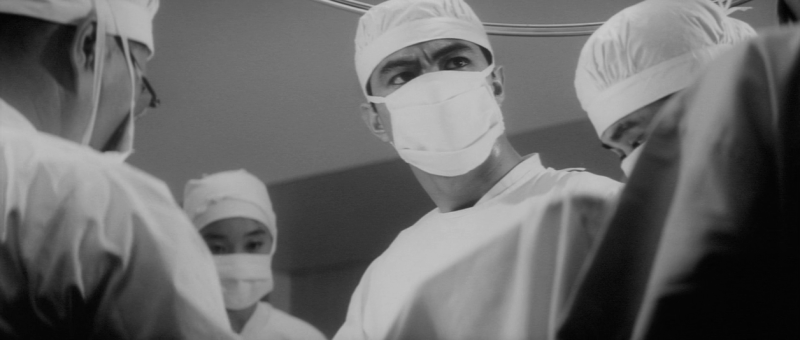
If can’t they can’t have faith in the medical system, the very people who are supposed to care for them when they are most in need, how can they have faith in anything else? As the rather bleak conclusion makes clear, the entire system is rotten to the core and no longer has any place for idealists like Satomi who are continually pushed to the margins by those jockeying for power in this infinitely corrupt society defined by hierarchy and cronyism while ordinary people, like Sasaki, continue to pay the price. Just as in his opening sequence, Yamamoto takes a scalpel to the operations of the medical industry to expose the messy viscera below but ultimately can offer no real cure in the face of such an overwhelming systemic failure. 


Original trailer (no subtitles)

Untamed (あらくれ, Mikio Naruse, 1957)

“Don’t let guys control you. You have to make them men” the heroine of Mikio Naruse’s Taisho-era drama Untamed (あらくれ, Arakure, AKA Untamed Woman) advises a former rival, yet largely fails to do so herself in the fiercely patriarchal post-Meiji society. Based on a serialised novel by Shusei Tokuda published in 1915 but set in late Meiji rather than early Taisho, Naruse’s adaptation essentially drops a contemporary post-war woman into a by then almost unrecognisable Japan, but finds her hamstrung firstly by feckless and entitled men and then by complicit women who themselves cannot accept her transgressive femininity. 

As the film opens, a teenage Shima (Hideko Takamine) has just married wealthy grocery store owner Tsuru (Ken Uehara) but the marriage is already a failure. Though Shima is compared favourably with Tsuru’s previous wife who was apparently in poor health, presumably suffering with TB which required a sojourn by the sea, it soon becomes clear that Tsuru is as trapped by the archaic patriarchal social system as she is. He was apparently in love with a woman from a higher social class he was too afraid to pursue and despite still seeing her also has a mistress near their factory in Hokkaido whom he often visits under the guise of a business trip. Yet when Shima tells him she thinks she may be pregnant, he is unimpressed, immediately questioning the paternity of the child while harping on about her having been married before which it seems is not quite true. Perhaps the reason that she has ended up a second wife despite her youth and beauty, Shima ran out on a marriage to a childhood friend arranged for her by her adoptive parents the night before the wedding not realising they had already registered the union without her knowledge or consent. 

This transgressive act at once signals Shima’s total disregard for conventionality and insistence on her own autonomy, yet it is also indicative of the fact she married Tsuru in search of a better life, knowing that to marry her adoptive parents’ choice meant only a life of servitude on the family farm. She is not always a terribly likeable figure, coldly explaining that she didn’t mind being fostered out because the adoptive family were wealthier and could give her a better life than she had with her birth parents. Yet it’s this sense of familial dislocation and the liminal status it gives her that allow her to take agency over her life in the way other women might not, unwilling to lose the familial security Shima may not feel she ever had. Tsuru is also an adopted son, but the price for disobedience for him may be even higher and indeed as we later hear his inability to sort out his love life eventually sees him out on his ear. His pettiness in refusing to accept the child is his leads to an argument which causes Shima to slip on the stairs and miscarry, the implication being that she may not be able to bear more children leaving her unlikely to remarry and thereby spurring her desire for a tempered independence. 

The fall is the last straw. Tsuru divorces Shima citing her inability to play the role of the proper wife while her birth family, from whom she is emotionally estranged, refuse to take her back as do the adoptive parents because of the embarrassment she caused them with the marriage stunt. She is often described as “like a man”, unable to win as Tsuru at once insists she wear the frumpy kimonos left behind by his previous wife who was a decade older, complains she wears too much makeup, and tells her to loosen her kimono belt to de-emphasises her figure, while criticising her for being unfeminine in her refusal to simply put up with his bad behaviour as is expected for a wife in this era. Shima fulfils all her wifely duties and as we see is in fact running his business as the women of the family are often seen to do while their husbands spend the money they earn for them on other women whether drinking with geishas or supporting mistresses in second homes. When her husband hits her, she fights back rather than shrinking away chastened as intended. 

Yet she cannot overcome the sense that a man is necessary for her success which cannot be accomplished alone. Cast out from her family, her brother installs her in the mountains to work in a geisha house if only as kitchen staff but soon does a flit to reunite with his married lover who has left her husband for him. While there she falls for the quiet and sensitive inn owner Hamaya (Masayuki Mori), also an adopted heir, whose wife is again ill with TB. Hamaya may be treating his wife a little better than Tsuru did his, but quite clearly assumes she’ll die in starting an affair with Shima who is then sent away to an even more remote inn to avoid a potential scandal. As Tsuru did with the woman he apparently loved, Shima continues to see Hamaya until he too succumbs to TB as an ideal of an impossible love while simultaneously accepting that he failed her in being too weak and cowardly to fight for their romance, outright refusing to become his mistress. 

This may be one reason she is determined never again to be an employee but to own her own store which is why she ends up marrying tailor Onoda (Daisuke Kato) who introduces her to textiles and seamstressing at which she quickly proves adept having mastered the modern sewing machine. She marries Onoda in believing him “reliable”, but soon comes to regard him as lazy and feckless. The first shop fails because he can’t keep up with her. The male employees are always taking breaks to drink tea and play shogi, Onoda complaining that he’s tired while she does all his work for him and the housework too. Yet he also criticises her for a lack of femininity, snapping back that it must be her time of the month when she berates him in front of their employees while later after they’ve become successful complaining it’s “embarrassing” that his workhorse wife doesn’t know the things a sophisticated society woman would such as ikebana while flirting with the teacher he’s hired ostensibility to teach her. He even forces her to wear a frumpy and already somewhat dated classically Edwardian dress with a fancy bonnet which more resembles something a country girl might wear to church than the latest in Western fashions in an attempt to advertise their tailoring which seems primed to backfire. 

That she learns to ride a bicycle in this rather ridiculous outfit is again a symbol of her desire to seize and manipulate modernity even giving rise to a piece of innuendo from her much younger assistant Kimura (Tatsuya Nakadai) as to the pounding she’s been getting from the saddle. Kimura seems to think the problem with the business is that Onoda’s patterns are outdated, offering her a new modernity while she prepares to cut Onoda out on catching him with his mistress taking their best employee with her to ruin his business and start another of her own. Though once again she cannot leave alone only with a man the ending is perhaps more hopeful than might be expected from a Naruse film allowing Shima to commit herself fully to the sense of industry she embodies always ready to start again, work harder, and achieve her desires unwilling to be bound by conventional ideas of femininity or to simply put up with useless men who refuse to accept her for all she is. Yet she largely fails to make men of them, each of her various suitors failing to live up to her, ruined by an oppressive social system that encourages them to exploit female labour while taking it for granted in their intense sense of patriarchal entitlement. 


Choji Snack Bar (居酒屋兆治, Yasuo Furuhata, 1983)

Beginning his career at Toei, Yasuo Furuhata is most closely associated with tough guy action films forging a strong and enduring relationship with the genre’s key star Ken Takakura through their work on the New Abashiri Prison series. From the late ‘70s however he began to transition further towards the realms of manly melodrama with a series of films which often starred Takakura as a man struggling to adapt to life in modern Japan such as the guilt-ridden policeman of Station or the conflicted former yakuza of Yasha. Arriving between the two and adapted from a novel by Hitomi Yamaguchi, Choji Snack Bar (居酒屋兆治, Izakaya Choji) is in someways much the same casting a typically stoic Takakura as an intensely noble man whose values are increasingly at odds with the world in which he lives while shifting away from the realms of manly action towards a more somber contemplation of the broken dreams of post-war youth. 

Eiji (Ken Takakura), known to all as “Choji”, is a happily married father of two who gave up his job in shipping to open a bar selling small eats in a Hakodate. He and his wife Shigeko (Tokiko Kato) have been planning to expand the business by opening a larger location near the docks but Eiji is dragging his feet largely it seems because the place found for him by childhood friend Kawahara (Juzo Itami) is too close to another bar run by an old man who helped him when he first started out so he’s loathe to risk infringing on his livelihood. Meanwhile, the central drama in town in the mysterious disappearance of Choji’s childhood sweetheart, Sayo (Reiko Ohara), who married a wealthy ranch owner but has long been trapped in an unhappy marriage she has several times failed to escape. Sayo’s disappearance coincided with a fire at the ranch which is suspected to have been started deliberately the assumption being that Sayo is responsible. 

The ironic disappearance of Sayo forces Choji into a reconsideration of his life choices, something his middle-aged friends also find themselves experiencing if for various different reasons. Choji was once a high school baseball star dreaming of turning pro but his hopes were dashed after an injury forced him to leave the sport thereafter working in an office at the docks but later resigning rather than accept a promotion that would mean he’d suddenly be the boss to his former friends. The bar is his way of being his own man, no one’s boss but his own, though his decision was not universally respected among his friends and in fact came as something of a shock to Shigeko who consented to an arranged marriage partly in search of the typical salaryman life. Most of the other men in town, however, struggle to keep their youthful dreams alive or to find accommodation with the way their lives are now. Inoue (Eiji Misato), for example, is obsessed with cabaret singing, spending all his time in karaoke bars often wearing elaborate costumes and makeup. Childhood friend Iwashita (Kunie Tanaka) even wonders if he’s gone “mad” after taking him to task for neglecting his family on discovering that he’s converted a docked boat into a tiny private cabaret space complete with a sound system and lighting as well as a small seating area for spectators who presumably have not yet materialised. 

This is perhaps in a way a symbol in itself of Japan’s new economic prosperity, later thrown into stark contrast by Choji’s explanation that he and Sayo broke up because of their mutual poverty he nobly pushing her to marry a wealthy man so at least one of them could be happy. Happy is however something Sayo has never been, later paying a short visit to Choji during which she blames him for his “cowardice” suggesting that he is largely responsible for the misery of her life in failing to fight for their love, giving up too easily on a distant happiness which is something he later cautions a young baseball player not to do. The police meanwhile accuse him of complicity, implying the pair knew Sayo’s husband had TB and thought he’d die soon enough after which they’d inherit his money and stay together, consequently assuming the “arson” was an attempted murder. 

The irony is that Choji is far too noble to have ever considered such a thing, something demonstrated by his continuing righteousness in refusing to take up Kawahara’s offer of cheap and lucrative new premises because it would mean betraying his former mentor, refusing to condemn his former teacher’s shock marriage to a woman 30 years his junior, and eventually taking Kawahara to task for his callous comments over the death of friend’s wife. Rival cabbie Akimoto (Masao Komatsu) was forever joking that his wife would die before him and sleazily flirting with young women, but went into debt in order to buy her an elaborate funeral altar and is completely devastated by her loss while living with his three children in a noticeably rundown apartment. As Choji puts it, Kawahara’s broken dream is in no longer being the big boss among the boys as he was in their high school days, fuelling his sense of middle-aged male frustration into embittered drunken violence. Yet everyone is always telling Choji he is being unnecessarily “good”, that he should stop thinking about doing the right thing and put himself first by accepting the offer to relocate the bar because business is business. 

Sayo too is trapped in the past unable to accommodate herself with the way her life turned out, an ironic casualty of Choji’s goodness clinging to her broken dream of youth. These now middle-aged teens of the post-war era are in a sense victims of their age, denied the sense of possibility the youth of today might enjoy but equally unable to step fully into the contemporary era of economic prosperity which some feel has become increasingly amoral and unkind. Nevertheless, as Shigeko puts it “no one can take away what a person carries in their heart”, Choji manfully retaining his nobility while literally burning the image of the past but perhaps carrying it with him as the other men carry the shards of their broken dreams some with more nobility than others.  


Original trailer (no subtitles)

Seven Samurai (七人の侍, Akira Kurosawa, 1954)

An eclipse of the accepted order allows a temporary truce in the ongoing class conflict that defines feudal society in Akira Kurosawa’s seminal post-war historical epic, Seven Samurai (七人の侍, Shichinin no Samurai). Set in the late 16th century, the action takes place in a world on the brink of collapse. The Sengoku era is drawing to a close but is also in a moment of intense crisis which has left large numbers of highly skilled warriors essentially orphaned, wandering the land torn between their basic needs for food and shelter and their dignity as members of a theoretic aristocracy. 

Plagued by bandits, many of whom may be these orphaned swordsmen, a small village contemplates the unthinkable in hiring samurai, otherwise their oppressors and uniquely responsible for the chaos which surrounds them, for protection. “Land tax, forced labour, drought…and now bandits!” one woman exclaims shortly before suggesting they simply surrender all their grain and then hang themselves. As they can offer only expenses in the form of rice, the only samurai they can hope to recruit are already desperate, so hungry that they may be willing to deign to defending their social inferiors with whom they would not usually mix unwilling to accept that they are both victims of the inherently corrupt social order. This explains why the villagers’ early entreaties are met with such scorn and cynicism, either rudely rejected out of hand or ending only in deception. 

In this there is an echo of the world of 1954 which was beginning edge away from the chaos and privation of the immediate post-war society, bandits standing in for thieves and profiteers themselves a product of intense food insecurity. Yet here it’s desperation that allows a temporary merging of the world of lord and peasant, brokered finally by unexpected compassion on the part of a noble samurai who, in an act of extreme transgression, symbolically erases his elite status by shaving his head in order to save a child taken as a hostage by another desperate man. Kambei (Takashi Shimura) may be somewhat reduced in circumstances but refuses to give in to the immorality of the world around him, finally agreeing to help the villagers essentially out of a sense of pity willing to accept only the gift of sustenance moved by the villagers’ sacrifice in discovering that they give him the last of their white rice while subsisting only on millet. 

Yet having taken this step, the villagers remain uncertain they can really trust the men they’ve hired to protect them who are after all each trained in death. Later we discover that they have, like many of the time, occasionally finished off the odd lone samurai fleeing the battlefield in order to loot the bodies as a large stockpile of samurai armour later discovered by the samurai-pretender Kikuchiyo (Toshiro Mifune) testifies. On being confronted with this uncomfortable reality, the samurai fall silent knowing this armour was stripped from men much like themselves, but can ultimately offer little by way of defence when presented with an angry rant from Kikuchiyo who points out that they are themselves responsible in having created this world of chaos through their internecine quests for power. “In war you burn their villages, trample their fields, steal their food, work them like slaves, rape their women, and kill ‘em if they resist. What to you expect ‘em to do?”

When Kambei and the others first arrive in the village, there is no welcoming committee. The villagers all hide, frightened to leave their homes partly because of paranoia spread by widowed father Manzo (Kamatari Fujiwara) convinced that randy samurai are going ravish all of their daughters who will, doubtless, be overcome with awe by these sophisticated men of the elite. In an echo of Kambei’s transgression, Manzo forces something similar on his teenage daughter Shino (Keiko Tsushima), roughly cutting her hair while she cries and resists before dressing her up as a boy so that she’ll be safe from lusty samurai. The plan, however, backfires in that she later engages in a doomed romance with the young Katsuhiro (Isao Kimura). Their eventual union is the symbolic merging of the two worlds, a moment of eclipse in the usual hierarchy, but it’s born of the same impulses than brought Kambei and the others to the village. In fear and desperation, they behave as if there’s no tomorrow, only tomorrow must come and just as sun and moon must eventually move apart and resume their regular orbits so the relationship between Katsuhiro and Shino is an impossibility. 

Like Kambei, Katsuhiro had occupied a slightly liminal position because of his relative youth, neither boy nor man. He first encounters Shino while marvelling at the natural beauty of the forest, only to berate her for doing the same. “Is this any time for an able-bodied man to be picking flowers?”, he ironically asks her, yet he is repeatedly forced back towards conventional masculinity as marker of adulthood virtually ignoring her when tasked with carrying a dummy to the ridge, while she later returns the same gesture reassuming her femininity in joining the rice planting, a peasant woman once again. “What’s wrong with two people in love?” the wounded Rikichi (Yoshio Tsuchiya) asks Manzo, trying to smooth over this moment of cross-class crisis, only for Monzo to ask what he’s supposed to now his only daughter has become “damaged goods”, unfit for marriage in a fiercely patriarchal society in which it is impossible to survive without a husband. 

Katsuhiro cannot marry her, this sense of solidarity if not quite equality can be only temporary. Kambei himself admits as much as he reflects that the battle has been won but the victory belongs not to them but to the peasants, anticipating his a sense his own obsolescence the end of the Sengoku era bringing about a change in the nature of the samurai that two centuries later will lead to its abolition. Our sympathies might shift, witnessing Kambei’s obvious disapproval of the peasants’ relish in taking revenge on the bandits who have caused them so much misery in their own way perhaps perpetuating the cycle of violence and resentment that drives the feudal engine. One cannot help but pity him, displaced once again returning to a life of ceaseless wandering, his presence in the village now no longer necessary and in fact inappropriate. 

Returning to the world of 1954, there might be something a little uncomfortable in this lament for the death of the samurai who can have no place either in the modern society or in a peasant village in 1587, as there may be in the implication that the peasants are savage and vindictive while Kambei alone is good and kind even if the roots of his compassion lie in his willingness to literally sever himself from his elite status. The roles had in a sense been reversed, the samurai hired hands to peasant bosses, but the inversion can be only temporary. In insisting that only by protecting others can one hope to protect oneself, Kambei may be advocating for a more compassionate society but as much as he has attempted to remove himself from the class system he can not in the end overcome it. Nevertheless, in the gruelling battle scene that closes the film, all rain, mud, death and misery, Kurosawa himself deals the final blow to the samurai in the nihilistic futility of violence manifesting itself once again in the lingering feudalism of the mid-century society. 


Seven Samurai is re-released in UK cinemas in its recent 4K restoration as part of BFI Japan on 29th October.

BFI re-release trailer (English subtitles)

Early Spring (早春, Yasujiro Ozu, 1956)

By the mid-1950s, Japan’s economy was beginning to improve but now that the desperation that went with hunger had dissipated it freed those who’d managed to climb out of post-war privation to wonder just what the point of their ceaseless toil was. Yasujiro Ozu’s primary subject matter remained the modern family, but 1956’s Early Spring (早春, Soshun) sees him heading in a darker direction as he weighs up the delusions of the salaryman dream and discovers that whichever way you swing it, life is disappointing. 

So it seems to be for salaryman Shoji (Ryo Ikebe). He and Masako (Chikage Awashima) married for love a long time ago, but it’s clear that there is distance in their relationship. They sleep in the same room but their futons are slightly too far apart, and the few words they exchange with each other in the morning are terse in the extreme. The truth is that for many a salaryman for whom long hours and interoffice bonding sessions are compulsory, work is the new family. Wives are welcome to join the Sunday hiking outings but it seems few do. Masako too declines, telling her mother she felt it to be too expensive, already irritated with her husband’s irresponsible spending on mahjong games and drinking with friends. 

Money is certainly a constant worry for her and as we learn from her mother they’re behind on the rent despite it being “very cheap”. Masako had made a visit home in part to ask for another loan, which her mother seems reluctant to give, offering her daughter a takeout of the oden her restaurant sells which is first declined but then accepted. Her mother also flags up the other problem in their marriage which is that they sadly lost a child in infancy and have had no more. Sorrow may have killed their love, but the fact her husband stays out all hours and wastes the little money he earns while failing to win promotions only makes the situation worse. 

As for Shoji, he is becoming very aware of the delusions of the “salaryman dream”. He is one of thousands of men identically dressed in white shirts and grey trousers that board the packed rush hour trains every day heading into the city. His life is one of pointless drudgery and its only victory is that keeps hunger from the door, not even quite stretching to a roof over his head. “All that’s waiting for us is disillusion and loneliness” according to a veteran salaryman growing close to his retirement and realising that he has little left to live on, his dream of buying a small stationary shop all but unobtainable. He was dead set against his own son joining the ranks of the salaryman, but in the end failed to prevent it.

It is perhaps this sense of frustration and impotence that draws Shoji into an affair with a younger woman, Chiyo (Keiko Kishi), who is admittedly very pretty but seems to hold little interest for him aside from her youth and beauty. Chiyo openly pursues her older colleague, declaring that she doesn’t care he has a wife but has come to hate her after the first time they slept together. Shoji meanwhile remains guilty and conflicted. He evidently continues seeing Chiyo, lying to Masako that he’s visiting a sick friend, but otherwise regards her as an irritation. When his co-workers figure out what’s going on they try to stage an intervention, but Shoji doesn’t show up and Chiyo angrily denies everything before arriving at Masako’s looking for Shoji only this time he really is out visiting a sick friend. 

Miura (Junji Masuda), the sick friend, is a true believer in the salaryman dream. Now that he’s ill, he misses the packed trains and elevators, not to mention his old workplace friends. All he wants is to be well enough to return to the office and his predicament perhaps has Shoji thinking that at least he has his health and things aren’t so bad for him after all. Masako, meanwhile, turns to other women for advice. The woman across the way recounts how she caught her husband out with his mistress and made a scene that’s rendered him docile and obedient ever since (a rare man in an Ozu film putting his socks neatly in the laundry basket and hanging up his own coat rather than throwing it on the floor for his wife to deal with). Her widowed friend is more sanguine, admitting that caution is necessary but it’s a little dark to envy the life of a widow for its “freedom”, while her mother thinks she’s overreacting because that’s just how men are in this generation or any other. 

Shoji’s old mentor agrees that “everyone’s disappointed” and all that remains is to try and make the most of it, but still he sees that Shoji has been reckless and inconsiderate in his treatment of both women. He avoids his wife because of the emotional distance between them born of grief, and only really has an affair with Chiyo because it was easier than refusing her. He didn’t even enjoy it, and doubtless it did not quite quell the sense of despair he feels with the utter pointlessness of the “salaryman dream”. Masako, in turn, is disappointed with married life, with her husband’s emotional cowardice, and with her own lack of options. Ultimately, Ozu sides with the mother, not quite condoning Shoji’s behaviour while perhaps excusing it as a direct consequence of dullness of his life while forcing Masako to accept complicity in her husband’s weakness. They may reunite, the stressors of their Tokyo life from the high cost of living to the lure of mahjong now absent, but there is a sense of futility in their eventual insistence that they will “make it work” through starting over in a new place while gazing at the train that, they assume, will eventually carry them back to the city and all of its false promises of a brighter future. 


Early Spring screens 19th/20th/21st October & 20th/23rd November at London’s BFI Southbank as part of BFI Japan. It is also available to stream in the UK via BFI Player and in the US via Criterion Channel.